Errors & Omissions Insurance 
Update: Brokers’ E&O Exposure 
Presented by Samantha Ip 
Insurance Institute of British Columbia 
September 9, 2014
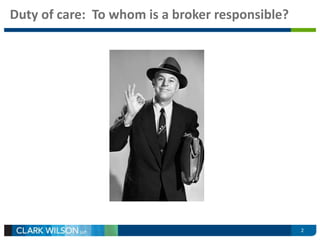
Duty of care: To whom is a broker responsible? 
2
Duty of care: To whom is a broker responsible? 
3 
• To the Insured 
– Contract 
– Negligence 
– Fiduciary Duty 
– Fraud 
– Misrepresentation 
• To the Insurer 
– Contract 
– Fiduciary Duty (if 
agents) 
– Negligence 
• To Third Parties 
– Contract (Third party 
beneficiary) 
– Negligence
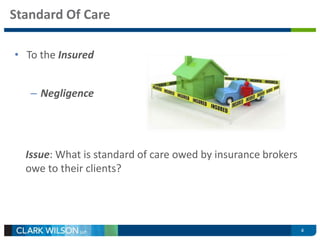
Standard Of Care 
4 
• To the Insured 
– Negligence 
Issue: What is standard of care owed by insurance brokers 
owe to their clients?
5 
Background to Liability- Standard of Care 
• “Standard of care” : 
– The degree of care owed 
– It is what the “reasonable person” or “reasonable 
broker” would do in similar circumstances. 
– The standard of care owed is dependent on the 
circumstances, both in terms of the situation and the 
individuals involved.
6 
Standard of Care – “Reasonable Broker” 
• What is the standard of care owed by a “reasonable 
broker”? 
– Traditionally, courts viewed brokers as “salesmen”. The 
salesmen’s obligation was to sell the product 
requested by the client. 
– Recently, the trend has been to hold brokers to the 
standard of a professional, which imports additional 
responsibilities and obligations.
7 
Standard of Care – “Reasonable Broker” 
• Why does a higher standard of care apply to brokers? 
– The insurance industry and brokers have become more 
specialized. 
– Brokers are commonly experts in the products they 
sell. 
– Clients can be novices and will defer to a broker’s 
opinion. 
– Being underinsured can cause severe loss.
8 
Bronfman v. BFL Canada Risk and Insurance Services Inc., 2013 
ONSC 5372 
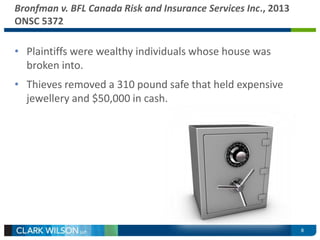
• Plaintiffs were wealthy individuals whose house was 
broken into. 
• Thieves removed a 310 pound safe that held expensive 
jewellery and $50,000 in cash.
9 
Bronfman v. BFL Canada Risk and Insurance Services Inc., 2013 
ONSC 5372 
• Plaintiffs discovered that their insurance policy contained 
several restrictions, including a coverage limit of $10,000 
for jewellery and $1,500 for cash. 
• Plaintiffs argued that the broker failed to advise of the 
coverage limits, and if they had done so, they would have 
obtained higher limits. 
• The broker’s position: Plaintiff has an obligation to read 
their policy, and voice any concerns because they are in 
the best position to determine their needs.
10 
Bronfman v. BFL Canada Risk and Insurance Services Inc., 2013 
ONSC 5372- Decision 
• Held: The broker did not maintain a reasonable standard 
of care. 
• A reasonable standard of care imposes an obligation on a 
broker to explain the extent of coverage and to point out 
any relevant gaps. 
• Key fact: By being aware of the plaintiff’s wealth and the 
coverage limits, the broker breached the standard of care 
by not advising on, or even addressing, greater coverage.
11 
Bronfman v. BFL Canada Risk and Insurance Services Inc., 2013 
ONSC 5372 
• Brokers must be diligent in assessing the needs of their 
clients – a positive obligation. 
• Risk management lesson: If a client relies on an agent to 
ensure that he or she is protected, then the broker has an 
obligation to inform himself of the client’s business or 
situation in order to assess the foreseeable risks to the 
client.
Keizer v. Portage LaPrairie Mutual Insurance Co., 2013 NSSC 118 
12 
• Plaintiffs sued insurance brokerage for breach of contract and 
negligence for failing to obtain and confirm the proper 
insurance coverage the plaintiffs needed, based on the 
information they provided. 
• The plaintiff was a retired carpenter 
who (1) set up a woodworking shop 
in his garage and (2) performed 
contract work installing cabinets 
and countertops. 
• The plaintiff contacted a broker and 
informed him that he was seeking 
insurance for these activities.
Keizer v. Portage LaPrairie Mutual Insurance Co., 2013 NSSC 118 
• Broker then contacted the insurer and arranged for 
insurance to cover the cabinet and countertop installation 
aspect of his business, but not the home woodshop. 
• Upon renewal, the broker filled out the renewal without 
calling the plaintiff to confirm the currency of the 
information. Again, the broker only provided the insurer 
with information pertaining to the insured cabinet and 
countertop installation, and not the woodshop. 
• Shortly after the renewal a fire occurred in the woodshop. 
After investigating, the insurer denied coverage on the basis 
that operating a woodshop in the garage constituted a 
material change in risk under the homeowners policy. 
13
Keizer v. Portage LaPrairie Mutual Insurance Co., 2013 NSSC 118- 
Decision 
• Brokerage was found liable for negligence 
• Held: Court found that standard of care owed by broker was to 
place the insurance policies needed by the plaintiffs to cover the 
home based carpentry and furniture repair business activities. 
• Broker was negligent in two respects: 
• 1) The broker who placed the insurance was negligent in 
failing to inform the insurer of the home based woodshop. 
• This would have alerted the insurer to the insured’s 
intention to do have the woodworking shop. 
• 2) The broker who renewed the insurance was negligent in 
failing to confirm with the insured the currency of the 
information regarding the insured’s business activities. 
14
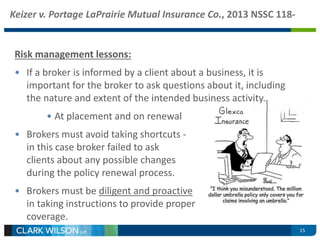
Keizer v. Portage LaPrairie Mutual Insurance Co., 2013 NSSC 118- 
Risk management lessons: 
• If a broker is informed by a client about a business, it is 
important for the broker to ask questions about it, including 
the nature and extent of the intended business activity. 
• At placement and on renewal 
• Brokers must avoid taking shortcuts - 
in this case broker failed to ask 
clients about any possible changes 
during the policy renewal process. 
• Brokers must be diligent and proactive 
in taking instructions to provide proper 
coverage. 
15
Veert Landscaping Inc. v. Ranger Insurance Brokers Ltd., 2013 
MBQB 117 
• Action for negligence by two corporate plaintiffs against 
their insurance brokerage. 
• Action brought after a fire occurred at the main shop of the 
plaintiffs’ business premises. 
• One of plaintiffs suffered a loss; the building and its 
contents were underinsured. 
16
Veert Landscaping Inc. v. Ranger Insurance Brokers Ltd., 2013 
MBQB 117 
• Plaintiffs claimed that broker was negligent by failing to give 
proper advice and to ensure adequate insurance and 
coverage. 
• Broker denied any breach and asserted that the insurance 
values and coverage provided were in accordance with the 
instructions of the plaintiffs’ owner. 
17
Veert Landscaping Inc. v. Ranger Insurance Brokers Ltd., 2013 
MBQB 117- Decision 
• Held: Court dismissed plaintiffs’ action. 
• Court found that plaintiff owner was the person most closely 
associated with his business and in the best position to know the 
value of his property. 
• In the absence of expert opinion, the court was not prepared to 
accept that the defendant broker had an obligation to advise the 
plaintiffs to obtain an appraisal of the building and to create a 
complete inventory list of contents to ensure they had sufficient 
replacement cost insurance. 
18
Veert Landscaping Inc. v. Ranger Insurance Brokers Ltd., 2013 
MBQB 117- 
Risk Management Lessons 
• So far, brokers generally not required to retain other experts. 
• While this court did not impose a duty to advise an insured to 
obtain appraisals or to create complete inventory lists, it may 
be wise for brokers to do so – good risk management. 
• Courts may recognize such a duty in the future based 
on appropriate expert opinion evidence. 
• Brokers can defer to clients if clients have specialized 
knowledge in determining the replacement cost of their 
property. 
• HOWEVER, the safest course of action is to proactively 
determine the client’s needs. 
19
Breach of Duty Of Care Does Not Mean Broker Is Liable 
• Failure to meet standard of care does not necessarily mean 
liability for a loss. 
• The breach of standard of care must actually cause the loss 
• Test: “But For” the breach would the insured’s loss have 
occurred? 
20
McIntosh v. Royal Sun Alliance Insurance Co. of Canada, 2007 FC 
23 
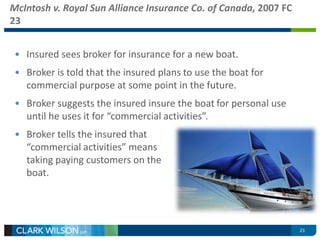
• Insured sees broker for insurance for a new boat. 
• Broker is told that the insured plans to use the boat for 
commercial purpose at some point in the future. 
• Broker suggests the insured insure the boat for personal use 
until he uses it for “commercial activities”. 
• Broker tells the insured that 
“commercial activities” means 
taking paying customers on the 
boat. 
21
McIntosh v. Royal Sun Alliance Insurance Co. of Canada, 2007 FC 
23 
• Broker tries to obtain commercial coverage, but is unsuccessful. 
• Insured incorporates a business for the purposes of running a 
charter. He creates business cards and begins to advertise his 
services. The insured does not take any paying customers in the 
first year. 
• Policy comes up for renewal. Policy added a provision that the 
policy would be void if the insured concealed or misrepresented 
a materials fact relating to the “previous, current or future use of 
the boat”. 
• At time for insurance renewal, the broker did not have any 
communication with insured about the use of the boat. Broker 
sends the renewal to the insured and asks him to confirm he 
wants the same coverage. 
22
McIntosh v. Royal Sun Alliance Insurance Co. of Canada, 2007 FC 
23 
• Boat is stolen after policy renewal. 
• The insurer denies coverage due to material 
misrepresentation and claims that the insured engaged in 
“commercial activities” thereby voiding the policy 
• Insured brings an action against insurer and broker. 
23
McIntosh v. Royal Sun Alliance Insurance Co. of Canada, 2007 FC 
23– Decision 
• Held: The policy was void 
• Court interpreted “commercial purpose” to include more than 
taking paying customers – broker interpretation incorrect. 
• Key finding of fact: The insured did take paying customers on 
his boat. 
• Held: Broker failed to meet his standard of care in two ways: 
1) Broker has a duty to ask questions: Knowing that the 
insured intended to take customers on his boat for charters, 
the broker had an obligation to explore the insured’s 
business plans. This included what the timeline was for the 
creation of the business, and any business activities the 
insured might undertake. 
24
McIntosh v. Royal Sun Alliance Insurance Co. of Canada, 2007 FC 
23– Decision 
2) Duty to give accurate advice: The broker’s advice that 
“commercial purpose” only meant taking paying customers, 
was incorrect. The broker had an obligation to determine 
what the insurer considered “commercial activities” in light 
of the fact that the insured intended on operating a 
business. 
• However– the broker was not liable to the plaintiff on this claim: 
• the broker’s failure to meet the standard of care did not cause 
the insured’s loss: 
• Despite the incorrect advice, the insured did not rely on it to 
his detriment. Instead, the insured chose to take paying 
customers knowing full well that it could void his insurance. 
25
McIntosh v. Royal Sun Alliance Insurance Co. of Canada, 2007 FC 
23– Risk Management Lessons 
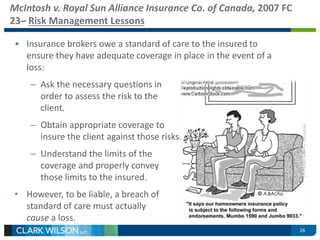
• Insurance brokers owe a standard of care to the insured to 
ensure they have adequate coverage in place in the event of a 
loss: 
– Ask the necessary questions in 
order to assess the risk to the 
client. 
– Obtain appropriate coverage to 
insure the client against those risks. 
– Understand the limits of the 
coverage and properly convey 
those limits to the insured. 
• However, to be liable, a breach of 
standard of care must actually 
cause a loss. 
26
Summary - Risk Management Lessons 
1) The recent trend in the case law - courts are placing an increasingly 
higher standard of care on brokers to carry out proactive inquiry 
and to ensure appropriate coverage for their clients. 
2) Generally, the more reliance on a broker by an insured, the higher 
the standard of care imposed on the broker. 
3) If an insured is relying on a broker to obtain sufficient coverage 
then the broker has a positive obligation to: 
• Ask questions about the insureds circumstances; 
• Point out gaps in coverage; 
• Alert insureds to any changes in a renewal policy; and 
• Review the insured’s needs at renewal time to ensure the 
coverage is adequate. 
27
Summary - Risk Management Lessons 
4) Courts generally do not require brokers to go beyond their own 
area of expertise. However, a broker should not mislead an 
insured regarding their abilities. 
5) Courts continue to show a tendency to try and “do justice” in 
each case. 
28
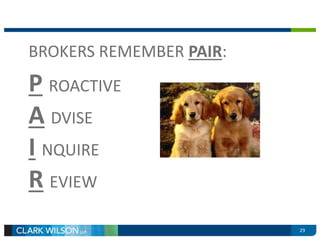
BROKERS REMEMBER PAIR: 
P ROACTIVE 
A DVISE 
I NQUIRE 
R EVIEW 
29
Presented By: 
Presented by Samantha Ip, Clark Wilson LLP 
ssi@cwilson.com | 604.643.3172 
www.cwilson.com 
THANK YOU
These materials are necessarily of a general nature and 
do not take into consideration any specific matter, client 
or fact pattern. 
Please direct inquiries or comments to: 
Samantha Ip, Clark Wilson LLP 
ssi@cwilson.com | 604.643.3172 
www.cwilson.com 
THANK YOU

Errors & Omissions Insurance Update: Brokers' E&O Exposure

  • 1.
    Errors & OmissionsInsurance Update: Brokers’ E&O Exposure Presented by Samantha Ip Insurance Institute of British Columbia September 9, 2014
  • 2.
    Duty of care:To whom is a broker responsible? 2
  • 3.
    Duty of care:To whom is a broker responsible? 3 • To the Insured – Contract – Negligence – Fiduciary Duty – Fraud – Misrepresentation • To the Insurer – Contract – Fiduciary Duty (if agents) – Negligence • To Third Parties – Contract (Third party beneficiary) – Negligence
  • 4.
    Standard Of Care 4 • To the Insured – Negligence Issue: What is standard of care owed by insurance brokers owe to their clients?
  • 5.
    5 Background toLiability- Standard of Care • “Standard of care” : – The degree of care owed – It is what the “reasonable person” or “reasonable broker” would do in similar circumstances. – The standard of care owed is dependent on the circumstances, both in terms of the situation and the individuals involved.
  • 6.
    6 Standard ofCare – “Reasonable Broker” • What is the standard of care owed by a “reasonable broker”? – Traditionally, courts viewed brokers as “salesmen”. The salesmen’s obligation was to sell the product requested by the client. – Recently, the trend has been to hold brokers to the standard of a professional, which imports additional responsibilities and obligations.
  • 7.
    7 Standard ofCare – “Reasonable Broker” • Why does a higher standard of care apply to brokers? – The insurance industry and brokers have become more specialized. – Brokers are commonly experts in the products they sell. – Clients can be novices and will defer to a broker’s opinion. – Being underinsured can cause severe loss.
  • 8.
    8 Bronfman v.BFL Canada Risk and Insurance Services Inc., 2013 ONSC 5372 • Plaintiffs were wealthy individuals whose house was broken into. • Thieves removed a 310 pound safe that held expensive jewellery and $50,000 in cash.
  • 9.
    9 Bronfman v.BFL Canada Risk and Insurance Services Inc., 2013 ONSC 5372 • Plaintiffs discovered that their insurance policy contained several restrictions, including a coverage limit of $10,000 for jewellery and $1,500 for cash. • Plaintiffs argued that the broker failed to advise of the coverage limits, and if they had done so, they would have obtained higher limits. • The broker’s position: Plaintiff has an obligation to read their policy, and voice any concerns because they are in the best position to determine their needs.
  • 10.
    10 Bronfman v.BFL Canada Risk and Insurance Services Inc., 2013 ONSC 5372- Decision • Held: The broker did not maintain a reasonable standard of care. • A reasonable standard of care imposes an obligation on a broker to explain the extent of coverage and to point out any relevant gaps. • Key fact: By being aware of the plaintiff’s wealth and the coverage limits, the broker breached the standard of care by not advising on, or even addressing, greater coverage.
  • 11.
    11 Bronfman v.BFL Canada Risk and Insurance Services Inc., 2013 ONSC 5372 • Brokers must be diligent in assessing the needs of their clients – a positive obligation. • Risk management lesson: If a client relies on an agent to ensure that he or she is protected, then the broker has an obligation to inform himself of the client’s business or situation in order to assess the foreseeable risks to the client.
  • 12.
    Keizer v. PortageLaPrairie Mutual Insurance Co., 2013 NSSC 118 12 • Plaintiffs sued insurance brokerage for breach of contract and negligence for failing to obtain and confirm the proper insurance coverage the plaintiffs needed, based on the information they provided. • The plaintiff was a retired carpenter who (1) set up a woodworking shop in his garage and (2) performed contract work installing cabinets and countertops. • The plaintiff contacted a broker and informed him that he was seeking insurance for these activities.
  • 13.
    Keizer v. PortageLaPrairie Mutual Insurance Co., 2013 NSSC 118 • Broker then contacted the insurer and arranged for insurance to cover the cabinet and countertop installation aspect of his business, but not the home woodshop. • Upon renewal, the broker filled out the renewal without calling the plaintiff to confirm the currency of the information. Again, the broker only provided the insurer with information pertaining to the insured cabinet and countertop installation, and not the woodshop. • Shortly after the renewal a fire occurred in the woodshop. After investigating, the insurer denied coverage on the basis that operating a woodshop in the garage constituted a material change in risk under the homeowners policy. 13
  • 14.
    Keizer v. PortageLaPrairie Mutual Insurance Co., 2013 NSSC 118- Decision • Brokerage was found liable for negligence • Held: Court found that standard of care owed by broker was to place the insurance policies needed by the plaintiffs to cover the home based carpentry and furniture repair business activities. • Broker was negligent in two respects: • 1) The broker who placed the insurance was negligent in failing to inform the insurer of the home based woodshop. • This would have alerted the insurer to the insured’s intention to do have the woodworking shop. • 2) The broker who renewed the insurance was negligent in failing to confirm with the insured the currency of the information regarding the insured’s business activities. 14
  • 15.
    Keizer v. PortageLaPrairie Mutual Insurance Co., 2013 NSSC 118- Risk management lessons: • If a broker is informed by a client about a business, it is important for the broker to ask questions about it, including the nature and extent of the intended business activity. • At placement and on renewal • Brokers must avoid taking shortcuts - in this case broker failed to ask clients about any possible changes during the policy renewal process. • Brokers must be diligent and proactive in taking instructions to provide proper coverage. 15
  • 16.
    Veert Landscaping Inc.v. Ranger Insurance Brokers Ltd., 2013 MBQB 117 • Action for negligence by two corporate plaintiffs against their insurance brokerage. • Action brought after a fire occurred at the main shop of the plaintiffs’ business premises. • One of plaintiffs suffered a loss; the building and its contents were underinsured. 16
  • 17.
    Veert Landscaping Inc.v. Ranger Insurance Brokers Ltd., 2013 MBQB 117 • Plaintiffs claimed that broker was negligent by failing to give proper advice and to ensure adequate insurance and coverage. • Broker denied any breach and asserted that the insurance values and coverage provided were in accordance with the instructions of the plaintiffs’ owner. 17
  • 18.
    Veert Landscaping Inc.v. Ranger Insurance Brokers Ltd., 2013 MBQB 117- Decision • Held: Court dismissed plaintiffs’ action. • Court found that plaintiff owner was the person most closely associated with his business and in the best position to know the value of his property. • In the absence of expert opinion, the court was not prepared to accept that the defendant broker had an obligation to advise the plaintiffs to obtain an appraisal of the building and to create a complete inventory list of contents to ensure they had sufficient replacement cost insurance. 18
  • 19.
    Veert Landscaping Inc.v. Ranger Insurance Brokers Ltd., 2013 MBQB 117- Risk Management Lessons • So far, brokers generally not required to retain other experts. • While this court did not impose a duty to advise an insured to obtain appraisals or to create complete inventory lists, it may be wise for brokers to do so – good risk management. • Courts may recognize such a duty in the future based on appropriate expert opinion evidence. • Brokers can defer to clients if clients have specialized knowledge in determining the replacement cost of their property. • HOWEVER, the safest course of action is to proactively determine the client’s needs. 19
  • 20.
    Breach of DutyOf Care Does Not Mean Broker Is Liable • Failure to meet standard of care does not necessarily mean liability for a loss. • The breach of standard of care must actually cause the loss • Test: “But For” the breach would the insured’s loss have occurred? 20
  • 21.
    McIntosh v. RoyalSun Alliance Insurance Co. of Canada, 2007 FC 23 • Insured sees broker for insurance for a new boat. • Broker is told that the insured plans to use the boat for commercial purpose at some point in the future. • Broker suggests the insured insure the boat for personal use until he uses it for “commercial activities”. • Broker tells the insured that “commercial activities” means taking paying customers on the boat. 21
  • 22.
    McIntosh v. RoyalSun Alliance Insurance Co. of Canada, 2007 FC 23 • Broker tries to obtain commercial coverage, but is unsuccessful. • Insured incorporates a business for the purposes of running a charter. He creates business cards and begins to advertise his services. The insured does not take any paying customers in the first year. • Policy comes up for renewal. Policy added a provision that the policy would be void if the insured concealed or misrepresented a materials fact relating to the “previous, current or future use of the boat”. • At time for insurance renewal, the broker did not have any communication with insured about the use of the boat. Broker sends the renewal to the insured and asks him to confirm he wants the same coverage. 22
  • 23.
    McIntosh v. RoyalSun Alliance Insurance Co. of Canada, 2007 FC 23 • Boat is stolen after policy renewal. • The insurer denies coverage due to material misrepresentation and claims that the insured engaged in “commercial activities” thereby voiding the policy • Insured brings an action against insurer and broker. 23
  • 24.
    McIntosh v. RoyalSun Alliance Insurance Co. of Canada, 2007 FC 23– Decision • Held: The policy was void • Court interpreted “commercial purpose” to include more than taking paying customers – broker interpretation incorrect. • Key finding of fact: The insured did take paying customers on his boat. • Held: Broker failed to meet his standard of care in two ways: 1) Broker has a duty to ask questions: Knowing that the insured intended to take customers on his boat for charters, the broker had an obligation to explore the insured’s business plans. This included what the timeline was for the creation of the business, and any business activities the insured might undertake. 24
  • 25.
    McIntosh v. RoyalSun Alliance Insurance Co. of Canada, 2007 FC 23– Decision 2) Duty to give accurate advice: The broker’s advice that “commercial purpose” only meant taking paying customers, was incorrect. The broker had an obligation to determine what the insurer considered “commercial activities” in light of the fact that the insured intended on operating a business. • However– the broker was not liable to the plaintiff on this claim: • the broker’s failure to meet the standard of care did not cause the insured’s loss: • Despite the incorrect advice, the insured did not rely on it to his detriment. Instead, the insured chose to take paying customers knowing full well that it could void his insurance. 25
  • 26.
    McIntosh v. RoyalSun Alliance Insurance Co. of Canada, 2007 FC 23– Risk Management Lessons • Insurance brokers owe a standard of care to the insured to ensure they have adequate coverage in place in the event of a loss: – Ask the necessary questions in order to assess the risk to the client. – Obtain appropriate coverage to insure the client against those risks. – Understand the limits of the coverage and properly convey those limits to the insured. • However, to be liable, a breach of standard of care must actually cause a loss. 26
  • 27.
    Summary - RiskManagement Lessons 1) The recent trend in the case law - courts are placing an increasingly higher standard of care on brokers to carry out proactive inquiry and to ensure appropriate coverage for their clients. 2) Generally, the more reliance on a broker by an insured, the higher the standard of care imposed on the broker. 3) If an insured is relying on a broker to obtain sufficient coverage then the broker has a positive obligation to: • Ask questions about the insureds circumstances; • Point out gaps in coverage; • Alert insureds to any changes in a renewal policy; and • Review the insured’s needs at renewal time to ensure the coverage is adequate. 27
  • 28.
    Summary - RiskManagement Lessons 4) Courts generally do not require brokers to go beyond their own area of expertise. However, a broker should not mislead an insured regarding their abilities. 5) Courts continue to show a tendency to try and “do justice” in each case. 28
  • 29.
    BROKERS REMEMBER PAIR: P ROACTIVE A DVISE I NQUIRE R EVIEW 29
  • 30.
    Presented By: Presentedby Samantha Ip, Clark Wilson LLP ssi@cwilson.com | 604.643.3172 www.cwilson.com THANK YOU
  • 31.
    These materials arenecessarily of a general nature and do not take into consideration any specific matter, client or fact pattern. Please direct inquiries or comments to: Samantha Ip, Clark Wilson LLP ssi@cwilson.com | 604.643.3172 www.cwilson.com THANK YOU