Errors of Refraction
• Emmetropia
• It is state of refraction wherein
the parallel rays of light coming
from infinity are focused at the
sensitive layer of retina with the
accommodation being at rest.
• Ametropia
• It is a state of refraction when
the parallel rays of light coming
from infinity are focused either
in front or behind the sensitive
layer of retina in one or both
meridian with accommodation at
rest.
• Types:-
• a)Myopia
• b)Hypermetropia
• C) Astigmatism
Hypermetropia long sightedness
• Def:-It is a refractive state of
the eye wherein parallel rays of
light coming from infinity are
focused behind the retina with
accommodation being at rest.
• Etiology
1. Axial
2. Curvatural
3. Index
4. Positional
5. Absence of lens
6. Consecutive
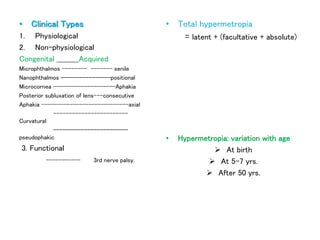
• Clinical Types
1. Physiological
2. Non-physiological
Congenital _________Acquired
Microphthalmos -------- ------- senile
Nanophthalmos ----------------positional
Microcornea --------------------Aphakia
Posterior subluxation of lens---consecutive
Aphakia ----------------------------axial
------------------------
Curvatural
------------------------
pseudophakic
3. Functional
----------- 3rd nerve palsy.
• Total hypermetropia
= latent + (facultative + absolute)
• Hypermetropia: variation with age
 At birth
 At 5-7 yrs.
 After 50 yrs.
Clinical features
Symptoms
• Asymptomatic
• Asthenopic
• Defective vision
• Both
Signs
• Size of eye ball
• Cornea
• Anterior chamber
• Retinoscopy
• Fundus examination
• A-scan ultrasonography
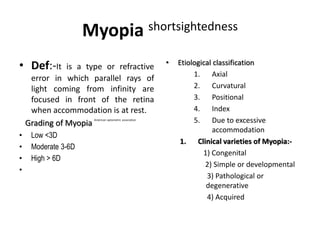
Myopia shortsightedness
• Def:-It is a type or refractive
error in which parallel rays of
light coming from infinity are
focused in front of the retina
when accommodation is at rest.
Grading of Myopia
American optometric association
• Low <3D
• Moderate 3-6D
• High > 6D
•
• Etiological classification
1. Axial
2. Curvatural
3. Positional
4. Index
5. Due to excessive
accommodation
1. Clinical varieties of Myopia:-
1) Congenital
2) Simple or developmental
3) Pathological or
degenerative
4) Acquired
Astigmatism
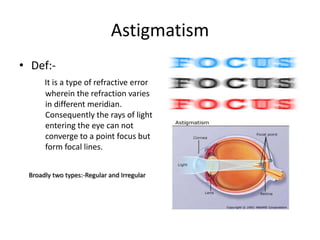
• Def:-
It is a type of refractive error
wherein the refraction varies
in different meridian.
Consequently the rays of light
entering the eye can not
converge to a point focus but
form focal lines.
Broadly two types:-Regular and Irregular
Khurana 7th :598
Treatment
Khurana 7th :598
Surgical options for Myopia
Surgical option
for Hypermetropia
Correction of Hypermetropia
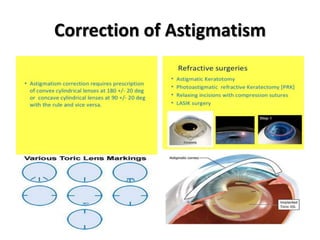
Correction of Astigmatism

Errors of refraction

  • 1.
  • 2.
    • Emmetropia • Itis state of refraction wherein the parallel rays of light coming from infinity are focused at the sensitive layer of retina with the accommodation being at rest. • Ametropia • It is a state of refraction when the parallel rays of light coming from infinity are focused either in front or behind the sensitive layer of retina in one or both meridian with accommodation at rest. • Types:- • a)Myopia • b)Hypermetropia • C) Astigmatism
  • 3.
    Hypermetropia long sightedness •Def:-It is a refractive state of the eye wherein parallel rays of light coming from infinity are focused behind the retina with accommodation being at rest. • Etiology 1. Axial 2. Curvatural 3. Index 4. Positional 5. Absence of lens 6. Consecutive
  • 4.
    • Clinical Types 1.Physiological 2. Non-physiological Congenital _________Acquired Microphthalmos -------- ------- senile Nanophthalmos ----------------positional Microcornea --------------------Aphakia Posterior subluxation of lens---consecutive Aphakia ----------------------------axial ------------------------ Curvatural ------------------------ pseudophakic 3. Functional ----------- 3rd nerve palsy. • Total hypermetropia = latent + (facultative + absolute) • Hypermetropia: variation with age  At birth  At 5-7 yrs.  After 50 yrs.
  • 5.
    Clinical features Symptoms • Asymptomatic •Asthenopic • Defective vision • Both Signs • Size of eye ball • Cornea • Anterior chamber • Retinoscopy • Fundus examination • A-scan ultrasonography
  • 7.
    Myopia shortsightedness • Def:-Itis a type or refractive error in which parallel rays of light coming from infinity are focused in front of the retina when accommodation is at rest. Grading of Myopia American optometric association • Low <3D • Moderate 3-6D • High > 6D • • Etiological classification 1. Axial 2. Curvatural 3. Positional 4. Index 5. Due to excessive accommodation 1. Clinical varieties of Myopia:- 1) Congenital 2) Simple or developmental 3) Pathological or degenerative 4) Acquired
  • 15.
    Astigmatism • Def:- It isa type of refractive error wherein the refraction varies in different meridian. Consequently the rays of light entering the eye can not converge to a point focus but form focal lines. Broadly two types:-Regular and Irregular
  • 19.
  • 20.
  • 21.
  • 24.
  • 25.
  • 26.
  • 27.