ERRSection 3Sources of information and advice about employment Rights and Responsibilities
3.1 Internal Sources What you should know:The range of information made available to you by your employer on matters relating to your employment and working practice and where this can be obtained.
Where you would find information within your organisation about: Personnel issues (e.g. annual leave entitlement) 		In your contract when you join.Training opportunities (e.g. in-house training, NVQs)		In the agreement signed before you start your job
3.2 External SourcesWhat you should know:Other information sources that may be available outside the workplace, what they provide and how to use them.
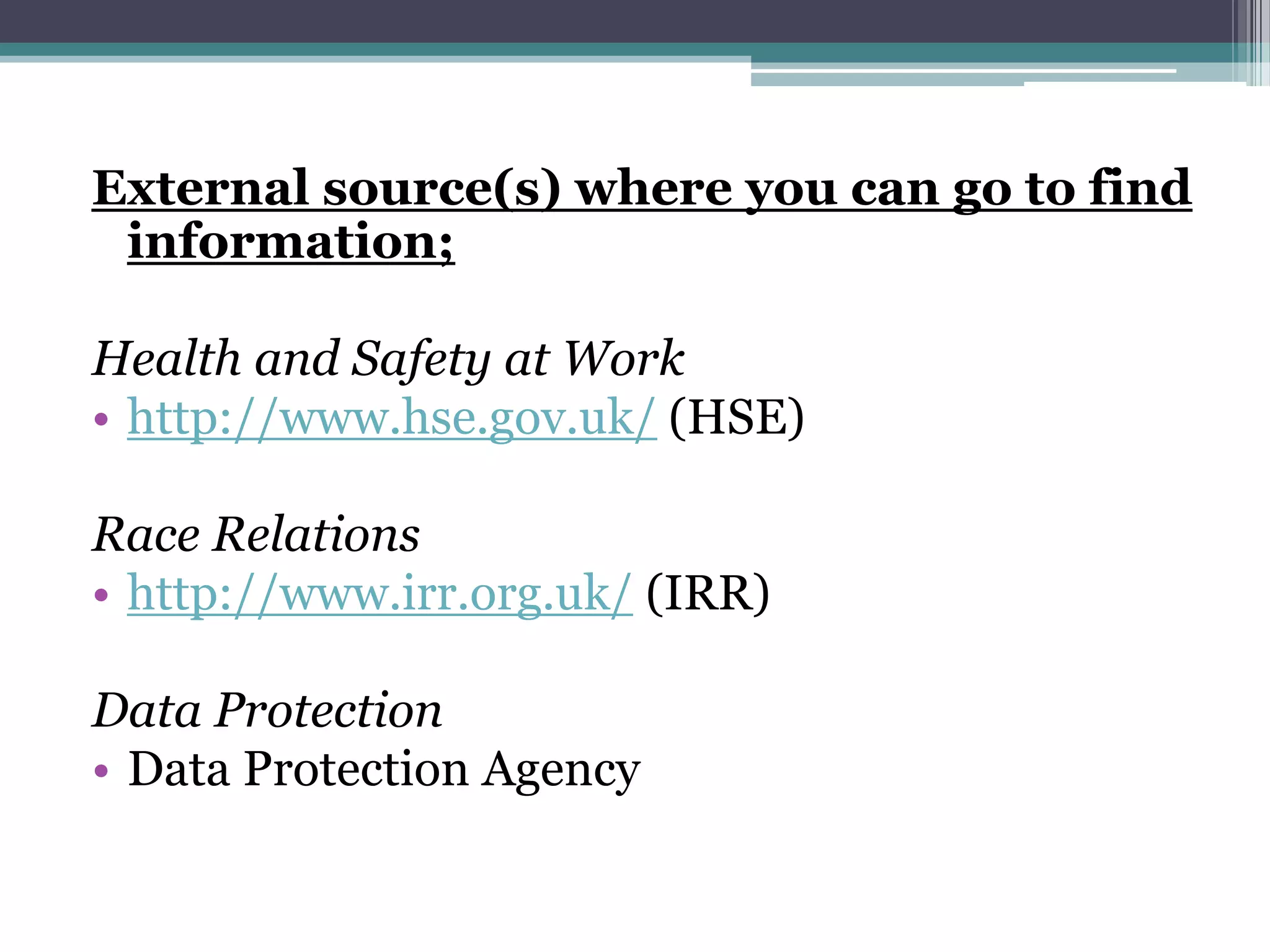
External source(s) where you can go to find information; Health and Safety at Work http://www.hse.gov.uk/ (HSE)Race Relations http://www.irr.org.uk/ (IRR)Data Protection Data Protection Agency
ERRSection 4About your Occupation and Organisation
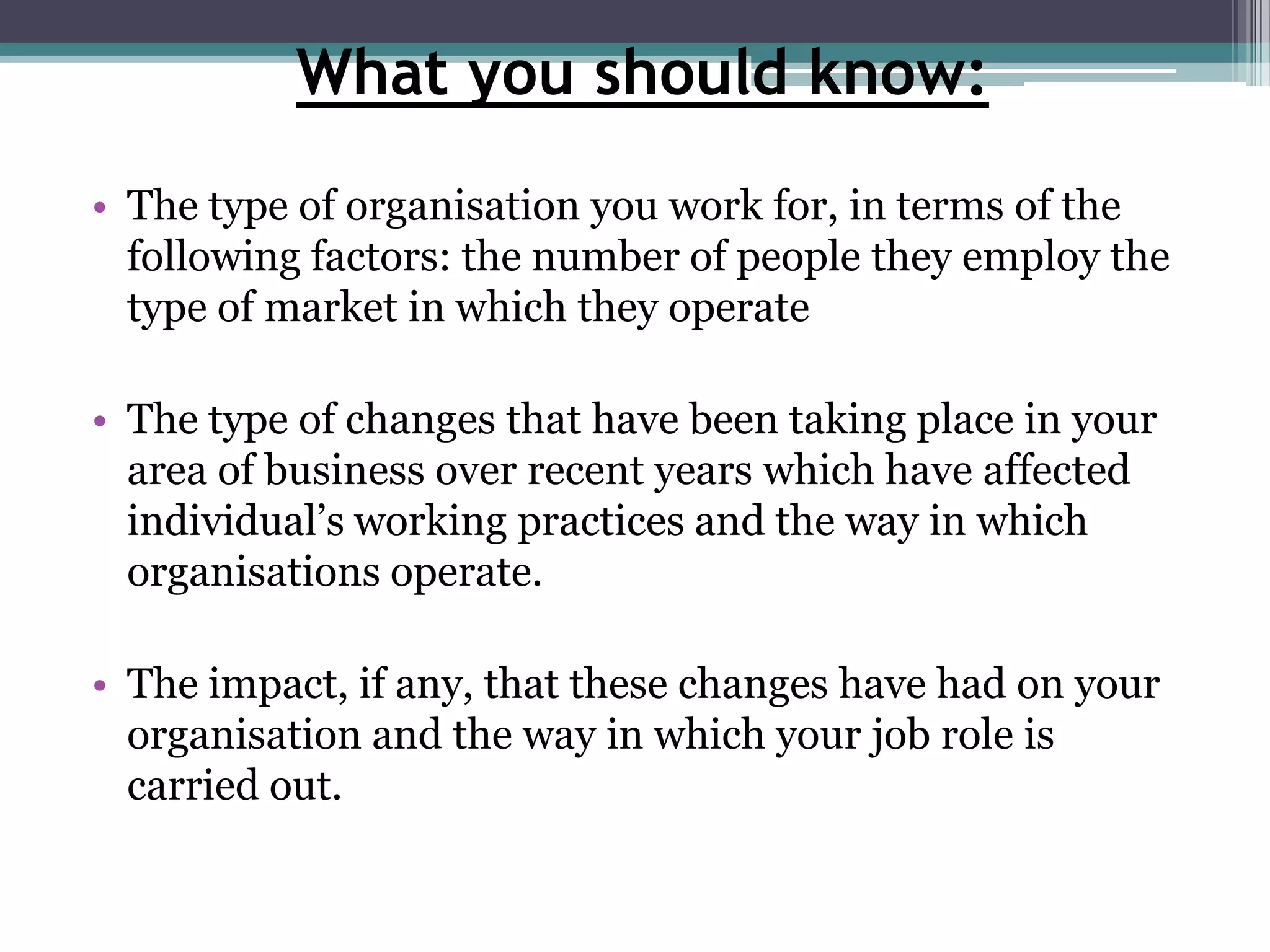
What you should know:The type of organisation you work for, in terms of the following factors: the number of people they employ the type of market in which they operateThe type of changes that have been taking place in your area of business over recent years which have affected individual’s working practices and the way in which organisations operate. The impact, if any, that these changes have had on your organisation and the way in which your job role is carried out.
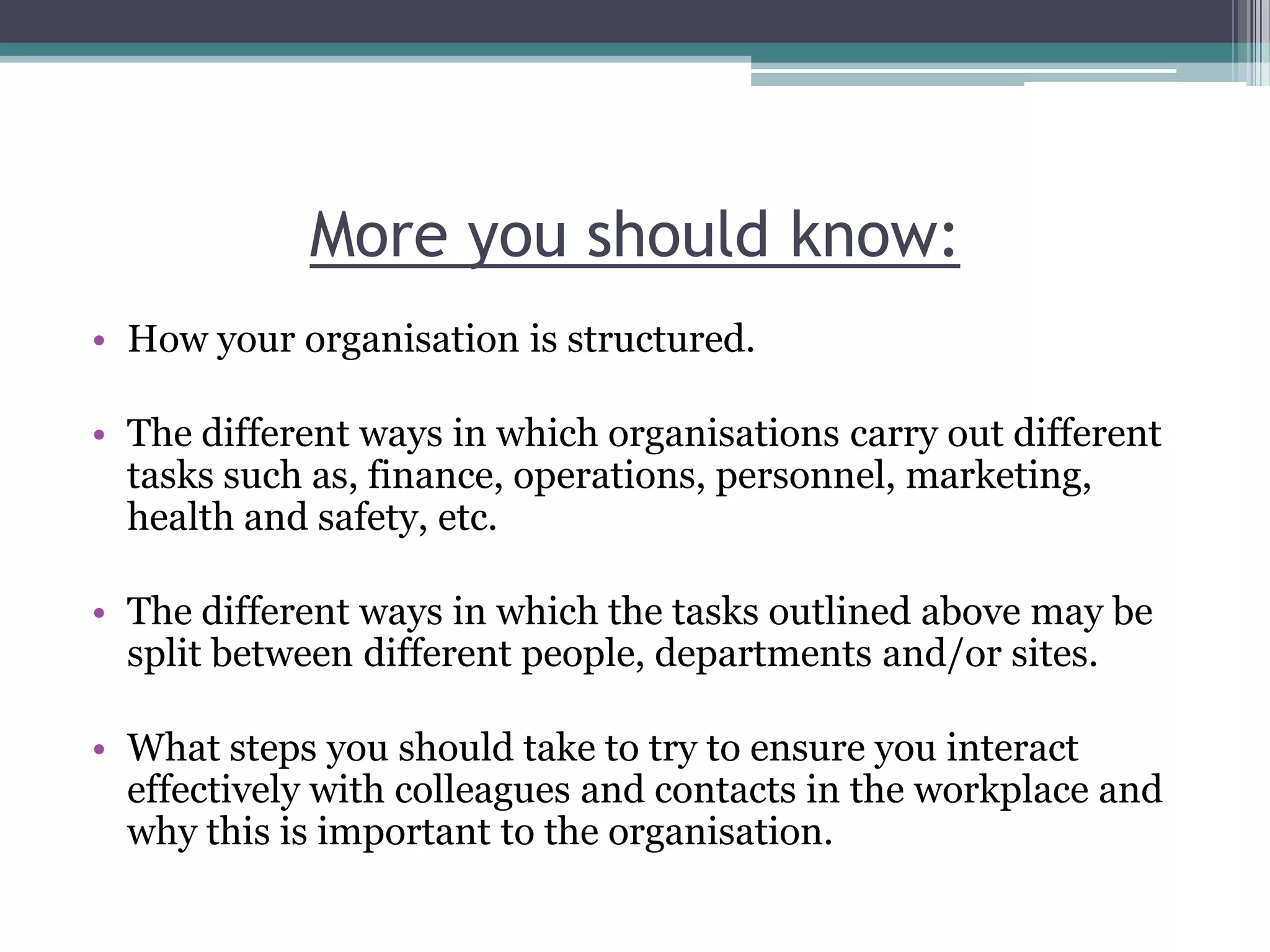
More you should know:How your organisation is structured.The different ways in which organisations carry out different tasks such as, finance, operations, personnel, marketing, health and safety, etc. The different ways in which the tasks outlined above may be split between different people, departments and/or sites. What steps you should take to try to ensure you interact effectively with colleagues and contacts in the workplace and why this is important to the organisation.  
The main tasks that are part of your job roleFollow All Health and Safety RulesRespect OthersFollow the policies and proceduresComplete all work on time
ERRSection 5Occupations and Career Pathways
What you should know:Occupations may be much specialised to a particular industry for example, Car Manufacturing, Website Design or Banking. The requirements and characteristics of typical career paths associated with your occupation. The main stages and requirements of the development programme which you are pursuing and what training and development opportunities your organisation provides in relation to this.
The opportunities for training and development provided by your employer (this could be short courses, NVQs, in-house training, etc). For Example;Training for IT, Business Admin and Customer Service Apprenticeship
ERRSection 6Representative Bodies relevant to you and your Organisation
6.1 Representation Within any industry there are a range of representative bodies that promote the views of a group of people with common interests. The representative bodies collect the views of their members and act as their voice in discussions with other groups on issues that affect them all. Representation occurs both within an organisation and other bodies.  Representation between different bodies can occur at local and national levels as well.
What you should know:If there are any trade unions relevant to your occupation, in representing and protecting the common interests of employees.  If there are any professional bodies relevant to your occupation. If there are any regulatory bodies relevant to your industry and occupation for example, British Medical Association. The name and role of the Standard Setting/Sector Bodies relevant to your occupation.
The role and purpose of the Health and Safety CommissionTo make sure that the workplace/environment is safe for everyone to work in and that there are no safety hazards that may cause hard to others.
The main trade union is for your occupation;UNISONName and address of the Standard Setting/Sector Bodies responsible for your area of business.CfACfA business skills @ work6 Graphite Square, Vauxhall Walk, London SE11 5EE

ERR SECTION-3-6

  • 1.
    ERRSection 3Sources ofinformation and advice about employment Rights and Responsibilities
  • 2.
    3.1 Internal SourcesWhat you should know:The range of information made available to you by your employer on matters relating to your employment and working practice and where this can be obtained.
  • 3.
    Where you wouldfind information within your organisation about: Personnel issues (e.g. annual leave entitlement) In your contract when you join.Training opportunities (e.g. in-house training, NVQs) In the agreement signed before you start your job
  • 4.
    3.2 External SourcesWhatyou should know:Other information sources that may be available outside the workplace, what they provide and how to use them.
  • 5.
    External source(s) whereyou can go to find information; Health and Safety at Work http://www.hse.gov.uk/ (HSE)Race Relations http://www.irr.org.uk/ (IRR)Data Protection Data Protection Agency
  • 6.
    ERRSection 4About yourOccupation and Organisation
  • 7.
    What you shouldknow:The type of organisation you work for, in terms of the following factors: the number of people they employ the type of market in which they operateThe type of changes that have been taking place in your area of business over recent years which have affected individual’s working practices and the way in which organisations operate. The impact, if any, that these changes have had on your organisation and the way in which your job role is carried out.
  • 8.
    More you shouldknow:How your organisation is structured.The different ways in which organisations carry out different tasks such as, finance, operations, personnel, marketing, health and safety, etc. The different ways in which the tasks outlined above may be split between different people, departments and/or sites. What steps you should take to try to ensure you interact effectively with colleagues and contacts in the workplace and why this is important to the organisation.  
  • 9.
    The main tasksthat are part of your job roleFollow All Health and Safety RulesRespect OthersFollow the policies and proceduresComplete all work on time
  • 10.
  • 11.
    What you shouldknow:Occupations may be much specialised to a particular industry for example, Car Manufacturing, Website Design or Banking. The requirements and characteristics of typical career paths associated with your occupation. The main stages and requirements of the development programme which you are pursuing and what training and development opportunities your organisation provides in relation to this.
  • 12.
    The opportunities fortraining and development provided by your employer (this could be short courses, NVQs, in-house training, etc). For Example;Training for IT, Business Admin and Customer Service Apprenticeship
  • 13.
    ERRSection 6Representative Bodiesrelevant to you and your Organisation
  • 14.
    6.1 Representation Withinany industry there are a range of representative bodies that promote the views of a group of people with common interests. The representative bodies collect the views of their members and act as their voice in discussions with other groups on issues that affect them all. Representation occurs both within an organisation and other bodies. Representation between different bodies can occur at local and national levels as well.
  • 15.
    What you shouldknow:If there are any trade unions relevant to your occupation, in representing and protecting the common interests of employees. If there are any professional bodies relevant to your occupation. If there are any regulatory bodies relevant to your industry and occupation for example, British Medical Association. The name and role of the Standard Setting/Sector Bodies relevant to your occupation.
  • 16.
    The role andpurpose of the Health and Safety CommissionTo make sure that the workplace/environment is safe for everyone to work in and that there are no safety hazards that may cause hard to others.
  • 17.
    The main tradeunion is for your occupation;UNISONName and address of the Standard Setting/Sector Bodies responsible for your area of business.CfACfA business skills @ work6 Graphite Square, Vauxhall Walk, London SE11 5EE