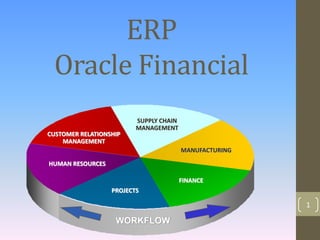
ERP
Oracle Financial
By Group 1
1
Finance
WORKFLOW
CUSTOMER RELATIONSHIP
MANAGEMENT
SUPPLY CHAIN
MANAGEMENT
MANUFACTURING
FINANCE
PROJECTS
HUMAN RESOURCES
Agenda
1. What is ERP?
2. Oracle Apps Family
3. Oracle ERP Overview
4. Oracle E Business Suite
2
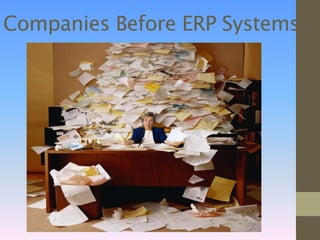
Companies Before ERP Systems
Transfer to
Accounting Office
Example: Before ERP Systems
1. What is Enterprise Resource
Planning (ERP)?
• ERP is an enterprise-wide information system designed to
coordinate all the
• resources,
• information,
• activities needed
to complete business processes such as;
• order fulfillment
• billing.
8
Oracle Web Employees
HUMAN
RESOURCES PROJECTS MANUFAC -
TURING
BUSINESS INTELLIGENCE
LOCAL EXTENSIONS
SELF-SERVICE
FINANCIALS
CRM
ORACLE E-BUSINESS SUITE
VERTICAL EXTENSIONS
SCM
2. Oracle Apps Family
ISACA Conference
3. Oracle ERP Overview
Human
Resources
Finance
Projects
Self-Service
Supply Chain
Management
Manufacturing
Front Office
Applied
Technology
Finance
General Ledger
Payables
Receivables
Fixed Assets
Additional Tools
Manufacturing
Engineering
Bills of Material
Master Scheduling / MRP
Capacity
Work in Process
Quality
Cost Management
Process (OPM)
Rhythm Factory Planning
Rhythm Advanced Scheduling
Project Manufacturing
Flow Manufacturing
Supply Chain Management
Order Entry
Purchasing
Product Configurator
Supply Chain Planning
Supplier Scheduling
Inventory
Projects
Project Costing
Project Billing
Personal Time & Expense
Activity Management Gateway
Project Connect
CRM
Marketing (3 modules)
Sales (5 modules)
Service (5 modules)
Call Center (5 modules)
Human Resources
Payroll
Human Resources
Training Administration
Time Management
Advanced Benefits
Applied Technology
Workflow
Alert (Business Agents)
Applications Data Warehouse
EDI Gateway
Self-Service
Web Customers
Web Suppliers
Web Employees
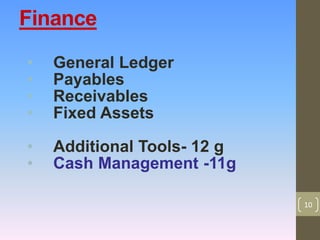
Finance
• General Ledger
• Payables
• Receivables
• Fixed Assets
• Additional Tools- 12 g
• Cash Management -11g
10
11
General Ledger
• Statement of Financial Positions (Balance Sheet)
Assets = Liabilities + (Shareholders or Owners equity )
• Statement of profit and lost (Income Statement)
(Sales - Expenses = Net Income)
12
Accounting - it is how much profit we made, assets and liabilities
 It is a quantitative measurement of business that taking place
 Helps make business decision, it tells you the HEALTH of the company
 It is a Process of obtaining financial data
13
14
15
16
17
18
Payables
• Manage Suppliers
• What you have purchase to which vendor
• Did you paid on time or
• What method of payments you use
• Examples of Expenses Payables are:
• ~ Advertising ~ Office supplies
• ~ Travel ~ Utilities
Example of Households Payable
~ Bills from Electric company, telephone and etc.
Expenses
19
20
21
22
23
24
25
26
Receivables
• Money of the Customers
• Has a person paid already
• Claims that are expected to be collected in cash
• The money owed to a business by its clients
(customers or debtors)
27
28
29
30
31
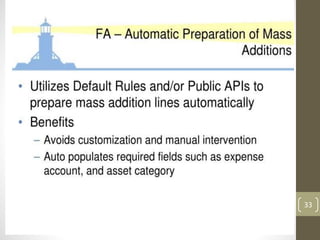
Fixed Assets
• Which assets is located at what location
• Which employees using that assets
• What has been the expenses made by that assets
• Example:
~Oven used to bake bread
~Motor vehicles use to transport deliveries
~ Land, Building, furniture, Office Equipment and
Computes or machinery
• Equipment used to generate income
32
33
34
Additional Tools
35
36
37
38
39
40
41
42
43
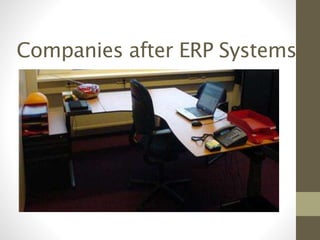
Companies after ERP Systems
AMA before ERP
45
AMA after ERP
46
ORACLE.AMAES.EDU.PH
47

erp_financial (1).pptx

  • 1.
    ERP Oracle Financial By Group1 1 Finance WORKFLOW CUSTOMER RELATIONSHIP MANAGEMENT SUPPLY CHAIN MANAGEMENT MANUFACTURING FINANCE PROJECTS HUMAN RESOURCES
  • 2.
    Agenda 1. What isERP? 2. Oracle Apps Family 3. Oracle ERP Overview 4. Oracle E Business Suite 2
  • 3.
  • 4.
  • 6.
    1. What isEnterprise Resource Planning (ERP)? • ERP is an enterprise-wide information system designed to coordinate all the • resources, • information, • activities needed to complete business processes such as; • order fulfillment • billing.
  • 8.
    8 Oracle Web Employees HUMAN RESOURCESPROJECTS MANUFAC - TURING BUSINESS INTELLIGENCE LOCAL EXTENSIONS SELF-SERVICE FINANCIALS CRM ORACLE E-BUSINESS SUITE VERTICAL EXTENSIONS SCM 2. Oracle Apps Family
  • 9.
    ISACA Conference 3. OracleERP Overview Human Resources Finance Projects Self-Service Supply Chain Management Manufacturing Front Office Applied Technology Finance General Ledger Payables Receivables Fixed Assets Additional Tools Manufacturing Engineering Bills of Material Master Scheduling / MRP Capacity Work in Process Quality Cost Management Process (OPM) Rhythm Factory Planning Rhythm Advanced Scheduling Project Manufacturing Flow Manufacturing Supply Chain Management Order Entry Purchasing Product Configurator Supply Chain Planning Supplier Scheduling Inventory Projects Project Costing Project Billing Personal Time & Expense Activity Management Gateway Project Connect CRM Marketing (3 modules) Sales (5 modules) Service (5 modules) Call Center (5 modules) Human Resources Payroll Human Resources Training Administration Time Management Advanced Benefits Applied Technology Workflow Alert (Business Agents) Applications Data Warehouse EDI Gateway Self-Service Web Customers Web Suppliers Web Employees
  • 10.
    Finance • General Ledger •Payables • Receivables • Fixed Assets • Additional Tools- 12 g • Cash Management -11g 10
  • 11.
  • 12.
    General Ledger • Statementof Financial Positions (Balance Sheet) Assets = Liabilities + (Shareholders or Owners equity ) • Statement of profit and lost (Income Statement) (Sales - Expenses = Net Income) 12 Accounting - it is how much profit we made, assets and liabilities  It is a quantitative measurement of business that taking place  Helps make business decision, it tells you the HEALTH of the company  It is a Process of obtaining financial data
  • 13.
  • 14.
  • 15.
  • 16.
  • 17.
  • 18.
  • 19.
    Payables • Manage Suppliers •What you have purchase to which vendor • Did you paid on time or • What method of payments you use • Examples of Expenses Payables are: • ~ Advertising ~ Office supplies • ~ Travel ~ Utilities Example of Households Payable ~ Bills from Electric company, telephone and etc. Expenses 19
  • 20.
  • 21.
  • 22.
  • 23.
  • 24.
  • 25.
  • 26.
  • 27.
    Receivables • Money ofthe Customers • Has a person paid already • Claims that are expected to be collected in cash • The money owed to a business by its clients (customers or debtors) 27
  • 28.
  • 29.
  • 30.
  • 31.
  • 32.
    Fixed Assets • Whichassets is located at what location • Which employees using that assets • What has been the expenses made by that assets • Example: ~Oven used to bake bread ~Motor vehicles use to transport deliveries ~ Land, Building, furniture, Office Equipment and Computes or machinery • Equipment used to generate income 32
  • 33.
  • 34.
  • 35.
  • 36.
  • 37.
  • 38.
  • 39.
  • 40.
  • 41.
  • 42.
  • 43.
  • 44.
  • 45.
  • 46.
  • 47.

Editor's Notes

  • #13 1. Bookkeeping or summary of transaction
  • #14 users
  • #15 Balance sheet and income statements accounts
  • #17 AC= submit documents like BIR, AL= budget
  • #18 R= A=budget R= E=input
  • #19 Entry debit and credit
  • #21 Input input
  • #28 detors
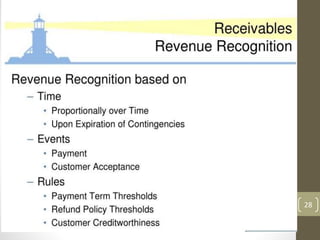
  • #29 Time = credit terms , days or duration Events=Sales and payment Rules= Refund, delay percentage of increase, penalty
  • #35 Inventory system