AgGateway and FAIR Data
e-ROSA Stakeholder Workshop
Montpellier, France, July 6-7, 2017
R. Andres Ferreyra (Ag Connections, LLC)
AgGateway
• Nonprofit consortium of 230+ members
• Mission: Promote, enable and expand eAgriculture.
– Strong emphasis on implementing existing standards
– Strong emphasis on collaboration
• Membership
– Open; members are primarily businesses.
– Other organizations typically join as Associate members
– There is a category for individual memberships.
• Transparent funding, governance, anti-trust and IP
framework.
• Authority: De facto (Implementation by stakeholders)
– Output often handed off to ISO, other de jure organizations.
• Expertise: Supply chain and field operations business processes
• Field operations interoperability initiatives: SPADE, PAIL, ADAPT.
Current Focus on eInfrastructure
• Perception that field operations and supply-chain
transaction data are strongly proprietary, and
personally-identifiable-data (PII)-dense.
– Limited (growing) interest in making it findable / accessible.
– Definitely no interest in making it “open”.
• There is a lot more consensus in setting up a common
system of (FAIR) eInfrastructure
– Product identifiers
– Variable-type registries
– This translates into making the filed operations and supply-
chain transaction data interoperable and reusable.
4
What is “Reference Data”?
• Information needed to unambiguously identify a
product, and to enable its use in a farm management
information system (FMIS) or a field operation.
• It changes rarely, and a great part of its value lies in
giving access to it to the different actors in the
business process.
• Current focus:
– Crop protection products
– Seed products
– Equipment
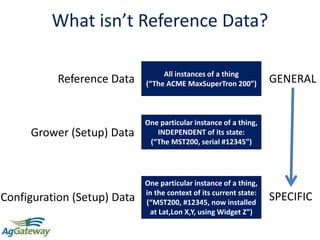
All instances of a thing
(“The ACME MaxSuperTron 200”)
One particular instance of a thing,
INDEPENDENT of its state:
(“The MST200, serial #12345”)
One particular instance of a thing,
in the context of its current state:
(“MST200, #12345, now installed
at Lat,Lon X,Y, using Widget Z”)
GENERAL
SPECIFIC
Reference Data
Grower (Setup) Data
Configuration (Setup) Data
What isn’t Reference Data?
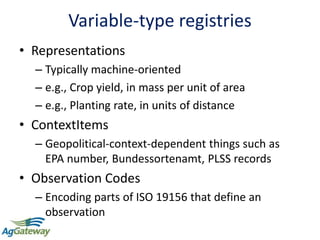
Variable-type registries
• Representations
– Typically machine-oriented
– e.g., Crop yield, in mass per unit of area
– e.g., Planting rate, in units of distance
• ContextItems
– Geopolitical-context-dependent things such as
EPA number, Bundessortenamt, PLSS records
• Observation Codes
– Encoding parts of ISO 19156 that define an
observation
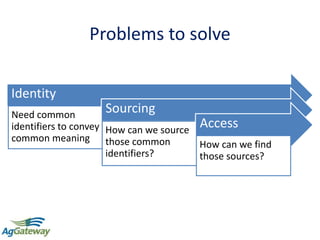
Identity
Need common
identifiers to convey
common meaning
Sourcing
How can we source
those common
identifiers?
Access
How can we find
those sources?
Problems to solve
7
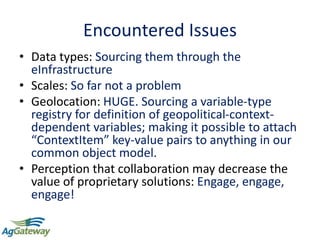
Encountered Issues
• Data types: Sourcing them through the
eInfrastructure
• Scales: So far not a problem
• Geolocation: HUGE. Sourcing a variable-type
registry for definition of geopolitical-context-
dependent variables; making it possible to attach
“ContextItem” key-value pairs to anything in our
common object model.
• Perception that collaboration may decrease the
value of proprietary solutions: Engage, engage,
engage!
Challenge: Relationships
• We need to capture relationships among:
– Documents
• Required for traceability, regulatory purposes
• Causal, Contextual, Compositional
– Concepts
• Code 178 (“Corn”) in John Deere machinery crop list is
equivalent to “Maize” from Claas’ machinery crop list.
• Retailer X’s proprietary ID for Product A is equivalent to
FMIS Y’s proprietary ID.
• Still unclear whether we should create our
own infrastructure, or if there are alternatives.
Discussion
• The "return on investment“ (real or expected)
– No hard data yet, but looking to enable real data
exchange across the industry. Potentially
impactful.
• The perspectives : what could make it easier in
terms of process, tools, practices
– Will try smaller, bite-sized projects
• How do you go from data lake to linked data
– Buy-in is earned based on results, but
– Have to deal with chicken-and-egg dynamic
THANKS!
Challenge: Geopolitical Context
• Accommodating geopolitical-context-dependent
data (e.g., EPA, FSA numbers) is critical for our
work to be relevant to farmers, but conflicting
requirements must be reconciled:
– Industry data standards favor universality (i.e., staying
free of regionally-specific clutter.)
– Local business processes involve local data.
• Additionally,
– We want controlled vocabularies. (To enforce shared
meanings among actors), but,
– the dynamic nature of business / regulation requires
the vocabulary to be easily extensible.
12
http://bit.ly/2aAWpmH
Challenge: Linking Supply Chain and
Field Operations Concepts
• Supply chain perspective: what is bought and sold (including
how it is packaged, ordered, delivered, invoiced, paid for,
tracked, etc.):
– Jugs, boxes, pallets of Product X, each with its own Global Trade Item
Number (GTIN)
• Field operations perspective: what is applied
– Rate A [kg/ha] of Product X applied over an area B [ha] = a total of A * B
[kg] of product.
– There is a (typically locally) unique ID to refer to product X; it’s
packaging is relevant only to some
• We seek to build mapping functionality into our Reference Data
API system.
4 Things we want to agree on
• Can we agree on what things mean? (Identity and Semantics)
– For humans: Ag Glossary
– For computers: Reference Data
• Can we agree on how things happen (Processes)?
– Stories, Process Models, Use Cases
• Can we agree on what we need to know (Data Requirements)?
– Core Documents
– Irrigation (PAIL)
– Telematics (WAVE)
– Grain handling (CART)
– ContextItems
• Can we agree on how things can talk to each other
(Interoperability)?
– ADAPT object model, ADAPT plug-in framework
– SPADE Reference Data APIs
– Upcoming SPADE /PAIL work on data exchange APIs
14
http://bit.ly/2aQVT5d

eROSA Stakeholder WS1: AgGateway and FAIR Data

  • 1.
    AgGateway and FAIRData e-ROSA Stakeholder Workshop Montpellier, France, July 6-7, 2017 R. Andres Ferreyra (Ag Connections, LLC)
  • 2.
    AgGateway • Nonprofit consortiumof 230+ members • Mission: Promote, enable and expand eAgriculture. – Strong emphasis on implementing existing standards – Strong emphasis on collaboration • Membership – Open; members are primarily businesses. – Other organizations typically join as Associate members – There is a category for individual memberships. • Transparent funding, governance, anti-trust and IP framework. • Authority: De facto (Implementation by stakeholders) – Output often handed off to ISO, other de jure organizations. • Expertise: Supply chain and field operations business processes • Field operations interoperability initiatives: SPADE, PAIL, ADAPT.
  • 3.
    Current Focus oneInfrastructure • Perception that field operations and supply-chain transaction data are strongly proprietary, and personally-identifiable-data (PII)-dense. – Limited (growing) interest in making it findable / accessible. – Definitely no interest in making it “open”. • There is a lot more consensus in setting up a common system of (FAIR) eInfrastructure – Product identifiers – Variable-type registries – This translates into making the filed operations and supply- chain transaction data interoperable and reusable.
  • 4.
    4 What is “ReferenceData”? • Information needed to unambiguously identify a product, and to enable its use in a farm management information system (FMIS) or a field operation. • It changes rarely, and a great part of its value lies in giving access to it to the different actors in the business process. • Current focus: – Crop protection products – Seed products – Equipment
  • 5.
    All instances ofa thing (“The ACME MaxSuperTron 200”) One particular instance of a thing, INDEPENDENT of its state: (“The MST200, serial #12345”) One particular instance of a thing, in the context of its current state: (“MST200, #12345, now installed at Lat,Lon X,Y, using Widget Z”) GENERAL SPECIFIC Reference Data Grower (Setup) Data Configuration (Setup) Data What isn’t Reference Data?
  • 6.
    Variable-type registries • Representations –Typically machine-oriented – e.g., Crop yield, in mass per unit of area – e.g., Planting rate, in units of distance • ContextItems – Geopolitical-context-dependent things such as EPA number, Bundessortenamt, PLSS records • Observation Codes – Encoding parts of ISO 19156 that define an observation
  • 7.
    Identity Need common identifiers toconvey common meaning Sourcing How can we source those common identifiers? Access How can we find those sources? Problems to solve 7
  • 8.
    Encountered Issues • Datatypes: Sourcing them through the eInfrastructure • Scales: So far not a problem • Geolocation: HUGE. Sourcing a variable-type registry for definition of geopolitical-context- dependent variables; making it possible to attach “ContextItem” key-value pairs to anything in our common object model. • Perception that collaboration may decrease the value of proprietary solutions: Engage, engage, engage!
  • 9.
    Challenge: Relationships • Weneed to capture relationships among: – Documents • Required for traceability, regulatory purposes • Causal, Contextual, Compositional – Concepts • Code 178 (“Corn”) in John Deere machinery crop list is equivalent to “Maize” from Claas’ machinery crop list. • Retailer X’s proprietary ID for Product A is equivalent to FMIS Y’s proprietary ID. • Still unclear whether we should create our own infrastructure, or if there are alternatives.
  • 10.
    Discussion • The "returnon investment“ (real or expected) – No hard data yet, but looking to enable real data exchange across the industry. Potentially impactful. • The perspectives : what could make it easier in terms of process, tools, practices – Will try smaller, bite-sized projects • How do you go from data lake to linked data – Buy-in is earned based on results, but – Have to deal with chicken-and-egg dynamic
  • 11.
  • 12.
    Challenge: Geopolitical Context •Accommodating geopolitical-context-dependent data (e.g., EPA, FSA numbers) is critical for our work to be relevant to farmers, but conflicting requirements must be reconciled: – Industry data standards favor universality (i.e., staying free of regionally-specific clutter.) – Local business processes involve local data. • Additionally, – We want controlled vocabularies. (To enforce shared meanings among actors), but, – the dynamic nature of business / regulation requires the vocabulary to be easily extensible. 12 http://bit.ly/2aAWpmH
  • 13.
    Challenge: Linking SupplyChain and Field Operations Concepts • Supply chain perspective: what is bought and sold (including how it is packaged, ordered, delivered, invoiced, paid for, tracked, etc.): – Jugs, boxes, pallets of Product X, each with its own Global Trade Item Number (GTIN) • Field operations perspective: what is applied – Rate A [kg/ha] of Product X applied over an area B [ha] = a total of A * B [kg] of product. – There is a (typically locally) unique ID to refer to product X; it’s packaging is relevant only to some • We seek to build mapping functionality into our Reference Data API system.
  • 14.
    4 Things wewant to agree on • Can we agree on what things mean? (Identity and Semantics) – For humans: Ag Glossary – For computers: Reference Data • Can we agree on how things happen (Processes)? – Stories, Process Models, Use Cases • Can we agree on what we need to know (Data Requirements)? – Core Documents – Irrigation (PAIL) – Telematics (WAVE) – Grain handling (CART) – ContextItems • Can we agree on how things can talk to each other (Interoperability)? – ADAPT object model, ADAPT plug-in framework – SPADE Reference Data APIs – Upcoming SPADE /PAIL work on data exchange APIs 14 http://bit.ly/2aQVT5d