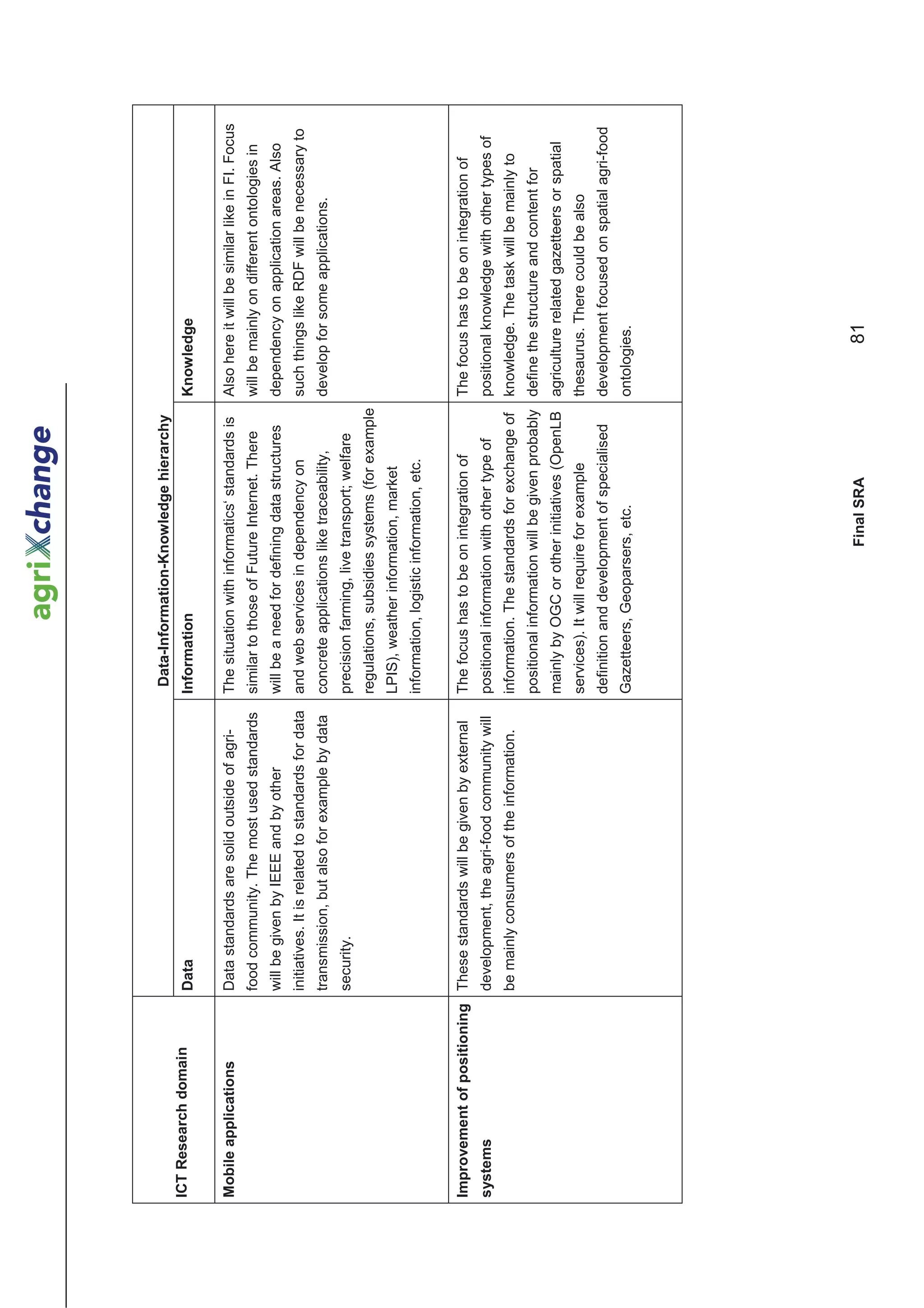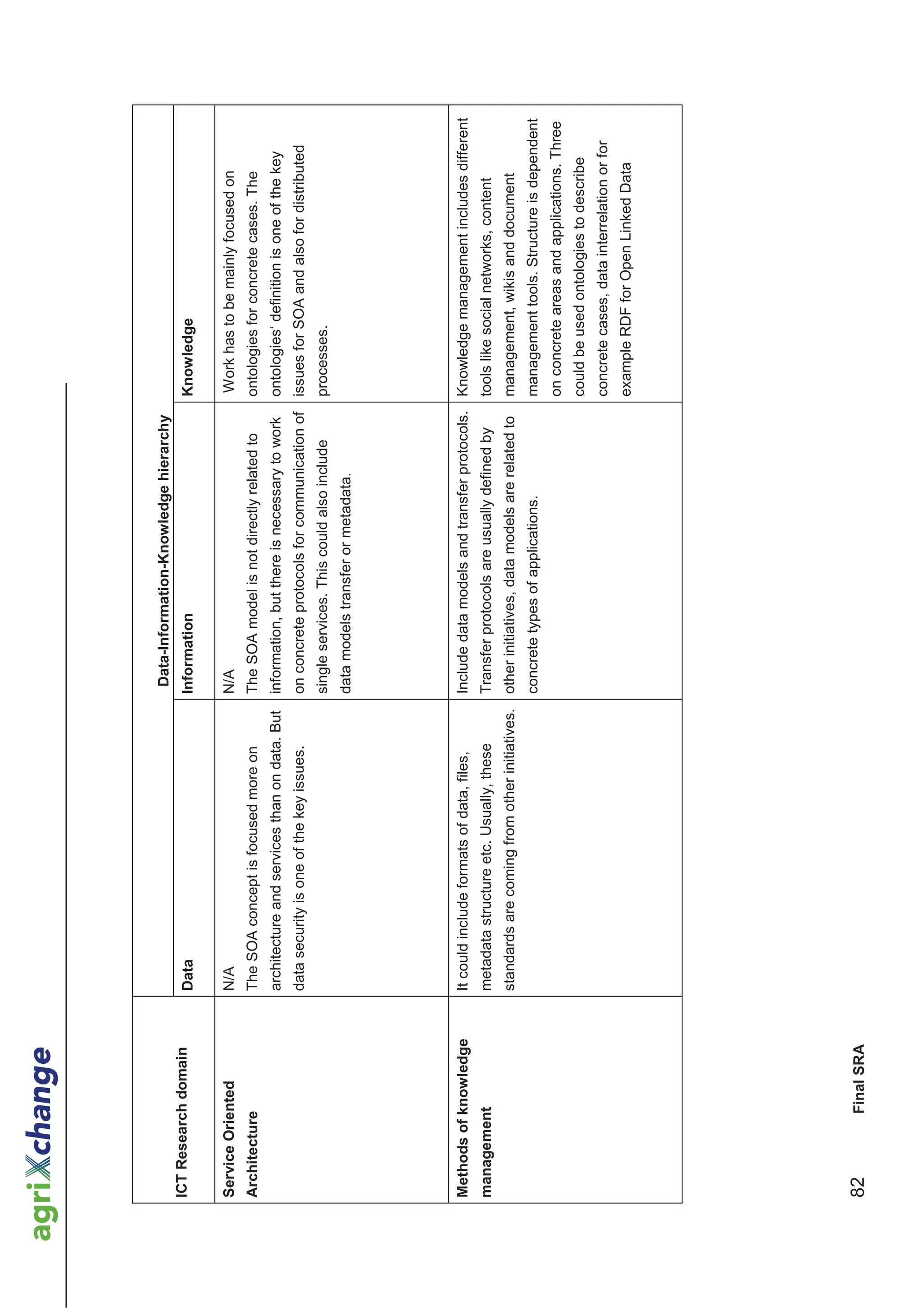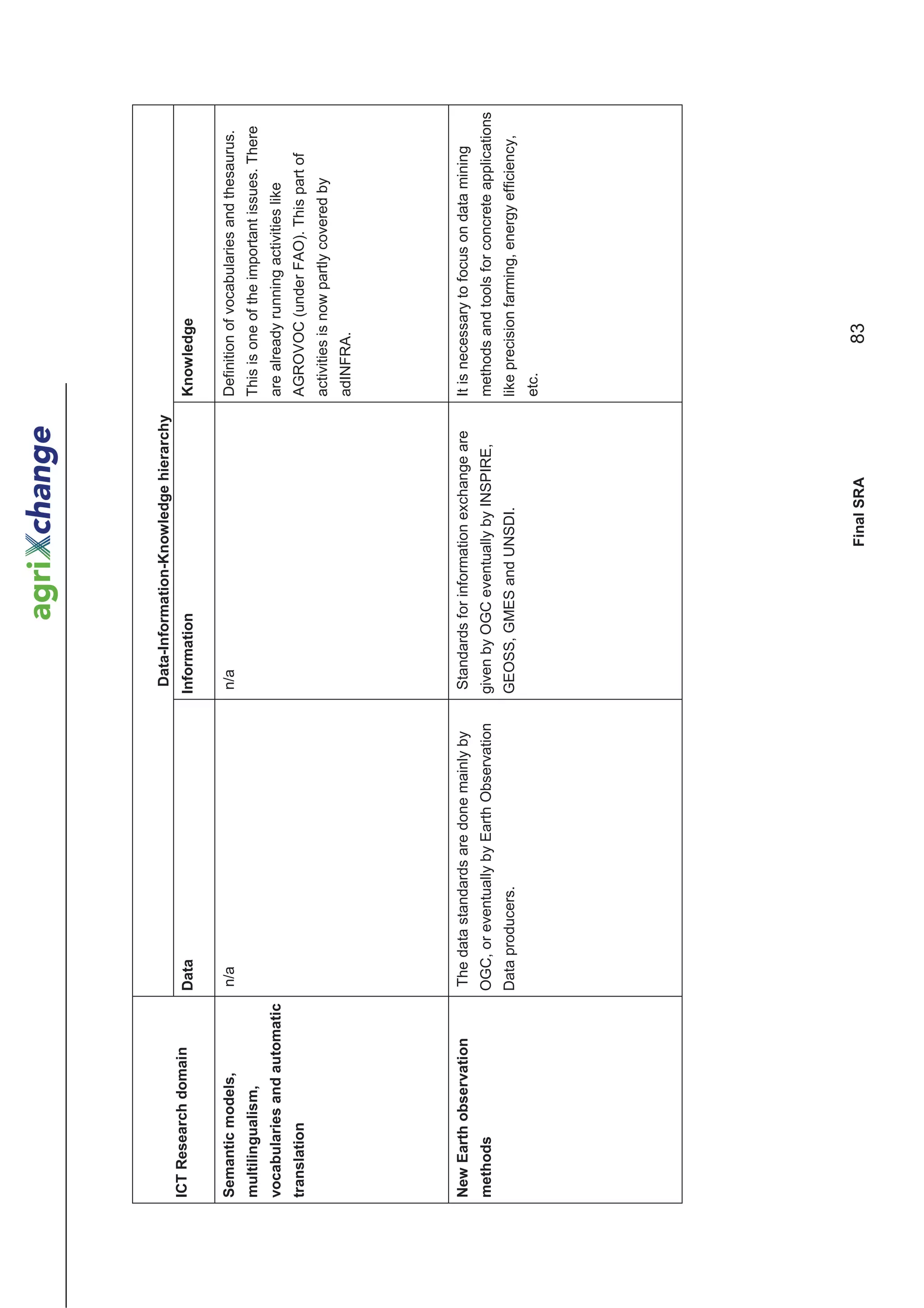
Final SRA ‘Common
Basis for policy making
for introduction of
innovative approaches
on data exchange in
agri-food industry’


               network for data exchange in agriculture
Final Strategic Research Agenda (SRA):
Common Basis for policy
making for the introduction of innovative
approaches to data exchange in the agri-
food industry


Karel Charvat, Sarka Horakova, Sjaak Wolfert, Henri Holster, Otto Schmid, Liisa
Pesonen, Daniel Martini, Esther Mietzsch, Tomas Mildorf (WP5)


28. 11. 2012
Final


D 5.2.


                                                                                                           th
                                                        agriXchange is funded by the European Commission’s 7
                                                        Framework Programme, Contract no. 244957
About the agriXchange project
agriXchange is a EU-funded project and it is a coordination and support action to setup a
network for developing a system for common data exchange in the agricultural sector.

Project summary

Within the knowledge-based bio-economy, information sharing is an important issue. In agri-food
business, this is a complex issue because many aspects and dimensions play a role. An installed
base of information systems lack standardisation, which hampers efficient exchange of information.
This leads to inefficient business processes and hampers adoption of new knowledge and
technology. The exchange of information at whole chain or network level is poorly organised.
Although arable and livestock farming have their own specific needs, there are many similarities in
the need for an integrated approach. Spatial data increasingly plays an important role in agriculture.
The overall objective of this project is to coordinate and support the setting up of a sustainable
network for developing a system for common data exchange in agriculture. This will be achieved by:

ï   establishing a platform on data exchange in agriculture in the EU;
ï   developing a reference framework for interoperability of data exchange;
ï   identifying the main challenges for harmonising data exchange.

First, an in-depth analysis and investigation of the state-of-the art in EU member states will be carried
out. A platform is built up that facilitates communication and collaborative working groups, that work
on several, representative use cases, guided by an integrative reference framework. The framework
consists of a sound architecture and infrastructure based on a business process modeling approach
integrating existing standards and services. The development is done in close interaction with
relevant stakeholders through the platform and international workshops. The results converge into a
strategic research agenda that contains a roadmap for future developments.

Project consortium:

ï   Wageningen University & Research Center (LEI, LSR, Alterra) - The Netherlands
ï   KuratoriumfürTechnikundBauwesen in der Landwirtschaft (KTBL) - Germany
ï   MTT Agrifood Research - Finland
ï   Wireless Info (WRLS) - Czech Republic
ï   Institut de l’Elevage (ELEV) - France
ï   Institut de RecercaiTecnologiaAgroalimentàries (IRTA) - Spain
ï   Teagasc - Ireland
ï   Universität Rostock-Germany
ï   ForschungsinstitutfürBiologischenLandbau (FIBL) - Switzerland
ï   Altavia - Italy
ï   Poznan University of Life Sciences (PULS) - Poland
ï   ACTA Informatique - France
ï   Progis software - Austria


More information:

Dr. Sjaak Wolfert (coordinator)       e-mail: sjaak.wolfert@wur.nl
LEI Wageningen UR                     phone: +31 317 485 939
P.O. Box 35                           mobile: +31 624 135 790
6700 AA Wageningen                    www.agriXchange.eu
The Netherlands                       info@agriXchange.eu
Table of Contents
Figures and Tables ...............................................................................................................................5
Abbreviations ........................................................................................................................................6
Executive Summary ..............................................................................................................................7
Synthetic Summary .............................................................................................................................12
1      Introduction ..................................................................................................................................19
    1.1         Background and scope .......................................................................................................19
    1.2         Problem ..............................................................................................................................19
    1.3         Objectives of study .............................................................................................................20
    1.4         Approach and outline..........................................................................................................20
2      ICT for Agriculture Interoperability ...............................................................................................22
    2.1         Data, information and knowledge .......................................................................................22
    2.2         Standardisation need for the agriculture sector ..................................................................23
    2.3         Interoperability on farm level ..............................................................................................24
3      Standardisation ............................................................................................................................25
    3.1         Current standardisation initiatives ......................................................................................25
       3.1.1       ISO .................................................................................................................................25
       3.1.2       W3C ...............................................................................................................................25
       3.1.3       OASIS ............................................................................................................................25
       3.1.4       OGC ...............................................................................................................................25
       3.1.5       IEEE ...............................................................................................................................25
       3.1.6       VDMA – ISOBUS ...........................................................................................................26
       3.1.7       agroXML .........................................................................................................................26
       3.1.8       INSPIRE .........................................................................................................................26
    3.2         agriXchange results ............................................................................................................26
    3.3         Conclusion ..........................................................................................................................27
4      Overview of past activities............................................................................................................29
    4.1         Aforo ...................................................................................................................................29
    4.2         Rural Wins ..........................................................................................................................31
    4.3         Valencia Declaration...........................................................................................................33
    4.4         eRural Brussels conference conclusions............................................................................35
    4.5         Prague Declaration .............................................................................................................36
    4.6         aBard vision ........................................................................................................................37
    4.7         ami@netfood Strategic Research Agenda .........................................................................38
    4.8         The vision on the future value chain for 2016 by the Global Commerce Initiative..............39
    4.9         Study on Availability of Access to Computer Networks in Rural Areas ..............................40
    4.10        The research agenda of the European Platform for Food for Life ......................................41
    4.11        Future Farm vision..............................................................................................................41
    4.12        The Research Agenda and the Action Plan by the Technology Platform for Organic Food
    and Farming.....................................................................................................................................47
    4.13        The third SCAR Foresight exercise ....................................................................................48


                                                                                                      Final SRA                                          3
4.14       Cologne declaration............................................................................................................49
    4.15       Vision, Strategic Research Agenda and Third Implementation Action Plan (2009) of the
    European Agriculture Machinery Industry (Subplatform AET of the Technology Platform
    MANUFUTURE................................................................................................................................51
    4.16       ICT Agri Eranet ...................................................................................................................51
    4.17       agriXchange analysis of data exchange in agriculture in the EU27 & Switzerland ............53
    4.18       Conclusions from the overview of past activities ................................................................56
5      Future Trends in ICT - Future Internet, Open Data and Open Source ........................................58
    5.1        ICT vision of Future Internet ...............................................................................................58
       5.1.1       c@r .................................................................................................................................58
       5.1.2       COIN IP ..........................................................................................................................59
       5.1.3       FI-WARE ........................................................................................................................60
       5.1.4       SmartAgriFood ...............................................................................................................61
       5.1.5       agINFRA .........................................................................................................................62
    5.2        Open Source Software (OSS) ............................................................................................63
       5.2.1       Open Data ......................................................................................................................64
    5.3        Conclusion from Future Trends ..........................................................................................65
6      Future challenges for ICT for Agri-food ........................................................................................67
    6.1        Why are the challenges important ......................................................................................67
    6.2        Political and organisational challenges...............................................................................68
    6.3        Technological, innovation and research challenges ...........................................................69
7      Application Research domain for Agriculture, Food, Rural development and Environment ........71
8      ICT Technologies for agri-food and rural regions.........................................................................75
9      SRA for standardisation in agri-food data, information and knowledge .......................................79
    9.1        Conclusion from SRA for standardisation...........................................................................87
10         Recommendations for long-term agriXchange sustainability..................................................88
    10.1       Challenge 1 ........................................................................................................................88
    10.2       Challenge 2 ........................................................................................................................89
    10.3       Challenge 3 ........................................................................................................................89
    10.4       Challenge 4 ........................................................................................................................90
    10.5       Challenge 5 ........................................................................................................................90
References ..........................................................................................................................................91


4                  Final SRA
Figures and Tables
Figure 1 Schema of the challenges that influence the SRA ................................................................14
Table 1 Matrix of relation between Challenges and Applications research Domain ...........................15
Table 2 Matrix of dependencies between Applications domain and ICT development priorities .......16
Figure 2 The Data-Information-Knowledge-Wisdom hierarchy of Ackoff [3] .......................................22
Figure 3 Schematic overview of relationships between farm management and its environment (from
Sörensen et al [6]) ...............................................................................................................................24
Figure 4 The AFORO road mapping methodology .............................................................................30
Figure 5 Framework of the Rural Wins project to describe ICT requirements and issues for rural and
maritime areas. ...................................................................................................................................32
Figure 6 Exchange of knowledge’s cross different levels of farm management .................................42
Figure 7 C@R Reference architecture ................................................................................................59
Figure 8 Future Internet Cloud Layers ................................................................................................60
Figure 9 The 5-start deployment scheme for Open Data [65] .............................................................65
Figure 10 Two factors that define the long-term sustainability of agriXchange ...................................67
Figure 11 Four chains of influence ......................................................................................................68
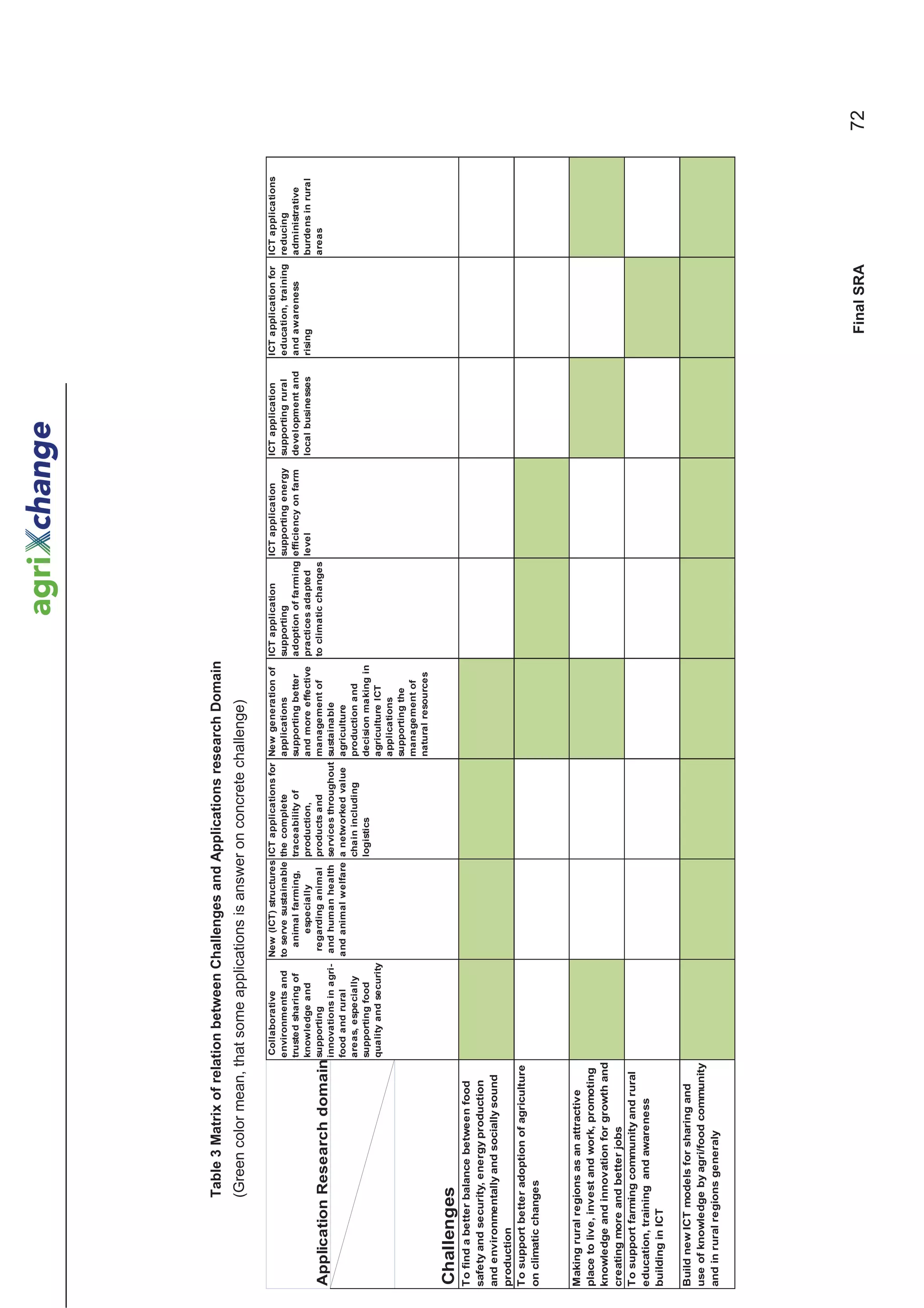
Table 3 Matrix of relation between Challenges and Applications research Domain ...........................72
Table 4 Matrix of dependencies between Applications domain and ICT development priorities ........76
Table 5 Agri-food standardisation needs on different level of Data-Information-Knowledge hierarchy
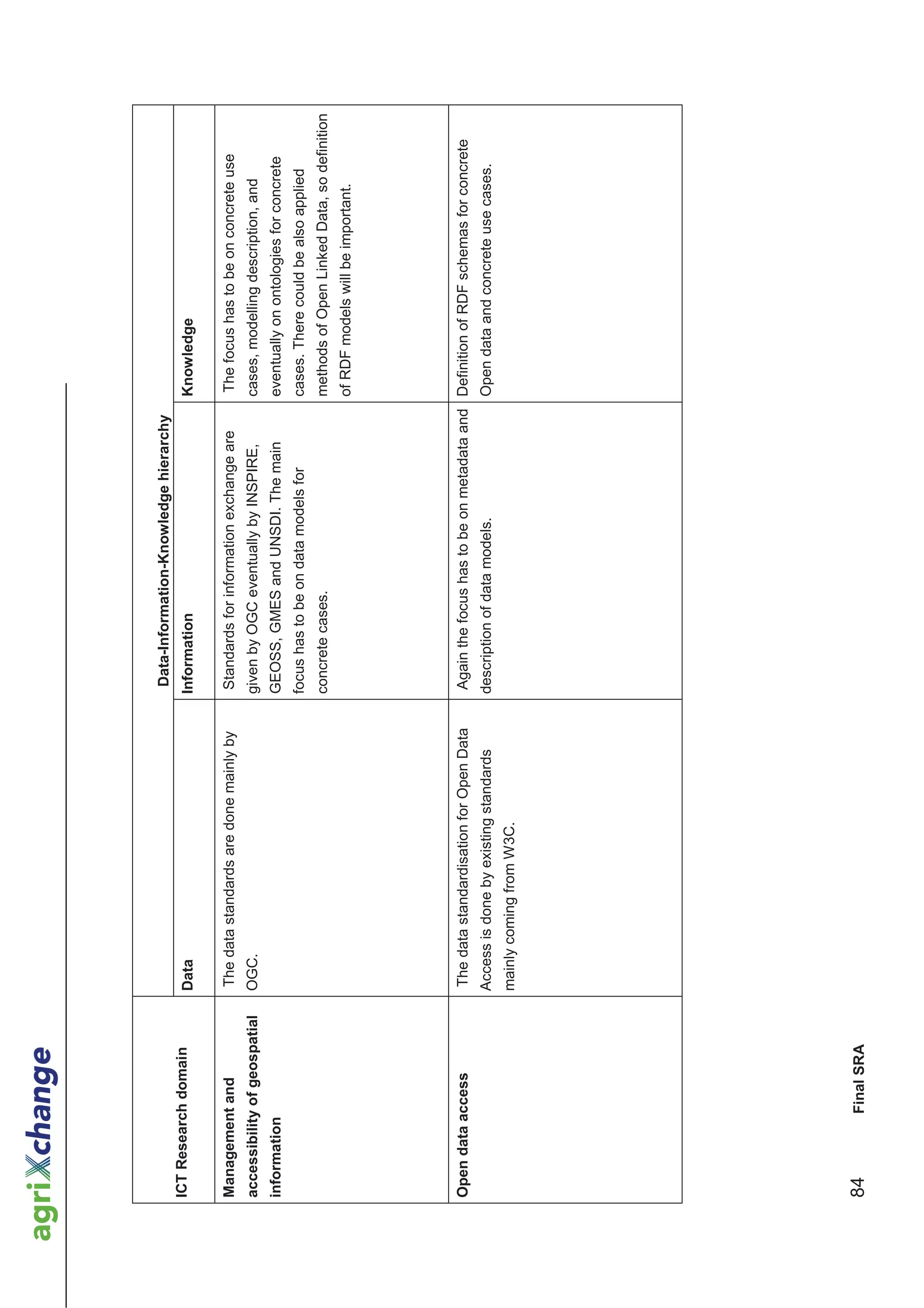
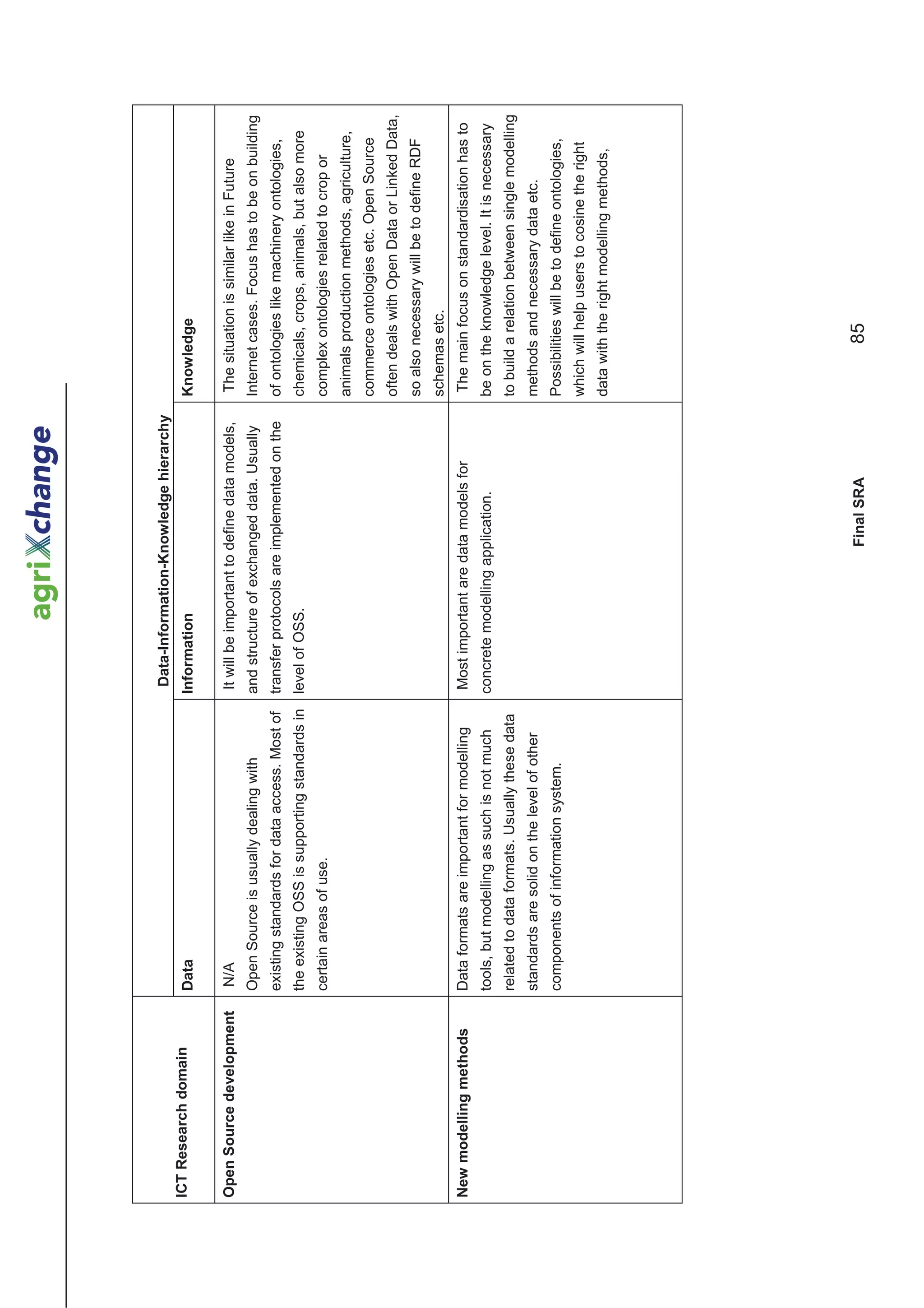
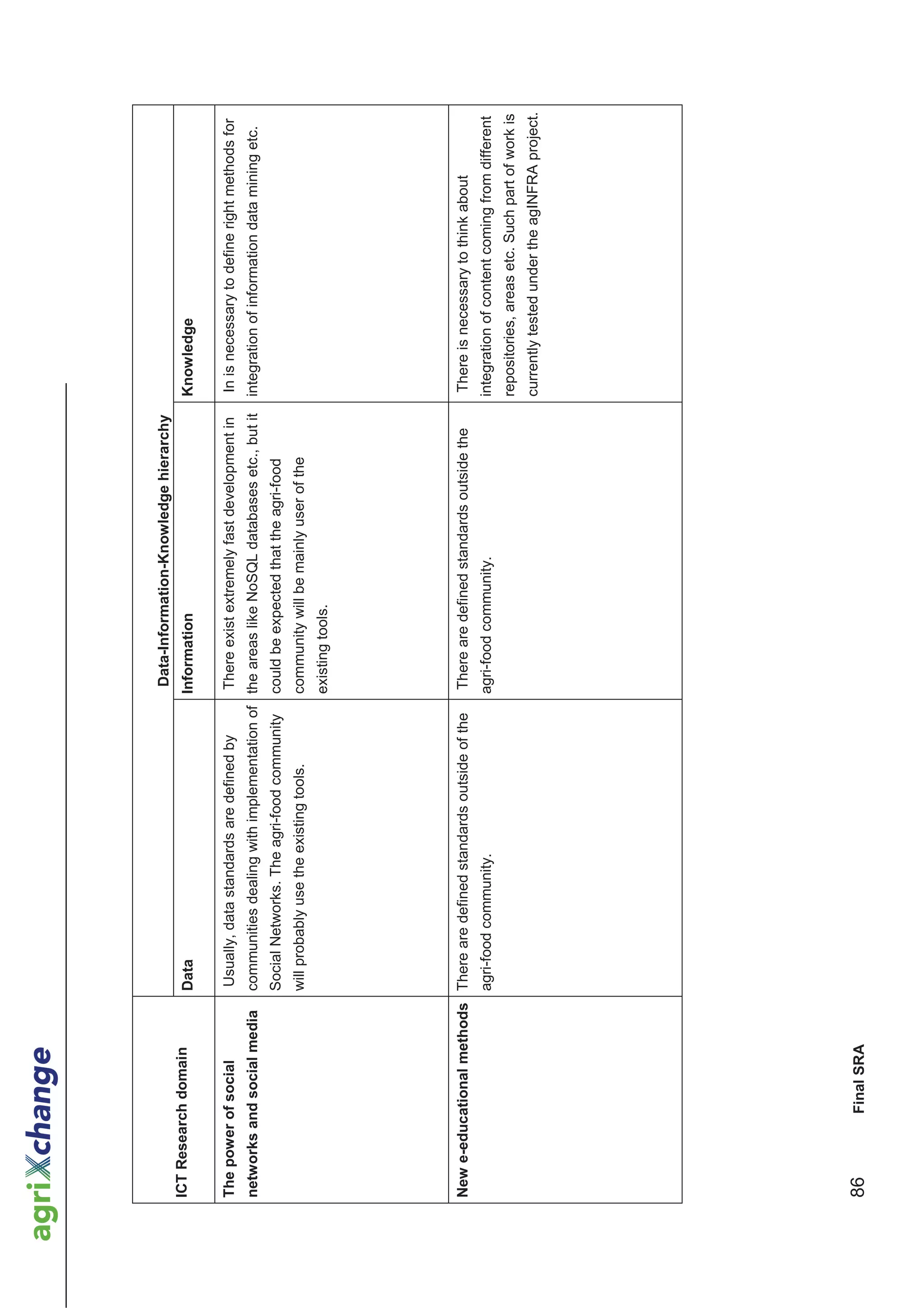
for different ICT Research Domains ....................................................................................................80


                                                                                                  Final SRA                                        5
Abbreviations
CAP              Common agricultural policy
DG               Directorate-General of the European Commission
DG REGIO         Directorate General for Regional Policy
Digital Agenda   A Digital Agenda for Europe
EFITA            European Federation for Information Technology in Agriculture, Food and the
                 Environment
eRural IP        eRural Integrated Project
FAO              Food and Agriculture Organisation
FP7              Seventh Framework Programme
FI-PPP           Future Internet Public-Private Partnership
GIS              Geographic information system
HTTP             Hypertext Transfer Protocol
i2010            A European Information Society for growth and employment
ICT              Information and communication technology
INFITA           International Network for Information Technology in Agriculture
KBBE             Knowledge-Based Bio-Economy
LEADER           European Community Initiative for assisting rural communities in improving the
                 quality of life and economic prosperity in their local area
PR               Public relations
IoT              Internet of Things
IPR              Intellectual Property Rights
OSGeo            Open Source Geospatial Foundation
OSI              Open Source Initiative
OSS              Open Source Software
RDF              Resource Description Framework
RFID             Radio Frequency Identification RT&D
RTD              Research and Technology Development
SLA              Service Level Agreement
SMEs             Small and medium-sized enterprises
SWG              Special Working Groups
SRA              Strategic Research Agenda
URI              Uniform Resource Identifier
WLAN             Wireless local area network
WIMAX            Worldwide Interoperability for Microwave Access
WTO              World Trade Organization
XML              Extensible Markup Language


6           Final SRA
Executive Summary
In our networked society, standards play an important role. That is especially the case in exchanging
digital data. With “Standards” we refer to the protocols that describe how data (in so called ‘meta-
data’) and the data-exchange are defined to make a digital exchange of data between two devices
(often computers but also computer-machine interaction) possible. Such standards enable
interoperability of data, information and knowledge between systems – they ensure compatibility.
Standards can reduce choice but the big advantage is that they reduce transaction costs to share
data and promote competition (users can easily change suppliers as they are not ‘locked in’ to
complete systems). That means they can also support innovation, although the wide use of a
standard can also block progress to something better.
Standardisation (the process of setting standards) can be a problematic process. Some standards
arise automatically in the market, for instance because somebody introduces an exemplary new
product that gets a large market share (the PDF format for published documents is an example). In
other cases newcomers to the market have a big incentive to support interoperability to win market
share (e.g. MS Word supports the use of WordPerfect files). However, often it is not that easy.
New products are not always developed with standardisation in mind, which can lead to path
dependency (as is shown in the debate if the QWERTY key pad was and is still optimal). In some
cases there have been fierce debates if a certain product standard that wins in the market, is really
optimal (e.g. in video recording between the technical advanced BETAMAX and the VHS that could
record a full football match). A standard can also lead to a monopolistic position of a product, but also
a clever use or a lack of standards can lead to unbalanced market situations (Shapiro and Varian,
1999)1.
Where there is not a guarantee that good standards arise automatically, they have to be created. As
many benefit from a standard, and a standard has positive externalities, free rider behaviour and
underinvestment is not unthinkable. There is an organisational challenge to create and maintain
standards.
Often this challenge is taken up by industry organisations, especially standard setting organisations
that have clear, open procedures for that activity. For instance, in Dutch agriculture specific
organisations (like AgroConnect) financed by industry membership fees set standards for specific
EDI (Electronic Data Interchange) messages in agriculture, after developing with industry partners
and research. In Germany KTBL plays a similar role concerning AgroXML. In food-retail the barcode
is an important standard, originally developed by Albert Heijn (now Ahold) in the 1970s and proposed
to colleague-retailers. Currently GS1 maintains such standards. Some standards are set by
governments, e.g. in the framework of UN/CEFACT. In some cases such standards are regulated to
be obligatory, or are obligatory in data exchange with the government (Blind, 2004)2.


agriXchange
It is against this background that agriXchange established a network of persons and organisations for
developing a system for common data exchange in the agricultural sector. This report provides a
strategic research agenda (SRA) for future work on data exchange and standards. The objective of


1
    C. Shapiro and H. Varian: The Art of Standard Wars in: California Management Review, 41-2, 1999
2
    K. Blind: The Economics of Standards: theory, evidence, policy. Edgar Elgar, 2004


                                                                               Final SRA               7
the SRA is to identify major challenges related to data exchange and the use of standards identified
mainly in the agriculture sector but also the agri-food industry sector.
The development of standards is based on data-models that describe the data that has to be
exchange and in a way that ensures the compatibility with the data systems at both ends of the
transfer. agriXchange investigated some cases to build a reference model for the standard setting
process itself, and implemented a practical model tool (aXTool) in the agriXchange platform to
search for and develop standards.


Future ICT use as demand for standards
To promote future standard setting in agriculture it is important to have an idea on the future use of
ICT. A review of the literature concludes that the deployment of ICT infrastructure for (standardised)
data exchange in Europe is progressing very fast. A large part of the population in Europe has the
possibility to access broadband or has permanent access to the Internet (the bandwidth is usually
lower for rural regions than for cities). However the actual use is much lower than the potential, and
especially agriculture and the rural areas are behind in the uptake of this technology. In many cases
application priorities are the same as 10 years ago. A big problem in going forward is the data,
information and knowledge exchange and interoperability. The uptake of new ICT interoperable
technologies in primary production, which will be accepted by farming sector, is an important part of
our SRA.
Our analysis learns that the last decade there is low sustainability of ICT related agri-food research
and little exchange of experiences among projects. Often similar analyses with similar results are
provided, but overall progress is slow. To overcome this problem, it is necessary to support a long-
term suitability of ICT research and to support a long-time vision for RTD development in the agri-
food sector.
We also conclude that better and faster implementation of ICT and related RTD demand more
appropriate business model thinking in addition to the current technical focus. Better and faster
implementation would also be supported by a strong professional (international) organisation which
unifies different efforts of different ICT research and development groups, but which will be also able
to protect interests of communities. The candidate for such an organisation could be the European
Federation for Information Technology in Agriculture, Food and the Environment (EFITA,) but it will
be necessary to change its organisational structure.
It is important to renew dialogues for politicians to focus on ICT for rural regions as part of Horizon
2020 activities. It is not only important to support standardisation awareness, but also deployment of
new solutions necessary for rural regions. Currently, ICT for agri-food is not covered on a large scale.
It is It is important to renew dialogues with politicians to focus on ICT for rural regions as part of
Horizon 2020 activities.
Due to the global character of agriculture and food production and also because agriculture
production influences and is influenced by the environment, it is important to improve dialogue and
transfer of ICT knowledge between developed and developing countries.
The latest ICT research trends, cover three aspects: Future Internet, Open Source Software and
Open Data. Future Internet (mainly cloud computing) and Open Source Software, show two
important developments:
    •    Interoperability and service-oriented architecture, which allows easy replacement of one
         component or service by another one. This concept is already currently broadly used in
         geographic information systems.


8              Final SRA
•    Support for large-scale use of Open Sources by Future Internet. Currently, Open Source
         generates business for companies which customise solutions into final applications. Such
         web-based solutions could generate profit for SMEs developers.
Open data initiatives and Public Sector Information are also considered important for the agri-food
sector. Until now, mainly farmers have been limited by restricted access to data, information and
knowledge. Linked Data introduces new semantic principles into Web resources and could be useful
to the agri-food sector.


Beyond future ICT use: research for far-future ICT use.
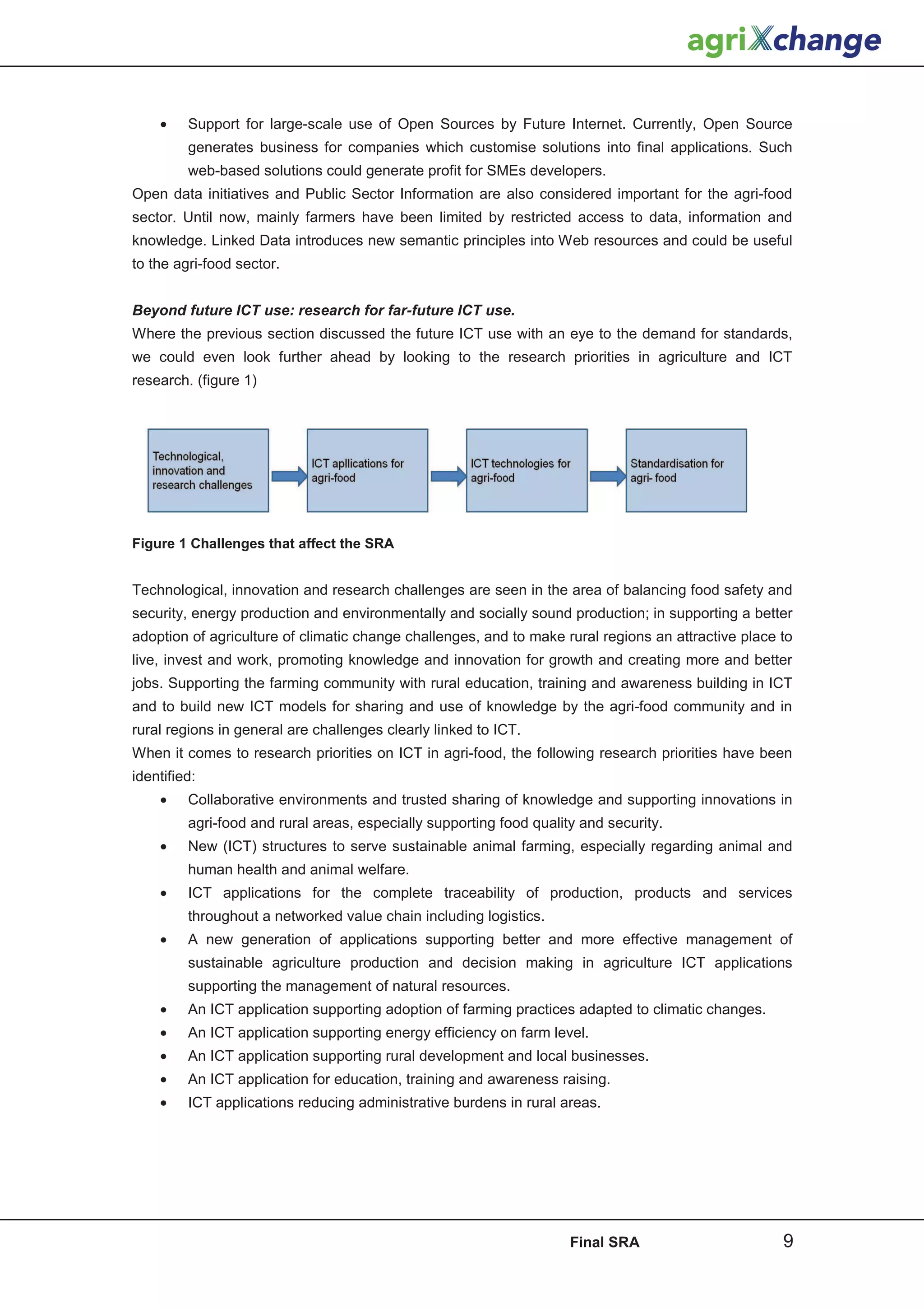
Where the previous section discussed the future ICT use with an eye to the demand for standards,
we could even look further ahead by looking to the research priorities in agriculture and ICT
research. (figure 1)


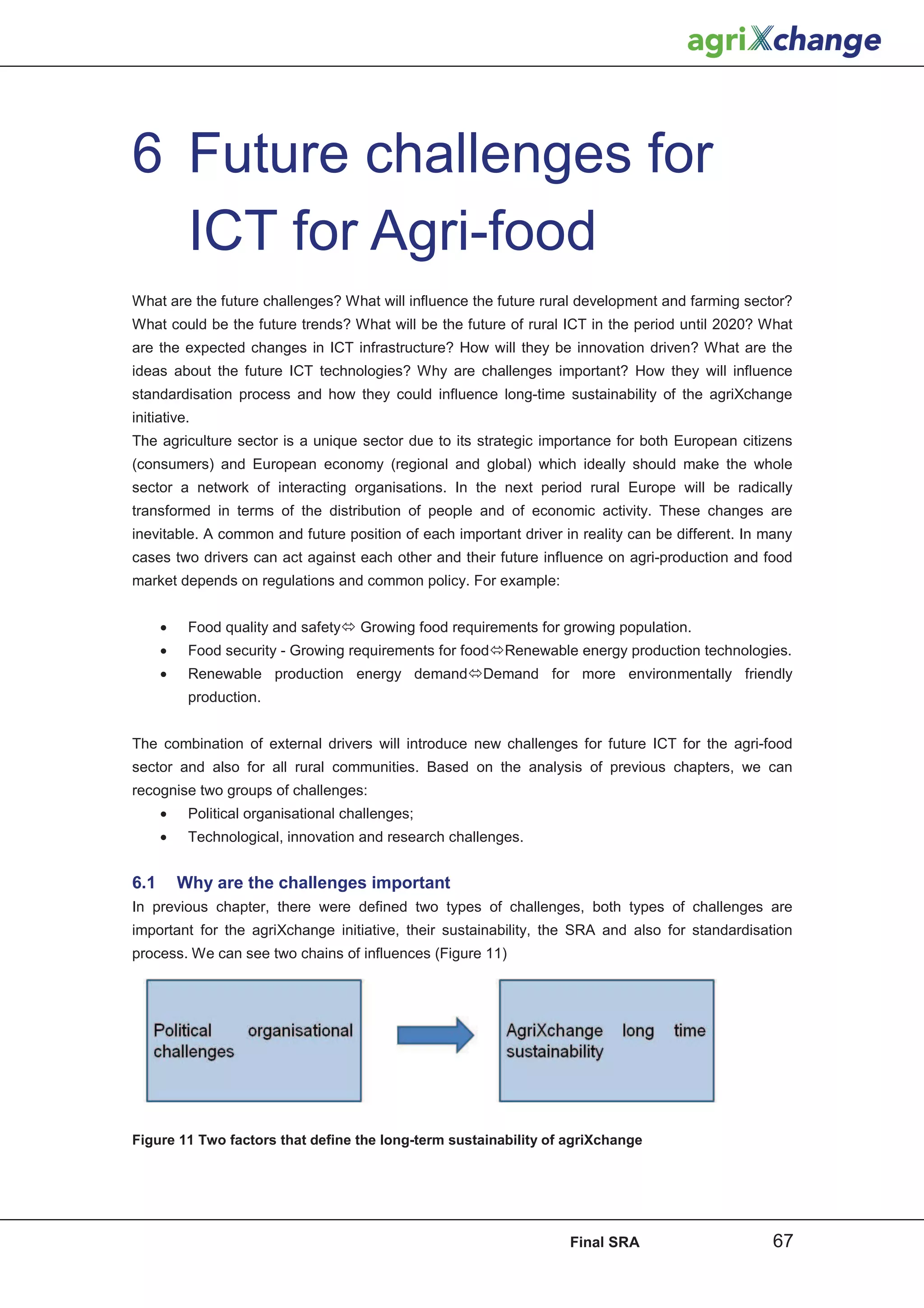
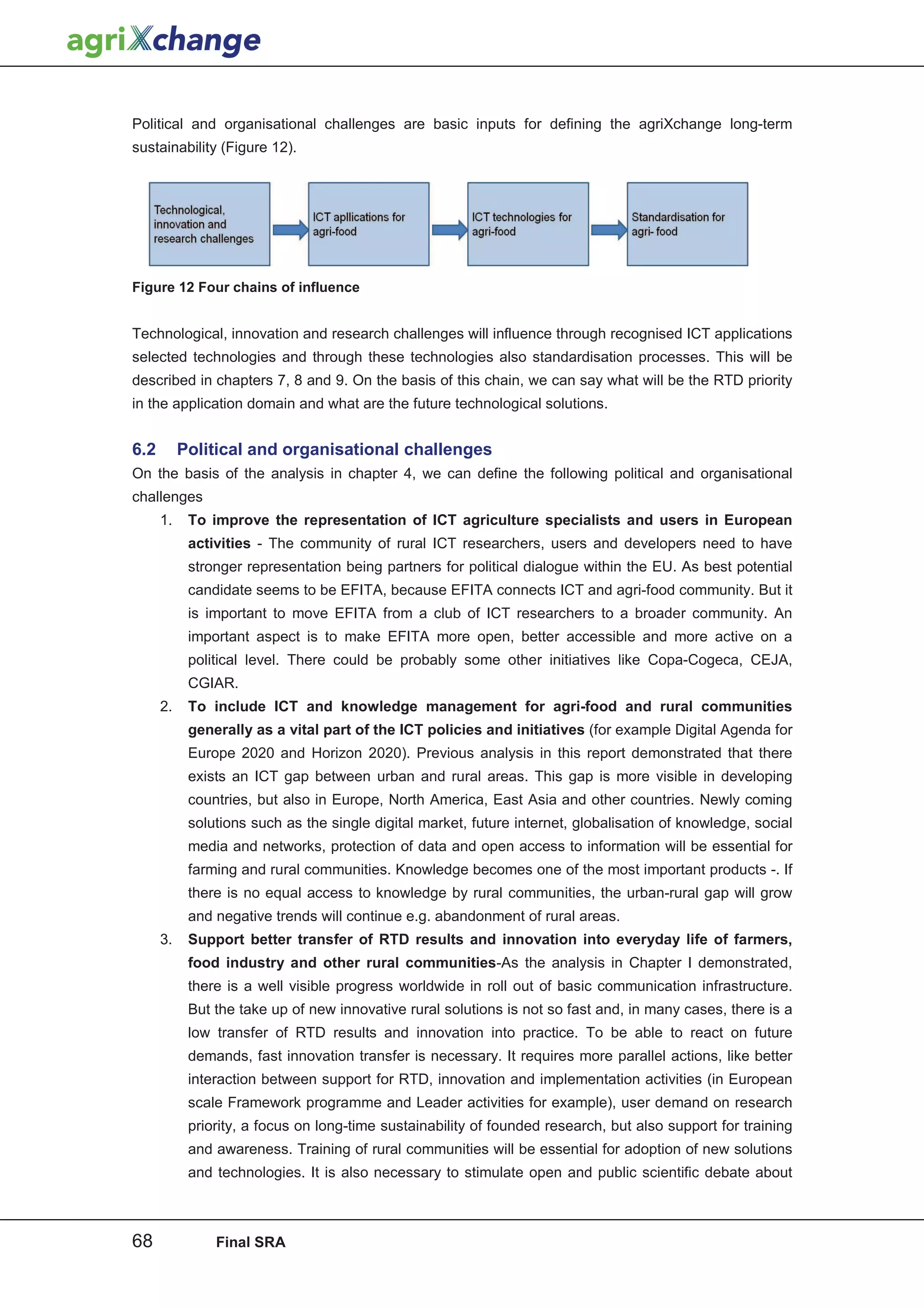
Figure 1 Challenges that affect the SRA


Technological, innovation and research challenges are seen in the area of balancing food safety and
security, energy production and environmentally and socially sound production; in supporting a better
adoption of agriculture of climatic change challenges, and to make rural regions an attractive place to
live, invest and work, promoting knowledge and innovation for growth and creating more and better
jobs. Supporting the farming community with rural education, training and awareness building in ICT
and to build new ICT models for sharing and use of knowledge by the agri-food community and in
rural regions in general are challenges clearly linked to ICT.
When it comes to research priorities on ICT in agri-food, the following research priorities have been
identified:
    •    Collaborative environments and trusted sharing of knowledge and supporting innovations in
         agri-food and rural areas, especially supporting food quality and security.
    •    New (ICT) structures to serve sustainable animal farming, especially regarding animal and
         human health and animal welfare.
    •    ICT applications for the complete traceability of production, products and services
         throughout a networked value chain including logistics.
    •    A new generation of applications supporting better and more effective management of
         sustainable agriculture production and decision making in agriculture ICT applications
         supporting the management of natural resources.
    •    An ICT application supporting adoption of farming practices adapted to climatic changes.
    •    An ICT application supporting energy efficiency on farm level.
    •    An ICT application supporting rural development and local businesses.
    •    An ICT application for education, training and awareness raising.
    •    ICT applications reducing administrative burdens in rural areas.


                                                                     Final SRA                       9
Future standardisation needs: the SRA
Based on this analysis of future use of ICT in agriculture, we can address the future need for
standardisation. This leads to the following observations on data, information and knowledge
standardisation.
Concerning data standardisation, the agri-food community will mainly be the consumer of standards
coming from other domains or activities. For example activities related to Future Internet, where it is
the intention to design low-level standards allowing developers to access data through standardised
API. A similar situation, for example, can be found with geospatial data, where access is solved
through OGC standards. Also questions like security are mainly solved outside the agri-food
community. It is important to follow such initiatives, and eventually participate in them if progress is
not fast enough or solutions tend not to take agri-food specifics into account. In two specific
agricultural areas further development is necessary inside of the agri-food community:
             o     ISOBUS for access to information to agriculture machinery;
             o     Special agriculture sensors or RFID activities.
More important seems to be the standardisation efforts at the information level. This focuses on
protocols (Web services), API and data models for exchange of information in different areas such as
traceability, precision farming, livestock transport, welfare regulations, subsidies systems (for
example LPIS), weather information, market information, logistic information. It seems that for the
coming years the key focus will be in this area. The work could be partly related to activities such as
agroXML.
With the expansion of Web-based technologies, more standardisation efforts will be necessary at the
knowledge level. Access to knowledge is the goal of many information systems. It is necessary to
build knowledge based tools, which will help user in orientation and right decision. That could be
ontologies, RDF schemas for linked open data, thesauri or vocabularies. Such activities already
exist, for example under FAO (AgroVoc thesaurus) and different tools of knowledge management.
This effort is partly covered by a new project agINFRA.


After AgriXchange….
In standardisation, it is important to transfer the standard to the community. It is necessary to support
communication between researchers, politicians, industry and also final users. It is necessary to
transfer all knowledge to the users. It is important that the requirements for standards are not
defined only by the government or by large industry. Standards have to cover needs of users like
farmers and regional and local ICT developers. Involvement of these communities is crucial. At the
other side, the food market is international and for example information about food traceability has to
be shared worldwide. It is important in this area to develop and support global standards.
It is not realistic to establish a new organization for such standardisation processes, although more
coordination at EU level seems attractive. This is not only a question of financing, but it is also a
question of building infrastructure, human resources, etc. For this reason, we recommend to hand
over and continue agriXchange results under the umbrella of an existing organisation. It will increase
the chances for financing of future activities. As an umbrella organisation at EU level, the European
Federation for Information Technology in Agriculture (EFITA) would be most suitable.
Currently, ICT for the agri-food sector is not covered by any policies and also there is no direct
support for such activities. The topic is addressed by different Directorate Generals (DGs), but no DG
covers this issue fully. It is important to include these topics as part of the European priorities and
also as part of Horizon 2020. Collaboration between member states could be strengthened by the
ERAnet ICT-Agri. It is important to have a strong representative community, which will provide the


10           Final SRA
necessary lobbying. On the worldwide level, part of these activities is covered by FAO. But there are
gaps between FAO and the worldwide community. It is necessary to improve cooperation. The
International Network for Information Technology in Agriculture (INFITA) could play an important role
here.
RTD results and results of standardisation have to be transferred into practice to local and regional
users. In the future, the agINFRA project could be of help. The project has an objective to build
infrastructure for sharing agriculture information. It is necessary to support open innovation initiatives
in rural regions. It would be good to introduce concept of “Smart Rural Regions” similar to Smart
Cities.


                                                                      Final SRA                       11
Synthetic Summary
The agriXchange Strategic Research Agenda (SRA) goes beyond the general scope of the
agriXchange initiative. It is focused not only on standardisation of data exchange but also on the
definition of research priorities for ICT in the agri-food sector and for future sustainability of ICT
agriculture research and standardisation.
The document was prepared in two stages. Project team studies and available materials were the
basis for the first stage. The second stage involved community contribution, which comprised the
following three ways of updating the document:
     •   Publishing the draft agriXchange SRA on the project agriXchange platform for public
         discussion.
     •   In situ discussion about the draft agriXchange SRA on SmartAgriMatics 2012 conference in
         Paris;
     •   Virtual discussion about the draft agriXchange SRA on Linked-In network. The challenges
         and recommendations were discussed by an international community. A number of
         comments and contributions came from social networks. In effect, this was the most
         valuable source of comments.
The last update of the document was done on the basis of comments and discussions within the
agriXchange team. Those comments led to this final version of the document.
The document is divided into ten parts.
The first part, the introduction, defines the background and scope, main problems, objectives and
approach and outline for the rest of the document.
The second part introduces basic problems of agriculture interoperability, the problems of
management and interoperability of data, information and knowledge in agriculture.
The third part gives a short overview of current standardisation initiatives, which are relevant to the
problems of agriXchange. It also describes current agriXchange activities in the area of
standardisation. The agriXchange work was focused on two topics:
     •       the structure of the framework model serves information on sharing and harmonisation
             development for data exchange, and
     •       the implementation of the practical model tool (aXTool) in the agriXchange platform to
             be user-friendly.
The fourth part gives an overview of previous activities. We analysed only those projects and
documents that were focused on a vision of future ICT for agri-food or eventually ICT for rural
development. The analyses conclude that the progress in the deployment of ICT infrastructure for
(standardised) data exchange in Europe is changing very fast and changes from one year to the
other. In principle, a large part of the population in Europe has the possibility to access broadband
or has permanent access to the Internet (the bandwidth is usually lower for rural regions than for
cities). This potential access to the Internet is not really used: real use of Internet access is lower in
rural regions and the uptake of new solutions into practice and also research in agri-food and rural
applications is slower than the deployment of the general infrastructure. In many cases application
priorities are the same as 10 years ago. The big problem is the data, information and knowledge
exchange and interoperability.


12           Final SRA
•    From the overview we come to the following conclusions, important for building of
         agriXchange SRA: The uptake of new ICT interoperable technologies in primary production,
         which will be accepted by farming sector
    •    The analysis of documents from the last decade demonstrates that there is low sustainability
         of ICT for agri-food research and little exchange of experiences among projects. Often
         similar analyses with similar results are provided, but overall progress is slow. To overcome
         this problem, it is necessary to support a long-term suitability of ICT research and to support
         a long-time vision for RTD development in the agri-food sector.
    •    Better and faster implementation of RTD results of ICT in practice with appropriate business
         model thinking.
    •    A strong professional (international) organisation which will unify different efforts of different
         ICT research and development groups, but which will be also able to protect interests of
         communities. The candidate for such an organisation could be the European Federation for
         Information Technology in Agriculture, Food and the Environment (EFITA,) but it will be
         necessary to change its organisational structure.
    •    It is important to renew dialogues for politicians to focus on ICT for rural regions as part of
         Horizon 2020 activities. It is not only important to support standardisation awareness, but
         also deployment of new solutions necessary for rural regions. Currently, ICT for agri-food is
         not covered on a large scale, neither in DG Connect research nor in KBBE calls.
    •    Due to the global character of agriculture and food production and also because agriculture
         production influences and is influenced by the environment, it is important to improve
         dialogue and transfer of ICT knowledge between developed and developing countries.
Chapter five is focused on the latest ICT research trends, covering three aspects:
    •        Future Internet;
    •        Open Source Software;
    •        Open Data.
This chapter discusses the relation between Future Internet (mainly cloud computing) and Open
Source Software, which could be in some way considered as competitive approaches, but at the
same time they could be in synergy. There are two important aspects:
    1.   Interoperability and service-oriented architecture, which allows easy replacement of one
         component or service by another one. This concept is already currently broadly used in
         geographic information systems.
    2.   Support for large-scale use of Open Sources by Future Internet. Currently, Open Source
         generates business for companies which customise solutions into final applications. Such
         web-based solutions could generate profit for SMEs developers.
The last part of the analysis is focused on Open Data and Linked Data. Open data initiatives and
Public Sector Information are also considered important for the agri-food sector. Until now, mainly
farmers have been limited by restricted access to data, information and knowledge. Linked Data
introduces new semantic principles into Web resources and could be useful to the agri-food sector.
Chapters 2 to 5 are mainly analytical: the focus of these chapters was on collecting and analysis of
available resources. The next chapters are synthetic, focused on building a new vision.


Chapter 6 is focused on future challenges. There are two types of challenges
    •    Political-organisational challenges
    •    Technological, innovation and research challenges


                                                                      Final SRA                        13
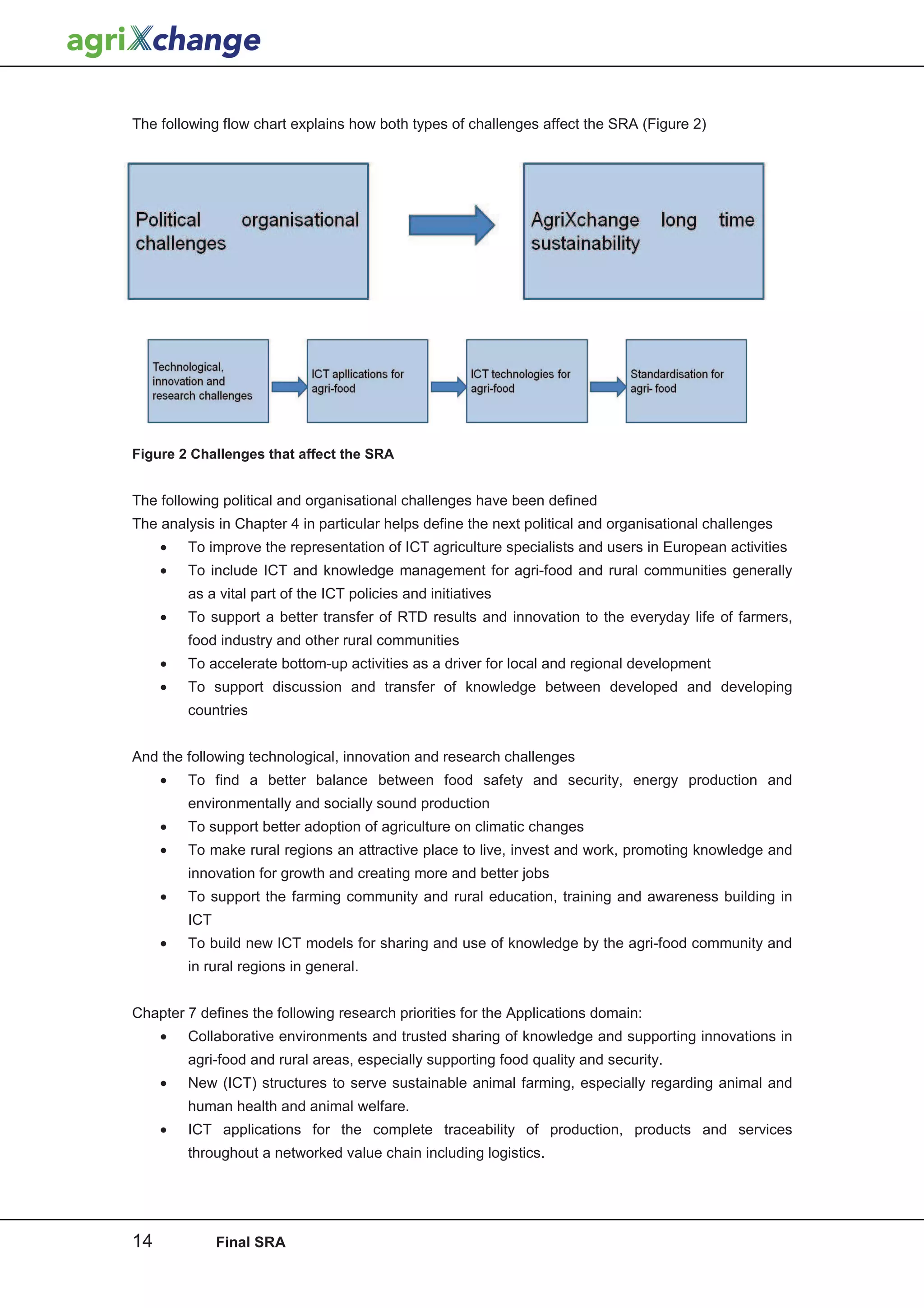
The following flow chart explains how both types of challenges affect the SRA (Figure 2)


Figure 2 Challenges that affect the SRA


The following political and organisational challenges have been defined
The analysis in Chapter 4 in particular helps define the next political and organisational challenges
     •   To improve the representation of ICT agriculture specialists and users in European activities
     •   To include ICT and knowledge management for agri-food and rural communities generally
         as a vital part of the ICT policies and initiatives
     •   To support a better transfer of RTD results and innovation to the everyday life of farmers,
         food industry and other rural communities
     •   To accelerate bottom-up activities as a driver for local and regional development
     •   To support discussion and transfer of knowledge between developed and developing
         countries


And the following technological, innovation and research challenges
     •   To find a better balance between food safety and security, energy production and
         environmentally and socially sound production
     •   To support better adoption of agriculture on climatic changes
     •   To make rural regions an attractive place to live, invest and work, promoting knowledge and
         innovation for growth and creating more and better jobs
     •   To support the farming community and rural education, training and awareness building in
         ICT
     •   To build new ICT models for sharing and use of knowledge by the agri-food community and
         in rural regions in general.


Chapter 7 defines the following research priorities for the Applications domain:
     •   Collaborative environments and trusted sharing of knowledge and supporting innovations in
         agri-food and rural areas, especially supporting food quality and security.
     •   New (ICT) structures to serve sustainable animal farming, especially regarding animal and
         human health and animal welfare.
     •   ICT applications for the complete traceability of production, products and services
         throughout a networked value chain including logistics.


14             Final SRA
•   A new generation of applications supporting better and more effective management of
        sustainable agriculture production and decision making in agriculture ICT applications
        supporting the management of natural resources.
    •   An ICT application supporting adoption of farming practices adapted to climatic changes.
    •   An ICT application supporting energy efficiency on farm level.
    •   An ICT application supporting rural development and local businesses.
    •   An ICT application for education, training and awareness raising.
    •   ICT applications reducing administrative burdens in rural areas.
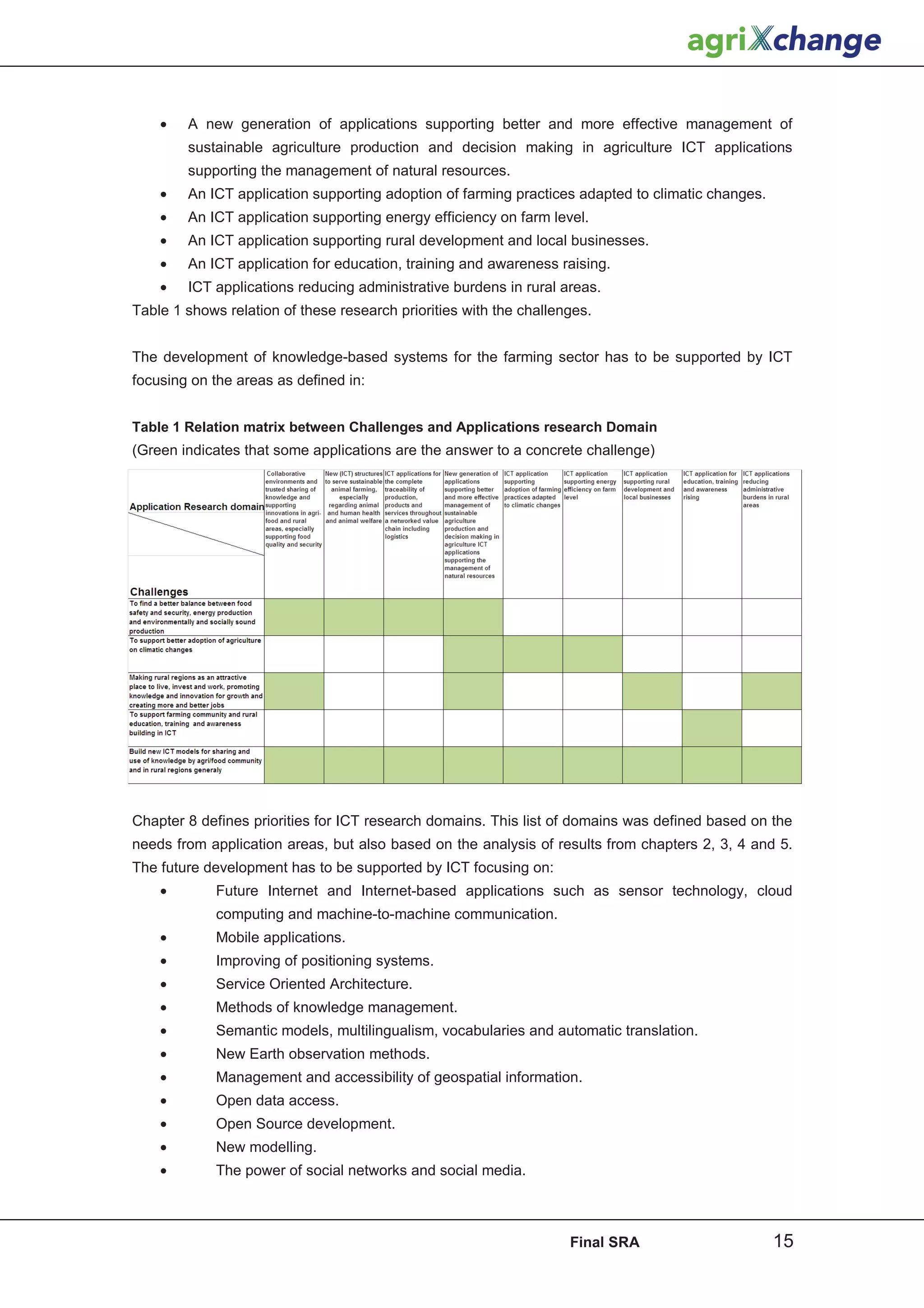
Table 1 shows relation of these research priorities with the challenges.


The development of knowledge-based systems for the farming sector has to be supported by ICT
focusing on the areas as defined in:


Table 1 Relation matrix between Challenges and Applications research Domain
(Green indicates that some applications are the answer to a concrete challenge)


Chapter 8 defines priorities for ICT research domains. This list of domains was defined based on the
needs from application areas, but also based on the analysis of results from chapters 2, 3, 4 and 5.
The future development has to be supported by ICT focusing on:
    •        Future Internet and Internet-based applications such as sensor technology, cloud
             computing and machine-to-machine communication.
    •        Mobile applications.
    •        Improving of positioning systems.
    •        Service Oriented Architecture.
    •        Methods of knowledge management.
    •        Semantic models, multilingualism, vocabularies and automatic translation.
    •        New Earth observation methods.
    •        Management and accessibility of geospatial information.
    •        Open data access.
    •        Open Source development.
    •        New modelling.
    •        The power of social networks and social media.


                                                                    Final SRA                      15
•                      New e-educational and training methods.


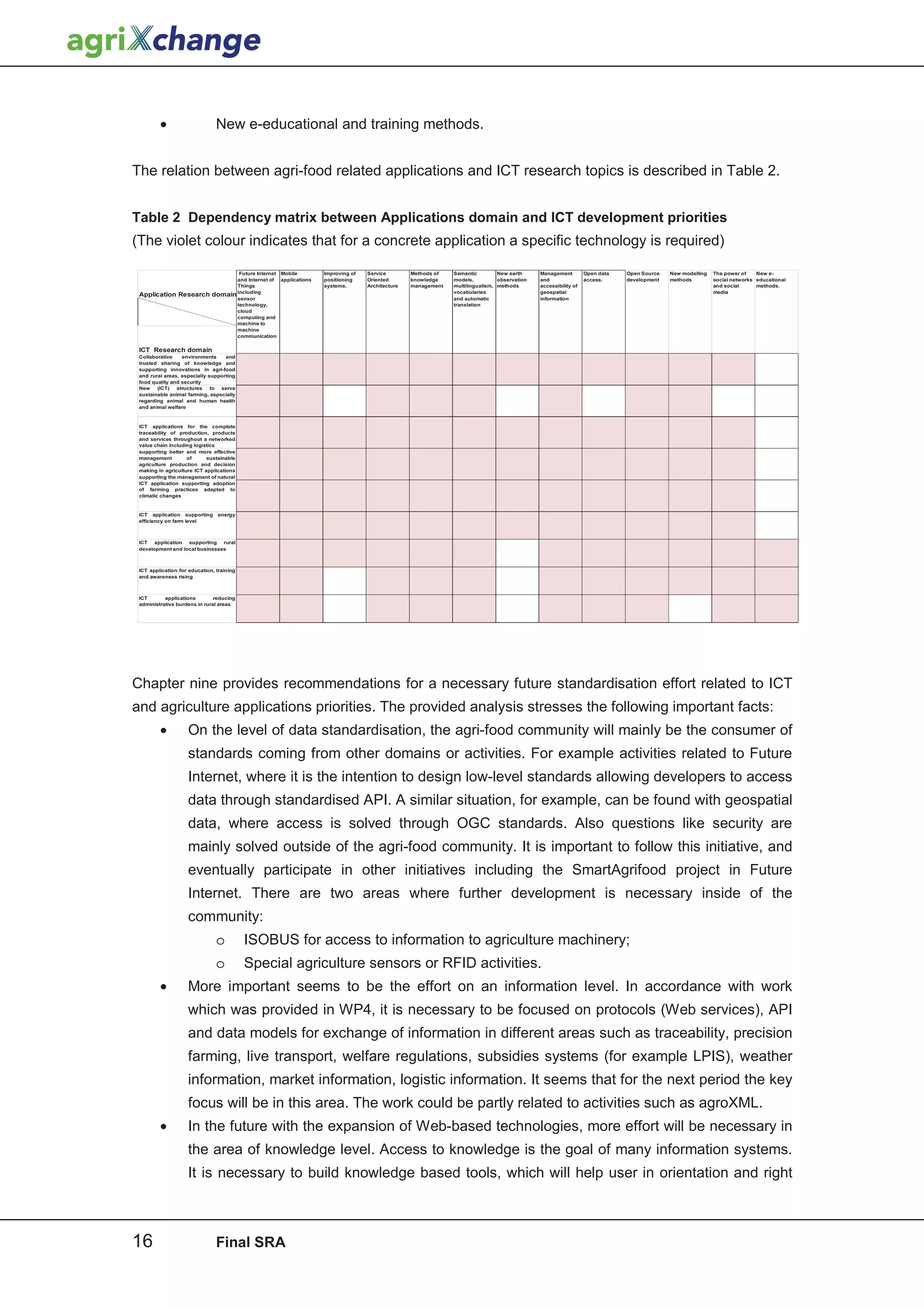
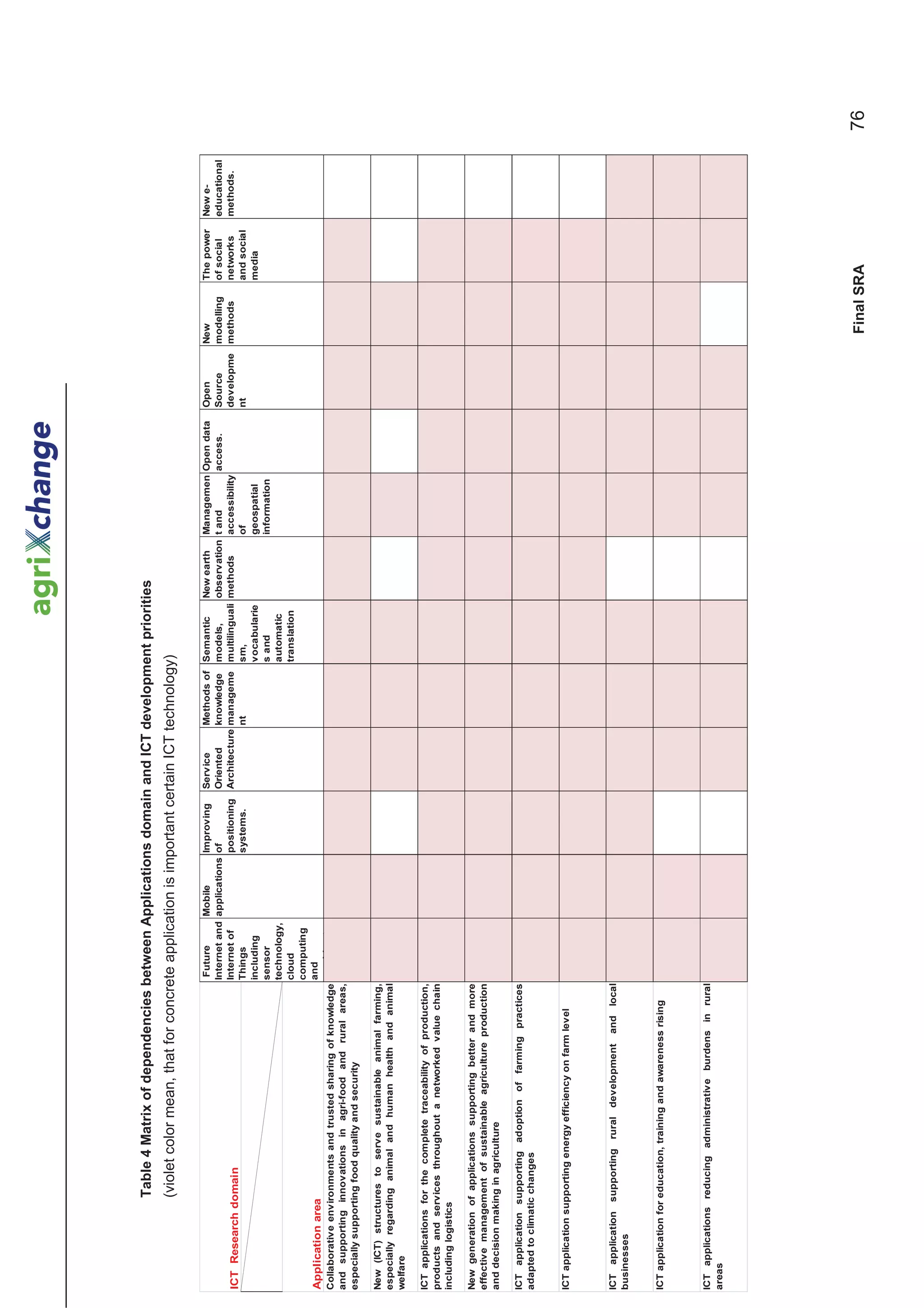
The relation between agri-food related applications and ICT research topics is described in Table 2.


Table 2 Dependency matrix between Applications domain and ICT development priorities
(The violet colour indicates that for a concrete application a specific technology is required)

                                            Future Internet Mobile        Improving of   Service        Methods of   Semantic         New earth     Management         Open data   Open Source   New modelling   The power of    New e-
                                           and Internet of applications   positioning    Oriented       knowledge    models,          observation   and                access.     development   methods         social networks educational
                                           Things                         systems.       Architecture   management   multilingualism, methods       accessibility of                                             and social      methods.
 Application Research domain including                                                                               vocabularies                   geospatial                                                   media
                                           sensor                                                                    and automatic                  information
                                           technology,                                                               translation
                                           cloud
                                           computing and
                                           machine to
                                           machine
                                           communication


 ICT Research domain
 Collaborative    environments     and
 trusted sharing of knowledge and
 supporting innovations in agri-food
 and rural areas, especially supporting
 food quality and security
 New    (ICT)   structures    to serve
 sustainable animal farming, especially
 regarding animal and human health
 and animal welfare


 ICT applications for the complete
 traceability of production, products
 and services throughout a networked
 value chain including logistics
 supporting better and more effective
 management         of      sustainable
 agriculture production and decision
 making in agriculture ICT applications
 supporting the management of natural
 ICT application supporting adoption
 of farming practices adapted to
 climatic changes


 ICT application supporting     energy
 efficiency on farm level


 ICT application supporting rural
 development and local businesses


 ICT application for education, training
 and awareness rising


 ICT       applications        reducing
 administrative burdens in rural areas


Chapter nine provides recommendations for a necessary future standardisation effort related to ICT
and agriculture applications priorities. The provided analysis stresses the following important facts:
         •          On the level of data standardisation, the agri-food community will mainly be the consumer of
                    standards coming from other domains or activities. For example activities related to Future
                    Internet, where it is the intention to design low-level standards allowing developers to access
                    data through standardised API. A similar situation, for example, can be found with geospatial
                    data, where access is solved through OGC standards. Also questions like security are
                    mainly solved outside of the agri-food community. It is important to follow this initiative, and
                    eventually participate in other initiatives including the SmartAgrifood project in Future
                    Internet. There are two areas where further development is necessary inside of the
                    community:
                                o            ISOBUS for access to information to agriculture machinery;
                                o            Special agriculture sensors or RFID activities.
         •          More important seems to be the effort on an information level. In accordance with work
                    which was provided in WP4, it is necessary to be focused on protocols (Web services), API
                    and data models for exchange of information in different areas such as traceability, precision
                    farming, live transport, welfare regulations, subsidies systems (for example LPIS), weather
                    information, market information, logistic information. It seems that for the next period the key
                    focus will be in this area. The work could be partly related to activities such as agroXML.
         •          In the future with the expansion of Web-based technologies, more effort will be necessary in
                    the area of knowledge level. Access to knowledge is the goal of many information systems.
                    It is necessary to build knowledge based tools, which will help user in orientation and right


16                              Final SRA
decision. It could be ontologies, RDF schemas for open linked data, thesaurus or
        vocabularies. Such activities already exist, for example under FAO (AgroVoc thesaurus) and
        different tools of knowledge management. This effort is partly covered by the new project
        agINFRA.
Chapter 10 defines long-term strategic goals for sustainability of agriXchange. This strategy follows
the political organisational challenges defined in Chapter 6 for the following reasons:
    •   In any area there are two types of standardisation efforts:
             o   Community or industry driven effort. For these it is necessary to have structure
                 inside the community, which will take leadership in this area.
             o   Politically driven standardisation – in the agri-food area it could include standards
                 for animals welfare, food security etc. For implementation in practice, it is necessary
                 to support related policy. Also, it is good for policy makers to have partners on the
                 community level.
    •   For any standard it is important to transfer it to the community. It is necessary to support
        communication between researchers, politicians, industry and also final users. It is
        necessary to transfer all knowledge to the users.
    •   It is important that the requirements for standards are not defined only by politicians or by
        large industry. Standards have to cover needs of users like farmers and regional and local
        IST developers. Involvement of these communities is crucial.
    •   The food market is international and for example information about food traceability has to
        be shared worldwide. It is important in this area to support standards worldwide.
As a reaction on single challenges there are the following recommendations:
    •   It is necessary to have a better coordination of different activities related to ICT for
        agriculture, but also related to standardisation. On the basis of the performed analysis, it
        seems not realistic to establish a new platform initiative. It is not only a question of financing,
        but it is also a question of building infrastructure, human resources, etc. For this reason, the
        project team recommends to move agriXchange under the umbrella of an existing
        organisation. It will increase the chances for financing of future activities. As an umbrella
        organisation, the European Federation for Information Technology in Agriculture (EFITA)
        would be most suitable. The advantage to have a European body, representing the ICT Agri-
        food sector, which could be an interesting partner for the European Commission and other
        policy actors.., in particular for Initiatives such as the European Innovation Partnership.
    •   Currently ICT for agri-food sector is not covered by any policies and also there is no direct
        support for such activities. The topic is addressed by different Directorate Generals (DGs),
        but no DG covers this issue fully. It is important to include these topics as part of the
        European priorities and also as part of Horizon 2020. From this reason, it is important to
        have strong representative of a community, which will provide the necessary lobbing. On the
        worldwide level, part of these activities is covered by FAO. But there are gaps between FAO
        and the worldwide community. It is necessary to improve cooperation.
    •   Any RTD results and also results of standardisation have to be transferred into practice to
        local and regional users. In the future, the agINFRA project could be of help. The project has
        an objective to build infrastructure for sharing agriculture information.
    •   It is necessary to support open innovation initiatives in rural regions. It will be good to
        introduce concept of “Smart Rural Regions” similar to Smart Cities.


                                                                      Final SRA                        17
•   It is necessary to support standardisation cooperation also worldwide. FAO or the
         International Network for Information Technology in Agriculture (INFITA) could play an
         important role.


18           Final SRA
1 Introduction
1.1    Background and scope

The objective of this report is to provide a Strategic Research Agenda (SRA) which reflects the
business demands for use of ICT and exchange of agriculture data, information and knowledge
supported by current standardisation, but also by future research in ICT for the agri-food industry. It
reflects the needs of the agriculture business. The focus of the SRA is on identifying major ICT
challenges related to the use of ICT and data, information, knowledge and standards in agriculture
and the agri-food industry sector. The agenda defines not only the necessary ICT standards, but also
in a broader view the Research and Technology Development (RTD) areas which will be selected as
key priorities to achieve the challenges identified. The wide deployment of data, information and
knowledge management, which will include ICT technologies, data, information and standards,
exchange of information and use of ICT standards specifically oriented to the agri-food industry, will
support the transformation of agriculture production into a competitive, sustainable and dynamic
Knowledge-Based Bio-Economy (KBBE) as well as facilitate the participation and ultimately the
complete integration of agricultural production into the Knowledge Society. The SRA is mainly
focused on the KBBE and ICT programmes within the EU FP7 Research Programme, but it is based
on activities on a regional and cross-regional level as well as within other EU programmes and
initiatives. It is critical to follow the main trends, but also to cooperate with the main industry and ICT
players involved. The definition of the SRA required a deep knowledge of problems of agriculture
data, information and knowledge interoperability, previous activities, existing standardisation
problems, the state of the art in the agri-food ICT area, but also consultations with representatives
from industry, governments, agencies, operators, and agri-food authorities and stakeholders involved
in rural development. The discussions with stakeholders during events such as the GeoFARMatics
conference in Cologne in 2010 or the EFITA congress in Prague 2011 played an important role. The
first version of the SRA was published in May 2012. The current document is presenting the final
version of strategic lines that, after validation of the draft version (mainly provided based on the
Smart AgriMatics conference and the Linked-In social network), will support all domain stakeholders
in the process of implementing a number of specific measures to achieve the stated objectives. This
document is the final version, but it is still open for comments. The goal of this SAR is to stimulate
future discussions. For this reason, the document is published under the Common Creative License
to support its re-use and further exploitation of the collected ideas. The objective of the document is
to stimulate discussion. ICT in agriculture is a very dynamic sector and it requires the continual
updating of ideas. On the other hand, the analysis of previous activities demonstrates that there is a
need for a long-time sustainability of ICT for agri-food research (many previous SRAs and other
strategic documents dispersed without any continuity and also accessibility of previous documents).


1.2    Problem
The agriculture sector is a unique sector due to its strategic importance for both European citizens
(consumers) and the European economy (regional and global), which, ideally, should make the
whole sector a network of interacting organisations. Rural areas are of particular importance with
respect to the agri-food sector and should be specifically addressed within this scope. There is an
increasing tension that has not been experienced in any other sector between the requirements to


                                                                      Final SRA                        19
ensure full food safety as well as sustainability while keeping costs under control. Also it is necessary
to ensure the long-term strategic interests of Europe and worldwide [1], also with regard to food
security and global challenges. To solve the problems of future farming, we need to develop a new
generation of knowledge management, which will help the agri-food sector to adopt to a changing
world. The objective of future knowledge management is to help the agri-food sector to be
competitive in the market in the sense of required products, quality and amount, to be able to react to
changes in the world market, changes in subsidies systems, requirements for environment
protection, but also to be able to react for example to increasing costs of inputs or to climate
changes. The future knowledge management systems have to support not only direct profitability of
the agri-food sector or environment protection, but also activities of individuals and groups, allowing
effective collaboration among groups in the agri-food industry and consumers and wider
communities, especially in the rural domain. Having these considerations in mind, the proposed
vision lays the foundation for meeting ambitious but achievable operational objectives that in the long
run will definitively contribute to fulfil identified needs. The knowledge management represents the
on-going relationship between people, processes and technology systems involved in designing,
capturing and implementing the intellectual infrastructure of an organisation. It encompasses the
necessary changes in management attitudes, organisational behaviour and policy. Knowledge
management should create a value for the customer and increase the profitability of farms. It is clear
from the definition that knowledge management goes one step further than the simple concept of
information systems and data exchange and entails other two factors, people and processes [2]. This
will require better exchange of information, but also the adoption of new scientific and research
results in the agri-food sector.
The discussions on social networks demonstrate the growing importance of bottom-up activities,
collaboration and social media. Open innovation and open data access are important for future rural
development. Such activities as Living Labs could help rural regions in future. For the urban
population there is a growing activity called Smart Cities. It is important to support similar activities for
rural regions - Smart Rural Regions.


1.3     Objectives of study
The objective of the SRA is to identify major challenges related to the use of standards identified in
agriculture and agri-food industry sector. The agenda defines Research and Technology
Development areas which will be selected as key priorities to achieve the challenges identified. The
future wide deployment and use of standards, which will be specifically oriented to the agri-food
industry, will support the transformation of agriculture production into competitive and dynamic
knowledge-based economy, as well as facilitating the participation and ultimately the complete
integration of the EU agriculture production into the Knowledge Society. The SRA is mainly focused
on KBBE and ICT within FP7 and Horizon2020, but also on sets of activities on a regional and
cross.-regional level as well as within other EU programmes and initiatives.
The second objective is to recommend a way for the long-term sustainability of the agriXchange
initiative.


1.4     Approach and outline
The SRA is not built from scratch. There are two main sources of ideas that are used and extended
in the agriXchange SRA. The first source are the results of previous activities. There were many
activities trying to define the future vision or the ICT and knowledge management in agriculture and
in a broader sense also in rural development. In many cases the project results disappeared together


20            Final SRA
with the project itself. The first part of our work was a deep analysis of previous work and to see what
was done, what was already overcome and what has been valid until now.
The second information sources were the results from WP2, WP3 and WP4 of agriXchange. The
analyses are used as an input and recommendation for the SRA. As was already stressed, the SRA
not only focuses on the standardisation process but also on defining priorities for future research.
This is done because future research priorities will define necessary standardisation tasks in ICT for
the agri-food sector.
A part of the recommendation is also a suggestion for the long-term sustainability of the agriXchange
initiative. The report is outlined as follows:
    •    Chapter 2 gives an introduction to the problem of standardisation of ICT in agriculture
    •    Chapter 3 gives a short overview of current standardisation initiatives relevant to
         agriXchange
    •    Chapter 4 analyses previous projects and results of other WPs of agriXchange.
    •    Chapter 5 focuses on current ICT trends and their potential implementation in the agri-food
         sector
    •    Chapter 6 defines future research and political challenges for ICT in agri-food sector.
    •    Chapter 7 focuses on defining future research priorities in ICT applications for agri-food
         sector.
    •    Chapter 8 defines ICT research priorities given by needs of applications.
    •    Chapter 9 answers the question how research priorities in ICT for agriculture will generate
         new requirements for standardisation.
    •    Chapter 10 focuses on agriXchange long-term sustainability and on the definition of political
         priorities for the next period.
The final version was prepared on the basis of discussions about the draft SRA during the AgriMatics
2012 conference in Paris and by mainly using moderated discussions on Linked-In and comments
from the project partners. The results of all the discussions were used for finalising the SRA.


                                                                     Final SRA                      21
2 ICT for Agriculture
  Interoperability
2.1    Data, information and knowledge
For every discussion about knowledge or information management it is important to better
understand basic terms such as data, information and knowledge. It is also important to understand
the problems of interoperability and standardisation. For a better explanation we will use the Data-
Information-Knowledge-Wisdom hierarchy (Figure 3).


                                                         •   Data: as symbols;
                                                         •   Information: data that are processed to be
                                                    useful; provides answers to "who", "what", "where",
                                                    and "when" questions;
                                                         •   Knowledge:     application   of   data   and
                                                    information; answers "how" questions;
                                                         •   Wisdom: evaluated understanding.


Figure 3 The Data-Information-Knowledge-Wisdom hierarchy of Ackoff [3]


A further elaboration of Ackoff's definitions follows:
             •    Data... data is raw. It simply exists and has no significance beyond its existence (in
                  and of itself). It can exist in any form, usable or not. It does not have meaning of
                  itself. In computer parlance, a spreadsheet generally starts out by holding data
             •    Information... information is data that has been given meaning by way of relational
                  connection. This "meaning" can be useful, but does not have to be. In computer
                  parlance, a relational database makes information from the data stored within it.
             •    Knowledge... knowledge is the appropriate collection of information, such that it's
                  intent is to be useful. Knowledge is a deterministic process.
             •    Wisdom... wisdom is an extrapolative and non-deterministic, non-probabilistic
                  process. It calls upon all the previous levels of consciousness, and specifically upon
                  special types of human programming (moral, ethical codes, etc.). It beckons to give
                  us understanding about which there has previously been no understanding, and in
                  doing so, goes far beyond understanding itself. It is the essence of philosophical
                  probing.” [4]


For the future analysis of agriXchange, important are the first three terms data, information and
knowledge, which define three levels related to the management of farms. The wisdom could be
understood as part of decision processes.


22           Final SRA
We have defined three levels of management:
      •    Data Management;
      •    Information Management;
      •    Knowledge management.


Data management includes
      •    Data governance;
      •    Data Architecture, Analysis and Design;
      •    Database Management;
      •    Data Security Management;
      •    Data Quality Management;
      •    Metadata Management;
      •    Document, Record and Content Management;
      •    Reference and Master Data Management.
Information management includes
      •    Records management;
      •    Can be stored, catalogued, organised;
      •    Align with corporate goals and strategies;
      •    Set up a database;
      •    Use for day-to-day optimum decision-making;
      •    Aims for efficiency;
      •    Data with a purpose.
Knowledge management includes
      •    A framework for designing an organisation’s goals, structures, and processes to add value;
      •    Collect, disseminate, use of information;
      •    Align with corporate goals and strategies;
      •    Focus on cultivating, sharing, and strategising;
      •    Connecting people to gain a competitive advantage;
      •    Information with a purpose.


It is clear that we have to look at the problem of agriculture standardisation from different angles. It is
evident that the focus on standardisation only on data level is too narrow and will not be able to cover
the needs of the agri-food sector. In the future, the main effort has to be on the level of
standardisation of information and knowledge.


2.2       Standardisation need for the agriculture sector
Future Farm deliverable 3.1[5] says that a farmer needs to manage a lot of information to make
economically and environmentally sound decisions. Such a process is very labour intensive because
most parts have to be executed manually. The farm activities include the monitoring field operations,
managing the finances and applying for subsidies, depending on different software applications.
Farmers need to use different tools to manage monitoring and data acquisition onǦline in the field.
They need to analyse information related to subsidies, and to communicate with tax offices, product
resellers etc. These needs are portrayed in Figure 4.


                                                                      Final SRA                        23
Figure 4 Relationship between farm management and its environment (from Sörensen et al. [6])


Any decision on farm level requires intensive data, information and knowledge flows. It requires
many different tools. Interoperability plays an important role.


2.3       Interoperability on farm level
Effective use of ICT management tools, decision support, accounting systems, tools for precision
farming etc. require intensive sharing of all:
      •    Data – for example from machinery, loggers etc.;
      •    Information – exchange of information with public bodies, consumers etc.;
      •    Knowledge – it is important for farm management systems to be able to understand the
           content of information from different external resources.
Interoperability on the farm level cannot be reduced to simple data structures and protocols, but that
has to be fully understood. Agriculture standardisation is a broad subject that overlaps different other
standardisation efforts. The task for the agriXchange initiative is to decide where to share standards
from other initiatives and where to focus the effort of our own standardisation activities.
For standardisation, it is important to know what we have to standardise and why. We need to
analyse the main challenges of ICT for agriculture. These challenges will be used later on to define
what we have to standardise. It is also important to follow the main research trends, because in some
cases future technologies could overcome some standardisation problems.


24             Final SRA
3 Standardisation
This chapter gives a brief overview of existing standardisation efforts that are important for
agriXchange. It also describes the results from WP4.


3.1    Current standardisation initiatives

3.1.1 ISO
ISO is the International Organization for Standardization, which develops and publishes international
standards. ISO standards ensure that products and services are safe, reliable and of good quality.
For businesses, they are strategic tools that reduce costs by minimising waste and errors and
increasing productivity. They help companies to access new markets, level the playing field for
developing countries and facilitate free and fair global trade. [7]


3.1.2 W3C
The World Wide Web Consortium (W3C) is an international community where member organisations,
a full-time staff, and the public work together to develop Web standards. The W3C mission is to lead
the World Wide Web to its full potential by developing protocols and guidelines that ensure the long-
term growth of the Web. Below we discuss important aspects of this mission, all of which further
W3C's vision of One Web. [8]


3.1.3 OASIS
OASIS (Organization for the Advancement of Structured Information Standards) is a not-for-profit
consortium that drives the development, convergence and adoption of open standards for the global
information society. OASIS promotes industry consensus and produces worldwide standards for
security, Cloud computing, SOA, Web services, the Smart Grid, electronic publishing, emergency
management, and other areas. OASIS open standards offer the potential to lower costs, stimulate
innovation, grow global markets, and protect the right of free choice of technology. [9]


3.1.4 OGC
The Open Geospatial Consortium (OGC) is an international industry consortium of 478 companies,
government agencies and universities participating in a consensus process to develop publicly
available interface standards. OGC® Standards support interoperable solutions that "geo-enable" the
Web, wireless and location-based services and mainstream IT. The standards empower technology
developers to make complex spatial information and services accessible and useful with all kinds of
applications. [10]


3.1.5 IEEE
IEEE is the world's largest professional association dedicated to advancing technological innovation
and excellence for the benefit of humanity. IEEE and its members inspire a global community
through IEEE's highly cited publications, conferences, technology standards, and professional and
educational activities. IEEE, pronounced "Eye-triple-E," stands for the Institute of Electrical and
Electronics Engineers. The association is chartered under this name and it is the full legal name. [11]


                                                                      Final SRA                     25
3.1.6 VDMA – ISOBUS
ISOBUS is managed by the ISOBUS group in VDMA. The VDMA (VerbandDeutscherMaschinen-
und Anlagenbau - German Engineering Federation) is a network of around 3,000 engineering
industry companies in Europe and 400 industry experts.
The ISOBUS standard specifies a serial data network for control and communications on forestry or
agricultural tractors. It consists of several parts: General standard for mobile data communication,
Physical layer, Data link layer, Network layer, Network management, Virtual terminal, Implement
messages applications layer, Power train messages, Tractor ECU, Task controller and management
information system data interchange, Mobile data element dictionary, Diagnostic, File Server. The
work for further parts is ongoing. It is currently ISO standard ISO 11783. [12]


3.1.7 agroXML
agroXML is a standard facilitating data exchange in agriculture and other sectors in contact with
agriculture. agroXML is developed by the KTBL and partners among makers of agricultural software
systems, machinery companies and service providers. agroXML is based on the internationally
standardised eXtensible Markup Language (XML). It consists of schemas complemented by content
lists. The schema is designed in a modular way. The English language is used for data type and
element names and the documentation. Essential modules with definitions concerning the farm and
plant production are currently available, modules for livestock farming are in development. [13]


3.1.8 INSPIRE
In Europe a major recent development has been the entering in force of the INSPIRE Directive in
May 2007, establishing an infrastructure for spatial information in Europe to support Community
environmental policies, and policies or activities which may have an impact on the environment.
INSPIRE is based on the infrastructures for spatial information established and operated by the 27
Member States of the European Union. The Directive addresses 34 spatial data themes needed for
environmental applications, with key components specified through technical implementing rules.
This makes INSPIRE a unique example of a legislative “regional” approach. [14]


3.2       agriXchange results
A part of the agriXchange work in WP4 agriXchange team focused on the basic design of the generic
integration framework for data, information and knowledge exchange harmonisation and
interoperability based on selected use cases. The project worked with two levels of use case
descriptions.
      •    The first is a “wide scope” use case description, covering a whole domain-specific procedure
           fulfilling the user needs, for example fertilising procedures from planning to execution,
           consisting of a chain of processes, actors and data-exchange transactions.
      •    The “narrow scope” description serves as a meta-data model of the interface, where the
           context of the data transaction of that specific interface is briefly described.


The agriXchange WP4 effort focused on two aspects:
      •    the structure of the framework model serves information sharing and harmonisation
           development of the data exchange, and
      •    the implementation of the practical model tool (aXTool) in the agriXchange platform has to
           be user-friendly.


26              Final SRA
The agriXchange Reference Framework design contains functionalities such as search, contribute,
discussion and evaluation by user experience, and also a mechanism for quality management. The
design serves different interest groups with their focus on either wide-scope use cases or narrow-
scoped interface solutions, and assists in interactions between the scopes [15].
From the user point of view, the agriXchange Reference Framework should serve four main
functions: searching for existing solutions interlinked with any open (standardised) interface,
contributing (to) existing solutions, discussion and evaluation of solutions. The Reference Framework
tool should provide information in details that suit user’s demand in different phases of a system
development process.


Classification of contributed information according to the agriXchange Reference Information Model
(aXRIM) is a backbone for the generic integration framework and provides the foundation for the
relevant functionalities of the aXTool, like relevant and efficient search functions. The main classes of
aXRIM are Process, Actors, Communication protocol and Data. The aXRIM includes elements which
concern Technical architecture and Technical communication infrastructure (Class: Communication
protocol) and Organisational embedding (Class: Actors).


Users can be classified as developers, modellers and business users depending on the scope of
their interest. The users can represent specific groups of narrow interest areas or wider themes.
When contributing, users follow a certain work flow through which the aXTool gives guidance. The
quality maintenance requires the contributors to identify their name, the organisation and community
they represent, and the contact information. Also, collected user experiences of already existing
solutions that are also shared by other contributors, are utilised to describe the quality of a certain
solution [16].
Wide-scope use case descriptions serve the development and optimisation of farming, food logistics
and trading systems which capture several sub-systems, actors and stakeholders. Narrow-scope
interfaces focus on single data exchange interfaces and actors and processes around them, and the
level of information detail is higher, including technical details, standards and other implementation
instructions. For this level, one of the key factors in data exchange is the sharing of vocabularies. In
many cases, each data exchange solution has its own specific vocabulary. To increase cost
efficiency in constructing an interoperable system, the harmonising of vocabularies is essential. The
aim of the information modelling of the two use cases is to give a high-level understanding of the
content of the information to be exchanged between the parties or actors involved. Gathering the
data content from different use cases to the agriXchange collection gives a good ground for further
analysis and harmonisation of the vocabulary in the agri-food sector [17].


3.3    Conclusion
Almost all of the described standardisation efforts have some effect on the agri-food sector. Initiatives
such as ISOBUS or agroXML could in future be interconnected with agriXchange initiatives in some
way; the agriXchange community could contribute to some standardisation efforts with requirements
directly from agri-food community and some standards will be simply adopted by the community.
From the work in WP4 it is clear that an important part of future standardisation efforts will be related
to concrete processes, decision making, etc. Standardisation on the level of data exchange is
required (ISOBUS, IEEE standardisation in sensors communication protocols, etc.), but increasingly
also on the level of information exchange and in future also on the level of knowledge (for example
semantic).


                                                                     Final SRA                       27
Another important aspect is that current standardisation initiatives are publicly driven or driven by
large industries (W3C, OGC, OASIS). For ICT in the agri-food sector it is important to support the
participation of Small and medium enterprises (SMEs) in standardisation processes or minimally
support free access of SMEs to existing standards. The participation of SMEs in the development of
agri-food applications is very high, but the participation of SMEs in standardisation initiatives is very
low (SMEs have no capacity to participate in these activities and to contribute to standards). This
could lead to situations where current standards do not fit the needs of agri-food ICT well. It is
necessary to find the way (granting, networking activities) to support participation of SMEs in
standardisation activities.


28           Final SRA
4 Overview of past
  activities
ICT for agriculture, food, environment and rural development is not a new issue. There were many
activities and initiatives during the last years. New research projects very often start from scratch
without taking into account results from previous activities. Therefore, we decided to include this
chapter to show some project results performed mainly during the first decade of the 21st century.
We expect this chapter can provide a good overview of how ideas have changed, what was reached
and where progress can be shown. It is based on an analysis of supporting and coordination actions
and key declarations with a focus on future strategies in the area of ICT for agriculture, food, rural
development and environment. This analysis includes a short overview of the results or
recommendations from the projects and studies and a list of previous declarations: To complete this
study, part of the analysis is taken from WP2 [18]
      •    Aforo Roadmap
      •    Rural Wins Recommendation
      •    Valencia Declaration
      •    eRural Brussels conference conclusions
      •    Prague Declaration
      •    aBard vision
      •    ami@netfood Strategic Research Agenda
      •    The vision on the future value chain for 2016 by the Global Commerce Initiative
      •    Study on Availability of Access to Computer Networks in Rural Areas
      •    The research agenda of the European Platform for Food for Life
      •    Future Farms recommendations
      •    The Research Agenda and the Action Plan by the Technology Platform for Organic Food
           and Farming
      •    The third SCAR Foresight exercise
      •    Cologne Declaration supported by agriXchange
      •    Vision, Strategic Research Agenda and Third Implementation Action Plan (2009) of the
           European Agriculture Machinery Industry (Subplatform AET of the Technology Platform
           MANUFUTURE
      •    ICT Agri Eranet
      •    agriXchange analysis of data exchange in agriculture in the EU27 & Switzerland
This chapter is prepared as an overview and a review of existing outputs and publications from the
above mentioned projects.


4.1       Aforo
The objective of the AFORO [19] project (running in 2002 and 2003) was to provide a vision and
work plan to implement future RTD trends for the transformation of agri-food industries into digital
enterprises. The AFORO consortium split the agri-food domain into several more "manageable"
sectors. Each of them had its own roadmap. The selected sectors were:
(a)        primary sources,


                                                                     Final SRA                     29
(b)       processed food products,
(c)       beverages
(d)       additives, conservatives & flavours.


For every sector the main objectives were:
      •   to define business needs,
      •   to identify the main constraints to be taken into account,
      •   to define a technology independent roadmap based on business demands.
The AFORO methodology defined an approach to how the business needs of the agri-food domain
can be established in an ordered way. The process was divided into the following steps:
      •   data gathering,
      •   ascertaining of current and future objectives,
      •   analysis of these objectives,
      •   listing of key drivers [19].


           Knowledge Acquisition: Structured questionnaires, checklists and benchmarks …
            Knowledge Acquisition: Structured questionnaires, checklists and benchmarks …


                 (A) AS--IS Situation                        (B) To--Be Situation
                                                                      -
                   (A)AS- -ISState
                  (A)PresentISSituation
                       AS- Situation
                        AS-IS Situation
                    (A)AS -StateSituation
                        AS- Situation
                         AS-IS Situation
                        AS
                       PresentIs Situation
                          AS-IS
                          As-
                          As                                   (B)To -Be Situation
                                                              (B)DesiredBeSituation
                                                                   To-
                                                                    To-Be Situation
                                                                (B)To -BeSituation
                                                                    To- Vision
                                                                     To-Be Situation
                                                                    To
                                                                     To-
                                                                     To-Be Situation
                                                                     To
                                                                 (B)DesiredVision
                     (A)PresentState
                           As-Is
                       Present State
                        Present State
                        Present
                         Present State
                                 State
                                                                      To-Be Situation
                                                                   Desired Vision
                                                                   Desired Vision
                                                                    Desired Vision
                                                                    Desired Vision
                                                                    Desired Vision
                          Present State                                Desired Vision


                                      Meta Model Analysis of A & B to
                                     locate position on a continuum …


             3DVW           A                                                B          )XWXUH       C
                                      Perform Risk Analysis to select
                                  Optimal path from A to B and towards C


                                           Requirements Analysis
                                            Requirements Analysis
                                              Project Planning
                                               Project Planning
                                          Design and Development
                                           Design and Development


           )HHGEDFN                             Implementation
                                                 Implementation
                                                Test & Evaluate
                                                 Test & Evaluate
                                                                                            © CIMRU, 2002


Figure 5 The AFORO road mapping methodology


The AFORO project defined a roadmapping methodology based on the description of the situation As
is and defining the strategic vision To be (see Figure 5). The important output from the AFORO
roadmap is a consensus of business needs. The following business needs were recognised by
AFORO [20].


      •   To support food traceability and safety over the whole European market chain.
      •   To implement interoperability technologies enabling networked organisations and forming a
          Single Food European Market.


30             Final SRA
•     To develop market knowledge supporting innovative value added products, processes and
            business strategies.
      •     To design and develop interoperability tools for European logistic and services.
      •     To design a European Agri-food Information System including materials, technologies, and
            results of RTD activities.
      •     To support the transformation of agri-food business into an effective collaborative
            organisation.
For every issue the situation As is was analysed and the roadmap To be was defined. For detailed
recommendations, see [20].


4.2        Rural Wins
The objective of Rural Wins [21] (2002 – 2003) was to build a strategic RTD roadmap developing an
information and communications technologies’ vision to ensure the economically and technically
feasible deployment of information and communication solutions for rural areas including also
maritime regions and islands.


The project provided an analysis of:
      •     the trends in technology development,
      •     the needed equipment,
      •     the deployment of services.


Different scenarios of joint public and private initiatives and business models were analysed to
reduce the discriminatory gap that nowadays exists between rural and urban areas with regard to
broadband accessibility and applications’ deployment. Rural Wins use the following classification of
rural areas (based on typology of DG Region)


      1.    Integrated rural areas - territories with a growing population, an employment basis in the
            secondary and tertiary sectors, but with farming remaining an important land use. The
            environmental, social and cultural heritage of some of these areas, relatively close to big
            cities, may be under pressure of "urbanisation". The rural character of some of these areas
            is at risk of becoming predominantly suburban.
      2.    Intermediate rural areas - relatively distant from urban centres, with a mixture of primary and
            secondary sectors; in many countries larger scale farming operations can be found.
      3.    Remote rural areas - areas with the lowest population densities, the lowest incomes and an
            older population. These areas depend heavily on agricultural or fishing employment and
            generally provide the least adequate basic services
For all three types of rural areas, the barriers that need to be addressed by Broadband ICTs are
identified as:
      •     Distance barriers - access to administrative and governmental services and structures
            (taxes, subsidies etc.).
      •     Economic barriers - access to wider business and labour markets (suppliers, customers,
            opportunities).
      •     Social barriers of rural inhabitants to information, education & training facilities, health, social
            services etc.


                                                                           Final SRA                        31
•    Information barriers – currently the amenities of many rural areas are "invisible" to the
          "outside world" (inhabitants of other areas, urban centres or citizens of other states - rural
          tourism, local products etc.).


Based on the analysis of socio-economic and technology trends, the project concluded that for Rural
Broadband access the following is needed:
     •    Public/Private Partnerships;
     •    New access technologies.


The project developed a strategic roadmap template that provides a simple, coherent and complete
framework to describe the ICT requirements and issues for rural and maritime areas (Figure 6).


                                              $ZDUHQHVV


                                              9LVLRQ
                                              3ROLF
                                7HFK                                6HU
                               QRORJ                              YLFHV


Figure 6 Framework of the Rural Wins project to describe ICT requirements and issues for rural
and maritime areas.


The framework consists of 4 dimensions:


     1.   Vision/Policy,
     2.   Awareness,
     3.   Technology/Infrastructure
     4.   Services/Applications


These were identified for each of the Rural Wins’ (a) Integrated, (b) Intermediate  (c) Remote types
of rural and maritime areas.


Using this framework, the following concrete scenarios are identified for each type of rural area:
     •    Integrated areas
          o   ICT needs – similar to urban;
          o   Recommended – “standard” fibre/wired/mobile/WLAN;
          o   Objectives – full parity and use with urban areas;


32            Final SRA
o   Implementation – commercial;
      •    Intermediate areas
           o   ICT needs – distributed “economies of scope”;
           o   Recommended – some fibre/wire/mobile/WLAN to towns, satellite/WLAN elsewhere;
           o   Objectives – competitive SMEs  access by all to all services;
           o   Implementation – public/private partnerships;
      •    Remote areas
           o   ICT needs – part of regional economic, social  cultural development;
           o   Recommended – satellite/WLAN - new access approaches are required;
           o   Objectives – ubiquitous fixed  mobile services to overcome barriers;
           o   Implementation – public funding, public/private  community partnerships.


The use of bi-directional broadband satellite links and local/community owned and operated wireless
LANS (particularly Meshs of Wi-Fi (802.11a/b) wireless cells) are identified as being particularly
relevant eRural access technologies for remote rural areas.
Rural Wins promotes “eRural” policy. The eRural Integrated project (eRural IP) has to adopt an
integrated and multidisciplinary approach across the whole value chain from technology to services
and awareness that will cover all RTD to eliminate the Urban/Rural Digital Divide. [22]


4.3       Valencia Declaration
The Valencia Declaration was the output of the European Conference “Information Society as Key
Enabler for Rural Development” organised in Valencia, on 3 and 4 February 2003. The Valencia
Declaration addressed the following issues [23]:
      •    INFRASTRUCTURES AND SERVICES - telecommunications infrastructures must provide
           the same level of information transmission and of technology and knowledge transfer. Due
           to low population density and weak economic activity in rural areas, it is necessary to design
           an optimal convergence model to deploy broadband telecommunications networks. Public
           administration has to support the deployment of such an infrastructure, offering a strategic
           framework of cooperation and reinforcing the process of telecommunications liberalisation.
           Member States should address communications infrastructures and their contents in rural
           areas as a strategic priority. This will require implementation of European Authorities'
           suggestions regarding the development of information society national and regional plans,
           through the development of infrastructures (broadband) as well as services. With regards to
           services to citizens, it must be taken into account that one of the reasons for the
           depopulation of rural areas is that urban areas provide services to which rural population has
           no access. The use of ICT could be the key to overcome this situation. The following is
           already available but needs to be enhanced: direct access to administrations (e-
           Government), particularly the remote delivery of traditional public services, such as health
           (e-health), social assistance, education and lifelong learning (e-learning).


      •    TRADITIONAL SECTORS AND NEW BUSINESS OPPORTUNITIES – it is necessary to use
           ICT to gain major benefits through becoming a part of the information society. With regards
           to the traditional sectors in rural areas (agriculture, livestock, fishing, forestry and food
           industries) it is worth mentioning the following benefits:


                                                                        Final SRA                    33
o   Concerning food safety and quality: the use of more efficient quality management and
             assurance tools as well as training, communication and information applications and
             government follow-up models.
         o   The increase in clearness, transparency and efficiency in agricultural markets as well as
             in sector relationships and in relations among different sectors.
         o   The increase in competitiveness by means of a faster adaptation to new market trends.
         o   The increase in consumer confidence through the use of tools which enable food
             traceability, in a way that they will be able to check food safety and quality and that
             throughout the production process, environmental and animal welfare rules have been
             respected.
         o   The use of e-business tools to concentrate offer and to allow producers to increase their
             share in the end value of the product.
     •   KNOWLEDGE SOCIETY FOR ALL - To get rural citizens and companies into the
         information society they must participate in the general cultural change process, required by
         this new society model. To this end, the first step to be taken is the development of “digital
         literacy” initiatives, which will promote the day-to-day use of computers and the Internet. ICT
         usage levels in companies and homes vary between countries, regions and even counties,
         but are always significantly lower in rural compared to urban areas. However, it is worth
         bearing in mind that rural areas are very diverse one from another and show varying levels
         of socio-economic development. Another factor which must not be disregarded is language.
         The respect for European multilingual diversity demands actions which contemplate this
         reality. Overcoming the psychological resistance to technological change must not be
         underestimated, and will require awareness, training and capacity-building initiatives, while,
         at the same time, the communication interfaces improve their user-centred and user-friendly
         character. Moreover, ICT can provide rural inhabitants with cultural and leisure services,
         which could help to overcome the “sense of isolation” that is often considered a major cause
         for young people to leave rural areas. The creation of virtual communities and the
         recreational uses of the Internet can open a window to the world for rural citizens, while
         increasing the feeling of belonging to their rural community and identity.


The conclusion of the Valencia Declaration stressed the importance of inviting all public and private
agents to create a new strategic framework of cooperation from which to promote the following:
     •   the development of telecommunications infrastructures on an equal basis in all European
         territories, within the confines of current regulatory legislation;
     •   the location of new activities in rural areas, as well as the development of value-creation
         actions for all businesses and services;
     •   the formation of active policies by those responsible for public administration at European,
         national, regional and local level to ensure appropriate action for the achievement of these
         objectives;
     •   multidisciplinary research (technical and socio-economic) to enable a better understanding
         of the fundamental new drivers of the information society and their impact on rural areas;
     •   the continuity of discussions, to share expertise and best practices, and to facilitate the
         progression from a model based on pilot projects to a model that allows successful initiatives
         to be widely adopted.


34           Final SRA
4.4       eRural Brussels conference conclusions
As a follow-up of the Valencia conference, the European associations EFITA together with the Czech
Centre of Strategic Study (CCSS) and with support of DG INFSO of the European Commission
organised one day @rural conference in Brussels. The mission of the @rural conference was to
      •    facilitate the support for establishing of new European @rural policy,
      •    exchange information and experience,
      •    support the development of knowledge in the area of ICT in rural development to enhance
           the competitiveness of Europe,
      •    promote the awareness of ICT in rural areas of Europe.


The Brussels @rural conference joined representatives of national, regional and local governments,
ICT researchers and developers, ICT industry, consultants, specialists for rural development with
representatives of the European Commission.
The @rural conference conclusions stressed that ICT technologies offer the possibility to bring new
activities, services and applications to rural areas, or to enhance those already existing, providing
thus a chance to overcome the barriers and to bridge the widening rural-urban divide. [24].


The development of the information society in rural areas fosters European development and
integration, and increases the competitiveness of European companies. A region needs a solid
foundation for innovation, particularly through an innovation infrastructure with telecommunications
and effective use of knowledge. Communications technology enables increased interconnectivity
between knowledge workers and companies through virtual networking. Shortages of skills and
qualified staff emerge as a major obstacle to innovation. Regions should therefore pay more attention
to lifelong learning to facilitate the adoption of new technologies.


The discussed @rural vision supported the stimulation of services, applications and content including
modern online public services, e-government, e-learning, e-health services and dynamic business
environment. It is important to fund more services, applications and content. Broadband
infrastructure provision depends on the availability of new services to use it. This problem is
particularly acute in rural areas, where competitive infrastructure provision is not emerging as rapidly
as in more central or urban areas. There is thus need for a more pro-active and holistic approach that
harnesses latent demand in rural areas for service provision. Getting affordable broadband to areas
currently regarded as commercially unviable was mentioned as a challenge. Such an approach
would go a long way to ensure “wider adoption, broader availability and an extension of ICT
applications and services in all economic and public services and in the society as a whole”.


Conclusions mentioned the importance of tacit and specialised knowledge calls for greater mobility of
knowledge workers in rural regions and investment in training and education. Traditional approaches
to the production and use of knowledge have to be adapted to this system view of the innovation
process in a knowledge society for rural regions. To this end, new relationships must be established
between public support organisations, universities and enterprises. In addition to their traditional
roles in education and research, universities should promote the transfer and diffusion of knowledge
and technologies using ICTs, especially towards their local regional business environment.


                                                                       Final SRA                    35
A discussion on the concept of ambient intelligence was a priority. Ambient intelligence provides a
vision of the information society where the emphasis is on greater user-friendliness, more efficient
services support, user-empowerment, and support for human interactions.


To assert the implementation of European Research Area principles into rural regions, it is important
to support research focusing on ICT implementation in rural areas with a critical mass of rural actors,
effort and public-private-partnerships across Europe. The eRural research needs to adopt an
integrated and multidisciplinary approach across the whole value chain from technology to services
and with an awareness that will cover all RTDD to eliminate the Urban/Rural Digital Divide.


Among the application topics, these main future challenges were mentioned: eGovernment,
environment monitoring and emergency services, food safety, precision farming, controlling of
subsidies, application for food industry, ICT solution for forestry and wood industry, eBusiness,
teleworking, added value chain, eRural tourism, eHealth, eLearning with special needs for remote
areas, the eContent solutions, entertainment, eCulture.
In the field of communication, the following important research topics were recognised: mobile
systems and mainly WLAN, satellite communication, hyperlan, terminals able to work in different
networks.


WEB technologies became an important topic – knowledge management, semantic WEB,
personalised WEB, multilingual WEB, distributed system and interoperability including grid
technologies (mainly semantic and knowledge grid), data and network security, location-based
services, GIS and earth observation, visualisation, image processing simulation, embedded systems.


It was recognised that the current level of development of technologies enables their direct
implementation. Support has to be focused not only on research itself but also on the implementation
of the research results. The relation between RTD support and implementation support (structural
funds) is necessary. The coordination of the activities of DG INFSO, DG Research, DG Agri and DG
Regio on a European level is important.


4.5       Prague Declaration
The Prague Declaration was discussed and published during the European Conference Information
System in Agriculture and Forestry organised in Prague between 15 and 17 May 2006. The
document in the context of a proposed eRural Policy for Europe notes that the current EU Rural
Development Strategy for 2007-2013 represents a welcome opportunity for the creation of a Rural
Knowledge Society.
The participants declared that the overall eRural Policy Strategy should be based on the combination
of a bottom-up and top-down Information and Communications Technology (ICT) development -
always rooted in the cultural heritage, needs and desires of the rural communities. This will involve
ICT decision makers, developers, providers, end users and other stakeholders.


The imperative aspects are the following:
      •    Policy and Leadership;
      •    Research and Innovation Related to the Development of a Rural Knowledge Society;
      •    Technology Access, Applications and Content;
      •    New Working Environment Business Models;


36             Final SRA
•     Social and Human Aspects;
      •     Environmental Aspects.


The Prague Declaration devotes the following objectives:
      •     Sustainable eRural policies by those responsible for public administration at European,
            national, regional and local level.
      •     The support and take up of affordable telecommunications infrastructures and services on a
            unified basis in all European and other relevant territories.
      •     The development of value-creating activities supporting sustainable development of new
            growth areas in rural communities.
      •     Technology    platforms    supporting   multidisciplinary   and     collaborative   research   and
            development on social, economic and environmental aspects to enable fundamental new
            drivers of the Rural Knowledge Society. These include assessment and monitoring of their
            impact on rural areas.
      •     Further discussions to share expertise and implementation of best practices. [25], [26]


4.6        aBard vision
A-BARD (2005 – 2006) was a Coordination Action that was researching rural broadband provision
and use. It was targeted to the needs of rural communities. A-BARD addressed questions close to
eRural actors including [27]:
      •     Rural broadband deployment in rural Europe: issues, models, best practices, affordability
            and accessibility?
      •     Broadband applications and services: what is emerging and can some of those applications
            and services directly address the digital divide?
      •     A-BARD is documenting emerging results and experience to focus and leverage emerging
            results from on-going RTD, mobile applications and services deployment and ICT take-up.


The aBard recommendations [26] were based primarily on the assessment of work that was
undertaken in the A-BARD project, and a synthesis of technological possibilities, market
opportunities and the capacity of actors in the regional authorities (to develop and expand ICT based
services and applications). This synthesis takes into account the experience of rural areas as a
whole and of possible development scenarios in the context of wider EU developments. It provided a
perspective on market segmentation in terms of both existing and foreseeable telecommunications
products / services. The A-BARD recommendations were structured into four categories:
      •     Policy aspects;
      •     Strategic actions;
      •     Standalone initiatives;
      •     Further research  innovation.


These needed to balance top-down and bottom-up approaches. They are summarised as follows:
      1.    Define an ambitious European Rural Broadband Strategy as an integral part of Sustainable
            Rural Development Policy
                •    Allocate public funding where there is “market failure”;
                •    In i2010 A European Information Society for growth and employment and FP7,
                     include specific infrastructure, ICT use and RTD initiatives for rural areas;
      2.    Stimulate business and technical competition in the Rural Broadband Market


                                                                            Final SRA                      37
•     Every user should have a choice of 2 or more broadband access options;
                •     Stimulate Public Sector Demand aggregation in rural and remote areas;
      3.    Develop sustainable Connected Rural eCommunities to stimulate demand and broadband
            take up
                •     Enhance Regional Leadership and Local Champions;
                •     Promote and support awareness (“know what”) and training (“know how”);
      4.    Provide services and content that rural users want (“killer applications”).
                •     Local content;
                •     Entertainment;
                •     As well as eBusiness, eLearning, eHealth, eGovernment.


4.7        ami@netfood Strategic Research Agenda
The objective of the AMI@Netfood project (2005 -2006) was to support the implementation of the IST
Research Priority and Framework Programme, providing a long-term vision on future trends on
scientific and technology research oriented to the development and application of ambient
intelligence technologies for the agri-food domain. [28]


The Strategic Research Agenda (SRA) outlined activities necessary to support both rural
development and in particular agri-food industries. Concerning agri-food businesses, SRA intended
to provide a path to facilitate the sector to retain their position as world leaders in providing safe and
healthy food products at a reasonable cost. The approach taken was to draw upon ICT to support
businesses and industry in the agri-food sector and transform it into a Collaborative Working
Environment (CWE). In relation with rural development domain, the SRA described the needs of the
sector and proposed measures to implement ICT solutions in rural areas to support their
development. The approach selected not only focused on the development of applications and
infrastructures, but also on a means to promote the diversification of rural activities and the
promotion of new services through the wide adoption of information and communications
technologies [29].


The ami@netfood SRA defined the following challenges:
      •     Support the European agri-food industry, especially SMEs, to be a worldwide leader in the
            supply of high quality and safe food products.
      •     Increase the level of involvement of consumers in the agri-food value chain by means of the
            wide adoption of relevant IC technologies and applications.
      •     Increase the areas in which European citizens find collaborative working environments
            assisted by ICTs by extending them to agri-food industry and rural domain.
      •     Open new business opportunities for the European ICT industry through development of
            new applications and tools to support the European agri-food and rural sector.
      •     Contribute to trigger the investment in ICT and telecommunications infrastructure by means
            of creating new business models in rural areas.
      •     Make rural Europe a more attractive place to live, invest and work, promoting knowledge
            and innovation for growth and creating more and better jobs.


The research and technology development (RTD) domains selected were: [30]
      •     ICT applications for the complete traceability of products and services throughout a
            networked value chain.


38              Final SRA
•    Collaborative environments in agri-food and rural areas.
      •    ICT applications supporting the management of natural resources and rural development
           creating value for citizens and businesses.
      •    Innovative ICT applications in rural areas using broadband infrastructure.


The defined RTD objectives were:
      •    Developing of interoperable integrated intra- and inter-enterprise applications.
      •    Improving network collaboration.
      •    Increasing the effectiveness and efficiency of knowledge sharing.
      •    Improving the customer orientated business model.
      •    Supporting the dynamic network management.


4.8       The vision on the future value chain for 2016 by the Global Commerce
          Initiative
“The Global Commerce Initiative (CGI) has described the future value chain for 2016, in particular
from a retailer's perspective (GCI 2006). They identify several external driving forces, outside the
direct control of industry, retail and consumer product companies that can be grouped into five areas:
      •    Economic issues, including the reshuffling of the world’s top economies, the growing gap
           between industrialised and developing countries, as well as a focus on social responsibility
           among the more developed countries in areas such as fair trading.
      •    Ecological issues, including water, energy and fuel scarcity and efficiency, sustainability and
           waste management.
      •    Changing demographics, such as the shift in global population, urbanisation and cross-
           border migration.
      •    New technologies, such as virtual reality, quantum computers and information networks,
           have the potential to make data, people and objects accessible everywhere and
           immediately. Regulatory forces, including extended legislation on health and wellness (for
           example, labelling of products) and privacy standards.
At the same time, there will be key industry trends that will affect the future value chain, particularly in
the areas of consumer behaviour, information flow and product flow. In contrast with the external
driving forces, it is possible to shape these internal forces. GCI sees a convergence of these external
forces and industry trends that will drive the evolution of the value chain. From that point of view, they
identify six critical areas of opportunity and growth and improved performance of which information
sharing is the most interesting in the context of this project. About information sharing they write the
following:
           Companies must be prepared to share standards-based data free of charge. Sharing
information (such as supply chain events) between trading partners will result in an improved
information flow and, as a consequence, improved collaboration to better serve the consumer. A
resulting collaborative information platform could become the basis for further supply chain solutions,
like demand-driven ordering and collaborative promotion planning.
Thus, GCI envisions an open network, with flexible relationships between network partners, which
implies less hierarchical, linear chain structures. This has consequences for innovation that will be
developed within these open networks, together with changing, sometimes anonymous, partners.
There will be less focus on the products themselves and everything is considered as a service. ICT
could enable information sharing and thus facilitate and improve knowledge-based production
because ICT could help to:


                                                                       Final SRA                        39
•    organise and streamline large amounts of data in an effective way (data warehousing)
      •    make knowledge accessible (e-content) and put it in the right context for application (e.g. by
           context-sensitive search)”
      •    combine knowledge and data in models that are meaningful in the right context (e.g. in
           decision support systems)”[31]


4.9       Study on Availability of Access to Computer Networks in Rural Areas
The DG AGRI “Study on Availability of Access to Computer Networks in Rural Areas” provided policy
makers, stakeholders and others with guidance how to maximise the benefits of Information 
Communications Technology (ICT) for growth and jobs in all rural areas of Europe, using the support
of rural development programmes. The study prepared:
      •    a database of best practices,
      •    a review of existing policies [32].


On the basis of the analysis a set of recommendations with focus on maximisation of the benefits of
ICT for rural development was prepared:
      •    A coherent eRural strategy as an integral part of sustainable rural development policy,
           focusing on building capacity, even though this often produces “softer” outputs;
      •    Improvement within the eRural strategy of control and monitoring of ICT indicators, policies
           and initiatives including the collection of coherent statistical data;
      •    Measures which stimulate business and technical competition at different levels of scope
           and sophistication within the rural broadband market;
      •    Developing sustainable connected rural eCommunities to stimulate demand and ICT take-up
           – particularly by enhancing regional leadership and local champions to ensure that ‘bottom
           up’ projects flourish, and by supporting awareness (“know what”) and training (“know how”);
      •    Providing services and content that rural users feel are pertinent to them, especially
           entertainment and local content, as well as policy priorities such as eBusiness, eLearning,
           eHealth and eGovernment services;
      •    Encouraging initiatives which promote the theme of eCommunity, particularly by way of a
           common eRural agenda;
      •    Adopting a rubric of best practice at the interface between LEADER and those seeking
           access to funding;
      •    Extending investment in broadband infrastructure to all local public sector agencies and
           schools;
      •    Investing and developing the content of local networks;
      •    Raising the digital e-skills of local businesses and citizens;
      •    Introduction of an eProcurement process with appropriate safeguards and innovative
           proactive online support to fast-track ICT projects in rural areas;
      •    Explicitly encourage the role of local authorities in laying ducts and then renting them to
           operators on an open and non-discriminatory basis, and promoting indoor pre-cabling for all
           new buildings in their regions.


Review adds new factors to those identified in previous research:
      •    A shared sense of lagging behind, which can be stimulated constructively by a local
           ‘champion’;
      •    Being spurred on as a consequence of a successful local enterprise;


40             Final SRA
•    Being encouraged by the experience or ICT familiarity of others;
    •    Following a targeted intervention which demonstrably has improved the local quality of life;
    •    Emotional responses for local, personal reasons;
    •    Local resistance to an imposed agenda; [32]


4.10 The research agenda of the European Platform for Food for Life
“The European Technology Platform Food for Life has developed a Strategic Research Agenda
(SRA), presenting the priorities for research, communication, training and knowledge transfer in the
food sector for the coming years. Eight research challenges are defined: ensuring that the healthy
choice is the easy choice for consumers, delivering a healthier diet, developing quality food products,
assuring safe foods that consumers can trust, achieving sustainable food production, and managing
the food chain.
However, the platform states that for successful implementation of the programme further
prioritisation is required. This has resulted into three key trusts, involving research that will lead to
improved competitiveness of the agro-food industry by developing new processes, products and
tools that:
    •    Improve health, well-being and longevity
    •    Build consumer trust in the food chain, and
    •    Derive from sustainable and ethical production
The platform Food for Life has given particular attention to the changes that are necessary
throughout Europe to enhance awareness of the impact that research could make on business
efficiency, costs of production and more robust markets. Particular emphasis has been placed on
identifying new, effective measures in communication, training and knowledge transfer activities, both
as a means of ensuring increased consumer trust and understanding of food science and
technology, and in engaging the industry.”[31]


4.11 Future Farm vision
Future Farm was a European project funded by the EU as part of the Seventh Research Framework
Programme. It ran between 2008 and 2010. The main aim of the project was to make a vision of
future arable farming. [33], [34]
The project recognised that the future farming and also future farming knowledge management
system will have to solve many problems, where there will be very different requirements on
production, but also on strategic decisions. There is a list of influences and drivers that will also
influence farming. For example, requirements on food quality and safety in opposition with
requirements as a result of a growing population and on renewable energy production technologies.
The project also highlights that in some cases production on renewable production energy can have
negative influence on the environment. It is important to introduce a new knowledge system that will
help to solve such problems. [35], [36]
By 2030 the importance of biotechnology will grow and research results could be transferred on farm
level. There will be two important trends: requirements on quality of production (high quality food,
vegetables and fruits and also growing demand on special food) and on environmental friendly
production on one side and increasing demand on amount of production on the other side.


The project expects that two main groups of farm will exist in 2030:
    •    Multifunctional farms.
    •    Industrial farms with focus on high efficiency and high quality of production.


                                                                       Final SRA                     41
The focus of the multifunctional farm will be on efficient agriculture from an environmental and socio-
economic point of view. But the future of the multifunctional farms will depend on public dialog and
valuation of non-production goods. [37]
The focus of the industrial farm will be to produce enough food and energy in a sustainable way
which meets the consumer’s demands. The quality of food will be important in Europe and it is
expected, that also bio production will be industrialised or will become knowledge intensive. The
expectation is that the industrial farm will be able to exist without subsidies, but it will dependent on
the level of restriction. Science will be the key driver.
In 2030 agriculture will become fully knowledge driven. This will require full adoption of ICT. New
sensors and nanotechnologies will become part of management. ICT facilitated the development of
robotics and automation now used in many industries including the agri-food sector.
On an architectural level of information systems, Future Farm recommends a focus on service
oriented architecture, which could guarantee better connections and interoperability of future
systems. It will influence used GIS systems, a better acceptation of XML standards, but also the
importance of robotics will grow.
For adoption of new technologies, it will be important to focus on two horizontal issues: education
and standardisation. Without educated staff it will not be possible to introduce new knowledge
intensive methods. Standardisation importance will grow for interconnectivity of different levels of
farming knowledge systems. [38], [39].


From the point of view of Future Farming, it is necessary to take into account previous analyses for
suggestion of future knowledge management system functionalities and interrelation. The basic
principles of interrelation could be expressed by the following Figure 7 (coming from [39]).


Figure 7 Exchange of knowledge’s cross different levels of farm management


The image expresses the task for knowledge exchange on different levels. By studying this schema
the following transfer of knowledge could be expected.


42           Final SRA
Climate changes
Macro level
There will be a need for a long-time modelling of influences of global climatic changes on production
in single regions. It is not only a focus on a selection of best crops and their varieties, but also an
analysis of new pests or insects. It will be important to analyse and predict the needs for irrigation. In
the short term, it will be necessary to predict extreme weather events.


Farm level
Prediction model for climatic changes in middle term period (minimally for one season, but better for
three or five seasons) will be an important aspect for changing a strategy on the farm level. There is
no possibility to change arable production during the season. It is better to continually move to a new
production.


Micro level
With changing climatic conditions and with higher probability of extreme local events, the importance
of local monitoring and local weather forecast for a short time period (weeks, a month) will grow. The
use of new sensor technologies and local forecasts systems will play an important role.


Demographic
Macro level
On a macro level it is necessary to forecast the amount of food that will be necessary worldwide and
regionally only. This forecast should enable a middle term perspective from one to five years for
farmers to adapt their production for the next season, but also to provide some changes for the
following years. It is also necessary to provide a short-time forecast of yields during a season so
farmers can optimise their marketing strategy.


Farm level
The seasonal forecast of yield has to be used on farm level for optimising other costs of production
during the season. Middle-term forecasts have to be used for optimisation of farm production
(selection of crops, varieties, crop production focus). Other important aspects could be to decrease
the demand on labour resources by better farm management and logistics, by introducing robots or
by implementing larger ones.


Micro level
The short and middle term information about yield demand will require to use different models of
precision farming. It is not possible to implement one model. This will be necessary to offer different
possibilities, like maximise yield, to keep good yield quality, to minimise costs (to keep soil
sustainable development), to optimise farm profit for future farm development, etc. Robots’
implementation helps to solve problems with time needed for data collection, accuracy, objectivity of
data collection and labour resources.


Energy cost
Macro level
From the development of costs of energy in the last years, it seems that costs of energy are not
predictable. But in the long term we can expect that the cost of energy will grow. There will be a need


                                                                      Final SRA                       43
for prediction of the development of energy costs. The cost of energy will be important from two
different reasons:
     •   Energy costs will influence costs of production.
     •   Energy costs will be important for decision.


Farm level
The new knowledge management system on farm level has to be focus on three aspects:
     •   How to decrease cost consumption, which will be focused on farm management strategy
         and improving of logistic.
     •   To use such machinery that will guarantee lower energy consumption for the same amount
         of work.
     •   Decision about optimal crop composition.


Micro level
Development of energy cost will influence farm management on field level in the following aspects:
     •   Optimisation of energy consumption using robotic technology.
     •   Use PF technologies in new direction to decrease energy costs as for example precision
         seeding or precision crop protection.
     •   With potential energy production will be necessary to change the PF models like in previous
         case.


New demands on food quality
Macro level
It will be necessary to collect and analyse information of consumer behaviour and consumer
requirements in the direction of food quality or specific diet requirements. It will be necessary to
qualify and also quantify the willingness of the population to pay for certain quality of production or for
certain products. Currently, for major population costs of production are the main criterion. This
criterion is in relation with economic situation of single citizens and globally with economic situation in
countries.


Farm level
The main decision on farm level will be whether it will be better to orient farm production towards
lower amounts of high quality yields at higher prices or towards higher amounts of lower quality
yields at lower prices.


Micro level
The new food quality demands will have on field level the following influences on knowledge
management systems:
     •   Using new tools of traceability to give evidence about quality of production.
     •   To use new Precision Farming algorithms to guarantee higher quality of production.
     •   To use new technologies like robotics to guarantee more precise fertilisation and crop
         protection.


Innovative drivers
Macro level


44            Final SRA
From an innovation point of view, it will be necessary to offer information to farmers about new crops
that could be used for concrete climatic or geographic conditions, about their resistance, productivity
etc. It will be important to give farmers access to new possibilities of using different crops for energy
production, different bio products and use of different crops for example in pharmacy.


Farm level
The information about new products has to be used for optimal selection of sorts in relation with
geographical and climatic production. The information about needs for different crops for non-food
production and also their prizes has to be used for decision, which will be orientated towards farm
production.


Micro level
On a micro level, PF methods should be able to adapt for specific requirements of new sorts.
It is important to introduce new methods of traceability, which will guarantee usability of crops for
specific bio production and in pharmacy. New technologies like robotics, will be required to provide
operations more effectively


Development of sustainable agriculture
Macro level
On a macro level, there is a need to guarantee access of farmers to information about possible
payment and the possibility of environmental valuation. It is important to take into account that if
farmers will play a role in environment protection, they will need to have a profit from it. It is
necessary to offer them concrete values, which they will obtain using certain methods of production.


Farm level
The knowledge management system has to support the following tasks:
    •      To define optimal methods of production (selection of crops, crop rotation, etc.) to guarantee
           long-term sustainability of the production and protection of quality of soil as the mean of
           production.
    •      To support decision. If the farmer will be more oriented on classical intensive production or
           on the methods of environment protection of production, it has to be done on the concrete
           level of environmental valuation.


Micro level
The knowledge management on micro level has to cover the following tasks:
    •      Monitoring of soil quality.
    •      Precision farming methods, which will guarantee protection of environment.
    •      Traceability tools giving evidence of used methods.


Policies
Macro level
The knowledge about changes in policies, standards, changes in subsidies has to be transferred into
such forms that could be easily acceptable by farm management systems. Policies, subsidies,
standards are usually not possible to change on a lower level, but they represent some level of
limitation. It is necessary to transfer this knowledge into decision supporting systems on farm level as
a limitation. It is necessary to support subsidies management and controlling systems.


                                                                      Final SRA                      45
Farm level
It is necessary to include limitations given by policies as components or limitations for decision
support system on farm level. It is necessary to analyse and collect information that is required as
evidence from governmental bodies.


Micro level
The knowledge management on a field level has to guarantee traceability and all monitoring of all
parameters that will be required by legislation.


Economy
Macro level
It is necessary to collect knowledge about costs of inputs on market and also about prizes of
products on the market to give chance to farmers to adapt their behaviour. It is necessary to provide
integration of information in vertical and horizontal agri-food chains and also integration of knowledge
among farmers, advisory and service organisations using a common workspace to guarantee
effective cooperation.


Farm level
There is a need for a decision support system, which will be able, on the basis of economical
information from market, to analyse possible changes in production, selection of suppliers and to
select to whom to sell the production. It is necessary to give the possibility to share a part of the
information in the horizontal and vertical chain.


Micro level
The PF tools have to guarantee effective exchange of information with suppliers.


Public opinion
Macro level
Public opinion could have an influence on consumer behaviour, on the costs of products on the
market, but also could influence policies (for example global warming problem). It is necessary to
analyse different public opinion campaigns and analyse their possible influence on the market.


Farm level
On farm level, it is necessary to include as one criterion for Decision Supporting Systems possible
influences of public opinion campaigns on market.
Good traceability on all farm levels has to be supported.


Micro level
Support for full traceability.
Active participation in IT related standardisation activities will also be necessary in terms of
facilitating that work related to standards does comply with the users' long-term requirements. Here,
having the input of rural users to future standards and regulations will facilitate a faster take up of
ICTs.
The main conclusions of the vision for Future Farm knowledge management system are:
     •   Both directional knowledge transfer among macro farm and field management level;


46            Final SRA
•    Main decision has to be provided on farm level;
    •    Use standards for communication among levels;
    •    Use Open Service Architecture;
    •    For decision system give possibilities;
    •    To select suboptimal variants;
    •    To use non deterministic methods.


To provide optimal decision, the system needs to have an access to as much knowledge from global
level as possible (the different macro knowledge was mentioned before). Any missing knowledge
could have an effect on the final decision. There are many limitations, but also many freedoms for
decision. It is necessary to mentioned one risk. If all farmers will use the same input knowledge and
the same deterministic algorithm, the usage of such decision could lead to distortion of the market.
There exist two possible options, which could guarantee non uniform decision:
    •    To use suboptimal variants.
    •    To use non deterministic methods for decision.


4.12 The Research Agenda and the Action Plan by the Technology Platform for
     Organic Food and Farming
TP Organics has published a Research Vision 2025 (2008) and a Strategic Research Agenda, with
concrete research priorities (2009). In December 2010, TP Organics finalised its Implementation
Action Plan. The Implementation Action Plan considered how innovation can be stimulated through
organic food and farming research and, crucially, translated into changes in business and agricultural
practice. TP Organics argues for a broad understanding of innovation that includes technology,
know-how and social/organisational innovations. Accordingly, innovation can involve different actors
throughout the food sector. The action plan also addresses knowledge management in organic
agriculture, focusing on the further development of participatory research methods. A key role will
have ICT in particular in providing new information management systems and better communication
between the different actors. In the future ICT will also play an important role in communicating
values and providing tools for consumers to enable ethical decision making concerning food (already
tested in the organic food sector in a pioneer phase.
European agriculture faces specific challenges but at the same time Europe has a unique potential
for the development of agro-ecology based solutions that must be supported through well focused
research. TP Organics believes that the most effective approaches to agriculture and food research
will be systems-based, multi- and trans-disciplinary, taking into account the interconnections between
biodiversity, dietary diversity, functional diversity and health must be taken into account.
Finally the action plan identifies six themes which could be used to organise research and innovation
activities in agriculture under Europe’s 8th Framework Programme on Research Cooperation:
    •   Eco-functional intensification – A new area of agricultural research which aims to harness
        beneficial activities of the ecosystem to increase productivity in agriculture.
    •    The economics of high output / low input farming - Developing reliable economic and
        environmental assessments of new recycling, renewable-based and efficiency-boosting
        technologies for agriculture
    •    Health care schemes for livestock - Shifting from therapeutics to livestock health care
        schemes based on good husbandry and disease prevention.
    •   Resilience and “sustainability” - Dealing with a more rapidly changing environment by
        focusing on ‘adaptive capacity’ to help build resilience of farmers, farms and production


                                                                      Final SRA                   47
methods. From farm diversity to food diversity and health and wellbeing of citizens - Building
         on existing initiatives to reconnect consumers and producers, using a ‘whole food chain’
         approach to improve availability of natural and authentic foods.
     •   Creating centres of innovation in farming communities - A network of centres in Europe
         applying and developing trans-disciplinary and participatory scientific approaches to support
         innovation among farmers and SMEs and improving research capacities across Europe.[58]


4.13 The third SCAR Foresight exercise
The purpose of the 3rd Foresight Exercise (FEG3) of the Standing Committee on Agriculture
Research (SCAR) is to update the state of some critical driving forces and to focus on the transition
towards an agricultural and food system in a resource-constrained world. Rising resource prices in
recent years, combined with increasing global demand for resources due to a growing population and
increasing wealth, have brought the issue of resource scarcity to the forefront of the political agenda.
In light of agricultural production in a 30-40 years perspective, the following issues were identified as
most critical: (1) “Classical” or “old” scarcities related to natural resource use: fertile land, freshwater,
energy, phosphorus, and nitrogen, (2) “New” scarcities related to environmental limits that aggravate
the “classical” scarcities: climate change including ocean acidification and biodiversity loss, and (3)
Societal contributions that aggravate these scarcities but can also become important pathways for
transitions to sustainable and equitable food consumption and production.
The report is looking from 2 different perspectives, from a productivity perspective or narrative and
from a sufficiency perspective or narrative, when outlining transition pathways. A special subchapter
(6.3.4) is describing trends, drivers and barriers with regard to Information and Communication
Technologies (ICT): “The solution to the problem of future scarcities of natural resources will primarily
be found in technological innovation and changes in consumer and producer behaviour, production
systems and the market. New technologies, underpinned by ICT, will help deliver greater efficiency in
resource use and greater resource substitution. ICT will also be critical in helping bring about the
behavioural changes needed for future sustainable lifestyles. Increasingly, successful agricultural
innovation is about accessing, adapting and applying locally-relevant information and techniques,
available ‘just-in-time’ to respond to rapidly changing opportunities and threats Increasingly, ICTs
empower farmers as innovators by providing:
     •   ‘smarter’ and more locally appropriate and productive inputs; more effective cultivation and
         production techniques;
     •   risk mitigation strategies and skills;
     •   support to farmers as active participants in the innovation process.
ICTs are invaluable as increasingly sophisticated farm management tools. as farming enterprises will
make much greater use of decision-support systems in a drive to maximise production efficiency and
minimise costs. ”With regard to barriers and policies for ICT, the report concludes that “In order to
fully realise the benefits of ICTs, there are three broad prerequisites that must be provided: access,
capacity (skills) and applications (services). Access refers to both the hardware and the underlying
infrastructure. Both must be reliable and affordable; additionally, infrastructure must be ubiquitous.
The capacity or skills to use ICTs are the second requirement. These skills are required to varying
degrees at several levels along a continuum ranging from basic end-users (e-literacy) to ICT
specialists with highly developed technical skills. Lastly, there must be applications and services that
are relevant, localised and affordable. This requires developing countries, in particular, to undertake
a complex set of policy, investment, innovation and capacity-building measures, in close coordination
with international donors, the private sector and other partners, to encourage the growth of locally


48           Final SRA
appropriate, affordable and sustainable ICT infrastructure, tools, applications and services for the
agriculture sector and the rural economy.[31]


4.14 Cologne declaration
The Cologne Declaration was prepared at the European conference GeoFARMatics 2010 in Cologne
in Germany, which was organised by the EU-funded projects FutureFarm, agriXchange and the
CAPIGI network. The Cologne Declaration recognises that agri-food and rural ICT must be an
essential part of the European Digital Agenda for 2020.New changes in the global food supply,
growing demands on food quality and quantity, energy demands and environmental aspects
introduce new demands on future knowledge management. The objective of future knowledge
management has to be focused on the agri-food and rural communities to be able to react
adequately to these changes. For this reason, knowledge management has to become part of the
agri-food and rural production system. This requires a clear vision, which has to be based on
discussions with farmers, experts, politicians and other stakeholders. The single digital market,
Future Internet, sharing of knowledge, social networks, protection of data and open access to
information will be essential for farming and rural communities.


The imperative aspects are the following:
    •   Policy and Leadership
        o    including representatives of ICT for agriculture and rural development specialists into
             the legislative processes of the European Communities leading to the definition of
             priorities of the Digital Agenda;
        o    raising awareness and establishing a social platform for exchange of information among
             key participants, especially rural communities;
        o    supporting a platform for standardisation of information inside rural communities and the
             agri-food sector but also between the agri-food sector and other sectors;
        o    including rural knowledge management as an essential part of the future European
             Strategic Development plan;
        o    building a coherent strategy for rural public sector information management.


    •   Research and Innovation- The development of knowledge-based systems for the farming
        sector has to be supported by ICT focused on:
        o    Future Internet and Internet of things including sensor technology and machine to
             machine communication;
        o    Service Oriented Architecture as a key element of architectures for future knowledge
             management systems;
        o    The power of social networks and social media or so called knowledge internet;
        o    Management and accessibility of geospatial information as a key information source for
             any decision;


On the application side the focus has to be on:
        o    ICT applications for the complete traceability of production, products and services
             throughout a networked value chain including logistics;
        o    Collaborative environments and trusted sharing of knowledge and supporting
             innovations in agri-food and rural areas, especially supporting food quality and security;


                                                                    Final SRA                        49
o   ICT applications supporting the management of natural resources and rural
             development.
     •   Future Technological Solutions - Future Internet architectures must reflect the needs and
         specificity of rural communities. It has to be resilient, trustworthy and energy-efficient and
         designed to support open access and increasing heterogeneity of end-points. Networks
         should sustain a large number of devices, many orders of magnitude higher than the current
         Internet, handle large irregular information flows and be compatible with ultra-high capacity,
         end-to-end connectivity. Service Oriented Architectures have to provide methods for
         systems development and integration where systems group functionality around business
         processes and package these as interoperable services. The future development of
         technology has to be based on a broader use of social networks. It is important to support
         the development of machine-readable legislation, guidelines and standards to integrate
         management information systems with policy tools.


     •   Standardisation - Integration and orchestration among services based on semantic
         integration of collaborative activities, including semantic compatibility for information and
         services, as well as ontologies for collaboration will be a major priority for future solutions.


     •   Social organisation of knowledge management - The concept of Trust Centres has to
         represent an integrated approach to guarantee the security aspects for all participants in the
         future farm. There will be a growing importance of protection of privacy and I Intellectual
         Property Rights (IPR) because trust of information is one from the priorities for all rural
         communities. Pan European Social Networks have to support trust centres and enable such
         technologies as cloud applications and which will have to guarantee knowledge security.


     •   Social and Human Aspects - Rural businesses are usually small or medium-sized
         businesses according to the number of people they employ and so knowledge management
         and internal processes are different from large companies. Future knowledge systems have
         to be based on each community’s own concepts of value, cultural heritage and a local vision
         of a preferred future. The objective is to develop human-centred reference models of
         sustainable rural life-styles that overcome social divisions and exclusion and include unique
         rural features and create new rural businesses and social infrastructures and attractive
         computer-based education.


     •   Environmental Aspects - Societal and political pressures for increased environmental
         standards are expected. It will be necessary to discuss such aspects as the use of GM
         production and environmental aspects of bio fuel production. These aspects will, on one
         side, require exact economical, health and environmental mathematical analysis and, on the
         other side, public discussion and e participation on such decisions.


The Cologne Declaration entreats all public and private agents to create a new strategic framework
of cooperation to promote:
     •   Defined key objectives for the agri-food and rural Digital Agenda for 2020;
     •   Support for the development of future internet technologies and the internet of things;
     •   Support for social networking to reach consensus about future environmental, economic and
         social priorities of agri-food and rural strategies;


50           Final SRA
•    The initiation of a continuous e-conference of all stakeholders to define a clear future
         strategy and priorities;
    •    Support for new ICT and knowledge-based solutions supporting the development of future
         generations of rural businesses;
    •    Support the development of knowledge technologies to guarantee, in the future, high quality
         food production;
    •    Open public discussion on how to solve future problems and to secure food production
         versus the production of energy and environmental benefits. [40].


4.15 Vision, Strategic Research Agenda and Third Implementation Action Plan
     (2009) of the European Agriculture Machinery Industry (Subplatform AET of
     the Technology Platform MANUFUTURE
The proposals of AET in their vision, Strategic Research Agenda and their Action Plan emphasise
the need for research in the following areas: Sustainable Plant Production: Smart Sustainable
Agricultural Production Machines Systems and Architectures, Innovative power train technology in
mobile working machines, Safe Workplace 2025 / Future Agri Human Machine Interfaces. Improved
machine efficiency, Sustainable Animal Production: Innovative and Animal Welfare related Milking
Technology, systems for small and medium-sized livestock units (SMLU) and organic farms (OF),
Climatisation of animal facilities. Bioenergy and Renewable Materials: Biomass provision concepts
for future biofuel applications. Harvesting and provision chains for new agricultural biomass residues,
etc. For these technological applications the use of information technologies and sensors play an
important role [58].


4.16 ICT Agri Eranet
ICT-AGRI is the 7th Framework Programme for Research ERA-NET project. ERA-NET has to
develop and strengthen the European Research Area in the area of ICT for Agriculture through
practical initiatives coordinating regional, national and European research programmes in this field
[41]. There are four objectives of ICT-AGRI:
    •    Mapping and analysis of existing research and future needs;
    •    Development of instruments and procedures for transnational funding activities;
    •    Development of strategic transnational research agenda and programmes;
    •    Establishing and maintaining of international collaborations and networks.
The main results of ICT Agri, which are important for agriXchange, are:
    •        ICT-AGRI Fact Sheet;
    •        Analysis of existing research and future needs identified by French actors;
    •        Reports on the organisation of research programmes and research institutes in 15
             European countries.


There are important facts recognised by ICT-AGRI Fact Sheet:
    •    The agricultural sector is currently facing a conflicting challenge: to produce more food and
         maintain high food quality and animal welfare standards while reducing agriculture’s
         environmental footprint.
    •    Information and communication technologies (ICTs) can help farmers address these issues,
         but European research on the use of ICTs in agriculture is fragmented.
    •    The ICT-AGRI is trying to coordinate European research in this important area to ensure that
         the massive potential of ICTs in the farming sector is not wasted [42].


                                                                     Final SRA                     51
Inside of ICT Agri project the French national network has identified the following challenges:
     •   Obvious lack of interfacing tools able to manage and use intelligently the knowledge bases
         provided by the many data collection systems.
     •   Need to develop global information systems to monitor and run the farm that include all the
         levels (e.g. for livestock production: management at animal, herd and farm levels) and
         beyond the farm (e.g.: quality traceability after processing).
     •   Too specific an offer from software manufacturers and one that is insufficiently interoperable
     •   Shortage of software designed to manage the fleet of equipment and sites.
     •   Emphasis to be placed on the exporting/sharing of information among all the actors in the
         production sector as part of a paperless approach.
     •   Encouraging the development of open source software and related interfaces.
     •   Necessary development of models and tools allowing for planning, supervision, forecasting
         and decision support.
     •   Building of operational decision-making processes.
     •   Computer models of farms helping to analyse and to devise work organisation methods and,
         more generally, resource management.
     •   Necessary development of new sensors.
     •   Development of research on wireless sensor networks.
     •   Concern for managing the energy autonomy of sensors.
     •   Need to move towards a greater integration of automated systems in the farm’s global
         information system.
     •   Effort required to have systems that are easy to use and within the reach of end-users.
     •   Inclusion of integrity/security dimensions essential for the dissemination of automated and
         robotic solutions on the market.
     •   Special responses to be given to certain specific production sectors at national level like
         Wine growing/tree cultivation, Forestry sector, Organic matter spreading, Confined animal
         production systems.
     •   Need to develop fresh disruptive approaches combining performance and production quality.
     •   Need to develop model-based anticipatory and predictive control systems.
     •   New technologies derived from robotics to do away with hard, tedious tasks.
     •   Special requirements of the agronomic risk management chain.
     •   Ever obvious shortage of interoperability, both for data collection systems and for system
         software packages.
     •   Need for financial support to encourage actors to take part in standardisation groups.
     •   Need to have methods and results for the performance assessment of systems proposed for
         Precision Agriculture and Precision Livestock Breeding, with a multi-criteria approach.
     •   Need for collective dynamics between users and suppliers and for collective organisation
         methods to be developed promoting the dissemination of these technologies.
     •   Promote a use-centred design approach.
     •   Re-examination of the value chain.
     •   Seminal effect of the Energy dimension.
     •   Facilitator effect of new environmental requirements.
     •   Possibility to reduce investment levels by pooling certain technological components.
     •   Advisable to take into account the uncertainties regarding sensor data and related
         processing.


52           Final SRA
•    Strongly advisable to set up both initial and continuing training modules [43].
The country report of ICT Agri was focused on the following areas:
    •    ICT applications to be used in primary agricultural or horticultural production, including online
         resources.
    •    Automated or semi-automated machinery, equipment for primary agricultural or horticultural
         production.
    •    Standardisation of data dictionaries and communication protocols for use in primary
         agricultural or horticultural production.
    •    ICT and automation in environmental regulation of primary agricultural or horticultural
         production.
    •    Effects of ICT and automation on competitiveness, profitability, and environmental impacts
         of agricultural or horticultural production.
    •    Business structures in sale and support of ICT and automated machinery in agricultural or
         horticultural production.
The country report includes 210 research institutes relevant to the ICT-AGRI research area. The
country report also has some important limitations. During the next mapping step, done via the ICT-
AGRI Meta Knowledge Base, more specific information about research projects and profiles of
researchers and research organisations will be mapped. The result will give a clear overview of the
current strengths and gaps in the research area of ICT and robotics in agriculture and agri-
environment [44].
ICT Agri is currently also working on an own SRA. The document is not yet available. The idea is to
use both results for future work under the umbrella of EFITA (or eventually some other network).


4.17 agriXchange analysis of data exchange in agriculture in the EU27 
     Switzerland
The report highlights the results of research on the current situation of data exchange in EU member
states and Switzerland. The current situation was a compilation of a literature review and
investigation of the state of the art in these countries.
In arable farming so called precision agriculture (PA) is one of the driving forces for data exchange
and issues related to data formats and interface standardisation. Currently, new automation, ICT and
GIS technologies provide solutions for steering and controlling site-specific production systems to
fulfil requirements of safe, efficient, environment friendly and traceable production. To enable
compatibility between different system parts that are needed in performing PA, an information
management system which uses open system interfaces and ICT standards, such as ISOBUS, and
efficient data transfer are required.
Much effort has been placed towards spatial data harmonisation in the past and positive results are
emerging especially in efforts towards standardisation work of the Open Geospatial Consortium, Inc.
(OGC) and ISO/TC211 Geographic Information/Geomatics. Another relevant harmonisation work is
related to the INSPIRE Directive. The scope of standard development of ISO/TC 211 is also relevant
and includes information technology, GIS, Remote Sensing (RS), Global Position System (GPS) and
other advanced concepts, models, patterns and technical methods. Geography Markup Language
(GML) identical to ISO standard 19136:2007 provides a variety of kinds of objects for describing
geography including features, coordinate reference systems, geometry, topology, time, units of
measure and generalised values.
The implications of ICT and data transfer in livestock production directly affect consumers in terms of
awareness and knowledge of consumers, information transfer for food safety, animal health and


                                                                      Final SRA                       53
welfare, efficient plant and animal production and sustainability of production systems. Expected ICT
developments in the coming years include developments towards external storage of farmer’s data to
cater for increasing amount of data produced. Centralised management information’s systems, with
internet-based cloud support are foreseen.
Geographical Positing Systems (GPS) is seen to become a of future agricultural technology in terms
recording field data collection, yield mapping automated Variable Rate Applications (VRA) in seeding
and fertilising amongst others.
According the results of the research, arable farms are largest in the Czech Republic, Denmark, UK
and France. The largest dairy farms were in Denmark, Cyprus, Czech Republic and the UK.
Farm automation level: by characterising precision farming (PF) as a measure of farm automation, in
most EU countries, PF is only used to a small extent by farmers. However, there is a significant
difference in areas across Europe, in Western and North Europe and for example in Czech Republic
there is more progress in PF development. Manufacturers of agricultural machines are the main
booster for adaptation of PF techniques in developed countries such as Germany, the Netherlands,
Denmark and Finland.
In general big differences all over Europe can be seen in data integration at process level. The
availability and accessibility of (broadband) Internet in rural areas is an issue in most countries.
Except from some countries like Germany, France, Denmark, Belgium and the Netherlands, no
(private) unions or bodies are reported who take care of the organisation of dataflow or
standardisation.
In many EU countries data definitions (semantics) have only public standards (XML schemas and
web services for example) mentioned. Standards definitions such as ISOBUS are available for
example machinery (ISObus), milking equipment (ISO 11788 ADED), electronic animal identification
(ISO 11784/11785/14223 and 24631) or forestry (ISO 19115), ISOagrinet (international), Agro EDI
Europe and Edaplos (France), AgroConnect (The Netherlands) were reported. However, data
integration along the whole food chain from farm to consumer is still lacking.
Analysis of the European area points out that it can be divided into four different levels of maturity on
data integration. The levels are; countries with none or hardly any data integration, those with poorly
developed data systems, countries with rather well developed systems and countries with quite well
developed data integration systems.
Education and demonstration about new technology adaptation, agricultural software, available
databases and digital information sources can help farmers to develop usage possibilities. Also
implementation of the (most easy) best practices from other EU regions in addition to use and
connections to existing global standards is needed.
Private businesses need coordinated organisation in setting up integrated systems for agriculture.
Countries with rather good data integration (Scandinavian states, CZE, GBR, IRL, BEL, CH) were
reported to demonstrate progressive involvement by private organisation within the past years.
The final level, level 4, are countries with fairly well developed data integration (FRA, DEU, NLD,
DNK). In these countries, system assessment and move towards open/shared communities is
already in place. Infrastructure based on hub structures (such as in communicating and transporting
systems) are also available.
The high-technology, high agricultural diversity cluster appears in countries like Finland, Spain,
Germany and Italy. They are characterised by a fairly high degree of organisation among
stakeholders in agricultural data exchange and good technical infrastructure availability.
Networking challenged cluster includes countries like Belgium, Denmark and the Netherlands. Within
these countries, open cooperation, also on the international level is an issue. Overcoming the


54           Final SRA
situation can be achieved by forming open networks and enhancing exchange of knowledge,
technologies and information between the public and the private sector.
The infrastructure challenged cluster consists of the countries Bulgaria, Greece, Ireland, Latvia,
Lithuania, and Portugal. Within these countries, wireless broadband connectivity or even basic
internet connectivity needs to be enhanced in rural areas. Information and education about
agricultural software, available databases and digital information sources can help farmers to
develop a view on benefits and usage possibilities.
To cater for the disparities of technological adaptation in different sections in the EU regions, the
following recommendations are given. In regions with most small farms and poor farmers usually no
standardisation and hardly any ICT is available, it is recommended that data structures should be
organised by public services to get developments started. The import of systems and data standards
through private business (through multinational trade) will help as well. Last recommendation for this
region is to copy knowledge (learn) from obligatory public services from other countries with
structured and standardised ICT systems for agricultural data transfer. The regions with problems
related to aging of farmers hence low rates of adaption of ICT by farmers, it is recommended in these
countries that the effect of adapting new technology should be demonstrated, and reinforced by
education, not only for learning purposes but also to create a new and enthusiastic working
environment for younger aged workers.
Build reliable public (CAP) services and extend them with Web Services to provide private business
with development opportunities for standardisation and practical implementation of CAP in the EU
countries. International initiatives are needed, too, and stronger countries in ICT should take the lead
in new international data integration initiatives and use international/global standardisation bodies like
ISO or UN/CEFACT.
Combine/redesign the best of several standards in different nations, like EDI-teelt – agroXML -
EDaplos.
In closing, the following general conclusions are given as big challenges in data exchange currently
and in future. For improving business in the agri-food supply chain networks, investment is needed in
creating trust and awareness in the chain, adoption of new technology by means of open innovations
is needed, new collaborative and service-oriented infrastructures are to be developed, implementing
business process standards and service-oriented approaches should be practiced, and standards set
against the backdrop of current EU policy should set, chosen and adopted. The policy implications
controlling efficient data inquiry for boosting CAP in the EU is crucial. EU or national governments
should play active roles directing the development of data standards. Private-public partnership is
needed to address issues with limited investment possibilities, especially in small domains and
countries. Involvement of public organisations in the setup of (private-public) collaborative data
infrastructure can be achieved through the initiation of common data structures in the EU, through
the initiation of (further) research on the implementations of common data structures and through
stimulating the availability of (broadband) internet infrastructure and capacity in rural areas. It is
discussed that the investigation was meant to provide an overview of the state of the art in data
exchange as bias for further project work.
The identification of key factors for the added value generated by a common data exchange system
was not precisely elaborated. The quantification of the benefits arising from overcoming these
barriers is beyond the scope of this analysis. Finally, as a recommendation, benefits arising from
overcoming the barriers discussed in this report should be quantified through future research. The
effect of adopting new technologies needs to be clearly demonstrated in EU countries and societies.
Data integration through open networks should be actively organised in these near years [45].


                                                                      Final SRA                       55
4.18 Conclusions from the overview of past activities
In our analysis we looked on several projects and documents focused on a vision of future ICT for
agri-food or eventually ICT for rural development. There were a number of really technological
projects, which are not mentioned (WirelessInfo, PreMathMod, c@r, COIN IP, SmartAgriFood,
agINFRA). The results of these projects are already partly overcome, and results or technological
visions of some of them will be used in the next chapters.
If we compare the changes in recommendations during the last ten years, we can see the biggest
progress in deployment of communication infrastructure. The progress in deployment of
infrastructure in Europe was very fast and changes from one year to the other were visible. About a
big part of Europe we can say that almost anybody has potential access to broadband (in rural
regions with lower bandwidths), that there is almost complete coverage of Europe by GSM and large
parts of Europe are covered by 3G technologies. Important phenomena become WIFI technologies.
Through WIFI hotspots you have the chance to connect to the Internet in many places in Europe.
The potential of WIMAX (Worldwide Interoperability for Microwave Access) is not used in full scale
yet. There is approximately 10 years of delay in developing countries in the implementation of the
infrastructure. But current status shows a fast development of mobile networks.
Already the “Study on Availability of Access to Computer Networks in Rural Areas” recognised that
the take up of new solutions into practice and also research in agri-food and rural applications is
slower than the deployment of the infrastructure. We can see that application priorities are not
changing so fast. For example some priorities including support for networking of organisations and
support for traceability can be seen as a major priority for the whole period. The big problem is
information exchange and interoperability. The reasons of these problems are:
     •   In many analysed studies social aspects were mentioned, in many countries the rural
         population is older with lower education than urban communities. This is one of the reasons
         of low take up in rural regions.
     •   Until now the connectivity and availability of data infrastructure in rural regions is lower.
     •   If we are looking on agri-food sector, we can recognise one important difference. Food
         market is globalised and food market requires global information. Till now agro production is
         mainly locally oriented and is working mainly with local information. The use of global
         information in farms is limited. There is also a problem, that farming software is fragmented
         and usually is developed by local developers. There is exception like precision farming
         system developed by big machinery producers, but usually this software covers only small
         segment of farming production. It was already recognise by Future Farm and ICT Agri, that
         future farming decision making has to be built on global information and that in future this
         global information will be necessary for farm competitiveness. This will also help to farming
         sector to compete with food sector, which is acting locally.
If we are analysing all the previous results, we can recognise one other important fact. The research
in ICT for Agri-food sector is diversified and different research group are not acting together. We can
see that in many projects the same exercises with similar results are repeated and usually there is no
long-term sustainability for the ICT Agri-food research.
The allocation of resources for the ICT for Agriculture research is another issue to be solved. The
financing is partly coming through the ICT programme, partly through the KBBE programme. The
current programmes are particularly focused on ICT in agriculture and it would be useful to organise
a cross-programme joint calls focus on research in this area.
As a conclusion from the overview of past activities, the following areas are necessary to support:


56           Final SRA
•   The take up of new ICT technologies in primary production.
•   Long-term suitability of ICT research and support for long-term vision for RTD development
    in the agri-food sector.
•   Better implementation of ICT RTD results into practice.
•   Strong professional organisation which will unify different efforts of different research and
    development groups, but which will be also able to protect interests of communities. The
    candidate for such an organisation could be EFITA, but there will be necessary to change its
    organisation structure.
•   It is important to renew dialogues between politicians to focus on ICT for rural regions as
    part of the Horizon 2020 activities.
•   Due to the global character of agriculture and food production and the fact that agriculture
    production influences and is influenced by environment, it is important to improve dialogue
    and transfer of knowledge between developed and developing countries.


                                                              Final SRA                      57
5 Future Trends in ICT -
  Future Internet, Open
  Data and Open Source
This chapter describes current trends, which could help ICT for agri-food developers in future to
overcome part of problems with standardisation and interoperability mainly on the level of data
access and data standardisation, in some cases on the level of information standardisation and partly
also on the level of knowledge exchange. These trends are:
      •    Future Internet;
      •    Open Source;
      •    Open Data.


5.1       ICT vision of Future Internet
Future Internet is a general term for research activities on new architectures for the Internet.
Approaches towards a future Internet range from small, incremental evolutionary steps to complete
redesigns (clean slate) and architecture principles, where the applied technologies shall not be
limited by existing standards or paradigms such as client server networking, which, for example,
might evolve into co-operative peer structures. The fact that an IP address denotes both the identifier
as well as the locator of an end system, sometimes referred to as semantic overload, is an example
of a conceptual shortcoming of the Internet protocol architecture [46]. The important aspects of
Future Internet are for example Cloud computing, Internet of Things, Data and Content Management,
Application Service Ecosystem, Security and Interface to Networks and Devices. One from important
ideas is to develop re-usable components, which could be used for developing of new applications. It
could help partly overcome problems of developers with implementation of low level (data
standards). In this chapter are summarised information about past and current initiatives (due their
technical characters only mentioned, but not described in chapter 2), which introduced concepts
leading towards Future Internet. Currently, similar principles are also implemented by agINFRA
project, focused on building infrastructure for agricultural research.


5.1.1 c@r
The concept of Future Internet is new, but some ideas of Future Internet [47] were already
elaborated, implemented and tested in the c@r project (Figure 8) [48], [49].


58             Final SRA
Figure 8 C@R Reference architecture


The schema describing the C@R architecture is from Christian Merz et al. / Reference Architecture
for Collaborative Working Environments [49].


The architecture was described as:
    •   CCS – Collaborative Core Services implemented as reusable software;
    •   SCT – Software Collaboration Tools;
    •   OC - Orchestration Capabilities;
    •   LLA – Living Lab Applications cover end user interactions.


The main idea was to develop re-usable components, which could be integrated by developers into
final applications. Currently, this concept is extended by more projects e.g. FI-WARE and COIN IP.
FI-WARE is focused on architecture design, COIN IP on enterprise collaboration and interoperability
services [50].


5.1.2 COIN IP
COIN IP was looking for a concept of Future Internet from the perspective of business collaboration
and business interoperability. It defines three types of services:


                                                                     Final SRA                  59
•   Enterprise Collaboration Services supporting collaborative processes in supply chains,
         collaborative networks or business ecosystems;
     •   Enterprise Interoperability Services reducing incompatibilities among enterprises;
     •   Service Platform as integrating services for enterprise collaboration and enterprise
         interoperability based on semantically-enabled Service Oriented Architectures (SSOA) [48],
         [49].
COIN IP provided a study of business models. It is working with the concept of SaaS-U (Service
Utility) as specific business model. It expects that the utility paradigm will be used for offering
services. The model expects that use-value and exchange-value are not identical and that in the
future mainly added value services will be sold. The analysis also mentioned the possibility of
domination of the market by few organisations, like in real utilities. [51]. A part of the COIN IP
activities was focused on Open Agriculture Services to define components and interfaces for farm
management. The main idea of COIN was again to develop re-usable components, mainly
supporting interoperability on the level of data, information, services and business processes.


5.1.3 FI-WARE
FI-WARE is currently integrating project with objectives to define architecture and components of
Future Internet. There exist list of other IP collecting user requirements from different areas. The
concepts coming from FI-WARE project will then be tested by numbers of future projects.
According to FI-WARE future internet includes:
     •   Cloud computing - There are three basic models of Cloud Computing
         o   Infrastructure as a Service (IaaS): rating compute resources;
         o   Platform as a Service (PaaS): use of a specific programming model and a standard set
             of technologies;
         o   Software as a Service (SaaS): end-users are renting stacked Final Applications; [47]
         o   The XaaS stacked model [47].


Figure 9 Future Internet Cloud Layers


     •   Internet of things – understand interconnection of physical object, living organism, person or
         concept interesting from the perspective of an application. [47].
     •   Data and content management - of data at large scale is going to be the cornerstone in the
         development of intelligent, customised, personalised, context-aware and enriched
         application and services.
     •   Application Service Ecosystem includes re-usable and commonly shared functional building
         blocks serving a multiplicity of usage areas across various sectors.


60           Final SRA
•    Security - has to guarantee that the personal information provided by users will be
         processed in accordance with the user rights and requirements.
    •    Interface to networks and devices - has to guarantee access to a variety of physical
         networks, contents, services, and information provided by a broad range of networks.


5.1.4 SmartAgriFood
SmartAgriFood is one from project collecting requirements coming from agri-food sector and
providing first proof of concept of FI-WARE.
The results of FI-WARE are transferred into the agri-food sector trough the SmartAgriFood project as
a part of the Future Internet Public-Private Partnership (FI-PPP) programme. This project focuses on
three sub systems of the sector:
    •    smart farming, focussing on sensors and traceability;
    •    smart agri-logistics, focusing on real-time virtualisation, connectivity and logistics
         intelligence;
    •    smart food awareness, focussing on transparency of data and knowledge representation
         [52].


SmartAgriFood project defined the following ten required functions of the Future Internet for agri-food
sector
    •    Function 1. The Internet is not limited to self-standing PCs -direct communication is
         possible between the machines, equipment, sensors, mobile phones, household
         refrigerators, etc.
    •    Function 2. There is a mobile equipment as data collector, data viewer (display) and
         information transmitter.
    •    Function 3. Quick and real-time exchange of large amount of data/video/3D information is
         possible.
    •    Function 4. Content based browsing - intelligent distribution and caching of content -each
         piece of information and each object gets an individual ID code. We need to specify properly
         what we want to know without knowing where to find it.
    •    Function 5. Services of customised information automatic integration of information on
         demand.
    •    Function 6. It is possible to position with higher accuracy for exact identification of objects,
         and control of the (agricultural) machines, equipment.
    •    Function 7. Cloud computing is able to handle tasks requiring high data processing,
         computing capacity. Users do not need to have their own infrastructure; it is available and
         accessible through the Internet at low cost and when necessary. Interworking is possible
         between local sub-systems and global system (cloud).
    •    Function 8. Higher privacy which guarantees the protection of personal data.
    •    Function 9. Global data warehousing and management capability is available (application
         for diseases, pesticides, fertilisers, foreign body, reference samples, etc.).
    •    Function 10. Ability to monitor meeting a set technical requirements and initiate automatic
         corrective actions and/or alarming system operators [53].
For the basic components of Future Internet defined by FI-WARE (see below) SmartAgrifood defines
additional requirements:
    •    “Cloud Hosting”: the Cloud Hosting concept is the basic enabler for providing scalable
         computation, software, data access and storage services. With a cloud, users can rent soft-


                                                                       Final SRA                     61
ware as a service or only as an infrastructure (e.g. data storage), keeping investments for
         small companies low. Small software companies will be competitive, as the cloud provides
         the possibility to focus on the application development without the need to implement a full
         functional platform. This also reduces time to market for new developments.
     •   Data/Context Management: The Data and Context management implements facilities for
         transfer, conversion, storage, analysis and access of a huge amount of data through the
         cloud. Further, instead of just processing data, the meaning of data is linked, allowing end-
         users to interpret data in a certain context. This functional block will enable a manifold of
         applications, e.g. intelligent decision support systems for farming or logistics, video or image
         processing for surveillance of the product quality or the integration of food or product specific
         ontologies or vocabulary.
     •   Internet of Things Services Enablement: Instead of only connecting computers and servers,
         the Internet of Things (IoT) takes all physical objects into account and extends the
         capabilities of entities to process information autonomously, react proactively and context
         sensitive to their current environment. It will support the communication, resource
         management, data handling and process automation of sensors, Radio-frequency
         identification (RFID) systems, or peer-to-peer machinery communication. It would support
         scenarios of e.g. online greenhouse management, remote machinery diagnostics or tracking
         of goods and their quality.
     •   The Applications/Services Ecosystem and Delivery Framework: It will enable the creation,
         composition, delivery, monetisation and use of applications and services on the Future
         Internet. It also supports business aspects related to the service provisioning, such as
         offering, accounting, billing and Service Level Agreement (SLA). Through composition of
         components developed and provided by different parties, new services tailored to the needs
         of specific usage areas can be provided. It offers the potential for e.g. Farm Management
         Systems, virtual market places for goods and services (e.g. transportation, spraying), legal
         compliancy and quality certifications, advisory services (e.g. e-veterinarian) or discussion
         groups of stakeholders.
     •   Interface to Networks and Devices: A broad range of devices will be enabled to
         communicate in the Future Internet through any wireless or fixed physical network
         connection at any place. Users will have their working environment and their applications,
         independent of the device, the location, the service provider or local (legacy) infrastructure.
         This enabler ensures one of the top priority demands of the food chain users, having a
         seamless service anywhere and anytime with any device.
     •   Security: Common to any application is the strong requirement of privacy, integrity and
         security, providing the foundation to get acceptance and trust from all stakeholders. It
         handles aspects of encryption, data access policies, fraud- and intrusion detection and
         identity management. The success of a manifold of Future Internet scenarios will rely on a
         proper implementation of the security aspects, ensuring that data will be only accessible
         from an authorised set of stakeholders and for the agreed purpose [54].
SmartAgriFood is now finishing the collection of user requirements in the first pilot trials. This will be
used for testing and deployment of generic infrastructure in the second call of FI PPP.


5.1.5 agINFRA
The Vision of the agINFRA is to develop an infrastructure for scientific agricultural data and to
improve service deployment for data by transferring scientific and technological results from the


62           Final SRA
agricultural field into real outcomes. Moreover agINFRA is proposing to create a high interoperability
between agricultural and other data resources. The key goals and corresponding project objectives
are as follows:
Scientific Goal: Increased sharing and federation of agricultural data
      •    Successfully deploy an open infrastructure for the sharing of digital agricultural content
      •    Include in the infrastructure resources ranging from raw observational and experimental data
           through to publications
      •    Promote the sharing of data amongst the wider scientific community to build trust
      •    Ensure outcomes significantly advance the state-of-the art in agricultural e-infrastructures
Scientific Goal: Efficient data management in the agricultural research process
      •    Ensure stakeholder needs are met with regards to data management and sharing
      •    Involve as many agricultural data sources as possible to provide maximum value
      •    Facilitate easier curation, certification, annotation, navigation and management of data
      •    Create new opportunities for data intensive research in the agricultural domain
Technical Goal: Deployment of robust European service infrastructure for scientific agricultural data
      •    Deploy tools (exchange standards, software, methodologies) for collaboration between
           European institutions in data-intensive research
      •    Validate the approach by enabling users to interact with each other and the data
      •    Identify gaps in standards that will be needed to guarantee the integrity/authenticity of data
      •    Establish specific and realistic indicators to measure success
Technical Goal: High interoperability between agricultural and other data resources
      •    Improve interoperability between existing e-infrastructures
      •    Successfully interconnect agricultural data repositories through extended metadata
      •    Advance implementation and adoption of European standards and specifications [55]
Generally agINFRA project is in initial phase, so it is difficult to recognise, if this initiative will reach its
objectives.


5.2       Open Source Software (OSS)
Open-source software (OSS) is computer software that is available with source code: the source
code and certain other rights normally reserved for copyright holders are provided under an open-
source license that permits users to study, change, improve and at times also to distribute the
software. Open source software is very often developed in a public, collaborative manner. Software
developers may want to publish their software with an open source license, so that anybody may
also develop the same software or understand its internal functioning. With open source software,
generally anyone is allowed to create modifications of it, port it to new operating systems and
processor architectures, share it with others or, in some cases, market it. There were pointed out
several policy-based reasons for adoption of open source, in particular, the heightened value
proposition from open source (when compared to most proprietary formats) in the following
categories:
      •    Security.
      •    Affordability.
      •    Transparency.
      •    Perpetuity.
      •    Interoperability.
      •    Localisation[56],[57]


                                                                          Final SRA                          63
Open source software and components usually support newest standards and usage of OSS could
help to developers again overcome part of the problem with standards for data and in some cases
also for information access. In last year’s also some big ICT vendors like for example IBM are
moving more and more towards OSS. Use and development of OSS is changing business paradigm
from delivery software towards delivery services.
Currently there exist different OSS initiatives. As examples could be mentioned:
     •   Open Source Initiative (OSI), which is a non-profit corporation with global scope formed to
         educate about and advocate for the benefits of open source and to build bridges among
         different constituencies in the open source community. One of our most important activities
         is as a standards body, maintaining the Open Source Definition for the good of the
         community. The Open Source Initiative Approved License trademark and programme
         creates a nexus of trust around which developers, users, corporations and governments can
         organise open source cooperation.[58]
     •   The Open Source Geospatial Foundation (OSGeo) was created to support the collaborative
         development of open source geospatial software, and promote its widespread use. OSGeo
         is a not-for-profit organisation whose mission is to support the collaborative development of
         open source geospatial software, and promote its widespread use. The foundation provides
         financial, organisational and legal support to the broader open source geospatial community.
         It also serves as an independent legal entity to which community members can contribute
         code, funding and other resources, secure in the knowledge that their contributions will be
         maintained for public benefit. OSGeo also serves as an outreach and advocacy organisation
         for the open source geospatial community, and provides a common forum and shared
         infrastructure for improving cross-project collaboration.[59]


5.2.1 Open Data
The concept of open data is not new; but a formalised definition is relatively new - the primary such
formalisation being that in the Open Definition which can be summarised in the statement that A
piece of data is open if anyone is free to use, reuse, and redistribute it - subject only, at most, to the
requirement to attribute and/or share-alike.[60]
Open data is often focused on non-textual material such as maps, geonomes, connectomes,
chemical compounds, mathematical and scientific formulae, medical data and practice, bioscience
and biodiversity. Problems often arise because these are commercially valuable or can be
aggregated into works of value. Access to, or re-use of, the data is controlled by organisations, both
public and private. Control may be through access restrictions, licenses, copyright, patents and
charges for access or re-use. Advocates of open data argue that these restrictions are against the
communal good and that these data should be made available without restriction or fee. In addition, it
is important that the data are re-usable without requiring further permission, though the types of re-
use (such as the creation of derivative works) may be controlled by license. [61]
Public sector information (PSI) is the largest source of information in Europe. It is produced and
collected by public bodies and includes digital maps, meteorological, legal, traffic, financial, economic
and other data. Most of this raw data could be re-used or integrated into new products and services,
which we use on a daily basis, such as car navigation systems, weather forecasts, financial and
insurance services. Public sector information is an important source of potential growth of innovative
online services through value-added products and services. Governments can stimulate content
markets by making public sector information available on transparent, effective and non-
discriminatory terms. For this reason, the Digital Agenda for Europe singled out the reuse of public


64           Final SRA
sector information as one of the key areas for action. [62] Re-use of public sector information means
using it in new ways by adding value to it, combining information from different sources, making
mash-ups and new applications, both for commercial and non-commercial purposes. Public sector
information has great economic potential. [63] The European Data Forum (EDF) is a meeting place
for industry, research, policymakers and community initiatives to discuss the challenges of Big Data
and the emerging Data Economy and to develop suitable action plans for addressing these
challenges. Of special focus for the EDF are Small and Medium-sized Enterprises (SMEs), since
they are driving innovation and competition in many data-driven economic sectors. The range of
topics discussed at the European Data Forum ranges from novel data-driven business models (e.g.
data clearing houses), and technological innovations (e.g. Linked Data Web) to societal aspects (e.g.
open governmental data as well as data privacy and security). [64]


Open Linked Data
Tim Berners-Lee, the inventor of the Web and Linked Data initiator, suggested a 5 star deployment
scheme for Open Data (Figure 10). Here, we give examples for each step of the stars and explain
costs and benefits that come along with it. The principles are


                 make your stuff available on the Web (whatever format) under an open license1
                 make it available as structured data (e.g., Excel instead of image scan of a table)
                 use non-proprietary formats (e.g., CSV instead of Excel)
                 use Uniform Resource Identifier (URI) to identify things, so that people can point at your stuff
                 link your data to other data to provide context


Figure 10 The 5-start deployment scheme for Open Data [65]


Linked Data is about using the Web to connect related data that wasn't previously linked, or using the
Web to lower the barriers to linking data currently linked using other methods. More specifically,
Wikipedia defines Linked Data as a term used to describe a recommended best practice for
exposing, sharing, and connecting pieces of data, information, and knowledge on the Semantic Web
using (URIs) and Resource Description Framework (RDF). [66] In computing, linked data describes
a method of publishing structured data so that it can be interlinked and become more useful. It builds
upon standard Web technologies such as Hypertext Transfer Protocol (HTTP) and URIs, but rather
than using them to serve web pages for human readers, it extends them to share information in a
way that can be read automatically by computers. This enables data from different sources to be
connected and queried. [67], [68]


5.3    Conclusion from Future Trends
In future trends, we mentioned two approaches, which could be considered competitive Future
Internet and mainly Cloud solution and Open Source initiative. It is necessary to mention, that Future
Internet is mainly pushed by big industry, the idea is to replace selling of software by selling
infrastructure, platforms and services. Open Source Software is now supported by both, small and
medium businesses, but also part of large industry, also Open Source development is more focused
on offering services, but also on offering software integration. The vision of Future Internet is that the
cloud will become a reality to overcome the problems of monopolies and opening possibilities for
small and medium developers to use existing infrastructure and platform, eventually to offer also
application to end users. For the future growth of the Open Source market, it is necessary to look on


                                                                                Final SRA                           65
such models, which will attract producers of software to publish their systems as Open Source. It is
also important to find for them sustainable business models. The goal is in principle not only to build
communities, but also to open the chance to generate profit for primary producers of such systems
and components. For Open Source developers and integrators is also important openness of
software and possibility to modify existing tools. This could be problem of Future Internet, if the code
will not be available and existing tools will limit developers. The optimal for future is some
convergence of both ways. Two aspects are important:


     1.   Interoperability and service-oriented architecture, which allows easy replacement of one
          component or service by another one. This concept is already currently broadly used in
          geographic information systems.
     2.   Support for large-scale use of Open Sources [69], [70], [71] by Future Internet. Currently,
          Open Source generates business for companies which customise solutions into final
          applications. Such web-based solutions could generate profit for SMEs developers.
Open data initiative and Public Sector Information are important also for agri-food sector. Till now,
mainly farmers are limited by restricted access to data, information and knowledge. As it was already
mentioned, farming has become knowledge-based industry and knowledge will be the driver. The
Linked Data introduce new semantic principles into Web resources and also could be useful for agri-
food sector.


66             Final SRA
6 Future challenges for
  ICT for Agri-food
What are the future challenges? What will influence the future rural development and farming sector?
What could be the future trends? What will be the future of rural ICT in the period until 2020? What
are the expected changes in ICT infrastructure? How will they be innovation driven? What are the
ideas about the future ICT technologies? Why are challenges important? How they will influence
standardisation process and how they could influence long-time sustainability of the agriXchange
initiative.
The agriculture sector is a unique sector due to its strategic importance for both European citizens
(consumers) and European economy (regional and global) which ideally should make the whole
sector a network of interacting organisations. In the next period rural Europe will be radically
transformed in terms of the distribution of people and of economic activity. These changes are
inevitable. A common and future position of each important driver in reality can be different. In many
cases two drivers can act against each other and their future influence on agri-production and food
market depends on regulations and common policy. For example:


      •    Food quality and safetyÙ Growing food requirements for growing population.
      •    Food security - Growing requirements for foodÙRenewable energy production technologies.
      •    Renewable production energy demandÙDemand for more environmentally friendly
           production.


The combination of external drivers will introduce new challenges for future ICT for the agri-food
sector and also for all rural communities. Based on the analysis of previous chapters, we can
recognise two groups of challenges:
      •    Political organisational challenges;
      •    Technological, innovation and research challenges.


6.1       Why are the challenges important
In previous chapter, there were defined two types of challenges, both types of challenges are
important for the agriXchange initiative, their sustainability, the SRA and also for standardisation
process. We can see two chains of influences (Figure 11)


Figure 11 Two factors that define the long-term sustainability of agriXchange


                                                                   Final SRA                       67
Political and organisational challenges are basic inputs for defining the agriXchange long-term
sustainability (Figure 12).


Figure 12 Four chains of influence


Technological, innovation and research challenges will influence through recognised ICT applications
selected technologies and through these technologies also standardisation processes. This will be
described in chapters 7, 8 and 9. On the basis of this chain, we can say what will be the RTD priority
in the application domain and what are the future technological solutions.


6.2        Political and organisational challenges
On the basis of the analysis in chapter 4, we can define the following political and organisational
challenges
      1.    To improve the representation of ICT agriculture specialists and users in European
            activities - The community of rural ICT researchers, users and developers need to have
            stronger representation being partners for political dialogue within the EU. As best potential
            candidate seems to be EFITA, because EFITA connects ICT and agri-food community. But it
            is important to move EFITA from a club of ICT researchers to a broader community. An
            important aspect is to make EFITA more open, better accessible and more active on a
            political level. There could be probably some other initiatives like Copa-Cogeca, CEJA,
            CGIAR.
      2.    To include ICT and knowledge management for agri-food and rural communities
            generally as a vital part of the ICT policies and initiatives (for example Digital Agenda for
            Europe 2020 and Horizon 2020). Previous analysis in this report demonstrated that there
            exists an ICT gap between urban and rural areas. This gap is more visible in developing
            countries, but also in Europe, North America, East Asia and other countries. Newly coming
            solutions such as the single digital market, future internet, globalisation of knowledge, social
            media and networks, protection of data and open access to information will be essential for
            farming and rural communities. Knowledge becomes one of the most important products -. If
            there is no equal access to knowledge by rural communities, the urban-rural gap will grow
            and negative trends will continue e.g. abandonment of rural areas.
      3.    Support better transfer of RTD results and innovation into everyday life of farmers,
            food industry and other rural communities-As the analysis in Chapter I demonstrated,
            there is a well visible progress worldwide in roll out of basic communication infrastructure.
            But the take up of new innovative rural solutions is not so fast and, in many cases, there is a
            low transfer of RTD results and innovation into practice. To be able to react on future
            demands, fast innovation transfer is necessary. It requires more parallel actions, like better
            interaction between support for RTD, innovation and implementation activities (in European
            scale Framework programme and Leader activities for example), user demand on research
            priority, a focus on long-time sustainability of founded research, but also support for training
            and awareness. Training of rural communities will be essential for adoption of new solutions
            and technologies. It is also necessary to stimulate open and public scientific debate about


68              Final SRA
such controversial themes such as bio energy production or genetic modified production.
            The strategy for transfer of research results into practice for rural regions has to be an
            important part of Horizon 2020, the new EU Research Framework Programme. It is
            necessary to modify future research activities to be more open for innovation and open for
            participation of SMEs in research and innovation processes. SMEs are key enablers for rural
            development and they cannot be only passive adopters of results of projects solved by other
            organisations. It is important to start with such activities like Smart Rural Regions and
            support of Open Innovation and Living Labs in rural regions.
      4.    To accelerate bottom up activities as a driver for local and regional development - The
            aBard vision and DG Agri studies recognised as the key success factors for development of
            rural regions specific local activities and the existence of local champions. This could be:
                •   local actors who are not interested in technology but take up the role for the greater
                    benefit of the communities they live in,
                •   younger and higher educated people moving to the rural areas, who wanted to have
                    almost the same level of services as in cities,
                •   local businesses with clear innovative and knowledge-based growing strategy that
                    needs an access to and sharing of knowledge,
                •   people moving to a rural areas
                •   people who spend holidays at homes in the rural area, who want similar broadband
                    access similar to cities and other activities.
      5.    To support discussion and transfer of knowledge between developed and developing
            countries – agriculture, food production, food safety and food security, energy, environment
            protection are global issues. It is important to support open discussion between developed
            and developing countries about these aspects. It is also important to support transfer of
            experiences. It should be bi-directional because for example use of mobile technologies and
            effectiveness of using them are now growing in developing countries.


6.3        Technological, innovation and research challenges

On the basis of the analysis in chapter 4, we can define the following technological, innovation and
research challenges:


      1.    To find a better balance between food safety and security, energy production and
            environmentally and socially sound production - As it was defined by Future Farm
            project and as it was mentioned in chapter4 the current agriculture and food production is
            subject to many different requirements and policy goals. On one side, the worldwide growing
            population brings new demands on food, but also on arable land, water, energy and other
            biological resources. There is a growing demand for energy and production costs of energy.
            On the other side, citizens and markets require a higher quality of food production, but also
            new products. It is related with the aging population in some part of the world, but also with
            ethnical and cultural changes (migration of population). All of them have generally a strong
            influence on the global ecosystems and environment. The influence is bi-directional and
            some issues like climatic changes, draughts, floods etc. also have a large influence on
            production. We need to find a model of sustainable agriculture production based on
            synergies and trade-offs across the economic, environmental and social impacts. This will
            require to find new methods of production, but also increasing the level of involvement of


                                                                        Final SRA                          69
citizens in the agri-food value chain. Also new and more integrated systems of sustainability
          assessment have to be developed taking better account of the multi-functional aspects of
          agriculture e.g. like the SAFA (Sustainability Assessment of Food and Agriculture System)
          approach of the FAO UN-Organisation).
     2.   To support better adoption of agriculture on climatic changes - experiences from past
          and discussions on scientific research in social networks demonstrated that climatic changes
          have an influence on agriculture production. This influence could be in some cases positive
          (for example warming for Nordic countries), but in most cases it is negative. It is necessary
          to support farmers with knowledge and how to adopt their production to the new conditions.
     3.   Making rural regions as an attractive place to live, invest and work, promoting
          knowledge and innovation for growth and creating more and better jobs -
          Abandonment of cultivated land has been increasing in many regions of the world. In several
          parts of Europe, the opposite trend exists with people moving back to countryside, but
          without returning to agriculture production. The number of people working in agriculture
          decreased in some countries to 2% of the country population. To attract people back to rural
          regions, it is necessary to improve infrastructure, possibilities of employment, culture,
          education, etc. It includes spatial planning, improvement of the situation of local and regional
          SME industries with focus on agri-food industry but also on local production and tourism.
     4.   To support farming community and rural education, training and awareness building
          in ICT -there are many gaps in rural regions, which are limiting the adoption of new ICT
          knowledge and new technologies. It is important to support education, training and
          awareness building focused on rural regions. There are important aspects like
          multilingualism (language skills in rural regions are very often low), social differences, but
          also accessibility of information.
     5.   Build new ICT models for sharing and use of knowledge by agri-food community and
          in rural regions generally. Currently we can recognise more shifts of technologies to web-
          based and mobile solutions, cloud computing, open access to content, social media,
          collaborative platforms and business intelligence. Building on such solutions will not only
          help rural communities, but will open also new business opportunities for the local and
          regional ICT-industry through development of new applications and tools to support the
          European agri-food and rural sector. Participation of local ICT SMEs on the development
          and implementation of local applications will play an important role in regional development.


70            Final SRA
7 Application Research
  domain for Agriculture,
  Food, Rural
  development and
  Environment
On the basis of the analysis, the following application research priorities were identified:
    •    Collaborative environments and trusted sharing of knowledge and supporting innovations in
         agri-food and rural areas, especially supporting food quality and security.
    •    New (ICT) structures to serve sustainable animal farming, especially regarding animal and
         human health and animal welfare.
    •    ICT applications for the complete traceability of production, products and services
         throughout a networked value chain including logistics.
    •    New generation of applications supporting better and more effective management of
         sustainable agriculture production and decision making in agriculture ICT applications
         supporting the management of natural resources.
    •    ICT application supporting adoption of farming practices adapted to climatic changes.
    •    ICT application supporting energy efficiency on farm level.
    •    ICT application supporting rural development and local businesses.
    •    ICT application for education, training and awareness rising.
    •    ICT applications reducing administrative burdens in rural areas.


Table 3 demonstrates the relation of future challenges and application research priorities.


                                                                       Final SRA                 71
Table 3 Matrix of relation between Challenges and Applications research Domain
                (Green color mean, that some applications is answer on concrete challenge)

                                             Collaborative       New (ICT) structures   ICT applications for   New generation of    ICT application       ICT application      ICT application    ICT application for   ICT applications
                                            environments and to serve sustainable       the complete           applications         supporting            supporting energy    supporting rural   education, training   reducing
                                            trusted sharing of     animal farming,      traceability of        supporting better    adoption of farming   efficiency on farm   development and    and awareness         administrative
                                            knowledge and            especially         production,            and more effective   practices adapted     level                local businesses   rising                burdens in rural
                                            supporting            regarding animal      products and           management of        to climatic changes                                                                 areas
Application Research domain                 innovations in agri- and human health       services throughout    sustainable
                                            food and rural       and animal welfare     a networked value      agriculture
                                            areas, especially                           chain including        production and
                                            supporting food                             logistics              decision making in
                                            quality and security                                               agriculture ICT
                                                                                                               applications
                                                                                                               supporting the
                                                                                                               management of
                                                                                                               natural resources

Challenges
To find a better balance between food
safety and security, energy production
and environmentally and socially sound
production
To support better adoption of agriculture
on climatic changes


Making rural regions as an attractive
place to live, invest and work, promoting
knowledge and innovation for growth and
creating more and better jobs
To support farming community and rural
education, training and awareness
building in ICT

Build new ICT models for sharing and
use of knowledge by agri/food community
and in rural regions generaly


                                                                                                                                                                                                      Final SRA                            72
The following text describes in more detail single research priorities:
    •   Collaborative environments and trusted sharing of knowledge and supporting
        innovations in agri-food and rural areas, especially supporting food quality and
        security - The concept of “trust centres” has to represent an integrated approach to
        guarantee the security aspects for all participants in the future farm. There will be a growing
        importance of protection of privacy and IPR. Trust of information is one of the priorities for all
        rural communities. Pan European social networks have to support trust centres and enable
        such technologies as cloud applications and which will have to guarantee knowledge
        security. [29]
    •   New (ICT) structures to serve sustainable animal farming, especially regarding animal
        and human health and animal welfare- to develop new social-technical (ICT) structures for
        protecting, monitoring or risk management of animal health and even more human-animal
        related health of society. Risks of zoonotic diseases and antibiotics issues are of high priority
        on the European agenda. Animal welfare quality is becoming of major importance for
        consumers as it is now for policy
    •   ICT applications for the complete traceability of production, products and services
        throughout a networked value chain including logistics - to develop world-class network
        management solutions that facilitate communication and co-operation between networks of
        SMEs and large enterprises in the agri-food and rural development domains. These
        solutions will enable the management of food supply chains/networks, virtual and extended
        enterprises through collaboration and knowledge exchange. [29]
    •   New generation of applications supporting better and more effective management of
        sustainable agriculture production and decision making in agriculture - Future farm
        knowledge management systems have to support not only direct profitability of farms or
        environment protection, but also activities of individuals and groups allowing effective
        collaboration among groups in agri-food industry, consumers and wider communities,
        especially in rural domain. Having these considerations in mind, the proposed vision lays the
        foundation for meeting ambitious but achievable operational objectives that will definitively
        contribute to fulfil identified needs in the long run. [29]
    •   ICT applications supporting the management of natural resources - With better
        understanding of the environmental relations, the necessary valuation of ecological
        performances will become possible. Pilot projects and best practice samples will be the key
        to demonstrate for a wide auditorium the benefits of environmental care-taking. New models
        of payments for ecosystem services and provision of public goods of the different groups of
        beneficiaries have to be worked out (local, regional, national, continental and worldwide) as
        well as the best practices between today’s government owned environment or private
        owned with social responsibilities have to be worked out [29]
    •   ICT application supporting adoption of farming practices adapted to climatic changes
        - it is important to support monitoring of influences of climatic changes on farming production
        on farm level as well as regional level, taking into account agricultural knowledge and
        advisory systems for farmers. Monitoring of influence of climatic changes could be provided
        using earth observation, sensor measurements, but mainly using crowd sourcing methods.
        Important are also social spaces, where farmers will have the possibility to discuss methods
        of farm adoption.
    •   ICT applications supporting agri-food logistics - the focus has to be on the transportation
        and distribution of food, sharing on-line monitoring information from trucks during the


                                                                      Final SRA                       73
transport of cargo, a flexible solution for on-demand dock reservation and an integrated
         freight and fleet management. In general, all the selected applications have the same
         practical benefits as cost reduction, better coordination and better information for decision
         making, and the proactive control of processes leading to increasing efficiency and
         effectiveness [72].
     •   ICT application supporting energy efficiency on farm level - Agriculture production uses
         energy in two ways – direct energy consumption is in arable farming mainly related to
         machinery energy consumption, indirect energy consumption is related to production of
         chemicals and synthetically produced nitrogen-fertilisers used in agriculture. Environmental
         effects of savings on direct and indirect energy saving in agriculture are integrally
         considered, as energy use efficiency also implies reduction of greenhouse gas emissions.
         Applications have to focus on development of hardware and software solutions supporting a
         significant reduction of the production intensity, in particular the use of energy and chemicals
         in crop production. ICT solutions are needed to support operational decision about crop
         protection as well as logistics optimisation in agriculture based on advanced sensor
         monitoring.
     •   ICT application supporting rural development and local businesses - Rural businesses
         are usually small or medium-sized businesses according to the number of people they
         employ. Therefore, knowledge management and internal processes are different from large
         companies. Future knowledge systems have to be based on each community’s own
         concepts of value, cultural heritage and a local vision of a preferred future. The objective is
         to develop human-centred reference models of sustainable rural life-styles that overcome
         social divisions and exclusion.
     •   ICT application for education, training and awareness rising - Agriculture will require
         highly educated staff. There will be large shift from manual work to knowledge management.
         It will be necessary to provide effective knowledge transfer to as many people as possible,
         through a range of services and to meet the diverse knowledge and information needs of our
         customers and stakeholders and incorporating management practices and technologies on
         the home farm, supervised project work and discussion groups and through linkages with
         higher level education institutions. The potential of ICT Tools as well as new social Internet
         media in education, training and awareness rising for more sustainable production and life-
         styles should be better explored and utilised.
     •   ICT applications reducing administrative burdens in rural areas - Future ICT
         applications have to reduce the administrative burden of enterprises and citizens in rural
         areas by reducing the information elicitation process of businesses when they want to use a
         particular instance of some public service, or making more effective use of the resources. It
         has to include, adapt and deploy a web infrastructure combining semantic services with a
         collaborative training and networking approach, in the rural setting. Furthermore it should
         include e-Government services that regional public authorities already offer and support
         them by a rigorous and reusable service process analysis and modelling, and then deploy a
         semantic service that facilitates the disambiguation of the small businesses needs and
         requirements when trying to use the particular services. At the same time, the semantic
         service is complemented by a number of other web-based services that support the creation
         of communities of learning and practice in rural settings, thus facilitating the communication
         between the rural businesses with the regional public authorities. [73]


74           Final SRA
8 ICT Technologies for
  agri-food and rural
  regions
On the basis of the analysis in Chapters 2, 3, 4 and 5, we have recognised the development of
applications for agri-food sector has to be supported by ICT development in the following areas:
    •   Future Internet and Internet of Things including sensor technology, cloud computing and
        machine to machine communication
    •   Mobile applications
    •   Improving of positioning systems.
    •   Service Oriented Architecture
    •   Methods of knowledge management
    •   Semantic models, multilingualism, vocabularies and automatic translation
    •   New earth observation methods.
    •   Management and accessibility of geospatial information
    •   Open data access.
    •   Open Source development
    •   New modelling methods
    •   The power of social networks and social media
    •   New e-educational methods.


The relation of the application and IST domains is in Table 4.


                                                                   Final SRA                       75
Table 4 Matrix of dependencies between Applications domain and ICT development priorities
                   (violet color mean, that for concrete application is important certain ICT technology)

                                                             Future      Mobile         Improving     Service      Methods of   Semantic      New earth     Managemen Open data     Open        New         The power    New e-
                                                            Internet and applications   of            Oriented     knowledge    models,       observation   t and         access.   Source      modelling   of social    educational
ICT Research domain                                         Internet of                 positioning   Architecture manageme     multilinguali methods       accessibility           developme   methods     networks     methods.
                                                            Things                      systems.                   nt           sm,                         of                      nt                      and social
                                                            including                                                           vocabularie                 geospatial                                      media
                                                            sensor                                                              s and                       information
                                                            technology,                                                         automatic
                                                            cloud                                                               translation
                                                            computing
Application area                                            and
Collaborative environments and trusted sharing of knowledge machine to
and supporting innovations in agri-food and rural areas,
especially supporting food quality and security

New (ICT) structures to serve sustainable animal farming,
especially regarding animal and human health and animal
welfare

ICT applications for the complete traceability of production,
products and services throughout a networked value chain
including logistics

New generation of applications supporting better and more
effective management of sustainable agriculture production
and decision making in agriculture

ICT application supporting adoption of farming practices
adapted to climatic changes


ICT application supporting energy efficiency on farm level


ICT application supporting rural development         and local
businesses


ICT application for education, training and awareness rising


ICT applications reducing administrative burdens in rural
areas


                                                                                                                                                                                                 Final SRA                             76
•   Future Internet and Internet of Things including sensor technology, cloud computing
    and machine to machine communication - Future Internet architectures must reflect the
    needs and specificity of rural communities. It has to be resilient, trustworthy and energy-
    efficient and designed to support open access and increasing heterogeneity of end-points.
    Networks should sustain a large number of devices, many orders of magnitude higher than
    the current Internet, handle large irregular information flows and be compatible with ultra-
    high capacity, end-to-end connectivity. Machinery to machinery communication will play an
    important role in future solutions. Cloud computing will be used more often in agriculture
    applications.
•   Mobile applications - information access will be provided more and more using smart
    phones and tablets. Mobile equipment will be used not only for accessing databases and
    clouds, but more and more also for collection of data. The data collection will be provided by
    professionals, but also the role of crowdsourcing applications will grow.
•   Improving of positioning systems- will be required by mobile equipment, sensor
    technologies, precision farming, logistic, and also by crowdsourcing activities. Combination
    of current systems (GPS, Glonas) with coming Galileo system will improve farming systems.
•   Service Oriented Architecture as a key element of architectures for future knowledge
    management systems. Service Oriented Architectures have to provide methods for systems
    development and integration where systems group functionality around business processes
    and package these as interoperable services.
•   Methods of knowledge management including aspects of interoperability. It is important to
    support the development of machine-readable legislation, guidelines and standards to
    integrate management information systems with policy tools. Major priorities for future
    knowledge systems will be the integration and orchestration among services based on
    semantic integration of collaborative activities, including semantic compatibility for
    information and services, as well as ontologies for collaboration.
•   Semantic models, multilingualism, vocabularies and automatic translation- The
    understanding of terms was recognised by AgriXchange project and also by SmartAgriFood,
    as one of the big problems for implementing interoperability. So the focus on common
    understanding and vocabularies is very important. Another large problem is multilingualism.
    Rural citizens in many countries usually are able to speak and write only by their mother
    language. Language is a large barrier; improved methods of automatic translation have to
    be developed.
•   New earth observation methods- will be important for the collection of data on farm level,
    but also on global level. Analysis of earth observation data will be used for global production
    forecast, for precision farming purposes, but also for better monitoring of biodiversity and
    climatic changes.
•   Management and accessibility of geospatial information as a key information source for
    any decision. Geospatial information includes not only digital maps, ortophotos or satellite
    imagery, but also location services and sensors. Importance of geospatial information will
    become more and more important and its amount will rapidly grow with new sensor
    technologies. Effective methods of management, accessibility and analysis will be important.


                                                                Final SRA                      77
•   Open data access - will become important in near future for improving future farming
         management. Better accessibility of spatial and non-spatial data will improve farm
         management, but also will open new possibilities for future decision-making systems.
     •   Open Source development - Open Source development can bring many advantages not
         only for research, but also for the commercial community. Open source can help users
         (private and public) and the whole IT sector. The future will give more opportunities for open
         solutions and also for smaller flexible companies, which will be able to adopt their strategies
         and activities reacting pro-actively on new situation. Other important issue is stronger
         international cooperation of small companies and not only inside of one country.
     •   New modelling methods- new modelling methods will become in future more important.
         Their importance will be not only in application like precision farming, but also in long-time
         planning and decision-making. It will require growing computing capacity to introduce
         methods including linear programming or theory of game.
     •   The power of social networks and social media - The future development of technology
         has to be based on a broader use of social networks and social media.
     •   New e-educational methods- will combine virtual modelling, reasoning, user focused
         training and new methods of interactions using mobile applications.


78           Final SRA
9 SRA for standardisation
  in agri-food data,
  information and
  knowledge
The standardisation objectives for the agri-food community related to expected technological
development are given by Table 5. It is necessary to take into account that an important part of the
standardisation effort will run outside of the agri-food community and the agri-food community will be
in many cases probably the only user of standards coming from different areas. But it is important to
follow technological development and to be able to accept newest standards.


                                                                   Final SRA                      79
Table 5 Agri-food standardisation needs on different level of Data-Information-Knowledge hierarchy for different ICT Research Domains


                                                                               Data-Information-Knowledge hierarchy
ICT Research domain            Data                                           Information                                     Knowledge

Future Internet and Internet On the data level is intention of Future         On the information level, it is important to    Focus has to be on building of ontologies
of Things including sensor     Internet to define standards for data          define protocols (Web services) or API and      like machinery ontology’s, chemicals,
technology, cloud              management and also standards for              data models for exchange of information in      crops, animals, but also more complex
computing and machine to       accessing of external devices. From the        different areas like traceability, precision    ontologies related to crop or animals
machine communication          side of agri-food community will be            farming, live transport; welfare regulations,   production methods, agriculture e
                               necessary to support interaction of devices    subsidies systems (for example LPIS),           commerce ontologies etc. There already
                               used in agri-food production. It is for        weather information, market information,        partially exists an effort related to
                               example standards for data collection from     logistic information, etc.                      AGROVOC under FAO [74].Part of these
                               machineries (ISOBUS), different agriculture                                                    activities could be probably covered by
                               and food type sensors (for example IEEE                                                        newly running project agInfra [75].
                               P1451, SDI-12, RFID). The sensor                                                               Also such things like RDF will be necessary
                               standardisation is provided mainly outside                                                     to develop for some applications.
                               of agri-food community, but participation of
                               members of agri-community is important.


                                                                                                                                        Final SRA                       80
Data-Information-Knowledge hierarchy
ICT Research domain          Data                                               Information                                    Knowledge

Mobile applications          Data standards are solid outside of agri-          The situation with informatics‘ standards is   Also here it will be similar like in FI. Focus
                             food community. The most used standards            similar to those of Future Internet. There     will be mainly on different ontologies in
                             will be given by IEEE and by other                 will be a need for defining data structures    dependency on application areas. Also
                             initiatives. It is related to standards for data   and web services in dependency on              such things like RDF will be necessary to
                             transmission, but also for example by data         concrete applications like traceability,       develop for some applications.
                             security.                                          precision farming, live transport; welfare
                                                                                regulations, subsidies systems (for example
                                                                                LPIS), weather information, market
                                                                                information, logistic information, etc.


Improvement of positioning These standards will be given by external            The focus has to be on integration of          The focus has to be on integration of
systems                      development, the agri-food community will          positional information with other type of      positional knowledge with other types of
                             be mainly consumers of the information.            information. The standards for exchange of     knowledge. The task will be mainly to
                                                                                positional information will be given probably define the structure and content for
                                                                                mainly by OGC or other initiatives (OpenLB agriculture related gazetteers or spatial
                                                                                services). It will require for example         thesaurus. There could be also
                                                                                definition and development of specialised      development focused on spatial agri-food
                                                                                Gazetteers, Geoparsers, etc.                   ontologies.


                                                                                                        Final SRA                      81
Data-Information-Knowledge hierarchy
ICT Research domain    Data                                           Information                                     Knowledge

Service Oriented       N/A                                            N/A                                             Work has to be mainly focused on
Architecture           The SOA concept is focused more on             The SOA model is not directly related to        ontologies for concrete cases. The
                       architecture and services than on data. But    information, but there is necessary to work     ontologies‘ definition is one of the key
                       data security is one of the key issues.        on concrete protocols for communication of      issues for SOA and also for distributed
                                                                      single services. This could also include        processes.
                                                                      data models transfer or metadata.


Methods of knowledge   It could include formats of data, files,       Include data models and transfer protocols. Knowledge management includes different
management             metadata structure etc. Usually, these         Transfer protocols are usually defined by       tools like social networks, content
                       standards are coming from other initiatives.   other initiatives, data models are related to   management, wikis and document
                                                                      concrete types of applications.                 management tools. Structure is dependent
                                                                                                                      on concrete areas and applications. Three
                                                                                                                      could be used ontologies to describe
                                                                                                                      concrete cases, data interrelation or for
                                                                                                                      example RDF for Open Linked Data


82         Final SRA
Data-Information-Knowledge hierarchy
ICT Research domain          Data                                      Information                              Knowledge

Semantic models,             n/a                                       n/a                                      Definition of vocabularies and thesaurus.
multilingualism,                                                                                                This is one of the important issues. There
vocabularies and automatic                                                                                      are already running activities like
translation                                                                                                     AGROVOC (under FAO). This part of
                                                                                                                activities is now partly covered by
                                                                                                                adINFRA.


New Earth observation        The data standards are done mainly by     Standards for information exchange are   It is necessary to focus on data mining
methods                      OGC, or eventually by Earth Observation   given by OGC eventually by INSPIRE,      methods and tools for concrete applications
                             Data producers.                           GEOSS, GMES and UNSDI.                   like precision farming, energy efficiency,
                                                                                                                etc.


                                                                                           Final SRA                    83
Data-Information-Knowledge hierarchy
ICT Research domain           Data                                     Information                               Knowledge

Management and                The data standards are done mainly by    Standards for information exchange are     The focus has to be on concrete use
accessibility of geospatial   OGC.                                     given by OGC eventually by INSPIRE,       cases, modelling description, and
information                                                            GEOSS, GMES and UNSDI. The main           eventually on ontologies for concrete
                                                                       focus has to be on data models for        cases. There could be also applied
                                                                       concrete cases.                           methods of Open Linked Data, so definition
                                                                                                                 of RDF models will be important.


Open data access              The data standardisation for Open Data   Again the focus has to be on metadata and Definition of RDF schemas for concrete
                              Access is done by existing standards     description of data models.               Open data and concrete use cases.
                              mainly coming from W3C.


84            Final SRA
Data-Information-Knowledge hierarchy
ICT Research domain       Data                                          Information                                   Knowledge

Open Source development   N/A                                           It will be important to define data models,   The situation is similar like in Future
                          Open Source is usually dealing with           and structure of exchanged data. Usually      Internet cases. Focus has to be on building
                          existing standards for data access. Most of   transfer protocols are implemented on the     of ontologies like machinery ontologies,
                          the existing OSS is supporting standards in   level of OSS.                                 chemicals, crops, animals, but also more
                          certain areas of use.                                                                       complex ontologies related to crop or
                                                                                                                      animals production methods, agriculture,
                                                                                                                      commerce ontologies etc. Open Source
                                                                                                                      often deals with Open Data or Linked Data,
                                                                                                                      so also necessary will be to define RDF
                                                                                                                      schemas etc.
New modelling methods     Data formats are important for modelling      Most important are data models for            The main focus on standardisation has to
                          tools, but modelling as such is not much      concrete modelling application.               be on the knowledge level. It is necessary
                          related to data formats. Usually these data                                                 to build a relation between single modelling
                          standards are solid on the level of other                                                   methods and necessary data etc.
                          components of information system.                                                           Possibilities will be to define ontologies,
                                                                                                                      which will help users to cosine the right
                                                                                                                      data with the right modelling methods,


                                                                                              Final SRA                       85
Data-Information-Knowledge hierarchy
ICT Research domain         Data                                        Information                                  Knowledge

The power of social          Usually, data standards are defined by     There exist extremely fast development in    In is necessary to define right methods for
networks and social media   communities dealing with implementation of the areas like NoSQL databases etc., but it   integration of information data mining etc.
                            Social Networks. The agri-food community    could be expected that the agri-food
                            will probably use the existing tools.       community will be mainly user of the
                                                                        existing tools.


New e-educational methods There are defined standards outside of the    There are defined standards outside the      There is necessary to think about
                            agri-food community.                        agri-food community.                         integration of content coming from different
                                                                                                                     repositories, areas etc. Such part of work is
                                                                                                                     currently tested under the agINFRA project.


86         Final SRA
9.1       Conclusion from SRA for standardisation

The provided analysis demonstrates the following facts:
      •    On the level of data standardisation, the agri-food community will be mainly consumer of
           standards coming from other domains or activities. For example activities related to Future
           Internet, where intention is to design low level standards allowing developers to access data
           through standardised API. Similar situation is for example with geospatial data, where
           access is solved through OGC standards. Also questions like security are mainly solved
           outside of the agri-food community. It is important to follow this initiative, eventually
           participate on other initiatives including SmartAgriFood project in Future Internet. There are
           two areas where further development is necessary inside of the community:
           o   ISOBUS for access to information to agriculture machinery;
           o   Special agriculture sensors or RFID activities.
      •    More important seems to be the effort on information level. In accordance with work which
           was provided in WP4 it is necessary to be focused on protocols (Web services), API and
           data models for exchange of information in different areas such as traceability, precision
           farming, live transport, welfare regulations, subsidies systems (for example LPIS), weather
           information, market information, logistic information. It seems that for the next period the key
           focus will be in this area. The work could be partly related to activities such as agroXML.
      •    In the future, with the expansion of Web-based technologies more effort will be necessary in
           the area of knowledge level. Access to knowledge is the goal of many information systems.
           It is necessary to build knowledge-based tools, which will help the user in orientation and
           taking the right decision. It could be by means of ontologies, RDF schemas for open linked
           data, a thesaurus or vocabularies. Such activities already exist, for example under FAO
           (AGROVOC thesaurus) and different tools of knowledge management. This effort is partly
           cover by the new project agINFRA.


                                                                       Final SRA                         87
10 Recommendations for
  long-term agriXchange
  sustainability
Chapter six defines five political and organisational challenges:
     1.   To improve the representation of ICT agriculture specialists and users in European activities.
     2.   To include ICT and knowledge management for agri-food and rural communities generally
          as a vital part of the ICT policies and initiatives.
     3.   Support better transfer of RTD results and innovation into everyday life of farmers, food
          industry and other rural communities.
     4.   To accelerate bottom up activities as a driver for local and regional development.
     5.   To support discussion and transfer of knowledge between developed and developing
          countries.
All these challenges are also important for agriXchange long-time sustainability, but also for agri-food
standardisation. Why?
     1.       In any areas there exist two types of standardisation efforts:
              •    Community or industry driven effort. It is necessary to have structure inside the
                   community which will take the leadership in this area.
              •    Politically driven standardisation – in agri-food it could include standards for animals
                   welfare, food security etc. It is necessary to support related policy. Also, it is good
                   for policy makers to have partners on the community level.
     2.       For any standard it is important to transfer it to community. It is necessary to support
              communication between researchers, politicians, industry and also final users. It is
              necessary to transfer all knowledge to the users.
     3.       It is important that the requirements for standards are not defined only by politicians or
              by large industry, but the standards has to cover needs of users like farmers, but also
              regional and local IST developers. These communities are crucial for future success.
     4.       Food market is international and for example information about food traceability has to
              be shared worldwide. It is important also in this area to support standards worldwide.


10.1 Challenge 1
The discussions during the SmartAgriMatics conference, but also discussions on LinkedIn,
demonstrate that it is necessary to have a better coordination of different activities related to ICT for
agriculture, but also related to standardisation. Currently there exist a lot of fragmented initiatives
with zero or only little information exchange, but also with low sustainability after the end of the
financing period. It is important to have a kind of coordination community, which will help to exchange
information, to coordinate different initiatives and to transfer experiences. Such organisations have to


88            Final SRA
be independent and open for all stakeholders. agriXchange [76] project has considered two
organisational options which could guarantee long-term sustainability of the agriXchange activities:
    •   Founding a new, separate organisation, that will take care of issues identified in the
        agriXchange project;
    •   Continuing under the roof of an existing organisation within task forces, working groups etc.
Both options were in WP3. The focus was on the analyses of past activities, maintenance and
hosting of the web-based platforms and on coordination activities. On the basis of the performed
analysis, it seems not realistic to establish a new platform initiative. It is not only a question of
financing, but it is also a question of building infrastructure, human resources, etc. For this reason,
the project team recommends to move agriXchange under the umbrella of an existing organisation. It
will increase the chances for financing of future activities. As a umbrella organisation, the European
Federation for Information Technology in Agriculture (EFITA) would be most suitable. There is
necessary to think about such organisations that are independent and which could run on the basis
of membership. It is necessary to exclude an organisation like FAO or World Bank, because they are
official bodies and it will not allow broader participation. Important is to start discussion with other
running initiatives like ICT Agri and agINFR and to look for common consensus. In the case, that
EFITA will take such responsibility, there will be necessary to make changes in the structure of
EFITA to make the direct participation easier for industries and individuals (not only through national
networks) and to make EFITA more operational. In principle, moving the agriXchange initiative and
network under the EFITA umbrella could be a win-win strategy and could benefit both initiatives. Past
experiences on Linked-In demonstrated that there is a willingness to cooperate on different topics,
e.g. on the Strategic Research Agenda outlined by agriXchange project agriXchange. During the last
project period new working groups started to be formed and currently there are working groups for
Open Data Access and Sensors as well as for cooperation with developing countries have been
established. To collaborate with EFITA brings in this direction, it could help to bring also the
advantage to have a body, which could be a partner for the
the advantage to have a European body, representing the ICT Agri-food sector, which could be an
interesting partner for the European Commission and other policy actors.., in particular for Initiatives
such as the European Innovation Partnership.


10.2 Challenge 2
As it was already mentioned, there is a lot of standardisation needs among public bodies and farmers
or food industry. There is important role of public sector and also European Commission. Currently
ICT for agri-food sector is not covered by any policies and also there is no direct support for such
activities. The topic is addressed by different Directorates General (DGs) (Agriculture, Connect,
Research, JRC, Health, Regio), but none of the DGs covers this issue fully. It is important to include
these topics as part of European priorities and also as part of Horizon 2020. Also from this reason it
is important to have strong representative of community, which will provide lobbing for this.
On the worldwide level part of these activities are covered by FAO. Due to existing gap between FAO
and worldwide community, it is necessary to improve cooperation. There could help from the
agINFRA project, where FAO is a partner.


10.3 Challenge 3
Any RTD results and also results of standardisation has to be transferred into practice to local and
regional users. As it was mentioned in chapter 4, there is usually low sustainability of projects, low


                                                                    Final SRA                       89
transfer of information and also re-use. Here probably could help the agINFRA project, which has
objective to build infrastructure for sharing agriculture information.


10.4 Challenge 4
From the request coming from the end users and for better transfer and better innovation in rural
regions it will be useful to support open innovation initiatives in rural regions. Similar with running
initiative Smart Cities will be good to introduce concept of “Smart Rural Regions”. This idea was
already discussed by agriXchange project on Linked-In network with positive feedback.


10.5 Challenge 5
As it was already mentioned, the problem of standardisation in agri-food sector is worldwide. It is
necessary to support standardisation cooperation also worldwide. In some areas like machinery the
cooperation already exists on industrial basis, but in many areas there is no organisation or bodies
dealing with this problem. FAO and the International Network for Information Technology in
Agriculture (INFITA) could play an important role. INFITA is a roof organisation connecting EFITA
with similar organisations in America, Asia and Oceania (Africa is till now inactive).


90           Final SRA
References
1.        Karel Charvat, Pavel Gnip Future Farm for Farm of Future, IST Africa 2011, Gabarone
Botswana
2.        P. Gnip and K. Charvat, M. Gemtou Vision statements and Road-map methodology for
adoption of knowledge management, AGRIS on-line Papers in Economics and Informatics, volume 2,
Issue 4
3.        Gene Bellinger, Durval Castro, Anthony Mills, Data, Information, Knowledge and Wisdom,
http://www.systemswiki.org/index.php?title=Data,_Information,_Knowledge_and_Wisdom
4.        DIKW - Russell Ackoff's view, http://paradigmas2006.blogspot.cz/2006/05/dikw-russell-
ackoffs-view.html
5.        Sørensen, C, Bildsøe, P. Fountas, S., Pesonen, L.,Pedersen, S., Basso, B. Nash, E,
Deliverable 3.1, System analysis and definition of system boundaries, Work package 3: “Analysis
and specification of knowledge based farm management”
6.        Sörensen C.G., Pesonen L., Fountas S., Suomi P., Bochtis D., BildsĜe P., Pedersen S.M.
2010. A usercentric approach for information modelling in arable farming In: Computers and
Electronics in Agriculture 73 (2010)
7.        http://www.iso.org/iso/home.html
8.        http://www.w3.org/Consortium/
9.        https://www.oasis-open.org/org
10.       http://www.opengeospatial.org/ogc
11.       http://www.ieee.org/about/index.html
12.       http://en.wikipedia.org/wiki/ISO_11783
13.       http://www.agrixchange.org/axtool/standard/agroxml
14.       http://inspire.jrc.ec.europa.eu
15.       Liisa Pesonen, Benedicte Fusai, Erik Rehben, Markku Koistinen AgriXchange D4.5 Report
describing the reference framework; design and verification
16.       Liisa Pesonen, Rob Lokers, Mario Schmitz, Ari Ronkainen, Markku Koistinen, Erik Rehben,
Andrea Turchi, AgriXchange D4.3 The basic design
17.       Liisa Pesonen, Benedicte Fusai, Erik Rehben, Markku Koistinen, AgriXchange D4.4
Information models of the three selected use cases LPIS, GeoFertilizer and Animal Registration
18.       Henri Holster, Sarka Horakova, Bert Ipema, Bénédicte Fusai, Gianfranco Giannerini,
Frederick Teye, Daniel Martini, Laurence Shalloo, Otto Schmid, Cor Verdouw D2.1 In-depth insight
into the European information, communication  technology issues and needs in agriculture,
AgriXchange , February 2011
19.       Dragan Stokic, Ana Teresa Correia, Martin John, Brian Wall, Fernando Ubieta, Vania
Bicocchi, Massimo Garuti, Alvaro Oliveira, Juan Antonio Alvarez, Itziar Cuenca,Julio Font, Maria
Acilu, Dimitris Kiritsis Dragan Stokic, AnaTeresa Correia, John Martin Agri-Food Roadmaps, IST-
2001-37258, Roadmap based on business demands for each sector
20.       Fernando Ubieta Aforo Information Society and Rural Development Evaluation Scenario,
http://www.ruralwins.org/images/FernandoUbieta.pdf
21.       http://www.ruralwins.org/objectives.htm
22.       John J O’Flaherty at all: Roadmap for ICT solutions for rural areas and maritime regions IST-
2001-39107 D5.3:The Roadmap for Rural ICTs http://www.ruralwins.org/RW_D5.3.pdf


                                                                    Final SRA                       91
23.     The Valencia Declaration,
http://europeandcis.undp.org/uploads/valencia%20declaration%20rural%20info%20society.pdf
24.     @rural conference conclusions, http://www.ami-
communities.eu/www.amiatwork.com/europa.eu.int/information_society/activities/atwork/erural_at_w
ork/documents/at_rural_conf_concls.pdf
25.     THE PRAGUE DECLARATION,
http://www.ccss.cz/en/?menuID=50articleID=105action=articlepresenter=ArticleDetail
26.     Karel Charvat at all, A-BARD – Analysing Broadband Access for Rural Development,
Coordination Action, Priority SSP-2003-8.1.B.3.5 - Information Society Issues, D7.3 Final A-BARD
Recommendations
27.     ftp://ftp.cordis.europa.eu/pub/ist/docs/directorate_d/cnt/a-bard_en.pdf
28.     http://www.ami-netfood.com/
29.     Dr. Bjarki A Brynjarsson, Dr. Dragan Stokic, Harald Sundmaeker, Jesús de Juan. DRAFT
Strategic Research Agenda. Collaborative Work Environments – ICTs supporting Agri-food
businesses and Rural development
30.     Strategic Research Agenda – Summary Collaborative Work Environments - ICT supporting
agrifood businesses and rural development
31.     Henri Holster, Sarka Horakova, Bert Ipema, Bénédicte Fusai, Gianfranco Giannerini,
Frederick Teye, Daniel Martini, Laurence Shalloo, Otto Schmid, Cor Verdouw D2.1 In-depth insight
into the European information, communication  technology issues and needs in agriculture,
AgriXchange , February 2011
32.     Study on Availability of Access to Computer Networks in Rural Areas, Contract No: 30-CE-
0099278/00-78, http://ec.europa.eu/agriculture/analysis/external/networks/fulltext_en.pdf
33.     http://www.futurefarm.eu/about
34.     Charvat K. at all D1.1.1 List of external drivers, Integration of Farm Management Information
Systems to support real-time management decisions and compliance of management standards.
35.     Charvat K. at all D1.1.2, Analysis of external drivers, Integration of Farm Management
Information Systems to support real-time management decisions and compliance of management
standards.
36.     Charvat K. at, D1.2.2, SWOT analysis of drivers and farms, Integration of Farm
Management Information Systems to support real-time management decisions and compliance of
management standards.
37.     Karel Charvát, Pavel Gnip, Walter Mayer FutureFarm vision, AGRIS on-line Papers in
Economics and Informatics
38.     Karel Charvát, Pavel Gnip, Walter Mayer FutureFarm vision, AGRIS on-line Papers in
Economics and Informatics
39.     Charvat at all D1.2.3 Visions and recommendations for knowledge management, Report
from FUTUREFARM project
40.     Cologne Declaration,
http://www.wirelessinfo.cz/?menuID=1articleID=5action=articlepresenter=ArticleDetail
41.     http://db-ictagri.eu/ict-agri/content/about_ict-agri.php
42.     http://db-ictagri.eu/ict-agri/files/ICT-AGRI_WEB.pdf
43.     Analysis of existing research and future needs identified by French actors, http://db-
ictagri.eu/ict-agri/files/ICT-AGRI-May10-Cemagref.pdf
44.     Reports on the organisation of research programmes and research institutes in 15
European countries, http://db-ictagri.eu/ict-agri/files/ICT-Agri-country_report-summary.pdf


92           Final SRA
45.     Henri Holster, Sarka Horakova ,Bert Ipema, Bénédicte Fusai, Gianfranco Giannerini,
Frederick Teye, Daniel Martini, Laurence Shalloo, Otto Schmid Current situation on data exchange in
agriculture in the EU27  Switzerland, agriXchange
46.      http://en.wikipedia.org/wiki/Future_Internet
47.     https://forge.fi-ware.eu/plugins/mediawiki/wiki/fiware/index.php/FI-WARE_Product_Vision
48.     www.c-rural.eu
49.     Hans Schaffers, Javier García Guzmán, Mariano Navarro de la Cruz, Christian Merz at all
Living Labs for Rural Development Results from the C@R Integrated Project, Published by:
TRAGSA and FAO, ISBN-13: 978-84-693-0040-4
50.     http://www.coin-ip.eu/
51.     K. Charvat junior, P Gnip, Karel Charvat COIN – Module for Tactical planning of
agriculture production. EFITA/WCCA 2011, Praha
52.     http://www.smartagrifood.eu/node/96
53.     Smart Food and Agribusiness: Future Internet for Safe and Healthy Food from Farm to Fork,
D.700.1 Inventory of long and short term future needs of food chain users for future functions of
internet, http://www.smartagrifood.eu/sites/default/files/content-
files/downloads/SAF_D700.1_Final.pdf
54.     Smart Food and Agribusiness: Future Internet for Safe and Healthy Food from Farm to Fork,
D700.2 Inventory of Future Capabilities of Internet to Meet Future Long and Short Term Needs of the
Food Sector, http://www.smartagrifood.eu/sites/default/files/content-files/downloads/SAF_D700-
2_V011_Final_0.pdf
55.      http://aginfra.eu/en/the-project/objectives
56.      http://en.wikipedia.org/wiki/Open-source_software
57.      Casson and Ryan, Open Standards, Open Source Adoption in the Public Sector, and Their
Relationship to Microsoft’s Market Dominance
58.      http://opensource.org/
59.      http://www.osgeo.org/content/foundation/about.html
60.      http://opendefinition.org/
61.     http://en.wikipedia.org/wiki/Open_data
62.      COMMISSION DECISION of 12 December 2011 on the reuse of Commission documents,
http://eur-lex.europa.eu/LexUriServ/LexUriServ.do?uri=OJ:L:2011:330:0039:0042:EN:PDF
63.     Public Sector Information - Raw Data for New Services and Products
64.     http://www.data-forum.eu/
65.      http://5stardata.info/
66.      http://linkeddata.org/home
67.      Bizer, Christian; Heath, Tom; Berners-Lee, Tim (2009). Linked Data—The Story So Far.
International Journal on Semantic Web and Information Systems 5 (3): 1–22.
doi:10.4018/jswis.2009081901. ISSN 15526283. Retrieved 2010-12-18.
68.     http://en.wikipedia.org/wiki/Linked_data
69.     Karel Charvát Future of Open Source systems, Geoinformatics FCE CTU 2009
70.     Karel CHARVAT, Zbynek KRIVANEK Dual Licensing Policy – New Way for Software
Development, IST Africa 2010
71.     Armantas Ostreika / KTC; Michael Printzos / PRO; Guillermo Schwartz / LOGCMG,
Thorsten Reitz/FHG-IGD, Karel Charvat/HSRS, Humboldt, A2.4-D1 Software distribution strategies
and business models, 2007


                                                                     Final SRA                      93
72.     Smart Food and Agribusiness: Future Internet for Safe and Healthy Food from Farm to Fork,
D700.2 Inventory of Future Capabilities of Internet to Meet Future Long and Short Term Needs of the
Food Sector, http://www.smartagrifood.eu/sites/default/files/content-files/downloads/SAF_D700-
2_V011_Final_0.pdf
73.     http://www.rural-inclusion.eu/?q=en/node/9
74.      http://aims.fao.org/standards/agrovoc/about
75.      http://aginfra.eu/
76.     agriXchange WP3 Business model for long-term sustainability


94           Final SRA
D5.2 agri xchange final sra_final

D5.2 agri xchange final sra_final

  • 1.
    Final SRA ‘Common Basisfor policy making for introduction of innovative approaches on data exchange in agri-food industry’ network for data exchange in agriculture
  • 2.
    Final Strategic ResearchAgenda (SRA): Common Basis for policy making for the introduction of innovative approaches to data exchange in the agri- food industry Karel Charvat, Sarka Horakova, Sjaak Wolfert, Henri Holster, Otto Schmid, Liisa Pesonen, Daniel Martini, Esther Mietzsch, Tomas Mildorf (WP5) 28. 11. 2012 Final D 5.2. th agriXchange is funded by the European Commission’s 7 Framework Programme, Contract no. 244957
  • 3.
    About the agriXchangeproject agriXchange is a EU-funded project and it is a coordination and support action to setup a network for developing a system for common data exchange in the agricultural sector. Project summary Within the knowledge-based bio-economy, information sharing is an important issue. In agri-food business, this is a complex issue because many aspects and dimensions play a role. An installed base of information systems lack standardisation, which hampers efficient exchange of information. This leads to inefficient business processes and hampers adoption of new knowledge and technology. The exchange of information at whole chain or network level is poorly organised. Although arable and livestock farming have their own specific needs, there are many similarities in the need for an integrated approach. Spatial data increasingly plays an important role in agriculture. The overall objective of this project is to coordinate and support the setting up of a sustainable network for developing a system for common data exchange in agriculture. This will be achieved by: ï establishing a platform on data exchange in agriculture in the EU; ï developing a reference framework for interoperability of data exchange; ï identifying the main challenges for harmonising data exchange. First, an in-depth analysis and investigation of the state-of-the art in EU member states will be carried out. A platform is built up that facilitates communication and collaborative working groups, that work on several, representative use cases, guided by an integrative reference framework. The framework consists of a sound architecture and infrastructure based on a business process modeling approach integrating existing standards and services. The development is done in close interaction with relevant stakeholders through the platform and international workshops. The results converge into a strategic research agenda that contains a roadmap for future developments. Project consortium: ï Wageningen University & Research Center (LEI, LSR, Alterra) - The Netherlands ï KuratoriumfürTechnikundBauwesen in der Landwirtschaft (KTBL) - Germany ï MTT Agrifood Research - Finland ï Wireless Info (WRLS) - Czech Republic ï Institut de l’Elevage (ELEV) - France ï Institut de RecercaiTecnologiaAgroalimentàries (IRTA) - Spain ï Teagasc - Ireland ï Universität Rostock-Germany ï ForschungsinstitutfürBiologischenLandbau (FIBL) - Switzerland ï Altavia - Italy ï Poznan University of Life Sciences (PULS) - Poland ï ACTA Informatique - France ï Progis software - Austria More information: Dr. Sjaak Wolfert (coordinator) e-mail: sjaak.wolfert@wur.nl LEI Wageningen UR phone: +31 317 485 939 P.O. Box 35 mobile: +31 624 135 790 6700 AA Wageningen www.agriXchange.eu The Netherlands info@agriXchange.eu
  • 4.
    Table of Contents Figuresand Tables ...............................................................................................................................5 Abbreviations ........................................................................................................................................6 Executive Summary ..............................................................................................................................7 Synthetic Summary .............................................................................................................................12 1 Introduction ..................................................................................................................................19 1.1 Background and scope .......................................................................................................19 1.2 Problem ..............................................................................................................................19 1.3 Objectives of study .............................................................................................................20 1.4 Approach and outline..........................................................................................................20 2 ICT for Agriculture Interoperability ...............................................................................................22 2.1 Data, information and knowledge .......................................................................................22 2.2 Standardisation need for the agriculture sector ..................................................................23 2.3 Interoperability on farm level ..............................................................................................24 3 Standardisation ............................................................................................................................25 3.1 Current standardisation initiatives ......................................................................................25 3.1.1 ISO .................................................................................................................................25 3.1.2 W3C ...............................................................................................................................25 3.1.3 OASIS ............................................................................................................................25 3.1.4 OGC ...............................................................................................................................25 3.1.5 IEEE ...............................................................................................................................25 3.1.6 VDMA – ISOBUS ...........................................................................................................26 3.1.7 agroXML .........................................................................................................................26 3.1.8 INSPIRE .........................................................................................................................26 3.2 agriXchange results ............................................................................................................26 3.3 Conclusion ..........................................................................................................................27 4 Overview of past activities............................................................................................................29 4.1 Aforo ...................................................................................................................................29 4.2 Rural Wins ..........................................................................................................................31 4.3 Valencia Declaration...........................................................................................................33 4.4 eRural Brussels conference conclusions............................................................................35 4.5 Prague Declaration .............................................................................................................36 4.6 aBard vision ........................................................................................................................37 4.7 ami@netfood Strategic Research Agenda .........................................................................38 4.8 The vision on the future value chain for 2016 by the Global Commerce Initiative..............39 4.9 Study on Availability of Access to Computer Networks in Rural Areas ..............................40 4.10 The research agenda of the European Platform for Food for Life ......................................41 4.11 Future Farm vision..............................................................................................................41 4.12 The Research Agenda and the Action Plan by the Technology Platform for Organic Food and Farming.....................................................................................................................................47 4.13 The third SCAR Foresight exercise ....................................................................................48 Final SRA 3
  • 5.
    4.14 Cologne declaration............................................................................................................49 4.15 Vision, Strategic Research Agenda and Third Implementation Action Plan (2009) of the European Agriculture Machinery Industry (Subplatform AET of the Technology Platform MANUFUTURE................................................................................................................................51 4.16 ICT Agri Eranet ...................................................................................................................51 4.17 agriXchange analysis of data exchange in agriculture in the EU27 & Switzerland ............53 4.18 Conclusions from the overview of past activities ................................................................56 5 Future Trends in ICT - Future Internet, Open Data and Open Source ........................................58 5.1 ICT vision of Future Internet ...............................................................................................58 5.1.1 c@r .................................................................................................................................58 5.1.2 COIN IP ..........................................................................................................................59 5.1.3 FI-WARE ........................................................................................................................60 5.1.4 SmartAgriFood ...............................................................................................................61 5.1.5 agINFRA .........................................................................................................................62 5.2 Open Source Software (OSS) ............................................................................................63 5.2.1 Open Data ......................................................................................................................64 5.3 Conclusion from Future Trends ..........................................................................................65 6 Future challenges for ICT for Agri-food ........................................................................................67 6.1 Why are the challenges important ......................................................................................67 6.2 Political and organisational challenges...............................................................................68 6.3 Technological, innovation and research challenges ...........................................................69 7 Application Research domain for Agriculture, Food, Rural development and Environment ........71 8 ICT Technologies for agri-food and rural regions.........................................................................75 9 SRA for standardisation in agri-food data, information and knowledge .......................................79 9.1 Conclusion from SRA for standardisation...........................................................................87 10 Recommendations for long-term agriXchange sustainability..................................................88 10.1 Challenge 1 ........................................................................................................................88 10.2 Challenge 2 ........................................................................................................................89 10.3 Challenge 3 ........................................................................................................................89 10.4 Challenge 4 ........................................................................................................................90 10.5 Challenge 5 ........................................................................................................................90 References ..........................................................................................................................................91 4 Final SRA
  • 6.
    Figures and Tables Figure1 Schema of the challenges that influence the SRA ................................................................14 Table 1 Matrix of relation between Challenges and Applications research Domain ...........................15 Table 2 Matrix of dependencies between Applications domain and ICT development priorities .......16 Figure 2 The Data-Information-Knowledge-Wisdom hierarchy of Ackoff [3] .......................................22 Figure 3 Schematic overview of relationships between farm management and its environment (from Sörensen et al [6]) ...............................................................................................................................24 Figure 4 The AFORO road mapping methodology .............................................................................30 Figure 5 Framework of the Rural Wins project to describe ICT requirements and issues for rural and maritime areas. ...................................................................................................................................32 Figure 6 Exchange of knowledge’s cross different levels of farm management .................................42 Figure 7 C@R Reference architecture ................................................................................................59 Figure 8 Future Internet Cloud Layers ................................................................................................60 Figure 9 The 5-start deployment scheme for Open Data [65] .............................................................65 Figure 10 Two factors that define the long-term sustainability of agriXchange ...................................67 Figure 11 Four chains of influence ......................................................................................................68 Table 3 Matrix of relation between Challenges and Applications research Domain ...........................72 Table 4 Matrix of dependencies between Applications domain and ICT development priorities ........76 Table 5 Agri-food standardisation needs on different level of Data-Information-Knowledge hierarchy for different ICT Research Domains ....................................................................................................80 Final SRA 5
  • 7.
    Abbreviations CAP Common agricultural policy DG Directorate-General of the European Commission DG REGIO Directorate General for Regional Policy Digital Agenda A Digital Agenda for Europe EFITA European Federation for Information Technology in Agriculture, Food and the Environment eRural IP eRural Integrated Project FAO Food and Agriculture Organisation FP7 Seventh Framework Programme FI-PPP Future Internet Public-Private Partnership GIS Geographic information system HTTP Hypertext Transfer Protocol i2010 A European Information Society for growth and employment ICT Information and communication technology INFITA International Network for Information Technology in Agriculture KBBE Knowledge-Based Bio-Economy LEADER European Community Initiative for assisting rural communities in improving the quality of life and economic prosperity in their local area PR Public relations IoT Internet of Things IPR Intellectual Property Rights OSGeo Open Source Geospatial Foundation OSI Open Source Initiative OSS Open Source Software RDF Resource Description Framework RFID Radio Frequency Identification RT&D RTD Research and Technology Development SLA Service Level Agreement SMEs Small and medium-sized enterprises SWG Special Working Groups SRA Strategic Research Agenda URI Uniform Resource Identifier WLAN Wireless local area network WIMAX Worldwide Interoperability for Microwave Access WTO World Trade Organization XML Extensible Markup Language 6 Final SRA
  • 8.
    Executive Summary In ournetworked society, standards play an important role. That is especially the case in exchanging digital data. With “Standards” we refer to the protocols that describe how data (in so called ‘meta- data’) and the data-exchange are defined to make a digital exchange of data between two devices (often computers but also computer-machine interaction) possible. Such standards enable interoperability of data, information and knowledge between systems – they ensure compatibility. Standards can reduce choice but the big advantage is that they reduce transaction costs to share data and promote competition (users can easily change suppliers as they are not ‘locked in’ to complete systems). That means they can also support innovation, although the wide use of a standard can also block progress to something better. Standardisation (the process of setting standards) can be a problematic process. Some standards arise automatically in the market, for instance because somebody introduces an exemplary new product that gets a large market share (the PDF format for published documents is an example). In other cases newcomers to the market have a big incentive to support interoperability to win market share (e.g. MS Word supports the use of WordPerfect files). However, often it is not that easy. New products are not always developed with standardisation in mind, which can lead to path dependency (as is shown in the debate if the QWERTY key pad was and is still optimal). In some cases there have been fierce debates if a certain product standard that wins in the market, is really optimal (e.g. in video recording between the technical advanced BETAMAX and the VHS that could record a full football match). A standard can also lead to a monopolistic position of a product, but also a clever use or a lack of standards can lead to unbalanced market situations (Shapiro and Varian, 1999)1. Where there is not a guarantee that good standards arise automatically, they have to be created. As many benefit from a standard, and a standard has positive externalities, free rider behaviour and underinvestment is not unthinkable. There is an organisational challenge to create and maintain standards. Often this challenge is taken up by industry organisations, especially standard setting organisations that have clear, open procedures for that activity. For instance, in Dutch agriculture specific organisations (like AgroConnect) financed by industry membership fees set standards for specific EDI (Electronic Data Interchange) messages in agriculture, after developing with industry partners and research. In Germany KTBL plays a similar role concerning AgroXML. In food-retail the barcode is an important standard, originally developed by Albert Heijn (now Ahold) in the 1970s and proposed to colleague-retailers. Currently GS1 maintains such standards. Some standards are set by governments, e.g. in the framework of UN/CEFACT. In some cases such standards are regulated to be obligatory, or are obligatory in data exchange with the government (Blind, 2004)2. agriXchange It is against this background that agriXchange established a network of persons and organisations for developing a system for common data exchange in the agricultural sector. This report provides a strategic research agenda (SRA) for future work on data exchange and standards. The objective of 1 C. Shapiro and H. Varian: The Art of Standard Wars in: California Management Review, 41-2, 1999 2 K. Blind: The Economics of Standards: theory, evidence, policy. Edgar Elgar, 2004 Final SRA 7
  • 9.
    the SRA isto identify major challenges related to data exchange and the use of standards identified mainly in the agriculture sector but also the agri-food industry sector. The development of standards is based on data-models that describe the data that has to be exchange and in a way that ensures the compatibility with the data systems at both ends of the transfer. agriXchange investigated some cases to build a reference model for the standard setting process itself, and implemented a practical model tool (aXTool) in the agriXchange platform to search for and develop standards. Future ICT use as demand for standards To promote future standard setting in agriculture it is important to have an idea on the future use of ICT. A review of the literature concludes that the deployment of ICT infrastructure for (standardised) data exchange in Europe is progressing very fast. A large part of the population in Europe has the possibility to access broadband or has permanent access to the Internet (the bandwidth is usually lower for rural regions than for cities). However the actual use is much lower than the potential, and especially agriculture and the rural areas are behind in the uptake of this technology. In many cases application priorities are the same as 10 years ago. A big problem in going forward is the data, information and knowledge exchange and interoperability. The uptake of new ICT interoperable technologies in primary production, which will be accepted by farming sector, is an important part of our SRA. Our analysis learns that the last decade there is low sustainability of ICT related agri-food research and little exchange of experiences among projects. Often similar analyses with similar results are provided, but overall progress is slow. To overcome this problem, it is necessary to support a long- term suitability of ICT research and to support a long-time vision for RTD development in the agri- food sector. We also conclude that better and faster implementation of ICT and related RTD demand more appropriate business model thinking in addition to the current technical focus. Better and faster implementation would also be supported by a strong professional (international) organisation which unifies different efforts of different ICT research and development groups, but which will be also able to protect interests of communities. The candidate for such an organisation could be the European Federation for Information Technology in Agriculture, Food and the Environment (EFITA,) but it will be necessary to change its organisational structure. It is important to renew dialogues for politicians to focus on ICT for rural regions as part of Horizon 2020 activities. It is not only important to support standardisation awareness, but also deployment of new solutions necessary for rural regions. Currently, ICT for agri-food is not covered on a large scale. It is It is important to renew dialogues with politicians to focus on ICT for rural regions as part of Horizon 2020 activities. Due to the global character of agriculture and food production and also because agriculture production influences and is influenced by the environment, it is important to improve dialogue and transfer of ICT knowledge between developed and developing countries. The latest ICT research trends, cover three aspects: Future Internet, Open Source Software and Open Data. Future Internet (mainly cloud computing) and Open Source Software, show two important developments: • Interoperability and service-oriented architecture, which allows easy replacement of one component or service by another one. This concept is already currently broadly used in geographic information systems. 8 Final SRA
  • 10.
    Support for large-scale use of Open Sources by Future Internet. Currently, Open Source generates business for companies which customise solutions into final applications. Such web-based solutions could generate profit for SMEs developers. Open data initiatives and Public Sector Information are also considered important for the agri-food sector. Until now, mainly farmers have been limited by restricted access to data, information and knowledge. Linked Data introduces new semantic principles into Web resources and could be useful to the agri-food sector. Beyond future ICT use: research for far-future ICT use. Where the previous section discussed the future ICT use with an eye to the demand for standards, we could even look further ahead by looking to the research priorities in agriculture and ICT research. (figure 1) Figure 1 Challenges that affect the SRA Technological, innovation and research challenges are seen in the area of balancing food safety and security, energy production and environmentally and socially sound production; in supporting a better adoption of agriculture of climatic change challenges, and to make rural regions an attractive place to live, invest and work, promoting knowledge and innovation for growth and creating more and better jobs. Supporting the farming community with rural education, training and awareness building in ICT and to build new ICT models for sharing and use of knowledge by the agri-food community and in rural regions in general are challenges clearly linked to ICT. When it comes to research priorities on ICT in agri-food, the following research priorities have been identified: • Collaborative environments and trusted sharing of knowledge and supporting innovations in agri-food and rural areas, especially supporting food quality and security. • New (ICT) structures to serve sustainable animal farming, especially regarding animal and human health and animal welfare. • ICT applications for the complete traceability of production, products and services throughout a networked value chain including logistics. • A new generation of applications supporting better and more effective management of sustainable agriculture production and decision making in agriculture ICT applications supporting the management of natural resources. • An ICT application supporting adoption of farming practices adapted to climatic changes. • An ICT application supporting energy efficiency on farm level. • An ICT application supporting rural development and local businesses. • An ICT application for education, training and awareness raising. • ICT applications reducing administrative burdens in rural areas. Final SRA 9
  • 11.
    Future standardisation needs:the SRA Based on this analysis of future use of ICT in agriculture, we can address the future need for standardisation. This leads to the following observations on data, information and knowledge standardisation. Concerning data standardisation, the agri-food community will mainly be the consumer of standards coming from other domains or activities. For example activities related to Future Internet, where it is the intention to design low-level standards allowing developers to access data through standardised API. A similar situation, for example, can be found with geospatial data, where access is solved through OGC standards. Also questions like security are mainly solved outside the agri-food community. It is important to follow such initiatives, and eventually participate in them if progress is not fast enough or solutions tend not to take agri-food specifics into account. In two specific agricultural areas further development is necessary inside of the agri-food community: o ISOBUS for access to information to agriculture machinery; o Special agriculture sensors or RFID activities. More important seems to be the standardisation efforts at the information level. This focuses on protocols (Web services), API and data models for exchange of information in different areas such as traceability, precision farming, livestock transport, welfare regulations, subsidies systems (for example LPIS), weather information, market information, logistic information. It seems that for the coming years the key focus will be in this area. The work could be partly related to activities such as agroXML. With the expansion of Web-based technologies, more standardisation efforts will be necessary at the knowledge level. Access to knowledge is the goal of many information systems. It is necessary to build knowledge based tools, which will help user in orientation and right decision. That could be ontologies, RDF schemas for linked open data, thesauri or vocabularies. Such activities already exist, for example under FAO (AgroVoc thesaurus) and different tools of knowledge management. This effort is partly covered by a new project agINFRA. After AgriXchange…. In standardisation, it is important to transfer the standard to the community. It is necessary to support communication between researchers, politicians, industry and also final users. It is necessary to transfer all knowledge to the users. It is important that the requirements for standards are not defined only by the government or by large industry. Standards have to cover needs of users like farmers and regional and local ICT developers. Involvement of these communities is crucial. At the other side, the food market is international and for example information about food traceability has to be shared worldwide. It is important in this area to develop and support global standards. It is not realistic to establish a new organization for such standardisation processes, although more coordination at EU level seems attractive. This is not only a question of financing, but it is also a question of building infrastructure, human resources, etc. For this reason, we recommend to hand over and continue agriXchange results under the umbrella of an existing organisation. It will increase the chances for financing of future activities. As an umbrella organisation at EU level, the European Federation for Information Technology in Agriculture (EFITA) would be most suitable. Currently, ICT for the agri-food sector is not covered by any policies and also there is no direct support for such activities. The topic is addressed by different Directorate Generals (DGs), but no DG covers this issue fully. It is important to include these topics as part of the European priorities and also as part of Horizon 2020. Collaboration between member states could be strengthened by the ERAnet ICT-Agri. It is important to have a strong representative community, which will provide the 10 Final SRA
  • 12.
    necessary lobbying. Onthe worldwide level, part of these activities is covered by FAO. But there are gaps between FAO and the worldwide community. It is necessary to improve cooperation. The International Network for Information Technology in Agriculture (INFITA) could play an important role here. RTD results and results of standardisation have to be transferred into practice to local and regional users. In the future, the agINFRA project could be of help. The project has an objective to build infrastructure for sharing agriculture information. It is necessary to support open innovation initiatives in rural regions. It would be good to introduce concept of “Smart Rural Regions” similar to Smart Cities. Final SRA 11
  • 13.
    Synthetic Summary The agriXchangeStrategic Research Agenda (SRA) goes beyond the general scope of the agriXchange initiative. It is focused not only on standardisation of data exchange but also on the definition of research priorities for ICT in the agri-food sector and for future sustainability of ICT agriculture research and standardisation. The document was prepared in two stages. Project team studies and available materials were the basis for the first stage. The second stage involved community contribution, which comprised the following three ways of updating the document: • Publishing the draft agriXchange SRA on the project agriXchange platform for public discussion. • In situ discussion about the draft agriXchange SRA on SmartAgriMatics 2012 conference in Paris; • Virtual discussion about the draft agriXchange SRA on Linked-In network. The challenges and recommendations were discussed by an international community. A number of comments and contributions came from social networks. In effect, this was the most valuable source of comments. The last update of the document was done on the basis of comments and discussions within the agriXchange team. Those comments led to this final version of the document. The document is divided into ten parts. The first part, the introduction, defines the background and scope, main problems, objectives and approach and outline for the rest of the document. The second part introduces basic problems of agriculture interoperability, the problems of management and interoperability of data, information and knowledge in agriculture. The third part gives a short overview of current standardisation initiatives, which are relevant to the problems of agriXchange. It also describes current agriXchange activities in the area of standardisation. The agriXchange work was focused on two topics: • the structure of the framework model serves information on sharing and harmonisation development for data exchange, and • the implementation of the practical model tool (aXTool) in the agriXchange platform to be user-friendly. The fourth part gives an overview of previous activities. We analysed only those projects and documents that were focused on a vision of future ICT for agri-food or eventually ICT for rural development. The analyses conclude that the progress in the deployment of ICT infrastructure for (standardised) data exchange in Europe is changing very fast and changes from one year to the other. In principle, a large part of the population in Europe has the possibility to access broadband or has permanent access to the Internet (the bandwidth is usually lower for rural regions than for cities). This potential access to the Internet is not really used: real use of Internet access is lower in rural regions and the uptake of new solutions into practice and also research in agri-food and rural applications is slower than the deployment of the general infrastructure. In many cases application priorities are the same as 10 years ago. The big problem is the data, information and knowledge exchange and interoperability. 12 Final SRA
  • 14.
    From the overview we come to the following conclusions, important for building of agriXchange SRA: The uptake of new ICT interoperable technologies in primary production, which will be accepted by farming sector • The analysis of documents from the last decade demonstrates that there is low sustainability of ICT for agri-food research and little exchange of experiences among projects. Often similar analyses with similar results are provided, but overall progress is slow. To overcome this problem, it is necessary to support a long-term suitability of ICT research and to support a long-time vision for RTD development in the agri-food sector. • Better and faster implementation of RTD results of ICT in practice with appropriate business model thinking. • A strong professional (international) organisation which will unify different efforts of different ICT research and development groups, but which will be also able to protect interests of communities. The candidate for such an organisation could be the European Federation for Information Technology in Agriculture, Food and the Environment (EFITA,) but it will be necessary to change its organisational structure. • It is important to renew dialogues for politicians to focus on ICT for rural regions as part of Horizon 2020 activities. It is not only important to support standardisation awareness, but also deployment of new solutions necessary for rural regions. Currently, ICT for agri-food is not covered on a large scale, neither in DG Connect research nor in KBBE calls. • Due to the global character of agriculture and food production and also because agriculture production influences and is influenced by the environment, it is important to improve dialogue and transfer of ICT knowledge between developed and developing countries. Chapter five is focused on the latest ICT research trends, covering three aspects: • Future Internet; • Open Source Software; • Open Data. This chapter discusses the relation between Future Internet (mainly cloud computing) and Open Source Software, which could be in some way considered as competitive approaches, but at the same time they could be in synergy. There are two important aspects: 1. Interoperability and service-oriented architecture, which allows easy replacement of one component or service by another one. This concept is already currently broadly used in geographic information systems. 2. Support for large-scale use of Open Sources by Future Internet. Currently, Open Source generates business for companies which customise solutions into final applications. Such web-based solutions could generate profit for SMEs developers. The last part of the analysis is focused on Open Data and Linked Data. Open data initiatives and Public Sector Information are also considered important for the agri-food sector. Until now, mainly farmers have been limited by restricted access to data, information and knowledge. Linked Data introduces new semantic principles into Web resources and could be useful to the agri-food sector. Chapters 2 to 5 are mainly analytical: the focus of these chapters was on collecting and analysis of available resources. The next chapters are synthetic, focused on building a new vision. Chapter 6 is focused on future challenges. There are two types of challenges • Political-organisational challenges • Technological, innovation and research challenges Final SRA 13
  • 15.
    The following flowchart explains how both types of challenges affect the SRA (Figure 2) Figure 2 Challenges that affect the SRA The following political and organisational challenges have been defined The analysis in Chapter 4 in particular helps define the next political and organisational challenges • To improve the representation of ICT agriculture specialists and users in European activities • To include ICT and knowledge management for agri-food and rural communities generally as a vital part of the ICT policies and initiatives • To support a better transfer of RTD results and innovation to the everyday life of farmers, food industry and other rural communities • To accelerate bottom-up activities as a driver for local and regional development • To support discussion and transfer of knowledge between developed and developing countries And the following technological, innovation and research challenges • To find a better balance between food safety and security, energy production and environmentally and socially sound production • To support better adoption of agriculture on climatic changes • To make rural regions an attractive place to live, invest and work, promoting knowledge and innovation for growth and creating more and better jobs • To support the farming community and rural education, training and awareness building in ICT • To build new ICT models for sharing and use of knowledge by the agri-food community and in rural regions in general. Chapter 7 defines the following research priorities for the Applications domain: • Collaborative environments and trusted sharing of knowledge and supporting innovations in agri-food and rural areas, especially supporting food quality and security. • New (ICT) structures to serve sustainable animal farming, especially regarding animal and human health and animal welfare. • ICT applications for the complete traceability of production, products and services throughout a networked value chain including logistics. 14 Final SRA
  • 16.
    A new generation of applications supporting better and more effective management of sustainable agriculture production and decision making in agriculture ICT applications supporting the management of natural resources. • An ICT application supporting adoption of farming practices adapted to climatic changes. • An ICT application supporting energy efficiency on farm level. • An ICT application supporting rural development and local businesses. • An ICT application for education, training and awareness raising. • ICT applications reducing administrative burdens in rural areas. Table 1 shows relation of these research priorities with the challenges. The development of knowledge-based systems for the farming sector has to be supported by ICT focusing on the areas as defined in: Table 1 Relation matrix between Challenges and Applications research Domain (Green indicates that some applications are the answer to a concrete challenge) Chapter 8 defines priorities for ICT research domains. This list of domains was defined based on the needs from application areas, but also based on the analysis of results from chapters 2, 3, 4 and 5. The future development has to be supported by ICT focusing on: • Future Internet and Internet-based applications such as sensor technology, cloud computing and machine-to-machine communication. • Mobile applications. • Improving of positioning systems. • Service Oriented Architecture. • Methods of knowledge management. • Semantic models, multilingualism, vocabularies and automatic translation. • New Earth observation methods. • Management and accessibility of geospatial information. • Open data access. • Open Source development. • New modelling. • The power of social networks and social media. Final SRA 15
  • 17.
    New e-educational and training methods. The relation between agri-food related applications and ICT research topics is described in Table 2. Table 2 Dependency matrix between Applications domain and ICT development priorities (The violet colour indicates that for a concrete application a specific technology is required) Future Internet Mobile Improving of Service Methods of Semantic New earth Management Open data Open Source New modelling The power of New e- and Internet of applications positioning Oriented knowledge models, observation and access. development methods social networks educational Things systems. Architecture management multilingualism, methods accessibility of and social methods. Application Research domain including vocabularies geospatial media sensor and automatic information technology, translation cloud computing and machine to machine communication ICT Research domain Collaborative environments and trusted sharing of knowledge and supporting innovations in agri-food and rural areas, especially supporting food quality and security New (ICT) structures to serve sustainable animal farming, especially regarding animal and human health and animal welfare ICT applications for the complete traceability of production, products and services throughout a networked value chain including logistics supporting better and more effective management of sustainable agriculture production and decision making in agriculture ICT applications supporting the management of natural ICT application supporting adoption of farming practices adapted to climatic changes ICT application supporting energy efficiency on farm level ICT application supporting rural development and local businesses ICT application for education, training and awareness rising ICT applications reducing administrative burdens in rural areas Chapter nine provides recommendations for a necessary future standardisation effort related to ICT and agriculture applications priorities. The provided analysis stresses the following important facts: • On the level of data standardisation, the agri-food community will mainly be the consumer of standards coming from other domains or activities. For example activities related to Future Internet, where it is the intention to design low-level standards allowing developers to access data through standardised API. A similar situation, for example, can be found with geospatial data, where access is solved through OGC standards. Also questions like security are mainly solved outside of the agri-food community. It is important to follow this initiative, and eventually participate in other initiatives including the SmartAgrifood project in Future Internet. There are two areas where further development is necessary inside of the community: o ISOBUS for access to information to agriculture machinery; o Special agriculture sensors or RFID activities. • More important seems to be the effort on an information level. In accordance with work which was provided in WP4, it is necessary to be focused on protocols (Web services), API and data models for exchange of information in different areas such as traceability, precision farming, live transport, welfare regulations, subsidies systems (for example LPIS), weather information, market information, logistic information. It seems that for the next period the key focus will be in this area. The work could be partly related to activities such as agroXML. • In the future with the expansion of Web-based technologies, more effort will be necessary in the area of knowledge level. Access to knowledge is the goal of many information systems. It is necessary to build knowledge based tools, which will help user in orientation and right 16 Final SRA
  • 18.
    decision. It couldbe ontologies, RDF schemas for open linked data, thesaurus or vocabularies. Such activities already exist, for example under FAO (AgroVoc thesaurus) and different tools of knowledge management. This effort is partly covered by the new project agINFRA. Chapter 10 defines long-term strategic goals for sustainability of agriXchange. This strategy follows the political organisational challenges defined in Chapter 6 for the following reasons: • In any area there are two types of standardisation efforts: o Community or industry driven effort. For these it is necessary to have structure inside the community, which will take leadership in this area. o Politically driven standardisation – in the agri-food area it could include standards for animals welfare, food security etc. For implementation in practice, it is necessary to support related policy. Also, it is good for policy makers to have partners on the community level. • For any standard it is important to transfer it to the community. It is necessary to support communication between researchers, politicians, industry and also final users. It is necessary to transfer all knowledge to the users. • It is important that the requirements for standards are not defined only by politicians or by large industry. Standards have to cover needs of users like farmers and regional and local IST developers. Involvement of these communities is crucial. • The food market is international and for example information about food traceability has to be shared worldwide. It is important in this area to support standards worldwide. As a reaction on single challenges there are the following recommendations: • It is necessary to have a better coordination of different activities related to ICT for agriculture, but also related to standardisation. On the basis of the performed analysis, it seems not realistic to establish a new platform initiative. It is not only a question of financing, but it is also a question of building infrastructure, human resources, etc. For this reason, the project team recommends to move agriXchange under the umbrella of an existing organisation. It will increase the chances for financing of future activities. As an umbrella organisation, the European Federation for Information Technology in Agriculture (EFITA) would be most suitable. The advantage to have a European body, representing the ICT Agri- food sector, which could be an interesting partner for the European Commission and other policy actors.., in particular for Initiatives such as the European Innovation Partnership. • Currently ICT for agri-food sector is not covered by any policies and also there is no direct support for such activities. The topic is addressed by different Directorate Generals (DGs), but no DG covers this issue fully. It is important to include these topics as part of the European priorities and also as part of Horizon 2020. From this reason, it is important to have strong representative of a community, which will provide the necessary lobbing. On the worldwide level, part of these activities is covered by FAO. But there are gaps between FAO and the worldwide community. It is necessary to improve cooperation. • Any RTD results and also results of standardisation have to be transferred into practice to local and regional users. In the future, the agINFRA project could be of help. The project has an objective to build infrastructure for sharing agriculture information. • It is necessary to support open innovation initiatives in rural regions. It will be good to introduce concept of “Smart Rural Regions” similar to Smart Cities. Final SRA 17
  • 19.
    It is necessary to support standardisation cooperation also worldwide. FAO or the International Network for Information Technology in Agriculture (INFITA) could play an important role. 18 Final SRA
  • 20.
    1 Introduction 1.1 Background and scope The objective of this report is to provide a Strategic Research Agenda (SRA) which reflects the business demands for use of ICT and exchange of agriculture data, information and knowledge supported by current standardisation, but also by future research in ICT for the agri-food industry. It reflects the needs of the agriculture business. The focus of the SRA is on identifying major ICT challenges related to the use of ICT and data, information, knowledge and standards in agriculture and the agri-food industry sector. The agenda defines not only the necessary ICT standards, but also in a broader view the Research and Technology Development (RTD) areas which will be selected as key priorities to achieve the challenges identified. The wide deployment of data, information and knowledge management, which will include ICT technologies, data, information and standards, exchange of information and use of ICT standards specifically oriented to the agri-food industry, will support the transformation of agriculture production into a competitive, sustainable and dynamic Knowledge-Based Bio-Economy (KBBE) as well as facilitate the participation and ultimately the complete integration of agricultural production into the Knowledge Society. The SRA is mainly focused on the KBBE and ICT programmes within the EU FP7 Research Programme, but it is based on activities on a regional and cross-regional level as well as within other EU programmes and initiatives. It is critical to follow the main trends, but also to cooperate with the main industry and ICT players involved. The definition of the SRA required a deep knowledge of problems of agriculture data, information and knowledge interoperability, previous activities, existing standardisation problems, the state of the art in the agri-food ICT area, but also consultations with representatives from industry, governments, agencies, operators, and agri-food authorities and stakeholders involved in rural development. The discussions with stakeholders during events such as the GeoFARMatics conference in Cologne in 2010 or the EFITA congress in Prague 2011 played an important role. The first version of the SRA was published in May 2012. The current document is presenting the final version of strategic lines that, after validation of the draft version (mainly provided based on the Smart AgriMatics conference and the Linked-In social network), will support all domain stakeholders in the process of implementing a number of specific measures to achieve the stated objectives. This document is the final version, but it is still open for comments. The goal of this SAR is to stimulate future discussions. For this reason, the document is published under the Common Creative License to support its re-use and further exploitation of the collected ideas. The objective of the document is to stimulate discussion. ICT in agriculture is a very dynamic sector and it requires the continual updating of ideas. On the other hand, the analysis of previous activities demonstrates that there is a need for a long-time sustainability of ICT for agri-food research (many previous SRAs and other strategic documents dispersed without any continuity and also accessibility of previous documents). 1.2 Problem The agriculture sector is a unique sector due to its strategic importance for both European citizens (consumers) and the European economy (regional and global), which, ideally, should make the whole sector a network of interacting organisations. Rural areas are of particular importance with respect to the agri-food sector and should be specifically addressed within this scope. There is an increasing tension that has not been experienced in any other sector between the requirements to Final SRA 19
  • 21.
    ensure full foodsafety as well as sustainability while keeping costs under control. Also it is necessary to ensure the long-term strategic interests of Europe and worldwide [1], also with regard to food security and global challenges. To solve the problems of future farming, we need to develop a new generation of knowledge management, which will help the agri-food sector to adopt to a changing world. The objective of future knowledge management is to help the agri-food sector to be competitive in the market in the sense of required products, quality and amount, to be able to react to changes in the world market, changes in subsidies systems, requirements for environment protection, but also to be able to react for example to increasing costs of inputs or to climate changes. The future knowledge management systems have to support not only direct profitability of the agri-food sector or environment protection, but also activities of individuals and groups, allowing effective collaboration among groups in the agri-food industry and consumers and wider communities, especially in the rural domain. Having these considerations in mind, the proposed vision lays the foundation for meeting ambitious but achievable operational objectives that in the long run will definitively contribute to fulfil identified needs. The knowledge management represents the on-going relationship between people, processes and technology systems involved in designing, capturing and implementing the intellectual infrastructure of an organisation. It encompasses the necessary changes in management attitudes, organisational behaviour and policy. Knowledge management should create a value for the customer and increase the profitability of farms. It is clear from the definition that knowledge management goes one step further than the simple concept of information systems and data exchange and entails other two factors, people and processes [2]. This will require better exchange of information, but also the adoption of new scientific and research results in the agri-food sector. The discussions on social networks demonstrate the growing importance of bottom-up activities, collaboration and social media. Open innovation and open data access are important for future rural development. Such activities as Living Labs could help rural regions in future. For the urban population there is a growing activity called Smart Cities. It is important to support similar activities for rural regions - Smart Rural Regions. 1.3 Objectives of study The objective of the SRA is to identify major challenges related to the use of standards identified in agriculture and agri-food industry sector. The agenda defines Research and Technology Development areas which will be selected as key priorities to achieve the challenges identified. The future wide deployment and use of standards, which will be specifically oriented to the agri-food industry, will support the transformation of agriculture production into competitive and dynamic knowledge-based economy, as well as facilitating the participation and ultimately the complete integration of the EU agriculture production into the Knowledge Society. The SRA is mainly focused on KBBE and ICT within FP7 and Horizon2020, but also on sets of activities on a regional and cross.-regional level as well as within other EU programmes and initiatives. The second objective is to recommend a way for the long-term sustainability of the agriXchange initiative. 1.4 Approach and outline The SRA is not built from scratch. There are two main sources of ideas that are used and extended in the agriXchange SRA. The first source are the results of previous activities. There were many activities trying to define the future vision or the ICT and knowledge management in agriculture and in a broader sense also in rural development. In many cases the project results disappeared together 20 Final SRA
  • 22.
    with the projectitself. The first part of our work was a deep analysis of previous work and to see what was done, what was already overcome and what has been valid until now. The second information sources were the results from WP2, WP3 and WP4 of agriXchange. The analyses are used as an input and recommendation for the SRA. As was already stressed, the SRA not only focuses on the standardisation process but also on defining priorities for future research. This is done because future research priorities will define necessary standardisation tasks in ICT for the agri-food sector. A part of the recommendation is also a suggestion for the long-term sustainability of the agriXchange initiative. The report is outlined as follows: • Chapter 2 gives an introduction to the problem of standardisation of ICT in agriculture • Chapter 3 gives a short overview of current standardisation initiatives relevant to agriXchange • Chapter 4 analyses previous projects and results of other WPs of agriXchange. • Chapter 5 focuses on current ICT trends and their potential implementation in the agri-food sector • Chapter 6 defines future research and political challenges for ICT in agri-food sector. • Chapter 7 focuses on defining future research priorities in ICT applications for agri-food sector. • Chapter 8 defines ICT research priorities given by needs of applications. • Chapter 9 answers the question how research priorities in ICT for agriculture will generate new requirements for standardisation. • Chapter 10 focuses on agriXchange long-term sustainability and on the definition of political priorities for the next period. The final version was prepared on the basis of discussions about the draft SRA during the AgriMatics 2012 conference in Paris and by mainly using moderated discussions on Linked-In and comments from the project partners. The results of all the discussions were used for finalising the SRA. Final SRA 21
  • 23.
    2 ICT forAgriculture Interoperability 2.1 Data, information and knowledge For every discussion about knowledge or information management it is important to better understand basic terms such as data, information and knowledge. It is also important to understand the problems of interoperability and standardisation. For a better explanation we will use the Data- Information-Knowledge-Wisdom hierarchy (Figure 3). • Data: as symbols; • Information: data that are processed to be useful; provides answers to "who", "what", "where", and "when" questions; • Knowledge: application of data and information; answers "how" questions; • Wisdom: evaluated understanding. Figure 3 The Data-Information-Knowledge-Wisdom hierarchy of Ackoff [3] A further elaboration of Ackoff's definitions follows: • Data... data is raw. It simply exists and has no significance beyond its existence (in and of itself). It can exist in any form, usable or not. It does not have meaning of itself. In computer parlance, a spreadsheet generally starts out by holding data • Information... information is data that has been given meaning by way of relational connection. This "meaning" can be useful, but does not have to be. In computer parlance, a relational database makes information from the data stored within it. • Knowledge... knowledge is the appropriate collection of information, such that it's intent is to be useful. Knowledge is a deterministic process. • Wisdom... wisdom is an extrapolative and non-deterministic, non-probabilistic process. It calls upon all the previous levels of consciousness, and specifically upon special types of human programming (moral, ethical codes, etc.). It beckons to give us understanding about which there has previously been no understanding, and in doing so, goes far beyond understanding itself. It is the essence of philosophical probing.” [4] For the future analysis of agriXchange, important are the first three terms data, information and knowledge, which define three levels related to the management of farms. The wisdom could be understood as part of decision processes. 22 Final SRA
  • 24.
    We have definedthree levels of management: • Data Management; • Information Management; • Knowledge management. Data management includes • Data governance; • Data Architecture, Analysis and Design; • Database Management; • Data Security Management; • Data Quality Management; • Metadata Management; • Document, Record and Content Management; • Reference and Master Data Management. Information management includes • Records management; • Can be stored, catalogued, organised; • Align with corporate goals and strategies; • Set up a database; • Use for day-to-day optimum decision-making; • Aims for efficiency; • Data with a purpose. Knowledge management includes • A framework for designing an organisation’s goals, structures, and processes to add value; • Collect, disseminate, use of information; • Align with corporate goals and strategies; • Focus on cultivating, sharing, and strategising; • Connecting people to gain a competitive advantage; • Information with a purpose. It is clear that we have to look at the problem of agriculture standardisation from different angles. It is evident that the focus on standardisation only on data level is too narrow and will not be able to cover the needs of the agri-food sector. In the future, the main effort has to be on the level of standardisation of information and knowledge. 2.2 Standardisation need for the agriculture sector Future Farm deliverable 3.1[5] says that a farmer needs to manage a lot of information to make economically and environmentally sound decisions. Such a process is very labour intensive because most parts have to be executed manually. The farm activities include the monitoring field operations, managing the finances and applying for subsidies, depending on different software applications. Farmers need to use different tools to manage monitoring and data acquisition onǦline in the field. They need to analyse information related to subsidies, and to communicate with tax offices, product resellers etc. These needs are portrayed in Figure 4. Final SRA 23
  • 25.
    Figure 4 Relationshipbetween farm management and its environment (from Sörensen et al. [6]) Any decision on farm level requires intensive data, information and knowledge flows. It requires many different tools. Interoperability plays an important role. 2.3 Interoperability on farm level Effective use of ICT management tools, decision support, accounting systems, tools for precision farming etc. require intensive sharing of all: • Data – for example from machinery, loggers etc.; • Information – exchange of information with public bodies, consumers etc.; • Knowledge – it is important for farm management systems to be able to understand the content of information from different external resources. Interoperability on the farm level cannot be reduced to simple data structures and protocols, but that has to be fully understood. Agriculture standardisation is a broad subject that overlaps different other standardisation efforts. The task for the agriXchange initiative is to decide where to share standards from other initiatives and where to focus the effort of our own standardisation activities. For standardisation, it is important to know what we have to standardise and why. We need to analyse the main challenges of ICT for agriculture. These challenges will be used later on to define what we have to standardise. It is also important to follow the main research trends, because in some cases future technologies could overcome some standardisation problems. 24 Final SRA
  • 26.
    3 Standardisation This chaptergives a brief overview of existing standardisation efforts that are important for agriXchange. It also describes the results from WP4. 3.1 Current standardisation initiatives 3.1.1 ISO ISO is the International Organization for Standardization, which develops and publishes international standards. ISO standards ensure that products and services are safe, reliable and of good quality. For businesses, they are strategic tools that reduce costs by minimising waste and errors and increasing productivity. They help companies to access new markets, level the playing field for developing countries and facilitate free and fair global trade. [7] 3.1.2 W3C The World Wide Web Consortium (W3C) is an international community where member organisations, a full-time staff, and the public work together to develop Web standards. The W3C mission is to lead the World Wide Web to its full potential by developing protocols and guidelines that ensure the long- term growth of the Web. Below we discuss important aspects of this mission, all of which further W3C's vision of One Web. [8] 3.1.3 OASIS OASIS (Organization for the Advancement of Structured Information Standards) is a not-for-profit consortium that drives the development, convergence and adoption of open standards for the global information society. OASIS promotes industry consensus and produces worldwide standards for security, Cloud computing, SOA, Web services, the Smart Grid, electronic publishing, emergency management, and other areas. OASIS open standards offer the potential to lower costs, stimulate innovation, grow global markets, and protect the right of free choice of technology. [9] 3.1.4 OGC The Open Geospatial Consortium (OGC) is an international industry consortium of 478 companies, government agencies and universities participating in a consensus process to develop publicly available interface standards. OGC® Standards support interoperable solutions that "geo-enable" the Web, wireless and location-based services and mainstream IT. The standards empower technology developers to make complex spatial information and services accessible and useful with all kinds of applications. [10] 3.1.5 IEEE IEEE is the world's largest professional association dedicated to advancing technological innovation and excellence for the benefit of humanity. IEEE and its members inspire a global community through IEEE's highly cited publications, conferences, technology standards, and professional and educational activities. IEEE, pronounced "Eye-triple-E," stands for the Institute of Electrical and Electronics Engineers. The association is chartered under this name and it is the full legal name. [11] Final SRA 25
  • 27.
    3.1.6 VDMA –ISOBUS ISOBUS is managed by the ISOBUS group in VDMA. The VDMA (VerbandDeutscherMaschinen- und Anlagenbau - German Engineering Federation) is a network of around 3,000 engineering industry companies in Europe and 400 industry experts. The ISOBUS standard specifies a serial data network for control and communications on forestry or agricultural tractors. It consists of several parts: General standard for mobile data communication, Physical layer, Data link layer, Network layer, Network management, Virtual terminal, Implement messages applications layer, Power train messages, Tractor ECU, Task controller and management information system data interchange, Mobile data element dictionary, Diagnostic, File Server. The work for further parts is ongoing. It is currently ISO standard ISO 11783. [12] 3.1.7 agroXML agroXML is a standard facilitating data exchange in agriculture and other sectors in contact with agriculture. agroXML is developed by the KTBL and partners among makers of agricultural software systems, machinery companies and service providers. agroXML is based on the internationally standardised eXtensible Markup Language (XML). It consists of schemas complemented by content lists. The schema is designed in a modular way. The English language is used for data type and element names and the documentation. Essential modules with definitions concerning the farm and plant production are currently available, modules for livestock farming are in development. [13] 3.1.8 INSPIRE In Europe a major recent development has been the entering in force of the INSPIRE Directive in May 2007, establishing an infrastructure for spatial information in Europe to support Community environmental policies, and policies or activities which may have an impact on the environment. INSPIRE is based on the infrastructures for spatial information established and operated by the 27 Member States of the European Union. The Directive addresses 34 spatial data themes needed for environmental applications, with key components specified through technical implementing rules. This makes INSPIRE a unique example of a legislative “regional” approach. [14] 3.2 agriXchange results A part of the agriXchange work in WP4 agriXchange team focused on the basic design of the generic integration framework for data, information and knowledge exchange harmonisation and interoperability based on selected use cases. The project worked with two levels of use case descriptions. • The first is a “wide scope” use case description, covering a whole domain-specific procedure fulfilling the user needs, for example fertilising procedures from planning to execution, consisting of a chain of processes, actors and data-exchange transactions. • The “narrow scope” description serves as a meta-data model of the interface, where the context of the data transaction of that specific interface is briefly described. The agriXchange WP4 effort focused on two aspects: • the structure of the framework model serves information sharing and harmonisation development of the data exchange, and • the implementation of the practical model tool (aXTool) in the agriXchange platform has to be user-friendly. 26 Final SRA
  • 28.
    The agriXchange ReferenceFramework design contains functionalities such as search, contribute, discussion and evaluation by user experience, and also a mechanism for quality management. The design serves different interest groups with their focus on either wide-scope use cases or narrow- scoped interface solutions, and assists in interactions between the scopes [15]. From the user point of view, the agriXchange Reference Framework should serve four main functions: searching for existing solutions interlinked with any open (standardised) interface, contributing (to) existing solutions, discussion and evaluation of solutions. The Reference Framework tool should provide information in details that suit user’s demand in different phases of a system development process. Classification of contributed information according to the agriXchange Reference Information Model (aXRIM) is a backbone for the generic integration framework and provides the foundation for the relevant functionalities of the aXTool, like relevant and efficient search functions. The main classes of aXRIM are Process, Actors, Communication protocol and Data. The aXRIM includes elements which concern Technical architecture and Technical communication infrastructure (Class: Communication protocol) and Organisational embedding (Class: Actors). Users can be classified as developers, modellers and business users depending on the scope of their interest. The users can represent specific groups of narrow interest areas or wider themes. When contributing, users follow a certain work flow through which the aXTool gives guidance. The quality maintenance requires the contributors to identify their name, the organisation and community they represent, and the contact information. Also, collected user experiences of already existing solutions that are also shared by other contributors, are utilised to describe the quality of a certain solution [16]. Wide-scope use case descriptions serve the development and optimisation of farming, food logistics and trading systems which capture several sub-systems, actors and stakeholders. Narrow-scope interfaces focus on single data exchange interfaces and actors and processes around them, and the level of information detail is higher, including technical details, standards and other implementation instructions. For this level, one of the key factors in data exchange is the sharing of vocabularies. In many cases, each data exchange solution has its own specific vocabulary. To increase cost efficiency in constructing an interoperable system, the harmonising of vocabularies is essential. The aim of the information modelling of the two use cases is to give a high-level understanding of the content of the information to be exchanged between the parties or actors involved. Gathering the data content from different use cases to the agriXchange collection gives a good ground for further analysis and harmonisation of the vocabulary in the agri-food sector [17]. 3.3 Conclusion Almost all of the described standardisation efforts have some effect on the agri-food sector. Initiatives such as ISOBUS or agroXML could in future be interconnected with agriXchange initiatives in some way; the agriXchange community could contribute to some standardisation efforts with requirements directly from agri-food community and some standards will be simply adopted by the community. From the work in WP4 it is clear that an important part of future standardisation efforts will be related to concrete processes, decision making, etc. Standardisation on the level of data exchange is required (ISOBUS, IEEE standardisation in sensors communication protocols, etc.), but increasingly also on the level of information exchange and in future also on the level of knowledge (for example semantic). Final SRA 27
  • 29.
    Another important aspectis that current standardisation initiatives are publicly driven or driven by large industries (W3C, OGC, OASIS). For ICT in the agri-food sector it is important to support the participation of Small and medium enterprises (SMEs) in standardisation processes or minimally support free access of SMEs to existing standards. The participation of SMEs in the development of agri-food applications is very high, but the participation of SMEs in standardisation initiatives is very low (SMEs have no capacity to participate in these activities and to contribute to standards). This could lead to situations where current standards do not fit the needs of agri-food ICT well. It is necessary to find the way (granting, networking activities) to support participation of SMEs in standardisation activities. 28 Final SRA
  • 30.
    4 Overview ofpast activities ICT for agriculture, food, environment and rural development is not a new issue. There were many activities and initiatives during the last years. New research projects very often start from scratch without taking into account results from previous activities. Therefore, we decided to include this chapter to show some project results performed mainly during the first decade of the 21st century. We expect this chapter can provide a good overview of how ideas have changed, what was reached and where progress can be shown. It is based on an analysis of supporting and coordination actions and key declarations with a focus on future strategies in the area of ICT for agriculture, food, rural development and environment. This analysis includes a short overview of the results or recommendations from the projects and studies and a list of previous declarations: To complete this study, part of the analysis is taken from WP2 [18] • Aforo Roadmap • Rural Wins Recommendation • Valencia Declaration • eRural Brussels conference conclusions • Prague Declaration • aBard vision • ami@netfood Strategic Research Agenda • The vision on the future value chain for 2016 by the Global Commerce Initiative • Study on Availability of Access to Computer Networks in Rural Areas • The research agenda of the European Platform for Food for Life • Future Farms recommendations • The Research Agenda and the Action Plan by the Technology Platform for Organic Food and Farming • The third SCAR Foresight exercise • Cologne Declaration supported by agriXchange • Vision, Strategic Research Agenda and Third Implementation Action Plan (2009) of the European Agriculture Machinery Industry (Subplatform AET of the Technology Platform MANUFUTURE • ICT Agri Eranet • agriXchange analysis of data exchange in agriculture in the EU27 & Switzerland This chapter is prepared as an overview and a review of existing outputs and publications from the above mentioned projects. 4.1 Aforo The objective of the AFORO [19] project (running in 2002 and 2003) was to provide a vision and work plan to implement future RTD trends for the transformation of agri-food industries into digital enterprises. The AFORO consortium split the agri-food domain into several more "manageable" sectors. Each of them had its own roadmap. The selected sectors were: (a) primary sources, Final SRA 29
  • 31.
    (b) processed food products, (c) beverages (d) additives, conservatives & flavours. For every sector the main objectives were: • to define business needs, • to identify the main constraints to be taken into account, • to define a technology independent roadmap based on business demands. The AFORO methodology defined an approach to how the business needs of the agri-food domain can be established in an ordered way. The process was divided into the following steps: • data gathering, • ascertaining of current and future objectives, • analysis of these objectives, • listing of key drivers [19]. Knowledge Acquisition: Structured questionnaires, checklists and benchmarks … Knowledge Acquisition: Structured questionnaires, checklists and benchmarks … (A) AS--IS Situation (B) To--Be Situation - (A)AS- -ISState (A)PresentISSituation AS- Situation AS-IS Situation (A)AS -StateSituation AS- Situation AS-IS Situation AS PresentIs Situation AS-IS As- As (B)To -Be Situation (B)DesiredBeSituation To- To-Be Situation (B)To -BeSituation To- Vision To-Be Situation To To- To-Be Situation To (B)DesiredVision (A)PresentState As-Is Present State Present State Present Present State State To-Be Situation Desired Vision Desired Vision Desired Vision Desired Vision Desired Vision Present State Desired Vision Meta Model Analysis of A & B to locate position on a continuum … 3DVW A B )XWXUH C Perform Risk Analysis to select Optimal path from A to B and towards C Requirements Analysis Requirements Analysis Project Planning Project Planning Design and Development Design and Development )HHGEDFN Implementation Implementation Test & Evaluate Test & Evaluate © CIMRU, 2002 Figure 5 The AFORO road mapping methodology The AFORO project defined a roadmapping methodology based on the description of the situation As is and defining the strategic vision To be (see Figure 5). The important output from the AFORO roadmap is a consensus of business needs. The following business needs were recognised by AFORO [20]. • To support food traceability and safety over the whole European market chain. • To implement interoperability technologies enabling networked organisations and forming a Single Food European Market. 30 Final SRA
  • 32.
    To develop market knowledge supporting innovative value added products, processes and business strategies. • To design and develop interoperability tools for European logistic and services. • To design a European Agri-food Information System including materials, technologies, and results of RTD activities. • To support the transformation of agri-food business into an effective collaborative organisation. For every issue the situation As is was analysed and the roadmap To be was defined. For detailed recommendations, see [20]. 4.2 Rural Wins The objective of Rural Wins [21] (2002 – 2003) was to build a strategic RTD roadmap developing an information and communications technologies’ vision to ensure the economically and technically feasible deployment of information and communication solutions for rural areas including also maritime regions and islands. The project provided an analysis of: • the trends in technology development, • the needed equipment, • the deployment of services. Different scenarios of joint public and private initiatives and business models were analysed to reduce the discriminatory gap that nowadays exists between rural and urban areas with regard to broadband accessibility and applications’ deployment. Rural Wins use the following classification of rural areas (based on typology of DG Region) 1. Integrated rural areas - territories with a growing population, an employment basis in the secondary and tertiary sectors, but with farming remaining an important land use. The environmental, social and cultural heritage of some of these areas, relatively close to big cities, may be under pressure of "urbanisation". The rural character of some of these areas is at risk of becoming predominantly suburban. 2. Intermediate rural areas - relatively distant from urban centres, with a mixture of primary and secondary sectors; in many countries larger scale farming operations can be found. 3. Remote rural areas - areas with the lowest population densities, the lowest incomes and an older population. These areas depend heavily on agricultural or fishing employment and generally provide the least adequate basic services For all three types of rural areas, the barriers that need to be addressed by Broadband ICTs are identified as: • Distance barriers - access to administrative and governmental services and structures (taxes, subsidies etc.). • Economic barriers - access to wider business and labour markets (suppliers, customers, opportunities). • Social barriers of rural inhabitants to information, education & training facilities, health, social services etc. Final SRA 31
  • 33.
    Information barriers – currently the amenities of many rural areas are "invisible" to the "outside world" (inhabitants of other areas, urban centres or citizens of other states - rural tourism, local products etc.). Based on the analysis of socio-economic and technology trends, the project concluded that for Rural Broadband access the following is needed: • Public/Private Partnerships; • New access technologies. The project developed a strategic roadmap template that provides a simple, coherent and complete framework to describe the ICT requirements and issues for rural and maritime areas (Figure 6). $ZDUHQHVV 9LVLRQ 3ROLF 7HFK 6HU QRORJ YLFHV Figure 6 Framework of the Rural Wins project to describe ICT requirements and issues for rural and maritime areas. The framework consists of 4 dimensions: 1. Vision/Policy, 2. Awareness, 3. Technology/Infrastructure 4. Services/Applications These were identified for each of the Rural Wins’ (a) Integrated, (b) Intermediate (c) Remote types of rural and maritime areas. Using this framework, the following concrete scenarios are identified for each type of rural area: • Integrated areas o ICT needs – similar to urban; o Recommended – “standard” fibre/wired/mobile/WLAN; o Objectives – full parity and use with urban areas; 32 Final SRA
  • 34.
    o Implementation – commercial; • Intermediate areas o ICT needs – distributed “economies of scope”; o Recommended – some fibre/wire/mobile/WLAN to towns, satellite/WLAN elsewhere; o Objectives – competitive SMEs access by all to all services; o Implementation – public/private partnerships; • Remote areas o ICT needs – part of regional economic, social cultural development; o Recommended – satellite/WLAN - new access approaches are required; o Objectives – ubiquitous fixed mobile services to overcome barriers; o Implementation – public funding, public/private community partnerships. The use of bi-directional broadband satellite links and local/community owned and operated wireless LANS (particularly Meshs of Wi-Fi (802.11a/b) wireless cells) are identified as being particularly relevant eRural access technologies for remote rural areas. Rural Wins promotes “eRural” policy. The eRural Integrated project (eRural IP) has to adopt an integrated and multidisciplinary approach across the whole value chain from technology to services and awareness that will cover all RTD to eliminate the Urban/Rural Digital Divide. [22] 4.3 Valencia Declaration The Valencia Declaration was the output of the European Conference “Information Society as Key Enabler for Rural Development” organised in Valencia, on 3 and 4 February 2003. The Valencia Declaration addressed the following issues [23]: • INFRASTRUCTURES AND SERVICES - telecommunications infrastructures must provide the same level of information transmission and of technology and knowledge transfer. Due to low population density and weak economic activity in rural areas, it is necessary to design an optimal convergence model to deploy broadband telecommunications networks. Public administration has to support the deployment of such an infrastructure, offering a strategic framework of cooperation and reinforcing the process of telecommunications liberalisation. Member States should address communications infrastructures and their contents in rural areas as a strategic priority. This will require implementation of European Authorities' suggestions regarding the development of information society national and regional plans, through the development of infrastructures (broadband) as well as services. With regards to services to citizens, it must be taken into account that one of the reasons for the depopulation of rural areas is that urban areas provide services to which rural population has no access. The use of ICT could be the key to overcome this situation. The following is already available but needs to be enhanced: direct access to administrations (e- Government), particularly the remote delivery of traditional public services, such as health (e-health), social assistance, education and lifelong learning (e-learning). • TRADITIONAL SECTORS AND NEW BUSINESS OPPORTUNITIES – it is necessary to use ICT to gain major benefits through becoming a part of the information society. With regards to the traditional sectors in rural areas (agriculture, livestock, fishing, forestry and food industries) it is worth mentioning the following benefits: Final SRA 33
  • 35.
    o Concerning food safety and quality: the use of more efficient quality management and assurance tools as well as training, communication and information applications and government follow-up models. o The increase in clearness, transparency and efficiency in agricultural markets as well as in sector relationships and in relations among different sectors. o The increase in competitiveness by means of a faster adaptation to new market trends. o The increase in consumer confidence through the use of tools which enable food traceability, in a way that they will be able to check food safety and quality and that throughout the production process, environmental and animal welfare rules have been respected. o The use of e-business tools to concentrate offer and to allow producers to increase their share in the end value of the product. • KNOWLEDGE SOCIETY FOR ALL - To get rural citizens and companies into the information society they must participate in the general cultural change process, required by this new society model. To this end, the first step to be taken is the development of “digital literacy” initiatives, which will promote the day-to-day use of computers and the Internet. ICT usage levels in companies and homes vary between countries, regions and even counties, but are always significantly lower in rural compared to urban areas. However, it is worth bearing in mind that rural areas are very diverse one from another and show varying levels of socio-economic development. Another factor which must not be disregarded is language. The respect for European multilingual diversity demands actions which contemplate this reality. Overcoming the psychological resistance to technological change must not be underestimated, and will require awareness, training and capacity-building initiatives, while, at the same time, the communication interfaces improve their user-centred and user-friendly character. Moreover, ICT can provide rural inhabitants with cultural and leisure services, which could help to overcome the “sense of isolation” that is often considered a major cause for young people to leave rural areas. The creation of virtual communities and the recreational uses of the Internet can open a window to the world for rural citizens, while increasing the feeling of belonging to their rural community and identity. The conclusion of the Valencia Declaration stressed the importance of inviting all public and private agents to create a new strategic framework of cooperation from which to promote the following: • the development of telecommunications infrastructures on an equal basis in all European territories, within the confines of current regulatory legislation; • the location of new activities in rural areas, as well as the development of value-creation actions for all businesses and services; • the formation of active policies by those responsible for public administration at European, national, regional and local level to ensure appropriate action for the achievement of these objectives; • multidisciplinary research (technical and socio-economic) to enable a better understanding of the fundamental new drivers of the information society and their impact on rural areas; • the continuity of discussions, to share expertise and best practices, and to facilitate the progression from a model based on pilot projects to a model that allows successful initiatives to be widely adopted. 34 Final SRA
  • 36.
    4.4 eRural Brussels conference conclusions As a follow-up of the Valencia conference, the European associations EFITA together with the Czech Centre of Strategic Study (CCSS) and with support of DG INFSO of the European Commission organised one day @rural conference in Brussels. The mission of the @rural conference was to • facilitate the support for establishing of new European @rural policy, • exchange information and experience, • support the development of knowledge in the area of ICT in rural development to enhance the competitiveness of Europe, • promote the awareness of ICT in rural areas of Europe. The Brussels @rural conference joined representatives of national, regional and local governments, ICT researchers and developers, ICT industry, consultants, specialists for rural development with representatives of the European Commission. The @rural conference conclusions stressed that ICT technologies offer the possibility to bring new activities, services and applications to rural areas, or to enhance those already existing, providing thus a chance to overcome the barriers and to bridge the widening rural-urban divide. [24]. The development of the information society in rural areas fosters European development and integration, and increases the competitiveness of European companies. A region needs a solid foundation for innovation, particularly through an innovation infrastructure with telecommunications and effective use of knowledge. Communications technology enables increased interconnectivity between knowledge workers and companies through virtual networking. Shortages of skills and qualified staff emerge as a major obstacle to innovation. Regions should therefore pay more attention to lifelong learning to facilitate the adoption of new technologies. The discussed @rural vision supported the stimulation of services, applications and content including modern online public services, e-government, e-learning, e-health services and dynamic business environment. It is important to fund more services, applications and content. Broadband infrastructure provision depends on the availability of new services to use it. This problem is particularly acute in rural areas, where competitive infrastructure provision is not emerging as rapidly as in more central or urban areas. There is thus need for a more pro-active and holistic approach that harnesses latent demand in rural areas for service provision. Getting affordable broadband to areas currently regarded as commercially unviable was mentioned as a challenge. Such an approach would go a long way to ensure “wider adoption, broader availability and an extension of ICT applications and services in all economic and public services and in the society as a whole”. Conclusions mentioned the importance of tacit and specialised knowledge calls for greater mobility of knowledge workers in rural regions and investment in training and education. Traditional approaches to the production and use of knowledge have to be adapted to this system view of the innovation process in a knowledge society for rural regions. To this end, new relationships must be established between public support organisations, universities and enterprises. In addition to their traditional roles in education and research, universities should promote the transfer and diffusion of knowledge and technologies using ICTs, especially towards their local regional business environment. Final SRA 35
  • 37.
    A discussion onthe concept of ambient intelligence was a priority. Ambient intelligence provides a vision of the information society where the emphasis is on greater user-friendliness, more efficient services support, user-empowerment, and support for human interactions. To assert the implementation of European Research Area principles into rural regions, it is important to support research focusing on ICT implementation in rural areas with a critical mass of rural actors, effort and public-private-partnerships across Europe. The eRural research needs to adopt an integrated and multidisciplinary approach across the whole value chain from technology to services and with an awareness that will cover all RTDD to eliminate the Urban/Rural Digital Divide. Among the application topics, these main future challenges were mentioned: eGovernment, environment monitoring and emergency services, food safety, precision farming, controlling of subsidies, application for food industry, ICT solution for forestry and wood industry, eBusiness, teleworking, added value chain, eRural tourism, eHealth, eLearning with special needs for remote areas, the eContent solutions, entertainment, eCulture. In the field of communication, the following important research topics were recognised: mobile systems and mainly WLAN, satellite communication, hyperlan, terminals able to work in different networks. WEB technologies became an important topic – knowledge management, semantic WEB, personalised WEB, multilingual WEB, distributed system and interoperability including grid technologies (mainly semantic and knowledge grid), data and network security, location-based services, GIS and earth observation, visualisation, image processing simulation, embedded systems. It was recognised that the current level of development of technologies enables their direct implementation. Support has to be focused not only on research itself but also on the implementation of the research results. The relation between RTD support and implementation support (structural funds) is necessary. The coordination of the activities of DG INFSO, DG Research, DG Agri and DG Regio on a European level is important. 4.5 Prague Declaration The Prague Declaration was discussed and published during the European Conference Information System in Agriculture and Forestry organised in Prague between 15 and 17 May 2006. The document in the context of a proposed eRural Policy for Europe notes that the current EU Rural Development Strategy for 2007-2013 represents a welcome opportunity for the creation of a Rural Knowledge Society. The participants declared that the overall eRural Policy Strategy should be based on the combination of a bottom-up and top-down Information and Communications Technology (ICT) development - always rooted in the cultural heritage, needs and desires of the rural communities. This will involve ICT decision makers, developers, providers, end users and other stakeholders. The imperative aspects are the following: • Policy and Leadership; • Research and Innovation Related to the Development of a Rural Knowledge Society; • Technology Access, Applications and Content; • New Working Environment Business Models; 36 Final SRA
  • 38.
    Social and Human Aspects; • Environmental Aspects. The Prague Declaration devotes the following objectives: • Sustainable eRural policies by those responsible for public administration at European, national, regional and local level. • The support and take up of affordable telecommunications infrastructures and services on a unified basis in all European and other relevant territories. • The development of value-creating activities supporting sustainable development of new growth areas in rural communities. • Technology platforms supporting multidisciplinary and collaborative research and development on social, economic and environmental aspects to enable fundamental new drivers of the Rural Knowledge Society. These include assessment and monitoring of their impact on rural areas. • Further discussions to share expertise and implementation of best practices. [25], [26] 4.6 aBard vision A-BARD (2005 – 2006) was a Coordination Action that was researching rural broadband provision and use. It was targeted to the needs of rural communities. A-BARD addressed questions close to eRural actors including [27]: • Rural broadband deployment in rural Europe: issues, models, best practices, affordability and accessibility? • Broadband applications and services: what is emerging and can some of those applications and services directly address the digital divide? • A-BARD is documenting emerging results and experience to focus and leverage emerging results from on-going RTD, mobile applications and services deployment and ICT take-up. The aBard recommendations [26] were based primarily on the assessment of work that was undertaken in the A-BARD project, and a synthesis of technological possibilities, market opportunities and the capacity of actors in the regional authorities (to develop and expand ICT based services and applications). This synthesis takes into account the experience of rural areas as a whole and of possible development scenarios in the context of wider EU developments. It provided a perspective on market segmentation in terms of both existing and foreseeable telecommunications products / services. The A-BARD recommendations were structured into four categories: • Policy aspects; • Strategic actions; • Standalone initiatives; • Further research innovation. These needed to balance top-down and bottom-up approaches. They are summarised as follows: 1. Define an ambitious European Rural Broadband Strategy as an integral part of Sustainable Rural Development Policy • Allocate public funding where there is “market failure”; • In i2010 A European Information Society for growth and employment and FP7, include specific infrastructure, ICT use and RTD initiatives for rural areas; 2. Stimulate business and technical competition in the Rural Broadband Market Final SRA 37
  • 39.
    Every user should have a choice of 2 or more broadband access options; • Stimulate Public Sector Demand aggregation in rural and remote areas; 3. Develop sustainable Connected Rural eCommunities to stimulate demand and broadband take up • Enhance Regional Leadership and Local Champions; • Promote and support awareness (“know what”) and training (“know how”); 4. Provide services and content that rural users want (“killer applications”). • Local content; • Entertainment; • As well as eBusiness, eLearning, eHealth, eGovernment. 4.7 ami@netfood Strategic Research Agenda The objective of the AMI@Netfood project (2005 -2006) was to support the implementation of the IST Research Priority and Framework Programme, providing a long-term vision on future trends on scientific and technology research oriented to the development and application of ambient intelligence technologies for the agri-food domain. [28] The Strategic Research Agenda (SRA) outlined activities necessary to support both rural development and in particular agri-food industries. Concerning agri-food businesses, SRA intended to provide a path to facilitate the sector to retain their position as world leaders in providing safe and healthy food products at a reasonable cost. The approach taken was to draw upon ICT to support businesses and industry in the agri-food sector and transform it into a Collaborative Working Environment (CWE). In relation with rural development domain, the SRA described the needs of the sector and proposed measures to implement ICT solutions in rural areas to support their development. The approach selected not only focused on the development of applications and infrastructures, but also on a means to promote the diversification of rural activities and the promotion of new services through the wide adoption of information and communications technologies [29]. The ami@netfood SRA defined the following challenges: • Support the European agri-food industry, especially SMEs, to be a worldwide leader in the supply of high quality and safe food products. • Increase the level of involvement of consumers in the agri-food value chain by means of the wide adoption of relevant IC technologies and applications. • Increase the areas in which European citizens find collaborative working environments assisted by ICTs by extending them to agri-food industry and rural domain. • Open new business opportunities for the European ICT industry through development of new applications and tools to support the European agri-food and rural sector. • Contribute to trigger the investment in ICT and telecommunications infrastructure by means of creating new business models in rural areas. • Make rural Europe a more attractive place to live, invest and work, promoting knowledge and innovation for growth and creating more and better jobs. The research and technology development (RTD) domains selected were: [30] • ICT applications for the complete traceability of products and services throughout a networked value chain. 38 Final SRA
  • 40.
    Collaborative environments in agri-food and rural areas. • ICT applications supporting the management of natural resources and rural development creating value for citizens and businesses. • Innovative ICT applications in rural areas using broadband infrastructure. The defined RTD objectives were: • Developing of interoperable integrated intra- and inter-enterprise applications. • Improving network collaboration. • Increasing the effectiveness and efficiency of knowledge sharing. • Improving the customer orientated business model. • Supporting the dynamic network management. 4.8 The vision on the future value chain for 2016 by the Global Commerce Initiative “The Global Commerce Initiative (CGI) has described the future value chain for 2016, in particular from a retailer's perspective (GCI 2006). They identify several external driving forces, outside the direct control of industry, retail and consumer product companies that can be grouped into five areas: • Economic issues, including the reshuffling of the world’s top economies, the growing gap between industrialised and developing countries, as well as a focus on social responsibility among the more developed countries in areas such as fair trading. • Ecological issues, including water, energy and fuel scarcity and efficiency, sustainability and waste management. • Changing demographics, such as the shift in global population, urbanisation and cross- border migration. • New technologies, such as virtual reality, quantum computers and information networks, have the potential to make data, people and objects accessible everywhere and immediately. Regulatory forces, including extended legislation on health and wellness (for example, labelling of products) and privacy standards. At the same time, there will be key industry trends that will affect the future value chain, particularly in the areas of consumer behaviour, information flow and product flow. In contrast with the external driving forces, it is possible to shape these internal forces. GCI sees a convergence of these external forces and industry trends that will drive the evolution of the value chain. From that point of view, they identify six critical areas of opportunity and growth and improved performance of which information sharing is the most interesting in the context of this project. About information sharing they write the following: Companies must be prepared to share standards-based data free of charge. Sharing information (such as supply chain events) between trading partners will result in an improved information flow and, as a consequence, improved collaboration to better serve the consumer. A resulting collaborative information platform could become the basis for further supply chain solutions, like demand-driven ordering and collaborative promotion planning. Thus, GCI envisions an open network, with flexible relationships between network partners, which implies less hierarchical, linear chain structures. This has consequences for innovation that will be developed within these open networks, together with changing, sometimes anonymous, partners. There will be less focus on the products themselves and everything is considered as a service. ICT could enable information sharing and thus facilitate and improve knowledge-based production because ICT could help to: Final SRA 39
  • 41.
    organise and streamline large amounts of data in an effective way (data warehousing) • make knowledge accessible (e-content) and put it in the right context for application (e.g. by context-sensitive search)” • combine knowledge and data in models that are meaningful in the right context (e.g. in decision support systems)”[31] 4.9 Study on Availability of Access to Computer Networks in Rural Areas The DG AGRI “Study on Availability of Access to Computer Networks in Rural Areas” provided policy makers, stakeholders and others with guidance how to maximise the benefits of Information Communications Technology (ICT) for growth and jobs in all rural areas of Europe, using the support of rural development programmes. The study prepared: • a database of best practices, • a review of existing policies [32]. On the basis of the analysis a set of recommendations with focus on maximisation of the benefits of ICT for rural development was prepared: • A coherent eRural strategy as an integral part of sustainable rural development policy, focusing on building capacity, even though this often produces “softer” outputs; • Improvement within the eRural strategy of control and monitoring of ICT indicators, policies and initiatives including the collection of coherent statistical data; • Measures which stimulate business and technical competition at different levels of scope and sophistication within the rural broadband market; • Developing sustainable connected rural eCommunities to stimulate demand and ICT take-up – particularly by enhancing regional leadership and local champions to ensure that ‘bottom up’ projects flourish, and by supporting awareness (“know what”) and training (“know how”); • Providing services and content that rural users feel are pertinent to them, especially entertainment and local content, as well as policy priorities such as eBusiness, eLearning, eHealth and eGovernment services; • Encouraging initiatives which promote the theme of eCommunity, particularly by way of a common eRural agenda; • Adopting a rubric of best practice at the interface between LEADER and those seeking access to funding; • Extending investment in broadband infrastructure to all local public sector agencies and schools; • Investing and developing the content of local networks; • Raising the digital e-skills of local businesses and citizens; • Introduction of an eProcurement process with appropriate safeguards and innovative proactive online support to fast-track ICT projects in rural areas; • Explicitly encourage the role of local authorities in laying ducts and then renting them to operators on an open and non-discriminatory basis, and promoting indoor pre-cabling for all new buildings in their regions. Review adds new factors to those identified in previous research: • A shared sense of lagging behind, which can be stimulated constructively by a local ‘champion’; • Being spurred on as a consequence of a successful local enterprise; 40 Final SRA
  • 42.
    Being encouraged by the experience or ICT familiarity of others; • Following a targeted intervention which demonstrably has improved the local quality of life; • Emotional responses for local, personal reasons; • Local resistance to an imposed agenda; [32] 4.10 The research agenda of the European Platform for Food for Life “The European Technology Platform Food for Life has developed a Strategic Research Agenda (SRA), presenting the priorities for research, communication, training and knowledge transfer in the food sector for the coming years. Eight research challenges are defined: ensuring that the healthy choice is the easy choice for consumers, delivering a healthier diet, developing quality food products, assuring safe foods that consumers can trust, achieving sustainable food production, and managing the food chain. However, the platform states that for successful implementation of the programme further prioritisation is required. This has resulted into three key trusts, involving research that will lead to improved competitiveness of the agro-food industry by developing new processes, products and tools that: • Improve health, well-being and longevity • Build consumer trust in the food chain, and • Derive from sustainable and ethical production The platform Food for Life has given particular attention to the changes that are necessary throughout Europe to enhance awareness of the impact that research could make on business efficiency, costs of production and more robust markets. Particular emphasis has been placed on identifying new, effective measures in communication, training and knowledge transfer activities, both as a means of ensuring increased consumer trust and understanding of food science and technology, and in engaging the industry.”[31] 4.11 Future Farm vision Future Farm was a European project funded by the EU as part of the Seventh Research Framework Programme. It ran between 2008 and 2010. The main aim of the project was to make a vision of future arable farming. [33], [34] The project recognised that the future farming and also future farming knowledge management system will have to solve many problems, where there will be very different requirements on production, but also on strategic decisions. There is a list of influences and drivers that will also influence farming. For example, requirements on food quality and safety in opposition with requirements as a result of a growing population and on renewable energy production technologies. The project also highlights that in some cases production on renewable production energy can have negative influence on the environment. It is important to introduce a new knowledge system that will help to solve such problems. [35], [36] By 2030 the importance of biotechnology will grow and research results could be transferred on farm level. There will be two important trends: requirements on quality of production (high quality food, vegetables and fruits and also growing demand on special food) and on environmental friendly production on one side and increasing demand on amount of production on the other side. The project expects that two main groups of farm will exist in 2030: • Multifunctional farms. • Industrial farms with focus on high efficiency and high quality of production. Final SRA 41
  • 43.
    The focus ofthe multifunctional farm will be on efficient agriculture from an environmental and socio- economic point of view. But the future of the multifunctional farms will depend on public dialog and valuation of non-production goods. [37] The focus of the industrial farm will be to produce enough food and energy in a sustainable way which meets the consumer’s demands. The quality of food will be important in Europe and it is expected, that also bio production will be industrialised or will become knowledge intensive. The expectation is that the industrial farm will be able to exist without subsidies, but it will dependent on the level of restriction. Science will be the key driver. In 2030 agriculture will become fully knowledge driven. This will require full adoption of ICT. New sensors and nanotechnologies will become part of management. ICT facilitated the development of robotics and automation now used in many industries including the agri-food sector. On an architectural level of information systems, Future Farm recommends a focus on service oriented architecture, which could guarantee better connections and interoperability of future systems. It will influence used GIS systems, a better acceptation of XML standards, but also the importance of robotics will grow. For adoption of new technologies, it will be important to focus on two horizontal issues: education and standardisation. Without educated staff it will not be possible to introduce new knowledge intensive methods. Standardisation importance will grow for interconnectivity of different levels of farming knowledge systems. [38], [39]. From the point of view of Future Farming, it is necessary to take into account previous analyses for suggestion of future knowledge management system functionalities and interrelation. The basic principles of interrelation could be expressed by the following Figure 7 (coming from [39]). Figure 7 Exchange of knowledge’s cross different levels of farm management The image expresses the task for knowledge exchange on different levels. By studying this schema the following transfer of knowledge could be expected. 42 Final SRA
  • 44.
    Climate changes Macro level Therewill be a need for a long-time modelling of influences of global climatic changes on production in single regions. It is not only a focus on a selection of best crops and their varieties, but also an analysis of new pests or insects. It will be important to analyse and predict the needs for irrigation. In the short term, it will be necessary to predict extreme weather events. Farm level Prediction model for climatic changes in middle term period (minimally for one season, but better for three or five seasons) will be an important aspect for changing a strategy on the farm level. There is no possibility to change arable production during the season. It is better to continually move to a new production. Micro level With changing climatic conditions and with higher probability of extreme local events, the importance of local monitoring and local weather forecast for a short time period (weeks, a month) will grow. The use of new sensor technologies and local forecasts systems will play an important role. Demographic Macro level On a macro level it is necessary to forecast the amount of food that will be necessary worldwide and regionally only. This forecast should enable a middle term perspective from one to five years for farmers to adapt their production for the next season, but also to provide some changes for the following years. It is also necessary to provide a short-time forecast of yields during a season so farmers can optimise their marketing strategy. Farm level The seasonal forecast of yield has to be used on farm level for optimising other costs of production during the season. Middle-term forecasts have to be used for optimisation of farm production (selection of crops, varieties, crop production focus). Other important aspects could be to decrease the demand on labour resources by better farm management and logistics, by introducing robots or by implementing larger ones. Micro level The short and middle term information about yield demand will require to use different models of precision farming. It is not possible to implement one model. This will be necessary to offer different possibilities, like maximise yield, to keep good yield quality, to minimise costs (to keep soil sustainable development), to optimise farm profit for future farm development, etc. Robots’ implementation helps to solve problems with time needed for data collection, accuracy, objectivity of data collection and labour resources. Energy cost Macro level From the development of costs of energy in the last years, it seems that costs of energy are not predictable. But in the long term we can expect that the cost of energy will grow. There will be a need Final SRA 43
  • 45.
    for prediction ofthe development of energy costs. The cost of energy will be important from two different reasons: • Energy costs will influence costs of production. • Energy costs will be important for decision. Farm level The new knowledge management system on farm level has to be focus on three aspects: • How to decrease cost consumption, which will be focused on farm management strategy and improving of logistic. • To use such machinery that will guarantee lower energy consumption for the same amount of work. • Decision about optimal crop composition. Micro level Development of energy cost will influence farm management on field level in the following aspects: • Optimisation of energy consumption using robotic technology. • Use PF technologies in new direction to decrease energy costs as for example precision seeding or precision crop protection. • With potential energy production will be necessary to change the PF models like in previous case. New demands on food quality Macro level It will be necessary to collect and analyse information of consumer behaviour and consumer requirements in the direction of food quality or specific diet requirements. It will be necessary to qualify and also quantify the willingness of the population to pay for certain quality of production or for certain products. Currently, for major population costs of production are the main criterion. This criterion is in relation with economic situation of single citizens and globally with economic situation in countries. Farm level The main decision on farm level will be whether it will be better to orient farm production towards lower amounts of high quality yields at higher prices or towards higher amounts of lower quality yields at lower prices. Micro level The new food quality demands will have on field level the following influences on knowledge management systems: • Using new tools of traceability to give evidence about quality of production. • To use new Precision Farming algorithms to guarantee higher quality of production. • To use new technologies like robotics to guarantee more precise fertilisation and crop protection. Innovative drivers Macro level 44 Final SRA
  • 46.
    From an innovationpoint of view, it will be necessary to offer information to farmers about new crops that could be used for concrete climatic or geographic conditions, about their resistance, productivity etc. It will be important to give farmers access to new possibilities of using different crops for energy production, different bio products and use of different crops for example in pharmacy. Farm level The information about new products has to be used for optimal selection of sorts in relation with geographical and climatic production. The information about needs for different crops for non-food production and also their prizes has to be used for decision, which will be orientated towards farm production. Micro level On a micro level, PF methods should be able to adapt for specific requirements of new sorts. It is important to introduce new methods of traceability, which will guarantee usability of crops for specific bio production and in pharmacy. New technologies like robotics, will be required to provide operations more effectively Development of sustainable agriculture Macro level On a macro level, there is a need to guarantee access of farmers to information about possible payment and the possibility of environmental valuation. It is important to take into account that if farmers will play a role in environment protection, they will need to have a profit from it. It is necessary to offer them concrete values, which they will obtain using certain methods of production. Farm level The knowledge management system has to support the following tasks: • To define optimal methods of production (selection of crops, crop rotation, etc.) to guarantee long-term sustainability of the production and protection of quality of soil as the mean of production. • To support decision. If the farmer will be more oriented on classical intensive production or on the methods of environment protection of production, it has to be done on the concrete level of environmental valuation. Micro level The knowledge management on micro level has to cover the following tasks: • Monitoring of soil quality. • Precision farming methods, which will guarantee protection of environment. • Traceability tools giving evidence of used methods. Policies Macro level The knowledge about changes in policies, standards, changes in subsidies has to be transferred into such forms that could be easily acceptable by farm management systems. Policies, subsidies, standards are usually not possible to change on a lower level, but they represent some level of limitation. It is necessary to transfer this knowledge into decision supporting systems on farm level as a limitation. It is necessary to support subsidies management and controlling systems. Final SRA 45
  • 47.
    Farm level It isnecessary to include limitations given by policies as components or limitations for decision support system on farm level. It is necessary to analyse and collect information that is required as evidence from governmental bodies. Micro level The knowledge management on a field level has to guarantee traceability and all monitoring of all parameters that will be required by legislation. Economy Macro level It is necessary to collect knowledge about costs of inputs on market and also about prizes of products on the market to give chance to farmers to adapt their behaviour. It is necessary to provide integration of information in vertical and horizontal agri-food chains and also integration of knowledge among farmers, advisory and service organisations using a common workspace to guarantee effective cooperation. Farm level There is a need for a decision support system, which will be able, on the basis of economical information from market, to analyse possible changes in production, selection of suppliers and to select to whom to sell the production. It is necessary to give the possibility to share a part of the information in the horizontal and vertical chain. Micro level The PF tools have to guarantee effective exchange of information with suppliers. Public opinion Macro level Public opinion could have an influence on consumer behaviour, on the costs of products on the market, but also could influence policies (for example global warming problem). It is necessary to analyse different public opinion campaigns and analyse their possible influence on the market. Farm level On farm level, it is necessary to include as one criterion for Decision Supporting Systems possible influences of public opinion campaigns on market. Good traceability on all farm levels has to be supported. Micro level Support for full traceability. Active participation in IT related standardisation activities will also be necessary in terms of facilitating that work related to standards does comply with the users' long-term requirements. Here, having the input of rural users to future standards and regulations will facilitate a faster take up of ICTs. The main conclusions of the vision for Future Farm knowledge management system are: • Both directional knowledge transfer among macro farm and field management level; 46 Final SRA
  • 48.
    Main decision has to be provided on farm level; • Use standards for communication among levels; • Use Open Service Architecture; • For decision system give possibilities; • To select suboptimal variants; • To use non deterministic methods. To provide optimal decision, the system needs to have an access to as much knowledge from global level as possible (the different macro knowledge was mentioned before). Any missing knowledge could have an effect on the final decision. There are many limitations, but also many freedoms for decision. It is necessary to mentioned one risk. If all farmers will use the same input knowledge and the same deterministic algorithm, the usage of such decision could lead to distortion of the market. There exist two possible options, which could guarantee non uniform decision: • To use suboptimal variants. • To use non deterministic methods for decision. 4.12 The Research Agenda and the Action Plan by the Technology Platform for Organic Food and Farming TP Organics has published a Research Vision 2025 (2008) and a Strategic Research Agenda, with concrete research priorities (2009). In December 2010, TP Organics finalised its Implementation Action Plan. The Implementation Action Plan considered how innovation can be stimulated through organic food and farming research and, crucially, translated into changes in business and agricultural practice. TP Organics argues for a broad understanding of innovation that includes technology, know-how and social/organisational innovations. Accordingly, innovation can involve different actors throughout the food sector. The action plan also addresses knowledge management in organic agriculture, focusing on the further development of participatory research methods. A key role will have ICT in particular in providing new information management systems and better communication between the different actors. In the future ICT will also play an important role in communicating values and providing tools for consumers to enable ethical decision making concerning food (already tested in the organic food sector in a pioneer phase. European agriculture faces specific challenges but at the same time Europe has a unique potential for the development of agro-ecology based solutions that must be supported through well focused research. TP Organics believes that the most effective approaches to agriculture and food research will be systems-based, multi- and trans-disciplinary, taking into account the interconnections between biodiversity, dietary diversity, functional diversity and health must be taken into account. Finally the action plan identifies six themes which could be used to organise research and innovation activities in agriculture under Europe’s 8th Framework Programme on Research Cooperation: • Eco-functional intensification – A new area of agricultural research which aims to harness beneficial activities of the ecosystem to increase productivity in agriculture. • The economics of high output / low input farming - Developing reliable economic and environmental assessments of new recycling, renewable-based and efficiency-boosting technologies for agriculture • Health care schemes for livestock - Shifting from therapeutics to livestock health care schemes based on good husbandry and disease prevention. • Resilience and “sustainability” - Dealing with a more rapidly changing environment by focusing on ‘adaptive capacity’ to help build resilience of farmers, farms and production Final SRA 47
  • 49.
    methods. From farmdiversity to food diversity and health and wellbeing of citizens - Building on existing initiatives to reconnect consumers and producers, using a ‘whole food chain’ approach to improve availability of natural and authentic foods. • Creating centres of innovation in farming communities - A network of centres in Europe applying and developing trans-disciplinary and participatory scientific approaches to support innovation among farmers and SMEs and improving research capacities across Europe.[58] 4.13 The third SCAR Foresight exercise The purpose of the 3rd Foresight Exercise (FEG3) of the Standing Committee on Agriculture Research (SCAR) is to update the state of some critical driving forces and to focus on the transition towards an agricultural and food system in a resource-constrained world. Rising resource prices in recent years, combined with increasing global demand for resources due to a growing population and increasing wealth, have brought the issue of resource scarcity to the forefront of the political agenda. In light of agricultural production in a 30-40 years perspective, the following issues were identified as most critical: (1) “Classical” or “old” scarcities related to natural resource use: fertile land, freshwater, energy, phosphorus, and nitrogen, (2) “New” scarcities related to environmental limits that aggravate the “classical” scarcities: climate change including ocean acidification and biodiversity loss, and (3) Societal contributions that aggravate these scarcities but can also become important pathways for transitions to sustainable and equitable food consumption and production. The report is looking from 2 different perspectives, from a productivity perspective or narrative and from a sufficiency perspective or narrative, when outlining transition pathways. A special subchapter (6.3.4) is describing trends, drivers and barriers with regard to Information and Communication Technologies (ICT): “The solution to the problem of future scarcities of natural resources will primarily be found in technological innovation and changes in consumer and producer behaviour, production systems and the market. New technologies, underpinned by ICT, will help deliver greater efficiency in resource use and greater resource substitution. ICT will also be critical in helping bring about the behavioural changes needed for future sustainable lifestyles. Increasingly, successful agricultural innovation is about accessing, adapting and applying locally-relevant information and techniques, available ‘just-in-time’ to respond to rapidly changing opportunities and threats Increasingly, ICTs empower farmers as innovators by providing: • ‘smarter’ and more locally appropriate and productive inputs; more effective cultivation and production techniques; • risk mitigation strategies and skills; • support to farmers as active participants in the innovation process. ICTs are invaluable as increasingly sophisticated farm management tools. as farming enterprises will make much greater use of decision-support systems in a drive to maximise production efficiency and minimise costs. ”With regard to barriers and policies for ICT, the report concludes that “In order to fully realise the benefits of ICTs, there are three broad prerequisites that must be provided: access, capacity (skills) and applications (services). Access refers to both the hardware and the underlying infrastructure. Both must be reliable and affordable; additionally, infrastructure must be ubiquitous. The capacity or skills to use ICTs are the second requirement. These skills are required to varying degrees at several levels along a continuum ranging from basic end-users (e-literacy) to ICT specialists with highly developed technical skills. Lastly, there must be applications and services that are relevant, localised and affordable. This requires developing countries, in particular, to undertake a complex set of policy, investment, innovation and capacity-building measures, in close coordination with international donors, the private sector and other partners, to encourage the growth of locally 48 Final SRA
  • 50.
    appropriate, affordable andsustainable ICT infrastructure, tools, applications and services for the agriculture sector and the rural economy.[31] 4.14 Cologne declaration The Cologne Declaration was prepared at the European conference GeoFARMatics 2010 in Cologne in Germany, which was organised by the EU-funded projects FutureFarm, agriXchange and the CAPIGI network. The Cologne Declaration recognises that agri-food and rural ICT must be an essential part of the European Digital Agenda for 2020.New changes in the global food supply, growing demands on food quality and quantity, energy demands and environmental aspects introduce new demands on future knowledge management. The objective of future knowledge management has to be focused on the agri-food and rural communities to be able to react adequately to these changes. For this reason, knowledge management has to become part of the agri-food and rural production system. This requires a clear vision, which has to be based on discussions with farmers, experts, politicians and other stakeholders. The single digital market, Future Internet, sharing of knowledge, social networks, protection of data and open access to information will be essential for farming and rural communities. The imperative aspects are the following: • Policy and Leadership o including representatives of ICT for agriculture and rural development specialists into the legislative processes of the European Communities leading to the definition of priorities of the Digital Agenda; o raising awareness and establishing a social platform for exchange of information among key participants, especially rural communities; o supporting a platform for standardisation of information inside rural communities and the agri-food sector but also between the agri-food sector and other sectors; o including rural knowledge management as an essential part of the future European Strategic Development plan; o building a coherent strategy for rural public sector information management. • Research and Innovation- The development of knowledge-based systems for the farming sector has to be supported by ICT focused on: o Future Internet and Internet of things including sensor technology and machine to machine communication; o Service Oriented Architecture as a key element of architectures for future knowledge management systems; o The power of social networks and social media or so called knowledge internet; o Management and accessibility of geospatial information as a key information source for any decision; On the application side the focus has to be on: o ICT applications for the complete traceability of production, products and services throughout a networked value chain including logistics; o Collaborative environments and trusted sharing of knowledge and supporting innovations in agri-food and rural areas, especially supporting food quality and security; Final SRA 49
  • 51.
    o ICT applications supporting the management of natural resources and rural development. • Future Technological Solutions - Future Internet architectures must reflect the needs and specificity of rural communities. It has to be resilient, trustworthy and energy-efficient and designed to support open access and increasing heterogeneity of end-points. Networks should sustain a large number of devices, many orders of magnitude higher than the current Internet, handle large irregular information flows and be compatible with ultra-high capacity, end-to-end connectivity. Service Oriented Architectures have to provide methods for systems development and integration where systems group functionality around business processes and package these as interoperable services. The future development of technology has to be based on a broader use of social networks. It is important to support the development of machine-readable legislation, guidelines and standards to integrate management information systems with policy tools. • Standardisation - Integration and orchestration among services based on semantic integration of collaborative activities, including semantic compatibility for information and services, as well as ontologies for collaboration will be a major priority for future solutions. • Social organisation of knowledge management - The concept of Trust Centres has to represent an integrated approach to guarantee the security aspects for all participants in the future farm. There will be a growing importance of protection of privacy and I Intellectual Property Rights (IPR) because trust of information is one from the priorities for all rural communities. Pan European Social Networks have to support trust centres and enable such technologies as cloud applications and which will have to guarantee knowledge security. • Social and Human Aspects - Rural businesses are usually small or medium-sized businesses according to the number of people they employ and so knowledge management and internal processes are different from large companies. Future knowledge systems have to be based on each community’s own concepts of value, cultural heritage and a local vision of a preferred future. The objective is to develop human-centred reference models of sustainable rural life-styles that overcome social divisions and exclusion and include unique rural features and create new rural businesses and social infrastructures and attractive computer-based education. • Environmental Aspects - Societal and political pressures for increased environmental standards are expected. It will be necessary to discuss such aspects as the use of GM production and environmental aspects of bio fuel production. These aspects will, on one side, require exact economical, health and environmental mathematical analysis and, on the other side, public discussion and e participation on such decisions. The Cologne Declaration entreats all public and private agents to create a new strategic framework of cooperation to promote: • Defined key objectives for the agri-food and rural Digital Agenda for 2020; • Support for the development of future internet technologies and the internet of things; • Support for social networking to reach consensus about future environmental, economic and social priorities of agri-food and rural strategies; 50 Final SRA
  • 52.
    The initiation of a continuous e-conference of all stakeholders to define a clear future strategy and priorities; • Support for new ICT and knowledge-based solutions supporting the development of future generations of rural businesses; • Support the development of knowledge technologies to guarantee, in the future, high quality food production; • Open public discussion on how to solve future problems and to secure food production versus the production of energy and environmental benefits. [40]. 4.15 Vision, Strategic Research Agenda and Third Implementation Action Plan (2009) of the European Agriculture Machinery Industry (Subplatform AET of the Technology Platform MANUFUTURE The proposals of AET in their vision, Strategic Research Agenda and their Action Plan emphasise the need for research in the following areas: Sustainable Plant Production: Smart Sustainable Agricultural Production Machines Systems and Architectures, Innovative power train technology in mobile working machines, Safe Workplace 2025 / Future Agri Human Machine Interfaces. Improved machine efficiency, Sustainable Animal Production: Innovative and Animal Welfare related Milking Technology, systems for small and medium-sized livestock units (SMLU) and organic farms (OF), Climatisation of animal facilities. Bioenergy and Renewable Materials: Biomass provision concepts for future biofuel applications. Harvesting and provision chains for new agricultural biomass residues, etc. For these technological applications the use of information technologies and sensors play an important role [58]. 4.16 ICT Agri Eranet ICT-AGRI is the 7th Framework Programme for Research ERA-NET project. ERA-NET has to develop and strengthen the European Research Area in the area of ICT for Agriculture through practical initiatives coordinating regional, national and European research programmes in this field [41]. There are four objectives of ICT-AGRI: • Mapping and analysis of existing research and future needs; • Development of instruments and procedures for transnational funding activities; • Development of strategic transnational research agenda and programmes; • Establishing and maintaining of international collaborations and networks. The main results of ICT Agri, which are important for agriXchange, are: • ICT-AGRI Fact Sheet; • Analysis of existing research and future needs identified by French actors; • Reports on the organisation of research programmes and research institutes in 15 European countries. There are important facts recognised by ICT-AGRI Fact Sheet: • The agricultural sector is currently facing a conflicting challenge: to produce more food and maintain high food quality and animal welfare standards while reducing agriculture’s environmental footprint. • Information and communication technologies (ICTs) can help farmers address these issues, but European research on the use of ICTs in agriculture is fragmented. • The ICT-AGRI is trying to coordinate European research in this important area to ensure that the massive potential of ICTs in the farming sector is not wasted [42]. Final SRA 51
  • 53.
    Inside of ICTAgri project the French national network has identified the following challenges: • Obvious lack of interfacing tools able to manage and use intelligently the knowledge bases provided by the many data collection systems. • Need to develop global information systems to monitor and run the farm that include all the levels (e.g. for livestock production: management at animal, herd and farm levels) and beyond the farm (e.g.: quality traceability after processing). • Too specific an offer from software manufacturers and one that is insufficiently interoperable • Shortage of software designed to manage the fleet of equipment and sites. • Emphasis to be placed on the exporting/sharing of information among all the actors in the production sector as part of a paperless approach. • Encouraging the development of open source software and related interfaces. • Necessary development of models and tools allowing for planning, supervision, forecasting and decision support. • Building of operational decision-making processes. • Computer models of farms helping to analyse and to devise work organisation methods and, more generally, resource management. • Necessary development of new sensors. • Development of research on wireless sensor networks. • Concern for managing the energy autonomy of sensors. • Need to move towards a greater integration of automated systems in the farm’s global information system. • Effort required to have systems that are easy to use and within the reach of end-users. • Inclusion of integrity/security dimensions essential for the dissemination of automated and robotic solutions on the market. • Special responses to be given to certain specific production sectors at national level like Wine growing/tree cultivation, Forestry sector, Organic matter spreading, Confined animal production systems. • Need to develop fresh disruptive approaches combining performance and production quality. • Need to develop model-based anticipatory and predictive control systems. • New technologies derived from robotics to do away with hard, tedious tasks. • Special requirements of the agronomic risk management chain. • Ever obvious shortage of interoperability, both for data collection systems and for system software packages. • Need for financial support to encourage actors to take part in standardisation groups. • Need to have methods and results for the performance assessment of systems proposed for Precision Agriculture and Precision Livestock Breeding, with a multi-criteria approach. • Need for collective dynamics between users and suppliers and for collective organisation methods to be developed promoting the dissemination of these technologies. • Promote a use-centred design approach. • Re-examination of the value chain. • Seminal effect of the Energy dimension. • Facilitator effect of new environmental requirements. • Possibility to reduce investment levels by pooling certain technological components. • Advisable to take into account the uncertainties regarding sensor data and related processing. 52 Final SRA
  • 54.
    Strongly advisable to set up both initial and continuing training modules [43]. The country report of ICT Agri was focused on the following areas: • ICT applications to be used in primary agricultural or horticultural production, including online resources. • Automated or semi-automated machinery, equipment for primary agricultural or horticultural production. • Standardisation of data dictionaries and communication protocols for use in primary agricultural or horticultural production. • ICT and automation in environmental regulation of primary agricultural or horticultural production. • Effects of ICT and automation on competitiveness, profitability, and environmental impacts of agricultural or horticultural production. • Business structures in sale and support of ICT and automated machinery in agricultural or horticultural production. The country report includes 210 research institutes relevant to the ICT-AGRI research area. The country report also has some important limitations. During the next mapping step, done via the ICT- AGRI Meta Knowledge Base, more specific information about research projects and profiles of researchers and research organisations will be mapped. The result will give a clear overview of the current strengths and gaps in the research area of ICT and robotics in agriculture and agri- environment [44]. ICT Agri is currently also working on an own SRA. The document is not yet available. The idea is to use both results for future work under the umbrella of EFITA (or eventually some other network). 4.17 agriXchange analysis of data exchange in agriculture in the EU27 Switzerland The report highlights the results of research on the current situation of data exchange in EU member states and Switzerland. The current situation was a compilation of a literature review and investigation of the state of the art in these countries. In arable farming so called precision agriculture (PA) is one of the driving forces for data exchange and issues related to data formats and interface standardisation. Currently, new automation, ICT and GIS technologies provide solutions for steering and controlling site-specific production systems to fulfil requirements of safe, efficient, environment friendly and traceable production. To enable compatibility between different system parts that are needed in performing PA, an information management system which uses open system interfaces and ICT standards, such as ISOBUS, and efficient data transfer are required. Much effort has been placed towards spatial data harmonisation in the past and positive results are emerging especially in efforts towards standardisation work of the Open Geospatial Consortium, Inc. (OGC) and ISO/TC211 Geographic Information/Geomatics. Another relevant harmonisation work is related to the INSPIRE Directive. The scope of standard development of ISO/TC 211 is also relevant and includes information technology, GIS, Remote Sensing (RS), Global Position System (GPS) and other advanced concepts, models, patterns and technical methods. Geography Markup Language (GML) identical to ISO standard 19136:2007 provides a variety of kinds of objects for describing geography including features, coordinate reference systems, geometry, topology, time, units of measure and generalised values. The implications of ICT and data transfer in livestock production directly affect consumers in terms of awareness and knowledge of consumers, information transfer for food safety, animal health and Final SRA 53
  • 55.
    welfare, efficient plantand animal production and sustainability of production systems. Expected ICT developments in the coming years include developments towards external storage of farmer’s data to cater for increasing amount of data produced. Centralised management information’s systems, with internet-based cloud support are foreseen. Geographical Positing Systems (GPS) is seen to become a of future agricultural technology in terms recording field data collection, yield mapping automated Variable Rate Applications (VRA) in seeding and fertilising amongst others. According the results of the research, arable farms are largest in the Czech Republic, Denmark, UK and France. The largest dairy farms were in Denmark, Cyprus, Czech Republic and the UK. Farm automation level: by characterising precision farming (PF) as a measure of farm automation, in most EU countries, PF is only used to a small extent by farmers. However, there is a significant difference in areas across Europe, in Western and North Europe and for example in Czech Republic there is more progress in PF development. Manufacturers of agricultural machines are the main booster for adaptation of PF techniques in developed countries such as Germany, the Netherlands, Denmark and Finland. In general big differences all over Europe can be seen in data integration at process level. The availability and accessibility of (broadband) Internet in rural areas is an issue in most countries. Except from some countries like Germany, France, Denmark, Belgium and the Netherlands, no (private) unions or bodies are reported who take care of the organisation of dataflow or standardisation. In many EU countries data definitions (semantics) have only public standards (XML schemas and web services for example) mentioned. Standards definitions such as ISOBUS are available for example machinery (ISObus), milking equipment (ISO 11788 ADED), electronic animal identification (ISO 11784/11785/14223 and 24631) or forestry (ISO 19115), ISOagrinet (international), Agro EDI Europe and Edaplos (France), AgroConnect (The Netherlands) were reported. However, data integration along the whole food chain from farm to consumer is still lacking. Analysis of the European area points out that it can be divided into four different levels of maturity on data integration. The levels are; countries with none or hardly any data integration, those with poorly developed data systems, countries with rather well developed systems and countries with quite well developed data integration systems. Education and demonstration about new technology adaptation, agricultural software, available databases and digital information sources can help farmers to develop usage possibilities. Also implementation of the (most easy) best practices from other EU regions in addition to use and connections to existing global standards is needed. Private businesses need coordinated organisation in setting up integrated systems for agriculture. Countries with rather good data integration (Scandinavian states, CZE, GBR, IRL, BEL, CH) were reported to demonstrate progressive involvement by private organisation within the past years. The final level, level 4, are countries with fairly well developed data integration (FRA, DEU, NLD, DNK). In these countries, system assessment and move towards open/shared communities is already in place. Infrastructure based on hub structures (such as in communicating and transporting systems) are also available. The high-technology, high agricultural diversity cluster appears in countries like Finland, Spain, Germany and Italy. They are characterised by a fairly high degree of organisation among stakeholders in agricultural data exchange and good technical infrastructure availability. Networking challenged cluster includes countries like Belgium, Denmark and the Netherlands. Within these countries, open cooperation, also on the international level is an issue. Overcoming the 54 Final SRA
  • 56.
    situation can beachieved by forming open networks and enhancing exchange of knowledge, technologies and information between the public and the private sector. The infrastructure challenged cluster consists of the countries Bulgaria, Greece, Ireland, Latvia, Lithuania, and Portugal. Within these countries, wireless broadband connectivity or even basic internet connectivity needs to be enhanced in rural areas. Information and education about agricultural software, available databases and digital information sources can help farmers to develop a view on benefits and usage possibilities. To cater for the disparities of technological adaptation in different sections in the EU regions, the following recommendations are given. In regions with most small farms and poor farmers usually no standardisation and hardly any ICT is available, it is recommended that data structures should be organised by public services to get developments started. The import of systems and data standards through private business (through multinational trade) will help as well. Last recommendation for this region is to copy knowledge (learn) from obligatory public services from other countries with structured and standardised ICT systems for agricultural data transfer. The regions with problems related to aging of farmers hence low rates of adaption of ICT by farmers, it is recommended in these countries that the effect of adapting new technology should be demonstrated, and reinforced by education, not only for learning purposes but also to create a new and enthusiastic working environment for younger aged workers. Build reliable public (CAP) services and extend them with Web Services to provide private business with development opportunities for standardisation and practical implementation of CAP in the EU countries. International initiatives are needed, too, and stronger countries in ICT should take the lead in new international data integration initiatives and use international/global standardisation bodies like ISO or UN/CEFACT. Combine/redesign the best of several standards in different nations, like EDI-teelt – agroXML - EDaplos. In closing, the following general conclusions are given as big challenges in data exchange currently and in future. For improving business in the agri-food supply chain networks, investment is needed in creating trust and awareness in the chain, adoption of new technology by means of open innovations is needed, new collaborative and service-oriented infrastructures are to be developed, implementing business process standards and service-oriented approaches should be practiced, and standards set against the backdrop of current EU policy should set, chosen and adopted. The policy implications controlling efficient data inquiry for boosting CAP in the EU is crucial. EU or national governments should play active roles directing the development of data standards. Private-public partnership is needed to address issues with limited investment possibilities, especially in small domains and countries. Involvement of public organisations in the setup of (private-public) collaborative data infrastructure can be achieved through the initiation of common data structures in the EU, through the initiation of (further) research on the implementations of common data structures and through stimulating the availability of (broadband) internet infrastructure and capacity in rural areas. It is discussed that the investigation was meant to provide an overview of the state of the art in data exchange as bias for further project work. The identification of key factors for the added value generated by a common data exchange system was not precisely elaborated. The quantification of the benefits arising from overcoming these barriers is beyond the scope of this analysis. Finally, as a recommendation, benefits arising from overcoming the barriers discussed in this report should be quantified through future research. The effect of adopting new technologies needs to be clearly demonstrated in EU countries and societies. Data integration through open networks should be actively organised in these near years [45]. Final SRA 55
  • 57.
    4.18 Conclusions fromthe overview of past activities In our analysis we looked on several projects and documents focused on a vision of future ICT for agri-food or eventually ICT for rural development. There were a number of really technological projects, which are not mentioned (WirelessInfo, PreMathMod, c@r, COIN IP, SmartAgriFood, agINFRA). The results of these projects are already partly overcome, and results or technological visions of some of them will be used in the next chapters. If we compare the changes in recommendations during the last ten years, we can see the biggest progress in deployment of communication infrastructure. The progress in deployment of infrastructure in Europe was very fast and changes from one year to the other were visible. About a big part of Europe we can say that almost anybody has potential access to broadband (in rural regions with lower bandwidths), that there is almost complete coverage of Europe by GSM and large parts of Europe are covered by 3G technologies. Important phenomena become WIFI technologies. Through WIFI hotspots you have the chance to connect to the Internet in many places in Europe. The potential of WIMAX (Worldwide Interoperability for Microwave Access) is not used in full scale yet. There is approximately 10 years of delay in developing countries in the implementation of the infrastructure. But current status shows a fast development of mobile networks. Already the “Study on Availability of Access to Computer Networks in Rural Areas” recognised that the take up of new solutions into practice and also research in agri-food and rural applications is slower than the deployment of the infrastructure. We can see that application priorities are not changing so fast. For example some priorities including support for networking of organisations and support for traceability can be seen as a major priority for the whole period. The big problem is information exchange and interoperability. The reasons of these problems are: • In many analysed studies social aspects were mentioned, in many countries the rural population is older with lower education than urban communities. This is one of the reasons of low take up in rural regions. • Until now the connectivity and availability of data infrastructure in rural regions is lower. • If we are looking on agri-food sector, we can recognise one important difference. Food market is globalised and food market requires global information. Till now agro production is mainly locally oriented and is working mainly with local information. The use of global information in farms is limited. There is also a problem, that farming software is fragmented and usually is developed by local developers. There is exception like precision farming system developed by big machinery producers, but usually this software covers only small segment of farming production. It was already recognise by Future Farm and ICT Agri, that future farming decision making has to be built on global information and that in future this global information will be necessary for farm competitiveness. This will also help to farming sector to compete with food sector, which is acting locally. If we are analysing all the previous results, we can recognise one other important fact. The research in ICT for Agri-food sector is diversified and different research group are not acting together. We can see that in many projects the same exercises with similar results are repeated and usually there is no long-term sustainability for the ICT Agri-food research. The allocation of resources for the ICT for Agriculture research is another issue to be solved. The financing is partly coming through the ICT programme, partly through the KBBE programme. The current programmes are particularly focused on ICT in agriculture and it would be useful to organise a cross-programme joint calls focus on research in this area. As a conclusion from the overview of past activities, the following areas are necessary to support: 56 Final SRA
  • 58.
    The take up of new ICT technologies in primary production. • Long-term suitability of ICT research and support for long-term vision for RTD development in the agri-food sector. • Better implementation of ICT RTD results into practice. • Strong professional organisation which will unify different efforts of different research and development groups, but which will be also able to protect interests of communities. The candidate for such an organisation could be EFITA, but there will be necessary to change its organisation structure. • It is important to renew dialogues between politicians to focus on ICT for rural regions as part of the Horizon 2020 activities. • Due to the global character of agriculture and food production and the fact that agriculture production influences and is influenced by environment, it is important to improve dialogue and transfer of knowledge between developed and developing countries. Final SRA 57
  • 59.
    5 Future Trendsin ICT - Future Internet, Open Data and Open Source This chapter describes current trends, which could help ICT for agri-food developers in future to overcome part of problems with standardisation and interoperability mainly on the level of data access and data standardisation, in some cases on the level of information standardisation and partly also on the level of knowledge exchange. These trends are: • Future Internet; • Open Source; • Open Data. 5.1 ICT vision of Future Internet Future Internet is a general term for research activities on new architectures for the Internet. Approaches towards a future Internet range from small, incremental evolutionary steps to complete redesigns (clean slate) and architecture principles, where the applied technologies shall not be limited by existing standards or paradigms such as client server networking, which, for example, might evolve into co-operative peer structures. The fact that an IP address denotes both the identifier as well as the locator of an end system, sometimes referred to as semantic overload, is an example of a conceptual shortcoming of the Internet protocol architecture [46]. The important aspects of Future Internet are for example Cloud computing, Internet of Things, Data and Content Management, Application Service Ecosystem, Security and Interface to Networks and Devices. One from important ideas is to develop re-usable components, which could be used for developing of new applications. It could help partly overcome problems of developers with implementation of low level (data standards). In this chapter are summarised information about past and current initiatives (due their technical characters only mentioned, but not described in chapter 2), which introduced concepts leading towards Future Internet. Currently, similar principles are also implemented by agINFRA project, focused on building infrastructure for agricultural research. 5.1.1 c@r The concept of Future Internet is new, but some ideas of Future Internet [47] were already elaborated, implemented and tested in the c@r project (Figure 8) [48], [49]. 58 Final SRA
  • 60.
    Figure 8 C@RReference architecture The schema describing the C@R architecture is from Christian Merz et al. / Reference Architecture for Collaborative Working Environments [49]. The architecture was described as: • CCS – Collaborative Core Services implemented as reusable software; • SCT – Software Collaboration Tools; • OC - Orchestration Capabilities; • LLA – Living Lab Applications cover end user interactions. The main idea was to develop re-usable components, which could be integrated by developers into final applications. Currently, this concept is extended by more projects e.g. FI-WARE and COIN IP. FI-WARE is focused on architecture design, COIN IP on enterprise collaboration and interoperability services [50]. 5.1.2 COIN IP COIN IP was looking for a concept of Future Internet from the perspective of business collaboration and business interoperability. It defines three types of services: Final SRA 59
  • 61.
    Enterprise Collaboration Services supporting collaborative processes in supply chains, collaborative networks or business ecosystems; • Enterprise Interoperability Services reducing incompatibilities among enterprises; • Service Platform as integrating services for enterprise collaboration and enterprise interoperability based on semantically-enabled Service Oriented Architectures (SSOA) [48], [49]. COIN IP provided a study of business models. It is working with the concept of SaaS-U (Service Utility) as specific business model. It expects that the utility paradigm will be used for offering services. The model expects that use-value and exchange-value are not identical and that in the future mainly added value services will be sold. The analysis also mentioned the possibility of domination of the market by few organisations, like in real utilities. [51]. A part of the COIN IP activities was focused on Open Agriculture Services to define components and interfaces for farm management. The main idea of COIN was again to develop re-usable components, mainly supporting interoperability on the level of data, information, services and business processes. 5.1.3 FI-WARE FI-WARE is currently integrating project with objectives to define architecture and components of Future Internet. There exist list of other IP collecting user requirements from different areas. The concepts coming from FI-WARE project will then be tested by numbers of future projects. According to FI-WARE future internet includes: • Cloud computing - There are three basic models of Cloud Computing o Infrastructure as a Service (IaaS): rating compute resources; o Platform as a Service (PaaS): use of a specific programming model and a standard set of technologies; o Software as a Service (SaaS): end-users are renting stacked Final Applications; [47] o The XaaS stacked model [47]. Figure 9 Future Internet Cloud Layers • Internet of things – understand interconnection of physical object, living organism, person or concept interesting from the perspective of an application. [47]. • Data and content management - of data at large scale is going to be the cornerstone in the development of intelligent, customised, personalised, context-aware and enriched application and services. • Application Service Ecosystem includes re-usable and commonly shared functional building blocks serving a multiplicity of usage areas across various sectors. 60 Final SRA
  • 62.
    Security - has to guarantee that the personal information provided by users will be processed in accordance with the user rights and requirements. • Interface to networks and devices - has to guarantee access to a variety of physical networks, contents, services, and information provided by a broad range of networks. 5.1.4 SmartAgriFood SmartAgriFood is one from project collecting requirements coming from agri-food sector and providing first proof of concept of FI-WARE. The results of FI-WARE are transferred into the agri-food sector trough the SmartAgriFood project as a part of the Future Internet Public-Private Partnership (FI-PPP) programme. This project focuses on three sub systems of the sector: • smart farming, focussing on sensors and traceability; • smart agri-logistics, focusing on real-time virtualisation, connectivity and logistics intelligence; • smart food awareness, focussing on transparency of data and knowledge representation [52]. SmartAgriFood project defined the following ten required functions of the Future Internet for agri-food sector • Function 1. The Internet is not limited to self-standing PCs -direct communication is possible between the machines, equipment, sensors, mobile phones, household refrigerators, etc. • Function 2. There is a mobile equipment as data collector, data viewer (display) and information transmitter. • Function 3. Quick and real-time exchange of large amount of data/video/3D information is possible. • Function 4. Content based browsing - intelligent distribution and caching of content -each piece of information and each object gets an individual ID code. We need to specify properly what we want to know without knowing where to find it. • Function 5. Services of customised information automatic integration of information on demand. • Function 6. It is possible to position with higher accuracy for exact identification of objects, and control of the (agricultural) machines, equipment. • Function 7. Cloud computing is able to handle tasks requiring high data processing, computing capacity. Users do not need to have their own infrastructure; it is available and accessible through the Internet at low cost and when necessary. Interworking is possible between local sub-systems and global system (cloud). • Function 8. Higher privacy which guarantees the protection of personal data. • Function 9. Global data warehousing and management capability is available (application for diseases, pesticides, fertilisers, foreign body, reference samples, etc.). • Function 10. Ability to monitor meeting a set technical requirements and initiate automatic corrective actions and/or alarming system operators [53]. For the basic components of Future Internet defined by FI-WARE (see below) SmartAgrifood defines additional requirements: • “Cloud Hosting”: the Cloud Hosting concept is the basic enabler for providing scalable computation, software, data access and storage services. With a cloud, users can rent soft- Final SRA 61
  • 63.
    ware as aservice or only as an infrastructure (e.g. data storage), keeping investments for small companies low. Small software companies will be competitive, as the cloud provides the possibility to focus on the application development without the need to implement a full functional platform. This also reduces time to market for new developments. • Data/Context Management: The Data and Context management implements facilities for transfer, conversion, storage, analysis and access of a huge amount of data through the cloud. Further, instead of just processing data, the meaning of data is linked, allowing end- users to interpret data in a certain context. This functional block will enable a manifold of applications, e.g. intelligent decision support systems for farming or logistics, video or image processing for surveillance of the product quality or the integration of food or product specific ontologies or vocabulary. • Internet of Things Services Enablement: Instead of only connecting computers and servers, the Internet of Things (IoT) takes all physical objects into account and extends the capabilities of entities to process information autonomously, react proactively and context sensitive to their current environment. It will support the communication, resource management, data handling and process automation of sensors, Radio-frequency identification (RFID) systems, or peer-to-peer machinery communication. It would support scenarios of e.g. online greenhouse management, remote machinery diagnostics or tracking of goods and their quality. • The Applications/Services Ecosystem and Delivery Framework: It will enable the creation, composition, delivery, monetisation and use of applications and services on the Future Internet. It also supports business aspects related to the service provisioning, such as offering, accounting, billing and Service Level Agreement (SLA). Through composition of components developed and provided by different parties, new services tailored to the needs of specific usage areas can be provided. It offers the potential for e.g. Farm Management Systems, virtual market places for goods and services (e.g. transportation, spraying), legal compliancy and quality certifications, advisory services (e.g. e-veterinarian) or discussion groups of stakeholders. • Interface to Networks and Devices: A broad range of devices will be enabled to communicate in the Future Internet through any wireless or fixed physical network connection at any place. Users will have their working environment and their applications, independent of the device, the location, the service provider or local (legacy) infrastructure. This enabler ensures one of the top priority demands of the food chain users, having a seamless service anywhere and anytime with any device. • Security: Common to any application is the strong requirement of privacy, integrity and security, providing the foundation to get acceptance and trust from all stakeholders. It handles aspects of encryption, data access policies, fraud- and intrusion detection and identity management. The success of a manifold of Future Internet scenarios will rely on a proper implementation of the security aspects, ensuring that data will be only accessible from an authorised set of stakeholders and for the agreed purpose [54]. SmartAgriFood is now finishing the collection of user requirements in the first pilot trials. This will be used for testing and deployment of generic infrastructure in the second call of FI PPP. 5.1.5 agINFRA The Vision of the agINFRA is to develop an infrastructure for scientific agricultural data and to improve service deployment for data by transferring scientific and technological results from the 62 Final SRA
  • 64.
    agricultural field intoreal outcomes. Moreover agINFRA is proposing to create a high interoperability between agricultural and other data resources. The key goals and corresponding project objectives are as follows: Scientific Goal: Increased sharing and federation of agricultural data • Successfully deploy an open infrastructure for the sharing of digital agricultural content • Include in the infrastructure resources ranging from raw observational and experimental data through to publications • Promote the sharing of data amongst the wider scientific community to build trust • Ensure outcomes significantly advance the state-of-the art in agricultural e-infrastructures Scientific Goal: Efficient data management in the agricultural research process • Ensure stakeholder needs are met with regards to data management and sharing • Involve as many agricultural data sources as possible to provide maximum value • Facilitate easier curation, certification, annotation, navigation and management of data • Create new opportunities for data intensive research in the agricultural domain Technical Goal: Deployment of robust European service infrastructure for scientific agricultural data • Deploy tools (exchange standards, software, methodologies) for collaboration between European institutions in data-intensive research • Validate the approach by enabling users to interact with each other and the data • Identify gaps in standards that will be needed to guarantee the integrity/authenticity of data • Establish specific and realistic indicators to measure success Technical Goal: High interoperability between agricultural and other data resources • Improve interoperability between existing e-infrastructures • Successfully interconnect agricultural data repositories through extended metadata • Advance implementation and adoption of European standards and specifications [55] Generally agINFRA project is in initial phase, so it is difficult to recognise, if this initiative will reach its objectives. 5.2 Open Source Software (OSS) Open-source software (OSS) is computer software that is available with source code: the source code and certain other rights normally reserved for copyright holders are provided under an open- source license that permits users to study, change, improve and at times also to distribute the software. Open source software is very often developed in a public, collaborative manner. Software developers may want to publish their software with an open source license, so that anybody may also develop the same software or understand its internal functioning. With open source software, generally anyone is allowed to create modifications of it, port it to new operating systems and processor architectures, share it with others or, in some cases, market it. There were pointed out several policy-based reasons for adoption of open source, in particular, the heightened value proposition from open source (when compared to most proprietary formats) in the following categories: • Security. • Affordability. • Transparency. • Perpetuity. • Interoperability. • Localisation[56],[57] Final SRA 63
  • 65.
    Open source softwareand components usually support newest standards and usage of OSS could help to developers again overcome part of the problem with standards for data and in some cases also for information access. In last year’s also some big ICT vendors like for example IBM are moving more and more towards OSS. Use and development of OSS is changing business paradigm from delivery software towards delivery services. Currently there exist different OSS initiatives. As examples could be mentioned: • Open Source Initiative (OSI), which is a non-profit corporation with global scope formed to educate about and advocate for the benefits of open source and to build bridges among different constituencies in the open source community. One of our most important activities is as a standards body, maintaining the Open Source Definition for the good of the community. The Open Source Initiative Approved License trademark and programme creates a nexus of trust around which developers, users, corporations and governments can organise open source cooperation.[58] • The Open Source Geospatial Foundation (OSGeo) was created to support the collaborative development of open source geospatial software, and promote its widespread use. OSGeo is a not-for-profit organisation whose mission is to support the collaborative development of open source geospatial software, and promote its widespread use. The foundation provides financial, organisational and legal support to the broader open source geospatial community. It also serves as an independent legal entity to which community members can contribute code, funding and other resources, secure in the knowledge that their contributions will be maintained for public benefit. OSGeo also serves as an outreach and advocacy organisation for the open source geospatial community, and provides a common forum and shared infrastructure for improving cross-project collaboration.[59] 5.2.1 Open Data The concept of open data is not new; but a formalised definition is relatively new - the primary such formalisation being that in the Open Definition which can be summarised in the statement that A piece of data is open if anyone is free to use, reuse, and redistribute it - subject only, at most, to the requirement to attribute and/or share-alike.[60] Open data is often focused on non-textual material such as maps, geonomes, connectomes, chemical compounds, mathematical and scientific formulae, medical data and practice, bioscience and biodiversity. Problems often arise because these are commercially valuable or can be aggregated into works of value. Access to, or re-use of, the data is controlled by organisations, both public and private. Control may be through access restrictions, licenses, copyright, patents and charges for access or re-use. Advocates of open data argue that these restrictions are against the communal good and that these data should be made available without restriction or fee. In addition, it is important that the data are re-usable without requiring further permission, though the types of re- use (such as the creation of derivative works) may be controlled by license. [61] Public sector information (PSI) is the largest source of information in Europe. It is produced and collected by public bodies and includes digital maps, meteorological, legal, traffic, financial, economic and other data. Most of this raw data could be re-used or integrated into new products and services, which we use on a daily basis, such as car navigation systems, weather forecasts, financial and insurance services. Public sector information is an important source of potential growth of innovative online services through value-added products and services. Governments can stimulate content markets by making public sector information available on transparent, effective and non- discriminatory terms. For this reason, the Digital Agenda for Europe singled out the reuse of public 64 Final SRA
  • 66.
    sector information asone of the key areas for action. [62] Re-use of public sector information means using it in new ways by adding value to it, combining information from different sources, making mash-ups and new applications, both for commercial and non-commercial purposes. Public sector information has great economic potential. [63] The European Data Forum (EDF) is a meeting place for industry, research, policymakers and community initiatives to discuss the challenges of Big Data and the emerging Data Economy and to develop suitable action plans for addressing these challenges. Of special focus for the EDF are Small and Medium-sized Enterprises (SMEs), since they are driving innovation and competition in many data-driven economic sectors. The range of topics discussed at the European Data Forum ranges from novel data-driven business models (e.g. data clearing houses), and technological innovations (e.g. Linked Data Web) to societal aspects (e.g. open governmental data as well as data privacy and security). [64] Open Linked Data Tim Berners-Lee, the inventor of the Web and Linked Data initiator, suggested a 5 star deployment scheme for Open Data (Figure 10). Here, we give examples for each step of the stars and explain costs and benefits that come along with it. The principles are make your stuff available on the Web (whatever format) under an open license1 make it available as structured data (e.g., Excel instead of image scan of a table) use non-proprietary formats (e.g., CSV instead of Excel) use Uniform Resource Identifier (URI) to identify things, so that people can point at your stuff link your data to other data to provide context Figure 10 The 5-start deployment scheme for Open Data [65] Linked Data is about using the Web to connect related data that wasn't previously linked, or using the Web to lower the barriers to linking data currently linked using other methods. More specifically, Wikipedia defines Linked Data as a term used to describe a recommended best practice for exposing, sharing, and connecting pieces of data, information, and knowledge on the Semantic Web using (URIs) and Resource Description Framework (RDF). [66] In computing, linked data describes a method of publishing structured data so that it can be interlinked and become more useful. It builds upon standard Web technologies such as Hypertext Transfer Protocol (HTTP) and URIs, but rather than using them to serve web pages for human readers, it extends them to share information in a way that can be read automatically by computers. This enables data from different sources to be connected and queried. [67], [68] 5.3 Conclusion from Future Trends In future trends, we mentioned two approaches, which could be considered competitive Future Internet and mainly Cloud solution and Open Source initiative. It is necessary to mention, that Future Internet is mainly pushed by big industry, the idea is to replace selling of software by selling infrastructure, platforms and services. Open Source Software is now supported by both, small and medium businesses, but also part of large industry, also Open Source development is more focused on offering services, but also on offering software integration. The vision of Future Internet is that the cloud will become a reality to overcome the problems of monopolies and opening possibilities for small and medium developers to use existing infrastructure and platform, eventually to offer also application to end users. For the future growth of the Open Source market, it is necessary to look on Final SRA 65
  • 67.
    such models, whichwill attract producers of software to publish their systems as Open Source. It is also important to find for them sustainable business models. The goal is in principle not only to build communities, but also to open the chance to generate profit for primary producers of such systems and components. For Open Source developers and integrators is also important openness of software and possibility to modify existing tools. This could be problem of Future Internet, if the code will not be available and existing tools will limit developers. The optimal for future is some convergence of both ways. Two aspects are important: 1. Interoperability and service-oriented architecture, which allows easy replacement of one component or service by another one. This concept is already currently broadly used in geographic information systems. 2. Support for large-scale use of Open Sources [69], [70], [71] by Future Internet. Currently, Open Source generates business for companies which customise solutions into final applications. Such web-based solutions could generate profit for SMEs developers. Open data initiative and Public Sector Information are important also for agri-food sector. Till now, mainly farmers are limited by restricted access to data, information and knowledge. As it was already mentioned, farming has become knowledge-based industry and knowledge will be the driver. The Linked Data introduce new semantic principles into Web resources and also could be useful for agri- food sector. 66 Final SRA
  • 68.
    6 Future challengesfor ICT for Agri-food What are the future challenges? What will influence the future rural development and farming sector? What could be the future trends? What will be the future of rural ICT in the period until 2020? What are the expected changes in ICT infrastructure? How will they be innovation driven? What are the ideas about the future ICT technologies? Why are challenges important? How they will influence standardisation process and how they could influence long-time sustainability of the agriXchange initiative. The agriculture sector is a unique sector due to its strategic importance for both European citizens (consumers) and European economy (regional and global) which ideally should make the whole sector a network of interacting organisations. In the next period rural Europe will be radically transformed in terms of the distribution of people and of economic activity. These changes are inevitable. A common and future position of each important driver in reality can be different. In many cases two drivers can act against each other and their future influence on agri-production and food market depends on regulations and common policy. For example: • Food quality and safetyÙ Growing food requirements for growing population. • Food security - Growing requirements for foodÙRenewable energy production technologies. • Renewable production energy demandÙDemand for more environmentally friendly production. The combination of external drivers will introduce new challenges for future ICT for the agri-food sector and also for all rural communities. Based on the analysis of previous chapters, we can recognise two groups of challenges: • Political organisational challenges; • Technological, innovation and research challenges. 6.1 Why are the challenges important In previous chapter, there were defined two types of challenges, both types of challenges are important for the agriXchange initiative, their sustainability, the SRA and also for standardisation process. We can see two chains of influences (Figure 11) Figure 11 Two factors that define the long-term sustainability of agriXchange Final SRA 67
  • 69.
    Political and organisationalchallenges are basic inputs for defining the agriXchange long-term sustainability (Figure 12). Figure 12 Four chains of influence Technological, innovation and research challenges will influence through recognised ICT applications selected technologies and through these technologies also standardisation processes. This will be described in chapters 7, 8 and 9. On the basis of this chain, we can say what will be the RTD priority in the application domain and what are the future technological solutions. 6.2 Political and organisational challenges On the basis of the analysis in chapter 4, we can define the following political and organisational challenges 1. To improve the representation of ICT agriculture specialists and users in European activities - The community of rural ICT researchers, users and developers need to have stronger representation being partners for political dialogue within the EU. As best potential candidate seems to be EFITA, because EFITA connects ICT and agri-food community. But it is important to move EFITA from a club of ICT researchers to a broader community. An important aspect is to make EFITA more open, better accessible and more active on a political level. There could be probably some other initiatives like Copa-Cogeca, CEJA, CGIAR. 2. To include ICT and knowledge management for agri-food and rural communities generally as a vital part of the ICT policies and initiatives (for example Digital Agenda for Europe 2020 and Horizon 2020). Previous analysis in this report demonstrated that there exists an ICT gap between urban and rural areas. This gap is more visible in developing countries, but also in Europe, North America, East Asia and other countries. Newly coming solutions such as the single digital market, future internet, globalisation of knowledge, social media and networks, protection of data and open access to information will be essential for farming and rural communities. Knowledge becomes one of the most important products -. If there is no equal access to knowledge by rural communities, the urban-rural gap will grow and negative trends will continue e.g. abandonment of rural areas. 3. Support better transfer of RTD results and innovation into everyday life of farmers, food industry and other rural communities-As the analysis in Chapter I demonstrated, there is a well visible progress worldwide in roll out of basic communication infrastructure. But the take up of new innovative rural solutions is not so fast and, in many cases, there is a low transfer of RTD results and innovation into practice. To be able to react on future demands, fast innovation transfer is necessary. It requires more parallel actions, like better interaction between support for RTD, innovation and implementation activities (in European scale Framework programme and Leader activities for example), user demand on research priority, a focus on long-time sustainability of founded research, but also support for training and awareness. Training of rural communities will be essential for adoption of new solutions and technologies. It is also necessary to stimulate open and public scientific debate about 68 Final SRA
  • 70.
    such controversial themessuch as bio energy production or genetic modified production. The strategy for transfer of research results into practice for rural regions has to be an important part of Horizon 2020, the new EU Research Framework Programme. It is necessary to modify future research activities to be more open for innovation and open for participation of SMEs in research and innovation processes. SMEs are key enablers for rural development and they cannot be only passive adopters of results of projects solved by other organisations. It is important to start with such activities like Smart Rural Regions and support of Open Innovation and Living Labs in rural regions. 4. To accelerate bottom up activities as a driver for local and regional development - The aBard vision and DG Agri studies recognised as the key success factors for development of rural regions specific local activities and the existence of local champions. This could be: • local actors who are not interested in technology but take up the role for the greater benefit of the communities they live in, • younger and higher educated people moving to the rural areas, who wanted to have almost the same level of services as in cities, • local businesses with clear innovative and knowledge-based growing strategy that needs an access to and sharing of knowledge, • people moving to a rural areas • people who spend holidays at homes in the rural area, who want similar broadband access similar to cities and other activities. 5. To support discussion and transfer of knowledge between developed and developing countries – agriculture, food production, food safety and food security, energy, environment protection are global issues. It is important to support open discussion between developed and developing countries about these aspects. It is also important to support transfer of experiences. It should be bi-directional because for example use of mobile technologies and effectiveness of using them are now growing in developing countries. 6.3 Technological, innovation and research challenges On the basis of the analysis in chapter 4, we can define the following technological, innovation and research challenges: 1. To find a better balance between food safety and security, energy production and environmentally and socially sound production - As it was defined by Future Farm project and as it was mentioned in chapter4 the current agriculture and food production is subject to many different requirements and policy goals. On one side, the worldwide growing population brings new demands on food, but also on arable land, water, energy and other biological resources. There is a growing demand for energy and production costs of energy. On the other side, citizens and markets require a higher quality of food production, but also new products. It is related with the aging population in some part of the world, but also with ethnical and cultural changes (migration of population). All of them have generally a strong influence on the global ecosystems and environment. The influence is bi-directional and some issues like climatic changes, draughts, floods etc. also have a large influence on production. We need to find a model of sustainable agriculture production based on synergies and trade-offs across the economic, environmental and social impacts. This will require to find new methods of production, but also increasing the level of involvement of Final SRA 69
  • 71.
    citizens in theagri-food value chain. Also new and more integrated systems of sustainability assessment have to be developed taking better account of the multi-functional aspects of agriculture e.g. like the SAFA (Sustainability Assessment of Food and Agriculture System) approach of the FAO UN-Organisation). 2. To support better adoption of agriculture on climatic changes - experiences from past and discussions on scientific research in social networks demonstrated that climatic changes have an influence on agriculture production. This influence could be in some cases positive (for example warming for Nordic countries), but in most cases it is negative. It is necessary to support farmers with knowledge and how to adopt their production to the new conditions. 3. Making rural regions as an attractive place to live, invest and work, promoting knowledge and innovation for growth and creating more and better jobs - Abandonment of cultivated land has been increasing in many regions of the world. In several parts of Europe, the opposite trend exists with people moving back to countryside, but without returning to agriculture production. The number of people working in agriculture decreased in some countries to 2% of the country population. To attract people back to rural regions, it is necessary to improve infrastructure, possibilities of employment, culture, education, etc. It includes spatial planning, improvement of the situation of local and regional SME industries with focus on agri-food industry but also on local production and tourism. 4. To support farming community and rural education, training and awareness building in ICT -there are many gaps in rural regions, which are limiting the adoption of new ICT knowledge and new technologies. It is important to support education, training and awareness building focused on rural regions. There are important aspects like multilingualism (language skills in rural regions are very often low), social differences, but also accessibility of information. 5. Build new ICT models for sharing and use of knowledge by agri-food community and in rural regions generally. Currently we can recognise more shifts of technologies to web- based and mobile solutions, cloud computing, open access to content, social media, collaborative platforms and business intelligence. Building on such solutions will not only help rural communities, but will open also new business opportunities for the local and regional ICT-industry through development of new applications and tools to support the European agri-food and rural sector. Participation of local ICT SMEs on the development and implementation of local applications will play an important role in regional development. 70 Final SRA
  • 72.
    7 Application Research domain for Agriculture, Food, Rural development and Environment On the basis of the analysis, the following application research priorities were identified: • Collaborative environments and trusted sharing of knowledge and supporting innovations in agri-food and rural areas, especially supporting food quality and security. • New (ICT) structures to serve sustainable animal farming, especially regarding animal and human health and animal welfare. • ICT applications for the complete traceability of production, products and services throughout a networked value chain including logistics. • New generation of applications supporting better and more effective management of sustainable agriculture production and decision making in agriculture ICT applications supporting the management of natural resources. • ICT application supporting adoption of farming practices adapted to climatic changes. • ICT application supporting energy efficiency on farm level. • ICT application supporting rural development and local businesses. • ICT application for education, training and awareness rising. • ICT applications reducing administrative burdens in rural areas. Table 3 demonstrates the relation of future challenges and application research priorities. Final SRA 71
  • 73.
    Table 3 Matrixof relation between Challenges and Applications research Domain (Green color mean, that some applications is answer on concrete challenge) Collaborative New (ICT) structures ICT applications for New generation of ICT application ICT application ICT application ICT application for ICT applications environments and to serve sustainable the complete applications supporting supporting energy supporting rural education, training reducing trusted sharing of animal farming, traceability of supporting better adoption of farming efficiency on farm development and and awareness administrative knowledge and especially production, and more effective practices adapted level local businesses rising burdens in rural supporting regarding animal products and management of to climatic changes areas Application Research domain innovations in agri- and human health services throughout sustainable food and rural and animal welfare a networked value agriculture areas, especially chain including production and supporting food logistics decision making in quality and security agriculture ICT applications supporting the management of natural resources Challenges To find a better balance between food safety and security, energy production and environmentally and socially sound production To support better adoption of agriculture on climatic changes Making rural regions as an attractive place to live, invest and work, promoting knowledge and innovation for growth and creating more and better jobs To support farming community and rural education, training and awareness building in ICT Build new ICT models for sharing and use of knowledge by agri/food community and in rural regions generaly Final SRA 72
  • 74.
    The following textdescribes in more detail single research priorities: • Collaborative environments and trusted sharing of knowledge and supporting innovations in agri-food and rural areas, especially supporting food quality and security - The concept of “trust centres” has to represent an integrated approach to guarantee the security aspects for all participants in the future farm. There will be a growing importance of protection of privacy and IPR. Trust of information is one of the priorities for all rural communities. Pan European social networks have to support trust centres and enable such technologies as cloud applications and which will have to guarantee knowledge security. [29] • New (ICT) structures to serve sustainable animal farming, especially regarding animal and human health and animal welfare- to develop new social-technical (ICT) structures for protecting, monitoring or risk management of animal health and even more human-animal related health of society. Risks of zoonotic diseases and antibiotics issues are of high priority on the European agenda. Animal welfare quality is becoming of major importance for consumers as it is now for policy • ICT applications for the complete traceability of production, products and services throughout a networked value chain including logistics - to develop world-class network management solutions that facilitate communication and co-operation between networks of SMEs and large enterprises in the agri-food and rural development domains. These solutions will enable the management of food supply chains/networks, virtual and extended enterprises through collaboration and knowledge exchange. [29] • New generation of applications supporting better and more effective management of sustainable agriculture production and decision making in agriculture - Future farm knowledge management systems have to support not only direct profitability of farms or environment protection, but also activities of individuals and groups allowing effective collaboration among groups in agri-food industry, consumers and wider communities, especially in rural domain. Having these considerations in mind, the proposed vision lays the foundation for meeting ambitious but achievable operational objectives that will definitively contribute to fulfil identified needs in the long run. [29] • ICT applications supporting the management of natural resources - With better understanding of the environmental relations, the necessary valuation of ecological performances will become possible. Pilot projects and best practice samples will be the key to demonstrate for a wide auditorium the benefits of environmental care-taking. New models of payments for ecosystem services and provision of public goods of the different groups of beneficiaries have to be worked out (local, regional, national, continental and worldwide) as well as the best practices between today’s government owned environment or private owned with social responsibilities have to be worked out [29] • ICT application supporting adoption of farming practices adapted to climatic changes - it is important to support monitoring of influences of climatic changes on farming production on farm level as well as regional level, taking into account agricultural knowledge and advisory systems for farmers. Monitoring of influence of climatic changes could be provided using earth observation, sensor measurements, but mainly using crowd sourcing methods. Important are also social spaces, where farmers will have the possibility to discuss methods of farm adoption. • ICT applications supporting agri-food logistics - the focus has to be on the transportation and distribution of food, sharing on-line monitoring information from trucks during the Final SRA 73
  • 75.
    transport of cargo,a flexible solution for on-demand dock reservation and an integrated freight and fleet management. In general, all the selected applications have the same practical benefits as cost reduction, better coordination and better information for decision making, and the proactive control of processes leading to increasing efficiency and effectiveness [72]. • ICT application supporting energy efficiency on farm level - Agriculture production uses energy in two ways – direct energy consumption is in arable farming mainly related to machinery energy consumption, indirect energy consumption is related to production of chemicals and synthetically produced nitrogen-fertilisers used in agriculture. Environmental effects of savings on direct and indirect energy saving in agriculture are integrally considered, as energy use efficiency also implies reduction of greenhouse gas emissions. Applications have to focus on development of hardware and software solutions supporting a significant reduction of the production intensity, in particular the use of energy and chemicals in crop production. ICT solutions are needed to support operational decision about crop protection as well as logistics optimisation in agriculture based on advanced sensor monitoring. • ICT application supporting rural development and local businesses - Rural businesses are usually small or medium-sized businesses according to the number of people they employ. Therefore, knowledge management and internal processes are different from large companies. Future knowledge systems have to be based on each community’s own concepts of value, cultural heritage and a local vision of a preferred future. The objective is to develop human-centred reference models of sustainable rural life-styles that overcome social divisions and exclusion. • ICT application for education, training and awareness rising - Agriculture will require highly educated staff. There will be large shift from manual work to knowledge management. It will be necessary to provide effective knowledge transfer to as many people as possible, through a range of services and to meet the diverse knowledge and information needs of our customers and stakeholders and incorporating management practices and technologies on the home farm, supervised project work and discussion groups and through linkages with higher level education institutions. The potential of ICT Tools as well as new social Internet media in education, training and awareness rising for more sustainable production and life- styles should be better explored and utilised. • ICT applications reducing administrative burdens in rural areas - Future ICT applications have to reduce the administrative burden of enterprises and citizens in rural areas by reducing the information elicitation process of businesses when they want to use a particular instance of some public service, or making more effective use of the resources. It has to include, adapt and deploy a web infrastructure combining semantic services with a collaborative training and networking approach, in the rural setting. Furthermore it should include e-Government services that regional public authorities already offer and support them by a rigorous and reusable service process analysis and modelling, and then deploy a semantic service that facilitates the disambiguation of the small businesses needs and requirements when trying to use the particular services. At the same time, the semantic service is complemented by a number of other web-based services that support the creation of communities of learning and practice in rural settings, thus facilitating the communication between the rural businesses with the regional public authorities. [73] 74 Final SRA
  • 76.
    8 ICT Technologiesfor agri-food and rural regions On the basis of the analysis in Chapters 2, 3, 4 and 5, we have recognised the development of applications for agri-food sector has to be supported by ICT development in the following areas: • Future Internet and Internet of Things including sensor technology, cloud computing and machine to machine communication • Mobile applications • Improving of positioning systems. • Service Oriented Architecture • Methods of knowledge management • Semantic models, multilingualism, vocabularies and automatic translation • New earth observation methods. • Management and accessibility of geospatial information • Open data access. • Open Source development • New modelling methods • The power of social networks and social media • New e-educational methods. The relation of the application and IST domains is in Table 4. Final SRA 75
  • 77.
    Table 4 Matrixof dependencies between Applications domain and ICT development priorities (violet color mean, that for concrete application is important certain ICT technology) Future Mobile Improving Service Methods of Semantic New earth Managemen Open data Open New The power New e- Internet and applications of Oriented knowledge models, observation t and access. Source modelling of social educational ICT Research domain Internet of positioning Architecture manageme multilinguali methods accessibility developme methods networks methods. Things systems. nt sm, of nt and social including vocabularie geospatial media sensor s and information technology, automatic cloud translation computing Application area and Collaborative environments and trusted sharing of knowledge machine to and supporting innovations in agri-food and rural areas, especially supporting food quality and security New (ICT) structures to serve sustainable animal farming, especially regarding animal and human health and animal welfare ICT applications for the complete traceability of production, products and services throughout a networked value chain including logistics New generation of applications supporting better and more effective management of sustainable agriculture production and decision making in agriculture ICT application supporting adoption of farming practices adapted to climatic changes ICT application supporting energy efficiency on farm level ICT application supporting rural development and local businesses ICT application for education, training and awareness rising ICT applications reducing administrative burdens in rural areas Final SRA 76
  • 78.
    Future Internet and Internet of Things including sensor technology, cloud computing and machine to machine communication - Future Internet architectures must reflect the needs and specificity of rural communities. It has to be resilient, trustworthy and energy- efficient and designed to support open access and increasing heterogeneity of end-points. Networks should sustain a large number of devices, many orders of magnitude higher than the current Internet, handle large irregular information flows and be compatible with ultra- high capacity, end-to-end connectivity. Machinery to machinery communication will play an important role in future solutions. Cloud computing will be used more often in agriculture applications. • Mobile applications - information access will be provided more and more using smart phones and tablets. Mobile equipment will be used not only for accessing databases and clouds, but more and more also for collection of data. The data collection will be provided by professionals, but also the role of crowdsourcing applications will grow. • Improving of positioning systems- will be required by mobile equipment, sensor technologies, precision farming, logistic, and also by crowdsourcing activities. Combination of current systems (GPS, Glonas) with coming Galileo system will improve farming systems. • Service Oriented Architecture as a key element of architectures for future knowledge management systems. Service Oriented Architectures have to provide methods for systems development and integration where systems group functionality around business processes and package these as interoperable services. • Methods of knowledge management including aspects of interoperability. It is important to support the development of machine-readable legislation, guidelines and standards to integrate management information systems with policy tools. Major priorities for future knowledge systems will be the integration and orchestration among services based on semantic integration of collaborative activities, including semantic compatibility for information and services, as well as ontologies for collaboration. • Semantic models, multilingualism, vocabularies and automatic translation- The understanding of terms was recognised by AgriXchange project and also by SmartAgriFood, as one of the big problems for implementing interoperability. So the focus on common understanding and vocabularies is very important. Another large problem is multilingualism. Rural citizens in many countries usually are able to speak and write only by their mother language. Language is a large barrier; improved methods of automatic translation have to be developed. • New earth observation methods- will be important for the collection of data on farm level, but also on global level. Analysis of earth observation data will be used for global production forecast, for precision farming purposes, but also for better monitoring of biodiversity and climatic changes. • Management and accessibility of geospatial information as a key information source for any decision. Geospatial information includes not only digital maps, ortophotos or satellite imagery, but also location services and sensors. Importance of geospatial information will become more and more important and its amount will rapidly grow with new sensor technologies. Effective methods of management, accessibility and analysis will be important. Final SRA 77
  • 79.
    Open data access - will become important in near future for improving future farming management. Better accessibility of spatial and non-spatial data will improve farm management, but also will open new possibilities for future decision-making systems. • Open Source development - Open Source development can bring many advantages not only for research, but also for the commercial community. Open source can help users (private and public) and the whole IT sector. The future will give more opportunities for open solutions and also for smaller flexible companies, which will be able to adopt their strategies and activities reacting pro-actively on new situation. Other important issue is stronger international cooperation of small companies and not only inside of one country. • New modelling methods- new modelling methods will become in future more important. Their importance will be not only in application like precision farming, but also in long-time planning and decision-making. It will require growing computing capacity to introduce methods including linear programming or theory of game. • The power of social networks and social media - The future development of technology has to be based on a broader use of social networks and social media. • New e-educational methods- will combine virtual modelling, reasoning, user focused training and new methods of interactions using mobile applications. 78 Final SRA
  • 80.
    9 SRA forstandardisation in agri-food data, information and knowledge The standardisation objectives for the agri-food community related to expected technological development are given by Table 5. It is necessary to take into account that an important part of the standardisation effort will run outside of the agri-food community and the agri-food community will be in many cases probably the only user of standards coming from different areas. But it is important to follow technological development and to be able to accept newest standards. Final SRA 79
  • 81.
    Table 5 Agri-foodstandardisation needs on different level of Data-Information-Knowledge hierarchy for different ICT Research Domains Data-Information-Knowledge hierarchy ICT Research domain Data Information Knowledge Future Internet and Internet On the data level is intention of Future On the information level, it is important to Focus has to be on building of ontologies of Things including sensor Internet to define standards for data define protocols (Web services) or API and like machinery ontology’s, chemicals, technology, cloud management and also standards for data models for exchange of information in crops, animals, but also more complex computing and machine to accessing of external devices. From the different areas like traceability, precision ontologies related to crop or animals machine communication side of agri-food community will be farming, live transport; welfare regulations, production methods, agriculture e necessary to support interaction of devices subsidies systems (for example LPIS), commerce ontologies etc. There already used in agri-food production. It is for weather information, market information, partially exists an effort related to example standards for data collection from logistic information, etc. AGROVOC under FAO [74].Part of these machineries (ISOBUS), different agriculture activities could be probably covered by and food type sensors (for example IEEE newly running project agInfra [75]. P1451, SDI-12, RFID). The sensor Also such things like RDF will be necessary standardisation is provided mainly outside to develop for some applications. of agri-food community, but participation of members of agri-community is important. Final SRA 80
  • 82.
    Data-Information-Knowledge hierarchy ICT Researchdomain Data Information Knowledge Mobile applications Data standards are solid outside of agri- The situation with informatics‘ standards is Also here it will be similar like in FI. Focus food community. The most used standards similar to those of Future Internet. There will be mainly on different ontologies in will be given by IEEE and by other will be a need for defining data structures dependency on application areas. Also initiatives. It is related to standards for data and web services in dependency on such things like RDF will be necessary to transmission, but also for example by data concrete applications like traceability, develop for some applications. security. precision farming, live transport; welfare regulations, subsidies systems (for example LPIS), weather information, market information, logistic information, etc. Improvement of positioning These standards will be given by external The focus has to be on integration of The focus has to be on integration of systems development, the agri-food community will positional information with other type of positional knowledge with other types of be mainly consumers of the information. information. The standards for exchange of knowledge. The task will be mainly to positional information will be given probably define the structure and content for mainly by OGC or other initiatives (OpenLB agriculture related gazetteers or spatial services). It will require for example thesaurus. There could be also definition and development of specialised development focused on spatial agri-food Gazetteers, Geoparsers, etc. ontologies. Final SRA 81
  • 83.
    Data-Information-Knowledge hierarchy ICT Researchdomain Data Information Knowledge Service Oriented N/A N/A Work has to be mainly focused on Architecture The SOA concept is focused more on The SOA model is not directly related to ontologies for concrete cases. The architecture and services than on data. But information, but there is necessary to work ontologies‘ definition is one of the key data security is one of the key issues. on concrete protocols for communication of issues for SOA and also for distributed single services. This could also include processes. data models transfer or metadata. Methods of knowledge It could include formats of data, files, Include data models and transfer protocols. Knowledge management includes different management metadata structure etc. Usually, these Transfer protocols are usually defined by tools like social networks, content standards are coming from other initiatives. other initiatives, data models are related to management, wikis and document concrete types of applications. management tools. Structure is dependent on concrete areas and applications. Three could be used ontologies to describe concrete cases, data interrelation or for example RDF for Open Linked Data 82 Final SRA
  • 84.
    Data-Information-Knowledge hierarchy ICT Researchdomain Data Information Knowledge Semantic models, n/a n/a Definition of vocabularies and thesaurus. multilingualism, This is one of the important issues. There vocabularies and automatic are already running activities like translation AGROVOC (under FAO). This part of activities is now partly covered by adINFRA. New Earth observation The data standards are done mainly by Standards for information exchange are It is necessary to focus on data mining methods OGC, or eventually by Earth Observation given by OGC eventually by INSPIRE, methods and tools for concrete applications Data producers. GEOSS, GMES and UNSDI. like precision farming, energy efficiency, etc. Final SRA 83
  • 85.
    Data-Information-Knowledge hierarchy ICT Researchdomain Data Information Knowledge Management and The data standards are done mainly by Standards for information exchange are The focus has to be on concrete use accessibility of geospatial OGC. given by OGC eventually by INSPIRE, cases, modelling description, and information GEOSS, GMES and UNSDI. The main eventually on ontologies for concrete focus has to be on data models for cases. There could be also applied concrete cases. methods of Open Linked Data, so definition of RDF models will be important. Open data access The data standardisation for Open Data Again the focus has to be on metadata and Definition of RDF schemas for concrete Access is done by existing standards description of data models. Open data and concrete use cases. mainly coming from W3C. 84 Final SRA
  • 86.
    Data-Information-Knowledge hierarchy ICT Researchdomain Data Information Knowledge Open Source development N/A It will be important to define data models, The situation is similar like in Future Open Source is usually dealing with and structure of exchanged data. Usually Internet cases. Focus has to be on building existing standards for data access. Most of transfer protocols are implemented on the of ontologies like machinery ontologies, the existing OSS is supporting standards in level of OSS. chemicals, crops, animals, but also more certain areas of use. complex ontologies related to crop or animals production methods, agriculture, commerce ontologies etc. Open Source often deals with Open Data or Linked Data, so also necessary will be to define RDF schemas etc. New modelling methods Data formats are important for modelling Most important are data models for The main focus on standardisation has to tools, but modelling as such is not much concrete modelling application. be on the knowledge level. It is necessary related to data formats. Usually these data to build a relation between single modelling standards are solid on the level of other methods and necessary data etc. components of information system. Possibilities will be to define ontologies, which will help users to cosine the right data with the right modelling methods, Final SRA 85
  • 87.
    Data-Information-Knowledge hierarchy ICT Researchdomain Data Information Knowledge The power of social Usually, data standards are defined by There exist extremely fast development in In is necessary to define right methods for networks and social media communities dealing with implementation of the areas like NoSQL databases etc., but it integration of information data mining etc. Social Networks. The agri-food community could be expected that the agri-food will probably use the existing tools. community will be mainly user of the existing tools. New e-educational methods There are defined standards outside of the There are defined standards outside the There is necessary to think about agri-food community. agri-food community. integration of content coming from different repositories, areas etc. Such part of work is currently tested under the agINFRA project. 86 Final SRA
  • 88.
    9.1 Conclusion from SRA for standardisation The provided analysis demonstrates the following facts: • On the level of data standardisation, the agri-food community will be mainly consumer of standards coming from other domains or activities. For example activities related to Future Internet, where intention is to design low level standards allowing developers to access data through standardised API. Similar situation is for example with geospatial data, where access is solved through OGC standards. Also questions like security are mainly solved outside of the agri-food community. It is important to follow this initiative, eventually participate on other initiatives including SmartAgriFood project in Future Internet. There are two areas where further development is necessary inside of the community: o ISOBUS for access to information to agriculture machinery; o Special agriculture sensors or RFID activities. • More important seems to be the effort on information level. In accordance with work which was provided in WP4 it is necessary to be focused on protocols (Web services), API and data models for exchange of information in different areas such as traceability, precision farming, live transport, welfare regulations, subsidies systems (for example LPIS), weather information, market information, logistic information. It seems that for the next period the key focus will be in this area. The work could be partly related to activities such as agroXML. • In the future, with the expansion of Web-based technologies more effort will be necessary in the area of knowledge level. Access to knowledge is the goal of many information systems. It is necessary to build knowledge-based tools, which will help the user in orientation and taking the right decision. It could be by means of ontologies, RDF schemas for open linked data, a thesaurus or vocabularies. Such activities already exist, for example under FAO (AGROVOC thesaurus) and different tools of knowledge management. This effort is partly cover by the new project agINFRA. Final SRA 87
  • 89.
    10 Recommendations for long-term agriXchange sustainability Chapter six defines five political and organisational challenges: 1. To improve the representation of ICT agriculture specialists and users in European activities. 2. To include ICT and knowledge management for agri-food and rural communities generally as a vital part of the ICT policies and initiatives. 3. Support better transfer of RTD results and innovation into everyday life of farmers, food industry and other rural communities. 4. To accelerate bottom up activities as a driver for local and regional development. 5. To support discussion and transfer of knowledge between developed and developing countries. All these challenges are also important for agriXchange long-time sustainability, but also for agri-food standardisation. Why? 1. In any areas there exist two types of standardisation efforts: • Community or industry driven effort. It is necessary to have structure inside the community which will take the leadership in this area. • Politically driven standardisation – in agri-food it could include standards for animals welfare, food security etc. It is necessary to support related policy. Also, it is good for policy makers to have partners on the community level. 2. For any standard it is important to transfer it to community. It is necessary to support communication between researchers, politicians, industry and also final users. It is necessary to transfer all knowledge to the users. 3. It is important that the requirements for standards are not defined only by politicians or by large industry, but the standards has to cover needs of users like farmers, but also regional and local IST developers. These communities are crucial for future success. 4. Food market is international and for example information about food traceability has to be shared worldwide. It is important also in this area to support standards worldwide. 10.1 Challenge 1 The discussions during the SmartAgriMatics conference, but also discussions on LinkedIn, demonstrate that it is necessary to have a better coordination of different activities related to ICT for agriculture, but also related to standardisation. Currently there exist a lot of fragmented initiatives with zero or only little information exchange, but also with low sustainability after the end of the financing period. It is important to have a kind of coordination community, which will help to exchange information, to coordinate different initiatives and to transfer experiences. Such organisations have to 88 Final SRA
  • 90.
    be independent andopen for all stakeholders. agriXchange [76] project has considered two organisational options which could guarantee long-term sustainability of the agriXchange activities: • Founding a new, separate organisation, that will take care of issues identified in the agriXchange project; • Continuing under the roof of an existing organisation within task forces, working groups etc. Both options were in WP3. The focus was on the analyses of past activities, maintenance and hosting of the web-based platforms and on coordination activities. On the basis of the performed analysis, it seems not realistic to establish a new platform initiative. It is not only a question of financing, but it is also a question of building infrastructure, human resources, etc. For this reason, the project team recommends to move agriXchange under the umbrella of an existing organisation. It will increase the chances for financing of future activities. As a umbrella organisation, the European Federation for Information Technology in Agriculture (EFITA) would be most suitable. There is necessary to think about such organisations that are independent and which could run on the basis of membership. It is necessary to exclude an organisation like FAO or World Bank, because they are official bodies and it will not allow broader participation. Important is to start discussion with other running initiatives like ICT Agri and agINFR and to look for common consensus. In the case, that EFITA will take such responsibility, there will be necessary to make changes in the structure of EFITA to make the direct participation easier for industries and individuals (not only through national networks) and to make EFITA more operational. In principle, moving the agriXchange initiative and network under the EFITA umbrella could be a win-win strategy and could benefit both initiatives. Past experiences on Linked-In demonstrated that there is a willingness to cooperate on different topics, e.g. on the Strategic Research Agenda outlined by agriXchange project agriXchange. During the last project period new working groups started to be formed and currently there are working groups for Open Data Access and Sensors as well as for cooperation with developing countries have been established. To collaborate with EFITA brings in this direction, it could help to bring also the advantage to have a body, which could be a partner for the the advantage to have a European body, representing the ICT Agri-food sector, which could be an interesting partner for the European Commission and other policy actors.., in particular for Initiatives such as the European Innovation Partnership. 10.2 Challenge 2 As it was already mentioned, there is a lot of standardisation needs among public bodies and farmers or food industry. There is important role of public sector and also European Commission. Currently ICT for agri-food sector is not covered by any policies and also there is no direct support for such activities. The topic is addressed by different Directorates General (DGs) (Agriculture, Connect, Research, JRC, Health, Regio), but none of the DGs covers this issue fully. It is important to include these topics as part of European priorities and also as part of Horizon 2020. Also from this reason it is important to have strong representative of community, which will provide lobbing for this. On the worldwide level part of these activities are covered by FAO. Due to existing gap between FAO and worldwide community, it is necessary to improve cooperation. There could help from the agINFRA project, where FAO is a partner. 10.3 Challenge 3 Any RTD results and also results of standardisation has to be transferred into practice to local and regional users. As it was mentioned in chapter 4, there is usually low sustainability of projects, low Final SRA 89
  • 91.
    transfer of informationand also re-use. Here probably could help the agINFRA project, which has objective to build infrastructure for sharing agriculture information. 10.4 Challenge 4 From the request coming from the end users and for better transfer and better innovation in rural regions it will be useful to support open innovation initiatives in rural regions. Similar with running initiative Smart Cities will be good to introduce concept of “Smart Rural Regions”. This idea was already discussed by agriXchange project on Linked-In network with positive feedback. 10.5 Challenge 5 As it was already mentioned, the problem of standardisation in agri-food sector is worldwide. It is necessary to support standardisation cooperation also worldwide. In some areas like machinery the cooperation already exists on industrial basis, but in many areas there is no organisation or bodies dealing with this problem. FAO and the International Network for Information Technology in Agriculture (INFITA) could play an important role. INFITA is a roof organisation connecting EFITA with similar organisations in America, Asia and Oceania (Africa is till now inactive). 90 Final SRA
  • 92.
    References 1. Karel Charvat, Pavel Gnip Future Farm for Farm of Future, IST Africa 2011, Gabarone Botswana 2. P. Gnip and K. Charvat, M. Gemtou Vision statements and Road-map methodology for adoption of knowledge management, AGRIS on-line Papers in Economics and Informatics, volume 2, Issue 4 3. Gene Bellinger, Durval Castro, Anthony Mills, Data, Information, Knowledge and Wisdom, http://www.systemswiki.org/index.php?title=Data,_Information,_Knowledge_and_Wisdom 4. DIKW - Russell Ackoff's view, http://paradigmas2006.blogspot.cz/2006/05/dikw-russell- ackoffs-view.html 5. Sørensen, C, Bildsøe, P. Fountas, S., Pesonen, L.,Pedersen, S., Basso, B. Nash, E, Deliverable 3.1, System analysis and definition of system boundaries, Work package 3: “Analysis and specification of knowledge based farm management” 6. Sörensen C.G., Pesonen L., Fountas S., Suomi P., Bochtis D., BildsĜe P., Pedersen S.M. 2010. A usercentric approach for information modelling in arable farming In: Computers and Electronics in Agriculture 73 (2010) 7. http://www.iso.org/iso/home.html 8. http://www.w3.org/Consortium/ 9. https://www.oasis-open.org/org 10. http://www.opengeospatial.org/ogc 11. http://www.ieee.org/about/index.html 12. http://en.wikipedia.org/wiki/ISO_11783 13. http://www.agrixchange.org/axtool/standard/agroxml 14. http://inspire.jrc.ec.europa.eu 15. Liisa Pesonen, Benedicte Fusai, Erik Rehben, Markku Koistinen AgriXchange D4.5 Report describing the reference framework; design and verification 16. Liisa Pesonen, Rob Lokers, Mario Schmitz, Ari Ronkainen, Markku Koistinen, Erik Rehben, Andrea Turchi, AgriXchange D4.3 The basic design 17. Liisa Pesonen, Benedicte Fusai, Erik Rehben, Markku Koistinen, AgriXchange D4.4 Information models of the three selected use cases LPIS, GeoFertilizer and Animal Registration 18. Henri Holster, Sarka Horakova, Bert Ipema, Bénédicte Fusai, Gianfranco Giannerini, Frederick Teye, Daniel Martini, Laurence Shalloo, Otto Schmid, Cor Verdouw D2.1 In-depth insight into the European information, communication technology issues and needs in agriculture, AgriXchange , February 2011 19. Dragan Stokic, Ana Teresa Correia, Martin John, Brian Wall, Fernando Ubieta, Vania Bicocchi, Massimo Garuti, Alvaro Oliveira, Juan Antonio Alvarez, Itziar Cuenca,Julio Font, Maria Acilu, Dimitris Kiritsis Dragan Stokic, AnaTeresa Correia, John Martin Agri-Food Roadmaps, IST- 2001-37258, Roadmap based on business demands for each sector 20. Fernando Ubieta Aforo Information Society and Rural Development Evaluation Scenario, http://www.ruralwins.org/images/FernandoUbieta.pdf 21. http://www.ruralwins.org/objectives.htm 22. John J O’Flaherty at all: Roadmap for ICT solutions for rural areas and maritime regions IST- 2001-39107 D5.3:The Roadmap for Rural ICTs http://www.ruralwins.org/RW_D5.3.pdf Final SRA 91
  • 93.
    23. The Valencia Declaration, http://europeandcis.undp.org/uploads/valencia%20declaration%20rural%20info%20society.pdf 24. @rural conference conclusions, http://www.ami- communities.eu/www.amiatwork.com/europa.eu.int/information_society/activities/atwork/erural_at_w ork/documents/at_rural_conf_concls.pdf 25. THE PRAGUE DECLARATION, http://www.ccss.cz/en/?menuID=50articleID=105action=articlepresenter=ArticleDetail 26. Karel Charvat at all, A-BARD – Analysing Broadband Access for Rural Development, Coordination Action, Priority SSP-2003-8.1.B.3.5 - Information Society Issues, D7.3 Final A-BARD Recommendations 27. ftp://ftp.cordis.europa.eu/pub/ist/docs/directorate_d/cnt/a-bard_en.pdf 28. http://www.ami-netfood.com/ 29. Dr. Bjarki A Brynjarsson, Dr. Dragan Stokic, Harald Sundmaeker, Jesús de Juan. DRAFT Strategic Research Agenda. Collaborative Work Environments – ICTs supporting Agri-food businesses and Rural development 30. Strategic Research Agenda – Summary Collaborative Work Environments - ICT supporting agrifood businesses and rural development 31. Henri Holster, Sarka Horakova, Bert Ipema, Bénédicte Fusai, Gianfranco Giannerini, Frederick Teye, Daniel Martini, Laurence Shalloo, Otto Schmid, Cor Verdouw D2.1 In-depth insight into the European information, communication technology issues and needs in agriculture, AgriXchange , February 2011 32. Study on Availability of Access to Computer Networks in Rural Areas, Contract No: 30-CE- 0099278/00-78, http://ec.europa.eu/agriculture/analysis/external/networks/fulltext_en.pdf 33. http://www.futurefarm.eu/about 34. Charvat K. at all D1.1.1 List of external drivers, Integration of Farm Management Information Systems to support real-time management decisions and compliance of management standards. 35. Charvat K. at all D1.1.2, Analysis of external drivers, Integration of Farm Management Information Systems to support real-time management decisions and compliance of management standards. 36. Charvat K. at, D1.2.2, SWOT analysis of drivers and farms, Integration of Farm Management Information Systems to support real-time management decisions and compliance of management standards. 37. Karel Charvát, Pavel Gnip, Walter Mayer FutureFarm vision, AGRIS on-line Papers in Economics and Informatics 38. Karel Charvát, Pavel Gnip, Walter Mayer FutureFarm vision, AGRIS on-line Papers in Economics and Informatics 39. Charvat at all D1.2.3 Visions and recommendations for knowledge management, Report from FUTUREFARM project 40. Cologne Declaration, http://www.wirelessinfo.cz/?menuID=1articleID=5action=articlepresenter=ArticleDetail 41. http://db-ictagri.eu/ict-agri/content/about_ict-agri.php 42. http://db-ictagri.eu/ict-agri/files/ICT-AGRI_WEB.pdf 43. Analysis of existing research and future needs identified by French actors, http://db- ictagri.eu/ict-agri/files/ICT-AGRI-May10-Cemagref.pdf 44. Reports on the organisation of research programmes and research institutes in 15 European countries, http://db-ictagri.eu/ict-agri/files/ICT-Agri-country_report-summary.pdf 92 Final SRA
  • 94.
    45. Henri Holster, Sarka Horakova ,Bert Ipema, Bénédicte Fusai, Gianfranco Giannerini, Frederick Teye, Daniel Martini, Laurence Shalloo, Otto Schmid Current situation on data exchange in agriculture in the EU27 Switzerland, agriXchange 46. http://en.wikipedia.org/wiki/Future_Internet 47. https://forge.fi-ware.eu/plugins/mediawiki/wiki/fiware/index.php/FI-WARE_Product_Vision 48. www.c-rural.eu 49. Hans Schaffers, Javier García Guzmán, Mariano Navarro de la Cruz, Christian Merz at all Living Labs for Rural Development Results from the C@R Integrated Project, Published by: TRAGSA and FAO, ISBN-13: 978-84-693-0040-4 50. http://www.coin-ip.eu/ 51. K. Charvat junior, P Gnip, Karel Charvat COIN – Module for Tactical planning of agriculture production. EFITA/WCCA 2011, Praha 52. http://www.smartagrifood.eu/node/96 53. Smart Food and Agribusiness: Future Internet for Safe and Healthy Food from Farm to Fork, D.700.1 Inventory of long and short term future needs of food chain users for future functions of internet, http://www.smartagrifood.eu/sites/default/files/content- files/downloads/SAF_D700.1_Final.pdf 54. Smart Food and Agribusiness: Future Internet for Safe and Healthy Food from Farm to Fork, D700.2 Inventory of Future Capabilities of Internet to Meet Future Long and Short Term Needs of the Food Sector, http://www.smartagrifood.eu/sites/default/files/content-files/downloads/SAF_D700- 2_V011_Final_0.pdf 55. http://aginfra.eu/en/the-project/objectives 56. http://en.wikipedia.org/wiki/Open-source_software 57. Casson and Ryan, Open Standards, Open Source Adoption in the Public Sector, and Their Relationship to Microsoft’s Market Dominance 58. http://opensource.org/ 59. http://www.osgeo.org/content/foundation/about.html 60. http://opendefinition.org/ 61. http://en.wikipedia.org/wiki/Open_data 62. COMMISSION DECISION of 12 December 2011 on the reuse of Commission documents, http://eur-lex.europa.eu/LexUriServ/LexUriServ.do?uri=OJ:L:2011:330:0039:0042:EN:PDF 63. Public Sector Information - Raw Data for New Services and Products 64. http://www.data-forum.eu/ 65. http://5stardata.info/ 66. http://linkeddata.org/home 67. Bizer, Christian; Heath, Tom; Berners-Lee, Tim (2009). Linked Data—The Story So Far. International Journal on Semantic Web and Information Systems 5 (3): 1–22. doi:10.4018/jswis.2009081901. ISSN 15526283. Retrieved 2010-12-18. 68. http://en.wikipedia.org/wiki/Linked_data 69. Karel Charvát Future of Open Source systems, Geoinformatics FCE CTU 2009 70. Karel CHARVAT, Zbynek KRIVANEK Dual Licensing Policy – New Way for Software Development, IST Africa 2010 71. Armantas Ostreika / KTC; Michael Printzos / PRO; Guillermo Schwartz / LOGCMG, Thorsten Reitz/FHG-IGD, Karel Charvat/HSRS, Humboldt, A2.4-D1 Software distribution strategies and business models, 2007 Final SRA 93
  • 95.
    72. Smart Food and Agribusiness: Future Internet for Safe and Healthy Food from Farm to Fork, D700.2 Inventory of Future Capabilities of Internet to Meet Future Long and Short Term Needs of the Food Sector, http://www.smartagrifood.eu/sites/default/files/content-files/downloads/SAF_D700- 2_V011_Final_0.pdf 73. http://www.rural-inclusion.eu/?q=en/node/9 74. http://aims.fao.org/standards/agrovoc/about 75. http://aginfra.eu/ 76. agriXchange WP3 Business model for long-term sustainability 94 Final SRA