ER DIAGRAM
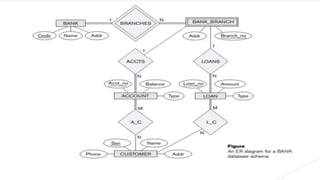
Map the BANK ER schema of following figure into a relational schema. Specify all primary keys and foreign
keys.
Following figure shows an ER schema for a database that can be used to keep track of transport ships and
their locations for maritime authorities. Map this schema into a relational schema and specify all primary
keys and foreign keys.
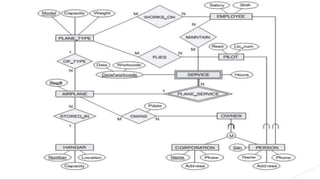
Following figure shows an example of an EER diagram for a small private airport database that is used to
keep track of airplanes, their owners, airport employees, and pilots. Map following ER-Model to Relational
schema
A library service wants to create a database to store details of its libraries, books and borrowers. Details
include the following:
A book has a unique ISBN number, a title and one or more authors. The library service may own several
copies of a given book, each of which is located in one of the service’s libraries. A given library contains
many books, and in order to distinguish different copies of the same book a library assigns a different
copy-number to each of its copies of a given book; the price that was paid for each copy is also recorded.
Every library has a unique name and is either a main library or a branch library. A main library may have
zero or more branch libraries and every branch library is a branch of exactly one main library. A borrower
has a name and a unique ID code. A borrower can have many books on loan, but each copy of a book can
only be on loan to one borrower. A borrower could borrow the same book on several occasions, but it is
assumed that each such loan will take place on a different date.
A preliminary design of an Extended-Entity-Relationship model intended to meet the above specification. The design contains
at least 10 errors. Describe each error, clearly stating both the nature of the problem and its solution, and draw a corrected
EER model.
1. author should be a multivalued attribute.
2. location should be an identifying relationship.
3. Copy should have total participation in location.
4. a Loan can have only 1 Borrower.
5. number should be a discriminating attribute for Copy.
6. Branch should have total participation in the branch relationship.
7. no-of-branches should be an attribute on Main not Library.
8. specialization of Library should be disjoint.
9. Borrower should have a name attribute.
10. ISBN should be the key of book, not name.
A university consists of a number of departments. Each department offers several courses. A number of
modules make up each course. Students enroll in a particular course and take modules towards the
completion of that course. Each module is taught by a lecturer from the appropriate department, and each
lecturer tutors a group of students
Erlonggg

Erlonggg

  • 1.
  • 2.
    Map the BANKER schema of following figure into a relational schema. Specify all primary keys and foreign keys.
  • 4.
    Following figure showsan ER schema for a database that can be used to keep track of transport ships and their locations for maritime authorities. Map this schema into a relational schema and specify all primary keys and foreign keys.
  • 6.
    Following figure showsan example of an EER diagram for a small private airport database that is used to keep track of airplanes, their owners, airport employees, and pilots. Map following ER-Model to Relational schema
  • 8.
    A library servicewants to create a database to store details of its libraries, books and borrowers. Details include the following: A book has a unique ISBN number, a title and one or more authors. The library service may own several copies of a given book, each of which is located in one of the service’s libraries. A given library contains many books, and in order to distinguish different copies of the same book a library assigns a different copy-number to each of its copies of a given book; the price that was paid for each copy is also recorded. Every library has a unique name and is either a main library or a branch library. A main library may have zero or more branch libraries and every branch library is a branch of exactly one main library. A borrower has a name and a unique ID code. A borrower can have many books on loan, but each copy of a book can only be on loan to one borrower. A borrower could borrow the same book on several occasions, but it is assumed that each such loan will take place on a different date.
  • 10.
    A preliminary designof an Extended-Entity-Relationship model intended to meet the above specification. The design contains at least 10 errors. Describe each error, clearly stating both the nature of the problem and its solution, and draw a corrected EER model. 1. author should be a multivalued attribute. 2. location should be an identifying relationship. 3. Copy should have total participation in location. 4. a Loan can have only 1 Borrower. 5. number should be a discriminating attribute for Copy. 6. Branch should have total participation in the branch relationship. 7. no-of-branches should be an attribute on Main not Library. 8. specialization of Library should be disjoint. 9. Borrower should have a name attribute. 10. ISBN should be the key of book, not name.
  • 12.
    A university consistsof a number of departments. Each department offers several courses. A number of modules make up each course. Students enroll in a particular course and take modules towards the completion of that course. Each module is taught by a lecturer from the appropriate department, and each lecturer tutors a group of students