ON THE PULSE OF THE NETWORKED SOCIETY
Ericsson
Mobility
Report
M
O
BILE
W
O
RLD
CO
N
GRESS
ED
ITIO
N
FEBRUARY
2016
2  ERICSSON MOBILITY REPORT  MWC EDITION FEBRUARY 2016
Mobile subscription essentials 2015
2021
forecast Unit
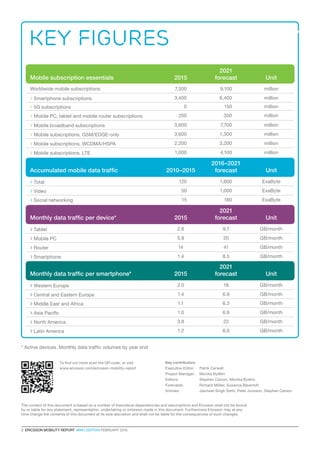
Worldwide mobile subscriptions 7,300 9,100 million
> Smartphone subscriptions 3,400 6,400 million
> 5G subscriptions 0 150 million
> Mobile PC, tablet and mobile router subscriptions 250 350 million
> Mobile broadband subscriptions 3,600 7,700 million
> Mobile subscriptions, GSM/EDGE-only 3,600 1,300 million
> Mobile subscriptions, WCDMA/HSPA 2,200 3,200 million
> Mobile subscriptions, LTE 1,000 4,100 million
Accumulated mobile data traffic 2010–2015
2016–2021
forecast Unit
> Total 120 1,600 ExaByte
> Video 50 1,000 ExaByte
> Social networking 15 180 ExaByte
Monthly data traffic per device* 2015
2021
forecast Unit
> Tablet 2.6 9.7 GB/month
> Mobile PC 5.8 20 GB/month
> Router 14 41 GB/month
> Smartphone 1.4 8.5 GB/month
Monthly data traffic per smartphone* 2015
2021
forecast Unit
> Western Europe 2.0 18 GB/month
> Central and Eastern Europe 1.4 6.9 GB/month
> Middle East and Africa 1.1 6.3 GB/month
> Asia Pacific 1.0 6.9 GB/month
> North America 3.8 22 GB/month
> Latin America 1.2 6.0 GB/month
Key figures
The content of this document is based on a number of theoretical dependencies and assumptions and Ericsson shall not be bound
by or liable for any statement, representation, undertaking or omission made in this document. Furthermore Ericsson may at any
time change the contents of this document at its sole discretion and shall not be liable for the consequences of such changes.
* Active devices. Monthly data traffic volumes by year end
Key contributors
Executive Editor:	 Patrik Cerwall
Project Manager: 	 Monika Byléhn
Editors: 	 Stephen Carson, Monika Byléhn
Forecasts: 	 Richard Möller, Susanna Bävertoft
Articles: 	 Jasmeet Singh Sethi, Peter Jonsson, Stephen Carson
To find out more scan the QR code, or visit
www.ericsson.com/ericsson-mobility-report
FEBRUARY 2016  MWC EDITION ERICSSON MOBILITY REPORT  3
In this Ericsson Mobility Report we
introduce a neuroscience study by
Ericsson ConsumerLab that captured
objective reactions to varied levels
of network performance while using
a smartphone. It revealed that under
time constraints delays in web page
load times and video streaming can
be as stressful as watching a horror
movie. On the other hand, if there are
no such delays, we unconsciously
become more satisfied with our
mobile service provider.
In November, we significantly
increased our mobile data traffic
forecast. In Q4 2015, data traffic grew
by 65 percent compared to Q4 2014
and is now anticipated to grow at
45 percent annually through 2021.
Video streaming remains the largest
mobile data traffic generator. The
growth in video traffic is boosted
mainly by the growing availability and
popularity of video content services,
devices with larger and higher
resolution screens, high performing
networks enabling a better experience
and changing user behavior.
Social networking is second only to
video in driving traffic growth. We
share more online now than we have
ever done before. With the increased
penetration of smartphones, it is very
convenient to access social media
platforms. In Q4 2015, smartphones
accounted for around 75 percent of
all mobile phones sold worldwide
and we predict an additional 3 billion
smartphone subscriptions by the end
of 2021.
We hope that you enjoy this year’s
Mobile World Congress and look
forward to an exciting 2016!
PUBLISHER
Rima Qureshi
Senior Vice President,
Chief Strategy Officer
Smooth browsing and video streaming
increase Net Promoter Scores
QUARTERLY
UPDATES
articles
Ericsson Mobility
Report MWC 2016
04	 The stress of streaming delays
08	 All the world’s a screen
09	 The lives of others
10	 Mobile subscriptions Q4 2015
11	 Mobile traffic Q4 2015
Poor network performance
increases smartphone users’
heart rate and stress levels
Smartphone users share
more online than ever before.
Social networking traffic
over the next 6 years will be
12 times that of the last 6
68 million mobile subscriptions
were added during the last
quarter of 2015, 21 million
of which were in India
4 9 10
PAGE PAGE PAGE
FEBRUARY 2016  MWC EDITION ERICSSON MOBILITY REPORT  3
4  ERICSSON MOBILITY REPORT  MWC EDITION FEBRUARY 2016
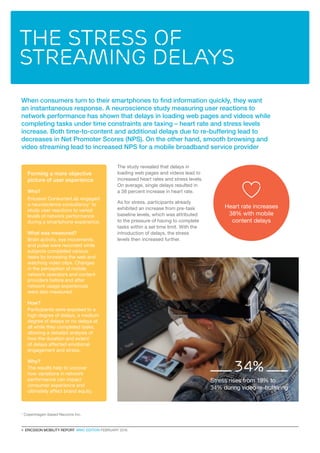
When consumers turn to their smartphones to find information quickly, they want
an instantaneous response. A neuroscience study measuring user reactions to
network performance has shown that delays in loading web pages and videos while
completing tasks under time constraints are taxing – heart rate and stress levels
increase. Both time-to-content and additional delays due to re-buffering lead to
decreases in Net Promoter Scores (NPS). On the other hand, smooth browsing and
video streaming lead to increased NPS for a mobile broadband service provider
The study revealed that delays in
loading web pages and videos lead to
increased heart rates and stress levels.
On average, single delays resulted in
a 38 percent increase in heart rate.
As for stress, participants already
exhibited an increase from pre-task
baseline levels, which was attributed
to the pressure of having to complete
tasks within a set time limit. With the
introduction of delays, the stress
levels then increased further.
The stress of
streaming delays
Forming a more objective
picture of user experience
Who?
Ericsson ConsumerLab engaged
a neuroscience consultancy1
to
study user reactions to varied
levels of network performance
during a smartphone experience.
What was measured?
Brain activity, eye movements,
and pulse were recorded while
subjects completed various
tasks by browsing the web and
watching video clips. Changes
in the perception of mobile
network operators and content
providers before and after
network usage experiences
were also measured.
How?
Participants were exposed to a
high degree of delays, a medium
degree of delays or no delays at
all while they completed tasks,
allowing a detailed analysis of
how the duration and extent
of delays affected emotional
engagement and stress.
Why?
The results help to uncover
how variations in network
performance can impact
consumer experience and
ultimately affect brand equity.
34%
1
Copenhagen-based Neurons Inc.
Stress rises from 19% to
34% during video re-buffering
Heart rate increases
38% with mobile
content delays
FEBRUARY 2016  MWC EDITION ERICSSON MOBILITY REPORT  5
Experiencing
mobile delays
Solving a
math problem
Stress and streaming
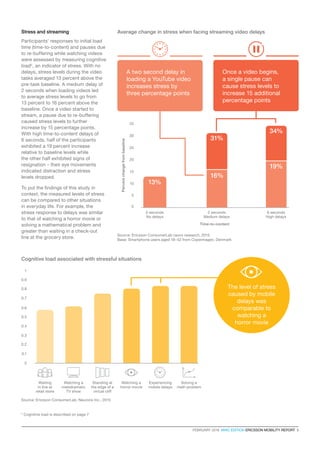
Participants’ responses to initial load
time (time-to-content) and pauses due
to re-buffering while watching videos
were assessed by measuring cognitive
load2
, an indicator of stress. With no
delays, stress levels during the video
tasks averaged 13 percent above the
pre-task baseline. A medium delay of
2 seconds when loading videos led
to average stress levels to go from
13 percent to 16 percent above the
baseline. Once a video started to
stream, a pause due to re-buffering
caused stress levels to further
increase by 15 percentage points.
With high time-to-content delays of
6 seconds, half of the participants
exhibited a 19 percent increase
relative to baseline levels while
the other half exhibited signs of
resignation – their eye movements
indicated distraction and stress
levels dropped.
To put the findings of this study in
context, the measured levels of stress
can be compared to other situations
in everyday life. For example, the
stress response to delays was similar
to that of watching a horror movie or
solving a mathematical problem and
greater than waiting in a check-out
line at the grocery store.
Average change in stress when facing streaming video delays
Cognitive load associated with stressful situations
0
5
10
0
0.1
0.4
0.7
0.2
0.5
0.8
0.3
0.6
0.9
1
15
20
25
30
35
A two second delay in
loading a YouTube video
increases stress by
three percentage points
6 seconds
High delays
2 seconds
Medium delays
Time-to-content
Percentchangefrombaseline
0 seconds
No delays
Waiting
in line at
retail store
Watching a
melodramatic
TV show
Standing at
the edge of a
virtual cliff
Watching a
horror movie
13%
31%
34%
16%
19%
Once a video begins,
a single pause can
cause stress levels to
increase 15 additional
percentage points
2
Cognitive load is described on page 7
Source: Ericsson ConsumerLab, Neurons Inc., 2015
Source: Ericsson ConsumerLab neuro research, 2015
Base: Smartphone users aged 18–52 from Copenhagen, Denmark
The level of stress
caused by mobile
delays was
comparable to
watching a
horror movie
6  ERICSSON MOBILITY REPORT  MWC EDITION FEBRUARY 2016
Patience is a virtue, but not for users
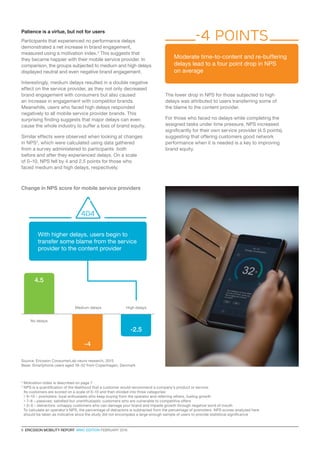
Participants that experienced no performance delays
demonstrated a net increase in brand engagement,
measured using a motivation index.3
This suggests that
they became happier with their mobile service provider. In
comparison, the groups subjected to medium and high delays
displayed neutral and even negative brand engagement.
Interestingly, medium delays resulted in a double negative
effect on the service provider, as they not only decreased
brand engagement with consumers but also caused
an increase in engagement with competitor brands.
Meanwhile, users who faced high delays responded
negatively to all mobile service provider brands. This
surprising finding suggests that major delays can even
cause the whole industry to suffer a loss of brand equity.
Similar effects were observed when looking at changes
in NPS4
, which were calculated using data gathered
from a survey administered to participants both
before and after they experienced delays. On a scale
of 0–10, NPS fell by 4 and 2.5 points for those who
faced medium and high delays, respectively.
The lower drop in NPS for those subjected to high
delays was attributed to users transferring some of
the blame to the content provider.
For those who faced no delays while completing the
assigned tasks under time pressure, NPS increased
significantly for their own service provider (4.5 points),
suggesting that offering customers good network
performance when it is needed is a key to improving
brand equity.
-4 Points
Moderate time-to-content and re-buffering
delays lead to a four point drop in NPS
on average
3
Motivation index is described on page 7
4
NPS is a quantification of the likelihood that a customer would recommend a company’s product or service.
Its customers are scored on a scale of 0–10 and then divided into three categories:
 9–10 – promoters: loyal enthusiasts who keep buying from the operator and referring others, fueling growth
 7–8 – passives: satisfied but unenthusiastic customers who are vulnerable to competitive offers
 0–6 – detractors: unhappy customers who can damage your brand and impede growth through negative word of mouth
To calculate an operator’s NPS, the percentage of detractors is subtracted from the percentage of promoters. NPS scores analyzed here
should be taken as indicative since the study did not encompass a large enough sample of users to provide statistical significance
Change in NPS score for mobile service providers
Source: Ericsson ConsumerLab neuro research, 2015
Base: Smartphone users aged 18–52 from Copenhagen, Denmark
With higher delays, users begin to
transfer some blame from the service
provider to the content provider
4.5
-4
-2.5
No delays
Medium delays High delays
FEBRUARY 2016  MWC EDITION ERICSSON MOBILITY REPORT  7
EEG electrode headsets were
used to record brain activity
Methodology: Measuring user response
to network performance
A total of 30 volunteers aged 18–52 in Copenhagen were
randomly selected from an existing panel of online users. All
of the participants were mobile broadband subscribers that
regularly browsed and streamed video on their smartphones.
The participants were fitted with pulse meters and
eye-tracking glasses, as well as EEG electrode headsets
to record brain activity. They were each issued an Android
smartphone, and asked to complete 18 tasks within a
20 minute time period. The smartphones were programmed
to appear as if they were using a mobile broadband network
connection. The tasks consisted of navigating through
news articles on web pages and YouTube videos which
were set up with a range of pre-determined delays.
The subjects were split into 3 groups of 10, and each
group was exposed to a different level of network
performance while attempting to complete the mobile
web and video tasks. None of the respondents knew
they would be subjected to pre-determined delays.
	 Group 1 (no delays)
	Group 2 (medium delays): 4–6 seconds of web page
load time; 2 seconds of video load time and 3 video
pauses of 3 seconds due to buffering events
	Group 3 (high delays): 10–14 seconds in web page
loading; 6 seconds of video load time and 3 video
pauses of 3 seconds due to buffering events
To measure consumers’ unconscious responses to brands,
the participants were shown a series of images including
logos of mobile operators and content providers. Participants
were also asked whether they were willing to recommend
their mobile broadband service provider. The tests were
administered both before and after the web and video
tasks in order to measure changes in responses.
The study was designed around three types of measurements:
electrical activity in the brain, eye movements, and pulse.
Brain activity captured with EEG headsets was used to
assess the two neuro metrics described below.
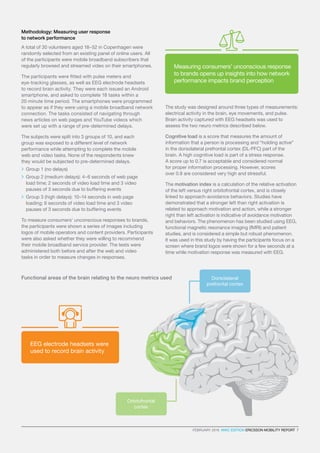
Cognitive load is a score that measures the amount of
information that a person is processing and “holding active”
in the dorsolateral prefrontal cortex (DL-PFC) part of the
brain. A high cognitive load is part of a stress response.
A score up to 0.7 is acceptable and considered normal
for proper information processing. However, scores
over 0.8 are considered very high and stressful.
The motivation index is a calculation of the relative activation
of the left versus right orbitofrontal cortex, and is closely
linked to approach-avoidance behaviors. Studies have
demonstrated that a stronger left than right activation is
related to approach motivation and action, while a stronger
right than left activation is indicative of avoidance motivation
and behaviors. The phenomenon has been studied using EEG,
functional magnetic resonance imaging (fMRI) and patient
studies, and is considered a simple but robust phenomenon.
It was used in this study by having the participants focus on a
screen where brand logos were shown for a few seconds at a
time while motivation response was measured with EEG.
Measuring consumers’ unconscious response
to brands opens up insights into how network
performance impacts brand perception
Functional areas of the brain relating to the neuro metrics used Dorsolateral
prefrontal cortex
Orbitofrontal
cortex
FEBRUARY 2016  MWC EDITION ERICSSON MOBILITY REPORT  7
8  ERICSSON MOBILITY REPORT  MWC EDITION FEBRUARY 2016
Additional factors underpinning the forecast traffic growth
include the rising share of smartphone subscriptions –
particularly for LTE smartphones – as well as increased
data consumption per LTE subscriber. In many markets,
the rate of growth for data consumption per subscriber
has not declined over time as fast as presumed. A similar
data consumption pattern is also expected to apply to
new LTE subscribers. This increasing data consumption
per subscription is mainly driven by video traffic.
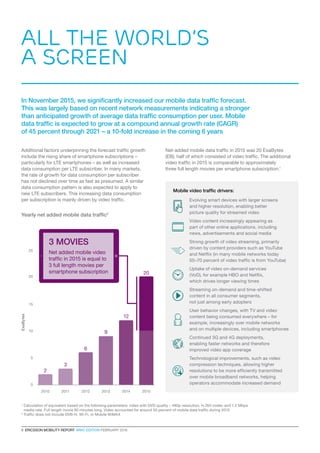
Net-added mobile data traffic in 2015 was 20 ExaBytes
(EB), half of which consisted of video traffic. The additional
video traffic in 2015 is comparable to approximately
three full length movies per smartphone subscription.1
3 MOVIES
Net added mobile video
traffic in 2015 is equal to
3 full length movies per
smartphone subscription
In November 2015, we significantly increased our mobile data traffic forecast.
This was largely based on recent network measurements indicating a stronger
than anticipated growth of average data traffic consumption per user. Mobile
data traffic is expected to grow at a compound annual growth rate (CAGR)
of 45 percent through 2021 – a 10-fold increase in the coming 6 years
all the world’s
a screen
Evolving smart devices with larger screens
and higher resolution, enabling better
picture quality for streamed video
Video content increasingly appearing as
part of other online applications, including
news, advertisements and social media
Strong growth of video streaming, primarily
driven by content providers such as YouTube
and Netflix (in many mobile networks today
50–70 percent of video traffic is from YouTube)
Uptake of video on-demand services
(VoD), for example HBO and Netflix,
which drives longer viewing times
Streaming on-demand and time-shifted
content in all consumer segments,
not just among early adopters
User behavior changes, with TV and video
content being consumed everywhere – for
example, increasingly over mobile networks
and on multiple devices, including smartphones
Continued 3G and 4G deployments,
enabling faster networks and therefore
improved video app coverage
Technological improvements, such as video
compression techniques, allowing higher
resolutions to be more efficiently transmitted
over mobile broadband networks, helping
operators accommodate increased demand
Mobile video traffic drivers:
1
Calculation of equivalent based on the following parameters: video with DVD quality – 480p resolution, H.264 codec and 1.2 Mbps
media rate. Full length movie 90 minutes long. Video accounted for around 50 percent of mobile data traffic during 2015
2
Traffic does not include DVB-H, Wi-Fi, or Mobile WiMAX
Yearly net added mobile data traffic2
2010 2011 2012 2013 2014 2015
2
3
6
9
12
0
5
10
15
20
ExaBytes
25
20
FEBRUARY 2016  MWC EDITION ERICSSON MOBILITY REPORT  9
Ericsson ConsumerLab research1
shows that today more
people communicate using text than voice calls. Many are
also used to instantly sharing photos and videos via social
networks. For example, over 70 percent of smartphone
owners say they share personal photos regularly and have
an audience which sees what’s been shared. 46 percent are
active on more than one social network.2
Accumulated social networking traffic over the next
6 years is forecast to be around 180 EB, which is
comparable to every person on earth spending around
35 minutes on social media3
every day, or a total of more
than 200 billion photos4
viewed every day.
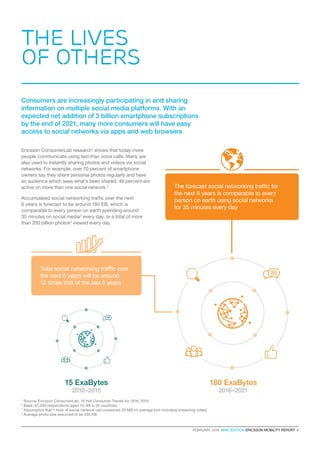
15 ExaBytes 180 ExaBytes
Consumers are increasingly participating in and sharing
information on multiple social media platforms. With an
expected net addition of 3 billion smartphone subscriptions
by the end of 2021, many more consumers will have easy
access to social networks via apps and web browsers
the lives
of others
1
Source: Ericsson ConsumerLab, 10 Hot Consumer Trends for 2016, 2015
2
Base: 45,290 respondents aged 15–69 in 24 countries
3
Assumption that 1 hour of social network use consumes 20 MB on average (not including streaming video)
4
Average photo size assumed to be 400 KB
2010–2015 2016–2021
Total social networking traffic over
the next 6 years will be around
12 times that of the last 6 years
The forecast social networking traffic for
the next 6 years is comparable to every
person on earth using social networks
for 35 minutes every day
10  ERICSSON MOBILITY REPORT  MWC EDITION FEBRUARY 2016
112
India
Middle East
mobile subscriptions
q4 2015
395395
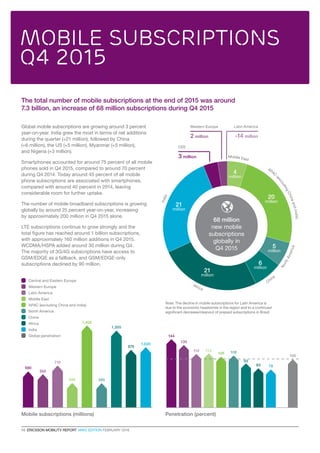
Global mobile subscriptions are growing around 3 percent
year-on-year. India grew the most in terms of net additions
during the quarter (+21 million), followed by China
(+6 million), the US (+5 million), Myanmar (+5 million),
and Nigeria (+3 million).
Smartphones accounted for around 75 percent of all mobile
phones sold in Q4 2015, compared to around 70 percent
during Q4 2014. Today around 45 percent of all mobile
phone subscriptions are associated with smartphones,
compared with around 40 percent in 2014, leaving
considerable room for further uptake.
The number of mobile broadband subscriptions is growing
globally by around 25 percent year-on-year, increasing
by approximately 200 million in Q4 2015 alone.
LTE subscriptions continue to grow strongly and the
total figure has reached around 1 billion subscriptions,
with approximately 160 million additions in Q4 2015.
WCDMA/HSPA added around 30 million during Q4.
The majority of 3G/4G subscriptions have access to
GSM/EDGE as a fallback, and GSM/EDGE-only
subscriptions declined by 90 million.
Mobile subscriptions (millions)
550
590
975
1,400
1,020
710
1,305
The total number of mobile subscriptions at the end of 2015 was around
7.3 billion, an increase of 68 million subscriptions during Q4 2015
Note: The decline in mobile subscriptions for Latin America is
due to the economic headwinds in the region and to a continued
significant decrease/cleanout of prepaid subscriptions in Brazil
Central and Eastern Europe
APAC (excluding China and India)
Western Europe
North America
Latin America
China
Middle East
Africa
India
Global penetration 144
130
113
106 108
83 79
100
93
Penetration (percent)
APAC
(excludingChinaandIndia)
China
Africa
NorthAmerica
-14 million
3 million
2 million
21
million
21
million
6
million
5
million
20
million
4
million
CEE
Western Europe Latin America
68 million
new mobile
subscriptions
globally in
Q4 2015
FEBRUARY 2016  MWC EDITION ERICSSON MOBILITY REPORT  11
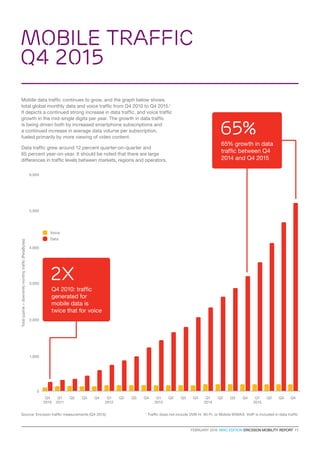
Mobile data traffic continues to grow, and the graph below shows
total global monthly data and voice traffic from Q4 2010 to Q4 2015.1
It depicts a continued strong increase in data traffic, and voice traffic
growth in the mid-single digits per year. The growth in data traffic
is being driven both by increased smartphone subscriptions and
a continued increase in average data volume per subscription,
fueled primarily by more viewing of video content.
Data traffic grew around 12 percent quarter-on-quarter and
65 percent year-on-year. It should be noted that there are large
differences in traffic levels between markets, regions and operators.
mobile traffic
q4 2015
2x
Q4 2010: traffic
generated for
mobile data is
twice that for voice
65%
65% growth in data
traffic between Q4
2014 and Q4 2015
Voice
Data
2,000
3,000
4,000
5,000
6,000
0
1,000
Total(uplink+downlink)monthlytraffic(PetaBytes)
Q4
2010
Q1
2011
Q2 Q3 Q4 Q1
2012
Q2 Q3 Q4 Q1
2013
Q2 Q3 Q4 Q1
2014
Q2 Q2 Q3 Q4Q3 Q4 Q1
2015
1
Traffic does not include DVB-H, Wi-Fi, or Mobile WiMAX. VoIP is included in data trafficSource: Ericsson traffic measurements (Q4 2015)
EAB-16:001237 Uen
© Ericsson AB 2016
Ericsson
SE-126 25 Stockholm, Sweden
Telephone +46 10 719 0000
www.ericsson.com
Ericsson is the driving force behind the Networked Society – a world leader in
communications technology and services. Our long-term relationships with every
major telecom operator in the world allow people, business and society to fulfill
their potential and create a more sustainable future.
Our services, software and infrastructure – especially in mobility, broadband and
the cloud – are enabling the telecom industry and other sectors to do better business,
increase efficiency, improve the user experience and capture new opportunities.
With approximately 115,000 professionals and customers in 180 countries, we combine
global scale with technology and services leadership. We support networks that
connect more than 2.5 billion subscribers. Forty percent of the world’s mobile traffic
is carried over Ericsson networks. And our investments in research and development
ensure that our solutions – and our customers – stay in front.

Ericsson Mobility Report, MWC Edition, February 2016

  • 1.
    ON THE PULSEOF THE NETWORKED SOCIETY Ericsson Mobility Report M O BILE W O RLD CO N GRESS ED ITIO N FEBRUARY 2016
  • 2.
    2  ERICSSON MOBILITYREPORT  MWC EDITION FEBRUARY 2016 Mobile subscription essentials 2015 2021 forecast Unit Worldwide mobile subscriptions 7,300 9,100 million > Smartphone subscriptions 3,400 6,400 million > 5G subscriptions 0 150 million > Mobile PC, tablet and mobile router subscriptions 250 350 million > Mobile broadband subscriptions 3,600 7,700 million > Mobile subscriptions, GSM/EDGE-only 3,600 1,300 million > Mobile subscriptions, WCDMA/HSPA 2,200 3,200 million > Mobile subscriptions, LTE 1,000 4,100 million Accumulated mobile data traffic 2010–2015 2016–2021 forecast Unit > Total 120 1,600 ExaByte > Video 50 1,000 ExaByte > Social networking 15 180 ExaByte Monthly data traffic per device* 2015 2021 forecast Unit > Tablet 2.6 9.7 GB/month > Mobile PC 5.8 20 GB/month > Router 14 41 GB/month > Smartphone 1.4 8.5 GB/month Monthly data traffic per smartphone* 2015 2021 forecast Unit > Western Europe 2.0 18 GB/month > Central and Eastern Europe 1.4 6.9 GB/month > Middle East and Africa 1.1 6.3 GB/month > Asia Pacific 1.0 6.9 GB/month > North America 3.8 22 GB/month > Latin America 1.2 6.0 GB/month Key figures The content of this document is based on a number of theoretical dependencies and assumptions and Ericsson shall not be bound by or liable for any statement, representation, undertaking or omission made in this document. Furthermore Ericsson may at any time change the contents of this document at its sole discretion and shall not be liable for the consequences of such changes. * Active devices. Monthly data traffic volumes by year end Key contributors Executive Editor: Patrik Cerwall Project Manager: Monika Byléhn Editors: Stephen Carson, Monika Byléhn Forecasts: Richard Möller, Susanna Bävertoft Articles: Jasmeet Singh Sethi, Peter Jonsson, Stephen Carson To find out more scan the QR code, or visit www.ericsson.com/ericsson-mobility-report
  • 3.
    FEBRUARY 2016  MWCEDITION ERICSSON MOBILITY REPORT  3 In this Ericsson Mobility Report we introduce a neuroscience study by Ericsson ConsumerLab that captured objective reactions to varied levels of network performance while using a smartphone. It revealed that under time constraints delays in web page load times and video streaming can be as stressful as watching a horror movie. On the other hand, if there are no such delays, we unconsciously become more satisfied with our mobile service provider. In November, we significantly increased our mobile data traffic forecast. In Q4 2015, data traffic grew by 65 percent compared to Q4 2014 and is now anticipated to grow at 45 percent annually through 2021. Video streaming remains the largest mobile data traffic generator. The growth in video traffic is boosted mainly by the growing availability and popularity of video content services, devices with larger and higher resolution screens, high performing networks enabling a better experience and changing user behavior. Social networking is second only to video in driving traffic growth. We share more online now than we have ever done before. With the increased penetration of smartphones, it is very convenient to access social media platforms. In Q4 2015, smartphones accounted for around 75 percent of all mobile phones sold worldwide and we predict an additional 3 billion smartphone subscriptions by the end of 2021. We hope that you enjoy this year’s Mobile World Congress and look forward to an exciting 2016! PUBLISHER Rima Qureshi Senior Vice President, Chief Strategy Officer Smooth browsing and video streaming increase Net Promoter Scores QUARTERLY UPDATES articles Ericsson Mobility Report MWC 2016 04 The stress of streaming delays 08 All the world’s a screen 09 The lives of others 10 Mobile subscriptions Q4 2015 11 Mobile traffic Q4 2015 Poor network performance increases smartphone users’ heart rate and stress levels Smartphone users share more online than ever before. Social networking traffic over the next 6 years will be 12 times that of the last 6 68 million mobile subscriptions were added during the last quarter of 2015, 21 million of which were in India 4 9 10 PAGE PAGE PAGE FEBRUARY 2016  MWC EDITION ERICSSON MOBILITY REPORT  3
  • 4.
    4  ERICSSON MOBILITYREPORT  MWC EDITION FEBRUARY 2016 When consumers turn to their smartphones to find information quickly, they want an instantaneous response. A neuroscience study measuring user reactions to network performance has shown that delays in loading web pages and videos while completing tasks under time constraints are taxing – heart rate and stress levels increase. Both time-to-content and additional delays due to re-buffering lead to decreases in Net Promoter Scores (NPS). On the other hand, smooth browsing and video streaming lead to increased NPS for a mobile broadband service provider The study revealed that delays in loading web pages and videos lead to increased heart rates and stress levels. On average, single delays resulted in a 38 percent increase in heart rate. As for stress, participants already exhibited an increase from pre-task baseline levels, which was attributed to the pressure of having to complete tasks within a set time limit. With the introduction of delays, the stress levels then increased further. The stress of streaming delays Forming a more objective picture of user experience Who? Ericsson ConsumerLab engaged a neuroscience consultancy1 to study user reactions to varied levels of network performance during a smartphone experience. What was measured? Brain activity, eye movements, and pulse were recorded while subjects completed various tasks by browsing the web and watching video clips. Changes in the perception of mobile network operators and content providers before and after network usage experiences were also measured. How? Participants were exposed to a high degree of delays, a medium degree of delays or no delays at all while they completed tasks, allowing a detailed analysis of how the duration and extent of delays affected emotional engagement and stress. Why? The results help to uncover how variations in network performance can impact consumer experience and ultimately affect brand equity. 34% 1 Copenhagen-based Neurons Inc. Stress rises from 19% to 34% during video re-buffering Heart rate increases 38% with mobile content delays
  • 5.
    FEBRUARY 2016  MWCEDITION ERICSSON MOBILITY REPORT  5 Experiencing mobile delays Solving a math problem Stress and streaming Participants’ responses to initial load time (time-to-content) and pauses due to re-buffering while watching videos were assessed by measuring cognitive load2 , an indicator of stress. With no delays, stress levels during the video tasks averaged 13 percent above the pre-task baseline. A medium delay of 2 seconds when loading videos led to average stress levels to go from 13 percent to 16 percent above the baseline. Once a video started to stream, a pause due to re-buffering caused stress levels to further increase by 15 percentage points. With high time-to-content delays of 6 seconds, half of the participants exhibited a 19 percent increase relative to baseline levels while the other half exhibited signs of resignation – their eye movements indicated distraction and stress levels dropped. To put the findings of this study in context, the measured levels of stress can be compared to other situations in everyday life. For example, the stress response to delays was similar to that of watching a horror movie or solving a mathematical problem and greater than waiting in a check-out line at the grocery store. Average change in stress when facing streaming video delays Cognitive load associated with stressful situations 0 5 10 0 0.1 0.4 0.7 0.2 0.5 0.8 0.3 0.6 0.9 1 15 20 25 30 35 A two second delay in loading a YouTube video increases stress by three percentage points 6 seconds High delays 2 seconds Medium delays Time-to-content Percentchangefrombaseline 0 seconds No delays Waiting in line at retail store Watching a melodramatic TV show Standing at the edge of a virtual cliff Watching a horror movie 13% 31% 34% 16% 19% Once a video begins, a single pause can cause stress levels to increase 15 additional percentage points 2 Cognitive load is described on page 7 Source: Ericsson ConsumerLab, Neurons Inc., 2015 Source: Ericsson ConsumerLab neuro research, 2015 Base: Smartphone users aged 18–52 from Copenhagen, Denmark The level of stress caused by mobile delays was comparable to watching a horror movie
  • 6.
    6  ERICSSON MOBILITYREPORT  MWC EDITION FEBRUARY 2016 Patience is a virtue, but not for users Participants that experienced no performance delays demonstrated a net increase in brand engagement, measured using a motivation index.3 This suggests that they became happier with their mobile service provider. In comparison, the groups subjected to medium and high delays displayed neutral and even negative brand engagement. Interestingly, medium delays resulted in a double negative effect on the service provider, as they not only decreased brand engagement with consumers but also caused an increase in engagement with competitor brands. Meanwhile, users who faced high delays responded negatively to all mobile service provider brands. This surprising finding suggests that major delays can even cause the whole industry to suffer a loss of brand equity. Similar effects were observed when looking at changes in NPS4 , which were calculated using data gathered from a survey administered to participants both before and after they experienced delays. On a scale of 0–10, NPS fell by 4 and 2.5 points for those who faced medium and high delays, respectively. The lower drop in NPS for those subjected to high delays was attributed to users transferring some of the blame to the content provider. For those who faced no delays while completing the assigned tasks under time pressure, NPS increased significantly for their own service provider (4.5 points), suggesting that offering customers good network performance when it is needed is a key to improving brand equity. -4 Points Moderate time-to-content and re-buffering delays lead to a four point drop in NPS on average 3 Motivation index is described on page 7 4 NPS is a quantification of the likelihood that a customer would recommend a company’s product or service. Its customers are scored on a scale of 0–10 and then divided into three categories: 9–10 – promoters: loyal enthusiasts who keep buying from the operator and referring others, fueling growth 7–8 – passives: satisfied but unenthusiastic customers who are vulnerable to competitive offers 0–6 – detractors: unhappy customers who can damage your brand and impede growth through negative word of mouth To calculate an operator’s NPS, the percentage of detractors is subtracted from the percentage of promoters. NPS scores analyzed here should be taken as indicative since the study did not encompass a large enough sample of users to provide statistical significance Change in NPS score for mobile service providers Source: Ericsson ConsumerLab neuro research, 2015 Base: Smartphone users aged 18–52 from Copenhagen, Denmark With higher delays, users begin to transfer some blame from the service provider to the content provider 4.5 -4 -2.5 No delays Medium delays High delays
  • 7.
    FEBRUARY 2016  MWCEDITION ERICSSON MOBILITY REPORT  7 EEG electrode headsets were used to record brain activity Methodology: Measuring user response to network performance A total of 30 volunteers aged 18–52 in Copenhagen were randomly selected from an existing panel of online users. All of the participants were mobile broadband subscribers that regularly browsed and streamed video on their smartphones. The participants were fitted with pulse meters and eye-tracking glasses, as well as EEG electrode headsets to record brain activity. They were each issued an Android smartphone, and asked to complete 18 tasks within a 20 minute time period. The smartphones were programmed to appear as if they were using a mobile broadband network connection. The tasks consisted of navigating through news articles on web pages and YouTube videos which were set up with a range of pre-determined delays. The subjects were split into 3 groups of 10, and each group was exposed to a different level of network performance while attempting to complete the mobile web and video tasks. None of the respondents knew they would be subjected to pre-determined delays. Group 1 (no delays) Group 2 (medium delays): 4–6 seconds of web page load time; 2 seconds of video load time and 3 video pauses of 3 seconds due to buffering events Group 3 (high delays): 10–14 seconds in web page loading; 6 seconds of video load time and 3 video pauses of 3 seconds due to buffering events To measure consumers’ unconscious responses to brands, the participants were shown a series of images including logos of mobile operators and content providers. Participants were also asked whether they were willing to recommend their mobile broadband service provider. The tests were administered both before and after the web and video tasks in order to measure changes in responses. The study was designed around three types of measurements: electrical activity in the brain, eye movements, and pulse. Brain activity captured with EEG headsets was used to assess the two neuro metrics described below. Cognitive load is a score that measures the amount of information that a person is processing and “holding active” in the dorsolateral prefrontal cortex (DL-PFC) part of the brain. A high cognitive load is part of a stress response. A score up to 0.7 is acceptable and considered normal for proper information processing. However, scores over 0.8 are considered very high and stressful. The motivation index is a calculation of the relative activation of the left versus right orbitofrontal cortex, and is closely linked to approach-avoidance behaviors. Studies have demonstrated that a stronger left than right activation is related to approach motivation and action, while a stronger right than left activation is indicative of avoidance motivation and behaviors. The phenomenon has been studied using EEG, functional magnetic resonance imaging (fMRI) and patient studies, and is considered a simple but robust phenomenon. It was used in this study by having the participants focus on a screen where brand logos were shown for a few seconds at a time while motivation response was measured with EEG. Measuring consumers’ unconscious response to brands opens up insights into how network performance impacts brand perception Functional areas of the brain relating to the neuro metrics used Dorsolateral prefrontal cortex Orbitofrontal cortex FEBRUARY 2016  MWC EDITION ERICSSON MOBILITY REPORT  7
  • 8.
    8  ERICSSON MOBILITYREPORT  MWC EDITION FEBRUARY 2016 Additional factors underpinning the forecast traffic growth include the rising share of smartphone subscriptions – particularly for LTE smartphones – as well as increased data consumption per LTE subscriber. In many markets, the rate of growth for data consumption per subscriber has not declined over time as fast as presumed. A similar data consumption pattern is also expected to apply to new LTE subscribers. This increasing data consumption per subscription is mainly driven by video traffic. Net-added mobile data traffic in 2015 was 20 ExaBytes (EB), half of which consisted of video traffic. The additional video traffic in 2015 is comparable to approximately three full length movies per smartphone subscription.1 3 MOVIES Net added mobile video traffic in 2015 is equal to 3 full length movies per smartphone subscription In November 2015, we significantly increased our mobile data traffic forecast. This was largely based on recent network measurements indicating a stronger than anticipated growth of average data traffic consumption per user. Mobile data traffic is expected to grow at a compound annual growth rate (CAGR) of 45 percent through 2021 – a 10-fold increase in the coming 6 years all the world’s a screen Evolving smart devices with larger screens and higher resolution, enabling better picture quality for streamed video Video content increasingly appearing as part of other online applications, including news, advertisements and social media Strong growth of video streaming, primarily driven by content providers such as YouTube and Netflix (in many mobile networks today 50–70 percent of video traffic is from YouTube) Uptake of video on-demand services (VoD), for example HBO and Netflix, which drives longer viewing times Streaming on-demand and time-shifted content in all consumer segments, not just among early adopters User behavior changes, with TV and video content being consumed everywhere – for example, increasingly over mobile networks and on multiple devices, including smartphones Continued 3G and 4G deployments, enabling faster networks and therefore improved video app coverage Technological improvements, such as video compression techniques, allowing higher resolutions to be more efficiently transmitted over mobile broadband networks, helping operators accommodate increased demand Mobile video traffic drivers: 1 Calculation of equivalent based on the following parameters: video with DVD quality – 480p resolution, H.264 codec and 1.2 Mbps media rate. Full length movie 90 minutes long. Video accounted for around 50 percent of mobile data traffic during 2015 2 Traffic does not include DVB-H, Wi-Fi, or Mobile WiMAX Yearly net added mobile data traffic2 2010 2011 2012 2013 2014 2015 2 3 6 9 12 0 5 10 15 20 ExaBytes 25 20
  • 9.
    FEBRUARY 2016  MWCEDITION ERICSSON MOBILITY REPORT  9 Ericsson ConsumerLab research1 shows that today more people communicate using text than voice calls. Many are also used to instantly sharing photos and videos via social networks. For example, over 70 percent of smartphone owners say they share personal photos regularly and have an audience which sees what’s been shared. 46 percent are active on more than one social network.2 Accumulated social networking traffic over the next 6 years is forecast to be around 180 EB, which is comparable to every person on earth spending around 35 minutes on social media3 every day, or a total of more than 200 billion photos4 viewed every day. 15 ExaBytes 180 ExaBytes Consumers are increasingly participating in and sharing information on multiple social media platforms. With an expected net addition of 3 billion smartphone subscriptions by the end of 2021, many more consumers will have easy access to social networks via apps and web browsers the lives of others 1 Source: Ericsson ConsumerLab, 10 Hot Consumer Trends for 2016, 2015 2 Base: 45,290 respondents aged 15–69 in 24 countries 3 Assumption that 1 hour of social network use consumes 20 MB on average (not including streaming video) 4 Average photo size assumed to be 400 KB 2010–2015 2016–2021 Total social networking traffic over the next 6 years will be around 12 times that of the last 6 years The forecast social networking traffic for the next 6 years is comparable to every person on earth using social networks for 35 minutes every day
  • 10.
    10  ERICSSON MOBILITYREPORT  MWC EDITION FEBRUARY 2016 112 India Middle East mobile subscriptions q4 2015 395395 Global mobile subscriptions are growing around 3 percent year-on-year. India grew the most in terms of net additions during the quarter (+21 million), followed by China (+6 million), the US (+5 million), Myanmar (+5 million), and Nigeria (+3 million). Smartphones accounted for around 75 percent of all mobile phones sold in Q4 2015, compared to around 70 percent during Q4 2014. Today around 45 percent of all mobile phone subscriptions are associated with smartphones, compared with around 40 percent in 2014, leaving considerable room for further uptake. The number of mobile broadband subscriptions is growing globally by around 25 percent year-on-year, increasing by approximately 200 million in Q4 2015 alone. LTE subscriptions continue to grow strongly and the total figure has reached around 1 billion subscriptions, with approximately 160 million additions in Q4 2015. WCDMA/HSPA added around 30 million during Q4. The majority of 3G/4G subscriptions have access to GSM/EDGE as a fallback, and GSM/EDGE-only subscriptions declined by 90 million. Mobile subscriptions (millions) 550 590 975 1,400 1,020 710 1,305 The total number of mobile subscriptions at the end of 2015 was around 7.3 billion, an increase of 68 million subscriptions during Q4 2015 Note: The decline in mobile subscriptions for Latin America is due to the economic headwinds in the region and to a continued significant decrease/cleanout of prepaid subscriptions in Brazil Central and Eastern Europe APAC (excluding China and India) Western Europe North America Latin America China Middle East Africa India Global penetration 144 130 113 106 108 83 79 100 93 Penetration (percent) APAC (excludingChinaandIndia) China Africa NorthAmerica -14 million 3 million 2 million 21 million 21 million 6 million 5 million 20 million 4 million CEE Western Europe Latin America 68 million new mobile subscriptions globally in Q4 2015
  • 11.
    FEBRUARY 2016  MWCEDITION ERICSSON MOBILITY REPORT  11 Mobile data traffic continues to grow, and the graph below shows total global monthly data and voice traffic from Q4 2010 to Q4 2015.1 It depicts a continued strong increase in data traffic, and voice traffic growth in the mid-single digits per year. The growth in data traffic is being driven both by increased smartphone subscriptions and a continued increase in average data volume per subscription, fueled primarily by more viewing of video content. Data traffic grew around 12 percent quarter-on-quarter and 65 percent year-on-year. It should be noted that there are large differences in traffic levels between markets, regions and operators. mobile traffic q4 2015 2x Q4 2010: traffic generated for mobile data is twice that for voice 65% 65% growth in data traffic between Q4 2014 and Q4 2015 Voice Data 2,000 3,000 4,000 5,000 6,000 0 1,000 Total(uplink+downlink)monthlytraffic(PetaBytes) Q4 2010 Q1 2011 Q2 Q3 Q4 Q1 2012 Q2 Q3 Q4 Q1 2013 Q2 Q3 Q4 Q1 2014 Q2 Q2 Q3 Q4Q3 Q4 Q1 2015 1 Traffic does not include DVB-H, Wi-Fi, or Mobile WiMAX. VoIP is included in data trafficSource: Ericsson traffic measurements (Q4 2015)
  • 12.
    EAB-16:001237 Uen © EricssonAB 2016 Ericsson SE-126 25 Stockholm, Sweden Telephone +46 10 719 0000 www.ericsson.com Ericsson is the driving force behind the Networked Society – a world leader in communications technology and services. Our long-term relationships with every major telecom operator in the world allow people, business and society to fulfill their potential and create a more sustainable future. Our services, software and infrastructure – especially in mobility, broadband and the cloud – are enabling the telecom industry and other sectors to do better business, increase efficiency, improve the user experience and capture new opportunities. With approximately 115,000 professionals and customers in 180 countries, we combine global scale with technology and services leadership. We support networks that connect more than 2.5 billion subscribers. Forty percent of the world’s mobile traffic is carried over Ericsson networks. And our investments in research and development ensure that our solutions – and our customers – stay in front.