May 2014 https://about.me/EDUARDOLFP
Global Analysis Digital Consumer
Online consumption summary
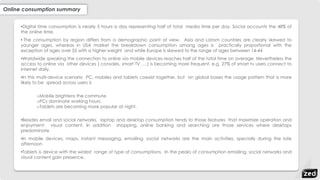
•Digital time consumption is nearly 5 hours a day representing half of total media time per day. Social accounts the 48% of
the online time.
• The consumption by region differs from a demographic point of view. Asia and Latam countries are clearly skewed to
younger ages, whereas in USA market the breakdown consumption among ages is practically proportional with the
exception of ages over 55 with a higher weight and while Europe is skewed to the range of ages between 14-44
•Worldwide speaking the connection to online via mobile devices reaches half of the total time on average. Nevertheless the
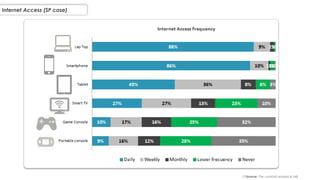
access to online via other devices ( consoles, smart TV ….) is becoming more frequent, e.g 27% of smart tv users connect to
internet daily.
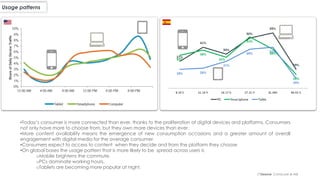
•In this multi-device scenario PC, mobiles and tablets coexist together, but on global bases the usage pattern that is more
likely to be spread across users is
oMobile brightens the commute.
oPCs dominate working hours.
oTablets are becoming more popular at night.
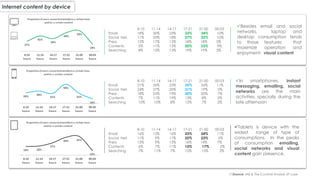
•Besides email and social networks, laptop and desktop consumption tends to those features that maximize operation and
enjoyment: visual content. In addition shopping, online banking and searching are those services where desktops
predominate
•In mobile devices, maps, instant messaging, emailing, social networks are the main activities, specially during the late
afternoon
•Tablets is device with the widest range of type of consumptions. In the peaks of consumption emailing, social networks and
visual content gain presence.
Consumer Spend Media Time
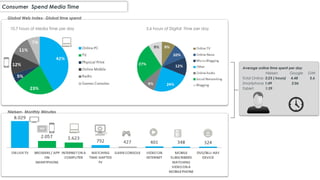
Global Web Index- Global time spend
10.7 hours of Media Time per day 5,6 hours of Digital Time per day
Average online time spent per day
Nielsen Google GWI
Total Online: 3:25 ( hours) 4.48 5.6
Smartphone 1:49 2:06
Tablet: 1:39
Nielsen- Monthly Minutes
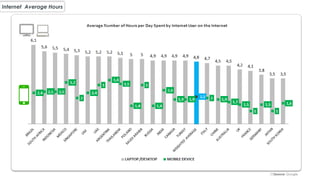
Internet Average Hours
(*)Source: Google
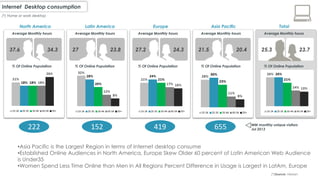
Internet Desktop consumption
(*)Source: Nielsen
21.5 20.4
Average Monthly hours
% Of Online Population
North America Latin America Europe Asia Pacific
37.6 34.3
Average Monthly hours
% Of Online Population
27 23.8
Average Monthly hours
% Of Online Population
27.2 24.3
Average Monthly hours
% Of Online Population
•Asia Pacific is the Largest Region in terms of Internet desktop consume
•Established Online Audiences in North America, Europe Skew Older 60 percent of Latin American Web Audience
is Under35
•Women Spend Less Time Online than Men in All Regions Percent Difference in Usage is Largest in LatAm, Europe
25.3 23.7
Average Monthly hours
% Of Online Population
Total
222 152 419 655 MM monthly unique visitors
Jul 2013
(*) Home or work desktop
Internet Access (SP case)
(*)Source: The cocktail analysis & IAB
Usage patterns
(*)Source: Comscore & IAB
•Today’s consumer is more connected than ever, thanks to the proliferation of digital devices and platforms. Consumers
not only have more to choose from, but they own more devices than ever.
•More content availability means the emergence of new consumption occasions and a greater amount of overall
engagement with digital media for the average consumer
•Consumers expect to access to content when they decide and from the platform they choose
•On global bases the usage pattern that is more likely to be spread across users is
oMobile brightens the commute.
oPCs dominate working hours.
oTablets are becoming more popular at night.
(*)Source: Comscore & IAB & PWC
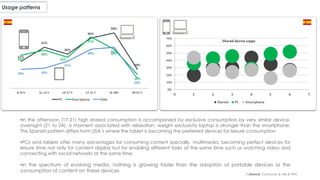
•In the afternoon (17-21) high shared consumption is accompanied by exclusive consumption by very similar device,
overnight (21 to 24), a moment associated with relaxation, weight exclusivity laptop is stronger than the smartphone.
This Spanish pattern differs form USA´s where the tablet is becoming the preferred devices for leisure consumption
•PCs and tablets offer many advantages for consuming content specially multimedia, becoming perfect devices for
leisure time not only for content display but for enabling different tasks at the same time such us watching video and
connecting with social networks at the same time.
•In the spectrum of evolving media, nothing is growing faster than the adoption of portable devices or the
consumption of content on these devices
Usage patterns
Internet content by device
(*)Source: IAB & The Cocktail Analysis SP case
8-10 11-14 14-17 17-21 21-00 00-03
Email 18% 30% 23% 33% 34% 10%
Social Net. 11% 20% 18% 27% 32% 10%
Press 12% 17% 13% 18% 18% 5%
Contents 5% 11% 13% 20% 23% 9%
Searching 8% 15% 13% 19% 19% 5%
Besides email and social
networks, laptop and
desktop consumption tends
to those features that
maximize operation and
enjoyment: visual content
8-10 11-14 14-17 17-21 21-00 00-03
Email 21% 26% 23% 35% 26% 11%
Social Net. 24% 27% 20% 31% 19% 5%
Press 18% 25% 19% 30% 20% 7%
Contents 7% 11% 19% 13% 8% 2%
Searching 10% 10% 8% 12% 7% 2%
In smartphones, instant
messaging, emailing, social
networks are the main
activities, specially during the
late afternoon
8-10 11-14 14-17 17-21 21-00 00-03
Email 16% 13% 16% 23% 24% 11%
Social Net. 11% 9% 17% 22% 23% 5%
Press 13% 9% 13% 16% 14% 7%
Contents 6% 7% 11% 15% 17% 2%
Searching 7% 11% 7% 15% 15% 2%
Tablets is device with the
widest range of type of
consumptions. In the peaks
of consumption emailing,
social networks and visual
content gain presence.
Connection uses
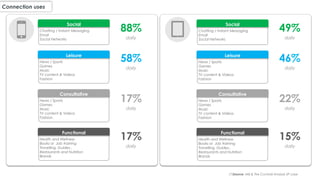
Social
Chatting / Instant Messaging
Email
Social Networks
Leisure
News / Sports
Games
Music
TV content & Videos
Fashion
Consultative
News / Sports
Games
Music
TV content & Videos
Fashion
Functional
Health and Wellness
Books or Job training
Travelling, Guides..
Restaurants and Nutrition
Brands
Social
Chatting / Instant Messaging
Email
Social Networks
Leisure
News / Sports
Games
Music
TV content & Videos
Fashion
Consultative
News / Sports
Games
Music
TV content & Videos
Fashion
Functional
Health and Wellness
Books or Job training
Travelling, Guides..
Restaurants and Nutrition
Brands
88%
daily
58%
daily
17%
daily
17%
daily
49%
daily
46%
daily
22%
daily
15%
daily
(*)Source: IAB & The Cocktail Analysis SP case
Desktop/ Laptop
Which device do you use to access to the following services more often
(*)Source: The Coctkail Analysis
Mobile
both
interchangeably
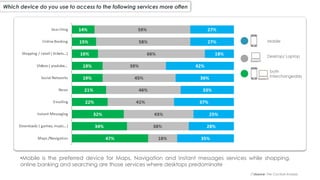
•Mobile is the preferred device for Maps, Navigation and Instant messages services while shopping,
online banking and searching are those services where desktops predominate
Laptop
Primary devices used by consumers for online activities
(*)Source: Ericsson
Instant
messaging
/chat
Play
Games
Access
Social
Network
Find out
news keep
up with the
world
Browse
internet
sites
Online
banking
Buy
products
online
Stream
videos
Smartphone Desktop
Social Networks Consumer
Social Networks summary
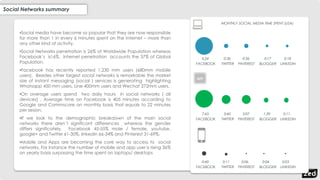
•Social media have become so popular that they are now responsible
for more than 1 in every 6 minutes spent on the internet – more than
any other kind of activity.
•Social Networks penetration is 26% of Worldwide Population whereas
Facebook´s is16%. Internet penetration accounts the 37% of Global
Population.
•Facebook has recently reported 1.230 mm users (680mm mobile
users). Besides other largest social networks is remarkable the market
size of instant messaging (social ) services is generating highlighting
Whatsapp 450 mm users, Line 400mm users and Wechat 272mm users.
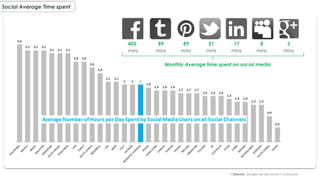
•On average users spend two daily hours in social networks ( all
devices) . Average time on Facebook is 405 minutes according to
Google and Commscore on monthly basis that equals to 22 minutes
per sesion.
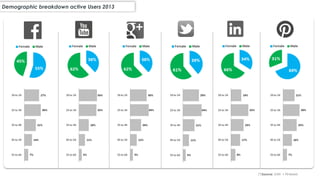
•If we look to the demographic breakdown of the main social
networks there aren´t significant differences whereas the gender
differs significately. Facebook 45-55% male / female, youtube,
google+ and Twitter 61-30%, linkedin 66-34% and Pinterest 31-69%.
•Mobile and Apps are becoming the core way to access to social
networks. For instance the number of mobile and app user is rising 36%
on yearly basis surpassing the time spent on laptops/ desktops
APP
6:24 0:36 0:36 0:17 0:18
FACEBOOK TWITTER PINTEREST BLOGGER LINKEDIN
7:43 3:40 3:07 1:39 0:11
FACEBOOK TWITTER PINTEREST BLOGGER LINKEDIN
0:40 0:11 0:06 0:04 0:03
FACEBOOK TWITTER PINTEREST BLOGGER LINKEDIN
MONTHLY SOCIAL MEDIA TIME SPENT (USA)
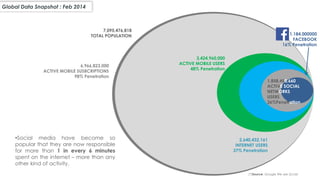
Global Data Snapshot : Feb 2014
(*)Source: Google We are Sccial
7,095,476,818
TOTAL POPULATION
6,966,823,000
ACTIVE MOBILE SUSBCRIPTIONS
98% Penetration
3,424,960,000
ACTIVE MOBILE USERS
48% Penetration
2,640,432,161
INTERNET USERS
37% Penetration
•Social media have become so
popular that they are now responsible
for more than 1 in every 6 minutes
spent on the internet – more than any
other kind of activity.
1,858,450,660
ACTIVE SOCIAL
NETWORKS
USERS
26%Penetration
1.184.000000
FACEBOOK
16% Penetration
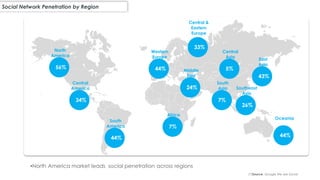
Social Network Penetration by Region
(*)Source: Google We are Social
•North America market leads social penetration across regions
56%
North
America
34%
Central
America
44%
South
America 7%
Africa
44%
Western
Europe
24%
Middle
East
33%
Central &
Eastern
Europe
5%
Central
Asia
7%
South
Asia
26%
Southeast
Asia
43%
East
Asia
44%
Oceania
Social Average Time spent
(*)Source: Google we are social + Comscore
405
mins
89
mins
89
mins
21
mins
17
mins
8
mins
3
mins
Monthly Average time spent on social media
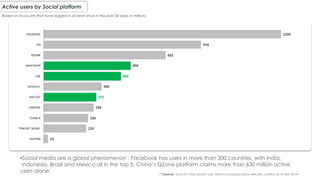
Active users by Social platform
(*)Source: Sources: most recent user data in company press releases, correct as at Feb 2014
Based on Accounts that have logged in at least once in the past 30 days, in millions
•Social media are a global phenomenon : Facebook has users in more than 200 countries, with India,
Indonesia, Brazil and Mexico all in the top 5. China’s QZone platform claims more than 630 million active
users alone.
Demographic breakdown active Users 2013
(*)Source: GWI + Pinterest
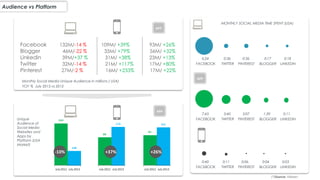
Audience vs Platform
(*)Source: Nielsen
Facebook 132M/-14 % 109M/ +39% 93M/ +26%
Blogger 46M/-22 % 35M/ +79% 56M/ +32%
Linkedin 39M/+37 % 31M/ +38% 23M/ +13%
Twitter 32M/-14 % 21M/ +117% 17M/ +80%
Pinterest 27M/-2 % 16M/ +233% 17M/ +22%
APP
Monthly Social Media Unique Audience in millions ( USA)
YOY % July 2013 vs 2012
-10% +37% +26%
APP
Unique
Audience of
Social Media
Websites and
Apps by
Platform (USA
Market)
APP
6:24 0:36 0:36 0:17 0:18
FACEBOOK TWITTER PINTEREST BLOGGER LINKEDIN
7:43 3:40 3:07 1:39 0:11
FACEBOOK TWITTER PINTEREST BLOGGER LINKEDIN
0:40 0:11 0:06 0:04 0:03
FACEBOOK TWITTER PINTEREST BLOGGER LINKEDIN
MONTHLY SOCIAL MEDIA TIME SPENT (USA)
Mobile Consumption
Mobile consumption summary
•Smartphone owners may be the majority of mobile
users in countries like the U.S. and U.K., but the
trusty feature phone continues to be the mobile
device of choice in places like India, Brazil and
Russia where the network infrastructure required for
smartphones and next generation mobile devices
has yet to appear outside of large, urban centers.
•There are differences in the device penetration
rates between men and women among all
countries, with China and Brazil showing the largest
gender divide among smartphone owners .
•In some countries, like India and Russia where the
median smartphone bill is significantly higher than
that of all mobile users and feature phones have a
higher penetration, consumers are opting for more
flexible, less expensive options, such as “pay-as-
you-go” data pricing, or taking advantage of WiFi
connectivity.
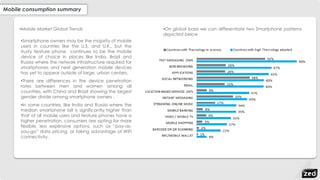
•On global basis we can differentiate two Smartphone patterns
depicted below
•Mobile Market Global Trends
Type of devices
(*)Source: Nielsen
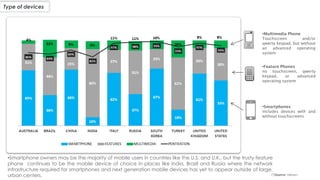
•Smartphone owners may be the majority of mobile users in countries like the U.S. and U.K., but the trusty feature
phone continues to be the mobile device of choice in places like India, Brazil and Russia where the network
infrastructure required for smartphones and next generation mobile devices has yet to appear outside of large,
urban centers.
•Multimedia Phone
Touchscreen and/or
qwerty keypad, but without
an advanced operating
system
•Feature Phones
no touchscreen, qwerty
keypad, or advanced
operating system
•Smartphones
includes devices with and
without touchscreens
Who owns a smartphone
(*)Source: Nielsen
AUSTRALIA BRAZIL CHINA INDIA ITALY
RUSSIA SOUTH KOREA TURKEY UNITED KINGDOM UNITED STATES
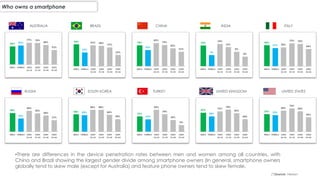
•There are differences in the device penetration rates between men and women among all countries, with
China and Brazil showing the largest gender divide among smartphone owners (In general, smartphone owners
globally tend to skew male (except for Australia) and feature phone owners tend to skew female.
How much does mobile service cost
(*)Source: Nielsen
AUSTRALIA BRAZIL CHINA INDIA ITALY
RUSSIA SOUTH KOREA TURKEY UNITED KINGDOM UNITED STATES
AVERAGE
MONTHLY BILL
AUD$50
SMARTPHONES
AUD$44
ALL MOBILE
PHONE USERS
AVERAGE
MONTHLY BILL
R$50
SMARTPHONES
R$49
ALL MOBILE
PHONE USERS
AVERAGE
MONTHLY BILL
¥100
SMARTPHONES
¥ 100
ALL MOBILE
PHONE USERS
AVERAGE
MONTHLY BILL
₹ 499
SMARTPHONES
₹ 300
ALL MOBILE
PHONE USERS
AVERAGE
MONTHLY BILL
€22
SMARTPHONES
€20
ALL MOBILE
PHONE USERS
AVERAGE
MONTHLY BILL
Руб 500
SMARTPHONES
Руб 400
ALL MOBILE
PHONE USERS
AVERAGE
MONTHLY BILL
₩ 55000
SMARTPHONES
₩ 50000
ALL MOBILE
PHONE USERS
AVERAGE
MONTHLY BILL
TRY 30
SMARTPHONES
na
ALL MOBILE
PHONE USERS
AVERAGE
MONTHLY BILL
£ 25
SMARTPHONES
£ 20
ALL MOBILE
PHONE USERS
AVERAGE
MONTHLY BILL
$ 93
SMARTPHONES
$ 66
ALL MOBILE
PHONE USERS
HAVE DATA PLAN? HAVE DATA PLAN? HAVE DATA PLAN? HAVE DATA PLAN? HAVE DATA PLAN?
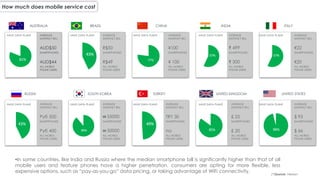
•In some countries, like India and Russia where the median smartphone bill is significantly higher than that of all
mobile users and feature phones have a higher penetration, consumers are opting for more flexible, less
expensive options, such as “pay-as-you-go” data pricing, or taking advantage of WiFi connectivity.
Usage of smartphones
(*)Source: Nielsen
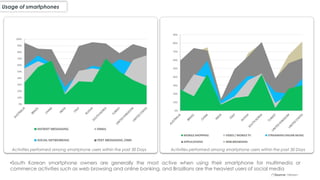
•South Korean smartphone owners are generally the most active when using their smartphone for multimedia or
commerce activities such as web browsing and online banking, and Brazilians are the heaviest users of social media
Activities performed among smartphone users within the past 30 Days Activities performed among smartphone users within the past 30 Days
Smartphones Impact on Shopping
(*)Source: Nielsen
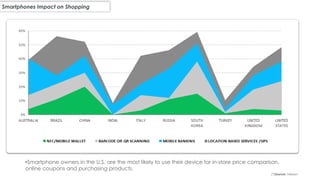
•Smartphone owners in the U.S. are the most likely to use their device for in-store price comparison,
online coupons and purchasing products.
Frequency of access to the following service via mobile
(*)Source: The cocktail analysis SP case
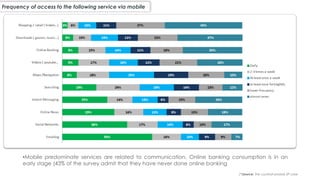
•Mobile predominate services are related to communication. Online banking consumption is in an
early stage (43% of the survey admit that they have never done online banking
App Consumption
App summary
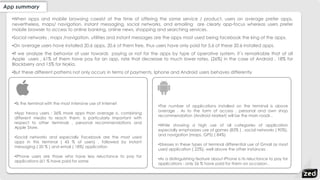
•When apps and mobile browsing coexist at the time of offering the same service / product, users on average prefer apps,
nevertheless, maps/ navigation, instant messaging, social networks, and emailing are clearly app-focus whereas users prefer
mobile browser to access to online banking, online news, shopping and searching services.
•Social networks , maps /navigation, utilities and instant messages are the apps most used being facebook the king of the apps.
•On average users have installed 20.6 apps, 20.6 of them free, thus users have only paid for 5,6 of these 20.6 installed apps.
•If we analyze the behavior of user towards paying or not for the apps by type of operative system, it´s remarkable that of all
Apple users , 61% of them have pay for an app, rate that decrease to much lower rates, (26%) in the case of Android , 18% for
Blackberry and 15% for Nokia.
•But these different patterns not only occurs in terms of payments, Iphone and Android users behaves differently
•Is the terminal with the most intensive use of Internet
•App heavy users : 36% more apps than average o, combining
different media to reach them. Is particularly important with
respect to other terminals , personal recommendations and
Apple Store.
•Social networks and especially Facebook are the most used
apps in this terminal ( 43 % of users) , followed by instant
messaging ( 20 % ) and email ( 18%) application
•IPhone users are those who have less reluctance to pay for
applications (61 % have paid for some
•The number of applications installed on the terminal is above
average . As to the form of access , personal and own shop
recommendation (Android Market) will be the main roads .
•While showing a high use of all categories of application
especially emphasizes use of games (83% ) , social networks ( 90%),
and navigation (maps, GPS) ( 84%)
•Stresses in these types of terminal differential use of Gmail as most
used application ( 22%), well above the other instances .
•As a distinguishing feature about iPhone is its reluctance to pay for
applications : only 26 % have paid for them on occasion .
Monthly Usage App & Mobile Web
(*)Source: Nielsen USA
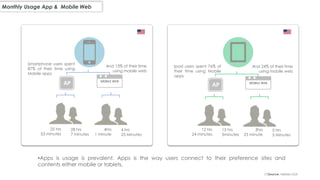
•Apps is usage is prevalent. Apps is the way users connect to their preference sites and
contents either mobile or tablets.
AP
APMOBILE WEB
AP
APMOBILE WEB
Smartphone users spent
87% of their time using
Mobile apps
And 13% of their time
using mobile web
25 hrs
53 minutes
28 hrs
7 minutes
4hrs
1 minute
4 hrs
23 Minutes
Ipad users spent 76% of
their time using Mobile
apps
And 24% of their time
using mobile web
12 hrs
24 minutes
15 hrs
5minutes
3hrs
23 minute
5 hrs
5 Minutes
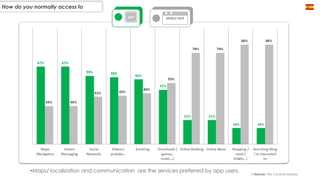
How do you normally access to
(*)Source: The Cocktail analysis
APP MOBILE WEB
•Maps/ localization and communication are the services preferred by app users.
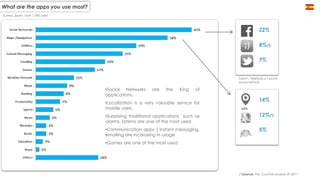
What are the apps you use most?
(*)Source: The Cocktail analysis SP 2011
•Social Networks are the King of
applications.
•Localization is a very valuable service for
mobile users
•Surprising traditional applications such as
alarms, laterns are one of the most used
•Communication apps ( instant messaging,
emailing are increasing in usage
•Games are one of the most used
Survey_Spain: over 1.000 users.
22%
8%(*)
7%
Tuenti : Telefonica´s youth
social netwok
14%
12%(*)
5%
GPS
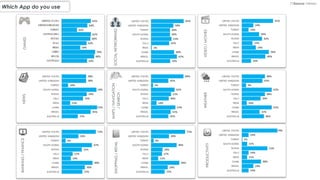
Which App do you use
(*)Source: Nielsen
GAMES
SOCIALNETWORKING
VIDEO/MOVIES
NEWS
MAPS/NAVIGATION
/SEARCH
WEATHER
BANKING/FINANCE
SHOPPING/RETAIL
PRODUCTIVITY
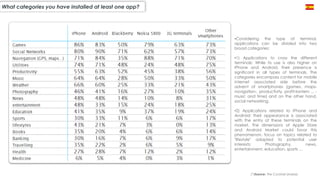
What categories you have installed at least one app?
(*)Source: The Cocktail analysis
•Considering the type of terminal,
applications can be divided into two
broad categories:
•1) Applications to cross the different
terminals: While its use is also higher on
iPhone and Android, their presence is
significant in all types of terminals. The
categories encompass content for mobile
internet associated side before the
advent of smartphones (games, maps-
navigation-, productivity, profit-lantern ... -
music and time) and on the other hand,
social networking.
•2) Applications related to iPhone and
Android: their appearance is associated
with the entry of these terminals on the
market. The dimensions of Apple Store
and Android Market could favor this
phenomenon. focus on topics related to
"lifestyle" adapted to potential user
interests: Photography, news,
entertainment, education, sports ...
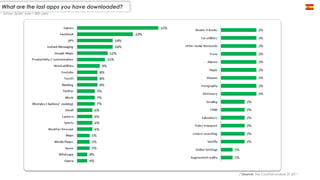
What are the last apps you have downloaded?
(*)Source: The Cocktail analysis SP 2011
Survey_Spain: over 1.000 users.
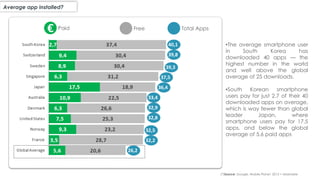
Average app installed?
(*)Source: Google, Mobile Planet 2013 + Mashable
•The average smartphone user
in South Korea has
downloaded 40 apps — the
highest number in the world
and well above the global
average of 25 downloads.
•South Korean smartphone
users pay for just 2.7 of their 40
downloaded apps on average,
which is way fewer than global
leader Japan, where
smartphone users pay for 17.5
apps, and below the global
average of 5.6 paid apps
FreePaid€
40,1
39,8
39,3
37,5
36,4
33,4
32,9
32,8
32,5
32,2
26,2
Total Apps
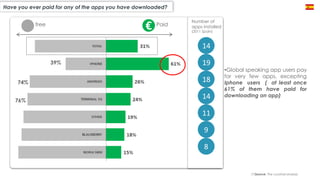
Have you ever paid for any of the apps you have downloaded?
(*)Source: The cocktail analysis
•Global speaking app users pay
for very few apps, excepting
Iphone users ( at least once
61% of them have paid for
downloading an app)
14
19
18
14
11
9
8
Number of
apps installed
(2011 Spain)
free Paid
€
39%
74%
76%
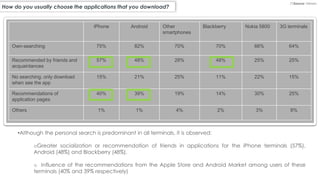
How do you usually choose the applications that you download?
(*)Source: Nielsen
iPhone Android Other
smartphones
Blackberry Nokia 5800 3G terminals
Own-searching 75% 82% 70% 70% 66% 64%
Recommended by friends and
acquaintances
57% 48% 28% 48% 25% 25%
No searching, only download
when see the app
15% 21% 25% 11% 22% 15%
Recommendations of
application pages
40% 39% 19% 14% 30% 25%
Others 1% 1% 4% 2% 3% 8%
•Although the personal search is predominant in all terminals, it is observed:
oGreater socialization or recommendation of friends in applications for the iPhone terminals (57%),
Android (48%) and Blackberry (48%).
o Influence of the recommendations from the Apple Store and Android Market among users of these
terminals (40% and 39% respectively)
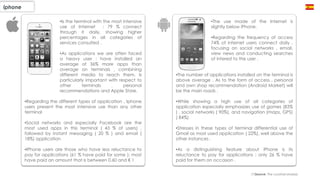
•The use made of the Internet is
slightly below iPhone.
•Regarding the frequency of access
74% of internet users connect daily ,
focusing on social networks , email,
view news and conducting searches
of interest to the user .
•The number of applications installed on the terminal is
above average . As to the form of access , personal
and own shop recommendation (Android Market) will
be the main roads .
•While showing a high use of all categories of
application especially emphasizes use of games (83%
) , social networks ( 90%), and navigation (maps, GPS)
( 84%)
•Stresses in these types of terminal differential use of
Gmail as most used application ( 22%), well above the
other instances .
•As a distinguishing feature about iPhone is its
reluctance to pay for applications : only 26 % have
paid for them on occasion .
Iphone
(*)Source: The cocktail analysis
•Is the terminal with the most intensive
use of Internet : 79 % connect
through it daily, showing higher
percentages in all categories of
services consulted .
•As applications we are often faced
a heavy user : have installed an
average of 36% more apps than
average on terminals , combining
different media to reach them. Is
particularly important with respect to
other terminals , personal
recommendations and Apple Store.
•Regarding the different types of application , Iphone
users present the most intensive use than any other
terminal
•Social networks and especially Facebook are the
most used apps in this terminal ( 43 % of users) ,
followed by instant messaging ( 20 % ) and email (
18%) application
•IPhone users are those who have less reluctance to
pay for applications (61 % have paid for some ): most
have paid an amount that is between 0.60 and € 1
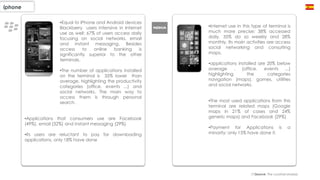
•Internet use in this type of terminal is
much more precise: 38% accessed
daily, 35% do so weekly and 28%
monthly. Its main activities are access
social networking and consulting
maps.
•applications installed are 20% below
average , (office, events ...)
highlighting the categories
navigation (maps), games, utilities
and social networks.
•The most used applications from this
terminal are related maps (Google
maps in 21% of cases and 24%
generic maps) and Facebook (29%)
•Payment for Applications is a
minority: only 15% have done it.
Iphone
(*)Source: The cocktail analysis
•Equal to iPhone and Android devices
Blackberry users intensive in Internet
use as well: 67% of users access daily
focusing on social networks, email
and instant messaging. Besides
access to online banking is
significantly superior to the other
terminals.
•The number of applications installed
on the terminal is 35% lower than
average, highlighting the productivity
categories (office, events ...) and
social networks. The main way to
access them is through personal
search.
•Applications that consumers use are Facebook
(49%), email (32%) and instant messaging (29%)
•Its users are reluctant to pay for downloading
applications, only 18% have done
E-commerce
E & M T & commerce
(*)Source: GWI commerce summary Feb 2014
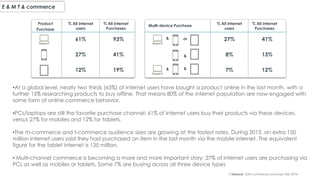
•At a global level, nearly two thirds (65%) of internet users have bought a product online in the last month, with a
further 15% researching products to buy offline. That means 80% of the internet population are now engaged with
some form of online commerce behavior.
•PCs/laptops are still the favorite purchase channel: 61% of internet users buy their products via these devices,
versus 27% for mobiles and 12% for tablets.
•The m-commerce and t-commerce audience sizes are growing at the fastest rates. During 2013, an extra 150
million internet users said they had purchased an item in the last month via the mobile internet. The equivalent
figure for the tablet internet is 135 million.
• Multi-channel commerce is becoming a more and more important story: 27% of internet users are purchasing via
PCs as well as mobiles or tablets. Some 7% are buying across all three device types
Product
Purchase
% All internet
users
% All internet
Purchases
61%
27%
12%
93%
41%
19%
Multi-device Purchase
% All internet
users
% All internet
Purchases
27%
8%
7%
41%
13%
12%
& or
&
&&
Products online by Country
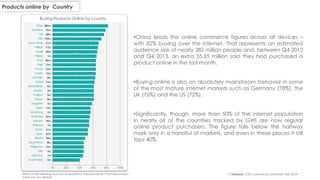
•China leads the online commerce figures across all devices –
with 82% buying over the internet. That represents an estimated
audience size of nearly 382 million people and, between Q4 2012
and Q4 2013, an extra 35.55 million said they had purchased a
product online in the last month.
•Buying online is also an absolutely mainstream behavior in some
of the most mature internet markets such as Germany (78%), the
UK (76%) and the US (72%).
•Significantly, though, more than 50% of the internet population
in nearly all of the countries tracked by GWI are now regular
online product purchasers. The figure falls below the halfway
mark only in a handful of markets, and even in these places it still
tops 40%.
Buying Products Online by country
Which of the following have you done online in the past month ( Purchase product
online (via any device)
(*)Source: GWI commerce summary Feb 2014
Local Deal Sites and Social Networks Now Major Purchase Platforms
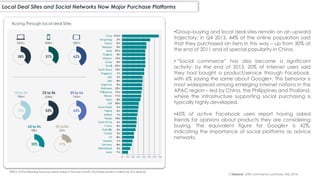
•Group-buying and local deal sites remain on an upward
trajectory; in Q4 2013, 44% of the online population said
that they purchased an item in this way – up from 30% at
the end of 2011 and of special popularity in China.
• “Social commerce” has also become a significant
activity: by the end of 2013, 20% of internet users said
they had bought a product/service through Facebook,
with 6% saying the same about Google+. This behavior is
most widespread among emerging internet nations in the
APAC region – led by China, the Philippines and Thailand,
where the infrastructure supporting social purchasing is
typically highly developed.
•45% of active Facebook users report having asked
friends for opinions about products they are considering
buying. The equivalent figure for Google+ is 42%,
indicating the importance of social platforms as advice
networks.
Buying Through local deal Sites
Which of the following have you done online in the past month ( Purchase product online (via any device)
(*)Source: GWI commerce summary Feb 2014
Showrooming and Webrooming
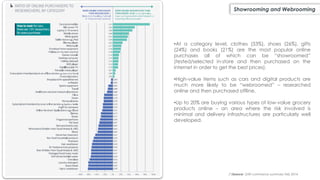
•At a category level, clothes (33%), shoes (26%), gifts
(24%) and books (21%) are the most popular online
purchases all of which can be “showroomed”
(tested/selected in-store and then purchased on the
internet in order to get the best prices).
•High-value items such as cars and digital products are
much more likely to be “webroomed” – researched
online and then purchased offline.
•Up to 20% are buying various types of low-value grocery
products online – an area where the risk involved is
minimal and delivery infrastructures are particularly well
developed.
(*)Source: GWI commerce summary Feb 2014
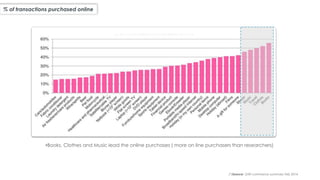
% of transactions purchased online
•Books, Clothes and Music lead the online purchases ( more on line purchasers than researchers)
(*)Source: GWI commerce summary Feb 2014
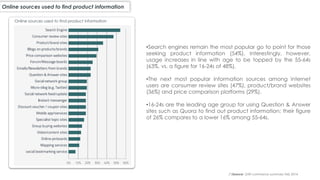
Online sources used to find product information
•Search engines remain the most popular go to point for those
seeking product information (54%). Interestingly, however,
usage increases in line with age to be topped by the 55-64s
(63%, vs. a figure for 16-24s of 48%).
•The next most popular information sources among internet
users are consumer review sites (47%), product/brand websites
(36%) and price comparison platforms (29%).
•16-24s are the leading age group for using Question & Answer
sites such as Quora to find out product information; their figure
of 26% compares to a lower 16% among 55-64s.
Online sources used to find product information
(*)Source: GWI commerce summary Feb 2014
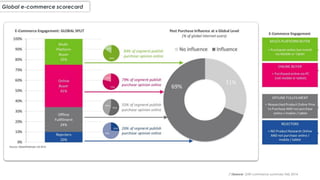
Global e-commerce scorecard
(*)Source: GWI commerce summary Feb 2014
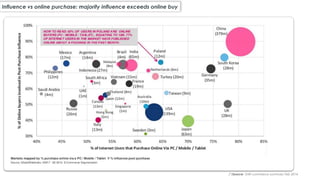
Influence vs online purchase: majority influence exceeds online buy
(*)Source: GWI commerce summary Feb 2014
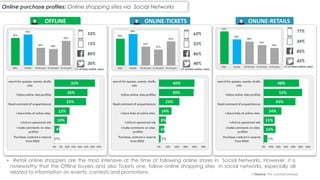
Online purchase profiles: Online shopping sites via Social Networks
(*)Source: The cocktail analysis
OFF-LINEOFFLINE ONLINE-TICKETS ONLINE-RETAILS
53%
15%
80%
30%
(*) of total online users
63%
23%
86%
40%
(*) of total online users
77%
34%
85%
42%
(*) of total online users
• Retail online shoppers are the most intensive at the time of following online stores in Social Networks. However, it is
noteworthy that the Offline buyers and also Tickets one, follow online shopping sites in social networks, especially all
related to information on events, contests and promotions.
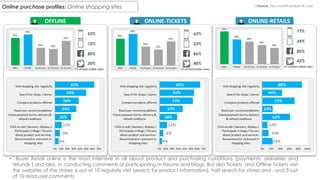
Online purchase profiles: Online shopping sites (*)Source: The cocktail analysis SP case
OFF-LINEOFFLINE ONLINE-TICKETS ONLINE-RETAILS
53%
15%
80%
30%
(*) of total online users
63%
23%
86%
40%
(*) of total online users
77%
34%
85%
42%
(*) of total online users
• Buyer Retail online is the most intensive in all about product and purchasing conditions (payments, deliveries and
refunds ) and also in conducting comments or participating in forums and blogs. But also Tickets and Offline Tickets visit
the websites of the stores: 6 out of 10 regularly visit (search for product information), half search for stores and , and 3 out
of 10 read user comments
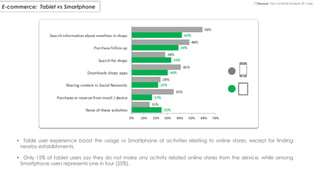
E-commerce: Tablet vs Smartphone
(*)Source: The cocktail analysis SP case
• Table user experience boost the usage vs Smartphone of activities relating to online stores, except for finding
nearby establishments.
• Only 15% of tablet users say they do not make any activity related online stores from the device, while among
Smartphone users represents one in four (25%).
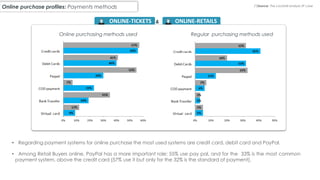
Online purchase profiles: Payments methods (*)Source: The cocktail analysis SP case
ONLINE-TICKETS ONLINE-RETAILS
• Regarding payment systems for online purchase the most used systems are credit card, debit card and PayPal.
• Among Retail Buyers online, PayPal has a more important role: 55% use pay pal, and for the 33% is the most common
payment system, above the credit card (57% use it but only for the 32% is the standard of payment).
Online purchasing methods used Regular purchasing methods used
&

Global analysis digital consumer

  • 1.
  • 2.
    Online consumption summary •Digitaltime consumption is nearly 5 hours a day representing half of total media time per day. Social accounts the 48% of the online time. • The consumption by region differs from a demographic point of view. Asia and Latam countries are clearly skewed to younger ages, whereas in USA market the breakdown consumption among ages is practically proportional with the exception of ages over 55 with a higher weight and while Europe is skewed to the range of ages between 14-44 •Worldwide speaking the connection to online via mobile devices reaches half of the total time on average. Nevertheless the access to online via other devices ( consoles, smart TV ….) is becoming more frequent, e.g 27% of smart tv users connect to internet daily. •In this multi-device scenario PC, mobiles and tablets coexist together, but on global bases the usage pattern that is more likely to be spread across users is oMobile brightens the commute. oPCs dominate working hours. oTablets are becoming more popular at night. •Besides email and social networks, laptop and desktop consumption tends to those features that maximize operation and enjoyment: visual content. In addition shopping, online banking and searching are those services where desktops predominate •In mobile devices, maps, instant messaging, emailing, social networks are the main activities, specially during the late afternoon •Tablets is device with the widest range of type of consumptions. In the peaks of consumption emailing, social networks and visual content gain presence.
  • 3.
    Consumer Spend MediaTime Global Web Index- Global time spend 10.7 hours of Media Time per day 5,6 hours of Digital Time per day Average online time spent per day Nielsen Google GWI Total Online: 3:25 ( hours) 4.48 5.6 Smartphone 1:49 2:06 Tablet: 1:39 Nielsen- Monthly Minutes
  • 4.
  • 5.
    Internet Desktop consumption (*)Source:Nielsen 21.5 20.4 Average Monthly hours % Of Online Population North America Latin America Europe Asia Pacific 37.6 34.3 Average Monthly hours % Of Online Population 27 23.8 Average Monthly hours % Of Online Population 27.2 24.3 Average Monthly hours % Of Online Population •Asia Pacific is the Largest Region in terms of Internet desktop consume •Established Online Audiences in North America, Europe Skew Older 60 percent of Latin American Web Audience is Under35 •Women Spend Less Time Online than Men in All Regions Percent Difference in Usage is Largest in LatAm, Europe 25.3 23.7 Average Monthly hours % Of Online Population Total 222 152 419 655 MM monthly unique visitors Jul 2013 (*) Home or work desktop
  • 6.
    Internet Access (SPcase) (*)Source: The cocktail analysis & IAB
  • 7.
    Usage patterns (*)Source: Comscore& IAB •Today’s consumer is more connected than ever, thanks to the proliferation of digital devices and platforms. Consumers not only have more to choose from, but they own more devices than ever. •More content availability means the emergence of new consumption occasions and a greater amount of overall engagement with digital media for the average consumer •Consumers expect to access to content when they decide and from the platform they choose •On global bases the usage pattern that is more likely to be spread across users is oMobile brightens the commute. oPCs dominate working hours. oTablets are becoming more popular at night.
  • 8.
    (*)Source: Comscore &IAB & PWC •In the afternoon (17-21) high shared consumption is accompanied by exclusive consumption by very similar device, overnight (21 to 24), a moment associated with relaxation, weight exclusivity laptop is stronger than the smartphone. This Spanish pattern differs form USA´s where the tablet is becoming the preferred devices for leisure consumption •PCs and tablets offer many advantages for consuming content specially multimedia, becoming perfect devices for leisure time not only for content display but for enabling different tasks at the same time such us watching video and connecting with social networks at the same time. •In the spectrum of evolving media, nothing is growing faster than the adoption of portable devices or the consumption of content on these devices Usage patterns
  • 9.
    Internet content bydevice (*)Source: IAB & The Cocktail Analysis SP case 8-10 11-14 14-17 17-21 21-00 00-03 Email 18% 30% 23% 33% 34% 10% Social Net. 11% 20% 18% 27% 32% 10% Press 12% 17% 13% 18% 18% 5% Contents 5% 11% 13% 20% 23% 9% Searching 8% 15% 13% 19% 19% 5% Besides email and social networks, laptop and desktop consumption tends to those features that maximize operation and enjoyment: visual content 8-10 11-14 14-17 17-21 21-00 00-03 Email 21% 26% 23% 35% 26% 11% Social Net. 24% 27% 20% 31% 19% 5% Press 18% 25% 19% 30% 20% 7% Contents 7% 11% 19% 13% 8% 2% Searching 10% 10% 8% 12% 7% 2% In smartphones, instant messaging, emailing, social networks are the main activities, specially during the late afternoon 8-10 11-14 14-17 17-21 21-00 00-03 Email 16% 13% 16% 23% 24% 11% Social Net. 11% 9% 17% 22% 23% 5% Press 13% 9% 13% 16% 14% 7% Contents 6% 7% 11% 15% 17% 2% Searching 7% 11% 7% 15% 15% 2% Tablets is device with the widest range of type of consumptions. In the peaks of consumption emailing, social networks and visual content gain presence.
  • 10.
    Connection uses Social Chatting /Instant Messaging Email Social Networks Leisure News / Sports Games Music TV content & Videos Fashion Consultative News / Sports Games Music TV content & Videos Fashion Functional Health and Wellness Books or Job training Travelling, Guides.. Restaurants and Nutrition Brands Social Chatting / Instant Messaging Email Social Networks Leisure News / Sports Games Music TV content & Videos Fashion Consultative News / Sports Games Music TV content & Videos Fashion Functional Health and Wellness Books or Job training Travelling, Guides.. Restaurants and Nutrition Brands 88% daily 58% daily 17% daily 17% daily 49% daily 46% daily 22% daily 15% daily (*)Source: IAB & The Cocktail Analysis SP case
  • 11.
    Desktop/ Laptop Which devicedo you use to access to the following services more often (*)Source: The Coctkail Analysis Mobile both interchangeably •Mobile is the preferred device for Maps, Navigation and Instant messages services while shopping, online banking and searching are those services where desktops predominate
  • 12.
    Laptop Primary devices usedby consumers for online activities (*)Source: Ericsson Instant messaging /chat Play Games Access Social Network Find out news keep up with the world Browse internet sites Online banking Buy products online Stream videos Smartphone Desktop
  • 13.
  • 14.
    Social Networks summary •Socialmedia have become so popular that they are now responsible for more than 1 in every 6 minutes spent on the internet – more than any other kind of activity. •Social Networks penetration is 26% of Worldwide Population whereas Facebook´s is16%. Internet penetration accounts the 37% of Global Population. •Facebook has recently reported 1.230 mm users (680mm mobile users). Besides other largest social networks is remarkable the market size of instant messaging (social ) services is generating highlighting Whatsapp 450 mm users, Line 400mm users and Wechat 272mm users. •On average users spend two daily hours in social networks ( all devices) . Average time on Facebook is 405 minutes according to Google and Commscore on monthly basis that equals to 22 minutes per sesion. •If we look to the demographic breakdown of the main social networks there aren´t significant differences whereas the gender differs significately. Facebook 45-55% male / female, youtube, google+ and Twitter 61-30%, linkedin 66-34% and Pinterest 31-69%. •Mobile and Apps are becoming the core way to access to social networks. For instance the number of mobile and app user is rising 36% on yearly basis surpassing the time spent on laptops/ desktops APP 6:24 0:36 0:36 0:17 0:18 FACEBOOK TWITTER PINTEREST BLOGGER LINKEDIN 7:43 3:40 3:07 1:39 0:11 FACEBOOK TWITTER PINTEREST BLOGGER LINKEDIN 0:40 0:11 0:06 0:04 0:03 FACEBOOK TWITTER PINTEREST BLOGGER LINKEDIN MONTHLY SOCIAL MEDIA TIME SPENT (USA)
  • 15.
    Global Data Snapshot: Feb 2014 (*)Source: Google We are Sccial 7,095,476,818 TOTAL POPULATION 6,966,823,000 ACTIVE MOBILE SUSBCRIPTIONS 98% Penetration 3,424,960,000 ACTIVE MOBILE USERS 48% Penetration 2,640,432,161 INTERNET USERS 37% Penetration •Social media have become so popular that they are now responsible for more than 1 in every 6 minutes spent on the internet – more than any other kind of activity. 1,858,450,660 ACTIVE SOCIAL NETWORKS USERS 26%Penetration 1.184.000000 FACEBOOK 16% Penetration
  • 16.
    Social Network Penetrationby Region (*)Source: Google We are Social •North America market leads social penetration across regions 56% North America 34% Central America 44% South America 7% Africa 44% Western Europe 24% Middle East 33% Central & Eastern Europe 5% Central Asia 7% South Asia 26% Southeast Asia 43% East Asia 44% Oceania
  • 17.
    Social Average Timespent (*)Source: Google we are social + Comscore 405 mins 89 mins 89 mins 21 mins 17 mins 8 mins 3 mins Monthly Average time spent on social media
  • 18.
    Active users bySocial platform (*)Source: Sources: most recent user data in company press releases, correct as at Feb 2014 Based on Accounts that have logged in at least once in the past 30 days, in millions •Social media are a global phenomenon : Facebook has users in more than 200 countries, with India, Indonesia, Brazil and Mexico all in the top 5. China’s QZone platform claims more than 630 million active users alone.
  • 19.
    Demographic breakdown activeUsers 2013 (*)Source: GWI + Pinterest
  • 20.
    Audience vs Platform (*)Source:Nielsen Facebook 132M/-14 % 109M/ +39% 93M/ +26% Blogger 46M/-22 % 35M/ +79% 56M/ +32% Linkedin 39M/+37 % 31M/ +38% 23M/ +13% Twitter 32M/-14 % 21M/ +117% 17M/ +80% Pinterest 27M/-2 % 16M/ +233% 17M/ +22% APP Monthly Social Media Unique Audience in millions ( USA) YOY % July 2013 vs 2012 -10% +37% +26% APP Unique Audience of Social Media Websites and Apps by Platform (USA Market) APP 6:24 0:36 0:36 0:17 0:18 FACEBOOK TWITTER PINTEREST BLOGGER LINKEDIN 7:43 3:40 3:07 1:39 0:11 FACEBOOK TWITTER PINTEREST BLOGGER LINKEDIN 0:40 0:11 0:06 0:04 0:03 FACEBOOK TWITTER PINTEREST BLOGGER LINKEDIN MONTHLY SOCIAL MEDIA TIME SPENT (USA)
  • 21.
  • 22.
    Mobile consumption summary •Smartphoneowners may be the majority of mobile users in countries like the U.S. and U.K., but the trusty feature phone continues to be the mobile device of choice in places like India, Brazil and Russia where the network infrastructure required for smartphones and next generation mobile devices has yet to appear outside of large, urban centers. •There are differences in the device penetration rates between men and women among all countries, with China and Brazil showing the largest gender divide among smartphone owners . •In some countries, like India and Russia where the median smartphone bill is significantly higher than that of all mobile users and feature phones have a higher penetration, consumers are opting for more flexible, less expensive options, such as “pay-as- you-go” data pricing, or taking advantage of WiFi connectivity. •On global basis we can differentiate two Smartphone patterns depicted below •Mobile Market Global Trends
  • 23.
    Type of devices (*)Source:Nielsen •Smartphone owners may be the majority of mobile users in countries like the U.S. and U.K., but the trusty feature phone continues to be the mobile device of choice in places like India, Brazil and Russia where the network infrastructure required for smartphones and next generation mobile devices has yet to appear outside of large, urban centers. •Multimedia Phone Touchscreen and/or qwerty keypad, but without an advanced operating system •Feature Phones no touchscreen, qwerty keypad, or advanced operating system •Smartphones includes devices with and without touchscreens
  • 24.
    Who owns asmartphone (*)Source: Nielsen AUSTRALIA BRAZIL CHINA INDIA ITALY RUSSIA SOUTH KOREA TURKEY UNITED KINGDOM UNITED STATES •There are differences in the device penetration rates between men and women among all countries, with China and Brazil showing the largest gender divide among smartphone owners (In general, smartphone owners globally tend to skew male (except for Australia) and feature phone owners tend to skew female.
  • 25.
    How much doesmobile service cost (*)Source: Nielsen AUSTRALIA BRAZIL CHINA INDIA ITALY RUSSIA SOUTH KOREA TURKEY UNITED KINGDOM UNITED STATES AVERAGE MONTHLY BILL AUD$50 SMARTPHONES AUD$44 ALL MOBILE PHONE USERS AVERAGE MONTHLY BILL R$50 SMARTPHONES R$49 ALL MOBILE PHONE USERS AVERAGE MONTHLY BILL ¥100 SMARTPHONES ¥ 100 ALL MOBILE PHONE USERS AVERAGE MONTHLY BILL ₹ 499 SMARTPHONES ₹ 300 ALL MOBILE PHONE USERS AVERAGE MONTHLY BILL €22 SMARTPHONES €20 ALL MOBILE PHONE USERS AVERAGE MONTHLY BILL Руб 500 SMARTPHONES Руб 400 ALL MOBILE PHONE USERS AVERAGE MONTHLY BILL ₩ 55000 SMARTPHONES ₩ 50000 ALL MOBILE PHONE USERS AVERAGE MONTHLY BILL TRY 30 SMARTPHONES na ALL MOBILE PHONE USERS AVERAGE MONTHLY BILL £ 25 SMARTPHONES £ 20 ALL MOBILE PHONE USERS AVERAGE MONTHLY BILL $ 93 SMARTPHONES $ 66 ALL MOBILE PHONE USERS HAVE DATA PLAN? HAVE DATA PLAN? HAVE DATA PLAN? HAVE DATA PLAN? HAVE DATA PLAN? HAVE DATA PLAN? HAVE DATA PLAN? HAVE DATA PLAN? HAVE DATA PLAN? HAVE DATA PLAN? •In some countries, like India and Russia where the median smartphone bill is significantly higher than that of all mobile users and feature phones have a higher penetration, consumers are opting for more flexible, less expensive options, such as “pay-as-you-go” data pricing, or taking advantage of WiFi connectivity.
  • 26.
    Usage of smartphones (*)Source:Nielsen •South Korean smartphone owners are generally the most active when using their smartphone for multimedia or commerce activities such as web browsing and online banking, and Brazilians are the heaviest users of social media Activities performed among smartphone users within the past 30 Days Activities performed among smartphone users within the past 30 Days
  • 27.
    Smartphones Impact onShopping (*)Source: Nielsen •Smartphone owners in the U.S. are the most likely to use their device for in-store price comparison, online coupons and purchasing products.
  • 28.
    Frequency of accessto the following service via mobile (*)Source: The cocktail analysis SP case •Mobile predominate services are related to communication. Online banking consumption is in an early stage (43% of the survey admit that they have never done online banking
  • 29.
  • 30.
    App summary •When appsand mobile browsing coexist at the time of offering the same service / product, users on average prefer apps, nevertheless, maps/ navigation, instant messaging, social networks, and emailing are clearly app-focus whereas users prefer mobile browser to access to online banking, online news, shopping and searching services. •Social networks , maps /navigation, utilities and instant messages are the apps most used being facebook the king of the apps. •On average users have installed 20.6 apps, 20.6 of them free, thus users have only paid for 5,6 of these 20.6 installed apps. •If we analyze the behavior of user towards paying or not for the apps by type of operative system, it´s remarkable that of all Apple users , 61% of them have pay for an app, rate that decrease to much lower rates, (26%) in the case of Android , 18% for Blackberry and 15% for Nokia. •But these different patterns not only occurs in terms of payments, Iphone and Android users behaves differently •Is the terminal with the most intensive use of Internet •App heavy users : 36% more apps than average o, combining different media to reach them. Is particularly important with respect to other terminals , personal recommendations and Apple Store. •Social networks and especially Facebook are the most used apps in this terminal ( 43 % of users) , followed by instant messaging ( 20 % ) and email ( 18%) application •IPhone users are those who have less reluctance to pay for applications (61 % have paid for some •The number of applications installed on the terminal is above average . As to the form of access , personal and own shop recommendation (Android Market) will be the main roads . •While showing a high use of all categories of application especially emphasizes use of games (83% ) , social networks ( 90%), and navigation (maps, GPS) ( 84%) •Stresses in these types of terminal differential use of Gmail as most used application ( 22%), well above the other instances . •As a distinguishing feature about iPhone is its reluctance to pay for applications : only 26 % have paid for them on occasion .
  • 31.
    Monthly Usage App& Mobile Web (*)Source: Nielsen USA •Apps is usage is prevalent. Apps is the way users connect to their preference sites and contents either mobile or tablets. AP APMOBILE WEB AP APMOBILE WEB Smartphone users spent 87% of their time using Mobile apps And 13% of their time using mobile web 25 hrs 53 minutes 28 hrs 7 minutes 4hrs 1 minute 4 hrs 23 Minutes Ipad users spent 76% of their time using Mobile apps And 24% of their time using mobile web 12 hrs 24 minutes 15 hrs 5minutes 3hrs 23 minute 5 hrs 5 Minutes
  • 32.
    How do younormally access to (*)Source: The Cocktail analysis APP MOBILE WEB •Maps/ localization and communication are the services preferred by app users.
  • 33.
    What are theapps you use most? (*)Source: The Cocktail analysis SP 2011 •Social Networks are the King of applications. •Localization is a very valuable service for mobile users •Surprising traditional applications such as alarms, laterns are one of the most used •Communication apps ( instant messaging, emailing are increasing in usage •Games are one of the most used Survey_Spain: over 1.000 users. 22% 8%(*) 7% Tuenti : Telefonica´s youth social netwok 14% 12%(*) 5% GPS
  • 34.
    Which App doyou use (*)Source: Nielsen GAMES SOCIALNETWORKING VIDEO/MOVIES NEWS MAPS/NAVIGATION /SEARCH WEATHER BANKING/FINANCE SHOPPING/RETAIL PRODUCTIVITY
  • 35.
    What categories youhave installed at least one app? (*)Source: The Cocktail analysis •Considering the type of terminal, applications can be divided into two broad categories: •1) Applications to cross the different terminals: While its use is also higher on iPhone and Android, their presence is significant in all types of terminals. The categories encompass content for mobile internet associated side before the advent of smartphones (games, maps- navigation-, productivity, profit-lantern ... - music and time) and on the other hand, social networking. •2) Applications related to iPhone and Android: their appearance is associated with the entry of these terminals on the market. The dimensions of Apple Store and Android Market could favor this phenomenon. focus on topics related to "lifestyle" adapted to potential user interests: Photography, news, entertainment, education, sports ...
  • 36.
    What are thelast apps you have downloaded? (*)Source: The Cocktail analysis SP 2011 Survey_Spain: over 1.000 users.
  • 37.
    Average app installed? (*)Source:Google, Mobile Planet 2013 + Mashable •The average smartphone user in South Korea has downloaded 40 apps — the highest number in the world and well above the global average of 25 downloads. •South Korean smartphone users pay for just 2.7 of their 40 downloaded apps on average, which is way fewer than global leader Japan, where smartphone users pay for 17.5 apps, and below the global average of 5.6 paid apps FreePaid€ 40,1 39,8 39,3 37,5 36,4 33,4 32,9 32,8 32,5 32,2 26,2 Total Apps
  • 38.
    Have you everpaid for any of the apps you have downloaded? (*)Source: The cocktail analysis •Global speaking app users pay for very few apps, excepting Iphone users ( at least once 61% of them have paid for downloading an app) 14 19 18 14 11 9 8 Number of apps installed (2011 Spain) free Paid € 39% 74% 76%
  • 39.
    How do youusually choose the applications that you download? (*)Source: Nielsen iPhone Android Other smartphones Blackberry Nokia 5800 3G terminals Own-searching 75% 82% 70% 70% 66% 64% Recommended by friends and acquaintances 57% 48% 28% 48% 25% 25% No searching, only download when see the app 15% 21% 25% 11% 22% 15% Recommendations of application pages 40% 39% 19% 14% 30% 25% Others 1% 1% 4% 2% 3% 8% •Although the personal search is predominant in all terminals, it is observed: oGreater socialization or recommendation of friends in applications for the iPhone terminals (57%), Android (48%) and Blackberry (48%). o Influence of the recommendations from the Apple Store and Android Market among users of these terminals (40% and 39% respectively)
  • 40.
    •The use madeof the Internet is slightly below iPhone. •Regarding the frequency of access 74% of internet users connect daily , focusing on social networks , email, view news and conducting searches of interest to the user . •The number of applications installed on the terminal is above average . As to the form of access , personal and own shop recommendation (Android Market) will be the main roads . •While showing a high use of all categories of application especially emphasizes use of games (83% ) , social networks ( 90%), and navigation (maps, GPS) ( 84%) •Stresses in these types of terminal differential use of Gmail as most used application ( 22%), well above the other instances . •As a distinguishing feature about iPhone is its reluctance to pay for applications : only 26 % have paid for them on occasion . Iphone (*)Source: The cocktail analysis •Is the terminal with the most intensive use of Internet : 79 % connect through it daily, showing higher percentages in all categories of services consulted . •As applications we are often faced a heavy user : have installed an average of 36% more apps than average on terminals , combining different media to reach them. Is particularly important with respect to other terminals , personal recommendations and Apple Store. •Regarding the different types of application , Iphone users present the most intensive use than any other terminal •Social networks and especially Facebook are the most used apps in this terminal ( 43 % of users) , followed by instant messaging ( 20 % ) and email ( 18%) application •IPhone users are those who have less reluctance to pay for applications (61 % have paid for some ): most have paid an amount that is between 0.60 and € 1
  • 41.
    •Internet use inthis type of terminal is much more precise: 38% accessed daily, 35% do so weekly and 28% monthly. Its main activities are access social networking and consulting maps. •applications installed are 20% below average , (office, events ...) highlighting the categories navigation (maps), games, utilities and social networks. •The most used applications from this terminal are related maps (Google maps in 21% of cases and 24% generic maps) and Facebook (29%) •Payment for Applications is a minority: only 15% have done it. Iphone (*)Source: The cocktail analysis •Equal to iPhone and Android devices Blackberry users intensive in Internet use as well: 67% of users access daily focusing on social networks, email and instant messaging. Besides access to online banking is significantly superior to the other terminals. •The number of applications installed on the terminal is 35% lower than average, highlighting the productivity categories (office, events ...) and social networks. The main way to access them is through personal search. •Applications that consumers use are Facebook (49%), email (32%) and instant messaging (29%) •Its users are reluctant to pay for downloading applications, only 18% have done
  • 42.
  • 43.
    E & MT & commerce (*)Source: GWI commerce summary Feb 2014 •At a global level, nearly two thirds (65%) of internet users have bought a product online in the last month, with a further 15% researching products to buy offline. That means 80% of the internet population are now engaged with some form of online commerce behavior. •PCs/laptops are still the favorite purchase channel: 61% of internet users buy their products via these devices, versus 27% for mobiles and 12% for tablets. •The m-commerce and t-commerce audience sizes are growing at the fastest rates. During 2013, an extra 150 million internet users said they had purchased an item in the last month via the mobile internet. The equivalent figure for the tablet internet is 135 million. • Multi-channel commerce is becoming a more and more important story: 27% of internet users are purchasing via PCs as well as mobiles or tablets. Some 7% are buying across all three device types Product Purchase % All internet users % All internet Purchases 61% 27% 12% 93% 41% 19% Multi-device Purchase % All internet users % All internet Purchases 27% 8% 7% 41% 13% 12% & or & &&
  • 44.
    Products online byCountry •China leads the online commerce figures across all devices – with 82% buying over the internet. That represents an estimated audience size of nearly 382 million people and, between Q4 2012 and Q4 2013, an extra 35.55 million said they had purchased a product online in the last month. •Buying online is also an absolutely mainstream behavior in some of the most mature internet markets such as Germany (78%), the UK (76%) and the US (72%). •Significantly, though, more than 50% of the internet population in nearly all of the countries tracked by GWI are now regular online product purchasers. The figure falls below the halfway mark only in a handful of markets, and even in these places it still tops 40%. Buying Products Online by country Which of the following have you done online in the past month ( Purchase product online (via any device) (*)Source: GWI commerce summary Feb 2014
  • 45.
    Local Deal Sitesand Social Networks Now Major Purchase Platforms •Group-buying and local deal sites remain on an upward trajectory; in Q4 2013, 44% of the online population said that they purchased an item in this way – up from 30% at the end of 2011 and of special popularity in China. • “Social commerce” has also become a significant activity: by the end of 2013, 20% of internet users said they had bought a product/service through Facebook, with 6% saying the same about Google+. This behavior is most widespread among emerging internet nations in the APAC region – led by China, the Philippines and Thailand, where the infrastructure supporting social purchasing is typically highly developed. •45% of active Facebook users report having asked friends for opinions about products they are considering buying. The equivalent figure for Google+ is 42%, indicating the importance of social platforms as advice networks. Buying Through local deal Sites Which of the following have you done online in the past month ( Purchase product online (via any device) (*)Source: GWI commerce summary Feb 2014
  • 46.
    Showrooming and Webrooming •Ata category level, clothes (33%), shoes (26%), gifts (24%) and books (21%) are the most popular online purchases all of which can be “showroomed” (tested/selected in-store and then purchased on the internet in order to get the best prices). •High-value items such as cars and digital products are much more likely to be “webroomed” – researched online and then purchased offline. •Up to 20% are buying various types of low-value grocery products online – an area where the risk involved is minimal and delivery infrastructures are particularly well developed. (*)Source: GWI commerce summary Feb 2014
  • 47.
    % of transactionspurchased online •Books, Clothes and Music lead the online purchases ( more on line purchasers than researchers) (*)Source: GWI commerce summary Feb 2014
  • 48.
    Online sources usedto find product information •Search engines remain the most popular go to point for those seeking product information (54%). Interestingly, however, usage increases in line with age to be topped by the 55-64s (63%, vs. a figure for 16-24s of 48%). •The next most popular information sources among internet users are consumer review sites (47%), product/brand websites (36%) and price comparison platforms (29%). •16-24s are the leading age group for using Question & Answer sites such as Quora to find out product information; their figure of 26% compares to a lower 16% among 55-64s. Online sources used to find product information (*)Source: GWI commerce summary Feb 2014
  • 49.
    Global e-commerce scorecard (*)Source:GWI commerce summary Feb 2014
  • 50.
    Influence vs onlinepurchase: majority influence exceeds online buy (*)Source: GWI commerce summary Feb 2014
  • 51.
    Online purchase profiles:Online shopping sites via Social Networks (*)Source: The cocktail analysis OFF-LINEOFFLINE ONLINE-TICKETS ONLINE-RETAILS 53% 15% 80% 30% (*) of total online users 63% 23% 86% 40% (*) of total online users 77% 34% 85% 42% (*) of total online users • Retail online shoppers are the most intensive at the time of following online stores in Social Networks. However, it is noteworthy that the Offline buyers and also Tickets one, follow online shopping sites in social networks, especially all related to information on events, contests and promotions.
  • 52.
    Online purchase profiles:Online shopping sites (*)Source: The cocktail analysis SP case OFF-LINEOFFLINE ONLINE-TICKETS ONLINE-RETAILS 53% 15% 80% 30% (*) of total online users 63% 23% 86% 40% (*) of total online users 77% 34% 85% 42% (*) of total online users • Buyer Retail online is the most intensive in all about product and purchasing conditions (payments, deliveries and refunds ) and also in conducting comments or participating in forums and blogs. But also Tickets and Offline Tickets visit the websites of the stores: 6 out of 10 regularly visit (search for product information), half search for stores and , and 3 out of 10 read user comments
  • 53.
    E-commerce: Tablet vsSmartphone (*)Source: The cocktail analysis SP case • Table user experience boost the usage vs Smartphone of activities relating to online stores, except for finding nearby establishments. • Only 15% of tablet users say they do not make any activity related online stores from the device, while among Smartphone users represents one in four (25%).
  • 54.
    Online purchase profiles:Payments methods (*)Source: The cocktail analysis SP case ONLINE-TICKETS ONLINE-RETAILS • Regarding payment systems for online purchase the most used systems are credit card, debit card and PayPal. • Among Retail Buyers online, PayPal has a more important role: 55% use pay pal, and for the 33% is the most common payment system, above the credit card (57% use it but only for the 32% is the standard of payment). Online purchasing methods used Regular purchasing methods used &