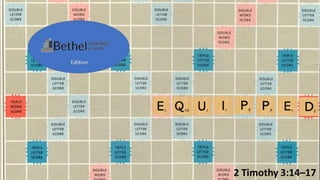
Equipped
2 Timothy 3:14–17
P3I1 D2
E1U1Q1
0
E1
P3
Edition
2 Timothy 3:14–17
You, however, continue in the things you have learned
and become convinced of, knowing from whom you
have learned them, and that from childhood you have
known the sacred writings which are able to give you
the wisdom that leads to salvation through faith which
is in Christ Jesus. All Scripture is inspired by God and
profitable for teaching, for reproof, for correction, for
training in righteousness; so that the man of God may
be adequate, equipped for every good work.
Equipped
2 Timothy 3:14–17
P3I1 D2
E1U1Q1
0
E1 P3
Edition
Barna Research
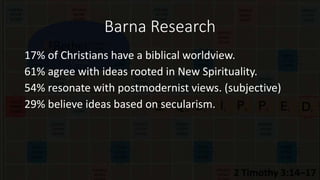
17% of Christians have a biblical worldview.
61% agree with ideas rooted in New Spirituality.
54% resonate with postmodernist views. (subjective)
29% believe ideas based on secularism.
Shocking
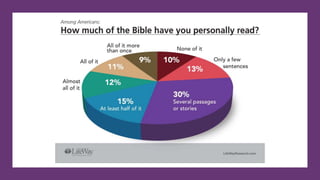
Researchers George Gallup and Jim Castelli put the problem squarely: “Americans revere the Bible—but, by and large,
they don’t read it. And because they don’t read it, they have become a nation of biblical illiterates.” How bad is it?
Researchers tell us that it’s worse than most could imagine.
Fewer than half of all adults can name the four Gospels. Many Christians cannot identify more than two or three of
the disciples. According to data from the Barna Research Group, 60 percent of Americans can’t name even five of the
Ten Commandments. “No wonder people break the Ten Commandments all the time. They don’t know what they
are,” said George Barna, president of the firm. The bottom line? “Increasingly, America is biblically illiterate.”
Multiple surveys reveal the problem in stark terms. According to 82 percent of Americans, “God helps those who help
themselves,” is a Bible verse. Those identified as born-again Christians did better—by one percent. A majority of
adults think the Bible teaches that the most important purpose in life is taking care of one’s family.
Some of the statistics are enough to perplex even those aware of the problem. A Barna poll indicated that at least 12
percent of adults believe that Joan of Arc was Noah’s wife. Another survey of graduating high school seniors revealed
that over 50 percent thought that Sodom and Gomorrah were husband and wife. A considerable number of
respondents to one poll indicated that the Sermon on the Mount was preached by Billy Graham.
LESS THAN ½ OF CHRISTIANS READ THE BIBLE DAILY
An ongoing process
…continue in the things you have learned and become
convinced of, knowing from whom you have learned
them, and that from childhood you have known the
sacred writings…
Studying
Continue in what you have learned
Convinced-sure about because of it’s reliability
Study the word from childhood
Foundational Truth
2 Timothy 3:16…All Scripture is inspired by God and
profitable for teaching, for reproof, for correction, for
training in righteousness;
Notice the source…
Notice what it is used for…
By God
God breathed-living word
At creation God breathed and
man became a living being
Our
Fundamental
Belief
The Scriptures, both the Old and
New Testaments, are verbally
inspired of God and are the
revelation of God to man, the
infallible, authoritative rule of
faith and conduct.
The Outcome
2 Timothy 3:17…so that the man of God may be
adequate, equipped for every good work.
Adequate-qualified or proficient
In matters of faith and conduct
God equips us
Hebrews 13:20–21…Now
the God of peace…equip
you in every good thing to
do His will, working in us
that which is pleasing in His
sight, through Jesus Christ…
This is how you get there
2 Timothy 2:15…Be diligent to present yourself
approved to God as a workman who does not need to
be ashamed, accurately handling the word of truth.
Diligent-to do something with intense effort and
motivation
Your Textbook
Hebrews 4:12…For the word of God is living and active
and sharper than any two-edged sword, and piercing as
far as the division of soul and spirit, of both joints and
marrow, and able to judge the thoughts and intentions
of the heart.
This is what we become proficient with
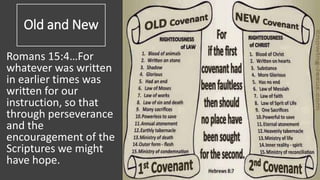
Old and New
Romans 15:4…For
whatever was written
in earlier times was
written for our
instruction, so that
through perseverance
and the
encouragement of the
Scriptures we might
have hope.
A must have on
the journey of life
Psalm 119:105…Your word
is a lamp to my feet And a
light to my path.
Your Teacher
John 14:26…But the Helper, the
Holy Spirit, whom the Father
will send in My name, He will
teach you all things, and bring
to your remembrance all that I
said to you.
Your Teacher
1 Corinthians 2:13…which
things we also speak, not in
words taught by human
wisdom, but in those taught
by the Spirit, combining
spiritual thoughts with
spiritual words.
Your Teacher
1 John 2:27…As for you, the anointing which you
received from Him abides in you, and you have no need
for anyone to teach you; but as His anointing teaches
you about all things, and is true and is not a lie, and just
as it has taught you, you abide in Him.
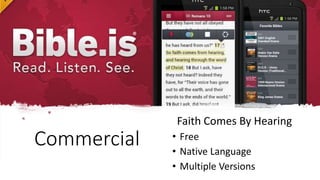
Commercial
Faith Comes By Hearing
• Free
• Native Language
• Multiple Versions
Study to show yourself
approved
Bible
Pen and paper
How to start
Pray
Ask the Holy Spirit to lead
Ask Questions
Who
What
Where
When
Why
How
Who
Who wrote it? While all Scripture is God-
breathed, God used humans to
accomplish the task of writing the
books of the Bible. Each writer
brings his own personality and
writing style to the text, which
makes it fun to switch from Paul’s
logic and sarcasm to John’s more
love-filled letters. It also helps
explain things like how similar
James’ letter is to the Sermon on
the Mount, considering James was
Jesus’ half-brother.
What
What genre is it?
1. Law
2. History
3. Poetry
4. Prophesy
5. Gospel
6. Epistle
Each book of the Bible is written in
one or more genres. Knowing the
genre of a passage helps us choose
which interpretative tools to use with
each text.
Just like you read the Sunday comics
differently than you read Shakespeare,
so you’ll read Proverbs differently than
the Sermon on the Mount
Where
Where did it go? Simply put, the Bible is written FOR us
but it wasn’t written TO us. And you
get into tricky territory if you try to
take some of the words of Scripture as
if they were written for you. Now this
isn’t to say we can’t learn from these
books. They’re part of the Bible for a
reason. But we must begin by asking,
“Where did the writer send this book
after he finished writing it? Who read
it? What did their lives look like? How
would they have understood it?” Then
we’ll begin getting a better picture of
what the writer’s intent was.
When
3. When was it written? Did you know the books of the
Bible are not presented in
chronological order? They’re
grouped by genres instead . So
it’s fascinating to discover that
the book of Job (which comes
right before Psalms) was
written sometime just after
the Flood. perspective-shift.
Answering “when” also tells us
a lot about the culture of the
time and place
Why
Why was it written? writers write with a specific purpose in
mind. So it is with the writers of
Scripture. Moses wrote the first five
books to instruct the Israelites and
remind them what God had done for
them. Paul wrote Galatians to confront
those who said circumcision was
necessary for salvation. Others wrote to
admonish, inspire, warn, and encourage.
We can tell why a book was written by
identifying major themes and repeated
ideas. Look at these in light of the Big
Story, the cultural and historical context,
and you’ll soon get a better
understanding of why the book was
written in the first place.
How
How should I respond?
How do I do this?
How do I share this?
Equipped 2 Timothy 3:14-17

Equipped 2 Timothy 3:14-17

  • 1.
    Equipped 2 Timothy 3:14–17 P3I1D2 E1U1Q1 0 E1 P3 Edition
  • 2.
    2 Timothy 3:14–17 You,however, continue in the things you have learned and become convinced of, knowing from whom you have learned them, and that from childhood you have known the sacred writings which are able to give you the wisdom that leads to salvation through faith which is in Christ Jesus. All Scripture is inspired by God and profitable for teaching, for reproof, for correction, for training in righteousness; so that the man of God may be adequate, equipped for every good work.
  • 3.
    Equipped 2 Timothy 3:14–17 P3I1D2 E1U1Q1 0 E1 P3 Edition
  • 4.
    Barna Research 17% ofChristians have a biblical worldview. 61% agree with ideas rooted in New Spirituality. 54% resonate with postmodernist views. (subjective) 29% believe ideas based on secularism.
  • 5.
    Shocking Researchers George Gallupand Jim Castelli put the problem squarely: “Americans revere the Bible—but, by and large, they don’t read it. And because they don’t read it, they have become a nation of biblical illiterates.” How bad is it? Researchers tell us that it’s worse than most could imagine. Fewer than half of all adults can name the four Gospels. Many Christians cannot identify more than two or three of the disciples. According to data from the Barna Research Group, 60 percent of Americans can’t name even five of the Ten Commandments. “No wonder people break the Ten Commandments all the time. They don’t know what they are,” said George Barna, president of the firm. The bottom line? “Increasingly, America is biblically illiterate.” Multiple surveys reveal the problem in stark terms. According to 82 percent of Americans, “God helps those who help themselves,” is a Bible verse. Those identified as born-again Christians did better—by one percent. A majority of adults think the Bible teaches that the most important purpose in life is taking care of one’s family. Some of the statistics are enough to perplex even those aware of the problem. A Barna poll indicated that at least 12 percent of adults believe that Joan of Arc was Noah’s wife. Another survey of graduating high school seniors revealed that over 50 percent thought that Sodom and Gomorrah were husband and wife. A considerable number of respondents to one poll indicated that the Sermon on the Mount was preached by Billy Graham. LESS THAN ½ OF CHRISTIANS READ THE BIBLE DAILY
  • 7.
    An ongoing process …continuein the things you have learned and become convinced of, knowing from whom you have learned them, and that from childhood you have known the sacred writings…
  • 8.
    Studying Continue in whatyou have learned Convinced-sure about because of it’s reliability Study the word from childhood
  • 9.
    Foundational Truth 2 Timothy3:16…All Scripture is inspired by God and profitable for teaching, for reproof, for correction, for training in righteousness; Notice the source… Notice what it is used for…
  • 10.
    By God God breathed-livingword At creation God breathed and man became a living being
  • 11.
    Our Fundamental Belief The Scriptures, boththe Old and New Testaments, are verbally inspired of God and are the revelation of God to man, the infallible, authoritative rule of faith and conduct.
  • 12.
    The Outcome 2 Timothy3:17…so that the man of God may be adequate, equipped for every good work. Adequate-qualified or proficient In matters of faith and conduct
  • 13.
    God equips us Hebrews13:20–21…Now the God of peace…equip you in every good thing to do His will, working in us that which is pleasing in His sight, through Jesus Christ…
  • 14.
    This is howyou get there 2 Timothy 2:15…Be diligent to present yourself approved to God as a workman who does not need to be ashamed, accurately handling the word of truth. Diligent-to do something with intense effort and motivation
  • 15.
    Your Textbook Hebrews 4:12…Forthe word of God is living and active and sharper than any two-edged sword, and piercing as far as the division of soul and spirit, of both joints and marrow, and able to judge the thoughts and intentions of the heart. This is what we become proficient with
  • 16.
    Old and New Romans15:4…For whatever was written in earlier times was written for our instruction, so that through perseverance and the encouragement of the Scriptures we might have hope.
  • 17.
    A must haveon the journey of life Psalm 119:105…Your word is a lamp to my feet And a light to my path.
  • 18.
    Your Teacher John 14:26…Butthe Helper, the Holy Spirit, whom the Father will send in My name, He will teach you all things, and bring to your remembrance all that I said to you.
  • 19.
    Your Teacher 1 Corinthians2:13…which things we also speak, not in words taught by human wisdom, but in those taught by the Spirit, combining spiritual thoughts with spiritual words.
  • 20.
    Your Teacher 1 John2:27…As for you, the anointing which you received from Him abides in you, and you have no need for anyone to teach you; but as His anointing teaches you about all things, and is true and is not a lie, and just as it has taught you, you abide in Him.
  • 21.
    Commercial Faith Comes ByHearing • Free • Native Language • Multiple Versions
  • 22.
    Study to showyourself approved Bible Pen and paper
  • 23.
    How to start Pray Askthe Holy Spirit to lead
  • 24.
  • 25.
    Who Who wrote it?While all Scripture is God- breathed, God used humans to accomplish the task of writing the books of the Bible. Each writer brings his own personality and writing style to the text, which makes it fun to switch from Paul’s logic and sarcasm to John’s more love-filled letters. It also helps explain things like how similar James’ letter is to the Sermon on the Mount, considering James was Jesus’ half-brother.
  • 26.
    What What genre isit? 1. Law 2. History 3. Poetry 4. Prophesy 5. Gospel 6. Epistle Each book of the Bible is written in one or more genres. Knowing the genre of a passage helps us choose which interpretative tools to use with each text. Just like you read the Sunday comics differently than you read Shakespeare, so you’ll read Proverbs differently than the Sermon on the Mount
  • 27.
    Where Where did itgo? Simply put, the Bible is written FOR us but it wasn’t written TO us. And you get into tricky territory if you try to take some of the words of Scripture as if they were written for you. Now this isn’t to say we can’t learn from these books. They’re part of the Bible for a reason. But we must begin by asking, “Where did the writer send this book after he finished writing it? Who read it? What did their lives look like? How would they have understood it?” Then we’ll begin getting a better picture of what the writer’s intent was.
  • 28.
    When 3. When wasit written? Did you know the books of the Bible are not presented in chronological order? They’re grouped by genres instead . So it’s fascinating to discover that the book of Job (which comes right before Psalms) was written sometime just after the Flood. perspective-shift. Answering “when” also tells us a lot about the culture of the time and place
  • 29.
    Why Why was itwritten? writers write with a specific purpose in mind. So it is with the writers of Scripture. Moses wrote the first five books to instruct the Israelites and remind them what God had done for them. Paul wrote Galatians to confront those who said circumcision was necessary for salvation. Others wrote to admonish, inspire, warn, and encourage. We can tell why a book was written by identifying major themes and repeated ideas. Look at these in light of the Big Story, the cultural and historical context, and you’ll soon get a better understanding of why the book was written in the first place.
  • 30.
    How How should Irespond? How do I do this? How do I share this?