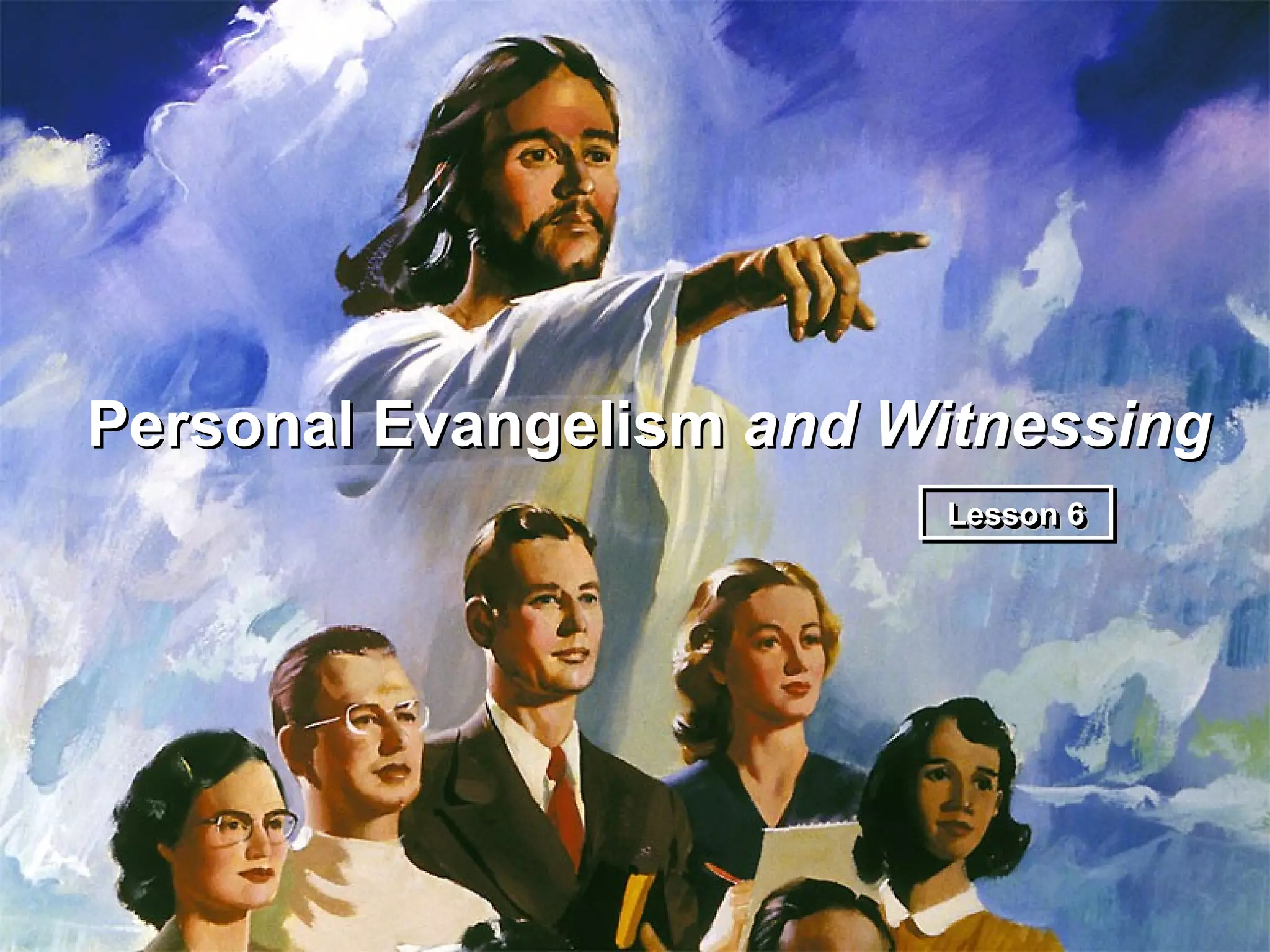





Personal Evangelism and Witnessing
                         Lesson 6
                         Lesson 6
Key Text:
“Vosotros sois mis testigos,
dice Jehová, y mi siervo que
yo escogí”
Isa. 43:10


 PENSAMIENTO CLAVE: Los que tienen el gozo
 de la certeza de la salvación querrán conducir a
 otros a experimentar lo mismo.
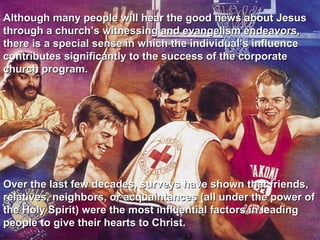
Although many people will hear the good news about Jesus
through a church’s witnessing and evangelism endeavors,
there is a special sense in which the individual’s influence
contributes significantly to the success of the corporate
church program.


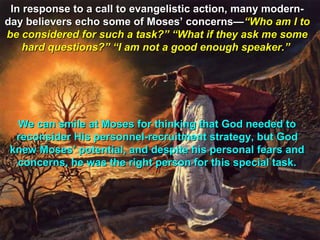
Over the last few decades, surveys have shown that friends,
relatives, neighbors, or acquaintances (all under the power of
the Holy Spirit) were the most influential factors in leading
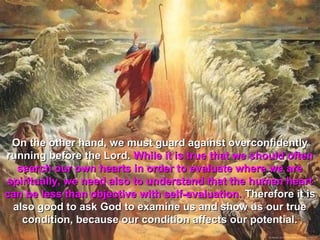
people to give their hearts to Christ.
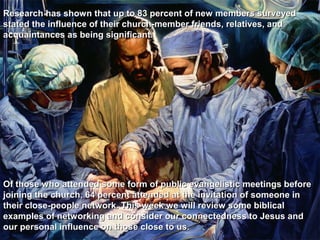
Research has shown that up to 83 percent of new members surveyed
stated the influence of their church-member friends, relatives, and
acquaintances as being significant.


Of those who attended some form of public evangelistic meetings before
joining the church, 64 percent attended at the invitation of someone in
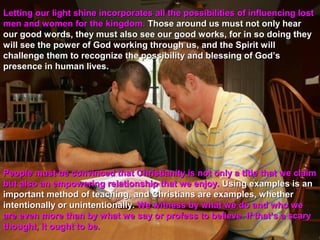
their close-people network. This week we will review some biblical
examples of networking and consider our connectedness to Jesus and
our personal influence on those close to us.
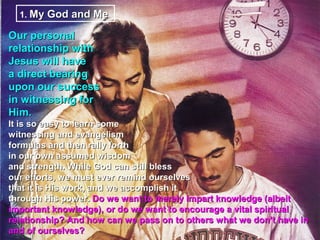
1. My God and Me

Our personal
relationship with
Jesus will have
a direct bearing
upon our success
in witnessing for
Him.
It is so easy to learn some
witnessing and evangelism
formulas and then rally forth
in our own assumed wisdom
and strength. While God can still bless
our efforts, we must ever remind ourselves
that it is His work, and we accomplish it
through His power. Do we want to merely impart knowledge (albeit
important knowledge), or do we want to encourage a vital spiritual
relationship? And how can we pass on to others what we don’t have in
and of ourselves?
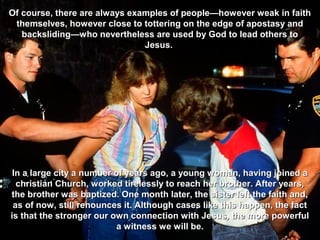
Of course, there are always examples of people—however weak in faith
 themselves, however close to tottering on the edge of apostasy and
   backsliding—who nevertheless are used by God to lead others to
                               Jesus.


 In a large city a number of years ago, a young woman, having joined a
  christian Church, worked tirelessly to reach her brother. After years,
the brother was baptized. One month later, the sister left the faith and,
 as of now, still renounces it. Although cases like this happen, the fact
is that the stronger our own connection with Jesus, the more powerful
                          a witness we will be.
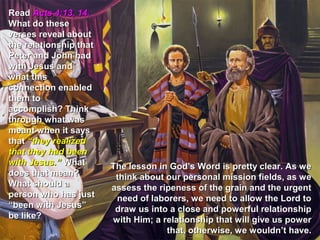
Read Acts 4:13, 14.
What do these
verses reveal about
the relationship that
Peter and John had
with Jesus and
what this
connection enabled
them to
accomplish? Think
through what was
meant when it says
that “they realized
that they had been
with Jesus.” What       The lesson in God’s Word is pretty clear. As we
does that mean?          think about our personal mission fields, as we
What should a           assess the ripeness of the grain and the urgent
person who has just      need of laborers, we need to allow the Lord to
“been with Jesus”        draw us into a close and powerful relationship
be like?                with Him; a relationship that will give us power
                                     that, otherwise, we wouldn’t have.
REFLECTION


     How is your own personal
    relationship with the Lord?
How does your mere presence, the
way you talk, act, and treat people,
reveal your relationship with God?
Be as painfully honest with yourself
        as you possibly can.
2. My Personal Mission Field
 2. My Personal Mission Field


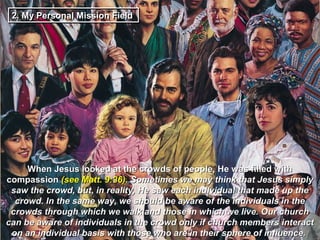
     When Jesus looked at the crowds of people, He was filled with
compassion (see Matt. 9:36). Sometimes we may think that Jesus simply
 saw the crowd, but, in reality, He saw each individual that made up the
  crowd. In the same way, we should be aware of the individuals in the
 crowds through which we walk and those in which we live. Our church
can be aware of individuals in the crowd only if church members interact
 on an individual basis with those who are in their sphere of influence.
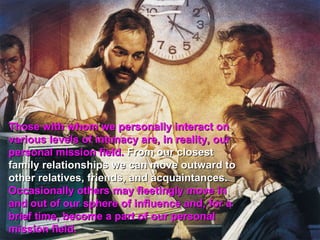
Those with whom we personally interact on
various levels of intimacy are, in reality, our
personal mission field. From our closest
family relationships we can move outward to
other relatives, friends, and acquaintances.
Occasionally others may fleetingly move in
and out of our sphere of influence and, for a
brief time, become a part of our personal
mission field.
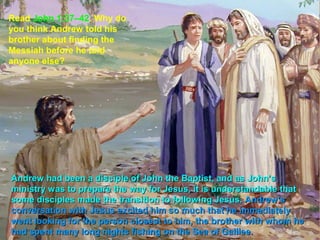
Read John 1:37–42. Why do
you think Andrew told his
brother about finding the
Messiah before he told
anyone else?


Andrew had been a disciple of John the Baptist, and as John’s
ministry was to prepare the way for Jesus, it is understandable that
some disciples made the transition to following Jesus. Andrew’s
conversation with Jesus excited him so much that he immediately
went looking for the person closest to him, the brother with whom he
had spent many long nights fishing on the Sea of Galilee.
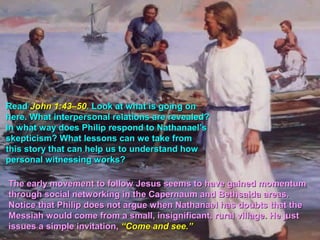
Read John 1:43–50. Look at what is going on
here. What interpersonal relations are revealed?
In what way does Philip respond to Nathanael’s
skepticism? What lessons can we take from
this story that can help us to understand how
personal witnessing works?

The early movement to follow Jesus seems to have gained momentum
through social networking in the Capernaum and Bethsaida areas.
Notice that Philip does not argue when Nathanael has doubts that the
Messiah would come from a small, insignificant, rural village. He just
issues a simple invitation, “Come and see.”
REFLECTION


 How much self-sacrifice will it
take on your part for you to be a
 better witness to those in your
            vicinity?
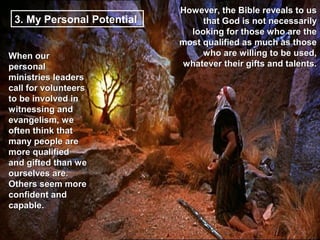
However, the Bible reveals to us
 3. My Personal Potential        that God is not necessarily
                              looking for those who are the
                            most qualified as much as those
When our                         who are willing to be used,
personal                    whatever their gifts and talents.
ministries leaders
call for volunteers
to be involved in
witnessing and
evangelism, we
often think that
many people are
more qualified
and gifted than we
ourselves are.
Others seem more
confident and
capable.
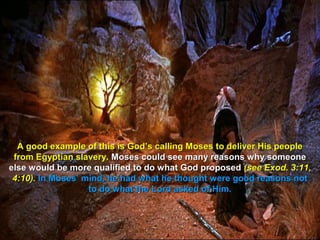
A good example of this is God’s calling Moses to deliver His people
 from Egyptian slavery. Moses could see many reasons why someone
else would be more qualified to do what God proposed (see Exod. 3:11,
 4:10). In Moses’ mind, he had what he thought were good reasons not
                   to do what the Lord asked of Him.
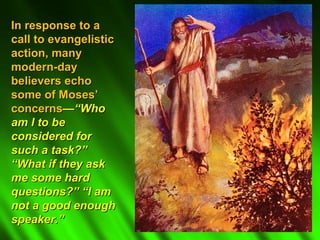
In response to a
call to evangelistic
action, many
modern-day
believers echo
some of Moses’
concerns—“Who
am I to be
considered for
such a task?”
“What if they ask
me some hard
questions?” “I am
not a good enough
speaker.”
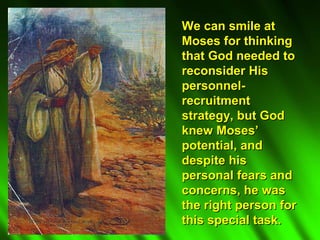
We can smile at
Moses for thinking
that God needed to
reconsider His
personnel-
recruitment
strategy, but God
knew Moses’
potential, and
despite his
personal fears and
concerns, he was
the right person for
this special task.
In response to a call to evangelistic action, many modern-
day believers echo some of Moses’ concerns—“Who am I to
be considered for such a task?” “What if they ask me some
    hard questions?” “I am not a good enough speaker.”


  We can smile at Moses for thinking that God needed to
  reconsider His personnel-recruitment strategy, but God
 knew Moses’ potential, and despite his personal fears and
  concerns, he was the right person for this special task.
On the other hand, we must guard against overconfidently
running before the Lord. While it is true that we should often
  search our own hearts in order to evaluate where we are
spiritually, we need also to understand that the human heart
can be less than objective with self-evaluation. Therefore it is
 also good to ask God to examine us and show us our true
   condition, because our condition affects our potential.
REFLECTION

  Read Psalm 139. Why did David ask God to
               search His heart?
 What lessons are here for us, not just in terms
 of witnessing but regarding our walk with the
               Lord, in general?
   What can we take away from this psalm for
             ourselves right now?
What comfort, hope, and encouragement is there
                   for you?
At the same time, what does it say to you about
 the changes that you need to make in the way
                   you live?
4. The Witness of a Righteous Life

Do actions really speak
louder than words? Yes,
immensely so. It is true,
therefore, that while a
message can be given
through actions without
words, an equally strong
message can be given
through words without
actions.
4. The Witness of a Righteous Life

There is something
very powerful about
a message that incorporates
both actions and words
that are in agreement.
To profess to love God and then act as if you
don’t is hypocrisy, and the worst witness that can
be given is profession and action that are not in
harmony. Consistency speaks loudly. While your
family and friends may not seem to be listening
to what you say, they are watching to see if it is
in harmony with what you do and how you live.
Read 1 Peter 3:1–15. What do these verses tell us about the power of a
Christian life and its potential to win unbelievers to Christ? Imagine the
power that would attend our witness were we to live as we are told to in
this passage. What message especially does verse 15 give in the whole
         context of our personal witness? See also Matt. 5:16.
We can imagine the strife that could have arisen when a pagan woman
     accepted Jesus as her Savior while her husband remained in
  paganism. Her burden for his salvation could lead her to exhibit an
 argumentative and nagging spirit as she considered him to be part of
 her personal mission field. On the other hand, as Peter suggests, she
could be faithful to her God and hope and pray that her godly life would
 win her unbelieving husband to the Master. In other words, she could
  let the actions of her daily life be a constant and powerful witness.
Letting our light shine incorporates all the possibilities of influencing lost
men and women for the kingdom. Those around us must not only hear
our good words, they must also see our good works, for in so doing they
will see the power of God working through us, and the Spirit will
challenge them to recognize the possibility and blessing of God’s
presence in human lives.


People must be convinced that Christianity is not only a title that we claim
but also an empowering relationship that we enjoy. Using examples is an
important method of teaching, and Christians are examples, whether
intentionally or unintentionally. We witness by what we do and who we
are even more than by what we say or profess to believe. If that’s a scary
thought, it ought to be.
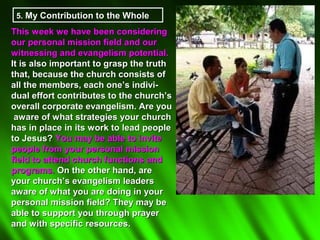
5. My Contribution to the Whole

This week we have been considering
our personal mission field and our
witnessing and evangelism potential.
It is also important to grasp the truth
that, because the church consists of
all the members, each one’s indivi-
dual effort contributes to the church’s
overall corporate evangelism. Are you
 aware of what strategies your church
has in place in its work to lead people
to Jesus? You may be able to invite
people from your personal mission
field to attend church functions and
programs. On the other hand, are
your church’s evangelism leaders
aware of what you are doing in your
personal mission field? They may be
able to support you through prayer
and with specific resources.
Read John 4:37, 38.
What encouragement
can we get from
Jesus’ words, “ ‘
“One sows and
another reaps” ’ ”?
What is He saying
here, and how have
you seen that truth
realized in your own
experience?


It is very probable that on this occasion Jesus was making
reference to the gospel seed sown by Himself, John the
Baptist, and the Samaritan woman. The disciples were
reaping where others had sown, and the time had indeed
arrived when sowers and reapers were rejoicing together.
When Jesus said “ ‘ “One sows and another reaps,” ’ ” He was not
 saying that, as individuals, we are either sowers or reapers.
    Although our churches have probably put more emphasis upon the
 reapers, it is true that, were there no sowers, the reapers would wait in
 vain for a harvest. We are all called to sow and to reap, and in any local
    church scene there are many combinations of sowing and reaping
activities. It may be that your sowing in your personal mission field will be
  reaped at a corporate church reaping process. It may also be that the
  seeds that others have sown will be reaped as people come into your
                            personal mission field.
As we consider the ways
in which each individual
contributes to the whole
(see 1 Cor. 12:12–27),
the farming process
reminds us that even
before the seed is sown,
someone else has
cleared the ground and
ploughed the soil.
Clearly the sowing and
reaping are parts of a
process that continues
after a person has joined
the body. The harvest
must not be left in the
fields but gathered into
the barn.
REFLECTION


How can you be more involved in the
sowing and reaping process in your
               church?
 In what ways have you discovered
 that by working for the salvation of
       others, your own faith is
           strengthened?
    Why do you think that is so?
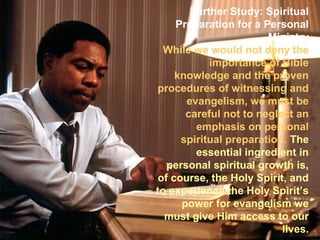
Further Study: Spiritual
    Preparation for a Personal
                       Ministry
  While we would not deny the
           importance of Bible
    knowledge and the proven
procedures of witnessing and
      evangelism, we must be
      careful not to neglect an
        emphasis on personal
     spiritual preparation. The
        essential ingredient in
  personal spiritual growth is,
of course, the Holy Spirit, and
to experience the Holy Spirit’s
     power for evangelism we
  must give Him access to our
                          lives.
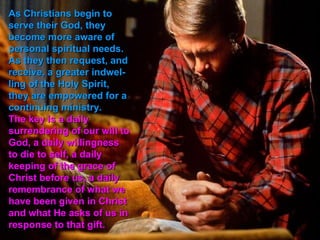
As Christians begin to
serve their God, they
become more aware of
personal spiritual needs.
As they then request, and
receive, a greater indwel-
ling of the Holy Spirit,
they are empowered for a
continuing ministry.
The key is a daily
surrendering of our will to
God, a daily willingness
to die to self, a daily
keeping of the grace of
Christ before us, a daily
remembrance of what we
have been given in Christ
and what He asks of us in
response to that gift.
ADAPT it!                           Effective for
                                   SMALL GROUPS
      Teaching Approach


ASSOCIATE truth – Why should I study this lesson?
DISCOVER truth – What does the Bible say about this
truth?
APPLY truth – How can this truth affect my life today?
PLAN using the truth – How can I use this truth today?
TRANSFER truth to life – What changes do I need in my
life
  ?
                 We invite you to download and study
                  each one of the 13 lessons about
                   “Evangelism and Witnessing”
                     Slideshare.net/chucho1943

06 personal evangelism

  • 1.
    Personal Evangelism andWitnessing Lesson 6 Lesson 6
  • 2.
    Key Text: “Vosotros soismis testigos, dice Jehová, y mi siervo que yo escogí” Isa. 43:10 PENSAMIENTO CLAVE: Los que tienen el gozo de la certeza de la salvación querrán conducir a otros a experimentar lo mismo.
  • 3.
    Although many peoplewill hear the good news about Jesus through a church’s witnessing and evangelism endeavors, there is a special sense in which the individual’s influence contributes significantly to the success of the corporate church program. Over the last few decades, surveys have shown that friends, relatives, neighbors, or acquaintances (all under the power of the Holy Spirit) were the most influential factors in leading people to give their hearts to Christ.
  • 4.
    Research has shownthat up to 83 percent of new members surveyed stated the influence of their church-member friends, relatives, and acquaintances as being significant. Of those who attended some form of public evangelistic meetings before joining the church, 64 percent attended at the invitation of someone in their close-people network. This week we will review some biblical examples of networking and consider our connectedness to Jesus and our personal influence on those close to us.
  • 5.
    1. My Godand Me Our personal relationship with Jesus will have a direct bearing upon our success in witnessing for Him. It is so easy to learn some witnessing and evangelism formulas and then rally forth in our own assumed wisdom and strength. While God can still bless our efforts, we must ever remind ourselves that it is His work, and we accomplish it through His power. Do we want to merely impart knowledge (albeit important knowledge), or do we want to encourage a vital spiritual relationship? And how can we pass on to others what we don’t have in and of ourselves?
  • 6.
    Of course, thereare always examples of people—however weak in faith themselves, however close to tottering on the edge of apostasy and backsliding—who nevertheless are used by God to lead others to Jesus. In a large city a number of years ago, a young woman, having joined a christian Church, worked tirelessly to reach her brother. After years, the brother was baptized. One month later, the sister left the faith and, as of now, still renounces it. Although cases like this happen, the fact is that the stronger our own connection with Jesus, the more powerful a witness we will be.
  • 7.
    Read Acts 4:13,14. What do these verses reveal about the relationship that Peter and John had with Jesus and what this connection enabled them to accomplish? Think through what was meant when it says that “they realized that they had been with Jesus.” What The lesson in God’s Word is pretty clear. As we does that mean? think about our personal mission fields, as we What should a assess the ripeness of the grain and the urgent person who has just need of laborers, we need to allow the Lord to “been with Jesus” draw us into a close and powerful relationship be like? with Him; a relationship that will give us power that, otherwise, we wouldn’t have.
  • 8.
    REFLECTION How is your own personal relationship with the Lord? How does your mere presence, the way you talk, act, and treat people, reveal your relationship with God? Be as painfully honest with yourself as you possibly can.
  • 9.
    2. My PersonalMission Field 2. My Personal Mission Field When Jesus looked at the crowds of people, He was filled with compassion (see Matt. 9:36). Sometimes we may think that Jesus simply saw the crowd, but, in reality, He saw each individual that made up the crowd. In the same way, we should be aware of the individuals in the crowds through which we walk and those in which we live. Our church can be aware of individuals in the crowd only if church members interact on an individual basis with those who are in their sphere of influence.
  • 10.
    Those with whomwe personally interact on various levels of intimacy are, in reality, our personal mission field. From our closest family relationships we can move outward to other relatives, friends, and acquaintances. Occasionally others may fleetingly move in and out of our sphere of influence and, for a brief time, become a part of our personal mission field.
  • 11.
    Read John 1:37–42.Why do you think Andrew told his brother about finding the Messiah before he told anyone else? Andrew had been a disciple of John the Baptist, and as John’s ministry was to prepare the way for Jesus, it is understandable that some disciples made the transition to following Jesus. Andrew’s conversation with Jesus excited him so much that he immediately went looking for the person closest to him, the brother with whom he had spent many long nights fishing on the Sea of Galilee.
  • 12.
    Read John 1:43–50.Look at what is going on here. What interpersonal relations are revealed? In what way does Philip respond to Nathanael’s skepticism? What lessons can we take from this story that can help us to understand how personal witnessing works? The early movement to follow Jesus seems to have gained momentum through social networking in the Capernaum and Bethsaida areas. Notice that Philip does not argue when Nathanael has doubts that the Messiah would come from a small, insignificant, rural village. He just issues a simple invitation, “Come and see.”
  • 13.
    REFLECTION How muchself-sacrifice will it take on your part for you to be a better witness to those in your vicinity?
  • 14.
    However, the Biblereveals to us 3. My Personal Potential that God is not necessarily looking for those who are the most qualified as much as those When our who are willing to be used, personal whatever their gifts and talents. ministries leaders call for volunteers to be involved in witnessing and evangelism, we often think that many people are more qualified and gifted than we ourselves are. Others seem more confident and capable.
  • 15.
    A good exampleof this is God’s calling Moses to deliver His people from Egyptian slavery. Moses could see many reasons why someone else would be more qualified to do what God proposed (see Exod. 3:11, 4:10). In Moses’ mind, he had what he thought were good reasons not to do what the Lord asked of Him.
  • 16.
    In response toa call to evangelistic action, many modern-day believers echo some of Moses’ concerns—“Who am I to be considered for such a task?” “What if they ask me some hard questions?” “I am not a good enough speaker.”
  • 17.
    We can smileat Moses for thinking that God needed to reconsider His personnel- recruitment strategy, but God knew Moses’ potential, and despite his personal fears and concerns, he was the right person for this special task.
  • 18.
    In response toa call to evangelistic action, many modern- day believers echo some of Moses’ concerns—“Who am I to be considered for such a task?” “What if they ask me some hard questions?” “I am not a good enough speaker.” We can smile at Moses for thinking that God needed to reconsider His personnel-recruitment strategy, but God knew Moses’ potential, and despite his personal fears and concerns, he was the right person for this special task.
  • 19.
    On the otherhand, we must guard against overconfidently running before the Lord. While it is true that we should often search our own hearts in order to evaluate where we are spiritually, we need also to understand that the human heart can be less than objective with self-evaluation. Therefore it is also good to ask God to examine us and show us our true condition, because our condition affects our potential.
  • 20.
    REFLECTION ReadPsalm 139. Why did David ask God to search His heart? What lessons are here for us, not just in terms of witnessing but regarding our walk with the Lord, in general? What can we take away from this psalm for ourselves right now? What comfort, hope, and encouragement is there for you? At the same time, what does it say to you about the changes that you need to make in the way you live?
  • 21.
    4. The Witnessof a Righteous Life Do actions really speak louder than words? Yes, immensely so. It is true, therefore, that while a message can be given through actions without words, an equally strong message can be given through words without actions.
  • 22.
    4. The Witnessof a Righteous Life There is something very powerful about a message that incorporates both actions and words that are in agreement. To profess to love God and then act as if you don’t is hypocrisy, and the worst witness that can be given is profession and action that are not in harmony. Consistency speaks loudly. While your family and friends may not seem to be listening to what you say, they are watching to see if it is in harmony with what you do and how you live.
  • 23.
    Read 1 Peter3:1–15. What do these verses tell us about the power of a Christian life and its potential to win unbelievers to Christ? Imagine the power that would attend our witness were we to live as we are told to in this passage. What message especially does verse 15 give in the whole context of our personal witness? See also Matt. 5:16.
  • 24.
    We can imaginethe strife that could have arisen when a pagan woman accepted Jesus as her Savior while her husband remained in paganism. Her burden for his salvation could lead her to exhibit an argumentative and nagging spirit as she considered him to be part of her personal mission field. On the other hand, as Peter suggests, she could be faithful to her God and hope and pray that her godly life would win her unbelieving husband to the Master. In other words, she could let the actions of her daily life be a constant and powerful witness.
  • 25.
    Letting our lightshine incorporates all the possibilities of influencing lost men and women for the kingdom. Those around us must not only hear our good words, they must also see our good works, for in so doing they will see the power of God working through us, and the Spirit will challenge them to recognize the possibility and blessing of God’s presence in human lives. People must be convinced that Christianity is not only a title that we claim but also an empowering relationship that we enjoy. Using examples is an important method of teaching, and Christians are examples, whether intentionally or unintentionally. We witness by what we do and who we are even more than by what we say or profess to believe. If that’s a scary thought, it ought to be.
  • 26.
    5. My Contributionto the Whole This week we have been considering our personal mission field and our witnessing and evangelism potential. It is also important to grasp the truth that, because the church consists of all the members, each one’s indivi- dual effort contributes to the church’s overall corporate evangelism. Are you aware of what strategies your church has in place in its work to lead people to Jesus? You may be able to invite people from your personal mission field to attend church functions and programs. On the other hand, are your church’s evangelism leaders aware of what you are doing in your personal mission field? They may be able to support you through prayer and with specific resources.
  • 27.
    Read John 4:37,38. What encouragement can we get from Jesus’ words, “ ‘ “One sows and another reaps” ’ ”? What is He saying here, and how have you seen that truth realized in your own experience? It is very probable that on this occasion Jesus was making reference to the gospel seed sown by Himself, John the Baptist, and the Samaritan woman. The disciples were reaping where others had sown, and the time had indeed arrived when sowers and reapers were rejoicing together.
  • 28.
    When Jesus said“ ‘ “One sows and another reaps,” ’ ” He was not saying that, as individuals, we are either sowers or reapers. Although our churches have probably put more emphasis upon the reapers, it is true that, were there no sowers, the reapers would wait in vain for a harvest. We are all called to sow and to reap, and in any local church scene there are many combinations of sowing and reaping activities. It may be that your sowing in your personal mission field will be reaped at a corporate church reaping process. It may also be that the seeds that others have sown will be reaped as people come into your personal mission field.
  • 29.
    As we considerthe ways in which each individual contributes to the whole (see 1 Cor. 12:12–27), the farming process reminds us that even before the seed is sown, someone else has cleared the ground and ploughed the soil. Clearly the sowing and reaping are parts of a process that continues after a person has joined the body. The harvest must not be left in the fields but gathered into the barn.
  • 30.
    REFLECTION How can yoube more involved in the sowing and reaping process in your church? In what ways have you discovered that by working for the salvation of others, your own faith is strengthened? Why do you think that is so?
  • 31.
    Further Study: Spiritual Preparation for a Personal Ministry While we would not deny the importance of Bible knowledge and the proven procedures of witnessing and evangelism, we must be careful not to neglect an emphasis on personal spiritual preparation. The essential ingredient in personal spiritual growth is, of course, the Holy Spirit, and to experience the Holy Spirit’s power for evangelism we must give Him access to our lives.
  • 32.
    As Christians beginto serve their God, they become more aware of personal spiritual needs. As they then request, and receive, a greater indwel- ling of the Holy Spirit, they are empowered for a continuing ministry. The key is a daily surrendering of our will to God, a daily willingness to die to self, a daily keeping of the grace of Christ before us, a daily remembrance of what we have been given in Christ and what He asks of us in response to that gift.
  • 33.
    ADAPT it! Effective for SMALL GROUPS Teaching Approach ASSOCIATE truth – Why should I study this lesson? DISCOVER truth – What does the Bible say about this truth? APPLY truth – How can this truth affect my life today? PLAN using the truth – How can I use this truth today? TRANSFER truth to life – What changes do I need in my life ? We invite you to download and study each one of the 13 lessons about “Evangelism and Witnessing” Slideshare.net/chucho1943