ENZYMES:
Nomenclature & Classification
Dr. Rituparna Saha
Assistant Professor
Department of Life Sciences
Subject: Enzymology
Enzymes
• Biological catalysts, protein in nature, thermolabile, synthesized by living
cells – substance on which enzyme acts – substrates
• Similarities between inorganic catalysts & enzymes – speed up chemical
reactions, accelerate state of equilibrium, doesn’t change, lowers the
activation energy, formation of intermediate, influenced by external
factors
• Differences between inorganic catalysts & enzymes – nature, source,
operating conditions, specificity, activity regulation, size, turnover rate,
lifespan
Enzymes - Characteristics
• Cofactor – Non-protein molecules
• Coenzyme – Organic compounds
• Prosthetic group – Non-protein compounds that bind via covalent or
non-covalent bonds
• Apoenzyme – Non-active enzyme without its cofactor
• Holoenzyme – Enzyme along with its cofactor
Enzymes – nomenclature & classification
• Substrate acted upon by the enzyme – carbohydrase, proteinase, lipase,
sucrase, maltase
• Type of reaction catalyzed – isomerase, hydrolase, oxidase, transaminase
• Substrate acted upon & type of reaction catalyzed – succinic
dehydrogenase, L-glutamic dehydrogenase
• Substance that is synthesized – Fumarase
• Chemical composition of the enzyme – only protein = pepsin, trypsin,
amylase; protein + cation = carbonic anhydrase (Zn2+
), tyrosinase (Cu2+
);
protein + organic compound = iron porphyrin enzymes (catalase),
flavoprotein (glycine oxidase)
• Substance hydrolyzed and the group involved – carbohydrate, lipid,
protein-hydrolyzing enzymes
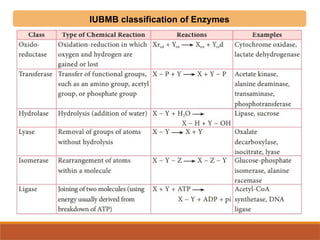
IUBMB classification of Enzymes
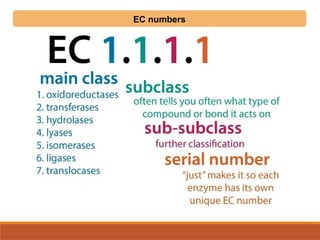
EC numbers
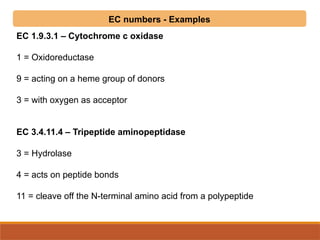
EC numbers - Examples
EC 1.9.3.1 – Cytochrome c oxidase
1 = Oxidoreductase
9 = acting on a heme group of donors
3 = with oxygen as acceptor
EC 3.4.11.4 – Tripeptide aminopeptidase
3 = Hydrolase
4 = acts on peptide bonds
11 = cleave off the N-terminal amino acid from a polypeptide
ENZYMES: Nomenclature & Classification.pptx

ENZYMES: Nomenclature & Classification.pptx

  • 1.
    ENZYMES: Nomenclature & Classification Dr.Rituparna Saha Assistant Professor Department of Life Sciences Subject: Enzymology
  • 2.
    Enzymes • Biological catalysts,protein in nature, thermolabile, synthesized by living cells – substance on which enzyme acts – substrates • Similarities between inorganic catalysts & enzymes – speed up chemical reactions, accelerate state of equilibrium, doesn’t change, lowers the activation energy, formation of intermediate, influenced by external factors • Differences between inorganic catalysts & enzymes – nature, source, operating conditions, specificity, activity regulation, size, turnover rate, lifespan
  • 3.
    Enzymes - Characteristics •Cofactor – Non-protein molecules • Coenzyme – Organic compounds • Prosthetic group – Non-protein compounds that bind via covalent or non-covalent bonds • Apoenzyme – Non-active enzyme without its cofactor • Holoenzyme – Enzyme along with its cofactor
  • 4.
    Enzymes – nomenclature& classification • Substrate acted upon by the enzyme – carbohydrase, proteinase, lipase, sucrase, maltase • Type of reaction catalyzed – isomerase, hydrolase, oxidase, transaminase • Substrate acted upon & type of reaction catalyzed – succinic dehydrogenase, L-glutamic dehydrogenase • Substance that is synthesized – Fumarase • Chemical composition of the enzyme – only protein = pepsin, trypsin, amylase; protein + cation = carbonic anhydrase (Zn2+ ), tyrosinase (Cu2+ ); protein + organic compound = iron porphyrin enzymes (catalase), flavoprotein (glycine oxidase) • Substance hydrolyzed and the group involved – carbohydrate, lipid, protein-hydrolyzing enzymes
  • 5.
  • 6.
  • 7.
    EC numbers -Examples EC 1.9.3.1 – Cytochrome c oxidase 1 = Oxidoreductase 9 = acting on a heme group of donors 3 = with oxygen as acceptor EC 3.4.11.4 – Tripeptide aminopeptidase 3 = Hydrolase 4 = acts on peptide bonds 11 = cleave off the N-terminal amino acid from a polypeptide