Chapter 5 (part 1)
Enzymes: Introduction
Catalyst
• substance that increase rates of a
chemical reaction
• does not effect equilibrium
• remain unchanged in overall
process
• reactants bind to catalyst,
products are released
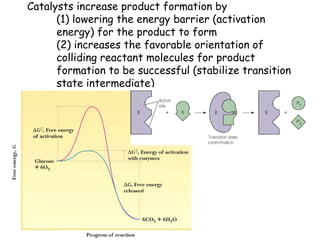
Catalysts increase product formation by
(1) lowering the energy barrier (activation
energy) for the product to form
(2) increases the favorable orientation of
colliding reactant molecules for product
formation to be successful (stabilize transition
state intermediate)
Catalytic Power
• Enzymes can accelerate reactions
as much as 1016
over uncatalyzed
rates!
• Urease is a good example:
– Catalyzed rate: 3x10⁴
/sec
– Uncatalyzed rate: 3x10 -10
/sec
– Ratio is 1x10¹⁴
!
Specificity
• Enzymes selectively recognize
proper substrates over other
molecules
• Enzymes produce products in very
high yields - often much greater
than 95%
• Specificity is controlled by
structure - the unique fit of
substrate with enzyme controls the
selectivity for substrate and the
product yield
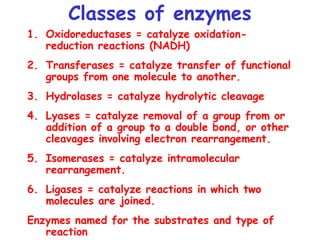
Classes of enzymes
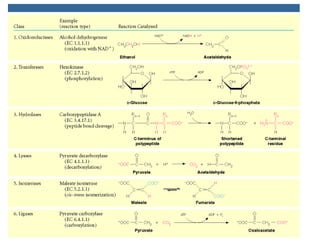
1. Oxidoreductases = catalyze oxidation-
reduction reactions (NADH)
2. Transferases = catalyze transfer of functional
groups from one molecule to another.
3. Hydrolases = catalyze hydrolytic cleavage
4. Lyases = catalyze removal of a group from or
addition of a group to a double bond, or other
cleavages involving electron rearrangement.
5. Isomerases = catalyze intramolecular
rearrangement.
6. Ligases = catalyze reactions in which two
molecules are joined.
Enzymes named for the substrates and type of
reaction
Co-enzymes
• Non-protein molecules that help enzymes
function
• Associate with active site of enzyme
• Enzyme + Co-enzyme = holoenzyme
• Enzyme alone = apoenzyme
• Organic co-enzymes – thiamin, riboflavin,
niacin, biotin
• Inorganic co-enzymes – Mg ++
, Fe++
, Zn++
,
Mn++
Kinetics
• study of reaction rate
• determines number of steps involved
• determines mechanism of reaction
• identifies “rate-limiting” step
Kinetics
• study of reaction rate
• determines number of steps involved
• determines mechanism of reaction
• identifies “rate-limiting” step

Enzymes: Introduction

  • 1.
    Chapter 5 (part1) Enzymes: Introduction
  • 2.
    Catalyst • substance thatincrease rates of a chemical reaction • does not effect equilibrium • remain unchanged in overall process • reactants bind to catalyst, products are released
  • 3.
    Catalysts increase productformation by (1) lowering the energy barrier (activation energy) for the product to form (2) increases the favorable orientation of colliding reactant molecules for product formation to be successful (stabilize transition state intermediate)
  • 4.
    Catalytic Power • Enzymescan accelerate reactions as much as 1016 over uncatalyzed rates! • Urease is a good example: – Catalyzed rate: 3x10⁴ /sec – Uncatalyzed rate: 3x10 -10 /sec – Ratio is 1x10¹⁴ !
  • 5.
    Specificity • Enzymes selectivelyrecognize proper substrates over other molecules • Enzymes produce products in very high yields - often much greater than 95% • Specificity is controlled by structure - the unique fit of substrate with enzyme controls the selectivity for substrate and the product yield
  • 6.
    Classes of enzymes 1.Oxidoreductases = catalyze oxidation- reduction reactions (NADH) 2. Transferases = catalyze transfer of functional groups from one molecule to another. 3. Hydrolases = catalyze hydrolytic cleavage 4. Lyases = catalyze removal of a group from or addition of a group to a double bond, or other cleavages involving electron rearrangement. 5. Isomerases = catalyze intramolecular rearrangement. 6. Ligases = catalyze reactions in which two molecules are joined. Enzymes named for the substrates and type of reaction
  • 8.
    Co-enzymes • Non-protein moleculesthat help enzymes function • Associate with active site of enzyme • Enzyme + Co-enzyme = holoenzyme • Enzyme alone = apoenzyme • Organic co-enzymes – thiamin, riboflavin, niacin, biotin • Inorganic co-enzymes – Mg ++ , Fe++ , Zn++ , Mn++
  • 9.
    Kinetics • study ofreaction rate • determines number of steps involved • determines mechanism of reaction • identifies “rate-limiting” step
  • 10.
    Kinetics • study ofreaction rate • determines number of steps involved • determines mechanism of reaction • identifies “rate-limiting” step