Download to read offline
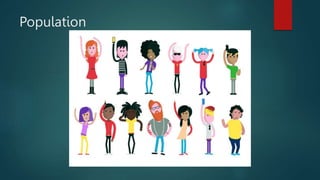
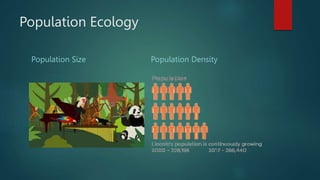
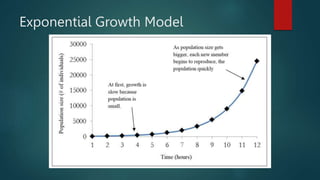
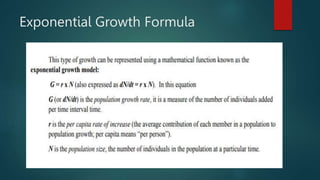
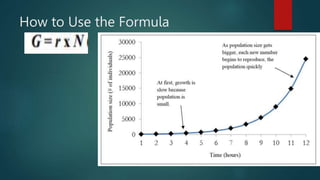
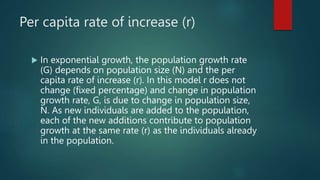
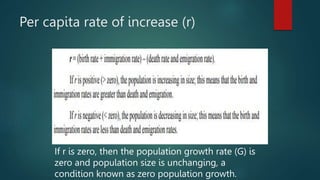
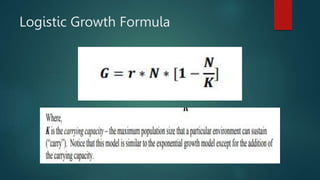
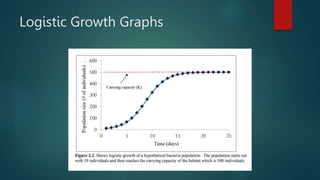
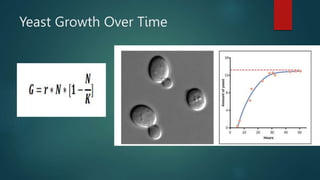
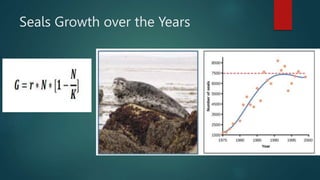

This document provides an overview of population ecology concepts including population size, density, growth, and models. It defines a population as a group of the same species living in the same area. Population ecology studies how populations interact with their environment and change over time. Populations can be characterized by size, density, dispersion, age structure, and sex ratio. The document discusses exponential and logistic population growth models. Exponential growth occurs when resources are unlimited, while logistic growth occurs when resources are limited, causing the growth rate to slow as the population approaches the environment's carrying capacity. Examples are provided to illustrate exponential and logistic growth patterns over time.


