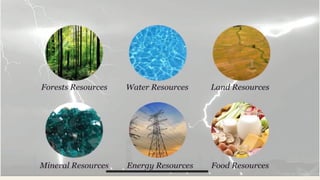
The word resource means a source of supply. The
natural resources include water, air, soil, minerals,
coal, forests, crops and wildlife are examples. All
the resources are classified based on quantity,
NATURAL
RESOURCES
Natural resources and associated
problems
Human population is growing day-by-day. Continuous increase in
population caused an increasing demand for natural resources. Due to
urban expansion, electricity need and industrialization, man started
utilizing natural resources at a much larger scale. Non-renewable
resources are limited.
There are many problems associated with
natural resources:
Forest resources and associated problems
Forests are one of the most important natural resources and a part of
biosphere since these are natural assets on this earth. Forests predominantly
composed of trees, shrubs, woody vegetation.
Forest resources and associated problems
1.Use and over-exploitation.
2. Deforestation
3. Timber extraction.
4. Mining and its effects on forest
5. Dams and their effects on forests and tribal people
Three major effects of deforestation:
1.Loss of biodiversity
2. Soil erosion
3. Increased greenhouse gas emissions
USES OF FOREST
1. Watershed protection:
• Reduce the rate of surface run-off of water.
2. Atmospheric regulation:
• Absorption of solar heat during evapo-transpiration. • Maintaining carbon
dioxide levels for plant growth.
3. Erosion control:
• Holding soil (by preventing rain from directly washing soil away).
4. Consumption of forest produce by local people who collect it for
subsistence –
Water resources and associated problems
Water resources are sources of water that are useful or potentially
useful. Uses of water include agricultural, industrial, household,
recreational and environmental activities.
Distribution of water on earth:
• 97% of the water on the Earth is salt water
Fresh water occurs mainly in two forms
1. Ground water and 2. Surface water
Water resources and associated problems
1. Use and overutilization of water. 2. Floods, droughts
3. Conflicts over water. 4. Dams and problems.
USES OF WATER
1. DOMESTIC USE:
Water used in the houses for the purposes of drinking, bathing, washing Clothes, cooking, sanitary
& other needs.
2. INDUSTRIAL USE:
Water is required for various industries such as cement, mining, textile, leather industries.
3. PUBLIC USE:
This includes water used for public utility purpose such as watering parks, Flushing streets, jails etc.
4. FIRE USE:
Water is used in case of accidents and to prevent the fire issues.
MINERAL resources and associated
problems
A mineral is a naturally occurring substance of definite chemical
composition and identifiable physical properties. An ore is a mineral or
combination of minerals from which a useful substance, such as a metal, can be
extracted and used to manufacture a useful product.
Mines are of two types :
1. Surface Mining
2. Underground Mining
Mineral resource and associated problems
3. Use and exploitation.
2. Environmental effects of extracting and using minerals.
USES OF MINERALS
1. Generation of energy by using coal (lignite / anthracite); uranium, gold, silver,
platinum, diamond are used in jewellery.
2. Some of the minerals are used as medicine.
Mining operations generally progress through four stages:
(1) Prospecting: Searching for minerals.
(2) Exploration: Assessing the size, shape, location
(3) Development: Work of preparing access to the deposit so that the minerals can be
extracted from it.
(4) Exploitation : Extracting the minerals from the mines.
Food resources and associated problems
The main sources of human food are plants and animals. Human
beings consume almost all parts of plants in the form of:
cereals (wheat, barley, millet, rye, oats, maize, corn, rice.
vegetables (carrot, cauliflower, beans);
fruits (banana, orange, grapes, pineapple) and spices (pepper, cloves).
ASSOCIATED PROBLEMS:
1. World food problems. 2. Changes caused by agriculture and over
grazing.
3. Effects of modern agriculture. 4. Fertilizer-pesticide problems.
USES OF FOOD
1. Source of energy for man
2.Helps with physical and mental development
3.For protection and regulation of body needs
4.It gives nutrients to the body
Food resources and associated problems
The main sources of human food are plants and animals. Human
beings consume almost all parts of plants in the form of:
cereals (wheat, barley, millet, rye, oats, maize, corn, rice.
vegetables (carrot, cauliflower, beans);
fruits (banana, orange, grapes, pineapple) and spices (pepper, cloves).
ASSOCIATED PROBLEMS:
1. World food problems. 2. Changes caused by agriculture and over
grazing.
3. Effects of modern agriculture. 4. Fertilizer-pesticide problems.
USES OF FOOD
1. Source of energy for man
2. Helps with physical and mental development
3. For protection and regulation of body needs
4. It gives nutrients to the body
energy resources and associated
problems
Energy is defined by physicists as the capacity to do work. Energy is
found on our planet in a variety of forms, some of which are immediately
useful to do work, while others require a process of transformation.
Energy is present in a number of forms such as:
1. mechanical 2. thermal
3. chemical 4. biological energy
Energy resources and associated problems
1. Growing energy needs.
Uses of energy
1. Energy is a primary input in any industrial operation.
2. It is also a major input in sectors such as commerce, transport,
tele-communications etc.
3. The wide range of services required in the household and industrial sectors.
4. Owing to the far-reaching changes in the forms of energy and their respective
roles in supporting human activities, research and training.
Two types of energy
resources
RENEWABLE RESOURCES
Non- ReNEWABLE RESOURCES
The renewable resources can maintain themselves or can be replaced if managed
wisely. These resources are constantly renewed in nature. The renewable
resources are therefore not likely to be lost due to excessive and unwise use.
These resources once used are lost forever, as they are not restored. They include
metallic minerals and fossil fuels. At current rates of usage, all the industrial
metals may lose for less than a century and those of petroleum and natural gas
may exhaust in 15-20 years.
RENEWABLE RESOURCES
The renewable resources can maintain themselves or can be replaced if managed
wisely. These resources are constantly renewed in nature. The renewable
resources are therefore not likely to be lost due to excessive and unwise use.
Four renewable energy sources
1. Solar energy
2. Wind energy
3. Hydropower
4. Geothermal energy
Land resources and associated problems
Land as a resource: Landforms such as hills, valleys, plains, river basins and wetlands
include different resource generating areas that the people living in them depend on.
Many traditional farming societies had ways of preserving areas from which they used
resources. If land is utilized carefully it can be considered a renewable resource. The roots
of trees and grasses bind the soil.
Land resources and associated problems
1. Land degradation.
2. Man-induced landslides.
3. Soil erosion and desertification.
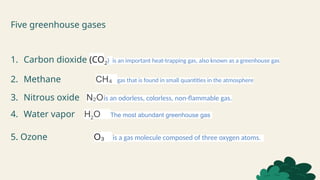
Five greenhouse gases
1. Carbon dioxide (CO2) is an important heat-trapping gas, also known as a greenhouse gas
2. Methane CH₄ gas that is found in small quantities in the atmosphere
3. Nitrous oxide N O
₂ is an odorless, colorless, non-flammable gas.
4. Water vapor H2O The most abundant greenhouse gas
5. Ozone O₃ is a gas molecule composed of three oxygen atoms.
Four layers of earth’s atmosphere
1. Troposphere lowest layer of the atmosphere
2. Stratosphere it contains the ozone layer
3. Mesosphere lies between the thermosphere and stratosphere
4. Thermosphere the atmosphere so thin that gas molecules rarely contact each
other
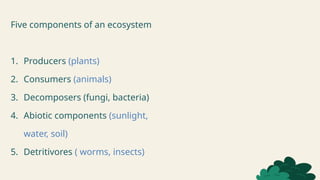
Five components of an ecosystem
1. Producers (plants)
2. Consumers (animals)
3. Decomposers (fungi, bacteria)
4. Abiotic components (sunlight,
water, soil)
5. Detritivores ( worms, insects)
Role of an individual
conservation of natural resources
a. Conserve Water:
1.Don’t keep water taps running while brushing, shaving, washing or bathing.
2. In washing machines fill the machine only to the level required for your clothes.
3. Install water saving toilets that use not more than 6 liters per flush.
b. Conserve energy:
1. Turn off lights fans and other appliances when not in use.
2. Obtain as much heat as possible from natural sources.
Dry the clothes in sun instead of direr if possible.
3. Control the use of A.C
Role of an individual
conservation of natural resources
a. Protect the Soil:
1. Grow different types of ornamental plants, herbs and trees in your garden. Grow grass
in the open areas which will bind the soil and prevent its erosion.
2. Make compost from your kitchen waste and use it for your kitchen-garden.
3. Do not irrigate the plants using a strong flow of water as it would wash off the soil.
b. Promote Sustainable Agriculture:
1.Do not waste food; Take as much as you can eat.
2. Reduce the use of pesticides.
3. Fertilize your crop with organic fertilizers.
THANK YOU FOR
ATTENTION
End Slide Cleana Jane
Torrecampo
Environmental
science

Environmental-Science-Presentationhgg.pptx

  • 1.
    The word resourcemeans a source of supply. The natural resources include water, air, soil, minerals, coal, forests, crops and wildlife are examples. All the resources are classified based on quantity, NATURAL RESOURCES
  • 3.
    Natural resources andassociated problems Human population is growing day-by-day. Continuous increase in population caused an increasing demand for natural resources. Due to urban expansion, electricity need and industrialization, man started utilizing natural resources at a much larger scale. Non-renewable resources are limited. There are many problems associated with natural resources:
  • 4.
    Forest resources andassociated problems Forests are one of the most important natural resources and a part of biosphere since these are natural assets on this earth. Forests predominantly composed of trees, shrubs, woody vegetation. Forest resources and associated problems 1.Use and over-exploitation. 2. Deforestation 3. Timber extraction. 4. Mining and its effects on forest 5. Dams and their effects on forests and tribal people
  • 5.
    Three major effectsof deforestation: 1.Loss of biodiversity 2. Soil erosion 3. Increased greenhouse gas emissions
  • 6.
    USES OF FOREST 1.Watershed protection: • Reduce the rate of surface run-off of water. 2. Atmospheric regulation: • Absorption of solar heat during evapo-transpiration. • Maintaining carbon dioxide levels for plant growth. 3. Erosion control: • Holding soil (by preventing rain from directly washing soil away). 4. Consumption of forest produce by local people who collect it for subsistence –
  • 7.
    Water resources andassociated problems Water resources are sources of water that are useful or potentially useful. Uses of water include agricultural, industrial, household, recreational and environmental activities. Distribution of water on earth: • 97% of the water on the Earth is salt water Fresh water occurs mainly in two forms 1. Ground water and 2. Surface water Water resources and associated problems 1. Use and overutilization of water. 2. Floods, droughts 3. Conflicts over water. 4. Dams and problems.
  • 8.
    USES OF WATER 1.DOMESTIC USE: Water used in the houses for the purposes of drinking, bathing, washing Clothes, cooking, sanitary & other needs. 2. INDUSTRIAL USE: Water is required for various industries such as cement, mining, textile, leather industries. 3. PUBLIC USE: This includes water used for public utility purpose such as watering parks, Flushing streets, jails etc. 4. FIRE USE: Water is used in case of accidents and to prevent the fire issues.
  • 9.
    MINERAL resources andassociated problems A mineral is a naturally occurring substance of definite chemical composition and identifiable physical properties. An ore is a mineral or combination of minerals from which a useful substance, such as a metal, can be extracted and used to manufacture a useful product. Mines are of two types : 1. Surface Mining 2. Underground Mining Mineral resource and associated problems 3. Use and exploitation. 2. Environmental effects of extracting and using minerals.
  • 10.
    USES OF MINERALS 1.Generation of energy by using coal (lignite / anthracite); uranium, gold, silver, platinum, diamond are used in jewellery. 2. Some of the minerals are used as medicine. Mining operations generally progress through four stages: (1) Prospecting: Searching for minerals. (2) Exploration: Assessing the size, shape, location (3) Development: Work of preparing access to the deposit so that the minerals can be extracted from it. (4) Exploitation : Extracting the minerals from the mines.
  • 11.
    Food resources andassociated problems The main sources of human food are plants and animals. Human beings consume almost all parts of plants in the form of: cereals (wheat, barley, millet, rye, oats, maize, corn, rice. vegetables (carrot, cauliflower, beans); fruits (banana, orange, grapes, pineapple) and spices (pepper, cloves). ASSOCIATED PROBLEMS: 1. World food problems. 2. Changes caused by agriculture and over grazing. 3. Effects of modern agriculture. 4. Fertilizer-pesticide problems.
  • 12.
    USES OF FOOD 1.Source of energy for man 2.Helps with physical and mental development 3.For protection and regulation of body needs 4.It gives nutrients to the body
  • 13.
    Food resources andassociated problems The main sources of human food are plants and animals. Human beings consume almost all parts of plants in the form of: cereals (wheat, barley, millet, rye, oats, maize, corn, rice. vegetables (carrot, cauliflower, beans); fruits (banana, orange, grapes, pineapple) and spices (pepper, cloves). ASSOCIATED PROBLEMS: 1. World food problems. 2. Changes caused by agriculture and over grazing. 3. Effects of modern agriculture. 4. Fertilizer-pesticide problems.
  • 14.
    USES OF FOOD 1.Source of energy for man 2. Helps with physical and mental development 3. For protection and regulation of body needs 4. It gives nutrients to the body
  • 15.
    energy resources andassociated problems Energy is defined by physicists as the capacity to do work. Energy is found on our planet in a variety of forms, some of which are immediately useful to do work, while others require a process of transformation. Energy is present in a number of forms such as: 1. mechanical 2. thermal 3. chemical 4. biological energy Energy resources and associated problems 1. Growing energy needs.
  • 16.
    Uses of energy 1.Energy is a primary input in any industrial operation. 2. It is also a major input in sectors such as commerce, transport, tele-communications etc. 3. The wide range of services required in the household and industrial sectors. 4. Owing to the far-reaching changes in the forms of energy and their respective roles in supporting human activities, research and training.
  • 17.
    Two types ofenergy resources
  • 18.
    RENEWABLE RESOURCES Non- ReNEWABLERESOURCES The renewable resources can maintain themselves or can be replaced if managed wisely. These resources are constantly renewed in nature. The renewable resources are therefore not likely to be lost due to excessive and unwise use. These resources once used are lost forever, as they are not restored. They include metallic minerals and fossil fuels. At current rates of usage, all the industrial metals may lose for less than a century and those of petroleum and natural gas may exhaust in 15-20 years.
  • 19.
    RENEWABLE RESOURCES The renewableresources can maintain themselves or can be replaced if managed wisely. These resources are constantly renewed in nature. The renewable resources are therefore not likely to be lost due to excessive and unwise use. Four renewable energy sources 1. Solar energy 2. Wind energy 3. Hydropower 4. Geothermal energy
  • 20.
    Land resources andassociated problems Land as a resource: Landforms such as hills, valleys, plains, river basins and wetlands include different resource generating areas that the people living in them depend on. Many traditional farming societies had ways of preserving areas from which they used resources. If land is utilized carefully it can be considered a renewable resource. The roots of trees and grasses bind the soil. Land resources and associated problems 1. Land degradation. 2. Man-induced landslides. 3. Soil erosion and desertification.
  • 21.
    Five greenhouse gases 1.Carbon dioxide (CO2) is an important heat-trapping gas, also known as a greenhouse gas 2. Methane CH₄ gas that is found in small quantities in the atmosphere 3. Nitrous oxide N O ₂ is an odorless, colorless, non-flammable gas. 4. Water vapor H2O The most abundant greenhouse gas 5. Ozone O₃ is a gas molecule composed of three oxygen atoms.
  • 22.
    Four layers ofearth’s atmosphere 1. Troposphere lowest layer of the atmosphere 2. Stratosphere it contains the ozone layer 3. Mesosphere lies between the thermosphere and stratosphere 4. Thermosphere the atmosphere so thin that gas molecules rarely contact each other
  • 23.
    Five components ofan ecosystem 1. Producers (plants) 2. Consumers (animals) 3. Decomposers (fungi, bacteria) 4. Abiotic components (sunlight, water, soil) 5. Detritivores ( worms, insects)
  • 24.
    Role of anindividual conservation of natural resources a. Conserve Water: 1.Don’t keep water taps running while brushing, shaving, washing or bathing. 2. In washing machines fill the machine only to the level required for your clothes. 3. Install water saving toilets that use not more than 6 liters per flush. b. Conserve energy: 1. Turn off lights fans and other appliances when not in use. 2. Obtain as much heat as possible from natural sources. Dry the clothes in sun instead of direr if possible. 3. Control the use of A.C
  • 25.
    Role of anindividual conservation of natural resources a. Protect the Soil: 1. Grow different types of ornamental plants, herbs and trees in your garden. Grow grass in the open areas which will bind the soil and prevent its erosion. 2. Make compost from your kitchen waste and use it for your kitchen-garden. 3. Do not irrigate the plants using a strong flow of water as it would wash off the soil. b. Promote Sustainable Agriculture: 1.Do not waste food; Take as much as you can eat. 2. Reduce the use of pesticides. 3. Fertilize your crop with organic fertilizers.
  • 26.
    THANK YOU FOR ATTENTION EndSlide Cleana Jane Torrecampo Environmental science