envorinmental based basic power point presentation so can any one easily use it for theeir project
1.
Somayya Institute ofTechnology,
Chandrapur
B.Tech First Year Engineering
Student
2.
INTODUCTION
1. Abhishek shukla.[ AIDS]
2.Pranjali Bawane
[ AIDS]
3.Sharawni chaudhari.
[ AIML]
4. Nandini thengne
[AIDS]
6. Praman neulkar [E.E]
7. Adarsh khadse. [CY]
8. Gunjan Dhawle [E.E]
9. Yash donge. [AIDS]
I
N
T
R
O
D
U
C
T
I
O
N
5. Aishwarya sagane [AIDS]
INC. Mahevish kaynat khan
[AIML]
envoirnment
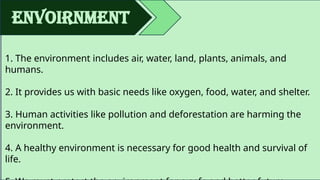
1. The environmentincludes air, water, land, plants, animals, and
humans.
2. It provides us with basic needs like oxygen, food, water, and shelter.
3. Human activities like pollution and deforestation are harming the
environment.
4. A healthy environment is necessary for good health and survival of
life.
6.
envoirnment
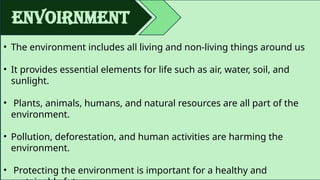
• The environmentincludes all living and non-living things around us
• It provides essential elements for life such as air, water, soil, and
sunlight.
• Plants, animals, humans, and natural resources are all part of the
environment.
• Pollution, deforestation, and human activities are harming the
environment.
• Protecting the environment is important for a healthy and
7.
GLOBAL WARMING
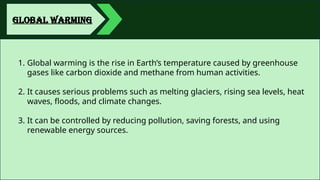
1. Globalwarming is the rise in Earth’s temperature caused by greenhouse
gases like carbon dioxide and methane from human activities.
2. It causes serious problems such as melting glaciers, rising sea levels, heat
waves, floods, and climate changes.
3. It can be controlled by reducing pollution, saving forests, and using
renewable energy sources.
8.
GLOBAL WARMING
Increase inEarth’s Average Temperature
1️
1️
⃣
Due to heavy pollution, the Earth is getting warmer every year. Factories,
vehicles, and burning fuels release gases that trap heat in the atmosphere. This
causes a continuous rise in global temperature.
Caused by Excess Carbon Dioxide and Pollution
2️
⃣
Carbon dioxide, methane, and smoke from human activities create a thick layer
in the atmosphere. This layer traps the Sun’s heat and does not allow it to
escape, making the planet hotter.
Melting of Glaciers and Polar Ice
3️
3️
⃣
Because of rising temperatures, ice in the Arctic and Antarctic regions is
melting very fast. Big glaciers are shrinking, which is a dangerous sign for the
future.
9.
CLIMATE CHANGE
1.Climate changerefers to long-term changes in the Earth’s temperature, rainfall,
wind patterns, and seasons over many years. These changes are happening faster
today due to both natural processes and human activities.
2.The main cause of climate change is human activity, Especially burning fossil
fuels, cutting down forests, industrial pollution, and excessive use of vehicles,
which release large amounts of greenhouse gases into the atmosphere..
3. Climate change results in serious environmental and social problems such as
floods, droughts, heat waves, stronger storms, melting glaciers, rising sea levels,
and negative effects on agriculture, wildlife, and human health.
10.
CLIMATE CHANGE
Irregular RainfallPatterns
1️
1️
⃣
Due to climate change, rainfall has become unpredictable. Some
places receive too much rain, while others suffer from no rainfall at
all.
Increase in Heat Waves and Cold Waves
2️
⃣
Extreme temperatures are becoming more common. Summers are
getting hotter and winters are becoming unusually colder in many
regions.
More Cyclones and Storms
3️
3️
⃣
Rising ocean temperatures increase the power of cyclones and
11.
HEALTH PROBLEMS
1.Health isthe state of complete physical, mental, and social well-
being, not just the absence of disease. A healthy person is active,
energetic, and able to perform daily activities efficiently.
2. Good health depends on proper nutrition, clean environment,
regular exercise, and enough rest. Eating a balanced diet, drinking
clean water, and maintaining personal hygiene are essential for a
healthy life.
3. Good health improves the quality of life by increasing strength,
focus, immunity, and happiness. It helps in preventing diseases,
improving academic performance, and living a long and productive
12.
HEALTH PROBLEMS
Asthma andBreathing Problems
Air pollution from vehicles, factories, and burning garbage causes
breathing problems. Children and elderly people suffer the most.
Heart and Lung Diseases
2️
2️
⃣
Continuous exposure to polluted air increases the risk of heart attacks
and lung infections. Many people die early due to pollution.
Water-Borne Diseases Like Cholera
3️
3️
⃣
Polluted water spreads dangerous diseases such as cholera, typhoid,
diarrhea, and jaundice, especially in poor areas.
13.
LOSS OF WILDLIFE
ANDBIO-DIVERSITY
1. Loss of wildlife and biodiversity means the disappearance of different
types of plants, animals, and living organisms from the Earth. This happens
mainly due to deforestation, pollution, climate change, hunting, and
destruction of natural habitats.
2. Human activities like urbanization, industrialization, and farming expansion
reduce forest areas and disturb natural ecosystems. When animals lose their
homes and food sources, many species become endangered or extinct.
3. The loss of biodiversity creates a serious imbalance in nature, affecting
food chains, climate, agriculture, and human life. Protecting wildlife, planting
trees, and conserving natural habitats are essential to save biodiversity for
future generations.
14.
LOSS OF WILDLIFE
ANDBIO-DIVERSITY
Animals Losing Their Natural Homes
1️
1️
⃣
Due to deforestation and construction, forests are destroyed. Animals
lose their shelters and are forced to move near human areas.
Many Species Becoming Endangered
2️
2️
⃣
Due to hunting, pollution, and habitat loss, many animals and plants
are on the verge of extinction
.
Disturbance in Food Chains
3️
3️
⃣
When one species disappears, the food chain breaks. This disturbs the
natural balance of the ecosystem.
15.
INCREASE IN NATURAL
DISASTERS
1.Theincrease in natural disasters like floods, earthquakes, cyclones,
droughts, and heat waves is a major global concern. These disasters are
becoming more frequent and intense due to climate change and
environmental imbalance.
2.Human activities such as deforestation, pollution, improper construction,
and excessive use of natural resources worsen the impact of natural disasters
by weakening the Earth’s natural protective systems.
3.The increase in natural disasters causes huge loss of life, property,
agriculture, and ecosystems, and also leads to poverty, disease, and
displacement of people. Disaster preparedness and environmental protection
are important to reduce their impact.
16.
INCREASE IN NATURAL
DISASTERS
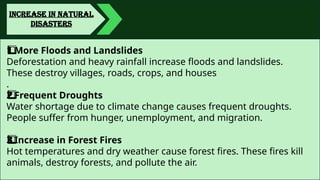
MoreFloods and Landslides
1️
1️
⃣
Deforestation and heavy rainfall increase floods and landslides.
These destroy villages, roads, crops, and houses
.
Frequent Droughts
2️
2️
⃣
Water shortage due to climate change causes frequent droughts.
People suffer from hunger, unemployment, and migration.
Increase in Forest Fires
3️
3️
⃣
Hot temperatures and dry weather cause forest fires. These fires kill
animals, destroy forests, and pollute the air.
17.
Somayya Institute ofTechnology,
Chandrapur
CERTTIFICATE
It is to certify that the seminar report titled AUTOMATIC ANTY GLARE
SYSTEM has been successfully completed by :--
NAME OF PARTICIPANTS:
1.ABHISHEK SHUKLA [CSEDS]
2. ADARSH KAKDE [CYS]
3.PRANJALI BAWANE [CSEDS]
4. SHRAVANI CHAUDHARI [AIML]
5.AISHWARYA SAGANE [CSEDS]
Designed BY ABHI ADS……
CONT:-8999622850…………


![INTODUCTION
1. Abhishek shukla. [ AIDS]
2.Pranjali Bawane
[ AIDS]
3.Sharawni chaudhari.
[ AIML]
4. Nandini thengne
[AIDS]
6. Praman neulkar [E.E]
7. Adarsh khadse. [CY]
8. Gunjan Dhawle [E.E]
9. Yash donge. [AIDS]
I
N
T
R
O
D
U
C
T
I
O
N
5. Aishwarya sagane [AIDS]
INC. Mahevish kaynat khan
[AIML]](https://image.slidesharecdn.com/abhishekppt-251228151118-0f69fa4b/85/envorinmental-based-basic-power-point-presentation-so-can-any-one-easily-use-it-for-theeir-project-2-320.jpg)

![Somayya Institute of Technology,
Chandrapur
CERTTIFICATE
It is to certify that the seminar report titled AUTOMATIC ANTY GLARE
SYSTEM has been successfully completed by :--
NAME OF PARTICIPANTS:
1.ABHISHEK SHUKLA [CSEDS]
2. ADARSH KAKDE [CYS]
3.PRANJALI BAWANE [CSEDS]
4. SHRAVANI CHAUDHARI [AIML]
5.AISHWARYA SAGANE [CSEDS]
Designed BY ABHI ADS……
CONT:-8999622850…………](https://image.slidesharecdn.com/abhishekppt-251228151118-0f69fa4b/85/envorinmental-based-basic-power-point-presentation-so-can-any-one-easily-use-it-for-theeir-project-17-320.jpg)


