

Environmental Pollution
Types and Sources

Sam Sanet Kumar
E.Kalaivani
Nivedita Gopinath
Ashish Bharadwaj
What is Pollution?

“Pollution means the introduction by man, directly or
indirectly, of substances or energy into the environment,
resulting in deleterious effects of such a nature as to
endanger human health, harm living resources and
ecosystems, and impair or interfere with amenities and
other legitimate uses of the environment.”
Definition of pollution by OECD (1974)
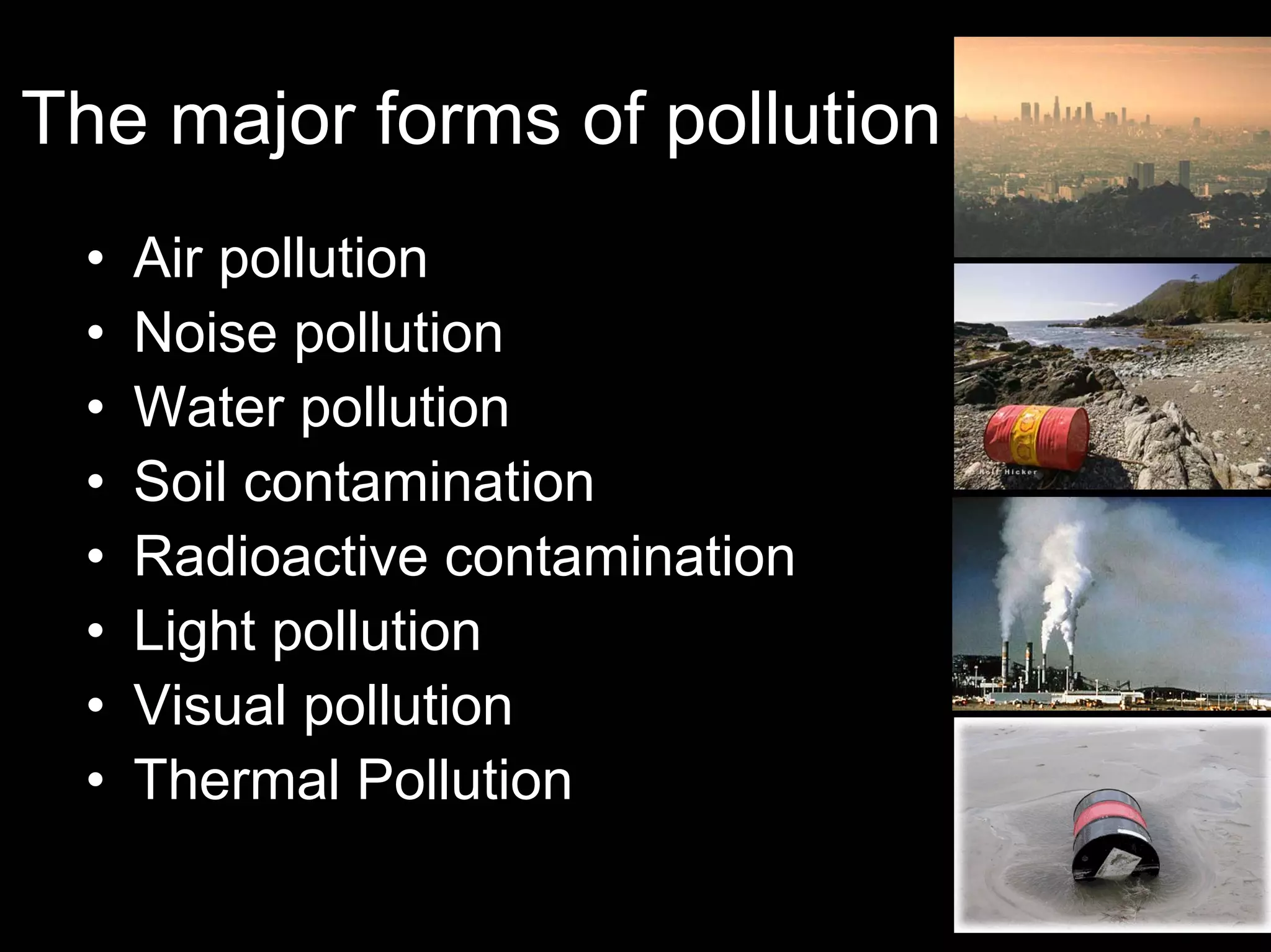
The major forms of pollution
•
•
•
•
•
•
•
•

Air pollution
Noise pollution
Water pollution
Soil contamination
Radioactive contamination
Light pollution
Visual pollution
Thermal Pollution
Air Pollution
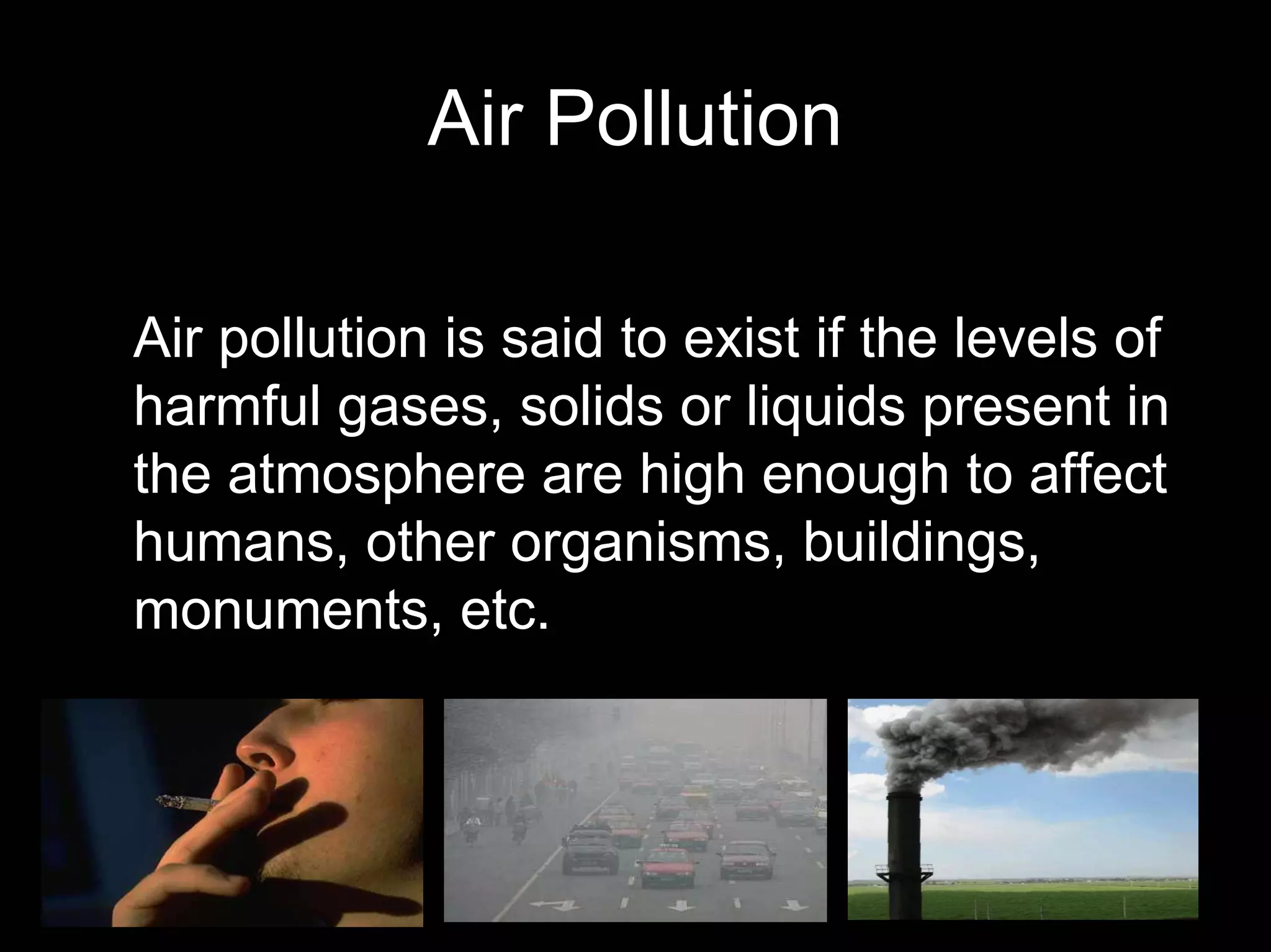
Air pollution is said to exist if the levels of
harmful gases, solids or liquids present in
the atmosphere are high enough to affect
humans, other organisms, buildings,
monuments, etc.
Major primary pollutants produced by human activity
include:
•
•
•
•
•
•
•
•
•

Sulfur oxides (SOx) especially sulfur dioxide
Nitrogen oxides (NOx) especially nitrogen dioxide
Carbon monoxide (CO)
Carbon dioxide (CO2), a greenhouse gas
Volatile organic compounds (VOC), such as hydrocarbon fuel
vapors and solvents
Particulate matter (PM), such as smoke and dust.
Chlorofluorocarbons (CFCs)
Ammonia (NH3)
Odors, such as from garbage, sewage, and industrial
processes

Secondary pollutants include:
• Particulate matter formed from gaseous primary pollutants
and compounds in photochemical smog, such as nitrogen
dioxide
• Ground level ozone (O3)
• Peroxyacetyl nitrate (PAN)
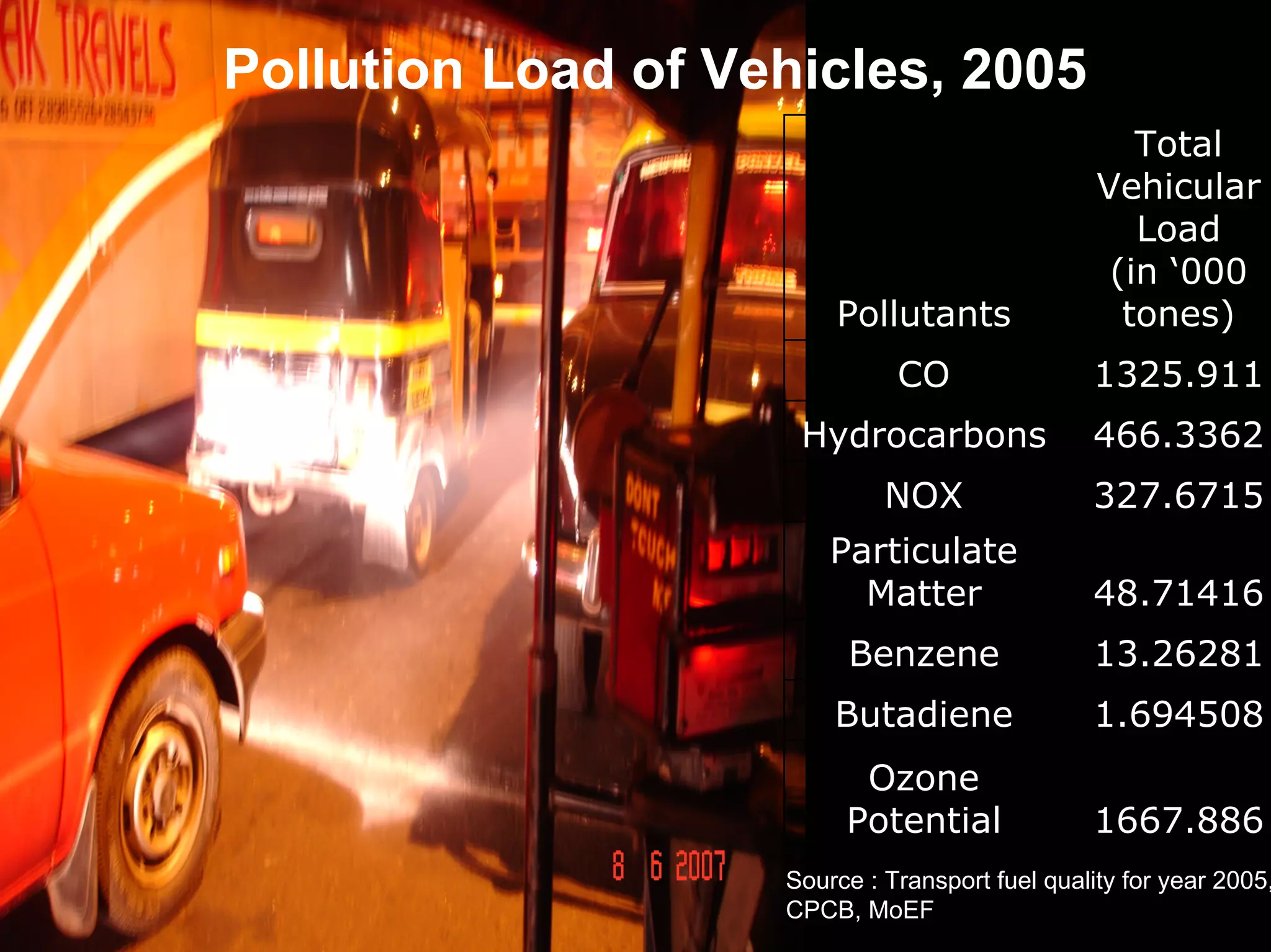
Pollution Load of Vehicles, 2005

Pollutants

Total
Vehicular
Load
(in ‘000
tones)

CO

1325.911

Hydrocarbons

466.3362

NOX

327.6715

Particulate
Matter

48.71416

Benzene

13.26281

Butadiene

1.694508

Ozone
Potential

1667.886

Source : Transport fuel quality for year 2005,
CPCB, MoEF
Case Study I
Mexico City
Just living and breathing here is equivalent to
smoking two packets of cigarettes a day (Raven
& Berg 2004)
Millions of tonnes of Emissions from 3 million
vehicles, 36,000 industries, leakage of LPG and
particles of dried faecal matter from sewage
(Enger 2004)
Reforestation, import of clean fuel and upgrading
of public transport have led to improvements.
Case Study II
New Delhi
• In the early ‘90s: Delhi the 4th most polluted city
in the world (Brandon et al. 1995)
• Annual cost of air pollution was Rs.14 Billion,
World Bank (Bell et al. 2004)
• Today, Delhi is a model city in the South Asian
region
• Radical Turnaround due to:
» Eviction of polluting industries from the city
» Conversion of all public transport to CNG
Water Pollution
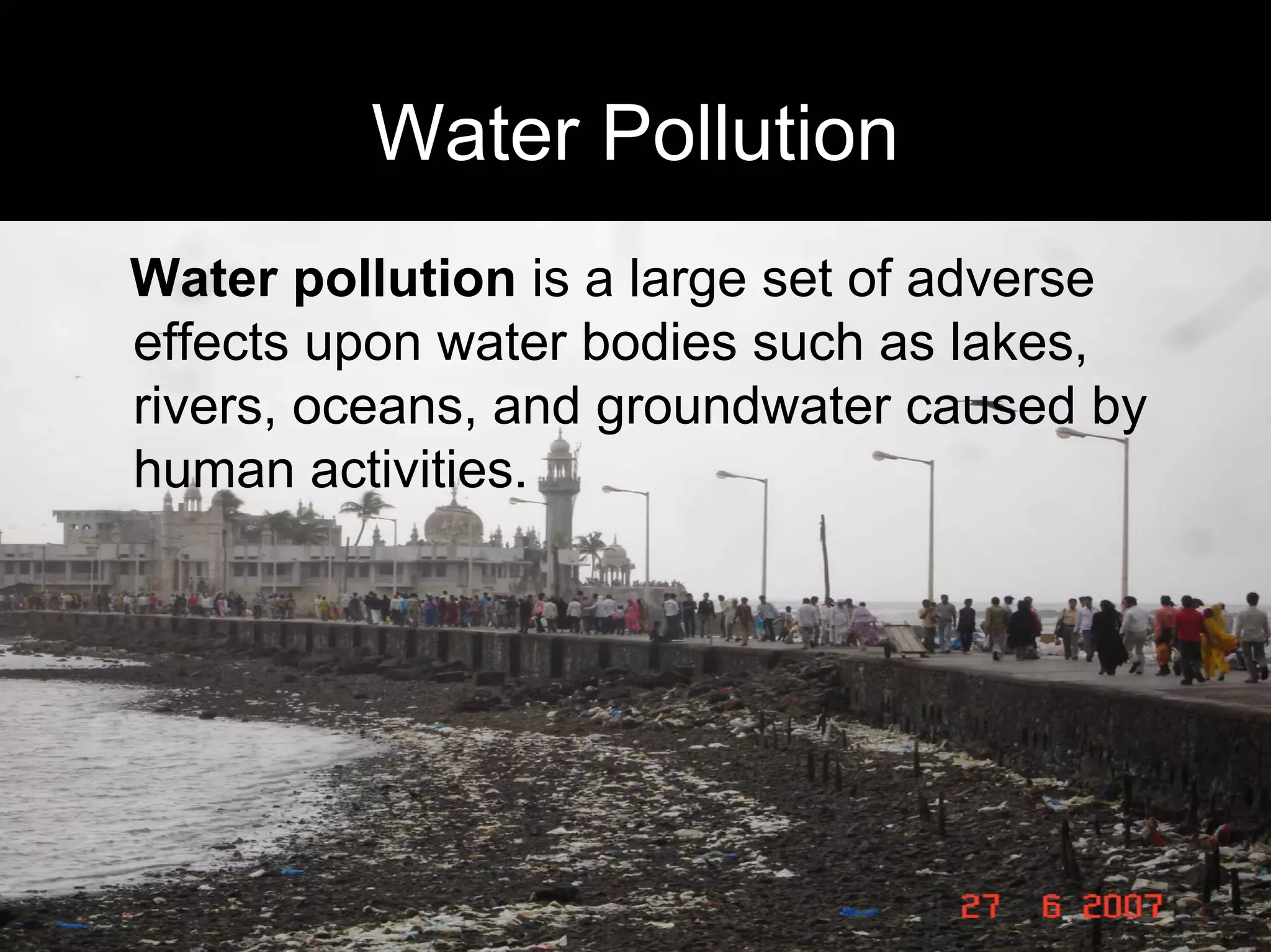
Water pollution is a large set of adverse
effects upon water bodies such as lakes,
rivers, oceans, and groundwater caused by
human activities.
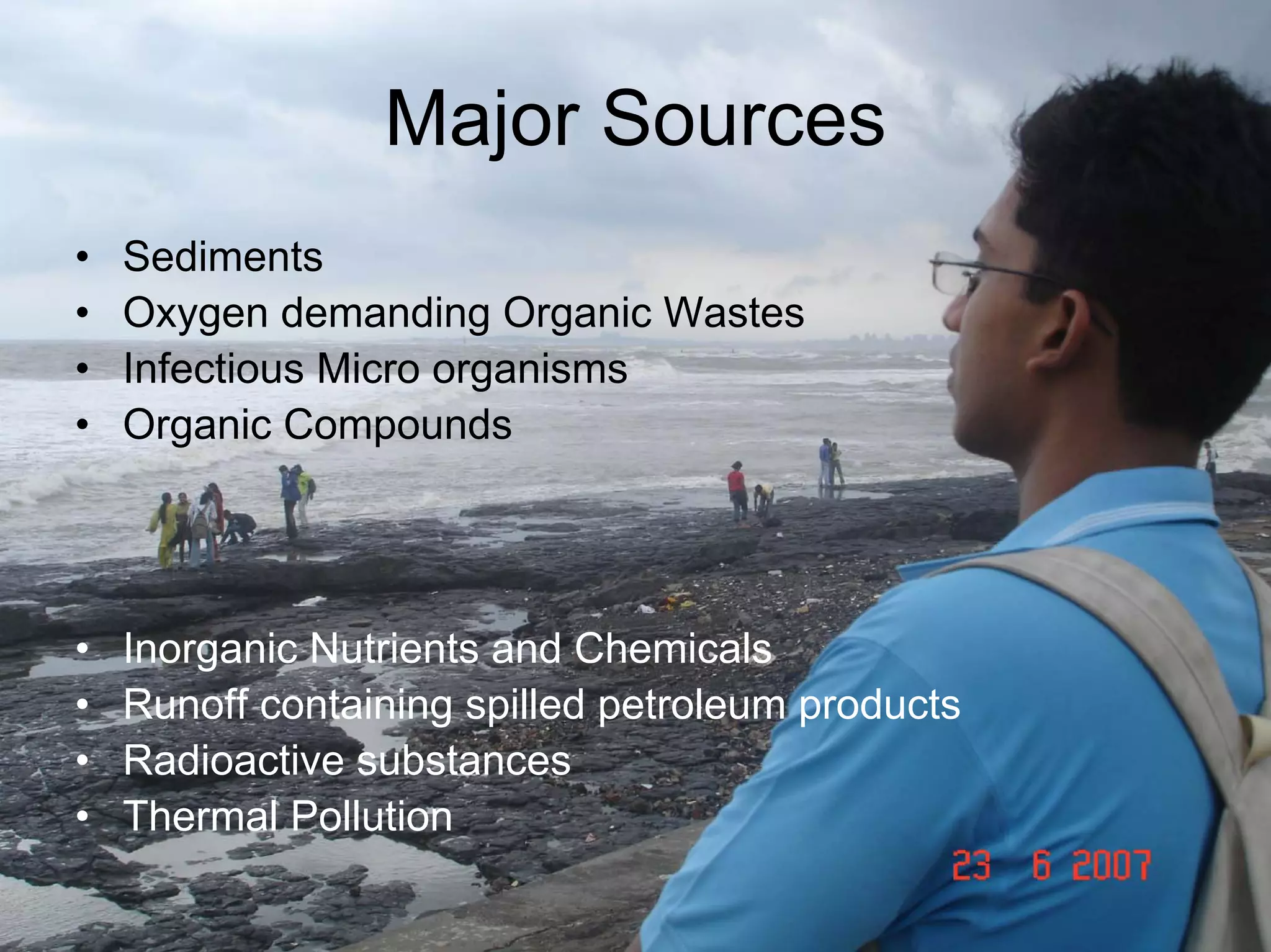
Major Sources
•
•
•
•

Sediments
Oxygen demanding Organic Wastes
Infectious Micro organisms
Organic Compounds

•
•
•
•

Inorganic Nutrients and Chemicals
Runoff containing spilled petroleum products
Radioactive substances
Thermal Pollution
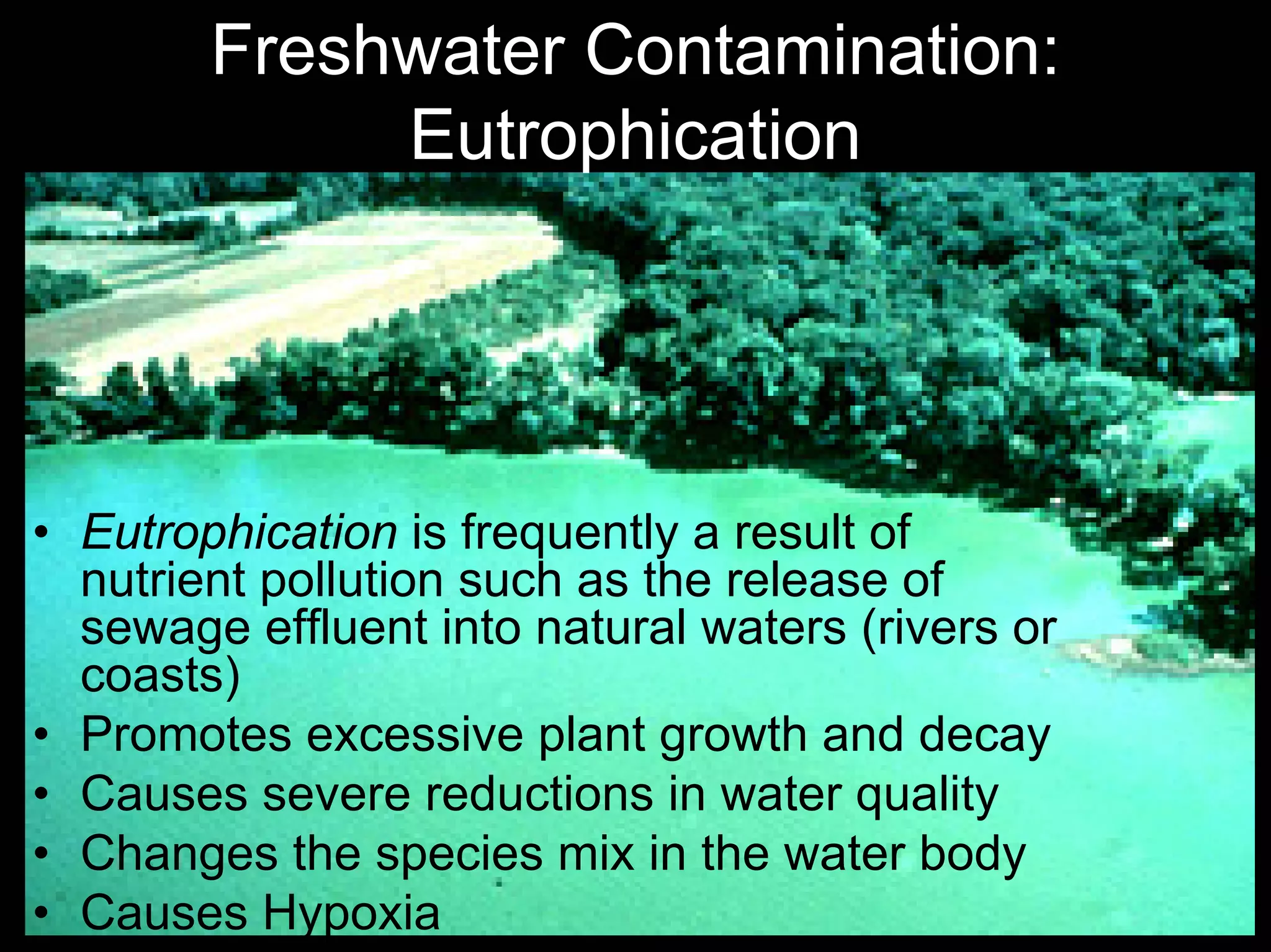
Freshwater Contamination:
Eutrophication

• Eutrophication is frequently a result of
nutrient pollution such as the release of
sewage effluent into natural waters (rivers or
coasts)
• Promotes excessive plant growth and decay
• Causes severe reductions in water quality
• Changes the species mix in the water body
• Causes Hypoxia
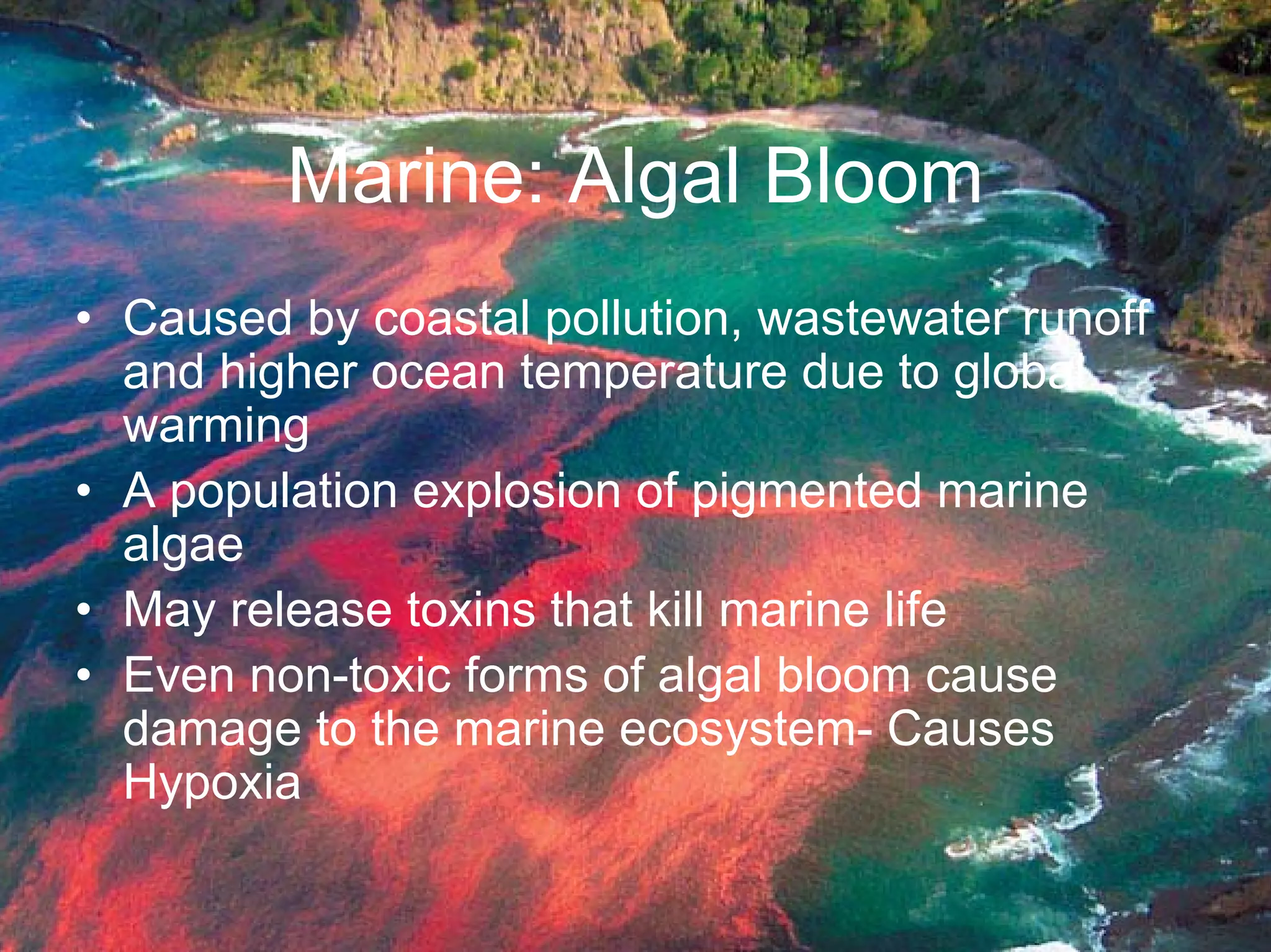
Marine: Algal Bloom
• Caused by coastal pollution, wastewater runoff
and higher ocean temperature due to global
warming
• A population explosion of pigmented marine
algae
• May release toxins that kill marine life
• Even non-toxic forms of algal bloom cause
damage to the marine ecosystem- Causes
Hypoxia
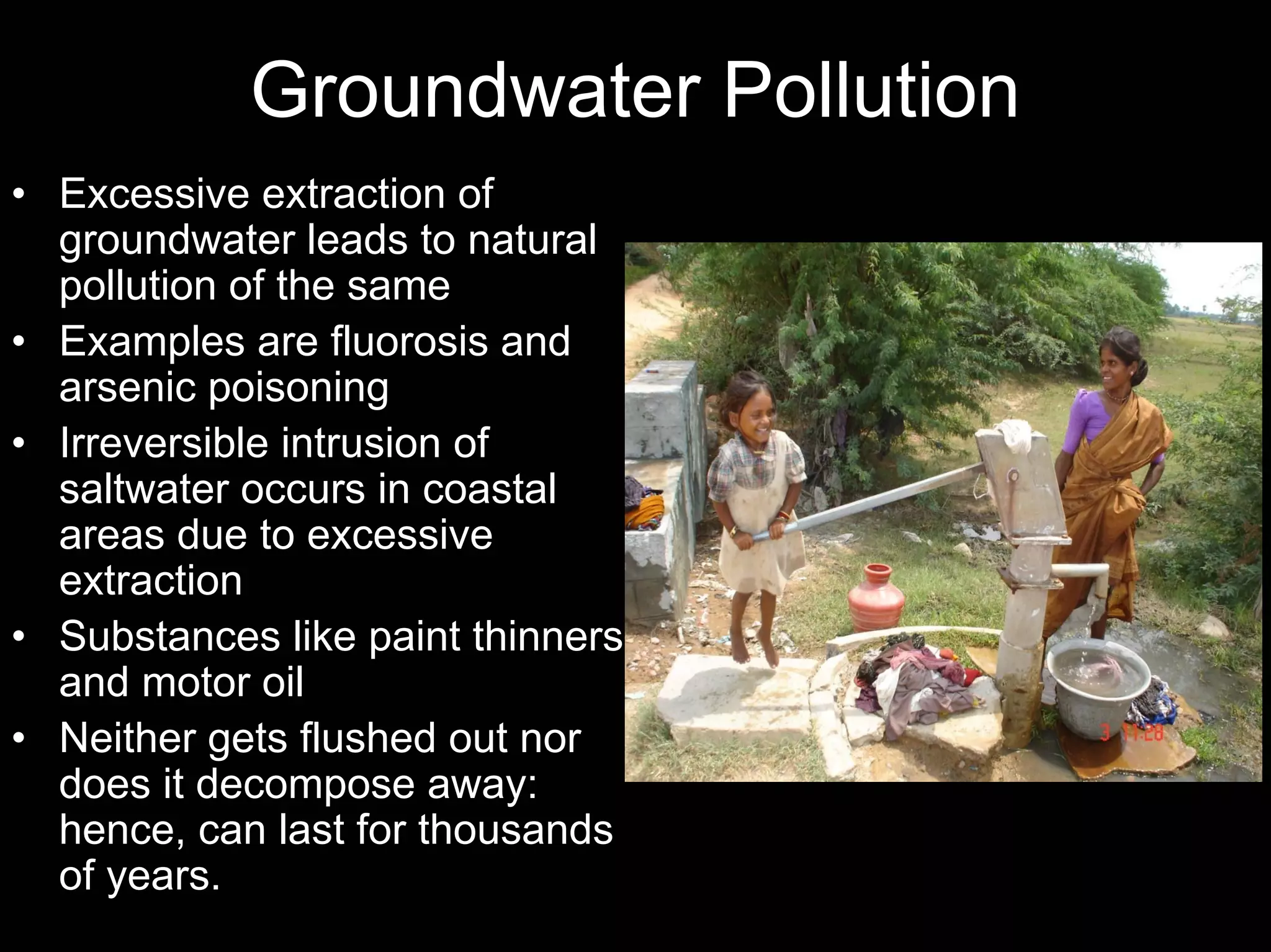
Groundwater Pollution
• Excessive extraction of
groundwater leads to natural
pollution of the same
• Examples are fluorosis and
arsenic poisoning
• Irreversible intrusion of
saltwater occurs in coastal
areas due to excessive
extraction
• Substances like paint thinners
and motor oil
• Neither gets flushed out nor
does it decompose away:
hence, can last for thousands
of years.
Arsenic and Fluoride
Contamination
• Arsenic and Fluoride deposits are present
naturally in aquifers. Poisons released due to
excessive water extraction
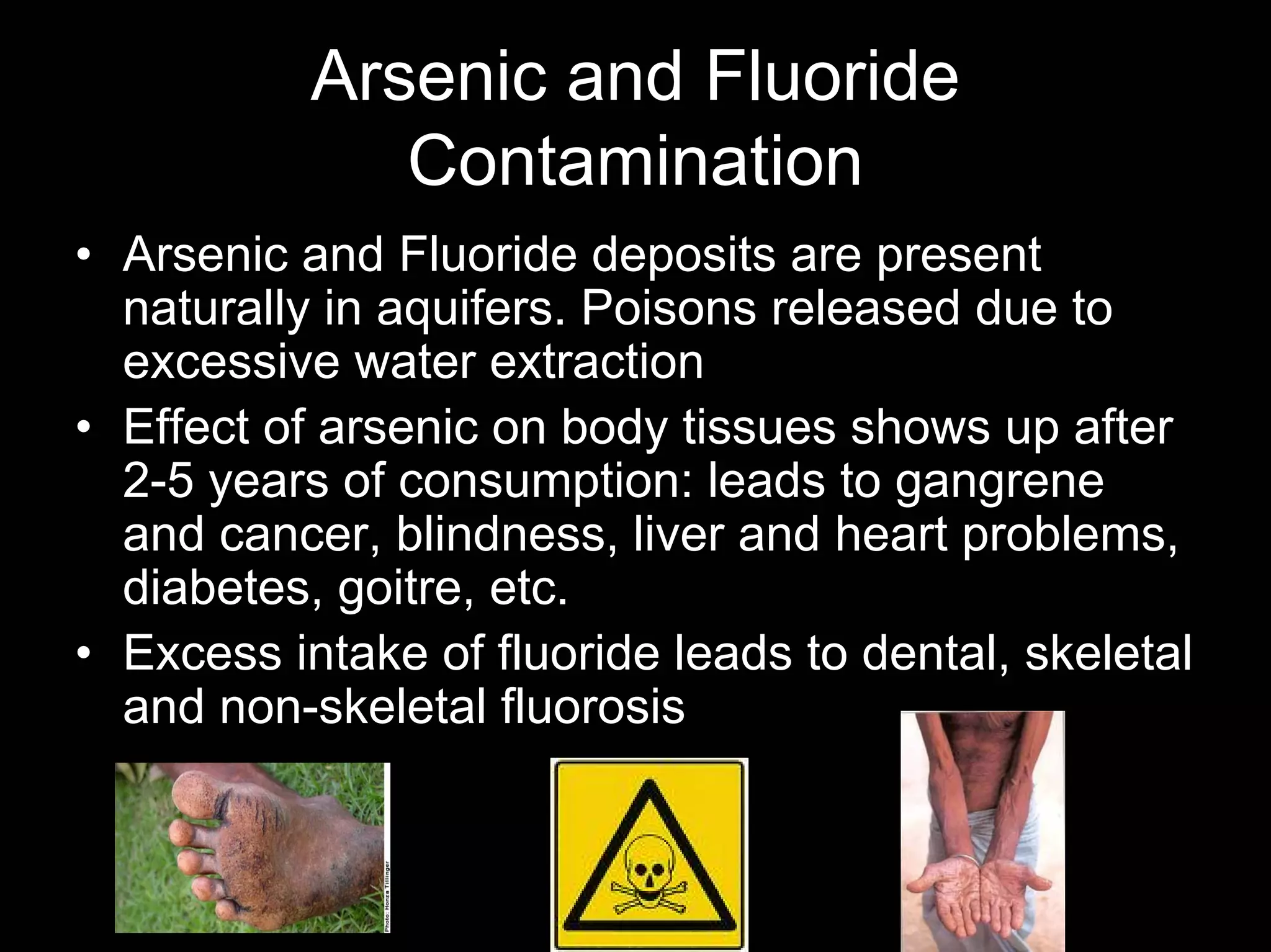
• Effect of arsenic on body tissues shows up after
2-5 years of consumption: leads to gangrene
and cancer, blindness, liver and heart problems,
diabetes, goitre, etc.
• Excess intake of fluoride leads to dental, skeletal
and non-skeletal fluorosis
Case Study III :
Fluorosis endemic in Jharana Kurd
• 1200 inhabitants of this Rajasthan village
suffer from Fluorosis (Jamwal & Manisha
2003)
• The disease has wiped out entire village
economies
• Brings stigma to women
• Problem now endemic in 19 states
• Govt. measures are weak- defluoridization
technology is expensive
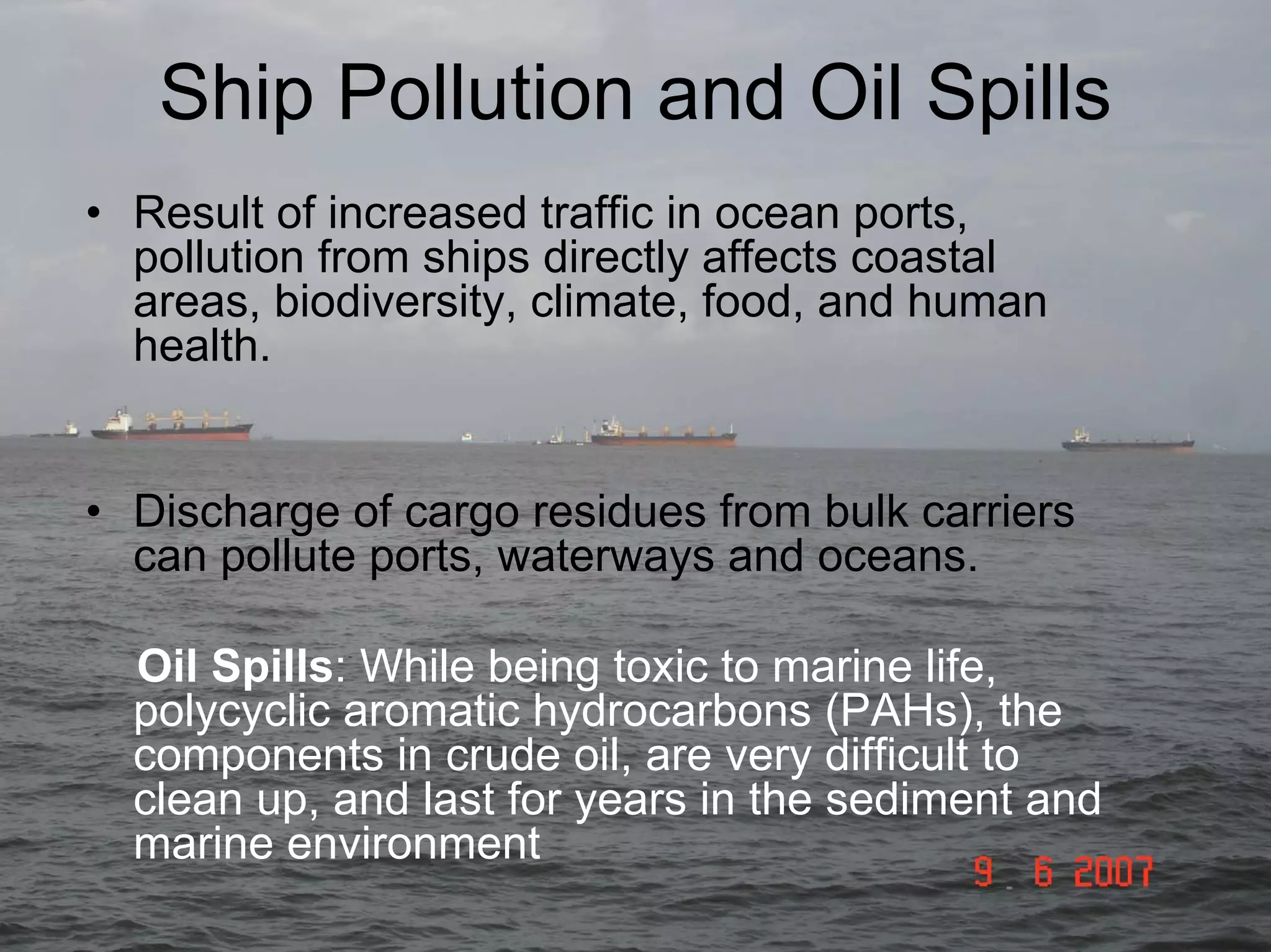
Ship Pollution and Oil Spills
• Result of increased traffic in ocean ports,
pollution from ships directly affects coastal
areas, biodiversity, climate, food, and human
health.
• Discharge of cargo residues from bulk carriers
can pollute ports, waterways and oceans.
Oil Spills: While being toxic to marine life,
polycyclic aromatic hydrocarbons (PAHs), the
components in crude oil, are very difficult to
clean up, and last for years in the sediment and
marine environment
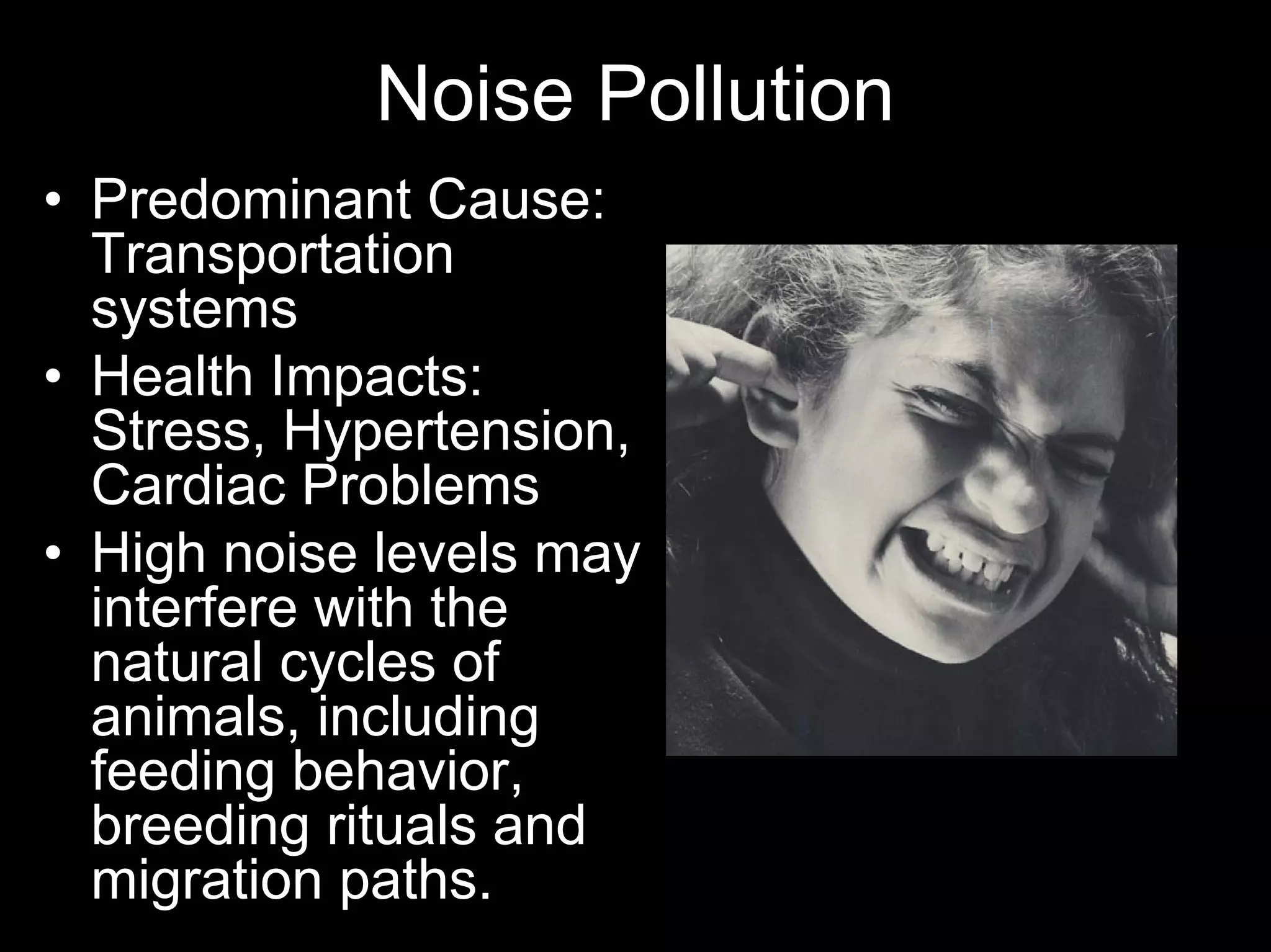
Noise Pollution
• Predominant Cause:
Transportation
systems
• Health Impacts:
Stress, Hypertension,
Cardiac Problems
• High noise levels may
interfere with the
natural cycles of
animals, including
feeding behavior,
breeding rituals and
migration paths.
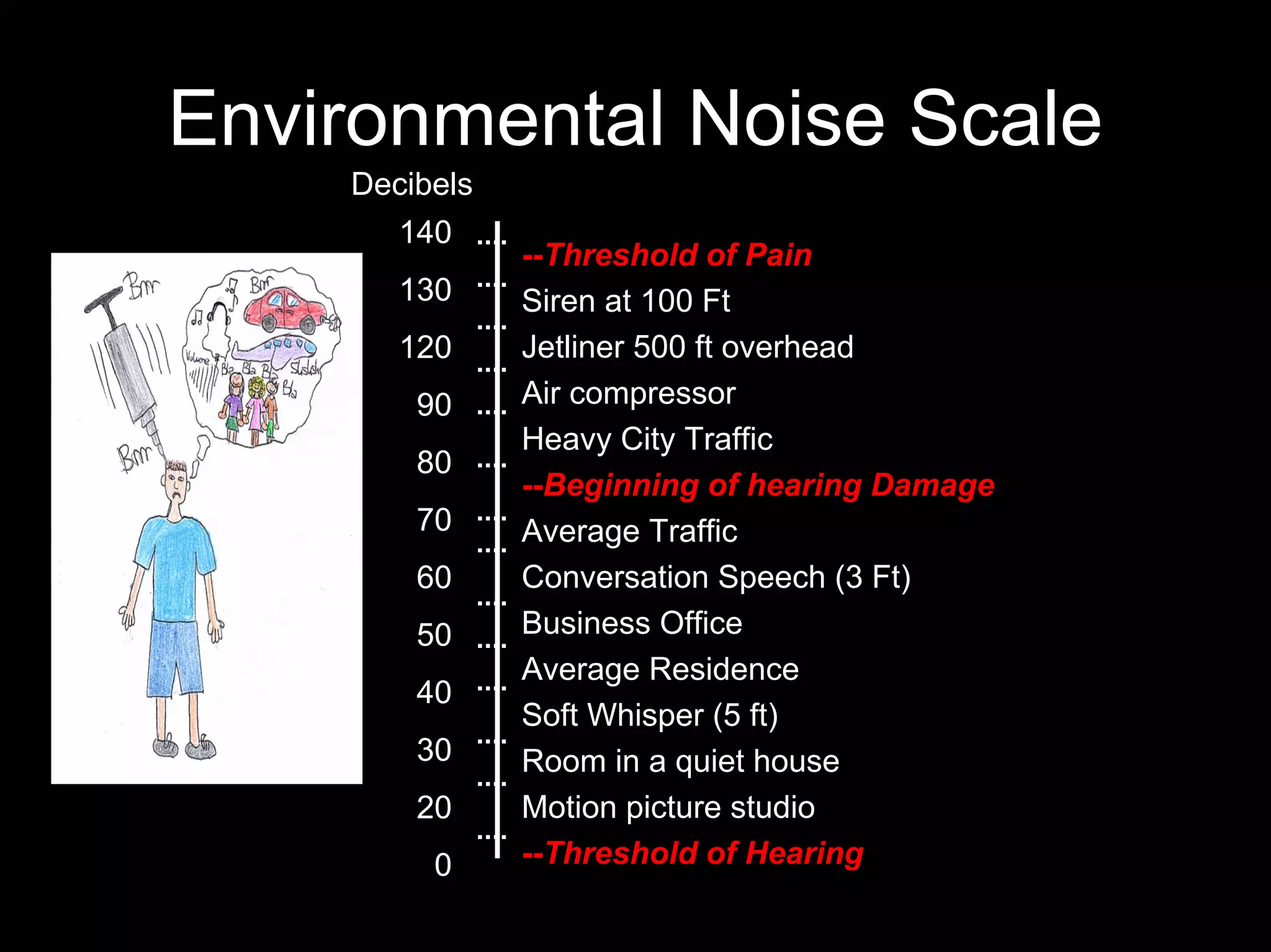
Environmental Noise Scale
Decibels
140
130
120
90
80
70
60
50
40
30
20
0

--Threshold of Pain
Siren at 100 Ft
Jetliner 500 ft overhead
Air compressor
Heavy City Traffic
--Beginning of hearing Damage
Average Traffic
Conversation Speech (3 Ft)
Business Office
Average Residence
Soft Whisper (5 ft)
Room in a quiet house
Motion picture studio
--Threshold of Hearing
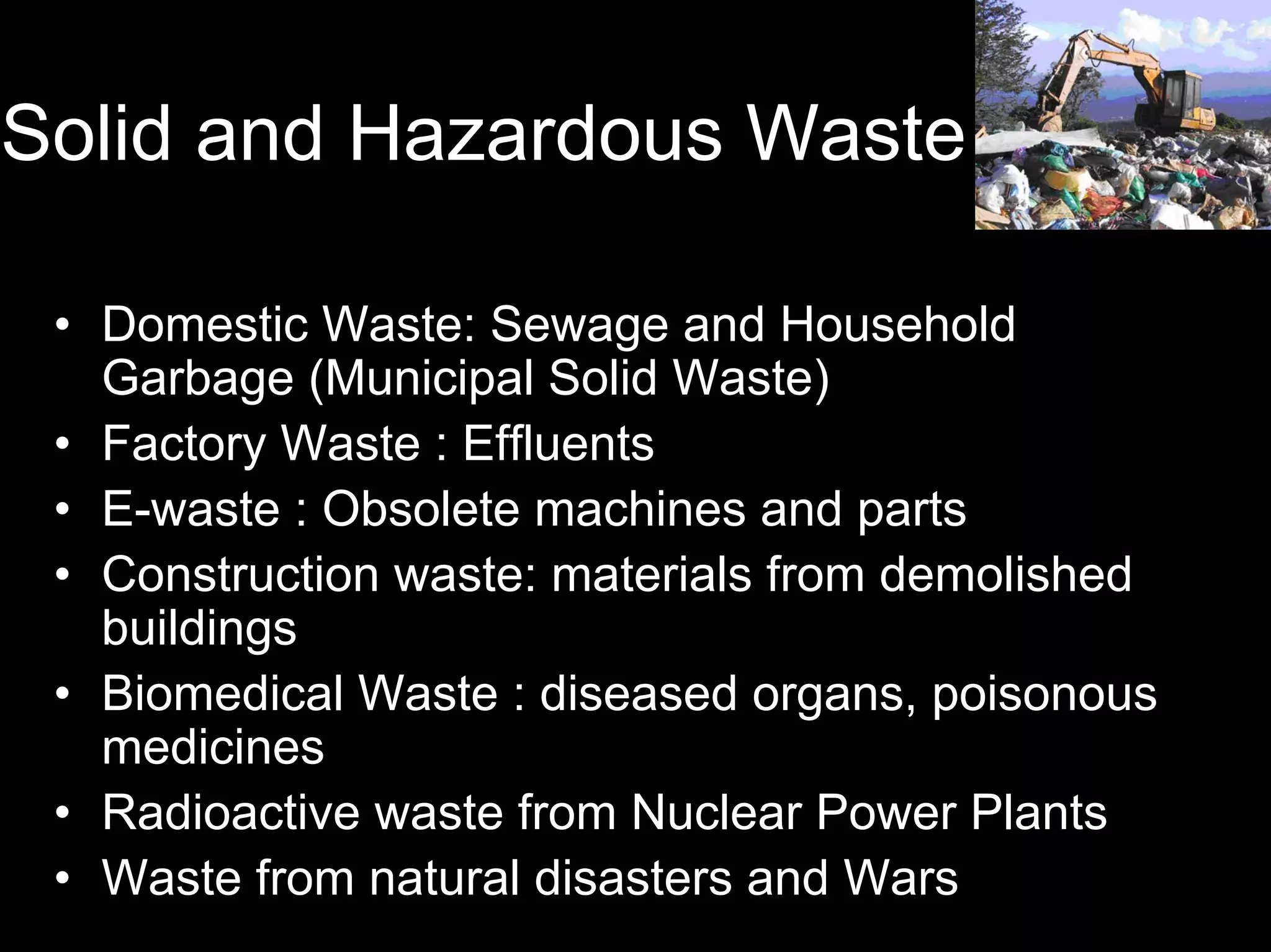
Solid and Hazardous Waste
• Domestic Waste: Sewage and Household
Garbage (Municipal Solid Waste)
• Factory Waste : Effluents
• E-waste : Obsolete machines and parts
• Construction waste: materials from demolished
buildings
• Biomedical Waste : diseased organs, poisonous
medicines
• Radioactive waste from Nuclear Power Plants
• Waste from natural disasters and Wars
Case Study IV:
Alang, Graveyard of Ships
• Alang lies in the Gulf of Kambhat in
Gujarat
• 300 ships are dismantled every year
(Bavadam 2004 & Chaudhary 2004)
• Most ships contain toxic waste; cost of
clean up falls on Gujarat Government
• Greenpeace Campaign started in 2003
has made some difference: “Clean Toxic
Ships Now!”
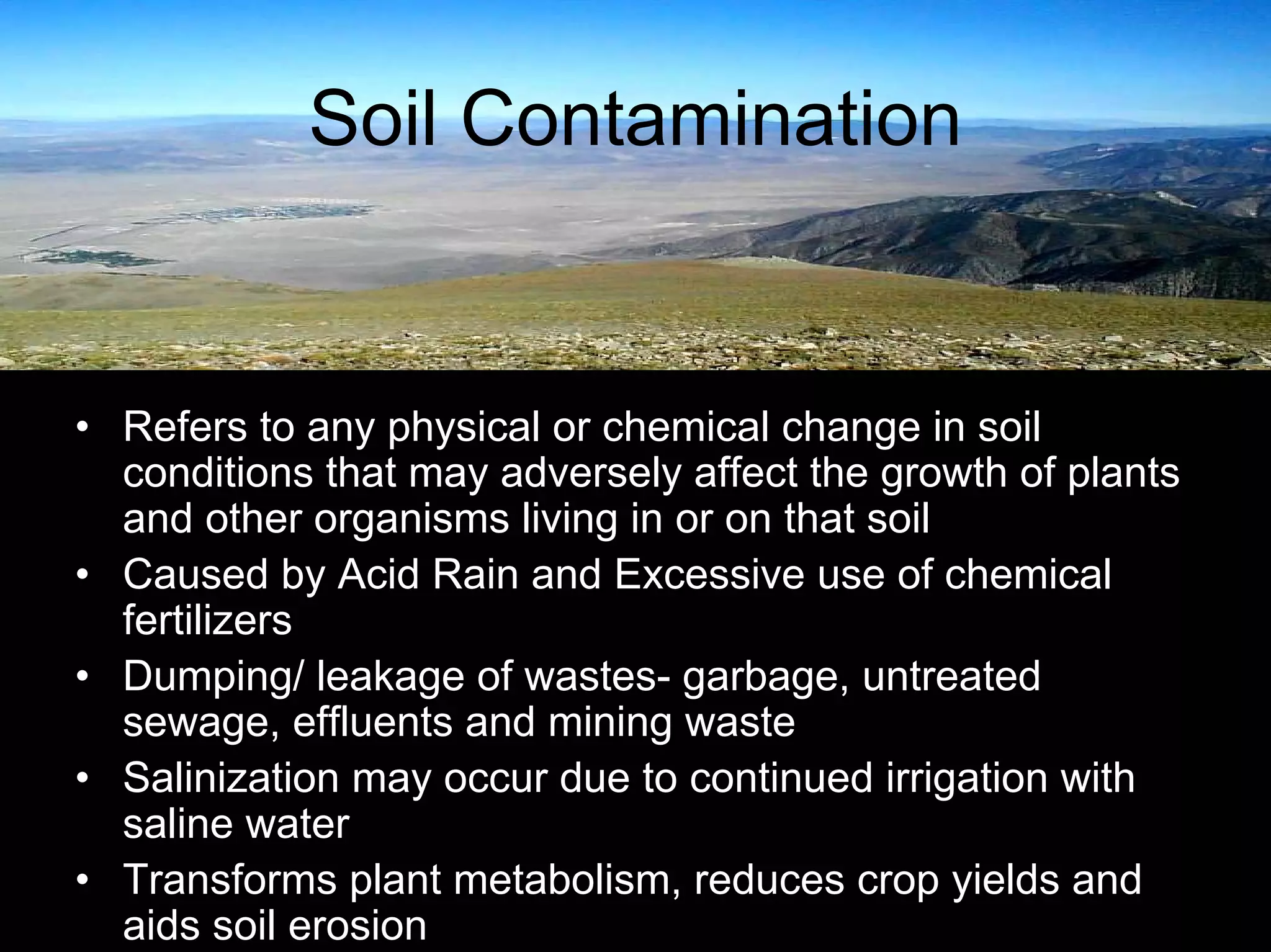
Soil Contamination

• Refers to any physical or chemical change in soil
conditions that may adversely affect the growth of plants
and other organisms living in or on that soil
• Caused by Acid Rain and Excessive use of chemical
fertilizers
• Dumping/ leakage of wastes- garbage, untreated
sewage, effluents and mining waste
• Salinization may occur due to continued irrigation with
saline water
• Transforms plant metabolism, reduces crop yields and
aids soil erosion
Radioactive Contamination
• Radioactive contamination is typically the
result of a spill or accident during the
production or use of radionuclides
• Radioactive contamination can enter the
body through ingestion, inhalation,
absorption, or injection
• Chernobyl: Radioactive Iodine led to
thyroid impairment and cancer
Other types of Pollution
• Thermal: temperature change in natural water
bodies caused by human influence. The main
cause of thermal pollution is the use of water as
a coolant, especially in power plants.
• "Light pollution" (or photopollution) refers to light
that is considered annoying, wasteful or harmful.
Excess light
loss in visual acuity,
hypertension, headaches and increased
incidence of carcinoma.
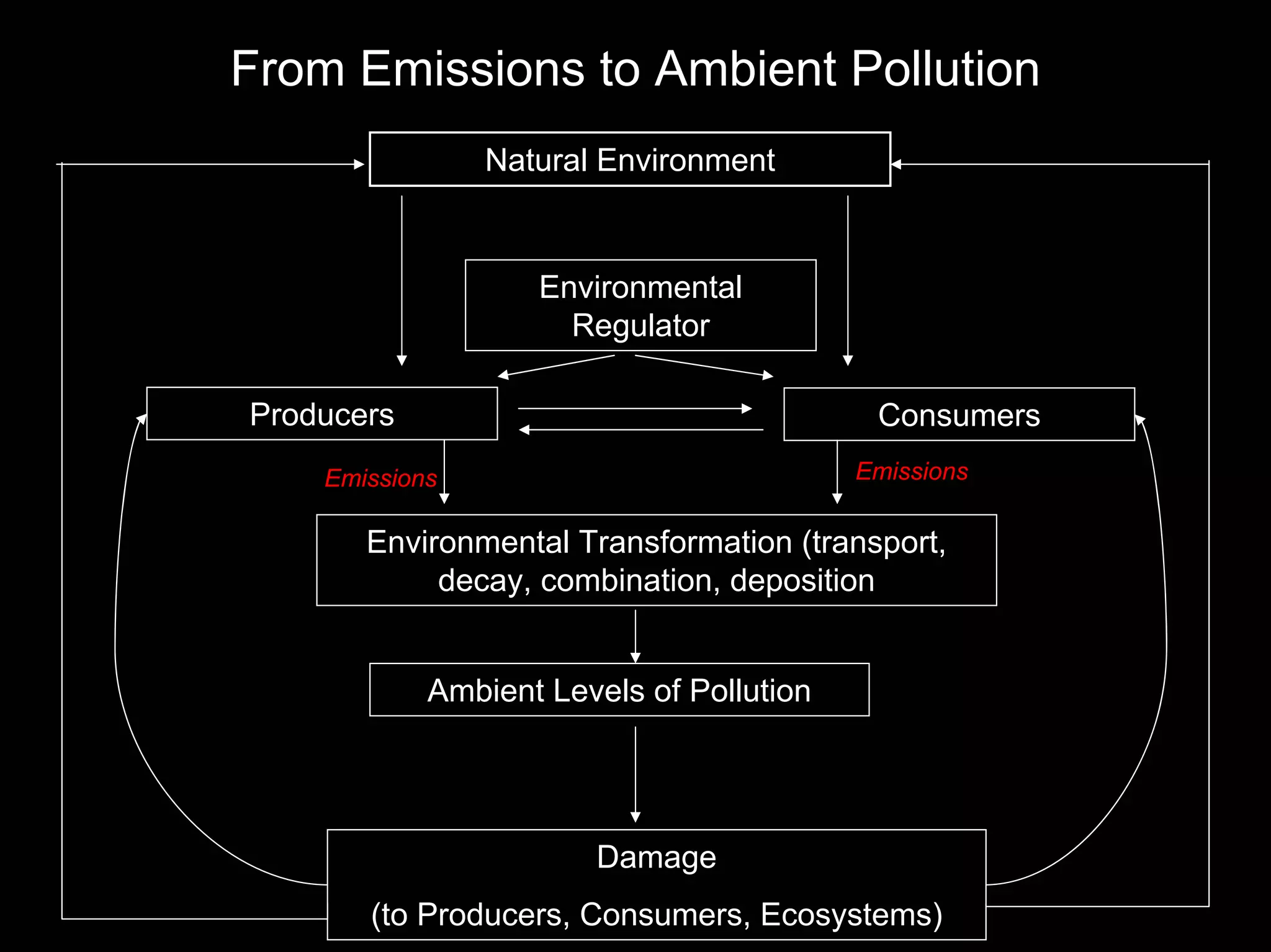
Emissions Vs. Ambient Pollution
• Polluter generates emissions
• Emissions are transformed into ambient
concentrations of pollution- i.e. in the air
around us or in water we drink
• Ambient Concentrations, not emissions
per se, cause damage
• The two are imperfectly connected.
From Emissions to Ambient Pollution
Natural Environment

Environmental
Regulator
Producers

Consumers
Emissions

Emissions

Environmental Transformation (transport,
decay, combination, deposition
Ambient Levels of Pollution

Damage
(to Producers, Consumers, Ecosystems)
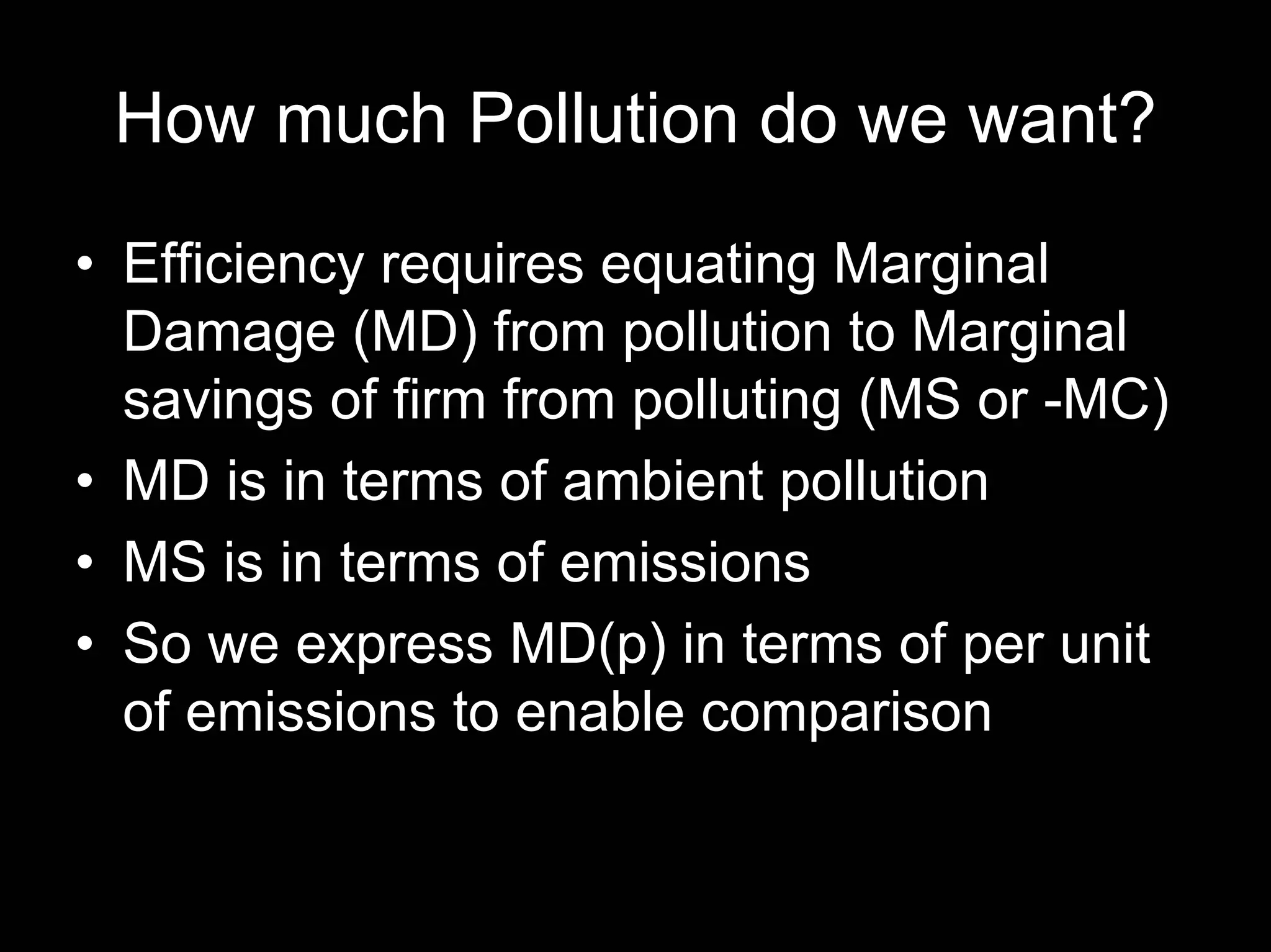
How much Pollution do we want?
• Efficiency requires equating Marginal
Damage (MD) from pollution to Marginal
savings of firm from polluting (MS or -MC)
• MD is in terms of ambient pollution
• MS is in terms of emissions
• So we express MD(p) in terms of per unit
of emissions to enable comparison
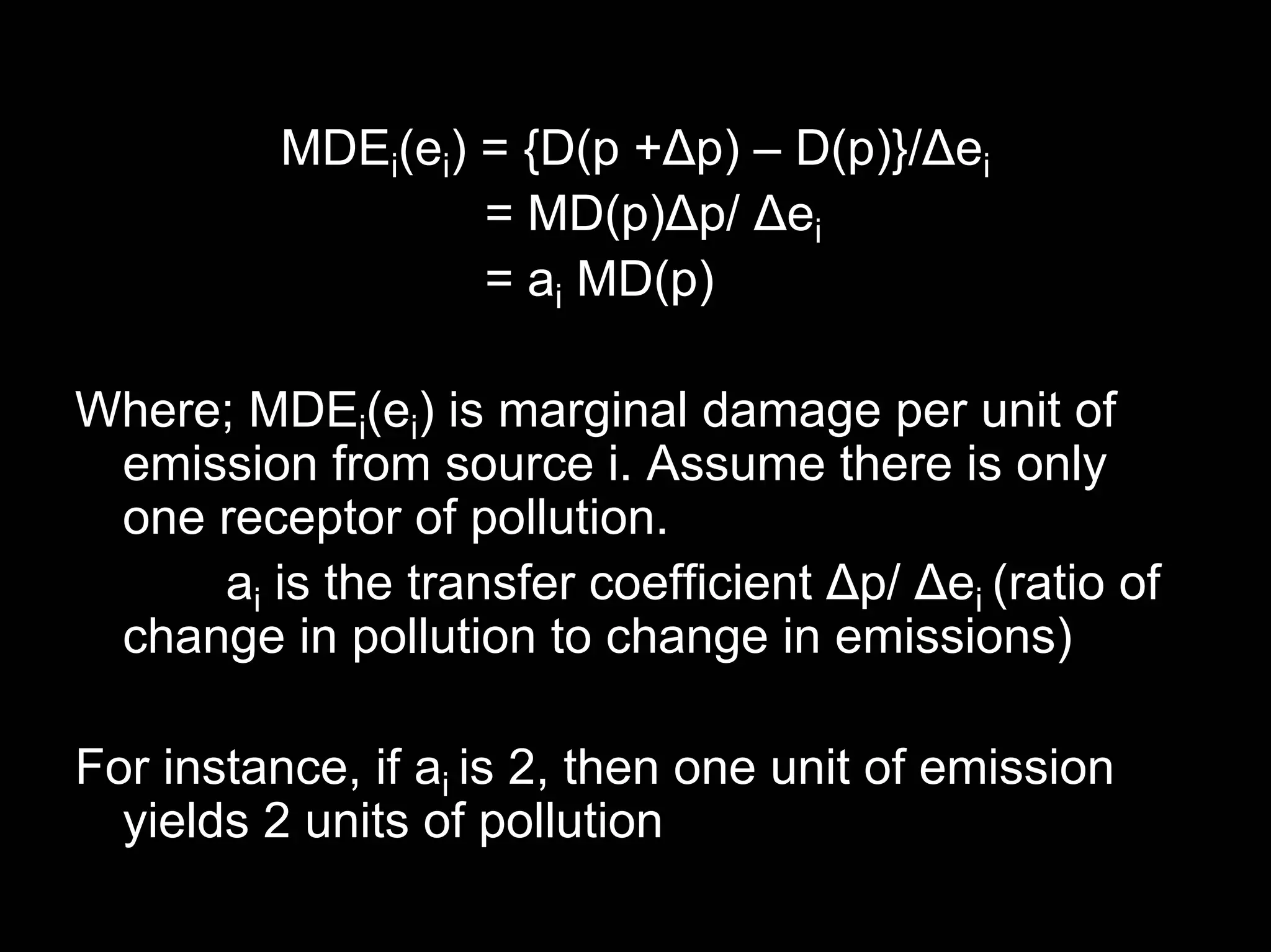
MDEi(ei) = {D(p +Δp) – D(p)}/Δei
= MD(p)Δp/ Δei
= ai MD(p)
Where; MDEi(ei) is marginal damage per unit of
emission from source i. Assume there is only
one receptor of pollution.
ai is the transfer coefficient Δp/ Δei (ratio of
change in pollution to change in emissions)
For instance, if ai is 2, then one unit of emission
yields 2 units of pollution
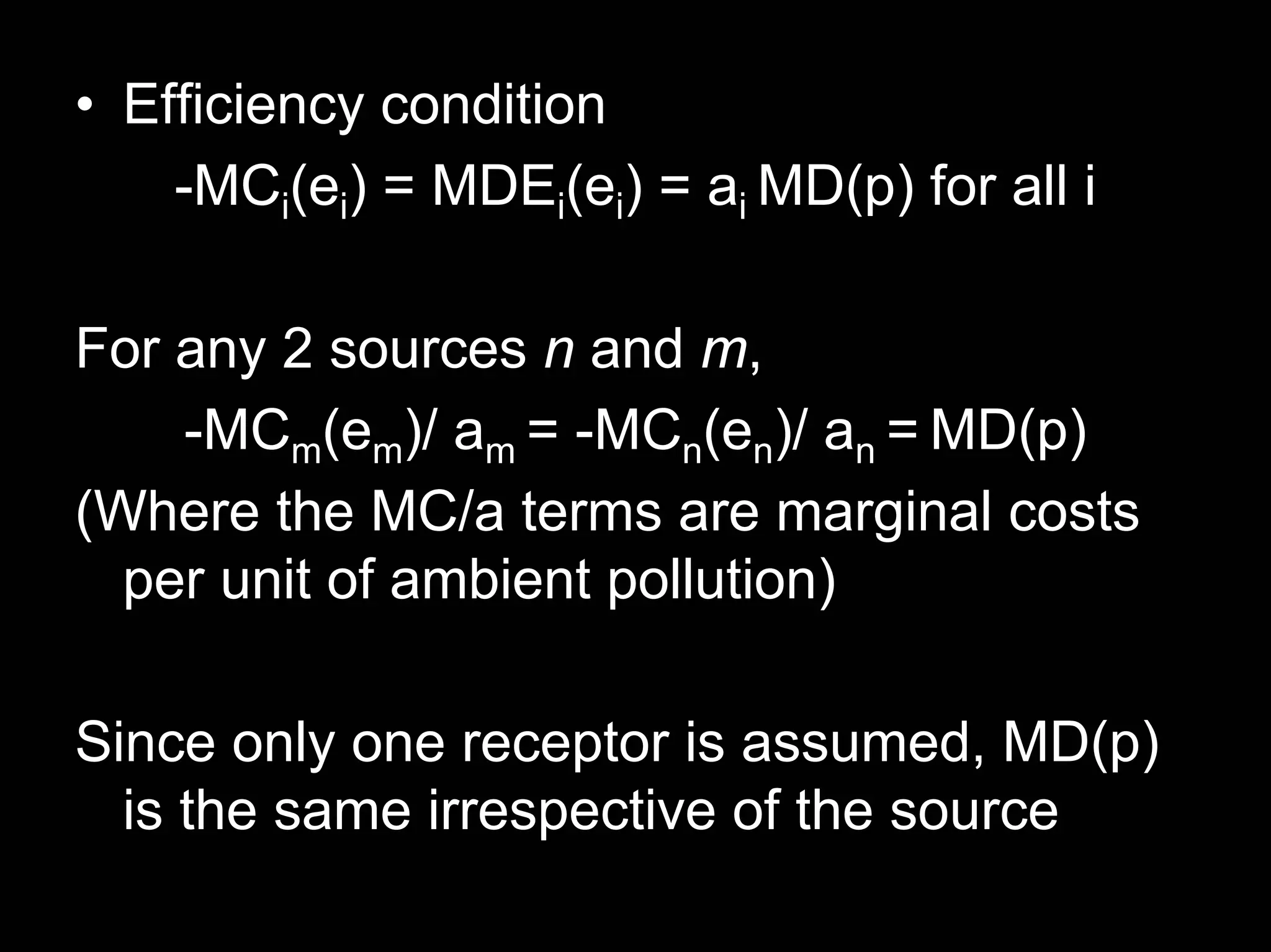
• Efficiency condition
-MCi(ei) = MDEi(ei) = ai MD(p) for all i
For any 2 sources n and m,
-MCm(em)/ am = -MCn(en)/ an = MD(p)
(Where the MC/a terms are marginal costs
per unit of ambient pollution)
Since only one receptor is assumed, MD(p)
is the same irrespective of the source
Thank you!
Questions?

Environmental pollution group 1

  • 2.
    Environmental Pollution Types andSources Sam Sanet Kumar E.Kalaivani Nivedita Gopinath Ashish Bharadwaj
  • 3.
    What is Pollution? “Pollutionmeans the introduction by man, directly or indirectly, of substances or energy into the environment, resulting in deleterious effects of such a nature as to endanger human health, harm living resources and ecosystems, and impair or interfere with amenities and other legitimate uses of the environment.” Definition of pollution by OECD (1974)
  • 4.
    The major formsof pollution • • • • • • • • Air pollution Noise pollution Water pollution Soil contamination Radioactive contamination Light pollution Visual pollution Thermal Pollution
  • 5.
    Air Pollution Air pollutionis said to exist if the levels of harmful gases, solids or liquids present in the atmosphere are high enough to affect humans, other organisms, buildings, monuments, etc.
  • 6.
    Major primary pollutantsproduced by human activity include: • • • • • • • • • Sulfur oxides (SOx) especially sulfur dioxide Nitrogen oxides (NOx) especially nitrogen dioxide Carbon monoxide (CO) Carbon dioxide (CO2), a greenhouse gas Volatile organic compounds (VOC), such as hydrocarbon fuel vapors and solvents Particulate matter (PM), such as smoke and dust. Chlorofluorocarbons (CFCs) Ammonia (NH3) Odors, such as from garbage, sewage, and industrial processes Secondary pollutants include: • Particulate matter formed from gaseous primary pollutants and compounds in photochemical smog, such as nitrogen dioxide • Ground level ozone (O3) • Peroxyacetyl nitrate (PAN)
  • 7.
    Pollution Load ofVehicles, 2005 Pollutants Total Vehicular Load (in ‘000 tones) CO 1325.911 Hydrocarbons 466.3362 NOX 327.6715 Particulate Matter 48.71416 Benzene 13.26281 Butadiene 1.694508 Ozone Potential 1667.886 Source : Transport fuel quality for year 2005, CPCB, MoEF
  • 8.
    Case Study I MexicoCity Just living and breathing here is equivalent to smoking two packets of cigarettes a day (Raven & Berg 2004) Millions of tonnes of Emissions from 3 million vehicles, 36,000 industries, leakage of LPG and particles of dried faecal matter from sewage (Enger 2004) Reforestation, import of clean fuel and upgrading of public transport have led to improvements.
  • 9.
    Case Study II NewDelhi • In the early ‘90s: Delhi the 4th most polluted city in the world (Brandon et al. 1995) • Annual cost of air pollution was Rs.14 Billion, World Bank (Bell et al. 2004) • Today, Delhi is a model city in the South Asian region • Radical Turnaround due to: » Eviction of polluting industries from the city » Conversion of all public transport to CNG
  • 10.
    Water Pollution Water pollutionis a large set of adverse effects upon water bodies such as lakes, rivers, oceans, and groundwater caused by human activities.
  • 11.
    Major Sources • • • • Sediments Oxygen demandingOrganic Wastes Infectious Micro organisms Organic Compounds • • • • Inorganic Nutrients and Chemicals Runoff containing spilled petroleum products Radioactive substances Thermal Pollution
  • 12.
    Freshwater Contamination: Eutrophication • Eutrophicationis frequently a result of nutrient pollution such as the release of sewage effluent into natural waters (rivers or coasts) • Promotes excessive plant growth and decay • Causes severe reductions in water quality • Changes the species mix in the water body • Causes Hypoxia
  • 13.
    Marine: Algal Bloom •Caused by coastal pollution, wastewater runoff and higher ocean temperature due to global warming • A population explosion of pigmented marine algae • May release toxins that kill marine life • Even non-toxic forms of algal bloom cause damage to the marine ecosystem- Causes Hypoxia
  • 14.
    Groundwater Pollution • Excessiveextraction of groundwater leads to natural pollution of the same • Examples are fluorosis and arsenic poisoning • Irreversible intrusion of saltwater occurs in coastal areas due to excessive extraction • Substances like paint thinners and motor oil • Neither gets flushed out nor does it decompose away: hence, can last for thousands of years.
  • 15.
    Arsenic and Fluoride Contamination •Arsenic and Fluoride deposits are present naturally in aquifers. Poisons released due to excessive water extraction • Effect of arsenic on body tissues shows up after 2-5 years of consumption: leads to gangrene and cancer, blindness, liver and heart problems, diabetes, goitre, etc. • Excess intake of fluoride leads to dental, skeletal and non-skeletal fluorosis
  • 16.
    Case Study III: Fluorosis endemic in Jharana Kurd • 1200 inhabitants of this Rajasthan village suffer from Fluorosis (Jamwal & Manisha 2003) • The disease has wiped out entire village economies • Brings stigma to women • Problem now endemic in 19 states • Govt. measures are weak- defluoridization technology is expensive
  • 17.
    Ship Pollution andOil Spills • Result of increased traffic in ocean ports, pollution from ships directly affects coastal areas, biodiversity, climate, food, and human health. • Discharge of cargo residues from bulk carriers can pollute ports, waterways and oceans. Oil Spills: While being toxic to marine life, polycyclic aromatic hydrocarbons (PAHs), the components in crude oil, are very difficult to clean up, and last for years in the sediment and marine environment
  • 18.
    Noise Pollution • PredominantCause: Transportation systems • Health Impacts: Stress, Hypertension, Cardiac Problems • High noise levels may interfere with the natural cycles of animals, including feeding behavior, breeding rituals and migration paths.
  • 19.
    Environmental Noise Scale Decibels 140 130 120 90 80 70 60 50 40 30 20 0 --Thresholdof Pain Siren at 100 Ft Jetliner 500 ft overhead Air compressor Heavy City Traffic --Beginning of hearing Damage Average Traffic Conversation Speech (3 Ft) Business Office Average Residence Soft Whisper (5 ft) Room in a quiet house Motion picture studio --Threshold of Hearing
  • 20.
    Solid and HazardousWaste • Domestic Waste: Sewage and Household Garbage (Municipal Solid Waste) • Factory Waste : Effluents • E-waste : Obsolete machines and parts • Construction waste: materials from demolished buildings • Biomedical Waste : diseased organs, poisonous medicines • Radioactive waste from Nuclear Power Plants • Waste from natural disasters and Wars
  • 21.
    Case Study IV: Alang,Graveyard of Ships • Alang lies in the Gulf of Kambhat in Gujarat • 300 ships are dismantled every year (Bavadam 2004 & Chaudhary 2004) • Most ships contain toxic waste; cost of clean up falls on Gujarat Government • Greenpeace Campaign started in 2003 has made some difference: “Clean Toxic Ships Now!”
  • 22.
    Soil Contamination • Refersto any physical or chemical change in soil conditions that may adversely affect the growth of plants and other organisms living in or on that soil • Caused by Acid Rain and Excessive use of chemical fertilizers • Dumping/ leakage of wastes- garbage, untreated sewage, effluents and mining waste • Salinization may occur due to continued irrigation with saline water • Transforms plant metabolism, reduces crop yields and aids soil erosion
  • 23.
    Radioactive Contamination • Radioactivecontamination is typically the result of a spill or accident during the production or use of radionuclides • Radioactive contamination can enter the body through ingestion, inhalation, absorption, or injection • Chernobyl: Radioactive Iodine led to thyroid impairment and cancer
  • 24.
    Other types ofPollution • Thermal: temperature change in natural water bodies caused by human influence. The main cause of thermal pollution is the use of water as a coolant, especially in power plants. • "Light pollution" (or photopollution) refers to light that is considered annoying, wasteful or harmful. Excess light loss in visual acuity, hypertension, headaches and increased incidence of carcinoma.
  • 25.
    Emissions Vs. AmbientPollution • Polluter generates emissions • Emissions are transformed into ambient concentrations of pollution- i.e. in the air around us or in water we drink • Ambient Concentrations, not emissions per se, cause damage • The two are imperfectly connected.
  • 26.
    From Emissions toAmbient Pollution Natural Environment Environmental Regulator Producers Consumers Emissions Emissions Environmental Transformation (transport, decay, combination, deposition Ambient Levels of Pollution Damage (to Producers, Consumers, Ecosystems)
  • 27.
    How much Pollutiondo we want? • Efficiency requires equating Marginal Damage (MD) from pollution to Marginal savings of firm from polluting (MS or -MC) • MD is in terms of ambient pollution • MS is in terms of emissions • So we express MD(p) in terms of per unit of emissions to enable comparison
  • 28.
    MDEi(ei) = {D(p+Δp) – D(p)}/Δei = MD(p)Δp/ Δei = ai MD(p) Where; MDEi(ei) is marginal damage per unit of emission from source i. Assume there is only one receptor of pollution. ai is the transfer coefficient Δp/ Δei (ratio of change in pollution to change in emissions) For instance, if ai is 2, then one unit of emission yields 2 units of pollution
  • 29.
    • Efficiency condition -MCi(ei)= MDEi(ei) = ai MD(p) for all i For any 2 sources n and m, -MCm(em)/ am = -MCn(en)/ an = MD(p) (Where the MC/a terms are marginal costs per unit of ambient pollution) Since only one receptor is assumed, MD(p) is the same irrespective of the source
  • 30.