©OECD/IEA2016
The role of energy in limiting
negative environmental
feedbacks
Dr. Timur Gül, OECD, 24 October 2016
© OECD/IEA 2016
Context
 Energy is at the center of economic activity, and demand keeps rising
 Global energy demand is set to rise by one-third to 2040
 Many of the root causes – and cures – of environmental problems are in
the energy sector
 Energy is the main driver of climate change: at least two-thirds of global
greenhouse gas emissions are from the energy sector
 Fossil-fuels cover around 80% of global energy use and are the main
source of CO2 emissions
 Energy production & use is an important contributor to emissions of
methane and nitrous oxide
 Energy is key driver of air pollution, the fourth largest human health risk
 only 8% of energy production is combustion free, and more than half of
the rest has no effective emissions control technology
© OECD/IEA 2016 The boundaries and names shown and the designations used on maps included in this publication do not imply official endorsement or acceptance by the IEA.
Pledges submitted
OECD Asia
Oceania
2.2 Gt
Russia and Caspian
2.0 Gt
Europe
3.8 Gt
North America
6.1 Gt
South America
1.2 Gt
Africa
1.1 Gt
Middle East
2.0 Gt
1.7 Gt
Other AsiaIndia
1.9 Gt
China
8.6 Gt
Efforts to address climate change
are underway
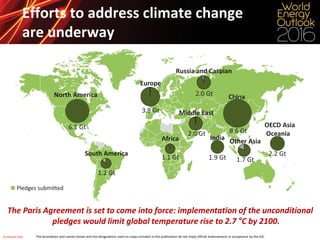
The Paris Agreement is set to come into force: implementation of the unconditional
pledges would limit global temperature rise to 2.7 °C by 2100.
© OECD/IEA 2016
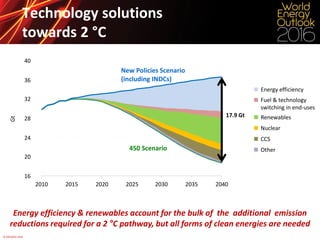
Energy efficiency & renewables account for the bulk of the additional emission
reductions required for a 2 °C pathway, but all forms of clean energies are needed
16
20
24
28
32
36
40
2010 2015 2020 2025 2030 2035 2040
Gt
New Policies Scenario
(including INDCs)
450 Scenario
17.9 Gt
Energy efficiency
Fuel & technology
switching in end-uses
Renewables
Nuclear
CCS
Other
Technology solutions
towards 2 °C
© OECD/IEA 2016
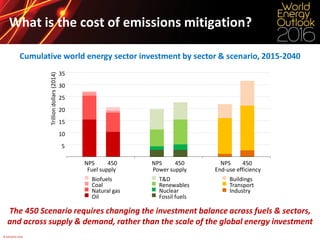
What is the cost of emissions mitigation?
Cumulative world energy sector investment by sector & scenario, 2015-2040
The 450 Scenario requires changing the investment balance across fuels & sectors,
and across supply & demand, rather than the scale of the global energy investment
5
10
15
20
25
30
35
NPS 450
Trilliondollars(2014)
Fuel supply Power supply End-use efficiency
NPS 450 NPS 450
Biofuels
Coal
Natural gas
Oil
T&D
Renewables
Nuclear
Fossil fuels
Buildings
Transport
Industry
© OECD/IEA 2016
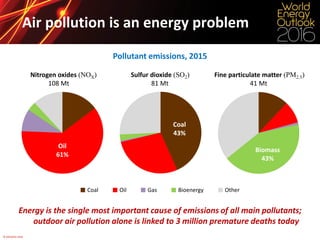
Air pollution is an energy problem
Pollutant emissions, 2015
Energy is the single most important cause of emissions of all main pollutants;
outdoor air pollution alone is linked to 3 million premature deaths today
81 Mt108 Mt 41 Mt
Fine particulate matter (PM2.5)Sulfur dioxide (SO2)Nitrogen oxides (NOX)
>99%
Non-energyEnergy-related
>99%>99% >99% 85%
Coal Oil Gas Bioenergy Other
Biomass
43%
Coal
43%
Oil
61%
© OECD/IEA 2016
MexicoSouth
Africa
Brazil
Thousands
200
100
Indonesia
50
150
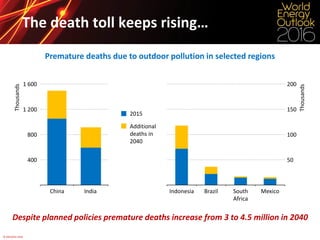
The death toll keeps rising…
Premature deaths due to outdoor pollution in selected regions
Despite planned policies premature deaths increase from 3 to 4.5 million in 2040
2015
Additional
deaths in
2040
400
1 200
IndiaChina
Thousands
1 600
800
© OECD/IEA 2016
4
8
Mt
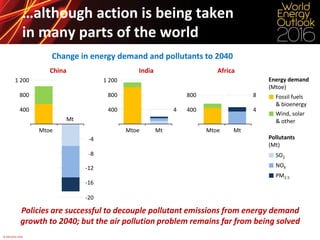
…although action is being taken
in many parts of the world
Policies are successful to decouple pollutant emissions from energy demand
growth to 2040; but the air pollution problem remains far from being solved
Change in energy demand and pollutants to 2040
Mtoe
Mt
400
800
1 200
Mtoe
4
Mt
India
400
800
Mtoe
AfricaChina
400
800
1 200
-20
-16
-12
-8
-4
Fossil fuels
& bioenergy
Wind, solar
& other
Energy demand
(Mtoe)
SO2
NOX
Pollutants
(Mt)
PM2.5
© OECD/IEA 2016
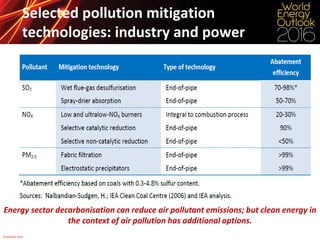
Selected pollution mitigation
technologies: industry and power
Energy sector decarbonisation can reduce air pollutant emissions; but clean energy in
the context of air pollution has additional options.
© OECD/IEA 2016
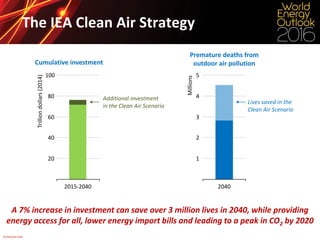
The IEA Clean Air Strategy
A 7% increase in investment can save over 3 million lives in 2040, while providing
energy access for all, lower energy import bills and leading to a peak in CO2 by 2020
Cumulative investment
20
40
60
80
100
Trilliondollars(2014)
1
2
3
4
5
Millions
2015-2040
Premature deaths from
outdoor air pollution
Additional investment
in the Clean Air Scenario
Lives saved in the
Clean Air Scenario
2040
© OECD/IEA 2016
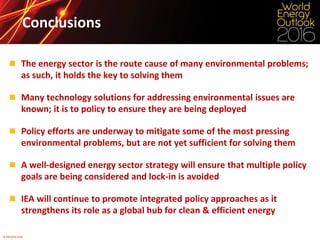
Conclusions
 The energy sector is the route cause of many environmental problems;
as such, it holds the key to solving them
 Many technology solutions for addressing environmental issues are
known; it is to policy to ensure they are being deployed
 Policy efforts are underway to mitigate some of the most pressing
environmental problems, but are not yet sufficient for solving them
 A well-designed energy sector strategy will ensure that multiple policy
goals are being considered and lock-in is avoided
 IEA will continue to promote integrated policy approaches as it
strengthens its role as a global hub for clean & efficient energy

ENV GLOBAL FORUM OCT 2016 - Session 3 - Timur Gül

  • 1.
    ©OECD/IEA2016 The role ofenergy in limiting negative environmental feedbacks Dr. Timur Gül, OECD, 24 October 2016
  • 2.
    © OECD/IEA 2016 Context Energy is at the center of economic activity, and demand keeps rising  Global energy demand is set to rise by one-third to 2040  Many of the root causes – and cures – of environmental problems are in the energy sector  Energy is the main driver of climate change: at least two-thirds of global greenhouse gas emissions are from the energy sector  Fossil-fuels cover around 80% of global energy use and are the main source of CO2 emissions  Energy production & use is an important contributor to emissions of methane and nitrous oxide  Energy is key driver of air pollution, the fourth largest human health risk  only 8% of energy production is combustion free, and more than half of the rest has no effective emissions control technology
  • 3.
    © OECD/IEA 2016The boundaries and names shown and the designations used on maps included in this publication do not imply official endorsement or acceptance by the IEA. Pledges submitted OECD Asia Oceania 2.2 Gt Russia and Caspian 2.0 Gt Europe 3.8 Gt North America 6.1 Gt South America 1.2 Gt Africa 1.1 Gt Middle East 2.0 Gt 1.7 Gt Other AsiaIndia 1.9 Gt China 8.6 Gt Efforts to address climate change are underway The Paris Agreement is set to come into force: implementation of the unconditional pledges would limit global temperature rise to 2.7 °C by 2100.
  • 4.
    © OECD/IEA 2016 Energyefficiency & renewables account for the bulk of the additional emission reductions required for a 2 °C pathway, but all forms of clean energies are needed 16 20 24 28 32 36 40 2010 2015 2020 2025 2030 2035 2040 Gt New Policies Scenario (including INDCs) 450 Scenario 17.9 Gt Energy efficiency Fuel & technology switching in end-uses Renewables Nuclear CCS Other Technology solutions towards 2 °C
  • 5.
    © OECD/IEA 2016 Whatis the cost of emissions mitigation? Cumulative world energy sector investment by sector & scenario, 2015-2040 The 450 Scenario requires changing the investment balance across fuels & sectors, and across supply & demand, rather than the scale of the global energy investment 5 10 15 20 25 30 35 NPS 450 Trilliondollars(2014) Fuel supply Power supply End-use efficiency NPS 450 NPS 450 Biofuels Coal Natural gas Oil T&D Renewables Nuclear Fossil fuels Buildings Transport Industry
  • 6.
    © OECD/IEA 2016 Airpollution is an energy problem Pollutant emissions, 2015 Energy is the single most important cause of emissions of all main pollutants; outdoor air pollution alone is linked to 3 million premature deaths today 81 Mt108 Mt 41 Mt Fine particulate matter (PM2.5)Sulfur dioxide (SO2)Nitrogen oxides (NOX) >99% Non-energyEnergy-related >99%>99% >99% 85% Coal Oil Gas Bioenergy Other Biomass 43% Coal 43% Oil 61%
  • 7.
    © OECD/IEA 2016 MexicoSouth Africa Brazil Thousands 200 100 Indonesia 50 150 Thedeath toll keeps rising… Premature deaths due to outdoor pollution in selected regions Despite planned policies premature deaths increase from 3 to 4.5 million in 2040 2015 Additional deaths in 2040 400 1 200 IndiaChina Thousands 1 600 800
  • 8.
    © OECD/IEA 2016 4 8 Mt …althoughaction is being taken in many parts of the world Policies are successful to decouple pollutant emissions from energy demand growth to 2040; but the air pollution problem remains far from being solved Change in energy demand and pollutants to 2040 Mtoe Mt 400 800 1 200 Mtoe 4 Mt India 400 800 Mtoe AfricaChina 400 800 1 200 -20 -16 -12 -8 -4 Fossil fuels & bioenergy Wind, solar & other Energy demand (Mtoe) SO2 NOX Pollutants (Mt) PM2.5
  • 9.
    © OECD/IEA 2016 Selectedpollution mitigation technologies: industry and power Energy sector decarbonisation can reduce air pollutant emissions; but clean energy in the context of air pollution has additional options.
  • 10.
    © OECD/IEA 2016 TheIEA Clean Air Strategy A 7% increase in investment can save over 3 million lives in 2040, while providing energy access for all, lower energy import bills and leading to a peak in CO2 by 2020 Cumulative investment 20 40 60 80 100 Trilliondollars(2014) 1 2 3 4 5 Millions 2015-2040 Premature deaths from outdoor air pollution Additional investment in the Clean Air Scenario Lives saved in the Clean Air Scenario 2040
  • 11.
    © OECD/IEA 2016 Conclusions The energy sector is the route cause of many environmental problems; as such, it holds the key to solving them  Many technology solutions for addressing environmental issues are known; it is to policy to ensure they are being deployed  Policy efforts are underway to mitigate some of the most pressing environmental problems, but are not yet sufficient for solving them  A well-designed energy sector strategy will ensure that multiple policy goals are being considered and lock-in is avoided  IEA will continue to promote integrated policy approaches as it strengthens its role as a global hub for clean & efficient energy