ENTREPRENEURSHIP
DEVELOPMENT
Tripti Tiwari
Microsoft Student Partner (MSP)
WHO IS AN
ENTREPRENEUR?
• An entrepreneur is a person who starts
an enterprise. He searches for change
and responds to it.
DEFINITIONS BY FAMOUS
ECONOMIST AND AUTHORS
• Richard Cantillon defines entrepreneur as, “An
entrepreneur is a person who pays a certain price for a
product to resell it at an uncertain price, thereby
making decisions about obtaining and using the
resources while consequently admitting the risk of
enterprise.
• Shapiro defined entrepreneur as, “Entrepreneurs take
initiative, accept risk of failure and have an internal
locus of control.”
CHARACTERISTICS OF
ENTREPRENEUR
• Risk bearer.
• Innovative.
• Forecasts uncertainties.
• Creative activity.
• Business oriented.
• Result oriented.
IMPORTANCE OF
ENTREPRENEURSHIP
• Establishment of viable units.
• Develop entrepreneurial tendencies.
• To promote innovations.
• Optimum utilization of resources.
• Increase employment opportunities.
• Balance economic development.
• Rapid economic development.
• Social satisfaction.
• Promote capital formation.
• Contribute towards Govt. policy execution.
CONTD…..
• Means of social change.
• Minimize Socio-economic problem.
• Establish self sufficient economy.
TYPES OF
ENTREPRENEURS.
• On the basis of ownership.
• On the basis of attitude.
• On the basis of centralization.
• On the basis of size.
• On the basis of entrepreneurial function.
• On the basis of leadership.
• Urban and Rural entrepreneurship.
ON THE BASIS OF
LEADERSHIP.
• Individualistic entrepreneurship.
• Group entrepreneurship.
ON THE BASIS OF
OWNERSHIP.
• Private entrepreneurship.
• Public entrepreneurship.
• Joint entrepreneurship.
• Co-operative entrepreneurship.
ON THE BASIS OF ATTITUDE.
• Traditional entrepreneurship.
• Modern/revolutionary entrepreneurship.
ON THE BASIS OF
CENTRALIZATION.
• Centralized entrepreneurship.
• Decentralized entrepreneurship.
ON THE BASIS OF SIZE
• Large entrepreneurship.
• Small entrepreneurship.
ON THE BASIS OF
ENTREPRENEURIAL
FUNCTION• Routine entrepreneurship.
• New type entrepreneurship.
OTHER TYPE OF
ENTREPRENEURSHIP
• Urban entrepreneurship.
• Rural entrepreneurship.
• Systematic entrepreneurship.
MOTIVATION
• Derived from word motive.
• An impulse that drives person into action.
• Process of encouragement to derive desired results.
CHARACTERISTICS FOR
MOTIVATION.
• It is an complex phenomena.
• Gives birth to common behavior.
• Differs from people to people.
• Common motivation produces common results.
• It is a managerial characteristics.
• It is a psychological process.
• It comes from different sources.
• It is a continuous process.
SOURCES OF
MOTIVATION
• Power driven motivation.
• Affiliation based motivation.
• Achievement based motivation.
POWER DRIVEN
MOTIVATION.
• Work for enhancing social prestige.
• Work under external pressure.
AFFILIATION BASED
MOTIVATION.
• To establish and maintain friendly relations.
• Basically done to get things done from relations.
ACHIEVEMENT BASED
MOTIVATION.
• Hard work for getting result.
• Believes on own efforts.
• Done to achieve something unique.
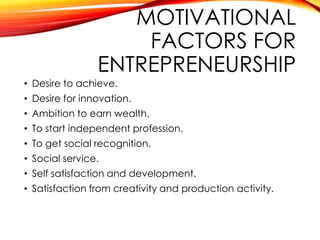
MOTIVATIONAL
FACTORS FOR
ENTREPRENEURSHIP
• Desire to achieve.
• Desire for innovation.
• Ambition to earn wealth.
• To start independent profession.
• To get social recognition.
• Social service.
• Self satisfaction and development.
• Satisfaction from creativity and production activity.
THANKS!!

Entrepreneurship development

  • 1.
  • 2.
    WHO IS AN ENTREPRENEUR? •An entrepreneur is a person who starts an enterprise. He searches for change and responds to it.
  • 3.
    DEFINITIONS BY FAMOUS ECONOMISTAND AUTHORS • Richard Cantillon defines entrepreneur as, “An entrepreneur is a person who pays a certain price for a product to resell it at an uncertain price, thereby making decisions about obtaining and using the resources while consequently admitting the risk of enterprise. • Shapiro defined entrepreneur as, “Entrepreneurs take initiative, accept risk of failure and have an internal locus of control.”
  • 4.
    CHARACTERISTICS OF ENTREPRENEUR • Riskbearer. • Innovative. • Forecasts uncertainties. • Creative activity. • Business oriented. • Result oriented.
  • 5.
    IMPORTANCE OF ENTREPRENEURSHIP • Establishmentof viable units. • Develop entrepreneurial tendencies. • To promote innovations. • Optimum utilization of resources. • Increase employment opportunities. • Balance economic development. • Rapid economic development. • Social satisfaction. • Promote capital formation. • Contribute towards Govt. policy execution.
  • 6.
    CONTD….. • Means ofsocial change. • Minimize Socio-economic problem. • Establish self sufficient economy.
  • 7.
    TYPES OF ENTREPRENEURS. • Onthe basis of ownership. • On the basis of attitude. • On the basis of centralization. • On the basis of size. • On the basis of entrepreneurial function. • On the basis of leadership. • Urban and Rural entrepreneurship.
  • 8.
    ON THE BASISOF LEADERSHIP. • Individualistic entrepreneurship. • Group entrepreneurship.
  • 9.
    ON THE BASISOF OWNERSHIP. • Private entrepreneurship. • Public entrepreneurship. • Joint entrepreneurship. • Co-operative entrepreneurship.
  • 10.
    ON THE BASISOF ATTITUDE. • Traditional entrepreneurship. • Modern/revolutionary entrepreneurship.
  • 11.
    ON THE BASISOF CENTRALIZATION. • Centralized entrepreneurship. • Decentralized entrepreneurship.
  • 12.
    ON THE BASISOF SIZE • Large entrepreneurship. • Small entrepreneurship.
  • 13.
    ON THE BASISOF ENTREPRENEURIAL FUNCTION• Routine entrepreneurship. • New type entrepreneurship.
  • 14.
    OTHER TYPE OF ENTREPRENEURSHIP •Urban entrepreneurship. • Rural entrepreneurship. • Systematic entrepreneurship.
  • 15.
    MOTIVATION • Derived fromword motive. • An impulse that drives person into action. • Process of encouragement to derive desired results.
  • 16.
    CHARACTERISTICS FOR MOTIVATION. • Itis an complex phenomena. • Gives birth to common behavior. • Differs from people to people. • Common motivation produces common results. • It is a managerial characteristics. • It is a psychological process. • It comes from different sources. • It is a continuous process.
  • 17.
    SOURCES OF MOTIVATION • Powerdriven motivation. • Affiliation based motivation. • Achievement based motivation.
  • 18.
    POWER DRIVEN MOTIVATION. • Workfor enhancing social prestige. • Work under external pressure.
  • 19.
    AFFILIATION BASED MOTIVATION. • Toestablish and maintain friendly relations. • Basically done to get things done from relations.
  • 20.
    ACHIEVEMENT BASED MOTIVATION. • Hardwork for getting result. • Believes on own efforts. • Done to achieve something unique.
  • 21.
    MOTIVATIONAL FACTORS FOR ENTREPRENEURSHIP • Desireto achieve. • Desire for innovation. • Ambition to earn wealth. • To start independent profession. • To get social recognition. • Social service. • Self satisfaction and development. • Satisfaction from creativity and production activity.
  • 22.