
ENTREPRENEURSHIP
Dr. Gopal Thapa
Tribhuvan University
Email: thapazee@gmail.com
Entrepreneur
 The term Entrepreneur is coined by J. B. Say in
1800 AD (Peter Drucker)
 The term Entrepreneur had originated from French
word ‘Entreprendre’ which denotes ‘undertakers,
i.e. the persons who take risks in new enterprises
(Those entrepreneurs were contractors who
undertook the risks of profit and loss.

08/19/18 Copy right reserved 2
Entrepreneur
 In 14th
century the term entrepreneur referred to
tax contractors.
 In 16th
century the term ‘entrepreneur’ was used to
denotes the soldiers involved in adventurous
travels
 In 17th
century the term ‘entrepreneur’ started to
use in civil engineering activities such as
construction and erecting forts.
 Since the beginning of 18th
century the term
entrepreneurship started to use in economic
aspects08/19/18 Copy right reserved 3
Entrepreneur
 They are business founder and ultimate owner of
business
 They are change agents
 They transform the resources to useful products.
 They are captain of industry, risk takers, decision
makers, loss bearers, collectors and managers of
resources
08/19/18 Copy right reserved 4
Entrepreneur
 They are innovators
 They are force of creative destruction
 Established way of doing things were destructed
through the creation of new and best ways of
doing business.
08/19/18 Copy right reserved 5
Entrepreneur: Factor of production
 Special type of factor of production
 Organizes all other factors of production
 Not hirable like other factors of production
 Independent factor of production
 Human beings with special factors of production
 It is active factor of production
 Reward for others is always positive
08/19/18 Copy right reserved 6
Entrepreneur
 US view: Entrepreneur is defined as one who
starts his own, new and small business
 German view: The person who owns and runs a
business
 FB Hawley: Entrepreneur is risk taker
 FH Knight: Entrepreneur is one who bears
uncertainty.
08/19/18 Copy right reserved 7
Entrepreneur
 The entrepreneur is one who actually searches for
change, responds to it and exploits change as an
opportunity .---- Peter Drucker
 The entrepreneur is one who creates a new
business in the face of risk and uncertainty for the
purpose of achieving profit and growth by
identifying opportunities and assembling the
necessary resources to capitalize those
opportunities. ----- Normo M. Scarborough &
Thomas W. Zimmerer
08/19/18 Copy right reserved 8
Features of Entrepreneur
 Achievement oriented
 Hard working
 Desire for responsibility
 Optimistic
 Independence
 Foresighted
 Risk taker
 Innovative
 Flexible
 Good leader and manager
08/19/18 Copy right reserved 9
Types of Entrepreneur (view of Clarence
Danholf)
 Innovating Entrepreneurs (make innovation)
 Imitative Entrepreneurs (imitate innovation)
 Fabian Entrepreneurs (Imitate only for survival)
 Drone Entrepreneurs (Refuse to change)
08/19/18 Copy right reserved 10
Types of Entrepreneur (Behavioral view)
 Solo Operators (work alone)
 Active Partners (Joint venture)
 Inventors ( Product innovation)
 Challengers (Always ready for challenges)
 Buyers (Buy the existing business)
 Life timers (Family enterprises)
08/19/18 Copy right reserved 11
Types of Entrepreneur (Focus group based:
Scarborough and Zimmerer)
 Women Entrepreneurs
 Minority Entrepreneurs
 Immigrant Entrepreneurs
 Part-time Entrepreneurs
 Home-based Entrepreneurs
 Family Business Entrepreneurs
 Corpreneurs (Couples)
08/19/18 Copy right reserved 12
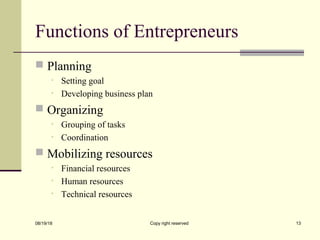
Functions of Entrepreneurs
 Planning
• Setting goal
• Developing business plan
 Organizing
• Grouping of tasks
• Coordination
 Mobilizing resources
• Financial resources
• Human resources
• Technical resources
08/19/18 Copy right reserved 13
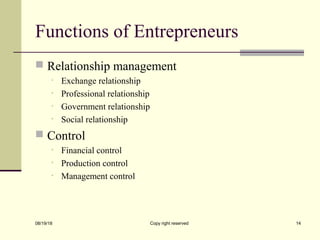
Functions of Entrepreneurs
 Relationship management
• Exchange relationship
• Professional relationship
• Government relationship
• Social relationship
 Control
• Financial control
• Production control
• Management control
08/19/18 Copy right reserved 14
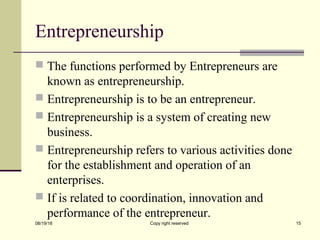
Entrepreneurship
 The functions performed by Entrepreneurs are
known as entrepreneurship.
 Entrepreneurship is to be an entrepreneur.
 Entrepreneurship is a system of creating new
business.
 Entrepreneurship refers to various activities done
for the establishment and operation of an
enterprises.
 If is related to coordination, innovation and
performance of the entrepreneur.
08/19/18 Copy right reserved 15
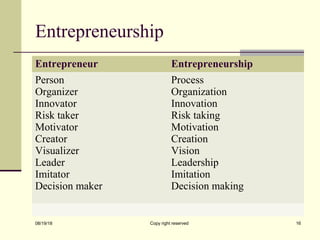
Entrepreneurship
08/19/18 Copy right reserved 16
Entrepreneur Entrepreneurship
Person
Organizer
Innovator
Risk taker
Motivator
Creator
Visualizer
Leader
Imitator
Decision maker
Process
Organization
Innovation
Risk taking
Motivation
Creation
Vision
Leadership
Imitation
Decision making
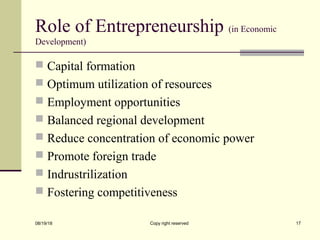
Role of Entrepreneurship (in Economic
Development)
 Capital formation
 Optimum utilization of resources
 Employment opportunities
 Balanced regional development
 Reduce concentration of economic power
 Promote foreign trade
 Indrustrilization
 Fostering competitiveness
08/19/18 Copy right reserved 17
?????
08/19/18 Copy right reserved 18

Entrepreneurship

  • 1.
    ENTREPRENEURSHIP Dr. Gopal Thapa TribhuvanUniversity Email: thapazee@gmail.com
  • 2.
    Entrepreneur  The termEntrepreneur is coined by J. B. Say in 1800 AD (Peter Drucker)  The term Entrepreneur had originated from French word ‘Entreprendre’ which denotes ‘undertakers, i.e. the persons who take risks in new enterprises (Those entrepreneurs were contractors who undertook the risks of profit and loss.  08/19/18 Copy right reserved 2
  • 3.
    Entrepreneur  In 14th centurythe term entrepreneur referred to tax contractors.  In 16th century the term ‘entrepreneur’ was used to denotes the soldiers involved in adventurous travels  In 17th century the term ‘entrepreneur’ started to use in civil engineering activities such as construction and erecting forts.  Since the beginning of 18th century the term entrepreneurship started to use in economic aspects08/19/18 Copy right reserved 3
  • 4.
    Entrepreneur  They arebusiness founder and ultimate owner of business  They are change agents  They transform the resources to useful products.  They are captain of industry, risk takers, decision makers, loss bearers, collectors and managers of resources 08/19/18 Copy right reserved 4
  • 5.
    Entrepreneur  They areinnovators  They are force of creative destruction  Established way of doing things were destructed through the creation of new and best ways of doing business. 08/19/18 Copy right reserved 5
  • 6.
    Entrepreneur: Factor ofproduction  Special type of factor of production  Organizes all other factors of production  Not hirable like other factors of production  Independent factor of production  Human beings with special factors of production  It is active factor of production  Reward for others is always positive 08/19/18 Copy right reserved 6
  • 7.
    Entrepreneur  US view:Entrepreneur is defined as one who starts his own, new and small business  German view: The person who owns and runs a business  FB Hawley: Entrepreneur is risk taker  FH Knight: Entrepreneur is one who bears uncertainty. 08/19/18 Copy right reserved 7
  • 8.
    Entrepreneur  The entrepreneuris one who actually searches for change, responds to it and exploits change as an opportunity .---- Peter Drucker  The entrepreneur is one who creates a new business in the face of risk and uncertainty for the purpose of achieving profit and growth by identifying opportunities and assembling the necessary resources to capitalize those opportunities. ----- Normo M. Scarborough & Thomas W. Zimmerer 08/19/18 Copy right reserved 8
  • 9.
    Features of Entrepreneur Achievement oriented  Hard working  Desire for responsibility  Optimistic  Independence  Foresighted  Risk taker  Innovative  Flexible  Good leader and manager 08/19/18 Copy right reserved 9
  • 10.
    Types of Entrepreneur(view of Clarence Danholf)  Innovating Entrepreneurs (make innovation)  Imitative Entrepreneurs (imitate innovation)  Fabian Entrepreneurs (Imitate only for survival)  Drone Entrepreneurs (Refuse to change) 08/19/18 Copy right reserved 10
  • 11.
    Types of Entrepreneur(Behavioral view)  Solo Operators (work alone)  Active Partners (Joint venture)  Inventors ( Product innovation)  Challengers (Always ready for challenges)  Buyers (Buy the existing business)  Life timers (Family enterprises) 08/19/18 Copy right reserved 11
  • 12.
    Types of Entrepreneur(Focus group based: Scarborough and Zimmerer)  Women Entrepreneurs  Minority Entrepreneurs  Immigrant Entrepreneurs  Part-time Entrepreneurs  Home-based Entrepreneurs  Family Business Entrepreneurs  Corpreneurs (Couples) 08/19/18 Copy right reserved 12
  • 13.
    Functions of Entrepreneurs Planning • Setting goal • Developing business plan  Organizing • Grouping of tasks • Coordination  Mobilizing resources • Financial resources • Human resources • Technical resources 08/19/18 Copy right reserved 13
  • 14.
    Functions of Entrepreneurs Relationship management • Exchange relationship • Professional relationship • Government relationship • Social relationship  Control • Financial control • Production control • Management control 08/19/18 Copy right reserved 14
  • 15.
    Entrepreneurship  The functionsperformed by Entrepreneurs are known as entrepreneurship.  Entrepreneurship is to be an entrepreneur.  Entrepreneurship is a system of creating new business.  Entrepreneurship refers to various activities done for the establishment and operation of an enterprises.  If is related to coordination, innovation and performance of the entrepreneur. 08/19/18 Copy right reserved 15
  • 16.
    Entrepreneurship 08/19/18 Copy rightreserved 16 Entrepreneur Entrepreneurship Person Organizer Innovator Risk taker Motivator Creator Visualizer Leader Imitator Decision maker Process Organization Innovation Risk taking Motivation Creation Vision Leadership Imitation Decision making
  • 17.
    Role of Entrepreneurship(in Economic Development)  Capital formation  Optimum utilization of resources  Employment opportunities  Balanced regional development  Reduce concentration of economic power  Promote foreign trade  Indrustrilization  Fostering competitiveness 08/19/18 Copy right reserved 17
  • 18.