Copyright Lean Kanban Inc. dja@leankanban.com @LKI_dja
Effective Middle
Management
Presenter
David J. Anderson
Lean Kanban Central
Europe
Munich, Germany
November 2015
Copyright Lean Kanban Inc. dja@leankanban.com @LKI_dja
Explicit Agendas
Copyright Lean Kanban Inc. dja@leankanban.com @LKI_dja
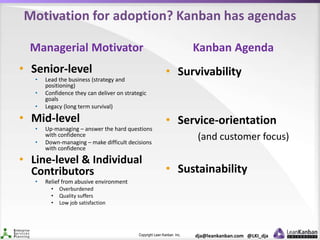
Motivation for adoption? Kanban has agendas
Managerial Motivator
• Senior-level
• Lead the business (strategy and
positioning)
• Confidence they can deliver on strategic
goals
• Legacy (long term survival)
• Mid-level
• Up-managing – answer the hard questions
with confidence
• Down-managing – make difficult decisions
with confidence
• Line-level & Individual
Contributors
• Relief from abusive environment
• Overburdened
• Quality suffers
• Low job satisfaction
Kanban Agenda
• Survivability
• Service-orientation
(and customer focus)
• Sustainability
Copyright Lean Kanban Inc. dja@leankanban.com @LKI_dja
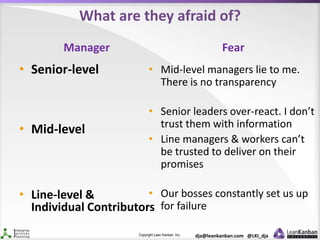
What are they afraid of?
Manager
• Senior-level
• Mid-level
• Line-level &
Individual Contributors
Fear
• Mid-level managers lie to me.
There is no transparency
• Senior leaders over-react. I don’t
trust them with information
• Line managers & workers can’t
be trusted to deliver on their
promises
• Our bosses constantly set us up
for failure
Copyright Lean Kanban Inc. dja@leankanban.com @LKI_dja
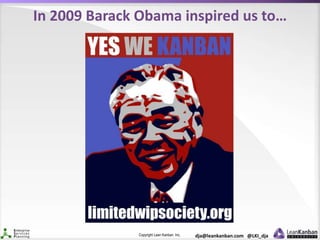
In 2009 Barack Obama inspired us to…
Copyright Lean Kanban Inc. dja@leankanban.com @LKI_dja
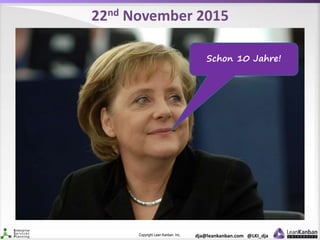
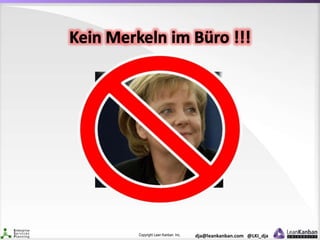
22nd November 2015
Schon 10 Jahre!
Copyright Lean Kanban Inc. dja@leankanban.com @LKI_dja
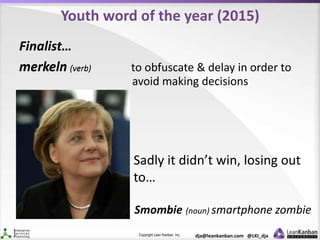
Youth word of the year (2015)
Finalist…
merkeln (verb)merkeln (verb) to obfuscate & delay in order to
avoid making decisions
Sadly it didn’t win, losing out
to…
Smombie (noun) smartphone zombie
Copyright Lean Kanban Inc. dja@leankanban.com @LKI_dja
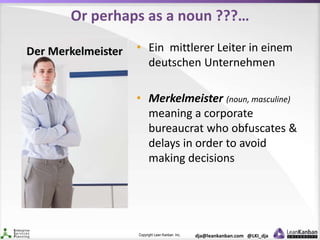
Or perhaps as a noun ???…
• Ein mittlerer Leiter in einem
deutschen Unternehmen
• Merkelmeister (noun, masculine)
meaning a corporate
bureaucrat who obfuscates &
delays in order to avoid
making decisions
Copyright Lean Kanban Inc. dja@leankanban.com @LKI_dja
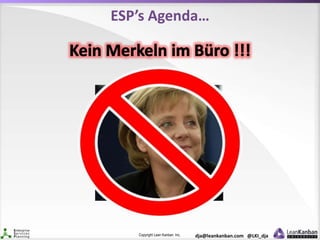
ESP’s Agenda…
Copyright Lean Kanban Inc. dja@leankanban.com @LKI_dja
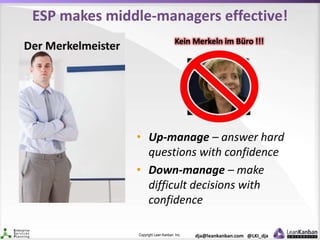
ESP makes middle-managers effective!
• Up-manage – answer hard
questions with confidence
• Down-manage – make
difficult decisions with
confidence
Copyright Lean Kanban Inc. dja@leankanban.com @LKI_dja
Enterprise Services Planning
Copyright Lean Kanban Inc. dja@leankanban.com @LKI_dja
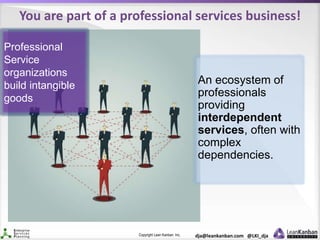
You are part of a professional services business!
An ecosystem of
professionals
providing
interdependent
services, often with
complex
dependencies.
Professional
Service
organizations
build intangible
goods
Copyright Lean Kanban Inc. dja@leankanban.com @LKI_dja
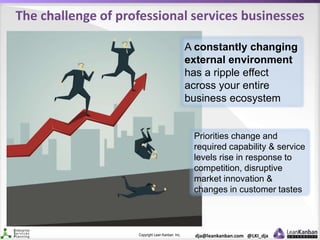
The challenge of professional services businesses
A constantly changing
external environment
has a ripple effect
across your entire
business ecosystem
Priorities change and
required capability & service
levels rise in response to
competition, disruptive
market innovation &
changes in customer tastes
Copyright Lean Kanban Inc. dja@leankanban.com @LKI_dja
What should
we start next? Will it be
delivered when
we need it?
Do we have
capacity to do
everything we
need to do?
Copyright Lean Kanban Inc. dja@leankanban.com @LKI_dja
How will
dependencies
affect our
ability
to deliver?
How many
activities should
we have running
in parallel?
If we delay starting something,
will the capacity be available
when we need it?
Copyright Lean Kanban Inc. dja@leankanban.com @LKI_dja
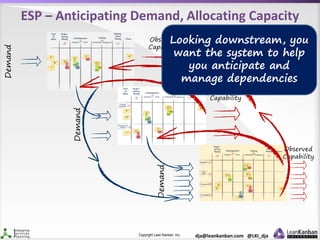
Demand
Observed
Capability
Demand
Demand
Observed
Capability
Observed
Capability
ESP – Anticipating Demand, Allocating Capacity
Looking downstream, you
want the system to help
you anticipate and
manage dependencies
Copyright Lean Kanban Inc. dja@leankanban.com @LKI_dja
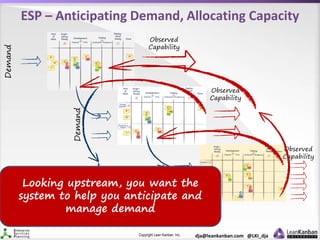
ESP – Anticipating Demand, Allocating Capacity
Demand
Observed
Capability
Demand
Demand
Observed
Capability
Observed
Capability
Looking upstream, you want the
system to help you anticipate and
manage demand
Copyright Lean Kanban Inc. dja@leankanban.com @LKI_dja
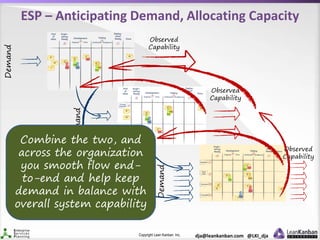
Demand
Observed
Capability
Demand
Demand
Observed
Capability
Observed
Capability
ESP – Anticipating Demand, Allocating Capacity
Combine the two, and
across the organization
you smooth flow end-
to-end and help keep
demand in balance with
overall system capability
Copyright Lean Kanban Inc. dja@leankanban.com @LKI_dja
Enterprise Services Planning
*Kanban is a way to organize and manage work. It improves
service delivery speed & predictability through a combination of
limiting work-in-progress & deferred commitment
It uses visual management and Lean techniques such as limiting
the amount of work in progress, and probabilistic forecasting.
Kanban helps to balance demand with capability.
Balancing demand and capability = improved flow.
Improved flow = Improved predictability.
Enterprise Services Planning (ESP) is an enterprise-wide
management solution that leverages Kanban*
to improve each service within your business.
Copyright Lean Kanban Inc. dja@leankanban.com @LKI_dja
The goal of Enterprise Services Planning
The goal of
Enterprise Services Planning
is to pick...
The Right Things
At The Right Time
Done The Right Way
With Appropriate Risk
Exposure
Copyright Lean Kanban Inc. dja@leankanban.com @LKI_dja
Enterprise Services Planning
Manufacturing
1947 – Kanban
1964 & 1975 – MRP
Professional Services
2004 – Kanban
2015 – ESP
ESP is “MRP for professional services”.
ESP is for managing capacity &
scheduling intangible work.
ESP uses algorithms enabled with data from
analysis of the work requests, our existing
capability, and knowledge of customer
expectations, to make recommendations
Copyright Lean Kanban Inc. dja@leankanban.com @LKI_dja
Enterprise Services Planning
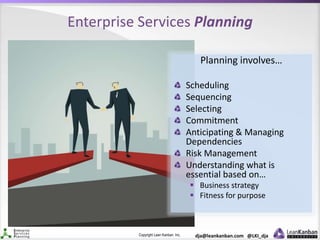
Planning involves…
Scheduling
Sequencing
Selecting
Commitment
Anticipating & Managing
Dependencies
Risk Management
Understanding what is
essential based on…
 Business strategy
 Fitness for purpose
Copyright Lean Kanban Inc. dja@leankanban.com @LKI_dja
Risk Assessment
(for scheduling, sequencing, & selection)
Copyright Lean Kanban Inc. dja@leankanban.com @LKI_dja
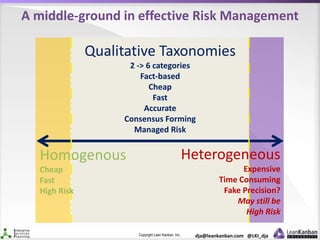
Qualitative Taxonomies
2 -> 6 categories
Fact-based
Cheap
Fast
Accurate
Consensus Forming
Managed Risk
Heterogeneous
Expensive
Time Consuming
Fake Precision?
May still be
High Risk
Homogenous
Cheap
Fast
High Risk
A middle-ground in effective Risk Management
Copyright Lean Kanban Inc. dja@leankanban.com @LKI_dja
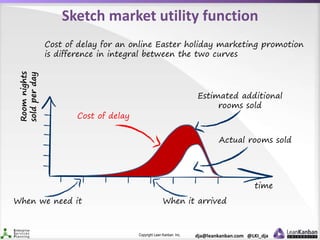
Sketch market utility functionRoomnights
soldperday
Actual rooms sold
Cost of delay
Estimated additional
rooms sold
When we need it When it arrived
Cost of delay for an online Easter holiday marketing promotion
is difference in integral between the two curves
time
Copyright Lean Kanban Inc. dja@leankanban.com @LKI_dja
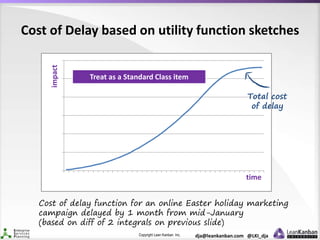
Cost of Delay based on utility function sketches
Cost of delay function for an online Easter holiday marketing
campaign delayed by 1 month from mid-January
(based on diff of 2 integrals on previous slide)
Treat as a Standard Class item
time
impact
Total cost
of delay
Copyright Lean Kanban Inc. dja@leankanban.com @LKI_dja
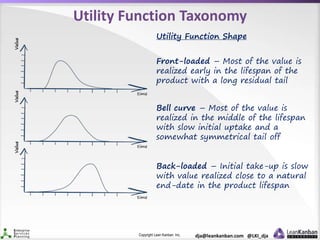
Utility Function Taxonomy
Front-loaded – Most of the value is
realized early in the lifespan of the
product with a long residual tail
Utility Function Shape
Bell curve – Most of the value is
realized in the middle of the lifespan
with slow initial uptake and a
somewhat symmetrical tail off
Back-loaded – Initial take-up is slow
with value realized close to a natural
end-date in the product lifespan
Copyright Lean Kanban Inc. dja@leankanban.com @LKI_dja
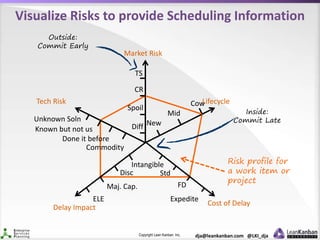
Visualize Risks to provide Scheduling Information
TS
Market Risk
CR
Spoil
Diff
Lifecycle
Cost of Delay
Tech Risk
Delay Impact
New
Mid
Cow
Expedite
FD
Std
Intangible
ELE
Maj. Cap.
Disc
Unknown Soln
Known but not us
Done it before
Commodity
Risk profile for
a work item or
project
Outside:
Commit Early
Inside:
Commit Late
Copyright Lean Kanban Inc. dja@leankanban.com @LKI_dja
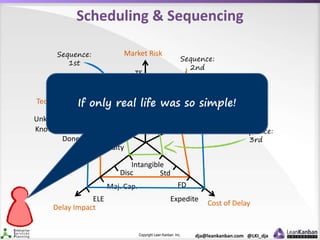
Scheduling & Sequencing
TS
Market Risk
CR
Spoil
Diff
Lifecycle
Cost of Delay
Tech Risk
Delay Impact
New
Mid
Cow
Expedite
FD
Std
Intangible
ELE
Maj. Cap.
Disc
Unknown Soln
Known but not us
Done it before
Commodity
Sequence:
1st
Sequence:
3rd
Sequence:
2nd
If only real life was so simple!
Copyright Lean Kanban Inc. dja@leankanban.com @LKI_dja
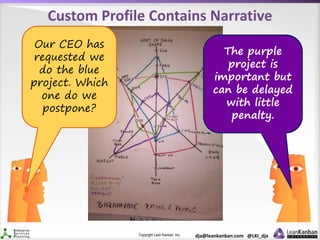
Custom Profile Contains Narrative
Our CEO has
requested we
do the blue
project. Which
one do we
postpone?
The purple
project is
important but
can be delayed
with little
penalty.
Copyright Lean Kanban Inc. dja@leankanban.com @LKI_dja
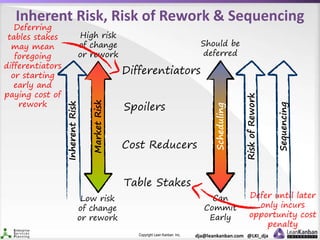
Inherent Risk, Risk of Rework & Sequencing
MarketRisk
Scheduling
High risk
of change
or rework
Low risk
of change
or rework
Can
Commit
Early
Should be
deferred
Differentiators
Spoilers
Table Stakes
Cost Reducers
Defer until later
only incurs
opportunity cost
penalty
Deferring
tables stakes
may mean
foregoing
differentiators
or starting
early and
paying cost of
rework
InherentRisk
RiskofRework
Sequencing
Copyright Lean Kanban Inc. dja@leankanban.com @LKI_dja
Revisiting the portfolio options
There is a low
penalty to
deferring the
purple project
compared to
alternatives
The purple
project remains
important. We
may need to
forgo something
else later in
order to insure
it is completed
Copyright Lean Kanban Inc. dja@leankanban.com @LKI_dja
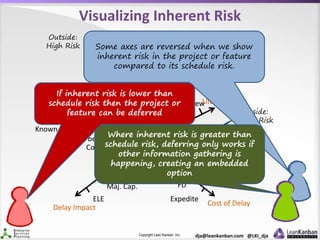
Visualizing Inherent Risk
Diff
Market Risk
Spoil
CR
TS
Lifecycle
Cost of Delay
Tech Risk
Delay Impact
Cow
Mid
New
Expedite
FD
Std
Intangible
ELE
Maj. Cap.
Disc
Unknown Soln
Known but not us
Done it before
Commodity
Outside:
High Risk
Inside:
Low Risk
Some axes are reversed when we show
inherent risk in the project or feature
compared to its schedule risk.
If inherent risk is lower than
schedule risk then the project or
feature can be deferred
Where inherent risk is greater than
schedule risk, deferring only works if
other information gathering is
happening, creating an embedded
option
Copyright Lean Kanban Inc. dja@leankanban.com @LKI_dja
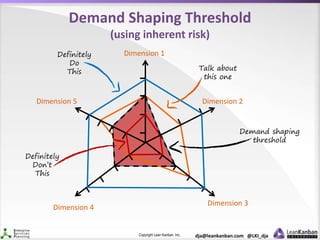
Demand Shaping Threshold
(using inherent risk)
Dimension 1
Dimension 2
Dimension 3
Dimension 5
Dimension 4
Definitely
Do
This
Demand shaping
threshold
Talk about
this one
Definitely
Don’t
This
Copyright Lean Kanban Inc. dja@leankanban.com @LKI_dja
Barbell Demand Shaping Threshold
Dimension 1
Dimension 2
Dimension 3
Dimension 5
Dimension 4
Definitely
Do
This Don’t do this one
Definitely
Do
This
Middle band
Rejection
Zone
Do this one
Copyright Lean Kanban Inc. dja@leankanban.com @LKI_dja
Forecasting
Copyright Lean Kanban Inc. dja@leankanban.com @LKI_dja
Lead Time & Weibull Distributions
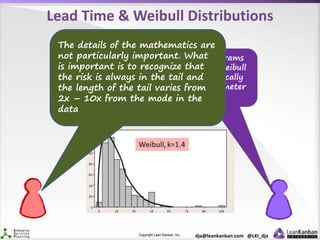
Lead time histograms
observed to be Weibull
distributions typically
with shape parameter
1.0 < k < 2.0
The details of the mathematics are
not particularly important. What
is important is to recognize that
the risk is always in the tail and
the length of the tail varies from
2x – 10x from the mode in the
data
Copyright Lean Kanban Inc. dja@leankanban.com @LKI_dja
ChangeRequests
SLA (customer expectation or fitness criteria)
60 days
Use Lead Time Distribution to Evaluate
Service Delivery Effectiveness
22-150 day
spread of variation
85%
on-time
15% late
Due Date
Performance
(DDP)
Predictability
Copyright Lean Kanban Inc. dja@leankanban.com @LKI_dja
Forecasting methods
ESP relies on two types of forecasting approaches
 Reference class forecasting
 Monte Carlo simulation
Reference class forecasting requires an assumption
of an equilibrium – the near future will reflect the
continuing conditions of the recent past
 We sample data from a period in the recent past and use it
to forecast future behavior
 The sample period is determined by evaluating the
volatility in kanban system liquidity
Copyright Lean Kanban Inc. dja@leankanban.com @LKI_dja
Scheduling
Copyright Lean Kanban Inc. dja@leankanban.com @LKI_dja
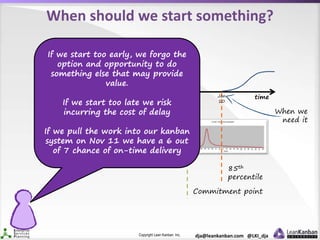
When should we start something?
impact
When we
need it
85th
percentile
Ideal Start
Here
Commitment point
timeJan
10
Nov
11
If we start too early, we forgo the
option and opportunity to do
something else that may provide
value.
If we start too late we risk
incurring the cost of delay
If we pull the work into our kanban
system on Nov 11 we have a 6 out
of 7 chance of on-time delivery
Copyright Lean Kanban Inc. dja@leankanban.com @LKI_dja
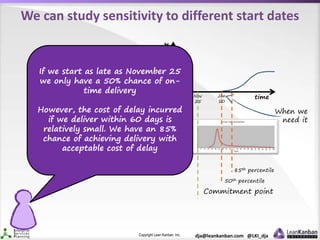
We can study sensitivity to different start dates
impact
When we
need it
50th percentile
Later Start
Here
Commitment point
timeJan
10
Nov
25
If we start as late as November 25
we only have a 50% chance of on-
time delivery
However, the cost of delay incurred
if we deliver within 60 days is
relatively small. We have an 85%
chance of achieving delivery with
acceptable cost of delay
85th percentile
Copyright Lean Kanban Inc. dja@leankanban.com @LKI_dja
What is the latest we could start?
impact
When we
need it
0th percentile
Very late
start
Commitment point
timeJan
10
Dec
19
If we start as late as December 19
we have 0% chance of on-time
delivery
We have about a 10% chance of a
total loss delivering the promotion
beyond the expiry date of the
opportunity
85th percentile
total loss
Copyright Lean Kanban Inc. dja@leankanban.com @LKI_dja
To be certain of delivery without incurring any
cost of delay is expensive
impact
When we
need it
98th
percentile
Early Start
Commitment point
timeJan
10
Aug
11
If we are conservative and do not
wish to carry any risk of late
delivery or any risk of incurring an
opportunity cost of delay, then we
must start as early as August 11th.
We must commit to our Spring
Break 2015 promotion during
Summer 2014!!!
Copyright Lean Kanban Inc. dja@leankanban.com @LKI_dja
Window of opportunity
impact
When we
need it
Earliest Start
timeJan
10
Aug
11
Latest
viable
start
Dec
19
Optimal Start
Nov
11
On August 11st the item becomes
available for selection at Kanban
system replenishment.
The ideal time to start is November
11th.
After December 19th our option to
deliver this item expires and we
would discard it from our pool.
Copyright Lean Kanban Inc. dja@leankanban.com @LKI_dja
Managing Dependencies
Copyright Lean Kanban Inc. dja@leankanban.com @LKI_dja
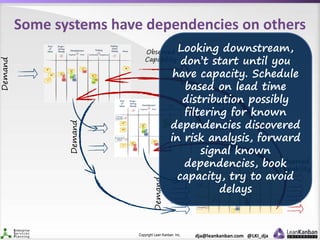
Some systems have dependencies on others
Demand
Observed
Capability
Demand
Demand
Observed
Capability
Observed
Capability
Looking downstream,
don’t start until you
have capacity. Schedule
based on lead time
distribution possibly
filtering for known
dependencies discovered
in risk analysis, forward
signal known
dependencies, book
capacity, try to avoid
delays
Copyright Lean Kanban Inc. dja@leankanban.com @LKI_dja
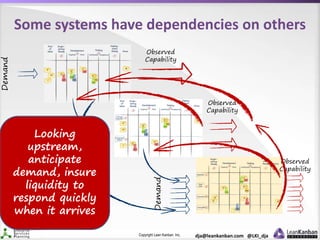
Some systems have dependencies on others
Demand
Observed
Capability
Demand
Demand
Observed
Capability
Observed
Capability
Looking
upstream,
anticipate
demand, insure
liquidity to
respond quickly
when it arrives
Copyright Lean Kanban Inc. dja@leankanban.com @LKI_dja
Some systems have dependencies on others
Demand
Observed
Capability
Demand
Demand
Observed
Capability
Observed
Capability
Combine the two,
and across the
organization you
smooth flow end-
to-end shortening
customer lead
times and
improving fitness
for purpose
Copyright Lean Kanban Inc. dja@leankanban.com @LKI_dja
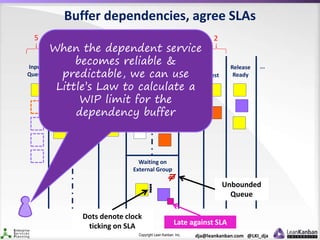
Buffer dependencies, agree SLAs
5 4 43 2 2
...Input
Queue
Dev
Ready In Prog DoneDoneIn Prog
DevelopmentAnalysis Build
Ready Test
Release
Ready
Waiting on
External Group
Late against SLA
Dots denote clock
ticking on SLA
∞7
Unbounded
Queue
When the dependent service
becomes reliable &
predictable, we can use
Little’s Law to calculate a
WIP limit for the
dependency buffer
Copyright Lean Kanban Inc. dja@leankanban.com @LKI_dja
Definition of
Enterprise Services Planning
Copyright Lean Kanban Inc. dja@leankanban.com @LKI_dja
Enterprise Services Planning
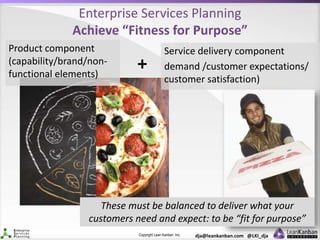
Achieve “Fitness for Purpose”
+
These must be balanced to deliver what your
customers need and expect: to be “fit for purpose”
Product component
(capability/brand/non-
functional elements)
Service delivery component
demand /customer expectations/
customer satisfaction)
Copyright Lean Kanban Inc. dja@leankanban.com @LKI_dja
Enterprise Services Planning
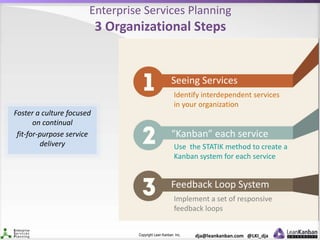
3 Organizational Steps
Foster a culture focused
on continual
fit-for-purpose service
delivery
Seeing Services
“Kanban” each service
Feedback Loop System
Identify interdependent services
in your organization
Use the STATIK method to create a
Kanban system for each service
Implement a set of responsive
feedback loops
Copyright Lean Kanban Inc. dja@leankanban.com @LKI_dja
The Kanban Method
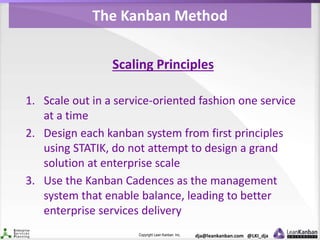
Scaling Principles
1. Scale out in a service-oriented fashion one service
at a time
2. Design each kanban system from first principles
using STATIK, do not attempt to design a grand
solution at enterprise scale
3. Use the Kanban Cadences as the management
system that enable balance, leading to better
enterprise services delivery
Copyright Lean Kanban Inc. dja@leankanban.com @LKI_dja
Enterprise Services Planning
Step 1: Seeing Services
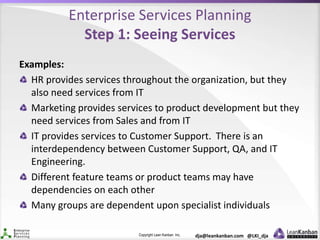
Examples:
HR provides services throughout the organization, but they
also need services from IT
Marketing provides services to product development but they
need services from Sales and from IT
IT provides services to Customer Support. There is an
interdependency between Customer Support, QA, and IT
Engineering.
Different feature teams or product teams may have
dependencies on each other
Many groups are dependent upon specialist individuals
Copyright Lean Kanban Inc. dja@leankanban.com @LKI_dja
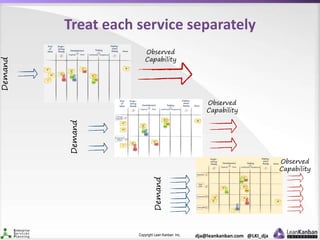
Treat each service separately
Demand
Observed
Capability
Demand
Demand
Observed
Capability
Observed
Capability
Copyright Lean Kanban Inc. dja@leankanban.com @LKI_dja
Enterprise Services Planning
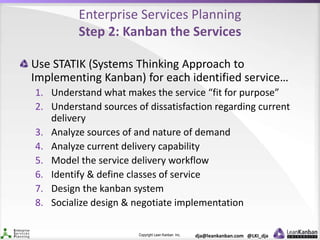
Step 2: Kanban the Services
Use STATIK (Systems Thinking Approach to
Implementing Kanban) for each identified service…
1. Understand what makes the service “fit for purpose”
2. Understand sources of dissatisfaction regarding current
delivery
3. Analyze sources of and nature of demand
4. Analyze current delivery capability
5. Model the service delivery workflow
6. Identify & define classes of service
7. Design the kanban system
8. Socialize design & negotiate implementation
Copyright Lean Kanban Inc. dja@leankanban.com @LKI_dja
Enterprise Services Planning
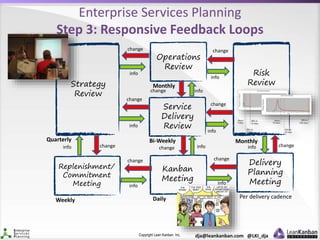
Step 3: Responsive Feedback Loops
Strategy
Review
Risk
Review
Monthly
Service
Delivery
Review
Bi-WeeklyQuarterly
Kanban
Meeting
Daily
Operations
Review
Monthly
Replenishment/
Commitment
Meeting
Weekly
Delivery
Planning
Meeting
Per delivery cadence
change change
change
change
change
change
change change
change
info
info
info
info
info
info
info
info
info
change info
Copyright Lean Kanban Inc. dja@leankanban.com @LKI_dja
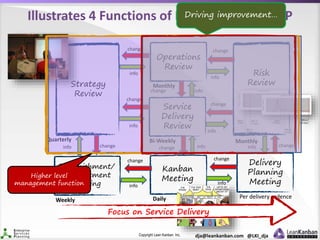
Illustrates 4 Functions of Management in ESP
Strategy
Review
Risk
Review
Monthly
Service
Delivery
Review
Bi-WeeklyQuarterly
Kanban
Meeting
Daily
Operations
Review
Monthly
Replenishment/
Commitment
Meeting
Weekly
Delivery
Planning
Meeting
Per delivery cadence
change change
change
change
change
change
change change
change
info
info
info
info
info
info
info
info
info
change info
Focus on Service Delivery
Driving improvement…
Higher level
management function
Copyright Lean Kanban Inc. dja@leankanban.com @LKI_dja
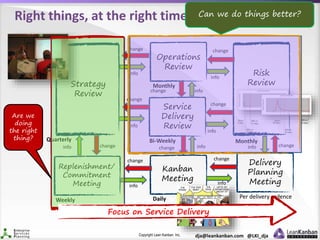
Right things, at the right time, done the right way
Strategy
Review
Risk
Review
Monthly
Service
Delivery
Review
Bi-WeeklyQuarterly
Kanban
Meeting
Daily
Operations
Review
Monthly
Replenishment/
Commitment
Meeting
Weekly
Delivery
Planning
Meeting
Per delivery cadence
change change
change
change
change
change
change change
change
info
info
info
info
info
info
info
info
info
change info
Can we do things better?
Are we
doing
the right
thing?
Focus on Service Delivery
Copyright Lean Kanban Inc. dja@leankanban.com @LKI_dja
Use feedback loops
to level capability across the network
Copyright Lean Kanban Inc. dja@leankanban.com @LKI_dja
Enterprise Services Planning
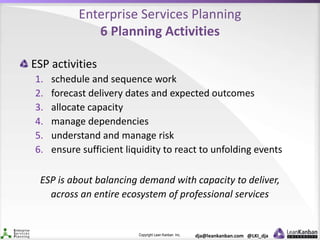
6 Planning Activities
ESP activities
1. schedule and sequence work
2. forecast delivery dates and expected outcomes
3. allocate capacity
4. manage dependencies
5. understand and manage risk
6. ensure sufficient liquidity to react to unfolding events
ESP is about balancing demand with capacity to deliver,
across an entire ecosystem of professional services
Copyright Lean Kanban Inc. dja@leankanban.com @LKI_dja
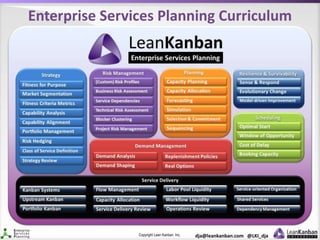
Enterprise Services Planning Curriculum
Copyright Lean Kanban Inc. dja@leankanban.com @LKI_dja
Summary
Copyright Lean Kanban Inc. dja@leankanban.com @LKI_dja
Enterprise Services Planning
The Right Things
At The Right Time
Done The Right Way
With Appropriate Risk
Exposure
Copyright Lean Kanban Inc. dja@leankanban.com @LKI_dja
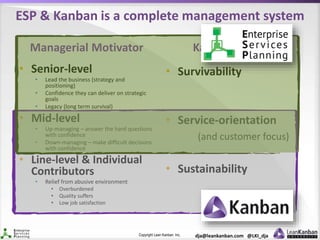
ESP & Kanban is a complete management system
Managerial Motivator
• Senior-level
• Lead the business (strategy and
positioning)
• Confidence they can deliver on strategic
goals
• Legacy (long term survival)
• Mid-level
• Up-managing – answer the hard questions
with confidence
• Down-managing – make difficult decisions
with confidence
• Line-level & Individual
Contributors
• Relief from abusive environment
• Overburdened
• Quality suffers
• Low job satisfaction
Kanban Agenda
• Survivability
• Service-orientation
(and customer focus)
• Sustainability
Copyright Lean Kanban Inc. dja@leankanban.com @LKI_dja
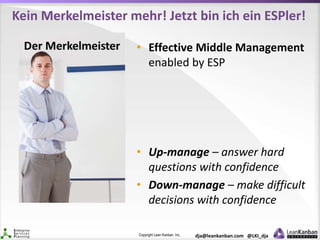
Kein Merkelmeister mehr! Jetzt bin ich ein ESPler!
• Effective Middle Management
enabled by ESP
• Up-manage – answer hard
questions with confidence
• Down-manage – make difficult
decisions with confidence
Copyright Lean Kanban Inc. dja@leankanban.com @LKI_dja
Thank you!
Copyright Lean Kanban Inc. dja@leankanban.com @LKI_dja
About
David Anderson is an innovator in
management of 21st Century
businesses that employ creative
people who “think for a living” . He
leads a training, consulting,
publishing and event planning
business dedicated to developing,
promoting and implementing new
management thinking & methods…
He has 30+ years experience in the high technology industry
starting with computer games in the early 1980’s. He has
led software organizations delivering superior productivity
and quality using innovative methods at large companies such
as Sprint and Motorola.
David defined Enterprise Services Planning and originated
Kanban Method an adaptive approach to improved service
delivery. His latest book, published in June 2012, is, Lessons
in Agile Management – On the Road to Kanban.
David is Chairman & CEO of Lean Kanban Inc., a business
operating globally, dedicated to providing quality training &
events to bring Kanban and Enterprise Services Planning to
businesses who employ those who must “think for a living.”
Copyright Lean Kanban Inc. dja@leankanban.com @LKI_dja
Risk profile courtesy of BazaarVoice
Acknowledgements
Copyright Lean Kanban Inc. dja@leankanban.com @LKI_dja

Enterprise Services Planning - Effective Middle Management

  • 1.
    Copyright Lean KanbanInc. dja@leankanban.com @LKI_dja Effective Middle Management Presenter David J. Anderson Lean Kanban Central Europe Munich, Germany November 2015
  • 2.
    Copyright Lean KanbanInc. dja@leankanban.com @LKI_dja Explicit Agendas
  • 3.
    Copyright Lean KanbanInc. dja@leankanban.com @LKI_dja Motivation for adoption? Kanban has agendas Managerial Motivator • Senior-level • Lead the business (strategy and positioning) • Confidence they can deliver on strategic goals • Legacy (long term survival) • Mid-level • Up-managing – answer the hard questions with confidence • Down-managing – make difficult decisions with confidence • Line-level & Individual Contributors • Relief from abusive environment • Overburdened • Quality suffers • Low job satisfaction Kanban Agenda • Survivability • Service-orientation (and customer focus) • Sustainability
  • 4.
    Copyright Lean KanbanInc. dja@leankanban.com @LKI_dja What are they afraid of? Manager • Senior-level • Mid-level • Line-level & Individual Contributors Fear • Mid-level managers lie to me. There is no transparency • Senior leaders over-react. I don’t trust them with information • Line managers & workers can’t be trusted to deliver on their promises • Our bosses constantly set us up for failure
  • 5.
    Copyright Lean KanbanInc. dja@leankanban.com @LKI_dja In 2009 Barack Obama inspired us to…
  • 6.
    Copyright Lean KanbanInc. dja@leankanban.com @LKI_dja 22nd November 2015 Schon 10 Jahre!
  • 7.
    Copyright Lean KanbanInc. dja@leankanban.com @LKI_dja Youth word of the year (2015) Finalist… merkeln (verb)merkeln (verb) to obfuscate & delay in order to avoid making decisions Sadly it didn’t win, losing out to… Smombie (noun) smartphone zombie
  • 8.
    Copyright Lean KanbanInc. dja@leankanban.com @LKI_dja Or perhaps as a noun ???… • Ein mittlerer Leiter in einem deutschen Unternehmen • Merkelmeister (noun, masculine) meaning a corporate bureaucrat who obfuscates & delays in order to avoid making decisions
  • 9.
    Copyright Lean KanbanInc. dja@leankanban.com @LKI_dja ESP’s Agenda…
  • 10.
    Copyright Lean KanbanInc. dja@leankanban.com @LKI_dja ESP makes middle-managers effective! • Up-manage – answer hard questions with confidence • Down-manage – make difficult decisions with confidence
  • 11.
    Copyright Lean KanbanInc. dja@leankanban.com @LKI_dja Enterprise Services Planning
  • 12.
    Copyright Lean KanbanInc. dja@leankanban.com @LKI_dja You are part of a professional services business! An ecosystem of professionals providing interdependent services, often with complex dependencies. Professional Service organizations build intangible goods
  • 13.
    Copyright Lean KanbanInc. dja@leankanban.com @LKI_dja The challenge of professional services businesses A constantly changing external environment has a ripple effect across your entire business ecosystem Priorities change and required capability & service levels rise in response to competition, disruptive market innovation & changes in customer tastes
  • 14.
    Copyright Lean KanbanInc. dja@leankanban.com @LKI_dja What should we start next? Will it be delivered when we need it? Do we have capacity to do everything we need to do?
  • 15.
    Copyright Lean KanbanInc. dja@leankanban.com @LKI_dja How will dependencies affect our ability to deliver? How many activities should we have running in parallel? If we delay starting something, will the capacity be available when we need it?
  • 16.
    Copyright Lean KanbanInc. dja@leankanban.com @LKI_dja Demand Observed Capability Demand Demand Observed Capability Observed Capability ESP – Anticipating Demand, Allocating Capacity Looking downstream, you want the system to help you anticipate and manage dependencies
  • 17.
    Copyright Lean KanbanInc. dja@leankanban.com @LKI_dja ESP – Anticipating Demand, Allocating Capacity Demand Observed Capability Demand Demand Observed Capability Observed Capability Looking upstream, you want the system to help you anticipate and manage demand
  • 18.
    Copyright Lean KanbanInc. dja@leankanban.com @LKI_dja Demand Observed Capability Demand Demand Observed Capability Observed Capability ESP – Anticipating Demand, Allocating Capacity Combine the two, and across the organization you smooth flow end- to-end and help keep demand in balance with overall system capability
  • 19.
    Copyright Lean KanbanInc. dja@leankanban.com @LKI_dja Enterprise Services Planning *Kanban is a way to organize and manage work. It improves service delivery speed & predictability through a combination of limiting work-in-progress & deferred commitment It uses visual management and Lean techniques such as limiting the amount of work in progress, and probabilistic forecasting. Kanban helps to balance demand with capability. Balancing demand and capability = improved flow. Improved flow = Improved predictability. Enterprise Services Planning (ESP) is an enterprise-wide management solution that leverages Kanban* to improve each service within your business.
  • 20.
    Copyright Lean KanbanInc. dja@leankanban.com @LKI_dja The goal of Enterprise Services Planning The goal of Enterprise Services Planning is to pick... The Right Things At The Right Time Done The Right Way With Appropriate Risk Exposure
  • 21.
    Copyright Lean KanbanInc. dja@leankanban.com @LKI_dja Enterprise Services Planning Manufacturing 1947 – Kanban 1964 & 1975 – MRP Professional Services 2004 – Kanban 2015 – ESP ESP is “MRP for professional services”. ESP is for managing capacity & scheduling intangible work. ESP uses algorithms enabled with data from analysis of the work requests, our existing capability, and knowledge of customer expectations, to make recommendations
  • 22.
    Copyright Lean KanbanInc. dja@leankanban.com @LKI_dja Enterprise Services Planning Planning involves… Scheduling Sequencing Selecting Commitment Anticipating & Managing Dependencies Risk Management Understanding what is essential based on…  Business strategy  Fitness for purpose
  • 23.
    Copyright Lean KanbanInc. dja@leankanban.com @LKI_dja Risk Assessment (for scheduling, sequencing, & selection)
  • 24.
    Copyright Lean KanbanInc. dja@leankanban.com @LKI_dja Qualitative Taxonomies 2 -> 6 categories Fact-based Cheap Fast Accurate Consensus Forming Managed Risk Heterogeneous Expensive Time Consuming Fake Precision? May still be High Risk Homogenous Cheap Fast High Risk A middle-ground in effective Risk Management
  • 25.
    Copyright Lean KanbanInc. dja@leankanban.com @LKI_dja Sketch market utility functionRoomnights soldperday Actual rooms sold Cost of delay Estimated additional rooms sold When we need it When it arrived Cost of delay for an online Easter holiday marketing promotion is difference in integral between the two curves time
  • 26.
    Copyright Lean KanbanInc. dja@leankanban.com @LKI_dja Cost of Delay based on utility function sketches Cost of delay function for an online Easter holiday marketing campaign delayed by 1 month from mid-January (based on diff of 2 integrals on previous slide) Treat as a Standard Class item time impact Total cost of delay
  • 27.
    Copyright Lean KanbanInc. dja@leankanban.com @LKI_dja Utility Function Taxonomy Front-loaded – Most of the value is realized early in the lifespan of the product with a long residual tail Utility Function Shape Bell curve – Most of the value is realized in the middle of the lifespan with slow initial uptake and a somewhat symmetrical tail off Back-loaded – Initial take-up is slow with value realized close to a natural end-date in the product lifespan
  • 28.
    Copyright Lean KanbanInc. dja@leankanban.com @LKI_dja Visualize Risks to provide Scheduling Information TS Market Risk CR Spoil Diff Lifecycle Cost of Delay Tech Risk Delay Impact New Mid Cow Expedite FD Std Intangible ELE Maj. Cap. Disc Unknown Soln Known but not us Done it before Commodity Risk profile for a work item or project Outside: Commit Early Inside: Commit Late
  • 29.
    Copyright Lean KanbanInc. dja@leankanban.com @LKI_dja Scheduling & Sequencing TS Market Risk CR Spoil Diff Lifecycle Cost of Delay Tech Risk Delay Impact New Mid Cow Expedite FD Std Intangible ELE Maj. Cap. Disc Unknown Soln Known but not us Done it before Commodity Sequence: 1st Sequence: 3rd Sequence: 2nd If only real life was so simple!
  • 30.
    Copyright Lean KanbanInc. dja@leankanban.com @LKI_dja Custom Profile Contains Narrative Our CEO has requested we do the blue project. Which one do we postpone? The purple project is important but can be delayed with little penalty.
  • 31.
    Copyright Lean KanbanInc. dja@leankanban.com @LKI_dja Inherent Risk, Risk of Rework & Sequencing MarketRisk Scheduling High risk of change or rework Low risk of change or rework Can Commit Early Should be deferred Differentiators Spoilers Table Stakes Cost Reducers Defer until later only incurs opportunity cost penalty Deferring tables stakes may mean foregoing differentiators or starting early and paying cost of rework InherentRisk RiskofRework Sequencing
  • 32.
    Copyright Lean KanbanInc. dja@leankanban.com @LKI_dja Revisiting the portfolio options There is a low penalty to deferring the purple project compared to alternatives The purple project remains important. We may need to forgo something else later in order to insure it is completed
  • 33.
    Copyright Lean KanbanInc. dja@leankanban.com @LKI_dja Visualizing Inherent Risk Diff Market Risk Spoil CR TS Lifecycle Cost of Delay Tech Risk Delay Impact Cow Mid New Expedite FD Std Intangible ELE Maj. Cap. Disc Unknown Soln Known but not us Done it before Commodity Outside: High Risk Inside: Low Risk Some axes are reversed when we show inherent risk in the project or feature compared to its schedule risk. If inherent risk is lower than schedule risk then the project or feature can be deferred Where inherent risk is greater than schedule risk, deferring only works if other information gathering is happening, creating an embedded option
  • 34.
    Copyright Lean KanbanInc. dja@leankanban.com @LKI_dja Demand Shaping Threshold (using inherent risk) Dimension 1 Dimension 2 Dimension 3 Dimension 5 Dimension 4 Definitely Do This Demand shaping threshold Talk about this one Definitely Don’t This
  • 35.
    Copyright Lean KanbanInc. dja@leankanban.com @LKI_dja Barbell Demand Shaping Threshold Dimension 1 Dimension 2 Dimension 3 Dimension 5 Dimension 4 Definitely Do This Don’t do this one Definitely Do This Middle band Rejection Zone Do this one
  • 36.
    Copyright Lean KanbanInc. dja@leankanban.com @LKI_dja Forecasting
  • 37.
    Copyright Lean KanbanInc. dja@leankanban.com @LKI_dja Lead Time & Weibull Distributions Lead time histograms observed to be Weibull distributions typically with shape parameter 1.0 < k < 2.0 The details of the mathematics are not particularly important. What is important is to recognize that the risk is always in the tail and the length of the tail varies from 2x – 10x from the mode in the data
  • 38.
    Copyright Lean KanbanInc. dja@leankanban.com @LKI_dja ChangeRequests SLA (customer expectation or fitness criteria) 60 days Use Lead Time Distribution to Evaluate Service Delivery Effectiveness 22-150 day spread of variation 85% on-time 15% late Due Date Performance (DDP) Predictability
  • 39.
    Copyright Lean KanbanInc. dja@leankanban.com @LKI_dja Forecasting methods ESP relies on two types of forecasting approaches  Reference class forecasting  Monte Carlo simulation Reference class forecasting requires an assumption of an equilibrium – the near future will reflect the continuing conditions of the recent past  We sample data from a period in the recent past and use it to forecast future behavior  The sample period is determined by evaluating the volatility in kanban system liquidity
  • 40.
    Copyright Lean KanbanInc. dja@leankanban.com @LKI_dja Scheduling
  • 41.
    Copyright Lean KanbanInc. dja@leankanban.com @LKI_dja When should we start something? impact When we need it 85th percentile Ideal Start Here Commitment point timeJan 10 Nov 11 If we start too early, we forgo the option and opportunity to do something else that may provide value. If we start too late we risk incurring the cost of delay If we pull the work into our kanban system on Nov 11 we have a 6 out of 7 chance of on-time delivery
  • 42.
    Copyright Lean KanbanInc. dja@leankanban.com @LKI_dja We can study sensitivity to different start dates impact When we need it 50th percentile Later Start Here Commitment point timeJan 10 Nov 25 If we start as late as November 25 we only have a 50% chance of on- time delivery However, the cost of delay incurred if we deliver within 60 days is relatively small. We have an 85% chance of achieving delivery with acceptable cost of delay 85th percentile
  • 43.
    Copyright Lean KanbanInc. dja@leankanban.com @LKI_dja What is the latest we could start? impact When we need it 0th percentile Very late start Commitment point timeJan 10 Dec 19 If we start as late as December 19 we have 0% chance of on-time delivery We have about a 10% chance of a total loss delivering the promotion beyond the expiry date of the opportunity 85th percentile total loss
  • 44.
    Copyright Lean KanbanInc. dja@leankanban.com @LKI_dja To be certain of delivery without incurring any cost of delay is expensive impact When we need it 98th percentile Early Start Commitment point timeJan 10 Aug 11 If we are conservative and do not wish to carry any risk of late delivery or any risk of incurring an opportunity cost of delay, then we must start as early as August 11th. We must commit to our Spring Break 2015 promotion during Summer 2014!!!
  • 45.
    Copyright Lean KanbanInc. dja@leankanban.com @LKI_dja Window of opportunity impact When we need it Earliest Start timeJan 10 Aug 11 Latest viable start Dec 19 Optimal Start Nov 11 On August 11st the item becomes available for selection at Kanban system replenishment. The ideal time to start is November 11th. After December 19th our option to deliver this item expires and we would discard it from our pool.
  • 46.
    Copyright Lean KanbanInc. dja@leankanban.com @LKI_dja Managing Dependencies
  • 47.
    Copyright Lean KanbanInc. dja@leankanban.com @LKI_dja Some systems have dependencies on others Demand Observed Capability Demand Demand Observed Capability Observed Capability Looking downstream, don’t start until you have capacity. Schedule based on lead time distribution possibly filtering for known dependencies discovered in risk analysis, forward signal known dependencies, book capacity, try to avoid delays
  • 48.
    Copyright Lean KanbanInc. dja@leankanban.com @LKI_dja Some systems have dependencies on others Demand Observed Capability Demand Demand Observed Capability Observed Capability Looking upstream, anticipate demand, insure liquidity to respond quickly when it arrives
  • 49.
    Copyright Lean KanbanInc. dja@leankanban.com @LKI_dja Some systems have dependencies on others Demand Observed Capability Demand Demand Observed Capability Observed Capability Combine the two, and across the organization you smooth flow end- to-end shortening customer lead times and improving fitness for purpose
  • 50.
    Copyright Lean KanbanInc. dja@leankanban.com @LKI_dja Buffer dependencies, agree SLAs 5 4 43 2 2 ...Input Queue Dev Ready In Prog DoneDoneIn Prog DevelopmentAnalysis Build Ready Test Release Ready Waiting on External Group Late against SLA Dots denote clock ticking on SLA ∞7 Unbounded Queue When the dependent service becomes reliable & predictable, we can use Little’s Law to calculate a WIP limit for the dependency buffer
  • 51.
    Copyright Lean KanbanInc. dja@leankanban.com @LKI_dja Definition of Enterprise Services Planning
  • 52.
    Copyright Lean KanbanInc. dja@leankanban.com @LKI_dja Enterprise Services Planning Achieve “Fitness for Purpose” + These must be balanced to deliver what your customers need and expect: to be “fit for purpose” Product component (capability/brand/non- functional elements) Service delivery component demand /customer expectations/ customer satisfaction)
  • 53.
    Copyright Lean KanbanInc. dja@leankanban.com @LKI_dja Enterprise Services Planning 3 Organizational Steps Foster a culture focused on continual fit-for-purpose service delivery Seeing Services “Kanban” each service Feedback Loop System Identify interdependent services in your organization Use the STATIK method to create a Kanban system for each service Implement a set of responsive feedback loops
  • 54.
    Copyright Lean KanbanInc. dja@leankanban.com @LKI_dja The Kanban Method Scaling Principles 1. Scale out in a service-oriented fashion one service at a time 2. Design each kanban system from first principles using STATIK, do not attempt to design a grand solution at enterprise scale 3. Use the Kanban Cadences as the management system that enable balance, leading to better enterprise services delivery
  • 55.
    Copyright Lean KanbanInc. dja@leankanban.com @LKI_dja Enterprise Services Planning Step 1: Seeing Services Examples: HR provides services throughout the organization, but they also need services from IT Marketing provides services to product development but they need services from Sales and from IT IT provides services to Customer Support. There is an interdependency between Customer Support, QA, and IT Engineering. Different feature teams or product teams may have dependencies on each other Many groups are dependent upon specialist individuals
  • 56.
    Copyright Lean KanbanInc. dja@leankanban.com @LKI_dja Treat each service separately Demand Observed Capability Demand Demand Observed Capability Observed Capability
  • 57.
    Copyright Lean KanbanInc. dja@leankanban.com @LKI_dja Enterprise Services Planning Step 2: Kanban the Services Use STATIK (Systems Thinking Approach to Implementing Kanban) for each identified service… 1. Understand what makes the service “fit for purpose” 2. Understand sources of dissatisfaction regarding current delivery 3. Analyze sources of and nature of demand 4. Analyze current delivery capability 5. Model the service delivery workflow 6. Identify & define classes of service 7. Design the kanban system 8. Socialize design & negotiate implementation
  • 58.
    Copyright Lean KanbanInc. dja@leankanban.com @LKI_dja Enterprise Services Planning Step 3: Responsive Feedback Loops Strategy Review Risk Review Monthly Service Delivery Review Bi-WeeklyQuarterly Kanban Meeting Daily Operations Review Monthly Replenishment/ Commitment Meeting Weekly Delivery Planning Meeting Per delivery cadence change change change change change change change change change info info info info info info info info info change info
  • 59.
    Copyright Lean KanbanInc. dja@leankanban.com @LKI_dja Illustrates 4 Functions of Management in ESP Strategy Review Risk Review Monthly Service Delivery Review Bi-WeeklyQuarterly Kanban Meeting Daily Operations Review Monthly Replenishment/ Commitment Meeting Weekly Delivery Planning Meeting Per delivery cadence change change change change change change change change change info info info info info info info info info change info Focus on Service Delivery Driving improvement… Higher level management function
  • 60.
    Copyright Lean KanbanInc. dja@leankanban.com @LKI_dja Right things, at the right time, done the right way Strategy Review Risk Review Monthly Service Delivery Review Bi-WeeklyQuarterly Kanban Meeting Daily Operations Review Monthly Replenishment/ Commitment Meeting Weekly Delivery Planning Meeting Per delivery cadence change change change change change change change change change info info info info info info info info info change info Can we do things better? Are we doing the right thing? Focus on Service Delivery
  • 61.
    Copyright Lean KanbanInc. dja@leankanban.com @LKI_dja Use feedback loops to level capability across the network
  • 62.
    Copyright Lean KanbanInc. dja@leankanban.com @LKI_dja Enterprise Services Planning 6 Planning Activities ESP activities 1. schedule and sequence work 2. forecast delivery dates and expected outcomes 3. allocate capacity 4. manage dependencies 5. understand and manage risk 6. ensure sufficient liquidity to react to unfolding events ESP is about balancing demand with capacity to deliver, across an entire ecosystem of professional services
  • 63.
    Copyright Lean KanbanInc. dja@leankanban.com @LKI_dja Enterprise Services Planning Curriculum
  • 64.
    Copyright Lean KanbanInc. dja@leankanban.com @LKI_dja Summary
  • 65.
    Copyright Lean KanbanInc. dja@leankanban.com @LKI_dja Enterprise Services Planning The Right Things At The Right Time Done The Right Way With Appropriate Risk Exposure
  • 66.
    Copyright Lean KanbanInc. dja@leankanban.com @LKI_dja ESP & Kanban is a complete management system Managerial Motivator • Senior-level • Lead the business (strategy and positioning) • Confidence they can deliver on strategic goals • Legacy (long term survival) • Mid-level • Up-managing – answer the hard questions with confidence • Down-managing – make difficult decisions with confidence • Line-level & Individual Contributors • Relief from abusive environment • Overburdened • Quality suffers • Low job satisfaction Kanban Agenda • Survivability • Service-orientation (and customer focus) • Sustainability
  • 67.
    Copyright Lean KanbanInc. dja@leankanban.com @LKI_dja Kein Merkelmeister mehr! Jetzt bin ich ein ESPler! • Effective Middle Management enabled by ESP • Up-manage – answer hard questions with confidence • Down-manage – make difficult decisions with confidence
  • 68.
    Copyright Lean KanbanInc. dja@leankanban.com @LKI_dja
  • 69.
    Copyright Lean KanbanInc. dja@leankanban.com @LKI_dja Thank you!
  • 70.
    Copyright Lean KanbanInc. dja@leankanban.com @LKI_dja About David Anderson is an innovator in management of 21st Century businesses that employ creative people who “think for a living” . He leads a training, consulting, publishing and event planning business dedicated to developing, promoting and implementing new management thinking & methods… He has 30+ years experience in the high technology industry starting with computer games in the early 1980’s. He has led software organizations delivering superior productivity and quality using innovative methods at large companies such as Sprint and Motorola. David defined Enterprise Services Planning and originated Kanban Method an adaptive approach to improved service delivery. His latest book, published in June 2012, is, Lessons in Agile Management – On the Road to Kanban. David is Chairman & CEO of Lean Kanban Inc., a business operating globally, dedicated to providing quality training & events to bring Kanban and Enterprise Services Planning to businesses who employ those who must “think for a living.”
  • 71.
    Copyright Lean KanbanInc. dja@leankanban.com @LKI_dja Risk profile courtesy of BazaarVoice Acknowledgements
  • 72.
    Copyright Lean KanbanInc. dja@leankanban.com @LKI_dja

Editor's Notes

  • #22 Joseph Orlicky – Manufacturing Resource Planning
  • #35 In this example, a risk threshold is established. Only the higher risk items are accepted. Low risk items are rejected. Items which straddle the threshold are discussed and accepted based on free capacity.
  • #36 In this example, a barbell risk strategy is adopted of accepting the riskiest and easiest items but omitting the items of medium risk
  • #55 There are 3 Change Management Principles designed to frame an evolutionary approach to improvement. Be aware that the Kanban Method is applied to the way you work now, and it will help you evolve the way you work gradually over time. [Briefly walk through each of the principles. See David’s blog at http://www.djaa.com/principles-general-practices-kanban-method if you want help with how to explain each.]
  • #60 The KMP II class is built around the 7 cadences of the Kanban Method. The focus is on institutionalizing the feedback loops and developing templates for each meeting or review including a list of who will attend and what information they must bring to the meetings. The objective is to drive improvement and evolutionary change through management feedback loops implemented as a series of rituals happening on cadences tailored to the specific needs of the business. Strategy Review is out-of-scope until the Portfolio Management module of the ESP class.
  • #61 The KMP II class is built around the 7 cadences of the Kanban Method. The focus is on institutionalizing the feedback loops and developing templates for each meeting or review including a list of who will attend and what information they must bring to the meetings. The objective is to drive improvement and evolutionary change through management feedback loops implemented as a series of rituals happening on cadences tailored to the specific needs of the business. Strategy Review is out-of-scope until the Portfolio Management module of the ESP class.
  • #64 Enterprise Services Planning