4th
Spice, Herbs and Aromatic Sector
Platform Meeting
Opportunities and Challenges of Aromatic
Sub-Sector: Ethiopian Aromatic Sub Sector Scenario
August 2, 2017
Presented by: Addisu Alemayehu
(ENTAG Spice, Herbs and Aromatic Project
Coordinator)
Content
1. Definition and Use of Aromatic Oils
2. Overview of the Sector in World and Ethiopia
3. Potentials and Opportunities of the Sub-Sector
4. Challenges of the Sub-Sector????
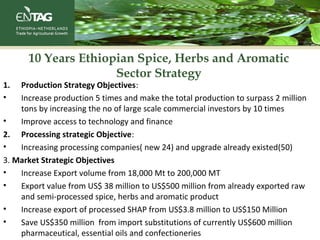
10 Years Ethiopian Spice, Herbs and Aromatic
Sector Strategy
1. Production Strategy Objectives:
• Increase production 5 times and make the total production to surpass 2 million
tons by increasing the no of large scale commercial investors by 10 times
• Improve access to technology and finance
2. Processing strategic Objective:
• Increasing processing companies( new 24) and upgrade already existed(50)
3. Market Strategic Objectives
• Increase Export volume from 18,000 Mt to 200,000 MT
• Export value from US$ 38 million to US$500 million from already exported raw
and semi-processed spice, herbs and aromatic product
• Increase export of processed SHAP from US$3.8 million to US$150 Million
• Save US$350 million from import substitutions of currently US$600 million
pharmaceutical, essential oils and confectioneries
1.Definition and Uses of Aromatic Plants
1.1. Definition
• Aromatic plants can be defined as plants which possess odoriferous oil
in either of their organs or sometimes even in the whole plant
• The commonly used terms associated with aromatic plants includes
herbs, spices and essential oils
• There are well over 3000 recognized essential oil bearing plants,
around 300 essential oils are produced and traded internationally but
most are of minor importance in terms of worldwide demand
• More than 63 aromatic plants well studied and 29 of them has
released varieties and production technologies
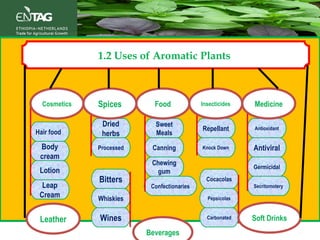
1.2 Uses of Aromatic Plants
Hair food
Body
cream
Lotion
Leap
Cream
Dried
herbs
Processed
Sweet
Meals
Canning
Chewing
gum
Confectionaries
Repellant
Knock Down
Antioxidant
Antiviral
Germicidal
Secritomotery
Bitters
Whiskies
Wines
Cocacolas
Pepsicolas
Carbonated
Cosmetics Spices Food Insecticides Medicine
Leather
Beverages
Soft Drinks
1.2 Uses of Aromatic Plants
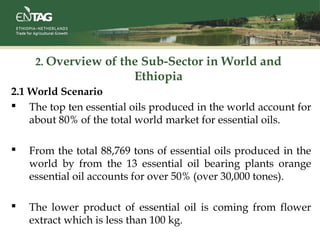
2. Overview of the Sub-Sector in World and
Ethiopia
2.1 World Scenario
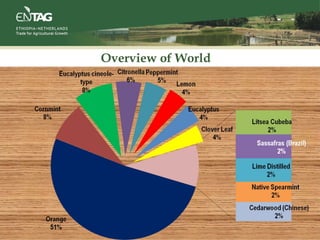
 The top ten essential oils produced in the world account for
about 80% of the total world market for essential oils.
 From the total 88,769 tons of essential oils produced in the
world by from the 13 essential oil bearing plants orange
essential oil accounts for over 50% (over 30,000 tones).
 The lower product of essential oil is coming from flower
extract which is less than 100 kg.
Overview of World
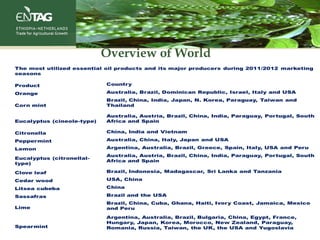
Overview of World
The most utilized essential oil products and its major producers during 2011/2012 marketing
seasons
Product Country
Orange Australia, Brazil, Dominican Republic, Israel, Italy and USA
Corn mint
Brazil, China, India, Japan, N. Korea, Paraguay, Taiwan and
Thailand
Eucalyptus (cineole-type)
Australia, Austria, Brazil, China, India, Paraguay, Portugal, South
Africa and Spain
Citronella China, India and Vietnam
Peppermint Australia, China, Italy, Japan and USA
Lemon Argentina, Australia, Brazil, Greece, Spain, Italy, USA and Peru
Eucalyptus (citronellal-
type)
Australia, Austria, Brazil, China, India, Paraguay, Portugal, South
Africa and Spain
Clove leaf Brazil, Indonesia, Madagascar, Sri Lanka and Tanzania
Cedar wood USA, China
Litsea cubeba China
Sassafras Brazil and the USA
Lime
Brazil, China, Cuba, Ghana, Haiti, Ivory Coast, Jamaica, Mexico
and Peru
Spearmint
Argentina, Australia, Brazil, Bulgaria, China, Egypt, France,
Hungary, Japan, Korea, Morocco, New Zealand, Paraguay,
Romania, Russia, Taiwan, the UK, the USA and Yugoslavia
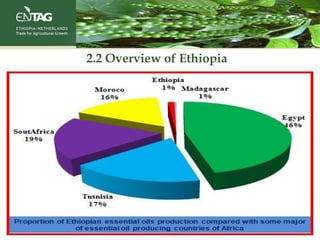
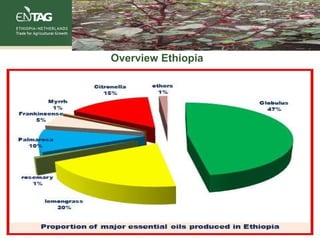
2.2 Overview of Ethiopia
Overview Ethiopia
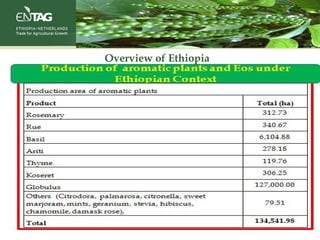
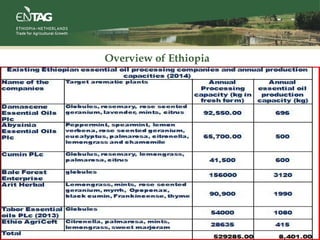
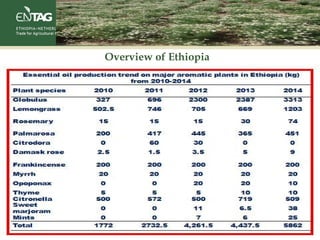
Overview of Ethiopia
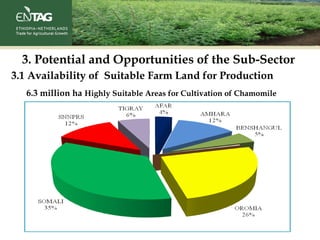
3. Potential and Opportunities of the Sub-Sector
3.1 Availability of Suitable Farm Land for Production
6.3 million ha Highly Suitable Areas for Cultivation of Chamomile
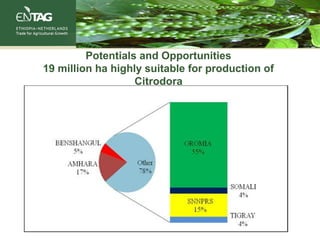
Potentials and Opportunities
19 million ha highly suitable for production of
Citrodora
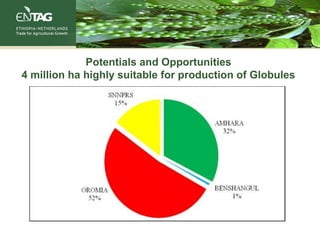
Potentials and Opportunities
4 million ha highly suitable for production of Globules
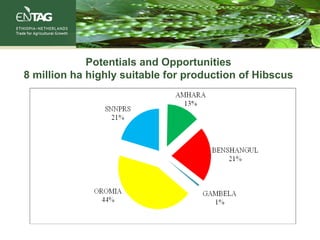
Potentials and Opportunities
8 million ha highly suitable for production of Hibscus
Potentials and Opportunities
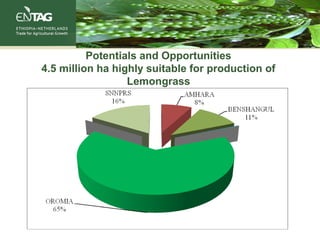
4.5 million ha highly suitable for production of
Lemongrass
Potentials and Opportunities
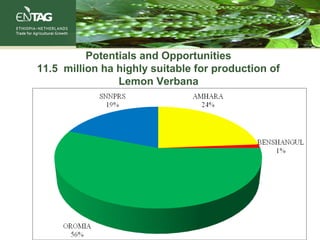
11.5 million ha highly suitable for production of
Lemon Verbana
Potentials and Opportunities
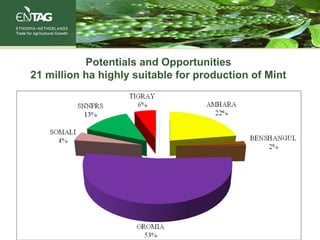
21 million ha highly suitable for production of Mint
Potentials and Opportunities
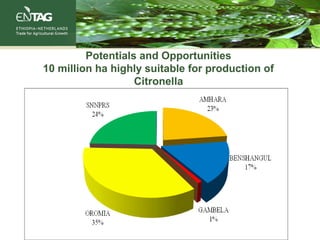
10 million ha highly suitable for production of
Citronella
Potentials and Opportunities
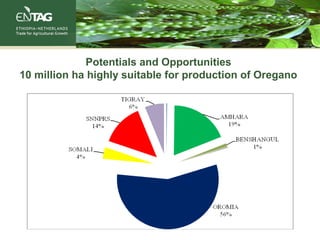
10 million ha highly suitable for production of Oregano
Potentials and Opportunities
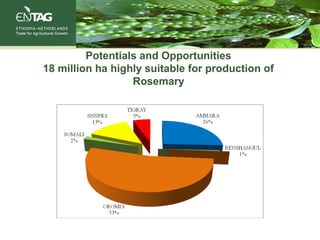
18 million ha highly suitable for production of
Rosemary
Potentials and Opportunities
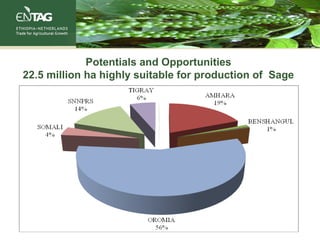
22.5 million ha highly suitable for production of Sage
Potentials and Opportunities
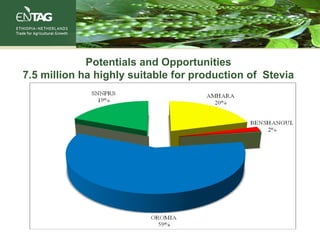
7.5 million ha highly suitable for production of Stevia
Potentials and Opportunities
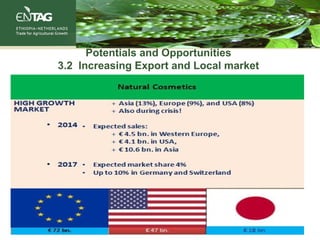
3.2 Increasing Export and Local market
Growing market
• According to the United Nations Comtrade statistics, the size of
essential oil fragrance and flavor global market was estimated at US$
24 billion in 2011, growing at an annual rate of 10% (Govindasamy et
al., 2013
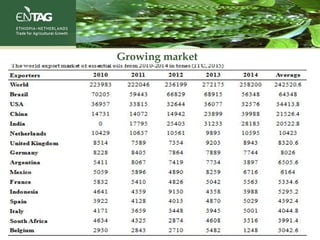
• Averaged over the last five years, the export market of essential oils is
over 240 thousand tons. The world export market of essential oils
increased from 223,983 tons in the year 2010 to 258,200 tons in the year
2014.
• The leading exporter countries of essential oils are Brazil, USA, China,
India, Netherlands, UK, Germany and Argentina according to their
order of rank with the market share of 26.53%, 14.19%, 8.88%, 8.46%,
4.30%, 3.43%, 3.31%, 3.31% and 2.68%, respectively.
Growing market
Growing market
• From the African continent, South Africa, Madagascar, Morocco, Egypt and
Tunisia leading the essential oil export market.
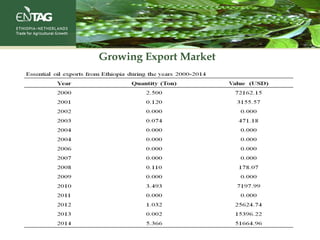
• Whilst, Ethiopia is found in the twelve ranks from African countries and
out of 124 exporter countries, takes the 124 stage with 0.001% market share
of the world essential oil market
• Ethiopian only exported 5.3 Mt of Eos and earned 51 thousands USD Dollar
• In African: Nigeria, South Africa, Egypt, Ghana, Botswana, Angola,
Kenya, Uganda, Sudan and Ethiopia are listed out the major essential oil
importers from the continent
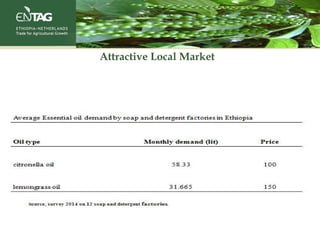
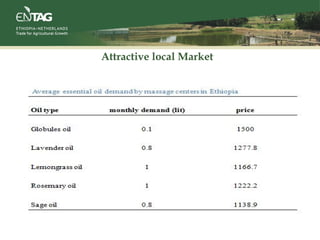
• The local demand for pharmaceutical, cosmetics, soap and detergent
factories, alcohol and liquor industries ingredients is relatively increasing
over time.
• The local industries import over 50% of the raw material requirements
mainly from India, Brazil, Israel, South Africa and Germany.
Attractive Local Market
Attractive local Market
Growing Export Market
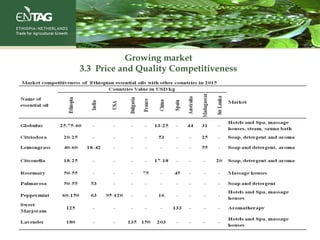
Growing market
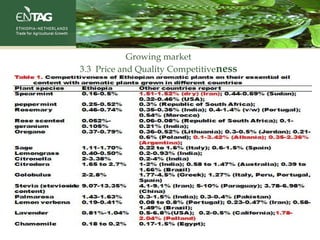
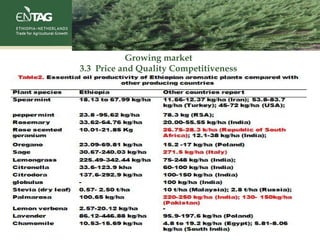
3.3 Price and Quality Competitiveness
Growing market
3.3 Price and Quality Competitiveness
Growing market
3.3 Price and Quality Competitiveness
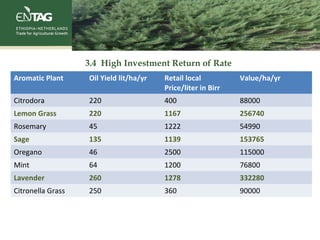
3.4 High Investment Return of Rate
Aromatic Plant Oil Yield lit/ha/yr Retail local
Price/liter in Birr
Value/ha/yr
Citrodora 220 400 88000
Lemon Grass 220 1167 256740
Rosemary 45 1222 54990
Sage 135 1139 153765
Oregano 46 2500 115000
Mint 64 1200 76800
Lavender 260 1278 332280
Citronella Grass 250 360 90000
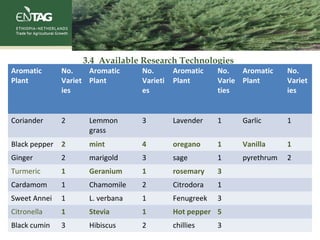
3.4 Available Research Technologies
Aromatic
Plant
No.
Variet
ies
Aromatic
Plant
No.
Varieti
es
Aromatic
Plant
No.
Varie
ties
Aromatic
Plant
No.
Variet
ies
Coriander 2 Lemmon
grass
3 Lavender 1 Garlic 1
Black pepper 2 mint 4 oregano 1 Vanilla 1
Ginger 2 marigold 3 sage 1 pyrethrum 2
Turmeric 1 Geranium 1 rosemary 3
Cardamom 1 Chamomile 2 Citrodora 1
Sweet Annei 1 L. verbana 1 Fenugreek 3
Citronella 1 Stevia 1 Hot pepper 5
Black cumin 3 Hibiscus 2 chillies 3
Entag presentation  on 4th spice platform meeting

Entag presentation on 4th spice platform meeting

  • 1.
    4th Spice, Herbs andAromatic Sector Platform Meeting Opportunities and Challenges of Aromatic Sub-Sector: Ethiopian Aromatic Sub Sector Scenario August 2, 2017 Presented by: Addisu Alemayehu (ENTAG Spice, Herbs and Aromatic Project Coordinator)
  • 2.
    Content 1. Definition andUse of Aromatic Oils 2. Overview of the Sector in World and Ethiopia 3. Potentials and Opportunities of the Sub-Sector 4. Challenges of the Sub-Sector????
  • 3.
    10 Years EthiopianSpice, Herbs and Aromatic Sector Strategy 1. Production Strategy Objectives: • Increase production 5 times and make the total production to surpass 2 million tons by increasing the no of large scale commercial investors by 10 times • Improve access to technology and finance 2. Processing strategic Objective: • Increasing processing companies( new 24) and upgrade already existed(50) 3. Market Strategic Objectives • Increase Export volume from 18,000 Mt to 200,000 MT • Export value from US$ 38 million to US$500 million from already exported raw and semi-processed spice, herbs and aromatic product • Increase export of processed SHAP from US$3.8 million to US$150 Million • Save US$350 million from import substitutions of currently US$600 million pharmaceutical, essential oils and confectioneries
  • 4.
    1.Definition and Usesof Aromatic Plants 1.1. Definition • Aromatic plants can be defined as plants which possess odoriferous oil in either of their organs or sometimes even in the whole plant • The commonly used terms associated with aromatic plants includes herbs, spices and essential oils • There are well over 3000 recognized essential oil bearing plants, around 300 essential oils are produced and traded internationally but most are of minor importance in terms of worldwide demand • More than 63 aromatic plants well studied and 29 of them has released varieties and production technologies
  • 5.
    1.2 Uses ofAromatic Plants Hair food Body cream Lotion Leap Cream Dried herbs Processed Sweet Meals Canning Chewing gum Confectionaries Repellant Knock Down Antioxidant Antiviral Germicidal Secritomotery Bitters Whiskies Wines Cocacolas Pepsicolas Carbonated Cosmetics Spices Food Insecticides Medicine Leather Beverages Soft Drinks 1.2 Uses of Aromatic Plants
  • 6.
    2. Overview ofthe Sub-Sector in World and Ethiopia 2.1 World Scenario  The top ten essential oils produced in the world account for about 80% of the total world market for essential oils.  From the total 88,769 tons of essential oils produced in the world by from the 13 essential oil bearing plants orange essential oil accounts for over 50% (over 30,000 tones).  The lower product of essential oil is coming from flower extract which is less than 100 kg.

  • 7.
  • 8.
    Overview of World Themost utilized essential oil products and its major producers during 2011/2012 marketing seasons Product Country Orange Australia, Brazil, Dominican Republic, Israel, Italy and USA Corn mint Brazil, China, India, Japan, N. Korea, Paraguay, Taiwan and Thailand Eucalyptus (cineole-type) Australia, Austria, Brazil, China, India, Paraguay, Portugal, South Africa and Spain Citronella China, India and Vietnam Peppermint Australia, China, Italy, Japan and USA Lemon Argentina, Australia, Brazil, Greece, Spain, Italy, USA and Peru Eucalyptus (citronellal- type) Australia, Austria, Brazil, China, India, Paraguay, Portugal, South Africa and Spain Clove leaf Brazil, Indonesia, Madagascar, Sri Lanka and Tanzania Cedar wood USA, China Litsea cubeba China Sassafras Brazil and the USA Lime Brazil, China, Cuba, Ghana, Haiti, Ivory Coast, Jamaica, Mexico and Peru Spearmint Argentina, Australia, Brazil, Bulgaria, China, Egypt, France, Hungary, Japan, Korea, Morocco, New Zealand, Paraguay, Romania, Russia, Taiwan, the UK, the USA and Yugoslavia
  • 9.
  • 10.
  • 11.
  • 12.
  • 13.
  • 14.
    3. Potential andOpportunities of the Sub-Sector 3.1 Availability of Suitable Farm Land for Production 6.3 million ha Highly Suitable Areas for Cultivation of Chamomile
  • 15.
    Potentials and Opportunities 19million ha highly suitable for production of Citrodora
  • 16.
    Potentials and Opportunities 4million ha highly suitable for production of Globules
  • 17.
    Potentials and Opportunities 8million ha highly suitable for production of Hibscus
  • 18.
    Potentials and Opportunities 4.5million ha highly suitable for production of Lemongrass
  • 19.
    Potentials and Opportunities 11.5million ha highly suitable for production of Lemon Verbana
  • 20.
    Potentials and Opportunities 21million ha highly suitable for production of Mint
  • 21.
    Potentials and Opportunities 10million ha highly suitable for production of Citronella
  • 22.
    Potentials and Opportunities 10million ha highly suitable for production of Oregano
  • 23.
    Potentials and Opportunities 18million ha highly suitable for production of Rosemary
  • 24.
    Potentials and Opportunities 22.5million ha highly suitable for production of Sage
  • 25.
    Potentials and Opportunities 7.5million ha highly suitable for production of Stevia
  • 26.
    Potentials and Opportunities 3.2Increasing Export and Local market
  • 27.
    Growing market • Accordingto the United Nations Comtrade statistics, the size of essential oil fragrance and flavor global market was estimated at US$ 24 billion in 2011, growing at an annual rate of 10% (Govindasamy et al., 2013 • Averaged over the last five years, the export market of essential oils is over 240 thousand tons. The world export market of essential oils increased from 223,983 tons in the year 2010 to 258,200 tons in the year 2014. • The leading exporter countries of essential oils are Brazil, USA, China, India, Netherlands, UK, Germany and Argentina according to their order of rank with the market share of 26.53%, 14.19%, 8.88%, 8.46%, 4.30%, 3.43%, 3.31%, 3.31% and 2.68%, respectively.
  • 28.
  • 29.
    Growing market • Fromthe African continent, South Africa, Madagascar, Morocco, Egypt and Tunisia leading the essential oil export market. • Whilst, Ethiopia is found in the twelve ranks from African countries and out of 124 exporter countries, takes the 124 stage with 0.001% market share of the world essential oil market • Ethiopian only exported 5.3 Mt of Eos and earned 51 thousands USD Dollar • In African: Nigeria, South Africa, Egypt, Ghana, Botswana, Angola, Kenya, Uganda, Sudan and Ethiopia are listed out the major essential oil importers from the continent • The local demand for pharmaceutical, cosmetics, soap and detergent factories, alcohol and liquor industries ingredients is relatively increasing over time. • The local industries import over 50% of the raw material requirements mainly from India, Brazil, Israel, South Africa and Germany.
  • 30.
  • 31.
  • 32.
  • 33.
    Growing market 3.3 Priceand Quality Competitiveness
  • 34.
    Growing market 3.3 Priceand Quality Competitiveness
  • 35.
    Growing market 3.3 Priceand Quality Competitiveness
  • 36.
    3.4 High InvestmentReturn of Rate Aromatic Plant Oil Yield lit/ha/yr Retail local Price/liter in Birr Value/ha/yr Citrodora 220 400 88000 Lemon Grass 220 1167 256740 Rosemary 45 1222 54990 Sage 135 1139 153765 Oregano 46 2500 115000 Mint 64 1200 76800 Lavender 260 1278 332280 Citronella Grass 250 360 90000
  • 37.
    3.4 Available ResearchTechnologies Aromatic Plant No. Variet ies Aromatic Plant No. Varieti es Aromatic Plant No. Varie ties Aromatic Plant No. Variet ies Coriander 2 Lemmon grass 3 Lavender 1 Garlic 1 Black pepper 2 mint 4 oregano 1 Vanilla 1 Ginger 2 marigold 3 sage 1 pyrethrum 2 Turmeric 1 Geranium 1 rosemary 3 Cardamom 1 Chamomile 2 Citrodora 1 Sweet Annei 1 L. verbana 1 Fenugreek 3 Citronella 1 Stevia 1 Hot pepper 5 Black cumin 3 Hibiscus 2 chillies 3