derby.ac.uk
Enhancing Your
Academic Writing
derby.ac.uk
What will this session cover?
• Creating ‘flow’
• Signposting
• Academic language
• Finding your ‘academic voice’
• Writing formally
• Active vs passive voice
• Cautious language
• Objective, subjective and emotive language
• Time for questions
derby.ac.uk
The Academic Writing Series
• Preparing for Academic Writing
• Academic Writing: The First Draft
• Enhancing Your Academic Writing
• Improving Marks in Academic Writing
• Click here to see the latest Academic Writing workshop dates!
derby.ac.uk
Improving Flow
What do you think is meant by the
phrase ‘flow’?
derby.ac.uk
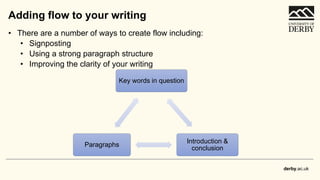
Adding flow to your writing
• There are a number of ways to create flow including:
• Signposting
• Using a strong paragraph structure
• Improving the clarity of your writing
Key words in question
Introduction &
conclusion
Paragraphs
derby.ac.uk
What is signposting?
• Words and phrases that connect
different parts of your assignment
together.
• Use signposts in:
• The introduction
• The start of each paragraph
• The end of each paragraph
• Within each paragraph with words
such as however and therefore
derby.ac.uk
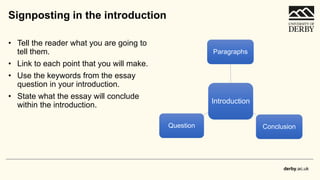
Signposting in the introduction
• Tell the reader what you are going to
tell them.
• Link to each point that you will make.
• Use the keywords from the essay
question in your introduction.
• State what the essay will conclude
within the introduction. Introduction
Paragraphs
Conclusion
Question
derby.ac.uk
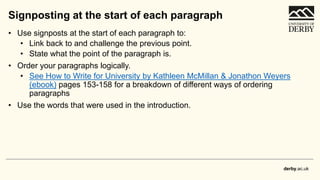
Signposting at the start of each paragraph
• Use signposts at the start of each paragraph to:
• Link back to and challenge the previous point.
• State what the point of the paragraph is.
• Order your paragraphs logically.
• See How to Write for University by Kathleen McMillan & Jonathon Weyers
(ebook) pages 153-158 for a breakdown of different ways of ordering
paragraphs
• Use the words that were used in the introduction.
derby.ac.uk
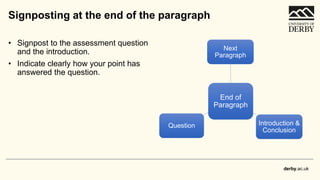
Signposting at the end of the paragraph
• Signpost to the assessment question
and the introduction.
• Indicate clearly how your point has
answered the question.
End of
Paragraph
Next
Paragraph
Introduction &
Conclusion
Question
derby.ac.uk
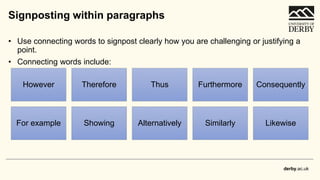
Signposting within paragraphs
• Use connecting words to signpost clearly how you are challenging or justifying a
point.
• Connecting words include:
However Therefore Thus Furthermore Consequently
For example Showing Alternatively Similarly Likewise
derby.ac.uk
Improving Flow: Academic Language
• Academic Language is used to increase the clarity and specificity of your writing.
• Make sure that you understand the meaning of academic language before you use
it.
• Words that direct your argument:
• Words to signal similar reasons
• Words to present different views
• Words to strengthen your argument.
• See Bloomsbury Skills for Study – Writing Skills – Words used to support lines of
reasoning
derby.ac.uk
Academic Language: Signalling similar reasons
• The following words can be used to highlight the similarity between two
corresponding aspects of your work (points/evidence/reasoning etc)
• Similarly; equally; likewise; in the same way
• Furthermore; again; further; what is more
• In addition; correspondingly
• In fact; in reality
• As for; as to; with respect to; regarding
derby.ac.uk
Academic Language: To present different views
• The following words can be used to highlight the differences between two
corresponding aspects of your work (points/evidence/reasoning etc) and to present
counter points.
• However; by contrast; another way of viewing this is; alternatively
• One alternative is; another possibility
• On the one hand… on the other hand
• Conversely; in comparison; on the contrary; in fact
• Though; although
derby.ac.uk
Academic Language: To strengthen your argument
• The following words can be used to back up an argument with further information
(evidence/points/explanation)
• Also; moreover; furthermore; again; further; what is more
• In addition; besides; above all
• Not only… but also; similarly; correspondingly
• In fact; in reality
• As for; as to; with respect to; regarding
derby.ac.uk
Your Academic Voice
derby.ac.uk
Introduction to Academic Voice
• There is no one way to write, although different methods have advantages and
disadvantages.
• Whilst how you write is unique to you, your writing should still aim to hit marking
criteria and be clear for the reader and be written formally.
• Features of formal writing:
• See Successful Academic Writing (2009) by Andy Gillet – Available as an Ebook
• Formal vocabulary
• Active vs passive voice
• Cautious language
• Objective vs subjective language
• Avoid emotive language
• Use of questions
• Contracted forms
• References
derby.ac.uk
Formal Vocabulary
• Academic writing uses more formal vocabulary than spoken language.
• Academic writing is clearer and more specific than informal language.
• Avoid using pompous language and instead use clear language.
• Language that is used should not allow for multiple interpretations of what is
meant.
• Example:
• Roberts (2007) says that lower house prices do not affect you if you are not
planning to sell your property.
• How could this be made more formal?
• Formal example:
• Roberts (2007) claims that lower house prices do not affect homeowners if they
are not planning to sell their property.
derby.ac.uk
Formal Vocabulary: Multi-Word Verbs
• Try to avoid using verbs that use multiple words such as ‘look up’ or ‘go out’ as
these often have a more formal equivalent such as ‘consult’ and ‘leave’.
• When writing a first draft focus on writing what is easier and look for these multi-
word verbs when proofreading.
• Examples:
Multi Word Verb Formal Verb
Think about Consider
Carried out Complete
Got worse Deteriorate
Find out Investigate
Showed up Attend
derby.ac.uk
Active Voice vs Passive Voice
• In spoken English a subject (such as people, somebody, they, we or you) is used
when it is unclear who the person doing an action is.
• Here is an example:
• They forecast rain for today (active)
• In academic writing, passive writing is often preferred where it is unclear who the
person doing the action is.
• Example:
• Rain was forecast for today (passive)
• Not all active sentences should be changed to passive ones. A number of factors
must be considered.
derby.ac.uk
Active Voice vs Passive Voice: Factors
• Not all active sentences should be changed to passive ones. A number of factors
must be considered.
• Where the person must be stated for the meaning to be clear.
• In this situation it would be more appropriate to specify the person (active writing).
• Example:
• Mrs Bennet was looking for a potential suitor for Elizabeth (Active)
• A potential suitor for Elizabeth was being sought (Passive)
• The passive sentence is less clear due to the person doing the seeking not being
stated.
• Key question: Is the action or the result of the action more important than the
person carrying it out?
derby.ac.uk
Cautious Language
• Cautious language, also known as hedges, is expressing the level of certainty of
your academic writing.
• It is used to:
• Protect from claims being easily dismissed, and
• To acknowledge flaws in evidence and exceptions.
• Often it is unlikely that you can conclusively say that something will definitively
happen.
• Be careful to avoid making sweeping statements that do not consider exceptions.
• In academic writing you should be cautious and highlight the certainty of your
argument.
• Caution can be applied through Modal verbs, Modal adverbs, Modal adjectives,
Signalling Phrases, Quantifiers, Introductory Words and That Clauses.
• (See the post session email for slides with example terms, and for a video of these
terms being explained)
derby.ac.uk
Objective vs Subjective Language
• Subjective language is language that refers to the reader or writer and their
opinion/perspective.
• Academic writing should be written in the 3rd person and should take be written
objectively.
• People reading your work want to know that your opinions and thoughts are based
upon research, reading and lectures from objective research.
• Avoid terms including ‘I’, ‘me’ and you.
• If you do not reference an idea, the reader will assume that it is yours and so you
do not need to add I think.
• Examples of objective language
• It is worthwhile to consider
• The data indicates that
derby.ac.uk
Emotive Language
• When writing objectively, your writing becomes impersonal and there is little room
for emotive language that highlights your personal views.
• Examples of emotive language include adverbs such as:
• Unfortunately
• Luckily
• Surprisingly
• Thankfully
derby.ac.uk
Use of Questions
• Some writers may want to use questions as a way of introducing the point that they
wish to make next.
• Example:
• Increasing numbers of students are choosing Business Studies as their university
subject. What is the reason for this? Many students believe…
• Questions should be avoided in academic writing and should be rewritten where
possible.
• Example:
• Increasing numbers of students are choosing Business Studies as their university
subject. The reason for this is that many students believe….
derby.ac.uk
Contracted Forms
• Shortened words such as don’t, can’t and shouldn’t are informal and should not
normally be used in academic writing.
• The exception for this is when used in quotations.
• These should be replaced with the longer form words do not, can not and should
not.
derby.ac.uk
Proofreading Workshop
• We run proofreading
workshops.
• The workshop explores how
proofreading is more than an
checking your spelling,
punctuation and grammar; it is
instead an opportunity to check
that your writing hits the
marking criteria ahead of
submitting.
• Find these through our
workshop calendar.
derby.ac.uk
The Academic Writing Series
• Preparing for Academic Writing
• Academic Writing: The First Draft
• Enhancing Your Academic Writing
• Improving Marks in Academic Writing
• Click here to see the latest Academic Writing workshop dates!
derby.ac.uk
Further Resources
derby.ac.uk
Further Resources
Develop@Derby Guides: https://libguides.derby.ac.uk/develop-at-derby
Subject Guides: libguides.derby.ac.uk/subjectguides
YouTube: youtube.com/c/DerbyUniLibrary
Podcast Sites: Search “University of Derby Skills Podcast” on major podcasting sites.
Social Media:
Instagram: @DerbyUniLibrary
Twitter: @DerbyUniLibrary
Develop@Derby Workshops: https://libcal.derby.ac.uk/calendar/events
derby.ac.uk
University of Derby, Kedleston Road, Derby, DE22 1GB
T +44 (0)1332 591044 E opendays@derby.ac.uk

Enhancing your academic writing.pptx

  • 1.
  • 2.
    derby.ac.uk What will thissession cover? • Creating ‘flow’ • Signposting • Academic language • Finding your ‘academic voice’ • Writing formally • Active vs passive voice • Cautious language • Objective, subjective and emotive language • Time for questions
  • 3.
    derby.ac.uk The Academic WritingSeries • Preparing for Academic Writing • Academic Writing: The First Draft • Enhancing Your Academic Writing • Improving Marks in Academic Writing • Click here to see the latest Academic Writing workshop dates!
  • 4.
    derby.ac.uk Improving Flow What doyou think is meant by the phrase ‘flow’?
  • 5.
    derby.ac.uk Adding flow toyour writing • There are a number of ways to create flow including: • Signposting • Using a strong paragraph structure • Improving the clarity of your writing Key words in question Introduction & conclusion Paragraphs
  • 6.
    derby.ac.uk What is signposting? •Words and phrases that connect different parts of your assignment together. • Use signposts in: • The introduction • The start of each paragraph • The end of each paragraph • Within each paragraph with words such as however and therefore
  • 7.
    derby.ac.uk Signposting in theintroduction • Tell the reader what you are going to tell them. • Link to each point that you will make. • Use the keywords from the essay question in your introduction. • State what the essay will conclude within the introduction. Introduction Paragraphs Conclusion Question
  • 8.
    derby.ac.uk Signposting at thestart of each paragraph • Use signposts at the start of each paragraph to: • Link back to and challenge the previous point. • State what the point of the paragraph is. • Order your paragraphs logically. • See How to Write for University by Kathleen McMillan & Jonathon Weyers (ebook) pages 153-158 for a breakdown of different ways of ordering paragraphs • Use the words that were used in the introduction.
  • 9.
    derby.ac.uk Signposting at theend of the paragraph • Signpost to the assessment question and the introduction. • Indicate clearly how your point has answered the question. End of Paragraph Next Paragraph Introduction & Conclusion Question
  • 10.
    derby.ac.uk Signposting within paragraphs •Use connecting words to signpost clearly how you are challenging or justifying a point. • Connecting words include: However Therefore Thus Furthermore Consequently For example Showing Alternatively Similarly Likewise
  • 11.
    derby.ac.uk Improving Flow: AcademicLanguage • Academic Language is used to increase the clarity and specificity of your writing. • Make sure that you understand the meaning of academic language before you use it. • Words that direct your argument: • Words to signal similar reasons • Words to present different views • Words to strengthen your argument. • See Bloomsbury Skills for Study – Writing Skills – Words used to support lines of reasoning
  • 12.
    derby.ac.uk Academic Language: Signallingsimilar reasons • The following words can be used to highlight the similarity between two corresponding aspects of your work (points/evidence/reasoning etc) • Similarly; equally; likewise; in the same way • Furthermore; again; further; what is more • In addition; correspondingly • In fact; in reality • As for; as to; with respect to; regarding
  • 13.
    derby.ac.uk Academic Language: Topresent different views • The following words can be used to highlight the differences between two corresponding aspects of your work (points/evidence/reasoning etc) and to present counter points. • However; by contrast; another way of viewing this is; alternatively • One alternative is; another possibility • On the one hand… on the other hand • Conversely; in comparison; on the contrary; in fact • Though; although
  • 14.
    derby.ac.uk Academic Language: Tostrengthen your argument • The following words can be used to back up an argument with further information (evidence/points/explanation) • Also; moreover; furthermore; again; further; what is more • In addition; besides; above all • Not only… but also; similarly; correspondingly • In fact; in reality • As for; as to; with respect to; regarding
  • 15.
  • 16.
    derby.ac.uk Introduction to AcademicVoice • There is no one way to write, although different methods have advantages and disadvantages. • Whilst how you write is unique to you, your writing should still aim to hit marking criteria and be clear for the reader and be written formally. • Features of formal writing: • See Successful Academic Writing (2009) by Andy Gillet – Available as an Ebook • Formal vocabulary • Active vs passive voice • Cautious language • Objective vs subjective language • Avoid emotive language • Use of questions • Contracted forms • References
  • 17.
    derby.ac.uk Formal Vocabulary • Academicwriting uses more formal vocabulary than spoken language. • Academic writing is clearer and more specific than informal language. • Avoid using pompous language and instead use clear language. • Language that is used should not allow for multiple interpretations of what is meant. • Example: • Roberts (2007) says that lower house prices do not affect you if you are not planning to sell your property. • How could this be made more formal? • Formal example: • Roberts (2007) claims that lower house prices do not affect homeowners if they are not planning to sell their property.
  • 18.
    derby.ac.uk Formal Vocabulary: Multi-WordVerbs • Try to avoid using verbs that use multiple words such as ‘look up’ or ‘go out’ as these often have a more formal equivalent such as ‘consult’ and ‘leave’. • When writing a first draft focus on writing what is easier and look for these multi- word verbs when proofreading. • Examples: Multi Word Verb Formal Verb Think about Consider Carried out Complete Got worse Deteriorate Find out Investigate Showed up Attend
  • 19.
    derby.ac.uk Active Voice vsPassive Voice • In spoken English a subject (such as people, somebody, they, we or you) is used when it is unclear who the person doing an action is. • Here is an example: • They forecast rain for today (active) • In academic writing, passive writing is often preferred where it is unclear who the person doing the action is. • Example: • Rain was forecast for today (passive) • Not all active sentences should be changed to passive ones. A number of factors must be considered.
  • 20.
    derby.ac.uk Active Voice vsPassive Voice: Factors • Not all active sentences should be changed to passive ones. A number of factors must be considered. • Where the person must be stated for the meaning to be clear. • In this situation it would be more appropriate to specify the person (active writing). • Example: • Mrs Bennet was looking for a potential suitor for Elizabeth (Active) • A potential suitor for Elizabeth was being sought (Passive) • The passive sentence is less clear due to the person doing the seeking not being stated. • Key question: Is the action or the result of the action more important than the person carrying it out?
  • 21.
    derby.ac.uk Cautious Language • Cautiouslanguage, also known as hedges, is expressing the level of certainty of your academic writing. • It is used to: • Protect from claims being easily dismissed, and • To acknowledge flaws in evidence and exceptions. • Often it is unlikely that you can conclusively say that something will definitively happen. • Be careful to avoid making sweeping statements that do not consider exceptions. • In academic writing you should be cautious and highlight the certainty of your argument. • Caution can be applied through Modal verbs, Modal adverbs, Modal adjectives, Signalling Phrases, Quantifiers, Introductory Words and That Clauses. • (See the post session email for slides with example terms, and for a video of these terms being explained)
  • 22.
    derby.ac.uk Objective vs SubjectiveLanguage • Subjective language is language that refers to the reader or writer and their opinion/perspective. • Academic writing should be written in the 3rd person and should take be written objectively. • People reading your work want to know that your opinions and thoughts are based upon research, reading and lectures from objective research. • Avoid terms including ‘I’, ‘me’ and you. • If you do not reference an idea, the reader will assume that it is yours and so you do not need to add I think. • Examples of objective language • It is worthwhile to consider • The data indicates that
  • 23.
    derby.ac.uk Emotive Language • Whenwriting objectively, your writing becomes impersonal and there is little room for emotive language that highlights your personal views. • Examples of emotive language include adverbs such as: • Unfortunately • Luckily • Surprisingly • Thankfully
  • 24.
    derby.ac.uk Use of Questions •Some writers may want to use questions as a way of introducing the point that they wish to make next. • Example: • Increasing numbers of students are choosing Business Studies as their university subject. What is the reason for this? Many students believe… • Questions should be avoided in academic writing and should be rewritten where possible. • Example: • Increasing numbers of students are choosing Business Studies as their university subject. The reason for this is that many students believe….
  • 25.
    derby.ac.uk Contracted Forms • Shortenedwords such as don’t, can’t and shouldn’t are informal and should not normally be used in academic writing. • The exception for this is when used in quotations. • These should be replaced with the longer form words do not, can not and should not.
  • 26.
    derby.ac.uk Proofreading Workshop • Werun proofreading workshops. • The workshop explores how proofreading is more than an checking your spelling, punctuation and grammar; it is instead an opportunity to check that your writing hits the marking criteria ahead of submitting. • Find these through our workshop calendar.
  • 27.
    derby.ac.uk The Academic WritingSeries • Preparing for Academic Writing • Academic Writing: The First Draft • Enhancing Your Academic Writing • Improving Marks in Academic Writing • Click here to see the latest Academic Writing workshop dates!
  • 28.
  • 29.
    derby.ac.uk Further Resources Develop@Derby Guides:https://libguides.derby.ac.uk/develop-at-derby Subject Guides: libguides.derby.ac.uk/subjectguides YouTube: youtube.com/c/DerbyUniLibrary Podcast Sites: Search “University of Derby Skills Podcast” on major podcasting sites. Social Media: Instagram: @DerbyUniLibrary Twitter: @DerbyUniLibrary Develop@Derby Workshops: https://libcal.derby.ac.uk/calendar/events
  • 30.
    derby.ac.uk University of Derby,Kedleston Road, Derby, DE22 1GB T +44 (0)1332 591044 E opendays@derby.ac.uk

Editor's Notes

  • #5 Flow turns your piece of writing from a string of disjointed paragraphs into a journey of connected ideas. If your writing doesn’t flow the reader may struggle to follow your argument. This can ultimately result in a lower mark.
  • #6 Now that we have created our paragraph, the rest of this workshop will talk about how improve each paragraph. First we will talk about flow, there are two main ways that we will discuss to make your work flow naturally. First using a clear structure like the PEECL structure itself helps to create flow as each point is clear simple and separate. You can also use the link part of the paragraph to show how the paragraphs link. The second method is signposting which I will go through now.
  • #7 Achieving flow begins with planning a logical structure, but you also need to get the reader along that structure. Signposts are words and phrases that move the reader through your argument and help it to make sense and feel progressive. Effectively signposts allow you to connect the different parts of your assignment together and to link your work back to the overall essay question. You can use signposts: In your introduction At the start of each paragraph At the end of each paragraph Within paragraphs with words such as however and therefore. Signposts should leave the reader understanding your arguments and how each point links to the question.
  • #8 In your introduction use signposts to show the reader what to expect and to indicate what you are going to argue. Remember tell the author what you are going to tell them. Signposts in your introduction can link to each point that you make and to the key words that you have picked out from the essay question. These signposts indicate how you have chosen to approach the question. They inform the marker where you are heading, making your argument easier to follow from the start.
  • #9 Use signposts at the start of a paragraph explicitly linking to the previous paragraph. These move the argument on by directly challenging the idea that has come before. The pronoun ‘this’ makes a link with the previous paragraph. This is easier to achieve if you order your paragraphs into a logical structure. In addition to challenging what has come before you should also clearly state what the point of the paragraph is. In doing so, use key words from the question and your introduction to create flow. This point should say explicitly what the paragraph will find.
  • #10 Signposts can be used at the end of the paragraph to remind the readers of the link to the question and to nudge them towards the next point. These clearly identify to the reader how your paragraph and point has answered the question. Ensure that you use the keywords from the question here, whilst explaining explicitly how your point has answered or impacted the overall essay.
  • #11 Finally signposts can be used within paragraphs with words like however and therefore to make links between sentences. Words that you can use include however, therefore, thus, furthermore, consequently, for example, showing and alternatively. These help to navigate your argument from idea to idea and sentence to sentence. However you must ensure that you use these in the right context. These can be useful in supporting or challenging arguments and in explaining how your evidence or source proves your argument.
  • #12 Bloomsbury Skills for Study Writing Skills Words used to support lines of reasoning
  • #13 Bloomsbury Skills for Study Writing Skills Words used to support lines of reasoning
  • #14 Bloomsbury Skills for Study Writing Skills Words used to support lines of reasoning
  • #15 Bloomsbury Skills for Study Writing Skills Words used to support lines of reasoning
  • #36 Note research workshops for the research step Podcast Link: https://open.spotify.com/playlist/7Gfx0iw5DbYFgmExmbrFeF?si=8978dda7c3574d0e
  • #37 This session will feature some of the key parts of academic writing and some key tips and tricks that you can use in your essay writing. First we will discuss when and where to start essay writing before discussing how to structure your overall essay. We will then talk about paragraph structure and watch a short animated video explaining a simple paragraph structure designed to support your learning. I will then go through this structure and we will write an example paragraph aimed at answering a question. After this we will discuss how you make your writing flow before briefly discussing key academic language that you can use in your writing. Finally we will discuss some resources that we have available for academic writing that you can have a look at outside of this workshop. Throughout the session we will be working on improving a paragraph using the knowledge and skills that are mentioned throughout.