It was built in 1460 by the great Inca Emperor
Pachacuti
Some believe he built it as a retreat or country palace
for him and his guests
Some believe it was an isolated religious sanctuary
where nuns and priests worshipped the sun
Some also believe it was an ancient military stronghold
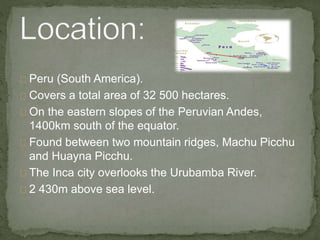
Peru (South America).
Covers a total area of 32 500 hectares.
On the eastern slopes of the Peruvian Andes,
1400km south of the equator.
Found between two mountain ridges, Machu Picchu
and Huayna Picchu.
The Inca city overlooks the Urubamba River.
2 430m above sea level.
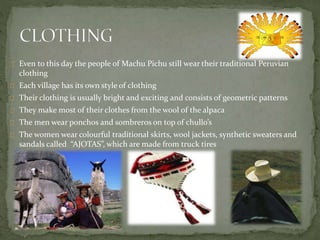
Even to this day the people of Machu Pichu still wear their traditional Peruvian
clothing
Each village has its own style of clothing
Their clothing is usually bright and exciting and consists of geometric patterns
They make most of their clothes from the wool of the alpaca
The men wear ponchos and sombreros on top of chullo’s
The women wear colourful traditional skirts, wool jackets, synthetic sweaters and
sandals called “AJOTAS”, which are made from truck tires
The word “Inca” stands for the ruling elite and their
ethnic group
They ruled an empire of many different ethnicities and
would make their presence known periodically by
taking up residence at a series of royal estates
People living there could have come from all over the
empire, speaking different languages
They were astronomers and the King wore a tunic with
rows of geometric motifs
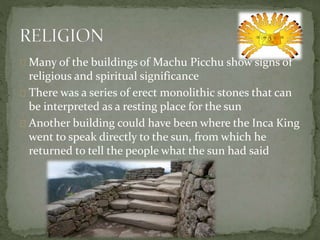
Many of the buildings of Machu Picchu show signs of
religious and spiritual significance
There was a series of erect monolithic stones that can
be interpreted as a resting place for the sun
Another building could have been where the Inca King
went to speak directly to the sun, from which he
returned to tell the people what the sun had said
They devoted most of their time to farming.
Potatoes were one of the main foods of the Inca. They
farmed varieties types of potatoes.
Meats: Llamas and Alpacas were the main
domesticated animals of Inca.
Drinks: chicha was the main drink for the people
during Inca period, which made from jora and maize.
Tourists have increased the landslide risk.
Erosion has increased due to human activity.
Tea bags and water bottles litter the hiking trail.
Limited number of tourists per day, as a way to
preserve the heritage site.
Only 1600 visitors, was 2500 visitors per day.
Garbage is piled along the Urubamba River.
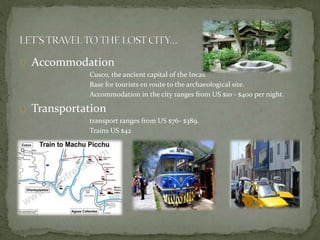
Accommodation
Cusco, the ancient capital of the Incas.
Base for tourists en route to the archaeological site.
Accommodation in the city ranges from US $10 - $400 per night.
Transportation
transport ranges from US $76- $389.
Trains US $42
The lost city of the Incas was discovered by
Professor Hiram Bingham.
It was built by Native Americans, in 1450 A.D.
The Inca did not have a written language.
Machu Picchu is listed as one of the world heritage
sites, by the United Nations.
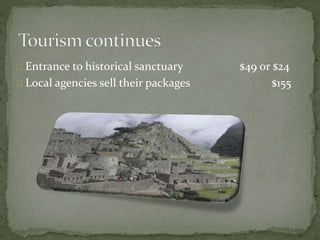
Entrance to historical sanctuary $49 or $24
Local agencies sell their packages $155
http://www.inside-peru.com/traditional-peruvian-clothing.html
abcdefg Wright & Valencia Zegarra 2001, 2003, p.1.
http://infosurhoy.com/cocoon/saii/xhtml/en_GB/features/saii/f
eatures/entertainment/2012/11/29/feature-02
Jarus, O. (2012). Machu Picchu: Facts and History. Available
from: http://www.livescience.com/22869-machu-picchu.html
(Accessed 15 March 2013).
Wright, K.R. & Zegarra, A.V. (2000). Machu Picchu: A Civil
Engineering Marvel. Virginia: ASCE Press.
Torres, M. (2011). 100 years of Machu Picchu and the impact
of tourism. Available from:
http://www.southernconejourneys.blogspot.com/2011/07/100-
years-of-machu-picchu-and-impact-of.html (Accessed 15
March 2012).

Englishpresentation 130526043014-phpapp02

  • 2.
    It was builtin 1460 by the great Inca Emperor Pachacuti Some believe he built it as a retreat or country palace for him and his guests Some believe it was an isolated religious sanctuary where nuns and priests worshipped the sun Some also believe it was an ancient military stronghold
  • 3.
    Peru (South America). Coversa total area of 32 500 hectares. On the eastern slopes of the Peruvian Andes, 1400km south of the equator. Found between two mountain ridges, Machu Picchu and Huayna Picchu. The Inca city overlooks the Urubamba River. 2 430m above sea level.
  • 5.
    Even to thisday the people of Machu Pichu still wear their traditional Peruvian clothing Each village has its own style of clothing Their clothing is usually bright and exciting and consists of geometric patterns They make most of their clothes from the wool of the alpaca The men wear ponchos and sombreros on top of chullo’s The women wear colourful traditional skirts, wool jackets, synthetic sweaters and sandals called “AJOTAS”, which are made from truck tires
  • 6.
    The word “Inca”stands for the ruling elite and their ethnic group They ruled an empire of many different ethnicities and would make their presence known periodically by taking up residence at a series of royal estates People living there could have come from all over the empire, speaking different languages They were astronomers and the King wore a tunic with rows of geometric motifs
  • 7.
    Many of thebuildings of Machu Picchu show signs of religious and spiritual significance There was a series of erect monolithic stones that can be interpreted as a resting place for the sun Another building could have been where the Inca King went to speak directly to the sun, from which he returned to tell the people what the sun had said
  • 8.
    They devoted mostof their time to farming. Potatoes were one of the main foods of the Inca. They farmed varieties types of potatoes. Meats: Llamas and Alpacas were the main domesticated animals of Inca. Drinks: chicha was the main drink for the people during Inca period, which made from jora and maize.
  • 9.
    Tourists have increasedthe landslide risk. Erosion has increased due to human activity. Tea bags and water bottles litter the hiking trail. Limited number of tourists per day, as a way to preserve the heritage site. Only 1600 visitors, was 2500 visitors per day. Garbage is piled along the Urubamba River.
  • 10.
    Accommodation Cusco, the ancientcapital of the Incas. Base for tourists en route to the archaeological site. Accommodation in the city ranges from US $10 - $400 per night. Transportation transport ranges from US $76- $389. Trains US $42
  • 11.
    The lost cityof the Incas was discovered by Professor Hiram Bingham. It was built by Native Americans, in 1450 A.D. The Inca did not have a written language. Machu Picchu is listed as one of the world heritage sites, by the United Nations.
  • 12.
    Entrance to historicalsanctuary $49 or $24 Local agencies sell their packages $155
  • 13.
    http://www.inside-peru.com/traditional-peruvian-clothing.html abcdefg Wright &Valencia Zegarra 2001, 2003, p.1. http://infosurhoy.com/cocoon/saii/xhtml/en_GB/features/saii/f eatures/entertainment/2012/11/29/feature-02 Jarus, O. (2012). Machu Picchu: Facts and History. Available from: http://www.livescience.com/22869-machu-picchu.html (Accessed 15 March 2013). Wright, K.R. & Zegarra, A.V. (2000). Machu Picchu: A Civil Engineering Marvel. Virginia: ASCE Press. Torres, M. (2011). 100 years of Machu Picchu and the impact of tourism. Available from: http://www.southernconejourneys.blogspot.com/2011/07/100- years-of-machu-picchu-and-impact-of.html (Accessed 15 March 2012).