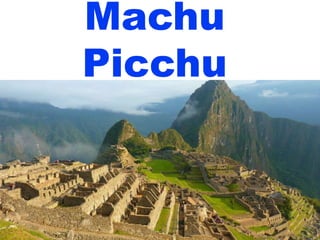
Machu
Picchu
Etymology
In the Quechua
language, machu means "old" or "old
person", while picchu means "peak;
mountain or prominence with a
broad base that ends in sharp
peaks", hence the name of the site
means "old peak".
HISTORY
Machu Picchu is a 15th-century Inca citadel situated on a
mountain ridge 2,430 meters (7,970 ft.) above sea level. It is
located in the Cusco Region, Urubamba
Province, Machupicchu District in Peru, above the Sacred
Valley, which is 80 kilometers (50 mi) northwest
of Cuzco and through which the Urubamba River flows.
Most archaeologists believe that Machu Picchu was built as
an estate for the Inca emperor Pachacuti (1438–1472).
Often mistakenly referred to as the "Lost City of the Incas"
(a title more accurately applied to Vilcabamba), it is the
most familiar icon of Inca civilization. The Incas built the
estate around 1450 but abandoned it a century later at the
time of the Spanish Conquest. Although known locally, it
was not known to the Spanish during the colonial period
and remained unknown to the outside world until American
historian Hiram Bingham brought it to international
attention in 1911.
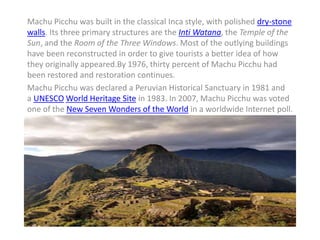
Machu Picchu was built in the classical Inca style, with polished dry-stone
walls. Its three primary structures are the Inti Watana, the Temple of the
Sun, and the Room of the Three Windows. Most of the outlying buildings
have been reconstructed in order to give tourists a better idea of how
they originally appeared.By 1976, thirty percent of Machu Picchu had
been restored and restoration continues.
Machu Picchu was declared a Peruvian Historical Sanctuary in 1981 and
a UNESCO World Heritage Site in 1983. In 2007, Machu Picchu was voted
one of the New Seven Wonders of the World in a worldwide Internet poll.
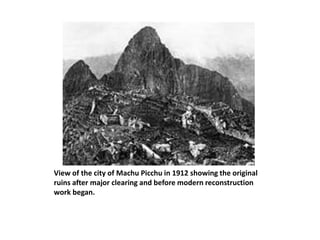
View of the city of Machu Picchu in 1912 showing the original
ruins after major clearing and before modern reconstruction
work began.
GEOGRAPHY
Machu Picchu lies in the southern hemisphere, 13.164 degrees
south of the equator . It is 80 kilometers (50 miles) northwest of
Cusco, on the crest of the mountain Machu Picchu, located about
2,430 meters (7,970 feet) above mean sea level, over 1,000 meters
(3,300 ft.) lower than Cusco, which has an elevation of 3,600
meters (11,800 ft.). As such, it had a milder climate than the Inca
capital. It is one of the most important archaeological sites in
South America, one of the most visited tourist attractions in Latin
America and the most visited in Peru.
Machu Picchu has wet and dry seasons, with the majority
of annual rain falling from October through to April
Layout
The site is roughly divided into an urban sector and an agricultural
sector, and into an upper town and a lower town. The temples are
in the upper town, the warehouses in the lower.
The architecture is adapted to the mountains. Approximately 200
buildings are arranged on wide parallel terraces around an east-
west central square. The various compounds, called kanchas, are
long and narrow in order to exploit the terrain. Sophisticated
channeling systems provided irrigation for the fields. Stone
stairways set in the walls allowed access to the different levels
across the site. The eastern section of the city was probably
residential. The western, separated by the square, was for
religious and ceremonial purposes. This section contains
the Torreon, the massive tower which may have been used as an
observatory.
Construction
The central buildings use the classical Inca architectural style of
polished dry-stone walls of regular shape. The Incas were masters of
this technique, called ashlar, in which blocks of stone are cut to fit
together tightly without mortar.
The section of the mountain where Machu Picchu was built provided
various challenges that the Incas solved with local materials. One issue
was the seismic activity due to two fault lines. It made mortar and
similar building methods nearly useless. Instead, the Inca mined stones
from the quarry at the site, lined them up and shaped them to fit
together perfectly, stabilizing the structures. Inca walls have many
stabilizing features: doors and windows are trapezoidal, narrowing
from bottom to top; corners usually are rounded; inside corners often
incline slightly into the rooms; and outside corners were often tied
together by "L"-shaped blocks; walls are offset slightly from row to row
rather than rising straight from bottom to top.
Tourism
Machu Picchu is a UNESCO World Heritage Site, both cultural
and natural. Since its discovery in 1911, growing numbers of
tourists visit the site yearly, reaching 400,000 in 2000. As
Peru's most visited tourist attraction and major revenue
generator, it is continually exposed to economic and
commercial forces. In the late 1990s, the Peruvian
government granted concessions to allow the construction of
a cable car and a luxury hotel, including a tourist complex
with boutiques and restaurants and a bridge to the site .
Many people protested the plans, including Peruvians and
foreign scientists, saying that more visitors would pose a
physical burden on the ruins. A no-fly zone exists above the
area. UNESCO is considering putting Machu Picchu on its List
of World Heritage in Danger.
Cultural artifacts: Dispute between
Peru and Yale University
In 1912, 1914 and 1915, Bingham removed
thousands of artifacts from Machu Picchu—ceramic
vessels, silver statues, jewelry and human bones—
and took them to Yale University for further study,
supposedly for 18 months. Yale instead kept the
artifacts until 2012, arguing that Peru lacked the
infrastructure and systems to care for them. Eliane
Karp, an anthropologist and wife of former
Peruvian President Alejandro Toledo, accused Yale
of profiting from Peru's cultural heritage. Many of
the articles were exhibited at Yale's Peabody
Museum.
In media
The 1955 film Secret of the
Incas by Paramount Pictures with Charlton
Heston and Ima Sumac was filmed on location
at Cusco and Machu Picchu, the first time that
a major Hollywood studio filmed on site. Five
hundred indigenous people were hired as
extras in the film.
The song "Kilimanjaro" from the 2010 South
Indian Tamil film Enthiran was filmed in Machu
Picchu. The sanction for filming was granted
only after direct intervention from the Indian
government
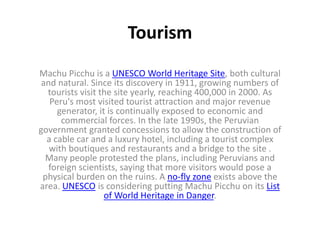
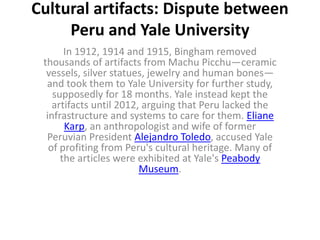
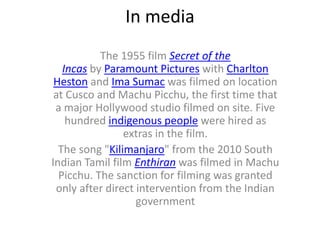
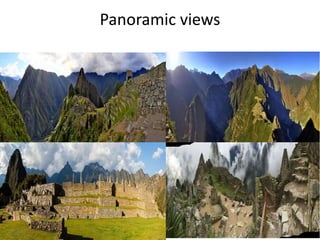
Panoramic views
THANK YOU

Machu pichu

  • 1.
  • 2.
    Etymology In the Quechua language,machu means "old" or "old person", while picchu means "peak; mountain or prominence with a broad base that ends in sharp peaks", hence the name of the site means "old peak".
  • 3.
    HISTORY Machu Picchu isa 15th-century Inca citadel situated on a mountain ridge 2,430 meters (7,970 ft.) above sea level. It is located in the Cusco Region, Urubamba Province, Machupicchu District in Peru, above the Sacred Valley, which is 80 kilometers (50 mi) northwest of Cuzco and through which the Urubamba River flows. Most archaeologists believe that Machu Picchu was built as an estate for the Inca emperor Pachacuti (1438–1472). Often mistakenly referred to as the "Lost City of the Incas" (a title more accurately applied to Vilcabamba), it is the most familiar icon of Inca civilization. The Incas built the estate around 1450 but abandoned it a century later at the time of the Spanish Conquest. Although known locally, it was not known to the Spanish during the colonial period and remained unknown to the outside world until American historian Hiram Bingham brought it to international attention in 1911.
  • 4.
    Machu Picchu wasbuilt in the classical Inca style, with polished dry-stone walls. Its three primary structures are the Inti Watana, the Temple of the Sun, and the Room of the Three Windows. Most of the outlying buildings have been reconstructed in order to give tourists a better idea of how they originally appeared.By 1976, thirty percent of Machu Picchu had been restored and restoration continues. Machu Picchu was declared a Peruvian Historical Sanctuary in 1981 and a UNESCO World Heritage Site in 1983. In 2007, Machu Picchu was voted one of the New Seven Wonders of the World in a worldwide Internet poll.
  • 5.
    View of thecity of Machu Picchu in 1912 showing the original ruins after major clearing and before modern reconstruction work began.
  • 6.
    GEOGRAPHY Machu Picchu liesin the southern hemisphere, 13.164 degrees south of the equator . It is 80 kilometers (50 miles) northwest of Cusco, on the crest of the mountain Machu Picchu, located about 2,430 meters (7,970 feet) above mean sea level, over 1,000 meters (3,300 ft.) lower than Cusco, which has an elevation of 3,600 meters (11,800 ft.). As such, it had a milder climate than the Inca capital. It is one of the most important archaeological sites in South America, one of the most visited tourist attractions in Latin America and the most visited in Peru. Machu Picchu has wet and dry seasons, with the majority of annual rain falling from October through to April
  • 7.
    Layout The site isroughly divided into an urban sector and an agricultural sector, and into an upper town and a lower town. The temples are in the upper town, the warehouses in the lower. The architecture is adapted to the mountains. Approximately 200 buildings are arranged on wide parallel terraces around an east- west central square. The various compounds, called kanchas, are long and narrow in order to exploit the terrain. Sophisticated channeling systems provided irrigation for the fields. Stone stairways set in the walls allowed access to the different levels across the site. The eastern section of the city was probably residential. The western, separated by the square, was for religious and ceremonial purposes. This section contains the Torreon, the massive tower which may have been used as an observatory.
  • 8.
    Construction The central buildingsuse the classical Inca architectural style of polished dry-stone walls of regular shape. The Incas were masters of this technique, called ashlar, in which blocks of stone are cut to fit together tightly without mortar. The section of the mountain where Machu Picchu was built provided various challenges that the Incas solved with local materials. One issue was the seismic activity due to two fault lines. It made mortar and similar building methods nearly useless. Instead, the Inca mined stones from the quarry at the site, lined them up and shaped them to fit together perfectly, stabilizing the structures. Inca walls have many stabilizing features: doors and windows are trapezoidal, narrowing from bottom to top; corners usually are rounded; inside corners often incline slightly into the rooms; and outside corners were often tied together by "L"-shaped blocks; walls are offset slightly from row to row rather than rising straight from bottom to top.
  • 9.
    Tourism Machu Picchu isa UNESCO World Heritage Site, both cultural and natural. Since its discovery in 1911, growing numbers of tourists visit the site yearly, reaching 400,000 in 2000. As Peru's most visited tourist attraction and major revenue generator, it is continually exposed to economic and commercial forces. In the late 1990s, the Peruvian government granted concessions to allow the construction of a cable car and a luxury hotel, including a tourist complex with boutiques and restaurants and a bridge to the site . Many people protested the plans, including Peruvians and foreign scientists, saying that more visitors would pose a physical burden on the ruins. A no-fly zone exists above the area. UNESCO is considering putting Machu Picchu on its List of World Heritage in Danger.
  • 10.
    Cultural artifacts: Disputebetween Peru and Yale University In 1912, 1914 and 1915, Bingham removed thousands of artifacts from Machu Picchu—ceramic vessels, silver statues, jewelry and human bones— and took them to Yale University for further study, supposedly for 18 months. Yale instead kept the artifacts until 2012, arguing that Peru lacked the infrastructure and systems to care for them. Eliane Karp, an anthropologist and wife of former Peruvian President Alejandro Toledo, accused Yale of profiting from Peru's cultural heritage. Many of the articles were exhibited at Yale's Peabody Museum.
  • 11.
    In media The 1955film Secret of the Incas by Paramount Pictures with Charlton Heston and Ima Sumac was filmed on location at Cusco and Machu Picchu, the first time that a major Hollywood studio filmed on site. Five hundred indigenous people were hired as extras in the film. The song "Kilimanjaro" from the 2010 South Indian Tamil film Enthiran was filmed in Machu Picchu. The sanction for filming was granted only after direct intervention from the Indian government
  • 12.
  • 13.