Textbook in English for Class I
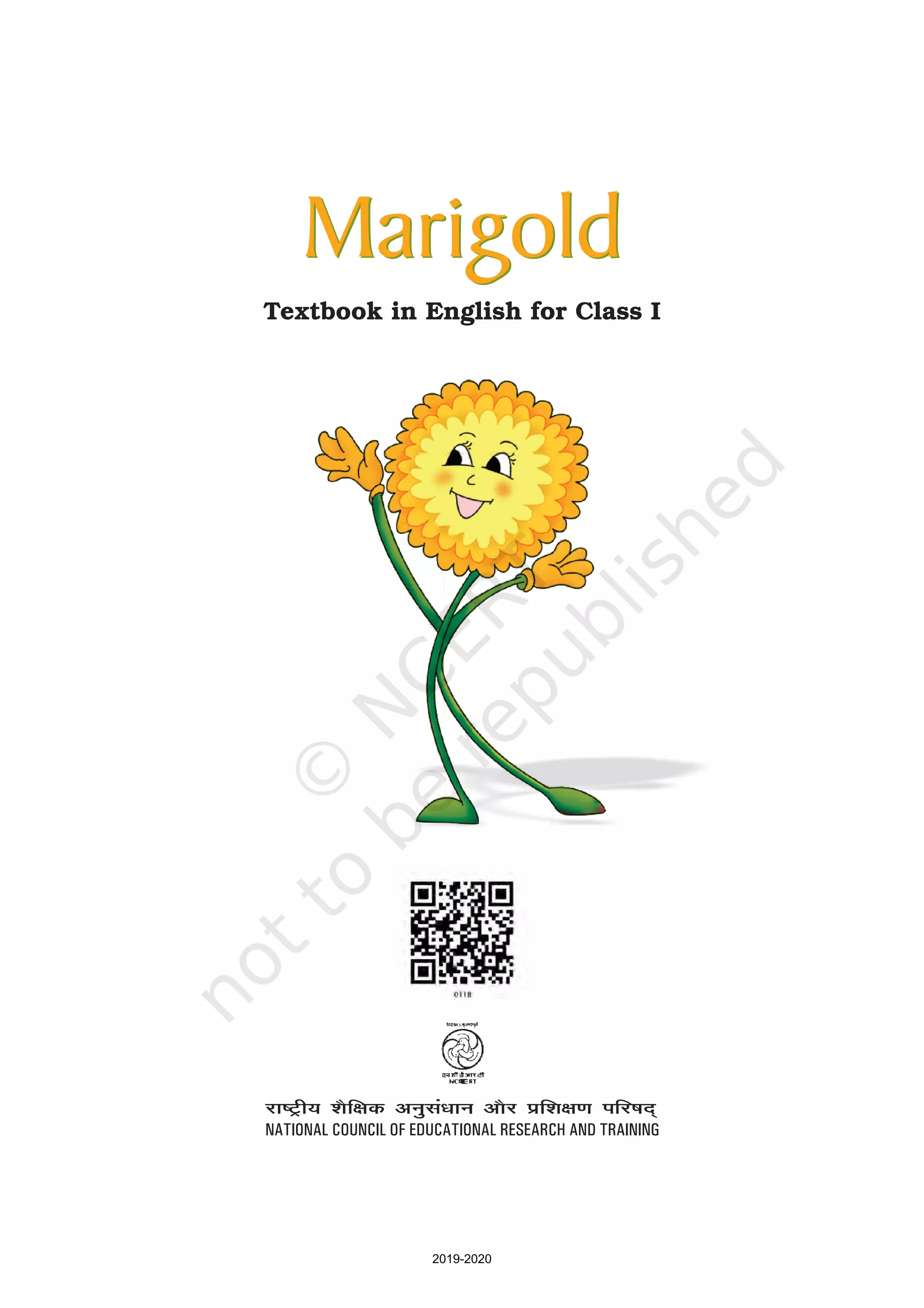
MarigoldMarigold
2019-2020
ALL RIGHTS RESERVED
K
K
K
No part of this publication may be reproduced, stored in a retrieval
system or transmitted, in any form or by any means, electronic,
mechanical, photocopying, recording or otherwise without the prior
permission of the publisher.
This book is sold subject to the condition that it shall not, by way of
trade, be lent, re-sold, hired out or otherwise disposed of without the
publisher’s consent, in any form of binding or cover other than that in
which it is published.
The correct price of this publication is the price printed on this page,
Any revised price indicated by a rubber stamp or by a sticker or by any
other means is incorrect and should be unacceptable.
First Edition
Reprinted
February 2006 Phalguna 1927
November 2006 Kartika 1928
October 2007 Kartika 1929
January 2009 Magha 1930
November 2009 Kartika 1931
November 2010 Kartika 1932
January 2012 Magha 1933
December 2012 Agrahayana 1934
October 2013 Asvina 1935
November 2017 Agrahayana 1939
November 2014 Agrahayana 1936
May 2016 Vaishakha 1938
December 2016 Pausa 1938
December 2018 Agrahayana 1940
PD 400T RPS
© National Council of Educational Research
and Training, 2006
` 60.00
Publication Team
Head, Publication :
Chief Production :
M. Siraj Anwar
Arun Chitkara
Henu Mehtani
Division
Officer
Production
Assistant
Chief Editor :
Chief Business :
Manager
:
Shveta Uppal
Gautam Ganguly
Sunil Kumar
Cover, layout and Illustrations
ISBN 81-7450-478-8
OFFICES OF THE PUBLICATION
DIVISION, NCERT
New Delhi 110 016 Phone : 011-26562708
Bangaluru 560 085 Phone : 080-26725740
Ahmedabad 380 014 Phone : 079-27541446
Kolkata 700 114 Phone : 033-25530454
Guwahati 781 021 Phone : 0361-2674869
NCERT Campus
Sri Aurobindo Marg
108, 100 Feet Road
Hosdakere Halli Extension
Banashankari III Stage
Navjivan Trust Building
P.O.Navjivan
CWC Campus
Opp. Dhankal Bus Stop
Panihati
CWC Complex
Maligaon
Printed on 80 GSM paper with NCERT
watermark
Published at the Publication Division by
the Secretary, National Council of
Educational Research and Training,
Sri Aurobindo Marg, New Delhi 110 016
and printed at Janambhumi Press Private
Ltd., Shed No. A1/A10/B1 (A&B)
Main Industrial Estate Kalapahar,
Guwahati - 781 016
2019-2020
The National Curriculum Framework, 2005, recommends that children’s life at
school must be linked to their life outside the school. This principle marks a
departure from the legacy of bookish learning which continues to shape our
system and causes a gap between the school, home and community. The
syllabi and textbooks developed on the basis of NCF signify an attempt to
implement this basic idea. They also attempt to discourage rote learning and
the maintenance of sharp boundaries between different subject areas. We hope
these measures will take us significantly further in the direction of a child-
centred system of education outlined in the National Policy on Education
(1986).
The success of this effort depends on the steps that school principals and
teachers will take to encourage children to reflect on their own learning and to
pursue imaginative activities and questions. We must recognise that given
space, time and freedom, children generate new knowledge by engaging with
the information passed on to them by adults. Treating the prescribed textbook
as the sole basis of examination is one of the key reasons why other resources
and sites of learning are ignored. Inculcating creativity and initiative is possible
if we perceive and treat children as participants in learning, not as receivers of a
fixed body of knowledge.
These aims imply considerable change in school routines and mode of
functioning. Flexibility in the daily time-table is as necessary as rigour in
implementing the annual calendar so that the required number of teaching
days are actually devoted to teaching. The methods used for teaching and
evaluation will also determine how effective this textbook proves for making
children’s life at school a happy experience, rather than a source of stress or
boredom. Syllabus designers have tried to address the problem of curricular
burden by restructuring and reorienting knowledge at different stages with
greater consideration for child psychology and the time available for teaching.
The textbook attempts to enhance this endeavour by giving higher priority and
space to opportunities for contemplation and wondering, discussion in small
groups, and activities requiring hands-on experience.
NCERT appreciates the hard work done by the textbook development
committee responsible for this book. We wish to thank the Chairperson of the
advisory group at primary level, Professor Anita Rampal and the Chief Advisor
for this book, Professor R. Lalitha Eapen (CIEFL, Hyderabad) for guiding the
work of this committee. Several teachers contributed to the development of this
textbook; we are grateful to their principals for making this possible. We are
indebted to the institutions and organisations which have generously
Foreword
2019-2020
permitted us to draw upon their resources, material and personnel. We are
especially grateful to the members of the National Monitoring Committee,
appointed by the Department of Secondary and Higher Education, Ministry of
Human Resource Development under the Chairpersonship of Professor Mrinal
Miri and Professor G.P. Deshpande, for their valuable time and contribution. As
an organisation committed to the systemic reform and continuous
improvement in the quality of its products, NCERT welcomes comments and
suggestions which will enable us to undertake further revision and refinement.
National Council of Educational
Research and Training
Director
20 December 2005
New Delhi
(iv)
2019-2020
Textbook Development Committee
CHAIRPERSON, ADVISORY COMMITTEE FOR TEXTBOOKS AT THE PRIMARY LEVEL
MEMBERS
Anita Rampal, Central Institute of Education, Delhi University
R. Lalitha Eapen, English and Foreign Languages University
(EFLU), Hyderabad.
Ram Janma Sharma, Former and Department of Education
in Languages, NCERT, New Delhi.
Anju Khanna, The Circle, New Delhi.
Meenu Kumar, Rajkiya Pratibha Vikas Vidyalaya, Vasant Kunj, Delhi.
Rekha Johnson, Demonstration School, RIE, Ajmer.
Usha Dutta, Department of Education in Languages,
NCERT, New Delhi.
Professor,
Professor,
Professor Head,
Principal,
PGT,
Primary Teacher,
rofessor,
CHIEF ADVISOR
CHIEF COORDINATOR
MEMBER-COORDINATOR
Nita Berry, New Delhi.
Shobha Chanana, Kendriya Vidyalaya, Sagar, Madhya Pradesh.
Children’s Literature Specialist,
TGT,
Former P
2019-2020
Acknowledgements
National Council of Educational Research and Training is most grateful to the
following for their valuable contributions in the development of this book –
R. Amritavalli, CIEFL, Hyderabad, M.L. Tickoo,
CIEFL, Hyderabad and Sonika Kaushik, Sanskriti School,
New Delhi.
The Council also thanks the following authors, copyright holders for
permission to use poems and stories included in this book.
by Aileen Fisher; by Alexei
Tolstoy from Russian Tales for Children, E.P. Dutton and Company Inc., New
York; by Carolyn Graham; by Vineeta Krishna,
Ratnasagar, 1994; , The Beacon Readers ‘At Old
Lobs’ by E.H. Grassam, Ginn and Company Ltd., London, 1951;
by Chitra Narendran, Frank Educational Aids Pvt. Ltd., New
Delhi; by Dorothy W. Baruch; by Manorama Jafa,
Ratnasagar Pvt. Ltd.; by Pranab and Smita Chakravarti, National
Book Trust, India, 2005; adapted from ‘Cleo’ by Ruth Dixon in ‘The
Children’s Treasury,’ compiled by Marjorie Barrows, Consolidated Book
Publishers, Chicago, 1947; by Mrinalini Srivastava,
translated by Alaka Shankar, Children’s Book Trust, New Delhi, 2003 and
by Anup Ray, National Book Trust, India, 2004. We also
acknowledge Bharat Gyan Vigyan Samithi by Nikolai Radlov,
New Delhi 2004 for and ; Central Institute of English
and Foreign Languages (CIEFL), Hyderabad for
and C by Lois Birken Shaw Fleming.
Special thanks are due to Shveta Uppal, NCERT and
Vandana R. Singh, C for going through the manuscript and
suggesting relevant changes.
The Council also gratefully acknowledges the contributions of
Rituraj Sharma, Keerti Lingwal, ; Sunanda,
and Parash Ram Kaushik in shaping
this book. Last but not the least, the efforts of the Publication Department,
NCERT are highly appreciated.
Professor, Professor (Retd.),
Primary Teacher,
After a Bath The Bubble, the Straw and the Shoe
One Little Kitten Lalu and Peelu
Mother Hen and the Chicks
Mittu and the
Yellow Mango
Merry-Go-Round Circle
Our Tree
Sundari
The Tiger and the Mosquito
Anandi’s Rainbow
Picture Stories
Giant Rat Umbrella Nest
Beginning Reading Programme,
2000 ome on Everybody, Let’s Sing
Chief Editor,
onsultant Editor
DTP Operator; Proof Reader
Copy Editor Incharge Computer Station,
2019-2020
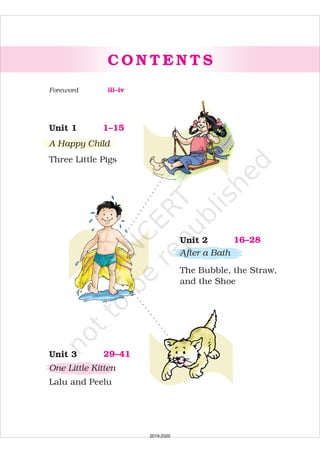
C O N T E N T S
1–15Unit 1
A Happy Child
Three Little Pigs
16–28Unit 2
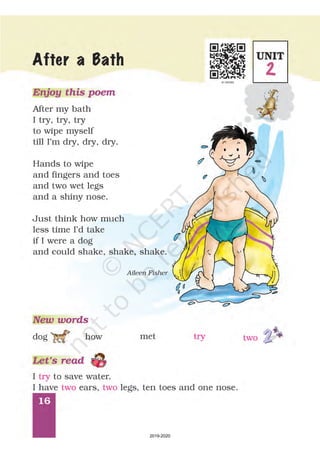
After a Bath
The Bubble, the Straw,
and the Shoe
29–41Unit 3
One Little Kitten
Lalu and Peelu
iii–ivForeword
2019-2020
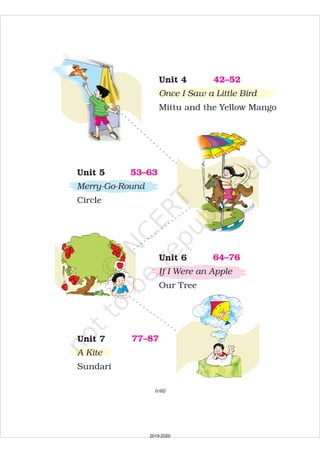
Unit 6
If I Were an Apple
Our Tree
64–76
Unit 7
A Kite
Sundari
77–87
42–52Unit 4
Once I Saw a Little Bird
Mittu and the Yellow Mango
53–63Unit 5
Merry-Go-Round
Circle
(viii)
2019-2020
Unit 10
Flying-Man
The Tailor and
his Friend
110–120
Unit 9
Clouds
Anandi’s Rainbow
98–109
Unit 8
A Little Turtle
The Tiger and
the Mosquito
88–97
(ix)
Picture Dictionary 121–122
2019-2020
2019-2020
1
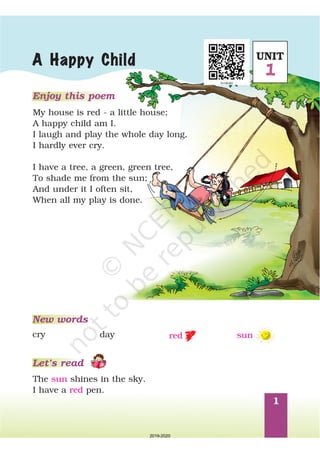
A Happy Child
My house is red - a little house;
A happy child am I.
I laugh and play the whole day long,
I hardly ever cry.
I have a tree, a green, green tree,
To shade me from the sun;
And under it I often sit,
When all my play is done.
reddaycry sun
New words
UNIT
1
The shines in the sky.
I have a pen.
sun
red
Let’s read
Enjoy this poem
2019-2020
2
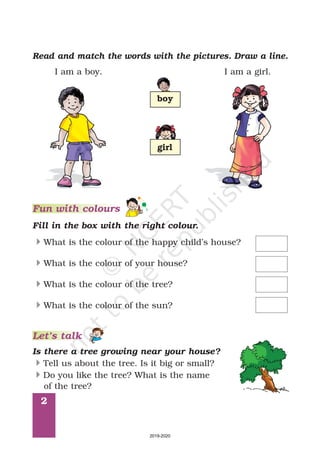
Read and match the words with the pictures. Draw a line.
I am a boy. I am a girl.
Fun with colours
Fill in the box with the right colour.
What is the colour of the happy child’s house?
What is the colour of your house?
What is the colour of the tree?
What is the colour of the sun?
4
4
4
4
boy
girl
Is there a tree growing near your house?
Tell us about the tree. Is it big or small?
Do you like the tree? What is the name
of the tree?
4
4
Let’s talk
2019-2020
3
Let’s share
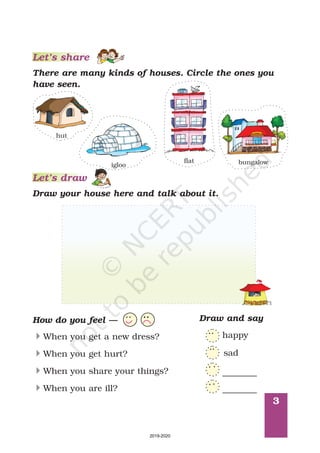
There are many kinds of houses. Circle the ones you
have seen.
hut
igloo
flat bungalow
Let’s draw
Draw your house here and talk about it.
How do you feel —
4
4
4
4
When you get a new dress?
When you get hurt?
When you share your things?
When you are ill?
Draw and say
happy
sad
________
________
2019-2020
4
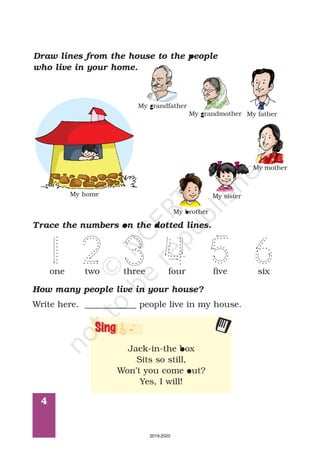
How many people live in your house?
Write here. ____________ people live in my house.
Sing
2019-2020
5
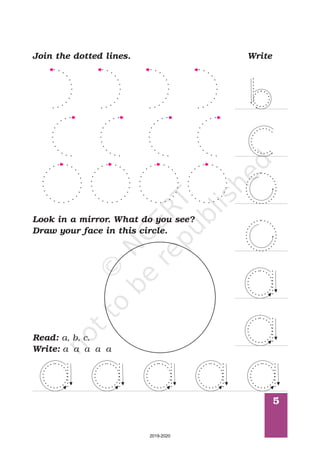
Look in a mirror. What do you see?
Draw your face in this circle.
WriteJoin the dotted lines.
Read:
Write:
a, b, c.
a a a a a
2019-2020
6
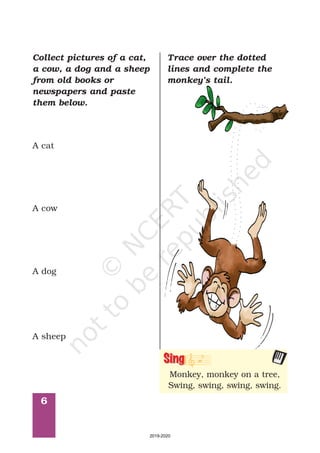
Collect pictures of a cat,
a cow, a dog and a sheep
from old books or
newspapers and paste
them below.
Trace over the dotted
lines and complete the
monkey’s tail.
Monkey, monkey on a tree,
Swing, swing, swing, swing.
Sing
A dog
A cat
A cow
A sheep
2019-2020
7
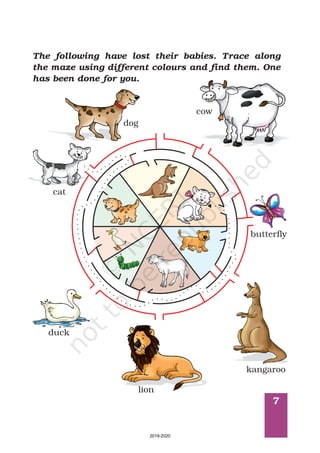
The following have lost their babies. Trace along
the maze using different colours and find them. One
has been done for you.
cow
dog
cat
duck
lion
kangaroo
butterfly
2019-2020
8
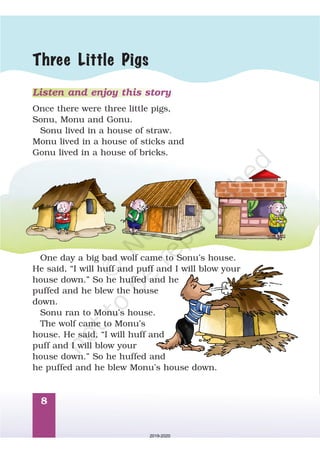
Listen and enjoy this story
Once there were three little pigs,
Sonu, Monu and Gonu.
Sonu lived in a house of straw.
Monu lived in a house of sticks and
Gonu lived in a house of bricks.
One day a big bad wolf came to Sonu’s house.
He said, “I will huff and puff and I will blow your
house down. So he huffed and he
puffed and he blew the house
down.
Sonu ran to Monu’s house.
The wolf came to Monu’s
house. He said, “I will huff and
puff and I will blow your
house down. So he huffed and
he puffed and he blew Monu’s house down.
”
”
Three Little Pigs
2019-2020
9
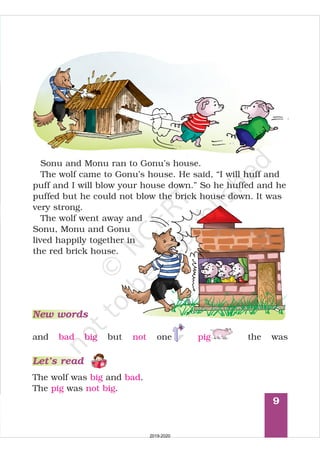
Sonu and Monu ran to Gonu’s house.
”
The wolf came to Gonu’s house. He said, “I will huff and
puff and I will blow your house down. So he huffed and he
puffed but he could not blow the brick house down. It was
very strong.
The wolf went away and
Sonu, Monu and Gonu
lived happily together in
the red brick house.
and bad big but not the was
The wolf was and .
The was .
big bad
pig not big
New words
Let’s read
pigone11
2019-2020
Let’s share
10
Reading is fun
How many pigs were there?
What did the big wolf say to the pigs?
4
4
Was the wolf good or bad?
What is your house made of?
4
4
Who is good?
Who is bad?
4
4
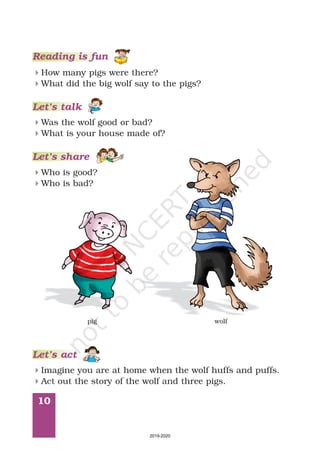
pig wolf
4
4
Imagine you are at home when the wolf huffs and puffs.
Act out the story of the wolf and three pigs.
Let’s act
Let’s talk
2019-2020
11
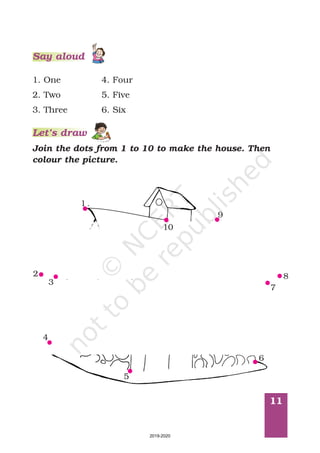
Join the dots from 1 to 10 to make the house. Then
colour the picture.
Let’s draw
1. One
2. Two
3. Three
4. Four
5. Five
6. Six
Say aloud
12
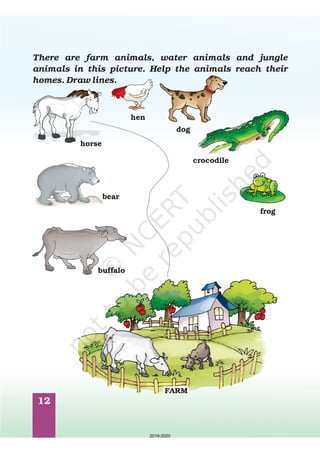
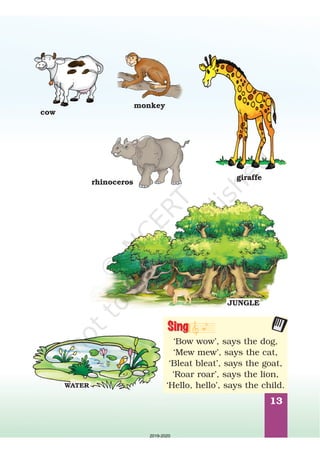
There are farm animals, water animals and jungle
animals in this picture. Help the animals reach their
homes. Draw lines.
bear
frog
crocodile
hen
horse
dog
buffalo
FARM
2019-2020
13
rhinoceros
monkey
cow
giraffe
JUNGLE
‘Bow wow’, says the dog,
‘Mew mew’, says the cat,
‘Bleat bleat’, says the goat,
‘Roar roar’, says the lion,
‘Hello, hello’, says the child.
Sing
WATER
2019-2020
14
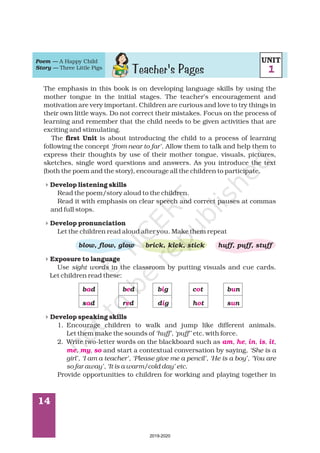
The emphasis in this book is on developing language skills by using the
mother tongue in the initial stages. The teacher’s encouragement and
motivation are very important. Children are curious and love to try things in
their own little ways. Do not correct their mistakes. Focus on the process of
learning and remember that the child needs to be given activities that are
exciting and stimulating.
The is about introducing the child to a process of learning
following the concept . Allow them to talk and help them to
express their thoughts by use of their mother tongue, visuals, pictures,
sketches, single word questions and answers. As you introduce the text
(both the poem and the story), encourage all the children to participate.
Read the poem/story aloud to the children.
Read it with emphasis on clear speech and correct pauses at commas
and full stops.
Let the children read aloud after you. Make them repeat
Use in the classroom by putting visuals and cue cards.
Let children read these:
1. Encourage children to walk and jump like different animals.
Let them make the sounds of etc. with force.
2. Write two-letter words on the blackboard such as
and start a contextual conversation by saying,
Provide opportunities to children for working and playing together in
first Unit
Develop listening skills
Develop pronunciation
Exposure to language
Develop speaking skills
‘from near to far’
sight words
‘huff’, ‘puff'’
, , , , ,
, , ‘She is a
girl’, ‘I am a teacher’, ‘Please give me a pencil’, ‘He is a boy’, ‘You are
so far away’, ‘It is a warm/cold day’ etc.
blow, flow, glow brick, kick, stick huff, puff, stuff
b d b d b g c t b n
s d r d d g h t s n
4
4
4
4
a e i o u
a e i o u
am he in is it
me my so
Poem —
Story —
A Happy Child
Three Little Pigs
Teacher's Pages
UNIT
1
2019-2020
15
small groups. It will promote interaction, togetherness and team spirit
besides encouragement for natural expressions.
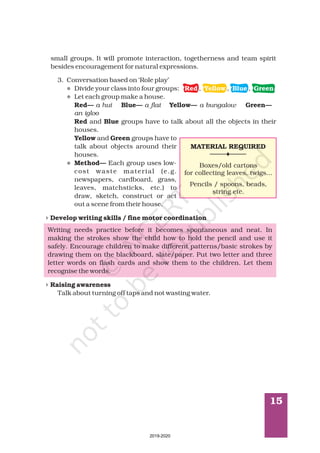
3. Conversation based on ‘Role play’
Divide your class into four groups: , , ,
Let each group make a house.
and groups have to talk about all the objects in their
houses.
and groups have to
talk about objects around their
houses.
Each group uses low-
cost waste material (e.g.
newspapers, cardboard, grass,
leaves, matchsticks, etc.) to
draw, sketch, construct or act
out a scene from their house.
Writing needs practice before it becomes spontaneous and neat. In
making the strokes show the child how to hold the pencil and use it
safely. Encourage children to make different patterns/basic strokes by
drawing them on the blackboard, slate/paper. Put two letter and three
letter words on flash cards and show them to the children. Let them
recognise the words.
Talk about turning off taps and not wasting water.
Red— Blue— Yellow— Green—
Red Blue
Yellow Green
Method—
Develop writing skills / fine motor coordination
Raising awareness
a hut a flat a bungalow
an igloo
l
l
l
4
4
Red Yellow Blue Green
MATERIAL REQUIRED
Boxes/old cartons
for collecting leaves, twigs...
Pencils / spoons, beads,
string etc.
2019-2020
2019-2020
2019-2020
18
Let’s do
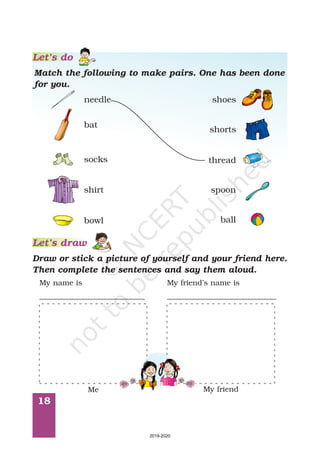
Match the following to make pairs. One has been done
for you.
Let’s draw
Draw or stick a picture of yourself and your friend here.
Then complete the sentences and say them aloud.
needle
bat
socks
shirt
bowl
shoes
shorts
thread
spoon
ball
Me My friend
My name is
____________________________
My friend’s name is
_____________________________
2019-2020
19
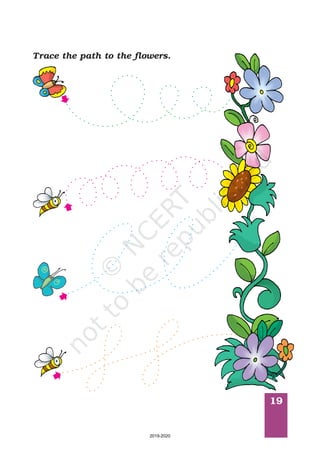
Trace the path to the flowers.
2019-2020
20
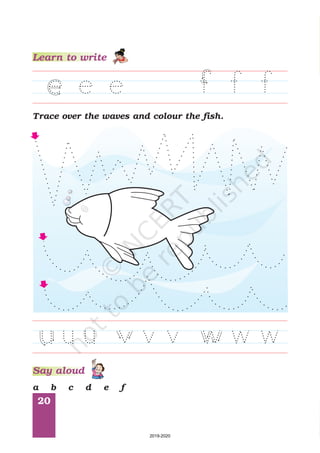
Trace over the waves and colour the fish.
a b c d e f
Learn to write
Say aloud
2019-2020
21
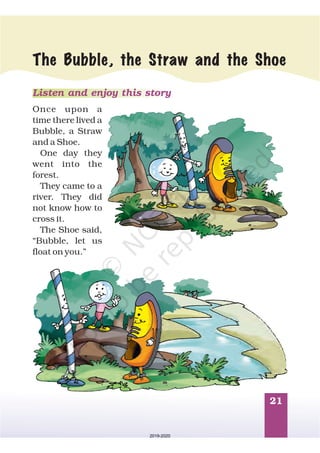
Listen and enjoy this story
Once upon a
time there lived a
Bubble, a Straw
and a Shoe.
One day they
went into the
forest.
They came to a
river. They did
not know how to
cross it.
The Shoe said,
“Bubble, let us
float on you.”
The Bubble, the Straw and the Shoe
2019-2020
22
bank bubble burst river splash
New words
Let’s read
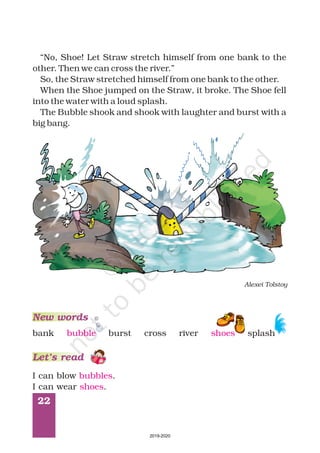
“No, Shoe! Let Straw stretch himself from one bank to the
other. Then we can cross the river.”
So, the Straw stretched himself from one bank to the other.
When the Shoe jumped on the Straw, it broke. The Shoe fell
into the water with a loud splash.
The Bubble shook and shook with laughter and burst with a
big bang.
Alexei Tolstoy
cross shoes
I can blow .
I can wear .
bubbles
shoes
2019-2020
Let’s share
23
Reading is fun
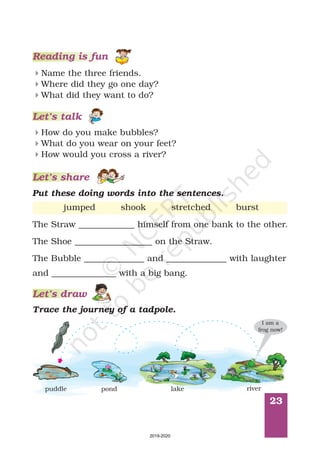
Name the three friends.
Where did they go one day?
What did they want to do?
4
4
4
How do you make bubbles?
What do you wear on your feet?
How would you cross a river?
4
4
4
Put these doing words into the sentences.
Let’s draw
Let’s talk
jumped shook stretched burst
The Straw _____________ himself from one bank to the other.
The Shoe __________________ on the Straw.
The Bubble ______________ and ______________ with laughter
and _______________ with a big bang.
Trace the journey of a tadpole.
puddle pond lake river
I am a
frog now!
2019-2020
24
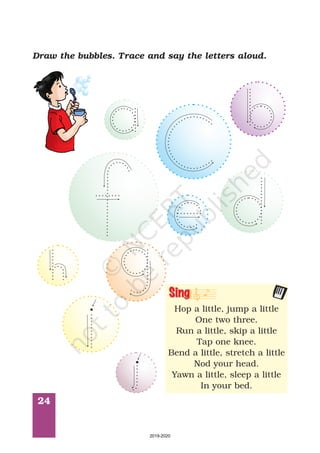
Draw the bubbles. Trace and say the letters aloud.
Hop a little, jump a little
One two three.
Run a little, skip a little
Tap one knee.
Bend a little, stretch a little
Nod your head.
Yawn a little, sleep a little
In your bed.
Sing
2019-2020
25
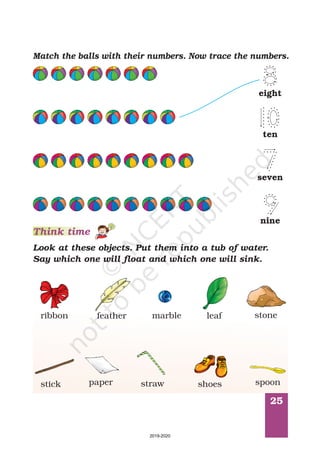
Match the balls with their numbers. Now trace the numbers.
Look at these objects. Put them into a tub of water.
Say which one will float and which one will sink.
Think time
ribbon feather stoneleafmarble
stick paper straw shoes spoon
seven
nine
ten
eight
2019-2020
26
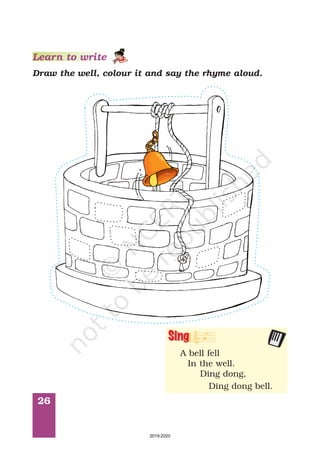
Draw the well, colour it and say the rhyme aloud.
A bell fell
In the well.
Ding dong,
Ding dong bell.
Sing
Learn to write
2019-2020
27
Poem —
Story —
After a Bath
The Bubble, the Straw
and the Shoe
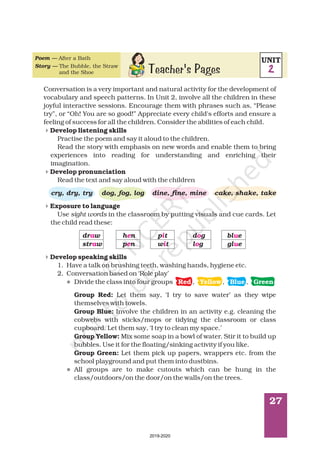
Conversation is a very important and natural activity for the development of
vocabulary and speech patterns. In Unit 2, involve all the children in these
joyful interactive sessions. Encourage them with phrases such as, “Please
try”, or “Oh! You are so good!” Appreciate every child's efforts and ensure a
feeling of success for all the children. Consider the abilities of each child.
Practise the poem and say it aloud to the children.
Read the story with emphasis on new words and enable them to bring
experiences into reading for understanding and enriching their
imagination.
Read the text and say aloud with the children
Use in the classroom by putting visuals and cue cards. Let
the child read these:
1. Have a talk on brushing teeth, washing hands, hygiene etc.
2. Conversation based on ‘Role play’
Divide the class into four groups , , ,
Let them say, ‘I try to save water’ as they wipe
themselves with towels.
Involve the children in an activity e.g. cleaning the
cobwebs with sticks/mops or tidying the classroom or class
cupboard. Let them say, ‘I try to clean my space.’
Mix some soap in a bowl of water. Stir it to build up
bubbles. Use it for the floating/sinking activity if you like.
Let them pick up papers, wrappers etc. from the
school playground and put them into dustbins.
All groups are to make cutouts which can be hung in the
class/outdoors/on the door/on the walls/on the trees.
Develop listening skills
Develop pronunciation
Exposure to language
Develop speaking skills
Group Red:
Group Blue:
Group Yellow:
Group Green:
sight words
cry, dry, try dog, fog, log dine, fine, mine cake, shake, take
dr w h n p t d g bl e
str w p n w t l g gl e
4
4
4
4
l
l
a e i o u
a e i o u
Red Yellow Blue Green
Teacher's Pages
UNIT
2
2019-2020
28
l
4
4
Imagine you are walking down a street and you see a friend far
away. Wave out and call your friend.
1. (a) Write on the blackboard and . Let the child
write numbers and trace a few letters. These are the child’s
attempts at writing. The teacher can gradually lead the child to
proper formation of letters. Also provide each child with a
comfortable writing position, adequate space and an
appreciative atmosphere.
(b) Each child's grip on the pencil and appropriate colouring within
lines must be looked into.
(c) Use Activity Sheets to further encourage the patterns as on
pages 19, 20, 23, 24, 25 and 26 and numbers 1 to 10 (here
co-ordinate with the maths teacher). However, do not force the
child.
2. Enact a situation when your writing hand is hurt and you have to
write.
3. Show children how to open and
close buttons/zip and tie
shoelaces.
Talk to the children about switching
off lights, fans etc. when not required.
Develop writing skills / fine motor coordination
to
Raising awareness
a, e, i, o, u 1 10
MATERIAL REQUIRED
Any old clothes with buttons,
purse / bag with a zip,
shoes with laces.
2019-2020
29
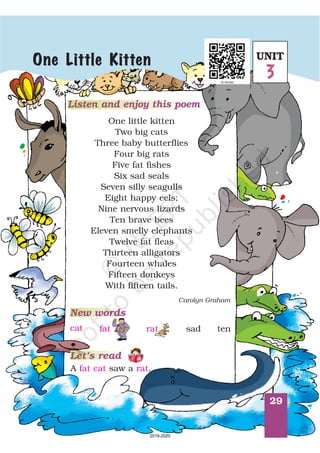
Listen and enjoy this poem
One little kitten
Two big cats
Three baby butterflies
Four big rats
Five fat fishes
Six sad seals
Seven silly seagulls
Eight happy eels;
Nine nervous lizards
Ten brave bees
Eleven smelly elephants
Twelve fat fleas
Thirteen alligators
Fourteen whales
Fifteen donkeys
With fifteen tails.
Carolyn Graham
New words
Let’s read
A saw a .fat cat rat
cat rat sad ten
One Little Kitten
fat
UNIT
3
2019-2020
30
4
4
How many kinds of creatures are there in the poem?
Are the seals happy?
4
4
4
4
Where do the fish live?
What are the other things found in water?
There are many creatures in the poem. Which ones
have you seen?
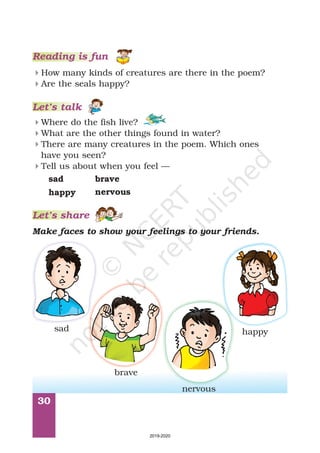
Tell us about when you feel —
Reading is fun
Let’s talk
sad
happy
brave
nervous
Let’s share
Make faces to show your feelings to your friends.
sad happy
brave
nervous
2019-2020
31
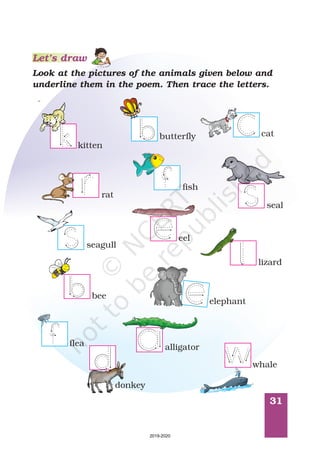
Look at the pictures of the animals given below and
underline them in the poem. Then trace the letters.
kitten
catbutterfly
rat
fish
seal
seagull
eel
elephant
flea alligator
whale
donkey
Let’s draw
bee
lizard
2019-2020
32
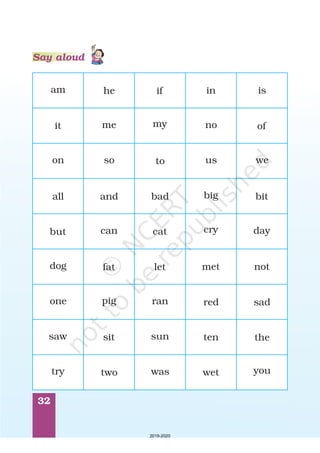
am he if in is
it me my no of
on so to us we
all and bad big bit
but can cat cry day
dog fat let met not
one pig ran red sad
saw sit sun ten the
try two was wet you
Say aloud
2019-2020
33
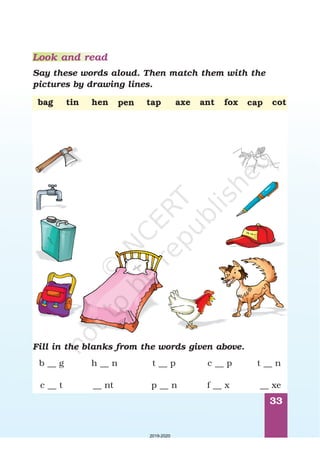
Look and read
Say these words aloud. Then match them with the
pictures by drawing lines.
bag cottin tap axehen foxantpen cap
Fill in the blanks from the words given above.
c __ p
f __ x
t __ p
p __ n
h __ n
__ nt
b __ g
c __ t
t __ n
__ xe
2019-2020
34
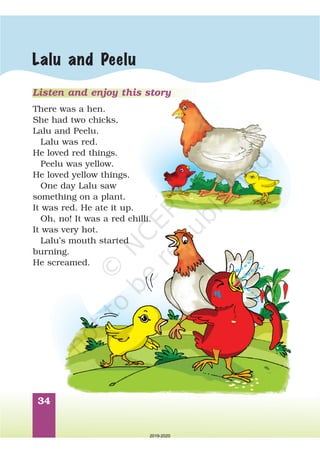
Lalu and Peelu
Listen and enjoy this story
There was a hen.
She had two chicks,
Lalu and Peelu.
Lalu was red.
He loved red things.
Peelu was yellow.
He loved yellow things.
One day Lalu saw
something on a plant.
It was red. He ate it up.
Oh, no! It was a red chilli.
It was very hot.
Lalu’s mouth started
burning.
He screamed.
2019-2020
35
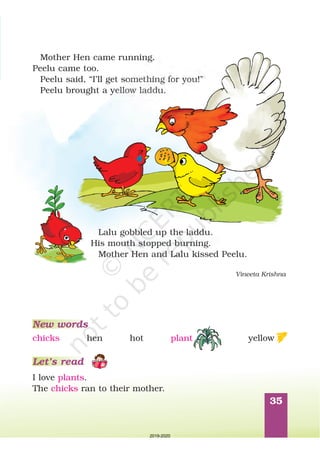
Mother Hen came running.
Peelu came too.
Peelu said, I’ll get something for you!”
Peelu brought a yellow laddu.
“
I love .
The ran to their mother.
plants
chicks
New words
Let’s read
chicks hen
Vineeta Krishna
Lalu gobbled up the laddu.
His mouth stopped burning.
Mother Hen and Lalu kissed Peelu.
yellowplanthot
2019-2020
36
Reading is fun
4
4
4
Name the chicks in the story.
Who liked yellow things?
What did Lalu eat one day?
Let’s talk
4Peelu brought a yellow laddu for Lalu. What are the
other things Peelu could have brought that are both
yellow and sweet? Name at least two, e.g. a mango.
4Lalu loves red things. Peelu loves yellow things. The
colour red is called ‘lal’ in Hindi and yellow is called
‘peela’. What do you call these colours in your
language?
Let’s share
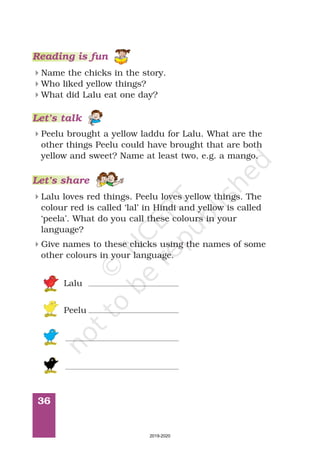
4Give names to these chicks using the names of some
other colours in your language.
Lalu
Peelu
2019-2020
37
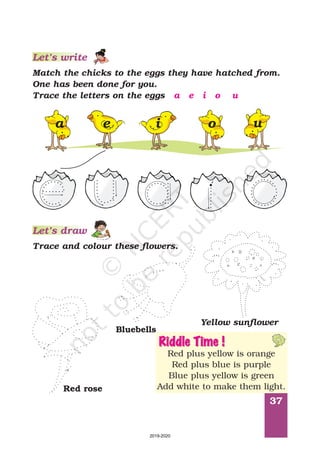
Match the chicks to the eggs they have hatched from.
One has been done for you.
Trace the letters on the eggs a e i o u
Let’s write
Trace and colour these flowers.
Red rose
Bluebells
Yellow sunflower
Riddle Time !
Red plus yellow is orange
Red plus blue is purple
Blue plus yellow is green
Add white to make them light.
Let’s draw
a e i o u
2019-2020
38
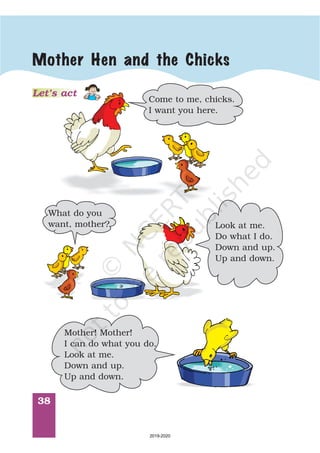
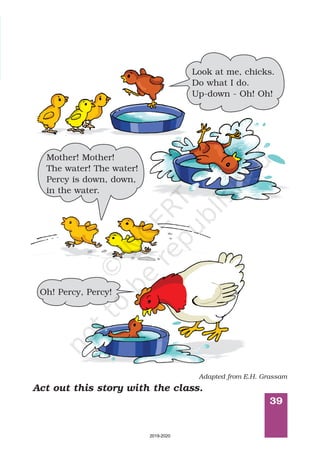
Mother Hen and the Chicks
Let’s act
Come to me, chicks.
I want you here.
Look at me.
Do what I do.
Down and up.
Up and down.
What do you
want, mother?
Mother! Mother!
I can do what you do.
Look at me.
Down and up.
Up and down.
2019-2020
39
Act out this story with the class.
Look at me, chicks.
Do what I do.
Up-down - Oh! Oh!
Mother! Mother!
The water! The water!
Percy is down, down,
in the water.
Oh! Percy, Percy!
Adapted from E.H. Grassam
2019-2020
40
While working with the children provide them with activities that are
interesting and challenging. Give opportunities for fun to the children and
encourage early writing attempts. Help them to develop the skill to identify
and discriminate objects, pictures, colours, shapes etc.
Recite the poem to the children using appropriate actions/gestures.
Read the story with emphasis on new words and make sentences with
reference to the story.
Read the text and say aloud with the children
Use in the classroom such as visuals and cue cards. Let the
children read these:
The little play on chicks can introduce vocabulary in an interesting,
conversational way.
1. Have a talk on eating healthy food.
2. Conversation based on ‘Role play’
Divide the class into four groups , , ,
to make paper bags.
to collect leaves for eyes, nose, ears.
to roll a string/play dough for whiskers.
to roll a rope/twigs to make tails.
All groups will join to complete the
paper bags. The children can decorate
them with animal faces or figures.
Afterwards these can be used as hand
puppets. You can encourage the
children as they go about doing this
activity. Add any other material that
you may want.
Develop listening skills
Develop pronunciation
Exposure to language
Develop speaking skills
Group Red:
Group Blue:
Group Yellow:
Group Green:
ate, date, gate boy, joy, toy burn, turn bees, fleas
sight words
4
4
4
4
l
a e i o u
Red Yellow Blue Green
Poem
Story
—
—
One Little Kitten
Lalu and Peelu
Teacher's Pages
UNIT
3
MATERIAL REQUIRED
Any old paper bags/
newspapers, glue, thread, rope,
coloured pencils and markers.
2019-2020
41
l
l
4
4
Imagine you are eating a fruit and it falls down. Ask the children
what they would do.
Act out a situation when (i) you are hungry (ii) you are full (iii) you
overeat.
1. Write the words and numbers to on the
blackboard. Let the child write numbers and read from the board.
Use Activity Sheets to further encourage the patterns as on pages
31, 33 and 37 and numbers 11 to 20 (here co-ordinate with the
maths teacher). However, do not force the child.
2. Sorting things into groups is an essential part of learning. By
differentiating between objects, children start to think about
similarities and differences and how things can be categorised.
Show children how to sort leaves and twigs by placing them in two
different piles.
3. Give children coloured beads and ask them to string them in a
sequence. For example, one blue bead, two red beads and so on. Or
on a string, thread two or three beads and ask the children the
number of beads.
Tell the children to wash their hands before and after meals.
Develop writing skills / fine motor coordination
11 20
Raising awareness
hat bed pin hot cut, , , ,
2019-2020
2019-2020
43
4
4
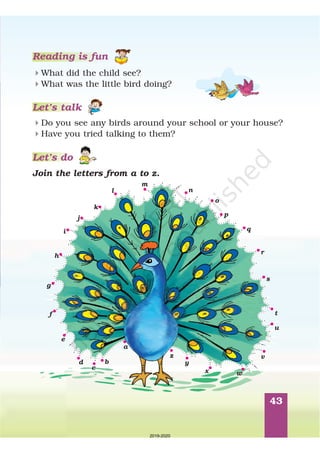
What did the child see?
What was the little bird doing?
4
4
Do you see any birds around your school or your house?
Have you tried talking to them?
Join the letters from a to z.
Reading is fun
Let’s talk
Let’s do
a
b
c
d
e
f
g
h
i
j
k
l
m
n
o
p
q
r
s
t
u
v
wx
y
z
2019-2020
44
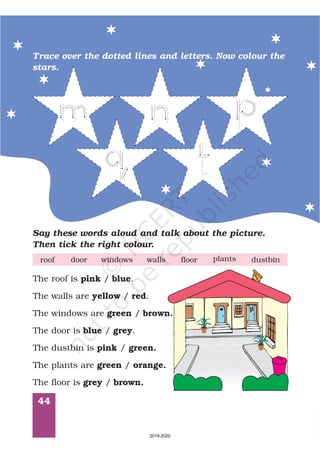
Trace over the dotted lines and letters. Now colour the
stars.
Say these words aloud and talk about the picture.
Then tick the right colour.
door windows floorwallsroof plants dustbin
The roof is / .
The walls are / .
The windows are /
The door is / .
The dustbin is /
The plants are /
The floor is /
pink blue
yellow red
green brown.
blue grey
pink green.
green orange.
grey brown.
2019-2020
45
Mittu and the Yellow Mango
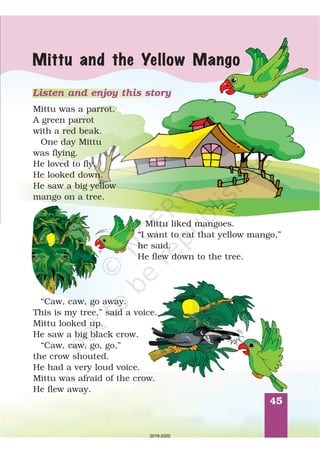
Mittu was a parrot.
A green parrot
with a red beak.
One day Mittu
was flying.
He loved to fly.
He looked down.
He saw a big yellow
mango on a tree.
Mittu liked mangoes.
“I want to eat that yellow mango,”
he said.
He flew down to the tree.
“Caw, caw, go away.
This is my tree,” said a voice.
Mittu looked up.
He saw a big black crow.
“Caw, caw, go, go,
the crow shouted.
He had a very loud voice.
Mittu was afraid of the crow.
He flew away.
”
Listen and enjoy this story
2019-2020
46
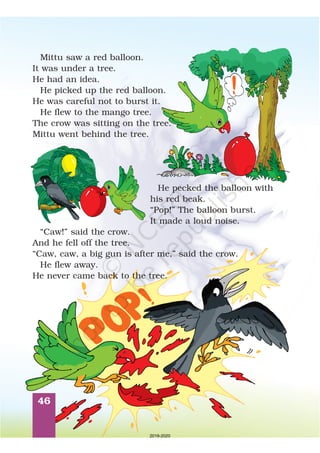
Mittu saw a red balloon.
It was under a tree.
He had an idea.
He picked up the red balloon.
He was careful not to burst it.
He flew to the mango tree.
The crow was sitting on the tree.
Mittu went behind the tree.
He pecked the balloon with
his red beak.
“Pop!” The balloon burst.
It made a loud noise.
“Caw!” said the crow.
And he fell off the tree.
“Caw, caw, a big gun is after me,” said the crow.
He flew away.
He never came back to the tree.
2019-2020
47
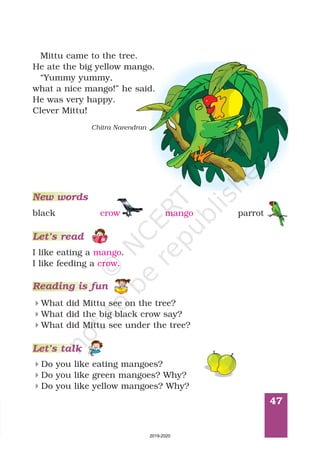
Mittu came to the tree.
He ate the big yellow mango.
“Yummy yummy,
what a nice mango! he said.
He was very happy.
Clever Mittu!
”
Chitra Narendran
4
4
4
What did Mittu see on the tree?
What did the big black crow say?
What did Mittu see under the tree?
Reading is fun
4
4
4
Do you like eating mangoes?
Do you like green mangoes? Why?
Do you like yellow mangoes? Why?
Let’s talk
I like eating a .
I like feeding a .
mango
crow
Let’s read
New words
black crow mango parrot
2019-2020
48
Let’s share
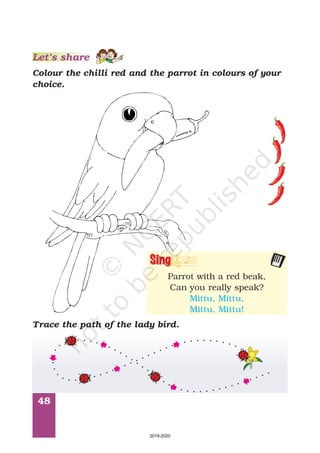
Colour the chilli red and the parrot in colours of your
choice.
Trace the path of the lady bird.
Parrot with a red beak,
Can you really speak?
Mittu, Mittu,
Mittu, Mittu!
Sing
2019-2020
49
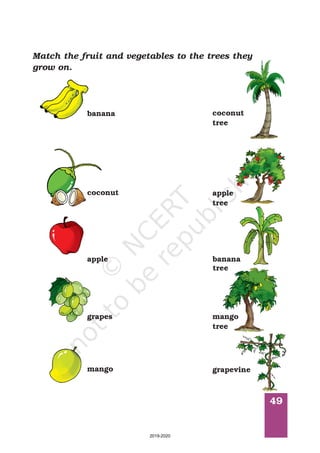
Match the fruit and vegetables to the trees they
grow on.
coconut
tree
grapevine
banana
tree
mango
tree
apple
tree
coconut
apple
grapes
mango
banana
2019-2020
50
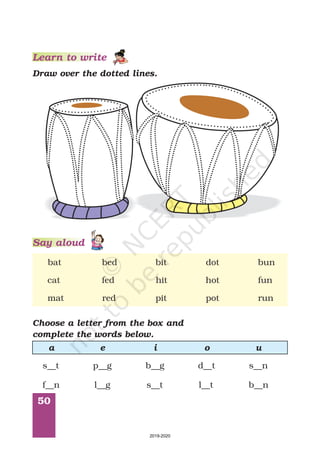
Learn to write
bat bed bit dot bun
cat fed hit hot fun
mat red pit pot run
Choose a letter from the box and
complete the words below.
a e i o u
s__t p__g b__g d__t s__n
f__n l__g s__t l__t b__n
Draw over the dotted lines.
Say aloud
2019-2020
51
Teacher's Pages
Poem —
Story —
Once I saw a Little Bird
Mittu and the Yellow Mango
The children look forward to this active approach of hearing, doing and
participating. Now they can be given the freedom to choose their groups and
tasks. Groups can be divided into those who want to (i) taste something
tangy like a lemon, (ii) sweet like sugar,
(iii) bitter like neem/bitter gourd or (iv)
salt. Let them make with the
required ingredients and drink it.
Shared activities will foster healthy
relationships.
By this time children should be able to read a few words. Involve them
in a reading activity, laying emphasis on the highlighted words in the text.
Say aloud with the children
Display in the classroom. Sight word vocabulary is
developed by using words repeatedly in meaningful contexts. Let children
read these:
1. The peacock is our national bird. The male bird has a beautiful tail.
The female is called a peahen. Encourage children to talk about
other birds they see in their school or near their homes.
2. Conversation based on ‘Role play’
At this stage children should be able to identify different sounds
in their environment. Ask them to imagine that they are birds and
let them call out to another bird. Encourage them to listen to
sounds of nature (chirping of birds, rainfall, wind blowing etc.)
nimbu pani
‘Stop’ says the red light,
‘Go’ says the green.
‘Wait’ says the yellow light,
Blinking in between.
sight words
Develop reading skills
Develop pronunciation
Exposure to language
Develop speaking skills
chilli mango parrot
4
4
4
4
l
UNIT
4
MATERIAL REQUIRED
2 lemons, little sugar,
little salt,
and .
a
a neem leaves
drinking water
2019-2020
52
l
l
4
4
Act out a scene when the children are birds flying in the sky.
The children may be taken out and given their food outdoors. Let
them be motivated to talk about different tastes after the meal or
have a conversation about if the activity has been
done.
1. Write the following words and numbers on the blackboard —
and digits from to . Use Activity Sheets and you
can also start using a notebook to further encourage the patterns as
on pages 43, 44, 48, 49 and 50.
2. Show the children how to draw a bird/ make a bird with clay/play
dough.
Tell the class that birds are our friends. We can feed them with some
grains or bread crumbs.
nimbu pani
,
, ,
Develop writing skills / fine motor coordination
1 10
Raising awareness
hop
stop shop mop
2019-2020
53
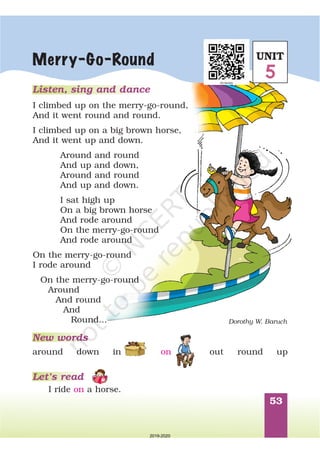
I climbed up on the merry-go-round,
And it went round and round.
I climbed up on a big brown horse,
And it went up and down.
Around and round
And up and down,
Around and round
And up and down.
I sat high up
On a big brown horse
And rode around
On the merry-go-round
Around
And round
And
Round...
And rode around
On the merry-go-round
I rode around
Dorothy W. Baruch
Merry-Go-Round
I ride a horse.on
Listen, sing and dance
New words
Let’s read
around down out round uponin
UNIT
5
2019-2020
54
Let’s share
Let’s talk
Reading is fun
How did the merry-go-round go?
How did the big brown horse go?
4
4
Have you seen a merry-go-round?
Where have you seen it?
Would you like to go to a fair?
4
4
4
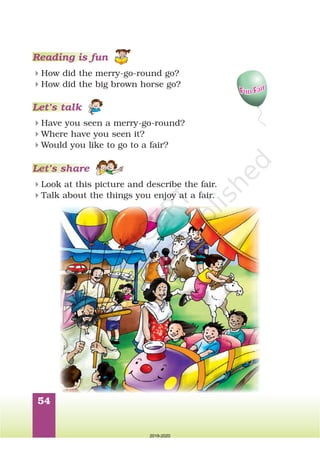
Look at this picture and describe the fair.
Talk about the things you enjoy at a fair.
4
4
2019-2020
55
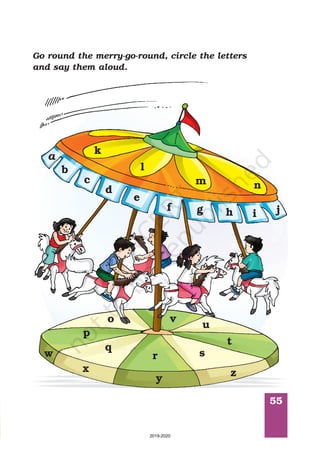
Go round the merry-go-round, circle the letters
and say them aloud.
a
b
c
d
e
f g h i j
k
l
m n
o
p
q
r s
t
u
v
w
x
y
z
2019-2020
56
Circle
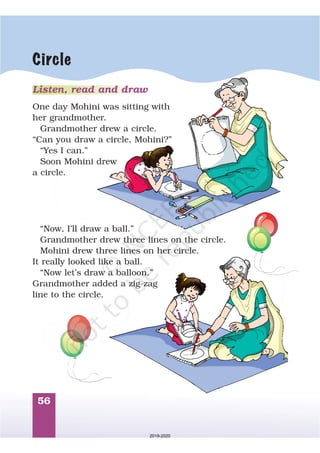
Listen, read and draw
One day Mohini was sitting with
her grandmother.
Grandmother drew a circle.
“Can you draw a circle, Mohini?”
“Yes I can.”
Soon Mohini drew
a circle.
“Now, I’ll draw a ball.”
Grandmother drew three lines on the circle.
Mohini drew three lines on her circle.
It really looked like a ball.
“Now let’s draw a balloon.”
Grandmother added a zig-zag
line to the circle.
2019-2020
57
Manorama Jafa
I can draw a .
The is round.
circle
moon
New words
Let’s read
ball blue circle lines moon
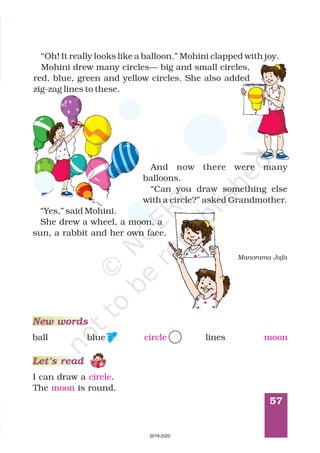
“Oh! It really looks like a balloon.” Mohini clapped with joy.
Mohini drew many circles— big and small circles,
red, blue, green and yellow circles. She also added
zig-zag lines to these.
And now there were many
balloons.
“Can you draw something else
with a circle?” asked Grandmother.
“Yes,” said Mohini.
She drew a wheel, a moon, a
sun, a rabbit and her own face.
2019-2020
Reading is fun
58
What did Grandmother and Mohini draw first?
What were the colours of the balloons that Mohini drew?
4
4
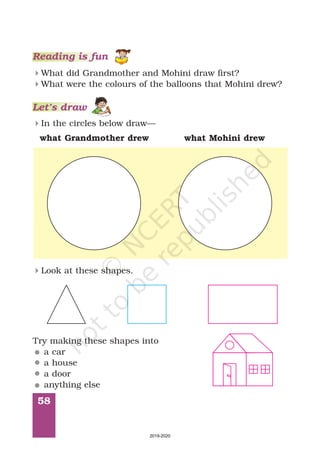
Let’s draw
In the circles below draw—4
what Grandmother drew what Mohini drew
Look at these shapes.4
Try making these shapes into
a car
a house
a door
anything else
2019-2020
59
Draw a face on the balloon below. One has been
done for you.
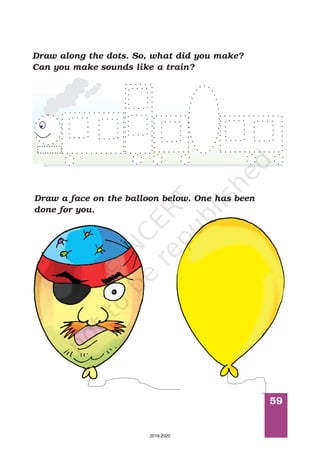
Draw along the dots. So, what did you make?
Can you make sounds like a train?
2019-2020
60
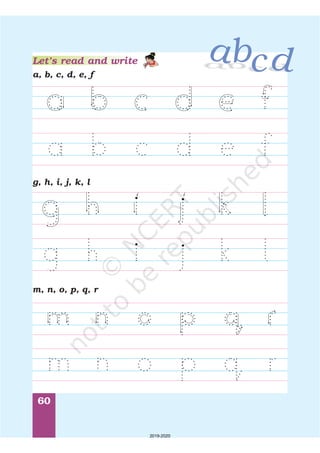
a, b, c, d, e, f
g, h, i, j, k, l
m, n, o, p, q, r
ba cdLet’s read and write
2019-2020
61
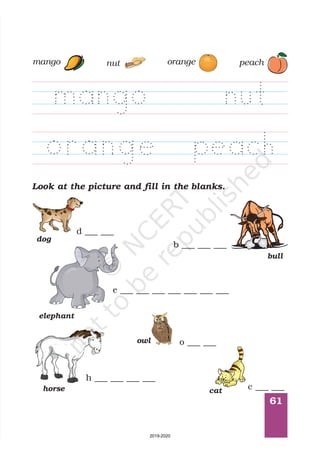
peachmango nut orange
Look at the picture and fill in the blanks.
c ___ ___
e ___ ___ ___ ___ ___ ___ ___
o ___ ___
d ___ ___
h ___ ___ ___ ___
b ___ ___ ___
cat
dog
elephant
owl
bull
horse
2019-2020
Teacher's Pages
62
Activities now have more to do with what the children like to do. You can try
this:
Make the children sit in a circle. Ask a child to start counting from
number 1. The child sitting next to him/her continues with number 2
and so on. The child who has to say number 5 or 10 says and the
next child starts with number 1 again.
Draw a circle on the floor with a piece of chalk. Let the children walk
along the drawn line. Ask them to hold a book/any object in one hand
and walk along the line. Talk to them about balancing things. Ask them
if they feel giddy on a merry-go-round.
The children can be taken outdoors during the break and allowed to eat
their snacks there. Let them talk to each other about the different tastes
of foods. Ask children to speak to the point and take turns. Also inculcate
in them a habit of listening when others speak.
Read the following words and say aloud with the children:
Display the following in the classroom and let the children
read them aloud.
Children can play ‘Farmer’s in the Den’ or any other song of their
choice.
chup
sight words
The farmer’s in the den, The farmer wants a wife,
The farmer’s in the den, The wife wants a child,
Heigho-the cheerio, The child wants a nurse,
The farmer’s in the den. The nurse wants a dog,
The dog wants a bone.
Develop listening skills
Develop pronunciation
Exposure to language
Develop speaking skills
around bound brown down
found ground sound
circle line oval square triangle zig-zag
l
l
4
4
4
4
Poem —
Story —
Merry-Go-Round
Circle
UNIT
5
2019-2020
63
4
4
Develop writing skills / fine motor coordination
Raising awareness
1.Write the letters from to on the blackboard. Let the children read and
write from the blackboard and the picture dictionary. Children should
not be forced or pressurised to recognise words or letters. This can be
done through pictures or actions. Use Activity Sheets and a notebook to
further encourage the patterns as on pages 55, 58, 59, 60 and 61, and
any extra exercises that the children want to do.
2.Pour water from one container to
another.
Tell the class that we must cover
our food from flies.
a q
MATERIAL REQUIRED
2 glasses / cups / pots
and water
2019-2020
64
Learn, recite and enjoy this poem
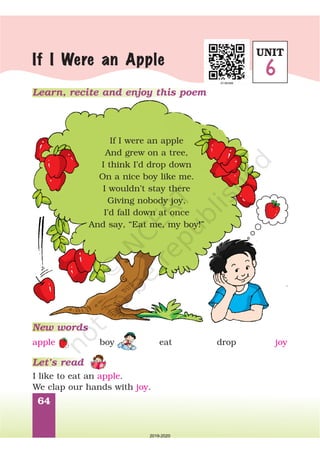
If I Were an Apple
If I were an apple
And grew on a tree,
I think I’d drop down
On a nice boy like me.
I wouldn’t stay there
Giving nobody joy,
I’d fall down at once
And say, “Eat me, my boy!”
New words
Let’s read
I like to eat an .
We clap our hands with .
apple
joy
apple boy eat drop joy
UNIT
6
2019-2020
65
Reading is fun
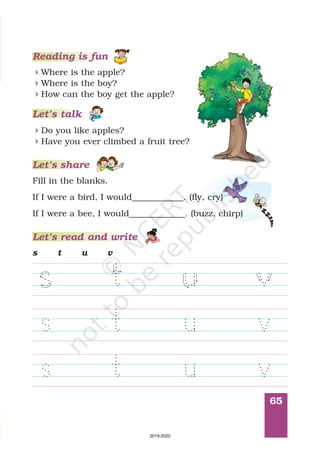
How can the boy get the apple?
Where is the apple?
Where is the boy?
4
4
4
Let’s talk
Do you like apples?
Have you ever climbed a fruit tree?
4
4
Let’s share
Fill in the blanks.
If I were a bird, I would____________. (fly, cry)
If I were a bee, I would (buzz, chirp)_____________.
Let’s read and write
s t u v
2019-2020
66
apple drew dew ball
people grew few call
ripple threw mew fall
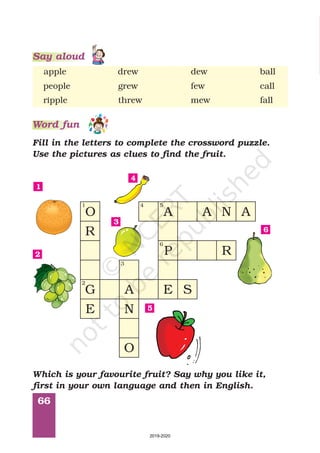
Fill in the letters to complete the crossword puzzle.
Use the pictures as clues to find the fruit.
Word fun
O
R
G A
N
O
E
P R
A A N A
S
E
1
2
3
4 5
6
1
2
3
4
5
6
Which is your favourite fruit? Say why you like it,
first in your own language and then in English.
Say aloud
2019-2020
67
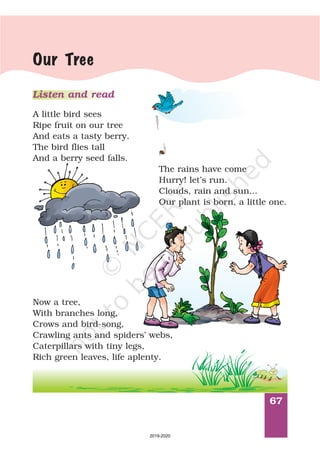
Our Tree
Listen and read
A little bird sees
Ripe fruit on our tree
And eats a tasty berry.
The bird flies tall
And a berry seed falls.
The rains have come
Hurry! let’s run.
Clouds, rain and sun...
Our plant is born, a little one.
Now a tree,
With branches long,
Crows and bird-song,
Crawling ants and spiders’ webs,
Caterpillars with tiny legs,
Rich green leaves, life aplenty.
2019-2020
68
Clouds bring .
The has branches.
rain
tree
New words
Let’s read
berry caterpillars nest rain tree
Pranab and Smita Chakravarti
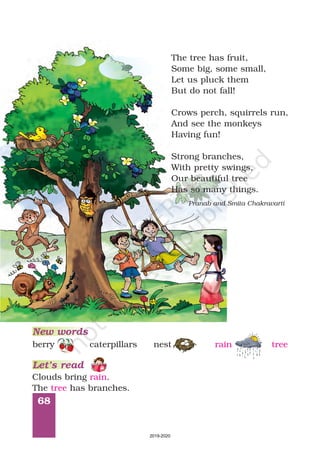
The tree has fruit,
Some big, some small,
Let us pluck them
But do not fall!
Strong branches,
With pretty swings,
Our beautiful tree
Has so many things.
Crows perch, squirrels run,
And see the monkeys
Having fun!
2019-2020
69
Reading is fun
Where does the little bird see the fruit?
What does she do?
What happens when she eats the berry?
4
4
4
Where do birds live?
Have you seen any birds near your house?
Do you know their names in English or in your own
language?
4
4
4
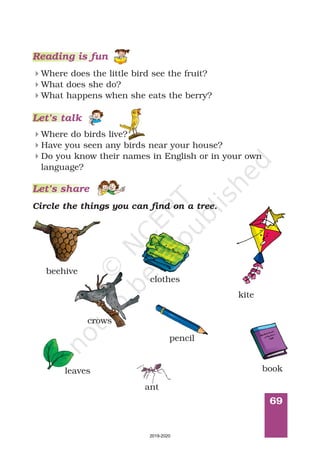
Circle the things you can find on a tree.
beehive
clothes
kite
crows
pencil
bookleaves
Let’s talk
Let’s share
ant
2019-2020
70
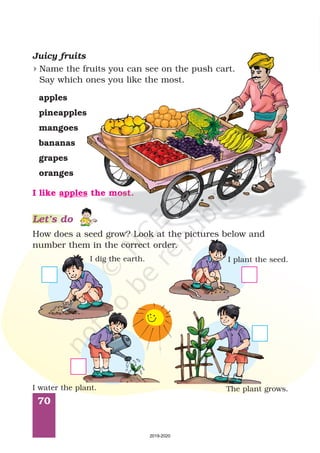
Name the fruits you can see on the push cart.
Say which ones you like the most.
4
How does a seed grow? Look at the pictures below and
number them in the correct order.
Juicy fruits
I dig the earth. I plant the seed.
I water the plant. The plant grows.
apples
pineapples
mangoes
bananas
grapes
oranges
I like the most.apples
Let’s do
2019-2020
71
w x y z
Let’s read and write
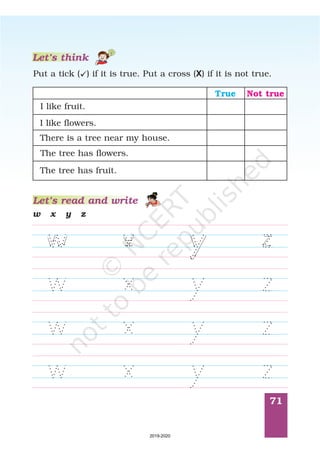
Put a tick ( ) if it is true. Put a cross ( ) if it is not true.ü X
Let’s think
True Not true
I like fruit.
I like flowers.
There is a tree near my house.
The tree has flowers.
The tree has fruit.
2019-2020
72
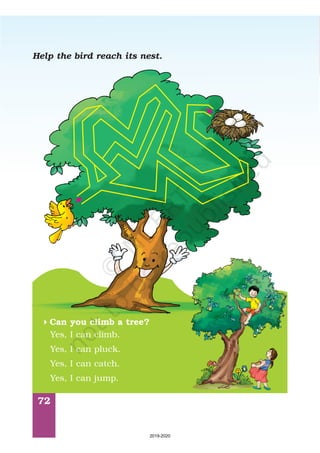
Help the bird reach its nest.
Can you climb a tree?4
Yes, I can climb.
Yes, I can pluck.
Yes, I can catch.
Yes, I can jump.
2019-2020
73
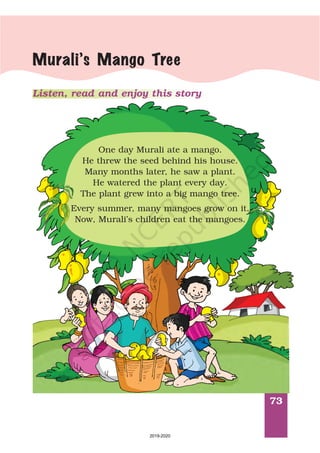
Murali’s Mango Tree
Listen, read and enjoy this story
Shyamala Kumaradas
One day Murali ate a mango.
He threw the seed behind his house.
Many months later, he saw a plant.
He watered the plant every day.
The plant grew into a big mango tree.
Every summer, many mangoes grow on it.
Now, Murali’s children eat the mangoes.
2019-2020
74
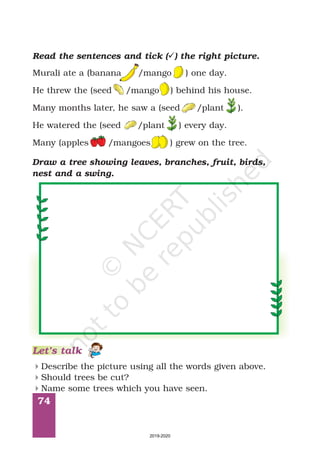
Draw a tree showing leaves, branches, fruit, birds,
nest and a swing.
Read the sentences and tick ( ) the right picture.ü
Murali ate a (banana /mango ) one day.
He threw the (seed /mango ) behind his house.
Many months later, he saw a (seed /plant ).
He watered the (seed /plant ) every day.
Many (apples /mangoes ) grew on the tree.
Let’s talk
Describe the picture using all the words given above.
Should trees be cut?
Name some trees which you have seen.
4
4
4
2019-2020
75
This unit is a good opportunity for involving children in interesting activities
about their environment. Encourage children to look and listen attentively
and express their thoughts freely.
Talk to them about trees around and how important they are.
Share with them topics like “Why do you think trees are important
for us?”
Give them clues like, “They give us shade, flowers, fruits etc.”
Let the children make a class tree
with their handprints. Let them stick
leaves and twigs on it. Write this verse
and stick it under a tree.
Words like can be introduced.
This time let the be the names of children which can be
pasted on the tree that the children have made.
Names of all the children such as
Give children a week or two to learn a rhyme, one in their language and
one in English. Let them recite these. Always appreciate their efforts. Do
not push children who are not ready for it. As facilitators we must let
children speak at their own pace.
Group Activity
Develop pronunciation
tree, bee, flea
Exposure to language
Develop speaking skills
What do I plant?
When I plant a tree
I plant a circle of shade around me;
A circle of shade
Where people come
To rest under the sun.
sight words
Ritu Kabir Mohan Lofang
l
l
4
4
4
4
Teacher's Pages
Poem —
Story —
If I were an Apple
Our Tree
Murali’s Mango Tree
UNIT
6
MATERIAL REQUIRED
A sheet of paper, some twigs,
some leaves and an old
cardboard sheet
2019-2020
76
4
4
4
Develop writing skills
r z
Use the method of developing fine motor coordination
Awareness raising
Write the letters from to on the blackboard. Let the children read
from the board and the picture dictionary. Encourage these early writing
attempts and ensure a feeling of success for all children. Use Activity
Sheets and a notebook to further encourage the patterns as on pages
65, 66, 69, 70, 71, 72 and 74.
Tell the class how to sort out three mixed pulses into different piles or
sort leaves on the basis of their colour, shape and texture.
Have a discussion on the hazards of throwing things into the river and
why we must stop this from happening.
2019-2020
77
A Kite
New words
Let’s read
I can fly a .
I love to under a tree.
kite
sit
blow chanced sit
Learn and enjoy this poem
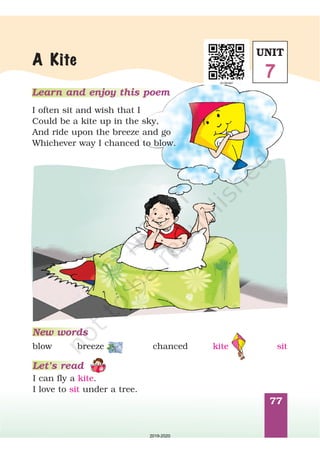
I often sit and wish that I
Could be a kite up in the sky,
And ride upon the breeze and go
Whichever way I chanced to blow.
kitebreeze
UNIT
7
2019-2020
78
Reading is fun
What does the child wish to be?
What does the child wish to do with the breeze?
4
4
Let’s talk
What would you like to be?
Imagine you are a bird in the sky. Describe what you
will feel when you see a kite flying near you.
4
4
Do you know more words with these sounds?
What are the different things that fly in the sky?
If you had wings, where would you fly?
4
4
Let’s share
ride dance
part
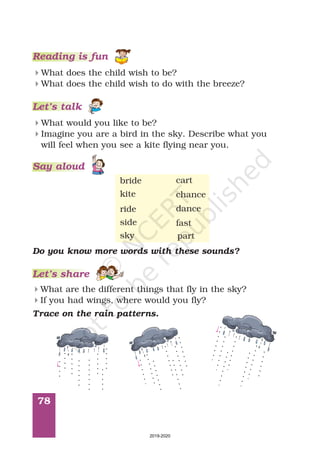
Trace on the rain patterns.
bride
kite
sky
side
cart
chance
fast
Say aloud
2019-2020
79
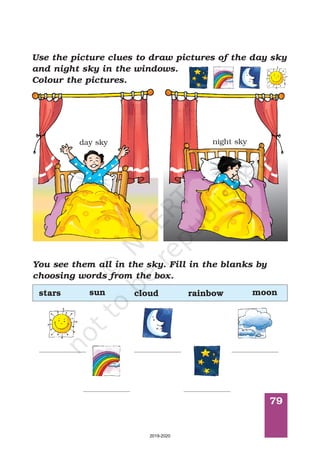
Use the picture clues to draw pictures of the day sky
and night sky in the windows.
Colour the pictures.
You see them all in the sky. Fill in the blanks by
choosing words from the box.
night sky
stars mooncloud rainbowsun
day sky
2019-2020
80
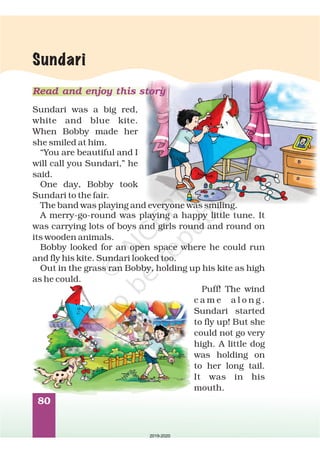
Sundari
Sundari was a big red,
white and blue kite.
When Bobby made her
she smiled at him.
“You are beautiful and I
will call you Sundari,” he
said.
One day, Bobby took
Sundari to the fair.
The band was playing and everyone was smiling.
Bobby looked for an open space where he could run
and fly his kite. Sundari looked too.
Out in the grass ran Bobby, holding up his kite as high
as he could.
Puff! The wind
c a m e a l o n g .
Sundari started
to fly up! But she
could not go very
high. A little dog
was holding on
to her long tail.
It was in his
mouth.
A merry-go-round was playing a happy little tune. It
was carrying lots of boys and girls round and round on
its wooden animals.
Read and enjoy this story
2019-2020
81
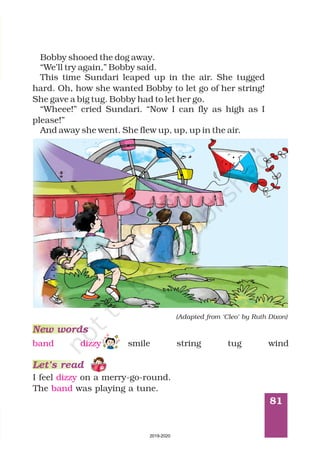
Bobby shooed the dog away.
“We’ll try again,” Bobby said.
This time Sundari leaped up in the air. She tugged
hard. Oh, how she wanted Bobby to let go of her string!
She gave a big tug. Bobby had to let her go.
“Wheee!” cried Sundari. “Now I can fly as high as I
please!”
And away she went. She flew up, up, up in the air.
(Adapted from ‘Cleo’ by Ruth Dixon)
New words
Let’s read
I feel on a merry-go-round.
The was playing a tune.
dizzy
band
band dizzy smile string tug wind
2019-2020
82
Reading is fun
Who made Sundari?
Why did Bobby call his kite ‘Sundari’?
Did Sundari fly very high at first?
What made Sundari really happy?
4
4
4
4
Let’s talk
Do you like to fly kites?
Who helps you to fly kites?
4
4
Let’s share
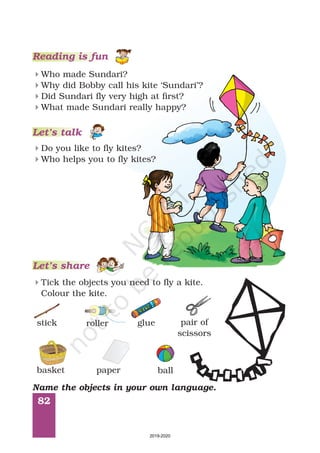
Tick the objects you need to fly a kite.
Colour the kite.
4
roller
paper
gluestick
ball
Name the objects in your own language.
basket
pair of
scissors
2019-2020
83
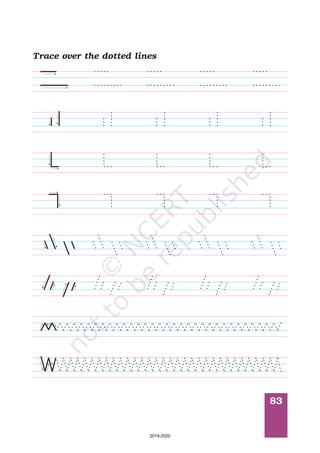
Trace over the dotted lines
2019-2020
84
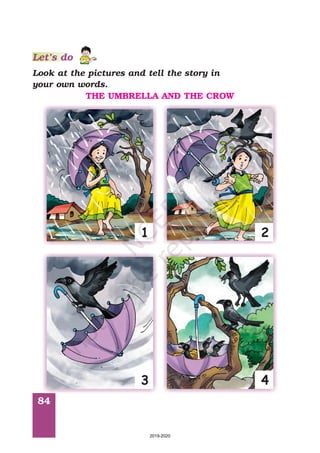
Look at the pictures and tell the story in
your own words.
THE UMBRELLA AND THE CROW
1
3
2
4
Let’s do
2019-2020
85
Rearrange the following sentences in the right
order to make it into a story on the left page.
A wind blows.
It is raining.
The crow flies away with the umbrella.
The girl has an umbrella.
The umbrella is now a nest.
The umbrella hangs from a tree.
4
4
4
4
4
4
Now say the story in English using the words rain,
crow, nest, is, has, blows, flies.wind,
Let’s read and write
2019-2020
86
In this unit we introduce children to sounds like , , , ,
, , , , and . Encourage children to listen to all the
sounds on their way to school. Let them discuss the ones that were pleasant
and those that were not. You can also ask them to recite different rhymes
involving animal sounds.
Have a reading session of the story 'Sundari'. Let each child be given a
few lines to read.
Continue to use in the classroom. Here you can put up the
following words and get the children to repeat after you.
Divide your class into four groups: , , ,
Enjoy this short play with children saying:
1, 2, 3, 4, 5
Once I caught a fish alive.
6, 7, 8, 9, 10
Then I let it go again.
11, 12, 13, 14, 15
Why did you let it go?
16, 17, 18, 19, 20
Because it bit my finger so.
Which finger did it bite?
This little finger on my right.
Let all children clap their hands and say this entire rhyme once again.
Through play, children develop the habit of establishing and following
instructions which will help them throughout their lives. Playing in
groups helps them to exercise self control. It also gives an opportunity to
the teacher to observe and improve children’s social understanding and
attitudes.
blow whoosh puff whiff
dizzy shooed shoo woof woo
sight words
Whoosh! Whoosh!
Woof! Woof!
Shoo! Shoo!
Blow! Blow!
Develop pronunciation
Exposure to language
Develop speaking skills
All children :
Group-1 :
Group-2 :
Group-3 :
Group-4 :
Group-1, 2, 3 :
Group-4 :
door tree window
4
4
4
1 2 3 4
Teacher's Pages
Poem —
Story —
A Kite
Sundari
UNIT
7
2019-2020
87
4
4
Develop writing skills / fine motor coordination
Raising awareness
Introduce to in capital letters. Write from to on the blackboard.
Let the children write and read from the board and from the picture
dictionary. Use Activity Sheets and a notebook for further practice.
Let children move in a single line saying, “ goes the train”.
Involve the children in a kite making
activity. They can either decorate their
class or the trees outside with the
kites they have made. They can talk
about festivals when kites fly in the
sky.
A Z a z
Puff, puff
MATERIAL REQUIRED
Any coloured paper,
strings and straws / twigs.
2019-2020
88
Say the poem aloud with actions
I am a little turtle
I crawl so slow,
I carry my house
Wherever I go.
When I get tired
I put in my head,
My legs and my tail
And I go to bed.
A Little Turtle
New words
A baby .
A has a shell.
crawls
turtle
carry crawl tired turtle
Let’s read
UNIT
8
2019-2020
89
Reading is fun
How does a turtle walk?
What does the turtle carry on its back?
Where does the turtle go when it is tired?
4
4
4
Let’s talk
4
4
What is the turtle’s house called?
What other reasons can you give for a turtle going
into its house?
Let’s share
Imagine you are a turtle. Crawl like a turtle.
Now you are tired so get into your shell and go to sleep.
Wake up and start to crawl again.
Now hide in your shell because some
naughty children are near you.
4
4
4
4
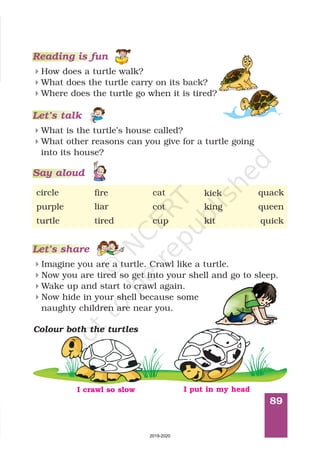
Colour both the turtles
cup quickturtle tired kit
catcircle fire kick quack
purple cotliar king queen
I crawl so slow I put in my head
Say aloud
2019-2020
90
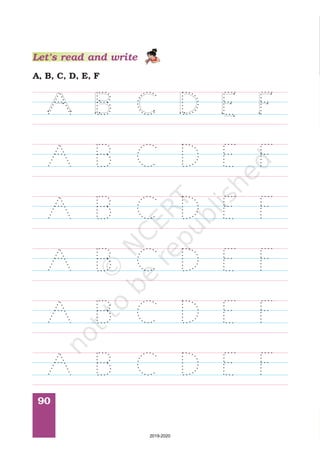
A, B, C, D, E, F
Let’s read and write
2019-2020
91
The Tiger and the Mosquito
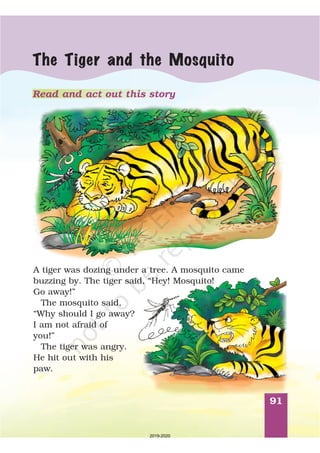
A tiger was dozing under a tree. A mosquito came
buzzing by. The tiger said, “Hey! Mosquito!
Go away!”
The mosquito said,
“Why should I go away?
I am not afraid of
you!”
The tiger was angry.
He hit out with his
paw.
Read and act out this story
2019-2020
92
Mrinalini Srivastava
I must not anyone.
I am to be an Indian.
hit
proud
New words
Let’s read
bleed great
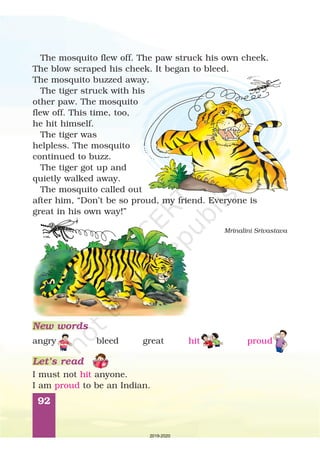
The mosquito flew off. The paw struck his own cheek.
The blow scraped his cheek. It began to bleed.
The mosquito buzzed away.
The tiger struck with his
other paw. The mosquito
flew off. This time, too,
he hit himself.
The tiger was
helpless. The mosquito
continued to buzz.
The tiger got up and
quietly walked away.
The mosquito called out
after him, “Don’t be so proud, my friend. Everyone is
great in his own way!”
angry hit proud
2019-2020
93
Reading is fun
Let’s talk
Why did the mosquito say, “I am not afraid of you!”?4
What do we learn from this story?
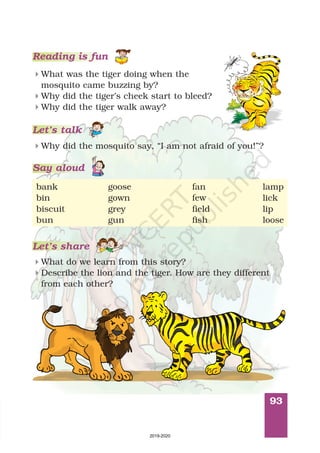
Describe the lion and the tiger. How are they different
from each other?
4
4
Let’s share
What was the tiger doing when the
mosquito came buzzing by?
Why did the tiger’s cheek start to bleed?
Why did the tiger walk away?
4
4
4
goose fan
biscuit
gun fish loose
bank
bin
bun
grey
gown few
field
lamp
lick
lip
Say aloud
2019-2020
94
Fill in the blanks by tracing the dotted words.
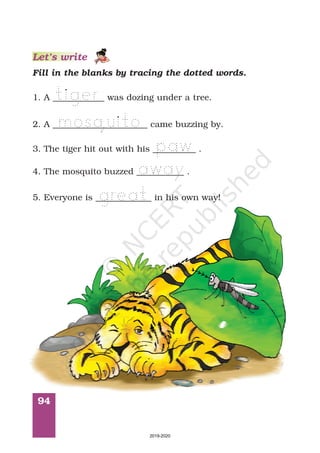
1. A ____________ was dozing under a tree.
2. A ______________________ came buzzing by.
3. The tiger hit out with his __________ .
4. The mosquito buzzed ___________ .
5. Everyone is _____________ in his own way!
Let’s write
2019-2020
95
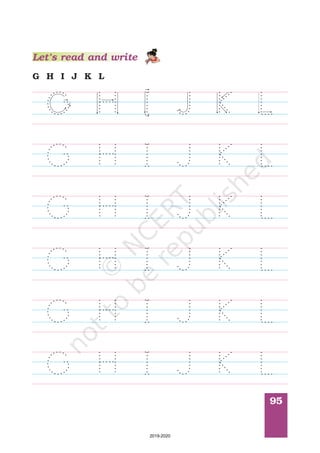
G H I J K L
Let’s read and write
2019-2020
96
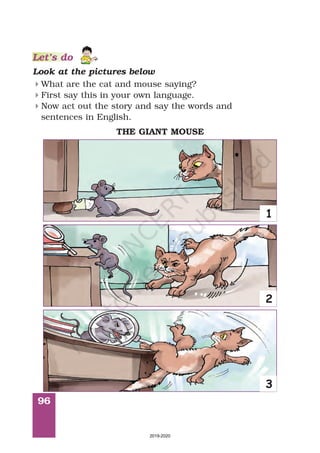
Look at the pictures below
What are the cat and mouse saying?
First say this in your own language.
Now act out the story and say the words and
sentences in English.
4
4
4
THE GIANT MOUSE
1
2
3
Let’s do
2019-2020
97
4
4
4
l
l
l
l
l
l
l
l
l
l
l
l
l
By this Unit children should be involved in
Observation
Conversation
Sharing
Reading
Writing
Craft making skills
hears
sees
feels
speak
reading
pre-
writing activities
This should be the last
milestone in the chain
of objects and things around them.
about the observation they have had.
of their own view point about the observation.
the text as much as they can, especially the new words.
Encourage the children to say dialogues in their own words; then
write the English words on the blackboard. Have a reading session of
any story from the Unit. Let each child be given a few lines to read.
Engage them in reading aloud with you.
simple words of one, two, three syllables (a syllable has one
vowel sound, e.g. mug, truck, more (one syllable); never, lazy (two
syllables) and September, October (three syllables).
such as simple folding, sticking and decorating
the classroom.
Development of listening skills — What the child is
important.
Development of visual skills — What the child is important.
Development of sharing skills — What the child is
important.
Development of speaking skills — How the child is asked to
is important.
Development of reading skills — How the child is exposed to
routine is important.
Development of fine motor skills — Child’s exposure to
is important.
Development of writing skills —
.
Encourage the children to brush their teeth after meals. As the
facilitator you can add to this list. We must educate the children to
preserve our natural resources at a very formative stage of their growth.
Use the method of developing skills in a very informal yet clear
manner. The following should be kept in mind:
Raising awareness
Teacher's Page
Poem —
Story —
A Little Turtle
The Tiger and the Mosquito
UNIT
8
2019-2020
98
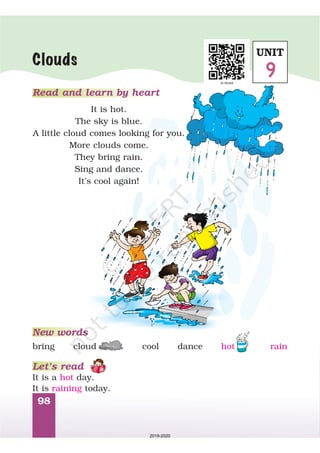
Read and learn by heart
It is hot.
The sky is blue.
A little cloud comes looking for you.
More clouds come.
They bring rain.
Sing and dance.
It’s cool again!
Clouds
New words
Let’s read
It is a day.
It is today.
hot
raining
bring cool dance rainhotcloud
UNIT
9
2019-2020
99
Reading is fun
What is the colour of the sky?
What do the clouds bring?
4
4
What is the colour of the clouds that bring us rain?
Do you like to sing and dance in the rain?
What keeps you dry in the rain?
4
4
4
What do you like to do
when it rains? (stay in/go out)
Do you like puddles?
The other seasons in India
are hot and cold.
Describe in your
language which season
you like the best.
Now can you say this in English?
4
4
4
Let’s talk
Let’s share
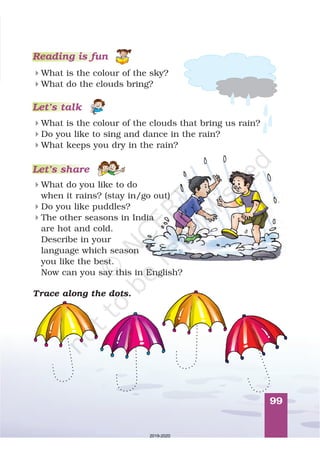
Trace along the dots.
2019-2020
100
fly
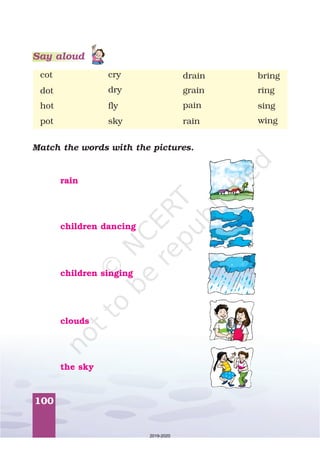
Match the words with the pictures.
the sky
clouds
rain
children singing
children dancing
cot
dot
hot
pot
cry
dry
sky
drain
grain
pain
rain
ring
bring
sing
wing
Say aloud
2019-2020
101
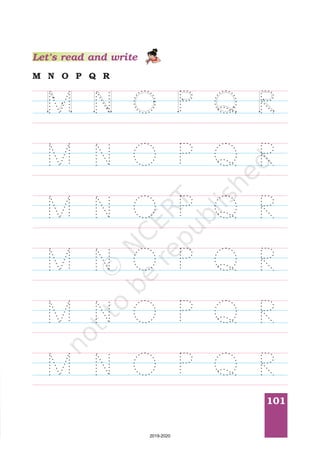
Let’s read and write
M N O P RO
2019-2020
102
I can read my name.
My name is _______________________ .
I am _______ years old.
I can write my address _______________________________
______________________________________________________
I can count till _____ . (10/20/30/40/50)
My teacher’s name is ______________________________ .
I study in class _________ (one).
The name of my school is __________________________ .
It is in _________________________________ (city).
Fill in the blanks
2019-2020
103
Anandi's Rainbow
Enjoy this nature story
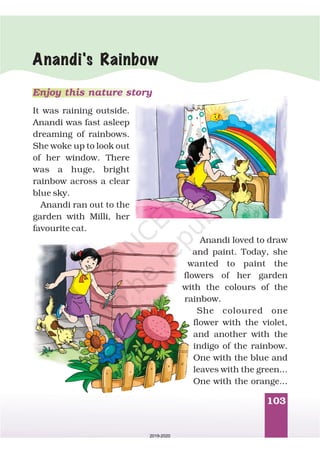
It was raining outside.
Anandi was fast asleep
dreaming of rainbows.
She woke up to look out
of her window. There
was a huge, bright
rainbow across a clear
blue sky.
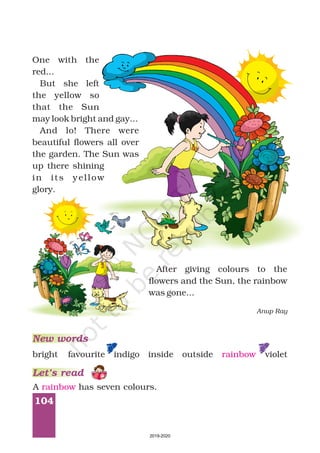
Anandi ran out to the
garden with Milli, her
favourite cat.
Anandi loved to draw
and paint. Today, she
wanted to paint the
flowers of her garden
with the colours of the
rainbow.
She coloured one
flower with the violet,
and another with the
indigo of the rainbow.
One with the blue and
leaves with the green...
One with the orange...
2019-2020
104
A has seven colours.rainbow
New words
Let’s read
bright favourite indigo inside outside rainbow violet
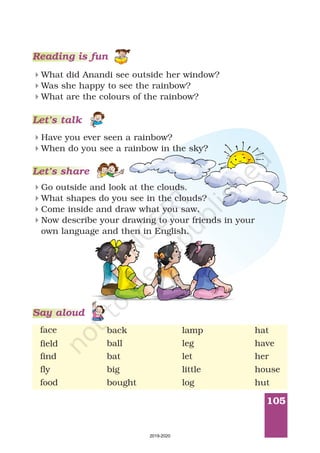
One with the
red...
But she left
the yellow so
that the Sun
may look bright and gay...
And lo! There were
beautiful flowers all over
the garden. The Sun was
up there shining
in its yellow
glory.
After giving colours to the
flowers and the Sun, the rainbow
was gone...
Anup Ray
2019-2020
105
Reading is fun
What did Anandi see outside her window?
Was she happy to see the rainbow?
What are the colours of the rainbow?
4
4
4
Let’s talk
Have you ever seen a rainbow?
When do you see a rainbow in the sky?
4
4
Let’s share
Go outside and look at the clouds.
What shapes do you see in the clouds?
Come inside and draw what you saw.
Now describe your drawing to your friends in your
own language and then in English.
4
4
4
4
ball
log
face
field
find
fly
food
back
bat
big
bought
lamp
leg
let
little
hat
have
hut
her
house
Say aloud
2019-2020
106
Look at the picture below. Circle the names of
things that you can see in the picture.
umbrella
puddle
raindrops
house
cat
boat
mud
sun
roses
pot
mat
Join the dots from Aa to Zz and see what you can create.
Cc
Dd
Ee
Ff
Gg
Hh
Ii
Jj
Kk
Ll
Mm
Nn
OoPp
Qq
Rr
Ss
Tt
Uu
Vv
Ww
Xx
Yy
Zz
Aa
Bb
Let’s do
2019-2020
107
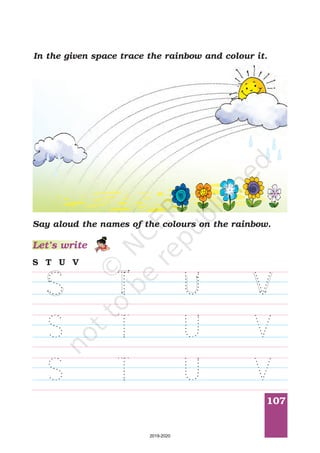
In the given space trace the rainbow and colour it.
Say aloud the names of the colours on the rainbow.
Let’s write
S T U V
2019-2020
108
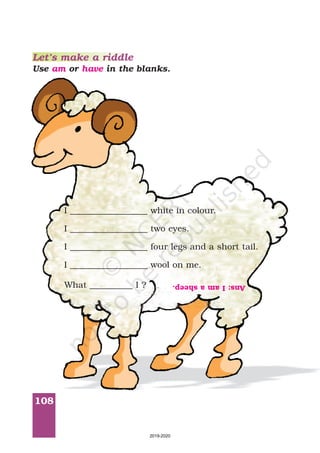
Let’s make a riddle
Use or in the blanks.am have
I __________________ white in colour.
I __________________ two eyes.
I __________________ four legs and a short tail.
I __________________ wool on me.
What __________ I ? Ans:Iamasheep.
2019-2020
109
Teacher's Page
The idea in this Unit is to assist the children in building their imagination;
making and speaking simple sentences; and writing at least a few sentences.
The sentences can be made both from the text and from their environment,
using the sight words and flash cards in their classroom or outdoors.
Let the children do the activity of . Encourage them to spot
the one that is different. For example, draw a sequence of objects such as
flowers and make one flower slightly different. Ask the children to point
out the one that is different. These kinds of activities are relevant to
reading as they help them identify and discriminate between objects and
pictures.
Alphabet cards can be used for the matching exercise. The teacher
makes cards from to in capitals and in lower case. The child has to
match the capital letter with the corresponding one in lower case. For
example, with and with .
Make a calender for every month showing birthdays of every child and
display it along with this traditional song:
Have a recitation or reading session of the poem ‘Clouds’. Let each child
be given a chance to read. The more confident he feels, the more
motivated he will be to continue in his efforts.
Have a reading session of the story ‘Anandi’s Rainbow’ from the Unit.
Let each child be given a few lines to read.
Discuss with them the following questions
How many days has September?
Does February have 30 days in the month?
How many months have thirty days?
How many months have thirty-one days?
When is your birthday?
How many children in the class have a birthday in each month?
Ask the class to repeat sentences like:
Develop reading skills
odd one out
Group activity
Develop pronunciation
Develop speaking skills
a z
A a B b
Thirty days hath September,
April, June, and November,
All the rest have thirty-one,
Excepting February alone.
‘It’s cold’, ‘It’s raining today’,
‘It’s hot’, ‘The wind is blowing’, ‘Leaves are falling’.
4
4
4
4
l
l
l
l
l
l
Poem —
Story —
Clouds
Anandi’s Rainbow
UNIT
9
2019-2020
110
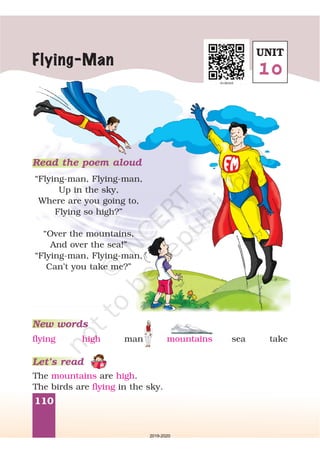
Read the poem aloud
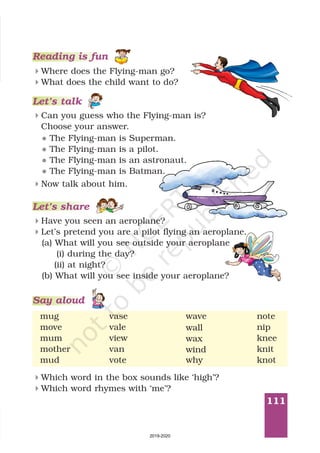
“Flying-man, Flying-man,
Up in the sky,
Where are you going to,
Flying so high?”
“Over the mountains,
And over the sea!”
“Flying-man, Flying-man,
Can’t you take me?”
Flying-Man
New words
Let’s read
The are .
The birds are in the sky.
mountains high
flying
flying high man mountains sea take
UNIT
10
2019-2020
111
Which word in the box sounds like ‘high’?
Which word rhymes with ‘me’?
4
4
mug vase wave
move vale
mum view
mother van
mud vote
wall
wax
wind
note
nip
knee
knit
knot
Reading is fun
Where does the Flying-man go?
What does the child want to do?
4
4
Can you guess who the Flying-man is?
Choose your answer.
4
l
l
l
l
The Flying-man is Superman.
The Flying-man is a pilot.
The Flying-man is an astronaut.
The Flying-man is Batman.
4Now talk about him.
Let’s talk
Have you seen an aeroplane?
Let’s pretend you are a pilot flying an aeroplane.
(a) What will you see outside your aeroplane
(i) during the day?
(ii) at night?
(b) What will you see inside your aeroplane?
4
4
Let’s share
why
Say aloud
2019-2020
112
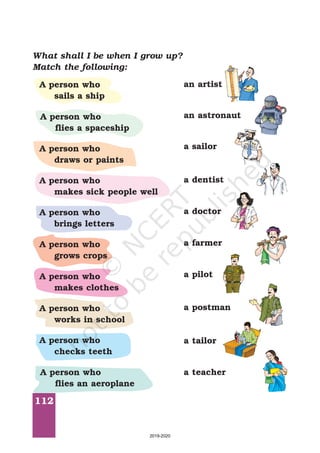
What shall I be when I grow up?
Match the following:
A person who
sails a ship
A person who
flies a spaceship
A person who
draws or paints
A person who
makes sick people well
A person who
brings letters
A person who
grows crops
A person who
makes clothes
A person who
works in school
A person who
checks teeth
A person who
flies an aeroplane
a sailor
a doctor
a pilot
a tailor
an astronaut
a dentist
a farmer
a postman
a teacher
an artist
2019-2020
113
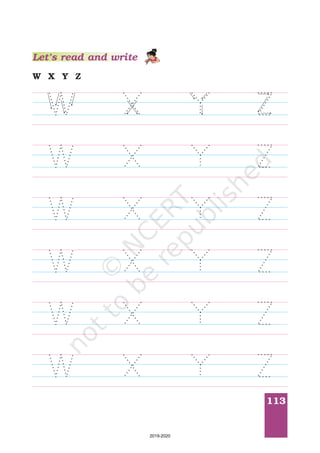
W X Y Z
Let’s read and write
2019-2020
114
2019-2020
115
The Tailor and his Friend
Read and enjoy this story
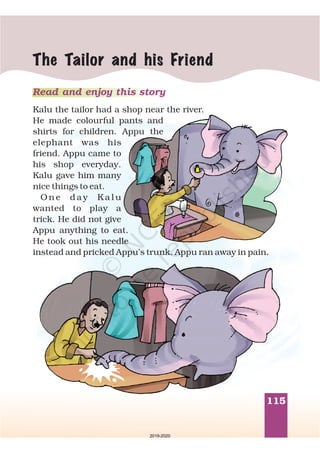
Kalu the tailor had a shop near the river.
He made colourful pants and
shirts for children. Appu the
elephant was his
friend. Appu came to
his shop everyday.
Kalu gave him many
nice things to eat.
O n e d a y K a l u
wanted to play a
trick. He did not give
Appu anything to eat.
He took out his needle
instead and pricked Appu’s trunk. Appu ran away in pain.
2019-2020
116
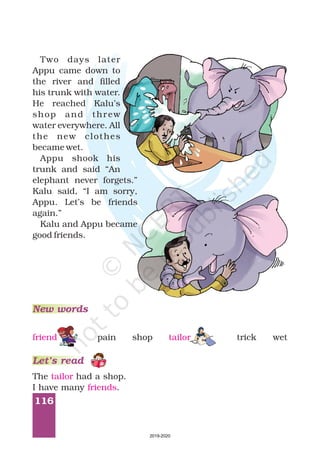
Two days later
Appu came down to
the river and filled
his trunk with water.
He reached Kalu’s
shop and threw
water everywhere. All
the new clothes
became wet.
Appu shook his
trunk and said “An
elephant never forgets.”
Kalu said, “I am sorry,
Appu. Let’s be friends
again.”
Kalu and Appu became
good friends.
The had a shop.
I have many .
tailor
friends
New words
Let’s read
pain shop trick wetfriend tailor
2019-2020
117
Let’s talk
Reading is fun
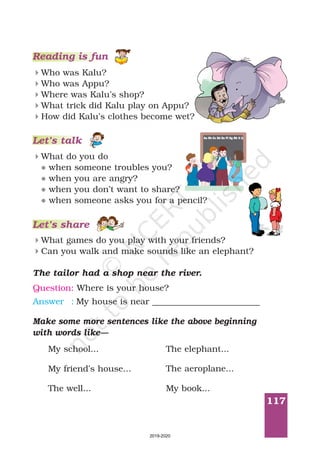
Who was Kalu?
Who was Appu?
Where was Kalu’s shop?
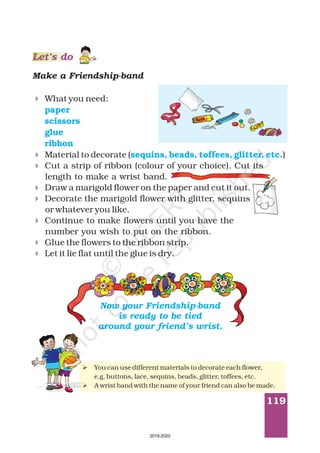
What trick did Kalu play on Appu?
How did Kalu’s clothes become wet?
4
4
4
4
4
What do you do
when someone troubles you?
when you are angry?
when you don’t want to share?
when someone asks you for a pencil?
4
l
l
l
l
Let’s share
What games do you play with your friends?
Can you walk and make sounds like an elephant?
4
4
The tailor had a shop near the river.
Question: Where is your house?
Answer : My house is near _________________________
Make some more sentences like the above beginning
with words like—
My school... The elephant...
My friend’s house... The aeroplane...
The well... My book...
2019-2020
118
pen
pink
pick
put
pan
yes
yell
young
year
yellow
zebra
zigzag
zip
zoo
zoom
jam
jeep
joy
jug
juice
Pick the odd one out. One has been done for you.
Sunday
March
Friday
April
Monday
May
Say aloud
2019-2020
119
Make a Friendship-band
4
4
4
4
4
4
4
4
What you need:
Material to decorate ( )
Cut a strip of ribbon (colour of your choice). Cut its
length to make a wrist band.
Draw a marigold flower on the paper and cut it out.
Decorate the marigold flower with glitter, sequins
or whatever you like.
Continue to make flowers until you have the
number you wish to put on the ribbon.
Glue the flowers to the ribbon strip.
Let it lie flat until the glue is dry.
paper
scissors
glue
ribbon
sequins, beads, toffees, glitter, etc.
Ø
Ø
You can use different materials to decorate each flower,
e.g. buttons, lace, sequins, beads, glitter, toffees, etc.
A wrist band with the name of your friend can also be made.
Now your Friendship-band
is ready to be tied
around your friend’s wrist.
Let’s do
2019-2020
120
4
4
4
4
4
4
4
l
l
l
The emphasis in this Unit is on:
different occupations;
imaginative thinking and
the ability to write and speak sentences.
Children should be able to write sentences such as ‘My name is…’
There can be times when the children do not speak correctly.
Remember, the main focus is on communication and the ability of the
children to express their feelings in English.
Children can be given a series of oral directions to listen to and then
follow. Gradually increase the number of directions. For example:
Encourage an in children and
provide them time for it. Motivate them by reading interesting stories and
poems. Use the language for instruction that is familiar to the child. Let
your enthusiasm for the story shine through. Speak slowly and clearly.
Some thoughts on friendship, basic hygiene, and compassion for
animals, peace and sensitivity to their environment can be discussed.
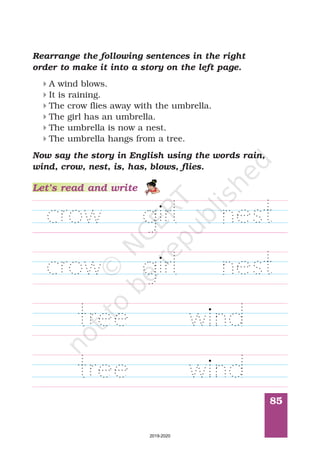
Ask the children to practice the alphabets in lower case and capital
letters. By now the child should have an understanding of basic
punctuation like capital letters, full stops and question marks and be able
to recognise plural and singular forms. In all this, the key word is
. The child who senses your faith in his abilities will learn
to trust himself and derive satisfaction from his accomplishments and
stay motivated.
are vital for the development of the child.
Through these he/she learns to communicate verbally, share, take turns
and enjoy interaction with others.
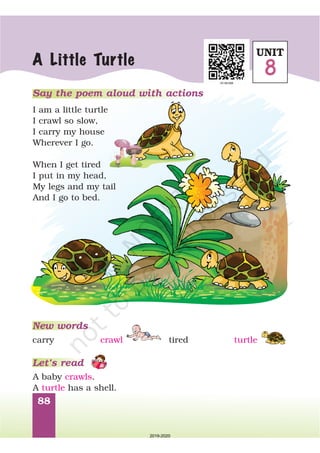
This book attempts to involve the child in a sense of joy for a new
language. The child who is gently nurtured, subtly led and exposed to all
aspects of his environment is the child who will learn.
Pat your head,
touch your nose,
pull your ear,
stamp your feet.
independent reading and writing habit
encouragement
Role play and activities
Poem —
Story —
Flying-Man
The Tailor and his Friend
Teacher's Page
UNIT
10
2019-2020
121
Aa
apple
Bb
balloon
Cc
cap
Dd
dog
Ee
elephant
Ff
fish
Gg
grapes
Hh
helicopter
Ii
igloo
Jj
jug
Kk
kite
Ll
lamp
Enjoy this picture dictionary
2019-2020
122
Ww
whale
Tt
tomato
Uu
umbrella
Vv
violin
Xx
Xmas tree
Yy
yak
Zz
zebra
Nn
nest
Oo
orange
Pp
peacock
Rr
rose
Ss
sheep
Mm
moon
Qq
quilt
2019-2020

English NCERT Class 1

  • 1.
    Textbook in Englishfor Class I MarigoldMarigold 2019-2020
  • 2.
    ALL RIGHTS RESERVED K K K Nopart of this publication may be reproduced, stored in a retrieval system or transmitted, in any form or by any means, electronic, mechanical, photocopying, recording or otherwise without the prior permission of the publisher. This book is sold subject to the condition that it shall not, by way of trade, be lent, re-sold, hired out or otherwise disposed of without the publisher’s consent, in any form of binding or cover other than that in which it is published. The correct price of this publication is the price printed on this page, Any revised price indicated by a rubber stamp or by a sticker or by any other means is incorrect and should be unacceptable. First Edition Reprinted February 2006 Phalguna 1927 November 2006 Kartika 1928 October 2007 Kartika 1929 January 2009 Magha 1930 November 2009 Kartika 1931 November 2010 Kartika 1932 January 2012 Magha 1933 December 2012 Agrahayana 1934 October 2013 Asvina 1935 November 2017 Agrahayana 1939 November 2014 Agrahayana 1936 May 2016 Vaishakha 1938 December 2016 Pausa 1938 December 2018 Agrahayana 1940 PD 400T RPS © National Council of Educational Research and Training, 2006 ` 60.00 Publication Team Head, Publication : Chief Production : M. Siraj Anwar Arun Chitkara Henu Mehtani Division Officer Production Assistant Chief Editor : Chief Business : Manager : Shveta Uppal Gautam Ganguly Sunil Kumar Cover, layout and Illustrations ISBN 81-7450-478-8 OFFICES OF THE PUBLICATION DIVISION, NCERT New Delhi 110 016 Phone : 011-26562708 Bangaluru 560 085 Phone : 080-26725740 Ahmedabad 380 014 Phone : 079-27541446 Kolkata 700 114 Phone : 033-25530454 Guwahati 781 021 Phone : 0361-2674869 NCERT Campus Sri Aurobindo Marg 108, 100 Feet Road Hosdakere Halli Extension Banashankari III Stage Navjivan Trust Building P.O.Navjivan CWC Campus Opp. Dhankal Bus Stop Panihati CWC Complex Maligaon Printed on 80 GSM paper with NCERT watermark Published at the Publication Division by the Secretary, National Council of Educational Research and Training, Sri Aurobindo Marg, New Delhi 110 016 and printed at Janambhumi Press Private Ltd., Shed No. A1/A10/B1 (A&B) Main Industrial Estate Kalapahar, Guwahati - 781 016 2019-2020
  • 3.
    The National CurriculumFramework, 2005, recommends that children’s life at school must be linked to their life outside the school. This principle marks a departure from the legacy of bookish learning which continues to shape our system and causes a gap between the school, home and community. The syllabi and textbooks developed on the basis of NCF signify an attempt to implement this basic idea. They also attempt to discourage rote learning and the maintenance of sharp boundaries between different subject areas. We hope these measures will take us significantly further in the direction of a child- centred system of education outlined in the National Policy on Education (1986). The success of this effort depends on the steps that school principals and teachers will take to encourage children to reflect on their own learning and to pursue imaginative activities and questions. We must recognise that given space, time and freedom, children generate new knowledge by engaging with the information passed on to them by adults. Treating the prescribed textbook as the sole basis of examination is one of the key reasons why other resources and sites of learning are ignored. Inculcating creativity and initiative is possible if we perceive and treat children as participants in learning, not as receivers of a fixed body of knowledge. These aims imply considerable change in school routines and mode of functioning. Flexibility in the daily time-table is as necessary as rigour in implementing the annual calendar so that the required number of teaching days are actually devoted to teaching. The methods used for teaching and evaluation will also determine how effective this textbook proves for making children’s life at school a happy experience, rather than a source of stress or boredom. Syllabus designers have tried to address the problem of curricular burden by restructuring and reorienting knowledge at different stages with greater consideration for child psychology and the time available for teaching. The textbook attempts to enhance this endeavour by giving higher priority and space to opportunities for contemplation and wondering, discussion in small groups, and activities requiring hands-on experience. NCERT appreciates the hard work done by the textbook development committee responsible for this book. We wish to thank the Chairperson of the advisory group at primary level, Professor Anita Rampal and the Chief Advisor for this book, Professor R. Lalitha Eapen (CIEFL, Hyderabad) for guiding the work of this committee. Several teachers contributed to the development of this textbook; we are grateful to their principals for making this possible. We are indebted to the institutions and organisations which have generously Foreword 2019-2020
  • 4.
    permitted us todraw upon their resources, material and personnel. We are especially grateful to the members of the National Monitoring Committee, appointed by the Department of Secondary and Higher Education, Ministry of Human Resource Development under the Chairpersonship of Professor Mrinal Miri and Professor G.P. Deshpande, for their valuable time and contribution. As an organisation committed to the systemic reform and continuous improvement in the quality of its products, NCERT welcomes comments and suggestions which will enable us to undertake further revision and refinement. National Council of Educational Research and Training Director 20 December 2005 New Delhi (iv) 2019-2020
  • 5.
    Textbook Development Committee CHAIRPERSON,ADVISORY COMMITTEE FOR TEXTBOOKS AT THE PRIMARY LEVEL MEMBERS Anita Rampal, Central Institute of Education, Delhi University R. Lalitha Eapen, English and Foreign Languages University (EFLU), Hyderabad. Ram Janma Sharma, Former and Department of Education in Languages, NCERT, New Delhi. Anju Khanna, The Circle, New Delhi. Meenu Kumar, Rajkiya Pratibha Vikas Vidyalaya, Vasant Kunj, Delhi. Rekha Johnson, Demonstration School, RIE, Ajmer. Usha Dutta, Department of Education in Languages, NCERT, New Delhi. Professor, Professor, Professor Head, Principal, PGT, Primary Teacher, rofessor, CHIEF ADVISOR CHIEF COORDINATOR MEMBER-COORDINATOR Nita Berry, New Delhi. Shobha Chanana, Kendriya Vidyalaya, Sagar, Madhya Pradesh. Children’s Literature Specialist, TGT, Former P 2019-2020
  • 6.
    Acknowledgements National Council ofEducational Research and Training is most grateful to the following for their valuable contributions in the development of this book – R. Amritavalli, CIEFL, Hyderabad, M.L. Tickoo, CIEFL, Hyderabad and Sonika Kaushik, Sanskriti School, New Delhi. The Council also thanks the following authors, copyright holders for permission to use poems and stories included in this book. by Aileen Fisher; by Alexei Tolstoy from Russian Tales for Children, E.P. Dutton and Company Inc., New York; by Carolyn Graham; by Vineeta Krishna, Ratnasagar, 1994; , The Beacon Readers ‘At Old Lobs’ by E.H. Grassam, Ginn and Company Ltd., London, 1951; by Chitra Narendran, Frank Educational Aids Pvt. Ltd., New Delhi; by Dorothy W. Baruch; by Manorama Jafa, Ratnasagar Pvt. Ltd.; by Pranab and Smita Chakravarti, National Book Trust, India, 2005; adapted from ‘Cleo’ by Ruth Dixon in ‘The Children’s Treasury,’ compiled by Marjorie Barrows, Consolidated Book Publishers, Chicago, 1947; by Mrinalini Srivastava, translated by Alaka Shankar, Children’s Book Trust, New Delhi, 2003 and by Anup Ray, National Book Trust, India, 2004. We also acknowledge Bharat Gyan Vigyan Samithi by Nikolai Radlov, New Delhi 2004 for and ; Central Institute of English and Foreign Languages (CIEFL), Hyderabad for and C by Lois Birken Shaw Fleming. Special thanks are due to Shveta Uppal, NCERT and Vandana R. Singh, C for going through the manuscript and suggesting relevant changes. The Council also gratefully acknowledges the contributions of Rituraj Sharma, Keerti Lingwal, ; Sunanda, and Parash Ram Kaushik in shaping this book. Last but not the least, the efforts of the Publication Department, NCERT are highly appreciated. Professor, Professor (Retd.), Primary Teacher, After a Bath The Bubble, the Straw and the Shoe One Little Kitten Lalu and Peelu Mother Hen and the Chicks Mittu and the Yellow Mango Merry-Go-Round Circle Our Tree Sundari The Tiger and the Mosquito Anandi’s Rainbow Picture Stories Giant Rat Umbrella Nest Beginning Reading Programme, 2000 ome on Everybody, Let’s Sing Chief Editor, onsultant Editor DTP Operator; Proof Reader Copy Editor Incharge Computer Station, 2019-2020
  • 7.
    C O NT E N T S 1–15Unit 1 A Happy Child Three Little Pigs 16–28Unit 2 After a Bath The Bubble, the Straw, and the Shoe 29–41Unit 3 One Little Kitten Lalu and Peelu iii–ivForeword 2019-2020
  • 8.
    Unit 6 If IWere an Apple Our Tree 64–76 Unit 7 A Kite Sundari 77–87 42–52Unit 4 Once I Saw a Little Bird Mittu and the Yellow Mango 53–63Unit 5 Merry-Go-Round Circle (viii) 2019-2020
  • 9.
    Unit 10 Flying-Man The Tailorand his Friend 110–120 Unit 9 Clouds Anandi’s Rainbow 98–109 Unit 8 A Little Turtle The Tiger and the Mosquito 88–97 (ix) Picture Dictionary 121–122 2019-2020
  • 10.
  • 11.
    1 A Happy Child Myhouse is red - a little house; A happy child am I. I laugh and play the whole day long, I hardly ever cry. I have a tree, a green, green tree, To shade me from the sun; And under it I often sit, When all my play is done. reddaycry sun New words UNIT 1 The shines in the sky. I have a pen. sun red Let’s read Enjoy this poem 2019-2020
  • 12.
    2 Read and matchthe words with the pictures. Draw a line. I am a boy. I am a girl. Fun with colours Fill in the box with the right colour. What is the colour of the happy child’s house? What is the colour of your house? What is the colour of the tree? What is the colour of the sun? 4 4 4 4 boy girl Is there a tree growing near your house? Tell us about the tree. Is it big or small? Do you like the tree? What is the name of the tree? 4 4 Let’s talk 2019-2020
  • 13.
    3 Let’s share There aremany kinds of houses. Circle the ones you have seen. hut igloo flat bungalow Let’s draw Draw your house here and talk about it. How do you feel — 4 4 4 4 When you get a new dress? When you get hurt? When you share your things? When you are ill? Draw and say happy sad ________ ________ 2019-2020
  • 14.
    4 How many peoplelive in your house? Write here. ____________ people live in my house. Sing 2019-2020
  • 15.
    5 Look in amirror. What do you see? Draw your face in this circle. WriteJoin the dotted lines. Read: Write: a, b, c. a a a a a 2019-2020
  • 16.
    6 Collect pictures ofa cat, a cow, a dog and a sheep from old books or newspapers and paste them below. Trace over the dotted lines and complete the monkey’s tail. Monkey, monkey on a tree, Swing, swing, swing, swing. Sing A dog A cat A cow A sheep 2019-2020
  • 17.
    7 The following havelost their babies. Trace along the maze using different colours and find them. One has been done for you. cow dog cat duck lion kangaroo butterfly 2019-2020
  • 18.
    8 Listen and enjoythis story Once there were three little pigs, Sonu, Monu and Gonu. Sonu lived in a house of straw. Monu lived in a house of sticks and Gonu lived in a house of bricks. One day a big bad wolf came to Sonu’s house. He said, “I will huff and puff and I will blow your house down. So he huffed and he puffed and he blew the house down. Sonu ran to Monu’s house. The wolf came to Monu’s house. He said, “I will huff and puff and I will blow your house down. So he huffed and he puffed and he blew Monu’s house down. ” ” Three Little Pigs 2019-2020
  • 19.
    9 Sonu and Monuran to Gonu’s house. ” The wolf came to Gonu’s house. He said, “I will huff and puff and I will blow your house down. So he huffed and he puffed but he could not blow the brick house down. It was very strong. The wolf went away and Sonu, Monu and Gonu lived happily together in the red brick house. and bad big but not the was The wolf was and . The was . big bad pig not big New words Let’s read pigone11 2019-2020
  • 20.
    Let’s share 10 Reading isfun How many pigs were there? What did the big wolf say to the pigs? 4 4 Was the wolf good or bad? What is your house made of? 4 4 Who is good? Who is bad? 4 4 pig wolf 4 4 Imagine you are at home when the wolf huffs and puffs. Act out the story of the wolf and three pigs. Let’s act Let’s talk 2019-2020
  • 21.
    11 Join the dotsfrom 1 to 10 to make the house. Then colour the picture. Let’s draw 1. One 2. Two 3. Three 4. Four 5. Five 6. Six Say aloud
  • 22.
    12 There are farmanimals, water animals and jungle animals in this picture. Help the animals reach their homes. Draw lines. bear frog crocodile hen horse dog buffalo FARM 2019-2020
  • 23.
    13 rhinoceros monkey cow giraffe JUNGLE ‘Bow wow’, saysthe dog, ‘Mew mew’, says the cat, ‘Bleat bleat’, says the goat, ‘Roar roar’, says the lion, ‘Hello, hello’, says the child. Sing WATER 2019-2020
  • 24.
    14 The emphasis inthis book is on developing language skills by using the mother tongue in the initial stages. The teacher’s encouragement and motivation are very important. Children are curious and love to try things in their own little ways. Do not correct their mistakes. Focus on the process of learning and remember that the child needs to be given activities that are exciting and stimulating. The is about introducing the child to a process of learning following the concept . Allow them to talk and help them to express their thoughts by use of their mother tongue, visuals, pictures, sketches, single word questions and answers. As you introduce the text (both the poem and the story), encourage all the children to participate. Read the poem/story aloud to the children. Read it with emphasis on clear speech and correct pauses at commas and full stops. Let the children read aloud after you. Make them repeat Use in the classroom by putting visuals and cue cards. Let children read these: 1. Encourage children to walk and jump like different animals. Let them make the sounds of etc. with force. 2. Write two-letter words on the blackboard such as and start a contextual conversation by saying, Provide opportunities to children for working and playing together in first Unit Develop listening skills Develop pronunciation Exposure to language Develop speaking skills ‘from near to far’ sight words ‘huff’, ‘puff'’ , , , , , , , ‘She is a girl’, ‘I am a teacher’, ‘Please give me a pencil’, ‘He is a boy’, ‘You are so far away’, ‘It is a warm/cold day’ etc. blow, flow, glow brick, kick, stick huff, puff, stuff b d b d b g c t b n s d r d d g h t s n 4 4 4 4 a e i o u a e i o u am he in is it me my so Poem — Story — A Happy Child Three Little Pigs Teacher's Pages UNIT 1 2019-2020
  • 25.
    15 small groups. Itwill promote interaction, togetherness and team spirit besides encouragement for natural expressions. 3. Conversation based on ‘Role play’ Divide your class into four groups: , , , Let each group make a house. and groups have to talk about all the objects in their houses. and groups have to talk about objects around their houses. Each group uses low- cost waste material (e.g. newspapers, cardboard, grass, leaves, matchsticks, etc.) to draw, sketch, construct or act out a scene from their house. Writing needs practice before it becomes spontaneous and neat. In making the strokes show the child how to hold the pencil and use it safely. Encourage children to make different patterns/basic strokes by drawing them on the blackboard, slate/paper. Put two letter and three letter words on flash cards and show them to the children. Let them recognise the words. Talk about turning off taps and not wasting water. Red— Blue— Yellow— Green— Red Blue Yellow Green Method— Develop writing skills / fine motor coordination Raising awareness a hut a flat a bungalow an igloo l l l 4 4 Red Yellow Blue Green MATERIAL REQUIRED Boxes/old cartons for collecting leaves, twigs... Pencils / spoons, beads, string etc. 2019-2020
  • 26.
  • 27.
  • 28.
    18 Let’s do Match thefollowing to make pairs. One has been done for you. Let’s draw Draw or stick a picture of yourself and your friend here. Then complete the sentences and say them aloud. needle bat socks shirt bowl shoes shorts thread spoon ball Me My friend My name is ____________________________ My friend’s name is _____________________________ 2019-2020
  • 29.
    19 Trace the pathto the flowers. 2019-2020
  • 30.
    20 Trace over thewaves and colour the fish. a b c d e f Learn to write Say aloud 2019-2020
  • 31.
    21 Listen and enjoythis story Once upon a time there lived a Bubble, a Straw and a Shoe. One day they went into the forest. They came to a river. They did not know how to cross it. The Shoe said, “Bubble, let us float on you.” The Bubble, the Straw and the Shoe 2019-2020
  • 32.
    22 bank bubble burstriver splash New words Let’s read “No, Shoe! Let Straw stretch himself from one bank to the other. Then we can cross the river.” So, the Straw stretched himself from one bank to the other. When the Shoe jumped on the Straw, it broke. The Shoe fell into the water with a loud splash. The Bubble shook and shook with laughter and burst with a big bang. Alexei Tolstoy cross shoes I can blow . I can wear . bubbles shoes 2019-2020
  • 33.
    Let’s share 23 Reading isfun Name the three friends. Where did they go one day? What did they want to do? 4 4 4 How do you make bubbles? What do you wear on your feet? How would you cross a river? 4 4 4 Put these doing words into the sentences. Let’s draw Let’s talk jumped shook stretched burst The Straw _____________ himself from one bank to the other. The Shoe __________________ on the Straw. The Bubble ______________ and ______________ with laughter and _______________ with a big bang. Trace the journey of a tadpole. puddle pond lake river I am a frog now! 2019-2020
  • 34.
    24 Draw the bubbles.Trace and say the letters aloud. Hop a little, jump a little One two three. Run a little, skip a little Tap one knee. Bend a little, stretch a little Nod your head. Yawn a little, sleep a little In your bed. Sing 2019-2020
  • 35.
    25 Match the ballswith their numbers. Now trace the numbers. Look at these objects. Put them into a tub of water. Say which one will float and which one will sink. Think time ribbon feather stoneleafmarble stick paper straw shoes spoon seven nine ten eight 2019-2020
  • 36.
    26 Draw the well,colour it and say the rhyme aloud. A bell fell In the well. Ding dong, Ding dong bell. Sing Learn to write 2019-2020
  • 37.
    27 Poem — Story — Aftera Bath The Bubble, the Straw and the Shoe Conversation is a very important and natural activity for the development of vocabulary and speech patterns. In Unit 2, involve all the children in these joyful interactive sessions. Encourage them with phrases such as, “Please try”, or “Oh! You are so good!” Appreciate every child's efforts and ensure a feeling of success for all the children. Consider the abilities of each child. Practise the poem and say it aloud to the children. Read the story with emphasis on new words and enable them to bring experiences into reading for understanding and enriching their imagination. Read the text and say aloud with the children Use in the classroom by putting visuals and cue cards. Let the child read these: 1. Have a talk on brushing teeth, washing hands, hygiene etc. 2. Conversation based on ‘Role play’ Divide the class into four groups , , , Let them say, ‘I try to save water’ as they wipe themselves with towels. Involve the children in an activity e.g. cleaning the cobwebs with sticks/mops or tidying the classroom or class cupboard. Let them say, ‘I try to clean my space.’ Mix some soap in a bowl of water. Stir it to build up bubbles. Use it for the floating/sinking activity if you like. Let them pick up papers, wrappers etc. from the school playground and put them into dustbins. All groups are to make cutouts which can be hung in the class/outdoors/on the door/on the walls/on the trees. Develop listening skills Develop pronunciation Exposure to language Develop speaking skills Group Red: Group Blue: Group Yellow: Group Green: sight words cry, dry, try dog, fog, log dine, fine, mine cake, shake, take dr w h n p t d g bl e str w p n w t l g gl e 4 4 4 4 l l a e i o u a e i o u Red Yellow Blue Green Teacher's Pages UNIT 2 2019-2020
  • 38.
    28 l 4 4 Imagine you arewalking down a street and you see a friend far away. Wave out and call your friend. 1. (a) Write on the blackboard and . Let the child write numbers and trace a few letters. These are the child’s attempts at writing. The teacher can gradually lead the child to proper formation of letters. Also provide each child with a comfortable writing position, adequate space and an appreciative atmosphere. (b) Each child's grip on the pencil and appropriate colouring within lines must be looked into. (c) Use Activity Sheets to further encourage the patterns as on pages 19, 20, 23, 24, 25 and 26 and numbers 1 to 10 (here co-ordinate with the maths teacher). However, do not force the child. 2. Enact a situation when your writing hand is hurt and you have to write. 3. Show children how to open and close buttons/zip and tie shoelaces. Talk to the children about switching off lights, fans etc. when not required. Develop writing skills / fine motor coordination to Raising awareness a, e, i, o, u 1 10 MATERIAL REQUIRED Any old clothes with buttons, purse / bag with a zip, shoes with laces. 2019-2020
  • 39.
    29 Listen and enjoythis poem One little kitten Two big cats Three baby butterflies Four big rats Five fat fishes Six sad seals Seven silly seagulls Eight happy eels; Nine nervous lizards Ten brave bees Eleven smelly elephants Twelve fat fleas Thirteen alligators Fourteen whales Fifteen donkeys With fifteen tails. Carolyn Graham New words Let’s read A saw a .fat cat rat cat rat sad ten One Little Kitten fat UNIT 3 2019-2020
  • 40.
    30 4 4 How many kindsof creatures are there in the poem? Are the seals happy? 4 4 4 4 Where do the fish live? What are the other things found in water? There are many creatures in the poem. Which ones have you seen? Tell us about when you feel — Reading is fun Let’s talk sad happy brave nervous Let’s share Make faces to show your feelings to your friends. sad happy brave nervous 2019-2020
  • 41.
    31 Look at thepictures of the animals given below and underline them in the poem. Then trace the letters. kitten catbutterfly rat fish seal seagull eel elephant flea alligator whale donkey Let’s draw bee lizard 2019-2020
  • 42.
    32 am he ifin is it me my no of on so to us we all and bad big bit but can cat cry day dog fat let met not one pig ran red sad saw sit sun ten the try two was wet you Say aloud 2019-2020
  • 43.
    33 Look and read Saythese words aloud. Then match them with the pictures by drawing lines. bag cottin tap axehen foxantpen cap Fill in the blanks from the words given above. c __ p f __ x t __ p p __ n h __ n __ nt b __ g c __ t t __ n __ xe 2019-2020
  • 44.
    34 Lalu and Peelu Listenand enjoy this story There was a hen. She had two chicks, Lalu and Peelu. Lalu was red. He loved red things. Peelu was yellow. He loved yellow things. One day Lalu saw something on a plant. It was red. He ate it up. Oh, no! It was a red chilli. It was very hot. Lalu’s mouth started burning. He screamed. 2019-2020
  • 45.
    35 Mother Hen camerunning. Peelu came too. Peelu said, I’ll get something for you!” Peelu brought a yellow laddu. “ I love . The ran to their mother. plants chicks New words Let’s read chicks hen Vineeta Krishna Lalu gobbled up the laddu. His mouth stopped burning. Mother Hen and Lalu kissed Peelu. yellowplanthot 2019-2020
  • 46.
    36 Reading is fun 4 4 4 Namethe chicks in the story. Who liked yellow things? What did Lalu eat one day? Let’s talk 4Peelu brought a yellow laddu for Lalu. What are the other things Peelu could have brought that are both yellow and sweet? Name at least two, e.g. a mango. 4Lalu loves red things. Peelu loves yellow things. The colour red is called ‘lal’ in Hindi and yellow is called ‘peela’. What do you call these colours in your language? Let’s share 4Give names to these chicks using the names of some other colours in your language. Lalu Peelu 2019-2020
  • 47.
    37 Match the chicksto the eggs they have hatched from. One has been done for you. Trace the letters on the eggs a e i o u Let’s write Trace and colour these flowers. Red rose Bluebells Yellow sunflower Riddle Time ! Red plus yellow is orange Red plus blue is purple Blue plus yellow is green Add white to make them light. Let’s draw a e i o u 2019-2020
  • 48.
    38 Mother Hen andthe Chicks Let’s act Come to me, chicks. I want you here. Look at me. Do what I do. Down and up. Up and down. What do you want, mother? Mother! Mother! I can do what you do. Look at me. Down and up. Up and down. 2019-2020
  • 49.
    39 Act out thisstory with the class. Look at me, chicks. Do what I do. Up-down - Oh! Oh! Mother! Mother! The water! The water! Percy is down, down, in the water. Oh! Percy, Percy! Adapted from E.H. Grassam 2019-2020
  • 50.
    40 While working withthe children provide them with activities that are interesting and challenging. Give opportunities for fun to the children and encourage early writing attempts. Help them to develop the skill to identify and discriminate objects, pictures, colours, shapes etc. Recite the poem to the children using appropriate actions/gestures. Read the story with emphasis on new words and make sentences with reference to the story. Read the text and say aloud with the children Use in the classroom such as visuals and cue cards. Let the children read these: The little play on chicks can introduce vocabulary in an interesting, conversational way. 1. Have a talk on eating healthy food. 2. Conversation based on ‘Role play’ Divide the class into four groups , , , to make paper bags. to collect leaves for eyes, nose, ears. to roll a string/play dough for whiskers. to roll a rope/twigs to make tails. All groups will join to complete the paper bags. The children can decorate them with animal faces or figures. Afterwards these can be used as hand puppets. You can encourage the children as they go about doing this activity. Add any other material that you may want. Develop listening skills Develop pronunciation Exposure to language Develop speaking skills Group Red: Group Blue: Group Yellow: Group Green: ate, date, gate boy, joy, toy burn, turn bees, fleas sight words 4 4 4 4 l a e i o u Red Yellow Blue Green Poem Story — — One Little Kitten Lalu and Peelu Teacher's Pages UNIT 3 MATERIAL REQUIRED Any old paper bags/ newspapers, glue, thread, rope, coloured pencils and markers. 2019-2020
  • 51.
    41 l l 4 4 Imagine you areeating a fruit and it falls down. Ask the children what they would do. Act out a situation when (i) you are hungry (ii) you are full (iii) you overeat. 1. Write the words and numbers to on the blackboard. Let the child write numbers and read from the board. Use Activity Sheets to further encourage the patterns as on pages 31, 33 and 37 and numbers 11 to 20 (here co-ordinate with the maths teacher). However, do not force the child. 2. Sorting things into groups is an essential part of learning. By differentiating between objects, children start to think about similarities and differences and how things can be categorised. Show children how to sort leaves and twigs by placing them in two different piles. 3. Give children coloured beads and ask them to string them in a sequence. For example, one blue bead, two red beads and so on. Or on a string, thread two or three beads and ask the children the number of beads. Tell the children to wash their hands before and after meals. Develop writing skills / fine motor coordination 11 20 Raising awareness hat bed pin hot cut, , , , 2019-2020
  • 52.
  • 53.
    43 4 4 What did thechild see? What was the little bird doing? 4 4 Do you see any birds around your school or your house? Have you tried talking to them? Join the letters from a to z. Reading is fun Let’s talk Let’s do a b c d e f g h i j k l m n o p q r s t u v wx y z 2019-2020
  • 54.
    44 Trace over thedotted lines and letters. Now colour the stars. Say these words aloud and talk about the picture. Then tick the right colour. door windows floorwallsroof plants dustbin The roof is / . The walls are / . The windows are / The door is / . The dustbin is / The plants are / The floor is / pink blue yellow red green brown. blue grey pink green. green orange. grey brown. 2019-2020
  • 55.
    45 Mittu and theYellow Mango Mittu was a parrot. A green parrot with a red beak. One day Mittu was flying. He loved to fly. He looked down. He saw a big yellow mango on a tree. Mittu liked mangoes. “I want to eat that yellow mango,” he said. He flew down to the tree. “Caw, caw, go away. This is my tree,” said a voice. Mittu looked up. He saw a big black crow. “Caw, caw, go, go, the crow shouted. He had a very loud voice. Mittu was afraid of the crow. He flew away. ” Listen and enjoy this story 2019-2020
  • 56.
    46 Mittu saw ared balloon. It was under a tree. He had an idea. He picked up the red balloon. He was careful not to burst it. He flew to the mango tree. The crow was sitting on the tree. Mittu went behind the tree. He pecked the balloon with his red beak. “Pop!” The balloon burst. It made a loud noise. “Caw!” said the crow. And he fell off the tree. “Caw, caw, a big gun is after me,” said the crow. He flew away. He never came back to the tree. 2019-2020
  • 57.
    47 Mittu came tothe tree. He ate the big yellow mango. “Yummy yummy, what a nice mango! he said. He was very happy. Clever Mittu! ” Chitra Narendran 4 4 4 What did Mittu see on the tree? What did the big black crow say? What did Mittu see under the tree? Reading is fun 4 4 4 Do you like eating mangoes? Do you like green mangoes? Why? Do you like yellow mangoes? Why? Let’s talk I like eating a . I like feeding a . mango crow Let’s read New words black crow mango parrot 2019-2020
  • 58.
    48 Let’s share Colour thechilli red and the parrot in colours of your choice. Trace the path of the lady bird. Parrot with a red beak, Can you really speak? Mittu, Mittu, Mittu, Mittu! Sing 2019-2020
  • 59.
    49 Match the fruitand vegetables to the trees they grow on. coconut tree grapevine banana tree mango tree apple tree coconut apple grapes mango banana 2019-2020
  • 60.
    50 Learn to write batbed bit dot bun cat fed hit hot fun mat red pit pot run Choose a letter from the box and complete the words below. a e i o u s__t p__g b__g d__t s__n f__n l__g s__t l__t b__n Draw over the dotted lines. Say aloud 2019-2020
  • 61.
    51 Teacher's Pages Poem — Story— Once I saw a Little Bird Mittu and the Yellow Mango The children look forward to this active approach of hearing, doing and participating. Now they can be given the freedom to choose their groups and tasks. Groups can be divided into those who want to (i) taste something tangy like a lemon, (ii) sweet like sugar, (iii) bitter like neem/bitter gourd or (iv) salt. Let them make with the required ingredients and drink it. Shared activities will foster healthy relationships. By this time children should be able to read a few words. Involve them in a reading activity, laying emphasis on the highlighted words in the text. Say aloud with the children Display in the classroom. Sight word vocabulary is developed by using words repeatedly in meaningful contexts. Let children read these: 1. The peacock is our national bird. The male bird has a beautiful tail. The female is called a peahen. Encourage children to talk about other birds they see in their school or near their homes. 2. Conversation based on ‘Role play’ At this stage children should be able to identify different sounds in their environment. Ask them to imagine that they are birds and let them call out to another bird. Encourage them to listen to sounds of nature (chirping of birds, rainfall, wind blowing etc.) nimbu pani ‘Stop’ says the red light, ‘Go’ says the green. ‘Wait’ says the yellow light, Blinking in between. sight words Develop reading skills Develop pronunciation Exposure to language Develop speaking skills chilli mango parrot 4 4 4 4 l UNIT 4 MATERIAL REQUIRED 2 lemons, little sugar, little salt, and . a a neem leaves drinking water 2019-2020
  • 62.
    52 l l 4 4 Act out ascene when the children are birds flying in the sky. The children may be taken out and given their food outdoors. Let them be motivated to talk about different tastes after the meal or have a conversation about if the activity has been done. 1. Write the following words and numbers on the blackboard — and digits from to . Use Activity Sheets and you can also start using a notebook to further encourage the patterns as on pages 43, 44, 48, 49 and 50. 2. Show the children how to draw a bird/ make a bird with clay/play dough. Tell the class that birds are our friends. We can feed them with some grains or bread crumbs. nimbu pani , , , Develop writing skills / fine motor coordination 1 10 Raising awareness hop stop shop mop 2019-2020
  • 63.
    53 I climbed upon the merry-go-round, And it went round and round. I climbed up on a big brown horse, And it went up and down. Around and round And up and down, Around and round And up and down. I sat high up On a big brown horse And rode around On the merry-go-round On the merry-go-round Around And round And Round... And rode around On the merry-go-round I rode around Dorothy W. Baruch Merry-Go-Round I ride a horse.on Listen, sing and dance New words Let’s read around down out round uponin UNIT 5 2019-2020
  • 64.
    54 Let’s share Let’s talk Readingis fun How did the merry-go-round go? How did the big brown horse go? 4 4 Have you seen a merry-go-round? Where have you seen it? Would you like to go to a fair? 4 4 4 Look at this picture and describe the fair. Talk about the things you enjoy at a fair. 4 4 2019-2020
  • 65.
    55 Go round themerry-go-round, circle the letters and say them aloud. a b c d e f g h i j k l m n o p q r s t u v w x y z 2019-2020
  • 66.
    56 Circle Listen, read anddraw One day Mohini was sitting with her grandmother. Grandmother drew a circle. “Can you draw a circle, Mohini?” “Yes I can.” Soon Mohini drew a circle. “Now, I’ll draw a ball.” Grandmother drew three lines on the circle. Mohini drew three lines on her circle. It really looked like a ball. “Now let’s draw a balloon.” Grandmother added a zig-zag line to the circle. 2019-2020
  • 67.
    57 Manorama Jafa I candraw a . The is round. circle moon New words Let’s read ball blue circle lines moon “Oh! It really looks like a balloon.” Mohini clapped with joy. Mohini drew many circles— big and small circles, red, blue, green and yellow circles. She also added zig-zag lines to these. And now there were many balloons. “Can you draw something else with a circle?” asked Grandmother. “Yes,” said Mohini. She drew a wheel, a moon, a sun, a rabbit and her own face. 2019-2020
  • 68.
    Reading is fun 58 Whatdid Grandmother and Mohini draw first? What were the colours of the balloons that Mohini drew? 4 4 Let’s draw In the circles below draw—4 what Grandmother drew what Mohini drew Look at these shapes.4 Try making these shapes into a car a house a door anything else 2019-2020
  • 69.
    59 Draw a faceon the balloon below. One has been done for you. Draw along the dots. So, what did you make? Can you make sounds like a train? 2019-2020
  • 70.
    60 a, b, c,d, e, f g, h, i, j, k, l m, n, o, p, q, r ba cdLet’s read and write 2019-2020
  • 71.
    61 peachmango nut orange Lookat the picture and fill in the blanks. c ___ ___ e ___ ___ ___ ___ ___ ___ ___ o ___ ___ d ___ ___ h ___ ___ ___ ___ b ___ ___ ___ cat dog elephant owl bull horse 2019-2020
  • 72.
    Teacher's Pages 62 Activities nowhave more to do with what the children like to do. You can try this: Make the children sit in a circle. Ask a child to start counting from number 1. The child sitting next to him/her continues with number 2 and so on. The child who has to say number 5 or 10 says and the next child starts with number 1 again. Draw a circle on the floor with a piece of chalk. Let the children walk along the drawn line. Ask them to hold a book/any object in one hand and walk along the line. Talk to them about balancing things. Ask them if they feel giddy on a merry-go-round. The children can be taken outdoors during the break and allowed to eat their snacks there. Let them talk to each other about the different tastes of foods. Ask children to speak to the point and take turns. Also inculcate in them a habit of listening when others speak. Read the following words and say aloud with the children: Display the following in the classroom and let the children read them aloud. Children can play ‘Farmer’s in the Den’ or any other song of their choice. chup sight words The farmer’s in the den, The farmer wants a wife, The farmer’s in the den, The wife wants a child, Heigho-the cheerio, The child wants a nurse, The farmer’s in the den. The nurse wants a dog, The dog wants a bone. Develop listening skills Develop pronunciation Exposure to language Develop speaking skills around bound brown down found ground sound circle line oval square triangle zig-zag l l 4 4 4 4 Poem — Story — Merry-Go-Round Circle UNIT 5 2019-2020
  • 73.
    63 4 4 Develop writing skills/ fine motor coordination Raising awareness 1.Write the letters from to on the blackboard. Let the children read and write from the blackboard and the picture dictionary. Children should not be forced or pressurised to recognise words or letters. This can be done through pictures or actions. Use Activity Sheets and a notebook to further encourage the patterns as on pages 55, 58, 59, 60 and 61, and any extra exercises that the children want to do. 2.Pour water from one container to another. Tell the class that we must cover our food from flies. a q MATERIAL REQUIRED 2 glasses / cups / pots and water 2019-2020
  • 74.
    64 Learn, recite andenjoy this poem If I Were an Apple If I were an apple And grew on a tree, I think I’d drop down On a nice boy like me. I wouldn’t stay there Giving nobody joy, I’d fall down at once And say, “Eat me, my boy!” New words Let’s read I like to eat an . We clap our hands with . apple joy apple boy eat drop joy UNIT 6 2019-2020
  • 75.
    65 Reading is fun Howcan the boy get the apple? Where is the apple? Where is the boy? 4 4 4 Let’s talk Do you like apples? Have you ever climbed a fruit tree? 4 4 Let’s share Fill in the blanks. If I were a bird, I would____________. (fly, cry) If I were a bee, I would (buzz, chirp)_____________. Let’s read and write s t u v 2019-2020
  • 76.
    66 apple drew dewball people grew few call ripple threw mew fall Fill in the letters to complete the crossword puzzle. Use the pictures as clues to find the fruit. Word fun O R G A N O E P R A A N A S E 1 2 3 4 5 6 1 2 3 4 5 6 Which is your favourite fruit? Say why you like it, first in your own language and then in English. Say aloud 2019-2020
  • 77.
    67 Our Tree Listen andread A little bird sees Ripe fruit on our tree And eats a tasty berry. The bird flies tall And a berry seed falls. The rains have come Hurry! let’s run. Clouds, rain and sun... Our plant is born, a little one. Now a tree, With branches long, Crows and bird-song, Crawling ants and spiders’ webs, Caterpillars with tiny legs, Rich green leaves, life aplenty. 2019-2020
  • 78.
    68 Clouds bring . Thehas branches. rain tree New words Let’s read berry caterpillars nest rain tree Pranab and Smita Chakravarti The tree has fruit, Some big, some small, Let us pluck them But do not fall! Strong branches, With pretty swings, Our beautiful tree Has so many things. Crows perch, squirrels run, And see the monkeys Having fun! 2019-2020
  • 79.
    69 Reading is fun Wheredoes the little bird see the fruit? What does she do? What happens when she eats the berry? 4 4 4 Where do birds live? Have you seen any birds near your house? Do you know their names in English or in your own language? 4 4 4 Circle the things you can find on a tree. beehive clothes kite crows pencil bookleaves Let’s talk Let’s share ant 2019-2020
  • 80.
    70 Name the fruitsyou can see on the push cart. Say which ones you like the most. 4 How does a seed grow? Look at the pictures below and number them in the correct order. Juicy fruits I dig the earth. I plant the seed. I water the plant. The plant grows. apples pineapples mangoes bananas grapes oranges I like the most.apples Let’s do 2019-2020
  • 81.
    71 w x yz Let’s read and write Put a tick ( ) if it is true. Put a cross ( ) if it is not true.ü X Let’s think True Not true I like fruit. I like flowers. There is a tree near my house. The tree has flowers. The tree has fruit. 2019-2020
  • 82.
    72 Help the birdreach its nest. Can you climb a tree?4 Yes, I can climb. Yes, I can pluck. Yes, I can catch. Yes, I can jump. 2019-2020
  • 83.
    73 Murali’s Mango Tree Listen,read and enjoy this story Shyamala Kumaradas One day Murali ate a mango. He threw the seed behind his house. Many months later, he saw a plant. He watered the plant every day. The plant grew into a big mango tree. Every summer, many mangoes grow on it. Now, Murali’s children eat the mangoes. 2019-2020
  • 84.
    74 Draw a treeshowing leaves, branches, fruit, birds, nest and a swing. Read the sentences and tick ( ) the right picture.ü Murali ate a (banana /mango ) one day. He threw the (seed /mango ) behind his house. Many months later, he saw a (seed /plant ). He watered the (seed /plant ) every day. Many (apples /mangoes ) grew on the tree. Let’s talk Describe the picture using all the words given above. Should trees be cut? Name some trees which you have seen. 4 4 4 2019-2020
  • 85.
    75 This unit isa good opportunity for involving children in interesting activities about their environment. Encourage children to look and listen attentively and express their thoughts freely. Talk to them about trees around and how important they are. Share with them topics like “Why do you think trees are important for us?” Give them clues like, “They give us shade, flowers, fruits etc.” Let the children make a class tree with their handprints. Let them stick leaves and twigs on it. Write this verse and stick it under a tree. Words like can be introduced. This time let the be the names of children which can be pasted on the tree that the children have made. Names of all the children such as Give children a week or two to learn a rhyme, one in their language and one in English. Let them recite these. Always appreciate their efforts. Do not push children who are not ready for it. As facilitators we must let children speak at their own pace. Group Activity Develop pronunciation tree, bee, flea Exposure to language Develop speaking skills What do I plant? When I plant a tree I plant a circle of shade around me; A circle of shade Where people come To rest under the sun. sight words Ritu Kabir Mohan Lofang l l 4 4 4 4 Teacher's Pages Poem — Story — If I were an Apple Our Tree Murali’s Mango Tree UNIT 6 MATERIAL REQUIRED A sheet of paper, some twigs, some leaves and an old cardboard sheet 2019-2020
  • 86.
    76 4 4 4 Develop writing skills rz Use the method of developing fine motor coordination Awareness raising Write the letters from to on the blackboard. Let the children read from the board and the picture dictionary. Encourage these early writing attempts and ensure a feeling of success for all children. Use Activity Sheets and a notebook to further encourage the patterns as on pages 65, 66, 69, 70, 71, 72 and 74. Tell the class how to sort out three mixed pulses into different piles or sort leaves on the basis of their colour, shape and texture. Have a discussion on the hazards of throwing things into the river and why we must stop this from happening. 2019-2020
  • 87.
    77 A Kite New words Let’sread I can fly a . I love to under a tree. kite sit blow chanced sit Learn and enjoy this poem I often sit and wish that I Could be a kite up in the sky, And ride upon the breeze and go Whichever way I chanced to blow. kitebreeze UNIT 7 2019-2020
  • 88.
    78 Reading is fun Whatdoes the child wish to be? What does the child wish to do with the breeze? 4 4 Let’s talk What would you like to be? Imagine you are a bird in the sky. Describe what you will feel when you see a kite flying near you. 4 4 Do you know more words with these sounds? What are the different things that fly in the sky? If you had wings, where would you fly? 4 4 Let’s share ride dance part Trace on the rain patterns. bride kite sky side cart chance fast Say aloud 2019-2020
  • 89.
    79 Use the pictureclues to draw pictures of the day sky and night sky in the windows. Colour the pictures. You see them all in the sky. Fill in the blanks by choosing words from the box. night sky stars mooncloud rainbowsun day sky 2019-2020
  • 90.
    80 Sundari Sundari was abig red, white and blue kite. When Bobby made her she smiled at him. “You are beautiful and I will call you Sundari,” he said. One day, Bobby took Sundari to the fair. The band was playing and everyone was smiling. Bobby looked for an open space where he could run and fly his kite. Sundari looked too. Out in the grass ran Bobby, holding up his kite as high as he could. Puff! The wind c a m e a l o n g . Sundari started to fly up! But she could not go very high. A little dog was holding on to her long tail. It was in his mouth. A merry-go-round was playing a happy little tune. It was carrying lots of boys and girls round and round on its wooden animals. Read and enjoy this story 2019-2020
  • 91.
    81 Bobby shooed thedog away. “We’ll try again,” Bobby said. This time Sundari leaped up in the air. She tugged hard. Oh, how she wanted Bobby to let go of her string! She gave a big tug. Bobby had to let her go. “Wheee!” cried Sundari. “Now I can fly as high as I please!” And away she went. She flew up, up, up in the air. (Adapted from ‘Cleo’ by Ruth Dixon) New words Let’s read I feel on a merry-go-round. The was playing a tune. dizzy band band dizzy smile string tug wind 2019-2020
  • 92.
    82 Reading is fun Whomade Sundari? Why did Bobby call his kite ‘Sundari’? Did Sundari fly very high at first? What made Sundari really happy? 4 4 4 4 Let’s talk Do you like to fly kites? Who helps you to fly kites? 4 4 Let’s share Tick the objects you need to fly a kite. Colour the kite. 4 roller paper gluestick ball Name the objects in your own language. basket pair of scissors 2019-2020
  • 93.
    83 Trace over thedotted lines 2019-2020
  • 94.
    84 Look at thepictures and tell the story in your own words. THE UMBRELLA AND THE CROW 1 3 2 4 Let’s do 2019-2020
  • 95.
    85 Rearrange the followingsentences in the right order to make it into a story on the left page. A wind blows. It is raining. The crow flies away with the umbrella. The girl has an umbrella. The umbrella is now a nest. The umbrella hangs from a tree. 4 4 4 4 4 4 Now say the story in English using the words rain, crow, nest, is, has, blows, flies.wind, Let’s read and write 2019-2020
  • 96.
    86 In this unitwe introduce children to sounds like , , , , , , , , and . Encourage children to listen to all the sounds on their way to school. Let them discuss the ones that were pleasant and those that were not. You can also ask them to recite different rhymes involving animal sounds. Have a reading session of the story 'Sundari'. Let each child be given a few lines to read. Continue to use in the classroom. Here you can put up the following words and get the children to repeat after you. Divide your class into four groups: , , , Enjoy this short play with children saying: 1, 2, 3, 4, 5 Once I caught a fish alive. 6, 7, 8, 9, 10 Then I let it go again. 11, 12, 13, 14, 15 Why did you let it go? 16, 17, 18, 19, 20 Because it bit my finger so. Which finger did it bite? This little finger on my right. Let all children clap their hands and say this entire rhyme once again. Through play, children develop the habit of establishing and following instructions which will help them throughout their lives. Playing in groups helps them to exercise self control. It also gives an opportunity to the teacher to observe and improve children’s social understanding and attitudes. blow whoosh puff whiff dizzy shooed shoo woof woo sight words Whoosh! Whoosh! Woof! Woof! Shoo! Shoo! Blow! Blow! Develop pronunciation Exposure to language Develop speaking skills All children : Group-1 : Group-2 : Group-3 : Group-4 : Group-1, 2, 3 : Group-4 : door tree window 4 4 4 1 2 3 4 Teacher's Pages Poem — Story — A Kite Sundari UNIT 7 2019-2020
  • 97.
    87 4 4 Develop writing skills/ fine motor coordination Raising awareness Introduce to in capital letters. Write from to on the blackboard. Let the children write and read from the board and from the picture dictionary. Use Activity Sheets and a notebook for further practice. Let children move in a single line saying, “ goes the train”. Involve the children in a kite making activity. They can either decorate their class or the trees outside with the kites they have made. They can talk about festivals when kites fly in the sky. A Z a z Puff, puff MATERIAL REQUIRED Any coloured paper, strings and straws / twigs. 2019-2020
  • 98.
    88 Say the poemaloud with actions I am a little turtle I crawl so slow, I carry my house Wherever I go. When I get tired I put in my head, My legs and my tail And I go to bed. A Little Turtle New words A baby . A has a shell. crawls turtle carry crawl tired turtle Let’s read UNIT 8 2019-2020
  • 99.
    89 Reading is fun Howdoes a turtle walk? What does the turtle carry on its back? Where does the turtle go when it is tired? 4 4 4 Let’s talk 4 4 What is the turtle’s house called? What other reasons can you give for a turtle going into its house? Let’s share Imagine you are a turtle. Crawl like a turtle. Now you are tired so get into your shell and go to sleep. Wake up and start to crawl again. Now hide in your shell because some naughty children are near you. 4 4 4 4 Colour both the turtles cup quickturtle tired kit catcircle fire kick quack purple cotliar king queen I crawl so slow I put in my head Say aloud 2019-2020
  • 100.
    90 A, B, C,D, E, F Let’s read and write 2019-2020
  • 101.
    91 The Tiger andthe Mosquito A tiger was dozing under a tree. A mosquito came buzzing by. The tiger said, “Hey! Mosquito! Go away!” The mosquito said, “Why should I go away? I am not afraid of you!” The tiger was angry. He hit out with his paw. Read and act out this story 2019-2020
  • 102.
    92 Mrinalini Srivastava I mustnot anyone. I am to be an Indian. hit proud New words Let’s read bleed great The mosquito flew off. The paw struck his own cheek. The blow scraped his cheek. It began to bleed. The mosquito buzzed away. The tiger struck with his other paw. The mosquito flew off. This time, too, he hit himself. The tiger was helpless. The mosquito continued to buzz. The tiger got up and quietly walked away. The mosquito called out after him, “Don’t be so proud, my friend. Everyone is great in his own way!” angry hit proud 2019-2020
  • 103.
    93 Reading is fun Let’stalk Why did the mosquito say, “I am not afraid of you!”?4 What do we learn from this story? Describe the lion and the tiger. How are they different from each other? 4 4 Let’s share What was the tiger doing when the mosquito came buzzing by? Why did the tiger’s cheek start to bleed? Why did the tiger walk away? 4 4 4 goose fan biscuit gun fish loose bank bin bun grey gown few field lamp lick lip Say aloud 2019-2020
  • 104.
    94 Fill in theblanks by tracing the dotted words. 1. A ____________ was dozing under a tree. 2. A ______________________ came buzzing by. 3. The tiger hit out with his __________ . 4. The mosquito buzzed ___________ . 5. Everyone is _____________ in his own way! Let’s write 2019-2020
  • 105.
    95 G H IJ K L Let’s read and write 2019-2020
  • 106.
    96 Look at thepictures below What are the cat and mouse saying? First say this in your own language. Now act out the story and say the words and sentences in English. 4 4 4 THE GIANT MOUSE 1 2 3 Let’s do 2019-2020
  • 107.
    97 4 4 4 l l l l l l l l l l l l l By this Unitchildren should be involved in Observation Conversation Sharing Reading Writing Craft making skills hears sees feels speak reading pre- writing activities This should be the last milestone in the chain of objects and things around them. about the observation they have had. of their own view point about the observation. the text as much as they can, especially the new words. Encourage the children to say dialogues in their own words; then write the English words on the blackboard. Have a reading session of any story from the Unit. Let each child be given a few lines to read. Engage them in reading aloud with you. simple words of one, two, three syllables (a syllable has one vowel sound, e.g. mug, truck, more (one syllable); never, lazy (two syllables) and September, October (three syllables). such as simple folding, sticking and decorating the classroom. Development of listening skills — What the child is important. Development of visual skills — What the child is important. Development of sharing skills — What the child is important. Development of speaking skills — How the child is asked to is important. Development of reading skills — How the child is exposed to routine is important. Development of fine motor skills — Child’s exposure to is important. Development of writing skills — . Encourage the children to brush their teeth after meals. As the facilitator you can add to this list. We must educate the children to preserve our natural resources at a very formative stage of their growth. Use the method of developing skills in a very informal yet clear manner. The following should be kept in mind: Raising awareness Teacher's Page Poem — Story — A Little Turtle The Tiger and the Mosquito UNIT 8 2019-2020
  • 108.
    98 Read and learnby heart It is hot. The sky is blue. A little cloud comes looking for you. More clouds come. They bring rain. Sing and dance. It’s cool again! Clouds New words Let’s read It is a day. It is today. hot raining bring cool dance rainhotcloud UNIT 9 2019-2020
  • 109.
    99 Reading is fun Whatis the colour of the sky? What do the clouds bring? 4 4 What is the colour of the clouds that bring us rain? Do you like to sing and dance in the rain? What keeps you dry in the rain? 4 4 4 What do you like to do when it rains? (stay in/go out) Do you like puddles? The other seasons in India are hot and cold. Describe in your language which season you like the best. Now can you say this in English? 4 4 4 Let’s talk Let’s share Trace along the dots. 2019-2020
  • 110.
    100 fly Match the wordswith the pictures. the sky clouds rain children singing children dancing cot dot hot pot cry dry sky drain grain pain rain ring bring sing wing Say aloud 2019-2020
  • 111.
    101 Let’s read andwrite M N O P RO 2019-2020
  • 112.
    102 I can readmy name. My name is _______________________ . I am _______ years old. I can write my address _______________________________ ______________________________________________________ I can count till _____ . (10/20/30/40/50) My teacher’s name is ______________________________ . I study in class _________ (one). The name of my school is __________________________ . It is in _________________________________ (city). Fill in the blanks 2019-2020
  • 113.
    103 Anandi's Rainbow Enjoy thisnature story It was raining outside. Anandi was fast asleep dreaming of rainbows. She woke up to look out of her window. There was a huge, bright rainbow across a clear blue sky. Anandi ran out to the garden with Milli, her favourite cat. Anandi loved to draw and paint. Today, she wanted to paint the flowers of her garden with the colours of the rainbow. She coloured one flower with the violet, and another with the indigo of the rainbow. One with the blue and leaves with the green... One with the orange... 2019-2020
  • 114.
    104 A has sevencolours.rainbow New words Let’s read bright favourite indigo inside outside rainbow violet One with the red... But she left the yellow so that the Sun may look bright and gay... And lo! There were beautiful flowers all over the garden. The Sun was up there shining in its yellow glory. After giving colours to the flowers and the Sun, the rainbow was gone... Anup Ray 2019-2020
  • 115.
    105 Reading is fun Whatdid Anandi see outside her window? Was she happy to see the rainbow? What are the colours of the rainbow? 4 4 4 Let’s talk Have you ever seen a rainbow? When do you see a rainbow in the sky? 4 4 Let’s share Go outside and look at the clouds. What shapes do you see in the clouds? Come inside and draw what you saw. Now describe your drawing to your friends in your own language and then in English. 4 4 4 4 ball log face field find fly food back bat big bought lamp leg let little hat have hut her house Say aloud 2019-2020
  • 116.
    106 Look at thepicture below. Circle the names of things that you can see in the picture. umbrella puddle raindrops house cat boat mud sun roses pot mat Join the dots from Aa to Zz and see what you can create. Cc Dd Ee Ff Gg Hh Ii Jj Kk Ll Mm Nn OoPp Qq Rr Ss Tt Uu Vv Ww Xx Yy Zz Aa Bb Let’s do 2019-2020
  • 117.
    107 In the givenspace trace the rainbow and colour it. Say aloud the names of the colours on the rainbow. Let’s write S T U V 2019-2020
  • 118.
    108 Let’s make ariddle Use or in the blanks.am have I __________________ white in colour. I __________________ two eyes. I __________________ four legs and a short tail. I __________________ wool on me. What __________ I ? Ans:Iamasheep. 2019-2020
  • 119.
    109 Teacher's Page The ideain this Unit is to assist the children in building their imagination; making and speaking simple sentences; and writing at least a few sentences. The sentences can be made both from the text and from their environment, using the sight words and flash cards in their classroom or outdoors. Let the children do the activity of . Encourage them to spot the one that is different. For example, draw a sequence of objects such as flowers and make one flower slightly different. Ask the children to point out the one that is different. These kinds of activities are relevant to reading as they help them identify and discriminate between objects and pictures. Alphabet cards can be used for the matching exercise. The teacher makes cards from to in capitals and in lower case. The child has to match the capital letter with the corresponding one in lower case. For example, with and with . Make a calender for every month showing birthdays of every child and display it along with this traditional song: Have a recitation or reading session of the poem ‘Clouds’. Let each child be given a chance to read. The more confident he feels, the more motivated he will be to continue in his efforts. Have a reading session of the story ‘Anandi’s Rainbow’ from the Unit. Let each child be given a few lines to read. Discuss with them the following questions How many days has September? Does February have 30 days in the month? How many months have thirty days? How many months have thirty-one days? When is your birthday? How many children in the class have a birthday in each month? Ask the class to repeat sentences like: Develop reading skills odd one out Group activity Develop pronunciation Develop speaking skills a z A a B b Thirty days hath September, April, June, and November, All the rest have thirty-one, Excepting February alone. ‘It’s cold’, ‘It’s raining today’, ‘It’s hot’, ‘The wind is blowing’, ‘Leaves are falling’. 4 4 4 4 l l l l l l Poem — Story — Clouds Anandi’s Rainbow UNIT 9 2019-2020
  • 120.
    110 Read the poemaloud “Flying-man, Flying-man, Up in the sky, Where are you going to, Flying so high?” “Over the mountains, And over the sea!” “Flying-man, Flying-man, Can’t you take me?” Flying-Man New words Let’s read The are . The birds are in the sky. mountains high flying flying high man mountains sea take UNIT 10 2019-2020
  • 121.
    111 Which word inthe box sounds like ‘high’? Which word rhymes with ‘me’? 4 4 mug vase wave move vale mum view mother van mud vote wall wax wind note nip knee knit knot Reading is fun Where does the Flying-man go? What does the child want to do? 4 4 Can you guess who the Flying-man is? Choose your answer. 4 l l l l The Flying-man is Superman. The Flying-man is a pilot. The Flying-man is an astronaut. The Flying-man is Batman. 4Now talk about him. Let’s talk Have you seen an aeroplane? Let’s pretend you are a pilot flying an aeroplane. (a) What will you see outside your aeroplane (i) during the day? (ii) at night? (b) What will you see inside your aeroplane? 4 4 Let’s share why Say aloud 2019-2020
  • 122.
    112 What shall Ibe when I grow up? Match the following: A person who sails a ship A person who flies a spaceship A person who draws or paints A person who makes sick people well A person who brings letters A person who grows crops A person who makes clothes A person who works in school A person who checks teeth A person who flies an aeroplane a sailor a doctor a pilot a tailor an astronaut a dentist a farmer a postman a teacher an artist 2019-2020
  • 123.
    113 W X YZ Let’s read and write 2019-2020
  • 124.
  • 125.
    115 The Tailor andhis Friend Read and enjoy this story Kalu the tailor had a shop near the river. He made colourful pants and shirts for children. Appu the elephant was his friend. Appu came to his shop everyday. Kalu gave him many nice things to eat. O n e d a y K a l u wanted to play a trick. He did not give Appu anything to eat. He took out his needle instead and pricked Appu’s trunk. Appu ran away in pain. 2019-2020
  • 126.
    116 Two days later Appucame down to the river and filled his trunk with water. He reached Kalu’s shop and threw water everywhere. All the new clothes became wet. Appu shook his trunk and said “An elephant never forgets.” Kalu said, “I am sorry, Appu. Let’s be friends again.” Kalu and Appu became good friends. The had a shop. I have many . tailor friends New words Let’s read pain shop trick wetfriend tailor 2019-2020
  • 127.
    117 Let’s talk Reading isfun Who was Kalu? Who was Appu? Where was Kalu’s shop? What trick did Kalu play on Appu? How did Kalu’s clothes become wet? 4 4 4 4 4 What do you do when someone troubles you? when you are angry? when you don’t want to share? when someone asks you for a pencil? 4 l l l l Let’s share What games do you play with your friends? Can you walk and make sounds like an elephant? 4 4 The tailor had a shop near the river. Question: Where is your house? Answer : My house is near _________________________ Make some more sentences like the above beginning with words like— My school... The elephant... My friend’s house... The aeroplane... The well... My book... 2019-2020
  • 128.
    118 pen pink pick put pan yes yell young year yellow zebra zigzag zip zoo zoom jam jeep joy jug juice Pick the oddone out. One has been done for you. Sunday March Friday April Monday May Say aloud 2019-2020
  • 129.
    119 Make a Friendship-band 4 4 4 4 4 4 4 4 Whatyou need: Material to decorate ( ) Cut a strip of ribbon (colour of your choice). Cut its length to make a wrist band. Draw a marigold flower on the paper and cut it out. Decorate the marigold flower with glitter, sequins or whatever you like. Continue to make flowers until you have the number you wish to put on the ribbon. Glue the flowers to the ribbon strip. Let it lie flat until the glue is dry. paper scissors glue ribbon sequins, beads, toffees, glitter, etc. Ø Ø You can use different materials to decorate each flower, e.g. buttons, lace, sequins, beads, glitter, toffees, etc. A wrist band with the name of your friend can also be made. Now your Friendship-band is ready to be tied around your friend’s wrist. Let’s do 2019-2020
  • 130.
    120 4 4 4 4 4 4 4 l l l The emphasis inthis Unit is on: different occupations; imaginative thinking and the ability to write and speak sentences. Children should be able to write sentences such as ‘My name is…’ There can be times when the children do not speak correctly. Remember, the main focus is on communication and the ability of the children to express their feelings in English. Children can be given a series of oral directions to listen to and then follow. Gradually increase the number of directions. For example: Encourage an in children and provide them time for it. Motivate them by reading interesting stories and poems. Use the language for instruction that is familiar to the child. Let your enthusiasm for the story shine through. Speak slowly and clearly. Some thoughts on friendship, basic hygiene, and compassion for animals, peace and sensitivity to their environment can be discussed. Ask the children to practice the alphabets in lower case and capital letters. By now the child should have an understanding of basic punctuation like capital letters, full stops and question marks and be able to recognise plural and singular forms. In all this, the key word is . The child who senses your faith in his abilities will learn to trust himself and derive satisfaction from his accomplishments and stay motivated. are vital for the development of the child. Through these he/she learns to communicate verbally, share, take turns and enjoy interaction with others. This book attempts to involve the child in a sense of joy for a new language. The child who is gently nurtured, subtly led and exposed to all aspects of his environment is the child who will learn. Pat your head, touch your nose, pull your ear, stamp your feet. independent reading and writing habit encouragement Role play and activities Poem — Story — Flying-Man The Tailor and his Friend Teacher's Page UNIT 10 2019-2020
  • 131.
  • 132.