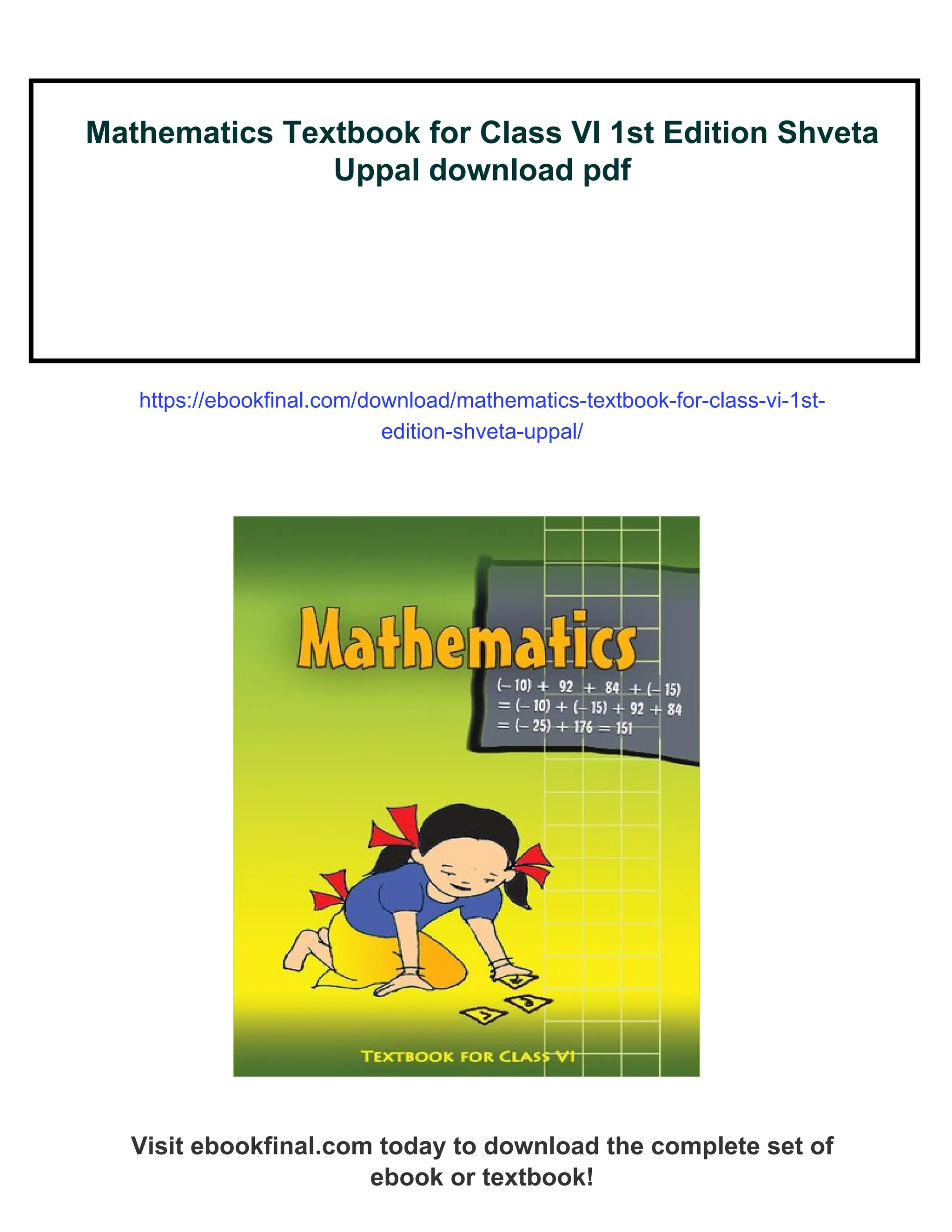
Mathematics Textbook for Class VI 1st Edition Shveta Uppal
Mathematics Textbook for Class VI 1st Edition Shveta Uppal
Mathematics Textbook for Class VI 1st Edition Shveta Uppal
Mathematics Textbook for Class VI 1st Edition Shveta Uppal
Mathematics Textbook for Class VI 1st Edition Shveta Uppal
1.
Mathematics Textbook forClass VI 1st Edition Shveta
Uppal download pdf
https://ebookfinal.com/download/mathematics-textbook-for-class-vi-1st-
edition-shveta-uppal/
Visit ebookfinal.com today to download the complete set of
ebook or textbook!
2.
Here are somerecommended products that we believe you will be
interested in. You can click the link to download.
Glencoe Geometry intro textbook Glencoe Mathematics
https://ebookfinal.com/download/glencoe-geometry-intro-textbook-
glencoe-mathematics/
Mathematics Class 10 2nd Edition Trishna Knowledge Systems
https://ebookfinal.com/download/mathematics-class-10-2nd-edition-
trishna-knowledge-systems/
A Textbook of Engineering Mathematics I 2nd Edition H.S.
Gangwar
https://ebookfinal.com/download/a-textbook-of-engineering-
mathematics-i-2nd-edition-h-s-gangwar/
APC New Perfect Composite Mathematics Class 2 3rd Edition
R. G. Gupta
https://ebookfinal.com/download/apc-new-perfect-composite-mathematics-
class-2-3rd-edition-r-g-gupta/
3.
Understanding ISC MathematicsClass 11 Sections A B C 5th
Edition M.L. Aggarwal
https://ebookfinal.com/download/understanding-isc-mathematics-
class-11-sections-a-b-c-5th-edition-m-l-aggarwal/
A Commentary on Livy Books VI X Vol I Introduction and
Book VI Oakley
https://ebookfinal.com/download/a-commentary-on-livy-books-vi-x-vol-i-
introduction-and-book-vi-oakley/
We Are What We Mourn The Contemporary English Canadian
Elegy 1st Edition Priscila Uppal
https://ebookfinal.com/download/we-are-what-we-mourn-the-contemporary-
english-canadian-elegy-1st-edition-priscila-uppal/
Mathematics for Game Developers 1st Edition Christopher
Tremblay
https://ebookfinal.com/download/mathematics-for-game-developers-1st-
edition-christopher-tremblay/
Textbook of Anaesthesia for Postgraduates 1st Edition
Agasti T. K.
https://ebookfinal.com/download/textbook-of-anaesthesia-for-
postgraduates-1st-edition-agasti-t-k/
5.
Mathematics Textbook forClass VI 1st Edition Shveta
Uppal Digital Instant Download
Author(s): Shveta Uppal; Indien National Council of Educational Research and
Training
ISBN(s): 9788174504821, 8174504826
Edition: 1
File Details: PDF, 10.74 MB
Year: 2006
Language: english
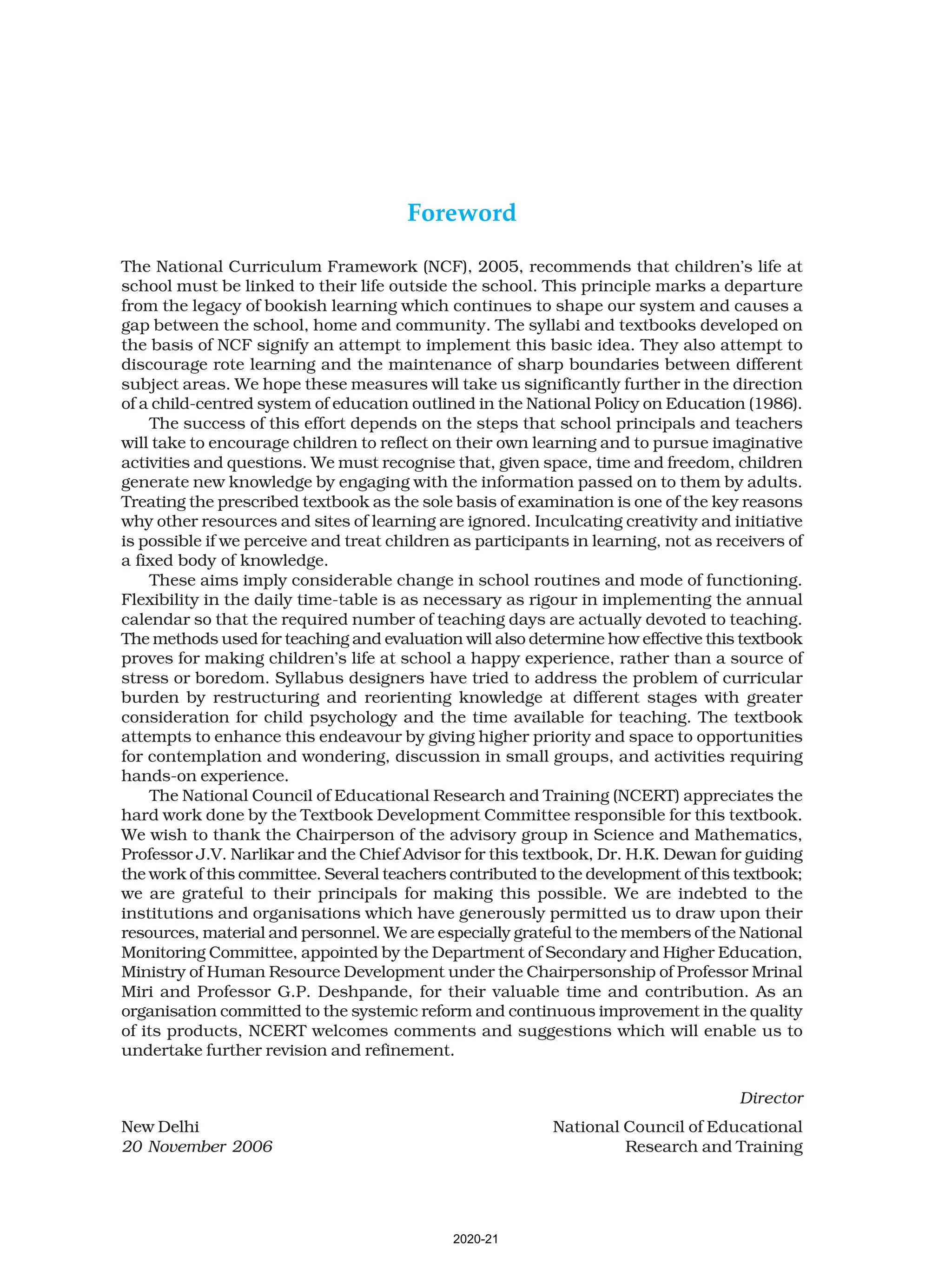
Foreword
The National CurriculumFramework (NCF), 2005, recommends that children’s life at
school must be linked to their life outside the school. This principle marks a departure
from the legacy of bookish learning which continues to shape our system and causes a
gap between the school, home and community. The syllabi and textbooks developed on
the basis of NCF signify an attempt to implement this basic idea. They also attempt to
discourage rote learning and the maintenance of sharp boundaries between different
subject areas. We hope these measures will take us significantly further in the direction
of a child-centred system of education outlined in the National Policy on Education (1986).
The success of this effort depends on the steps that school principals and teachers
will take to encourage children to reflect on their own learning and to pursue imaginative
activities and questions. We must recognise that, given space, time and freedom, children
generate new knowledge by engaging with the information passed on to them by adults.
Treating the prescribed textbook as the sole basis of examination is one of the key reasons
why other resources and sites of learning are ignored. Inculcating creativity and initiative
is possible if we perceive and treat children as participants in learning, not as receivers of
a fixed body of knowledge.
These aims imply considerable change in school routines and mode of functioning.
Flexibility in the daily time-table is as necessary as rigour in implementing the annual
calendar so that the required number of teaching days are actually devoted to teaching.
The methods used for teaching and evaluation will also determine how effective this textbook
proves for making children’s life at school a happy experience, rather than a source of
stress or boredom. Syllabus designers have tried to address the problem of curricular
burden by restructuring and reorienting knowledge at different stages with greater
consideration for child psychology and the time available for teaching. The textbook
attempts to enhance this endeavour by giving higher priority and space to opportunities
for contemplation and wondering, discussion in small groups, and activities requiring
hands-on experience.
The National Council of Educational Research and Training (NCERT) appreciates the
hard work done by the Textbook Development Committee responsible for this textbook.
We wish to thank the Chairperson of the advisory group in Science and Mathematics,
Professor J.V. Narlikar and the Chief Advisor for this textbook, Dr. H.K. Dewan for guiding
the work of this committee. Several teachers contributed to the development of this textbook;
we are grateful to their principals for making this possible. We are indebted to the
institutions and organisations which have generously permitted us to draw upon their
resources, material and personnel. We are especially grateful to the members of the National
Monitoring Committee, appointed by the Department of Secondary and Higher Education,
Ministry of Human Resource Development under the Chairpersonship of Professor Mrinal
Miri and Professor G.P. Deshpande, for their valuable time and contribution. As an
organisation committed to the systemic reform and continuous improvement in the quality
of its products, NCERT welcomes comments and suggestions which will enable us to
undertake further revision and refinement.
Director
New Delhi National Council of Educational
20 November 2006 Research and Training
2020-21
Textbook Development Committee
CHAIRPERSON,ADVISORY GROUP IN SCIENCE AND MATHEMATICS
J.V. Narlikar, Emeritus Professor, Inter University Centre for Astronomy & Astrophysics
(IUCCA), Ganeshkhind, Pune University, Pune
CHIEF ADVISOR
Dr. H.K. Dewan, Vidya Bhawan Society, Udaipur, Rajasthan
CHIEF COORDINATOR
Hukum Singh, Professor, DESM, NCERT, New Delhi
MEMBERS
Anjali Gupte, Teacher, Vidya Bhawan Public School, Udaipur, Rajasthan
Avantika Dam, TGT, CIE Experimental Basic School, Department of Education, Delhi
Dharam Prakash, Reader, CIET, NCERT, New Delhi
H.C. Pradhan, Professor, Homi Bhabha Centre for Science Education, TIFR, Mumbai,
Maharashtra
Harsha J. Patadia, Senior Reader, Centre of Advance Study in Education,
M.S. University of Baroda, Vadodara, Gujarat
Jabashree Ghosh, TGT, DM School, RIE, NCERT, Bhubaneswar, Orissa
Mahendra Shankar, Lecturer (S.G.) (Retd.), NCERT, New Delhi
Meena Shrimali, Teacher, Vidya Bhawan Senior Secondary School, Udaipur, Rajasthan
R. Athmaraman, Mathematics Education Consultant, TI Matric Higher Secondary School
and AMTI, Chennai, Tamil Nadu
S. Pattanayak, Professor, Institute of Mathematics and Application, Bhubaneswar, Orissa
S.K.S. Gautam, Professor, DESM, NCERT, New Delhi
Shraddha Agarwal, PGT, Sir Padampat Singhania Education Centre, Kanpur, (U.P.)
Srijata Das, Sr. Lecturer (Mathematics), SCERT, New Delhi
U.B. Tewari, Professor, Department of Mathematics, IIT, Kanpur, (U.P.)
Uaday Singh, Lecturer, DESM, NCERT, New Delhi
MEMBER-COORDINATORS
Ashutosh K. Wazalwar, Professor, DESM, NCERT, New Delhi
Praveen K. Chaurasia, Lecturer, DESM, NCERT, New Delhi
2020-21
12.
CONSTITUTION OF INDIA
FundamentalDuties
Fundamental Duties – It shall be the duty of every citizen of India —
(a) to abide by the Constitution and respect its ideals and institutions, the National
Flag and the National Anthem;
(b) to cherish and follow the noble ideals which inspired our national struggle for
freedom;
(c) to uphold and protect the sovereignty, unity and integrity of India;
(d) to defend the country and render national service when called upon to do so;
(e) to promote harmony and the spirit of common brotherhood amongst all the people
of India transcending religious, linguistic and regional or sectional diversities; to
renounce practices derogatory to the dignity of women;
(f) to value and preserve the rich heritage of our composite culture;
(g) to protect and improve the natural environment including forests, lakes, rivers,
wildlife and to have compassion for living creatures;
(h) to develop the scientific temper, humanism and the spirit of inquiry and reform;
(i) to safeguard public property and to abjure violence;
(j) to strive towards excellence in all spheres of individual and collective activity so
that the nation constantly rises to higher levels of endeavour and achievement;
(k) who is a parent or guardian, to provide opportunities for education to his child or,
as the case may be, ward between the age of six and fourteen years.
Part IV A (Article 51 A)
2020-21
13.
Acknowledgements
The Council acknowledgesthe valuable comments of the following participants of the workshop
towards the finalisation of the book — K.K. Gupta, Reader, U.N.P.G. College, Padrauna, Uttar
Pradesh; Deepak Mantri, Teacher, Vidya Bhawan Basic School, Udaipur, Rajasthan; Shagufta
Anjum, Teacher, Vidya Bhawan Senior Secondary School, Udaipur, Rajasthan; Ranjana Sharma,
Teacher, Vidya Bhawan Secondary School, Udaipur, Rajasthan. The Council acknowledges the
suggestions given by Utpal Chakraborty, Lecturer, SCERT, Raipur, Chattisgarh.
The Council gratefully acknowledges the valuable contributions of the following
participants of the Textbook Review Workshop : K. Balaji, TGT, Kendriya Vidyalaya, Donimalai,
Karnataka; Shiv Kumar Nimesh, TGT, Rajkiya Sarvodaya Bal Vidyalaya, Delhi; Ajay Singh,
TGT, Ramjas Senior Secondary School No. 3, Delhi; Rajkumar Dhawan, PGT, Geeta Senior
Secondary School No. 2, Delhi; Shuchi Goyal, PGT, The Airforce School, Delhi; Manjit Singh,
TGT, Government High School, Gurgaon, Haryana; Pratap Singh Rawat, Lecturer, SCERT,
Gurgaon, Haryana; Ritu Tiwari, TGT, Rajkiya Pratibha Vikas Vidyalaya, Delhi.
The Council acknowledges the support and facilities provided by Vidya Bhawan Society
and its staff, Udaipur for conducting the third workshop of the development committee at
Udaipur, and to the Director, Centre for Science Education and Communication (CSEC), Delhi
University for providing library help.
The Council acknowledges the academic and administrative support of Professor
Hukum Singh, Head, DESM, NCERT.
The Council also acknowledges the efforts of Uttam Kumar (NCERT) and Rajesh Sen
(Vidya Bhawan Society, Udaipur), DTP Operators; Monika Saxena, Copy Editor; and Abhimanu
Mohanty, Proof Reader; APC office and the administrative staff DESM, NCERT and the
Publication Department of the NCERT.
2020-21
14.
CONSTITUTION OF INDIA
PartIII (Articles 12 – 35)
(Subject to certain conditions, some exceptions
and reasonable restrictions)
guarantees these
Fundamental Rights
Right to Equality
• before law and equal protection of laws;
• irrespective of religion, race, caste, sex or place of birth;
• of opportunity in public employment;
• by abolition of untouchability and titles.
Right to Freedom
• of expression, assembly, association, movement, residence and profession;
• of certain protections in respect of conviction for offences;
• of protection of life and personal liberty;
• offreeandcompulsoryeducationforchildrenbetweentheageofsix and fourteenyears;
• of protection against arrest and detention in certain cases.
Right against Exploitation
• for prohibition of traffic in human beings and forced labour;
• for prohibition of employment of children in hazardous jobs.
Right to Freedom of Religion
• freedom of conscience and free profession, practice and propagation of religion;
• freedom to manage religious affairs;
• freedom as to payment of taxes for promotion of any particular religion;
• freedom as to attendance at religious instruction or religious worship in educational
institutions wholly maintained by the State.
Cultural and Educational Rights
• for protection of interests of minorities to conserve their language, script and culture;
• for minorities to establish and administer educational institutions of their choice.
Right to Constitutional Remedies
• by issuance of directions or orders or writs by the Supreme Court and High
Courts for enforcement of these Fundamental Rights.
2020-21
15.
A Note forthe Teachers
athematics has an important role in our life, it not only helps in day-to-day situations
but also develops logical reasoning, abstract thinking and imagination. It enriches life
and provides new dimensions to thinking. The struggle to learn abstract principles develops
the power to formulate and understand arguments and the capacity to see interrelations
among concepts. The enriched understanding helps us deal with abstract ideas in other subjects
as well. It also helps us understand and make better patterns, maps, appreciate area and
volume and see similarities between shapes and sizes. The scope of Mathematics includes
many aspects of our life and our environment. This relationship needs to be brought out at all
possible places.
Learning Mathematics is not about remembering solutions or methods but knowing
how to solve problems. We hope that you will give your students a lot of opportunities to
create and formulate problems themselves. We believe it would be a good idea to ask them
to formulate as many new problems as they can. This would help children in developing an
understanding of the concepts and principles of Mathematics. The nature of the problems
set up by them becomes varied and more complex as they become confident with the ideas
they are dealing in.
The Mathematics classroom should be alive and interactive in which the children should
be articulating their own understanding of concepts, evolving models and developing
definitions. Language and learning Mathematics have a very close relationship and there
should be a lot of opportunity for children to talk about ideas in Mathematics and bring in
their experiences in conjunction with whatever is being discussed in the classroom. There
should be no obvious restriction on them using their own words and language and the shift
to formal language should be gradual. There should be space for children to discuss ideas
amongst themselves and make presentations as a group regarding what they have
understood from the textbooks and present examples from the contexts of their own
experiences. They should be encouraged to read the book in groups and formulate and
express what they understand from it.
Mathematics requires abstractions. It is a discipline in which the learners learn to generalise,
formulate and prove statements based on logic. In learning to abstract, children would need
concrete material, experience and known context as scaffolds to help them. Please provide
them with those but also ensure that they do not get over dependent on them. We may point
out that the book tries to emphasise the difference between verification and proof. These two
ideas are often confused and we would hope that you would take care to avoid mixing up
verification with proof.
There are many situations provided in the book where children will be verifying
principles or patterns and would also be trying to find out exceptions to these. So, while on
the one hand children would be expected to observe patterns and make generalisations,
they would also be required to identify and find exceptions to the generalisations, extend
patterns to new situations and check their validity. This is an essential part of the ideas of
Mathematics learning and therefore, if you can find other places where such exercises can
be created for students, it would be useful. They must have many opportunities to solve
problems themselves and reflect on the solutions obtained. It is hoped that you would give
children the opportunity to provide logical arguments for different ideas and expect them
to follow logical arguments and find loopholes in the arguments presented. This is necessary
for them to develop the ability to understand what it means to prove something and also
become confident about the underlying concepts.
M
2020-21
16.
There is expectationthat in your class, Mathematics will emerge as a subject of exploration
and creation rather than an exercise of finding old answers to old and complicated problems.
The Mathematics classroom should not expect a blind application of ununderstood algorithm
and should encourage children to find many different ways to solve problems. They need
to appreciate that there are many alternative algorithms and many strategies that can be
adopted to find solutions to problems. If you can include some problems that have the
scope for many different correct solutions, it would help them appreciate the meaning of
Mathematics better.
We have tried to link chapters with each other and to use the concepts learnt in the initial
chapters to the ideas in the subsequent chapters. We hope that you will use this as an
opportunity to revise these concepts in a spiraling way so that children are helped to appreciate
the entire conceptual structure of Mathematics. Please give more time to ideas of negative
number, fractions, variables and other ideas that are new for children. Many of these are the
basis for further learning of Mathematics.
We hope that the book will help ensure that children learn to enjoy Mathematics and
explore formulating patterns and problems that they will enjoy doing themselves. They should
learn to be confident, not feel afraid of Mathematics and learn to help each other through
discussions. We also hope that you would find time to listen carefully and identify the ideas
that need to be emphasised with children and the places where the children can be given
space to articulate their ideas and verbalise their thoughts. We look forward to your comments
and suggestions regarding the book and hope that you will send us interesting exercises that
you develop in the course of teaching so that they can be included in the next edition.
2020-21
17.
Contents
FOREWORD iii
A NOTEFOR THE TEACHERS ix
CHAPTER 1 KNOWING OUR NUMBERS 1
CHAPTER 2 WHOLE NUMBERS 28
CHAPTER 3 PLAYING WITH NUMBERS 46
CHAPTER 4 BASIC GEOMETRICAL IDEAS 69
CHAPTER 5 UNDERSTANDING ELEMENTARY SHAPES 86
CHAPTER 6 INTEGERS 113
CHAPTER 7 FRACTIONS 133
CHAPTER 8 DECIMALS 164
CHAPTER 9 DATA HANDLING 184
CHAPTER 10 MENSURATION 205
CHAPTER 11 ALGEBRA 221
CHAPTER 12 RATIO AND PROPORTION 244
CHAPTER 13 SYMMETRY 261
CHAPTER 14 PRACTICAL GEOMETRY 274
ANSWERS 293
BRAIN-TEASERS 315
2020-21
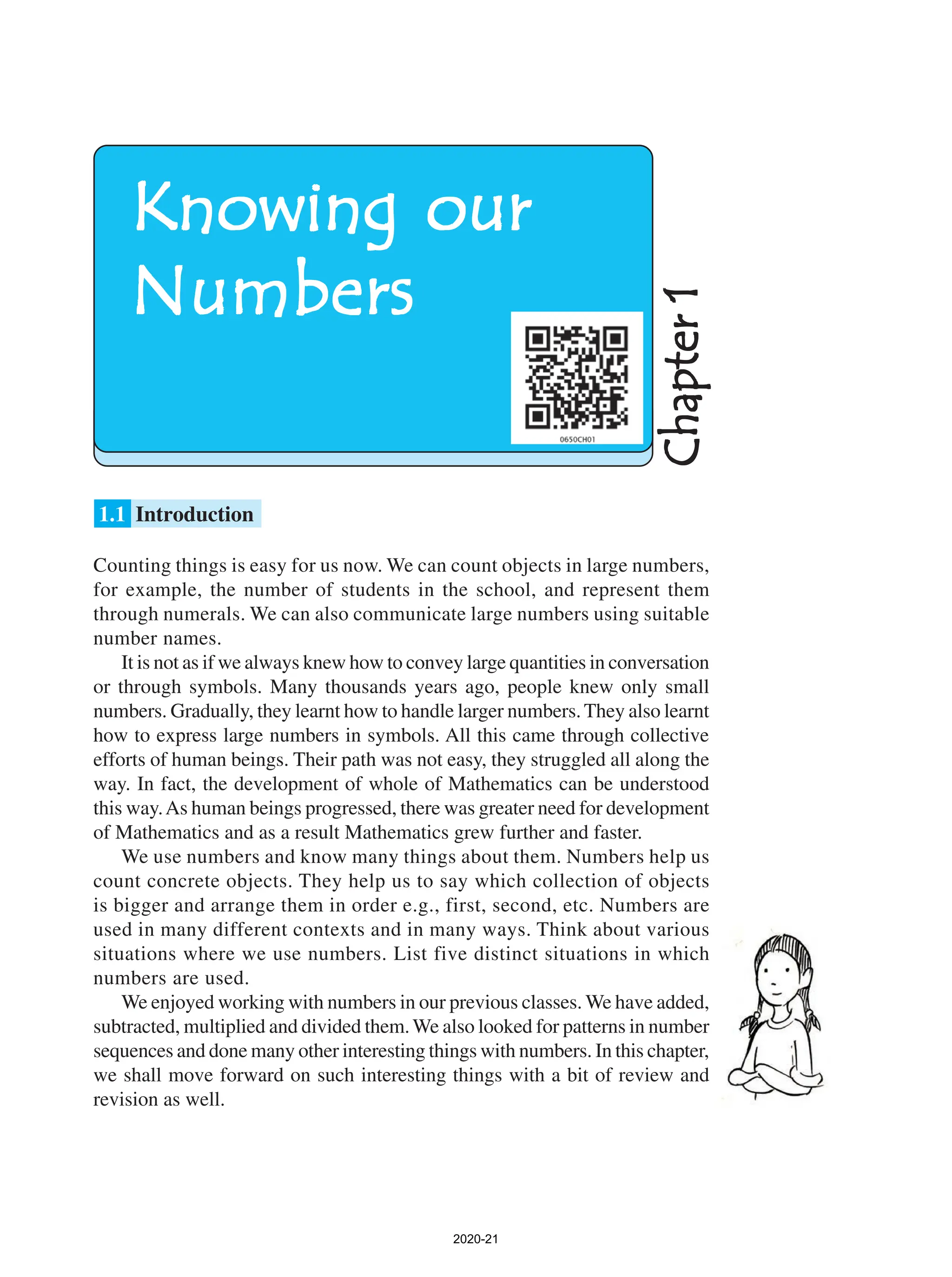
Counting things iseasy for us now. We can count objects in large numbers,
for example, the number of students in the school, and represent them
through numerals. We can also communicate large numbers using suitable
number names.
It is not as if we always knew how to convey large quantities in conversation
or through symbols. Many thousands years ago, people knew only small
numbers. Gradually, they learnt how to handle larger numbers.They also learnt
how to express large numbers in symbols. All this came through collective
efforts of human beings. Their path was not easy, they struggled all along the
way. In fact, the development of whole of Mathematics can be understood
this way.As human beings progressed, there was greater need for development
of Mathematics and as a result Mathematics grew further and faster.
We use numbers and know many things about them. Numbers help us
count concrete objects. They help us to say which collection of objects
is bigger and arrange them in order e.g., first, second, etc. Numbers are
used in many different contexts and in many ways. Think about various
situations where we use numbers. List five distinct situations in which
numbers are used.
We enjoyed working with numbers in our previous classes. We have added,
subtracted, multiplied and divided them.We also looked for patterns in number
sequences and done many other interesting things with numbers. In this chapter,
we shall move forward on such interesting things with a bit of review and
revision as well.
1.1 Introduction
Chapter
1
Chapter
1
Chapter
1
Chapter
1
Chapter
1
Knowing our
Knowing our
Knowing our
Knowing our
Knowing our
Numbers
Numbers
Numbers
Numbers
Numbers
2020-21
20.
MATHEMATICS
2
1.2 Comparing Numbers
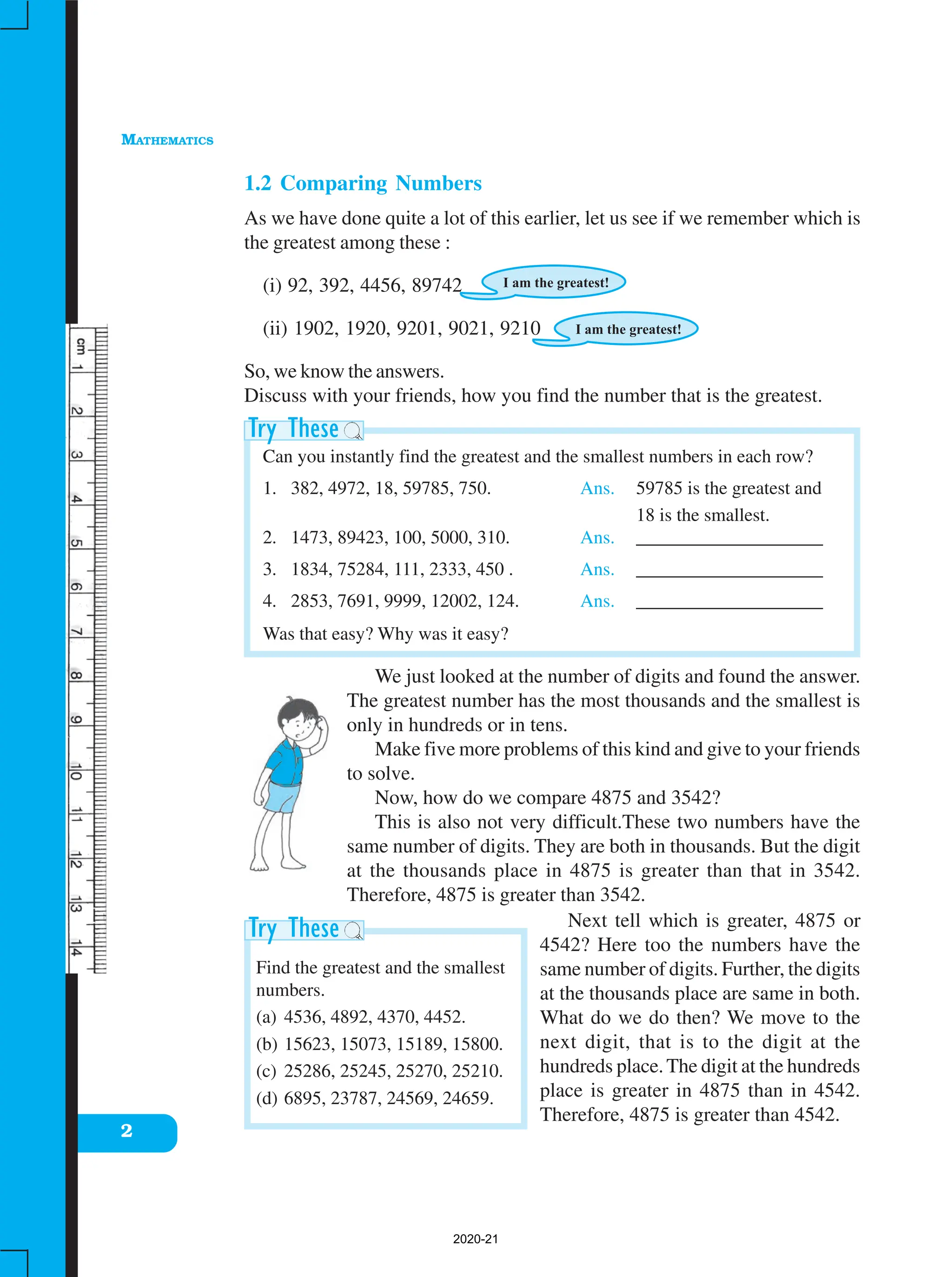
Aswe have done quite a lot of this earlier, let us see if we remember which is
the greatest among these :
(i) 92, 392, 4456, 89742
(ii) 1902, 1920, 9201, 9021, 9210
So, we know the answers.
Discuss with your friends, how you find the number that is the greatest.
Can you instantly find the greatest and the smallest numbers in each row?
1. 382, 4972, 18, 59785, 750. Ans. 59785 is the greatest and
18 is the smallest.
2. 1473, 89423, 100, 5000, 310. Ans. ____________________
3. 1834, 75284, 111, 2333, 450 . Ans. ____________________
4. 2853, 7691, 9999, 12002, 124. Ans. ____________________
Was that easy? Why was it easy?
We just looked at the number of digits and found the answer.
The greatest number has the most thousands and the smallest is
only in hundreds or in tens.
Make five more problems of this kind and give to your friends
to solve.
Now, how do we compare 4875 and 3542?
This is also not very difficult.These two numbers have the
same number of digits. They are both in thousands. But the digit
at the thousands place in 4875 is greater than that in 3542.
Therefore, 4875 is greater than 3542.
Next tell which is greater, 4875 or
4542? Here too the numbers have the
same number of digits. Further, the digits
at the thousands place are same in both.
What do we do then? We move to the
next digit, that is to the digit at the
hundreds place.The digit at the hundreds
place is greater in 4875 than in 4542.
Therefore, 4875 is greater than 4542.
Find the greatest and the smallest
numbers.
(a) 4536, 4892, 4370, 4452.
(b) 15623, 15073, 15189, 15800.
(c) 25286, 25245, 25270, 25210.
(d) 6895, 23787, 24569, 24659.
2020-21
21.
KNOWING OUR NUMBERS
3
98 6 7
1 0 2 7
4
4
9
9
1
If the digits at hundreds place are also same in the two numbers, then what
do we do?
Compare 4875 and 4889 ; Also compare 4875 and 4879.
1.2.1 How many numbers can you make?
Suppose, we have four digits 7, 8, 3, 5. Using these digits we want to make
different 4-digit numbers in such a way that no digit is repeated in them. Thus,
7835 is allowed, but 7735 is not. Make as many 4-digit numbers as you can.
Which is the greatest number you can get? Which is the smallest number?
The greatest number is 8753 and the smallest is 3578.
Think about the arrangement of the digits in both. Can you say how the largest
number is formed? Write down your procedure.
1. Usethegivendigitswithoutrepetitionandmakethegreatestandsmallest4-digit
numbers.
(a) 2, 8, 7, 4 (b) 9, 7, 4, 1 (c) 4, 7, 5, 0
(d) 1, 7, 6, 2 (e) 5, 4, 0, 3
(Hint : 0754 is a 3-digit number.)
2. Now make the greatest and the smallest 4-digit numbers by using any one
digit twice.
(a) 3, 8, 7 (b) 9, 0, 5 (c) 0, 4, 9 (d) 8, 5, 1
(Hint : Think in each case which digit will you use twice.)
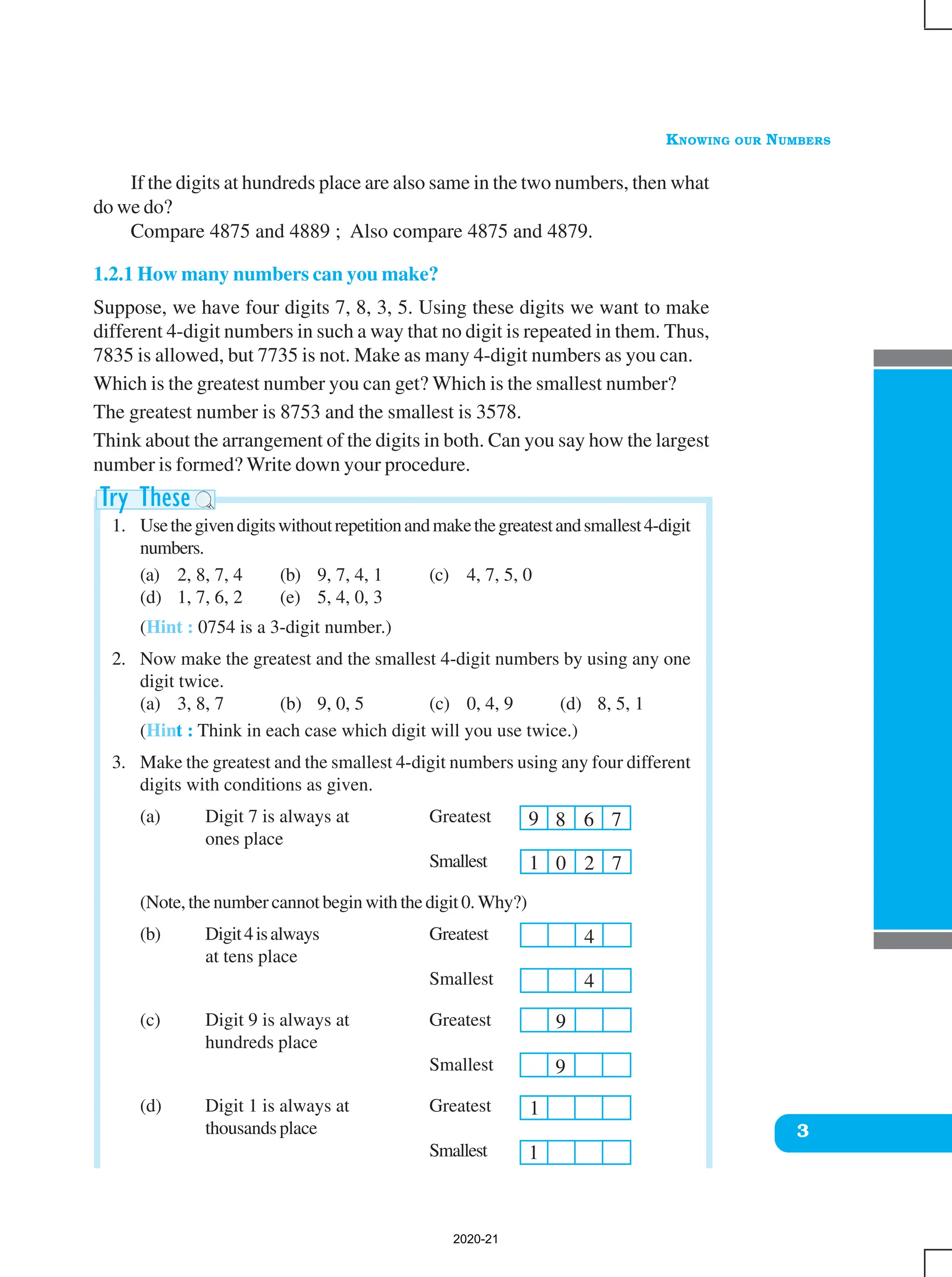
3. Make the greatest and the smallest 4-digit numbers using any four different
digits with conditions as given.
(a) Digit 7 is always at Greatest
ones place
Smallest
(Note, the number cannot begin with the digit 0. Why?)
(b) Digit4isalways Greatest
at tens place
Smallest
(c) Digit 9 is always at Greatest
hundreds place
Smallest
(d) Digit 1 is always at Greatest
thousandsplace
Smallest 1
2020-21
22.
MATHEMATICS
4
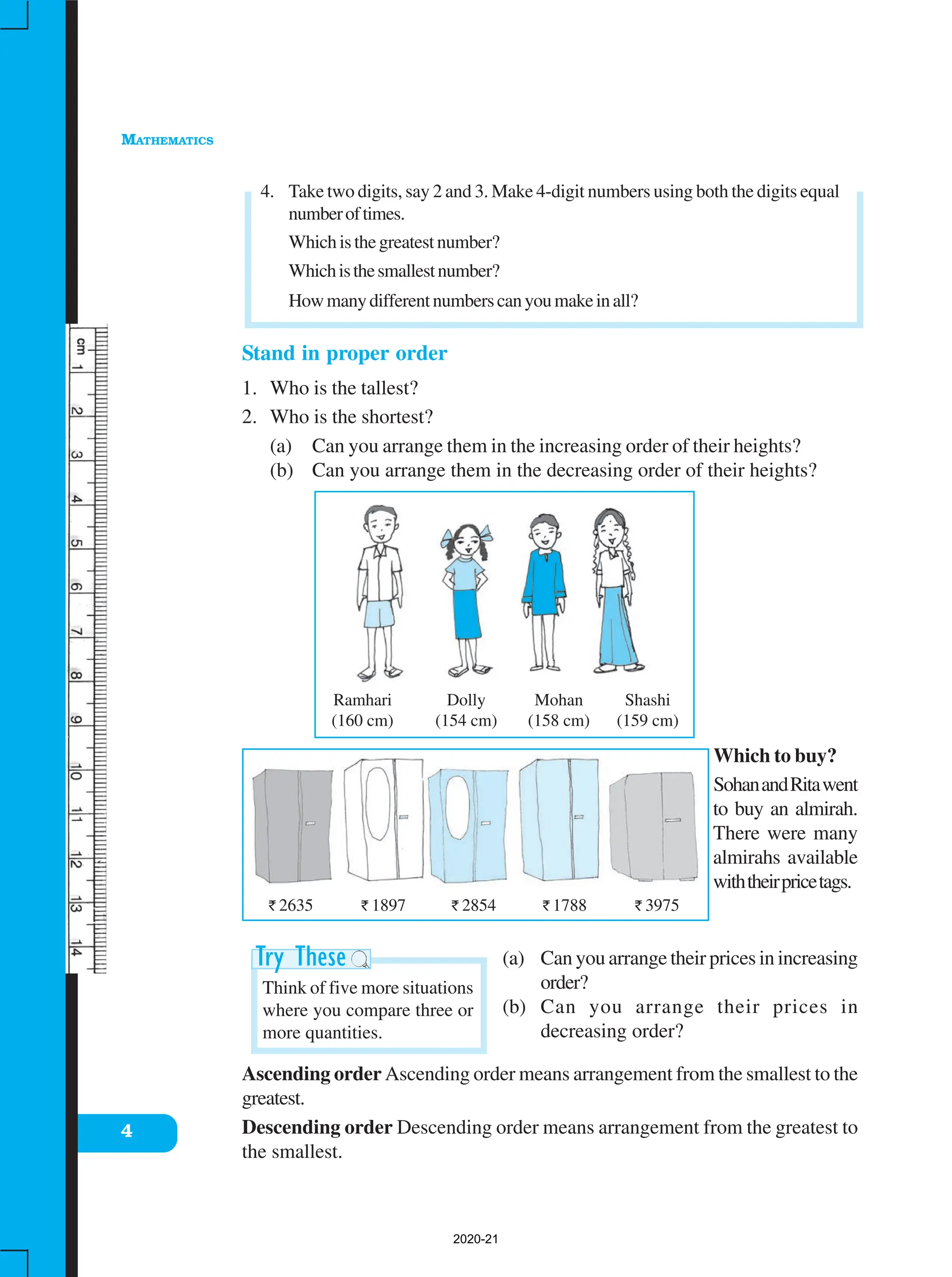
Ramhari
(160 cm)
Dolly
(154 cm)
Mohan
(158cm)
Shashi
(159 cm)
` 2635 ` 1897 ` 2854 ` 1788 ` 3975
4. Take two digits, say 2 and 3. Make 4-digit numbers using both the digits equal
numberoftimes.
Whichisthegreatestnumber?
Whichisthesmallestnumber?
Howmanydifferentnumberscanyoumakeinall?
Stand in proper order
1. Who is the tallest?
2. Who is the shortest?
(a) Can you arrange them in the increasing order of their heights?
(b) Can you arrange them in the decreasing order of their heights?
Which to buy?
SohanandRitawent
to buy an almirah.
There were many
almirahs available
withtheirpricetags.
(a) Can you arrange their prices in increasing
order?
(b) Can you arrange their prices in
decreasing order?
Ascending order Ascending order means arrangement from the smallest to the
greatest.
Descending order Descending order means arrangement from the greatest to
the smallest.
Think of five more situations
where you compare three or
more quantities.
2020-21
23.
KNOWING OUR NUMBERS
5
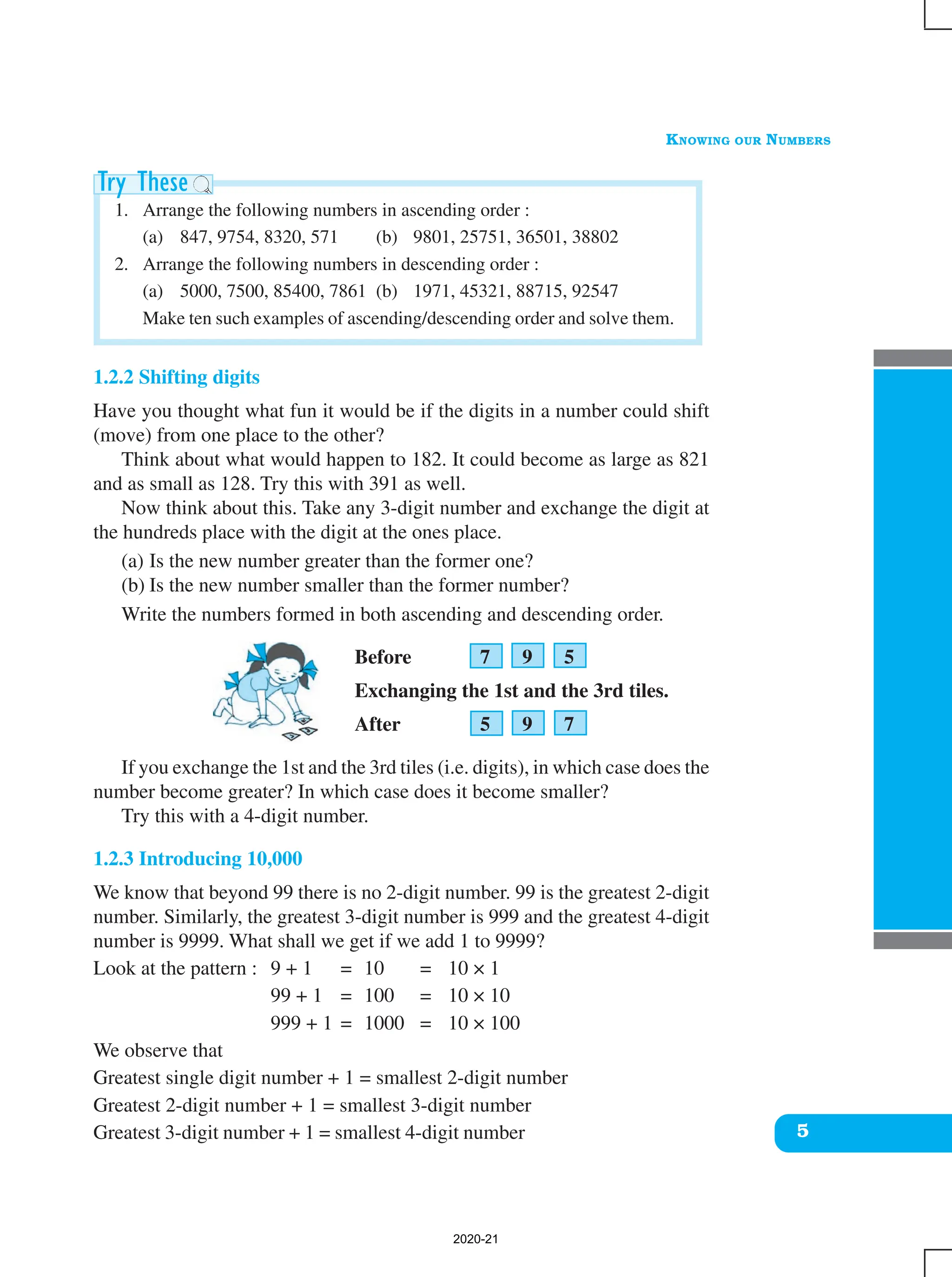
1.Arrange the following numbers in ascending order :
(a) 847, 9754, 8320, 571 (b) 9801, 25751, 36501, 38802
2. Arrange the following numbers in descending order :
(a) 5000, 7500, 85400, 7861 (b) 1971, 45321, 88715, 92547
Make ten such examples of ascending/descending order and solve them.
1.2.2 Shifting digits
Have you thought what fun it would be if the digits in a number could shift
(move) from one place to the other?
Think about what would happen to 182. It could become as large as 821
and as small as 128. Try this with 391 as well.
Now think about this. Take any 3-digit number and exchange the digit at
the hundreds place with the digit at the ones place.
(a) Is the new number greater than the former one?
(b) Is the new number smaller than the former number?
Write the numbers formed in both ascending and descending order.
Before 7 9 5
Exchanging the 1st and the 3rd tiles.
After 5 9 7
If you exchange the 1st and the 3rd tiles (i.e. digits), in which case does the
number become greater? In which case does it become smaller?
Try this with a 4-digit number.
1.2.3 Introducing 10,000
We know that beyond 99 there is no 2-digit number. 99 is the greatest 2-digit
number. Similarly, the greatest 3-digit number is 999 and the greatest 4-digit
number is 9999. What shall we get if we add 1 to 9999?
Look at the pattern : 9 + 1 = 10 = 10 × 1
99 + 1 = 100 = 10 × 10
999 + 1 = 1000 = 10 × 100
We observe that
Greatest single digit number + 1 = smallest 2-digit number
Greatest 2-digit number + 1 = smallest 3-digit number
Greatest 3-digit number + 1 = smallest 4-digit number
2020-21
24.
MATHEMATICS
6
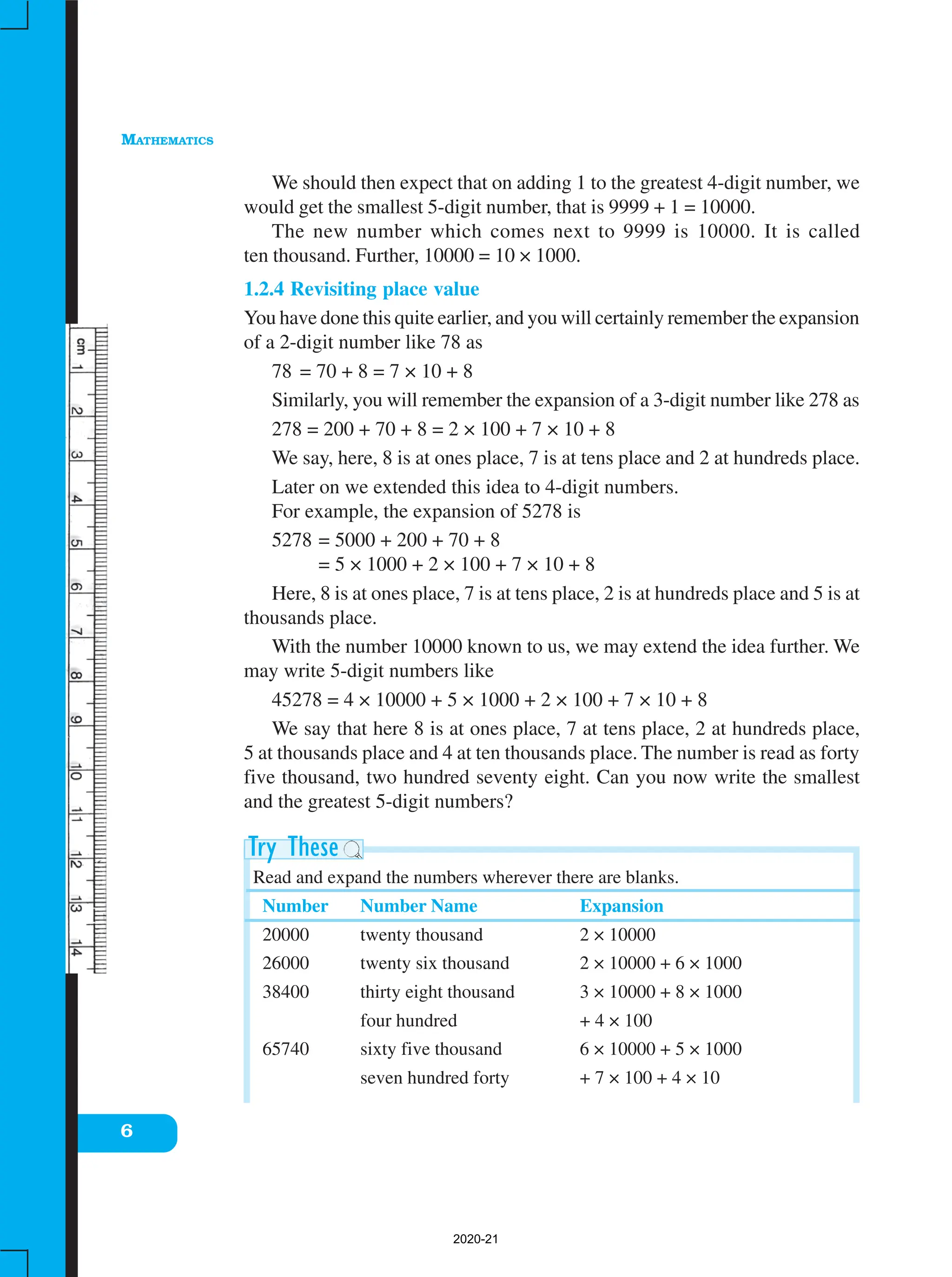
We should thenexpect that on adding 1 to the greatest 4-digit number, we
would get the smallest 5-digit number, that is 9999 + 1 = 10000.
The new number which comes next to 9999 is 10000. It is called
ten thousand. Further, 10000 = 10 × 1000.
1.2.4 Revisiting place value
You have done this quite earlier, and you will certainly remember the expansion
of a 2-digit number like 78 as
78 = 70 + 8 = 7 × 10 + 8
Similarly, you will remember the expansion of a 3-digit number like 278 as
278 = 200 + 70 + 8 = 2 × 100 + 7 × 10 + 8
We say, here, 8 is at ones place, 7 is at tens place and 2 at hundreds place.
Later on we extended this idea to 4-digit numbers.
For example, the expansion of 5278 is
5278 = 5000 + 200 + 70 + 8
= 5 × 1000 + 2 × 100 + 7 × 10 + 8
Here, 8 is at ones place, 7 is at tens place, 2 is at hundreds place and 5 is at
thousands place.
With the number 10000 known to us, we may extend the idea further. We
may write 5-digit numbers like
45278 = 4 × 10000 + 5 × 1000 + 2 × 100 + 7 × 10 + 8
We say that here 8 is at ones place, 7 at tens place, 2 at hundreds place,
5 at thousands place and 4 at ten thousands place. The number is read as forty
five thousand, two hundred seventy eight. Can you now write the smallest
and the greatest 5-digit numbers?
Read and expand the numbers wherever there are blanks.
Number Number Name Expansion
20000 twenty thousand 2 × 10000
26000 twenty six thousand 2 × 10000 + 6 × 1000
38400 thirty eight thousand 3 × 10000 + 8 × 1000
four hundred + 4 × 100
65740 sixty five thousand 6 × 10000 + 5 × 1000
seven hundred forty + 7 × 100 + 4 × 10
2020-21
25.
KNOWING OUR NUMBERS
7
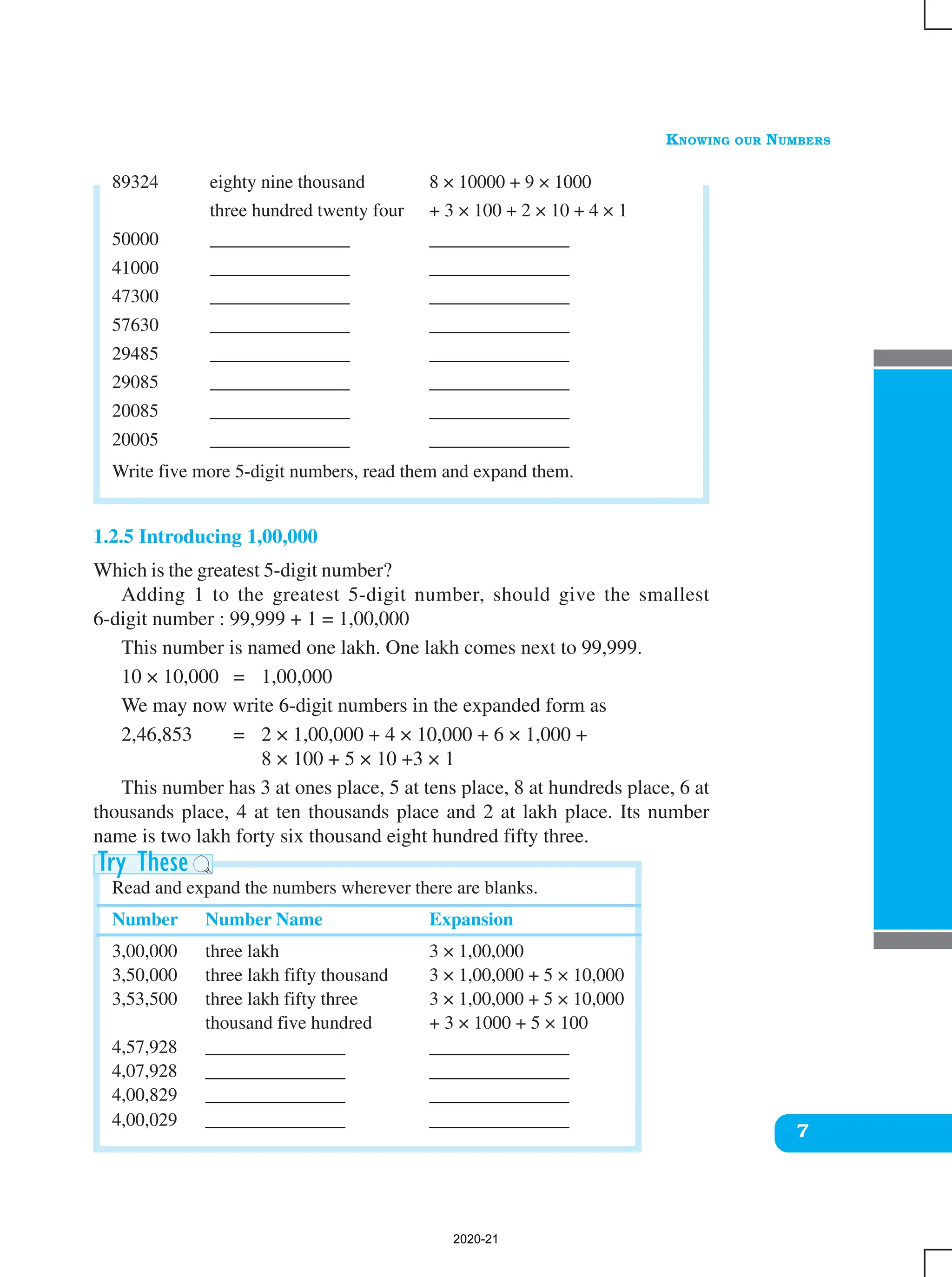
1.2.5Introducing 1,00,000
Which is the greatest 5-digit number?
Adding 1 to the greatest 5-digit number, should give the smallest
6-digit number : 99,999 + 1 = 1,00,000
This number is named one lakh. One lakh comes next to 99,999.
10 × 10,000 = 1,00,000
We may now write 6-digit numbers in the expanded form as
2,46,853 = 2 × 1,00,000 + 4 × 10,000 + 6 × 1,000 +
8 × 100 + 5 × 10 +3 × 1
This number has 3 at ones place, 5 at tens place, 8 at hundreds place, 6 at
thousands place, 4 at ten thousands place and 2 at lakh place. Its number
name is two lakh forty six thousand eight hundred fifty three.
Read and expand the numbers wherever there are blanks.
Number Number Name Expansion
3,00,000 three lakh 3 × 1,00,000
3,50,000 three lakh fifty thousand 3 × 1,00,000 + 5 × 10,000
3,53,500 three lakh fifty three 3 × 1,00,000 + 5 × 10,000
thousand five hundred + 3 × 1000 + 5 × 100
4,57,928 _______________ _______________
4,07,928 _______________ _______________
4,00,829 _______________ _______________
4,00,029 _______________ _______________
89324 eighty nine thousand 8 × 10000 + 9 × 1000
three hundred twenty four + 3 × 100 + 2 × 10 + 4 × 1
50000 _______________ _______________
41000 _______________ _______________
47300 _______________ _______________
57630 _______________ _______________
29485 _______________ _______________
29085 _______________ _______________
20085 _______________ _______________
20005 _______________ _______________
Write five more 5-digit numbers, read them and expand them.
2020-21
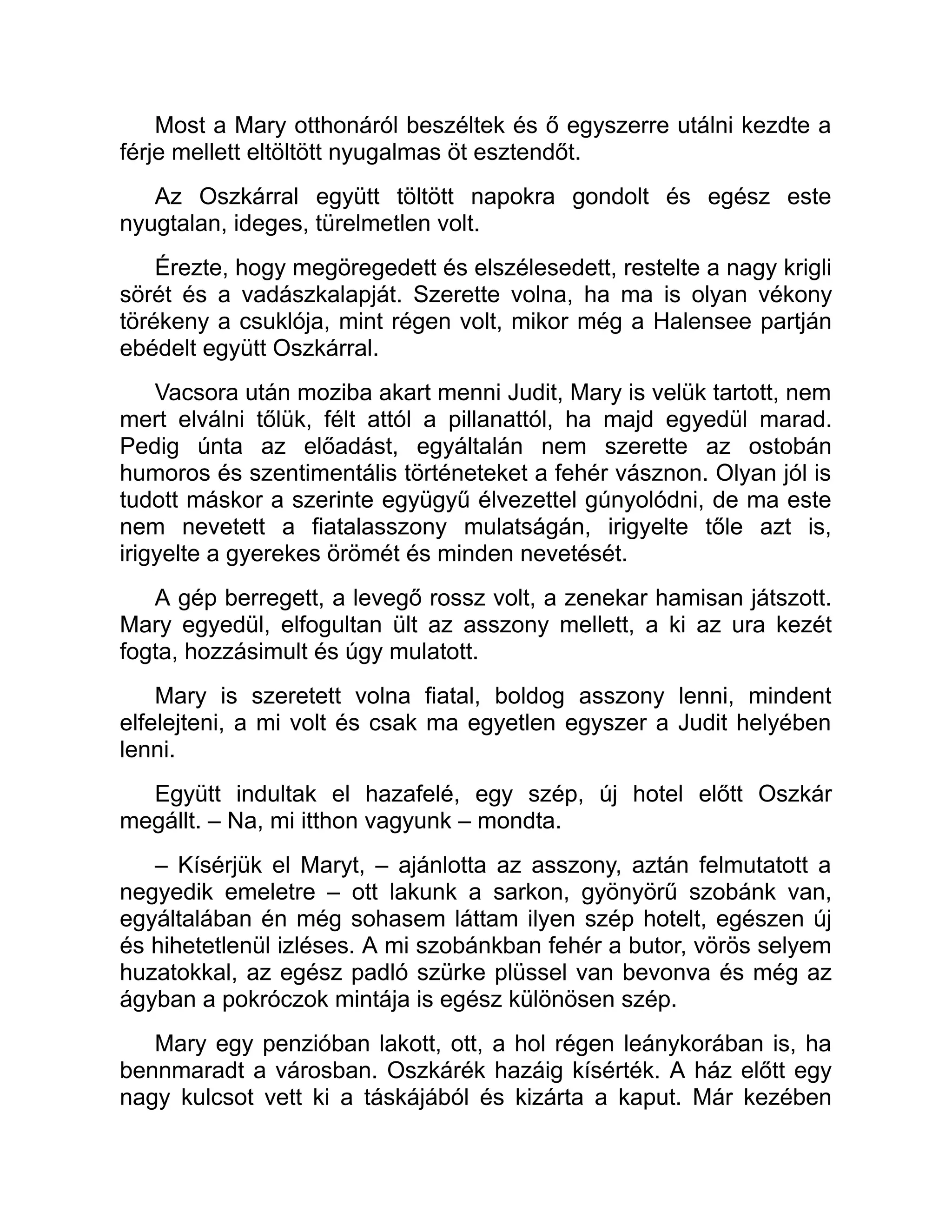
Most a Maryotthonáról beszéltek és ő egyszerre utálni kezdte a
férje mellett eltöltött nyugalmas öt esztendőt.
Az Oszkárral együtt töltött napokra gondolt és egész este
nyugtalan, ideges, türelmetlen volt.
Érezte, hogy megöregedett és elszélesedett, restelte a nagy krigli
sörét és a vadászkalapját. Szerette volna, ha ma is olyan vékony
törékeny a csuklója, mint régen volt, mikor még a Halensee partján
ebédelt együtt Oszkárral.
Vacsora után moziba akart menni Judit, Mary is velük tartott, nem
mert elválni tőlük, félt attól a pillanattól, ha majd egyedül marad.
Pedig únta az előadást, egyáltalán nem szerette az ostobán
humoros és szentimentális történeteket a fehér vásznon. Olyan jól is
tudott máskor a szerinte együgyű élvezettel gúnyolódni, de ma este
nem nevetett a fiatalasszony mulatságán, irigyelte tőle azt is,
irigyelte a gyerekes örömét és minden nevetését.
A gép berregett, a levegő rossz volt, a zenekar hamisan játszott.
Mary egyedül, elfogultan ült az asszony mellett, a ki az ura kezét
fogta, hozzásimult és úgy mulatott.
Mary is szeretett volna fiatal, boldog asszony lenni, mindent
elfelejteni, a mi volt és csak ma egyetlen egyszer a Judit helyében
lenni.
Együtt indultak el hazafelé, egy szép, új hotel előtt Oszkár
megállt. – Na, mi itthon vagyunk – mondta.
– Kísérjük el Maryt, – ajánlotta az asszony, aztán felmutatott a
negyedik emeletre – ott lakunk a sarkon, gyönyörű szobánk van,
egyáltalában én még sohasem láttam ilyen szép hotelt, egészen új
és hihetetlenül izléses. A mi szobánkban fehér a butor, vörös selyem
huzatokkal, az egész padló szürke plüssel van bevonva és még az
ágyban a pokróczok mintája is egész különösen szép.
Mary egy penzióban lakott, ott, a hol régen leánykorában is, ha
bennmaradt a városban. Oszkárék hazáig kísérték. A ház előtt egy
nagy kulcsot vett ki a táskájából és kizárta a kaput. Már kezében
28.
fogta a kilincset,mikor hirtelen érezte, hogy most így nem válhat el
tőlük, mit fog különben gondolni róla az az asszony.
– Holnap mit fognak csinálni? – kérdezte.
– Még nem tudom, nincs semmi tervünk – mondta Oszkár. – Este
az operába megyünk, csak az bizonyos még, a Pillangókisasszonyt
nézzük meg. Maga meddig marad még itt, Mary?
– Holnap este megyek vissza Feldaffingba.
Csend volt. Judit érezte, hogy most valami kedveset kell
mondania.
– Vacsorázzék velünk holnap is. Várjon, de hol? Tudja mit, jőjjön
el a szállodánk éttermébe, hétkor eszünk és aztán megyünk az
operába.
– Jó, majd meglátom, talán – felelte Mary és ez a barátságtalan
válasz jól esett neki.
Aztán elváltak, Mary bezárta a nagy kaput, felment a sötét
lépcsőn, fölnyitotta az előszobát is, meggyujtotta a számára
odakészített gyertyát és végre eljutott a szobájába.
Az ágy szélére ült le és gondolkodott a mai estén. Valami
bosszantó megszégyenítő érzés fogta el, bántotta az asszony
minden féltékenységtől ment kedvessége, a melylyel vele bánt és
bosszantotta, hogy ő meg annyira elveszítette a biztonságát, a
nyugalmát.
A gyertya pislogva égett, a villanyt már féltizenegykor lezárta a
háziasszony. Mary a félhomályban ülve nézte az egyenes, barnalábú
íróasztalt, a téglavörös mintás tapétát, az ízléstelen, olcsó függönyt.
Ő itt lakott, azok pedig most már hazaértek a fehér szobába, a
vörös selyemhuzatos butorok közé. A szürke bársonyszőnyegen jár
az asszony, rakosgat, vetkezik és Oszkár behúzza a szép, nagy
függönyöket.
29.
Az asszony bizonyosancsodálkozik, hogy ő, Mary, olyan, a
milyen, másnak képzelte. Más is azon a képen, a melyet
Frohnauban ajándékozott Oszkárnak. Akkor még hüvelyk- és
mutatóujjával tudta átfogni a csuklóját, most pedig egyáltalán nem
érte át. Ha ő olyan lenne, mint akkor volt, ha holnap megjelenhetne
megint a régi rozsdaszínű ruhájában, talán még féltékeny is lenne
Judit. – Mary olyan, mint egy rózsaszínű orchidea! – Erre csak úgy
emlékezett már, mint öregasszonyok az ifjúkori hódításaikra.
És Oszkár, Oszkár vajjon mit gondol most róla? Semmit, Oszkár
nem törődik már, csak a feleségével, most, míg ő itt ül az ágya
szélén, talán épen megöleli, úgy mint régen őt. Nem, nem úgy,
másként, nagy szerelemmel és boldogok, olyan boldogok, a milyen ő
nem volt és nem lehet sohasem.
Marynek tovább mozgott a képzelete, látta a gyönyörű mintás
pokróczokat, látta az asszony barna fejét a kis fehér párnán, hallotta
kaczagni és egyszerre ott állt előtte, úgy a mint ma este látta, a mint
tudta, hogy most már mindig látni fogja őt, a sötétkék ruhájában,
vörös szegélylyel a fekete áttört selyemzsinórok alatt, a kemény kis
alakjával, a mint profilba fordul, ránéz az urára és mosolyog.
Mary haragudott rá, féltékenynyé szerette volna tenni és nagy,
nagy szomorúságot okozni neki. Irigyelte a boldogságát, de már nem
érezte azt a fájón édes, egész testét megrázó vágyakozást, a melyet
régen érzett, ha Oszkárra gondolt. Az a vágyakozás már meg volt
ölve egy együttélésben, a mely fáradttá és unottá tette csak,
boldoggá soha. Már, már elhitette magával, hogy a nő számára a
férfi csak gyermeket jelent, az ifjúságban kívánt, remélt, sejtett
gyönyört soha.
Most látta Juditot, a mint mosolygó biztonsággal nézett az ura
szemébe, látta hozzásimulni, hallotta a szobájukról beszélni és
csónakázásaikról a Starnbergi-tavon.
Mary felugrott az ágy széléről, az ablakhoz ment. Vidám diákok
énekelve vonultak el a szemközti utczasoron. Lenn a vendéglőben
még sokan ültek és a lámpák széles fénysugarakat vetettek a
járdára. Póstások robogtak hazafelé autoczikliken, egy fiatal pár
30.
nevetve jött átaz utczán és nevetésük felhallatszott Maryhez. Ezek
is boldogok! Talán Oszkár és Judit most róla beszélnek, Oszkár
elmesél a feleségének a megismerkedésüktől az elválásukig
mindent, az egész tovatűnt berlini barátságukat.
Az asszony meg bizonyosan kitalálja a Mary nagy, reménytelen
szerelmét és sajnálja őt. Ebben a pillanatban sajnálja, a fehér
szobában, a férje karjaiban, mikor ő itt áll a nyitott ablakban
elhagyatva, egyedül.
Bizonyosan azt hiszi, hogy ő még mindig szereti Oszkárt s hogy
boldogtalan nagyon a mai találkozás után. Ezt nem akarta Mary,
együtt kell lennie velük okvetetlenül, meg fogja mutatni, hogy boldog
ő is, el fogja felejtetni velük a mai estét.
31.
XI.
Egy vonat robogottaz éjszakában Münchenből Feldaffing felé,
hideg, ködös, októberi éjben fázva simult Mary a kupé sarkába.
Egyedül és nagyon szomorúan.
Ismét találkozott Oszkárékkal. Már egész nap kereste őket, a
képtárakban, a sétatéren, a legszebb utczákon, a nagy árúházban,
szeretett volna túlesni a rá nézve olyan nehéz együttléten, de nem
találta meg őket sehol.
Végre eljött az este és együtt ültek ismét, látta az asszonyt
estélyi ruhában is, világos szürkén, selymesen, nagy tollas, kis
fekete kalapban, Oszkárt meg frakkban úgy, mint régen az Eriksen
Lolo hangversenyén. Most még szebb volt, férfiasabb és még
derültebben, fölényesebben nyugodt, mint akkor.
Arról az elmúlt estéről kezdett beszélni Mary, a mosolygó
visszaemlékezés derüs hangján, mintha egy együtt leélt gyermekkor
eseményeiről beszélne csak, olyan vidáman.
Aztán a kis fiáról mesélt sokat és nevelési kérdések felett vitába
elegyedett Judittal. Most végre fölényben érezte magát. – Istenem –
mondta végül – mit is tudja azt az, a ki csak pedagogus, a
legegyszerűbb anya is jobban ért a gyermekekhez. Maguk még nem
is tudják, milyen boldogság a gyerek, minden nő elsősorban anya, a
többi mind mellékes. Én csak azóta élek igazán, mióta megvan a
fiam. Még a hiúságról is lemondtam, a szép ruhák sem érdekelnek
többé, pedig az nálam nagy szó.
– Igen, leánykorában nagyon szerette a különös és szép színű
ruhákat. Nekem nagyon tetszettek is, én csak a jól öltözött nőket
32.
szeretem, – mondtaOszkár.
Mary Juditot nézte, a gyönyörű ruháját vizsgálta. – Nincs pedig
annak semmi értelme – jegyezte meg aztán.
Így mentette ki a vadászkalapját, füző nélküli reformruhás
megjelenését, a ragyogóan fiatal Judit mellett.
Oszkárék gyorsan vacsoráztak, siettek az operába. Bucsúzóul az
asszony virágokat vett ki egy csomagból és átadta Marynek.
Orchideák voltak, rózsaszinű orchideák.
– Fogadja el tőlem – mondta – Oszkár úgy emlékezett, hogy
ezek a kedvencz virágai.
Mary megköszönte és végtelen szomorú lett egy pillanatra a
szeme, a mint ránézett Oszkárra, a ki már nem is gondol arra, hogy
egyszer féltékenyen őrizte az ő orchideáját a gomblyukában.
Aztán Mary kinn állt az omnibusz megállóhelyen, egyik kezében
az esernyője és az orchideák, másikban a kis sárga táskája és sok
apró csomag, az egyikben czipő volt a kis Ervin számára, a
csomagoló papiros kiszakadt és kilátszott egy keskeny, fekete sarok.
Judit várni akart, míg jön a Mary omnibusza, de Oszkár nem
engedte, félt, hogy elkésnek és elmulasztják a nyitányt.
Elmentek hát. Judit még egyszer visszafordult és mosolyogva
intett Marynek, a ki utánuk nézett. Oszkár senkivel sem törődve,
átfogta a felesége derekát, úgy tartotta össze a nagy köpenyegét, az
asszony a széllel küzdve előre szegte a fejét és nagy strucztollai
libegtek a kalapján. Még egyszer előbújt szürke selyem harisnyája a
lakkczipője felett, aztán eltüntek a tömegben. Csak néhány könnyű,
rózsaszínű virág maradt belőlük. Még most is ott voltak a Mary
ölében, míg a vonat vitte őt hazafelé. Ölében voltak az orchideák és
össze-vissza zürzavarosan jártak fejében a gondolatok.
Nagyon levert volt, ez a találkozás kizaklatta őt a megszokott,
csendes életéből. Ő szótfogadott a férjének és az elmult öt év alatt
keveset gondolkozott az életen, keveset magán, szeszélyes volt
33.
néha és levert,de magyarázatot nem keresett. Hozzászokott ahhoz,
hogy ne várjon a napoktól mást, csakhogy elteljenek csendesen,
izgalom nélkül. Mióta a fia is meg volt, meg az ezer kedves, apró
gond, azóta épen nem törődött mással, mint az étellel, itallal, a
lakásával és a bútorokkal. Magáról elfelejtkezett egészen, úgy
mintha minden napra viseljük már az ünneplő ruhánkat és elfelejtünk
vigyázni arra, a mit valamikor annyi gonddal őriztünk.
A férje boldog volt vele, neki kényelmesebb volt a lecsiszolt,
eltompult Mary, ő szépnek látta és szerette, az ő szemében örökre
élt a régi varázsa. Csendes, nagy érzelem volt, a melyről sohasem
beszélt és óvatos, kicsit megszorított járása jellemezte egész
életüket. Maryt mindig bosszantotta ez a járás és most ott a kupé
sarkában egyszerre gyűlölte, épen úgy gyűlölte, mint a kifaragott,
élesen, biztosan körülhatárolva előadott véleményeit, szigorú nagy
szavait és az Ervin egész nyugodt, meggondolt szerelmét.
Oszkárra gondolt és arra, milyen lehet ha szeret, ha
szenvedélyesen, fiatalon öleli magához az asszonyát.
A halenseei sétájuk jutott eszébe, a csókjaik, visszagondolt a
búcsújukra az ő szobájában, mikor fejét a vállára hajtva ülhetett
mellette. Akkor Oszkár is szerette egy kicsit. Most már más ül
mellette, mást csókol, más az övé egészen.
Mary sohasem lehet az övé, soha azé a férfié, a kit szeret és
sohasem ölel senkit úgy, a hogy átvirrasztott fiatal éjszakáin az
álmait ölelte.
Ostobán hinni próbált Róth Ervinnek azon a rég elmúlt tavaszi
napon és a vágyak elcsitulását várta nála, de az ő vágyai nem
elcsitultak egy szerelemben, hanem lassan haltak meg, múltak el az
évekkel.
Most üresen áll és nincs semmije és senkije.
Hazagondolt, a kékvirágos levesestál jutott eszébe, a nagy kanál,
aztán hirtelen gyöngédséget érzett, a kis fiát látta, a mint feléje
nyujtja a tányérját. De mindjárt a férje is megjelent, szemben ült a
fiával, most óvatosan dugja nyakába a szalvétáját és a kis fia, a
34.
Mary baloldalán épenúgy a trikója kivágásába. Épen úgy, mindent
épen úgy, mint az apja, olyan óvatosan, tisztán, rendesen.
A szemei az apja jóságával, gyengédségével vannak tele,
minden szava az ő türelmével és kis kezei fehérek, keskenyek, mint
az Ervin kezei.
Egy nagy Ervin és egy kis Ervin, ez az ő élete. Oszkár és Judit
pedig most az operában ülnek, egymáshoz simulva zenét
hallgatnak, az asszony az ura kezét fogja, úgy mint tegnap, és
Oszkár ránéz meleg pillantással. Mosolyog is hozzá, de a szeme
komoly marad, csak a sűrű szőke bajusza mozdul meg. Milyen jól
ismerte Mary ezt a mosolyt.
Aztán hazamennek majd a Puccini zenéjének emlékével, a
legszerelmesebb zene emlékével és kicsit ünnepélyes lesz a
csókjuk, mintha a színpadon lennének ők is.
Egyszer Juditnak is lesz bizonyosan kis fia, de az Oszkárhoz fog
majd hasonlítani. Megszagolta az orchideáit és nézte őket soká. Ha
ő akkor régen mégis ott maradt volna Berlinben, talán most neki is
volna egy olyan kis gyermeke. Bolond gondolat, de elképzelni jó.
Minek is ment ő feleségül Ervinhez? Hátha találkozott volna még
valakivel, a kit tudott volna szeretni is. Vagy maradt volna inkább
egyedül, akkor nem pusztult volna el a művészete és nem halt volna
meg a vágyakozása, hanem végtelen, gyönyörű bánattá finomodik
eddig.
Apró kezekről álmodozott akkor, kis gyermekkarokat kívánt a
nyaka köré, minden szenvedést megváltó gyermekfejeket látott
maga előtt, a melyekről Frau Petersen beszélt azon a régi esős
délutánon, a Bettina néni szalonjában, a sok asszonynak.
Most megvolt a kis fia, de az apjához hasonlított, az apjához
egészen és Mary nem tudott benne gyönyörködni, mert nem szerette
a férfit, a ki adta és lealacsonyító volt számára a szenvedély, a
melyből támadt.
35.
Csak most gondoltavégig mindezt Mary, most kapott
magyarázatot sok nehéz órája, most megértette a gyermeke
születése után, nagy, ösztönszerű elégedetlenségéből fakadt sirását.
Megérkezett a vonat Feldaffingba, hideg volt, köd ülte meg a
tájat, mintha láthatatlan kezek lengetnének fehér fátyolokat. Igazi
ősz volt, szeles, hideg október és a fákról hullottak a levelek.
Mary gyalog ment haza, nem félt az éjszakától, egy vonat füttye
hallatszott messziről és a templom-óra ütni kezdett. Csak itt-ott égett
pislogva egy-egy lámpa az út mellett és Marynek vigyáznia kellett
minden lépésére. A küzdelem az úttal, a sötéttel új életkedvet öntött
belé, önkéntelenül valami kibúvót keresett nagy keserűségéből.
Zizegett a sok sárga levél a lába alatt, reménytelensége
szomorúság lett lassan, mély igazságokkal telt meg, függetlennek
érezte magát mindattól, a mi vele történt, külön vált a saját sorsától
és elhatározta, hogy könyvet ír róla.
Nagy tanulsággal teli könyvet az asszonyoknak, a leányoknak,
hogy sohase fogják meg férfi kezét nagy igérettel, ha nem szeretnek,
mint ő régen, régen egyszer tavaszszal.
Igen így is fogja kezdeni. – Tavasz volt, Mária az arczához
szorította az Egon kezét és… –
Gyorsan ment, sietett haza, még ma este el akarta kezdeni. Úgy
érezte, most már elmenekült zürzavaros, sötét helyzetéből és valami
nagyon világosnak és tisztának kell jönnie. Már a finom fejléczeket is
látta, a melyeket a könyvéhez rajzol, felébredt régen elaludt
munkakedve és majdnem vidám lett.
Otthon nem várták, csendesen zárta ki a kaput, felosont a
szobájába, ledobta a kalapját, kabátját, leült az íróasztalához,
meggyujtotta a lámpát, állát gondolkodva támasztotta az
összekulcsolt kezére és maga elé nézett. A fény ráesett a
Bartholomé domborművének képére, a mely a régi helyén lógott,
szemben vele.
36.
Mary rajta felejtettea pillantását. Egy fiatal férfi és egy nő aludt
egymás mellett holtan, keresztülfektetve rajtuk kis gyermekük. Ők
emelt fővel mennek be az elmúlás kapuján, míg körülöttük
roskadozva gyülekeznek öregek és fiatalok, más férfiak és nők, a
kiknek nem telt be a sorsuk úgy, mint nekik.
Mary nézte, nézte a képet, a lámpa bizonytalan fényében a férfi
lassan Oszkár lett, a nő olyan mint Judit és a gyermek az ő
gyermekük.
Piros rózsák nyíltak most is körülöttük a Mary képzeletében, mint
régen kinn a párisi temetőben… mi ehhez képest minden szó és
minden írás?
Mary lehajtotta a fejét az asztalra és sírt.
37.
*** END OFTHE PROJECT GUTENBERG EBOOK MARY ***
Updated editions will replace the previous one—the old editions will
be renamed.
Creating the works from print editions not protected by U.S.
copyright law means that no one owns a United States copyright in
these works, so the Foundation (and you!) can copy and distribute it
in the United States without permission and without paying copyright
royalties. Special rules, set forth in the General Terms of Use part of
this license, apply to copying and distributing Project Gutenberg™
electronic works to protect the PROJECT GUTENBERG™ concept
and trademark. Project Gutenberg is a registered trademark, and
may not be used if you charge for an eBook, except by following the
terms of the trademark license, including paying royalties for use of
the Project Gutenberg trademark. If you do not charge anything for
copies of this eBook, complying with the trademark license is very
easy. You may use this eBook for nearly any purpose such as
creation of derivative works, reports, performances and research.
Project Gutenberg eBooks may be modified and printed and given
away—you may do practically ANYTHING in the United States with
eBooks not protected by U.S. copyright law. Redistribution is subject
to the trademark license, especially commercial redistribution.
START: FULL LICENSE
PLEASE READ THISBEFORE YOU DISTRIBUTE OR USE THIS WORK
To protect the Project Gutenberg™ mission of promoting the free
distribution of electronic works, by using or distributing this work (or
any other work associated in any way with the phrase “Project
Gutenberg”), you agree to comply with all the terms of the Full
Project Gutenberg™ License available with this file or online at
www.gutenberg.org/license.
Section 1. General Terms of Use and
Redistributing Project Gutenberg™
electronic works
1.A. By reading or using any part of this Project Gutenberg™
electronic work, you indicate that you have read, understand, agree
to and accept all the terms of this license and intellectual property
(trademark/copyright) agreement. If you do not agree to abide by all
the terms of this agreement, you must cease using and return or
destroy all copies of Project Gutenberg™ electronic works in your
possession. If you paid a fee for obtaining a copy of or access to a
Project Gutenberg™ electronic work and you do not agree to be
bound by the terms of this agreement, you may obtain a refund from
the person or entity to whom you paid the fee as set forth in
paragraph 1.E.8.
1.B. “Project Gutenberg” is a registered trademark. It may only be
used on or associated in any way with an electronic work by people
who agree to be bound by the terms of this agreement. There are a
few things that you can do with most Project Gutenberg™ electronic
works even without complying with the full terms of this agreement.
See paragraph 1.C below. There are a lot of things you can do with
Project Gutenberg™ electronic works if you follow the terms of this
agreement and help preserve free future access to Project
Gutenberg™ electronic works. See paragraph 1.E below.
40.
1.C. The ProjectGutenberg Literary Archive Foundation (“the
Foundation” or PGLAF), owns a compilation copyright in the
collection of Project Gutenberg™ electronic works. Nearly all the
individual works in the collection are in the public domain in the
United States. If an individual work is unprotected by copyright law in
the United States and you are located in the United States, we do
not claim a right to prevent you from copying, distributing,
performing, displaying or creating derivative works based on the
work as long as all references to Project Gutenberg are removed. Of
course, we hope that you will support the Project Gutenberg™
mission of promoting free access to electronic works by freely
sharing Project Gutenberg™ works in compliance with the terms of
this agreement for keeping the Project Gutenberg™ name
associated with the work. You can easily comply with the terms of
this agreement by keeping this work in the same format with its
attached full Project Gutenberg™ License when you share it without
charge with others.
1.D. The copyright laws of the place where you are located also
govern what you can do with this work. Copyright laws in most
countries are in a constant state of change. If you are outside the
United States, check the laws of your country in addition to the terms
of this agreement before downloading, copying, displaying,
performing, distributing or creating derivative works based on this
work or any other Project Gutenberg™ work. The Foundation makes
no representations concerning the copyright status of any work in
any country other than the United States.
1.E. Unless you have removed all references to Project Gutenberg:
1.E.1. The following sentence, with active links to, or other
immediate access to, the full Project Gutenberg™ License must
appear prominently whenever any copy of a Project Gutenberg™
work (any work on which the phrase “Project Gutenberg” appears, or
with which the phrase “Project Gutenberg” is associated) is
accessed, displayed, performed, viewed, copied or distributed:
41.
This eBook isfor the use of anyone anywhere in the United
States and most other parts of the world at no cost and with
almost no restrictions whatsoever. You may copy it, give it away
or re-use it under the terms of the Project Gutenberg License
included with this eBook or online at www.gutenberg.org. If you
are not located in the United States, you will have to check the
laws of the country where you are located before using this
eBook.
1.E.2. If an individual Project Gutenberg™ electronic work is derived
from texts not protected by U.S. copyright law (does not contain a
notice indicating that it is posted with permission of the copyright
holder), the work can be copied and distributed to anyone in the
United States without paying any fees or charges. If you are
redistributing or providing access to a work with the phrase “Project
Gutenberg” associated with or appearing on the work, you must
comply either with the requirements of paragraphs 1.E.1 through
1.E.7 or obtain permission for the use of the work and the Project
Gutenberg™ trademark as set forth in paragraphs 1.E.8 or 1.E.9.
1.E.3. If an individual Project Gutenberg™ electronic work is posted
with the permission of the copyright holder, your use and distribution
must comply with both paragraphs 1.E.1 through 1.E.7 and any
additional terms imposed by the copyright holder. Additional terms
will be linked to the Project Gutenberg™ License for all works posted
with the permission of the copyright holder found at the beginning of
this work.
1.E.4. Do not unlink or detach or remove the full Project
Gutenberg™ License terms from this work, or any files containing a
part of this work or any other work associated with Project
Gutenberg™.
1.E.5. Do not copy, display, perform, distribute or redistribute this
electronic work, or any part of this electronic work, without
prominently displaying the sentence set forth in paragraph 1.E.1 with
active links or immediate access to the full terms of the Project
Gutenberg™ License.
42.
1.E.6. You mayconvert to and distribute this work in any binary,
compressed, marked up, nonproprietary or proprietary form,
including any word processing or hypertext form. However, if you
provide access to or distribute copies of a Project Gutenberg™ work
in a format other than “Plain Vanilla ASCII” or other format used in
the official version posted on the official Project Gutenberg™ website
(www.gutenberg.org), you must, at no additional cost, fee or expense
to the user, provide a copy, a means of exporting a copy, or a means
of obtaining a copy upon request, of the work in its original “Plain
Vanilla ASCII” or other form. Any alternate format must include the
full Project Gutenberg™ License as specified in paragraph 1.E.1.
1.E.7. Do not charge a fee for access to, viewing, displaying,
performing, copying or distributing any Project Gutenberg™ works
unless you comply with paragraph 1.E.8 or 1.E.9.
1.E.8. You may charge a reasonable fee for copies of or providing
access to or distributing Project Gutenberg™ electronic works
provided that:
• You pay a royalty fee of 20% of the gross profits you derive from
the use of Project Gutenberg™ works calculated using the
method you already use to calculate your applicable taxes. The
fee is owed to the owner of the Project Gutenberg™ trademark,
but he has agreed to donate royalties under this paragraph to
the Project Gutenberg Literary Archive Foundation. Royalty
payments must be paid within 60 days following each date on
which you prepare (or are legally required to prepare) your
periodic tax returns. Royalty payments should be clearly marked
as such and sent to the Project Gutenberg Literary Archive
Foundation at the address specified in Section 4, “Information
about donations to the Project Gutenberg Literary Archive
Foundation.”
• You provide a full refund of any money paid by a user who
notifies you in writing (or by e-mail) within 30 days of receipt that
s/he does not agree to the terms of the full Project Gutenberg™
License. You must require such a user to return or destroy all
43.
copies of theworks possessed in a physical medium and
discontinue all use of and all access to other copies of Project
Gutenberg™ works.
• You provide, in accordance with paragraph 1.F.3, a full refund of
any money paid for a work or a replacement copy, if a defect in
the electronic work is discovered and reported to you within 90
days of receipt of the work.
• You comply with all other terms of this agreement for free
distribution of Project Gutenberg™ works.
1.E.9. If you wish to charge a fee or distribute a Project Gutenberg™
electronic work or group of works on different terms than are set
forth in this agreement, you must obtain permission in writing from
the Project Gutenberg Literary Archive Foundation, the manager of
the Project Gutenberg™ trademark. Contact the Foundation as set
forth in Section 3 below.
1.F.
1.F.1. Project Gutenberg volunteers and employees expend
considerable effort to identify, do copyright research on, transcribe
and proofread works not protected by U.S. copyright law in creating
the Project Gutenberg™ collection. Despite these efforts, Project
Gutenberg™ electronic works, and the medium on which they may
be stored, may contain “Defects,” such as, but not limited to,
incomplete, inaccurate or corrupt data, transcription errors, a
copyright or other intellectual property infringement, a defective or
damaged disk or other medium, a computer virus, or computer
codes that damage or cannot be read by your equipment.
1.F.2. LIMITED WARRANTY, DISCLAIMER OF DAMAGES - Except
for the “Right of Replacement or Refund” described in paragraph
1.F.3, the Project Gutenberg Literary Archive Foundation, the owner
of the Project Gutenberg™ trademark, and any other party
distributing a Project Gutenberg™ electronic work under this
agreement, disclaim all liability to you for damages, costs and
44.
expenses, including legalfees. YOU AGREE THAT YOU HAVE NO
REMEDIES FOR NEGLIGENCE, STRICT LIABILITY, BREACH OF
WARRANTY OR BREACH OF CONTRACT EXCEPT THOSE
PROVIDED IN PARAGRAPH 1.F.3. YOU AGREE THAT THE
FOUNDATION, THE TRADEMARK OWNER, AND ANY
DISTRIBUTOR UNDER THIS AGREEMENT WILL NOT BE LIABLE
TO YOU FOR ACTUAL, DIRECT, INDIRECT, CONSEQUENTIAL,
PUNITIVE OR INCIDENTAL DAMAGES EVEN IF YOU GIVE
NOTICE OF THE POSSIBILITY OF SUCH DAMAGE.
1.F.3. LIMITED RIGHT OF REPLACEMENT OR REFUND - If you
discover a defect in this electronic work within 90 days of receiving it,
you can receive a refund of the money (if any) you paid for it by
sending a written explanation to the person you received the work
from. If you received the work on a physical medium, you must
return the medium with your written explanation. The person or entity
that provided you with the defective work may elect to provide a
replacement copy in lieu of a refund. If you received the work
electronically, the person or entity providing it to you may choose to
give you a second opportunity to receive the work electronically in
lieu of a refund. If the second copy is also defective, you may
demand a refund in writing without further opportunities to fix the
problem.
1.F.4. Except for the limited right of replacement or refund set forth in
paragraph 1.F.3, this work is provided to you ‘AS-IS’, WITH NO
OTHER WARRANTIES OF ANY KIND, EXPRESS OR IMPLIED,
INCLUDING BUT NOT LIMITED TO WARRANTIES OF
MERCHANTABILITY OR FITNESS FOR ANY PURPOSE.
1.F.5. Some states do not allow disclaimers of certain implied
warranties or the exclusion or limitation of certain types of damages.
If any disclaimer or limitation set forth in this agreement violates the
law of the state applicable to this agreement, the agreement shall be
interpreted to make the maximum disclaimer or limitation permitted
by the applicable state law. The invalidity or unenforceability of any
provision of this agreement shall not void the remaining provisions.
45.
1.F.6. INDEMNITY -You agree to indemnify and hold the
Foundation, the trademark owner, any agent or employee of the
Foundation, anyone providing copies of Project Gutenberg™
electronic works in accordance with this agreement, and any
volunteers associated with the production, promotion and distribution
of Project Gutenberg™ electronic works, harmless from all liability,
costs and expenses, including legal fees, that arise directly or
indirectly from any of the following which you do or cause to occur:
(a) distribution of this or any Project Gutenberg™ work, (b)
alteration, modification, or additions or deletions to any Project
Gutenberg™ work, and (c) any Defect you cause.
Section 2. Information about the Mission of
Project Gutenberg™
Project Gutenberg™ is synonymous with the free distribution of
electronic works in formats readable by the widest variety of
computers including obsolete, old, middle-aged and new computers.
It exists because of the efforts of hundreds of volunteers and
donations from people in all walks of life.
Volunteers and financial support to provide volunteers with the
assistance they need are critical to reaching Project Gutenberg™’s
goals and ensuring that the Project Gutenberg™ collection will
remain freely available for generations to come. In 2001, the Project
Gutenberg Literary Archive Foundation was created to provide a
secure and permanent future for Project Gutenberg™ and future
generations. To learn more about the Project Gutenberg Literary
Archive Foundation and how your efforts and donations can help,
see Sections 3 and 4 and the Foundation information page at
www.gutenberg.org.
Section 3. Information about the Project
Gutenberg Literary Archive Foundation
46.
The Project GutenbergLiterary Archive Foundation is a non-profit
501(c)(3) educational corporation organized under the laws of the
state of Mississippi and granted tax exempt status by the Internal
Revenue Service. The Foundation’s EIN or federal tax identification
number is 64-6221541. Contributions to the Project Gutenberg
Literary Archive Foundation are tax deductible to the full extent
permitted by U.S. federal laws and your state’s laws.
The Foundation’s business office is located at 809 North 1500 West,
Salt Lake City, UT 84116, (801) 596-1887. Email contact links and up
to date contact information can be found at the Foundation’s website
and official page at www.gutenberg.org/contact
Section 4. Information about Donations to
the Project Gutenberg Literary Archive
Foundation
Project Gutenberg™ depends upon and cannot survive without
widespread public support and donations to carry out its mission of
increasing the number of public domain and licensed works that can
be freely distributed in machine-readable form accessible by the
widest array of equipment including outdated equipment. Many small
donations ($1 to $5,000) are particularly important to maintaining tax
exempt status with the IRS.
The Foundation is committed to complying with the laws regulating
charities and charitable donations in all 50 states of the United
States. Compliance requirements are not uniform and it takes a
considerable effort, much paperwork and many fees to meet and
keep up with these requirements. We do not solicit donations in
locations where we have not received written confirmation of
compliance. To SEND DONATIONS or determine the status of
compliance for any particular state visit www.gutenberg.org/donate.
While we cannot and do not solicit contributions from states where
we have not met the solicitation requirements, we know of no
47.
Welcome to ourwebsite – the ideal destination for book lovers and
knowledge seekers. With a mission to inspire endlessly, we offer a
vast collection of books, ranging from classic literary works to
specialized publications, self-development books, and children's
literature. Each book is a new journey of discovery, expanding
knowledge and enriching the soul of the reade
Our website is not just a platform for buying books, but a bridge
connecting readers to the timeless values of culture and wisdom. With
an elegant, user-friendly interface and an intelligent search system,
we are committed to providing a quick and convenient shopping
experience. Additionally, our special promotions and home delivery
services ensure that you save time and fully enjoy the joy of reading.
Let us accompany you on the journey of exploring knowledge and
personal growth!
ebookfinal.com