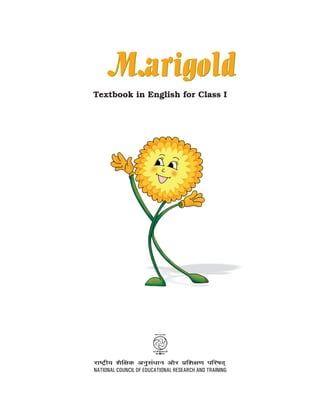
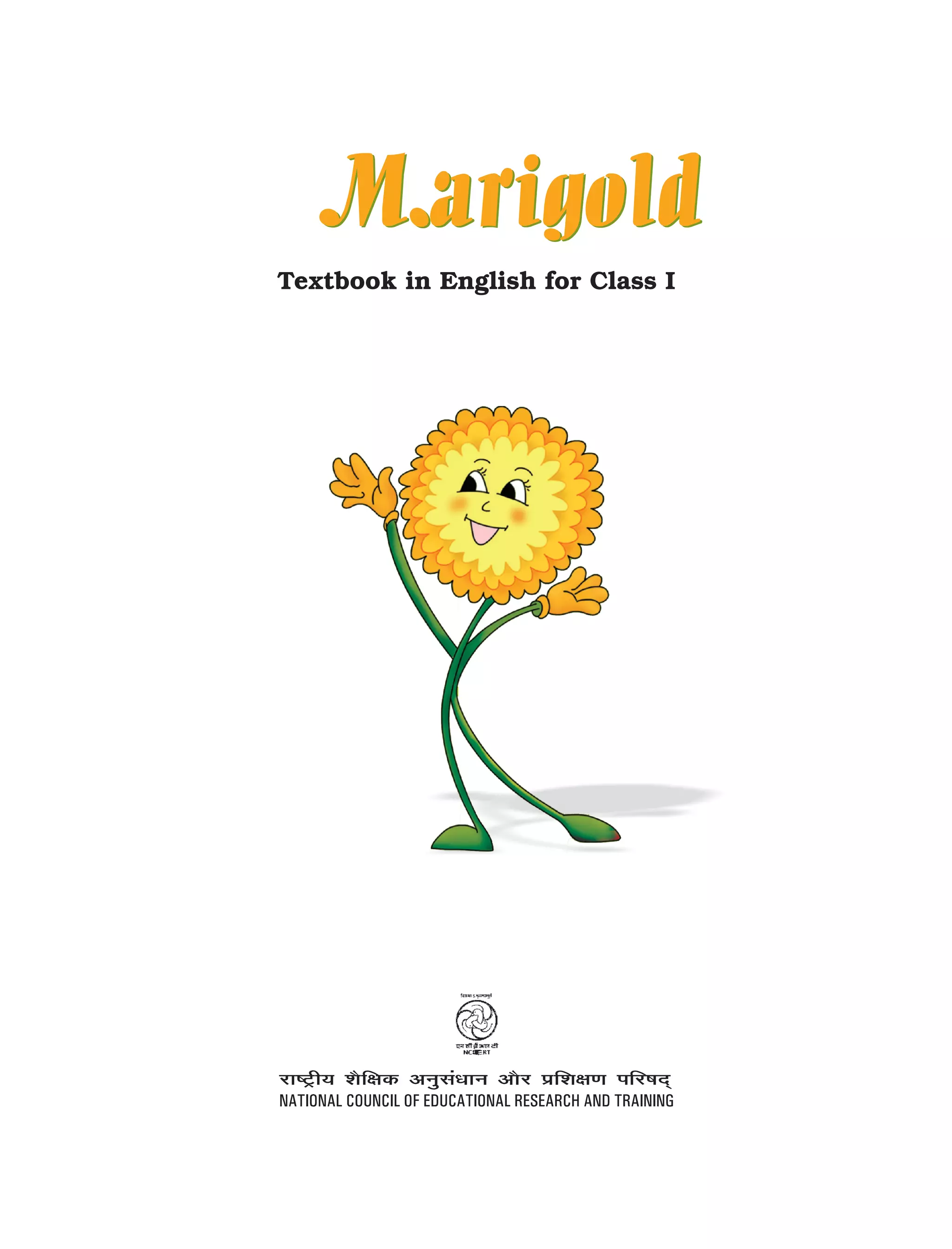
Textbook in English for Class I
MarigoldMarigold
ALL RIGHTS RESERVED
uNo part of this publication may be reproduced, stored in a retrieval
system or transmitted, in any form or by any means, electronic,
mechanical, photocopying, recording or otherwise without the prior
permission of the publisher.
uThis book is sold subject to the condition that it shall not, by way of
trade, be lent, re-sold, hired out or otherwise disposed of without the
publisher’s consent, in any form of binding or cover other than that in
which it is published.
uThe correct price of this publication is the price printed on this page,
Any revised price indicated by a rubber stamp or by a sticker or by any
other means is incorrect and should be unacceptable.
First Edition
February 2006 Phalguna 1927
Reprinted
November 2006 Kartika 1928
October 2007 Kartika 1929
January 2009 Magha 1930
November 2009 Kartika 1931
November 2010 Kartika 1932
January 2012 Magha 1933
December 2012 Agrahayana 1934
October 2013 Asvina 1935
November 2014 Agrahayana 1936
PD 420T IJ
© National Council of Educational Research
and Training, 2006
` 50.00
Printed on 80 GSM paper with NCERT
watermark
Published at the Publication Division by
the Secretary, National Council of
Educational Research and Training,
Sri Aurobindo Marg, New Delhi 110 016
and printed at S.K. Offset (P) Ltd., 10,
Sports Complex Enclave, Delhi Road,
Meerut 250 002
Publication Team
Head, Publication : N. K. Gupta
Division
Chief Production : Kalyan Banerjee
Officer
Chief Editor : Shveta Uppal
Chief Business : Gautam Ganguly
Manager
Production : Deepak Jaiswal
Assistant
Cover, layout and Illustrations
Henu Mehtani
ISBN 81-7450-478-8
OFFICES OF THE PUBLICATION
DIVISION, NCERT
NCERT Campus
Sri Aurobindo Marg
New Delhi 110 016 Phone : 011-26562708
108, 100 Feet Road
Hosdakere Halli Extension
Banashankari III Stage
Bangalore 560 085 Phone : 080-26725740
Navjivan Trust Building
P.O.Navjivan
Ahmedabad 380 014 Phone : 079-27541446
CWC Campus
Opp. Dhankal Bus Stop
Panihati
Kolkata 700 114 Phone : 033-25530454
CWC Complex
Maligaon
Guwahati 781 021 Phone : 0361-2674869
The National Curriculum Framework, 2005, recommends that children’s life at
school must be linked to their life outside the school. This principle marks a
departure from the legacy of bookish learning which continues to shape our
system and causes a gap between the school, home and community. The
syllabi and textbooks developed on the basis of NCF signify an attempt to
implement this basic idea. They also attempt to discourage rote learning and
the maintenance of sharp boundaries between different subject areas. We hope
these measures will take us significantly further in the direction of a child-
centred system of education outlined in the National Policy on Education
(1986).
The success of this effort depends on the steps that school principals and
teachers will take to encourage children to reflect on their own learning and to
pursue imaginative activities and questions. We must recognise that given
space, time and freedom, children generate new knowledge by engaging with
the information passed on to them by adults. Treating the prescribed textbook
as the sole basis of examination is one of the key reasons why other resources
and sites of learning are ignored. Inculcating creativity and initiative is possible
if we perceive and treat children as participants in learning, not as receivers of a
fixed body of knowledge.
These aims imply considerable change in school routines and mode of
functioning. Flexibility in the daily time-table is as necessary as rigour in
implementing the annual calendar so that the required number of teaching
days are actually devoted to teaching. The methods used for teaching and
evaluation will also determine how effective this textbook proves for making
children’s life at school a happy experience, rather than a source of stress or
boredom. Syllabus designers have tried to address the problem of curricular
burden by restructuring and reorienting knowledge at different stages with
greater consideration for child psychology and the time available for teaching.
The textbook attempts to enhance this endeavour by giving higher priority and
space to opportunities for contemplation and wondering, discussion in small
groups, and activities requiring hands-on experience.
NCERT appreciates the hard work done by the textbook development
committee responsible for this book. We wish to thank the Chairperson of the
advisory group at primary level, Professor Anita Rampal and the Chief Advisor
for this book, Professor R. Lalitha Eapen (CIEFL, Hyderabad) for guiding the
work of this committee. Several teachers contributed to the development of this
textbook; we are grateful to their principals for making this possible. We are
indebted to the institutions and organisations which have generously
Foreword
permitted us to draw upon their resources, material and personnel. We are
especially grateful to the members of the National Monitoring Committee,
appointed by the Department of Secondary and Higher Education, Ministry of
Human Resource Development under the Chairpersonship of Professor Mrinal
Miri and Professor G.P. Deshpande, for their valuable time and contribution. As
an organisation committed to the systemic reform and continuous
improvement in the quality of its products, NCERT welcomes comments and
suggestions which will enable us to undertake further revision and refinement.
Director
National Council of Educational
Research and Training
20 December 2005
New Delhi
(iv)
Textbook Development Committee
CHAIRPERSON, ADVISORY COMMITTEE FOR TEXTBOOKS AT THE PRIMARY LEVEL
Anita Rampal, Professor, Central Institute of Education, Delhi University
CHIEF ADVISOR
R. Lalitha Eapen, Professor, English and Foreign Languages University
(EFLU), Hyderabad.
CHIEF COORDINATOR
Ram Janma Sharma, Former Professor and Head, Department of Education
in Languages, NCERT, New Delhi.
MEMBERS
Anju Khanna, Principal, The Circle, New Delhi.
Meenu Kumar, PGT, Rajkiya Pratibha Vikas Vidyalaya, Vasant Kunj, Delhi.
Nita Berry, Children’s Literature Specialist, New Delhi.
Rekha Johnson, Primary Teacher, Demonstration School, RIE, Ajmer.
Shobha Chanana, TGT, Kendriya Vidyalaya, Sagar, Madhya Pradesh.
MEMBER-COORDINATOR
Usha Dutta, Former Professor, Department of Education in Languages,
NCERT, New Delhi.
Acknowledgements
National Council of Educational Research and Training is most grateful to the
following for their valuable contributions in the development of this book –
R. Amritavalli, Professor, CIEFL, Hyderabad, M.L. Tickoo, Professor (Retd.),
CIEFL, Hyderabad and Sonika Kaushik, Primary Teacher, Sanskriti School,
New Delhi.
The Council also thanks the following authors, copyright holders for
permission to use poems and stories included in this book.
After a Bath by Aileen Fisher; The Bubble, the Straw and the Shoe by Alexei
Tolstoy from Russian Tales for Children, E.P. Dutton and Company Inc., New
York; One Little Kitten by Carolyn Graham; Lalu and Peelu by Vineeta Krishna,
Ratnasagar, 1994; Mother Hen and the Chicks, The Beacon Readers ‘At Old
Lobs’ by E.H. Grassam, Ginn and Company Ltd., London, 1951; Mittu and the
Yellow Mango by Chitra Narendran, Frank Educational Aids Pvt. Ltd., New
Delhi; Merry-Go-Round by Dorothy W. Baruch; Circle by Manorama Jafa,
Ratnasagar Pvt. Ltd.; Our Tree by Pranab and Smita Chakravarti, National
Book Trust, India, 2005; Sundari adapted from ‘Cleo’ by Ruth Dixon in ‘The
Children’s Treasury,’ compiled by Marjorie Barrows, Consolidated Book
Publishers, Chicago, 1947; The Tiger and the Mosquito by Mrinalini Srivastava,
translated by Alaka Shankar, Children’s Book Trust, New Delhi, 2003 and
Anandi’s Rainbow by Anup Ray, National Book Trust, India, 2004. We also
acknowledge Bharat Gyan Vigyan Samithi Picture Stories by Nikolai Radlov,
New Delhi 2004 for Giant Rat and Umbrella Nest; Central Institute of English
and Foreign Languages (CIEFL), Hyderabad for Beginning Reading Programme,
2000 and Come on Everybody, Let’s Sing by Lois Birken Shaw Fleming.
Special thanks are due to Shveta Uppal, Chief Editor, NCERT and
Vandana R. Singh, Consultant Editor for going through the manuscript and
suggesting relevant changes.
The Council also gratefully acknowledges the contributions of
Rituraj Sharma, DTP Operator; Keerti Lingwal, Proof Reader; Sunanda,
Copy Editor and Incharge Computer Station, Parash Ram Kaushik in shaping
this book. Last but not the least, the efforts of the Publication Department,
NCERT are highly appreciated.
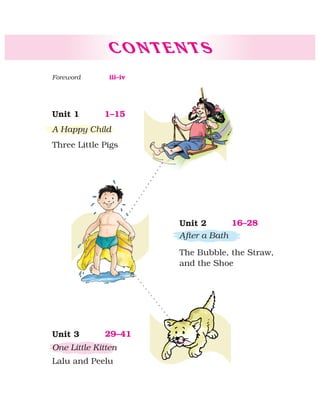
C O N T E N T S
1–15Unit 1
A Happy Child
Three Little Pigs
16–28Unit 2
After a Bath
The Bubble, the Straw,
and the Shoe
29–41Unit 3
One Little Kitten
Lalu and Peelu
iii–ivForeword
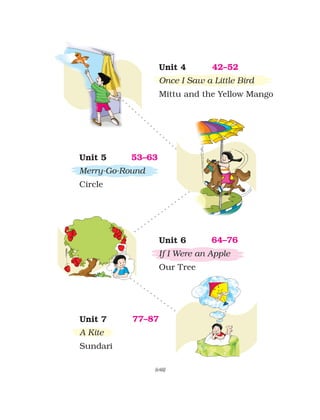
Unit 6
If I Were an Apple
Our Tree
64–76
Unit 7
A Kite
Sundari
77–87
42–52Unit 4
Once I Saw a Little Bird
Mittu and the Yellow Mango
53–63Unit 5
Merry-Go-Round
Circle
(viii)
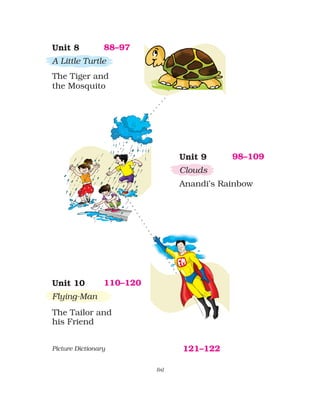
Unit 10
Flying-Man
The Tailor and
his Friend
110–120
Unit 9
Clouds
Anandi’s Rainbow
98–109
Unit 8
A Little Turtle
The Tiger and
the Mosquito
88–97
(ix)
Picture Dictionary 121–122
WE, THE PEOPLE OF INDIA, having
solemnly resolved to constitute India into a
1
[SOVEREIGN SOCIALIST SECULAR
DEMOCRATIC REPUBLIC] and to secure
to all its citizens :
JUSTICE, social, economic and
political;
LIBERTY of thought, expression, belief,
faith and worship;
EQUALITY of status and of opportunity
and to promote among them all;
FRATERNITY assuring the dignity of
2
the individual and the [unity and
integrity of the Nation];
IN OUR CONSTITUENT ASSEMBLY
this twenty-sixth day of November, 1949 do
HEREBY ADOPT, ENACT AND GIVE TO
OURSELVES THIS CONSTITUTION.
1. Subs. by the Constitution (Forty-second Amendment) Act, 1976, Sec.2,
for "Sovereign Democratic Republic" (w.e.f. 3.1.1977)
2. Subs. by the Constitution (Forty-second Amendment) Act, 1976, Sec.2,
for "Unity of the Nation" (w.e.f. 3.1.1977)
THE CONSTITUTION OF
INDIA
PREAMBLE

Prelims Book For Class 1st

  • 1.
    Textbook in Englishfor Class I MarigoldMarigold
  • 2.
    ALL RIGHTS RESERVED uNopart of this publication may be reproduced, stored in a retrieval system or transmitted, in any form or by any means, electronic, mechanical, photocopying, recording or otherwise without the prior permission of the publisher. uThis book is sold subject to the condition that it shall not, by way of trade, be lent, re-sold, hired out or otherwise disposed of without the publisher’s consent, in any form of binding or cover other than that in which it is published. uThe correct price of this publication is the price printed on this page, Any revised price indicated by a rubber stamp or by a sticker or by any other means is incorrect and should be unacceptable. First Edition February 2006 Phalguna 1927 Reprinted November 2006 Kartika 1928 October 2007 Kartika 1929 January 2009 Magha 1930 November 2009 Kartika 1931 November 2010 Kartika 1932 January 2012 Magha 1933 December 2012 Agrahayana 1934 October 2013 Asvina 1935 November 2014 Agrahayana 1936 PD 420T IJ © National Council of Educational Research and Training, 2006 ` 50.00 Printed on 80 GSM paper with NCERT watermark Published at the Publication Division by the Secretary, National Council of Educational Research and Training, Sri Aurobindo Marg, New Delhi 110 016 and printed at S.K. Offset (P) Ltd., 10, Sports Complex Enclave, Delhi Road, Meerut 250 002 Publication Team Head, Publication : N. K. Gupta Division Chief Production : Kalyan Banerjee Officer Chief Editor : Shveta Uppal Chief Business : Gautam Ganguly Manager Production : Deepak Jaiswal Assistant Cover, layout and Illustrations Henu Mehtani ISBN 81-7450-478-8 OFFICES OF THE PUBLICATION DIVISION, NCERT NCERT Campus Sri Aurobindo Marg New Delhi 110 016 Phone : 011-26562708 108, 100 Feet Road Hosdakere Halli Extension Banashankari III Stage Bangalore 560 085 Phone : 080-26725740 Navjivan Trust Building P.O.Navjivan Ahmedabad 380 014 Phone : 079-27541446 CWC Campus Opp. Dhankal Bus Stop Panihati Kolkata 700 114 Phone : 033-25530454 CWC Complex Maligaon Guwahati 781 021 Phone : 0361-2674869
  • 3.
    The National CurriculumFramework, 2005, recommends that children’s life at school must be linked to their life outside the school. This principle marks a departure from the legacy of bookish learning which continues to shape our system and causes a gap between the school, home and community. The syllabi and textbooks developed on the basis of NCF signify an attempt to implement this basic idea. They also attempt to discourage rote learning and the maintenance of sharp boundaries between different subject areas. We hope these measures will take us significantly further in the direction of a child- centred system of education outlined in the National Policy on Education (1986). The success of this effort depends on the steps that school principals and teachers will take to encourage children to reflect on their own learning and to pursue imaginative activities and questions. We must recognise that given space, time and freedom, children generate new knowledge by engaging with the information passed on to them by adults. Treating the prescribed textbook as the sole basis of examination is one of the key reasons why other resources and sites of learning are ignored. Inculcating creativity and initiative is possible if we perceive and treat children as participants in learning, not as receivers of a fixed body of knowledge. These aims imply considerable change in school routines and mode of functioning. Flexibility in the daily time-table is as necessary as rigour in implementing the annual calendar so that the required number of teaching days are actually devoted to teaching. The methods used for teaching and evaluation will also determine how effective this textbook proves for making children’s life at school a happy experience, rather than a source of stress or boredom. Syllabus designers have tried to address the problem of curricular burden by restructuring and reorienting knowledge at different stages with greater consideration for child psychology and the time available for teaching. The textbook attempts to enhance this endeavour by giving higher priority and space to opportunities for contemplation and wondering, discussion in small groups, and activities requiring hands-on experience. NCERT appreciates the hard work done by the textbook development committee responsible for this book. We wish to thank the Chairperson of the advisory group at primary level, Professor Anita Rampal and the Chief Advisor for this book, Professor R. Lalitha Eapen (CIEFL, Hyderabad) for guiding the work of this committee. Several teachers contributed to the development of this textbook; we are grateful to their principals for making this possible. We are indebted to the institutions and organisations which have generously Foreword
  • 4.
    permitted us todraw upon their resources, material and personnel. We are especially grateful to the members of the National Monitoring Committee, appointed by the Department of Secondary and Higher Education, Ministry of Human Resource Development under the Chairpersonship of Professor Mrinal Miri and Professor G.P. Deshpande, for their valuable time and contribution. As an organisation committed to the systemic reform and continuous improvement in the quality of its products, NCERT welcomes comments and suggestions which will enable us to undertake further revision and refinement. Director National Council of Educational Research and Training 20 December 2005 New Delhi (iv)
  • 5.
    Textbook Development Committee CHAIRPERSON,ADVISORY COMMITTEE FOR TEXTBOOKS AT THE PRIMARY LEVEL Anita Rampal, Professor, Central Institute of Education, Delhi University CHIEF ADVISOR R. Lalitha Eapen, Professor, English and Foreign Languages University (EFLU), Hyderabad. CHIEF COORDINATOR Ram Janma Sharma, Former Professor and Head, Department of Education in Languages, NCERT, New Delhi. MEMBERS Anju Khanna, Principal, The Circle, New Delhi. Meenu Kumar, PGT, Rajkiya Pratibha Vikas Vidyalaya, Vasant Kunj, Delhi. Nita Berry, Children’s Literature Specialist, New Delhi. Rekha Johnson, Primary Teacher, Demonstration School, RIE, Ajmer. Shobha Chanana, TGT, Kendriya Vidyalaya, Sagar, Madhya Pradesh. MEMBER-COORDINATOR Usha Dutta, Former Professor, Department of Education in Languages, NCERT, New Delhi.
  • 6.
    Acknowledgements National Council ofEducational Research and Training is most grateful to the following for their valuable contributions in the development of this book – R. Amritavalli, Professor, CIEFL, Hyderabad, M.L. Tickoo, Professor (Retd.), CIEFL, Hyderabad and Sonika Kaushik, Primary Teacher, Sanskriti School, New Delhi. The Council also thanks the following authors, copyright holders for permission to use poems and stories included in this book. After a Bath by Aileen Fisher; The Bubble, the Straw and the Shoe by Alexei Tolstoy from Russian Tales for Children, E.P. Dutton and Company Inc., New York; One Little Kitten by Carolyn Graham; Lalu and Peelu by Vineeta Krishna, Ratnasagar, 1994; Mother Hen and the Chicks, The Beacon Readers ‘At Old Lobs’ by E.H. Grassam, Ginn and Company Ltd., London, 1951; Mittu and the Yellow Mango by Chitra Narendran, Frank Educational Aids Pvt. Ltd., New Delhi; Merry-Go-Round by Dorothy W. Baruch; Circle by Manorama Jafa, Ratnasagar Pvt. Ltd.; Our Tree by Pranab and Smita Chakravarti, National Book Trust, India, 2005; Sundari adapted from ‘Cleo’ by Ruth Dixon in ‘The Children’s Treasury,’ compiled by Marjorie Barrows, Consolidated Book Publishers, Chicago, 1947; The Tiger and the Mosquito by Mrinalini Srivastava, translated by Alaka Shankar, Children’s Book Trust, New Delhi, 2003 and Anandi’s Rainbow by Anup Ray, National Book Trust, India, 2004. We also acknowledge Bharat Gyan Vigyan Samithi Picture Stories by Nikolai Radlov, New Delhi 2004 for Giant Rat and Umbrella Nest; Central Institute of English and Foreign Languages (CIEFL), Hyderabad for Beginning Reading Programme, 2000 and Come on Everybody, Let’s Sing by Lois Birken Shaw Fleming. Special thanks are due to Shveta Uppal, Chief Editor, NCERT and Vandana R. Singh, Consultant Editor for going through the manuscript and suggesting relevant changes. The Council also gratefully acknowledges the contributions of Rituraj Sharma, DTP Operator; Keerti Lingwal, Proof Reader; Sunanda, Copy Editor and Incharge Computer Station, Parash Ram Kaushik in shaping this book. Last but not the least, the efforts of the Publication Department, NCERT are highly appreciated.
  • 7.
    C O NT E N T S 1–15Unit 1 A Happy Child Three Little Pigs 16–28Unit 2 After a Bath The Bubble, the Straw, and the Shoe 29–41Unit 3 One Little Kitten Lalu and Peelu iii–ivForeword
  • 8.
    Unit 6 If IWere an Apple Our Tree 64–76 Unit 7 A Kite Sundari 77–87 42–52Unit 4 Once I Saw a Little Bird Mittu and the Yellow Mango 53–63Unit 5 Merry-Go-Round Circle (viii)
  • 9.
    Unit 10 Flying-Man The Tailorand his Friend 110–120 Unit 9 Clouds Anandi’s Rainbow 98–109 Unit 8 A Little Turtle The Tiger and the Mosquito 88–97 (ix) Picture Dictionary 121–122
  • 10.
    WE, THE PEOPLEOF INDIA, having solemnly resolved to constitute India into a 1 [SOVEREIGN SOCIALIST SECULAR DEMOCRATIC REPUBLIC] and to secure to all its citizens : JUSTICE, social, economic and political; LIBERTY of thought, expression, belief, faith and worship; EQUALITY of status and of opportunity and to promote among them all; FRATERNITY assuring the dignity of 2 the individual and the [unity and integrity of the Nation]; IN OUR CONSTITUENT ASSEMBLY this twenty-sixth day of November, 1949 do HEREBY ADOPT, ENACT AND GIVE TO OURSELVES THIS CONSTITUTION. 1. Subs. by the Constitution (Forty-second Amendment) Act, 1976, Sec.2, for "Sovereign Democratic Republic" (w.e.f. 3.1.1977) 2. Subs. by the Constitution (Forty-second Amendment) Act, 1976, Sec.2, for "Unity of the Nation" (w.e.f. 3.1.1977) THE CONSTITUTION OF INDIA PREAMBLE