C
DRAMA
Drama
•It is meant to be performed for an audience in the
form of a play.
•The term drama comes from a Greek word meaning
action (Classical Greek: δρᾶμα, drama), which is
derived from the verb meaning to do or to act (Classical
Greek: δράω, draō)
• The two masks associated with drama represent the traditional
generic division between comedy and tragedy. They are symbols of
the ancient Greek Muses, Thalia and Melpomene.
• Thalia was the Muse of comedy (the laughing face), while
Melpomene was the Muse of tragedy (the weeping face).
ELEMENTS OF
DRAMA
Characters
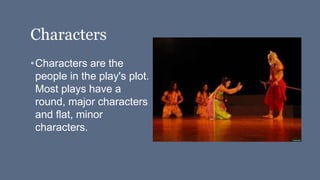
•Characters are the
people in the play's plot.
Most plays have a
round, major characters
and flat, minor
characters.

Audience
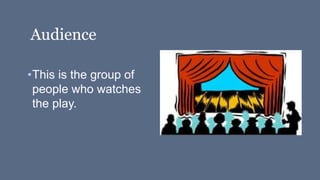
•This is the group of
people who watches
the play.
Setting
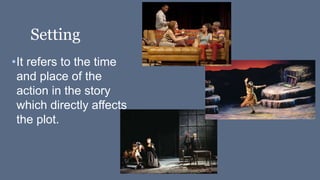
•It refers to the time
and place of the
action in the story
which directly affects
the plot.
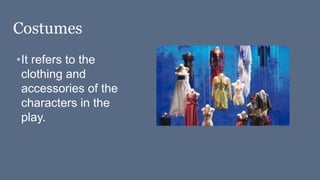
Costumes
•It refers to the
clothing and
accessories of the
characters in the
play.
Music
•This element
comprises of the
melody in the use of
sounds and rhythm in
dialogues as well as
melody
compositions.
Plot
•It is the basic storyline narrated through a
play.
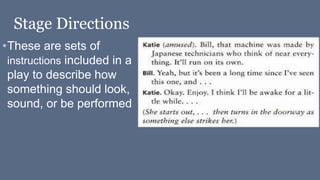
Stage Directions
•These are sets of
instructions included in a
play to describe how
something should look,
sound, or be performed
Script
•It is the written text from which a drama is
produced.
Dialogue
•It is a conversation between characters in a
drama.
Theme
•It is the central idea of a play which can either be
clearly stated through dialogue or action or can be
inferred after watching the entire performance.
Encircle the appositive phrase in each of the following sentences. Then draw an
arrow to the noun or pronoun that the appositive identifies and describes.
• My daughter's car, a Toyota, has certainly served her well.
• The Little Red Deli, our neighborhood store, is more than seventy-five years old.
• Eleven, Joe's house number, is also his uniform's number.
• The cheetah, the fastest land animal, sprinted across the plains.
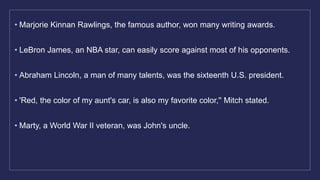
• Marjorie Kinnan Rawlings, the famous author, won many writing awards.
• LeBron James, an NBA star, can easily score against most of his opponents.
• Abraham Lincoln, a man of many talents, was the sixteenth U.S. president.
• 'Red, the color of my aunt's car, is also my favorite color,'' Mitch stated.
• Marty, a World War II veteran, was John's uncle.
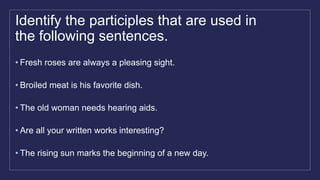
Identify the participles that are used in
the following sentences.
• Fresh roses are always a pleasing sight.
• Broiled meat is his favorite dish.
• The old woman needs hearing aids.
• Are all your written works interesting?
• The rising sun marks the beginning of a new day.
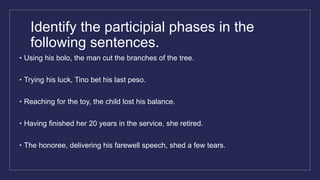
Identify the participial phases in the
following sentences.
• Using his bolo, the man cut the branches of the tree.
• Trying his luck, Tino bet his last peso.
• Reaching for the toy, the child lost his balance.
• Having finished her 20 years in the service, she retired.
• The honoree, delivering his farewell speech, shed a few tears.
• Having opened the safe, the burglar got all the cash.
• The ipil-ipil trees, planted around the campus, give shade to the students.
• Practicing bayanihan, the farmers moved the house in a short time.
• Being a good climber, Jose got the plum prize in the palo sebo.
• Having delivered his speech, the guest left the hall.
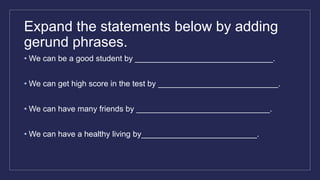
Expand the statements below by adding
gerund phrases.
• We can be a good student by _______________________________.
• We can get high score in the test by ___________________________.
• We can have many friends by ______________________________.
• We can have a healthy living by__________________________.
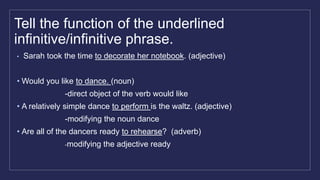
Tell the function of the underlined
infinitive/infinitive phrase.
• Sarah took the time to decorate her notebook. (adjective)
• Would you like to dance. (noun)
-direct object of the verb would like
• A relatively simple dance to perform is the waltz. (adjective)
-modifying the noun dance
• Are all of the dancers ready to rehearse? (adverb)
-modifying the adjective ready
1.
English Lesson: Drama

English Lesson: Drama

  • 1.
  • 2.
    Drama •It is meantto be performed for an audience in the form of a play. •The term drama comes from a Greek word meaning action (Classical Greek: δρᾶμα, drama), which is derived from the verb meaning to do or to act (Classical Greek: δράω, draō)
  • 3.
    • The twomasks associated with drama represent the traditional generic division between comedy and tragedy. They are symbols of the ancient Greek Muses, Thalia and Melpomene. • Thalia was the Muse of comedy (the laughing face), while Melpomene was the Muse of tragedy (the weeping face).
  • 4.
  • 5.
    Characters •Characters are the peoplein the play's plot. Most plays have a round, major characters and flat, minor characters.

  • 6.
    Audience •This is thegroup of people who watches the play.
  • 7.
    Setting •It refers tothe time and place of the action in the story which directly affects the plot.
  • 8.
    Costumes •It refers tothe clothing and accessories of the characters in the play.
  • 9.
    Music •This element comprises ofthe melody in the use of sounds and rhythm in dialogues as well as melody compositions.
  • 10.
    Plot •It is thebasic storyline narrated through a play.
  • 11.
    Stage Directions •These aresets of instructions included in a play to describe how something should look, sound, or be performed
  • 12.
    Script •It is thewritten text from which a drama is produced.
  • 13.
    Dialogue •It is aconversation between characters in a drama.
  • 14.
    Theme •It is thecentral idea of a play which can either be clearly stated through dialogue or action or can be inferred after watching the entire performance.
  • 15.
    Encircle the appositivephrase in each of the following sentences. Then draw an arrow to the noun or pronoun that the appositive identifies and describes. • My daughter's car, a Toyota, has certainly served her well. • The Little Red Deli, our neighborhood store, is more than seventy-five years old. • Eleven, Joe's house number, is also his uniform's number. • The cheetah, the fastest land animal, sprinted across the plains.
  • 16.
    • Marjorie KinnanRawlings, the famous author, won many writing awards. • LeBron James, an NBA star, can easily score against most of his opponents. • Abraham Lincoln, a man of many talents, was the sixteenth U.S. president. • 'Red, the color of my aunt's car, is also my favorite color,'' Mitch stated. • Marty, a World War II veteran, was John's uncle.
  • 17.
    Identify the participlesthat are used in the following sentences. • Fresh roses are always a pleasing sight. • Broiled meat is his favorite dish. • The old woman needs hearing aids. • Are all your written works interesting? • The rising sun marks the beginning of a new day.
  • 18.
    Identify the participialphases in the following sentences. • Using his bolo, the man cut the branches of the tree. • Trying his luck, Tino bet his last peso. • Reaching for the toy, the child lost his balance. • Having finished her 20 years in the service, she retired. • The honoree, delivering his farewell speech, shed a few tears.
  • 19.
    • Having openedthe safe, the burglar got all the cash. • The ipil-ipil trees, planted around the campus, give shade to the students. • Practicing bayanihan, the farmers moved the house in a short time. • Being a good climber, Jose got the plum prize in the palo sebo. • Having delivered his speech, the guest left the hall.
  • 20.
    Expand the statementsbelow by adding gerund phrases. • We can be a good student by _______________________________. • We can get high score in the test by ___________________________. • We can have many friends by ______________________________. • We can have a healthy living by__________________________.
  • 21.
    Tell the functionof the underlined infinitive/infinitive phrase. • Sarah took the time to decorate her notebook. (adjective) • Would you like to dance. (noun) -direct object of the verb would like • A relatively simple dance to perform is the waltz. (adjective) -modifying the noun dance • Are all of the dancers ready to rehearse? (adverb) -modifying the adjective ready
  • 22.