English Grammar part
2
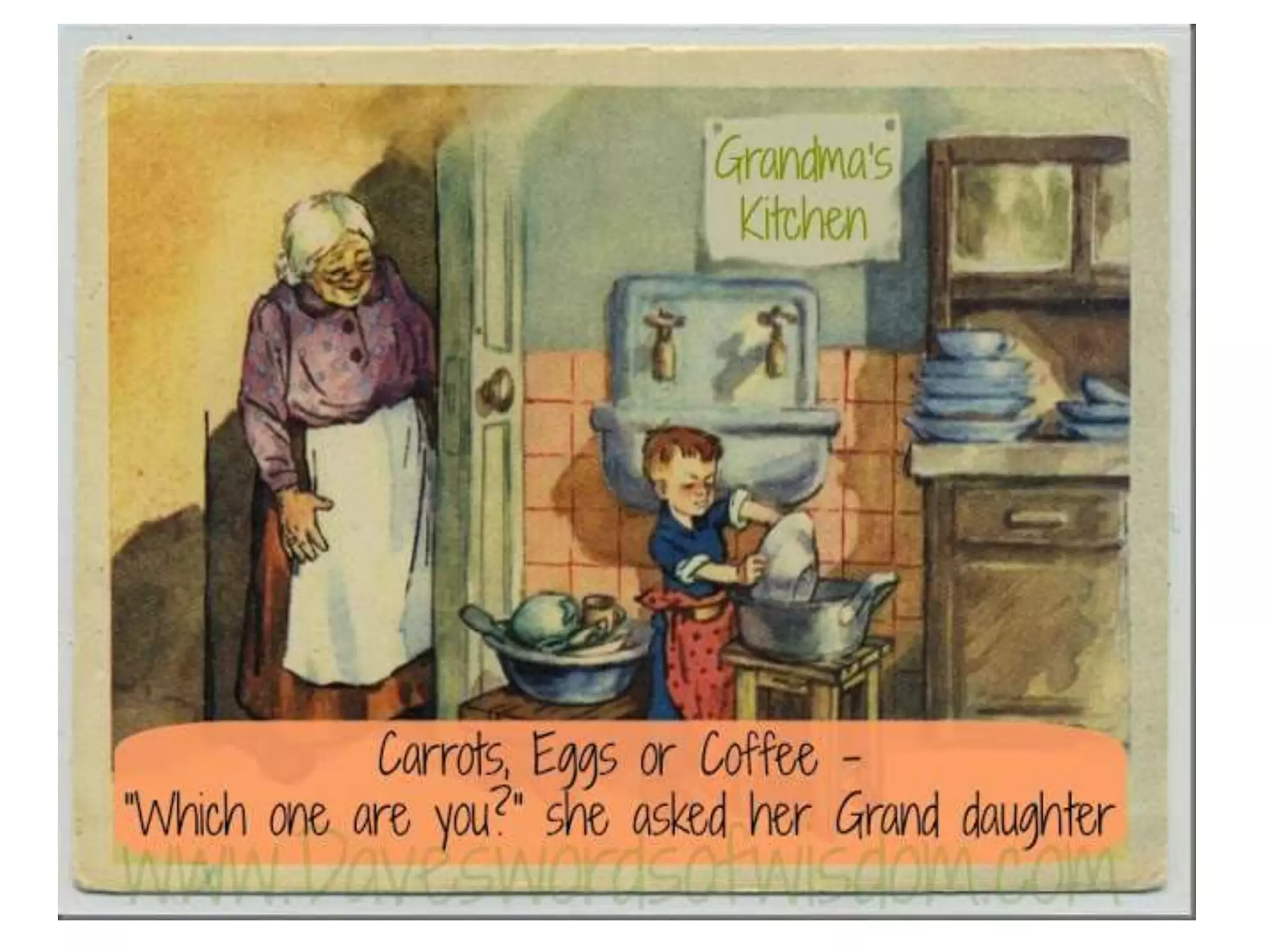
Grandmother says... Carrots, Eggs, or
Coffee; "Which are you?"
A young woman went to her
grandmother and told her about her
life and how things were so hard for
her. She did not know how she was
going to make it and wanted to give
up. She was tired of fighting and
struggling. It seemed as one problem
was solved a new one arose.
Her grandmother took her to the
kitchen. She filled three pots
with water. In the first, she
placed carrots, in the second
she placed eggs and
the last she placed ground
coffee beans. She let them sit
and boil without saying a word.
In about twenty minutes she
turned off the burners. She
fished the carrots out and
placed them in a bowl. She
pulled the eggs out and placed
them in a bowl. Then she ladled
the coffee out and placed it in a
bowl. Turning to her
granddaughter, she asked, "Tell
Carrots, eggs, and
coffee," she
replied.
She brought her closer
and asked her to feel
the carrots. She did
and noted that they
got soft. She then
asked her to take an
egg and break it.
After pulling off the shell, she
observed the hard-boiled egg.
Finally, she asked her to sip the
coffee. The granddaughter
smiled, as she tasted its rich
aroma. The granddaughter then
asked. "What's the point,
grandmother?"
Her grandmother
explained that each of
these objects had faced
the same adversity--
boiling water--but each
reacted differently.
The carrot went in strong, hard
and unrelenting. However after
being subjected to the boiling
water, it softened and became
weak. The egg had been fragile.
Its thin outer shell had protected
its liquid interior. But, after
sitting through the boiling water,
its inside became hardened.
The ground coffee beans were
unique, however. After they were
in the boiling water they had
changed the water.
"Which are you?" she asked her
granddaughter.
"When adversity knocks on
your door, how do you
respond? Are you a carrot,
an egg, or a coffee bean?"
Think of this: Which am I?
Am I the carrot that seems strong, but with
pain and adversity, do I wilt and become
soft and lose my strength?
Am I the egg that starts with a malleable
heart, but changes with the heat? Did I have
a fluid spirit, but after a death, a breakup, a
financial hardship or some other trial, have I
become hardened and stiff?
Does my shell look
the same, but on the
inside am I bitter and
tough with a stiff spirit
and a hardened
heart?
Or am I like the coffee bean? The
bean actually changes the hot
water, the very circumstance that
brings the pain. When the water
gets hot, it releases the fragrance
and flavor. If you are like the bean,
when things are at their worst, you
get better and change the situation
around you.
When the hours are the
darkest and trials are their
greatest do you elevate to
another level?
---AUTHOR UNKNOWN
—
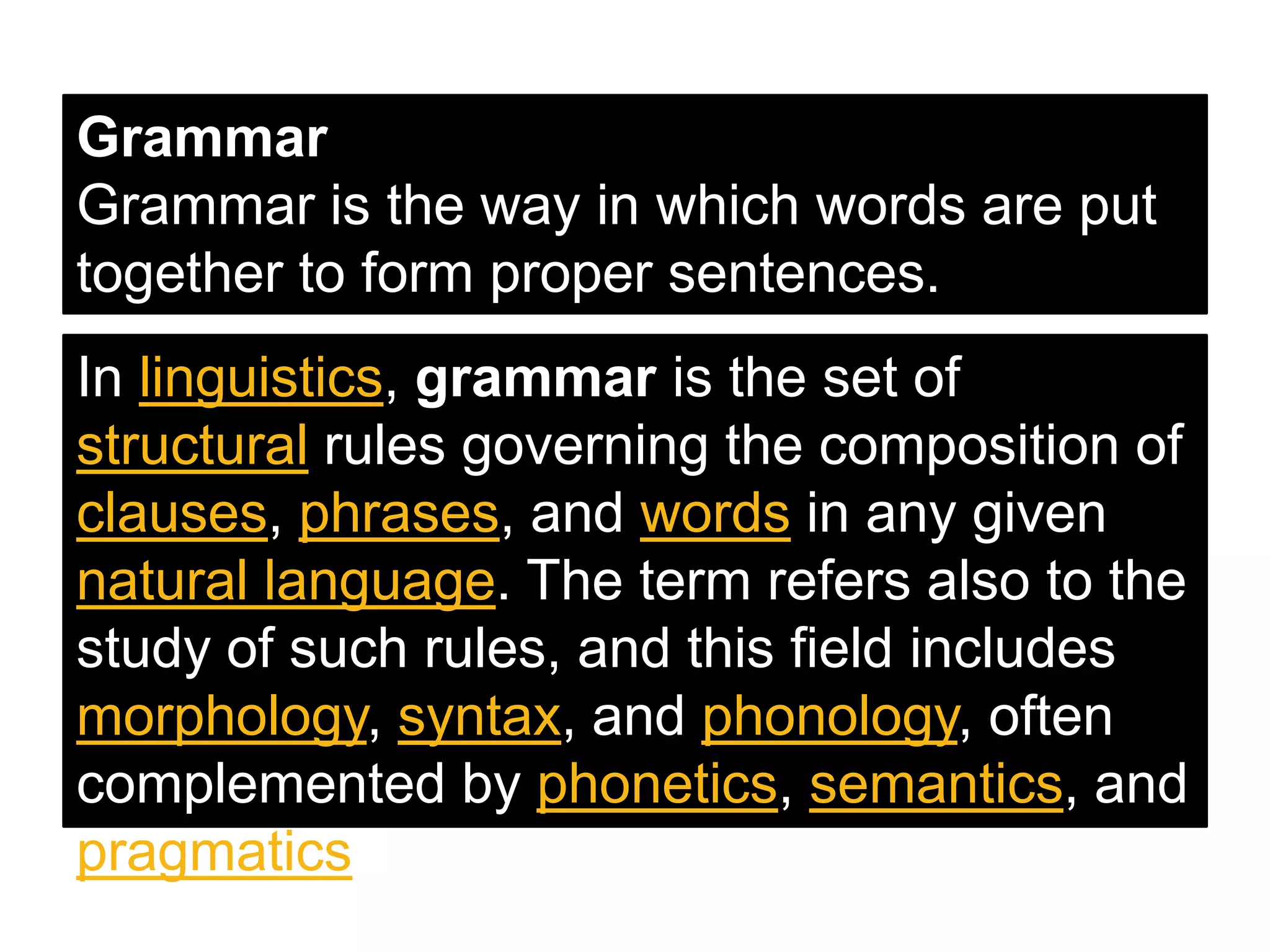
Grammar
Grammar is the way in which words are put
together to form proper sentences.
In linguistics, grammar is the set of
structural rules governing the composition of
clauses, phrases, and words in any given
natural language. The term refers also to the
study of such rules, and this field includes
morphology, syntax, and phonology, often
complemented by phonetics, semantics, and
pragmatics.
Rules of
Grammar
Key Rules
1. Use Active Voice
Every human language starts an active sentence with the subject,
or the "doer." In English, the verb (what's being done) follows the
subject. If there is an object (the receiver of the action), it comes
after the verb. The formula looks like this:
S+V+O. This rule is the foundation of the English language.
Here are some examples:
•Mary walked the dog.
•The dog liked Mary.
•I did not like the dog.
2. Link Ideas with a Conjunction
Sometimes you want to link two ideas
with a second S+V+O combination.
When you do, you need a coordinating
conjunction. The new formula looks like
this:
S+V+O, COORDINATING
CONJUNCTION+S+V+O
3. Use a Comma to Connect Two
Ideas As One
FANBOYS are used when connecting
two ideas as one in a single sentence,
but don't forget the comma.
For example:
I do not walk Mary's dog, nor do I wash
him.
Mary fed her dog, and I drank tea.
Mary feeds and walks her dog every
day, but the dog is still hyperactive.
4. Use the Simple Present Tense for
Habitual Actions
The simple present is the tense you use
for any habitual action. The things you
always do or do every Tuesday are
described with the simple present, which
just means you pick the first form of any
verb.
Mary likes dogs.
I don't walk Mary's dog.
Mary and I drink tea every Tuesday
together.
5. Use the Present Progressive Tense for
Current Action
The present progressive tense is for
anything that is happening right now. All of
the progressive tenses are easy to spot
because their verbs always end with "-ing"
and get a helping verb. A helping verb is just
so we know who and when we're talking
about. In the present progressive, the
helping verbs are the present tense
conjugations of "to be."
I am drinking green tea.
The barking dogs outside are driving me
6. Add "ed" to verbs for the Past Tense
When we talk about the past, we have to add
an "-ed" to regular verbs to make the second
form. Irregular verbs are tricky and have their
own sets of rules. Drink, for example, turns to
"drank." Most of the time, though, "-ed" will do.
I drank a lot of gree tea yesterday, but Mary
didn't.
The dogs stopped barking two seconds ago,
and I am feeling better.
Mary played fetch with her hyperactive dog.
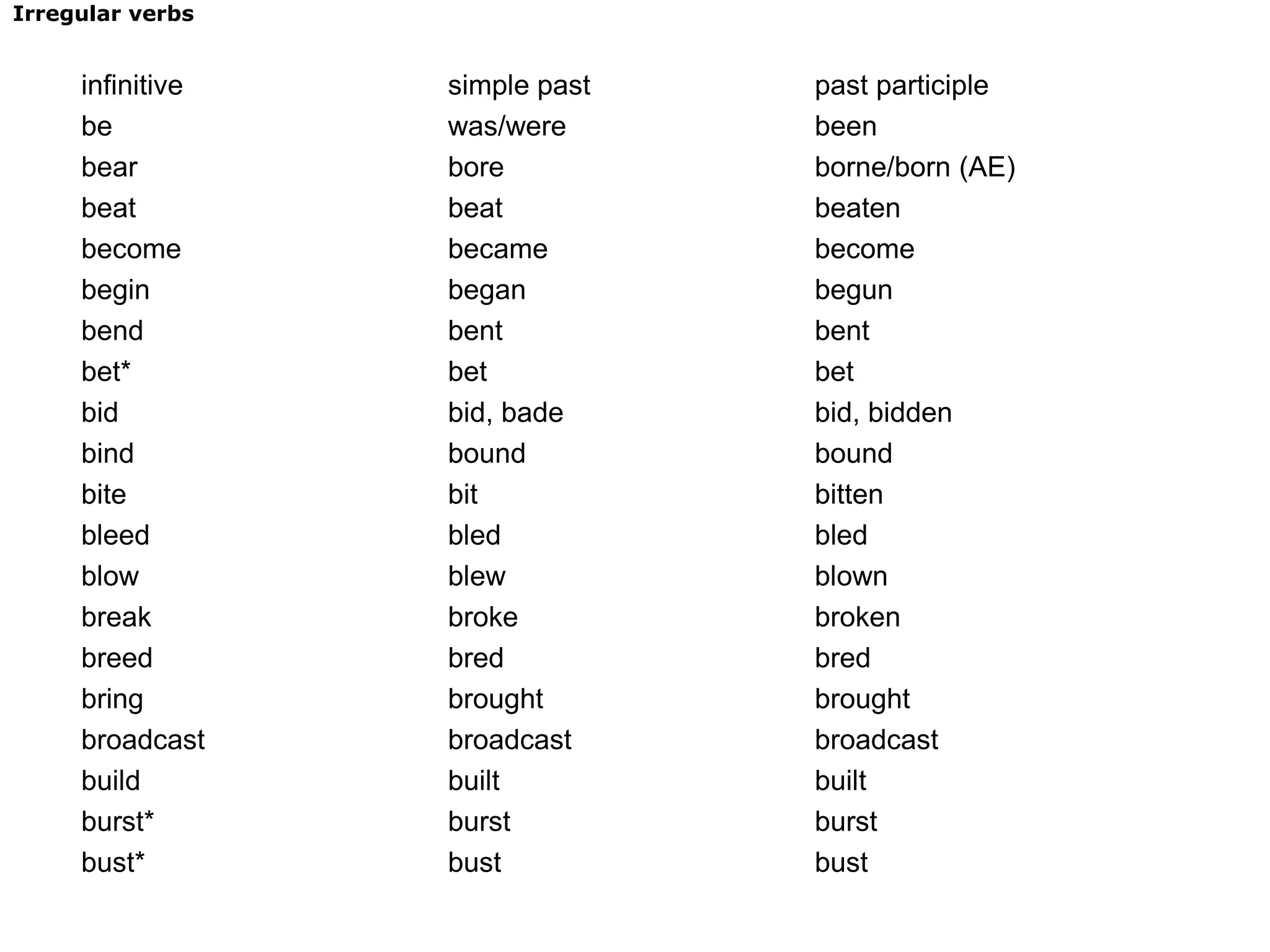
infinitive simple past past participle
be was/were been
bear bore borne/born (AE)
beat beat beaten
become became become
begin began begun
bend bent bent
bet* bet bet
bid bid, bade bid, bidden
bind bound bound
bite bit bitten
bleed bled bled
blow blew blown
break broke broken
breed bred bred
bring brought brought
broadcast broadcast broadcast
build built built
burst* burst burst
bust* bust bust
Irregular verbs
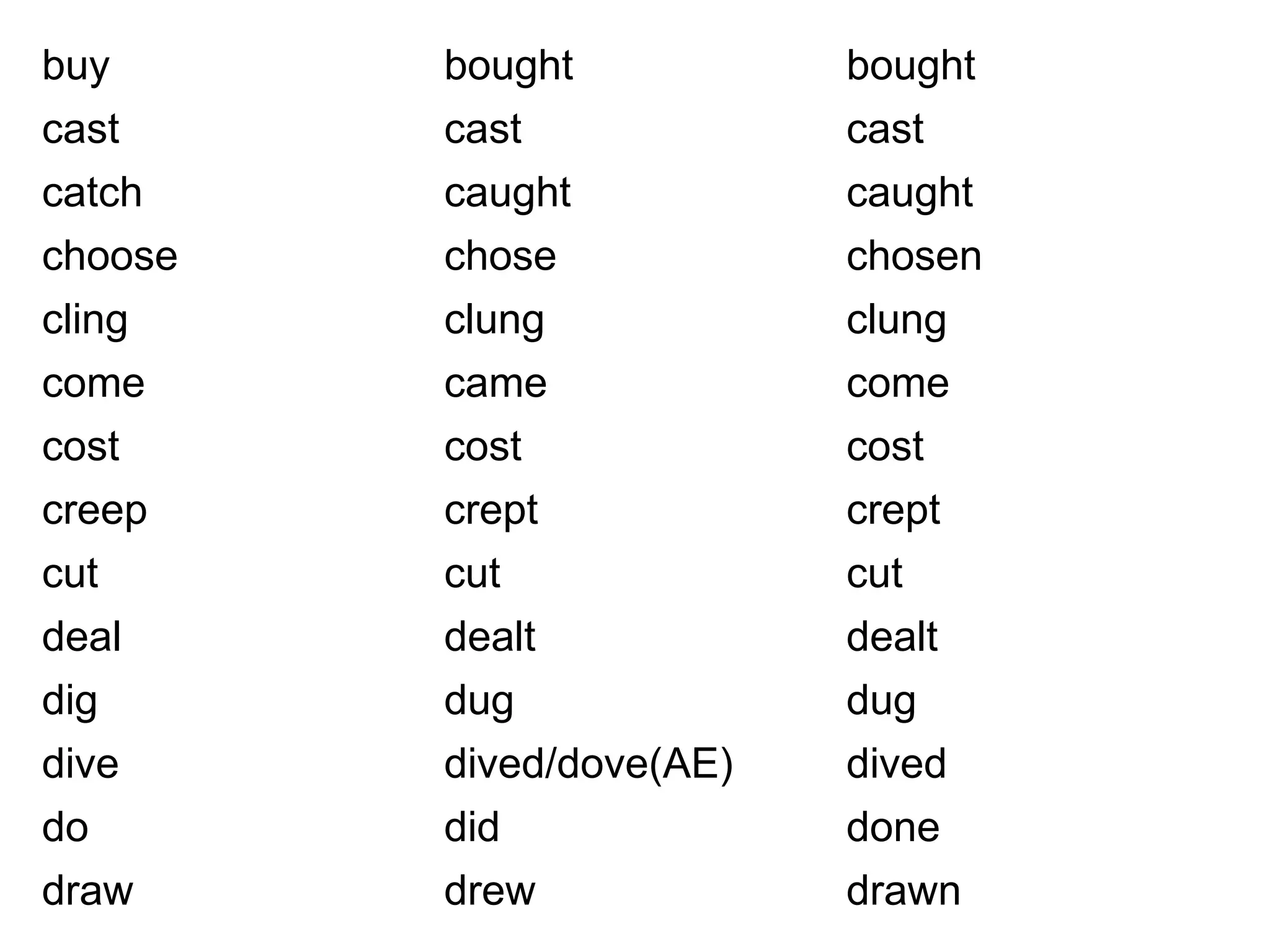
buy bought bought
cast cast cast
catch caught caught
choose chose chosen
cling clung clung
come came come
cost cost cost
creep crept crept
cut cut cut
deal dealt dealt
dig dug dug
dive dived/dove(AE) dived
do did done
draw drew drawn
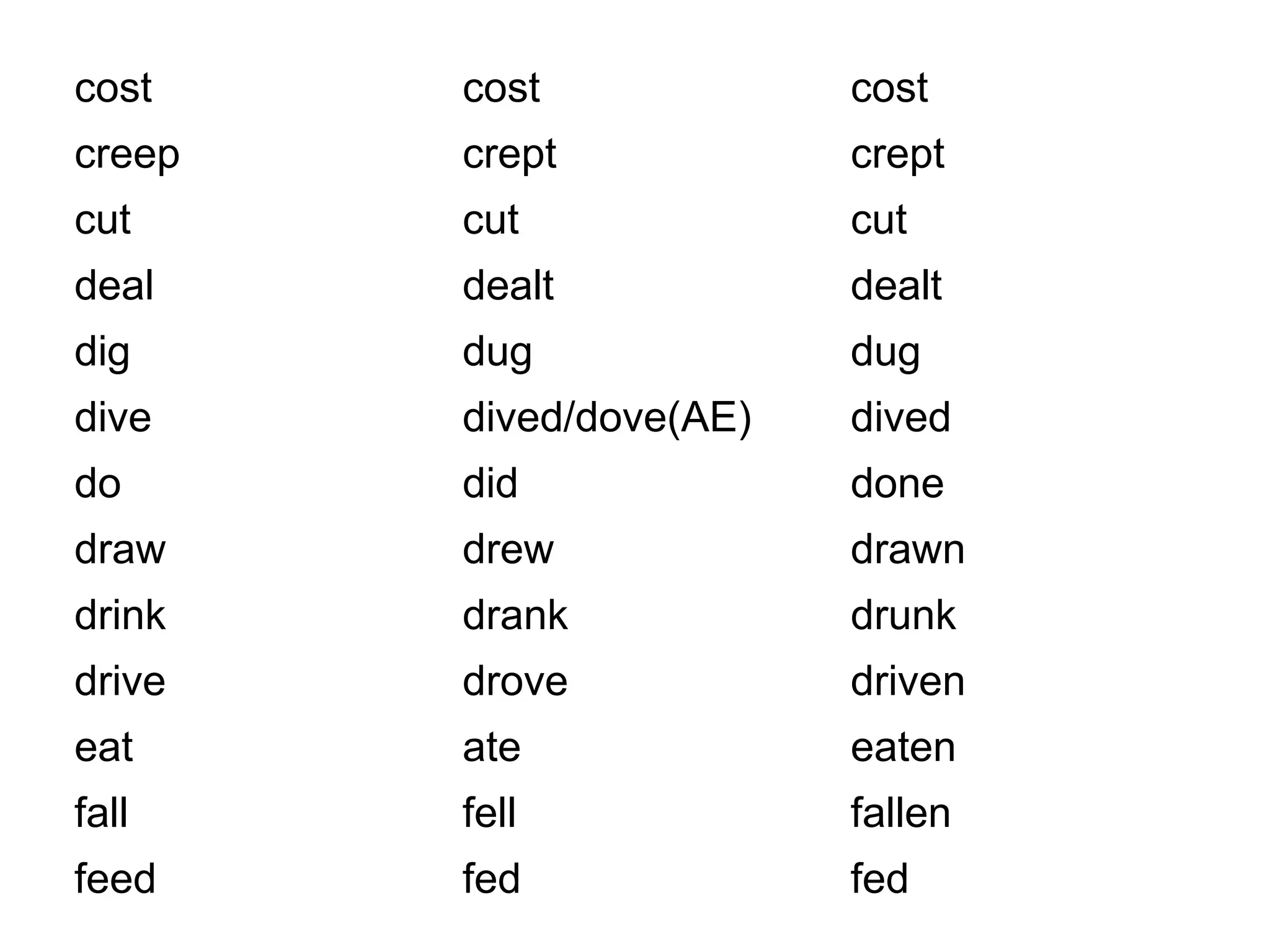
cost cost cost
creep crept crept
cut cut cut
deal dealt dealt
dig dug dug
dive dived/dove(AE) dived
do did done
draw drew drawn
drink drank drunk
drive drove driven
eat ate eaten
fall fell fallen
feed fed fed
Use
Perfect
Tenses
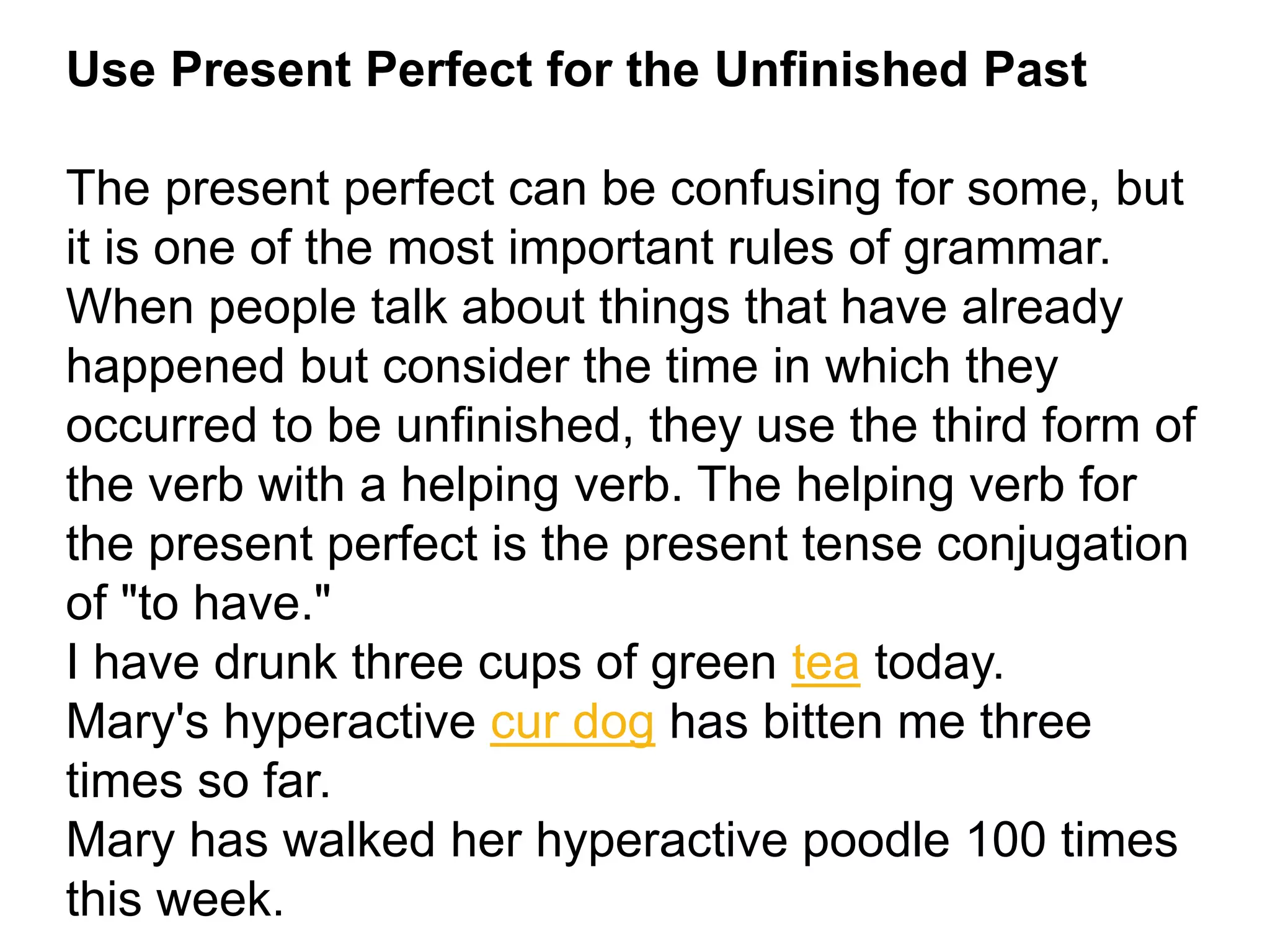
Use Present Perfect for the Unfinished Past
The present perfect can be confusing for some, but
it is one of the most important rules of grammar.
When people talk about things that have already
happened but consider the time in which they
occurred to be unfinished, they use the third form of
the verb with a helping verb. The helping verb for
the present perfect is the present tense conjugation
of "to have."
I have drunk three cups of green tea today.
Mary's hyperactive cur dog has bitten me three
times so far.
Mary has walked her hyperactive poodle 100 times
this week.
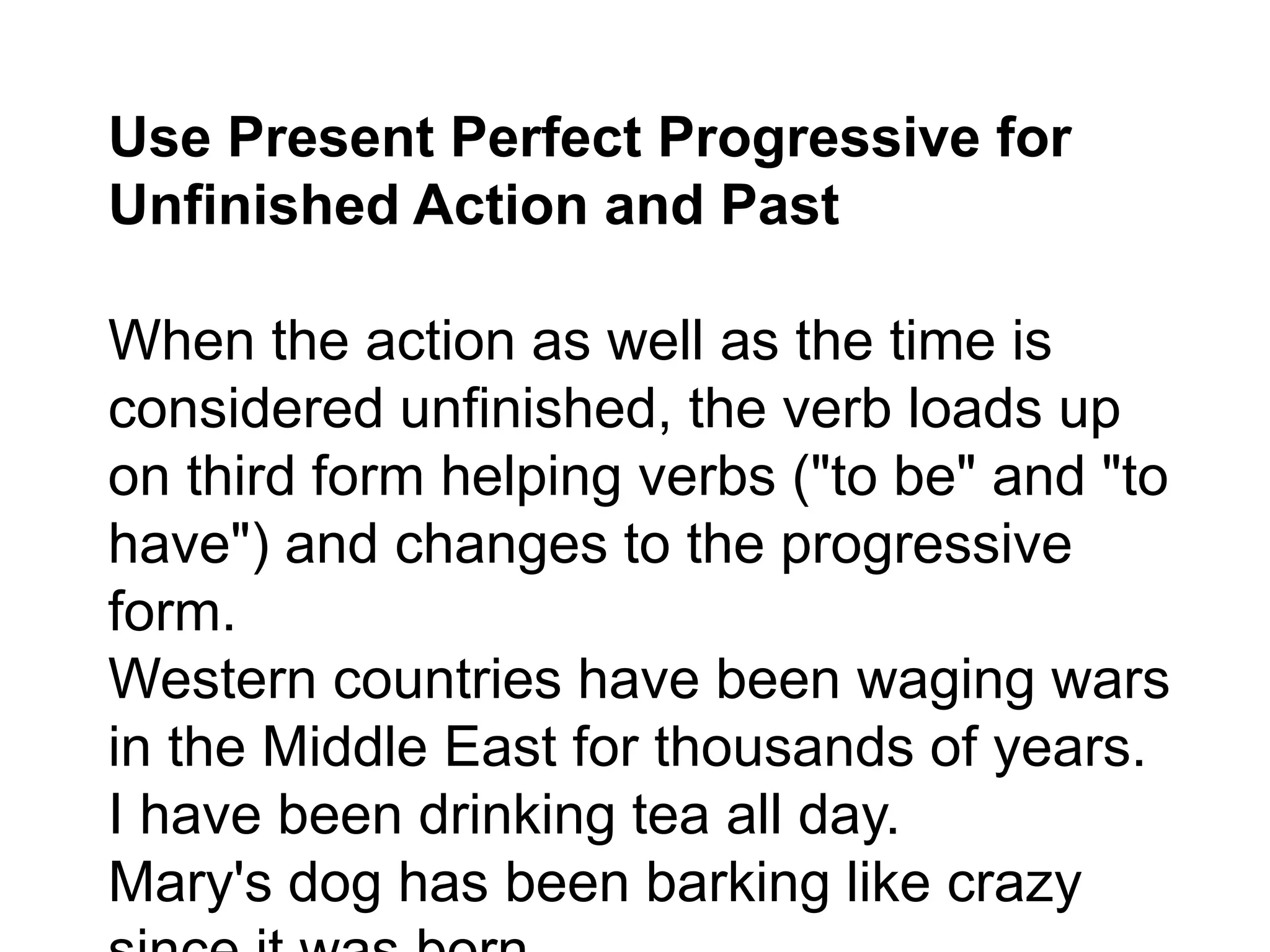
Use Present Perfect Progressive for
Unfinished Action and Past
When the action as well as the time is
considered unfinished, the verb loads up
on third form helping verbs ("to be" and "to
have") and changes to the progressive
form.
Western countries have been waging wars
in the Middle East for thousands of years.
I have been drinking tea all day.
Mary's dog has been barking like crazy
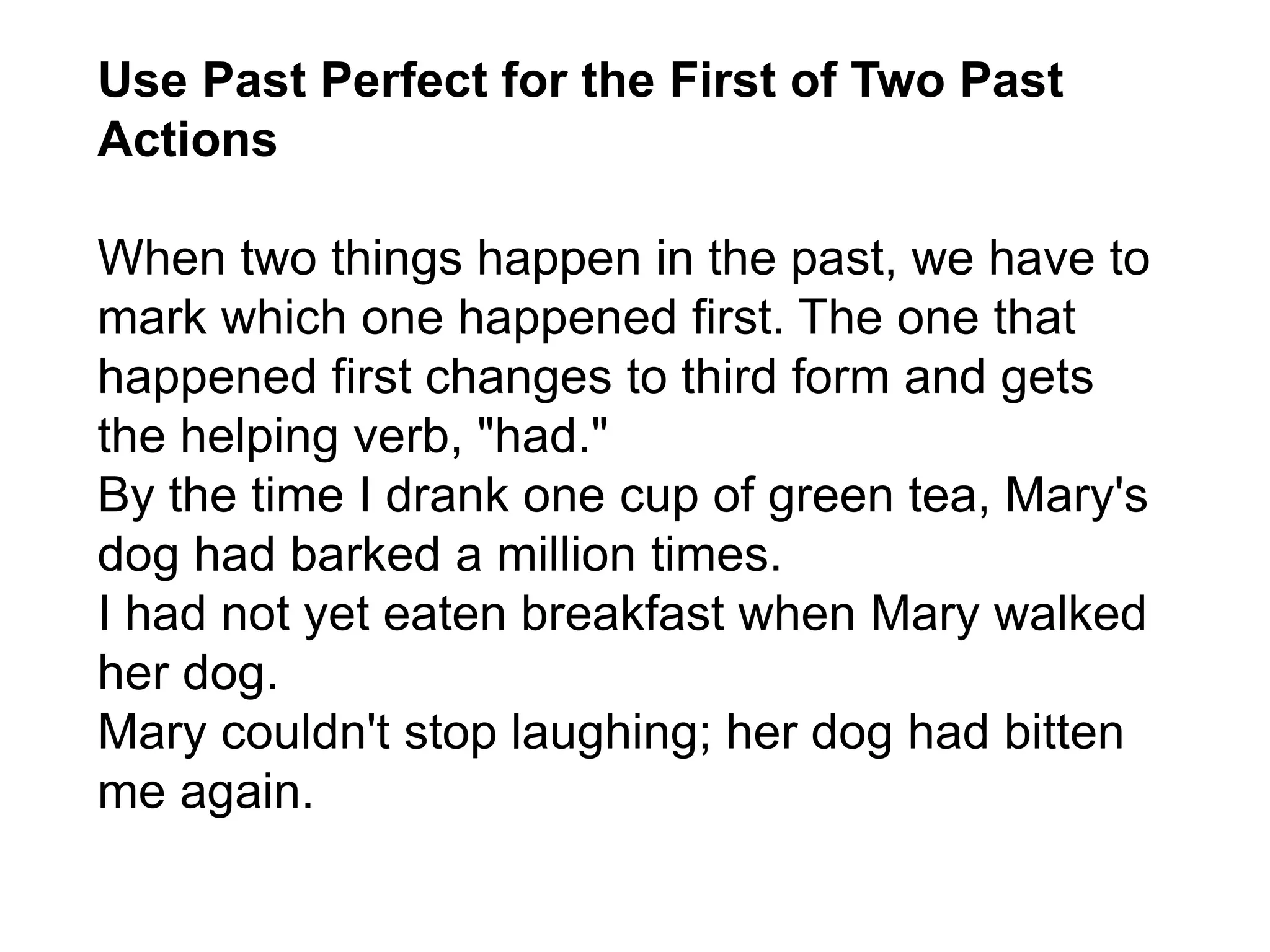
Use Past Perfect for the First of Two Past
Actions
When two things happen in the past, we have to
mark which one happened first. The one that
happened first changes to third form and gets
the helping verb, "had."
By the time I drank one cup of green tea, Mary's
dog had barked a million times.
I had not yet eaten breakfast when Mary walked
her dog.
Mary couldn't stop laughing; her dog had bitten
me again.

English grammar part 2

  • 1.
  • 3.
    Grandmother says... Carrots,Eggs, or Coffee; "Which are you?" A young woman went to her grandmother and told her about her life and how things were so hard for her. She did not know how she was going to make it and wanted to give up. She was tired of fighting and struggling. It seemed as one problem was solved a new one arose.
  • 4.
    Her grandmother tookher to the kitchen. She filled three pots with water. In the first, she placed carrots, in the second she placed eggs and the last she placed ground coffee beans. She let them sit and boil without saying a word.
  • 5.
    In about twentyminutes she turned off the burners. She fished the carrots out and placed them in a bowl. She pulled the eggs out and placed them in a bowl. Then she ladled the coffee out and placed it in a bowl. Turning to her granddaughter, she asked, "Tell
  • 6.
  • 7.
    She brought hercloser and asked her to feel the carrots. She did and noted that they got soft. She then asked her to take an egg and break it.
  • 8.
    After pulling offthe shell, she observed the hard-boiled egg. Finally, she asked her to sip the coffee. The granddaughter smiled, as she tasted its rich aroma. The granddaughter then asked. "What's the point, grandmother?"
  • 9.
    Her grandmother explained thateach of these objects had faced the same adversity-- boiling water--but each reacted differently.
  • 10.
    The carrot wentin strong, hard and unrelenting. However after being subjected to the boiling water, it softened and became weak. The egg had been fragile. Its thin outer shell had protected its liquid interior. But, after sitting through the boiling water, its inside became hardened.
  • 11.
    The ground coffeebeans were unique, however. After they were in the boiling water they had changed the water. "Which are you?" she asked her granddaughter.
  • 12.
    "When adversity knockson your door, how do you respond? Are you a carrot, an egg, or a coffee bean?" Think of this: Which am I?
  • 13.
    Am I thecarrot that seems strong, but with pain and adversity, do I wilt and become soft and lose my strength? Am I the egg that starts with a malleable heart, but changes with the heat? Did I have a fluid spirit, but after a death, a breakup, a financial hardship or some other trial, have I become hardened and stiff?
  • 14.
    Does my shelllook the same, but on the inside am I bitter and tough with a stiff spirit and a hardened heart?
  • 15.
    Or am Ilike the coffee bean? The bean actually changes the hot water, the very circumstance that brings the pain. When the water gets hot, it releases the fragrance and flavor. If you are like the bean, when things are at their worst, you get better and change the situation around you.
  • 16.
    When the hoursare the darkest and trials are their greatest do you elevate to another level? ---AUTHOR UNKNOWN —
  • 17.
    Grammar Grammar is theway in which words are put together to form proper sentences. In linguistics, grammar is the set of structural rules governing the composition of clauses, phrases, and words in any given natural language. The term refers also to the study of such rules, and this field includes morphology, syntax, and phonology, often complemented by phonetics, semantics, and pragmatics.
  • 20.
  • 21.
    Key Rules 1. UseActive Voice Every human language starts an active sentence with the subject, or the "doer." In English, the verb (what's being done) follows the subject. If there is an object (the receiver of the action), it comes after the verb. The formula looks like this: S+V+O. This rule is the foundation of the English language. Here are some examples: •Mary walked the dog. •The dog liked Mary. •I did not like the dog.
  • 22.
    2. Link Ideaswith a Conjunction Sometimes you want to link two ideas with a second S+V+O combination. When you do, you need a coordinating conjunction. The new formula looks like this: S+V+O, COORDINATING CONJUNCTION+S+V+O
  • 23.
    3. Use aComma to Connect Two Ideas As One FANBOYS are used when connecting two ideas as one in a single sentence, but don't forget the comma. For example: I do not walk Mary's dog, nor do I wash him. Mary fed her dog, and I drank tea. Mary feeds and walks her dog every day, but the dog is still hyperactive.
  • 24.
    4. Use theSimple Present Tense for Habitual Actions The simple present is the tense you use for any habitual action. The things you always do or do every Tuesday are described with the simple present, which just means you pick the first form of any verb. Mary likes dogs. I don't walk Mary's dog. Mary and I drink tea every Tuesday together.
  • 25.
    5. Use thePresent Progressive Tense for Current Action The present progressive tense is for anything that is happening right now. All of the progressive tenses are easy to spot because their verbs always end with "-ing" and get a helping verb. A helping verb is just so we know who and when we're talking about. In the present progressive, the helping verbs are the present tense conjugations of "to be." I am drinking green tea. The barking dogs outside are driving me
  • 26.
    6. Add "ed"to verbs for the Past Tense When we talk about the past, we have to add an "-ed" to regular verbs to make the second form. Irregular verbs are tricky and have their own sets of rules. Drink, for example, turns to "drank." Most of the time, though, "-ed" will do. I drank a lot of gree tea yesterday, but Mary didn't. The dogs stopped barking two seconds ago, and I am feeling better. Mary played fetch with her hyperactive dog.
  • 27.
    infinitive simple pastpast participle be was/were been bear bore borne/born (AE) beat beat beaten become became become begin began begun bend bent bent bet* bet bet bid bid, bade bid, bidden bind bound bound bite bit bitten bleed bled bled blow blew blown break broke broken breed bred bred bring brought brought broadcast broadcast broadcast build built built burst* burst burst bust* bust bust Irregular verbs
  • 28.
    buy bought bought castcast cast catch caught caught choose chose chosen cling clung clung come came come cost cost cost creep crept crept cut cut cut deal dealt dealt dig dug dug dive dived/dove(AE) dived do did done draw drew drawn
  • 29.
    cost cost cost creepcrept crept cut cut cut deal dealt dealt dig dug dug dive dived/dove(AE) dived do did done draw drew drawn drink drank drunk drive drove driven eat ate eaten fall fell fallen feed fed fed
  • 30.
  • 31.
    Use Present Perfectfor the Unfinished Past The present perfect can be confusing for some, but it is one of the most important rules of grammar. When people talk about things that have already happened but consider the time in which they occurred to be unfinished, they use the third form of the verb with a helping verb. The helping verb for the present perfect is the present tense conjugation of "to have." I have drunk three cups of green tea today. Mary's hyperactive cur dog has bitten me three times so far. Mary has walked her hyperactive poodle 100 times this week.
  • 32.
    Use Present PerfectProgressive for Unfinished Action and Past When the action as well as the time is considered unfinished, the verb loads up on third form helping verbs ("to be" and "to have") and changes to the progressive form. Western countries have been waging wars in the Middle East for thousands of years. I have been drinking tea all day. Mary's dog has been barking like crazy
  • 33.
    Use Past Perfectfor the First of Two Past Actions When two things happen in the past, we have to mark which one happened first. The one that happened first changes to third form and gets the helping verb, "had." By the time I drank one cup of green tea, Mary's dog had barked a million times. I had not yet eaten breakfast when Mary walked her dog. Mary couldn't stop laughing; her dog had bitten me again.