NAME – SHANVI MAHAJAN
CLASS-9
SECTION- D
SUBJECT- ENGLISH
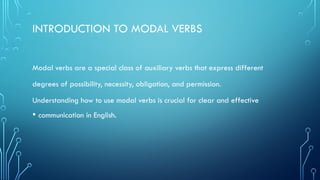
INTRODUCTION TO MODAL VERBS
Modal verbs are a special class of auxiliary verbs that express different
degrees of possibility, necessity, obligation, and permission.
Understanding how to use modal verbs is crucial for clear and effective
• communication in English.
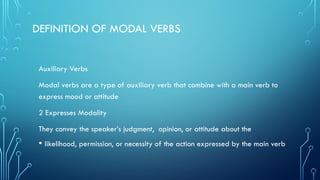
DEFINITION OF MODAL VERBS
Auxiliary Verbs
Modal verbs are a type of auxiliary verb that combine with a main verb to
express mood or attitude
2 Expresses Modality
They convey the speaker’s judgment, opinion, or attitude about the
• likelihood, permission, or necessity of the action expressed by the main verb
Diverse Meanings
• Modal verbs have a wide range of meanings, including ability, possibility,
permission, obligation and more .
EXPRESSING ABILITY ; CAN,COULD
Can
Expresses present ability or skill.
• E.g. I can speak three languages.
•
• could
• Expresses past ability or potential.
• E.g. When I was younger, I could run a mile in 5
EXPRESSING PERMISSION: MAY, MIGHT
• May
• Expresses formal or official permission.
• E.g. You may leave the classroom now.
• Might
• Expresses tentative or uncertain permission
• E.g. You might be able to go to the party
• if you finish your homework first.
EXPRESSING OBLIGATION: SHALL, SHOULD, MUST,
OUGHT TO
Shall/should
Expresses strong obligation or expectation.
Must
Expresses necessity or an absolute requirement.
Ought to
• Expresses moral obligation or what is the right thing to do.
EXPRESSING POSSIBILITY: MAY, MIGHT, COULD
May, might
Expresses uncertain or tentative possibility.
E.g. It may rain later today. You might be able to
finish the project on time.
could
Expresses a weaker form of possibility.
• E.g. The weather could be nice this weekend.
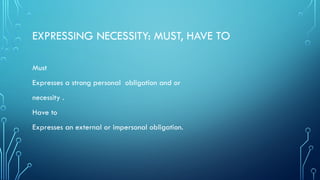
EXPRESSING NECESSITY: MUST, HAVE TO
Must
Expresses a strong personal obligation and or
necessity .
Have to
Expresses an external or impersonal obligation.
english grammar class - 9 modals ppt.pptx

english grammar class - 9 modals ppt.pptx

  • 1.
    NAME – SHANVIMAHAJAN CLASS-9 SECTION- D SUBJECT- ENGLISH
  • 2.
    INTRODUCTION TO MODALVERBS Modal verbs are a special class of auxiliary verbs that express different degrees of possibility, necessity, obligation, and permission. Understanding how to use modal verbs is crucial for clear and effective • communication in English.
  • 3.
    DEFINITION OF MODALVERBS Auxiliary Verbs Modal verbs are a type of auxiliary verb that combine with a main verb to express mood or attitude 2 Expresses Modality They convey the speaker’s judgment, opinion, or attitude about the • likelihood, permission, or necessity of the action expressed by the main verb
  • 4.
    Diverse Meanings • Modalverbs have a wide range of meanings, including ability, possibility, permission, obligation and more .
  • 5.
    EXPRESSING ABILITY ;CAN,COULD Can Expresses present ability or skill. • E.g. I can speak three languages. • • could • Expresses past ability or potential. • E.g. When I was younger, I could run a mile in 5
  • 6.
    EXPRESSING PERMISSION: MAY,MIGHT • May • Expresses formal or official permission. • E.g. You may leave the classroom now. • Might • Expresses tentative or uncertain permission • E.g. You might be able to go to the party • if you finish your homework first.
  • 7.
    EXPRESSING OBLIGATION: SHALL,SHOULD, MUST, OUGHT TO Shall/should Expresses strong obligation or expectation. Must Expresses necessity or an absolute requirement. Ought to • Expresses moral obligation or what is the right thing to do.
  • 8.
    EXPRESSING POSSIBILITY: MAY,MIGHT, COULD May, might Expresses uncertain or tentative possibility. E.g. It may rain later today. You might be able to finish the project on time. could Expresses a weaker form of possibility. • E.g. The weather could be nice this weekend.
  • 9.
    EXPRESSING NECESSITY: MUST,HAVE TO Must Expresses a strong personal obligation and or necessity . Have to Expresses an external or impersonal obligation.