MODALS
BY- OJAL SINGH SUBMITTED TO
CLASS- 9TH
D RACHITA MAAM
 HELLO EVERYONE
 MY NAME IS OJAL SINGH TODAY
I’M HERE TO DISCUSS ABOUT
MODALS,ABLIGATION OF
MODALS, PERMISSION OF
MODALS express possibility, ability,
permission, or necessity
INTRODUCTION
The modals are used to indicate a certain
possibility, abilities, doubts, suggestions,
requests, and more
 Modals refer to the helping verbs used in a
sentence to express specific hypothetical
situations like requests, capability, or advice.
Modals are always used with a main verb. The
most common modal verbs are- may, might,
shall, should, can, could, will, would, and
must.
DEFINATION
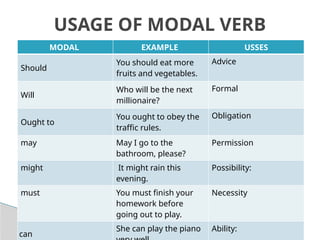
MODAL EXAMPLE USSES
Should
You should eat more
fruits and vegetables.
Advice
Will
Who will be the next
millionaire?
Formal
Ought to
You ought to obey the
traffic rules.
Obligation
may May I go to the
bathroom, please?
Permission
might It might rain this
evening.
Possibility:
must You must finish your
homework before
going out to play.
Necessity
can
She can play the piano Ability:
USAGE OF MODAL VERB
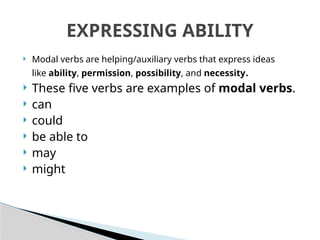
 Modal verbs are helping/auxiliary verbs that express ideas
like ability, permission, possibility, and necessity.
 These five verbs are examples of modal verbs.
 can
 could
 be able to
 may
 might
EXPRESSING ABILITY
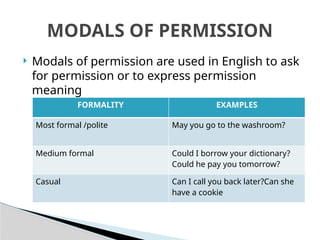
 Modals of permission are used in English to ask
for permission or to express permission
meaning
MODALS OF PERMISSION
FORMALITY EXAMPLES
Most formal /polite May you go to the washroom?
Medium formal Could I borrow your dictionary?
Could he pay you tomorrow?
Casual Can I call you back later?Can she
have a cookie
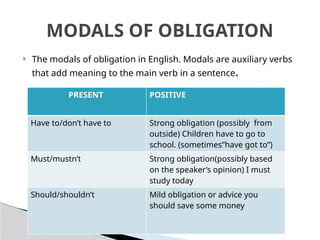
 The modals of obligation in English. Modals are auxiliary verbs
that add meaning to the main verb in a sentence.
MODALS OF OBLIGATION
PRESENT POSITIVE
Have to/don’t have to Strong obligation (possibly from
outside) Children have to go to
school. (sometimes”have got to”)
Must/mustn’t Strong obligation(possibly based
on the speaker’s opinion) I must
study today
Should/shouldn’t Mild obligation or advice you
should save some money
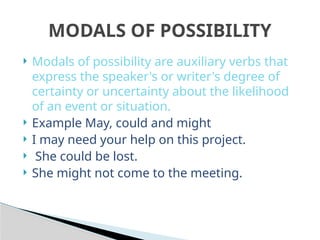
 Modals of possibility are auxiliary verbs that
express the speaker's or writer's degree of
certainty or uncertainty about the likelihood
of an event or situation.
 Example May, could and might
 I may need your help on this project.
 She could be lost.
 She might not come to the meeting.
MODALS OF POSSIBILITY
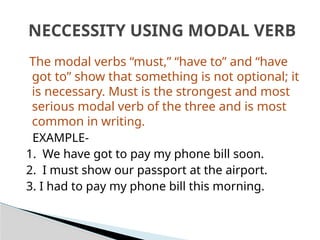
The modal verbs “must,” “have to” and “have
got to” show that something is not optional; it
is necessary. Must is the strongest and most
serious modal verb of the three and is most
common in writing.
EXAMPLE-
1. We have got to pay my phone bill soon.
2. I must show our passport at the airport.
3. I had to pay my phone bill this morning.
NECCESSITY USING MODAL VERB
 THAT BRINGS US TO THE END OF THE
PRESENTATION
 THANK YOU!!

English grammar Modals presentation.pptx

  • 1.
    MODALS BY- OJAL SINGHSUBMITTED TO CLASS- 9TH D RACHITA MAAM
  • 2.
     HELLO EVERYONE MY NAME IS OJAL SINGH TODAY I’M HERE TO DISCUSS ABOUT MODALS,ABLIGATION OF MODALS, PERMISSION OF MODALS express possibility, ability, permission, or necessity INTRODUCTION
  • 3.
    The modals areused to indicate a certain possibility, abilities, doubts, suggestions, requests, and more  Modals refer to the helping verbs used in a sentence to express specific hypothetical situations like requests, capability, or advice. Modals are always used with a main verb. The most common modal verbs are- may, might, shall, should, can, could, will, would, and must. DEFINATION
  • 4.
    MODAL EXAMPLE USSES Should Youshould eat more fruits and vegetables. Advice Will Who will be the next millionaire? Formal Ought to You ought to obey the traffic rules. Obligation may May I go to the bathroom, please? Permission might It might rain this evening. Possibility: must You must finish your homework before going out to play. Necessity can She can play the piano Ability: USAGE OF MODAL VERB
  • 5.
     Modal verbsare helping/auxiliary verbs that express ideas like ability, permission, possibility, and necessity.  These five verbs are examples of modal verbs.  can  could  be able to  may  might EXPRESSING ABILITY
  • 6.
     Modals ofpermission are used in English to ask for permission or to express permission meaning MODALS OF PERMISSION FORMALITY EXAMPLES Most formal /polite May you go to the washroom? Medium formal Could I borrow your dictionary? Could he pay you tomorrow? Casual Can I call you back later?Can she have a cookie
  • 7.
     The modalsof obligation in English. Modals are auxiliary verbs that add meaning to the main verb in a sentence. MODALS OF OBLIGATION PRESENT POSITIVE Have to/don’t have to Strong obligation (possibly from outside) Children have to go to school. (sometimes”have got to”) Must/mustn’t Strong obligation(possibly based on the speaker’s opinion) I must study today Should/shouldn’t Mild obligation or advice you should save some money
  • 8.
     Modals ofpossibility are auxiliary verbs that express the speaker's or writer's degree of certainty or uncertainty about the likelihood of an event or situation.  Example May, could and might  I may need your help on this project.  She could be lost.  She might not come to the meeting. MODALS OF POSSIBILITY
  • 9.
    The modal verbs“must,” “have to” and “have got to” show that something is not optional; it is necessary. Must is the strongest and most serious modal verb of the three and is most common in writing. EXAMPLE- 1. We have got to pay my phone bill soon. 2. I must show our passport at the airport. 3. I had to pay my phone bill this morning. NECCESSITY USING MODAL VERB
  • 10.
     THAT BRINGSUS TO THE END OF THE PRESENTATION  THANK YOU!!