Oxford Englishfor
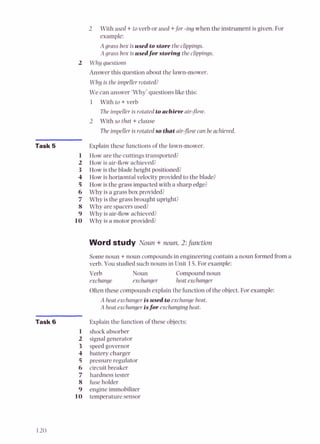
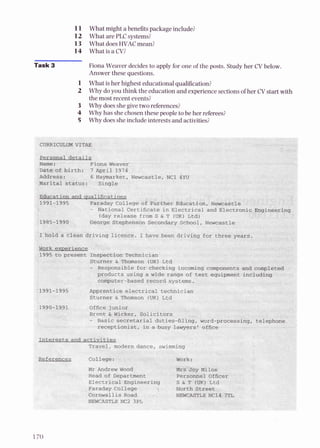
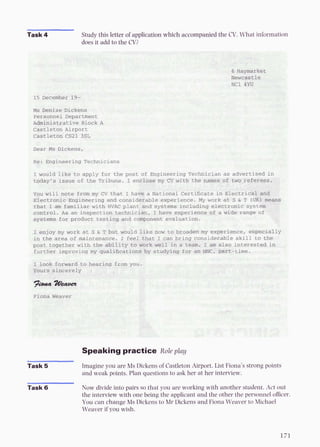
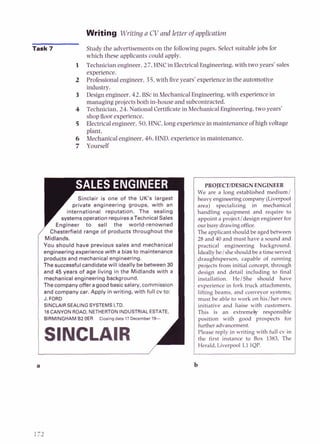
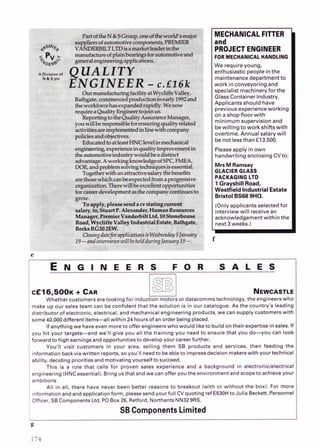
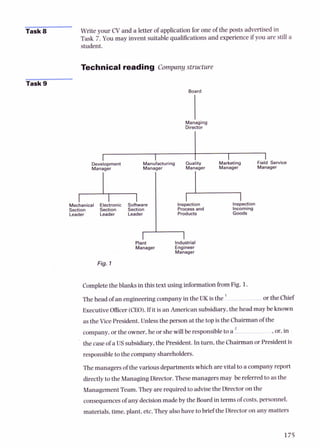
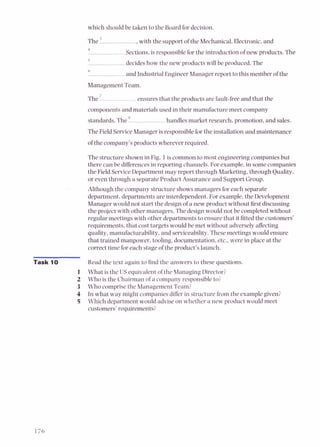
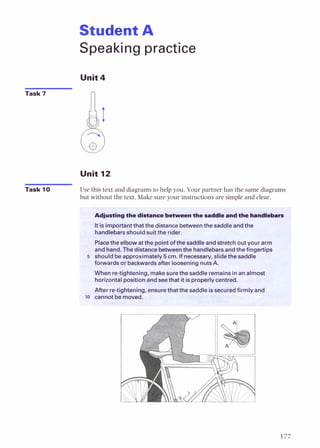
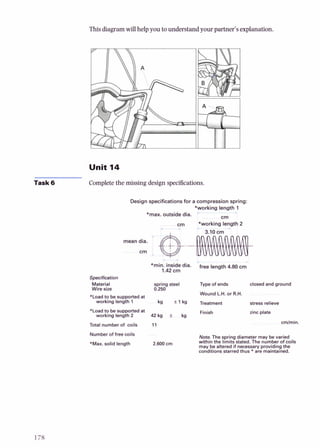
Electricaland Mechanical
Engineering
Eric H. Glendinning
Norman Glendinning,
C Eng, MIMechE
Oxford University Press
This file was collected by ccebook.cn form the internet, the author keeps the copyright.
More ebooks visit: http://www.ccebook.cn ccebook-orginal enlish ebooks
Technical contents
Page Unit Topic
Engineering
Courses
Materials
Mechanisms
Forces
Electricmotor
Student
Central heating
Safety at work
Young engineer
Washing machine
Racing bicycle
Lasers
Technician
Refrigerator
Scales
Portable generator
Road breaker
Disc brakes
Stdengineer
Lawn-mower
Corrosion
Maglevtrain
CADdesigner
Supercar
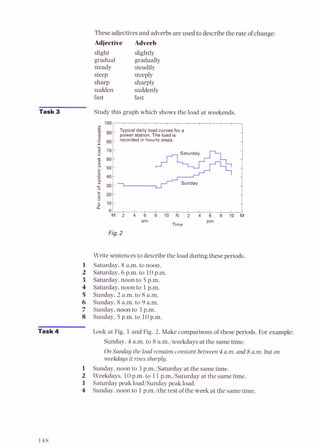
Graphs
Waste recycling
Robotics
Careers
Applying forajob
Technicalsyllabus
General
General
Engineeringmaterials
Mechanisms. Cams
Staticsand Dynamics
Electrotechnology
Electrical
Automaticsystems
General
General. Engineeringdesign
Automaticsystems. Transducers
Mechanics. Gearsystems
Mechanical technology
Robotics. General
Fluid mechanics
Automaticsystems. Straingauges
Electrotechnology. Powergeneration
Pneumatics
Hgdraulics
General. Processcontrol
Engineeringdesign
Mechanical technology. Corrosion
Electricalmachines. Motor selection
CAD
General
General
Technicalplant
Robotics. Steppermotors
General
General. Companystructure
This file was collected by ccebook.cn form the internet, the author keeps the copyright.
More ebooks visit: http://www.ccebook.cn ccebook-orginal enlish ebooks
Contents
Page
Unit 1 lo Engineering-what's itallabout?
10 Tuning-in
11 Reading lntroduction
12 Language study dealslis concerned with
13 Word study Word stress
13 Writing
14 Listening
Unit 2 15 Choosinga course
1 5 Tuning-in
16 Reading
20 Writing
Having apurpose
Letter writing. 1:requesting information
Unit 3 21 Engineeringmaterials
22 Tuning-in
22 Reading Scanning tables
23 Language study Making definitions
24 Writing Adding information to a text
Unit4 26 Mechanisms
26 Tuning-in
26 Reading Scanning a text
27 Writing Ways oflinking ideas. 1
29 Language study Dealing with technical terrrQ
29 Speakingpractice
Unit 5 31 Forcesin engineering
31 Tuning-in
31 Reading 1 Predicting
33 Reading 2 Grammarlinks in texts
34 Language study Thepresent passive
34 Listening Listening to lectures
This file was collected by ccebook.cn form the internet, the author keeps the copyright.
More ebooks visit: http://www.ccebook.cn ccebook-orginal enlish ebooks
Fane
Unit6 36 The electric motor
36 Tuning-in
36 Reading Skimming
39 Language study Describing functiorl
39 Writing Describing components
41 Word study
Unit 7 42 An engineering student
42 Tuning-in
42 Listening
44 Writing Comparing a~ld
contrasting
Unit 8 46 Central heating
46 Tuning-in
46 Reading Predicting
48 Language study Time clauses
49 Word study
Unit 9 so Safety at work
50 Tuning-in
51 Reading Understanding the writer'spurpose
53 Language study Making safety rules
53 Writing Waysoflinking ideas,2
Unit 10 55 Young engineer
55 Tuning-in
56 Listening
57 Writing
57 Speaking practice
Describing and esplaining
Unit 11 58 Washing machine
58 Tuning-in
58 Reading Reading diagranls
62 Language study IfJUnlesssmtences
63 Writing Explaining a diagram
This file was collected by ccebook.cn form the internet, the author keeps the copyright.
More ebooks visit: http://www.ccebook.cn ccebook-orginal enlish ebooks
Page
Unit 12 65
65
67
68
68
69
70
70
Unit 13 72
Unit 14 77
77
77
78
Unit 15 79
79
79
81
81
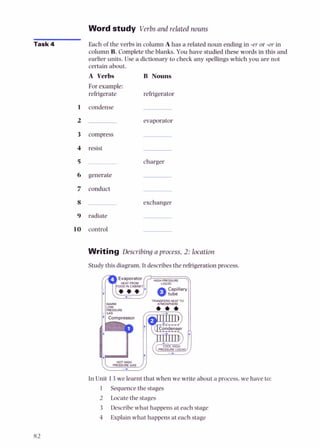
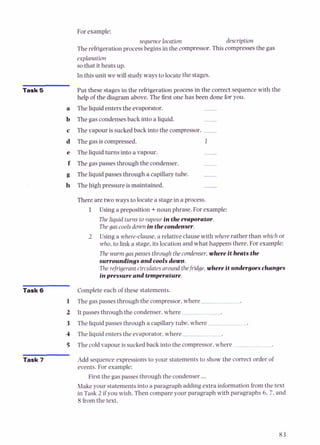
82
Unit 16 84
Racingbicycle
Tuning-in
Reading Prediction
Language study Describing reasons
Writing Describing contrast
Word study Properties of~nnterials
Speaking practice
Technical reading Gear systems
Lasers
Tuning-in
Reading
Language study used tolfor
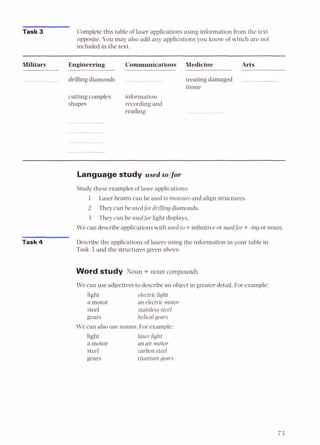
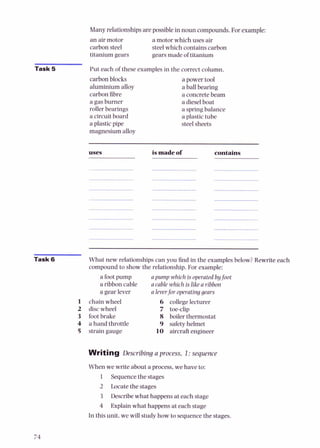
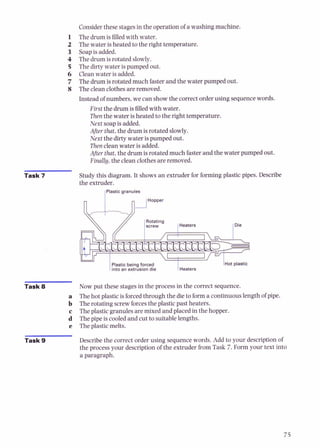
Word study Noun + noun cornpounds
Writing Describing nprocess, I: sequence
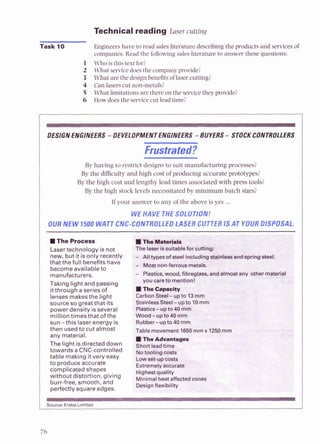
Technicalreading Laser cutting
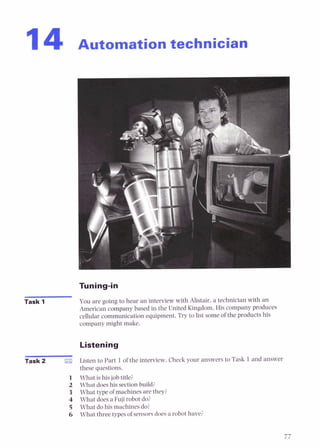
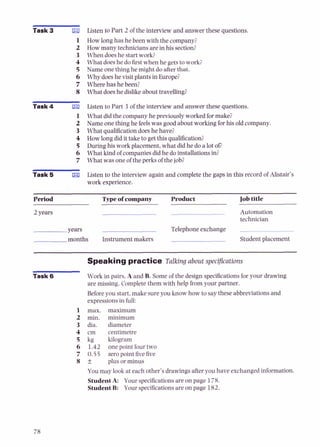
Automation technician
Tuning-in
Listening
Speaking practice Talking nbout spech?cntions
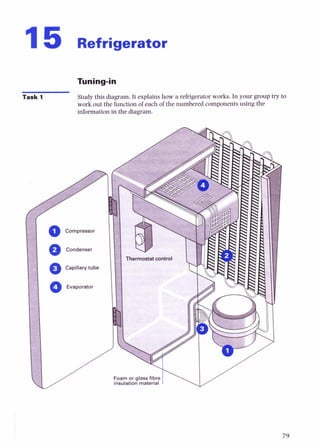
Refrigerator
Tuning-in
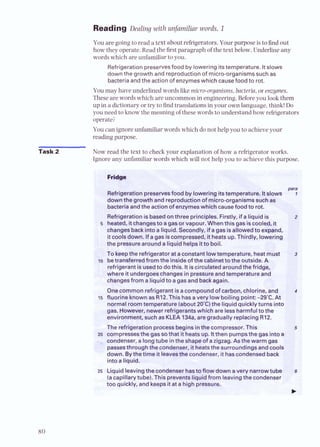
Reading Denling with unfnmiliar words. 1
Language study Pri~siples
and lows
Word study Verbsand related nouns
Writing Describing n process. 2:location
Scales
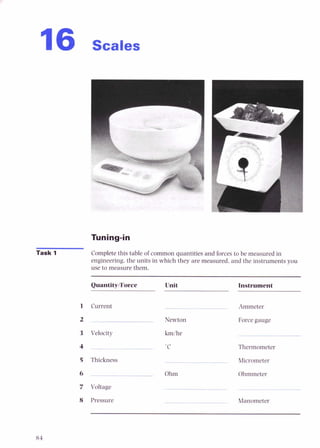
Tuning-in
Reading 1 Meaningfrorn context
Reading 2 Con~parir~g
sources
Language study Cnuse rind effect. I
Technicalreading Stmi11gauges
This file was collected by ccebook.cn form the internet, the author keeps the copyright.
More ebooks visit: http://www.ccebook.cn ccebook-orginal enlish ebooks
Page
Unit 17 91
91
91
93
94
94
Unit 18 98
98
98
101
103
103
105
Unit 19 106
Unit 20 112
112
114
114
Unit 21 116
Portablegenerator
Tuning-in
Reading Reading diagrams
Language study Causeand efject,2
Word study Verbswith -ize/-ise
Writing Describingaprocess, 3:sequence and
location
Technical reading Wavepower
Roadbreaker
Tuning-in
Reading
Language study Allow and prevent links
Writing Explaining an operation
Technical reading Air skates
Speaking practice
Disc brakes
Tuning-in
Reading Contbinir~g
skills
Language study Verbswith up anddown
Word study Verbs+-en
Writing Explaining an operation
Technical reading Water-based hydraulics
Staff engineer
Tuning-in
Listening
Language study Verbs with o n arldoff
Tuning-in
Reading 1 Predicting
Reading 2 Grammar links. 2
Language study Describi~?gfunctions
Word study Noun +noun, 2:function
Writing Description and exp:pla~mtion
Speaking practice Explair~ingf~irlctior~
This file was collected by ccebook.cn form the internet, the author keeps the copyright.
More ebooks visit: http://www.ccebook.cn ccebook-orginal enlish ebooks
Page
Unit22 123
123
124
125
126
126
Unit 23 128
Unit 24 137
Unit 25 140
140
142
144
145
Unit 26 146
146
147
149
149
151
Unit 27 152
152
154
155
156
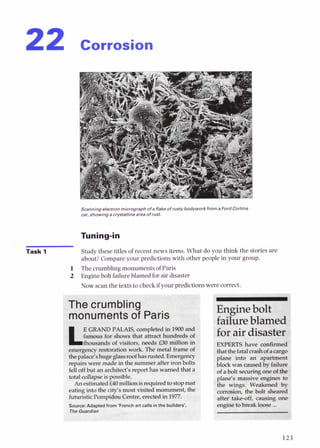
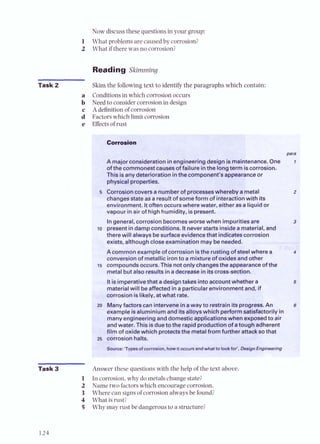
Corrosion
Tuning-in
Reading Skimming
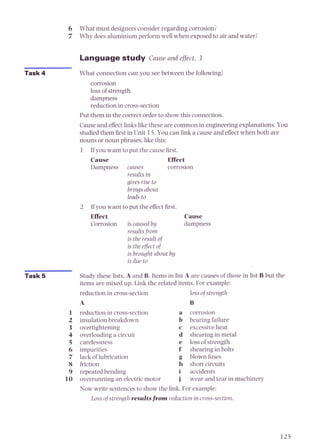
Language study Causeand ejfect.3
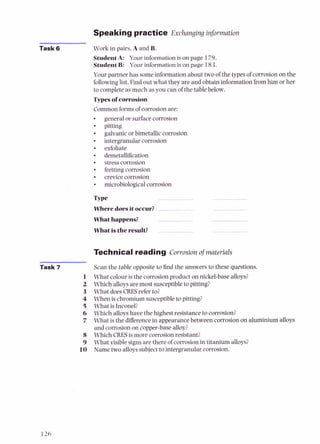
Speaking practice Exchanging information
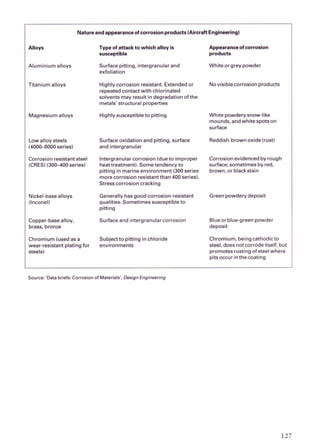
Technical reading Corrosionof materials
Maglev train
Tuning-in
Reading 1 Inferring
Reading 2 Dealing with unfamiliar words, 2
Language study Prediction
Writing Explanations
Technicalreading Motor selection:operating environment
Computer Aided Design(CAD)
Tuning-in
Listening
Language study Necessity: have toand need (to)
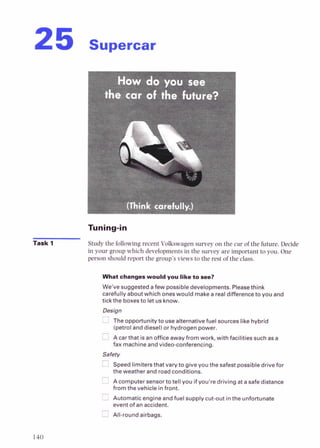
Supercar
Tuning-in
Reading Predicting: usingfirst sentences
Language study Crrtainty
Writing Summaries
Graphs
Tuning-in
Language study Describing graphs
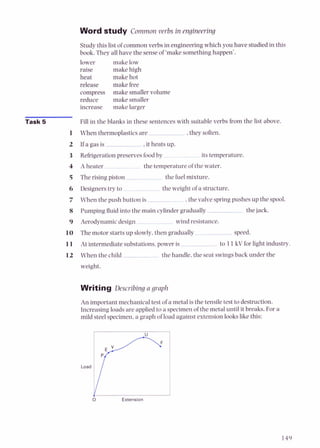
Word study Comnlon verbs in engineering
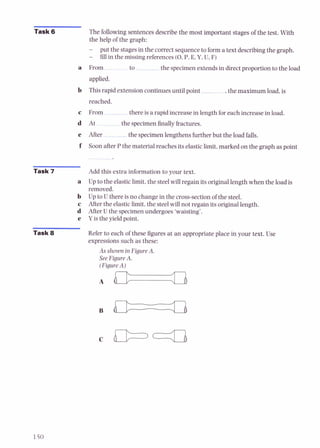
Writing Drscribing agraph
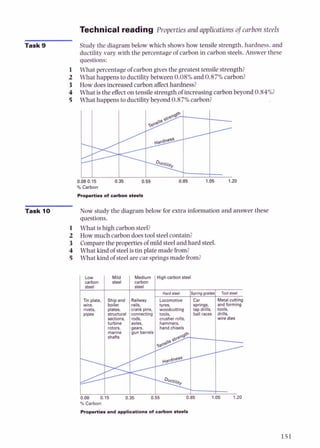
Technical reading Properties and applicationsofcarbon
steels
Waste recyclingplant
Tuning-in
Reading Transferring information, making notes
Language study Possibility:can andcould
Writing Describing aprocws, 4: reason and
mrthod
This file was collected by ccebook.cn form the internet, the author keeps the copyright.
More ebooks visit: http://www.ccebook.cn ccebook-orginal enlish ebooks
Page
Unit 28 157
157
157
159
162
163
Unit 29 165
165
167
168
168
Unit 30 169
Robotics
Tuning-in
Reading 1 Revising skills
Reading 2 Transferring information
Language study Concession:evenif and although
Technical reading Stepper motors
Careers in engineering
Tuning-in
Reading Infrrring
Speaking practice Role play
Listening Inferring
Applying for a job
Tuning-in
Reading Understandingjob advertisements
Speaking practice Roleplay
Writing Writing a CVand letter ofapplication
Technical reading Company structure
Student A Speakingpractice
Student B Speakingpractice
18s Glossaryof engineeringterms
This file was collected by ccebook.cn form the internet, the author keeps the copyright.
More ebooks visit: http://www.ccebook.cn ccebook-orginal enlish ebooks
Engineering-what's it all
about?
Tuning-in
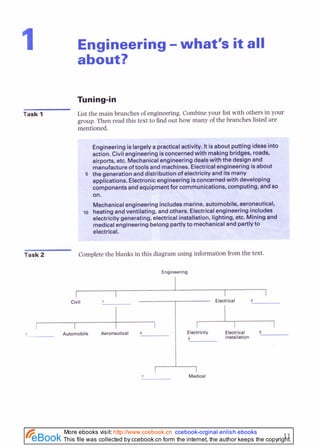
Task 1 List the main branches of engineering. Combine your list with others in your
group. Then read this text to 6nd out how many of the branches listed are
mentioned.
Task 2 Complete the blanks in this aiagram using information from the text.
Engineering
Civil 1
I Y
T
-
Automobile Aeronautical
Electrical
installation
7 Medical
This file was collected by ccebook.cn form the internet, the author keeps the copyright.
More ebooks visit: http://www.ccebook.cn ccebook-orginal enlish ebooks
Reading Introduction
In your study and work, it is important to think about what you are going to
read before you read. This helps you to link old and new knowledgeand to
make guesses about the meaning of the text. It is alsoimportant to have a clear
purpose so that you choosethe best way to read. In this book, you will find
tasks to make you think before you read and tasks to help you to have a clear
purpose when you read.
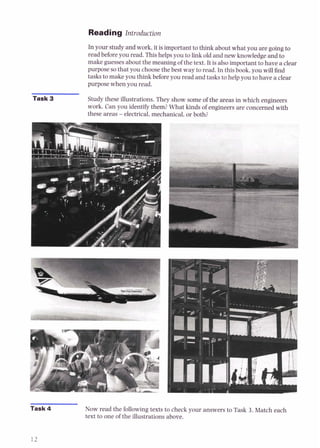
Task 3 Study these illustrations. They show some of the areas in which engineers
work. Can you identify them? What kinds of engineers are concerned with
these areas -electrical,mechanical, or both?
mask4 Now read the following texts to check your answers to Task 3. Match each
text to one of the illustrations above.
Task 5
IT#!!krt: Cars, trains, ships, and planesareall productsof
Imechanicalengineering. Mechanicalengineersare also involved in
support servicessuchas roads, railtrack, harbours,and bridges.
1 Foodprocessing:Mechanicalengineersdesign, develop, and make
I
5 the machinesandthe processingequipmentfor harvesting, preparing
and preservingthe foods anddrinksthat fill the supermarkets.
Medicalengineering: Bodyscanners, X-ray machines, life-support
systems, andother hightechequipment resultfrom mechanicaland
electricalengineerscombiningwith medicalexpertsto convert ideas
o into life-savingand life-preservingproducts.
Buildingservices: Electricalengineers provideallthe serviceswe
needinour homesand placesof work, including lighting, heating,
ventilation, air-conditioning, refrigeration,and lifts.
Energyand power: Electricalengineersareconcernedwith the
s production and distributionof electricityto homes, offices, industry,
hospitals,collegesand schools, andthe installation and maintenance
of the equipment involved intheseprocesses.
Source:Adaptedfrom Turningideasintoaction, Institutionof MechanicalEngineers,
andEnginminga Career,Institutionof ElectronicsandElectticalincorporated
Languagestudy dealslis concerned with
What is the link between column A and column B?
A B
mechanical machines
electrical electricity
Column A lists a branch of engineering or a type of engineer.Column Blists
things they are concerned with. We can show the link between them in a
number of ways:
1 Mechanical engineering deals with machines.
2 Mechanical engineers deal with machines.
3 Mechanical engineeringis concernedwith machines
4 Mechanical engineersare concernedwith machines.
5 Machines are theconcernof mechanical engineers.
Match each item in column A with an appropriate item from column B and
link the two in a sentence.
A B
marine a air-conditioning
aeronautical b roads and bridges
heating and ventilating c body scanners
electricitygenerating d cablesand switchgear
automobile e communications and equipment
civil f ships
electronic g planes
electricalinstallation h cars and trucks
medical i power stations
Word study Word stress
Words are dividedinto syllables.For example:
engine en.gine
engineer en.gin.eer
engineering en.gin.eer.ing
Each syllableispronounced separately,but normally only onesyllableis
stressed.That means it is saidmore slowly and clearly than the other syllables.
We say 'enginebut engin'eer. A gooddictionarywill showthe stressedsyllables.
Listen to these words. Try to mark the stressed syllables.
machinery
mechanical
machine
install
installation
electricity
electrical
electronics
aeronautical
ventilation
Writing
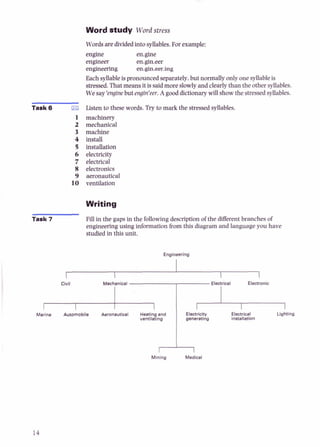
Task 7 Fill in the gaps in the followingdescriptionof the differentbranches of
engineering using informationfrom this diagram and language you have
studied in this unit.
Engineering
I I I I
, Civil Mech[nical Elect,ical Electronic
Marine Automobile Aeronautical Heatingand Electricity Electrical Lighting
ventilating generating installation
*
Mining Medical
2
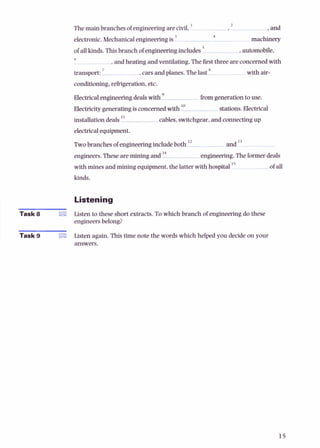
Themain branchesof engineeringarecivil. ' ,. and
4
electronic. Mechanicalengineeringis ' machinery
of allkinds.Thisbranchof engineeringincludes .automobiie.
6
,andheating andventilating.Thefirstthree are concernedwith
7 8
transport: . carsandplanes.The last with air-
conditioning,refrigeration.etc.
Electricalengineeringdealswith fromgenerationto use.
Electricitygeneratingisconcernedwith lo stations.Electrical
installationdeals " cables.switchgear,andconnectingup
electricalequipment.
Twobranchesof engineeringincludeboth l2 and l 3
engineers.These aremining and I* engineering.Theformerdeals
with mines andmining equipment,the latter with hospital " ofall
kinds.
1 Listening
Task 8 Listen to these shortextracts.To which branch of engineering do these
engineers belong?
! Task 9 Listen again. This time note the words which helped you decide on your
answers.
Choosinga course
Task 1 Study this list of points to consider when decidingwhether to study
engineering. Tick [J]the statementswhich refer to you. Then ask your
partner which statement- -of-- +- bim om
he-.
s
l
1 You enjoypracticalprojects-creating and investigatingthing
2 You likefinding out howthingswork.
3 You are interestedin improvingthe environment.
4 Youlikehelpingpeople.
6 Youenjoysolvingproblems.
6 Youenjoy organizingact~rties.
7 YouenjoyscienceprogrammesonTVor onthe radio.
8 Yousometimesreedarticlesonscientificorengineeringtopics.
9 You havea lot of determinationandstamina.
Ifyouhavetickedmostofthesestatements, engineering*the right
courseofstudyfor you.
S o w : Adaptsdfmm CytemunlrsmdT&- BBC EdwHbn
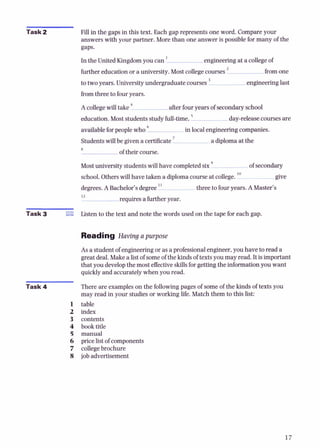
Task 2 Fill in the gaps in this text. Each gap represents one word. Compareyour
answers with your partner. More than one answer is possible for many of the
In the United Kingdomyou can ' engineering at a collegeof
further education or a university. Most collegecourses from one
to two years. Universityundergraduate courses ' engineering last
fromthree to fouryears.
Acollegewill take afterfouryears of secondary school
5
education. Most students study full-time. day-releasecourses are
availableforpeople who in localengineering companies.
Students will be given a certificate a diplomaat the
8
of their course.
Mostuniversity students wiU have completedsix of secondary
10
school.Otherswill have taken a diplomacourseat college. give
degrees.A Bachelor's degree" three to fouryears. AMaster's
12
r e q u i r e s a further year.
Task 3 Listen to the text and note the words used on the tape for each gap.
Reading Having a purpose
As a student of engineering or as a professionalengineer,you have to read a
great deal. Makea listof someof the kids of textsyou may read. It is important
that you developthe most effectiveskillsforgettiig the information you want
quickly and accurately when you read.
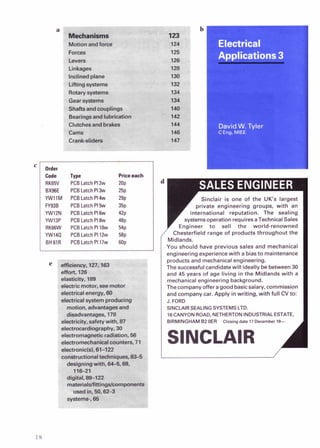
Task 4 There are exampleson the followingpages of some of the kinds of texts you
may read in your studies or working life. Match them to this list:
table
index
contents
book title
manual
price listof components
collegebrochure
job advertisement
Order
Code
RK65V
BX96E
W l l M
FY93B
WlZN
W13P
RK66W
W14a
BH6lR
T
w
P
C
BLatchP12w
P
C
BLatchPI3w
P
C
BLatchPl4w
P
C
BLatchPI5w
P
C
BLatchPI6w
PCBLatchPI8w
PCBLatchPI10w
P
C
BLatchPI12w
P
C
BLatchPI17w
Priceeach
ZOP
2 5 ~
2 9 ~
3
5
P
4 2 ~
4 8 ~
5 4 ~
5 8 ~
MP
electrical energy,
electrical system produci
motion, advantagesan
disadvantages, 178
electricitv. safety with. 87
electmeardiagraphy, 30
electromagnetic radiation, 56
electromechanicalcounters, 7
electronic(s), 61-122
constructionaltechniques,
designingwith, 644.69,
118-21
digid, 88-122
materials/fittings/wm
usedin. 50.624
Electrical
A,pplica+:nn- 3
'
Sinclair is one of the UK's largest
prlvate engineering groups, with an
reputation. The sealing I
/ chesterfield range of products throughout the
Midlands.
You should have previous sales and mechanical
engineering experiencewith a biasto maintenance
products and mechanicalengineering.
The successfulcandidatewill ideally be between30
and 45 years of age living in the Midlands with a
mechanical engineering background.
Thecompany offera good basicsalary,commission
and company car. Apply in writing, with full CV to.
J. FORD
SlNCLAlRSEALINGSYSTEMSLTD.
16CANYONROAD, NETHERTONINDUSTRIALESTATE.
BIRMINGHAM82OER Clos~ng
date 17December19-
SlNCLAlR
Step Action
Switchthe system off +0.003
Wait 5 seconds 1 1 -I2 1 - 1 4.005 /
g
1 Openthe top cover
2 Setthe MTR switchto
MTR mode,that is, move it
to the left.
3 Closethe top cover
Task 5
Shaft limits
Bearing
Heavy loading Light loading
When you read, it is important to have a clear purpose. Here are some of the
purposes you may have for reading the above texts. Match one purpose to
each text.
finding a job
pricing a component
finding out how to do something
choosingthe best chapter to read
looking for specificinformation on a topic
learning about electricalequipment
choosing a course
looking for a specification
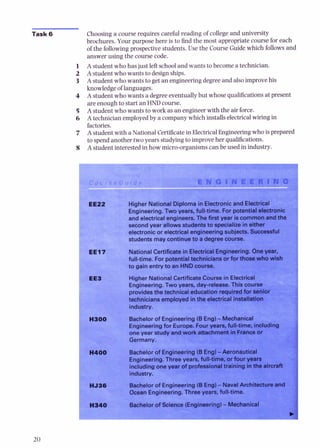
Task 6 Choosing a course requires careful reading of college and university
brochures. Your purpose here is to iind the most appropriate course for each
of the following prospective students. Use the Course Guide which follows and
answer using the course code.
A student who has just left schooland wants to become a technician.
A student who wants to designships.
A student who wants to get an engineering degreeand also improvehis
knowledgeof languages.
A student who wants a degreeeventually but whose qualificationsat present
are enough to start an HNDcourse.
A student who wants to work as an engineer with the air force.
A technician employedby a company which installselectricalwiring in
factories.
A student with a National Certificatein ElectricalEngineeringwho is prepared
to spend another two years studyingto improveher qualifications.
A student interested in how micro-organismscan be used in industry.
I ~ .~
EE22 ' ~ i ~ h i r
National Diploma in Electronicand Electrical
~n$iieering. Two years, full-time. For potential electronic
andeiectrical engineers. The first year iscommon andthe
second year allows studentsto specialize in either
electronic or electricalengineeringsubjects. Successful
m gstqdentsmay continueto a degreecourse.
.
... . . , .
.. :
.:'~&ionaicertificate in ElectricalEngineering. Oneyear,
'full-time. For potential technicians or for thosewho wish
I
ain entry to an HNDcourse.
er NationalCertificateCourse in Electrical.. -
neering.Two years, day-release. This col
providesthe technicaleducation requiredfor
technicians employed inthe electrical installation
industry.
H300 Bachelo! of Engineering(BEng)-Mechanical
Engineeringfor Europe. Four-am, full-time;
one year study andwork attac ntinFurnc
~ermany.
H400 Bachelor of Engineering(BEnyr- n t r ~ u ~ ..I
Engineering.Three years, full-time, or f~ tars
including one year of professionaltrainins nlthesi----'
industry.
HJ36 Bachelor of Engineering(BEng)-NavalArchitectufeand
Ocean Engineering.Three years, full-time.
H340 Bachelor of Science (Engineering)-Mechanical
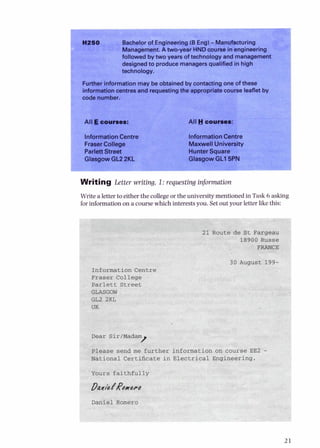
I Bachelor of cr~y~~reering
(B Eng)-Manufactur~~~u
1
Management.A two-year HNDcourse in engineering
followed bytwo years of technology and managemell1
designedto produce managersqualified in high
technology.
Furtherinformation may be obtained by contacting one of these
informationcentres and requestingthe appropriate course leaflet by
sode number.
All Ecourses:
InformationCentre
Fraser College
Parlett Street
Glasgow GL2 2KL
All Y courses:
Information Centre
Maxwell University
Glasgow GLl5PN
Writing Lettt, ,+,,.iting,1: r,,,,sting inforrnatib..
Write a letter to either the collegeor the university mentioned in Task 6 asking
forinformation on a course which interests you. Set out your letter like this:
21 Route de St Fargeau
18900 Russe
Fw
August 199-
Engineering materials
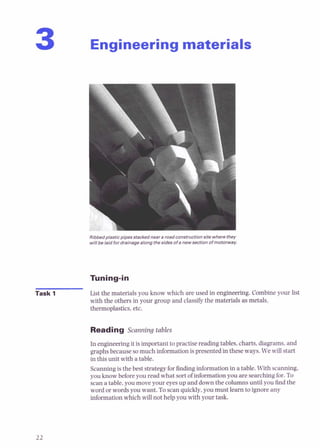
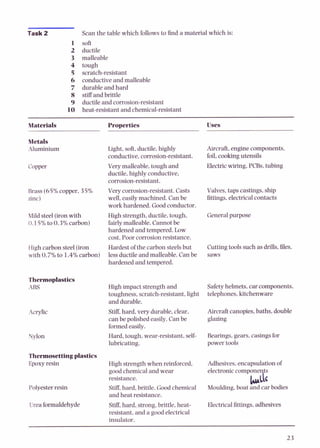
Ribbed plasticpipes stackedneara roadconstruction site where they
will be laid for drainage along the sides ofa newsection of motormay.
Task 1 List the materials you know which are used in engineering. Combineyour list
with the others in your group and classify the materials as metals.
thermoplastics, etc.
Reading Scanning tables
In engineering it isimportant to practise reading tables,charts,diagrams, and
graphs because somuch information ispresented in these ways. Wew
i
l
lstart
in this unit with a table.
Scanningis the best strategy forfinding information in a table. With scanning.
you know before you read what sort of information you are searching for. To
scan a table, you move y o u eyesup and down the columns until you 6nd the
word or wordsyou want. Toscan quickly,you must learnto ignore any
information which will not help you with your task.
Task 2 Scan the table which followsto 6nd a material which is:
1 soft
2 ductile
3 malleable
4 tough
5 scratch-resistant
6 conductiveand malleable
7 durableand hard
8 stiffand brittle
9 ductileand corrosion-resistant
10 heat-resistant and chemical-resistant
Materials Properties Uses
Metals
Aluminium Light,soft,ductile,highly Aircraft,enginecomponents.
conductive,corrosion-resistant. foil,cookingutensils
Copper Very malleable, tough and Electricwiring. PCBs,tubing
ductile,highly conductive.
corrosion-resistant.
Brass (65%copper. 35% Very corrosion-resistant. Casts Valves. taps castings.ship
zinc) well,easilymachined. Can be fittings,electricalcontacts
work hardened. Good conductor.
Mild steel(ion with High strength, ductile,tough. Generalpurpose
0.15%to 0.3%carbon) fairlymalleable.Cannot be
hardened and tempered.Low
cost.Poor corrosionresistance.
Highcarbon steel (ion Hardest of the carbon steelsbut Cuttingtools such asdrills,files,
with 0.7%to 1.4%carbon) lessductileand malleable. Canbe saws
hardened and tempered.
Thermoplastics
ABS
Acrylic
Nylon
High impact strength and
toughness,scratch-resistant,light
and durable.
Stiff,hard, very durable,clear.
can be polished easily. Can be
formedeasily.
Hard, tough, wear-resistant,self-
lubricating.
Thermosettingplastics
Epoxy resin High strength when reinforced,
good chemicaland wear
resistance.
Polyesterresin Stiff,hard, brittle. Good chemical
and heat resistance.
Urea formaldehyde Stiff,hard, strong,brittle, heat-
resistant, and a good electrical
insulator.
Safety helmets,car components,
telephones,kitchenware
Aiicraft canopies,baths, double
g
l
-
g
Bearings,gears,casingsfor
power tools
Adhesives,encapsulationof
Moulding,boat and car bodies
Electricalfittings,adhesives
Task 3
1
2
3
4
5
6
7
8
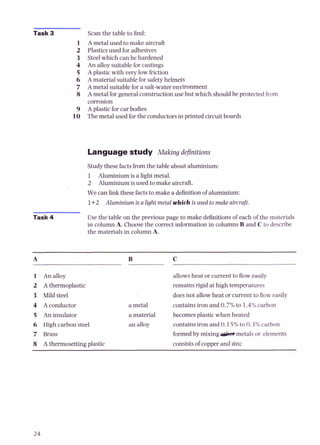
Scan the table to find:
A metalused to make aircraft
Plasticsused for adhesives
Steelwhich can be hardened
An alloy suitablefor castings
Aplastic with very low friction
Amaterialsuitablefor safetyhelmets
Ametal suitablefor a salt-waterenvironment
Ametal for general constructionuse but which shouldbe protected from
corrosion
Aplastic for car bodies
The metal used for the conductorsin printed circuitboards
Languagestudy Making definitions
Studythesefactsfrom the table about aluminium:
1 Aluminiumis a light metal.
2 Aluminiumisused tomake aircraft.
Wecan link these factsto make a debition of aluminium:
1+2 Aluminium is a lightmetal which is used to make aircraft.
Task 4 Use the table on the previouspage to make definitions of each of the materials
in column A. Choose the correct information in columnsB and C to describe
the materialsin column A.
1 Analloy
2 Athermoplastic
3 Mild steel
4 Aconductor
5 Aninsulator
6 High carbon steel
7 Brass
8 Athermosettingplastic
allowsheat or current to floweasily
remainsrigid at high temperatures
does not allow heat or current to flow easily
a metal contains iron and 0.7%to 1.4%
carbon
a material becomesplastic when heated
an alloy contains iron and 0.15%to 0.3%carbon
formed by mixing& metalsor elements
consistsof copper and zinc
Writing Adding information to a text
Studythis text about aluminium.
Aluminiumis used tomake aircraft,engine components,and many itemsfor
the kitchen.
We can add extra information to the text likethis:
Aluminium,whichisLight,soft,andductile,is used to make aircraft,
enginecomponents-forexample,cylinderheads-and many items for
the kitchen,suchaspots.
Note that the extra informationis marked with commasor dashes:
, which ....
-for example. ...-
such as ...,
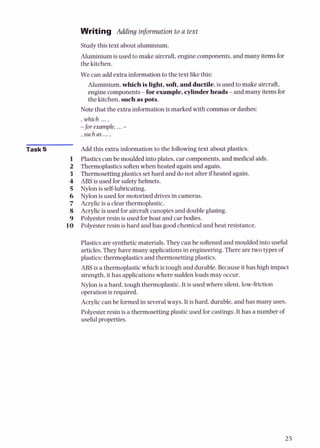
Task 5 Add this extra information to the following text about plastics.
Plasticscan be mouldedinto plates, car components,and medical aids.
Thermoplasticssoftenwhen heated again and again.
Thermosettingplastics sethard and do not alter if heated again.
ABS is used for safetyhelmets.
Nylon is self-lubricating.
Nylon is used for motorized drivesin cameras.
Acrylicis a clear thermoplastic.
Acrylicis used for aircraft canopiesand doubleglazing.
Polyester resinis used for boat and car bodies.
Polyester resinis hard and has good chemicaland heat resistance.
Plastics are syntheticmaterials. They can be softened and moulded into useful
articles.They have many applicationsin engineering.There are two typesof
plastics:thermoplasticsand thermosettingplastics.
ABS is a thermoplasticwhich is tough and durable. Because it has high impact
strength,it has applicationswhere suddenloadsmay occur.
Nylon is a hard, tough thermoplastic.It is used where silent,low-friction
operationis required.
Acryliccan be formedin severalways. It is hard, durable,and has many uses.
Polyester resin is a thermosettingplastic used for castings.It has a number of
usefulproperties.
Mechanisms
Tuning-in
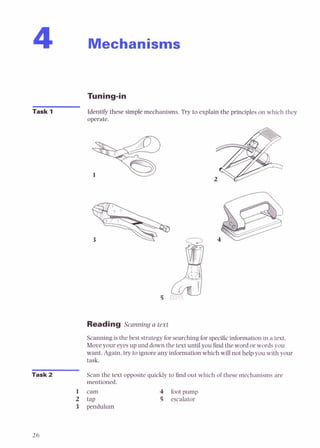
Task 1 Identify these simplemechanisms.Try to explain the principles on which they
operate.
Reading Scanning a text
Scanningis the best strategy forsearching for speci6cinformationin a text.
Moveyour eyesup and down the text until you find the word or wordsyou
want. Again, try to ignoreany informationwhich will not helpyou with your
task.
Task 2 Scan the text opposite quickly to 6nd out which of these mechanisms are
mentioned.
1 cam
2 tap
3 pendulum
4 foot pump
5 escalator
Task 3
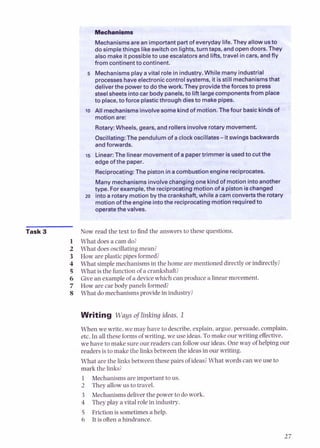
Mechanismsare an i
do simplethings like
from continentto continent.
5 Mechanismsplay avital role in industry.While many industrial
processeshaveelectroniccontrol systems, it isstill mechanismsthat
deliverthe powerto dothe work. They providethe forces to press
steelsheets intocar body panels, to lift largecomponentsfrom place
&,
,
>
.:
:.
,
#
>
*
, . .
..,,
.
>
: ,*:.s. ,?<
$&g#,!+$:,;?
andforwards.
edgeof the paper..
10 All mechanismsinvolvesome kindofmotion. Thefour basickindsof
Rotary:Wheels, gears, and roiier#--porary movement.
Oscillating: The pendulumof aclock oscillates- it swings backwards
15 Linear:The linear movementof a papertrimmer is usedto cutthe
Reciprocating:The piston ina combustion enginereciprocates.
Now read the text to find the answers to these questions.
What does a cam do?
What doesoscillatingmean?
How are plastic pipes formed?
What simplemechanisms in the home are mentioned directlyor indirectly?
What is the function of a crankshaft?
Give an exampleof a devicewhich can produce a linear movement.
How are car body panels formed?
What do mechanisms provide in industry?
Writing Waysof linking ideas, 1
When we write, we may have to describe,explain, argue,persuade, complain,
etc. In all these formsof writing, we use ideas. To make our writing effective.
we have to make sureour readers can followour ideas. One way of helping our
readers is to mahe the linksbetween the ideasin our writing.
What are the linksbetween these pairs of ideas?What words can we use to
mark the links?
1 Mechanismsare important to us.
2 They allow us to travel.
3 Mechanismsdeliverthe power to do work.
4 They play a vital role in industry.
5 Friction is sometimesa help.
6 It is oftena hindrance.
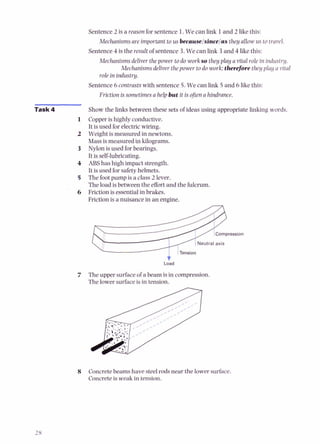
Sentence 2 is a reason for sentence 1.We can link 1and 2 like this:
Mechanisms are important to us because/since/asthey aIIow us to trawl.
Sentence 4 is the result of sentence 3. We can link 3 and 4 l i e this:
Mechanismsdeliverthepower to do work so they play a vita1role in industry.
Mechanismsdeliverthepowerto do work: therefore theyplay n vital
role in industry.
Sentence 6 contrastswith sentence 5. We can link 5 and 6 like this:
Frictionis sometimesa helpbut it is often a hindrance.
Task 4 Show the links between these sets of ideas using appropriate linking words.
1 Copperis highly conductive.
It is used for electricwiring.
2 Weight is measured in newtons.
Mass is measured in kilograms.
3 Nylon is used for bearings.
It is self-lubricating.
4 ABS has high impact strength.
It is used for safetyhelmets.
5 Thefoot pump is a class 2 lever.
Theload isbetween the effort and the fulcrum.
6 Frictionis essentialin brakes.
Frictionis a nuisance in an engine.
7 The upper surfaceof a beam is in compression.
The lower surfaceis in tension.
8 Concretebeams have steelrods near the lower surface.
Concreteis weak in tension.
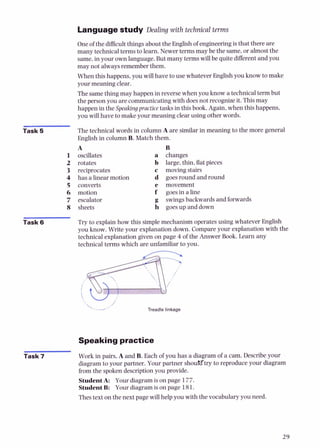
Task 5
Languagestudy Dealing with technical terms
One of the difficultthings about the English of engineering is that there are
many technical terms to learn. Newer terms may be the same, or almost the
same, in your own language. But many terms will be quite differentand you
may not always remember them.
When this happens,you will have to use whatever English you know to make
your meaning clear.
The samething may happen in reverse when you know a technical term but
the person you are communicating with doesnot recognize it. Thismay
happen in the Speakingpracticetasks in this book. Again, when this happens,
you will have to make your meaning clear using other words.
Task 6
The technical words in column A are similar in meaning to the more general
English in column B. Match them.
A B
oscillates a changes
rotates b large,thin, flat pieces
reciprocates c moving stairs
has a linear motion d goesround and round
converts e movement
motion f goesin a Line
escalator g swingsbackwards and forwards
sheets h goesup and down
Try to explain how this simplemechanism operates using whatever English
you know. Write your explanation down. Compareyour explanation with the
technical explanation given on page 4 of the Answer Book. Learn any
technical terms which are unfamiliar to you.
Treadle linkage
Speakingpractice
Task 7 Work in pairs, A and B. Each of you has a diagram of a cam. Describe your
diagram to your partner. Your partner shoufltry to reproduce your diagram
from the spoken description you provide.
StudentA: Your diagram is on page 177.
Student B: Your diagram is on page 181.
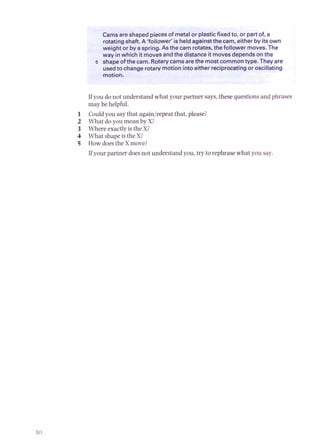
Thestext on the next page will help you with the vocabulary you need.
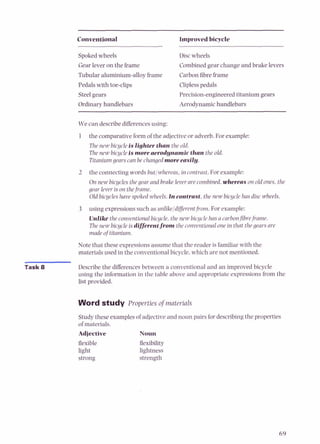
Camsareshaped piecesof metalor plasticfixed to, or partof, a
rotatingshaft. A 'follower' isheldagainstthe cam, either byitsown
weight or byaspring. As the cam rotates, the follower moves. The
way inwhich it movesandthe distance itmovesdependsonthe
shapeofthe cam. Rotarycamsarethe mostcommontype.Theyare
usedto changerotarymotionintoeither reciprocatingor oscillating
motion.
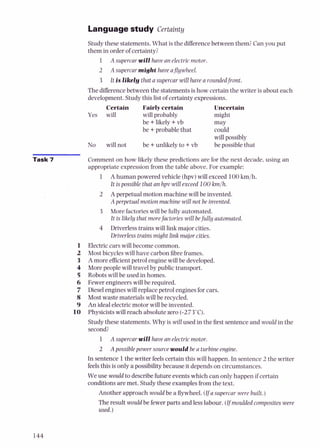
If you donot understandwhat yourpartnersays,thesequestionsand phrases
maybehelpful.
1 Couldyou say that againlrepeatthat,please?
2 What doyou meanby X?
3 Where exactlyis the X?
4 What shapeis the X?
5 How doesthe X move?
Ifyourpartnerdoesnotunderstandyou,try to rephrasewhat you say.
Forces in engineering
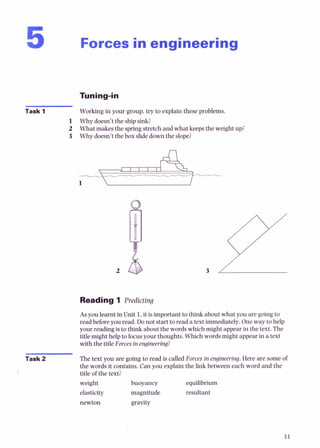
Task 1 Working in your group, try to explain these problems.
1 Why doesn't the shipsink?
2 What makes the spring stretch and what keeps the weight up?
3 Why doesn't the box slidedown the slope?
Reading 1 Predicting
Asyou learnt in Unit 1,it is important to think about what you are going to
read beforeyou read. Do not start to read a text immediately.One way to help
your reading isto t h i i about the words which might appear in the text. The
title might help to focusyour thoughts. Which wordsmight appear in a text
with the title Forcesin engineering?
Task 2 The text you are going to read is called Forces in engineering.Here are some of
the words it contains. Can you explain the link between each word and the
title of the text?
weight
elasticity
buoyancy
magnitude
equilibrium
resultant
newton gravity
Task 3 Now read the text. Use the information in the text to check the explanations
you made in Task 1.
Forcesinengineering
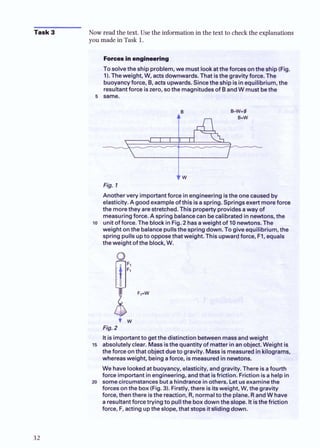
To solvethe ship problem, we must lookatthe forces onthe ship (Fig.
1).Theweight, W, acts downwards. That isthe gravity force. The
buoyancyforce, B, acts upwards.Sincetheship isinequilibrium, the
resultantforce iszero, sothe magnitudesof BandW must bethe
5 same.
Fig. 1
Another very importantforce inengineeringistheonecausedby
elasticity.A goodexampleofthis isaspring. Springsexertmoreforce
the morethey are stretched.Thisproperty providesaway of
measuringforce. A spring balancecan becalibratedin newtons, the
l o unit of force. The block in Fia. 2 hasaweiaht of 10newtons.The
weight on the balancepulls?hespringdown. To give equilibrium, the
spring pulls upto opposethat weight. This upwardforce, F1, equals
the weight ofthe block, W.
F
W
Fig. 2
Itis impottantto getthe distinction betweenmassandweight
15 absolutelyclear. Mass isthe quantity ofmatter inanobject.Weight is
the force onthat objectdueto gravity. Massismeasuredinkilograms,
whereasweight, being aforce, ismeasuredinRewtons.
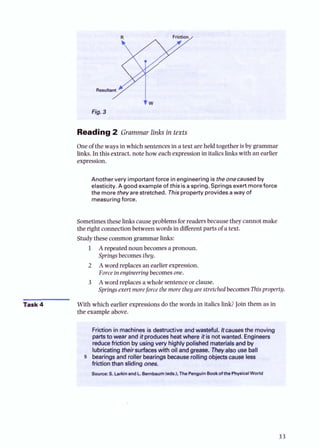
We havelookedat buoyancy, elasticity, andgravity.There isafourth
force important in engineering, andthat isfriction. Friction isa helpin
20 somecircumstancesbutehindrancein others. Letusexaminethe
forces onthe box (Fig.3).Firstly,there isitsweight, W, the gravity
force, thenthere isthe reaction, R
, normalto the plane. RandW have
a resultantforcetrying to pullthe boxdownt h e w . Itisthefriction
force, F
, actingupthe slope, that stops itslidingdown.
Reading2 Grammar links in texts
One of the waysin which sentencesin a text are held togetherisby grammar
links.In this extract,note how each expression in italicslids with an earlier
expression.
Another very important force inengineeringis theonecaused by
elasticity.Agood exampleof this isaspring. Springsexertmoreforce
the more theyare stretched. Thisproperty providesaway of
measuringforce.
Sometimestheselinkscauseproblemsfor readersbecausethey cannot make
the right connectionbetween words in differentparts of a text.
Studythesecommon grammar links:
1 A repeatednoun becomesa pronoun.
Springs becomes they.
2 A word replaces anearlierexpression.
Force in engineering becomesone.
3 A word replaces a whole sentenceor clause.
Springs exert moreforce the more they are stretched becomes Thisproperty.
Tr*4 With which earlier expressions do the words in italicslink?Join them as in
the exampleabove.
Frictionin machines is destructive andwasteful. Itcausesthe moving
partsto wear and itproducesheat where itis notwanted. Engineers
reducefriction by usingven/ highly polishedmaterialsand by
lubricatingtheirsurfaceswith oil and grease. Theyalso use ball
5 bearingsand roller bearings becauserolling objectscause less
friction than sliding ones.
Source:S. LarkinandL. Bernbaum(eds.l.The PenauinBookof the PhysicalWorld
...'
Languagestudy The present passive
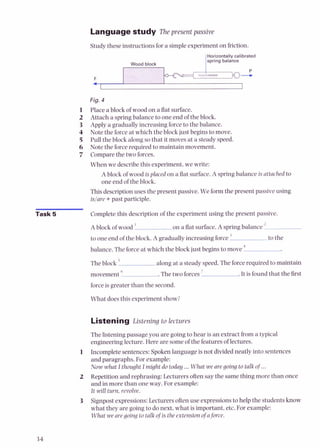
Studythese instructionsfor a simpleexperiment on friction.
IHorizontallv calibrated
Fig. 4
1 Place a block of wood on a flat surface.
2 Attach a spring balance to one end of the block.
3 Apply a gradually increasing force to the balance.
4 Note the forceat which the block just begins to move.
5 Pull the block along so that it moves at a steady speed.
6 Note the forcerequired to maintain movement.
7 Comparethe two forces.
When we describethis experiment, we write:
A block of wood is placed on a flat surface.A spring balance is attached to
one end of the block.
Thisdescriptionuses the present passive. We form the present passiveusing
islare +past participle.
Task 5 Complete this description of the experiment using the present passive.
A block of wood ' on a flat surface.A spring balance "
to one end of the block. A gradually increasing force to the
balance. The forceat which the blockjust beginsto move 4
-
The block along at a steady speed.The forcerequired to maintain
movement 6
. The two forces' .It is found that the first
forceis greater than the second.
What does this experiment show?
Listening Listening to lectures
Thelistening passage you are going to hear is an extract from a typical
engineering lecture. Here are someof the features of lectures.
1 Incompletesentences:Spokenlanguage is not dividedneatly into sentences
and paragraphs. For example:
Now what Ithought Imight do today ...What wearegoing to talkof...
2 Repetitionand rephrasing: Lecturersoftensay the samething more than once
and in more than one way. For example:
It will turn, revolve.
3 Signpostexpressions:Lecturersoftenuse expressionsto help the studentsknow
what they are going to do next, what is important, etc.For example:
What we are going to talk ojis the extensionofajorce.
Task 6 In the same way as when reading, it is helpful to think about the topic of a
lecture before you listen. The topii here is The Moment of a Force. Can you
explain the links between these words from the lecture and the topic?Use a
dictionary to help you if necessary.
turning distance product
pivot perpendicular leverage
fulcrum hinge
-
Task I
- Now listen to the lecture to check your explanations.
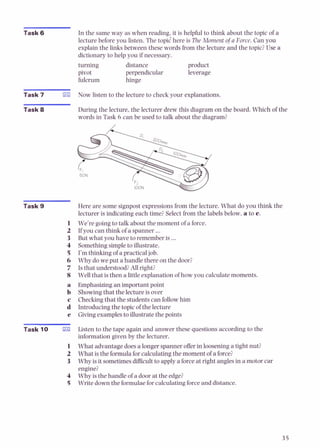
- During the lecture, the lecturer drew this diagram on the board. Which of the
words in Task 6 can be used to talk about the diagram?
Here are some signpost expressionsfrom the lecture. What do you think the
lecturer is indicating each time?Select from the labels below, a to e.
1 We're going to talk about the moment of a force.
2 If you can think of a spanner ...
3 But what you have to remember is ...
4 Somethingsim~le
to illustrate.
- .
5 I'm thinkiug ofa practical job.
6 2'hy do we put a handle there on the door?
7 Is that understood?All right?
8 Wellthat is then a littleexplanation of how you calculate moments.
a Emphasizingan important point
b Showing that the lecture is over
c Checking that the students can followhim
d Introducing the topic of the lecture
e Giving examplesto illustrate the points
Task 10 Listen to the tape again and answer these questions according to the
information given by the lecturer.
1 What advantage doesa longer spanner offer in loosening a tight nut?
2 What is the formula for calculating the moment of a force?
3 Why is it sometimesdifficultto apply a force at right angles in a motor car
engine?
4 Why is the handle of a door at the edge?
5 Write down the formulaeforcalculating forceand distance.
The electric motor
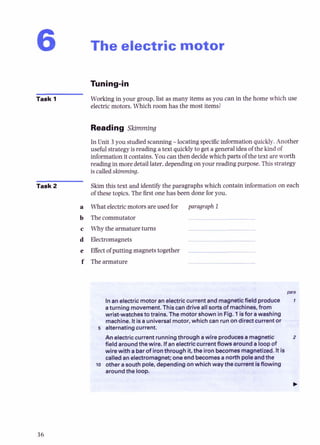
Task 1 Working in your group, list as many items as you can in the home which use
electric motors. Which room has the most items?
Reading Skimming
In Unit 3 you studiedscanning -locating specfic information quickly. Another
useful strategy is reading a text quickly to get a generalidea of the kind of
information it contains. You can then decidewhich parts of the text are worth
reading in more detaillater,dependingon your reading purpose.Thisstrategy
is called skimming.
Task 2 Skim this text and identify the paragraphs which contain information on each
of these topics. The 6rst one has been done for you.
a What electricmotors are used for paragraph 1
b The commutator
c Why the armature turns
d Electromagnets
e Effectof putting magnets together
f The armature
Inanelectricmotoranelectriccurrantand magneticfield produce
aturning movement.Thiscan driveall sorts of machines, from
wrist-watchestotrains.The motorshown in Fig. 1isfor awashing
machine. Itisauniversalmotor, whichcan runon directcurrentor
5 alternatingcurrent.
An electriccurrent runningthroughawire producesamagnetic
fieldaroundthewire. Ifan electriccurrentflowsarounda loopof
wirewith abarof ironthroughit,the ironbecomesmagnetized.Itis
! calledanelectromagnet; one endbecomesa northpoleandthe
o otherasouthpole, dependingonwhichwaythecurrent isflowing
aroundthe IOOD.
Ifyou puttwo magnetsclosetogether, likepoles-for example, 3
two northpoles-repeleachother, andunlikepolesattracteach
other.
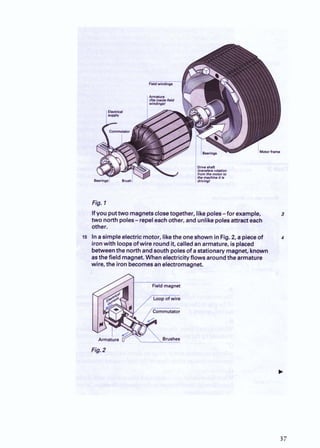
5 Inasimpleelectricmotor, likethe oneshowninFig.2
, a pieceof 4
ironwith loopsofwire roundit, calledanarmature, isplaced
betweenthe northandsouth polesof astationary magnet, known
asthefield magnet.Whenelectricityflowsaroundthearmature
wire, the ironbecomesanelectromagnet.
I The attractionand repulsion betweenthe polesofthis armature
magnetandthe polesof the field magnetmakethe armatureturn.
As a result, itsnorth pole isclosetothe south poleofthe field
maunet.Thenthe current is reversedsothe northw l e of the
armature magnetbecomesthesouth pole. Onceagain, the
attraction and repulsionbetweenit andthe field magnet makeit
turn. The armaturecontinuesturning as long asthe direction ofthe
current, andtherefore itsmagneticpoles, keepsbeing reversed.
To reversethe direction of the current, the endsofthe armature t
wire areconnectedto different halvesof a solit rino called a
I commutator. Currentflowsto andfromthe kmm;tatorthrough
small carbon blockscalledbrushes.As the armatureturns, first one
halfofthe commutator comesintocontactwith the brush
deliveringthe current, andthenthe other, sothe direction ofthe
current keepsbeing reversed.
Swfce: A( from'insideOWEle*ricMotof, Edumtion Gusrdian
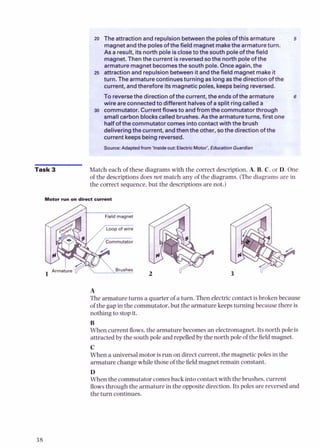
Match each of these diagrams with the correct description,A. B, C, or D. One
of the descriptionsdoes not match any of the diagrams. (The diagrams are in
the correct sequence, but the descriptions are not.)
Motor run on direcl current
A
The armature turns a quarter of a turn. Then electriccontact is broken because
of the gap in the commutator, but the armaturekeeps turning because there is
nothing to stopit.
B
When current flows,the armature becomes an electromagnet. Its north pole is
attracted by the south pole and repelledby the north pole of the field magnet.
C
When a universal motor isrun on direct current, the magnetic poles in the
armature change whilethose of the fieldmagnet remain constant.
D
When the commutator comesback into contact with the brushes, current
flowsthrough the armature in the oppositedirection.Its poles arereversedand
the turn continues.
Language study Describingfunction
Try to answer this question:
What doesan electricmotor do?
When we answer a question like this, we describethe function of something.
We can describethe function of an electricmotor in this way:
An electric motor converts electrical energy to mechanical energy.
We can emphasizethe function like this:
Thejunctionofanelectric motor is to convert electrical energy to mechanical
energy.
Task 4 Match each of these motor components to its function, and then describe its
function in a sentence.
Component Function
1 armature a transfers rotation from the motor
2 bearings b create an electromagnetic field
3 brushes c converts electromagnetic energy to rotation
4 commutator d reversesthe current to the armature
5 drive shaft e supportthe drive shaft
6 field windings f supplycurrent to the armature
Writing Describing components
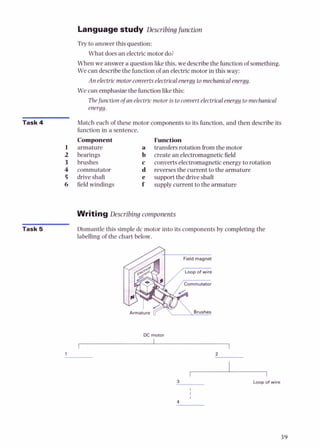
Task 5 Dismantle this simple dc motor into its components by completing the
labelling of the chart below.
Loop of wire
Now studythis descriptionof themotor.
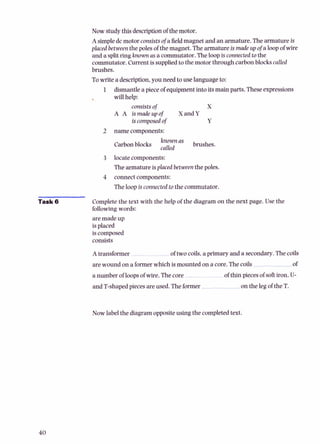
A simpledcmotor consistsofa fieldmagnet and an armature.Thearmature is
placed between the poles of themagnet. Thearmature is made upo
f a loopof wire
and asplitring knownasacommutator.Theloopis connectedto the
commutator.Currentis suppliedtothemotorthrough carbon blockscalled
brushes.
Towritea description,you need touse languageto:
1 dismantlea pieceof equipmentinto itsmain parts. These expressions
willhelp:
consistso
f X
A A ismadeupof XandY
iscomposedo
f Y
2 name components:
known as brushes.
Carbonblocks called
3 locatecomponents:
Thearmature isplaced betweenthepoles.
4 connectcomponents:
Theloopis connectedtothe commutator.
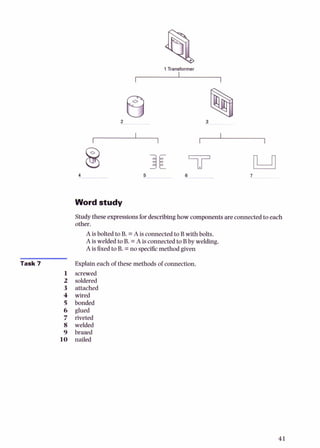
Task 6 Completethe text with the help of the diagram on the next page. Use the
followingwords:
are made up
isplaced
is composed
consists
A transformer oftwo coils,a primary and a secondary.Thecoils
arewound on a formerwhich ismounted on a core.Thecoils of
a number of loopsof wire. Thecore of thin piecesof softiron. U-
and T-shaped piecesare used. Theformer onthe legof theT.
Now labelthediagramoppositeusing the completedtext.
Word study
Studytheseexpressionsfor describinghow componentsare connectedtoeach
other.
A is bolted to B. = A is connectedto B with bolts.
A is welded to B. =A is connectedto Bby welding.
A is tixed to B. =no speci6cmethod given
Task 7 Explain each of these methods of connection.
1 screwed
2 soldered
3 attached
4 wired
5 bonded
6 glued
7 riveted
8 welded
9 brazed
10 nailed
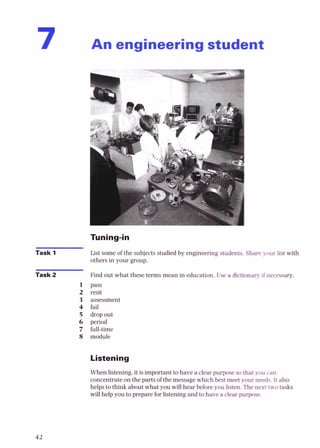
An engineering student
Task 1
Task 2
1
2
3
4
5
6
7
8
List some of the subjects studied by engineering studentsShare your List with
others in your group.
Find out what these terms mean in education. Usea dictiooary if necessary.
pass
resit
assessment
fail
dropout
period
full-time
module
Listening
When listening,it is important to have a clear purpose s
othat you can
concentrate on the parts of the messagewhich best meet youroads.It also
helps to think about what you will hear beforeyou listen.Tbtn
u
t two tasks
will helpyou to preparefor listening and to have a dearpurpose.
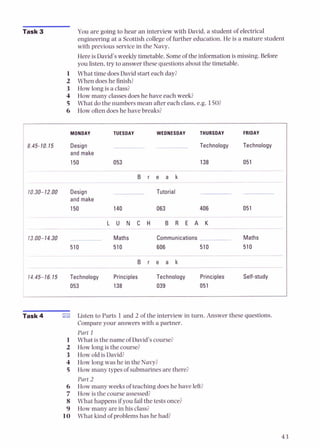
Task 3 You are going to hear an interview with David, a student of electrical
engineering at a Scottish college of further education. He is a mature student
with previous service in the Navy.
Here is David's weekly timetable. Someof the information is missing. Before
you listen,try to answer these questions about the timetable.
1 What time doesDavid start each day?
2 When does he finish?
3 How long is a class?
4 How many classesdoeshe have each week?
5 What do the numbers mean after each class. e.g. 150?
6 How often doeshe have breaks?
I MONDAY TUESDAY WEDNESDAY THURSDAY FRIDAY
Design
and make
150
Technology Technology
138 051
.~
B r e a k
- --
10.30-12.00 Design Tutorial
and make
150 140 063
p~~ ~ ~p --
L U N C H B R E A K
--
/ 13.00-14.30 Maths Communications Maths
1 510 510 606 510 510
-
-
-
B r e a k
I
14.45-16.15 Technology Principles Technology Principles Self-study
053 138 039 051
Task 4 Listen to Parts 1and 2 of the interview in turn. Answer these questions.
Compare your answers with a partner.
Part 1
What is the name of David's course?
How long is the course?
How old is David?
How long was he in the Navy?
How many types of submarines are there?
Part 2
How many weeks of teaching doeshe have left?
How is the course assessed?
What happens if you fail the tests once?
How many are in his class?
What kind of problemshas he had?
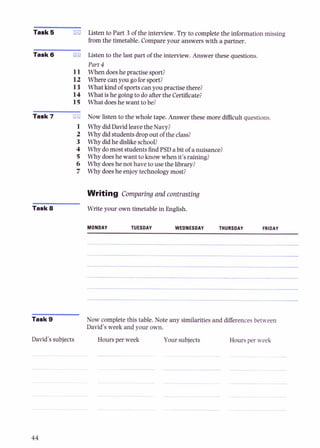
Task 6 D Listen to Part 3 of the interview.Try to completethe information missing
from the timetable. Compareyour answers with a partner.
Task 8 Liiten to the last part of the interview.Answer these questions.
Part4
11 Whendoeshe practisesport?
12 Where can you goforsport?
13 What kind of sportscan you practise there?
14 What ishe goingto do after the Certificate?
15 What doeshe want to be?
Task 7 D Now listen to the whole tape. Answer these more difficult questions.
1 Why didDavid leavethe Navy?
2 Why did students dropout of the class?
3 Why did he dislikeschool?
4 Why domost studentsfindPSDa bit of a nuisance?
5 Why doeshe want toknow when it's raining?
6 Why doeshe not have to use the library?
7 Why doeshe enjoytechnologymost?
Writing Comparing and contrasting
Task 8 Write your own timetable in English.
MONDAY TUESDAY WEDNESDAY THURSDAY FRIDAY
Task 9 Now completethis table. Note any similaritiesand differencesbetween
David's week and your own.
David's subjects Hours per week Your subjects Hoursper week
Task 10 Write a short comparison and contrast of your timetable and David's. These
expressions may be useful:
more time/hours/classes/maths than
lesstime/maths/physicsthan
fewerhours/classesthan
not asmuch tiie/maths/physics as
not asmany hours/classesas
start/finishearlierllater than
Note that less and much are used forthings which cannot be counted.
Central heating
Task 1 How can you heat a house in cold weather? List the possible ways
Reading Predicting
In Unit 5we learnt how using the title can help us to predict the contents of a
text. Diagrams are alsovery useful in helping the reader to make the right
guesses about what a text will contain. Before you read a text. read the title and
look at any diagrams it contains.
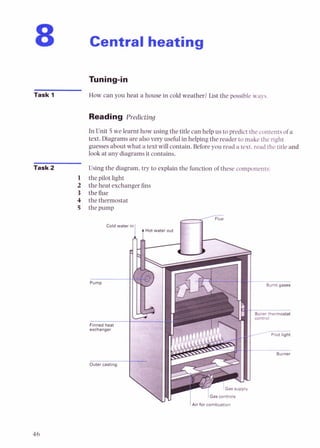
Task 2 Using the diagram, try to explain the function of these components:
1 the pilot light
2 the heat exchanger fins
3 theflue
4 the thermostat
5 the pump
Cold wate
-
Pump
Finned heat
exchanger
Outer casting
1 7 G a s & i ?
Air for combustion
Pilot light
b
Burner
Task 3 Scan this text quicklyto check the explanationsyou made in Task 2. You
mav not find all the information vou want.
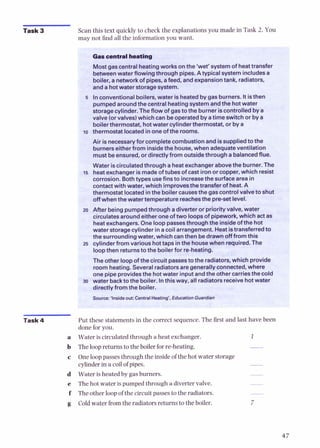
Gascentralheating
Mostgascentralheatingworks onthe 'wet' system of heattransfer
betweenwater flowingthrough pipes. Atypical systemincludesa
boiler, a networkof pipes, afeed, andexpansiontank, radiators,
anda hotwater storagesystem.
I
5 Inconventional boilers, water is heatedby gas burners. Itisthen
pumpedaroundthecentralheatingsystem andthe hotwater
storagecylinder.Theflow of gasto the burner iscontrolled bya
valve (orvalves)which can be operated byatime switch or by a
boilerthermostat, hotwater cylinderthermostat,or by a
ro thermostat locatedinoneofthe rooms.
Air isnecessaryfor completecombustion and issuppliedto the
burnerseitherfrom insidethe house, when adequateventilation
must beensured,or directly from outsidethrough a balancedflue.
Water iscirculatedthrough a heatexchangerabovethe burner. The
i s heatexchangerismadeof tubesof cast ironor copper, which resist
corrosion. Bothtypes usefins to increasethe surfacearea in
contactwith water, which improvesthe transferof heat.A
thermostat locatedinthe boiler causesthe gascontrolvalveto shut
offwhen thewatertemperature reachesthe pre-setlevel.
20 After being pumpedthrough adiverter or priorityvalve, water
circulatesaroundeither oneoftwo loopsof pipework, which act as
heatexchangers. One looppassesthroughthe insideof the hot
water storagecylinder in acoilarrangement. Heatistransferredto
the surrounding water, which canthen bedrawnoff from this
25 cylinder from various hottaps inthe housewhen required. The
loopthen returnstothe boilerfor re-heating.
The other loopof the circuit passestothe radiators, which provide
room heating. Several radiatorsare generallyconnected, where
one pipe providesthe hotwater input andthe other carriesthe cold
30 water backto the boiler. Inthis wav, all radiatorsreceivehotwater
directly fromthe boiler.
Source:'Inside out:CentralHeating', EducationGuardii
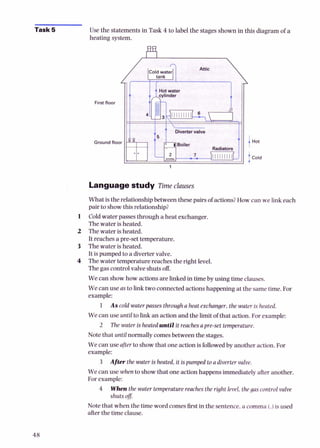
Task 4 Put these statementsin the correct sequence. The first and last have been
done for you.
Wateris circulatedthroughaheatexchanger. I
Theloopreturnsto theboiler forre-heating.
One loop passesthroughthe insideof the hot water storage
cylinderin acoil of pipes. -
Wateris heated by gasburners.
The hot water is pumpedthroughadivertervalve.
Theother loop of the circuitpassesto the radiators.
Coldwater fromthe radiatorsreturnsto the boiler.
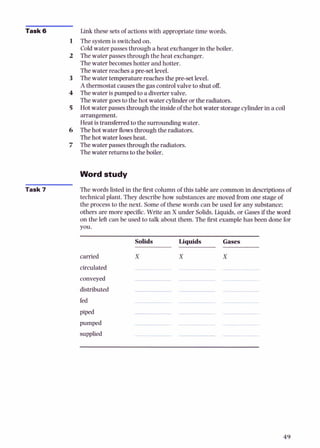
Use the statements in Task 4 to label the stagesshown in this diagram of a
heating system.
Fira flwr
Ground floor
t
1
Languagestudy Time clauses
What isthe relationship between thesepairs of actions?How can we link each
pair to showthis relationship?
1 Coldwater passes through a heat exchanger.
The water isheated.
2 The water is heated.
It reachesa pre-set temperature.
3 Thewater is heated.
It is pumped to a divertervalve.
4 Thewater temperaturereachesthe right level.
The gascontrolvalve shutsoff.
We can show how actionsare linked in timeby using timeclauses.
We can useas to link two connected actionshappening at the sametime. For
example:
1 As cold waterpasses througha heat exchanger, the water i
sheated.
We can use until to link an action and the limit of that action. For example:
2 The water is heateduntil it reachesapre-set temperature.
Note that until normally comesbetween the stages.
We can use afterto show that one actionis followed by another action. For
example:
3 qftcr the water is heated,it ispumped toa diverter valve.
We can use when to showthat one actionhappensimmediatelyafter another.
For example:
4 Whenthe water temperature reaches the right level, thegascontrol valve
shuts off.
Note that when the time word comesh t in the sentence.a comma (.) is used
afterthe time clause.
Task 6
1
2
Link these sets of actionswith appropriatetime words.
The system is switched on.
Cold water passes through a heat exchangerin the boiler.
Thewater passes through the heat exchanger.
Thewater becomeshotter and hotter.
Thewater reachesa pre-set level.
The water temperaturereachesthe pre-set level.
A thermostat causesthe gascontrolvalve to shut off.
The water ispumped to a divertervalve.
The water goes to the hot water cylinderor the radiators.
Hot water passes through the insideof the hot water storagecylinderin a coil
arrangement.
Heat istransferred to the surrounding water.
The hot water flowsthrough the radiators.
Thehot water loses heat.
Thewater passesthrough the radiators.
Thewater returns to the boiler.
Word study
Task 7 The words listed in the fust column of this table are common in descriptionsof
technical plant. They describehow substancesare moved from one stage of
the process to the next. Some of these words can be used for any substance:
others are more specsc. Write an X under Solids,Liquids, or Gases if the word
on the left can be used to talk about them. The kst examplehas been done for
you.
carried
circulated
conveyed
distibuted
fed
piped
pumped
supplied
Solids Liquids Gases
Safety at work
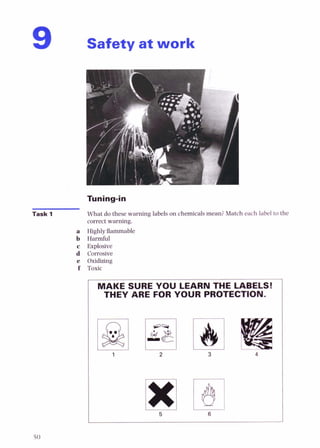
Task 1 What do these warning labels on chemicalsmean?Match each label to the
correct warning.
a Highly flammable
b Harmful
c Explosive
d Corrosive
e Oxidizing
f Toxic
MAKE SURE YOU LEARN THE LABELS!
THEY ARE FOR YOUR PROTECTION.
Task 2 List some of the potential dangers in your laboratory, workshop,or place of
work. How is the risk of these hazards reduced?
Task 3 Study the safety instructions from a workshop below, and then answer these
questions.
a Who are the instructions for?
b Who wrote them?
c What was the writer's purpose?
I 1 Wear protective clothing at all times.
I
2 Always wear eye protection whenoperating
lathes, cutters, and grinders and ensure the guard
is in place.
1 3 Keep your workplace tidy.
1
I 4 Theareasbetween benches and around machines
mustbe kept clear.
I
1 5 Toolsshouldbe put away when not in use and
I any breakages and losses reported
1 6 Machines should be cleaned after use,
Reading Understanding the writer'spurpose
Knowing what the writer's purposeis,who the writer is, and who the intended
readers are can help us to understand a text. The safety instructions in Task 3
are clearlyintendedto encourage employeesto be safety consciousand reduce
the risk of accidents. The writer is perhaps a supervisoror the companysafety
officer,and the intendedreaders are machine operatives.Knowing these things
can help us to work out the meaning of any part of the text we may not
understand.
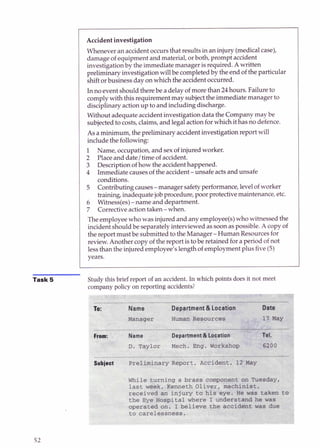
Task 4 Study the company document on safety on the next page, and then answer
these questions.
1 Who is this document for?
a machine operatives
b managers
c allemployees
d injuredemployees
2 Who wrote this document?
a tradeunion representative
b technician
c manager
d medicalstaff
3 What is the writer's intention?
a to prevent accidents
b to ensure speedyhelp forinjured employees
c tn protect the company
d to warn about dangers
Accident investigation
Whenever an accidentoccursthat results in an injury (medicalcase),
damage of equipment and material, or both, prompt accident
investigationby theimmediatemanager is required. Awritten
preliminary investigationwillbe completedby the end of theparticular
shiftorbusiness day onwhichthe accidentoccurred.
In noevent shouldtherebe a delay of more than 24hours.Failureto
complywith this requirementmay subjectthe immediatemanager to
disciplinaryactionup to and including discharge.
Without adequate accidentinvestigationdata the Companymay be
subjectedto costs,claims, and legalactionforwhichithas nodefence.
As aminimum, the preliminary accidentinvestigationreport will
include the following:
1 Name, occupation,and sexof injuredworker.
2 Placeand date/time of accident.
3 Descriptionof how the accidenthappened.
4 Immediate causesof the accident-unsafe actsand unsafe
conditions.
5 Contributingcauses-manager safetyperformance,levelof worker
baking,inadequatejob procedure,poor protectivemaintenance,etc.
6 Witness(es)-name and department.
7 Correctiveactiontaken- when.
The employeewho was injuredand any employee(s)who witnessed the
incidentshould be separatelyinterviewed as soonaspossible.A copy of
the report must be submitted to theManager-Human Resourcesfor
review.Another copy of the report istobe retained fora period of not
lessthan the injuredemployee's length of employmentplus five(5)
years.
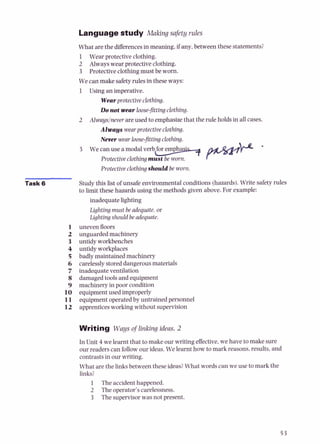
Task 5 Study this brief report o
f an accident.In which points does it not meet
company policy on reporting accidents?
Language study Making safety rules
What are the differencesin meaning, if any, between these statements?
1 Wear protectiveclothing.
2 Always wear protectiveclothing.
3 Protective clothing must be worn.
We can make safetyrules in these ways:
1 Using an imperative.
Wearprotective clothing.
Do not wear loose-fittingclothing.
2 Alwags/neverare used to emphasizethat the rule holds in all cases.
Alwa~s
wearprotective clothing.
Never wearloose-fittingclothing.
3 We can use amodal v
e
r
b
-
Protective clothing must be worn.
Protective clothingshould be worn.
Task 6 Study this list of unsafe environmental conditions (hazards).Write safety rules
to limit these hazards using the methods given above. For example:
inadequatelighting
Lighting must beadequate.or
Lighting should be adequate.
1 uneven floors
2 unguarded machinery
3 untidy workbenches
4 untidy workplaces
5 badly maintained machinery
6 carelesslystored dangerousmaterials
7 inadequate ventilation
8 damaged tools and equipment
9 machinery in poor condition
10 equipment used improperly
11 equipment operated by untrained personnel
12 apprentices working without supervision
Writing Waysof linking ideas, 2
In Unit 4 we learnt that to make our writing effective,we have to make sure
our readers can followour ideas. We learnt how to mark reasons, results, and
contrasts in our writing.
What are the linksbetween these ideas?What words can we use to mark the
links?
1 The accident happened.
2 The operator's carelessness.
3 The supervisorwas not present.
Sentence 2 is a reason for sentence 1.Sentence 3 is an additionalreason. We can
mark the links between them like this:
Theaccident happened becauseof the operator's carelessness.In
addition/moreover,the supervisor was not present.
We use because o
f to introduce a reason which is a noun or noun phrase. We
use in additionand moreover to introduce an additional reason.
What are the linksbetween these ideas?What wordscan we use to mark the
links?
4 Suitableprotection should be worn.
5 Safetyhelmets should be used where there is a danger of falling
objects.
Sentence 5 is an exampleto illustrate sentence 4. We can mark this in this way:
Suitableprotection should b
e worn.For example/Forinstance,sakty
helmets shouldbe used where there is adangeroffalling objects.
Task 7 Show the links between these sets of ideas using appropriate linking woru.
from this unit and from Unit 4.
1 Many accidents happen.
Workers' carelessness.
2 Education can reduce accidents.
It is important that all workersreceive training in basic safety.
3 Eye injuries can be serious.
Gogglesmust be worn for grinding and cutting.
4 Safetygloves provide protection for the hands.
They prevent burns.
They reduce the danger of cuts.
5 Safetyshoesprotect the feet against fallingobjects.
They prevent the feet getting caught in machinery.
6 Respiratorsshould be worn in dusty conditions.
Dust can damage the lungs.
7 Safetygear existsfor everydanger.
Each year people are injured.
They refuse or forget to wear the right gear.
1
0 Young engineer
Task 1 Lucy Porter is a recent winner of the Young Engineerfor Britain award.
Study this diagram of her invention.Discuss these questionsin your
group:
1 Whatis it?
2 Who is it for?
3 Howdoesit work?
Listening
Task 2 m
Task 3 rn
a
b
c
d
e
f
g
h
i
i
k
Task4
Task 5
1
2
3
4
5
6
Task 6
Task 7 m
1
2
3
4
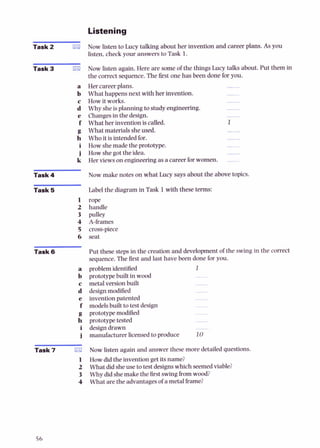
Now Listen to Lucy talking about her invention and career plans. As you
listen, check your answers to Task 1.
Now listen again. Here are someof the things Lucy talks about. Put them in
the correctsequence.The first one has been done for you.
Her careerplans.
What happensnext with her invention.
How it works.
Whysheisplanning tostudyengineering.
Changesin the design.
What her inventioniscalled.
What materialssheused.
Who it isintendedfor.
How shemade the prototype.
How shegot theidea.
Her viewsonengineeringasa careerforwomen.
Now make notes on what Lucy says about the above topics.
Label the diagram in Task 1with these terms:
rope
handle
pulley
A-frames
cross-piece
seat
Put these stepsin the creation and development of the swingin the correct
sequence.The &st and last have been done for you.
problemidentified 1
prototypebuilt in wood -
metalversion built -
design modified
inventionpatented -
modelsbuilt totestdesign -
prototypemodified -
prototypeh k d -
designdrawn -
manufacturer licensedto produce 10
Now listen again and answer these more detailed questions.
Howdid the inventiongetitsname?
What did sheusetotestdesignswhich seemedviable?
Whydid shemake thefirst swingkom wood?
What arethe advantagesof a metalframe?
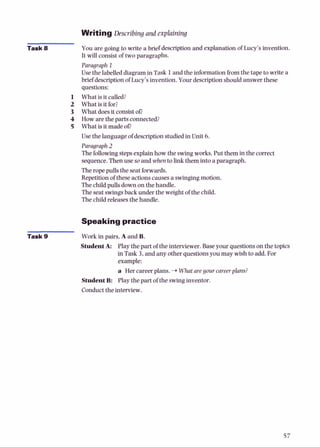
Writing Describing and explaining
Task 8 You are going to write a brief descriptionand explanation of Lucy's invention.
It will consist of two paragraphs.
Paragraph I
Use the labelled diagramin Task 1and the information from the tape to write a
brief descriptionof Lucy's invention.Your descriptionshould answer these
questions:
1 What is it called?
2 What is it for?
3 What doesitconsistOR
4 How are the parts connected?
5 What is it madeof)
Usethe language of descriptionstudiedin Unit 6.
Paragraph 2
The followingstepsexplainhow the swingworks. Put them in the correct
sequence.Then use soand when to link them into a paragraph.
Theropepulls the seatforwards.
Repetitionof theseactionscausesa swingingmotion.
The childpuUsdownon the handle.
The seatswingsback under the weight of the child.
The child releases the handle.
Speakingpractice
Task 9 Work in pairs. A and B.
StudentA: Playthe part of the interviewer.Baseyour questionson the topics
in Task 3,and any other questionsyou may wish to add. For
example:
a Her careerplans. +Whatare your careerplans?
StudentB: Play the part of the swinginventor.
Conduct the interview.
Washing machine
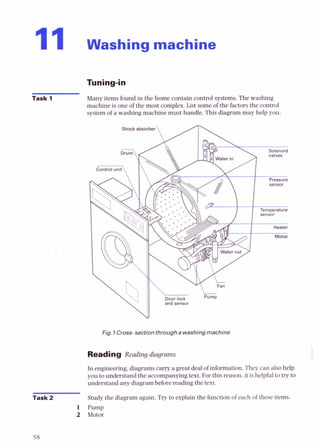
Task 1 Many items found in the home contain controlsystems. The washing
machine is one of the most complex.List some of the factorsthe control
system of a washing machine must handle. This diagram may help you.
Fig. 1Cross-sectionthrougha washing machine
Reading Reading diagrams
In engineering.diagramscarry a greatdeal of information.They can also help
you to understand the accompanying text. For this reason,it is helpful to try to
understand anydiagrambeforereadingthe text.
Task 2 Study the diagram again. Try to explain the function of each of these items.
1 Pump
2 Motor
Task 3
Shock absorber
Solenoidvalves
Heater
Pressuresensor
Door lock andsensor
Temperaturesensor
Fan
Read this text to check your answers to Task I
7 -
Controlqstems inthe home ,
*
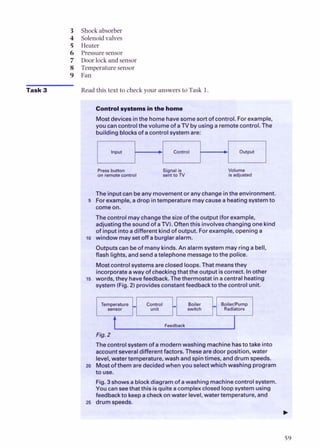
Mostdevices inthe homehavesomesort of control.Forexample,
you cancontrolthevolume of a TV by usinga remotecontrol.The
buildingblocksof a controlsystemare:
Input
t-
Press bumn Signal is Volume
on remotewntrol sent to TV is adjusted
Theinputcanbeany movementor any changeinthe environment.
5 Forexample. adrop intemperaturemaycauseaheatingsystemto
comeon.
The controlmaychangethesizeoftheoutput(forexample,
adjustingthe soundof aN).
Oftenthis involveschangingonekind
of inputintoadifferentkindof output. Forexample, openinga
lo window mayset offaburglaralarm.
Outputscanbeof manykinds. An alarmsystemmay ringabell,
flash lights, andsendatelephone messagetothe police.
Mostcontrolsystemsareclosedloops. That meansthey
incorporateaway ofcheckingthatthe outputiscorrect. Inother
15 words, theyhavefeedback. Thethermostat ina centralheating
system(Fig. 2) providesconstantfeedbackto thecontrolunit.
Temperature Control Boiler BoilerlPump
unit switch Radiators
Feedback
k
Fig.2
Thecontrolsystemof amodernwashing machinehasto takeinto
accountseveraldifferentfactors. Thesearedoor position, water
level, water temperature, washandspintimes, and drumspeeds.
zo Mostofthem aredecidedwhen youselectwhichwashingprogram
to Use.
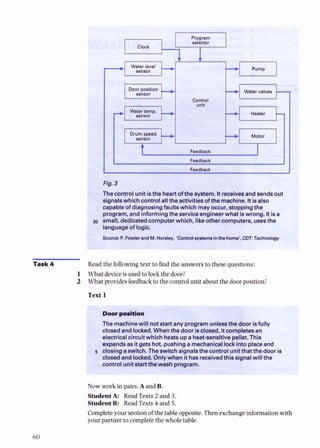
Fig. 3shows ablockdiagramof awashingmachinecontrolsystem.
YOUcanseethatthis isquitea complexclosedloopsystemusing
feedbackto keepacheckonwater level,water temperature, and
25 drumspeeds.
b
lump
J
The control unit isthe heartof the system. Itreceivesandsends
signalswhich control allthe activitiesofthe machine. It isalsc
capableof diagnosingfaults which mayoccur, stoppingthe
program, and informing the serviceengineerwhat iswrong. Iti
30 small, dedicatedcomputer which, likeother computers, usesth
languageof logic.
Source: P. Fowler andM.Horsley, 'Contmlsystemsinthe home', CDE TTechnolo
Task 4 Read the following text to 6nd the answers to these questions:
1 What deviceisused tolockthe door?
2 What providesfeedbackto thecontrolunit about the doorposition?
Doorposition
The machinewill notSLUI t ally plugram w~l~rrsthedoor
isfully
closedand locked. Whenthe door isclosed, itcompletesan
electricalcircuit which heatsupa heat-sensitivepellet. This
expandsas itgets hot, pushinga mechanicallockintoplaceand
closingaswitch. The switch signalsthe control unitthat thedoor is
closedand locked. Onlywhen ithasreceivedthis signalwill the
control unitstartthewash pronram~
Now work inpairs. A and B.
StudentA: Read Texts 2 and 3.
StudentB: ReadTexts4 and 5.
Completeyour sectionof the tableopposite.Thenexchangeinformationwith
your partner to completethe wholetable.
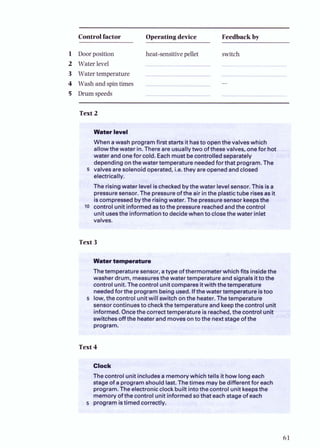
Control factor Operatingdevice Feedbackby
1 Door position heat-sensitivepellet switch
2 Water level
3 Water temperature
4 Wash and spintimes -
5 Drumspeeds
Text 2
Water Ieval
When awash program first starts it hasto openthe valveswhich
allowthe water in.There are usuallytwo of thesevalves, onefor hot
water andonefor cold. Eachmust becontrolledseparately
dependingonthewater temperatureneededforthat program. The
5 valvesaresolenoid operated, i.e. they are openedandclosed
electrically.
The risingwater level ischeckedbythe water levelsensor. This isa
pressuresensor. The pressureof the air inthe plastictube risesas it
iscompressedbythe risingwater. The pressuresensor keepsthe
10 control unit informedasto the Dressurereachedandthe control
unit usesthe informationto decidewhen to closethe water inlet
valves.
::*W&tt# <p3,F3<:,2?3yLT-'...
.,!>-.,:" *T.:%-~:~yz-i
..-.~
.. ,~ T&*$*.,*
:.'p$.:?:*:~%<*A>
, m
<*:p&*e*
Text 3
. . .
@ Water temperature
Thetemperaturesensor, atype ofthermometer which fits insidethe
washer drum, measuresthewater temperatureandsignalsittothe
control unit. Thecontrol unitcompares itwith thetemperature
nwdedforthe program being used.Ifthewater temperatureistoo
5 low, the control unitwill switch onthe heater.Thetemperature
sensorcontinuesto checkthetemperatureand keepthe control unit
informed. Oncethecorrecttemperature is reached,thecontrolunit
switchesoffthe heaterand movesonto the nextstage of the
program.
Text 4
Clock
Thecontrol unit includesa memorywhichtells ithowlong
staaeof a Droaramshould last. Thetimes mav bedifferent
he electronic clock built intothe control unit keepsth
memory ofthecontrol unit informedsothat eachstage of each
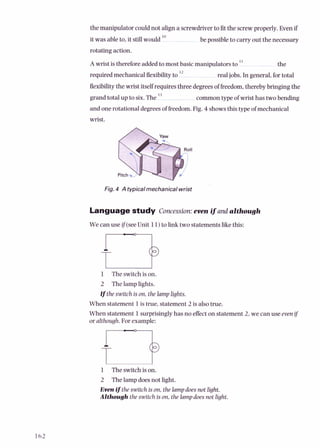
6 program istimedcorrectly.
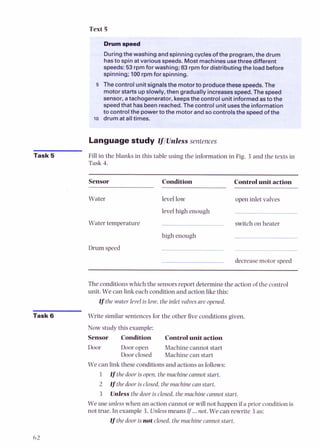
hasto spin at various speeds. Most machinesusethree different
@
*,as
: speeds: 53 rpmfor washing; 83 rpmfor distributingthe loadb e f ~ r & ~ ~ ~ * : ~ ~
spinning; 100rpmforspinning. ~ ~ z ~ ; &
w
@ Thecontrol unit signalsthe motorto producethesespeeds. The
.?<a
motor starts upslowly, thengradually increasesspeed. The spee
sensor, atachogenerator, keepsthecontrol unit informed asto
speedthat hasbeenreached.Thecontrol unit usesthe informat
to controlthe powertothe motor and socontrolsthespeed ofthe
l o drum at alltimes.
LanguageStudy IfJUnlesssentences
Task 5 Fill in the blanks in this table using the information in Fig. 3 and the texts in
Task 4.
Sensor Condition Control unitaction
Water level low open inlet valves
level high enough
Water temperature switch on heater
high enough
Drum speed
decreasemotor speed
The conditionswhich the sensors report determine the action of the control
unit. We can link each condition and action like this:
If the water levelis low, the inlet valvesareopened.
Task 6 Write similar sentences for the other five conditions given.
Now study this example:
Sensor Condition Controlunitaction
Door Door open Machine cannot start
Door closed Machine can start
We can link these conditions and actionsas follows:
1 uthe door is open, the machinecannotstart.
2 If the door isclosed, the machine can start.
3 Unkss thedoor isclosed,the machine cannotstart.
We use unless when an action cannot or will not happen if a prior condition is
not true. In example 3. Unless means If... not. We can rewrite 3 as:
If thedoor is not closed, the machinecannotstart.
Task 7 Complete these sentences using Unless and your knowledge of engineering.
1 Unlessthe ignition is switchedon, a car cannot
2 Unless the pilot light is on, gas central heating will not
3 Unless the diverter valve is switchedto central heating, the radiators will not
4 Unlessthere is current flowingin the primary coil of a transformer, there will
be no current in the coil.
5 Unlessthereis in the cylinders,a petrol engine will not start.
6 Unlessthe doorsare ,a liftwill not operate.
7 Unless mild steelis painted, it will
8 Unless electricalequipment is earthed, it may be
Writing Explaining a diagram
Task 8 Study this diagram of a pressure sensor. Explain how it works by linking each
pair of actions with appropriate time words.
1 A wash programme h s t starts.
It opensthe valves to allowthe water in.
2 The water levelin the drum rises.
The air in the plastic tube is compressed.
3 The pressure rises.
The diaphragm moves upwards.
4 Thiscontinues.
The switch contacts are separated.
5 Thishappens.
The fillvalves are closed.
Task 9 Join the followinggroups of statements to make longer sentences. Use the
words printed in italics above each group. You may omit words and make
whatever changesyou think are necessary in the word order and
punctuation of the sentences. Jointhe sentencesto make a paragraph.
1 which
Thetemperaturesensormeasuresthe water temperature.
Thetemperaturesensoris a typeof thermometer.
2 and
The temperature sensorfitsinsidethe washer drum.
The temperature sensorsignalsthe water temperature tothe controlunit.
3 which
Thecontrolunit comparesthe water temperaturewith the temperature.
Thetemperatureis needed for the programmebeing used.
4 If
The water temperatureis too low.
The controlunit will switchon the heater.
5 and
The temperaturesensorcontinuesto check the temperature.
The temperaturesensorkeeps the controlunit informed.
6 When...and
Thecorrecttemperatureis reached.
The controlunit switchesoff the heater.
The controlunit moves on to the next stageof the programme.
12 Racing bicycle
Chris Boardman in the 1992Olympics
Tuning-in
Task 1 Label this diagramof a bicycle with these terms.
pedals chain chain-wheel
seat gears brakes
handlebars frame toe-clips
Fig. 1
Task 2 E l Check your answersby listening to this description.
Task 3 CompareFig. 2 (below)with the bicycle shown in Fig. 1and Task 2. What
differencescan you note?Write your answers in this table.
Conventional(Fig.1) Improvement (Fig.2)
Spoked wheels
Gear lever on the frame
Tubular aluminium-alloy frame
Pedals with toe-clips
Steelgears
Ordinary handlebars
Liahtweiaht frame madefrom
a~icrah
giaoe aluminium alloy.
composite suchas carbon fibre.
or die-cast alumlnmum. The frame
Aerodvnamic handlebars. These also reduce
~~~ ~ ~~ ~~~~~
the rider's wind resistance without reducing
by too much the power that can oe applied
to the pedals. They are called 'triathlon' bars
shown is a low profile machine. becausethey were deve,opeo by a
wnicn decreases the wlno
?rofessionalAmerican triatnlete. Dave Scon.
resistance experiencedby the rider. hey became ~ o ~ u l a r
with racina cvclists
aftei Gre LeMond used them wheri he won
the 1989qourde France.
I
Fig.2
Task 4 Check your answers to Task 3 in column 1opposite. Then study Fig. 2 again
to find reasons for each improvement.
Improvement Reason
Discwheels
Combined gear change and brake
levers
Carbonfibreframe
Cliplesspedals
Precision-engineeredaluminium-
alloyor titanium gears
Aerodynamichandlebars
Reading Prediction
Task 5 Study this extract from the text you are going to read.
Bicycles, and especially racingbicycles, havemuch in common
with aircraft:
What similaritiesbetween racing bicycles and aircraft doyou think the text win
cover?Note your predictions.
Task 6 Read this text to check your answers to Task 5.
, ,
. , ' . ,~ . .
&*-
Thestandarddesign ofthe bicycle hasbeenin existencefor about
100years. But inthe past 10yearsthere havebeenmorechanges
than during any other decade.
Bicycles, and especially racingbicycles, havemuchincommon
5 with aircraft: botharedesignedto minimizewind resistance,
maximizeenergyefficiency, respondinstantlyto the demands
placedon them, yet weigh very littlewithout losing strength. So,
muchofthe technology used in aerospacehasfound itsway into
racingbicycles.
0 The heartofthe bicycleis itsframe. Itmust bestrong, light, flexible
enoughto absorb bumps, but notso muchtbat itwastes the enerav I
-.
the ridertransmits by pedalling.
Bicycleframe designersshare manyaimswith aircraft engineers,
who mustdesignwings which are strong, light, aerodynamic,and
5 efficient at converting engine power into lift. Yet the wings must be
flexible enoughto absorb turbulencewithout wastingthe engine's
thrust. Therefore, the modern bicycleframe andaircraftwing share
both materialsand designfeatures. Many racingbicycleframes
which consist of tubesjoined together are madefrom aluminium
1 alloys similar to those used in aviation. The Frenchcompany, Vitus, )
gluesthe tubestogether using the sametechniques asthose used
me
*..a...~
for connectingaircraftcomponents.
.
*
&
In recent years, aircraft manufacturers such as Boeing have been
experimentingwith composite materials like Cheval and carbon
-5 fibres. It is no surprise that some racing bicycleframesarenow
manufacturedfrom the same materials.
{%.
Perhapsthe most innovativeframe to date isconstructed from die*,,;
cast magnesium alloy.Itsdesigner, Frank Kirk,formerlyworked i n h
Language study Describing reasons
We can describe the reasonsfor an improvementor design change in a number
of ways. Studythis example:
Improvement/Designchange Reason
Discwheels Reduce wind resistance.
How many ways do you know to link an improvementand the reason forit;
Try to completethis sentenceby adding the reason given.
New racing bicycles have disc wheels
Using to +verb is the easiestway to link improvement and reason. For
example:
New racing bicycleshave disc wheels to reduce wind resistance.
Another simpleway is to use a linkingword. You studiedthis in Unit 5. For
example:
New racing bicycleshave disc wheels because/since/asthis reduces wind
resistance.
A more difficultway is to use so that which must be followedby a clause. For
example:
New racing bicycles have disc wheels sothat wind resistance is reduced.
Task 7 Link each improvement and reason in Task 4 using the methods given above.
Writing Describing contrast
In engineering,it is oftennecessary to compare and contrast different
proposals,solutionsto problems, and developments.In this unit we will focus
on contrast -describing differences.
We can showdifferencesin a table like this:
Conventional
Spokedwheels
Gear lever on the frame
Tubular aluminium-alloy frame
Pedalswith toe-clips
Steelgears
Ordinaryhandlebars
Improved bicycle
Disc wheels
Combined gear change and brake levers
Carbonfibreframe
Cliplesspedals
Precision-engineeredtitanium gears
Aerodynamichandlebars
We can describedifferencesusing:
1 the comparative form of the adjectiveor adverb. For example:
The new bicycleis lighter than the old.
The new bicycleis more aerodynamicthan the old.
Titanium geurs can be changed moreeasily.
2 the connecting words but/whereus,in contrast. For example:
On new bicycles the gear and brake leverare combined, whereas on old ones, the
gear lever is on theframe.
Old bicycles have spoked wheels. In contrast,the new bicyclehas disc wheels.
3 using expressions such as unlike/d#erentfrom. For example:
Unlikethe conventional bicycle, the new bicycle has a carbonfibreframe.
The new bicycleisdifferentfrom the conventional one in that the gears ure
made oftitanium.
Note that these expressionsassume that the reader is familiar with the
materials used in the conventionalbicycle,which are not mentioned.
Task 8 Describe the differencesbetween a conventional and an improved bicycle
using the information in the table above and appropriate expressionsfrom the
list provided.
Word study Properties of materials
Studythese examplesof adjectiveand noun pairs for describingthe propertien
of materials.
Adjective Noun
flexible flexibility
light lightness
strong strength
Task 9 Now fill in the gaps in this table with the missing adjectives and nouns.
Adjective Noun
elastic
tough
wind resistance
plasticity
soft
rigid
wear-resistant
hard
brittleness
Speaking practice
Task 10 Work in pairs. A and B.
Student A: Your task isto explain to your partner how to adjust the distance
between the saddleand the handlebars of a racing bicycle. Use
the text and diagrams on pages 17718 to helpyou.
Student B: Your task is to explainto your partner how to adjust the height
and tilt of the handlebars of a racing bicycle. Use the text and
diagrams on pages 18112 to help you.
Technical reading Gear systems
a Fig. 3
Bicyclesuseachain andsprocketsystemto transmitrotarymotion
from the drivershaftto the drivenshaft becauseof itsstrenathand 1
Driversprocket has60teeth.
Y
I Drivensprocket has 15
Number of teeth on driversprocket
,v-.
Task 11 Calculate the gear ratios of a bicycle with the system shown in Fig. 4 below. It
has a double chain-wheel and five driven sprocketson the rear wheel but only
the combinations shown below are recommended. You may need a
calculator.
Chain-wheel teeth Sprocket teeth Ratio
-
13 Lasers
Task 1 What are lasers?List any applicationsyou know for lasers.
Reading
Task 2 Readthis text to check your answers to Task 1
Lasers(LightAmplification byStimulated Emissionof Radiation)
are deviceswhich amolifv liohtand oroducebeamsof lioMwhich
. , -
arevery intense, directional,and pure incolour. ~ h e y
c& besolid
state, gas, smiconductor, or liquid.
5 When laserswere inventedin 1960,somepeoplethought they
could be usedas 'death rays'. Inthe 1980s.the UnitedStates
experimentedwith lasersasadefenceagainstnuclearmissiles.
Nowadays,they are usedto identifytargets. But apartfrom military
uses, they havemanyapplicationsinengineering
D communications, medicine,andthe arts.
Inengineering, powerfullaserbeamscanbefocusedona small
area. Thesebeamscanheat, melt, or vaporizematerial inavery
preciseway. Theycanbeusedfor drilling diamonds, cuning
complexshapes inmaterialsfrom plasticsto steel, for spotwelding
15 andfor surfacingtechniques, such as hardeningaircraft engine
turbine blades. Laser beamscan also be usedto measureandalign
uctures.
,-sers are idealfor communicationsinspace. Laser lightcancarry
many moreinformationchannelsthan microwavesbecauseof its
-0 hiih fram~~ncu
In Adiinn itcantraveltong&stances without
I
losingsignalstrength. Laserscan
alsobeusedfor information
recordingand reading.Compact
discsare readbylasers.
I
Inmedicine, laserbeamscantraal
damagedtissue inafractionof a
secondwithout harminghealthy
tissue.Theycanbeusedinvery
preciseeyeoperations.
Inthe arts, laserscanprovide
fantastic displaysof light. Pop
concertsare often accompaniedby
laserdisplays.
Task 3 Complete this table of laser applications using information from the text
opposite. You may also add any applications you know of which are not
included in the text.
Military Engineering Communications Medicine Arts
__- drilling diamonds treating damaged
tissue
cutting complex information
shapes recording and
reading
Languagestudy used toifor
Study these examples of laser applications:
1 Laser beams can be used to measure and align structures.
2 They can be usedfor drilling diamonds.
3 They can be usedfor light displays.
We can describe applications with used to +infinitive or usedfor +-ing or noun.
Task 4 Describe the applications of lasers using the information in your table in
Task 3 and the structures given above.
Word study Noun + noun compounds
We can use adjectives to describe an object in greater detail. For example:
light electric light
a motor an electric motor
steel stainless steel
gears helical gears
We can also use nouns. For example:
light laser light
a motor an air motor
steel carbonsteel
gears titaniumgears
Many relationships are possiblein noun compounds.For example:
an air motor a motor which uses air
carbonsteel steelwhich contains carbon
titanium gears gearsmade of titanium
Task 5 Put each of these examples in the correct column.
carbonblocks
aluminium alloy
carbonfibre
a gasburner
roller bearings
a circuitboard
a plastic pipe
magnesium alloy
apower tool
a ball bearing
a concretebeam
a diesel boat
a springbalance
a plastic tube
steel sheets
uses is madeof contains
Task 6 What new relationships can you find in the examples below?Rewrite each
compound to show the relationship. For example:
a foot pump
a ribbon cable
a gear lever
1 chain wheel
2 disc wheel
3 foot brake
4 a hand throttle
5 strain gauge
apump which is operatedbyfoot
a cable whichis like a ribbon
a leverfor operatinggears
6 collegelecturer
7 toe-clip
8 boiler thermostat
9 safetyhelmet
10 aircraft engineer
Writing Describing a process, 1:sequence
When we writeabout a process,we have to:
1 Sequencethe stages
2 Locate the stages
3 Describe what happens at each stage
4 Explain what happensat each stage
In this unit, we will studyhow to sequencethe stages.
Task 7
Task 8
Task 9
Consider these stagesin the operation of a washing machine.
The drum is filled with water.
The water is heated to the right temperature.
Soapis added.
The drum is rotated slowly.
The dirty water is pumped out.
Cleanwater is added.
The drum is rotated much fasterand the water pumped out.
The clean clothes are removed.
Instead of numbers, we can show the correct order using sequence words.
First the drum is filledwith water.
Then the water is heated to the right temperature.
Next soapis added.
After that, the drum is rotated slowly.
Next the diiywater is pumped out.
Then clean water is added.
After that, the drum is rotated much faster and the water pumped out.
Finally,the clean clothesare removed.
Study this diagram. It shows an extruder for forming plastic pipes. Describe
the extruder.
/Plasticgranules
I Plastic being forced
into an extrusion die
Now put these stages in the process in the correct sequence.
The hot plasticis forced through the die to form a continuous length of pipe.
The rotatine screwforcesthe olasticoast heaters.
-
The plastic granules are mixed and placed in the hopper.
The pipe is cooled and cut to suitable lengths.
The plasticmelts,
Describe the correct order using sequence words. Add to your description of
the process your description of the extruder from Task 7. Form your text into
a paragraph.
Technical reading Laser cutting
Task 10 Engineers have to read sales literature describing the products and services of
companies.Read the following salesliterature to answer these questions:
1 Who is this text for?
2 What servicedoesthe companyprovide?
3 What are the design benefits of laser cutting?
4 Can lasers cut non-metals?
5 What limitations are there on the servicethey provide?
6 How doesthe servicecut lead time?
DESIGNENGINEERS -DEVELOPMENT ENGINEERS -BUYERS- STOCKCONTROLLERS
Frustrated?
By having to restrict designs to suit manufacturing processes?
By the difficulty and high cost of producing accurate prototypes?
By the high cost and lengthy lead times associated with press tools?
By the high stock levels necessitated by minimum batch sizes?
If your answer to any of the above is yes ...
WEHAVE THESOLUTION!
OUR NEW 1500 WATT CIV INTROLLEDLASER CUTTERIS AT YO 7ISPOSAL.
T h e Process ITkemriah
Lasertechnology is not 'he laser issuitableforcutting:
new, but it is only recently Alltypesof steel includingdainles&and-springsteel.
that the full benefits have Mostnon-ferrousmetals.
become available to
manufacturers. Plastics, wood, fibreglass, andalmostany
youcareto mention!
Taking light and passi
itthrough a series of
lenses makesthe light CarbonSteel- up
source so greatthat its StainlessSteel-u
power density is several 'Ptastics-upto 40
milliontimes that of the Wood-upto 40 mm
sun -this laser energy is Rubber-upto 40 mrn
then usedto cut almost Table movement 1650mmx 1250rnm
any material.
The light isdirected down short
lead time
I
to produce accurate
I
Source:Eraba Limited
14 Automation technician
Task 1 You are zoing to hear an inlerviexv rvith illislair. a technician with an
American company based in the United I<ingdom.His company produces
cellul;~r
communication equipment. Try to list st~me
of the products his
company might make.
Listening
Task 2 Listen to Part 1 ofthe intervieiv. Check your allsrvcrs to Task 1 and answer
these questit~ns.
1 What is his joh title?
2 $'hat does his section huild?
3 What type of machines arc they:
4 $'hat does s Fuji robot do?
5 M'hat do his machines do?
6 Vhat three types orsensors does a robot have?
Task 3 E
l
1
L
3
4
5
6
7
8
Task 4 El
1
2
3
4
5
6
7
Task 5 El
Listen to Part 2 of the interview and answer these questions.
How long has he been with the company?
How many techniciansare in his section?
When doeshe start work?
What doeshe dofirst when he getsto work;
Name onething he might do afterthat.
Why does he visit plants in Europe?
Where has he been?
What doeshe dislike about travelling?
Listen to Part 3 of the interview and answer these questions.
What did the company he previously worked formake?
Name one thing he feelswas good about working for his old company.
What qualificationdoeshe have?
How long did it taketo getthis qualification?
Duringhis work placement, what did he do a lot OD
What k i d of companiesdid he do installations in?
What was one of the perks of the job?
Listen to the interview again and complete the gaps in this record of Alistair's
work experience.
Period Typeof company Product Jobtitle
2 years Automation
technician
years Telephoneexchange
months Instrument makers Student placement
Speaking practice Talking about specijcations
Task 6 Work in pairs. A and B. Some of the design specifications for your drawing
are missing. Complete them with help from your partner.
Before you start, make sureyou know how to say these abbreviations and
expressions in full:
max.
min.
dia.
cm
kg
1.42
0.55
f
maximum
minimum
diameter
centimetre
kilogram
one point four two
zero point fivefive
plus or minus
You may look at each other's drawings afteryou have exchanged information.
StudentA: Your specificationsare on page 178.
StudentB: Your specificationsare on page 182.
15 Refrigerator
Task 1 Study this diagram.It explains how a refrigerator works. In your group try to
work out the functionof each of the numbered components using the
informationin the diagram.
Foam or glassfibre
insulation material
Reading Dealing with unfamiliar words, 1
You are going to read a text about refrigerator$.Your purpose is to find out
how they operate. Readthe first paragraph of the text below. Underline any
wordswhich are unfamiliar to you.
RefrigerationDreservesfood by lowering itstemperature.Itslows
downthe growth and reproductionof micro-organismssuch as
bacteriaandthe actionof enzymes which causefood to rot.
You may have underlined words like micro-organisms,bacteria,or enzymes.
These are words which are uncommon in engineering. Beforeyou lookthem
up in a dictionary or try to find translations in your own language, think! Do
you need to know the meaning of these wordsto understand how refrigerators
operate?
You can ignore unfamiliar wordswhich do not help you to achieve your
reading purpose.
Task2 Now read the text to check your explanation of how a refrigerator works.
Ignore any unfamiliar words which will not help you to achieve this purpose.
psra
Refrigwatton preservesfoodbyloweringitstemperature. It*lows r
down the growth and reproductionof micro-organismssucl
bacteriaandthe actionof enzymeswhkh causefood to rot.
Refrigerationisbasedonthree principles. Firstly, ifa liquid is
s heated, itchangestoagasorvapour. Whenthis gasiscooleQjt
changesbadcintoa liquid. Secondly, ifagasisallowedto expnnd,
itcoolsdawn.if agas iscompressed, itheatsup. Thirdly, lowering
the pressurearoundaliquidhelpsitto boil.
To Keepthe refrigeratorat aconstantfowtemperature, heal
l o betransferredfrom the insideof thecabinettome outside.
refriserant isusedto dothis. Itiscirculatedaroundthe fridr;
where it undergoeschangesinpressureandtemperaturea
chengesfrom a liquidto agas and backagain.
Onecommon refrigerantisacompound of carbon, chlorine, and
i s fluorine knownas R12.This hasavery low boilingpoint: -29'C. At
normalroomtemoerature(about20'C) the liauidauicklvturns into
gaa However, n&er refribantswhich are lessharmfiltothe
environment, suchasKLEA 134a. aregradually replacingR12.
The refrigeration processbeginsintheCompressor.This
m compressesthegassothat itheatsup.Itthenpumpsthegas intcr
-I condenser, a longtube intheshapeof azigzag. Asthewarm gas
passesthroughthecondenser, itheatsthe surroundings andcools
down. Bythetime it leevesthecondenser, ithascondansedback
intoa liquid.
25 LiquidleavingthecondenserhastoRowdownavery narrowtube
(acapillarytube).This preventsliquidfrom leavingthe condenser
too quickly, andkeepsit at a high pressure. 3
%
..
I
-
-
.
-
-
-
- -
As the liquid passesfrom the narrow capillarytube to the larger
tubes of the evaporator,the pressurequicklydrops.The liquid
o turnsto vapour, which expands and cools.The coldvapour
absorbsheatfrom the fridge. It isthen sucked backinen the
com~ressor
s n t P W w ~ t o c e m
wain. -1
- .
The compressor isswitched on and off byathermostat
) that regulatestemperature, sothatthefoodfo~dia not over n.
Language study Principles and laws
Study these extractsfrom the text above.What kind of statements are they?
1 If a liquid is heated, it changes to a gas or vapour.
2 If a gas is allowed to expand,it cools down.
3 If a gas is compressed,it heats up.
Each consistsof an action followedby a result. For example:
Action Result
a liquid is heated it changes to a gas or vapour
Thesestatements are principles. They describethings in science and
engineering which are always true. The action is always followed by the same
result.
Principles have this form:
I
J
/When (action -present tense). (result-present tense).
Link each action in column A with a result from column B to describe an
important engineering principle.
A Action B Result
1 a liquid is heated
2 a gas is cooled
3 a gas expands
4 a gas is compressed
5 a forceis applied to a body
6 a current passes through a wire
7 a wire cuts a magnetic field
8 pressure is appliedto the surface
of an enclosedfluid
9 a forceis appliedto a spring fixed
at one end
it heats up
there is an equal and opposite
reaction
it changesto a gas
it extends in proportion to the force
it is transmitted equally throughout
the fluid
a current is induced in the wire
it cools down
it setsup a magnetic field around the
wire
it changes to a liquid
Word study Verbs and related nouns
Task 4 Each of the verbs in column A has a related noun ending in -er or -or in
column B. Complete the blanks. You have studied these words in this and
earlier units. Use a dictionary to check any spellings which you are not
certain about.
A Verbs
For example:
refrigerate
1 condense
3 compress
4 resist
6 generate
7 conduct
9 radiate
10 control
B Nouns
evaporator
charger
exchanger
Writing Describing a process. 2:location
Study this diagram. It describesthe refrigeration process.
In Unit 13we learnt that when we write about a process, we have to:
1 Sequencethe stages
2 Locate the stages
3 Describewhat happens at each stage
4 Explainwhat happens at each stage
For example:
sequencelocation description
Therefrigerationprocessbegins in the compressor.Thiscompressesthe gas
explanation
sothat it heats up.
In this unit we will studyways to locatethe stages.
Put these stagesin the refrigeration process in the correct sequencewith the
help of the diagram above. The 6rst one has been done for you.
a Theliquid entersthe evaporator. -
b Thegascondensesback into a liquid. -
c Thevapour is suckedback into the compressor. -
d Thegasis compressed. 1
e Theliquid turnsinto a vapour.
f Thegaspasses through thecondenser. -
g Theliquid passes through a capillarytube. -
h Thehigh pressure is maintained. -
There aretwo ways to locate a stagein a process.
1 Usinga preposition +noun phrase.Forexample:
Theliquid turns to vapourin theevaporator.
Thegascoolsdownin thecondenser.
2 Using a where-clause.a relativeclausewith where rather than which or
who,to link a stage,itslocation and what happensthere. For example:
The warm gaspassesthrough thecondenser,whereit heats the
surroundingsand coolsdown.
Therefrigerantcirculatesaround thefridge,whereit undergoeschanges
inp&s&rc and temperature.
-
Task t Completeeach of these statements.
1 Thegaspasses through the compressor,where
2 It passesthrough the condenser,where
-
Task ;
3 Theliquid passes through a capillarytube, where
4 Theliquid entersthe evaporator,where
5 Thecold vapour is sucked back intothecompressor,where
Add sequenceexpressions to your statements to show the correct orderof
events. For example:
Firstthe gaspasses through thecondenser ...
Makeyour statementsinto a paragraph addingextra information fromthe text
in Task 2 if you wish. Then compareyour paragraph with paragraphs 6.7,and
8fromthe text.
Task 1 Complete this table of common quantities and forces to be measured in
engineering,the units in which they are measured, and the instruments you
use to measure them.
QuantityIForce Unit Instrument
1 Current
2 -
3 Velocity
4
5 Thickness
7 Voltage
8 Pressure
Ammeter
Force gauge
Newton
km/hr
Thermometer
. Micrometer
Ohm Ohmmeter
Manometer
Task 2 How can you measure weight accurately?What alternatives are there? If you
cannot name the instruments, draw them.
Task 3 What do you think are the advantages of electronic scales over mechanical
scales?
Reading 1 Meaning from context
Read the first two paragraphs of this text and try to fill in the missing words.
More than one answer is possible for some of the blanks. Then check your
answer to Task 3 using the completed text.
Electronicscales
para
The electronickitchen scale takes a larger load and is 1
accurate than its mechanical counterpart. Whereas a
scalemay have a capacity of about 3kg,b r o k e n 4
25g units, the electronicscalecan a
load of to 5kgbroken into units of 5g or even 2g.
The scale by converting the load increase on its
platform weighing area into a weight reading
9
the liquid crystal display (LCD).It is controlled '"
microprocessorand can therefore 'I
from ounces to grams at the touch of a button. The compact internal
components alsomake it small and 'l to store.
Reading2 Comparing sources
When we read, we may wish to look at more than one source of information on
a topic to:
1 get extra information
2 find a text we can understand
3 check points where texts disagree
In the tasks which follow,we will compare information from a diagram and a
text.
Task 5 Study this diagram of electronic scales and complete the notes below.
1 Load cell 2 Straingauge 3 Circuitboard
Material Converterfunction
Position between the platform Microprocessor
and base function
Operation bends with the load
cell,stretching the
wires,voltage fallsin
proportion to load
TLa nnlngauge conslsts of smal waresthrodgn wnlch e vonaQeflows It s oondea to the Tha clmun baard
@ oao cel When the loao ce Ioenos, tne stram g a g e benos w tn r t The neavoer tne ,080 tne coma~nswomponant
mole nDenas and me herder nis for tne elecolclhto travel mramh tne *r rer Ifor tnsv are comoonsnls an analno, e
~ ~~~ ~ - , -
~. .
. -..~
.
. - .
stretchedl, resulting in a lower voltage. The change in voltage isdropo~ional
to the load. - II lo disitel converter which 1
. . .
ampifiesthe vonage from the
slrain gauge and converb it into
digital information, and the
microprocessor This changes
the digital information into weight
which is displayed on the LCD.
Task 6 Scan this text to find information on the load cell, the strain gauge, and the
circuit board. Note any information in the text which is new, i.e. additional or
different to the information obtained from the diagram.
'.-.?':*
~..,
G%. ?
:
$
<
%
Electronicscales useaweighing devicecalleda loadcell
underneaththe platform. The loadcell, analuminium alloy beam,
eliminatesthe needfor springs, cogs, or other moving partswhich
canwear, break, or cause inaccuracyinmechanicalscales.
5 A strain gauge isbondedon the loadcell. The strain gauge
consistsof asmall pieceof metalfoil which detectsany bending of
the beam.A controlled inputvoltage issuppliedto the straingauge
from a battery-poweredcircuit.
Whena loadisplacedon the platform, itcausesthe loadcell to
lo bendvery slightly. This, inturn, causesachange instrain, which
triggers achange inthe electricalresistanceof the strain gauge.
Asthe resistancechanges, so doesthe output voltagefrom the
strain gauge. Inshort, the changeinvoltage acrossthe straingauge
isproportionalto the loadonthe platform.
15 Thevoltage fromthe gaugeissmall and hasto beamplified and
thenconvertedintoadigital signal. This signal isfedto aspecially
programmed microprocessor,which convertsit intoaweight
readina.This isdisolavedon the LCD. The disolav will
automaticallyswitch iffafew minutesafterweighing isfinished,
zo thereby savingbatterypower.
iource:'Inside out: Electronicscales'.EducationGuardian
Languagestudy Cause and effect, 1
Studythese actions. What is the relationship between them?
1 A load is placed on the platform.
2 The load cellbends very slightly.
3 The strain gauge is stretched.
4 The electricalresistance increases.
In each case,the first action is the cause and the second action is the effect. We
can link a cause and effect like this:
1+2 A load isplaced on theplatform. which causes theload cell to bend very
slightly.
3+4 Thestraingaugeisstretched, whichcauses theelectricalresistance to
increase.
In these examples,both the cause and the effect are clauses-they contain a
subjectand a verb. Study this example:
Cause: The straingauge is stretched.
Effect: An increasein electricalresistance.
The effect is anoun phrase. We can link cause and effect l i e this:
The straingaugeis stretched, which causes an increasein electricalresistance.
In Unit 22 wc will study othcr ways to link a cause and an effect.
Task 7
Task 8
The diagram below is a cause and effect chain which explains how a strain
gauge works. Each arrow shows a cause and effect link. Match these actions
with the correct boxes in the diagram.
An increase in resistance.
A load is placed on the scale.
Adrop in voltage across the gauge.
The load cellbends very slightly.
They become longer and thinner.
The strain gauge conductors stretch.
The strain gauge bends.
1
L I
Now practise linkingeach pair of actions, i.e. 1+2,2+3,and so on.
Technical reading Strain gauges
Read the text below to find the answers to these questions.
What principle do strain gauges operate on?
Why is it an advantage to have a long length of conductor formed into many
rows in a strain gauge?
If you want to measure strain in a member, how do you position the strain
gauge?
Why is an amplifiernecessary?
Why is a dummy gauge included in the circuit?
What is the function of VR2;
Why would you adjust the output to exactlyzero?
In the circuit shown,how is the amplifieroutput displayed;
as:
Byarrangingthe wire intightly packedrows, quitelonglengthscan
befitted onto a small pad(Fig. 1).Modemstraingaugesaremade
notof wire, but byetchinga patternintometalfoil which isstuck to
a polyesterbacking(Fig.2).
lo inuse, agauge isstuck on tothe surfaceofthe memberbeing
tested. Itsactive axisisfixed alongthedirection inwhich you want
to measurethe strain. Movementsonthe passiveaxiswill haveno
realeffect on it.Thegauge mustthenbeconnectedto anelectronic
circuit. Fig. 3shows ablockdiagram of thecompletecircuit. The
i s resistanceofthegauge iscomparedwith the resistanceof fixed
value resistorsinthe circuit. Any differences in resistanceare
convertedintovoltagedifferences.Theseverv smallchanges in
v eare amplified befori igdis
Fig. 2 modernstraingauge
Fig.3 blockdiagramofthecompletecircuit
Wheatstone Amplifier Display
+ 9V bridge
0
I I
Fig.4 straingaugeincircuit
Thefinal circuit, shown in Fig.4, includesadummy gauge. This
20 comoensatesfor anychangesinthe resistanceoftheactive gauge
causedbytemperathe changes.The active anddummy gauges
form part of the Wheatstone bridge.With noforces appliedtothe
activeaauaethe out~ut
from this Dartof the circuit should bezero.
whenforc;?.sare applied, the resis'tanceofthe activegauge
25 changessothe outputvoltageto the amplifier changes. The
.. .
. .~ - ~ . - .~ ~ .
. .
amplifier magnifiesthat changesothat itcan beclearlyseen on th
meter.Thethreevariable resistorsinthecircuiteachallow different
adjustmentsto be made. VR1 allowsyou to 'balance'the bridge,
getting the resistancesexactly equal. VR2 allowsyou to adjustthe
I 'gain' ofthe amplifier, inother words, how muchthe voltage is
amplified. Byadjusting VR3 the output can be adjustedto exactly
zero beforea loadisappliedto the memberbeingtested.
Inpractice, strain gaugestendto be usedinpairsor groups, often
measuringthe strain invarious partsof astructureatthe same
i time. When usedlikethis they are often linkedto acomputer rathe
than aseries of display meters.Thecomputer keepsaconstant
checkon the outputs from eachof the strain gauges, makingsure
that nopanof the structure is being loadedbeyond normal limits.
Source: P. FowlerandM.Horsley, 'Control Systemsinthe Home'. CDT: Technologv
17 Portable generator
Task 1 List the different ways in which electricitycan be generated.
Reading Reading diagrams
Task 2 Study the diagram below of a portable generator. Answer these questions
using the diagram and your own knowledge of engineering.
1 What are its main parts?
2 What doesthe engine run on?
3 What are the four strokescalled?
4 What is the function of the crankshaft?
5 What do both stator and rotor have?
6 What is the differencebetween stator and rotor?
Stator windings
in which current
0 IExhaust is generated
Fig. 1
-
Task 3 Read this text to check as many of the answers as you can. You will not find
complete answers to all of the questions.
Portablegrnerator
Although mostelectricity comesfrom power stations, powercan
also begeneratedbyfar smaller means. Nowadays,electricity
generatorscan besmall enoughto holdinthehand.
Portablegeneratorsaremadeupoftwo mainparts: an engine,
5 which powersthe equipment, andan alternator, which converts
motionintoelectricity.
The engine shown (Fig.11runson petrol. It isstartedby pulling a
cord. This createsaspark insidewhich ignitesthe fuel mixture.
Inatypical four-strokeengine, when the piston descends, the air
to inlet valveopensand a mixtureof air and petrol issucked in
through acarburettor.
Thevalvecloses, the piston risesonthe compressionstrokeand a
sparkwithinthe upperchamber ignitesthemixture.This mini-
explosion pushesthe piston backdown, andas it risesagainthe
15 fumesformed bythe ignition areforced outthrough the exhaust
valve.
This cycle isrepeatedmanytimes persecond. The moving piston
makesthe crankshaft rotateat greatspeed.
The crankshaftextendsdirectlyto analternator,whichconsistsoi
'o two mainsets ofwindings-coils of insulatedcopperwire wound
closelyaroundan ironcore. Oneset, calledstatorwindings, is ini
fixed position andshaped likea broad ring.The other set, the
armaturewindings, iswound onthe rotorwhichisfixed tothe
rotating crankshaft. The rotor makesabout3,000 revolutions per
25 minute.
The rotor is magnetizedandas itspinsround, electricitv is
generated intha statorwindings throughthepr- of
electromagneticinduction.The etectriccurrent isfedtotheoutput
rminalsor sockets.
,
, ,,,is type of generatorcan producea700watt output,enoughto
operatelights, television, and somedomesticappliances. Larger
versionsprovideemergencypowerto hospitalsandfactories.
Task 4 Study this text on the four-stroke cycle. Then label each stroke correctly in
Fig. 2 opposite.
Inmelour-morecyme,m
e P
I
- aescen(~ 6 I
M
~
I
B
nroke,
duringwhich the inletvalveisopen. Thepisi wendsonthe
compressionstrokewith bothvalvesclosed.IBU tgnition takes
placeatthetop ofthe stroke.The pwver or expansionstroke
5 follows. The gasgenerated bythe burningfuel expandsrapidly,
driving the pistondown, bothvalves remainingclosed. Thecycle is
completedbythe exhauststroke, asthe pistonascendsoncemore,
forcingthe productsof combustion outthroughthe exhaustvalve.
Thecyclethen repeatsitself.
Carburettor Fuel inlet valve
I
d
Fig.2
Languagestudy Cause and effect, 2
Studythese pairs of actions. What is the link between each pair?
1 The gas expands.
2 Thisdrives the piston down.
3 The piston ascends.
4 Thisforcesthe products of combustion out.
There are two linksbetween the actions:
Theyhappen at the same time. We can show this using As (seeUnit 8).
1+2 As the gas expands, it drives thepiston down.
3+4 As thepiston ascends, itforces theproducts ofcombustionout.
One is a cause and the other an effect.
1 Cause: The gas expands.
2 Effect: Thisdrivesthe piston down.
3 Cause: The piston ascends.
4 Effect: This forces the products of combustion out.
We can show both the time link and the cause and effect link like this:
1+2 Thegas expands,driving thepiston down.
3+4 Thepiston ascends,forcing theproducts ofcombustion out.
Link these actions in the same way.
Task 5
Cause
Thepiston moves down the cylinder.
Thepiston creates a vacuum,
The pistonmovesup the cylinder.
The gas expands quickly.
The piston moves up and down.
Thecrankshaft spinsround.
The armature of the alternatorrotates.
The alternatorruns at a steady 3.000rpm.
Effect
This creates a partial vacuum.
Thisdrawsin fuel from the
carburettor.
This compresses the mixture.
Thispushes the piston down.
Thisrotates the crankshaft.
Thisturns the rotor at
3,000rpm.
Thisinduces a current in the
stator windings.
This generates around 700 watts.
Word study Verbs with -ize/-ise
Study this statement:
Therotor ismagnetized.
What doesit mean?Can you sayit another way?We can rewrite this statement
as:
The rotor ismade magnetic.
Verbs ending in -ize/-isehave a range of meanings with the general senseof
make +adjective.
Task 6 Rewrite these sentences replacing the phrases in italics with appropriate
-ize/-ise verbs.
1 Somecars are fitted with a security device which makesthe engine immobile.
2 In areas where the power supplyfluctuates, for sensitiveequipment a device to
rnakethe voltagestable is required.
3 Manufacturers seek to keepcosts toaminimum and profits toamaximum.
4 Most companies have installed computerstocontroltheir production line.
5 Companiesmay make their operation more rational by reducing the variety of
products they make.
Writing Describing a process, 3:sequence and location
Task 7 Fig. 3 opposite shows the distribution of power from power station to
consumer. The statements which follow describe the distribution. Put the
statements in the correct order with the help of the diagram. The fist one has
been done for you.
Task 8
Main grid Intermediate Distribution Domestic
supyly point subqation substation consumers
Fig.3
It is fedto substations.
It is steppedup by a transformer to high voltages
for long-distancedistribution.
It is distributedvia the grid to supplypoints.
It is distributedto the domesticconsumer. -
Electricityis generated at the power station at 25 kV. 1
It passesvia the switching compound to the grid.
It is distributedvia overhead or underground cables
to intermediatesubstations. -
Mark the sequence of stages using appropriatesequencewords where you
t h i i this is helpful. Add the followinginformation to your statements and
make them into a text.
At the main grid supplypoints,power is steppeddown to 33kV for distribution
toheavy industry.
At intermediatesubstations,power is reduced to 11kV for Lightindustry.
At the distributionsubstations,power is steppeddown to 415V. 3-phase,and
240 V, 1-phase.
Technical reading Wave power
Task 9 The two texts which follow describe two plants for generating electricity from
wave power. Note the similaritiesand differencesbetween the plants.
Wwe power
Air Wells Motor1 Shut-on valve -this isolatesthe water
chamber turbine generato chamber from the turbine and generator
IS switched off.
Wing column Shut-off valve
wall  I
When awave enters the gully, the water column moves When the waver ,air is drawn in through me 6
lp and the air above is forced out through the turbine. turbine, b d beca their special design the rotors i
making the rotors turn. keep turning in the same direction. @
&
%
Fig.4
Thisprototypewavepowerplantonthe Scottishislandof lslaywa
constructedby buildingaconcretewater columnacross a natural
aullvonthe shoreline.Wavesflowino inand out of the oullv cause 1
- . - .
, ,
water inthe columnto moveupand down.Asthewater movesup
5 itcompressesthe air aboveandforces itthroughawidetube atthe
back ofthewater column. Asthewater movesdown, air isdrawn
intothewater column.
The movingair passesthroughaturbine coupledto agenerator.
Boththeturbine andgenerator are unusual.Theturbine isaWelts
lo turbine(namedafter itsinventor)which keepsturning inone
diractioneventhoughthe airflow iscmstantly changingdirection.
ithastwo rotors, eachwith four blades.
Thegenerator isa wound rotorinductionmotor, whichactsasa
generatorwhen it isturningat speedsgreaterthan 1,500 rpm.
15 Belowthatspeed it operatesass motorandtakespowerfromthe
grid.This motorlgeneratoris usedbecausetheturbinetakes some
timeto buildupto aspeedwhereitcangenerateelectricity.When
theturbineslowsdown dueto alullinwave activitv. thegenerator
becomesanelectric motorand keepstheturbinerunningata
m minimumspeedsothat it is readyto acceptthepowerfromthe
nextbatchofwaves.
The plantiscontrolledby acomputer. ItincludesaPLC
(programmableloaiccontroller).which monitorsthe ooerationof
. -
the motor~~enerator
andthe ambuntof electricitygoingto or being [
25 takenfrom the grid. There isalsotesting equipmentto monitor
how muchelectricitythe plant isproducing andthe efficiencyofthe I
water column, turbine, andgenerator. - 1
This experimentalplant generates150kW. Plans havebeen
approvedfor theconstructionof a 1MWscheme.
Source:Adaotedfrom 'Insideout:Wave ~ower'.
Education Guardian
digkhoperfor wavepower p.oiect
. . Air vnnadto
a t w h e nattop
OfcomOlrradi
dewding
a
1WBVe a R h
The Art Osprey makesun
of a wave's verticalenergy.
although waver move
through the sea, the water
particles' mainmovement
i
m
(
- - 2 , 
1
Gg:5
Theworld's first powerstationintheopenseaisto bestationedoff
DounreayinScotland.Themachine, calledosprey (OceanSwell-
PoweredRenewableEnergy), will standin18metresof water a
kilometreout andnotonly harvestthe largerwaves, which produce
5 higher outputs, but alsogainpowerwithwavesfrom anydirection.
Thedevice isknownas anoscillatingwater column. As awave
rises, air ispushedthrough anair turbine andsuckedbackagainas
thewavefalls. Theturbine hasbeendesignedby ProfessorAlan
Wells, of Queen's University,Belfast. Itwill generate2 megawatts.
lo Thereispotentialfor 300Ospreysin W s h waterswhich could
provide 10percentofthe&ntn/'s peakelectricity demand.
I8 Road breaker
Task 1 In your group,make a list of any devicesyou know which use compressedair.
Task 2 List any 2.17rantagescompressed-air devicesh*x7* compared ~.lithelectr;rll
devices
Reading
Task 3 Read the text below and the diagramopposite to check your answers to
Tasks 1 and 2.
paintwavers.
5 by-airmolecubW%nga htface.Compressedairexertsagrea
pressurethanthe htheotbwrsideofthesurface, which isat
atmosphericores fhedifkmwinpressuredrivesthe
WIS. I idbreakers, arepoweredbycompressedair
aWI ssor. C0mp18888d-airpowerischeapand
com(wessor pumpsthecompressedairtothedrill throughahose.
There it drivmapistonupaddown. The movementofthe piston
delivers repeatedblowstothechiselthat hammersintothe road
surface.
z
a Pressingthethrottle, orcontrollever, downwardsreleasesthe
@ntd
vahre.This allowscompressedairtoenterthedrill. The air
p.sseothrough thevalve anddownachambercalledareturn
chnnbertothe unders~de
of thepiston.The pressureforcesthe ;
>
>
:
a
D i ~ t O t l t 0
rlseUDthe cvlinder.Asthedston rises. itcoversthe .".-"
. <%
a Ohaust, prew&ting&airfrom &ping. A &sametime, the g
a
risingpistonstamtocomereestheairtrap- above it. A-5.
The pneumsiicdrillor madbrisker
ispwwdby high.presuq air wh
i?lproducedby a compreskr:The
urmpr*ed airlspwn$dto tW
drillthrough a hose.
ExhauR
bmp-air
hoaa
Drill oparatonshould
ig. 1
The increaseinpressure
admittingair to thetopof the chmberandcl~sing
dff air inthe
return chamber.Asthe pressureinthe chamber increasesto620
30 kPa(90psi),itforcesthe pistonto strikethe chisel.Whenthe piston
passesthe exhaust, the air isrebasedintot h e m s p h e r eandthe
valvecloses. This opensthe returnchamberagain,which allows
theair to passtothe undersideofthe pistonand restartsthecycle.
Task 4 Put the following steps in the operation of the pneumatic drill in the correct
sequence with the help of the diagrams. The first one has been done for you --
an example.
a
b
C
d
e
f
g
h
i
Task 5
Fig.2 Fig.3
The air passes through the valve and down the vertical air port.
This allowscompressed air into the drill.
It forcesthe piston up the cylinder.
Pressingthe control lever opens the control valve.
This admits compressed air to the top of the cylinder.
The operating valve closesand the cycle startsagain.
The pressure of air on top of the piston opens the operatingvalve.
As the piston passes the exhaust, the air leavesthe cylinder.
The air expands, forcing the piston down.
Now label these components of the drill.
Languagestudy Allow andprevent links
Task 6 Fig. 4 shows the most basic components of a pneumatic system, a three-port
valve (3PV)and a single acting cylinder (SAC).The stepsbelow describe the
operation of the system when the push button of the valve is pressed. The h t
step is a.Put the others in the correct sequence.
lSeal JSpring
Pressed
From
regulator
Fig. 4
Air flow
a Thepush button is pressed.
b Port 3 is blocked.
c Ports 1 and 2 are connected.
d Thepiston compressesthe spring.
e The spoolis pushed down. -
f Air cannotescape. -
g Compressed air flowsthrough the valve to the SAC. -
h The compressed air pushes the piston along. -
Study these stepsfrom the operation of the valve.
3 Ports 1and 2 are connected.
4 Compressedair flows through the valve to the SAC.
5 Port 3 is blocked.
6 Air cannot escape.
What is the connection between Step 3 and Step4?
What is the connection between Step 5 and Step6?
Step 3 allows Step4 to happen. We can l
i
n
kthe stepsin three ways like this:
a Ports 1and 2 are connected. Thisallows rompressedair toflow through
the valve to the SAC.
b Ports 1and 2 are connected. Thispermits compressed airtoflow through
the valve to the SAC.
c Ports 1 and 2 are connected. Thislets compressed airflow through the valve
to the SAC.
Step 5prevents something. We can link steps 5 and 6like this:
Port 3 is blocked. Thisprevents airfrom escaping.
Task 7 Complete the blanks in this description of the operation of the valve with the
button pressed
I
the push button is pressed, the spool is pushed down.
1
ports 1and 2. This ' compressed air to flowthrough
the valve to the SAC.Port 3 is blocked which air from escaping.
The compressed air pushes the piston along.
5
the spring.
Task 8 Fig. 5 shows the system with the push button of the valve released.
Not pressed
a
g
Task 9
3 -
Movement
7 From cylinder
4
Air flow
Fig. 5
These are the stepsin the operation. Fill in the blanks in the steps.
The push button is released.
The valve spring ' up the spool.
Ports 2 and 3 are '
Air from the SAC escapesthrough '
Port 1is
Compressed air cannot enter the
The cylinder spring pushes the back in.
Now write your own description of how the system operates when the push
button is released.
Writing Explaining an operation
Task 10 These steps explain the operation of a road breaker. Link each set of steps into
a sentence using the words or phrases provided. Omit unnecessary words and
make any other changes required.
1 Pressing ...allowing
Press the control lever.
Thisopens the control valve.
This allowscompressed air to enter the drill.
2 ...forcing ...
The air passes through the valve and down the return chamber to the
underside of the piston.
Thepressure forcesthe piston to rise up the cylinder.
3 As ...which
Thepiston rises.
Thepiston coversthe exhaust.
Thisprevents the air from escaping.
4 At the same time ...which
The rising piston startsto compressthe air.
The air is trapped aboveit.
5 ...admitting ...and closing ...
Theincrease in pressure forcesthe operating valve to open.
This admits air to the top of the chamber.
Thisclosesoff air in the return chamber.
6 As ...
The pressure in the chamber increases to 620kPa.
The pressure forcesthe piston to strikethe chisel.
7 When...and ...
The piston passes the exhaust.
The air is released into the atmosphere.
The valve closes.
8 ...which ...and ...
Thisopens the return chamber again.
Thisallowsthe air to pass to the underside of the piston.
Thisrestarts the cycle.
Technical reading Air skates
- Skim the following extract from a company's sales Literature to identify the
paragraphs which describe:
a what an air skate consistsof
b the advantages of air skates
c the differencesbetween systems
d sizes,loads,and lift height
e air pressure required
AIR FILM MATERIAL
HANDLING SYSTEMS
para
Materialhandlingsystems i
usingthe air film principleare
also known as Air Skates.
The handlingof light to very 2
heavy objects usingair film to
float the load is easy and very
economical.A weight of 1.000
kg requiresa pullingforce of
only 1kg.
An air film skate is composed 3
of asupporting backplatewith
an O-shapedflexible cushion
or element which is inflatedbv
skates of 30 cm x 30 cm can lift
2.000 kg.The lift height is
approx. 1.5cm. Four skates of
50 x 50 cm can lift 10,000 kg.
The lift height is 1.5cm.
Combinations of air skates
providinga liftcapacity upto
100tonnes are not
exceptional.
When an object is moved t
usingan air film system, a
regulator unit correctly
distributes the compressedair
to the air skates and can
compensatefor out-of-balance
loads. Inthis way the load is
liftedverticallvand the loadcan
means of compressedair. he be movedeffortlessly and
escapingair forms athin film positionedaccurately.
lapprox. 0.02 mm)between
the element andfloor.
Three or more air skates 4
combineto ensurethat the
loadstarts floating and hasthe
abilityfor omnidirectional
movement.The loadto be
moved is lifted only afew
centimetres and as a result of
the low pressure(1-2 bar)no
clouds of dust are formed and
the floor cannot be damaged.
The dimensionsof the air 5
skates are very small. Four
The air skates operate on air 7
volume supplied by a
compressoror pneumatic
supply system working at a
pressureof 5-10 bar
(500-1000 kPa).
The air skates may be placed 8
separately under the load
which is easilyaccomplished
due to the low height.Two
basic systems are available.
each with its own
characteristics.The external
differences in operation of the
two systems are shown in the
diagrams below.
~oad SYSTEM A
supporting
backplate
5
*
-
~ i r
film I lsupponing / E I ~ ~
block
~oad SYSTEM B
Air inlet
backplate
block
The specific applicationfor 9
each customer determines
the choice of the system, the
operatingpressure, the
element material, etc. Hence.
it is necessaryto obtain
accurate details to get optimal
effectfrom the system.
The use of air film handling lo
techniques is not always
considered. Customerswho
have usedthe method have
beenamply rewardedwith
the following advantages:
- Very efficient
- Limited investment
- Reliable
- Minimal maintenance
- Ergonomic
- Can be usedwith equal
success indoorsand
outdoors
- Longworking life
- Quickly fitted
Source:'Why not letyour handling
problemsfloat awayon air?
Aerofilms Systems b.v.
Task 12 Scan the extract to find the answers to these questions.
How many skatesdoyou need to lifttwo tonnes?
What pressure of air must the compressorsupply?
What depth is the air film between skate and floor?
What forceis required to pull a load of one tonne?
Can the systembe used outdoors?
How high, typically,is the load lifted?
What doesthe regulator unit do?
How is the air 6lm formed?
Speaking practice
Task 13 Work in pairs. A and B. You each have a diagram to illustrate the symbols of
the International Standards Organisation for pneumatic components. Not all
of the symbols are labelled in your diagrams. Your task is to complete the
labellingof your diagrams with the help of your partner.
Remember,you must not show your diagrams to each other.
StudentA: Your diagram is on page 179.
StudentB: Your diagram is on page 182.
19 Disc brakes
Fig. 1
Tuning-in
Task 1 Discuss these questions in your group.
1 What formsof transportuse brakes?
2 What differentkinds ofbrakes arethere?
3 How docar brakes operate?
Reading Combining skills
Although we have examined the skillsseparately, in practice we use a mix of
skillswhen we read, dependingon our purpose and the level of the text. Inthe
tasks which follow,we will practise skimming,predicting, and scanning.
Task 2 Study the diagram on page 106 to get a general idea of what the text in Task
5 below contains.
Task 3 Skim the text below to find which paragraphs contain information on these
aspects of disc brakes.
Information Paragraph
a The hydraulics of braking -
b Principleson which discbrakes operate -
c The operation of the calipersystem -
d Consequencesof heat generated in braking -
e Energyconversionin braking
Task 4 Using your answers to Task 3, predict which paragraphs will have the
answers to these questions.
a What is the function of the calipers?
b Why do car wheels have vent holes?
c Where are the brakes mounted?
d What type of material are brake pads made from?
e What is the differencebetween the master and the wheel cylinder?
f What kind of energy does a moving vehicle have?
Task 5 Scan the text to check your predictions in Task 4, and find the answers to the
questions.
D i ibrakes
para
Discbrakesare usedon carsand motorcycles.They work by I
usingfriction and hydraulic power.Thefriction isgeneratedwhen
the brakes-stationarypadsmountedto thesuspensionsystem-
rubagainst metaldiscsturning with the wheels.
5 Thepadsare coveredwith a high-friction material.the resistance 2
of the padsagainstthe rotating discsconvertstheenergyof the
movingvehicle(kineticenergy)into heatenergyinthe brakes.As
kineticenergy islost, the car slowsdown.
This methodof brakiRgproducesagreat dealof heat, so brakes 3
l o haveto bemadefrom a heat-resistantmaterial, likeasbestos.The
intenseheata hexplainswhy carwheels needvent-holesaround
thecentre: when the car ismovingthe slotsensureaflow of air
over the brakes, helpingto coolthem down.
Whmthe driver pressesthe brakepedal, it pushesdownthe 4
15 piston inthe mastercylinder, so creatingpressureinthewid. The
fluid isincorn~ressible.
Thepressureistransmittedtothe wheel
cylinder which forces the brakepadsagainstthe revolvingdisc. The
mastercylinder hasasmallerdiameterthanthe wheelcylinder.
Hence,a relativelysmallforce applied onthe pedal producesa
zo largeforce on the brakepads.
The brake padsare held in a clampingdevice called a caliper.
The caliper system ensuresthat one brakepad is pushedagainst
the innersurfaceof the disc while, simultaneously, the other pad is
pulledagainstthe outer surface. Thisgivestwice the braking
25 power.The action is likesqueezingsomething betweenforefinger
and thumb.
Source:Adapted from 'Inside out: Disc brakes', Education Guardian
Languagestudy Verbs with up anddown
In this book, you have studied a number of verbs followedby upor down. For
example:
1 Transformersstepup the voltagefrom 25 kV to 400 kVfor transmission.
2 Useas littleforce aspossible to break down amachine into its components.
Task 6 Fill in the blanks in these sentences with either up or down. You have studied
these verbs in similar contexts.
1 As the car slows ,kineticenergy is converted to heat.
2 An installation technician connects -cables and switchgear.
3 A plastic pellet in a washing machine door heats and pushes the lock
into position.
4 Car wheelsare ventilated to cool the brake discs.
5 Transformers are used on construction sitesto step-
- the mains voltage
to avoid accidents with hand tools.
6 Students in David's maths classwere split into three groups.
7 One of Lucy's friendscame with the name Swingex-L.
8 Students should keep with subjectsl i e maths and physics.
Word study Verbs +-en
Can you rewrite this sentencereplacing the verb in italicswith another verb or
phrase of similarmeaning?
Thecaliper system ensuresthat the discis gripped on both sides.
Hereis oneway it can be done.
Thecalipersystem makes sure that the disc isgripped on both sides
Verbs beginning or ending with en oftenhave the meaning of becornelmake +
adjective.
Task 7 Replace the words in italicsin the following sentences with a suitable en verb
from this list.
ensure enlarge harden lengthen lessen lighten
loosen roughen sharpen shorten soften strengthen
tighten toughen weaken widen
1 Steelrods are used to make concrete beams stronger.
2 A torque wrench is used to make cylinderhead bolts tight.
3 Thermoplasticscan be made soft by heating them.
4 After thermosetting plastics become hard, they cannotbe softened again.
5 A reamer is a tool used to make a hole larger.
6 Corrosion makes structures weak.
7 Compressive forceswill make a beam shorter;tensileforces will make it longer.
8 Carbonfibreframesmake racing bicycles lighter and stronger.
9 Oil can be used to make tight bolts loose.
10 Carbonsteels are made toughby heating and quenching.
Writing Explaining an operation
Task 8
Task 9
Link the statements below to explain the operation of a hydraulic jack. Use
the diagram to help you.
L I
Car body
Lever reservoir
Fig.2
Thejack is placed under the car.
The lever ismoved up and down.
The movement is converted into a reciprocating motion.
The motion slidesthe piston back and forwards.
Each movement of the piston pumps a smallamount of fluid.
The fluidis pumpedfrom the reservoirthrough the one-way valve into the
main cylinder.
This action gradually raises the jack.
The car is lifted from the ground.
The car is lowered.
Thisis done by releasingthe one-way valve.
This allows the weight ofthe car to forcefluid from the cylinderback into the
reservoir.
The car slowly descends.
Divide your explanation into two paragraphs. Include a reference to Fig. 2.
Task 10
Technical reading Water-based hydraulics
- Find the answers to these questions in the text which follows.
1 Why is oil superior to water as a hydraulic fluid?
2 Why were water-containing fluidsdeveloped?
3 How can the wear of metal parts be reduced in water-based hydraulic
equipment?
4 What materials should be used where possible for component surfacesin
slidingcontact?
5 Why is sealingdifficultwith water-containing fluids?
6 Why is filtration of sea-water advised?
Hydraulic power was first basedon water. The developmentof the
oil industry meantthe readyavailability of powertransmission
fluidswith improvedcharacteristicscomparedto water. Oil has
better lubrication ability and increasedviscosity which allowed
s much highercontactloadsto beachievedinthe machineryas well
as lower leakagerates.
Water-containinghydraulicfluids haveevolvedsincethe late 1940s
inresponsetohfire ignition risksof oilsystems. The safety
concernsofthesteel, mining, and offshoreusershaveplayeda
o major parthere.
Initially, thesefluidswere 40/60waterloil mixture butthese have
beenprogressivelymodified intothe 95/5 systemsavailabletoday.
Hiahwater-basedfluids haveto containadditivessothat internal
cokponents relyingonmetal uponmetalcontactcanoDerate
s withwt excessivewear.
. %
n-polluting
7
media
I isavery attractiveprosp& especially becauseof environmental
concernsabout the consequencesof oil leakagesandthe disposal
of oil residues. Inorderto engineereffectivelyforwater power,the
zo following points needto beconsidered:
Water lacksboundary lubrication.Whenoil isusedasa
hydraulicfluid, it provideslubrication and reducescorrosion.
Machinerycanoperatewith some rubbingcontactwithout
excessivewear. Whenwater isused, componentsurfacesin
25 sliding contactshould be madeof corrosion-resistantnon-
metallicmaterialssuch asceramicsor polymers.
. Water has lowviscosity. Sealingismoredifficult.
. Corrosion. Metalsare significantly affectedbywater. The useof
corrosion-preventingadditivesor noncorrosive materialsis
30 advised.
a Contamination. Using'raw water' such assea-water which
containssignificant amountsof particlesandsalinity cancause
wear andcorrosion.Filtration may be necessary.
ource:Adaptedfrom P. Tweedale,'Beatingthefire riskwithWater Based
Staff engineer
Task 1
Task 2
What do these acronymsused in engineeringmean?
CAD
CAM
CIM
IT
MRP
Jfl
PC
PLC
Now read this text to check your answers.
Acronyms ana conceptsinengineeringand p
-
s
a control
The ITindustry's talent for reducingeverythingto alphabet soup is
only equalledby manufacturing. which vou canalmost discuss
withovt usingany realwords gall. But itisthe only way to avoid
jaw-breaking terminology like 'supervisory control and data
acquisition'.
CADICAM (ComputerAided Design/Manufacturing): Useof PCs
andworkstation applicationsto automatethe design and
manufacturing process. DesignersuseCADICAMto prototype
desianswithout redrawingthem by hand Pnt~ular
PCpackages
lo includeAutoCad, VersaCadand RoboCad.Workstationsystems
from IBM, DEC, HP, lntergraph, and Computervision. CAMhelp&..
preparationof programsto control robotic and manufacturing
equipment.
MRP(MaterialsRequirementPlanning):Breaksdown product into
15 list ofcomponentsneededto buildit.Helpsmanufacturersplan
what raw materialsthey needin stock.
MRPII(ManufacturingResourcesPlanning): Includesthe concept
of MRP, but also includesaspectsof order processing, distribution,
andprocessingtime.
m JIT (Just-in-TimeManufacturing):Carriesonwhere MRPandMRP
I
Ileaveoff. Meansyou only makethe productsyou haveto inorder
to satisfy market needs. Processextendsfrom design and MRPto
distributionof finished products.JIT-embracingmanufacturerstry
notto holdanystock, eitherof raw materialsor finished products,
25 but makeproductsjust intime to fill customer requirements.
CAPP(ComputerAided ProcessPlanning):Systemswork out how
bestto routethe production of itemsthat needto gothrough
severaldifferent processes.
Scada (SupervisoryControland DataAcquisition):Systemscollect
30 data, monitor manufacturingprocesses, and producemanagement
reportson the effectivenessof manufacturingprocesses.Are often
PCsystemsand usegraphicaldisplaysto alert shop-floor staffto
problemsina process.
ConcurrentEngineering:Conceptof developingdifferent aspects
35 of a productconcurrently.Products' design, manufacturing, and
documentationare integratedfromthe start. If design of a new
product ischanged,this isautomaticallypassedthroughto the
nextstagesof production planning.Intendedto replacetraditional
linearapproach, where eachstage hasto wait for previousstageto
40 becompleted. Aim isto reducetime-lag betweendesignand
finished product.
EDM(EngineeringDataManagement):Partof amovetowards
ConcurrentEngineeringand CIM(ComputerIntegrated
Manufacturing).Centraldatabasestoresall documentationrelated
45 to particularproducts. Productmanualsandtechnicaldata can be
generatedfrom originaldesigninformation, and engineersshould
beableto reusedesign data from previousprojects. Onecompany
has halvedtime between introducing achangerequestat the
designstage and producing completeplans.
50 PLC(ProgrammableLogicControl): Small, ruggedcontrollers are
programmedvia a programmingpanelto do aparticularjob ina
process. Once programmed, the controllerswill dothe samejob as
afull computersystem, butat a lower cost.Theycan be
reprogrammedeasilyto do different jobs.
Source:Adapted from J. Massey.'On the Make', PemnalComputer Magazine
Task 3 1 Who do you think this text was written for?
2 Somewords are missing fromthe text-the subjectof somesentences, articles
-
(the,a, an). Why?
3 What are AutoCad, Versacad, and RoboCad?
4 What is the differencebetween MRP and MRP II?
5 What do you t h i i the advantages of JITare?
6 What is the aimof Concurrent Engineering?
Listening
You are going to hear an interview with Edward,a staffengineer. The
interview contains someof the acronymslisted in Task 1.
Task 4 rn
1
2
3
4
5
6
7
-
Task t
Listen to the interview to 6nd these basic facts about Edward.
What sectiondoesEdward lead?
What doeshis company do?
How long has Edward worked for the company?
How many people started the company?
What is the company's turnover?
Why did he become anengineer?
What qualificationdoes he have?
Fill in as many spaces as you can in this extract where Edward is describing
CIM. Now listen to the interview again to check your answers and to
complete any remaining gaps.
Yes.There's a ' database in the master in the
factory.It holds specificationsforeveryproduct the factorymakes. Bar
code ' read the boards comingdown the production
4
and pass the information to the .The robot
says. 'OK. I'm going to build product A',so it pulls the CAD
fromthe database, and builds that product. When it's finished,it
7
the controller and passes on to the next to be
assembled.
Task 6 Answer these questions on the technical information in the interview.
1 What sort of tasks can the robots perform?
2 What are the robots driven by?
3 What do the robots use instead of PLC?
Languagestudy Verbs with on and off
In this book, you have studied a number of verbs followedby on or off.For
example:
1 JlTcawieson where MRP and MRP I1leaveoff.
2 Whenthe robot hasfinished, it informs thecontroller andpasses on to the
next product.
Task 7 Fill in the blanks in these sentences with either on or of. You have studied
these verbs in similar contexts.
1 Failuremeans that expensive developmentcostsmust be written with
no result.
2 The alarm goes if a window is broken.
3 When the water is hot, the control unit moves to the next stage of the
washing programme.
4 Componentswhich rely metal upon metal contact require
lubrication.
5 A thermostat causes the gas control valve to shut when the room
temperature is correct.
6 Feedback is used to check . water level,temperature, and drum speeds.
7 A car thief would set the alarm.
8 If a systemis needed urgently, there is no question of knocking at the
usual time.
9 Power may comefrom a smallturbine engine,running a cleanfuel
like natural gas.
10 The accident occurred afterthe plane took
Task 1 Study this diagram of a lawn-mower.Then answer the questions opposite
about the diagram.
The arrows show the path of
the air and grass cuttings.
Fig. 1
1 How is the grass cut?
2 How is the height of the cut adjusted?
3 What is the purpose of the fan?
4 How do the cuttings enter the grass box?
5 How is power provided?
6 How is the motor protected from grass intake?
7 What is the function of the hood?
Task 2 Analyse the functions of a lawn-mower by completing this 'Why and How'
diagram using the labels provided below.
4Trim 1
lawn
-
1
-
I
Provide
grass box
Why
_____)
How
7
2
3
Rotate
impeller
Fig.2 FunctionalAnalysisSystem Technique(FAST)diagram
Provide
duct to
grass bex
a rotate blade
b transport cuttings
c store cuttings
d usespacers
e bring grass upright
f achieve air-flow
g provide motor
h positionblade height
-
-
-
-
4
Provide
horizontal
velocity
to blade
5
-
-
-
Collect
cuttings
-Impact
grass with
sharp edge
-
6
7
-
-
-
-
Cut
-
grass
Reading 1 Predicting
Task 3 You are going to read a text about engineering design. The title is:
FAST, a versatile design tool
Beforeyou read the text, think about the answers to these questions:
1 Why do products have a finitelife?
2 How can too littlequality ruin a producer?
3 What does a customer require of any product?
Now read the text to check your answers and to find out the answersto these
questions.
4 What is a 'window of opportunity';
5 What is FAST?
6 What does it allowthe designerto do?
7 How can a design team use FAST to put value into a design?
FAST, a versatile design tool
Thetaskofthe engineer isto producethe correct product atthe
correctcostatthe correcttime. Ifa product misses itswindow of
oooortunitv. the manufacturercan lose uoto 33% of the lifecvcle
.. ..
orofits. Lostsalesare never madeuo aschanaesinthe market
-
5 &ace and in competitors' equipment meanthat any product has$e~""
finite life. d@&q
kA
The correct product isonewhich will satisfythe customer's
"
requirements:functionality, quality, affordability, and availability. It
mustalso satisfythe producer's requirements: low manufacturing
t o costs, simple quality control, and an identified marketing
opportunity. Quality is important to bothcustomer and
manufacturer.Too muchwill ruinthe producer,too littlewill
alienatethe customerand may also ruinthe produceriffaulty
goods haveto berecalled.
:@5 The designer's goal isto get it rightfirsttime. To dothis adesign
. .
.
,
.
--. processmust be usedwhich iseffectiveat producingagood
~c.&
@
design.An important tool inthe design processisthe Functional
i
?
..* AnalysisSystemTechnique(FAST)diagram. This enablesthe
designerto understandthe functional relationshipsof the system
20 beingdesigned. The example illustrated (Fig.2) showsthe
techniqueappliedto the design of alawn-mower.
The customer's requirement'Trim lawn' appears inthe boxto thc
right of the diagram. Readingfrom the left, onecan askthe
question 'Why' of any of the statementscontainedinthe other
25 boxes, andthe answerswill all leadto the customer's requirement.
Startingfrom the right and askingthe question 'How'establishes
the reasonfor the function described.
FAST has many uses-for example, to analyseacompetitor's
equipment. Thistool also enablesadesignteamto putvalue intoa
30 design. The processusually involvescombining anumberof
functions intosingle parts,thus reducingthe numberof partsand
savingcost in both materialsand labour.
Reading2 Grammar links, 2
Studythis paragraph from the text. Somephrases have been printed in bold.
Answer the questions in italicswhich followthem.
The designer's goal is to get it right first time. To do this [Todo what?]a design -
processmust be used which is effectiveat producing a gooddesign.An
important toolin the designprocessis the Functional AnalysisSystem
Technique (FAST)diagram. This [What?]enablesthe designerto understand
the functional relationships of the systembeing designed.The exampleshows
thetechnique [Whichtechnique?]appliedto the design of a lawn mower.
In Units 5 and 9 we studiedhow texts are held together by grammar links and
meaning links. The text abovecontains somecommon grammar links. Such
linksmay cause problems forthe reader who reads sentenceby sentence
because words seemto disappear or change. For example:
1 T
odo this a designprocess must b
e used means
Toget it rightfirst time, adesignprocess must be used
2 This enables thedesignerto understand means
TheFASTdiagram enablesthedesigner to understand
3 Theexampleshowsthe technique applied to thedesign ofa lawn-mower
means
TheexampleshowstheFundonal Analysis System Technique
appliedto thedesignofa lawn-mower.
Task 4 This text has more examples of the links studied here and in earlier units.
Answer the questions in the text.
On most mowers, a motor with a power of around 1kW is used to drive the
cutter and fan at over 6,000revolutions per minute (about the same [Same
what?]as a fast-rewing car).The motor is usually electricbut sometypes [Of
what?]use petrol engines. The fan sucksair in through two intakes, one in front
of the mower and one behind in the grass box. Thesecurrents [Ofwhat?]flow
past the motor, helping to keep it [What?]cool,before being forced under the
machine. This [What?]supportsits [What's?]weight.
Languagestudy Describing functions
To analyse the functions of a machine, we need to be able to answer 'How' and
'Why' questions. We have studiedmost of these methods in previousunits. We
will revise them here and introduce somenew methods.
1 How questions
Answer this question about the lawn-mower shown in Task 1.
Howare theclippingsstored?
We can answer 'How' questions like this:
1 With by +-ing. For example:
Theclippingsarestoredby providing a grassbox.
L With used + to verb or used +for -ing when the instrument is given. For
example:
A grass box is used tostore theclippings.
A grass box is usedfor storing theclippings.
2 Why questions
Answer this question about the lawn-mower.
W h yis the impeller rotated?
We can answer 'Why' questions like this:
1 With to +verb
The impeller is rotated toachieve air-flow.
2 With so that +clause
The impeller is rotatedso that air-flow can be achieved.
Task 5 Explain these functions of the lawn-mower.
1 How are the cuttings transported?
2 How is air-flowachieved?
3 How is the blade height positioned?
4 How is horizontal velocity provided to the blade?
5 How is the grass impacted with a sharp edge?
6 Why is a grass box provided?
7 Why is the grassbrought upright?
8 Why are spacersused?
9 Why is air-flowachieved?
10 Why is a motor provided?
Word study Noun + noun, 2:Junction
Some noun +noun compounds in engineering contain a noun formedfrom a
verb.You studiedsuch nouns in Unit 15.For example:
Verb Noun Compound noun
exchange exchanger heat exchanger
Often these compounds explainthe function of the object. For example:
A heat exchanger i s used toexchange heat.
A heat exchangerisfor exchanging heat.
Task 6 Explain the function of these objects:
1 shock absorber
2 signal generator
3 speed governor
4 battery charger
5 pressure regulator
6 circuit breaker
7 hardness tester
8 fuse holder
9 engine immobilizer
10 temperature sensor
Task 7
Task 8
Task 9
What are the names of these objects?Check the spelling in your dictionary.
a device used to:
reduce the speed (ofa motor)
indicate the level of oil (in a gear box)
grind the surface (ofa metal plate)
injectfuel (intopetrol or dieselengines)
filter oil (foran engine)
cut wires
sensemoisture (in an environment)
count binary (numbers)
compressair
convert digital(signals)to analogue (signals)
Writing Description and explanation
You are going to write a descriptionof a hovermower and an explanation 01
how it works.
The descriptionwill answer these questions:
What is the hovermower for?
What are its main components?
How are they connected?
The explanation will answer this question:
How doesit work?
Separate these sentences into those which describe and those which explain.
Ahovermower is for cutting grass.
When the motor is turned on,air is suckedin by the impellerfan.
There are fourmain components: an electricmotor, a fan, a cutting blade, and
a grassbox.
Pressure under the hood rises,which causes the mower to lift on a cushion of
air.
Some air escapesaround the hood, which stabilizesthe air pressure.
The fan is attached to the motor.
The cutting blade is fixed below the fan.
After the blades cut the grass, the cuttings are suckedinto the grass box by the
flow of air to the impellerfan.
The whole assemblyis coveredby a hood.
The grass box is situated behiid the motor.
Form the descriptivesentences into one paragraph and the explanatory
sentences into a second paragraph. Give your text a title.
Speaking practice Explaining function
Task 10 Work in pairs, A and B.
StudentA: Use the diagram in Task 2 to ask 'How' questions of your partner
likethis: How does the mower trim the lawn?Answer any questions
your partner askswith the help ofthe diagram.
StudentB: Use the diagram in Task 2 to ask 'Why' questions of your partner
like this: Why isa grass boxprovided?Answer any questions your
partner asks with the help of the diagram.
22 corrosion
Scanning electronmicrograph ofa flakeofrusty bodywork from a F
car,showing a crystallinearea ofrust.
Task 1 Study these titles of recent news items. What do you think the stories are
about?Compare your predictions with other people in your group.
1 The crumblingmonuments of Paris
2 Enginebolt failureblamed for air disaster
Now scan the texts to checkif yoorpredictionswere correct.
hecrumbling
onumentsof Paris
PALAIS, annpieted in 1900and
r shows that attract bdred9 gf
wands o
t visitors, needs £30 millim in
Nst
the
b r c e M nch art calls lnthe builder
The Guard
Enginebolt
failureblamed
for air disaster
EXPERTS have confirmed
thatthefatalcrashof acargo
plane into an apartment
block was causedby failure
of abolt securingoneof the
plane's massive engines to
the wings. Weakened by
corrosion, the bolt sheared
after take-off, causing one
enginetobreak loose ...
Now discussthese questions in your group:
L What problems are caused by corrosior'
1 What if there was no corrosion?
Reading arclrnrnlng
Task 2 Skim the following text to identify the paragraphs which contair
a Conditionsin which corrosionoccurs
b Need to considercorrosion in design
c A dehition of corrosion
1 Factorswhich limit corrosion
e Effectsof rust
para
A majorconsiderationinengineeringdesignismaintenance. One r
ofthecommonestcausesof failure inthe longterm iscorrosion.
This isanydeterioration inthe component's appearanceor
physicalproperties.
s Corrosioncoversa numberof processeswherebya metal
changesstateasa resultof someform of interactionwith its
environment. Itoften occurs wherewater, eitheras a liquid or
vapour inair of highhumidity, ispresent.
Ingeneral, corrosion becomesworsewhen impuritiesare
lo presentindampconditions. I
tneverstartsinsidea material
therewill always besurface evidencethat indicatescorrosi~
exists, althoughcloseexamination may beneeded.
Acommon exampleofcorrosion isthe rustingof steelwhe
conversionof metallic ironto a mixture of oxidesand other
15 compoundsoccurs. This not only changesthe appearanceof the
metal but also resultsin adecrease in itscross-section.
Itisimperativethat adesigntakes into accountM era
materialwill beaffected in a particularenvironm id, if
corrosion islikely, atwhat rate.
zo Menvfactorscan interveneinaway to restrainitsprogress. n n
example isaluminium and itsalloyswhich perform sa%sfactorilyin
manyengineeringand domesticapplicationswhen exposedto air
andwater. This isduetothe rapidproduction of atough adherent
film of oxide which protectsthe metalfrom further anacksothat
25 corrosion halts.
wrce: 'Typesof corrosion, howit m u mandwhatto IookfoC,assignEngineering
Task 3 Answer these questions with the help of the text abov~
1 In corrosion, why do metals change state?
2 Name two factorswhich encourage corrosia-..
3 Where can signsof corrosion always be found?
4 What is rust?
5 Why may rust be dangerous to a structure?
d What must designersconsiderregarding corrosion?
7 Why does aluminium perform well when exposedto air and water?
Languagestudy Cause and effect, 3
Task 4 What connection can you see between the following?
corrosion
loss of strength
dampness
reduction in cross-section
Put them in the correct order to show this connection.
Cause and effect links like these are common in engineering explanations. You
studiedthem first in Unit 15.You can link a cause and effect when both are
nouns or noun phrases, like this:
1 If you want to put the cause first.
Cause Effect
Dampness causes corrosion
results in
gives rise to
brings about
leads to
2 If you want to put the effect first.
Effect
Corrosion is caused by
resultsfrom
is the result of
is the efiect of
is brought about by
is due to
Cause
dampness
-
Task ! Study these lists.A and B. Items in list A are causes of those in list B but the
items are mixed up. Link the related items. For example:
reduction in cross-section loss of strength
reduction in cross-section a
insulation breakdown b
overtightening c
overloadinga circuit d
carelessness e
impurities f
lack of lubrication g
friction h
repeated bending i
overrunning an electric motor i
corrosion
bearing failure
excessiveheat
shearing in metal
lossof strength
shearing in bolts
blown fuses
short circuits
accidents
wear and tear in machinery
Now write sentences to show the link. For example:
Loss ofstrengthresultsfrom reduction in cross-section.
Speakingpractice Exchanging information
Task 6 Work in pairs, A and B.
StudentA: Your information is on page 179.
StudentB: Your information is on page 183.
Your partner has someinformation about two of the types of corrosion on the
followinglist.Find out what they are and obtain information fromh
i
m or her
to complete as much as you can of the table below.
Typesofcorrosion
Common formsof corrosion are:
general or surfacecorrosion
pitting
galvanic or bimetallic corrosion
intergranular corrosion
exfoliate
demetalli6cation
stresscorrosion
fretting corrosion
crevice corrosion
microbiologicalcorrosion
Type
Where doesit occur?
What happens?
What is the result?
Technical reading Corrosion of materials
Task 7
1
2
3
4
5
6
7
Scan the table opposite to find the answers to these questions.
What colour is the corrosion product on nickel-base alloys?
Which alloys aremost susceptibleto pitting?
What does CRESrefer to?
When is chromium susceptibleto pitting?
What isInconel?
Which alloyshave the highest resistance to corrosion?
What is the differencein appearance between corrosion on aluminium alloys
and corrosion on copper-basealloy?
Which CRESis more corrosionresistant?
What visible signsare there of corrosionin titanium alloys?
Name two alloyssubjectto intergranular corrosion.
Alloys
Aluminium alloys
Titanium alloys
Magnesium alloys
Natureandappearanceof corrosionproducts [Aircraft Engineering)
Low alloy steels
(400M000series)
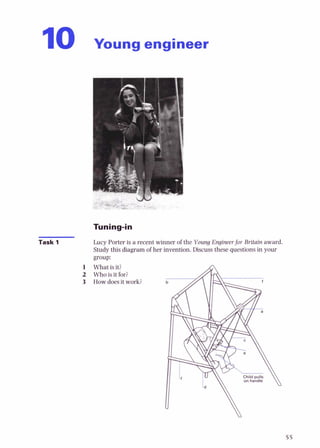
Type of attack to which alloy is
susceptible
Appearanceof corrosion
products
Surface pining, intergranular and White orgrey powder
exfoliation
Highlycorrosion resistant. Extended or Novisiblecorrosion products
repeatedcontactwith chlorinated
solvents may result in degradation ofthe
metals' structural properties
Highly susceptible to pining White powderysnow-like
mounds, andwhitespotson
surface
Surface oxidation and pitting, surface Reddish-brownoxide (rust)
and intergranular
Corrosion resistant steel Intergranularcorrosion (dueto improper Corrosionevidenced by rough
(CRES)1300-400 series) heattreatment). Sometendencv to surface; sometimes bv red,
pitting in marineenvironment (300series brown, or blackstain
more corrosion resistant than 400 series).
Stresscorrosion cracking
Nickel-basealloys
(Inconel)
Copper-basealloy,
brass, bronze
Generally has good corrosion-resistant Greenpowdery deposit
qualities. Sometimes susceptible to
pining
Surface and intergranularcorrosion Blueorblue-green powdet
deposit
Chromium (usedasa Subjectto pitting in chloride
wear-resistant platingfor environments
steels)
Chromium, beingcathodicto
steel, does notcorrode itself, but
promotes rusting of steelwhere
pitsoccurin the coating
Source: 'Data briefs:Corrosionof Materials'. Design Engineering
23 Maglev train
Task 1 Study this diagram of a Maglev train. What differencescan you note between
this and a conventional train?
Task 2 Now scan the following text quickly to check how many of the differencesyou
have noted are mentioned. Add any other differencesyou h d to your list.
LEV(magneticlevitatlonttraindoesnotr
. ..< j " g r r
, . . T . ~ ~ ~ ~ ~ .
notmdwey. Instead, magneticf* liftitabwethetrack, so
M u S e t k e y I b wuvhssts,a*les, suspension, dampers, or
5 brakes,MBB1B1v e h i c l e w ~ l ~ 8 n d
compact Theyarealso
paflution-free, as nofuelisbumedwithinthetrain, andcheapm
maintain.
TheMaglevsystemat BirminghamAirportcarriespassan- tr
theterminaltotherailwaystationanddheNationalExhCbfth
to Centre. Thecarsaremadeof ligbveightfibrdass, wriedonan
aluminiumchassis.
.y~$?g,r~F?
<
?
q
?
.
$
:
%
?
Task 3
Alltheelectricalequipmentwhich powersthe carsissituated under
the floors ortheseats. Eachcar cantake 32 passengersandtheir
luggage, upto aweight of 3tonnes.Thetrains travel at a maximum
i s speedof 42 kmh.
A concreteguidewayabovethe groundsupportsaT-shapedtrack
forthe two-car Maglevtrains. Thetrain is liftedfrom thetrack by
magneticattraction.This isthe forcebywhichtwo opposite
magneticpolesattracteachother (justastwo ofthesamepoles
20 repeleachother). Powerfulelectromagnetsat eachcorner ofthe
train exert a pullingforcewhich liftsthetrain upwardssothat it
floats 15mm abovethe track.
As peopleget on andoff, the weight of the train varies. Itmaydrop
closertothetrackthan the required 15mm, or risefurther from it.
25 To keepitat anevendistancefromthetrack, the force isvaried by a
microprocessor.
Eachtrain isdriven by an electric motorcalleda linear induction
motor. Electromagneticwindings, or coils, onthe train generatea
magneticfield inwhich the magneticpolesshift alongthe train.
u
, Thefield induceselectric current inthe track, which inturn
I
generatesitsown magneticfield. Thetwo fields inthe track andthe
train interactsothat the shiftingfield pullsthe floatingtrain along
I
the track.
ource: 'Inside out: Magnetic levitationtrain'. Education Guardian
Reading 1 inferring
Make a list of the advantages of the Maglev train. You may use the text to
-
helpyou.
Advantages
Task 4 Now list the disadvantages. You may use the text to helpyou.
Disadvantages
Now think about your lists. You will probablyfind that most of the advantages
are stated in the text. Few of the disadvantages are listed.You had to infer
them, to reason them out, from your knowledgeof the world and the
information in the text.
Not everythingwe learn froma text comesfromthe words on the page or
screen. Much of it comesfromour own head. When we read, we make mental
Links between what we read and what we already know about the topic. In
other words, we link new information and old to understand the text. Thiskind
of reading is called inferring.
Reading2 Dealing with unfamiliar words, 2
Answer this question using the extract from the text below.
Why are Maglev trains solight?
Because they have no wheels, axles,suspension,dampers,or brakes, Maglev
vehiclesarelight and compact.
In your answer, you may have used the word damper. Do you know what it
means?Doyou need to know its exact meaning?
We learnt in Unit 14that we can ignore unfamiliar wordswhich donot help
with our reading purpose. Somewords we cannotignore, but often an
approximate rather than exact meaning of a word is all that is required.
Sometimeswe can work out the approximate meaning of a word from its
context. For example,we can saythat dampers areprobably:
1 heavy (notlight)
2 large (notcompact)
3 part of the undercarriage (samesetaswheels, axles,suspension, and
brakes)
Task 5 Try to work out the approximate meaning of any of the words printed in bold
in this text whose meaning you do not already know. Check your answers
with a dictionary.
When 6rst introduced, linear motors were seen as a major technological
breakthrough.However,disappointinglyfew practical applicationshave
been found forthis new develovment.An earlier innovation,the Wankel
engine, was radicallydifferentfrom conventional engines, having a rotary
piston and no valves. Wankel engines were adoptedby the Mazda car
company. However,Wankel engines are now rarely used because of problems
with fuel consumption and maintenance. The Wankel story illustrates the
risksinvolvedin developing any new product -successcan mean a market
leadover competitorsbut failuremeans that expensivedevelopmentcosts
must bewritten &with no result. Sadly,technologicalsuperiority doesnot
guaranteesuccess. Betamax video tapes, technicallybetter than their rivals.
gaveway to VHSbecause of better marketing.
Languagestudy Prediction
Studythis diagram. What will be the result of this action?
Action
Twomagnets are held together with
oppositepoles facing.
Result
When an action is alwaysfollowed by the sameresult, we can link them like
this:
IflWhen two magnetsare held together with oppositepoles facing, they attract
eachother.
IflWhen two magnets are held together with oppositepolesfacing. they will
attract eachother.
When an action is always followedby the sameresult, the statement becomesa
generalprinciple or law. (SeeUnit 15.)Using the law, we can predict what will
happen in particular cases.
Predictthe result of the action illustrated here.
Result
Action
Two magnets are held together with
like poles facing.
Now write the principle illustrated.
If two magnets
Task 6 Predict the results of each of these actions. Then Link each action and result in
a sentence.
Action Result
1 A steelbar is subjected to tensile forces. The bar
F 4
-
1
-
F
We apply an effortat E.
3 The switch is closed.
4 The switch is pressed.
3 We move the effort by one metre.
b We move the effort by 50 centimetres.
VR=2
7 The circuit is broken.
8 120V ac is applied across the primary.
l 0 : l
Y We apply an impact load to a
brittle body.
The block
The load
10 We apply 24 V ac to the transformer
primary.
Writing Explanations
Studythis diagram. It showshow a Maglev train is supported without physical
contact with the track. Can you explain how this works?
Levitationmagnet Levitation force
t
Vehicle weight doznwards on magnet
The explanation consistsof a seriesof at least six steps.The first stepis:
1 Current flowsthrough the magnet coil.
The last stepis:
6 The train is lifted.
Canyou think of any of the stepsin between?
Explanationsconsistof a seriesof steps.Somestepsin anexplanation have
cause and effect links: others have time links. Here are someof the stepswhich
explain how the train is lifted.What kinds of links are there between the stages?
1 Currentflowsthrough the magnet coil.
2 The current creates a magnetic field round the poles.
3 The fieldinduces a current in the track.
4 The track becomes magnetized.
5 The two magnets attract each other.
6 The train is lifted.
You can show time linksusing the structures you studied in Unit 8.You can
show cause and effect linksusing the structures studied in Units 16,17,and
22, and in these ways:
1+2 Currentflowsthrough the magnet coil,creating a magneticfieldround
thepoles.
3+4 Thefieldinducesa current in the track;therefore the track becomes
magnetized.
5+6 The two magnetsattract each other,(therebu)lifting the train.
Thereby can be omitted from the last example.
Study these diagrams. They explain how the propulsion system operates.
Task 8
Try to completethe blanks in this set of stepswhich form an explanation of the
propulsion system.
Current through the motor coils.
The current creates fieldsin the motor.
The fields currentsin the track.
The track becomes
The current through the linear motor ischanged.
The magnetic in the motors shift.
There is and repulsion between the new motor fields and the
track fields.
The motor pulls the train along the to lieup the fields.
The through the coils changes and the process is repeated.
Divide the steps into two sets and form each set into one paragraph. Show the
links between the steps using whichever method you think appropriate.
Technical reading Motor selection: operating environment
Task 9 What special features would you expect to see specified when rotary motors
are being purchased to operate in the followingsituations?
1 In a workshop housing a wood planer.
2 In a boiler house which is regularly hosed down.
3 In a sewagepump house where the presence of methane gas can be expected.
4 To drive a centre lathe used for turning cast-iron components.
Read the text on the followingpagesto checkyour predictions.
Nhenchoosingadrive motorfor aparticularapplication, the
. .
iollowing pointsmustbeconsidered:
.~
1 Startingtoque
2 Startingcurrent limitation
5 3 Drivespeed
4 Operatingenvironment
5 Ratingandduty cycle
Wewill considerherethe operatingenvironment.Attention must
begivento the problemof providingsufficientcooling mediumto
lo carryawaythe heatfrom the windings butatthe sametime not
allowingthat mediumto carry intothe motor anything which will
harm itor blockupthe cooling ducts. Particularlyharmful areoil
vapour, carbon, andcast irondust.Where machinesmaygetwet,
for exampleonaship's deck, moisture ingressmust beprevented
15 or suitable insulationemployed.
0
Fins
&
TEFC motor
Drip-proof motor
Screen protectedmotor protectedagainst large solid particles
Motor with secondarycoolingsystem protectionagainst
moat solid materialand splashingwater
Fig. I
Probablythe mostcommonly found machineisthe rotally-
enclosed, fan-cooledmotor (TEFC).The motorwinding istotally
enclosedinthe motor housingwhich is usually ribbed onthe
outside. Afan is mounted onthe shaftexternalto the housingand
1 isprotectedby ashield. Thisfan blows air over the casing
removing heatfrom the motor. Inlargersizes, there is also afan
insidethe casing blowingair overthe windingstransferring heatto
the casing.
Where motorsare requiredto operate in explosivesituations, the
motor must beof flame-proof construction.This meansthat it must
be enclosedinsucha mannerthat any explosionwhich may occur
withinthe motor must becontainedwithin the motor. Often it is
easierto preventexplosivegases enteringthe motor. Ventilated
motors are usedwhich draw air from an uncontaminatedarea. Th~s
) is pumpedintothe motorwhichkeeps its internal pressureabove
that of itssurroundings.
Fig. 1illustratesavariety of protectedmotors.
Source:Adaptedfrom D.W.Tyler, ElectricalApplications
24 Computer Aided Design
Fig. 1
Task 1 Study the example of Computer Aided Design in Fig. 1.Answer these
questions about the diagram.
1 What structure does it show?
2 Apart from the design, what other information does the drawing provide?
3 What do you think the top row of words are f o r File, Edit. Constrain, etc..;
Listening
Task 2 You are going to listen to an interview with a designer of car engines. He
describes some of the advantages of CAD over traditional approaches to design
-for example, drawing and modelling. Before you listen, list any advantages
you think CAD has over these traditional approaches.
Task 3 Study the following extract from the tapescript of the interview. It covers the
interviewer's first question and answer. Fill in the gaps before you listen. One
word is missing from each gap. Then listen to this part of the interview to
check your answers.
Interviewer: What do you like about designingon computer?
Designer: The fact that you ' get into three dimensions
immediately.You don't ' to imagine how a
component will from two-dimensionaldrawings.
You can put your thoughts into the solid without
to go via paper. You can see,in the mind's 5
exactlyhow the components fit together or fit,
and you can modify,replace, and generally tailor parts very
quickly as ideas ' to you.
Task 4 B Now listen to the tape and list any advantages of CAD. Combineyour answers
with others in your group to make as full an answer as possible. When you
have finished,compare your answers with the list you made in Task 2.
Task 5 a Work in pairs, A and B. Listen to the whole tape again.
StudentA: Note any disadvantages of drawing in the table below.
StudentB: Note any disadvantages of modellingin the table below.
Now compare notes to completeboth sectionsof the table.
Disadvantages:
Drawing Modelling
Task 6 The designer mentions these components of a design cycle. Put them in the
correct sequence.
study results, modify design, stressanalyse,design,stressanalyse
Languagestudy Necessity:have to and need (to)
Study these examplesfrom the interview.
1 Youdon't have toimagine how acomponent will lookfrom two
dimensionaldrawings.
2 ...at the end ofthe day modelshave tobeconverted back intodrawingsfor
manufacture.
3 Normally oneneeds togo round the circle at leastfour times.
4 WithCAD,you need not describesuch afeature more than once.
Have to and need (to)can both be used to express necessity. In this sense,they
are similarto must. Must is a modal auxiliary verb and has no other forms,
whereas have to and need (to)have the samerange of formsas other verbs.
The table opposite shows ways of expressingnecessityand no necessity in the
present.
+necessity -necessity
have to do not have to
need to need not or do not need to
must -
Fill in the blanks in these sentences with appropriate forms of the verbs in the
table above.
1 Designerswho work with CAD produce drawingson paper.
2 The production planner can use the computer model to calculate what
machining be done.
3 One problem in working with wood or claymodelsis that they be
converted into drawingsfor manufacture.
4 With traditional design,you imagine a three-dimensional shape
from a two-dimensionaldrawing.
5 With CAD,designerscan put their ideasinto solid shapes without
use paper.
6 In engineering drawing repeated features be drawn again each
time but with CADthey be redrawn.
7 Making cars lighter mean making them flimsier or less safe.
How do you see
the car of the future?
(Think carefully.)
Task 1 Study the following recent Vokswagen survey on the car of the future.Decide
in your group which developments in the survey are important to you. One
person should report the group'sviews to the rest of the class.
What changes would you like to see?
We've suggested afew possible developments. Pleasethink
carefully about which ones would make a real difference to you and
tick the boxesto let us know.
Design
The opportunity to use alternative fuel sources like hybrid
(petroland diesel) or hydrogen power.
A car that is an office away from work, with facilities such as a
fax machine and video-conferencing.
Safety
Speed limitersthat vary to give you the safest possible drive f o ~
the weather and road conditions.
Acomputer sensorto tell you ifyou're driving at a safe distance
from thevehicle infront.
Automatic engine and fuel supply cut-out inthe unfortunate
event of an accident.
All-round airbags.
Engineimmobilizer which makes itvirtually impossiblefor
anyoneelseto drive your car away.
A tracking devicewhich allowsthe car to be locatedfast if it is
stolen.
Audio systemsbuilt intothe chassisor engine of the vehicleto
preventtheft.
Performance
Sportscar performancecombinedwith fuel economy.
Acomputerized routefinder which tells you the quickestway to
get to your destination.
Servicingby mobile unitsto save lengthyvisitsto agarage.
Source:V.A.G. (UK)Ltd
Task 2 What do you think will be different about cars in the next ten years?Think
about the followingpoints. Compare your ideas with other groups.
- materials
- design
- power
- fuel
Task 3 Read this title and introduction to a text. Try to guess the answers to the
questions which foll--7
if*:.$,.*^ 2 . .
'....
Supercartestfor
Matthew L.Watd on the technicalissuesthe President's
environmentally-friendly carfaces ...
1 Who is the President?
2 Who is Matthew L. Wald?
3 How can a car be environmentally-friendly?
4 Why might a car be called a Supercar?
5 What test does industry face?
Now read the first paragraph of the text. Does it help you to answer the
questions?
The 10-yearco-operativeproject betweengovernmentand Detroit
for an environmentally-correct supercarwill requireradicallynew
technologiesfor solving the car industry's problems: air pollution,
over-relianceon imported oil, and lossof marketshareto imports.
Reading Predicting: usingfirst sentences
In earlier units we studiedhow reading the title and using diagrams can help
you predictthe contents of a text. As we saw above,reading the firstparagraph
can alsobe very helpful.
Afinalway to get a good idea of the contents of a text isto read the first
sentenceof each of the otherparagraphs.
Task 4 Read these first sentences: then note down what you think the main points of
the text are.
1 Somesay it cannot be done but others say various components could be pulled
together to do thejob: electricmotors with batteries, fuel cells or flywheels to
deliverelectricity,plus lightweight, aerodynamic car bodies.
2 Instead of steel,someother type of material would be necessary for the
'supercar' body, somekind of compositeor carbon fibre.
3 Safetyisanother issuebut lighter need not mean flimsier.
4 Reducingbody weight and wind resistance will make any car more efficient.
5 Electronicscan,however.
6 Four possiblepower sources are being investigated.
7 Another possibility is fuel cells,which combineoxygenfrom air with hydrogen
to make electricity.
8 Yet another approach would be a flywheel, an electricalgenerator consistingof
free-spinningwheelswith magnets in the rims that can produce a current.
9 Afourth possiblepower source for the national supercar would be a small
turbine engine,running on a clean fuel like natural gas.
Task 5 Read one of the followingtexts as your teacher directs:A, B.C, or D. Note in
this table any information you find on solutions to the problems of designing
the Supercar.
Text
A Materials
B Shape
C Power
D Power source
Solution Reason@)
Problem
Now share your information with others in your group to complete the table.
TextA
Some say itcannot bedone butotherssay variouscomponents
couldbe pulledtogetherto dothejob: electric motorswith
batteries,fuel cells orflywheelsto deliverelectricity, plus
lightweight,aerodynamiccar bodies. t
Insteadof steel, someothertype of materialwouldbenecessary
for the 'supercar' body, some kind of compositeor carbonfibre.
Such materialsare availablenow, butare notconsideredcost
competitive with steel. Buta researchcentrein Coloradoclaims
I
that compositescan 'emerge from the mouldvirtually readyto
to use'. The resultwould befewer partsand lesslabourthan current
car bodyconstruction and, therefore, lesscost.
Safetyisanotherissuebut lighter neednot meanflimsier. The
centrepointsto lndy 500drive
rext B
*,dynamic drag accountsfor moreand moreof the energy
I
requ~red
to movethe car as speed rises. The car makersalready
know howto cut dragsharply. GeneralMotors' lmpacthasabout
halfthe drag of atypical car. The lmpacthas a roundedfront anda
5 taperedback. Itisalso smallto presentless othe
...:-A
*.*,%,T
Reducingbodyweight andwind resistancewill makeany car more
efficient. But roughly equalto the wind in eating upthe car's energy
isbraking, and internal combustionenginescannot do muchabout
that.
5 Electronicscan, however. Nearlyall electricdesigns use
regenerativebraking.Whenthe driver hitsthe brakethe motors
becomegenerators,convertingthe mechanicalenergyof the
slowingwheals intoelectricity.That capability virtually guarantees
that asuper-efficientcar will havean electric motor.
Text D
L
Fourpossiblepowersourcesare being investigated.The simple
one isbatteries. But if asuper-efficientcar isto havean attractive -
cruising range, itcannotcarry hundredsof pounds in batteries.
Another possibility isfuel cells, which combineoxygenfrom air
5 with hydrogento makeelectricity. Butcurrent fuel cellsoperate
steadily, and acar cell would haveto handlewidely varying
demandfor energy: zero, while stoppedattraffic lights, or several
timesthat consumedby an average house, while accelerating.
Yet anotherapproachwould beaflywheel, anelectricalgenerator
consistingof free-spinningwheelswith magnets inthe rimsthat
can produceacurrent. An early applicationofflywheels might bein
a racecar builtfor atwistingcourse, wherefrequent brakingmeans
highfuel consumption inconventionalcars.
-Afourth possiblepowersourceforthe nationalsupercarwould be I
=a smallturbine engine, runningon acleanfuel like naturalgas. It I
Task 6 Readthe whole text yourself. How much did the first paragraphand the first
sentences of the other paragraphshelpyou to predict the main pointsof the
whole text?Which first sentences were not very helpful?Why not?
Language study Certainty
Study these statements. What is the differencebetween them?Can you put
them in order of certainty:
1 A supercar will have an electric motor.
2 A supercar might have ajlywheel.
3 It is likely that asupercar will have a roundedfront.
The differencebetween the statements is how certain the writer is about each
development.Study this list of certainty expressions.
Certain Fairly certain Uncertain
Yes will will probably might
be +likely +vb may
be +probable that could
will possibly
be +unlikely to +vb be possible that
No will not
Task 7 Comment on how likely these predictions are for the next decade, using an
appropriate expression from the table above. For example:
1 A human powered vehicle (hpv)will exceed 100kmjh.
It ispossible that an hpv willexceed 100 kmlh.
2 Aperpetual motion machine will be invented.
Apcrpetual motion machine will not he invented.
3 More factories will be fully automated.
It is likely that morefactories will befully auton~atpd
4 Driverlesstrains will link major cities.
Driverless trains might link major cities.
1 Electric cars will become common.
2 Most bicycles will have carbon fibreframes.
3 A more efficientpetrol engine will be developed.
4 More people will travel by public transport.
5 Robots will be used in homes.
6 Fewer engineerswill be required.
7 Diesel engines will replace petrol engines for cars.
8 Most waste materials will be recycled.
9 An ideal electric motor will be invented.
10 Physicists will reach absolute zero (-273'C).
Study these statements. Why is will used in the tirst sentence and wouldin the
second?
1 A supercarwill have an electricmotor.
2 Apossiblepower source would beu turbineengine
In sentence 1the writer feelscertain this will happen. In sentence 2 the writer
feelsthis is only a possibility because it depends on circumstances.
We use would to describe futureevents which can only happen if certain
conditions are met. Study these examples from the text.
Another approach would be a flywheel. ( y asupercar were built.)
The result would be fewer parts and less labour. (Ifmouldedcomposites were
used.)
Task 8 What would happen if these conditions were met?
1 If all cars were made of plastic- -.
2 If all cars had dieselengines -
3 If powerful,lightweight batteries were developed -
4 If all cars were fitted with flywheels
5 If speedlimits were reduced
Task 9 What conditions are necessary for these events to happen?
1 All car parts would be recyclable.
2 Carswould travel 40 km/litre of fuel.
3 Carswould costmuch less to produce.
4 Cars would not require painting.
5 Carswould not require lubricants.
Writing Summaries
Thebest way to make a summary of a text is to write down the main points in
note form and then Link them clearly in your own words. If you are
summarizing for others, make sureyou do not over-summarize,that is, reduce
the text to the point that no one but you can understand what it means.
Task 10 Study these notes which summarize the Supercar text.
Text
A Materials
B Shape
C Power
D Powersource
Solution Reason@)
Composite,carbon fibre fewer parts, less labour
rounded front, tapered back, small reduce drag
electric motor allowsregenerative braking
Problem
1 batteries weight
2 fuel cells cannot cope with varying demand
3 fly wheel -
4 gas turbine with generator -
Now convert each sectionof the notes into one or two sentences. Use the
certainty expressionsyou studied in this unit. For example:
The Supercarwill havean electricmotor because onlyelectricmotorsallow
regenerative braking.
Ifyou think that your reader will not understand particular terms, definethem.
For example:
TheSupercarwill have an electricmotor becauseonly electricmotorsallow
regenerative braking, that is,converting brakingpowerback intoelectricalenergy.
Finally,link your sentences into paragraphs. You will need at least two.
- materials, shape, and power - possible power sources
You will alsoneed to add a brief introductory paragraph stating the objectives
of the Supercar project.
26 Graphs
In engineering, graphs and charts are a common way of givinginformation.
They allowa great deal of data to be presented easily in visual form.
Task 1 Label the following graphic displays with the correct term from this list:
graph pie chart
bar chart bar chart (columnchart)
Female students as a
percentage of all students
En ineering All courses
teclno~ogy
What goes wrong most
@ washing machines
@
I
-
9
-
d-
c
l
e
a
n
e
r
s
@ tumble-driers Repairs in the
first four years
@fridge-freezers $:E2isl
CBchestfreezers
I I I I I I I I
0 2000 4000 6000
Engine speed (rpml
0z g h t freezers
Task 2 Study the graph opposite which shows typical daily load curves for a power
station. Answer these questions about the graph for weekdays.
1 When is the peak load?
2 When is there least demand?
3 When is the load 65%of capacity?
4 What is the load at 1p.m.?
Fig. 1
"
,100
90-
%
-0 80-
P
g 7 0 -
0
2 60-
m
50
40-
30-
-
E 2 0 -
0
10-
0
O O
Describechanges in load for these periods:
J
& 4
Typical daily load curves far a .
power station. The load is
recorded in hourly steps.
1 " " " "
5 Between 6 a.m. and 10a.m.
6 Between 7 p.m. and midnight.
7 Between 3 p.m. and 5 p.m.
M 2 4 6 8 1 0 N 2 4 6 8 1 0 M
am
Time
pm
Language study Describing graphs
Look at the period 6 a.m. to 10a.m. We can describethe change in load in two
ways:
1 The load rises.
2 Thereis a rise in load.
We can make our descriptionmore accurate like this:
3 The load rises sharply.
4 Thereis a sharprise in load
Studythis table of verbs and related nouns of change. Thepast form of irregular
verbs is given in brackets.
Direction Verb
UP climb
go up (wentup)
increase
rise (rose)
Down
Level
decline
decrease
dip
drop
fall (fell)
go down (wentdown)
not change
remain constant
Noun
increase
rise
decline
decrease
dip
drop
fall
no change
These adjectives and adverbs are used to describe the rate of change:
Adjective Adverb
slight slightly
gradual gradually
steady steadily
steep steeply
sharp sharply
sudden suddenly
fast fast
Task 3 Study this graph which shows the load at weekends.
Typical daily load curvesfor a
power station. The load is
0
80 recorded in hourly steps.
Task 4
!5:1,,, , , , , , , , 1
0
0
M 2 4 6 8 1 0 N Z 4 6 8 1 0 M
am
Tme pm
Fig.2
Write sentencesto describe the load during these periods.
Saturday. 8 a.m. to noon.
Saturday. 6 p.m. to 10p.m.
Saturday. noon to 5 p.m.
Saturday, noon to 1p.m.
Sunday. 2 a.m.to 8 a.m.
Sunday, 8 a.m.to 9 a.m.
Sunday, noon to 3 p.m.
Sunday, 5 p.m. to 10p.m.
Look at Fig. 1and Fig. 2. Make comparisons of these periods. For example:
Sunday. 4 a.m.to 8 a.m./weekdays at the sametime.
OnSunday the load remains ronstant between 4 a.m. and 8 a.m. but on
weekdays it rises sharply.
Sunday, noon to 3 p.m./Saturday at the sametime.
Weekdays. 10p.m. to 11p.m./Saturday at the sametime.
Saturday peak IoadJSundaypeak load.
Sunday,noon to 1p.m./the rest of the week at the same time.
Word study Common verbs in engineering
Study this list of common verbs in engineering which you have studiedin this
book. They allhave the senseof 'make something happen'.
lower make low
raise make high
heat make hot
release make free
compress make smallervolume
reduce make smaller
increase make larger
Task 5 Fill in the blanks in these sentences with suitable verbs from the list above.
1 When thermoplastics are .they soften.
2 Ifa gasis .it heats up.
3 Refrigerationpreservesfood by - . its temperaturr.
4 A heater . the temperature of the water.
5 The rising piston the fuel mixture.
6 Designers try to the weight of a structure.
7 When the push button is ,the valve spring pushes up the spool.
8 Pumping fluid into the main cylinder gradually the jack.
9 Aerodynamicdesign . wind resistance.
10 The motor starts up slowly,then gradually speed.
11 At intermediate substations,power is to 11kV for light industry.
12 When the child the handle. the seat swingsback under the
weight.
Writing Describing a graph
An important mechanical test of a metal is the tensiletest to destruction.
Increasing loads are appliedto a specimenof the metal until it breaks. For a
mild steelspecimen,a graph of load against extension looks like this:
Task 6
Task 7
a
b
C
d
e
Task 8
The following sentences describe the most important stages of the test. With
the help of the graph:
- put the stagesin the correct sequence to form a text describingthe graph.
- fillin the missing references(0.P. E, Y. U. F)
F r o m - to the specimenextends in direct proportion to the load
applied.
Thisrapid extension continues until point ,the maximum load,is
reached.
From there is a rapid increase in length foreach increase in load.
A t the specimen finallyfractures.
A f t e r - the specimenlengthens further but the load falls.
Soonafter P the material reaches its elasticlimit,marked on the graph as point
Add this extra information to your text.
Up to the elasticlimit,the steelwill regain its original length when the load is
removed.
Up to U there is no change in the cross-sectionof the steel.
After the elasticlimit,the steelwill not regain its original length.
After U the specimen undergoes 'waisting'.
Y is the yield point.
Refer to each of these figures at an appropriate place in your text. Use
expressionssuch as these:
As shown in Figure A.
See Figure A.
(Figure A)
Technical reading Properties and applications of carbon steels
Task 9 Study the diagram below which shows how tensile strength, hardness. and
ductility vary with the percentage of carbon in carbon steels.Answer these
questions:
1 What percentageof carbon givesthe greatesttensilestrength?
2 What happens to ductilitybetween0.08%and 0.87%carbon?
3 How doesincreased carbon atYecthardness?
4 What isthe effecton tensilestrength of increasingcarbon beyond 0.84%?
5 What happens to ductility beyond 0.87%carbon?
/
/
0.08 0.15 0.35 0.55 0.85 1.05 1.20
%Carbon
Propertiesof carbon steels
Task 10 Now study the diagram below for extra information and answer these
questions.
1 What ishigh carbon steel?
2 How much carbon doestool steelcontain?
3 Comparethe properties of mild steeland hard steel.
4 What kind of steelistin plate made from?
5 What kind of steelarecar springsmade from?
0.08 0.15 0.35 0.55 0.85 1.05 1.20
%Carbon
Propertierand applicationsof carbon steels
27 waste recycling plant
Aluminium can recycling. The bales seen here contain over one million cans.
Task 1 You are going to read a text on recycling domesticrefuse. The main
components of refuse are given in the list below. Using your knowledge of
engineering, discuss in your group how one of these components could be
recovered from refuse and what use could be made of the materials recovered.
Your teacher will decide which component each group will discuss.
Ferrous metals Glass Plastics
Paper Organic materials Non-ferrous metals
Task 2 Now report your solutions to the rest of the class. Be prepared to answer
questions and defend your ideas.
Task 3 Readthe text below to see how the solutions proposedby your class compare
with those usedin the experimental plant described.
Recyclingdomestic refuse
The consumer society producesmoreand more refuse.A number
of solutionstothis problem havebeenproposed. Insomecountries
refuseisburntto generateelectricpower. InGermany, producers
musttake back unwantedpackagingfor recycling. Inother
5 countries, householdersare askedto separateout refusesothat it
can be recycledmoreeasily.Thistext describesan experimental
plant in Hollanddesignedto recycledomesticrefuse.
The rubbishcollectedfrom householdsconsistsof a mixtureof
organic materialssuch as kitchenwaste, and inorganic materials
lo such asglassandplasticbottles, tin cans, andpackaging.
The rubbish isfirst passedthrough a hammermillto shreditThe
millconsistsof rotating steelarmswhich break upany large items
to reducethem to amore manageablesize. Any itemswhich may
causedamage later inthe processare rejectedat this stage.
15 The shreddedmixture passesunderan electromagnetwhich
removesferrous metals. Muchofthis istin cans. Almost allferrous
metalsare recoveredinthisway.
After that, the residue iscarriedbyconveyorbeltto anair classifier.
Astream of air isblownthroughtheclassifier, which hasazig-zag
zo shape. Lowdensity materialssuch as plastic, paper, and some
organic substances riseto the top of the classifier. Higher density
materialssuch as glass and non-ferrousmetalsfall to the bottom
andare discarded.Thesecould befurther separatedout using a
rangeof processes. Forexample, aneddy current mechanism
25 couldscreenout aluminium waste. Frothflotationtechniques
could recoverglass.
The lowdensity portion iscarriedto a rotating drumwhere it is
screeiied. Fineorganic materialspassthroughthe screenleavinga
mixturewhich consists mainlyof plasticandpaper. Theorganic
30 residuecan be usedfor compostor to makebricks.
The nextstage isto separatethe plasticfrom the paper.Thiswas
initially a problem as bothare similar in density.Thesolution isto
wet the mixture. The paperabsorbswater and as a result becomes
denserthan the plastic.
35 Inthefinal stage, thewetted mixture ispassedthrough asecond
air-classifierwherethe lighter plasticleavesfrom the top andthe
denserwet paperfromthe bottom. The recoveredpapercould b
fed to pulp millsfor further recycling.
The remaining plasticisa mixture of thermosetsand
40 thermoplastics.Itis noteasyto separatetheseout butthe mixtutu
can be meltedandformed intoinsulating materialsfor building.
Reading Transferring information, making notes
Plastic
I -
miflure
-
i Air classifier - h
- Water sprays
I
3
e
- I
Task 4 Using the information in the text, completethe labellingof the flowchart. Add
these labels:
plastic and paper mixture air classifier
high density materials rotating drum
shreddedmixture ferrousmetals
paper wetted mixture
fineorganicmaterials
I f
Task 5 Study these notes on the first stage of the recycling process. They contain
information on location (Where?),action (What happens?),reason (Why?),and
method (How?).Read the text again to complete the notes for the other stages.
Stage 1
Hammer mill
Where? hammer mill
What happens? the waste is shredded
a
-
-
Why?
b
to reduce it to a manageable size
Electromagnet
Low
r. density
materials
How? using rotating steelarms to break up any largeitems
Stage2
Where?
What happens?
How? by magnetism
Stage3
Residue
. :
Where?
What happens? high and low density materials are separated
How? by a current of air which carries low density materials to
the top while high density materials fall to the bottom
- -
C -
Stage 4
Where?
What happens?
Why?
Stage 5
What happens?
Why?
Stage 6
Where?
What happens?
How?
the low densityportion is screened
to give the paper and plasticdifferentdensities
-
by a current of air which carries low density plastic to the
top while wet paper fallsto the bottom
Languagestudy Possibility: can and could
Answer these questions about the text.
1 Does this plant screen out aluminium waste?
2 Does it recover glass?
3 Is recoveredpaper fed to pulp mills?
4 Is recoveredplastic melted and formedinto insulating blocks?
5 Is organicresidue used for compost and bricks?
The answer to questions 1.2,and 3 is No. The answer to questions 4 and 5 is
YeslMaybe. How do we know?Look at the text.
1 An eddy current mechanismcould screen out aluminium waste.
2 Frothflotation techniques could recoverglass.
3 The recovered paper could befed topulp millsforfurther recycling.
4 The mixture can be melted andformed into insulating materialsfor
building.
5 The organic residuecan be usedfor compost or to make bricks.
We use could in examples 1.2,and 3 to show that something is possiblebut is
not in fact done. The reasons why nothing is done in these examplesmay be
expenseor lackof demand. We do not know.
We use can in examples4 and 5 to show that something is possible and may in
fact be done.
Task 6 Fill in the gaps in this text with either can or could. Be prepared to justify your
answers.
1 With present technology we recycle almost all domesticrefuse.
But in practice market forcesdetermine what is worth recycling.
2 Successfulplants in a number of countries show that refuse b
c
used as a fuel in power stations.
3 If we recycled most of our refuse,the increasing problem of waste disposal
be solved.
4 Sweaters be produced from old plastic bottles. A company in the
United Statesconverts the waste plastic into polyester yarn. It takes twenty-five
two-litrebottles to make a sweater.
5 At present we not easilyseparatethermosettingplastics from
thermoplastics.
Writing Describing aprocess. 4:reason and method
In Units 13and 15we learnt how to sequence and locate the stagesin a
process. In this unit we will study ways to describe and explain what happens
in each stage.
Look again at the notes on Stage 1.
Stage 1
Where?
What happens?
hammer mill
the waste is shredded
Why? to reduce it to a manageable size
How; using rotating steelarms to break up any largeitems
Note how we can combineinformation on sequence,location, process, reason.
and method. For example:
Sequence+location
The wastefirst passes toa hammer mill
+action
The wastefirstpasses toa hammer mill, whereiti s shredded
+reason
The wastefirstpasses toahammer mill, where it is shredded to reduce i t toa
manageable size
The wastefirstpasses toahammer mill,where it is shredded to reduce it to a
manageablesize using rotating steel arms tobreak up any large items.
Task 7 Combine information on the other stages in the same way to make a full
description of the recycling process. Note that you can help your reader
understand the sequence by carrying information from one stage to the next.
For example:
Stage 1 The waste is shredded.
Stage 2 Theshredded waste ...
Stage 5 The~nixture
is wetted.
Stage 6 Thewetted mixture ...
28 Robotics
Tuning-in
Task 1 Together, try to write a definition of a robot. Compare your answer with the
definition of an industrial robot given on page 36 of the Answer Book.
Reading 1 Revising skills
In the tasks which follow,we will revise some of the reading skillsyou have
studied.
Task 2 Study this diagram which shows the components of an industrial robot. What
do you think the functions of the three components shown are?
Computer with
appropriate 1e.g. eornpressorl
industrial interface
Fig. 7 Thecomponentsofanindustrialrobot
Task 3 Now read this text to check your ---.'rers to Tasl
.,, ,. .
The manipulator , ,
, ..
. .
This isthe bit which actuallydoesthe mechanicalwork, and inthis
case it isanthropomorphic ii.e. of human-like form),resemblingan
5 compressor.I"smaller, lightweight versionswhich useelectrical
stepper motors ratherthan hydraulicsor pneumatics,this would be I
omitted. 1
The computer
Thecontrolling computer isfined with appropriateinterfaces.
Thesemay includedigital inputs, digital outputs, ADCs (analogue-
l o to-digitalconverters), DACs(digital-to-analogueconverters),or
stepper motorcontrol ports.Thesecontrolthe various
compressors, stepper motors, andsolenoids, andreceivesignal,
I
fromthe manipulator's sensors.
. -- I
Task 4 Read the following text to find the answersto these questions.
1 What is the work volumeof amanipulator?
2 What is the work volumeof ahuman?
3 Why is the work volumeof ahumangreaterthanthat of anindustrialrobot?
4 What aredegreesof fre-Jn~2
-
Work volume
Robotsare multifuncti
manipulator is its'work volume': the volume ofspace intowhich it
can be positioned. The greaterthe workvolume, the more
extensivethe rangeof tasks itcan be programmedto carryout.
5 As a humanbeing, your work volume consistsof allthe placesyour
handscan reach. Mostindustrial robotshavea muchmore limited
work volume becausethey areboltedto the floor. Evenwith the
same limitation applied, however, the humanbodyisavery
flexible machinewith aworkvolume described-verv
ro approximately-byacylinder about 2.2 m highwith aradiusof
about 1.8 m and adomedtop.
-
o
f
-
Inorderto achieveflexibility of motionwithin athree-dimensional
space, a robot manipulator needsto beableto move inat least
three dimensions.Thetechnicaljargon isthat itrequiresat least
15 three 'degrees of freedom'. Figs. 2a-d show a numberof the more
commontypesof robot manipulator mechanisms. Eachhasthe
requisitethree degreesof freedom, allowingeither linear or
Reading2 Transferringinformation
Task 5 Study the text and accompanyingdiagram (Fig. 2a) below and note how the
information has beentransferred to Table 1
.
Fig. Type Degreeso ffreedom Work volume
- linear rotational
2a Cartesianor rectilinear 3 0 cube
Table 1
Commontypes of manipulator
Fig. 2a isthe simplest. Itsthree degreesof freedomare all linear
andat rightanglestoeacholher, sothey correspondto thethree
Cartesianco-ordinates. Drivingitpresentsno mathematical
difficulties, sinceeachdegreeoffreedom controls asingle
5 Cartesianco-ordinatewithout affectingthe others. Fairlyobviously,
thework volume ofthe Cartesianmanipulator isacube.
.
. .
.
-. .
,. .. .
.
..."
Task 6 Work in groups of three. Your teacher will select a text for you. Readthe text
and diagram to completeyour section of Table 1.
Text 1
Thesecondtypa of manipulator, shown inFig. ro, IS calleo a
cylindrical manipulator becauseofthe shape of itswork volume. It
hasone rotationalandtwo lineardegreesoffreedom. Becauseof
the rotational aspect, however,the maths neededto position it
becomesmoreinv agiven response
ed
%
"
* e a n % w - P - + x - . I
Text2
ere, and onceagainthecomplexity of positioningthe device
T a t 3
Thefinal type of manipulator hasthree rotationaldegreesof
freedom. This isthe mostcomplextype to control, but it has
increasedflexibilitv. Fia.2dshowsthistvve of manivulator-the
anthropomorphicarm.~he work volume'of a practicalmanipulator
i of this form isshown inFig.3. You will noticethat it is basically
sphericalbut hasmissing portions dueto the presenceof the arm
itself and becausethe rotationscannot achieveafull 360degrees.
The scallopson the innersurface arecausedbvconstraints
imposedbythejoints.
1%
-
p~
Task 7 Now exchange information with the others in your group to complete the
table.
Task 8 Complete the blanks in this text.
Mechanicalwrist
It is worth pointing ' that a human arm has far more freedom
2
the minimum three degreesof freedom,givingvery great
3
flexibilityin terms - positioning,path taken, and angle of
approach. Even without a wrist, the redundant degreesof freedomof the
4
-body would allow you to carry out most normal operations. Any
of the basic manipulators shown ' Figs. 2 a-d. on the other
6
,would be virtually useless as they stand. Although they could
get to any position,they ' only approach objectsfrom a single
angle.
To take an ,removing a screwwould be impossible
the manipulator could not align a screwdriverto fitthe screwproperly. Even if
it was ableto, it stillwould lo be possibleto carry out the necessarv
rotating action.
A wrist is thereforeaddedto most basic manipulatorsto 'l the
requiredmechanicalflexibilityto l2 realjobs. In general,for total
flexibilitythe wrist itself requires three degreesof freedom,thereby bringing the
grand total up to six. The l 3 common type of wrist has two bending
and one rotational degreesof freedom. Pig. 4 showsthis type of mechanical
wrist.
Fig. 4 A typicalmechanicalwrist
Languagestudy Concession:even if and although
We can use if(see Unit 11)to link two statementslikethis:
1 Theswitchis on.
2 The lamplights.
uthe switch ison, thelamplights.
When statement 1is true, statement 2 is also true.
When statement 1surprisinglyhas no effecton statement 2, we can use even ij
or although.For example:
m
1 The switchis on.
2 The lampdoesnot light.
Evenifthe switch is on,thelampdoesnot light.
Although the switch is on, thelampdoesnot light.
Task 9 A car is fitted with a seat belt warning Light. The light operates under these
conditions:
Seatoccupied Ignition Belt Light
Yes On Closed Off
Yes On Open On
Yes Off Closed Off
No Off Closed Off
Studytheseexamplesof normal and faultyoperation:
Normal
I
f the seat is occupied, the ignition onand the belt closed, the light is oh.
Faulty
Evenifthe belt is closed, the light stays on.
Although the belt is closed, the light stays on.
Giveother examplesof normal and faultyoperationof this circuit.
Technical reading Stepper motors
Task 10 Read the text which followsto 6nd the answers to these questions,then
complete the table.
1 Why wouldyou use a steppermotor to position the head of a disk drive unit?
2 Name two componentsthat are present in other electricmotor typesbut absent
from steppermotors.
3 For accuracyin positioning,would you selecta stepper motor with a largeor a
small stepangle?
Type Advantages Applications
Variablereluctance No detent torque
High dynamictorque
at low speed
Hybrid type Goodspeedltorque
characteristics
Canbe made very small.
very efficient
Steppermotorsare usefulwherever accuratecontrol of movement
isrequired. They are usedextensivelyinroboticsand in printers,
plotters andcomputer diskdrives, allof which requireprecise
positioningor speed. Ina plotter, for example, by usingtwo motors
running at 90degreesto eachother, they can beusedto drive a pn
an exactdistanceinall directions. Inrobotics, they areusedto
positionmanipulatorsexactlywhere required.
>.Te
a d
: . h r * a i . t i . d &-hd'.*&.-. r . <
<*..A stepper motoi%is not run K%e sameway as a nor . .
. motor, i.e. continuously rotating. Instead, it runsinaseries of
lo measuredsteps. Thesestepsaretriggered by pulsesfrom a
computer, each pulse makingthe motorturn either inaforward o
a reversedirection byanexact interval,typically 1.8,2.5,3.75,7.5
15, or 30degrees.Accuracy iswithin 3%to 5% of the laststep.
Fig.5a
The rotor inastepper motor is
maonetswith northandsouth
-
series of electromagnets, usuallyfour, which can beswitchedon
and off. Figs.5a and b illustratethe operationof a permanent
magnet-typesteppermotor. Whencurrent isappiiedto the stator
coils, itcreatesthe polearrangementshown inFig. 5a. Poles 1and
20 2are north. Hence, the rotor southpole isattractedto bothofthem
andsettles inthe midposition asshown. Whenthe statorcurrents
arechangedto producethe polearrangement shown inFig. 5b.
pole 1hassouth polarity.This repelsthe rotorwhichmovesto the
new position asshown. Eachpolaritychangeonthe statorcauses
25 the rotorto move (inthis case)45 degrees.
Steppermotors can bedivided intotwo groups. Thefirst oneworks
without apermanentmagnet.The secondone hasa permanent
magnet, usuallylocatedonthe rotor.
Variable reluctancemotorsform the first group. As there is no
30 permanentmagnet, the variable reluctancemotor haspractically
nodetenttorque. The rotor spinsfreely andgivesgood
accelerationand highspeed if lightly loaded.Applications include
micropositioning tables.
The second group comprisethe permanentmagnetmotor, the
35 hybrid motor, andthe disc magnetmotor. The permanentmagnet
type offers highdynamictorque at lowspeed and largestep
angles.This isa lowcost motor usedextensivelyin low inertia
applicationssuch as computer peripheralsand printers.
The hybridtypecombinesfeaturesof bothtypes mentioned above.
40 Ithasgoodspeed/torquecharacteristicsand micro-stepping
capability. Stepsof 1.8 degreesare possible.
Discmagnet motors can be madevary small and arevery efficient.
Oneoftheir firstapplicationswas inquartzsontrolled watches.
29 careers in engineering
Task 1 List some of the jobs in engineering.Combineyour list with others in your
group.
Task 2 Work in groupsof three.A. B, and C. Scan your section of this text.A, B,or
C. How many of the jobs in the combinedlist you made in Task 1are
mentionedin your section?
b~fessionalengineers
mayworka
8
:
W g nengineers:Theywork as pMtotateainto Createnew
I productsandextendthe lifeofoldproducts4updatingthemand
hndkwmm awlkationsfor them. Their aim isto builda u a l iand
5 reW&tykihedesi@n andt o i n t r o d u o s n e w c o m ~ e k d
materielstomeketheproductcheaper, lighter, orstronger.
installationengimrs: They work onthecustomer's premisesto
installequipment producedbytheircompany.
ProductionengineersThey ensurethatthe productionpr- is
I10 dcient. that materialsarehandledsafeIvandcorrectIv, andtha !
k
faultswhich inproductibnarec o f r ~ .
Thed&in and --
partme
msed a
B
Just belowthe professionalengineersarethe technician
15 engineers.They requireadetailedknowledgeof a particular
technology-electrical, mechanical, electronic, etc. They may leac
teamsof engineeringtechnicians.Technicianengineersand
engineeringtechniciansmaywork as:
TesZ/Laboratorytechnicians:Theytest samplesofthe materials
zo andofthe productto ensurequality ismaintained.
Installationandservice technicians They ensurethat equipment
sold bythecompany is installedcorrectly andcarryout
preventativemaintenanceandessentialrepairs.
Productionplanningandcontroltechnicians: They producethe
25 manufacturinginstructionsand organizethe work of production s-
that itcan bedoneasquickly, cheaply, andefficiently as possible.
Inspectiontechnicians Theycheckandensurethat incoming and
outgoing componentsand productsmeetspecifications.
Debugtechnicians Theyfault find, repair, andtest equipment anc
30 productsdownto component level.
Draughtsmeniwomenanddesigners They producethe drawings
anddesigndocumentsfrom whichthe product ismanufactured.
The nextgradeare crafismenlwomen.Theirwork is highlyskilled
and practical. Craftsmenandwomen maywork as:
25 Toolmakers:They makedies and mouldingtoolswhich are usedto
punchandform metalcomponentsand produceplastic
componentssuch as car bumpers.
FittersTheyassemblecomponentsinto larger products.
Maintenancefitters:They repair machinery.
40 Welders: They do specializedjoining, fabricating, and repairwork.
ElectriciansTheywire and installelectricalequipment.
Operatorsrequirefewer skills. Manyoperatorjobsconsist mainly
of minding a machine, especiallynowthat moreand more
processesare automated. However, someoperatorsmay haveto
45 checkcomponentsproducedbytheir machinesto ensurethey are
accurate.They may requiretraining inthe useof instrumentssuch
as micrometers, verniers, or simple 'golno go' gauges.
Source:Adaptedfrom S. Moss&A.S. Watts, CareersinEngineering,3rdedition
Task 3 Combine answers with the others in your group. How many of the jobs listed
in Task 1are mentioned in the whole text?
Task 4 Who would be employed to:
1 test completed motors from a production line?
2 6nd out why a new electronicsassemblydoesnot work?
3 produce a mould for a car body part?
4 seethat the correct test equipment is availableon a production line?
5 find a cheaper way of manufacturing a crankshaft?
6 repair heatingsystemsinstalledby their company?
7 s
e
ethat anewproductissafe to use?
8 commissionaturbinei
napower station?
Reading Inferring from samples
InTask 5 below andintheListening(Task 7), youareaskedto inferfrom a
smallsampleoftext informationwhich is notclearlystated. Usethe cluesinthe
samples andthe knowledgeyouhavegainedfromthetext Jobs in engineering.
Task 5 As a group, try to identify the jobs of these workers from their statements.
1 Weperformstandardchemicalandphysicaltestsonsamples, usuallyas
aresultofacomplaintfrominspectorsontheproductionline.Wearean
importantpartof production.Wehavetheauthoritytostopthelineifwe
findsomethingseriouslywrong. Ksinterestingwork, andwe'reableto
5 movearoundfromtesttotestandchat.Sometimes,admittedly, thework
getsabitrepetitive.
2 All machinistscanb e d i i u tTheolderMdresespecMllydon't likeme
tellingtherntheirworkisn'tgoodenoughancfirtWructingthemtodoit
again. Oneortwoof themseemtothinktbins~~~isalwaysoutto
get
lo them. I'm constantlyhavingtocalmthingsdown.
3 Wemeasureupthecomponentstoseethattheyaretherightsizeand
shape, andwe rnakeanyminoradjustmentsowsePY6swith handtoolsor
powertools.Allalong, partswillneedadjustingslightlyandyouhaveto
checkthingsateachstagewithmeasuringinstrumentsandgaugeo.YOU
15 havetogetafeelfor it-clearances havetobejust right.Otherwisethings
won't fittogether.
4 Ifindmyjoba verysatisfyingone. It's nevereasytoseyexactlywhyone
likesajob. I
thinkthebasicthingIgetoutofmyprofessionatthemoment
isthecreativitythatisinvolvedindesignwork. Youstartfromsquareone
zo with a lain sheetof~aoer.You
drawacomdonent.Youdesign
somethingandperhapsafewmonthslaterioucanseetheendproduct.
Andyougettoldwhetherornotyour designworks! Ithink Wsthataspect
that Ifindmostsatisfying.
Ienioymyjob. Ireallylikdoingthesamethmgeveryday-exactlythe
25 samejob. Youknowwhattolookforandhowthingsshouldbe.You know
howthemachine-orthernachines-run, whenamachineisworking
properlyandwhenthereissomethingwrongwith it.Ireallylikethe
routine.Idon't havedreamsofbecomingasupervisororanythinglike
that. I'm justcontent runningmymachines.
6 30 Mycompanymakesdesalinationequipment.Ittakesthesaltoutofsea
watersoitcanbeusedfor drinkingandirrigation.Alotofourcustomers
areinthe MiddleEast. Ihavetogotherewhenevernewequipmentis
beingset uptomakesureit's properlyinstalledandeverythingisrunning
OK.
Source(quotations1-5): T. May, People at Work: WorkingataligMenginetNingplant
Speaking practice Role play
Task 6 Work in pairs. A and B. Each of you has profiles of three workers in a light
engineering plant which supplies car electrical components such as starter
motors. fuel pumps, and alternators.
Play the part of one of these workers and be prepared to answer questions from
your partner about your work. Your partner must try to identifyyour job from
your replies.
In turn, find out about your partner.
Do not give your partner your job title until he or she has found out as much
information as possible and has made a guessat your occupation. Try to find
out:
1 Age
2 Education
3 Qualifications
4 Nature of work
5 Who he/she isresponsibleto
6 What he/she feelsabout his/her work
Before you start, work out with your partner useful questions to obtain this
information.
StudentA: Your profile is on pages 179/80.
Student B: Your profile is on page 183.
Listening Inferring from samples
Task 7 B Listen to these workers talking about their jobs. Try to match each extract to
one of these jobs.
a Methodsengineer
b Systemsanalyst
c Toolmaker
d Machine tooldevelopmentfitter
e Foreman/woman
f Applicationsengineer
30 Applying for a job
Task 1 What sort of engineering job do you do at present or would you l i e to do in
the future?What are the attractions of the job? Compare answers with others
in your group.
Reading Understanding job advertisements
Task 2 Answer the questions below about this job advertisement.
/ AAA *castleton~ir~ort>
Asahighlysuccessfulpart ofAAAplc,wehandled approximately5millionpassengerslastyear.Further
expansionoftheairportfacilitiesbascreatedacareeropportunityforthefollowing:
EngineeringTechnicians
c.El3,OOO
In this multi-skilled role you will carry out corrective and preventative maintenance on a variety of
electrical,electronic,andmechanicalplant.Youwillusecomputer-basedmonito~gsystemsforeffedive
control,faultdiagnosis,andoperationof plantandequipment.
Applicantsshouldhavearecognized HNCorNationalCertificatein ElectricallElectronicEngineering
andhave served arecognizedapprenticeship. Experienceintheoperation andmaintenanceof electro-
mechanicalplant utilizingelectronicsystemcontrolincludingexperienceof HVACplant and systems,
electronicPLCsystems,boilercontrolsystems,positionalandelectronicspeedcontrolsystemsincluding
hydraulics,pumps,andheatexchangerswould bedesirable.
Thisdemandingpositionrequireseffectivecommunicationskillstogetherwithaflexibleattitude.
Acleancurrentdrivinglicenceisessential.
Inmtumyou canexpectanattractivesalaqandbenefitspackage.
PleaseforwardacomprehensiveCVtoDeniseDickens,PersonnelDepartment,AdministrativeBlockA,
CastletonAirport,CastletonCS213SL.Closingdateforreceiptof completedapplicationsis31December.
 1
Which company is advertising?
Where are the jobs based?
At what professional level are the jobs available?
Applicants from which branch of engineering are eligible?
What qualifications are required?
In addition toqualifications, what must the applicants have completed?
List some of the areas in which experience is sought.
Might you be considered for the job without this experience?
In addition to qualifications and experience, what characteristics should
applicants have?
Which non-professional qualification is essential?
11 What might a benefitspackage include?
12 What are PLC systems?
13 What doesHVACmean?
14 What is a CV?
Task 3 Fiona Weaver decidesto apply for one of the posts. Study her C
V below.
Answer these questions.
1 What is her highest educationalqualification?
2 Why doyou think the education and experiencesectionsof her C
V start with
the most recent events?
3 Why doesshegive two references?
4 Why has shechosen these people to be her referees?
5 Why does she includeinterests and activities?
Task 4 Study this letter of application which accompanied the CV.What information
Ioes it add to the CV?
Speaking practice Role play
Task 5 Imagine you are Ms Dickens of CastletonAirport. List Fiona's strong points
and weak points. Plan questions to ask her at her interview.
Task 6 Now divide into pairs so that you are working with another student. Act out
the intemiew with one being the applicant and the other the personnel officer.
You can change Ms Dickens to Mr Dickens and Fiona Weaver to Michael
Weaver if you wish.
Writing Writing a CV and letter ofappIication
Task 7 Study the advertisements on the following pages. Select suitable jobs for
which these applicants could apply.
Technician engineer. 27. HNCin Electrical Engineering, with two years' sales
experience.
Professional engineer. 35, with five years' experience in the automotive
-
industry.
Design engineer. 42. BSc in Mechanical Engineering, with experience in
managing projects both in-house and subcontracted.
Technician, 24. National Certificate in Mechanical Engineering, two years'
shopfloor experience.
Electrical engineer, 50.HNC, long experience in maintenance of high voltage
plant.
Mechanical engineer, 46,HND, experience in maintenance.
Yourself
Sinclair is one of the UK's largest
private engineering groups, with an
international reputation. The sealing
systemsoperation requiresa Technical Sales
Engineer to sell the world-renowned I
/ Chesterfield range of products throughout the
Midlands.
You should have previous sales and mechanical
engineering experience with a bias to maintenance
products and mechanical engineering.
The successful candidatewill ideally be between 30
and 45 years of age living in the Midlands with a
mechanical engineering background.
Thecompanyoffera good basicsalary,commission
and company car. Apply in writing, with full cv to:
J. FORD
SlNCLAlR SEALING SYSTEMS LTD.
16 CANYON ROAD, NETHERTON INDUSTRIALESTATE,
BIRMINGHAMB2OER Closing date17 December lS-
SlNCLAlR 1
PROJECTIDESIGNENGINEER
We are a long established medium1
heavy engineeringcompany (Liverpool
area) specializing in mechanical
handling equipment and require to
appoint a projectldesign engineer for
our busy drawingoffice.
The applicant should be aged between
28 and 40 and must have a sound and
practical engineering background.
Ideallyhe/ sheshould be a timeserved
draughtsperson, capable of running
projects from initial concept, through
design and detail including to final
installation. HelShe should have
experience in fork truck attachments,
lifting beams, and conveyor systems;
must be able to work on hislher own
initiative and liaise with customers.
This is an extremely responsible
position with good prospects for
furtheradvancement.
Please reply in writing with full cv in
the first instance to Box 1383, The
Herald, Liverpool L1 IQP.
INTERNATIONALMECHANICALIELECTRICALPROJECTS
fNEGANDGENEROUSBENEFITS
John Blair Engineering, part of the Nelson
House Group, isa UKand International leader in
power and process engineering. Continuing
success in gaining new contracts world-wide
has resulted in the ongoing growth of our
Operations Division. This has created oppor-
tunities for additional Senior Subcontract
Personnel.
Your prime responsibilitieswill involve:
To be successful in this challenging position
you will be qualified to degree level in a
Mechanical, Electrical, or Quantity Surveying
discipline and have 10 years experience at a
Senior level preferably with a large, successful
organization. Good communication and inter-
personal skills are an essential requirement.
Salary is negotiable at a level attractive to high
calibre individuals and in addition to thecareer
the award andmanagemento f
prospects you would expect from a Company of
subcontractors working on major turnkey
our stature, we offer an attractive range of
benefits, substantial pension provision, free life
projects;
assurance. Dermanent health insurance. and
. .
the administration o f change control generous relocation expenses where
procedures; appropriate.
identification o f liabilities andrisk To apply please send a full cv stating current
assessment; salary to: Planning and Development Manager,
cost forecasting;
John Blair Engineering Limited, Durnbarton
Road, Clydeside, Dumbartonshire G52 1YA.
variation management. quoting reference number: 86146112.
JOHN BLAIR
C
~p
r ~ e n i o r
E l e c t r i c a l ~ n ~ i n e e
A M A J O R R O L E FOR A D E D I C A T E D P R O F E S S I O N A L
The Semiconductor UK plant at Knutsford covers Qualified to degree level and preferably holding
over 300.000 s q ~ a r e
feet. over 100.000s q ~ a r e profess ona, s t a r ~ s
yo^ w I nave excellent
feet of wh ch s devoted to c ean rooms We are knowleoqe of and exoerllse n the des~qn
of HV
currently investing some $90 million in new
equipment and buildingsandthe upgrading of
plant and facilities.
In this high tech environment devoted tothe
design and manufacture of semiconductors,
efficient and effective electrical supply and
distribution systems are essential. We now have
an opening for a Senior Electrical Engineerto
takefuil responsibility forthe management, use
and engineering of the electrical supply and
distribution on the site. Your expertise will be
called upon during electrical enhancement,
upgrades, and maintenance work. You will also
and LV distribution and control systems, gained
ideally during yourtime in a manufacturing and
operationallmaintenance environment.
This important role carries an excellent salary
and generous benefits includingfree private
health care, life assurance, contributory pension
scheme, and a progressive relocation package if
necessary.
To apply, please write with full C.V.to:
BrianWilliamson, Human Resources
Department, Semiconductor UK plc. Larkspur
Industrial Estate, Knutsford WA16 8QT.
have a responsibility for electrical safety and
energy management conservation. 0SemiconductorUK
MECHANICALFlllER
PROJECT ENGINEER
FORMECHANICALHANDLING
We requireyoung,
enthusiastic people inthe
maintenancedepartment to
work in conveyoring and
specialistmachinerv for the
dlass Containerindustry.
Applicants should have
previous experienceworking
on a shop floor with
minimum supervision and
bewilling to workshiftswith
overtimeAnnual salarywill
be not lessthan f13.500.
Pleaseapplyinown
I handwriting enclosing CV to:
MnMRamsay
GLACIER GLASS
PACKAGING LTD
1GrayshillRoad,
Westfield Industrial Estate
BristolBS68SHQ.
I(Only applicants selectedfor
interviewwill receivean
acknowledaementwithin the
Inext3 w e e k )
cf16,500~
+ CAR NEWCASTLE
Whether customersare looking for induction motors or datacommstechnology, the engineerswho
make up our sales team can be confidant that the solution is in our catalogue. As the country's leading
distributor of electronic,electrical, and mechanicalengineeringproducts,wecan supply customerswith
some40,000different items-all within 24 hoursof en order beingplaced.
Ifanythingwe haveeven moreto offer engineerswho would liketo build on their expertiseinsales. If
you hit your targets-and we'll give you all the training you need to ensure that you do-you can look
forwardto highearningsandopportunitiesto developyour careerfurther.
You'll visit customers in your area, selling them SB products and services, then feeding the
informationbackviawritten reports, soyou'll needto beableto impressdecision makerswith yourtechnical
ability, decidingprioritiesandmotivatingyourself tosucceed.
This is a role that calls for proven sales experience and a background in electronic/electricaI
engineering(HNCessential).Bringusthat andwe can offer youthe environmentandscopeto achieveyour
ambitions
All in all, there have never been better reasons to breakout (with or without the box). For more
informationandandapplicationform, pleasesendyourfull CVquotingref E530Hto Julia Beckeit, Personnel
Officer. SB ComponentsLtd, P
OBox26, Retford, NorthantsNN329RS.
SBComponentsLimited
g
Task 8 Write your C
V and a letter of applicationfor one of the posts advertisedin
Task 7. You may invent suitablequalificationsand experienceif you are still a
student.
Technical reading Company structure
Task 9
Board
Managing
Director
Plant Industrial
Manager Engineer
Manager
c
Development Manufacturing QualiIy Marketing Field Service
Manager Manager
I M
a
l
[ ,Manager , , Manager
Fig. 1
Mechanical Electronic Sofiware
Section Section Section
Leader Leader Leader
Completethe blanksin this text using information from Pig. 1.
1
The head of an engineeringcompany in the UK is the or the Chief
Executive Officer (CEO).If it is an Americansubsidiary,the head may be known
as the Vice President.Unlessthe person at the topis the Chairmanof the
company,or the owner,he or shewill be responsibleto a .or, in
the caseof a US subsidiary,the President.In turn, the Chairmanor Presidentis
responsibletothe company shareholders.
Inspection Inspection
Processand Incoming
Products Goods
The managers of the variousdepartmentswhich are vital to a company report
directlyto the ManagingDirector.Thesemanagers may be referred to asthe
ManagementTeam. They are required to advisethe Directoron the
consequencesof any decisionmade by the Board in termsof costs,personnel.
materials,t i e , plant, etc. They also have tobrief the Diector on anymatters
which should be taken to the Board for decision.
The ' ,with the support of the Mechanical.Electronic,and
1
Sections,is responsible for the introduction of new products. The
5
decides how the new products will be produced.The
6
and Industrial Engineer Manager report to this member of the
Management Team.
The ' ensures that the products are fault-free and that the
components and materials used in their manufacture meet company
standards.The handles market research, promotion, and sales.
The Field ServiceManager is responsible for the installation and maintenance
of the company's products wherever required.
The structure shown in Fig. 1is common to most engineering companies but
there can be differencesin reporting channels. For example,in somecompanies
the Field ServiceDepartment may report through Marketing,through Quality.
or even through a separate Product Assurailce and Support Group.
Although the company structure shows managers for each separate
department, departments are interdependent. For example,the Development
Manager would not start the designof a new product without first discussing
the project with other managers. The design would not be completed without
regular meetings with other departmentsto ensure that it fitted the customers'
requirements, that cost targets would be met without adversely affecting
quality, manufacturability,and serviceability. Thesemeetingswould ensure
that trained manpower, tooling,documentation, elc.. were in place at the
correct time for each stage of the product's launch.
-
Task 1t Read the text again to find the answers to these questions.
1 What is the US equivalent of the Managing Director?
2 Who is the Chairman of a company responsible to?
3 Who comprisethe Management Team?
4 In what way might companies differ in structurefrom the examplegiven?
5 Which department would advise on whether a new product would meet
customers' requirements?
Student A
Speaking practice
Unit4
Task 7
Unit 12
Task 10 Use this text and diagramsto help you. Your partner has the same diagrams
but without the text. Make sure your instructionsare simple and clea-
Itfsimportantthatthedistanc; betweenthe saddleandthe
handlebarsshouldsuit the rider.
Placethe&bowatfhe pointofthesaddleandstretchout your arm
andhand.Thedistancebetweenthehandlebarsandthefingertips
5 shouldbeapproximately5cm. If necessary,slidethe saddle
forwardsorbackwardsafter looseninanutsA.
-
When re-tightening, makesurethe saddleremainsinan almost
horizontalpositionandseethat itisproperlycentred.
After re-tightening,ensurethatthesaddleissecuredfirmly and
lo cannotbe moved.
Thisdiagramwill helpyou to understandyourpartner'sexplanation.
Unit 14
Task 6 Completethe missing design specifications.
Design specifications for a compression spring:
*working length 1
'max. outside dia. -,
~~~~~~~~
cm
. . c m *working length 2
- ~
mean die.
- v
-
*rnin. inside dia. free length 4.80 cm
1.42 crn
Material spring steel Type of ends closed and ground
Wire size 0.250
Wound L.H. or R.H. ~ ~ ~ ~ ~ ~ ~ ~ ~
*Load to be supportedat
working length 1 kg 1 kg T~~~~~~~~ stress relieve
*Load to be supporled at Finish zinc plate
working length 2 42kg f ~ ~ k g
~ ~~~~~~
Total numberof coils 11
cmlmin.
Numberof free coils ~ ~ ~ ~
'Max. solid length 2.600 cm
Note. The spring diameter may be varied
within the limits stated. The numberof coils
may be altered if necessary providingthe
conditions starredthus are maintained.
Unit 18
Task 13 lndicates
lndicates
lndicates spring return
Indicates
,:~ ~ ~ ~ ~ ~ ~ ~~
exhaust
Unit 22
,
Symb01
lndicates
Task 6
A A A I
v v v 10
Pitting describes the form of corrosion where localized grains of metal are
consumed, leaving small, irregular, but possibly deep, holes.
Although the amount of material removedmay be small,the metal may be
perforated.
air supply
.
.
Galvaniccorrosion results where two dissimilarmetals are connected in the
presence of moisture producing an electrolyticcell. The more activemetal
becomes the anode and corrodes away,while the less active will be protected,
Symbol '.
Unit 29
for SAC :
Task 6 1 Choose from one of these three profiles.
a Age
Jobtitle Machine tool developmentfitter
Education Collegeof Technology,fullTechnician's Certificateby day
releaseover 4 years
Duties Works on automatic machines in the machine tool
developmentdepartment, one of 1 7millers, turners, and
grinders. Responsibleformaintenance of machines, making
jigs, and fixturesfor specialistjobs and forbuilding and
commissioningnew machines
Responsibleto Foreman
Likesldislikes Likes the job because of the variety of work
b Age 42
Jobtitle Generalforemanlwoman
Education Technicalcollege.City& GuildsCertificateby day release
Duties Is in charge of 26 people -machine tool operators, tool setters.
etc. Based on the shop floor. Controlseveryday production jobs
Responsibleto Superintendent
Lies/dislikes Doesn't like having to sack people
Jobtitle Applications engineer
Education Technical college.City & Guilds Certificateby day release over 4
years
Duties Works in applications department - around 30 people.
Responsiblefor liaison between the company and the customer.
Tries to ensure that the customer's requirements can be met by
the company's products. Carries out tests on the products and
sendsresults to the customer on how the product performs.
Responsibleto Department manager
Likes/dislikes Gets a lot ofjob satisfactionbecause he/she gets to see an end
result. Finds the systemsin the factory a bit cumbersome. They
can hold up the work of the section.
2 Your partner is one of these workers:
Methods engineer
Systems analyst
Tool maker
Student B
Speaking practice
Unit4
Unit 12
Task 10 Use this text and diagrams to help you. Your partner has the same diagrams
but has no text. Make sure your instructions are simple and clear.
- -
Acomfortable positionisthe besttest. Differentheightsandangles
of the handlebarsshould betried untilyou findthe position which I
mostsuitsyou. H
Toadjustthe height, unscrewthe expander boltA bythree or four
5 turns. Giveasharp blowtothe bolt headto loosenthe handlebars.
Re-tightenoncethe proper height isobtained. rn
Makesurethe handlebarsstem is notpulledtoo far out of
tube. Thestem must remainat least65 mm engagedinthefron
fork. Thegrooved partof the expansionslits should notshow.
lo Totiltthe handlebars,loosenbolt8.
After all adjustmentshavebeenmade, makesurebothboltsare
firmly securedwiththe correcttools.The handlebarsahnlrld no
henthefront w*--' is heldfirmly betweenthe
Thisdiagramwill help you to understand your partner's explanation.
Unit 14
Task 6 Complete the missing design specifications.
Design specifications for a compression spring:
*working length 1
- -
%ax. outside dia. " 3.45 Cm
cm *working length 2
L l
L
+ &--
mean dia.
1.67cm 1 ' , i.
~7~ ~ -L-
-_I
*min. inside dia.
free length c m
Specification
Material spring steel Type of ends ~~~~~~~~~.~~
Wire size 0.250
'Load to be supponed at
Wound L.H. or R.H. L.H.
working length 1 14 kg k g ~reatment ~~~ . ... . .
'Load to be supponed at Finish
working length 2 ... kg i2.4 kg
Total number of coils ..~
Number of free coils 9
"Max. solid length 2.600 cm
Note. The sorina diameter mav be varied
w tn nthe lim~tistated
Tne nLmber of colls
may be altered $1necessaw orov d ng lne
cono~tlons
starred th-s are ma8ntanned
Unit 18
Task 13 lndicates
lndicates Push button
I
Q for
S Y ~ ~ O I
3PV
Indicates - I Svmbol 
Z I
for 

/ -Indicates
lndicates
a dead end ~~~~~~~~~~~
Spring to push
piston back
Unit22
Task 6 Demetallificationis the effective removal of one metal from an alloy,such as
zinc from a copperzinc alloy.
Although the metal remainingafter attack retains similardimensionsto the
original,it lacksmechanicalstrength and is porous.
Microbiologicalcorrosionismore often found in hot countries,but it also
occursin tanks, such as fueltanks. Fungusenters through the ventilation
systemor with the fueland grows insidethe tank. Thisleadsto leakage and can
result in structuralfailure.
Unit29
Task 6 1 Choose from one of these three profiles.
a Age 28
Jobtitle Methodsengineer
Education F
E College,Higher NationalDiploma,(asandwichcourse-6
months work, 6 months study).University,BSc (Eng)
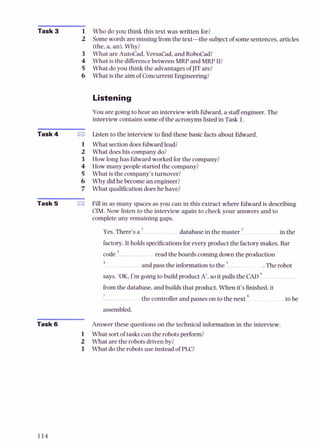
Duties Part of a team which plans new components and how they are
to be manufactured.Also responsiblefor specifyingor
recommendingnew equipment and new machines.If there is a
problem with production or materialsused for a project, the
team has to sortit out.
Responsibleto Production engineering manager
Likes/disliies Enjoysworking aspart of a team and solvingproblems
Jobtitle Systemsanalyst
Education Polytechnic,BA in BusinessStudies
Duties Assistant analyst in management servicesdepartment. Part of a
team composedof analysts and programmers. When a
department has a problem,he/she has to analyse it and come
up with a solution. If it is a solution which can be solvedby a
computer,the team design,write, and test a computer program
forthe problem.If it goeswell,the program is put into use. This
may involvetraining a 'user' in the new system.
Responsibleto Sectionleader
Likesldislikes Enjoys working with so many departments.Doesn't like it when
a user changes hislher mind about something after hours have
been spent designing a system.
Age 23
Jobtitle Toolmaker
Education Collegeof Technology,City & Guildssandwich course
Duties One of 50who work in the tool room -fitters,turners, millers.
grinder,jig borers. Spendstime on each kind of machine -
surface grinders, lathe,mill.
Responsibleto Foreman/woman
Likesldislikes Likes working with hislher hands.Enjoysgetting experience
with differentkinds of machines.
2 Your partner is one of these workers:
Machinetool developmentfitter
Foreman/woman
Applications engineer
Glossary of engineering terms
and abbreviations
Thedefinitionsin this glossaryrefer to words only as they are used in thisbook. The
meanings ofcertain words will vary according to context. As the texts in this book are
authentic and comefroma variety of sources, someinconsistency in hyphenation and
spellingis inevitable.
The unit and task numbers indicate where the word firstappears.
Abbreviationsusedinthe text
R =Reading section
SP = Speakingpractice
T =Task
TS =Tapescript
U =Unit
W = Writing section
n =noun
adj= adjective
v =verb
A-frame /'el frerdn [UlO. T5] a
structural framein the shape ofthe
letter A
ac/el 'si:/n [U23,T6] alternating current
aerodynamic l,earauda~'nzmrW
ndj
[U12,T3] designed to reduce wind
resistance
air classifieri'ea ,klres~fa~a(r)l
n [U27,
T3] a machine which uses air to segregate
materials by size and weight
alarm 1a'la:d rl [Ull, T31a means of
attracting attention utilizingeither sound
or vision
alloy i'zl~rl
n [U12,T3] a metal formedby
mixing together other metals and
elements
alternator/'~:ltanerta(r)l
n [U17,T31a
type of generator producing alternating
current
amplifier /'zmpl~fa~a(r)l
n [U16,TE] an
electronicdevicewhich converts small
signalchanges to large
anthropomorphic I,zn!3rapa'm~:fiW
11
[UZE,T31ofhuman-like form
armature i'a:mafa(r)i n [U6, TZ] the
moving part of an electricmotor which
comprisesa piece of iron with loopsofwire
running round it: the current through the
wire is reversedto provide the changes in
magnetic fieldsrequired to make the
motor run
oeating I'bearrgl 11 [U2,T4] a devicetu
reduce friction and wear between a
rotating shaft and a stationary part: may
contain balls or rollers
bimetallic corrosion Ibarmatzlrk
ka'rau3nl n [U22.T6] see galvanic
corrosion
block diagram i'blok ,daragrredn
[U11,T3] schematic drawing showing
differentfunctions in a systemor stages in
a process
body scannerl'bodi,skzna(r)/n [Ul, T4]
a medicalelectronicdevicefor building up
an image of the internal organsof a
patient
brittle i'hrrtlladj [U3, TZ] describesa
material which tends to break easily. e.g.
glass
brushes i'bm~rzi
n [U6, T2] spring-loaded
carbon blockswhich carry the electric
current to the commutator of an electric
motor
buoyancy l'baans~l
n [U5,T3]the
upthrust exerted by a fluid
buzzer i'biza(r)ln [U7,T5TS] a device
which uses an elec!xic signalto produce a
buzzingsound
CADkaedl n [UZO,Tl]computer-aided
design
CAM /kaem/ n [UZO,TZ] computer-aided
manufacture
caml k z d n [U4,T7] a speciallyprofiled
part which isEtted to a rotating shaft to
produce linear motion
capillarytubeka'prlan ,tju:bln [U15,
TZ] a tube with a very smalldiameterbore
CAPPlkaepl n [UZO,TZ] computer-aided
process planning
carbon fibrei'ka:bn ,faba(r)/n [U25,
T51high-strength fibremade fromcarbon
atoms
carburettorl,ka:ba'reta(r)/
n [U17,T3] a
devicewhere air and petrol are mixed in
an internal combustionengine
Cartesian co-ordinatesko:,ti:p
kau'~:drnats/n [U28,T5] information
about the positionof a body in spaceusing
distancesmeasured fromthree
intersectingplanes
chain wheel i'tSern wi:l/ n [UlZ,Tl] a
toothedpulley or sprocketused for
transmitting toque by a chain
charger i'tJa:dsa(r)I n [U15,T4] a device
which contains a unit forconverting
mains power to direct current at a suitable
voltage forcharging batteries
chisel1't~uU
n [U18,T3] asteeitwi with
one endformedinto a cutting edge
CIM l s d n [UZO,Tl]computer-integrated
manufachuing: describes a seriesof
processesor activitiesco-ordinated by
using a computer
circuit breaker rss:krt ,brerka(r)ln
[UZl,T6] anelectricalswitchfitted with
an overloadprotection cut out
closed loopl,klauzd'lu:pln [U11,T3]a
systemwhere part oftheoutput of a
systemisfed back into the input to modify
the output
commutator i'komju:,terta(r)ln [U6,TZ]
the part ofthe armature of an electric
motor which isincontact with the
brushes:it reversesthe flowof current
through the armature
compact disc1,kompaekt 'drsW n [U13,
TZ] plastic discused to storehigh quality
sound recordingsor computerdata on its
surface
component evaluation /kam,paunaut
~aelju'erJn1
n [U30,T4] the testingofa
componentto ensure it conformsto
speci6cations
compositel'kompaz~ti
n [U25,T4] a
fibre-reinforcedplastic material
compressed air kam,prest'ea(r)l n
[U18.T1]air at higher than atmospheric
pressure:used to power pneumatic devices
such as drills
compression Ikam'preJd n [U4,T4] the
effectofforceswhich act to squash a
structure
computer model kam'pju:ta ,modVn
[U24,T7]a representationof a design
createdin 3Don a computerusing a CAD
programme
computer-besed kam'pju:ta ,berst/adj
[U30.T31describesa system which relies
on the use of a computer
condenserkan'densa(r)/ n [U15,TZ] a
unit where vapour isconvertedback into
a liquid
conductorlkan'dnkta(r)In [U3,T3] a
material which will transmit electricityor
heat
constraint kan'strernti n [U28,T6] limit
imposedby the nature of a mechanism
cooling d u c t /'ku:lrq d ~ k V
n [U23,T9]a
passagewayto allow air to pass to a hot
surface,forexample,in a motor
corrosion-resistant lka'raup n,zrstantJ
adj[U3,T3]describesa material which
can be used in environmentswhere long-
term strength or appearance isimportant.
e.g.stainlesssteel
corrosive ka'rausrvl adj[U9,Tl]
describes a substancewhich corrodes(eats
or wears away),usuallyby chemical
action
crankshah/'kraeqkJa:fU n [U4,T2]the
main shaftofan engine which carriesthe
cranks forthe pistons
crevice corrosion i'krevrs ka,rauylin
[UZZ,T61corrosion in cracksor crevices
in pipes canying liquids
cylinder head /'srI~nda
,hedln [U3,W] a
plate which sealsthe endsofcylinderson
internal combustionengines:it contains
the valves
damper/'diempa(r)ln [U23,T2] a device
fittedbetweenthe chassisand axleofa
vehicle to remove springefects and
smoothtravel
databasei'de~tabelsi
n [U20,T2]a bank
ofinformationstored in a computerfor
easyaccess
d c ldi: 'si:ln [U6,T5] direct current
debug 1,di:'bnglvt [U29,T2] detect,locate
and correctfaults
degrees of freedom ldr,gri:zav
'frkdamin [U28,T4] the movements
achievableby a robot in three-dimensional
space
desalination l,di:sael~'ne~Jnln
[U29,T5]
production of fresh water from sea water
die Idad n [U13,T7] a specially shaped
block of metal used as a mould for other
materials
die-cast i'darko:st/adj [U12.T6]
produced from moulds
disc brakes i'd~sk
bre~ksi
n [U19,T2]
brakesin which a caliperclampsbrake
pads onto a discconnectedto the wheel of
the vehicle
diverter valve/dal'va:ta ,v;elv/n [U8,T6]
a valveused in central heating to redirect
the flow ofhot water from radiators to
water heating and viceversa
documentation 1,dokjumen'terSnl
n
[U30,T9] the completedescription of a
productin words and drawingsat every
slsye in itsmanulaaurc
ductile dhktall ,1d1IU3.T31dcs~.ribcsa
,. . .
material which can be stretchedand yet
retain its strength,e.g.copper
ductility ldnk'trhtd n [U26,T9]qualityof
beingductile
engine i'endgni n [U3,W] a devicewhich
covertsfuelinto work
equilibrium l,ekw~'hbnami
n [U5.T3]
balance (astructureisin equilibrium
when allthe forceson it are stableand
there isno movement)
escalator i'eskalerta(r)ln [U4,T2]
movingstairs
evaporator /r4v;eparerta(r)/
n [U15,T2] a
unit in which a liquid isconvertedinto a
vapour
exfoliate corrosion Ieks'fauliat
ka,raupln [U22,T6] when flakesofmetal
are displaced dueto corrosion
extrusion /rk'stru:3n/n [U13,T7] a
manufacturing process whereby a
material in its plasticstateisforced
through a die,e.g. to make plastic pipes
feedbacki'fidbiekl n [U11.T3]asignal
responding to theoutput ofa system
which isreturned to the input to modify
the output
field magnet /'fi:ld ,maegnat/n [U6,T2] a
magnet for producing and maintaining
the magneticfield in a generator or
electricmotor
friction l'frkSn/ n [U5,T2]the resistance
experiencedwhen two bodies rub against
each other
fuel cell l'tjual sell n [U25,T4] a cell
which convertsthe chemicalenergy of a
fuelto electricalenergy
fulcrum /'fulkram/ n [U5,T6]the pivot
point ofa systemoflevers,e.g.the screw in
a pair of scissors
turd1,i:di: 'emin [U20,T2]engineering
data management
elastic limit ir'liestlk ,Itnut/n [U26,T6]
the point at which a material will no
longer return to its originalshape a h r
tensile forcesare released
elasticitylrlaes't~s~t~l
n [U5,T3]the
property of a material to stretch and then
return to its originalstate
encapsulationl~r],kaepsju'le~jnl
n [U3,
T3] the processof completelyembeddinga
componentin a resin as protection from
the environment
galvanic corrosion lgiel'vien~k
ka,raopln [U22,T6]the corrosion which
resultswhen two dissimilarmetalsare
connectedIn the presenceof moisture
gesn lg~azl
n [U12,T1]an arrangementof
toothedwheelswhichmesh together to
change the speedor directionof
movement
gogglesi'gogaW n [U9,T7]protective
eyewear completelysurrounding the eyes
granules i'gr;enjualzln [U13.T71
material, e.g. plastic,in the formofsmall
grains
grinder I'gra~nd$r)/n 1[U9,T3]a
machine with a rotating discofabrasive
material used forsharpening tools and
removingrough edges [U29SP (A)]a
grinding machine operator
guard 1ga:dln lU9,T3]a deviceto
safeguard the operators ofmoving
machinery
I3 hammermilll'hemamrl/ n [U27,T3]a
crushing machine using impacts from
rotating arms
hazardi'haezadln [U9, T2] danger
h e a t exchanger i'hi:t 1ks,tJe1nd3a(r)l
n
[U8,T31the part ofa boiler where the
water is heated
heat-resistant i'hi:t n,z~stant/
arlj[U3,
T31describes a material which will
withstandexposure to high temperature
hinge lh1nd3/n [U5,T6]a flexible
mounting fordoors and lids
hydraulic 1ha1dr~:lrkl
ndi [U19,TZ]
describesa systemusing cylindersand
pistons and driven by a fluid
ignition l~g'n~fni
n [U28,T91the circuit
which allowshigh-tension current to pass
to the sparking plugs in an internal
combustion engine
insulator i'~nsju,le~ta(r)l
n [U3,T3]a
substancewhich will not transmit
electricityor heat
interfacel'mtafe~sl
n [U28,TZ] hardware
and softwareto enable a computer to
communicate with the deviceto he
controlled
intergranular corrosion i,~ntagrienjola
ka'rao3n/ 11 [UZZ,T61corrosion at the
boundaries ofthe crystal grains of a
material
ITlar 'ti:/ n IU20.Tll information
jcfd"f:i:","[U29 SP(A)]a work-holding
devicemade fora specificcomwnent. e.2.
-
to hold it for drilling
JlT/,d3e1a1 'ti:in [UZO,TZ]just-in-time
I
manufacturing
laser i'le~za(r)l
n [U13,T2]Light
Amplificationby Stimulated Emissionof
Radiation
LCDi,elsi: 'di:in [U16,T6] liquid crystal
display
load call /'laud selln [U16,T5] a load-
measuring element using an electrical
strain gaugeas the measuring device
malleable I'mel~abllarlj
[U3,T3]
describesa material which can be
stretched without breaking apart, e.g.
copper
manipulator lma'n~pju,le~ta(r)i
n [U28,
TZJthe part of a robot which carries out
the work
m e t h o d s engineerI'metladz
endg,n~a(r)i
n [U29,T7] someone
concerned with establishing the best
production method and equipment for
making an article
micrometer lmar'krnmita(r)/ n [U29,T2]
a U-shaped gauge used forprecise
measurement ofthicknesses: the gap
between the measuring facesis adjusted
by rotating a screwthread encased in a
graduated sleeve
microprocessor i,ma~krau'prausesa(r)/
n [U16,T5] integrated circuit chip at the
centre ofa computer for controlling the
system and processingthe data
mill 1m1V11 [U29,SP(B)]a milling
machine; uses multi-toothed cutters to
shapemetals and plastics
miller l'm~la(r)i
n [U29,SP(A)]a milling
machine operator
MRPi,ema: 'pi:/ n [UZO,T21materials
requirement planning
pedal i'ped(a)li n [UlZ,TI] foot-operated
lever. e.g. the accelerator pedal of a car
pendulum /'pendjulam/ n [U4,TZ] the
swinging weight used fortime control in
some clocks
pilot light i'pa~lat
la~ti
n [US,T2]a small
flameused to ignite the main burners in a
gas-firedheating boiIer
pitch 1p1tJin [U28,T6] angular
displacement along the lateral axis
pittingi'p~t~ui
n [U22,T6] corrosion due
to localid chemical reaction
plant/pla:nti 11 [U8,T7] the machines in a
factoryand all the buildings
PLC /,pi:el 'si:/n [UZO,TZ]programmable
logic control/cuntroller: the systemldevice
by which a microprocessorcontrols a
stage in a process automatically
pneumatic drill 1nju:mztrk 'dr~li
n
[U18,T3] a drillingmachine using
compressed air forpower
pressure regulator i'prefa ,regjule~ta(r)i
n [U21,T6] a deviceforadjustingor
maintaining pressure levels
protoWpal'prauta,tarpin [UlO,TZTS]
the first working model
pulley i'puld n [U10,T5]a grooved wheel
over which a ropepasses
reaction1ri:'aekJnIn [U5, T3] the force
which opposes an applied force
reamerlnma(r)ln [U19.T61a tool for
enlarging a drilled hole to a precise
diameter
recyclingl,ri:'sarkl~ql
n [U27,T1]
extracting from waste all materials that
can be reprocessed to be used again
refrigerantln'fnd3arantln [U15,T2] a
substance which changes easily from a
liquid to a gas and which can be used in
refrigeration to remove heat energy and
transferit to the surroundings
regenerativebrakingln'd3enaratlv
,bre~klr)I
n [U25,T5] a method ofbraking
electric motors where the motor becomes
a generator converting the energy ofthe
slowing wheels into electricity
remotecontrol1r1,mautkan'traull n
[U11,T3] a devicefor controlling
something froma distance
respiratori'respa,re~ta(r)l
n [U9, T71a
mask worn over the nose and mouth to
filter air
resultantin'z~ltantl
n [U5. T21the single
outcome ofa number of differentvectors
revolve/r~'volv/
vi [U5, T7TS] turn.
rotate
roboticslrau'bot~ksl
n [U28]the study or
production of machines which perform
tasks in a manner similar to humans
rolllraul/ n [U28,TS] angular rotation
about a longitudinal axis
rotor /'rauta(r)/n [U17,T21rotating part
of agenerator
scallop l'skolapl n [U28,T6] fan-shaped
curve
scratch-resistantllskrietJr ~ , z ~ s t a n
adj
[U3, T3] describesa material which
retains its appearance when exposed to
abrasion
sensingdevicei'sens~q
d~valsl
n [U7,
T5TSI a devicewhich monitors the
operating environment and is sensitive to
change
shockabsorberIJok abzs:ba(r)In
[Ull, T2] a devicefor absorbing shocks
and vibrations
signalgenerator i's~gnal
,d3enarerta(r)l
n [U21,T6] electronicdevicewhich
produces various signals used in tests and
measurements
solenoidI'saulan~~dl
n [U11,T2] a coil
w ~ t h
an iron core which is pulled into the
coil by a current passing through the coil
solenoidvalveI'saolan~~d
,vaelvlrr [Ul 1,
T2] a valve operated by a solenoid
spanner i'spsna(r)/ n [U5,T7 TS] a twl.
or level,for applying forceto nuts and
bolts
speedgovernor/spi:d,g~vana(r)l
n
[U21,T6] a devicefittedto an engine to
limit its speedto a pre-set level
springbalance1,sprlq 'haelansln
[U5, T31a measuring devicein which the
forceapplied is calculated by the extension
of a spring
sprocketI'sprnk~tl
n [U12,TI01a
toothed wheel over which a chain passes
stator/'ste~ta(r)/
n [U17.T2] stationary
part of a generator
strain gaugel'stre~n
g e ~ d d
n [U16,T5] a
deviceformeasuring strain in a structure
switchgeari'sw~tJg~a(r)l
n [Ul,T5]
switches and associated equipment for
controlling large elech.ical currents
systemsanalysti'slstamz ,aenahstIn
[U29,Ti'] someone responsible for
examininga problem to see whether it is
suitable for a computer application
tachogenerator I'tiekau,d3enarelta(r)in
[U11,T4] a sensor for measuring the
speed of rotation
TEFC/,ti:i: ef 'si:ladj [U23,T9] totally-
enclosed fan-cooled (motor)
tensionI'tenJnI n [U4, T4] the effectofa
pulling force which tends to stretch a body
thermoplasticl'Oa:mao,pliest~kl
n
[U3,T1] a plastic which softens when
heated and hardens when cooled
thermosettingplastic/,Oa:mauset~~~
'plaestrkl n [U3,T3] a plastic which retains
its shape and rigidity at high temperatures
thermostat /'Os:mast;et/n [U8.T31a
controldevice which operates at a pre-set
temperature
throttle I'OrotlI n [U18,T3] a valve for
controlling the supply of a gas or liquid
(e.g.fuel)to an engine
thrust IOr~stl
n [U12,T6] forceof
propulsion
tooling /'tu:l~l)/
n [U13,TI01 a
U
manufacturing equipmentrequired for the
manufacture ofa product y a w /
j
3
:
/
n [U28,T81angular rotation
toxic i'toks~W
adj [U9,T1]poisonous about a vertical axis
transformer/,traens'fa:ma(r)/
n [U6,T6] yield point 1'ji:ldp31ntin [U26,T7] the
a deviceforsteppingup or downthe point where the elasticlimitisreached
voltageof an alternating current
treadle Itredlln [U4,T6] a linkageused to
convertoscillatingintorotary movement
and viceversa
turbine i't3:bami n [U17,T9]a machine
which producespower when steam,gasor
water ispassedover the blades attached to
the rotating driveoutput shaft
turbulence /'ta:bjuland n [UlZ,T6]
violentor uneven movementof air
turner/'t3:na(r)/n [U29,SP(A)]a lathe
operator
undercarriage l'nnda,kiend3in [U23,
RZ] the supportingframeworkofa vehicle
comprisingwheels,axles,suspension,etc.
vapour l've~pa(r)/n [U15,TZ]a gasthat
can be liquefiedby increasingitspressure
vernieri'va:nra(r)/ n [U29,TZ] a
measuring gauge fitted with an auxiliary
scalewhich allowsthe operatorto read
the main scalewith an accuracyof one
tenth of a division
waisting/'we~st~q/
n [U26,T7]
deformationwhich bringsabout
narrowing of the section of a rod or
material under tension
wave power i'wew ,paua(r)/n [U17,T9]
a methodofgenerating electricityby using
the movementofwavesin water
workvolume/'wa:k ,volju:~II/
n [UZS,
T41the spacevolumeinto which the
manipulator ofa robot canbe positioned:
hence the volume whereusefulwork can
be done
T k a ~ ~ w n m k r r , a ~ t o t h e u d m s n d ~ , t h e
I
t
.
(
1
.
&
r
i
Wsndusdul unit-by-unitteaching notes.

English for electrical and mechanical engineering sb

  • 2.
    Oxford Englishfor Electricaland Mechanical Engineering EricH. Glendinning Norman Glendinning, C Eng, MIMechE Oxford University Press This file was collected by ccebook.cn form the internet, the author keeps the copyright. More ebooks visit: http://www.ccebook.cn ccebook-orginal enlish ebooks
  • 3.
    Technical contents Page UnitTopic Engineering Courses Materials Mechanisms Forces Electricmotor Student Central heating Safety at work Young engineer Washing machine Racing bicycle Lasers Technician Refrigerator Scales Portable generator Road breaker Disc brakes Stdengineer Lawn-mower Corrosion Maglevtrain CADdesigner Supercar Graphs Waste recycling Robotics Careers Applying forajob Technicalsyllabus General General Engineeringmaterials Mechanisms. Cams Staticsand Dynamics Electrotechnology Electrical Automaticsystems General General. Engineeringdesign Automaticsystems. Transducers Mechanics. Gearsystems Mechanical technology Robotics. General Fluid mechanics Automaticsystems. Straingauges Electrotechnology. Powergeneration Pneumatics Hgdraulics General. Processcontrol Engineeringdesign Mechanical technology. Corrosion Electricalmachines. Motor selection CAD General General Technicalplant Robotics. Steppermotors General General. Companystructure This file was collected by ccebook.cn form the internet, the author keeps the copyright. More ebooks visit: http://www.ccebook.cn ccebook-orginal enlish ebooks
  • 4.
    Contents Page Unit 1 loEngineering-what's itallabout? 10 Tuning-in 11 Reading lntroduction 12 Language study dealslis concerned with 13 Word study Word stress 13 Writing 14 Listening Unit 2 15 Choosinga course 1 5 Tuning-in 16 Reading 20 Writing Having apurpose Letter writing. 1:requesting information Unit 3 21 Engineeringmaterials 22 Tuning-in 22 Reading Scanning tables 23 Language study Making definitions 24 Writing Adding information to a text Unit4 26 Mechanisms 26 Tuning-in 26 Reading Scanning a text 27 Writing Ways oflinking ideas. 1 29 Language study Dealing with technical terrrQ 29 Speakingpractice Unit 5 31 Forcesin engineering 31 Tuning-in 31 Reading 1 Predicting 33 Reading 2 Grammarlinks in texts 34 Language study Thepresent passive 34 Listening Listening to lectures This file was collected by ccebook.cn form the internet, the author keeps the copyright. More ebooks visit: http://www.ccebook.cn ccebook-orginal enlish ebooks
  • 5.
    Fane Unit6 36 Theelectric motor 36 Tuning-in 36 Reading Skimming 39 Language study Describing functiorl 39 Writing Describing components 41 Word study Unit 7 42 An engineering student 42 Tuning-in 42 Listening 44 Writing Comparing a~ld contrasting Unit 8 46 Central heating 46 Tuning-in 46 Reading Predicting 48 Language study Time clauses 49 Word study Unit 9 so Safety at work 50 Tuning-in 51 Reading Understanding the writer'spurpose 53 Language study Making safety rules 53 Writing Waysoflinking ideas,2 Unit 10 55 Young engineer 55 Tuning-in 56 Listening 57 Writing 57 Speaking practice Describing and esplaining Unit 11 58 Washing machine 58 Tuning-in 58 Reading Reading diagranls 62 Language study IfJUnlesssmtences 63 Writing Explaining a diagram This file was collected by ccebook.cn form the internet, the author keeps the copyright. More ebooks visit: http://www.ccebook.cn ccebook-orginal enlish ebooks
  • 6.
    Page Unit 12 65 65 67 68 68 69 70 70 Unit13 72 Unit 14 77 77 77 78 Unit 15 79 79 79 81 81 82 Unit 16 84 Racingbicycle Tuning-in Reading Prediction Language study Describing reasons Writing Describing contrast Word study Properties of~nnterials Speaking practice Technical reading Gear systems Lasers Tuning-in Reading Language study used tolfor Word study Noun + noun cornpounds Writing Describing nprocess, I: sequence Technicalreading Laser cutting Automation technician Tuning-in Listening Speaking practice Talking nbout spech?cntions Refrigerator Tuning-in Reading Denling with unfnmiliar words. 1 Language study Pri~siples and lows Word study Verbsand related nouns Writing Describing n process. 2:location Scales Tuning-in Reading 1 Meaningfrorn context Reading 2 Con~parir~g sources Language study Cnuse rind effect. I Technicalreading Stmi11gauges This file was collected by ccebook.cn form the internet, the author keeps the copyright. More ebooks visit: http://www.ccebook.cn ccebook-orginal enlish ebooks
  • 7.
    Page Unit 17 91 91 91 93 94 94 Unit18 98 98 98 101 103 103 105 Unit 19 106 Unit 20 112 112 114 114 Unit 21 116 Portablegenerator Tuning-in Reading Reading diagrams Language study Causeand efject,2 Word study Verbswith -ize/-ise Writing Describingaprocess, 3:sequence and location Technical reading Wavepower Roadbreaker Tuning-in Reading Language study Allow and prevent links Writing Explaining an operation Technical reading Air skates Speaking practice Disc brakes Tuning-in Reading Contbinir~g skills Language study Verbswith up anddown Word study Verbs+-en Writing Explaining an operation Technical reading Water-based hydraulics Staff engineer Tuning-in Listening Language study Verbs with o n arldoff Tuning-in Reading 1 Predicting Reading 2 Grammar links. 2 Language study Describi~?gfunctions Word study Noun +noun, 2:function Writing Description and exp:pla~mtion Speaking practice Explair~ingf~irlctior~ This file was collected by ccebook.cn form the internet, the author keeps the copyright. More ebooks visit: http://www.ccebook.cn ccebook-orginal enlish ebooks
  • 8.
    Page Unit22 123 123 124 125 126 126 Unit 23128 Unit 24 137 Unit 25 140 140 142 144 145 Unit 26 146 146 147 149 149 151 Unit 27 152 152 154 155 156 Corrosion Tuning-in Reading Skimming Language study Causeand ejfect.3 Speaking practice Exchanging information Technical reading Corrosionof materials Maglev train Tuning-in Reading 1 Inferring Reading 2 Dealing with unfamiliar words, 2 Language study Prediction Writing Explanations Technicalreading Motor selection:operating environment Computer Aided Design(CAD) Tuning-in Listening Language study Necessity: have toand need (to) Supercar Tuning-in Reading Predicting: usingfirst sentences Language study Crrtainty Writing Summaries Graphs Tuning-in Language study Describing graphs Word study Comnlon verbs in engineering Writing Drscribing agraph Technical reading Properties and applicationsofcarbon steels Waste recyclingplant Tuning-in Reading Transferring information, making notes Language study Possibility:can andcould Writing Describing aprocws, 4: reason and mrthod This file was collected by ccebook.cn form the internet, the author keeps the copyright. More ebooks visit: http://www.ccebook.cn ccebook-orginal enlish ebooks
  • 9.
    Page Unit 28 157 157 157 159 162 163 Unit29 165 165 167 168 168 Unit 30 169 Robotics Tuning-in Reading 1 Revising skills Reading 2 Transferring information Language study Concession:evenif and although Technical reading Stepper motors Careers in engineering Tuning-in Reading Infrrring Speaking practice Role play Listening Inferring Applying for a job Tuning-in Reading Understandingjob advertisements Speaking practice Roleplay Writing Writing a CVand letter ofapplication Technical reading Company structure Student A Speakingpractice Student B Speakingpractice 18s Glossaryof engineeringterms This file was collected by ccebook.cn form the internet, the author keeps the copyright. More ebooks visit: http://www.ccebook.cn ccebook-orginal enlish ebooks
  • 10.
    Engineering-what's it all about? Tuning-in Task1 List the main branches of engineering. Combine your list with others in your group. Then read this text to 6nd out how many of the branches listed are mentioned. Task 2 Complete the blanks in this aiagram using information from the text. Engineering Civil 1 I Y T - Automobile Aeronautical Electrical installation 7 Medical This file was collected by ccebook.cn form the internet, the author keeps the copyright. More ebooks visit: http://www.ccebook.cn ccebook-orginal enlish ebooks
  • 11.
    Reading Introduction In yourstudy and work, it is important to think about what you are going to read before you read. This helps you to link old and new knowledgeand to make guesses about the meaning of the text. It is alsoimportant to have a clear purpose so that you choosethe best way to read. In this book, you will find tasks to make you think before you read and tasks to help you to have a clear purpose when you read. Task 3 Study these illustrations. They show some of the areas in which engineers work. Can you identify them? What kinds of engineers are concerned with these areas -electrical,mechanical, or both? mask4 Now read the following texts to check your answers to Task 3. Match each text to one of the illustrations above.
  • 12.
    Task 5 IT#!!krt: Cars,trains, ships, and planesareall productsof Imechanicalengineering. Mechanicalengineersare also involved in support servicessuchas roads, railtrack, harbours,and bridges. 1 Foodprocessing:Mechanicalengineersdesign, develop, and make I 5 the machinesandthe processingequipmentfor harvesting, preparing and preservingthe foods anddrinksthat fill the supermarkets. Medicalengineering: Bodyscanners, X-ray machines, life-support systems, andother hightechequipment resultfrom mechanicaland electricalengineerscombiningwith medicalexpertsto convert ideas o into life-savingand life-preservingproducts. Buildingservices: Electricalengineers provideallthe serviceswe needinour homesand placesof work, including lighting, heating, ventilation, air-conditioning, refrigeration,and lifts. Energyand power: Electricalengineersareconcernedwith the s production and distributionof electricityto homes, offices, industry, hospitals,collegesand schools, andthe installation and maintenance of the equipment involved intheseprocesses. Source:Adaptedfrom Turningideasintoaction, Institutionof MechanicalEngineers, andEnginminga Career,Institutionof ElectronicsandElectticalincorporated Languagestudy dealslis concerned with What is the link between column A and column B? A B mechanical machines electrical electricity Column A lists a branch of engineering or a type of engineer.Column Blists things they are concerned with. We can show the link between them in a number of ways: 1 Mechanical engineering deals with machines. 2 Mechanical engineers deal with machines. 3 Mechanical engineeringis concernedwith machines 4 Mechanical engineersare concernedwith machines. 5 Machines are theconcernof mechanical engineers. Match each item in column A with an appropriate item from column B and link the two in a sentence. A B marine a air-conditioning aeronautical b roads and bridges heating and ventilating c body scanners electricitygenerating d cablesand switchgear automobile e communications and equipment civil f ships electronic g planes electricalinstallation h cars and trucks medical i power stations
  • 13.
    Word study Wordstress Words are dividedinto syllables.For example: engine en.gine engineer en.gin.eer engineering en.gin.eer.ing Each syllableispronounced separately,but normally only onesyllableis stressed.That means it is saidmore slowly and clearly than the other syllables. We say 'enginebut engin'eer. A gooddictionarywill showthe stressedsyllables. Listen to these words. Try to mark the stressed syllables. machinery mechanical machine install installation electricity electrical electronics aeronautical ventilation Writing Task 7 Fill in the gaps in the followingdescriptionof the differentbranches of engineering using informationfrom this diagram and language you have studied in this unit. Engineering I I I I , Civil Mech[nical Elect,ical Electronic Marine Automobile Aeronautical Heatingand Electricity Electrical Lighting ventilating generating installation * Mining Medical
  • 14.
    2 Themain branchesof engineeringarecivil.' ,. and 4 electronic. Mechanicalengineeringis ' machinery of allkinds.Thisbranchof engineeringincludes .automobiie. 6 ,andheating andventilating.Thefirstthree are concernedwith 7 8 transport: . carsandplanes.The last with air- conditioning,refrigeration.etc. Electricalengineeringdealswith fromgenerationto use. Electricitygeneratingisconcernedwith lo stations.Electrical installationdeals " cables.switchgear,andconnectingup electricalequipment. Twobranchesof engineeringincludeboth l2 and l 3 engineers.These aremining and I* engineering.Theformerdeals with mines andmining equipment,the latter with hospital " ofall kinds. 1 Listening Task 8 Listen to these shortextracts.To which branch of engineering do these engineers belong? ! Task 9 Listen again. This time note the words which helped you decide on your answers.
  • 15.
    Choosinga course Task 1Study this list of points to consider when decidingwhether to study engineering. Tick [J]the statementswhich refer to you. Then ask your partner which statement- -of-- +- bim om he-. s l 1 You enjoypracticalprojects-creating and investigatingthing 2 You likefinding out howthingswork. 3 You are interestedin improvingthe environment. 4 Youlikehelpingpeople. 6 Youenjoysolvingproblems. 6 Youenjoy organizingact~rties. 7 YouenjoyscienceprogrammesonTVor onthe radio. 8 Yousometimesreedarticlesonscientificorengineeringtopics. 9 You havea lot of determinationandstamina. Ifyouhavetickedmostofthesestatements, engineering*the right courseofstudyfor you. S o w : Adaptsdfmm CytemunlrsmdT&- BBC EdwHbn
  • 16.
    Task 2 Fillin the gaps in this text. Each gap represents one word. Compareyour answers with your partner. More than one answer is possible for many of the In the United Kingdomyou can ' engineering at a collegeof further education or a university. Most collegecourses from one to two years. Universityundergraduate courses ' engineering last fromthree to fouryears. Acollegewill take afterfouryears of secondary school 5 education. Most students study full-time. day-releasecourses are availableforpeople who in localengineering companies. Students will be given a certificate a diplomaat the 8 of their course. Mostuniversity students wiU have completedsix of secondary 10 school.Otherswill have taken a diplomacourseat college. give degrees.A Bachelor's degree" three to fouryears. AMaster's 12 r e q u i r e s a further year. Task 3 Listen to the text and note the words used on the tape for each gap. Reading Having a purpose As a student of engineering or as a professionalengineer,you have to read a great deal. Makea listof someof the kids of textsyou may read. It is important that you developthe most effectiveskillsforgettiig the information you want quickly and accurately when you read. Task 4 There are exampleson the followingpages of some of the kinds of texts you may read in your studies or working life. Match them to this list: table index contents book title manual price listof components collegebrochure job advertisement
  • 17.
    Order Code RK65V BX96E W l lM FY93B WlZN W13P RK66W W14a BH6lR T w P C BLatchP12w P C BLatchPI3w P C BLatchPl4w P C BLatchPI5w P C BLatchPI6w PCBLatchPI8w PCBLatchPI10w P C BLatchPI12w P C BLatchPI17w Priceeach ZOP 2 5 ~ 2 9 ~ 3 5 P 4 2 ~ 4 8 ~ 5 4 ~ 5 8 ~ MP electrical energy, electrical system produci motion, advantagesan disadvantages, 178 electricitv. safety with. 87 electmeardiagraphy, 30 electromagnetic radiation, 56 electromechanicalcounters, 7 electronic(s), 61-122 constructionaltechniques, designingwith, 644.69, 118-21 digid, 88-122 materials/fittings/wm usedin. 50.624 Electrical A,pplica+:nn- 3 ' Sinclair is one of the UK's largest prlvate engineering groups, with an reputation. The sealing I / chesterfield range of products throughout the Midlands. You should have previous sales and mechanical engineering experiencewith a biasto maintenance products and mechanicalengineering. The successfulcandidatewill ideally be between30 and 45 years of age living in the Midlands with a mechanical engineering background. Thecompany offera good basicsalary,commission and company car. Apply in writing, with full CV to. J. FORD SlNCLAlRSEALINGSYSTEMSLTD. 16CANYONROAD, NETHERTONINDUSTRIALESTATE. BIRMINGHAM82OER Clos~ng date 17December19- SlNCLAlR
  • 18.
    Step Action Switchthe systemoff +0.003 Wait 5 seconds 1 1 -I2 1 - 1 4.005 / g 1 Openthe top cover 2 Setthe MTR switchto MTR mode,that is, move it to the left. 3 Closethe top cover Task 5 Shaft limits Bearing Heavy loading Light loading When you read, it is important to have a clear purpose. Here are some of the purposes you may have for reading the above texts. Match one purpose to each text. finding a job pricing a component finding out how to do something choosingthe best chapter to read looking for specificinformation on a topic learning about electricalequipment choosing a course looking for a specification
  • 19.
    Task 6 Choosinga course requires careful reading of college and university brochures. Your purpose here is to iind the most appropriate course for each of the following prospective students. Use the Course Guide which follows and answer using the course code. A student who has just left schooland wants to become a technician. A student who wants to designships. A student who wants to get an engineering degreeand also improvehis knowledgeof languages. A student who wants a degreeeventually but whose qualificationsat present are enough to start an HNDcourse. A student who wants to work as an engineer with the air force. A technician employedby a company which installselectricalwiring in factories. A student with a National Certificatein ElectricalEngineeringwho is prepared to spend another two years studyingto improveher qualifications. A student interested in how micro-organismscan be used in industry. I ~ .~ EE22 ' ~ i ~ h i r National Diploma in Electronicand Electrical ~n$iieering. Two years, full-time. For potential electronic andeiectrical engineers. The first year iscommon andthe second year allows studentsto specialize in either electronic or electricalengineeringsubjects. Successful m gstqdentsmay continueto a degreecourse. . ... . . , . .. : .:'~&ionaicertificate in ElectricalEngineering. Oneyear, 'full-time. For potential technicians or for thosewho wish I ain entry to an HNDcourse. er NationalCertificateCourse in Electrical.. - neering.Two years, day-release. This col providesthe technicaleducation requiredfor technicians employed inthe electrical installation industry. H300 Bachelo! of Engineering(BEng)-Mechanical Engineeringfor Europe. Four-am, full-time; one year study andwork attac ntinFurnc ~ermany. H400 Bachelor of Engineering(BEnyr- n t r ~ u ~ ..I Engineering.Three years, full-time, or f~ tars including one year of professionaltrainins nlthesi----' industry. HJ36 Bachelor of Engineering(BEng)-NavalArchitectufeand Ocean Engineering.Three years, full-time. H340 Bachelor of Science (Engineering)-Mechanical
  • 20.
    I Bachelor ofcr~y~~reering (B Eng)-Manufactur~~~u 1 Management.A two-year HNDcourse in engineering followed bytwo years of technology and managemell1 designedto produce managersqualified in high technology. Furtherinformation may be obtained by contacting one of these informationcentres and requestingthe appropriate course leaflet by sode number. All Ecourses: InformationCentre Fraser College Parlett Street Glasgow GL2 2KL All Y courses: Information Centre Maxwell University Glasgow GLl5PN Writing Lettt, ,+,,.iting,1: r,,,,sting inforrnatib.. Write a letter to either the collegeor the university mentioned in Task 6 asking forinformation on a course which interests you. Set out your letter like this: 21 Route de St Fargeau 18900 Russe Fw August 199-
  • 21.
    Engineering materials Ribbed plasticpipesstackedneara roadconstruction site where they will be laid for drainage along the sides ofa newsection of motormay. Task 1 List the materials you know which are used in engineering. Combineyour list with the others in your group and classify the materials as metals. thermoplastics, etc. Reading Scanning tables In engineering it isimportant to practise reading tables,charts,diagrams, and graphs because somuch information ispresented in these ways. Wew i l lstart in this unit with a table. Scanningis the best strategy forfinding information in a table. With scanning. you know before you read what sort of information you are searching for. To scan a table, you move y o u eyesup and down the columns until you 6nd the word or wordsyou want. Toscan quickly,you must learnto ignore any information which will not help you with your task.
  • 22.
    Task 2 Scanthe table which followsto 6nd a material which is: 1 soft 2 ductile 3 malleable 4 tough 5 scratch-resistant 6 conductiveand malleable 7 durableand hard 8 stiffand brittle 9 ductileand corrosion-resistant 10 heat-resistant and chemical-resistant Materials Properties Uses Metals Aluminium Light,soft,ductile,highly Aircraft,enginecomponents. conductive,corrosion-resistant. foil,cookingutensils Copper Very malleable, tough and Electricwiring. PCBs,tubing ductile,highly conductive. corrosion-resistant. Brass (65%copper. 35% Very corrosion-resistant. Casts Valves. taps castings.ship zinc) well,easilymachined. Can be fittings,electricalcontacts work hardened. Good conductor. Mild steel(ion with High strength, ductile,tough. Generalpurpose 0.15%to 0.3%carbon) fairlymalleable.Cannot be hardened and tempered.Low cost.Poor corrosionresistance. Highcarbon steel (ion Hardest of the carbon steelsbut Cuttingtools such asdrills,files, with 0.7%to 1.4%carbon) lessductileand malleable. Canbe saws hardened and tempered. Thermoplastics ABS Acrylic Nylon High impact strength and toughness,scratch-resistant,light and durable. Stiff,hard, very durable,clear. can be polished easily. Can be formedeasily. Hard, tough, wear-resistant,self- lubricating. Thermosettingplastics Epoxy resin High strength when reinforced, good chemicaland wear resistance. Polyesterresin Stiff,hard, brittle. Good chemical and heat resistance. Urea formaldehyde Stiff,hard, strong,brittle, heat- resistant, and a good electrical insulator. Safety helmets,car components, telephones,kitchenware Aiicraft canopies,baths, double g l - g Bearings,gears,casingsfor power tools Adhesives,encapsulationof Moulding,boat and car bodies Electricalfittings,adhesives
  • 23.
    Task 3 1 2 3 4 5 6 7 8 Scan thetable to find: A metalused to make aircraft Plasticsused for adhesives Steelwhich can be hardened An alloy suitablefor castings Aplastic with very low friction Amaterialsuitablefor safetyhelmets Ametal suitablefor a salt-waterenvironment Ametal for general constructionuse but which shouldbe protected from corrosion Aplastic for car bodies The metal used for the conductorsin printed circuitboards Languagestudy Making definitions Studythesefactsfrom the table about aluminium: 1 Aluminiumis a light metal. 2 Aluminiumisused tomake aircraft. Wecan link these factsto make a debition of aluminium: 1+2 Aluminium is a lightmetal which is used to make aircraft. Task 4 Use the table on the previouspage to make definitions of each of the materials in column A. Choose the correct information in columnsB and C to describe the materialsin column A. 1 Analloy 2 Athermoplastic 3 Mild steel 4 Aconductor 5 Aninsulator 6 High carbon steel 7 Brass 8 Athermosettingplastic allowsheat or current to floweasily remainsrigid at high temperatures does not allow heat or current to flow easily a metal contains iron and 0.7%to 1.4% carbon a material becomesplastic when heated an alloy contains iron and 0.15%to 0.3%carbon formed by mixing& metalsor elements consistsof copper and zinc
  • 24.
    Writing Adding informationto a text Studythis text about aluminium. Aluminiumis used tomake aircraft,engine components,and many itemsfor the kitchen. We can add extra information to the text likethis: Aluminium,whichisLight,soft,andductile,is used to make aircraft, enginecomponents-forexample,cylinderheads-and many items for the kitchen,suchaspots. Note that the extra informationis marked with commasor dashes: , which .... -for example. ...- such as ..., Task 5 Add this extra information to the following text about plastics. Plasticscan be mouldedinto plates, car components,and medical aids. Thermoplasticssoftenwhen heated again and again. Thermosettingplastics sethard and do not alter if heated again. ABS is used for safetyhelmets. Nylon is self-lubricating. Nylon is used for motorized drivesin cameras. Acrylicis a clear thermoplastic. Acrylicis used for aircraft canopiesand doubleglazing. Polyester resinis used for boat and car bodies. Polyester resinis hard and has good chemicaland heat resistance. Plastics are syntheticmaterials. They can be softened and moulded into useful articles.They have many applicationsin engineering.There are two typesof plastics:thermoplasticsand thermosettingplastics. ABS is a thermoplasticwhich is tough and durable. Because it has high impact strength,it has applicationswhere suddenloadsmay occur. Nylon is a hard, tough thermoplastic.It is used where silent,low-friction operationis required. Acryliccan be formedin severalways. It is hard, durable,and has many uses. Polyester resin is a thermosettingplastic used for castings.It has a number of usefulproperties.
  • 25.
    Mechanisms Tuning-in Task 1 Identifythese simplemechanisms.Try to explain the principles on which they operate. Reading Scanning a text Scanningis the best strategy forsearching for speci6cinformationin a text. Moveyour eyesup and down the text until you find the word or wordsyou want. Again, try to ignoreany informationwhich will not helpyou with your task. Task 2 Scan the text opposite quickly to 6nd out which of these mechanisms are mentioned. 1 cam 2 tap 3 pendulum 4 foot pump 5 escalator
  • 26.
    Task 3 Mechanismsare ani do simplethings like from continentto continent. 5 Mechanismsplay avital role in industry.While many industrial processeshaveelectroniccontrol systems, it isstill mechanismsthat deliverthe powerto dothe work. They providethe forces to press steelsheets intocar body panels, to lift largecomponentsfrom place &, , > .: :. , # > * , . . ..,, . > : ,*:.s. ,?< $&g#,!+$:,;? andforwards. edgeof the paper.. 10 All mechanismsinvolvesome kindofmotion. Thefour basickindsof Rotary:Wheels, gears, and roiier#--porary movement. Oscillating: The pendulumof aclock oscillates- it swings backwards 15 Linear:The linear movementof a papertrimmer is usedto cutthe Reciprocating:The piston ina combustion enginereciprocates. Now read the text to find the answers to these questions. What does a cam do? What doesoscillatingmean? How are plastic pipes formed? What simplemechanisms in the home are mentioned directlyor indirectly? What is the function of a crankshaft? Give an exampleof a devicewhich can produce a linear movement. How are car body panels formed? What do mechanisms provide in industry? Writing Waysof linking ideas, 1 When we write, we may have to describe,explain, argue,persuade, complain, etc. In all these formsof writing, we use ideas. To make our writing effective. we have to make sureour readers can followour ideas. One way of helping our readers is to mahe the linksbetween the ideasin our writing. What are the linksbetween these pairs of ideas?What words can we use to mark the links? 1 Mechanismsare important to us. 2 They allow us to travel. 3 Mechanismsdeliverthe power to do work. 4 They play a vital role in industry. 5 Friction is sometimesa help. 6 It is oftena hindrance.
  • 27.
    Sentence 2 isa reason for sentence 1.We can link 1and 2 like this: Mechanisms are important to us because/since/asthey aIIow us to trawl. Sentence 4 is the result of sentence 3. We can link 3 and 4 l i e this: Mechanismsdeliverthepower to do work so they play a vita1role in industry. Mechanismsdeliverthepowerto do work: therefore theyplay n vital role in industry. Sentence 6 contrastswith sentence 5. We can link 5 and 6 like this: Frictionis sometimesa helpbut it is often a hindrance. Task 4 Show the links between these sets of ideas using appropriate linking words. 1 Copperis highly conductive. It is used for electricwiring. 2 Weight is measured in newtons. Mass is measured in kilograms. 3 Nylon is used for bearings. It is self-lubricating. 4 ABS has high impact strength. It is used for safetyhelmets. 5 Thefoot pump is a class 2 lever. Theload isbetween the effort and the fulcrum. 6 Frictionis essentialin brakes. Frictionis a nuisance in an engine. 7 The upper surfaceof a beam is in compression. The lower surfaceis in tension. 8 Concretebeams have steelrods near the lower surface. Concreteis weak in tension.
  • 28.
    Task 5 Languagestudy Dealingwith technical terms One of the difficultthings about the English of engineering is that there are many technical terms to learn. Newer terms may be the same, or almost the same, in your own language. But many terms will be quite differentand you may not always remember them. When this happens,you will have to use whatever English you know to make your meaning clear. The samething may happen in reverse when you know a technical term but the person you are communicating with doesnot recognize it. Thismay happen in the Speakingpracticetasks in this book. Again, when this happens, you will have to make your meaning clear using other words. Task 6 The technical words in column A are similar in meaning to the more general English in column B. Match them. A B oscillates a changes rotates b large,thin, flat pieces reciprocates c moving stairs has a linear motion d goesround and round converts e movement motion f goesin a Line escalator g swingsbackwards and forwards sheets h goesup and down Try to explain how this simplemechanism operates using whatever English you know. Write your explanation down. Compareyour explanation with the technical explanation given on page 4 of the Answer Book. Learn any technical terms which are unfamiliar to you. Treadle linkage Speakingpractice Task 7 Work in pairs, A and B. Each of you has a diagram of a cam. Describe your diagram to your partner. Your partner shoufltry to reproduce your diagram from the spoken description you provide. StudentA: Your diagram is on page 177. Student B: Your diagram is on page 181. Thestext on the next page will help you with the vocabulary you need.
  • 29.
    Camsareshaped piecesof metalorplasticfixed to, or partof, a rotatingshaft. A 'follower' isheldagainstthe cam, either byitsown weight or byaspring. As the cam rotates, the follower moves. The way inwhich it movesandthe distance itmovesdependsonthe shapeofthe cam. Rotarycamsarethe mostcommontype.Theyare usedto changerotarymotionintoeither reciprocatingor oscillating motion. If you donot understandwhat yourpartnersays,thesequestionsand phrases maybehelpful. 1 Couldyou say that againlrepeatthat,please? 2 What doyou meanby X? 3 Where exactlyis the X? 4 What shapeis the X? 5 How doesthe X move? Ifyourpartnerdoesnotunderstandyou,try to rephrasewhat you say.
  • 30.
    Forces in engineering Task1 Working in your group, try to explain these problems. 1 Why doesn't the shipsink? 2 What makes the spring stretch and what keeps the weight up? 3 Why doesn't the box slidedown the slope? Reading 1 Predicting Asyou learnt in Unit 1,it is important to think about what you are going to read beforeyou read. Do not start to read a text immediately.One way to help your reading isto t h i i about the words which might appear in the text. The title might help to focusyour thoughts. Which wordsmight appear in a text with the title Forcesin engineering? Task 2 The text you are going to read is called Forces in engineering.Here are some of the words it contains. Can you explain the link between each word and the title of the text? weight elasticity buoyancy magnitude equilibrium resultant newton gravity
  • 31.
    Task 3 Nowread the text. Use the information in the text to check the explanations you made in Task 1. Forcesinengineering To solvethe ship problem, we must lookatthe forces onthe ship (Fig. 1).Theweight, W, acts downwards. That isthe gravity force. The buoyancyforce, B, acts upwards.Sincetheship isinequilibrium, the resultantforce iszero, sothe magnitudesof BandW must bethe 5 same. Fig. 1 Another very importantforce inengineeringistheonecausedby elasticity.A goodexampleofthis isaspring. Springsexertmoreforce the morethey are stretched.Thisproperty providesaway of measuringforce. A spring balancecan becalibratedin newtons, the l o unit of force. The block in Fia. 2 hasaweiaht of 10newtons.The weight on the balancepulls?hespringdown. To give equilibrium, the spring pulls upto opposethat weight. This upwardforce, F1, equals the weight ofthe block, W. F W Fig. 2 Itis impottantto getthe distinction betweenmassandweight 15 absolutelyclear. Mass isthe quantity ofmatter inanobject.Weight is the force onthat objectdueto gravity. Massismeasuredinkilograms, whereasweight, being aforce, ismeasuredinRewtons. We havelookedat buoyancy, elasticity, andgravity.There isafourth force important in engineering, andthat isfriction. Friction isa helpin 20 somecircumstancesbutehindrancein others. Letusexaminethe forces onthe box (Fig.3).Firstly,there isitsweight, W, the gravity force, thenthere isthe reaction, R , normalto the plane. RandW have a resultantforcetrying to pullthe boxdownt h e w . Itisthefriction force, F , actingupthe slope, that stops itslidingdown.
  • 32.
    Reading2 Grammar linksin texts One of the waysin which sentencesin a text are held togetherisby grammar links.In this extract,note how each expression in italicslids with an earlier expression. Another very important force inengineeringis theonecaused by elasticity.Agood exampleof this isaspring. Springsexertmoreforce the more theyare stretched. Thisproperty providesaway of measuringforce. Sometimestheselinkscauseproblemsfor readersbecausethey cannot make the right connectionbetween words in differentparts of a text. Studythesecommon grammar links: 1 A repeatednoun becomesa pronoun. Springs becomes they. 2 A word replaces anearlierexpression. Force in engineering becomesone. 3 A word replaces a whole sentenceor clause. Springs exert moreforce the more they are stretched becomes Thisproperty. Tr*4 With which earlier expressions do the words in italicslink?Join them as in the exampleabove. Frictionin machines is destructive andwasteful. Itcausesthe moving partsto wear and itproducesheat where itis notwanted. Engineers reducefriction by usingven/ highly polishedmaterialsand by lubricatingtheirsurfaceswith oil and grease. Theyalso use ball 5 bearingsand roller bearings becauserolling objectscause less friction than sliding ones. Source:S. LarkinandL. Bernbaum(eds.l.The PenauinBookof the PhysicalWorld ...'
  • 33.
    Languagestudy The presentpassive Studythese instructionsfor a simpleexperiment on friction. IHorizontallv calibrated Fig. 4 1 Place a block of wood on a flat surface. 2 Attach a spring balance to one end of the block. 3 Apply a gradually increasing force to the balance. 4 Note the forceat which the block just begins to move. 5 Pull the block along so that it moves at a steady speed. 6 Note the forcerequired to maintain movement. 7 Comparethe two forces. When we describethis experiment, we write: A block of wood is placed on a flat surface.A spring balance is attached to one end of the block. Thisdescriptionuses the present passive. We form the present passiveusing islare +past participle. Task 5 Complete this description of the experiment using the present passive. A block of wood ' on a flat surface.A spring balance " to one end of the block. A gradually increasing force to the balance. The forceat which the blockjust beginsto move 4 - The block along at a steady speed.The forcerequired to maintain movement 6 . The two forces' .It is found that the first forceis greater than the second. What does this experiment show? Listening Listening to lectures Thelistening passage you are going to hear is an extract from a typical engineering lecture. Here are someof the features of lectures. 1 Incompletesentences:Spokenlanguage is not dividedneatly into sentences and paragraphs. For example: Now what Ithought Imight do today ...What wearegoing to talkof... 2 Repetitionand rephrasing: Lecturersoftensay the samething more than once and in more than one way. For example: It will turn, revolve. 3 Signpostexpressions:Lecturersoftenuse expressionsto help the studentsknow what they are going to do next, what is important, etc.For example: What we are going to talk ojis the extensionofajorce.
  • 34.
    Task 6 Inthe same way as when reading, it is helpful to think about the topic of a lecture before you listen. The topii here is The Moment of a Force. Can you explain the links between these words from the lecture and the topic?Use a dictionary to help you if necessary. turning distance product pivot perpendicular leverage fulcrum hinge - Task I - Now listen to the lecture to check your explanations. - During the lecture, the lecturer drew this diagram on the board. Which of the words in Task 6 can be used to talk about the diagram? Here are some signpost expressionsfrom the lecture. What do you think the lecturer is indicating each time?Select from the labels below, a to e. 1 We're going to talk about the moment of a force. 2 If you can think of a spanner ... 3 But what you have to remember is ... 4 Somethingsim~le to illustrate. - . 5 I'm thinkiug ofa practical job. 6 2'hy do we put a handle there on the door? 7 Is that understood?All right? 8 Wellthat is then a littleexplanation of how you calculate moments. a Emphasizingan important point b Showing that the lecture is over c Checking that the students can followhim d Introducing the topic of the lecture e Giving examplesto illustrate the points Task 10 Listen to the tape again and answer these questions according to the information given by the lecturer. 1 What advantage doesa longer spanner offer in loosening a tight nut? 2 What is the formula for calculating the moment of a force? 3 Why is it sometimesdifficultto apply a force at right angles in a motor car engine? 4 Why is the handle of a door at the edge? 5 Write down the formulaeforcalculating forceand distance.
  • 35.
    The electric motor Task1 Working in your group, list as many items as you can in the home which use electric motors. Which room has the most items? Reading Skimming In Unit 3 you studiedscanning -locating specfic information quickly. Another useful strategy is reading a text quickly to get a generalidea of the kind of information it contains. You can then decidewhich parts of the text are worth reading in more detaillater,dependingon your reading purpose.Thisstrategy is called skimming. Task 2 Skim this text and identify the paragraphs which contain information on each of these topics. The 6rst one has been done for you. a What electricmotors are used for paragraph 1 b The commutator c Why the armature turns d Electromagnets e Effectof putting magnets together f The armature Inanelectricmotoranelectriccurrantand magneticfield produce aturning movement.Thiscan driveall sorts of machines, from wrist-watchestotrains.The motorshown in Fig. 1isfor awashing machine. Itisauniversalmotor, whichcan runon directcurrentor 5 alternatingcurrent. An electriccurrent runningthroughawire producesamagnetic fieldaroundthewire. Ifan electriccurrentflowsarounda loopof wirewith abarof ironthroughit,the ironbecomesmagnetized.Itis ! calledanelectromagnet; one endbecomesa northpoleandthe o otherasouthpole, dependingonwhichwaythecurrent isflowing aroundthe IOOD.
  • 36.
    Ifyou puttwo magnetsclosetogether,likepoles-for example, 3 two northpoles-repeleachother, andunlikepolesattracteach other. 5 Inasimpleelectricmotor, likethe oneshowninFig.2 , a pieceof 4 ironwith loopsofwire roundit, calledanarmature, isplaced betweenthe northandsouth polesof astationary magnet, known asthefield magnet.Whenelectricityflowsaroundthearmature wire, the ironbecomesanelectromagnet.
  • 37.
    I The attractionandrepulsion betweenthe polesofthis armature magnetandthe polesof the field magnetmakethe armatureturn. As a result, itsnorth pole isclosetothe south poleofthe field maunet.Thenthe current is reversedsothe northw l e of the armature magnetbecomesthesouth pole. Onceagain, the attraction and repulsionbetweenit andthe field magnet makeit turn. The armaturecontinuesturning as long asthe direction ofthe current, andtherefore itsmagneticpoles, keepsbeing reversed. To reversethe direction of the current, the endsofthe armature t wire areconnectedto different halvesof a solit rino called a I commutator. Currentflowsto andfromthe kmm;tatorthrough small carbon blockscalledbrushes.As the armatureturns, first one halfofthe commutator comesintocontactwith the brush deliveringthe current, andthenthe other, sothe direction ofthe current keepsbeing reversed. Swfce: A( from'insideOWEle*ricMotof, Edumtion Gusrdian Match each of these diagrams with the correct description,A. B, C, or D. One of the descriptionsdoes not match any of the diagrams. (The diagrams are in the correct sequence, but the descriptions are not.) Motor run on direcl current A The armature turns a quarter of a turn. Then electriccontact is broken because of the gap in the commutator, but the armaturekeeps turning because there is nothing to stopit. B When current flows,the armature becomes an electromagnet. Its north pole is attracted by the south pole and repelledby the north pole of the field magnet. C When a universal motor isrun on direct current, the magnetic poles in the armature change whilethose of the fieldmagnet remain constant. D When the commutator comesback into contact with the brushes, current flowsthrough the armature in the oppositedirection.Its poles arereversedand the turn continues.
  • 38.
    Language study Describingfunction Tryto answer this question: What doesan electricmotor do? When we answer a question like this, we describethe function of something. We can describethe function of an electricmotor in this way: An electric motor converts electrical energy to mechanical energy. We can emphasizethe function like this: Thejunctionofanelectric motor is to convert electrical energy to mechanical energy. Task 4 Match each of these motor components to its function, and then describe its function in a sentence. Component Function 1 armature a transfers rotation from the motor 2 bearings b create an electromagnetic field 3 brushes c converts electromagnetic energy to rotation 4 commutator d reversesthe current to the armature 5 drive shaft e supportthe drive shaft 6 field windings f supplycurrent to the armature Writing Describing components Task 5 Dismantle this simple dc motor into its components by completing the labelling of the chart below. Loop of wire
  • 39.
    Now studythis descriptionofthemotor. A simpledcmotor consistsofa fieldmagnet and an armature.Thearmature is placed between the poles of themagnet. Thearmature is made upo f a loopof wire and asplitring knownasacommutator.Theloopis connectedto the commutator.Currentis suppliedtothemotorthrough carbon blockscalled brushes. Towritea description,you need touse languageto: 1 dismantlea pieceof equipmentinto itsmain parts. These expressions willhelp: consistso f X A A ismadeupof XandY iscomposedo f Y 2 name components: known as brushes. Carbonblocks called 3 locatecomponents: Thearmature isplaced betweenthepoles. 4 connectcomponents: Theloopis connectedtothe commutator. Task 6 Completethe text with the help of the diagram on the next page. Use the followingwords: are made up isplaced is composed consists A transformer oftwo coils,a primary and a secondary.Thecoils arewound on a formerwhich ismounted on a core.Thecoils of a number of loopsof wire. Thecore of thin piecesof softiron. U- and T-shaped piecesare used. Theformer onthe legof theT. Now labelthediagramoppositeusing the completedtext.
  • 40.
    Word study Studytheseexpressionsfor describinghowcomponentsare connectedtoeach other. A is bolted to B. = A is connectedto B with bolts. A is welded to B. =A is connectedto Bby welding. A is tixed to B. =no speci6cmethod given Task 7 Explain each of these methods of connection. 1 screwed 2 soldered 3 attached 4 wired 5 bonded 6 glued 7 riveted 8 welded 9 brazed 10 nailed
  • 41.
    An engineering student Task1 Task 2 1 2 3 4 5 6 7 8 List some of the subjects studied by engineering studentsShare your List with others in your group. Find out what these terms mean in education. Usea dictiooary if necessary. pass resit assessment fail dropout period full-time module Listening When listening,it is important to have a clear purpose s othat you can concentrate on the parts of the messagewhich best meet youroads.It also helps to think about what you will hear beforeyou listen.Tbtn u t two tasks will helpyou to preparefor listening and to have a dearpurpose.
  • 42.
    Task 3 Youare going to hear an interview with David, a student of electrical engineering at a Scottish college of further education. He is a mature student with previous service in the Navy. Here is David's weekly timetable. Someof the information is missing. Before you listen,try to answer these questions about the timetable. 1 What time doesDavid start each day? 2 When does he finish? 3 How long is a class? 4 How many classesdoeshe have each week? 5 What do the numbers mean after each class. e.g. 150? 6 How often doeshe have breaks? I MONDAY TUESDAY WEDNESDAY THURSDAY FRIDAY Design and make 150 Technology Technology 138 051 .~ B r e a k - -- 10.30-12.00 Design Tutorial and make 150 140 063 p~~ ~ ~p -- L U N C H B R E A K -- / 13.00-14.30 Maths Communications Maths 1 510 510 606 510 510 - - - B r e a k I 14.45-16.15 Technology Principles Technology Principles Self-study 053 138 039 051 Task 4 Listen to Parts 1and 2 of the interview in turn. Answer these questions. Compare your answers with a partner. Part 1 What is the name of David's course? How long is the course? How old is David? How long was he in the Navy? How many types of submarines are there? Part 2 How many weeks of teaching doeshe have left? How is the course assessed? What happens if you fail the tests once? How many are in his class? What kind of problemshas he had?
  • 43.
    Task 6 DListen to Part 3 of the interview.Try to completethe information missing from the timetable. Compareyour answers with a partner. Task 8 Liiten to the last part of the interview.Answer these questions. Part4 11 Whendoeshe practisesport? 12 Where can you goforsport? 13 What kind of sportscan you practise there? 14 What ishe goingto do after the Certificate? 15 What doeshe want to be? Task 7 D Now listen to the whole tape. Answer these more difficult questions. 1 Why didDavid leavethe Navy? 2 Why did students dropout of the class? 3 Why did he dislikeschool? 4 Why domost studentsfindPSDa bit of a nuisance? 5 Why doeshe want toknow when it's raining? 6 Why doeshe not have to use the library? 7 Why doeshe enjoytechnologymost? Writing Comparing and contrasting Task 8 Write your own timetable in English. MONDAY TUESDAY WEDNESDAY THURSDAY FRIDAY Task 9 Now completethis table. Note any similaritiesand differencesbetween David's week and your own. David's subjects Hours per week Your subjects Hoursper week
  • 44.
    Task 10 Writea short comparison and contrast of your timetable and David's. These expressions may be useful: more time/hours/classes/maths than lesstime/maths/physicsthan fewerhours/classesthan not asmuch tiie/maths/physics as not asmany hours/classesas start/finishearlierllater than Note that less and much are used forthings which cannot be counted.
  • 45.
    Central heating Task 1How can you heat a house in cold weather? List the possible ways Reading Predicting In Unit 5we learnt how using the title can help us to predict the contents of a text. Diagrams are alsovery useful in helping the reader to make the right guesses about what a text will contain. Before you read a text. read the title and look at any diagrams it contains. Task 2 Using the diagram, try to explain the function of these components: 1 the pilot light 2 the heat exchanger fins 3 theflue 4 the thermostat 5 the pump Cold wate - Pump Finned heat exchanger Outer casting 1 7 G a s & i ? Air for combustion Pilot light b Burner
  • 46.
    Task 3 Scanthis text quicklyto check the explanationsyou made in Task 2. You mav not find all the information vou want. Gascentralheating Mostgascentralheatingworks onthe 'wet' system of heattransfer betweenwater flowingthrough pipes. Atypical systemincludesa boiler, a networkof pipes, afeed, andexpansiontank, radiators, anda hotwater storagesystem. I 5 Inconventional boilers, water is heatedby gas burners. Itisthen pumpedaroundthecentralheatingsystem andthe hotwater storagecylinder.Theflow of gasto the burner iscontrolled bya valve (orvalves)which can be operated byatime switch or by a boilerthermostat, hotwater cylinderthermostat,or by a ro thermostat locatedinoneofthe rooms. Air isnecessaryfor completecombustion and issuppliedto the burnerseitherfrom insidethe house, when adequateventilation must beensured,or directly from outsidethrough a balancedflue. Water iscirculatedthrough a heatexchangerabovethe burner. The i s heatexchangerismadeof tubesof cast ironor copper, which resist corrosion. Bothtypes usefins to increasethe surfacearea in contactwith water, which improvesthe transferof heat.A thermostat locatedinthe boiler causesthe gascontrolvalveto shut offwhen thewatertemperature reachesthe pre-setlevel. 20 After being pumpedthrough adiverter or priorityvalve, water circulatesaroundeither oneoftwo loopsof pipework, which act as heatexchangers. One looppassesthroughthe insideof the hot water storagecylinder in acoilarrangement. Heatistransferredto the surrounding water, which canthen bedrawnoff from this 25 cylinder from various hottaps inthe housewhen required. The loopthen returnstothe boilerfor re-heating. The other loopof the circuit passestothe radiators, which provide room heating. Several radiatorsare generallyconnected, where one pipe providesthe hotwater input andthe other carriesthe cold 30 water backto the boiler. Inthis wav, all radiatorsreceivehotwater directly fromthe boiler. Source:'Inside out:CentralHeating', EducationGuardii Task 4 Put these statementsin the correct sequence. The first and last have been done for you. Wateris circulatedthroughaheatexchanger. I Theloopreturnsto theboiler forre-heating. One loop passesthroughthe insideof the hot water storage cylinderin acoil of pipes. - Wateris heated by gasburners. The hot water is pumpedthroughadivertervalve. Theother loop of the circuitpassesto the radiators. Coldwater fromthe radiatorsreturnsto the boiler.
  • 47.
    Use the statementsin Task 4 to label the stagesshown in this diagram of a heating system. Fira flwr Ground floor t 1 Languagestudy Time clauses What isthe relationship between thesepairs of actions?How can we link each pair to showthis relationship? 1 Coldwater passes through a heat exchanger. The water isheated. 2 The water is heated. It reachesa pre-set temperature. 3 Thewater is heated. It is pumped to a divertervalve. 4 Thewater temperaturereachesthe right level. The gascontrolvalve shutsoff. We can show how actionsare linked in timeby using timeclauses. We can useas to link two connected actionshappening at the sametime. For example: 1 As cold waterpasses througha heat exchanger, the water i sheated. We can use until to link an action and the limit of that action. For example: 2 The water is heateduntil it reachesapre-set temperature. Note that until normally comesbetween the stages. We can use afterto show that one actionis followed by another action. For example: 3 qftcr the water is heated,it ispumped toa diverter valve. We can use when to showthat one actionhappensimmediatelyafter another. For example: 4 Whenthe water temperature reaches the right level, thegascontrol valve shuts off. Note that when the time word comesh t in the sentence.a comma (.) is used afterthe time clause.
  • 48.
    Task 6 1 2 Link thesesets of actionswith appropriatetime words. The system is switched on. Cold water passes through a heat exchangerin the boiler. Thewater passes through the heat exchanger. Thewater becomeshotter and hotter. Thewater reachesa pre-set level. The water temperaturereachesthe pre-set level. A thermostat causesthe gascontrolvalve to shut off. The water ispumped to a divertervalve. The water goes to the hot water cylinderor the radiators. Hot water passes through the insideof the hot water storagecylinderin a coil arrangement. Heat istransferred to the surrounding water. The hot water flowsthrough the radiators. Thehot water loses heat. Thewater passesthrough the radiators. Thewater returns to the boiler. Word study Task 7 The words listed in the fust column of this table are common in descriptionsof technical plant. They describehow substancesare moved from one stage of the process to the next. Some of these words can be used for any substance: others are more specsc. Write an X under Solids,Liquids, or Gases if the word on the left can be used to talk about them. The kst examplehas been done for you. carried circulated conveyed distibuted fed piped pumped supplied Solids Liquids Gases
  • 49.
    Safety at work Task1 What do these warning labels on chemicalsmean?Match each label to the correct warning. a Highly flammable b Harmful c Explosive d Corrosive e Oxidizing f Toxic MAKE SURE YOU LEARN THE LABELS! THEY ARE FOR YOUR PROTECTION.
  • 50.
    Task 2 Listsome of the potential dangers in your laboratory, workshop,or place of work. How is the risk of these hazards reduced? Task 3 Study the safety instructions from a workshop below, and then answer these questions. a Who are the instructions for? b Who wrote them? c What was the writer's purpose? I 1 Wear protective clothing at all times. I 2 Always wear eye protection whenoperating lathes, cutters, and grinders and ensure the guard is in place. 1 3 Keep your workplace tidy. 1 I 4 Theareasbetween benches and around machines mustbe kept clear. I 1 5 Toolsshouldbe put away when not in use and I any breakages and losses reported 1 6 Machines should be cleaned after use, Reading Understanding the writer'spurpose Knowing what the writer's purposeis,who the writer is, and who the intended readers are can help us to understand a text. The safety instructions in Task 3 are clearlyintendedto encourage employeesto be safety consciousand reduce the risk of accidents. The writer is perhaps a supervisoror the companysafety officer,and the intendedreaders are machine operatives.Knowing these things can help us to work out the meaning of any part of the text we may not understand. Task 4 Study the company document on safety on the next page, and then answer these questions. 1 Who is this document for? a machine operatives b managers c allemployees d injuredemployees 2 Who wrote this document? a tradeunion representative b technician c manager d medicalstaff 3 What is the writer's intention? a to prevent accidents b to ensure speedyhelp forinjured employees c tn protect the company d to warn about dangers
  • 51.
    Accident investigation Whenever anaccidentoccursthat results in an injury (medicalcase), damage of equipment and material, or both, prompt accident investigationby theimmediatemanager is required. Awritten preliminary investigationwillbe completedby the end of theparticular shiftorbusiness day onwhichthe accidentoccurred. In noevent shouldtherebe a delay of more than 24hours.Failureto complywith this requirementmay subjectthe immediatemanager to disciplinaryactionup to and including discharge. Without adequate accidentinvestigationdata the Companymay be subjectedto costs,claims, and legalactionforwhichithas nodefence. As aminimum, the preliminary accidentinvestigationreport will include the following: 1 Name, occupation,and sexof injuredworker. 2 Placeand date/time of accident. 3 Descriptionof how the accidenthappened. 4 Immediate causesof the accident-unsafe actsand unsafe conditions. 5 Contributingcauses-manager safetyperformance,levelof worker baking,inadequatejob procedure,poor protectivemaintenance,etc. 6 Witness(es)-name and department. 7 Correctiveactiontaken- when. The employeewho was injuredand any employee(s)who witnessed the incidentshould be separatelyinterviewed as soonaspossible.A copy of the report must be submitted to theManager-Human Resourcesfor review.Another copy of the report istobe retained fora period of not lessthan the injuredemployee's length of employmentplus five(5) years. Task 5 Study this brief report o f an accident.In which points does it not meet company policy on reporting accidents?
  • 52.
    Language study Makingsafety rules What are the differencesin meaning, if any, between these statements? 1 Wear protectiveclothing. 2 Always wear protectiveclothing. 3 Protective clothing must be worn. We can make safetyrules in these ways: 1 Using an imperative. Wearprotective clothing. Do not wear loose-fittingclothing. 2 Alwags/neverare used to emphasizethat the rule holds in all cases. Alwa~s wearprotective clothing. Never wearloose-fittingclothing. 3 We can use amodal v e r b - Protective clothing must be worn. Protective clothingshould be worn. Task 6 Study this list of unsafe environmental conditions (hazards).Write safety rules to limit these hazards using the methods given above. For example: inadequatelighting Lighting must beadequate.or Lighting should be adequate. 1 uneven floors 2 unguarded machinery 3 untidy workbenches 4 untidy workplaces 5 badly maintained machinery 6 carelesslystored dangerousmaterials 7 inadequate ventilation 8 damaged tools and equipment 9 machinery in poor condition 10 equipment used improperly 11 equipment operated by untrained personnel 12 apprentices working without supervision Writing Waysof linking ideas, 2 In Unit 4 we learnt that to make our writing effective,we have to make sure our readers can followour ideas. We learnt how to mark reasons, results, and contrasts in our writing. What are the linksbetween these ideas?What words can we use to mark the links? 1 The accident happened. 2 The operator's carelessness. 3 The supervisorwas not present.
  • 53.
    Sentence 2 isa reason for sentence 1.Sentence 3 is an additionalreason. We can mark the links between them like this: Theaccident happened becauseof the operator's carelessness.In addition/moreover,the supervisor was not present. We use because o f to introduce a reason which is a noun or noun phrase. We use in additionand moreover to introduce an additional reason. What are the linksbetween these ideas?What wordscan we use to mark the links? 4 Suitableprotection should be worn. 5 Safetyhelmets should be used where there is a danger of falling objects. Sentence 5 is an exampleto illustrate sentence 4. We can mark this in this way: Suitableprotection should b e worn.For example/Forinstance,sakty helmets shouldbe used where there is adangeroffalling objects. Task 7 Show the links between these sets of ideas using appropriate linking woru. from this unit and from Unit 4. 1 Many accidents happen. Workers' carelessness. 2 Education can reduce accidents. It is important that all workersreceive training in basic safety. 3 Eye injuries can be serious. Gogglesmust be worn for grinding and cutting. 4 Safetygloves provide protection for the hands. They prevent burns. They reduce the danger of cuts. 5 Safetyshoesprotect the feet against fallingobjects. They prevent the feet getting caught in machinery. 6 Respiratorsshould be worn in dusty conditions. Dust can damage the lungs. 7 Safetygear existsfor everydanger. Each year people are injured. They refuse or forget to wear the right gear.
  • 54.
    1 0 Young engineer Task1 Lucy Porter is a recent winner of the Young Engineerfor Britain award. Study this diagram of her invention.Discuss these questionsin your group: 1 Whatis it? 2 Who is it for? 3 Howdoesit work?
  • 55.
    Listening Task 2 m Task3 rn a b c d e f g h i i k Task4 Task 5 1 2 3 4 5 6 Task 6 Task 7 m 1 2 3 4 Now Listen to Lucy talking about her invention and career plans. As you listen, check your answers to Task 1. Now listen again. Here are someof the things Lucy talks about. Put them in the correctsequence.The first one has been done for you. Her careerplans. What happensnext with her invention. How it works. Whysheisplanning tostudyengineering. Changesin the design. What her inventioniscalled. What materialssheused. Who it isintendedfor. How shemade the prototype. How shegot theidea. Her viewsonengineeringasa careerforwomen. Now make notes on what Lucy says about the above topics. Label the diagram in Task 1with these terms: rope handle pulley A-frames cross-piece seat Put these stepsin the creation and development of the swingin the correct sequence.The &st and last have been done for you. problemidentified 1 prototypebuilt in wood - metalversion built - design modified inventionpatented - modelsbuilt totestdesign - prototypemodified - prototypeh k d - designdrawn - manufacturer licensedto produce 10 Now listen again and answer these more detailed questions. Howdid the inventiongetitsname? What did sheusetotestdesignswhich seemedviable? Whydid shemake thefirst swingkom wood? What arethe advantagesof a metalframe?
  • 56.
    Writing Describing andexplaining Task 8 You are going to write a brief descriptionand explanation of Lucy's invention. It will consist of two paragraphs. Paragraph I Use the labelled diagramin Task 1and the information from the tape to write a brief descriptionof Lucy's invention.Your descriptionshould answer these questions: 1 What is it called? 2 What is it for? 3 What doesitconsistOR 4 How are the parts connected? 5 What is it madeof) Usethe language of descriptionstudiedin Unit 6. Paragraph 2 The followingstepsexplainhow the swingworks. Put them in the correct sequence.Then use soand when to link them into a paragraph. Theropepulls the seatforwards. Repetitionof theseactionscausesa swingingmotion. The childpuUsdownon the handle. The seatswingsback under the weight of the child. The child releases the handle. Speakingpractice Task 9 Work in pairs. A and B. StudentA: Playthe part of the interviewer.Baseyour questionson the topics in Task 3,and any other questionsyou may wish to add. For example: a Her careerplans. +Whatare your careerplans? StudentB: Play the part of the swinginventor. Conduct the interview.
  • 57.
    Washing machine Task 1Many items found in the home contain controlsystems. The washing machine is one of the most complex.List some of the factorsthe control system of a washing machine must handle. This diagram may help you. Fig. 1Cross-sectionthrougha washing machine Reading Reading diagrams In engineering.diagramscarry a greatdeal of information.They can also help you to understand the accompanying text. For this reason,it is helpful to try to understand anydiagrambeforereadingthe text. Task 2 Study the diagram again. Try to explain the function of each of these items. 1 Pump 2 Motor
  • 58.
    Task 3 Shock absorber Solenoidvalves Heater Pressuresensor Doorlock andsensor Temperaturesensor Fan Read this text to check your answers to Task I 7 - Controlqstems inthe home , * Mostdevices inthe homehavesomesort of control.Forexample, you cancontrolthevolume of a TV by usinga remotecontrol.The buildingblocksof a controlsystemare: Input t- Press bumn Signal is Volume on remotewntrol sent to TV is adjusted Theinputcanbeany movementor any changeinthe environment. 5 Forexample. adrop intemperaturemaycauseaheatingsystemto comeon. The controlmaychangethesizeoftheoutput(forexample, adjustingthe soundof aN). Oftenthis involveschangingonekind of inputintoadifferentkindof output. Forexample, openinga lo window mayset offaburglaralarm. Outputscanbeof manykinds. An alarmsystemmay ringabell, flash lights, andsendatelephone messagetothe police. Mostcontrolsystemsareclosedloops. That meansthey incorporateaway ofcheckingthatthe outputiscorrect. Inother 15 words, theyhavefeedback. Thethermostat ina centralheating system(Fig. 2) providesconstantfeedbackto thecontrolunit. Temperature Control Boiler BoilerlPump unit switch Radiators Feedback k Fig.2 Thecontrolsystemof amodernwashing machinehasto takeinto accountseveraldifferentfactors. Thesearedoor position, water level, water temperature, washandspintimes, and drumspeeds. zo Mostofthem aredecidedwhen youselectwhichwashingprogram to Use. Fig. 3shows ablockdiagramof awashingmachinecontrolsystem. YOUcanseethatthis isquitea complexclosedloopsystemusing feedbackto keepacheckonwater level,water temperature, and 25 drumspeeds. b
  • 59.
    lump J The control unitisthe heartof the system. Itreceivesandsends signalswhich control allthe activitiesofthe machine. It isalsc capableof diagnosingfaults which mayoccur, stoppingthe program, and informing the serviceengineerwhat iswrong. Iti 30 small, dedicatedcomputer which, likeother computers, usesth languageof logic. Source: P. Fowler andM.Horsley, 'Contmlsystemsinthe home', CDE TTechnolo Task 4 Read the following text to 6nd the answers to these questions: 1 What deviceisused tolockthe door? 2 What providesfeedbackto thecontrolunit about the doorposition? Doorposition The machinewill notSLUI t ally plugram w~l~rrsthedoor isfully closedand locked. Whenthe door isclosed, itcompletesan electricalcircuit which heatsupa heat-sensitivepellet. This expandsas itgets hot, pushinga mechanicallockintoplaceand closingaswitch. The switch signalsthe control unitthat thedoor is closedand locked. Onlywhen ithasreceivedthis signalwill the control unitstartthewash pronram~ Now work inpairs. A and B. StudentA: Read Texts 2 and 3. StudentB: ReadTexts4 and 5. Completeyour sectionof the tableopposite.Thenexchangeinformationwith your partner to completethe wholetable.
  • 60.
    Control factor OperatingdeviceFeedbackby 1 Door position heat-sensitivepellet switch 2 Water level 3 Water temperature 4 Wash and spintimes - 5 Drumspeeds Text 2 Water Ieval When awash program first starts it hasto openthe valveswhich allowthe water in.There are usuallytwo of thesevalves, onefor hot water andonefor cold. Eachmust becontrolledseparately dependingonthewater temperatureneededforthat program. The 5 valvesaresolenoid operated, i.e. they are openedandclosed electrically. The risingwater level ischeckedbythe water levelsensor. This isa pressuresensor. The pressureof the air inthe plastictube risesas it iscompressedbythe risingwater. The pressuresensor keepsthe 10 control unit informedasto the Dressurereachedandthe control unit usesthe informationto decidewhen to closethe water inlet valves. ::*W&tt# <p3,F3<:,2?3yLT-'... .,!>-.,:" *T.:%-~:~yz-i ..-.~ .. ,~ T&*$*.,* :.'p$.:?:*:~%<*A> , m <*:p&*e* Text 3 . . . @ Water temperature Thetemperaturesensor, atype ofthermometer which fits insidethe washer drum, measuresthewater temperatureandsignalsittothe control unit. Thecontrol unitcompares itwith thetemperature nwdedforthe program being used.Ifthewater temperatureistoo 5 low, the control unitwill switch onthe heater.Thetemperature sensorcontinuesto checkthetemperatureand keepthe control unit informed. Oncethecorrecttemperature is reached,thecontrolunit switchesoffthe heaterand movesonto the nextstage of the program. Text 4 Clock Thecontrol unit includesa memorywhichtells ithowlong staaeof a Droaramshould last. Thetimes mav bedifferent he electronic clock built intothe control unit keepsth memory ofthecontrol unit informedsothat eachstage of each 6 program istimedcorrectly.
  • 61.
    hasto spin atvarious speeds. Most machinesusethree different @ *,as : speeds: 53 rpmfor washing; 83 rpmfor distributingthe loadb e f ~ r & ~ ~ ~ * : ~ ~ spinning; 100rpmforspinning. ~ ~ z ~ ; & w @ Thecontrol unit signalsthe motorto producethesespeeds. The .?<a motor starts upslowly, thengradually increasesspeed. The spee sensor, atachogenerator, keepsthecontrol unit informed asto speedthat hasbeenreached.Thecontrol unit usesthe informat to controlthe powertothe motor and socontrolsthespeed ofthe l o drum at alltimes. LanguageStudy IfJUnlesssentences Task 5 Fill in the blanks in this table using the information in Fig. 3 and the texts in Task 4. Sensor Condition Control unitaction Water level low open inlet valves level high enough Water temperature switch on heater high enough Drum speed decreasemotor speed The conditionswhich the sensors report determine the action of the control unit. We can link each condition and action like this: If the water levelis low, the inlet valvesareopened. Task 6 Write similar sentences for the other five conditions given. Now study this example: Sensor Condition Controlunitaction Door Door open Machine cannot start Door closed Machine can start We can link these conditions and actionsas follows: 1 uthe door is open, the machinecannotstart. 2 If the door isclosed, the machine can start. 3 Unkss thedoor isclosed,the machine cannotstart. We use unless when an action cannot or will not happen if a prior condition is not true. In example 3. Unless means If... not. We can rewrite 3 as: If thedoor is not closed, the machinecannotstart.
  • 62.
    Task 7 Completethese sentences using Unless and your knowledge of engineering. 1 Unlessthe ignition is switchedon, a car cannot 2 Unless the pilot light is on, gas central heating will not 3 Unless the diverter valve is switchedto central heating, the radiators will not 4 Unlessthere is current flowingin the primary coil of a transformer, there will be no current in the coil. 5 Unlessthereis in the cylinders,a petrol engine will not start. 6 Unlessthe doorsare ,a liftwill not operate. 7 Unless mild steelis painted, it will 8 Unless electricalequipment is earthed, it may be Writing Explaining a diagram Task 8 Study this diagram of a pressure sensor. Explain how it works by linking each pair of actions with appropriate time words. 1 A wash programme h s t starts. It opensthe valves to allowthe water in. 2 The water levelin the drum rises. The air in the plastic tube is compressed. 3 The pressure rises. The diaphragm moves upwards. 4 Thiscontinues. The switch contacts are separated. 5 Thishappens. The fillvalves are closed.
  • 63.
    Task 9 Jointhe followinggroups of statements to make longer sentences. Use the words printed in italics above each group. You may omit words and make whatever changesyou think are necessary in the word order and punctuation of the sentences. Jointhe sentencesto make a paragraph. 1 which Thetemperaturesensormeasuresthe water temperature. Thetemperaturesensoris a typeof thermometer. 2 and The temperature sensorfitsinsidethe washer drum. The temperature sensorsignalsthe water temperature tothe controlunit. 3 which Thecontrolunit comparesthe water temperaturewith the temperature. Thetemperatureis needed for the programmebeing used. 4 If The water temperatureis too low. The controlunit will switchon the heater. 5 and The temperaturesensorcontinuesto check the temperature. The temperaturesensorkeeps the controlunit informed. 6 When...and Thecorrecttemperatureis reached. The controlunit switchesoff the heater. The controlunit moves on to the next stageof the programme.
  • 64.
    12 Racing bicycle ChrisBoardman in the 1992Olympics Tuning-in Task 1 Label this diagramof a bicycle with these terms. pedals chain chain-wheel seat gears brakes handlebars frame toe-clips Fig. 1 Task 2 E l Check your answersby listening to this description.
  • 65.
    Task 3 CompareFig.2 (below)with the bicycle shown in Fig. 1and Task 2. What differencescan you note?Write your answers in this table. Conventional(Fig.1) Improvement (Fig.2) Spoked wheels Gear lever on the frame Tubular aluminium-alloy frame Pedals with toe-clips Steelgears Ordinary handlebars Liahtweiaht frame madefrom a~icrah giaoe aluminium alloy. composite suchas carbon fibre. or die-cast alumlnmum. The frame Aerodvnamic handlebars. These also reduce ~~~ ~ ~~ ~~~~~ the rider's wind resistance without reducing by too much the power that can oe applied to the pedals. They are called 'triathlon' bars shown is a low profile machine. becausethey were deve,opeo by a wnicn decreases the wlno ?rofessionalAmerican triatnlete. Dave Scon. resistance experiencedby the rider. hey became ~ o ~ u l a r with racina cvclists aftei Gre LeMond used them wheri he won the 1989qourde France. I Fig.2 Task 4 Check your answers to Task 3 in column 1opposite. Then study Fig. 2 again to find reasons for each improvement.
  • 66.
    Improvement Reason Discwheels Combined gearchange and brake levers Carbonfibreframe Cliplesspedals Precision-engineeredaluminium- alloyor titanium gears Aerodynamichandlebars Reading Prediction Task 5 Study this extract from the text you are going to read. Bicycles, and especially racingbicycles, havemuch in common with aircraft: What similaritiesbetween racing bicycles and aircraft doyou think the text win cover?Note your predictions. Task 6 Read this text to check your answers to Task 5. , , . , ' . ,~ . . &*- Thestandarddesign ofthe bicycle hasbeenin existencefor about 100years. But inthe past 10yearsthere havebeenmorechanges than during any other decade. Bicycles, and especially racingbicycles, havemuchincommon 5 with aircraft: botharedesignedto minimizewind resistance, maximizeenergyefficiency, respondinstantlyto the demands placedon them, yet weigh very littlewithout losing strength. So, muchofthe technology used in aerospacehasfound itsway into racingbicycles. 0 The heartofthe bicycleis itsframe. Itmust bestrong, light, flexible enoughto absorb bumps, but notso muchtbat itwastes the enerav I -. the ridertransmits by pedalling. Bicycleframe designersshare manyaimswith aircraft engineers, who mustdesignwings which are strong, light, aerodynamic,and 5 efficient at converting engine power into lift. Yet the wings must be flexible enoughto absorb turbulencewithout wastingthe engine's thrust. Therefore, the modern bicycleframe andaircraftwing share both materialsand designfeatures. Many racingbicycleframes which consist of tubesjoined together are madefrom aluminium 1 alloys similar to those used in aviation. The Frenchcompany, Vitus, )
  • 67.
    gluesthe tubestogether usingthe sametechniques asthose used me *..a...~ for connectingaircraftcomponents. . * & In recent years, aircraft manufacturers such as Boeing have been experimentingwith composite materials like Cheval and carbon -5 fibres. It is no surprise that some racing bicycleframesarenow manufacturedfrom the same materials. {%. Perhapsthe most innovativeframe to date isconstructed from die*,,; cast magnesium alloy.Itsdesigner, Frank Kirk,formerlyworked i n h Language study Describing reasons We can describe the reasonsfor an improvementor design change in a number of ways. Studythis example: Improvement/Designchange Reason Discwheels Reduce wind resistance. How many ways do you know to link an improvementand the reason forit; Try to completethis sentenceby adding the reason given. New racing bicycles have disc wheels Using to +verb is the easiestway to link improvement and reason. For example: New racing bicycleshave disc wheels to reduce wind resistance. Another simpleway is to use a linkingword. You studiedthis in Unit 5. For example: New racing bicycleshave disc wheels because/since/asthis reduces wind resistance. A more difficultway is to use so that which must be followedby a clause. For example: New racing bicycles have disc wheels sothat wind resistance is reduced. Task 7 Link each improvement and reason in Task 4 using the methods given above. Writing Describing contrast In engineering,it is oftennecessary to compare and contrast different proposals,solutionsto problems, and developments.In this unit we will focus on contrast -describing differences. We can showdifferencesin a table like this:
  • 68.
    Conventional Spokedwheels Gear lever onthe frame Tubular aluminium-alloy frame Pedalswith toe-clips Steelgears Ordinaryhandlebars Improved bicycle Disc wheels Combined gear change and brake levers Carbonfibreframe Cliplesspedals Precision-engineeredtitanium gears Aerodynamichandlebars We can describedifferencesusing: 1 the comparative form of the adjectiveor adverb. For example: The new bicycleis lighter than the old. The new bicycleis more aerodynamicthan the old. Titanium geurs can be changed moreeasily. 2 the connecting words but/whereus,in contrast. For example: On new bicycles the gear and brake leverare combined, whereas on old ones, the gear lever is on theframe. Old bicycles have spoked wheels. In contrast,the new bicyclehas disc wheels. 3 using expressions such as unlike/d#erentfrom. For example: Unlikethe conventional bicycle, the new bicycle has a carbonfibreframe. The new bicycleisdifferentfrom the conventional one in that the gears ure made oftitanium. Note that these expressionsassume that the reader is familiar with the materials used in the conventionalbicycle,which are not mentioned. Task 8 Describe the differencesbetween a conventional and an improved bicycle using the information in the table above and appropriate expressionsfrom the list provided. Word study Properties of materials Studythese examplesof adjectiveand noun pairs for describingthe propertien of materials. Adjective Noun flexible flexibility light lightness strong strength
  • 69.
    Task 9 Nowfill in the gaps in this table with the missing adjectives and nouns. Adjective Noun elastic tough wind resistance plasticity soft rigid wear-resistant hard brittleness Speaking practice Task 10 Work in pairs. A and B. Student A: Your task isto explain to your partner how to adjust the distance between the saddleand the handlebars of a racing bicycle. Use the text and diagrams on pages 17718 to helpyou. Student B: Your task is to explainto your partner how to adjust the height and tilt of the handlebars of a racing bicycle. Use the text and diagrams on pages 18112 to help you. Technical reading Gear systems a Fig. 3 Bicyclesuseachain andsprocketsystemto transmitrotarymotion from the drivershaftto the drivenshaft becauseof itsstrenathand 1
  • 70.
    Driversprocket has60teeth. Y I Drivensprockethas 15 Number of teeth on driversprocket ,v-. Task 11 Calculate the gear ratios of a bicycle with the system shown in Fig. 4 below. It has a double chain-wheel and five driven sprocketson the rear wheel but only the combinations shown below are recommended. You may need a calculator. Chain-wheel teeth Sprocket teeth Ratio -
  • 71.
    13 Lasers Task 1What are lasers?List any applicationsyou know for lasers. Reading Task 2 Readthis text to check your answers to Task 1 Lasers(LightAmplification byStimulated Emissionof Radiation) are deviceswhich amolifv liohtand oroducebeamsof lioMwhich . , - arevery intense, directional,and pure incolour. ~ h e y c& besolid state, gas, smiconductor, or liquid. 5 When laserswere inventedin 1960,somepeoplethought they could be usedas 'death rays'. Inthe 1980s.the UnitedStates experimentedwith lasersasadefenceagainstnuclearmissiles. Nowadays,they are usedto identifytargets. But apartfrom military uses, they havemanyapplicationsinengineering D communications, medicine,andthe arts. Inengineering, powerfullaserbeamscanbefocusedona small area. Thesebeamscanheat, melt, or vaporizematerial inavery preciseway. Theycanbeusedfor drilling diamonds, cuning complexshapes inmaterialsfrom plasticsto steel, for spotwelding 15 andfor surfacingtechniques, such as hardeningaircraft engine turbine blades. Laser beamscan also be usedto measureandalign uctures. ,-sers are idealfor communicationsinspace. Laser lightcancarry many moreinformationchannelsthan microwavesbecauseof its -0 hiih fram~~ncu In Adiinn itcantraveltong&stances without I losingsignalstrength. Laserscan alsobeusedfor information recordingand reading.Compact discsare readbylasers. I Inmedicine, laserbeamscantraal damagedtissue inafractionof a secondwithout harminghealthy tissue.Theycanbeusedinvery preciseeyeoperations. Inthe arts, laserscanprovide fantastic displaysof light. Pop concertsare often accompaniedby laserdisplays.
  • 72.
    Task 3 Completethis table of laser applications using information from the text opposite. You may also add any applications you know of which are not included in the text. Military Engineering Communications Medicine Arts __- drilling diamonds treating damaged tissue cutting complex information shapes recording and reading Languagestudy used toifor Study these examples of laser applications: 1 Laser beams can be used to measure and align structures. 2 They can be usedfor drilling diamonds. 3 They can be usedfor light displays. We can describe applications with used to +infinitive or usedfor +-ing or noun. Task 4 Describe the applications of lasers using the information in your table in Task 3 and the structures given above. Word study Noun + noun compounds We can use adjectives to describe an object in greater detail. For example: light electric light a motor an electric motor steel stainless steel gears helical gears We can also use nouns. For example: light laser light a motor an air motor steel carbonsteel gears titaniumgears
  • 73.
    Many relationships arepossiblein noun compounds.For example: an air motor a motor which uses air carbonsteel steelwhich contains carbon titanium gears gearsmade of titanium Task 5 Put each of these examples in the correct column. carbonblocks aluminium alloy carbonfibre a gasburner roller bearings a circuitboard a plastic pipe magnesium alloy apower tool a ball bearing a concretebeam a diesel boat a springbalance a plastic tube steel sheets uses is madeof contains Task 6 What new relationships can you find in the examples below?Rewrite each compound to show the relationship. For example: a foot pump a ribbon cable a gear lever 1 chain wheel 2 disc wheel 3 foot brake 4 a hand throttle 5 strain gauge apump which is operatedbyfoot a cable whichis like a ribbon a leverfor operatinggears 6 collegelecturer 7 toe-clip 8 boiler thermostat 9 safetyhelmet 10 aircraft engineer Writing Describing a process, 1:sequence When we writeabout a process,we have to: 1 Sequencethe stages 2 Locate the stages 3 Describe what happens at each stage 4 Explain what happensat each stage In this unit, we will studyhow to sequencethe stages.
  • 74.
    Task 7 Task 8 Task9 Consider these stagesin the operation of a washing machine. The drum is filled with water. The water is heated to the right temperature. Soapis added. The drum is rotated slowly. The dirty water is pumped out. Cleanwater is added. The drum is rotated much fasterand the water pumped out. The clean clothes are removed. Instead of numbers, we can show the correct order using sequence words. First the drum is filledwith water. Then the water is heated to the right temperature. Next soapis added. After that, the drum is rotated slowly. Next the diiywater is pumped out. Then clean water is added. After that, the drum is rotated much faster and the water pumped out. Finally,the clean clothesare removed. Study this diagram. It shows an extruder for forming plastic pipes. Describe the extruder. /Plasticgranules I Plastic being forced into an extrusion die Now put these stages in the process in the correct sequence. The hot plasticis forced through the die to form a continuous length of pipe. The rotatine screwforcesthe olasticoast heaters. - The plastic granules are mixed and placed in the hopper. The pipe is cooled and cut to suitable lengths. The plasticmelts, Describe the correct order using sequence words. Add to your description of the process your description of the extruder from Task 7. Form your text into a paragraph.
  • 75.
    Technical reading Lasercutting Task 10 Engineers have to read sales literature describing the products and services of companies.Read the following salesliterature to answer these questions: 1 Who is this text for? 2 What servicedoesthe companyprovide? 3 What are the design benefits of laser cutting? 4 Can lasers cut non-metals? 5 What limitations are there on the servicethey provide? 6 How doesthe servicecut lead time? DESIGNENGINEERS -DEVELOPMENT ENGINEERS -BUYERS- STOCKCONTROLLERS Frustrated? By having to restrict designs to suit manufacturing processes? By the difficulty and high cost of producing accurate prototypes? By the high cost and lengthy lead times associated with press tools? By the high stock levels necessitated by minimum batch sizes? If your answer to any of the above is yes ... WEHAVE THESOLUTION! OUR NEW 1500 WATT CIV INTROLLEDLASER CUTTERIS AT YO 7ISPOSAL. T h e Process ITkemriah Lasertechnology is not 'he laser issuitableforcutting: new, but it is only recently Alltypesof steel includingdainles&and-springsteel. that the full benefits have Mostnon-ferrousmetals. become available to manufacturers. Plastics, wood, fibreglass, andalmostany youcareto mention! Taking light and passi itthrough a series of lenses makesthe light CarbonSteel- up source so greatthat its StainlessSteel-u power density is several 'Ptastics-upto 40 milliontimes that of the Wood-upto 40 mm sun -this laser energy is Rubber-upto 40 mrn then usedto cut almost Table movement 1650mmx 1250rnm any material. The light isdirected down short lead time I to produce accurate I Source:Eraba Limited
  • 76.
    14 Automation technician Task1 You are zoing to hear an inlerviexv rvith illislair. a technician with an American company based in the United I<ingdom.His company produces cellul;~r communication equipment. Try to list st~me of the products his company might make. Listening Task 2 Listen to Part 1 ofthe intervieiv. Check your allsrvcrs to Task 1 and answer these questit~ns. 1 What is his joh title? 2 $'hat does his section huild? 3 What type of machines arc they: 4 $'hat does s Fuji robot do? 5 M'hat do his machines do? 6 Vhat three types orsensors does a robot have?
  • 77.
    Task 3 E l 1 L 3 4 5 6 7 8 Task4 El 1 2 3 4 5 6 7 Task 5 El Listen to Part 2 of the interview and answer these questions. How long has he been with the company? How many techniciansare in his section? When doeshe start work? What doeshe dofirst when he getsto work; Name onething he might do afterthat. Why does he visit plants in Europe? Where has he been? What doeshe dislike about travelling? Listen to Part 3 of the interview and answer these questions. What did the company he previously worked formake? Name one thing he feelswas good about working for his old company. What qualificationdoeshe have? How long did it taketo getthis qualification? Duringhis work placement, what did he do a lot OD What k i d of companiesdid he do installations in? What was one of the perks of the job? Listen to the interview again and complete the gaps in this record of Alistair's work experience. Period Typeof company Product Jobtitle 2 years Automation technician years Telephoneexchange months Instrument makers Student placement Speaking practice Talking about specijcations Task 6 Work in pairs. A and B. Some of the design specifications for your drawing are missing. Complete them with help from your partner. Before you start, make sureyou know how to say these abbreviations and expressions in full: max. min. dia. cm kg 1.42 0.55 f maximum minimum diameter centimetre kilogram one point four two zero point fivefive plus or minus You may look at each other's drawings afteryou have exchanged information. StudentA: Your specificationsare on page 178. StudentB: Your specificationsare on page 182.
  • 78.
    15 Refrigerator Task 1Study this diagram.It explains how a refrigerator works. In your group try to work out the functionof each of the numbered components using the informationin the diagram. Foam or glassfibre insulation material
  • 79.
    Reading Dealing withunfamiliar words, 1 You are going to read a text about refrigerator$.Your purpose is to find out how they operate. Readthe first paragraph of the text below. Underline any wordswhich are unfamiliar to you. RefrigerationDreservesfood by lowering itstemperature.Itslows downthe growth and reproductionof micro-organismssuch as bacteriaandthe actionof enzymes which causefood to rot. You may have underlined words like micro-organisms,bacteria,or enzymes. These are words which are uncommon in engineering. Beforeyou lookthem up in a dictionary or try to find translations in your own language, think! Do you need to know the meaning of these wordsto understand how refrigerators operate? You can ignore unfamiliar wordswhich do not help you to achieve your reading purpose. Task2 Now read the text to check your explanation of how a refrigerator works. Ignore any unfamiliar words which will not help you to achieve this purpose. psra Refrigwatton preservesfoodbyloweringitstemperature. It*lows r down the growth and reproductionof micro-organismssucl bacteriaandthe actionof enzymeswhkh causefood to rot. Refrigerationisbasedonthree principles. Firstly, ifa liquid is s heated, itchangestoagasorvapour. Whenthis gasiscooleQjt changesbadcintoa liquid. Secondly, ifagasisallowedto expnnd, itcoolsdawn.if agas iscompressed, itheatsup. Thirdly, lowering the pressurearoundaliquidhelpsitto boil. To Keepthe refrigeratorat aconstantfowtemperature, heal l o betransferredfrom the insideof thecabinettome outside. refriserant isusedto dothis. Itiscirculatedaroundthe fridr; where it undergoeschangesinpressureandtemperaturea chengesfrom a liquidto agas and backagain. Onecommon refrigerantisacompound of carbon, chlorine, and i s fluorine knownas R12.This hasavery low boilingpoint: -29'C. At normalroomtemoerature(about20'C) the liauidauicklvturns into gaa However, n&er refribantswhich are lessharmfiltothe environment, suchasKLEA 134a. aregradually replacingR12. The refrigeration processbeginsintheCompressor.This m compressesthegassothat itheatsup.Itthenpumpsthegas intcr -I condenser, a longtube intheshapeof azigzag. Asthewarm gas passesthroughthecondenser, itheatsthe surroundings andcools down. Bythetime it leevesthecondenser, ithascondansedback intoa liquid. 25 LiquidleavingthecondenserhastoRowdownavery narrowtube (acapillarytube).This preventsliquidfrom leavingthe condenser too quickly, andkeepsit at a high pressure. 3 % ..
  • 80.
    I - - . - - - - - As theliquid passesfrom the narrow capillarytube to the larger tubes of the evaporator,the pressurequicklydrops.The liquid o turnsto vapour, which expands and cools.The coldvapour absorbsheatfrom the fridge. It isthen sucked backinen the com~ressor s n t P W w ~ t o c e m wain. -1 - . The compressor isswitched on and off byathermostat ) that regulatestemperature, sothatthefoodfo~dia not over n. Language study Principles and laws Study these extractsfrom the text above.What kind of statements are they? 1 If a liquid is heated, it changes to a gas or vapour. 2 If a gas is allowed to expand,it cools down. 3 If a gas is compressed,it heats up. Each consistsof an action followedby a result. For example: Action Result a liquid is heated it changes to a gas or vapour Thesestatements are principles. They describethings in science and engineering which are always true. The action is always followed by the same result. Principles have this form: I J /When (action -present tense). (result-present tense). Link each action in column A with a result from column B to describe an important engineering principle. A Action B Result 1 a liquid is heated 2 a gas is cooled 3 a gas expands 4 a gas is compressed 5 a forceis applied to a body 6 a current passes through a wire 7 a wire cuts a magnetic field 8 pressure is appliedto the surface of an enclosedfluid 9 a forceis appliedto a spring fixed at one end it heats up there is an equal and opposite reaction it changesto a gas it extends in proportion to the force it is transmitted equally throughout the fluid a current is induced in the wire it cools down it setsup a magnetic field around the wire it changes to a liquid
  • 81.
    Word study Verbsand related nouns Task 4 Each of the verbs in column A has a related noun ending in -er or -or in column B. Complete the blanks. You have studied these words in this and earlier units. Use a dictionary to check any spellings which you are not certain about. A Verbs For example: refrigerate 1 condense 3 compress 4 resist 6 generate 7 conduct 9 radiate 10 control B Nouns evaporator charger exchanger Writing Describing a process. 2:location Study this diagram. It describesthe refrigeration process. In Unit 13we learnt that when we write about a process, we have to: 1 Sequencethe stages 2 Locate the stages 3 Describewhat happens at each stage 4 Explainwhat happens at each stage
  • 82.
    For example: sequencelocation description Therefrigerationprocessbeginsin the compressor.Thiscompressesthe gas explanation sothat it heats up. In this unit we will studyways to locatethe stages. Put these stagesin the refrigeration process in the correct sequencewith the help of the diagram above. The 6rst one has been done for you. a Theliquid entersthe evaporator. - b Thegascondensesback into a liquid. - c Thevapour is suckedback into the compressor. - d Thegasis compressed. 1 e Theliquid turnsinto a vapour. f Thegaspasses through thecondenser. - g Theliquid passes through a capillarytube. - h Thehigh pressure is maintained. - There aretwo ways to locate a stagein a process. 1 Usinga preposition +noun phrase.Forexample: Theliquid turns to vapourin theevaporator. Thegascoolsdownin thecondenser. 2 Using a where-clause.a relativeclausewith where rather than which or who,to link a stage,itslocation and what happensthere. For example: The warm gaspassesthrough thecondenser,whereit heats the surroundingsand coolsdown. Therefrigerantcirculatesaround thefridge,whereit undergoeschanges inp&s&rc and temperature. - Task t Completeeach of these statements. 1 Thegaspasses through the compressor,where 2 It passesthrough the condenser,where - Task ; 3 Theliquid passes through a capillarytube, where 4 Theliquid entersthe evaporator,where 5 Thecold vapour is sucked back intothecompressor,where Add sequenceexpressions to your statements to show the correct orderof events. For example: Firstthe gaspasses through thecondenser ... Makeyour statementsinto a paragraph addingextra information fromthe text in Task 2 if you wish. Then compareyour paragraph with paragraphs 6.7,and 8fromthe text.
  • 83.
    Task 1 Completethis table of common quantities and forces to be measured in engineering,the units in which they are measured, and the instruments you use to measure them. QuantityIForce Unit Instrument 1 Current 2 - 3 Velocity 4 5 Thickness 7 Voltage 8 Pressure Ammeter Force gauge Newton km/hr Thermometer . Micrometer Ohm Ohmmeter Manometer
  • 84.
    Task 2 Howcan you measure weight accurately?What alternatives are there? If you cannot name the instruments, draw them. Task 3 What do you think are the advantages of electronic scales over mechanical scales? Reading 1 Meaning from context Read the first two paragraphs of this text and try to fill in the missing words. More than one answer is possible for some of the blanks. Then check your answer to Task 3 using the completed text. Electronicscales para The electronickitchen scale takes a larger load and is 1 accurate than its mechanical counterpart. Whereas a scalemay have a capacity of about 3kg,b r o k e n 4 25g units, the electronicscalecan a load of to 5kgbroken into units of 5g or even 2g. The scale by converting the load increase on its platform weighing area into a weight reading 9 the liquid crystal display (LCD).It is controlled '" microprocessorand can therefore 'I from ounces to grams at the touch of a button. The compact internal components alsomake it small and 'l to store. Reading2 Comparing sources When we read, we may wish to look at more than one source of information on a topic to: 1 get extra information 2 find a text we can understand 3 check points where texts disagree In the tasks which follow,we will compare information from a diagram and a text.
  • 85.
    Task 5 Studythis diagram of electronic scales and complete the notes below. 1 Load cell 2 Straingauge 3 Circuitboard Material Converterfunction Position between the platform Microprocessor and base function Operation bends with the load cell,stretching the wires,voltage fallsin proportion to load TLa nnlngauge conslsts of smal waresthrodgn wnlch e vonaQeflows It s oondea to the Tha clmun baard @ oao cel When the loao ce Ioenos, tne stram g a g e benos w tn r t The neavoer tne ,080 tne coma~nswomponant mole nDenas and me herder nis for tne elecolclhto travel mramh tne *r rer Ifor tnsv are comoonsnls an analno, e ~ ~~~ ~ - , - ~. . . -..~ . . - . stretchedl, resulting in a lower voltage. The change in voltage isdropo~ional to the load. - II lo disitel converter which 1 . . . ampifiesthe vonage from the slrain gauge and converb it into digital information, and the microprocessor This changes the digital information into weight which is displayed on the LCD.
  • 86.
    Task 6 Scanthis text to find information on the load cell, the strain gauge, and the circuit board. Note any information in the text which is new, i.e. additional or different to the information obtained from the diagram. '.-.?':* ~.., G%. ? : $ < % Electronicscales useaweighing devicecalleda loadcell underneaththe platform. The loadcell, analuminium alloy beam, eliminatesthe needfor springs, cogs, or other moving partswhich canwear, break, or cause inaccuracyinmechanicalscales. 5 A strain gauge isbondedon the loadcell. The strain gauge consistsof asmall pieceof metalfoil which detectsany bending of the beam.A controlled inputvoltage issuppliedto the straingauge from a battery-poweredcircuit. Whena loadisplacedon the platform, itcausesthe loadcell to lo bendvery slightly. This, inturn, causesachange instrain, which triggers achange inthe electricalresistanceof the strain gauge. Asthe resistancechanges, so doesthe output voltagefrom the strain gauge. Inshort, the changeinvoltage acrossthe straingauge isproportionalto the loadonthe platform. 15 Thevoltage fromthe gaugeissmall and hasto beamplified and thenconvertedintoadigital signal. This signal isfedto aspecially programmed microprocessor,which convertsit intoaweight readina.This isdisolavedon the LCD. The disolav will automaticallyswitch iffafew minutesafterweighing isfinished, zo thereby savingbatterypower. iource:'Inside out: Electronicscales'.EducationGuardian Languagestudy Cause and effect, 1 Studythese actions. What is the relationship between them? 1 A load is placed on the platform. 2 The load cellbends very slightly. 3 The strain gauge is stretched. 4 The electricalresistance increases. In each case,the first action is the cause and the second action is the effect. We can link a cause and effect like this: 1+2 A load isplaced on theplatform. which causes theload cell to bend very slightly. 3+4 Thestraingaugeisstretched, whichcauses theelectricalresistance to increase. In these examples,both the cause and the effect are clauses-they contain a subjectand a verb. Study this example: Cause: The straingauge is stretched. Effect: An increasein electricalresistance. The effect is anoun phrase. We can link cause and effect l i e this: The straingaugeis stretched, which causes an increasein electricalresistance. In Unit 22 wc will study othcr ways to link a cause and an effect.
  • 87.
    Task 7 Task 8 Thediagram below is a cause and effect chain which explains how a strain gauge works. Each arrow shows a cause and effect link. Match these actions with the correct boxes in the diagram. An increase in resistance. A load is placed on the scale. Adrop in voltage across the gauge. The load cellbends very slightly. They become longer and thinner. The strain gauge conductors stretch. The strain gauge bends. 1 L I Now practise linkingeach pair of actions, i.e. 1+2,2+3,and so on. Technical reading Strain gauges Read the text below to find the answers to these questions. What principle do strain gauges operate on? Why is it an advantage to have a long length of conductor formed into many rows in a strain gauge? If you want to measure strain in a member, how do you position the strain gauge? Why is an amplifiernecessary? Why is a dummy gauge included in the circuit? What is the function of VR2; Why would you adjust the output to exactlyzero? In the circuit shown,how is the amplifieroutput displayed; as: Byarrangingthe wire intightly packedrows, quitelonglengthscan befitted onto a small pad(Fig. 1).Modemstraingaugesaremade notof wire, but byetchinga patternintometalfoil which isstuck to a polyesterbacking(Fig.2).
  • 88.
    lo inuse, agaugeisstuck on tothe surfaceofthe memberbeing tested. Itsactive axisisfixed alongthedirection inwhich you want to measurethe strain. Movementsonthe passiveaxiswill haveno realeffect on it.Thegauge mustthenbeconnectedto anelectronic circuit. Fig. 3shows ablockdiagram of thecompletecircuit. The i s resistanceofthegauge iscomparedwith the resistanceof fixed value resistorsinthe circuit. Any differences in resistanceare convertedintovoltagedifferences.Theseverv smallchanges in v eare amplified befori igdis Fig. 2 modernstraingauge Fig.3 blockdiagramofthecompletecircuit Wheatstone Amplifier Display + 9V bridge 0 I I Fig.4 straingaugeincircuit Thefinal circuit, shown in Fig.4, includesadummy gauge. This 20 comoensatesfor anychangesinthe resistanceoftheactive gauge causedbytemperathe changes.The active anddummy gauges form part of the Wheatstone bridge.With noforces appliedtothe activeaauaethe out~ut from this Dartof the circuit should bezero. whenforc;?.sare applied, the resis'tanceofthe activegauge 25 changessothe outputvoltageto the amplifier changes. The .. . . .~ - ~ . - .~ ~ . . .
  • 89.
    amplifier magnifiesthat changesothatitcan beclearlyseen on th meter.Thethreevariable resistorsinthecircuiteachallow different adjustmentsto be made. VR1 allowsyou to 'balance'the bridge, getting the resistancesexactly equal. VR2 allowsyou to adjustthe I 'gain' ofthe amplifier, inother words, how muchthe voltage is amplified. Byadjusting VR3 the output can be adjustedto exactly zero beforea loadisappliedto the memberbeingtested. Inpractice, strain gaugestendto be usedinpairsor groups, often measuringthe strain invarious partsof astructureatthe same i time. When usedlikethis they are often linkedto acomputer rathe than aseries of display meters.Thecomputer keepsaconstant checkon the outputs from eachof the strain gauges, makingsure that nopanof the structure is being loadedbeyond normal limits. Source: P. FowlerandM.Horsley, 'Control Systemsinthe Home'. CDT: Technologv
  • 90.
    17 Portable generator Task1 List the different ways in which electricitycan be generated. Reading Reading diagrams Task 2 Study the diagram below of a portable generator. Answer these questions using the diagram and your own knowledge of engineering. 1 What are its main parts? 2 What doesthe engine run on? 3 What are the four strokescalled? 4 What is the function of the crankshaft? 5 What do both stator and rotor have? 6 What is the differencebetween stator and rotor? Stator windings in which current 0 IExhaust is generated Fig. 1
  • 91.
    - Task 3 Readthis text to check as many of the answers as you can. You will not find complete answers to all of the questions. Portablegrnerator Although mostelectricity comesfrom power stations, powercan also begeneratedbyfar smaller means. Nowadays,electricity generatorscan besmall enoughto holdinthehand. Portablegeneratorsaremadeupoftwo mainparts: an engine, 5 which powersthe equipment, andan alternator, which converts motionintoelectricity. The engine shown (Fig.11runson petrol. It isstartedby pulling a cord. This createsaspark insidewhich ignitesthe fuel mixture. Inatypical four-strokeengine, when the piston descends, the air to inlet valveopensand a mixtureof air and petrol issucked in through acarburettor. Thevalvecloses, the piston risesonthe compressionstrokeand a sparkwithinthe upperchamber ignitesthemixture.This mini- explosion pushesthe piston backdown, andas it risesagainthe 15 fumesformed bythe ignition areforced outthrough the exhaust valve. This cycle isrepeatedmanytimes persecond. The moving piston makesthe crankshaft rotateat greatspeed. The crankshaftextendsdirectlyto analternator,whichconsistsoi 'o two mainsets ofwindings-coils of insulatedcopperwire wound closelyaroundan ironcore. Oneset, calledstatorwindings, is ini fixed position andshaped likea broad ring.The other set, the armaturewindings, iswound onthe rotorwhichisfixed tothe rotating crankshaft. The rotor makesabout3,000 revolutions per 25 minute. The rotor is magnetizedandas itspinsround, electricitv is generated intha statorwindings throughthepr- of electromagneticinduction.The etectriccurrent isfedtotheoutput rminalsor sockets. , , ,,,is type of generatorcan producea700watt output,enoughto operatelights, television, and somedomesticappliances. Larger versionsprovideemergencypowerto hospitalsandfactories. Task 4 Study this text on the four-stroke cycle. Then label each stroke correctly in Fig. 2 opposite. Inmelour-morecyme,m e P I - aescen(~ 6 I M ~ I B nroke, duringwhich the inletvalveisopen. Thepisi wendsonthe compressionstrokewith bothvalvesclosed.IBU tgnition takes placeatthetop ofthe stroke.The pwver or expansionstroke 5 follows. The gasgenerated bythe burningfuel expandsrapidly, driving the pistondown, bothvalves remainingclosed. Thecycle is completedbythe exhauststroke, asthe pistonascendsoncemore, forcingthe productsof combustion outthroughthe exhaustvalve. Thecyclethen repeatsitself.
  • 92.
    Carburettor Fuel inletvalve I d Fig.2 Languagestudy Cause and effect, 2 Studythese pairs of actions. What is the link between each pair? 1 The gas expands. 2 Thisdrives the piston down. 3 The piston ascends. 4 Thisforcesthe products of combustion out. There are two linksbetween the actions: Theyhappen at the same time. We can show this using As (seeUnit 8). 1+2 As the gas expands, it drives thepiston down. 3+4 As thepiston ascends, itforces theproducts ofcombustionout. One is a cause and the other an effect. 1 Cause: The gas expands. 2 Effect: Thisdrivesthe piston down. 3 Cause: The piston ascends. 4 Effect: This forces the products of combustion out. We can show both the time link and the cause and effect link like this: 1+2 Thegas expands,driving thepiston down. 3+4 Thepiston ascends,forcing theproducts ofcombustion out.
  • 93.
    Link these actionsin the same way. Task 5 Cause Thepiston moves down the cylinder. Thepiston creates a vacuum, The pistonmovesup the cylinder. The gas expands quickly. The piston moves up and down. Thecrankshaft spinsround. The armature of the alternatorrotates. The alternatorruns at a steady 3.000rpm. Effect This creates a partial vacuum. Thisdrawsin fuel from the carburettor. This compresses the mixture. Thispushes the piston down. Thisrotates the crankshaft. Thisturns the rotor at 3,000rpm. Thisinduces a current in the stator windings. This generates around 700 watts. Word study Verbs with -ize/-ise Study this statement: Therotor ismagnetized. What doesit mean?Can you sayit another way?We can rewrite this statement as: The rotor ismade magnetic. Verbs ending in -ize/-isehave a range of meanings with the general senseof make +adjective. Task 6 Rewrite these sentences replacing the phrases in italics with appropriate -ize/-ise verbs. 1 Somecars are fitted with a security device which makesthe engine immobile. 2 In areas where the power supplyfluctuates, for sensitiveequipment a device to rnakethe voltagestable is required. 3 Manufacturers seek to keepcosts toaminimum and profits toamaximum. 4 Most companies have installed computerstocontroltheir production line. 5 Companiesmay make their operation more rational by reducing the variety of products they make. Writing Describing a process, 3:sequence and location Task 7 Fig. 3 opposite shows the distribution of power from power station to consumer. The statements which follow describe the distribution. Put the statements in the correct order with the help of the diagram. The fist one has been done for you.
  • 94.
    Task 8 Main gridIntermediate Distribution Domestic supyly point subqation substation consumers Fig.3 It is fedto substations. It is steppedup by a transformer to high voltages for long-distancedistribution. It is distributedvia the grid to supplypoints. It is distributedto the domesticconsumer. - Electricityis generated at the power station at 25 kV. 1 It passesvia the switching compound to the grid. It is distributedvia overhead or underground cables to intermediatesubstations. - Mark the sequence of stages using appropriatesequencewords where you t h i i this is helpful. Add the followinginformation to your statements and make them into a text. At the main grid supplypoints,power is steppeddown to 33kV for distribution toheavy industry. At intermediatesubstations,power is reduced to 11kV for Lightindustry. At the distributionsubstations,power is steppeddown to 415V. 3-phase,and 240 V, 1-phase.
  • 95.
    Technical reading Wavepower Task 9 The two texts which follow describe two plants for generating electricity from wave power. Note the similaritiesand differencesbetween the plants. Wwe power Air Wells Motor1 Shut-on valve -this isolatesthe water chamber turbine generato chamber from the turbine and generator IS switched off. Wing column Shut-off valve wall I When awave enters the gully, the water column moves When the waver ,air is drawn in through me 6 lp and the air above is forced out through the turbine. turbine, b d beca their special design the rotors i making the rotors turn. keep turning in the same direction. @ & % Fig.4 Thisprototypewavepowerplantonthe Scottishislandof lslaywa constructedby buildingaconcretewater columnacross a natural aullvonthe shoreline.Wavesflowino inand out of the oullv cause 1 - . - . , , water inthe columnto moveupand down.Asthewater movesup 5 itcompressesthe air aboveandforces itthroughawidetube atthe back ofthewater column. Asthewater movesdown, air isdrawn intothewater column. The movingair passesthroughaturbine coupledto agenerator. Boththeturbine andgenerator are unusual.Theturbine isaWelts lo turbine(namedafter itsinventor)which keepsturning inone diractioneventhoughthe airflow iscmstantly changingdirection. ithastwo rotors, eachwith four blades. Thegenerator isa wound rotorinductionmotor, whichactsasa generatorwhen it isturningat speedsgreaterthan 1,500 rpm. 15 Belowthatspeed it operatesass motorandtakespowerfromthe grid.This motorlgeneratoris usedbecausetheturbinetakes some timeto buildupto aspeedwhereitcangenerateelectricity.When theturbineslowsdown dueto alullinwave activitv. thegenerator becomesanelectric motorand keepstheturbinerunningata m minimumspeedsothat it is readyto acceptthepowerfromthe nextbatchofwaves. The plantiscontrolledby acomputer. ItincludesaPLC (programmableloaiccontroller).which monitorsthe ooerationof . - the motor~~enerator andthe ambuntof electricitygoingto or being [
  • 96.
    25 takenfrom thegrid. There isalsotesting equipmentto monitor how muchelectricitythe plant isproducing andthe efficiencyofthe I water column, turbine, andgenerator. - 1 This experimentalplant generates150kW. Plans havebeen approvedfor theconstructionof a 1MWscheme. Source:Adaotedfrom 'Insideout:Wave ~ower'. Education Guardian digkhoperfor wavepower p.oiect . . Air vnnadto a t w h e nattop OfcomOlrradi dewding a 1WBVe a R h The Art Osprey makesun of a wave's verticalenergy. although waver move through the sea, the water particles' mainmovement i m ( - - 2 , 1 Gg:5 Theworld's first powerstationintheopenseaisto bestationedoff DounreayinScotland.Themachine, calledosprey (OceanSwell- PoweredRenewableEnergy), will standin18metresof water a kilometreout andnotonly harvestthe largerwaves, which produce 5 higher outputs, but alsogainpowerwithwavesfrom anydirection. Thedevice isknownas anoscillatingwater column. As awave rises, air ispushedthrough anair turbine andsuckedbackagainas thewavefalls. Theturbine hasbeendesignedby ProfessorAlan Wells, of Queen's University,Belfast. Itwill generate2 megawatts. lo Thereispotentialfor 300Ospreysin W s h waterswhich could provide 10percentofthe&ntn/'s peakelectricity demand.
  • 97.
    I8 Road breaker Task1 In your group,make a list of any devicesyou know which use compressedair. Task 2 List any 2.17rantagescompressed-air devicesh*x7* compared ~.lithelectr;rll devices Reading Task 3 Read the text below and the diagramopposite to check your answers to Tasks 1 and 2. paintwavers. 5 by-airmolecubW%nga htface.Compressedairexertsagrea pressurethanthe htheotbwrsideofthesurface, which isat atmosphericores fhedifkmwinpressuredrivesthe WIS. I idbreakers, arepoweredbycompressedair aWI ssor. C0mp18888d-airpowerischeapand com(wessor pumpsthecompressedairtothedrill throughahose. There it drivmapistonupaddown. The movementofthe piston delivers repeatedblowstothechiselthat hammersintothe road surface. z a Pressingthethrottle, orcontrollever, downwardsreleasesthe @ntd vahre.This allowscompressedairtoenterthedrill. The air p.sseothrough thevalve anddownachambercalledareturn chnnbertothe unders~de of thepiston.The pressureforcesthe ; > > : a D i ~ t O t l t 0 rlseUDthe cvlinder.Asthedston rises. itcoversthe .".-" . <% a Ohaust, prew&ting&airfrom &ping. A &sametime, the g a risingpistonstamtocomereestheairtrap- above it. A-5.
  • 98.
    The pneumsiicdrillor madbrisker ispwwdbyhigh.presuq air wh i?lproducedby a compreskr:The urmpr*ed airlspwn$dto tW drillthrough a hose. ExhauR bmp-air hoaa Drill oparatonshould ig. 1 The increaseinpressure admittingair to thetopof the chmberandcl~sing dff air inthe return chamber.Asthe pressureinthe chamber increasesto620 30 kPa(90psi),itforcesthe pistonto strikethe chisel.Whenthe piston passesthe exhaust, the air isrebasedintot h e m s p h e r eandthe valvecloses. This opensthe returnchamberagain,which allows theair to passtothe undersideofthe pistonand restartsthecycle.
  • 99.
    Task 4 Putthe following steps in the operation of the pneumatic drill in the correct sequence with the help of the diagrams. The first one has been done for you -- an example. a b C d e f g h i Task 5 Fig.2 Fig.3 The air passes through the valve and down the vertical air port. This allowscompressed air into the drill. It forcesthe piston up the cylinder. Pressingthe control lever opens the control valve. This admits compressed air to the top of the cylinder. The operating valve closesand the cycle startsagain. The pressure of air on top of the piston opens the operatingvalve. As the piston passes the exhaust, the air leavesthe cylinder. The air expands, forcing the piston down. Now label these components of the drill.
  • 100.
    Languagestudy Allow andpreventlinks Task 6 Fig. 4 shows the most basic components of a pneumatic system, a three-port valve (3PV)and a single acting cylinder (SAC).The stepsbelow describe the operation of the system when the push button of the valve is pressed. The h t step is a.Put the others in the correct sequence. lSeal JSpring Pressed From regulator Fig. 4 Air flow a Thepush button is pressed. b Port 3 is blocked. c Ports 1 and 2 are connected. d Thepiston compressesthe spring. e The spoolis pushed down. - f Air cannotescape. - g Compressed air flowsthrough the valve to the SAC. - h The compressed air pushes the piston along. - Study these stepsfrom the operation of the valve. 3 Ports 1and 2 are connected. 4 Compressedair flows through the valve to the SAC. 5 Port 3 is blocked. 6 Air cannot escape. What is the connection between Step 3 and Step4? What is the connection between Step 5 and Step6? Step 3 allows Step4 to happen. We can l i n kthe stepsin three ways like this: a Ports 1and 2 are connected. Thisallows rompressedair toflow through the valve to the SAC. b Ports 1and 2 are connected. Thispermits compressed airtoflow through the valve to the SAC. c Ports 1 and 2 are connected. Thislets compressed airflow through the valve to the SAC. Step 5prevents something. We can link steps 5 and 6like this: Port 3 is blocked. Thisprevents airfrom escaping.
  • 101.
    Task 7 Completethe blanks in this description of the operation of the valve with the button pressed I the push button is pressed, the spool is pushed down. 1 ports 1and 2. This ' compressed air to flowthrough the valve to the SAC.Port 3 is blocked which air from escaping. The compressed air pushes the piston along. 5 the spring. Task 8 Fig. 5 shows the system with the push button of the valve released. Not pressed a g Task 9 3 - Movement 7 From cylinder 4 Air flow Fig. 5 These are the stepsin the operation. Fill in the blanks in the steps. The push button is released. The valve spring ' up the spool. Ports 2 and 3 are ' Air from the SAC escapesthrough ' Port 1is Compressed air cannot enter the The cylinder spring pushes the back in. Now write your own description of how the system operates when the push button is released.
  • 102.
    Writing Explaining anoperation Task 10 These steps explain the operation of a road breaker. Link each set of steps into a sentence using the words or phrases provided. Omit unnecessary words and make any other changes required. 1 Pressing ...allowing Press the control lever. Thisopens the control valve. This allowscompressed air to enter the drill. 2 ...forcing ... The air passes through the valve and down the return chamber to the underside of the piston. Thepressure forcesthe piston to rise up the cylinder. 3 As ...which Thepiston rises. Thepiston coversthe exhaust. Thisprevents the air from escaping. 4 At the same time ...which The rising piston startsto compressthe air. The air is trapped aboveit. 5 ...admitting ...and closing ... Theincrease in pressure forcesthe operating valve to open. This admits air to the top of the chamber. Thisclosesoff air in the return chamber. 6 As ... The pressure in the chamber increases to 620kPa. The pressure forcesthe piston to strikethe chisel. 7 When...and ... The piston passes the exhaust. The air is released into the atmosphere. The valve closes. 8 ...which ...and ... Thisopens the return chamber again. Thisallowsthe air to pass to the underside of the piston. Thisrestarts the cycle. Technical reading Air skates - Skim the following extract from a company's sales Literature to identify the paragraphs which describe: a what an air skate consistsof b the advantages of air skates c the differencesbetween systems d sizes,loads,and lift height e air pressure required
  • 103.
    AIR FILM MATERIAL HANDLINGSYSTEMS para Materialhandlingsystems i usingthe air film principleare also known as Air Skates. The handlingof light to very 2 heavy objects usingair film to float the load is easy and very economical.A weight of 1.000 kg requiresa pullingforce of only 1kg. An air film skate is composed 3 of asupporting backplatewith an O-shapedflexible cushion or element which is inflatedbv skates of 30 cm x 30 cm can lift 2.000 kg.The lift height is approx. 1.5cm. Four skates of 50 x 50 cm can lift 10,000 kg. The lift height is 1.5cm. Combinations of air skates providinga liftcapacity upto 100tonnes are not exceptional. When an object is moved t usingan air film system, a regulator unit correctly distributes the compressedair to the air skates and can compensatefor out-of-balance loads. Inthis way the load is liftedverticallvand the loadcan means of compressedair. he be movedeffortlessly and escapingair forms athin film positionedaccurately. lapprox. 0.02 mm)between the element andfloor. Three or more air skates 4 combineto ensurethat the loadstarts floating and hasthe abilityfor omnidirectional movement.The loadto be moved is lifted only afew centimetres and as a result of the low pressure(1-2 bar)no clouds of dust are formed and the floor cannot be damaged. The dimensionsof the air 5 skates are very small. Four The air skates operate on air 7 volume supplied by a compressoror pneumatic supply system working at a pressureof 5-10 bar (500-1000 kPa). The air skates may be placed 8 separately under the load which is easilyaccomplished due to the low height.Two basic systems are available. each with its own characteristics.The external differences in operation of the two systems are shown in the diagrams below. ~oad SYSTEM A supporting backplate 5 * - ~ i r film I lsupponing / E I ~ ~ block ~oad SYSTEM B Air inlet backplate block The specific applicationfor 9 each customer determines the choice of the system, the operatingpressure, the element material, etc. Hence. it is necessaryto obtain accurate details to get optimal effectfrom the system. The use of air film handling lo techniques is not always considered. Customerswho have usedthe method have beenamply rewardedwith the following advantages: - Very efficient - Limited investment - Reliable - Minimal maintenance - Ergonomic - Can be usedwith equal success indoorsand outdoors - Longworking life - Quickly fitted Source:'Why not letyour handling problemsfloat awayon air? Aerofilms Systems b.v.
  • 104.
    Task 12 Scanthe extract to find the answers to these questions. How many skatesdoyou need to lifttwo tonnes? What pressure of air must the compressorsupply? What depth is the air film between skate and floor? What forceis required to pull a load of one tonne? Can the systembe used outdoors? How high, typically,is the load lifted? What doesthe regulator unit do? How is the air 6lm formed? Speaking practice Task 13 Work in pairs. A and B. You each have a diagram to illustrate the symbols of the International Standards Organisation for pneumatic components. Not all of the symbols are labelled in your diagrams. Your task is to complete the labellingof your diagrams with the help of your partner. Remember,you must not show your diagrams to each other. StudentA: Your diagram is on page 179. StudentB: Your diagram is on page 182.
  • 105.
    19 Disc brakes Fig.1 Tuning-in Task 1 Discuss these questions in your group. 1 What formsof transportuse brakes? 2 What differentkinds ofbrakes arethere? 3 How docar brakes operate?
  • 106.
    Reading Combining skills Althoughwe have examined the skillsseparately, in practice we use a mix of skillswhen we read, dependingon our purpose and the level of the text. Inthe tasks which follow,we will practise skimming,predicting, and scanning. Task 2 Study the diagram on page 106 to get a general idea of what the text in Task 5 below contains. Task 3 Skim the text below to find which paragraphs contain information on these aspects of disc brakes. Information Paragraph a The hydraulics of braking - b Principleson which discbrakes operate - c The operation of the calipersystem - d Consequencesof heat generated in braking - e Energyconversionin braking Task 4 Using your answers to Task 3, predict which paragraphs will have the answers to these questions. a What is the function of the calipers? b Why do car wheels have vent holes? c Where are the brakes mounted? d What type of material are brake pads made from? e What is the differencebetween the master and the wheel cylinder? f What kind of energy does a moving vehicle have? Task 5 Scan the text to check your predictions in Task 4, and find the answers to the questions. D i ibrakes para Discbrakesare usedon carsand motorcycles.They work by I usingfriction and hydraulic power.Thefriction isgeneratedwhen the brakes-stationarypadsmountedto thesuspensionsystem- rubagainst metaldiscsturning with the wheels. 5 Thepadsare coveredwith a high-friction material.the resistance 2 of the padsagainstthe rotating discsconvertstheenergyof the movingvehicle(kineticenergy)into heatenergyinthe brakes.As kineticenergy islost, the car slowsdown. This methodof brakiRgproducesagreat dealof heat, so brakes 3 l o haveto bemadefrom a heat-resistantmaterial, likeasbestos.The intenseheata hexplainswhy carwheels needvent-holesaround thecentre: when the car ismovingthe slotsensureaflow of air over the brakes, helpingto coolthem down. Whmthe driver pressesthe brakepedal, it pushesdownthe 4 15 piston inthe mastercylinder, so creatingpressureinthewid. The fluid isincorn~ressible. Thepressureistransmittedtothe wheel cylinder which forces the brakepadsagainstthe revolvingdisc. The mastercylinder hasasmallerdiameterthanthe wheelcylinder.
  • 107.
    Hence,a relativelysmallforce appliedonthe pedal producesa zo largeforce on the brakepads. The brake padsare held in a clampingdevice called a caliper. The caliper system ensuresthat one brakepad is pushedagainst the innersurfaceof the disc while, simultaneously, the other pad is pulledagainstthe outer surface. Thisgivestwice the braking 25 power.The action is likesqueezingsomething betweenforefinger and thumb. Source:Adapted from 'Inside out: Disc brakes', Education Guardian Languagestudy Verbs with up anddown In this book, you have studied a number of verbs followedby upor down. For example: 1 Transformersstepup the voltagefrom 25 kV to 400 kVfor transmission. 2 Useas littleforce aspossible to break down amachine into its components. Task 6 Fill in the blanks in these sentences with either up or down. You have studied these verbs in similar contexts. 1 As the car slows ,kineticenergy is converted to heat. 2 An installation technician connects -cables and switchgear. 3 A plastic pellet in a washing machine door heats and pushes the lock into position. 4 Car wheelsare ventilated to cool the brake discs. 5 Transformers are used on construction sitesto step- - the mains voltage to avoid accidents with hand tools. 6 Students in David's maths classwere split into three groups. 7 One of Lucy's friendscame with the name Swingex-L. 8 Students should keep with subjectsl i e maths and physics. Word study Verbs +-en Can you rewrite this sentencereplacing the verb in italicswith another verb or phrase of similarmeaning? Thecaliper system ensuresthat the discis gripped on both sides. Hereis oneway it can be done. Thecalipersystem makes sure that the disc isgripped on both sides Verbs beginning or ending with en oftenhave the meaning of becornelmake + adjective. Task 7 Replace the words in italicsin the following sentences with a suitable en verb from this list. ensure enlarge harden lengthen lessen lighten loosen roughen sharpen shorten soften strengthen tighten toughen weaken widen
  • 108.
    1 Steelrods areused to make concrete beams stronger. 2 A torque wrench is used to make cylinderhead bolts tight. 3 Thermoplasticscan be made soft by heating them. 4 After thermosetting plastics become hard, they cannotbe softened again. 5 A reamer is a tool used to make a hole larger. 6 Corrosion makes structures weak. 7 Compressive forceswill make a beam shorter;tensileforces will make it longer. 8 Carbonfibreframesmake racing bicycles lighter and stronger. 9 Oil can be used to make tight bolts loose. 10 Carbonsteels are made toughby heating and quenching. Writing Explaining an operation Task 8 Task 9 Link the statements below to explain the operation of a hydraulic jack. Use the diagram to help you. L I Car body Lever reservoir Fig.2 Thejack is placed under the car. The lever ismoved up and down. The movement is converted into a reciprocating motion. The motion slidesthe piston back and forwards. Each movement of the piston pumps a smallamount of fluid. The fluidis pumpedfrom the reservoirthrough the one-way valve into the main cylinder. This action gradually raises the jack. The car is lifted from the ground. The car is lowered. Thisis done by releasingthe one-way valve. This allows the weight ofthe car to forcefluid from the cylinderback into the reservoir. The car slowly descends. Divide your explanation into two paragraphs. Include a reference to Fig. 2.
  • 109.
    Task 10 Technical readingWater-based hydraulics - Find the answers to these questions in the text which follows. 1 Why is oil superior to water as a hydraulic fluid? 2 Why were water-containing fluidsdeveloped? 3 How can the wear of metal parts be reduced in water-based hydraulic equipment? 4 What materials should be used where possible for component surfacesin slidingcontact? 5 Why is sealingdifficultwith water-containing fluids? 6 Why is filtration of sea-water advised? Hydraulic power was first basedon water. The developmentof the oil industry meantthe readyavailability of powertransmission fluidswith improvedcharacteristicscomparedto water. Oil has better lubrication ability and increasedviscosity which allowed s much highercontactloadsto beachievedinthe machineryas well as lower leakagerates. Water-containinghydraulicfluids haveevolvedsincethe late 1940s inresponsetohfire ignition risksof oilsystems. The safety concernsofthesteel, mining, and offshoreusershaveplayeda o major parthere. Initially, thesefluidswere 40/60waterloil mixture butthese have beenprogressivelymodified intothe 95/5 systemsavailabletoday. Hiahwater-basedfluids haveto containadditivessothat internal cokponents relyingonmetal uponmetalcontactcanoDerate s withwt excessivewear. . %
  • 110.
    n-polluting 7 media I isavery attractiveprosp&especially becauseof environmental concernsabout the consequencesof oil leakagesandthe disposal of oil residues. Inorderto engineereffectivelyforwater power,the zo following points needto beconsidered: Water lacksboundary lubrication.Whenoil isusedasa hydraulicfluid, it provideslubrication and reducescorrosion. Machinerycanoperatewith some rubbingcontactwithout excessivewear. Whenwater isused, componentsurfacesin 25 sliding contactshould be madeof corrosion-resistantnon- metallicmaterialssuch asceramicsor polymers. . Water has lowviscosity. Sealingismoredifficult. . Corrosion. Metalsare significantly affectedbywater. The useof corrosion-preventingadditivesor noncorrosive materialsis 30 advised. a Contamination. Using'raw water' such assea-water which containssignificant amountsof particlesandsalinity cancause wear andcorrosion.Filtration may be necessary. ource:Adaptedfrom P. Tweedale,'Beatingthefire riskwithWater Based
  • 111.
    Staff engineer Task 1 Task2 What do these acronymsused in engineeringmean? CAD CAM CIM IT MRP Jfl PC PLC Now read this text to check your answers. Acronyms ana conceptsinengineeringand p - s a control The ITindustry's talent for reducingeverythingto alphabet soup is only equalledby manufacturing. which vou canalmost discuss withovt usingany realwords gall. But itisthe only way to avoid jaw-breaking terminology like 'supervisory control and data acquisition'. CADICAM (ComputerAided Design/Manufacturing): Useof PCs andworkstation applicationsto automatethe design and manufacturing process. DesignersuseCADICAMto prototype desianswithout redrawingthem by hand Pnt~ular PCpackages
  • 112.
    lo includeAutoCad, VersaCadandRoboCad.Workstationsystems from IBM, DEC, HP, lntergraph, and Computervision. CAMhelp&.. preparationof programsto control robotic and manufacturing equipment. MRP(MaterialsRequirementPlanning):Breaksdown product into 15 list ofcomponentsneededto buildit.Helpsmanufacturersplan what raw materialsthey needin stock. MRPII(ManufacturingResourcesPlanning): Includesthe concept of MRP, but also includesaspectsof order processing, distribution, andprocessingtime. m JIT (Just-in-TimeManufacturing):Carriesonwhere MRPandMRP I Ileaveoff. Meansyou only makethe productsyou haveto inorder to satisfy market needs. Processextendsfrom design and MRPto distributionof finished products.JIT-embracingmanufacturerstry notto holdanystock, eitherof raw materialsor finished products, 25 but makeproductsjust intime to fill customer requirements. CAPP(ComputerAided ProcessPlanning):Systemswork out how bestto routethe production of itemsthat needto gothrough severaldifferent processes. Scada (SupervisoryControland DataAcquisition):Systemscollect 30 data, monitor manufacturingprocesses, and producemanagement reportson the effectivenessof manufacturingprocesses.Are often PCsystemsand usegraphicaldisplaysto alert shop-floor staffto problemsina process. ConcurrentEngineering:Conceptof developingdifferent aspects 35 of a productconcurrently.Products' design, manufacturing, and documentationare integratedfromthe start. If design of a new product ischanged,this isautomaticallypassedthroughto the nextstagesof production planning.Intendedto replacetraditional linearapproach, where eachstage hasto wait for previousstageto 40 becompleted. Aim isto reducetime-lag betweendesignand finished product. EDM(EngineeringDataManagement):Partof amovetowards ConcurrentEngineeringand CIM(ComputerIntegrated Manufacturing).Centraldatabasestoresall documentationrelated 45 to particularproducts. Productmanualsandtechnicaldata can be generatedfrom originaldesigninformation, and engineersshould beableto reusedesign data from previousprojects. Onecompany has halvedtime between introducing achangerequestat the designstage and producing completeplans. 50 PLC(ProgrammableLogicControl): Small, ruggedcontrollers are programmedvia a programmingpanelto do aparticularjob ina process. Once programmed, the controllerswill dothe samejob as afull computersystem, butat a lower cost.Theycan be reprogrammedeasilyto do different jobs. Source:Adapted from J. Massey.'On the Make', PemnalComputer Magazine
  • 113.
    Task 3 1Who do you think this text was written for? 2 Somewords are missing fromthe text-the subjectof somesentences, articles - (the,a, an). Why? 3 What are AutoCad, Versacad, and RoboCad? 4 What is the differencebetween MRP and MRP II? 5 What do you t h i i the advantages of JITare? 6 What is the aimof Concurrent Engineering? Listening You are going to hear an interview with Edward,a staffengineer. The interview contains someof the acronymslisted in Task 1. Task 4 rn 1 2 3 4 5 6 7 - Task t Listen to the interview to 6nd these basic facts about Edward. What sectiondoesEdward lead? What doeshis company do? How long has Edward worked for the company? How many people started the company? What is the company's turnover? Why did he become anengineer? What qualificationdoes he have? Fill in as many spaces as you can in this extract where Edward is describing CIM. Now listen to the interview again to check your answers and to complete any remaining gaps. Yes.There's a ' database in the master in the factory.It holds specificationsforeveryproduct the factorymakes. Bar code ' read the boards comingdown the production 4 and pass the information to the .The robot says. 'OK. I'm going to build product A',so it pulls the CAD fromthe database, and builds that product. When it's finished,it 7 the controller and passes on to the next to be assembled. Task 6 Answer these questions on the technical information in the interview. 1 What sort of tasks can the robots perform? 2 What are the robots driven by? 3 What do the robots use instead of PLC?
  • 114.
    Languagestudy Verbs withon and off In this book, you have studied a number of verbs followedby on or off.For example: 1 JlTcawieson where MRP and MRP I1leaveoff. 2 Whenthe robot hasfinished, it informs thecontroller andpasses on to the next product. Task 7 Fill in the blanks in these sentences with either on or of. You have studied these verbs in similar contexts. 1 Failuremeans that expensive developmentcostsmust be written with no result. 2 The alarm goes if a window is broken. 3 When the water is hot, the control unit moves to the next stage of the washing programme. 4 Componentswhich rely metal upon metal contact require lubrication. 5 A thermostat causes the gas control valve to shut when the room temperature is correct. 6 Feedback is used to check . water level,temperature, and drum speeds. 7 A car thief would set the alarm. 8 If a systemis needed urgently, there is no question of knocking at the usual time. 9 Power may comefrom a smallturbine engine,running a cleanfuel like natural gas. 10 The accident occurred afterthe plane took
  • 115.
    Task 1 Studythis diagram of a lawn-mower.Then answer the questions opposite about the diagram. The arrows show the path of the air and grass cuttings. Fig. 1
  • 116.
    1 How isthe grass cut? 2 How is the height of the cut adjusted? 3 What is the purpose of the fan? 4 How do the cuttings enter the grass box? 5 How is power provided? 6 How is the motor protected from grass intake? 7 What is the function of the hood? Task 2 Analyse the functions of a lawn-mower by completing this 'Why and How' diagram using the labels provided below. 4Trim 1 lawn - 1 - I Provide grass box Why _____) How 7 2 3 Rotate impeller Fig.2 FunctionalAnalysisSystem Technique(FAST)diagram Provide duct to grass bex a rotate blade b transport cuttings c store cuttings d usespacers e bring grass upright f achieve air-flow g provide motor h positionblade height - - - - 4 Provide horizontal velocity to blade 5 - - - Collect cuttings -Impact grass with sharp edge - 6 7 - - - - Cut - grass
  • 117.
    Reading 1 Predicting Task3 You are going to read a text about engineering design. The title is: FAST, a versatile design tool Beforeyou read the text, think about the answers to these questions: 1 Why do products have a finitelife? 2 How can too littlequality ruin a producer? 3 What does a customer require of any product? Now read the text to check your answers and to find out the answersto these questions. 4 What is a 'window of opportunity'; 5 What is FAST? 6 What does it allowthe designerto do? 7 How can a design team use FAST to put value into a design? FAST, a versatile design tool Thetaskofthe engineer isto producethe correct product atthe correctcostatthe correcttime. Ifa product misses itswindow of oooortunitv. the manufacturercan lose uoto 33% of the lifecvcle .. .. orofits. Lostsalesare never madeuo aschanaesinthe market - 5 &ace and in competitors' equipment meanthat any product has$e~"" finite life. d@&q kA The correct product isonewhich will satisfythe customer's " requirements:functionality, quality, affordability, and availability. It mustalso satisfythe producer's requirements: low manufacturing t o costs, simple quality control, and an identified marketing opportunity. Quality is important to bothcustomer and manufacturer.Too muchwill ruinthe producer,too littlewill alienatethe customerand may also ruinthe produceriffaulty goods haveto berecalled. :@5 The designer's goal isto get it rightfirsttime. To dothis adesign . . . , . --. processmust be usedwhich iseffectiveat producingagood ~c.& @ design.An important tool inthe design processisthe Functional i ? ..* AnalysisSystemTechnique(FAST)diagram. This enablesthe designerto understandthe functional relationshipsof the system 20 beingdesigned. The example illustrated (Fig.2) showsthe techniqueappliedto the design of alawn-mower. The customer's requirement'Trim lawn' appears inthe boxto thc right of the diagram. Readingfrom the left, onecan askthe question 'Why' of any of the statementscontainedinthe other 25 boxes, andthe answerswill all leadto the customer's requirement. Startingfrom the right and askingthe question 'How'establishes the reasonfor the function described. FAST has many uses-for example, to analyseacompetitor's equipment. Thistool also enablesadesignteamto putvalue intoa 30 design. The processusually involvescombining anumberof functions intosingle parts,thus reducingthe numberof partsand savingcost in both materialsand labour.
  • 118.
    Reading2 Grammar links,2 Studythis paragraph from the text. Somephrases have been printed in bold. Answer the questions in italicswhich followthem. The designer's goal is to get it right first time. To do this [Todo what?]a design - processmust be used which is effectiveat producing a gooddesign.An important toolin the designprocessis the Functional AnalysisSystem Technique (FAST)diagram. This [What?]enablesthe designerto understand the functional relationships of the systembeing designed.The exampleshows thetechnique [Whichtechnique?]appliedto the design of a lawn mower. In Units 5 and 9 we studiedhow texts are held together by grammar links and meaning links. The text abovecontains somecommon grammar links. Such linksmay cause problems forthe reader who reads sentenceby sentence because words seemto disappear or change. For example: 1 T odo this a designprocess must b e used means Toget it rightfirst time, adesignprocess must be used 2 This enables thedesignerto understand means TheFASTdiagram enablesthedesigner to understand 3 Theexampleshowsthe technique applied to thedesign ofa lawn-mower means TheexampleshowstheFundonal Analysis System Technique appliedto thedesignofa lawn-mower. Task 4 This text has more examples of the links studied here and in earlier units. Answer the questions in the text. On most mowers, a motor with a power of around 1kW is used to drive the cutter and fan at over 6,000revolutions per minute (about the same [Same what?]as a fast-rewing car).The motor is usually electricbut sometypes [Of what?]use petrol engines. The fan sucksair in through two intakes, one in front of the mower and one behind in the grass box. Thesecurrents [Ofwhat?]flow past the motor, helping to keep it [What?]cool,before being forced under the machine. This [What?]supportsits [What's?]weight. Languagestudy Describing functions To analyse the functions of a machine, we need to be able to answer 'How' and 'Why' questions. We have studiedmost of these methods in previousunits. We will revise them here and introduce somenew methods. 1 How questions Answer this question about the lawn-mower shown in Task 1. Howare theclippingsstored? We can answer 'How' questions like this: 1 With by +-ing. For example: Theclippingsarestoredby providing a grassbox.
  • 119.
    L With used+ to verb or used +for -ing when the instrument is given. For example: A grass box is used tostore theclippings. A grass box is usedfor storing theclippings. 2 Why questions Answer this question about the lawn-mower. W h yis the impeller rotated? We can answer 'Why' questions like this: 1 With to +verb The impeller is rotated toachieve air-flow. 2 With so that +clause The impeller is rotatedso that air-flow can be achieved. Task 5 Explain these functions of the lawn-mower. 1 How are the cuttings transported? 2 How is air-flowachieved? 3 How is the blade height positioned? 4 How is horizontal velocity provided to the blade? 5 How is the grass impacted with a sharp edge? 6 Why is a grass box provided? 7 Why is the grassbrought upright? 8 Why are spacersused? 9 Why is air-flowachieved? 10 Why is a motor provided? Word study Noun + noun, 2:Junction Some noun +noun compounds in engineering contain a noun formedfrom a verb.You studiedsuch nouns in Unit 15.For example: Verb Noun Compound noun exchange exchanger heat exchanger Often these compounds explainthe function of the object. For example: A heat exchanger i s used toexchange heat. A heat exchangerisfor exchanging heat. Task 6 Explain the function of these objects: 1 shock absorber 2 signal generator 3 speed governor 4 battery charger 5 pressure regulator 6 circuit breaker 7 hardness tester 8 fuse holder 9 engine immobilizer 10 temperature sensor
  • 120.
    Task 7 Task 8 Task9 What are the names of these objects?Check the spelling in your dictionary. a device used to: reduce the speed (ofa motor) indicate the level of oil (in a gear box) grind the surface (ofa metal plate) injectfuel (intopetrol or dieselengines) filter oil (foran engine) cut wires sensemoisture (in an environment) count binary (numbers) compressair convert digital(signals)to analogue (signals) Writing Description and explanation You are going to write a descriptionof a hovermower and an explanation 01 how it works. The descriptionwill answer these questions: What is the hovermower for? What are its main components? How are they connected? The explanation will answer this question: How doesit work? Separate these sentences into those which describe and those which explain. Ahovermower is for cutting grass. When the motor is turned on,air is suckedin by the impellerfan. There are fourmain components: an electricmotor, a fan, a cutting blade, and a grassbox. Pressure under the hood rises,which causes the mower to lift on a cushion of air. Some air escapesaround the hood, which stabilizesthe air pressure. The fan is attached to the motor. The cutting blade is fixed below the fan. After the blades cut the grass, the cuttings are suckedinto the grass box by the flow of air to the impellerfan. The whole assemblyis coveredby a hood. The grass box is situated behiid the motor. Form the descriptivesentences into one paragraph and the explanatory sentences into a second paragraph. Give your text a title.
  • 121.
    Speaking practice Explainingfunction Task 10 Work in pairs, A and B. StudentA: Use the diagram in Task 2 to ask 'How' questions of your partner likethis: How does the mower trim the lawn?Answer any questions your partner askswith the help ofthe diagram. StudentB: Use the diagram in Task 2 to ask 'Why' questions of your partner like this: Why isa grass boxprovided?Answer any questions your partner asks with the help of the diagram.
  • 122.
    22 corrosion Scanning electronmicrographofa flakeofrusty bodywork from a F car,showing a crystallinearea ofrust. Task 1 Study these titles of recent news items. What do you think the stories are about?Compare your predictions with other people in your group. 1 The crumblingmonuments of Paris 2 Enginebolt failureblamed for air disaster Now scan the texts to checkif yoorpredictionswere correct. hecrumbling onumentsof Paris PALAIS, annpieted in 1900and r shows that attract bdred9 gf wands o t visitors, needs £30 millim in Nst the b r c e M nch art calls lnthe builder The Guard Enginebolt failureblamed for air disaster EXPERTS have confirmed thatthefatalcrashof acargo plane into an apartment block was causedby failure of abolt securingoneof the plane's massive engines to the wings. Weakened by corrosion, the bolt sheared after take-off, causing one enginetobreak loose ...
  • 123.
    Now discussthese questionsin your group: L What problems are caused by corrosior' 1 What if there was no corrosion? Reading arclrnrnlng Task 2 Skim the following text to identify the paragraphs which contair a Conditionsin which corrosionoccurs b Need to considercorrosion in design c A dehition of corrosion 1 Factorswhich limit corrosion e Effectsof rust para A majorconsiderationinengineeringdesignismaintenance. One r ofthecommonestcausesof failure inthe longterm iscorrosion. This isanydeterioration inthe component's appearanceor physicalproperties. s Corrosioncoversa numberof processeswherebya metal changesstateasa resultof someform of interactionwith its environment. Itoften occurs wherewater, eitheras a liquid or vapour inair of highhumidity, ispresent. Ingeneral, corrosion becomesworsewhen impuritiesare lo presentindampconditions. I tneverstartsinsidea material therewill always besurface evidencethat indicatescorrosi~ exists, althoughcloseexamination may beneeded. Acommon exampleofcorrosion isthe rustingof steelwhe conversionof metallic ironto a mixture of oxidesand other 15 compoundsoccurs. This not only changesthe appearanceof the metal but also resultsin adecrease in itscross-section. Itisimperativethat adesigntakes into accountM era materialwill beaffected in a particularenvironm id, if corrosion islikely, atwhat rate. zo Menvfactorscan interveneinaway to restrainitsprogress. n n example isaluminium and itsalloyswhich perform sa%sfactorilyin manyengineeringand domesticapplicationswhen exposedto air andwater. This isduetothe rapidproduction of atough adherent film of oxide which protectsthe metalfrom further anacksothat 25 corrosion halts. wrce: 'Typesof corrosion, howit m u mandwhatto IookfoC,assignEngineering Task 3 Answer these questions with the help of the text abov~ 1 In corrosion, why do metals change state? 2 Name two factorswhich encourage corrosia-.. 3 Where can signsof corrosion always be found? 4 What is rust? 5 Why may rust be dangerous to a structure?
  • 124.
    d What mustdesignersconsiderregarding corrosion? 7 Why does aluminium perform well when exposedto air and water? Languagestudy Cause and effect, 3 Task 4 What connection can you see between the following? corrosion loss of strength dampness reduction in cross-section Put them in the correct order to show this connection. Cause and effect links like these are common in engineering explanations. You studiedthem first in Unit 15.You can link a cause and effect when both are nouns or noun phrases, like this: 1 If you want to put the cause first. Cause Effect Dampness causes corrosion results in gives rise to brings about leads to 2 If you want to put the effect first. Effect Corrosion is caused by resultsfrom is the result of is the efiect of is brought about by is due to Cause dampness - Task ! Study these lists.A and B. Items in list A are causes of those in list B but the items are mixed up. Link the related items. For example: reduction in cross-section loss of strength reduction in cross-section a insulation breakdown b overtightening c overloadinga circuit d carelessness e impurities f lack of lubrication g friction h repeated bending i overrunning an electric motor i corrosion bearing failure excessiveheat shearing in metal lossof strength shearing in bolts blown fuses short circuits accidents wear and tear in machinery Now write sentences to show the link. For example: Loss ofstrengthresultsfrom reduction in cross-section.
  • 125.
    Speakingpractice Exchanging information Task6 Work in pairs, A and B. StudentA: Your information is on page 179. StudentB: Your information is on page 183. Your partner has someinformation about two of the types of corrosion on the followinglist.Find out what they are and obtain information fromh i m or her to complete as much as you can of the table below. Typesofcorrosion Common formsof corrosion are: general or surfacecorrosion pitting galvanic or bimetallic corrosion intergranular corrosion exfoliate demetalli6cation stresscorrosion fretting corrosion crevice corrosion microbiologicalcorrosion Type Where doesit occur? What happens? What is the result? Technical reading Corrosion of materials Task 7 1 2 3 4 5 6 7 Scan the table opposite to find the answers to these questions. What colour is the corrosion product on nickel-base alloys? Which alloys aremost susceptibleto pitting? What does CRESrefer to? When is chromium susceptibleto pitting? What isInconel? Which alloyshave the highest resistance to corrosion? What is the differencein appearance between corrosion on aluminium alloys and corrosion on copper-basealloy? Which CRESis more corrosionresistant? What visible signsare there of corrosionin titanium alloys? Name two alloyssubjectto intergranular corrosion.
  • 126.
    Alloys Aluminium alloys Titanium alloys Magnesiumalloys Natureandappearanceof corrosionproducts [Aircraft Engineering) Low alloy steels (400M000series) Type of attack to which alloy is susceptible Appearanceof corrosion products Surface pining, intergranular and White orgrey powder exfoliation Highlycorrosion resistant. Extended or Novisiblecorrosion products repeatedcontactwith chlorinated solvents may result in degradation ofthe metals' structural properties Highly susceptible to pining White powderysnow-like mounds, andwhitespotson surface Surface oxidation and pitting, surface Reddish-brownoxide (rust) and intergranular Corrosion resistant steel Intergranularcorrosion (dueto improper Corrosionevidenced by rough (CRES)1300-400 series) heattreatment). Sometendencv to surface; sometimes bv red, pitting in marineenvironment (300series brown, or blackstain more corrosion resistant than 400 series). Stresscorrosion cracking Nickel-basealloys (Inconel) Copper-basealloy, brass, bronze Generally has good corrosion-resistant Greenpowdery deposit qualities. Sometimes susceptible to pining Surface and intergranularcorrosion Blueorblue-green powdet deposit Chromium (usedasa Subjectto pitting in chloride wear-resistant platingfor environments steels) Chromium, beingcathodicto steel, does notcorrode itself, but promotes rusting of steelwhere pitsoccurin the coating Source: 'Data briefs:Corrosionof Materials'. Design Engineering
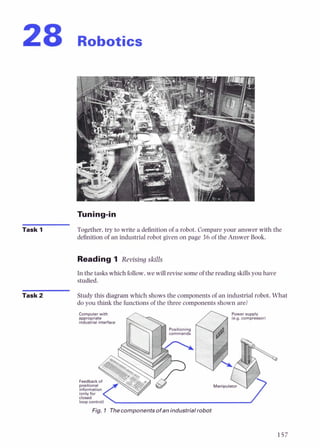
  • 127.
    23 Maglev train Task1 Study this diagram of a Maglev train. What differencescan you note between this and a conventional train? Task 2 Now scan the following text quickly to check how many of the differencesyou have noted are mentioned. Add any other differencesyou h d to your list. LEV(magneticlevitatlonttraindoesnotr . ..< j " g r r , . . T . ~ ~ ~ ~ ~ . notmdwey. Instead, magneticf* liftitabwethetrack, so M u S e t k e y I b wuvhssts,a*les, suspension, dampers, or 5 brakes,MBB1B1v e h i c l e w ~ l ~ 8 n d compact Theyarealso paflution-free, as nofuelisbumedwithinthetrain, andcheapm maintain. TheMaglevsystemat BirminghamAirportcarriespassan- tr theterminaltotherailwaystationanddheNationalExhCbfth to Centre. Thecarsaremadeof ligbveightfibrdass, wriedonan aluminiumchassis. .y~$?g,r~F? < ? q ? . $ : % ?
  • 128.
    Task 3 Alltheelectricalequipmentwhich powersthecarsissituated under the floors ortheseats. Eachcar cantake 32 passengersandtheir luggage, upto aweight of 3tonnes.Thetrains travel at a maximum i s speedof 42 kmh. A concreteguidewayabovethe groundsupportsaT-shapedtrack forthe two-car Maglevtrains. Thetrain is liftedfrom thetrack by magneticattraction.This isthe forcebywhichtwo opposite magneticpolesattracteachother (justastwo ofthesamepoles 20 repeleachother). Powerfulelectromagnetsat eachcorner ofthe train exert a pullingforcewhich liftsthetrain upwardssothat it floats 15mm abovethe track. As peopleget on andoff, the weight of the train varies. Itmaydrop closertothetrackthan the required 15mm, or risefurther from it. 25 To keepitat anevendistancefromthetrack, the force isvaried by a microprocessor. Eachtrain isdriven by an electric motorcalleda linear induction motor. Electromagneticwindings, or coils, onthe train generatea magneticfield inwhich the magneticpolesshift alongthe train. u , Thefield induceselectric current inthe track, which inturn I generatesitsown magneticfield. Thetwo fields inthe track andthe train interactsothat the shiftingfield pullsthe floatingtrain along I the track. ource: 'Inside out: Magnetic levitationtrain'. Education Guardian Reading 1 inferring Make a list of the advantages of the Maglev train. You may use the text to - helpyou. Advantages Task 4 Now list the disadvantages. You may use the text to helpyou. Disadvantages
  • 129.
    Now think aboutyour lists. You will probablyfind that most of the advantages are stated in the text. Few of the disadvantages are listed.You had to infer them, to reason them out, from your knowledgeof the world and the information in the text. Not everythingwe learn froma text comesfromthe words on the page or screen. Much of it comesfromour own head. When we read, we make mental Links between what we read and what we already know about the topic. In other words, we link new information and old to understand the text. Thiskind of reading is called inferring. Reading2 Dealing with unfamiliar words, 2 Answer this question using the extract from the text below. Why are Maglev trains solight? Because they have no wheels, axles,suspension,dampers,or brakes, Maglev vehiclesarelight and compact. In your answer, you may have used the word damper. Do you know what it means?Doyou need to know its exact meaning? We learnt in Unit 14that we can ignore unfamiliar wordswhich donot help with our reading purpose. Somewords we cannotignore, but often an approximate rather than exact meaning of a word is all that is required. Sometimeswe can work out the approximate meaning of a word from its context. For example,we can saythat dampers areprobably: 1 heavy (notlight) 2 large (notcompact) 3 part of the undercarriage (samesetaswheels, axles,suspension, and brakes) Task 5 Try to work out the approximate meaning of any of the words printed in bold in this text whose meaning you do not already know. Check your answers with a dictionary. When 6rst introduced, linear motors were seen as a major technological breakthrough.However,disappointinglyfew practical applicationshave been found forthis new develovment.An earlier innovation,the Wankel engine, was radicallydifferentfrom conventional engines, having a rotary piston and no valves. Wankel engines were adoptedby the Mazda car company. However,Wankel engines are now rarely used because of problems with fuel consumption and maintenance. The Wankel story illustrates the risksinvolvedin developing any new product -successcan mean a market leadover competitorsbut failuremeans that expensivedevelopmentcosts must bewritten &with no result. Sadly,technologicalsuperiority doesnot guaranteesuccess. Betamax video tapes, technicallybetter than their rivals. gaveway to VHSbecause of better marketing.
  • 130.
    Languagestudy Prediction Studythis diagram.What will be the result of this action? Action Twomagnets are held together with oppositepoles facing. Result When an action is alwaysfollowed by the sameresult, we can link them like this: IflWhen two magnetsare held together with oppositepoles facing, they attract eachother. IflWhen two magnets are held together with oppositepolesfacing. they will attract eachother. When an action is always followedby the sameresult, the statement becomesa generalprinciple or law. (SeeUnit 15.)Using the law, we can predict what will happen in particular cases. Predictthe result of the action illustrated here. Result Action Two magnets are held together with like poles facing. Now write the principle illustrated. If two magnets Task 6 Predict the results of each of these actions. Then Link each action and result in a sentence. Action Result 1 A steelbar is subjected to tensile forces. The bar F 4 - 1 - F
  • 131.
    We apply aneffortat E. 3 The switch is closed. 4 The switch is pressed. 3 We move the effort by one metre. b We move the effort by 50 centimetres. VR=2 7 The circuit is broken. 8 120V ac is applied across the primary. l 0 : l Y We apply an impact load to a brittle body. The block The load
  • 132.
    10 We apply24 V ac to the transformer primary. Writing Explanations Studythis diagram. It showshow a Maglev train is supported without physical contact with the track. Can you explain how this works? Levitationmagnet Levitation force t Vehicle weight doznwards on magnet The explanation consistsof a seriesof at least six steps.The first stepis: 1 Current flowsthrough the magnet coil. The last stepis: 6 The train is lifted. Canyou think of any of the stepsin between? Explanationsconsistof a seriesof steps.Somestepsin anexplanation have cause and effect links: others have time links. Here are someof the stepswhich explain how the train is lifted.What kinds of links are there between the stages? 1 Currentflowsthrough the magnet coil. 2 The current creates a magnetic field round the poles. 3 The fieldinduces a current in the track. 4 The track becomes magnetized. 5 The two magnets attract each other. 6 The train is lifted. You can show time linksusing the structures you studied in Unit 8.You can show cause and effect linksusing the structures studied in Units 16,17,and 22, and in these ways: 1+2 Currentflowsthrough the magnet coil,creating a magneticfieldround thepoles. 3+4 Thefieldinducesa current in the track;therefore the track becomes magnetized. 5+6 The two magnetsattract each other,(therebu)lifting the train. Thereby can be omitted from the last example.
  • 133.
    Study these diagrams.They explain how the propulsion system operates. Task 8 Try to completethe blanks in this set of stepswhich form an explanation of the propulsion system. Current through the motor coils. The current creates fieldsin the motor. The fields currentsin the track. The track becomes The current through the linear motor ischanged. The magnetic in the motors shift. There is and repulsion between the new motor fields and the track fields. The motor pulls the train along the to lieup the fields. The through the coils changes and the process is repeated. Divide the steps into two sets and form each set into one paragraph. Show the links between the steps using whichever method you think appropriate. Technical reading Motor selection: operating environment Task 9 What special features would you expect to see specified when rotary motors are being purchased to operate in the followingsituations? 1 In a workshop housing a wood planer. 2 In a boiler house which is regularly hosed down. 3 In a sewagepump house where the presence of methane gas can be expected. 4 To drive a centre lathe used for turning cast-iron components. Read the text on the followingpagesto checkyour predictions.
  • 134.
    Nhenchoosingadrive motorfor aparticularapplication,the . . iollowing pointsmustbeconsidered: .~ 1 Startingtoque 2 Startingcurrent limitation 5 3 Drivespeed 4 Operatingenvironment 5 Ratingandduty cycle Wewill considerherethe operatingenvironment.Attention must begivento the problemof providingsufficientcooling mediumto lo carryawaythe heatfrom the windings butatthe sametime not allowingthat mediumto carry intothe motor anything which will harm itor blockupthe cooling ducts. Particularlyharmful areoil vapour, carbon, andcast irondust.Where machinesmaygetwet, for exampleonaship's deck, moisture ingressmust beprevented 15 or suitable insulationemployed. 0 Fins & TEFC motor Drip-proof motor Screen protectedmotor protectedagainst large solid particles Motor with secondarycoolingsystem protectionagainst moat solid materialand splashingwater Fig. I
  • 135.
    Probablythe mostcommonly foundmachineisthe rotally- enclosed, fan-cooledmotor (TEFC).The motorwinding istotally enclosedinthe motor housingwhich is usually ribbed onthe outside. Afan is mounted onthe shaftexternalto the housingand 1 isprotectedby ashield. Thisfan blows air over the casing removing heatfrom the motor. Inlargersizes, there is also afan insidethe casing blowingair overthe windingstransferring heatto the casing. Where motorsare requiredto operate in explosivesituations, the motor must beof flame-proof construction.This meansthat it must be enclosedinsucha mannerthat any explosionwhich may occur withinthe motor must becontainedwithin the motor. Often it is easierto preventexplosivegases enteringthe motor. Ventilated motors are usedwhich draw air from an uncontaminatedarea. Th~s ) is pumpedintothe motorwhichkeeps its internal pressureabove that of itssurroundings. Fig. 1illustratesavariety of protectedmotors. Source:Adaptedfrom D.W.Tyler, ElectricalApplications
  • 136.
    24 Computer AidedDesign Fig. 1 Task 1 Study the example of Computer Aided Design in Fig. 1.Answer these questions about the diagram. 1 What structure does it show? 2 Apart from the design, what other information does the drawing provide? 3 What do you think the top row of words are f o r File, Edit. Constrain, etc..; Listening Task 2 You are going to listen to an interview with a designer of car engines. He describes some of the advantages of CAD over traditional approaches to design -for example, drawing and modelling. Before you listen, list any advantages you think CAD has over these traditional approaches. Task 3 Study the following extract from the tapescript of the interview. It covers the interviewer's first question and answer. Fill in the gaps before you listen. One word is missing from each gap. Then listen to this part of the interview to check your answers.
  • 137.
    Interviewer: What doyou like about designingon computer? Designer: The fact that you ' get into three dimensions immediately.You don't ' to imagine how a component will from two-dimensionaldrawings. You can put your thoughts into the solid without to go via paper. You can see,in the mind's 5 exactlyhow the components fit together or fit, and you can modify,replace, and generally tailor parts very quickly as ideas ' to you. Task 4 B Now listen to the tape and list any advantages of CAD. Combineyour answers with others in your group to make as full an answer as possible. When you have finished,compare your answers with the list you made in Task 2. Task 5 a Work in pairs, A and B. Listen to the whole tape again. StudentA: Note any disadvantages of drawing in the table below. StudentB: Note any disadvantages of modellingin the table below. Now compare notes to completeboth sectionsof the table. Disadvantages: Drawing Modelling Task 6 The designer mentions these components of a design cycle. Put them in the correct sequence. study results, modify design, stressanalyse,design,stressanalyse Languagestudy Necessity:have to and need (to) Study these examplesfrom the interview. 1 Youdon't have toimagine how acomponent will lookfrom two dimensionaldrawings. 2 ...at the end ofthe day modelshave tobeconverted back intodrawingsfor manufacture. 3 Normally oneneeds togo round the circle at leastfour times. 4 WithCAD,you need not describesuch afeature more than once. Have to and need (to)can both be used to express necessity. In this sense,they are similarto must. Must is a modal auxiliary verb and has no other forms, whereas have to and need (to)have the samerange of formsas other verbs. The table opposite shows ways of expressingnecessityand no necessity in the present.
  • 138.
    +necessity -necessity have todo not have to need to need not or do not need to must - Fill in the blanks in these sentences with appropriate forms of the verbs in the table above. 1 Designerswho work with CAD produce drawingson paper. 2 The production planner can use the computer model to calculate what machining be done. 3 One problem in working with wood or claymodelsis that they be converted into drawingsfor manufacture. 4 With traditional design,you imagine a three-dimensional shape from a two-dimensionaldrawing. 5 With CAD,designerscan put their ideasinto solid shapes without use paper. 6 In engineering drawing repeated features be drawn again each time but with CADthey be redrawn. 7 Making cars lighter mean making them flimsier or less safe.
  • 139.
    How do yousee the car of the future? (Think carefully.) Task 1 Study the following recent Vokswagen survey on the car of the future.Decide in your group which developments in the survey are important to you. One person should report the group'sviews to the rest of the class. What changes would you like to see? We've suggested afew possible developments. Pleasethink carefully about which ones would make a real difference to you and tick the boxesto let us know. Design The opportunity to use alternative fuel sources like hybrid (petroland diesel) or hydrogen power. A car that is an office away from work, with facilities such as a fax machine and video-conferencing. Safety Speed limitersthat vary to give you the safest possible drive f o ~ the weather and road conditions. Acomputer sensorto tell you ifyou're driving at a safe distance from thevehicle infront. Automatic engine and fuel supply cut-out inthe unfortunate event of an accident. All-round airbags.
  • 140.
    Engineimmobilizer which makesitvirtually impossiblefor anyoneelseto drive your car away. A tracking devicewhich allowsthe car to be locatedfast if it is stolen. Audio systemsbuilt intothe chassisor engine of the vehicleto preventtheft. Performance Sportscar performancecombinedwith fuel economy. Acomputerized routefinder which tells you the quickestway to get to your destination. Servicingby mobile unitsto save lengthyvisitsto agarage. Source:V.A.G. (UK)Ltd Task 2 What do you think will be different about cars in the next ten years?Think about the followingpoints. Compare your ideas with other groups. - materials - design - power - fuel Task 3 Read this title and introduction to a text. Try to guess the answers to the questions which foll--7 if*:.$,.*^ 2 . . '.... Supercartestfor Matthew L.Watd on the technicalissuesthe President's environmentally-friendly carfaces ... 1 Who is the President? 2 Who is Matthew L. Wald? 3 How can a car be environmentally-friendly? 4 Why might a car be called a Supercar? 5 What test does industry face? Now read the first paragraph of the text. Does it help you to answer the questions? The 10-yearco-operativeproject betweengovernmentand Detroit for an environmentally-correct supercarwill requireradicallynew technologiesfor solving the car industry's problems: air pollution, over-relianceon imported oil, and lossof marketshareto imports.
  • 141.
    Reading Predicting: usingfirstsentences In earlier units we studiedhow reading the title and using diagrams can help you predictthe contents of a text. As we saw above,reading the firstparagraph can alsobe very helpful. Afinalway to get a good idea of the contents of a text isto read the first sentenceof each of the otherparagraphs. Task 4 Read these first sentences: then note down what you think the main points of the text are. 1 Somesay it cannot be done but others say various components could be pulled together to do thejob: electricmotors with batteries, fuel cells or flywheels to deliverelectricity,plus lightweight, aerodynamic car bodies. 2 Instead of steel,someother type of material would be necessary for the 'supercar' body, somekind of compositeor carbon fibre. 3 Safetyisanother issuebut lighter need not mean flimsier. 4 Reducingbody weight and wind resistance will make any car more efficient. 5 Electronicscan,however. 6 Four possiblepower sources are being investigated. 7 Another possibility is fuel cells,which combineoxygenfrom air with hydrogen to make electricity. 8 Yet another approach would be a flywheel, an electricalgenerator consistingof free-spinningwheelswith magnets in the rims that can produce a current. 9 Afourth possiblepower source for the national supercar would be a small turbine engine,running on a clean fuel like natural gas. Task 5 Read one of the followingtexts as your teacher directs:A, B.C, or D. Note in this table any information you find on solutions to the problems of designing the Supercar. Text A Materials B Shape C Power D Power source Solution Reason@) Problem Now share your information with others in your group to complete the table. TextA Some say itcannot bedone butotherssay variouscomponents couldbe pulledtogetherto dothejob: electric motorswith batteries,fuel cells orflywheelsto deliverelectricity, plus lightweight,aerodynamiccar bodies. t
  • 142.
    Insteadof steel, someothertypeof materialwouldbenecessary for the 'supercar' body, some kind of compositeor carbonfibre. Such materialsare availablenow, butare notconsideredcost competitive with steel. Buta researchcentrein Coloradoclaims I that compositescan 'emerge from the mouldvirtually readyto to use'. The resultwould befewer partsand lesslabourthan current car bodyconstruction and, therefore, lesscost. Safetyisanotherissuebut lighter neednot meanflimsier. The centrepointsto lndy 500drive rext B *,dynamic drag accountsfor moreand moreof the energy I requ~red to movethe car as speed rises. The car makersalready know howto cut dragsharply. GeneralMotors' lmpacthasabout halfthe drag of atypical car. The lmpacthas a roundedfront anda 5 taperedback. Itisalso smallto presentless othe ...:-A *.*,%,T Reducingbodyweight andwind resistancewill makeany car more efficient. But roughly equalto the wind in eating upthe car's energy isbraking, and internal combustionenginescannot do muchabout that. 5 Electronicscan, however. Nearlyall electricdesigns use regenerativebraking.Whenthe driver hitsthe brakethe motors becomegenerators,convertingthe mechanicalenergyof the slowingwheals intoelectricity.That capability virtually guarantees that asuper-efficientcar will havean electric motor. Text D L Fourpossiblepowersourcesare being investigated.The simple one isbatteries. But if asuper-efficientcar isto havean attractive - cruising range, itcannotcarry hundredsof pounds in batteries. Another possibility isfuel cells, which combineoxygenfrom air 5 with hydrogento makeelectricity. Butcurrent fuel cellsoperate steadily, and acar cell would haveto handlewidely varying demandfor energy: zero, while stoppedattraffic lights, or several timesthat consumedby an average house, while accelerating. Yet anotherapproachwould beaflywheel, anelectricalgenerator consistingof free-spinningwheelswith magnets inthe rimsthat can produceacurrent. An early applicationofflywheels might bein a racecar builtfor atwistingcourse, wherefrequent brakingmeans highfuel consumption inconventionalcars. -Afourth possiblepowersourceforthe nationalsupercarwould be I =a smallturbine engine, runningon acleanfuel like naturalgas. It I Task 6 Readthe whole text yourself. How much did the first paragraphand the first sentences of the other paragraphshelpyou to predict the main pointsof the whole text?Which first sentences were not very helpful?Why not?
  • 143.
    Language study Certainty Studythese statements. What is the differencebetween them?Can you put them in order of certainty: 1 A supercar will have an electric motor. 2 A supercar might have ajlywheel. 3 It is likely that asupercar will have a roundedfront. The differencebetween the statements is how certain the writer is about each development.Study this list of certainty expressions. Certain Fairly certain Uncertain Yes will will probably might be +likely +vb may be +probable that could will possibly be +unlikely to +vb be possible that No will not Task 7 Comment on how likely these predictions are for the next decade, using an appropriate expression from the table above. For example: 1 A human powered vehicle (hpv)will exceed 100kmjh. It ispossible that an hpv willexceed 100 kmlh. 2 Aperpetual motion machine will be invented. Apcrpetual motion machine will not he invented. 3 More factories will be fully automated. It is likely that morefactories will befully auton~atpd 4 Driverlesstrains will link major cities. Driverless trains might link major cities. 1 Electric cars will become common. 2 Most bicycles will have carbon fibreframes. 3 A more efficientpetrol engine will be developed. 4 More people will travel by public transport. 5 Robots will be used in homes. 6 Fewer engineerswill be required. 7 Diesel engines will replace petrol engines for cars. 8 Most waste materials will be recycled. 9 An ideal electric motor will be invented. 10 Physicists will reach absolute zero (-273'C). Study these statements. Why is will used in the tirst sentence and wouldin the second? 1 A supercarwill have an electricmotor. 2 Apossiblepower source would beu turbineengine In sentence 1the writer feelscertain this will happen. In sentence 2 the writer feelsthis is only a possibility because it depends on circumstances. We use would to describe futureevents which can only happen if certain conditions are met. Study these examples from the text. Another approach would be a flywheel. ( y asupercar were built.) The result would be fewer parts and less labour. (Ifmouldedcomposites were used.)
  • 144.
    Task 8 Whatwould happen if these conditions were met? 1 If all cars were made of plastic- -. 2 If all cars had dieselengines - 3 If powerful,lightweight batteries were developed - 4 If all cars were fitted with flywheels 5 If speedlimits were reduced Task 9 What conditions are necessary for these events to happen? 1 All car parts would be recyclable. 2 Carswould travel 40 km/litre of fuel. 3 Carswould costmuch less to produce. 4 Cars would not require painting. 5 Carswould not require lubricants. Writing Summaries Thebest way to make a summary of a text is to write down the main points in note form and then Link them clearly in your own words. If you are summarizing for others, make sureyou do not over-summarize,that is, reduce the text to the point that no one but you can understand what it means. Task 10 Study these notes which summarize the Supercar text. Text A Materials B Shape C Power D Powersource Solution Reason@) Composite,carbon fibre fewer parts, less labour rounded front, tapered back, small reduce drag electric motor allowsregenerative braking Problem 1 batteries weight 2 fuel cells cannot cope with varying demand 3 fly wheel - 4 gas turbine with generator - Now convert each sectionof the notes into one or two sentences. Use the certainty expressionsyou studied in this unit. For example: The Supercarwill havean electricmotor because onlyelectricmotorsallow regenerative braking. Ifyou think that your reader will not understand particular terms, definethem. For example: TheSupercarwill have an electricmotor becauseonly electricmotorsallow regenerative braking, that is,converting brakingpowerback intoelectricalenergy. Finally,link your sentences into paragraphs. You will need at least two. - materials, shape, and power - possible power sources You will alsoneed to add a brief introductory paragraph stating the objectives of the Supercar project.
  • 145.
    26 Graphs In engineering,graphs and charts are a common way of givinginformation. They allowa great deal of data to be presented easily in visual form. Task 1 Label the following graphic displays with the correct term from this list: graph pie chart bar chart bar chart (columnchart) Female students as a percentage of all students En ineering All courses teclno~ogy What goes wrong most @ washing machines @ I - 9 - d- c l e a n e r s @ tumble-driers Repairs in the first four years @fridge-freezers $:E2isl CBchestfreezers I I I I I I I I 0 2000 4000 6000 Engine speed (rpml 0z g h t freezers Task 2 Study the graph opposite which shows typical daily load curves for a power station. Answer these questions about the graph for weekdays. 1 When is the peak load? 2 When is there least demand? 3 When is the load 65%of capacity? 4 What is the load at 1p.m.?
  • 146.
    Fig. 1 " ,100 90- % -0 80- P g7 0 - 0 2 60- m 50 40- 30- - E 2 0 - 0 10- 0 O O Describechanges in load for these periods: J & 4 Typical daily load curves far a . power station. The load is recorded in hourly steps. 1 " " " " 5 Between 6 a.m. and 10a.m. 6 Between 7 p.m. and midnight. 7 Between 3 p.m. and 5 p.m. M 2 4 6 8 1 0 N 2 4 6 8 1 0 M am Time pm Language study Describing graphs Look at the period 6 a.m. to 10a.m. We can describethe change in load in two ways: 1 The load rises. 2 Thereis a rise in load. We can make our descriptionmore accurate like this: 3 The load rises sharply. 4 Thereis a sharprise in load Studythis table of verbs and related nouns of change. Thepast form of irregular verbs is given in brackets. Direction Verb UP climb go up (wentup) increase rise (rose) Down Level decline decrease dip drop fall (fell) go down (wentdown) not change remain constant Noun increase rise decline decrease dip drop fall no change
  • 147.
    These adjectives andadverbs are used to describe the rate of change: Adjective Adverb slight slightly gradual gradually steady steadily steep steeply sharp sharply sudden suddenly fast fast Task 3 Study this graph which shows the load at weekends. Typical daily load curvesfor a power station. The load is 0 80 recorded in hourly steps. Task 4 !5:1,,, , , , , , , , 1 0 0 M 2 4 6 8 1 0 N Z 4 6 8 1 0 M am Tme pm Fig.2 Write sentencesto describe the load during these periods. Saturday. 8 a.m. to noon. Saturday. 6 p.m. to 10p.m. Saturday. noon to 5 p.m. Saturday, noon to 1p.m. Sunday. 2 a.m.to 8 a.m. Sunday, 8 a.m.to 9 a.m. Sunday, noon to 3 p.m. Sunday, 5 p.m. to 10p.m. Look at Fig. 1and Fig. 2. Make comparisons of these periods. For example: Sunday. 4 a.m.to 8 a.m./weekdays at the sametime. OnSunday the load remains ronstant between 4 a.m. and 8 a.m. but on weekdays it rises sharply. Sunday, noon to 3 p.m./Saturday at the sametime. Weekdays. 10p.m. to 11p.m./Saturday at the sametime. Saturday peak IoadJSundaypeak load. Sunday,noon to 1p.m./the rest of the week at the same time.
  • 148.
    Word study Commonverbs in engineering Study this list of common verbs in engineering which you have studiedin this book. They allhave the senseof 'make something happen'. lower make low raise make high heat make hot release make free compress make smallervolume reduce make smaller increase make larger Task 5 Fill in the blanks in these sentences with suitable verbs from the list above. 1 When thermoplastics are .they soften. 2 Ifa gasis .it heats up. 3 Refrigerationpreservesfood by - . its temperaturr. 4 A heater . the temperature of the water. 5 The rising piston the fuel mixture. 6 Designers try to the weight of a structure. 7 When the push button is ,the valve spring pushes up the spool. 8 Pumping fluid into the main cylinder gradually the jack. 9 Aerodynamicdesign . wind resistance. 10 The motor starts up slowly,then gradually speed. 11 At intermediate substations,power is to 11kV for light industry. 12 When the child the handle. the seat swingsback under the weight. Writing Describing a graph An important mechanical test of a metal is the tensiletest to destruction. Increasing loads are appliedto a specimenof the metal until it breaks. For a mild steelspecimen,a graph of load against extension looks like this:
  • 149.
    Task 6 Task 7 a b C d e Task8 The following sentences describe the most important stages of the test. With the help of the graph: - put the stagesin the correct sequence to form a text describingthe graph. - fillin the missing references(0.P. E, Y. U. F) F r o m - to the specimenextends in direct proportion to the load applied. Thisrapid extension continues until point ,the maximum load,is reached. From there is a rapid increase in length foreach increase in load. A t the specimen finallyfractures. A f t e r - the specimenlengthens further but the load falls. Soonafter P the material reaches its elasticlimit,marked on the graph as point Add this extra information to your text. Up to the elasticlimit,the steelwill regain its original length when the load is removed. Up to U there is no change in the cross-sectionof the steel. After the elasticlimit,the steelwill not regain its original length. After U the specimen undergoes 'waisting'. Y is the yield point. Refer to each of these figures at an appropriate place in your text. Use expressionssuch as these: As shown in Figure A. See Figure A. (Figure A)
  • 150.
    Technical reading Propertiesand applications of carbon steels Task 9 Study the diagram below which shows how tensile strength, hardness. and ductility vary with the percentage of carbon in carbon steels.Answer these questions: 1 What percentageof carbon givesthe greatesttensilestrength? 2 What happens to ductilitybetween0.08%and 0.87%carbon? 3 How doesincreased carbon atYecthardness? 4 What isthe effecton tensilestrength of increasingcarbon beyond 0.84%? 5 What happens to ductility beyond 0.87%carbon? / / 0.08 0.15 0.35 0.55 0.85 1.05 1.20 %Carbon Propertiesof carbon steels Task 10 Now study the diagram below for extra information and answer these questions. 1 What ishigh carbon steel? 2 How much carbon doestool steelcontain? 3 Comparethe properties of mild steeland hard steel. 4 What kind of steelistin plate made from? 5 What kind of steelarecar springsmade from? 0.08 0.15 0.35 0.55 0.85 1.05 1.20 %Carbon Propertierand applicationsof carbon steels
  • 151.
    27 waste recyclingplant Aluminium can recycling. The bales seen here contain over one million cans. Task 1 You are going to read a text on recycling domesticrefuse. The main components of refuse are given in the list below. Using your knowledge of engineering, discuss in your group how one of these components could be recovered from refuse and what use could be made of the materials recovered. Your teacher will decide which component each group will discuss. Ferrous metals Glass Plastics Paper Organic materials Non-ferrous metals Task 2 Now report your solutions to the rest of the class. Be prepared to answer questions and defend your ideas.
  • 152.
    Task 3 Readthetext below to see how the solutions proposedby your class compare with those usedin the experimental plant described. Recyclingdomestic refuse The consumer society producesmoreand more refuse.A number of solutionstothis problem havebeenproposed. Insomecountries refuseisburntto generateelectricpower. InGermany, producers musttake back unwantedpackagingfor recycling. Inother 5 countries, householdersare askedto separateout refusesothat it can be recycledmoreeasily.Thistext describesan experimental plant in Hollanddesignedto recycledomesticrefuse. The rubbishcollectedfrom householdsconsistsof a mixtureof organic materialssuch as kitchenwaste, and inorganic materials lo such asglassandplasticbottles, tin cans, andpackaging. The rubbish isfirst passedthrough a hammermillto shreditThe millconsistsof rotating steelarmswhich break upany large items to reducethem to amore manageablesize. Any itemswhich may causedamage later inthe processare rejectedat this stage. 15 The shreddedmixture passesunderan electromagnetwhich removesferrous metals. Muchofthis istin cans. Almost allferrous metalsare recoveredinthisway. After that, the residue iscarriedbyconveyorbeltto anair classifier. Astream of air isblownthroughtheclassifier, which hasazig-zag zo shape. Lowdensity materialssuch as plastic, paper, and some organic substances riseto the top of the classifier. Higher density materialssuch as glass and non-ferrousmetalsfall to the bottom andare discarded.Thesecould befurther separatedout using a rangeof processes. Forexample, aneddy current mechanism 25 couldscreenout aluminium waste. Frothflotationtechniques could recoverglass. The lowdensity portion iscarriedto a rotating drumwhere it is screeiied. Fineorganic materialspassthroughthe screenleavinga mixturewhich consists mainlyof plasticandpaper. Theorganic 30 residuecan be usedfor compostor to makebricks. The nextstage isto separatethe plasticfrom the paper.Thiswas initially a problem as bothare similar in density.Thesolution isto wet the mixture. The paperabsorbswater and as a result becomes denserthan the plastic. 35 Inthefinal stage, thewetted mixture ispassedthrough asecond air-classifierwherethe lighter plasticleavesfrom the top andthe denserwet paperfromthe bottom. The recoveredpapercould b fed to pulp millsfor further recycling. The remaining plasticisa mixture of thermosetsand 40 thermoplastics.Itis noteasyto separatetheseout butthe mixtutu can be meltedandformed intoinsulating materialsfor building.
  • 153.
    Reading Transferring information,making notes Plastic I - miflure - i Air classifier - h - Water sprays I 3 e - I Task 4 Using the information in the text, completethe labellingof the flowchart. Add these labels: plastic and paper mixture air classifier high density materials rotating drum shreddedmixture ferrousmetals paper wetted mixture fineorganicmaterials I f Task 5 Study these notes on the first stage of the recycling process. They contain information on location (Where?),action (What happens?),reason (Why?),and method (How?).Read the text again to complete the notes for the other stages. Stage 1 Hammer mill Where? hammer mill What happens? the waste is shredded a - - Why? b to reduce it to a manageable size Electromagnet Low r. density materials How? using rotating steelarms to break up any largeitems Stage2 Where? What happens? How? by magnetism Stage3 Residue . : Where? What happens? high and low density materials are separated How? by a current of air which carries low density materials to the top while high density materials fall to the bottom - - C -
  • 154.
    Stage 4 Where? What happens? Why? Stage5 What happens? Why? Stage 6 Where? What happens? How? the low densityportion is screened to give the paper and plasticdifferentdensities - by a current of air which carries low density plastic to the top while wet paper fallsto the bottom Languagestudy Possibility: can and could Answer these questions about the text. 1 Does this plant screen out aluminium waste? 2 Does it recover glass? 3 Is recoveredpaper fed to pulp mills? 4 Is recoveredplastic melted and formedinto insulating blocks? 5 Is organicresidue used for compost and bricks? The answer to questions 1.2,and 3 is No. The answer to questions 4 and 5 is YeslMaybe. How do we know?Look at the text. 1 An eddy current mechanismcould screen out aluminium waste. 2 Frothflotation techniques could recoverglass. 3 The recovered paper could befed topulp millsforfurther recycling. 4 The mixture can be melted andformed into insulating materialsfor building. 5 The organic residuecan be usedfor compost or to make bricks. We use could in examples 1.2,and 3 to show that something is possiblebut is not in fact done. The reasons why nothing is done in these examplesmay be expenseor lackof demand. We do not know. We use can in examples4 and 5 to show that something is possible and may in fact be done. Task 6 Fill in the gaps in this text with either can or could. Be prepared to justify your answers. 1 With present technology we recycle almost all domesticrefuse. But in practice market forcesdetermine what is worth recycling. 2 Successfulplants in a number of countries show that refuse b c used as a fuel in power stations. 3 If we recycled most of our refuse,the increasing problem of waste disposal be solved.
  • 155.
    4 Sweaters beproduced from old plastic bottles. A company in the United Statesconverts the waste plastic into polyester yarn. It takes twenty-five two-litrebottles to make a sweater. 5 At present we not easilyseparatethermosettingplastics from thermoplastics. Writing Describing aprocess. 4:reason and method In Units 13and 15we learnt how to sequence and locate the stagesin a process. In this unit we will study ways to describe and explain what happens in each stage. Look again at the notes on Stage 1. Stage 1 Where? What happens? hammer mill the waste is shredded Why? to reduce it to a manageable size How; using rotating steelarms to break up any largeitems Note how we can combineinformation on sequence,location, process, reason. and method. For example: Sequence+location The wastefirst passes toa hammer mill +action The wastefirstpasses toa hammer mill, whereiti s shredded +reason The wastefirstpasses toahammer mill, where it is shredded to reduce i t toa manageable size The wastefirstpasses toahammer mill,where it is shredded to reduce it to a manageablesize using rotating steel arms tobreak up any large items. Task 7 Combine information on the other stages in the same way to make a full description of the recycling process. Note that you can help your reader understand the sequence by carrying information from one stage to the next. For example: Stage 1 The waste is shredded. Stage 2 Theshredded waste ... Stage 5 The~nixture is wetted. Stage 6 Thewetted mixture ...
  • 156.
    28 Robotics Tuning-in Task 1Together, try to write a definition of a robot. Compare your answer with the definition of an industrial robot given on page 36 of the Answer Book. Reading 1 Revising skills In the tasks which follow,we will revise some of the reading skillsyou have studied. Task 2 Study this diagram which shows the components of an industrial robot. What do you think the functions of the three components shown are? Computer with appropriate 1e.g. eornpressorl industrial interface Fig. 7 Thecomponentsofanindustrialrobot
  • 157.
    Task 3 Nowread this text to check your ---.'rers to Tasl .,, ,. . The manipulator , , , .. . . This isthe bit which actuallydoesthe mechanicalwork, and inthis case it isanthropomorphic ii.e. of human-like form),resemblingan 5 compressor.I"smaller, lightweight versionswhich useelectrical stepper motors ratherthan hydraulicsor pneumatics,this would be I omitted. 1 The computer Thecontrolling computer isfined with appropriateinterfaces. Thesemay includedigital inputs, digital outputs, ADCs (analogue- l o to-digitalconverters), DACs(digital-to-analogueconverters),or stepper motorcontrol ports.Thesecontrolthe various compressors, stepper motors, andsolenoids, andreceivesignal, I fromthe manipulator's sensors. . -- I Task 4 Read the following text to find the answersto these questions. 1 What is the work volumeof amanipulator? 2 What is the work volumeof ahuman? 3 Why is the work volumeof ahumangreaterthanthat of anindustrialrobot? 4 What aredegreesof fre-Jn~2 - Work volume Robotsare multifuncti manipulator is its'work volume': the volume ofspace intowhich it can be positioned. The greaterthe workvolume, the more extensivethe rangeof tasks itcan be programmedto carryout. 5 As a humanbeing, your work volume consistsof allthe placesyour handscan reach. Mostindustrial robotshavea muchmore limited work volume becausethey areboltedto the floor. Evenwith the same limitation applied, however, the humanbodyisavery flexible machinewith aworkvolume described-verv ro approximately-byacylinder about 2.2 m highwith aradiusof about 1.8 m and adomedtop. - o f - Inorderto achieveflexibility of motionwithin athree-dimensional space, a robot manipulator needsto beableto move inat least three dimensions.Thetechnicaljargon isthat itrequiresat least 15 three 'degrees of freedom'. Figs. 2a-d show a numberof the more commontypesof robot manipulator mechanisms. Eachhasthe requisitethree degreesof freedom, allowingeither linear or
  • 158.
    Reading2 Transferringinformation Task 5Study the text and accompanyingdiagram (Fig. 2a) below and note how the information has beentransferred to Table 1 . Fig. Type Degreeso ffreedom Work volume - linear rotational 2a Cartesianor rectilinear 3 0 cube Table 1 Commontypes of manipulator Fig. 2a isthe simplest. Itsthree degreesof freedomare all linear andat rightanglestoeacholher, sothey correspondto thethree Cartesianco-ordinates. Drivingitpresentsno mathematical difficulties, sinceeachdegreeoffreedom controls asingle 5 Cartesianco-ordinatewithout affectingthe others. Fairlyobviously, thework volume ofthe Cartesianmanipulator isacube. . . . . -. . ,. .. . . ..." Task 6 Work in groups of three. Your teacher will select a text for you. Readthe text and diagram to completeyour section of Table 1. Text 1 Thesecondtypa of manipulator, shown inFig. ro, IS calleo a cylindrical manipulator becauseofthe shape of itswork volume. It hasone rotationalandtwo lineardegreesoffreedom. Becauseof the rotational aspect, however,the maths neededto position it becomesmoreinv agiven response ed % " * e a n % w - P - + x - . I
  • 159.
    Text2 ere, and onceagainthecomplexityof positioningthe device T a t 3 Thefinal type of manipulator hasthree rotationaldegreesof freedom. This isthe mostcomplextype to control, but it has increasedflexibilitv. Fia.2dshowsthistvve of manivulator-the anthropomorphicarm.~he work volume'of a practicalmanipulator i of this form isshown inFig.3. You will noticethat it is basically sphericalbut hasmissing portions dueto the presenceof the arm itself and becausethe rotationscannot achieveafull 360degrees. The scallopson the innersurface arecausedbvconstraints imposedbythejoints. 1% -
  • 160.
    p~ Task 7 Nowexchange information with the others in your group to complete the table. Task 8 Complete the blanks in this text. Mechanicalwrist It is worth pointing ' that a human arm has far more freedom 2 the minimum three degreesof freedom,givingvery great 3 flexibilityin terms - positioning,path taken, and angle of approach. Even without a wrist, the redundant degreesof freedomof the 4 -body would allow you to carry out most normal operations. Any of the basic manipulators shown ' Figs. 2 a-d. on the other 6 ,would be virtually useless as they stand. Although they could get to any position,they ' only approach objectsfrom a single angle. To take an ,removing a screwwould be impossible
  • 161.
    the manipulator couldnot align a screwdriverto fitthe screwproperly. Even if it was ableto, it stillwould lo be possibleto carry out the necessarv rotating action. A wrist is thereforeaddedto most basic manipulatorsto 'l the requiredmechanicalflexibilityto l2 realjobs. In general,for total flexibilitythe wrist itself requires three degreesof freedom,thereby bringing the grand total up to six. The l 3 common type of wrist has two bending and one rotational degreesof freedom. Pig. 4 showsthis type of mechanical wrist. Fig. 4 A typicalmechanicalwrist Languagestudy Concession:even if and although We can use if(see Unit 11)to link two statementslikethis: 1 Theswitchis on. 2 The lamplights. uthe switch ison, thelamplights. When statement 1is true, statement 2 is also true. When statement 1surprisinglyhas no effecton statement 2, we can use even ij or although.For example: m 1 The switchis on. 2 The lampdoesnot light. Evenifthe switch is on,thelampdoesnot light. Although the switch is on, thelampdoesnot light.
  • 162.
    Task 9 Acar is fitted with a seat belt warning Light. The light operates under these conditions: Seatoccupied Ignition Belt Light Yes On Closed Off Yes On Open On Yes Off Closed Off No Off Closed Off Studytheseexamplesof normal and faultyoperation: Normal I f the seat is occupied, the ignition onand the belt closed, the light is oh. Faulty Evenifthe belt is closed, the light stays on. Although the belt is closed, the light stays on. Giveother examplesof normal and faultyoperationof this circuit. Technical reading Stepper motors Task 10 Read the text which followsto 6nd the answers to these questions,then complete the table. 1 Why wouldyou use a steppermotor to position the head of a disk drive unit? 2 Name two componentsthat are present in other electricmotor typesbut absent from steppermotors. 3 For accuracyin positioning,would you selecta stepper motor with a largeor a small stepangle? Type Advantages Applications Variablereluctance No detent torque High dynamictorque at low speed Hybrid type Goodspeedltorque characteristics Canbe made very small. very efficient Steppermotorsare usefulwherever accuratecontrol of movement isrequired. They are usedextensivelyinroboticsand in printers, plotters andcomputer diskdrives, allof which requireprecise positioningor speed. Ina plotter, for example, by usingtwo motors running at 90degreesto eachother, they can beusedto drive a pn an exactdistanceinall directions. Inrobotics, they areusedto positionmanipulatorsexactlywhere required. >.Te a d
  • 163.
    : . hr * a i . t i . d &-hd'.*&.-. r . < <*..A stepper motoi%is not run K%e sameway as a nor . . . motor, i.e. continuously rotating. Instead, it runsinaseries of lo measuredsteps. Thesestepsaretriggered by pulsesfrom a computer, each pulse makingthe motorturn either inaforward o a reversedirection byanexact interval,typically 1.8,2.5,3.75,7.5 15, or 30degrees.Accuracy iswithin 3%to 5% of the laststep. Fig.5a The rotor inastepper motor is maonetswith northandsouth - series of electromagnets, usuallyfour, which can beswitchedon and off. Figs.5a and b illustratethe operationof a permanent magnet-typesteppermotor. Whencurrent isappiiedto the stator coils, itcreatesthe polearrangementshown inFig. 5a. Poles 1and 20 2are north. Hence, the rotor southpole isattractedto bothofthem andsettles inthe midposition asshown. Whenthe statorcurrents arechangedto producethe polearrangement shown inFig. 5b. pole 1hassouth polarity.This repelsthe rotorwhichmovesto the new position asshown. Eachpolaritychangeonthe statorcauses 25 the rotorto move (inthis case)45 degrees. Steppermotors can bedivided intotwo groups. Thefirst oneworks without apermanentmagnet.The secondone hasa permanent magnet, usuallylocatedonthe rotor. Variable reluctancemotorsform the first group. As there is no 30 permanentmagnet, the variable reluctancemotor haspractically nodetenttorque. The rotor spinsfreely andgivesgood accelerationand highspeed if lightly loaded.Applications include micropositioning tables. The second group comprisethe permanentmagnetmotor, the 35 hybrid motor, andthe disc magnetmotor. The permanentmagnet type offers highdynamictorque at lowspeed and largestep angles.This isa lowcost motor usedextensivelyin low inertia applicationssuch as computer peripheralsand printers. The hybridtypecombinesfeaturesof bothtypes mentioned above. 40 Ithasgoodspeed/torquecharacteristicsand micro-stepping capability. Stepsof 1.8 degreesare possible. Discmagnet motors can be madevary small and arevery efficient. Oneoftheir firstapplicationswas inquartzsontrolled watches.
  • 164.
    29 careers inengineering Task 1 List some of the jobs in engineering.Combineyour list with others in your group. Task 2 Work in groupsof three.A. B, and C. Scan your section of this text.A, B,or C. How many of the jobs in the combinedlist you made in Task 1are mentionedin your section? b~fessionalengineers mayworka 8 : W g nengineers:Theywork as pMtotateainto Createnew I productsandextendthe lifeofoldproducts4updatingthemand hndkwmm awlkationsfor them. Their aim isto builda u a l iand 5 reW&tykihedesi@n andt o i n t r o d u o s n e w c o m ~ e k d materielstomeketheproductcheaper, lighter, orstronger. installationengimrs: They work onthecustomer's premisesto installequipment producedbytheircompany. ProductionengineersThey ensurethatthe productionpr- is I10 dcient. that materialsarehandledsafeIvandcorrectIv, andtha ! k faultswhich inproductibnarec o f r ~ . Thed&in and -- partme msed a
  • 165.
    B Just belowthe professionalengineersarethetechnician 15 engineers.They requireadetailedknowledgeof a particular technology-electrical, mechanical, electronic, etc. They may leac teamsof engineeringtechnicians.Technicianengineersand engineeringtechniciansmaywork as: TesZ/Laboratorytechnicians:Theytest samplesofthe materials zo andofthe productto ensurequality ismaintained. Installationandservice technicians They ensurethat equipment sold bythecompany is installedcorrectly andcarryout preventativemaintenanceandessentialrepairs. Productionplanningandcontroltechnicians: They producethe 25 manufacturinginstructionsand organizethe work of production s- that itcan bedoneasquickly, cheaply, andefficiently as possible. Inspectiontechnicians Theycheckandensurethat incoming and outgoing componentsand productsmeetspecifications. Debugtechnicians Theyfault find, repair, andtest equipment anc 30 productsdownto component level. Draughtsmeniwomenanddesigners They producethe drawings anddesigndocumentsfrom whichthe product ismanufactured. The nextgradeare crafismenlwomen.Theirwork is highlyskilled and practical. Craftsmenandwomen maywork as: 25 Toolmakers:They makedies and mouldingtoolswhich are usedto punchandform metalcomponentsand produceplastic componentssuch as car bumpers. FittersTheyassemblecomponentsinto larger products. Maintenancefitters:They repair machinery. 40 Welders: They do specializedjoining, fabricating, and repairwork. ElectriciansTheywire and installelectricalequipment. Operatorsrequirefewer skills. Manyoperatorjobsconsist mainly of minding a machine, especiallynowthat moreand more processesare automated. However, someoperatorsmay haveto 45 checkcomponentsproducedbytheir machinesto ensurethey are accurate.They may requiretraining inthe useof instrumentssuch as micrometers, verniers, or simple 'golno go' gauges. Source:Adaptedfrom S. Moss&A.S. Watts, CareersinEngineering,3rdedition Task 3 Combine answers with the others in your group. How many of the jobs listed in Task 1are mentioned in the whole text? Task 4 Who would be employed to: 1 test completed motors from a production line? 2 6nd out why a new electronicsassemblydoesnot work? 3 produce a mould for a car body part? 4 seethat the correct test equipment is availableon a production line? 5 find a cheaper way of manufacturing a crankshaft?
  • 166.
    6 repair heatingsystemsinstalledbytheir company? 7 s e ethat anewproductissafe to use? 8 commissionaturbinei napower station? Reading Inferring from samples InTask 5 below andintheListening(Task 7), youareaskedto inferfrom a smallsampleoftext informationwhich is notclearlystated. Usethe cluesinthe samples andthe knowledgeyouhavegainedfromthetext Jobs in engineering. Task 5 As a group, try to identify the jobs of these workers from their statements. 1 Weperformstandardchemicalandphysicaltestsonsamples, usuallyas aresultofacomplaintfrominspectorsontheproductionline.Wearean importantpartof production.Wehavetheauthoritytostopthelineifwe findsomethingseriouslywrong. Ksinterestingwork, andwe'reableto 5 movearoundfromtesttotestandchat.Sometimes,admittedly, thework getsabitrepetitive. 2 All machinistscanb e d i i u tTheolderMdresespecMllydon't likeme tellingtherntheirworkisn'tgoodenoughancfirtWructingthemtodoit again. Oneortwoof themseemtothinktbins~~~isalwaysoutto get lo them. I'm constantlyhavingtocalmthingsdown. 3 Wemeasureupthecomponentstoseethattheyaretherightsizeand shape, andwe rnakeanyminoradjustmentsowsePY6swith handtoolsor powertools.Allalong, partswillneedadjustingslightlyandyouhaveto checkthingsateachstagewithmeasuringinstrumentsandgaugeo.YOU 15 havetogetafeelfor it-clearances havetobejust right.Otherwisethings won't fittogether. 4 Ifindmyjoba verysatisfyingone. It's nevereasytoseyexactlywhyone likesajob. I thinkthebasicthingIgetoutofmyprofessionatthemoment isthecreativitythatisinvolvedindesignwork. Youstartfromsquareone zo with a lain sheetof~aoer.You drawacomdonent.Youdesign somethingandperhapsafewmonthslaterioucanseetheendproduct. Andyougettoldwhetherornotyour designworks! Ithink Wsthataspect that Ifindmostsatisfying. Ienioymyjob. Ireallylikdoingthesamethmgeveryday-exactlythe 25 samejob. Youknowwhattolookforandhowthingsshouldbe.You know howthemachine-orthernachines-run, whenamachineisworking properlyandwhenthereissomethingwrongwith it.Ireallylikethe routine.Idon't havedreamsofbecomingasupervisororanythinglike that. I'm justcontent runningmymachines. 6 30 Mycompanymakesdesalinationequipment.Ittakesthesaltoutofsea watersoitcanbeusedfor drinkingandirrigation.Alotofourcustomers areinthe MiddleEast. Ihavetogotherewhenevernewequipmentis beingset uptomakesureit's properlyinstalledandeverythingisrunning OK. Source(quotations1-5): T. May, People at Work: WorkingataligMenginetNingplant
  • 167.
    Speaking practice Roleplay Task 6 Work in pairs. A and B. Each of you has profiles of three workers in a light engineering plant which supplies car electrical components such as starter motors. fuel pumps, and alternators. Play the part of one of these workers and be prepared to answer questions from your partner about your work. Your partner must try to identifyyour job from your replies. In turn, find out about your partner. Do not give your partner your job title until he or she has found out as much information as possible and has made a guessat your occupation. Try to find out: 1 Age 2 Education 3 Qualifications 4 Nature of work 5 Who he/she isresponsibleto 6 What he/she feelsabout his/her work Before you start, work out with your partner useful questions to obtain this information. StudentA: Your profile is on pages 179/80. Student B: Your profile is on page 183. Listening Inferring from samples Task 7 B Listen to these workers talking about their jobs. Try to match each extract to one of these jobs. a Methodsengineer b Systemsanalyst c Toolmaker d Machine tooldevelopmentfitter e Foreman/woman f Applicationsengineer
  • 168.
    30 Applying fora job Task 1 What sort of engineering job do you do at present or would you l i e to do in the future?What are the attractions of the job? Compare answers with others in your group. Reading Understanding job advertisements Task 2 Answer the questions below about this job advertisement. / AAA *castleton~ir~ort> Asahighlysuccessfulpart ofAAAplc,wehandled approximately5millionpassengerslastyear.Further expansionoftheairportfacilitiesbascreatedacareeropportunityforthefollowing: EngineeringTechnicians c.El3,OOO In this multi-skilled role you will carry out corrective and preventative maintenance on a variety of electrical,electronic,andmechanicalplant.Youwillusecomputer-basedmonito~gsystemsforeffedive control,faultdiagnosis,andoperationof plantandequipment. Applicantsshouldhavearecognized HNCorNationalCertificatein ElectricallElectronicEngineering andhave served arecognizedapprenticeship. Experienceintheoperation andmaintenanceof electro- mechanicalplant utilizingelectronicsystemcontrolincludingexperienceof HVACplant and systems, electronicPLCsystems,boilercontrolsystems,positionalandelectronicspeedcontrolsystemsincluding hydraulics,pumps,andheatexchangerswould bedesirable. Thisdemandingpositionrequireseffectivecommunicationskillstogetherwithaflexibleattitude. Acleancurrentdrivinglicenceisessential. Inmtumyou canexpectanattractivesalaqandbenefitspackage. PleaseforwardacomprehensiveCVtoDeniseDickens,PersonnelDepartment,AdministrativeBlockA, CastletonAirport,CastletonCS213SL.Closingdateforreceiptof completedapplicationsis31December. 1 Which company is advertising? Where are the jobs based? At what professional level are the jobs available? Applicants from which branch of engineering are eligible? What qualifications are required? In addition toqualifications, what must the applicants have completed? List some of the areas in which experience is sought. Might you be considered for the job without this experience? In addition to qualifications and experience, what characteristics should applicants have? Which non-professional qualification is essential?
  • 169.
    11 What mighta benefitspackage include? 12 What are PLC systems? 13 What doesHVACmean? 14 What is a CV? Task 3 Fiona Weaver decidesto apply for one of the posts. Study her C V below. Answer these questions. 1 What is her highest educationalqualification? 2 Why doyou think the education and experiencesectionsof her C V start with the most recent events? 3 Why doesshegive two references? 4 Why has shechosen these people to be her referees? 5 Why does she includeinterests and activities?
  • 170.
    Task 4 Studythis letter of application which accompanied the CV.What information Ioes it add to the CV? Speaking practice Role play Task 5 Imagine you are Ms Dickens of CastletonAirport. List Fiona's strong points and weak points. Plan questions to ask her at her interview. Task 6 Now divide into pairs so that you are working with another student. Act out the intemiew with one being the applicant and the other the personnel officer. You can change Ms Dickens to Mr Dickens and Fiona Weaver to Michael Weaver if you wish.
  • 171.
    Writing Writing aCV and letter ofappIication Task 7 Study the advertisements on the following pages. Select suitable jobs for which these applicants could apply. Technician engineer. 27. HNCin Electrical Engineering, with two years' sales experience. Professional engineer. 35, with five years' experience in the automotive - industry. Design engineer. 42. BSc in Mechanical Engineering, with experience in managing projects both in-house and subcontracted. Technician, 24. National Certificate in Mechanical Engineering, two years' shopfloor experience. Electrical engineer, 50.HNC, long experience in maintenance of high voltage plant. Mechanical engineer, 46,HND, experience in maintenance. Yourself Sinclair is one of the UK's largest private engineering groups, with an international reputation. The sealing systemsoperation requiresa Technical Sales Engineer to sell the world-renowned I / Chesterfield range of products throughout the Midlands. You should have previous sales and mechanical engineering experience with a bias to maintenance products and mechanical engineering. The successful candidatewill ideally be between 30 and 45 years of age living in the Midlands with a mechanical engineering background. Thecompanyoffera good basicsalary,commission and company car. Apply in writing, with full cv to: J. FORD SlNCLAlR SEALING SYSTEMS LTD. 16 CANYON ROAD, NETHERTON INDUSTRIALESTATE, BIRMINGHAMB2OER Closing date17 December lS- SlNCLAlR 1 PROJECTIDESIGNENGINEER We are a long established medium1 heavy engineeringcompany (Liverpool area) specializing in mechanical handling equipment and require to appoint a projectldesign engineer for our busy drawingoffice. The applicant should be aged between 28 and 40 and must have a sound and practical engineering background. Ideallyhe/ sheshould be a timeserved draughtsperson, capable of running projects from initial concept, through design and detail including to final installation. HelShe should have experience in fork truck attachments, lifting beams, and conveyor systems; must be able to work on hislher own initiative and liaise with customers. This is an extremely responsible position with good prospects for furtheradvancement. Please reply in writing with full cv in the first instance to Box 1383, The Herald, Liverpool L1 IQP.
  • 172.
    INTERNATIONALMECHANICALIELECTRICALPROJECTS fNEGANDGENEROUSBENEFITS John Blair Engineering,part of the Nelson House Group, isa UKand International leader in power and process engineering. Continuing success in gaining new contracts world-wide has resulted in the ongoing growth of our Operations Division. This has created oppor- tunities for additional Senior Subcontract Personnel. Your prime responsibilitieswill involve: To be successful in this challenging position you will be qualified to degree level in a Mechanical, Electrical, or Quantity Surveying discipline and have 10 years experience at a Senior level preferably with a large, successful organization. Good communication and inter- personal skills are an essential requirement. Salary is negotiable at a level attractive to high calibre individuals and in addition to thecareer the award andmanagemento f prospects you would expect from a Company of subcontractors working on major turnkey our stature, we offer an attractive range of benefits, substantial pension provision, free life projects; assurance. Dermanent health insurance. and . . the administration o f change control generous relocation expenses where procedures; appropriate. identification o f liabilities andrisk To apply please send a full cv stating current assessment; salary to: Planning and Development Manager, cost forecasting; John Blair Engineering Limited, Durnbarton Road, Clydeside, Dumbartonshire G52 1YA. variation management. quoting reference number: 86146112. JOHN BLAIR C ~p r ~ e n i o r E l e c t r i c a l ~ n ~ i n e e A M A J O R R O L E FOR A D E D I C A T E D P R O F E S S I O N A L The Semiconductor UK plant at Knutsford covers Qualified to degree level and preferably holding over 300.000 s q ~ a r e feet. over 100.000s q ~ a r e profess ona, s t a r ~ s yo^ w I nave excellent feet of wh ch s devoted to c ean rooms We are knowleoqe of and exoerllse n the des~qn of HV currently investing some $90 million in new equipment and buildingsandthe upgrading of plant and facilities. In this high tech environment devoted tothe design and manufacture of semiconductors, efficient and effective electrical supply and distribution systems are essential. We now have an opening for a Senior Electrical Engineerto takefuil responsibility forthe management, use and engineering of the electrical supply and distribution on the site. Your expertise will be called upon during electrical enhancement, upgrades, and maintenance work. You will also and LV distribution and control systems, gained ideally during yourtime in a manufacturing and operationallmaintenance environment. This important role carries an excellent salary and generous benefits includingfree private health care, life assurance, contributory pension scheme, and a progressive relocation package if necessary. To apply, please write with full C.V.to: BrianWilliamson, Human Resources Department, Semiconductor UK plc. Larkspur Industrial Estate, Knutsford WA16 8QT. have a responsibility for electrical safety and energy management conservation. 0SemiconductorUK
  • 173.
    MECHANICALFlllER PROJECT ENGINEER FORMECHANICALHANDLING We requireyoung, enthusiasticpeople inthe maintenancedepartment to work in conveyoring and specialistmachinerv for the dlass Containerindustry. Applicants should have previous experienceworking on a shop floor with minimum supervision and bewilling to workshiftswith overtimeAnnual salarywill be not lessthan f13.500. Pleaseapplyinown I handwriting enclosing CV to: MnMRamsay GLACIER GLASS PACKAGING LTD 1GrayshillRoad, Westfield Industrial Estate BristolBS68SHQ. I(Only applicants selectedfor interviewwill receivean acknowledaementwithin the Inext3 w e e k ) cf16,500~ + CAR NEWCASTLE Whether customersare looking for induction motors or datacommstechnology, the engineerswho make up our sales team can be confidant that the solution is in our catalogue. As the country's leading distributor of electronic,electrical, and mechanicalengineeringproducts,wecan supply customerswith some40,000different items-all within 24 hoursof en order beingplaced. Ifanythingwe haveeven moreto offer engineerswho would liketo build on their expertiseinsales. If you hit your targets-and we'll give you all the training you need to ensure that you do-you can look forwardto highearningsandopportunitiesto developyour careerfurther. You'll visit customers in your area, selling them SB products and services, then feeding the informationbackviawritten reports, soyou'll needto beableto impressdecision makerswith yourtechnical ability, decidingprioritiesandmotivatingyourself tosucceed. This is a role that calls for proven sales experience and a background in electronic/electricaI engineering(HNCessential).Bringusthat andwe can offer youthe environmentandscopeto achieveyour ambitions All in all, there have never been better reasons to breakout (with or without the box). For more informationandandapplicationform, pleasesendyourfull CVquotingref E530Hto Julia Beckeit, Personnel Officer. SB ComponentsLtd, P OBox26, Retford, NorthantsNN329RS. SBComponentsLimited g
  • 174.
    Task 8 Writeyour C V and a letter of applicationfor one of the posts advertisedin Task 7. You may invent suitablequalificationsand experienceif you are still a student. Technical reading Company structure Task 9 Board Managing Director Plant Industrial Manager Engineer Manager c Development Manufacturing QualiIy Marketing Field Service Manager Manager I M a l [ ,Manager , , Manager Fig. 1 Mechanical Electronic Sofiware Section Section Section Leader Leader Leader Completethe blanksin this text using information from Pig. 1. 1 The head of an engineeringcompany in the UK is the or the Chief Executive Officer (CEO).If it is an Americansubsidiary,the head may be known as the Vice President.Unlessthe person at the topis the Chairmanof the company,or the owner,he or shewill be responsibleto a .or, in the caseof a US subsidiary,the President.In turn, the Chairmanor Presidentis responsibletothe company shareholders. Inspection Inspection Processand Incoming Products Goods The managers of the variousdepartmentswhich are vital to a company report directlyto the ManagingDirector.Thesemanagers may be referred to asthe ManagementTeam. They are required to advisethe Directoron the consequencesof any decisionmade by the Board in termsof costs,personnel. materials,t i e , plant, etc. They also have tobrief the Diector on anymatters
  • 175.
    which should betaken to the Board for decision. The ' ,with the support of the Mechanical.Electronic,and 1 Sections,is responsible for the introduction of new products. The 5 decides how the new products will be produced.The 6 and Industrial Engineer Manager report to this member of the Management Team. The ' ensures that the products are fault-free and that the components and materials used in their manufacture meet company standards.The handles market research, promotion, and sales. The Field ServiceManager is responsible for the installation and maintenance of the company's products wherever required. The structure shown in Fig. 1is common to most engineering companies but there can be differencesin reporting channels. For example,in somecompanies the Field ServiceDepartment may report through Marketing,through Quality. or even through a separate Product Assurailce and Support Group. Although the company structure shows managers for each separate department, departments are interdependent. For example,the Development Manager would not start the designof a new product without first discussing the project with other managers. The design would not be completed without regular meetings with other departmentsto ensure that it fitted the customers' requirements, that cost targets would be met without adversely affecting quality, manufacturability,and serviceability. Thesemeetingswould ensure that trained manpower, tooling,documentation, elc.. were in place at the correct time for each stage of the product's launch. - Task 1t Read the text again to find the answers to these questions. 1 What is the US equivalent of the Managing Director? 2 Who is the Chairman of a company responsible to? 3 Who comprisethe Management Team? 4 In what way might companies differ in structurefrom the examplegiven? 5 Which department would advise on whether a new product would meet customers' requirements?
  • 176.
    Student A Speaking practice Unit4 Task7 Unit 12 Task 10 Use this text and diagramsto help you. Your partner has the same diagrams but without the text. Make sure your instructionsare simple and clea- Itfsimportantthatthedistanc; betweenthe saddleandthe handlebarsshouldsuit the rider. Placethe&bowatfhe pointofthesaddleandstretchout your arm andhand.Thedistancebetweenthehandlebarsandthefingertips 5 shouldbeapproximately5cm. If necessary,slidethe saddle forwardsorbackwardsafter looseninanutsA. - When re-tightening, makesurethe saddleremainsinan almost horizontalpositionandseethat itisproperlycentred. After re-tightening,ensurethatthesaddleissecuredfirmly and lo cannotbe moved.
  • 177.
    Thisdiagramwill helpyou tounderstandyourpartner'sexplanation. Unit 14 Task 6 Completethe missing design specifications. Design specifications for a compression spring: *working length 1 'max. outside dia. -, ~~~~~~~~ cm . . c m *working length 2 - ~ mean die. - v - *rnin. inside dia. free length 4.80 cm 1.42 crn Material spring steel Type of ends closed and ground Wire size 0.250 Wound L.H. or R.H. ~ ~ ~ ~ ~ ~ ~ ~ ~ *Load to be supportedat working length 1 kg 1 kg T~~~~~~~~ stress relieve *Load to be supporled at Finish zinc plate working length 2 42kg f ~ ~ k g ~ ~~~~~~ Total numberof coils 11 cmlmin. Numberof free coils ~ ~ ~ ~ 'Max. solid length 2.600 cm Note. The spring diameter may be varied within the limits stated. The numberof coils may be altered if necessary providingthe conditions starredthus are maintained.
  • 178.
    Unit 18 Task 13lndicates lndicates lndicates spring return Indicates ,:~ ~ ~ ~ ~ ~ ~ ~~ exhaust Unit 22 , Symb01 lndicates Task 6 A A A I v v v 10 Pitting describes the form of corrosion where localized grains of metal are consumed, leaving small, irregular, but possibly deep, holes. Although the amount of material removedmay be small,the metal may be perforated. air supply . . Galvaniccorrosion results where two dissimilarmetals are connected in the presence of moisture producing an electrolyticcell. The more activemetal becomes the anode and corrodes away,while the less active will be protected, Symbol '. Unit 29 for SAC : Task 6 1 Choose from one of these three profiles. a Age Jobtitle Machine tool developmentfitter Education Collegeof Technology,fullTechnician's Certificateby day releaseover 4 years Duties Works on automatic machines in the machine tool developmentdepartment, one of 1 7millers, turners, and grinders. Responsibleformaintenance of machines, making jigs, and fixturesfor specialistjobs and forbuilding and commissioningnew machines Responsibleto Foreman Likesldislikes Likes the job because of the variety of work b Age 42 Jobtitle Generalforemanlwoman Education Technicalcollege.City& GuildsCertificateby day release Duties Is in charge of 26 people -machine tool operators, tool setters. etc. Based on the shop floor. Controlseveryday production jobs Responsibleto Superintendent Lies/dislikes Doesn't like having to sack people
  • 179.
    Jobtitle Applications engineer EducationTechnical college.City & Guilds Certificateby day release over 4 years Duties Works in applications department - around 30 people. Responsiblefor liaison between the company and the customer. Tries to ensure that the customer's requirements can be met by the company's products. Carries out tests on the products and sendsresults to the customer on how the product performs. Responsibleto Department manager Likes/dislikes Gets a lot ofjob satisfactionbecause he/she gets to see an end result. Finds the systemsin the factory a bit cumbersome. They can hold up the work of the section. 2 Your partner is one of these workers: Methods engineer Systems analyst Tool maker
  • 180.
    Student B Speaking practice Unit4 Unit12 Task 10 Use this text and diagrams to help you. Your partner has the same diagrams but has no text. Make sure your instructions are simple and clear. - - Acomfortable positionisthe besttest. Differentheightsandangles of the handlebarsshould betried untilyou findthe position which I mostsuitsyou. H Toadjustthe height, unscrewthe expander boltA bythree or four 5 turns. Giveasharp blowtothe bolt headto loosenthe handlebars. Re-tightenoncethe proper height isobtained. rn Makesurethe handlebarsstem is notpulledtoo far out of tube. Thestem must remainat least65 mm engagedinthefron fork. Thegrooved partof the expansionslits should notshow. lo Totiltthe handlebars,loosenbolt8. After all adjustmentshavebeenmade, makesurebothboltsare firmly securedwiththe correcttools.The handlebarsahnlrld no henthefront w*--' is heldfirmly betweenthe
  • 181.
    Thisdiagramwill help youto understand your partner's explanation. Unit 14 Task 6 Complete the missing design specifications. Design specifications for a compression spring: *working length 1 - - %ax. outside dia. " 3.45 Cm cm *working length 2 L l L + &-- mean dia. 1.67cm 1 ' , i. ~7~ ~ -L- -_I *min. inside dia. free length c m Specification Material spring steel Type of ends ~~~~~~~~~.~~ Wire size 0.250 'Load to be supponed at Wound L.H. or R.H. L.H. working length 1 14 kg k g ~reatment ~~~ . ... . . 'Load to be supponed at Finish working length 2 ... kg i2.4 kg Total number of coils ..~ Number of free coils 9 "Max. solid length 2.600 cm Note. The sorina diameter mav be varied w tn nthe lim~tistated Tne nLmber of colls may be altered $1necessaw orov d ng lne cono~tlons starred th-s are ma8ntanned
  • 182.
    Unit 18 Task 13lndicates lndicates Push button I Q for S Y ~ ~ O I 3PV Indicates - I Svmbol Z I for / -Indicates lndicates a dead end ~~~~~~~~~~~ Spring to push piston back Unit22 Task 6 Demetallificationis the effective removal of one metal from an alloy,such as zinc from a copperzinc alloy. Although the metal remainingafter attack retains similardimensionsto the original,it lacksmechanicalstrength and is porous. Microbiologicalcorrosionismore often found in hot countries,but it also occursin tanks, such as fueltanks. Fungusenters through the ventilation systemor with the fueland grows insidethe tank. Thisleadsto leakage and can result in structuralfailure. Unit29 Task 6 1 Choose from one of these three profiles. a Age 28 Jobtitle Methodsengineer Education F E College,Higher NationalDiploma,(asandwichcourse-6 months work, 6 months study).University,BSc (Eng) Duties Part of a team which plans new components and how they are to be manufactured.Also responsiblefor specifyingor recommendingnew equipment and new machines.If there is a problem with production or materialsused for a project, the team has to sortit out. Responsibleto Production engineering manager Likes/disliies Enjoysworking aspart of a team and solvingproblems
  • 183.
    Jobtitle Systemsanalyst Education Polytechnic,BAin BusinessStudies Duties Assistant analyst in management servicesdepartment. Part of a team composedof analysts and programmers. When a department has a problem,he/she has to analyse it and come up with a solution. If it is a solution which can be solvedby a computer,the team design,write, and test a computer program forthe problem.If it goeswell,the program is put into use. This may involvetraining a 'user' in the new system. Responsibleto Sectionleader Likesldislikes Enjoys working with so many departments.Doesn't like it when a user changes hislher mind about something after hours have been spent designing a system. Age 23 Jobtitle Toolmaker Education Collegeof Technology,City & Guildssandwich course Duties One of 50who work in the tool room -fitters,turners, millers. grinder,jig borers. Spendstime on each kind of machine - surface grinders, lathe,mill. Responsibleto Foreman/woman Likesldislikes Likes working with hislher hands.Enjoysgetting experience with differentkinds of machines. 2 Your partner is one of these workers: Machinetool developmentfitter Foreman/woman Applications engineer
  • 184.
    Glossary of engineeringterms and abbreviations Thedefinitionsin this glossaryrefer to words only as they are used in thisbook. The meanings ofcertain words will vary according to context. As the texts in this book are authentic and comefroma variety of sources, someinconsistency in hyphenation and spellingis inevitable. The unit and task numbers indicate where the word firstappears. Abbreviationsusedinthe text R =Reading section SP = Speakingpractice T =Task TS =Tapescript U =Unit W = Writing section n =noun adj= adjective v =verb A-frame /'el frerdn [UlO. T5] a structural framein the shape ofthe letter A ac/el 'si:/n [U23,T6] alternating current aerodynamic l,earauda~'nzmrW ndj [U12,T3] designed to reduce wind resistance air classifieri'ea ,klres~fa~a(r)l n [U27, T3] a machine which uses air to segregate materials by size and weight alarm 1a'la:d rl [Ull, T31a means of attracting attention utilizingeither sound or vision alloy i'zl~rl n [U12,T3] a metal formedby mixing together other metals and elements alternator/'~:ltanerta(r)l n [U17,T31a type of generator producing alternating current amplifier /'zmpl~fa~a(r)l n [U16,TE] an electronicdevicewhich converts small signalchanges to large anthropomorphic I,zn!3rapa'm~:fiW 11 [UZE,T31ofhuman-like form armature i'a:mafa(r)i n [U6, TZ] the moving part of an electricmotor which comprisesa piece of iron with loopsofwire running round it: the current through the wire is reversedto provide the changes in magnetic fieldsrequired to make the motor run oeating I'bearrgl 11 [U2,T4] a devicetu reduce friction and wear between a rotating shaft and a stationary part: may contain balls or rollers bimetallic corrosion Ibarmatzlrk ka'rau3nl n [U22.T6] see galvanic corrosion block diagram i'blok ,daragrredn [U11,T3] schematic drawing showing differentfunctions in a systemor stages in a process body scannerl'bodi,skzna(r)/n [Ul, T4] a medicalelectronicdevicefor building up an image of the internal organsof a patient brittle i'hrrtlladj [U3, TZ] describesa material which tends to break easily. e.g. glass brushes i'bm~rzi n [U6, T2] spring-loaded carbon blockswhich carry the electric current to the commutator of an electric motor
  • 185.
    buoyancy l'baans~l n [U5,T3]the upthrustexerted by a fluid buzzer i'biza(r)ln [U7,T5TS] a device which uses an elec!xic signalto produce a buzzingsound CADkaedl n [UZO,Tl]computer-aided design CAM /kaem/ n [UZO,TZ] computer-aided manufacture caml k z d n [U4,T7] a speciallyprofiled part which isEtted to a rotating shaft to produce linear motion capillarytubeka'prlan ,tju:bln [U15, TZ] a tube with a very smalldiameterbore CAPPlkaepl n [UZO,TZ] computer-aided process planning carbon fibrei'ka:bn ,faba(r)/n [U25, T51high-strength fibremade fromcarbon atoms carburettorl,ka:ba'reta(r)/ n [U17,T3] a devicewhere air and petrol are mixed in an internal combustionengine Cartesian co-ordinatesko:,ti:p kau'~:drnats/n [U28,T5] information about the positionof a body in spaceusing distancesmeasured fromthree intersectingplanes chain wheel i'tSern wi:l/ n [UlZ,Tl] a toothedpulley or sprocketused for transmitting toque by a chain charger i'tJa:dsa(r)I n [U15,T4] a device which contains a unit forconverting mains power to direct current at a suitable voltage forcharging batteries chisel1't~uU n [U18,T3] asteeitwi with one endformedinto a cutting edge CIM l s d n [UZO,Tl]computer-integrated manufachuing: describes a seriesof processesor activitiesco-ordinated by using a computer circuit breaker rss:krt ,brerka(r)ln [UZl,T6] anelectricalswitchfitted with an overloadprotection cut out closed loopl,klauzd'lu:pln [U11,T3]a systemwhere part oftheoutput of a systemisfed back into the input to modify the output commutator i'komju:,terta(r)ln [U6,TZ] the part ofthe armature of an electric motor which isincontact with the brushes:it reversesthe flowof current through the armature compact disc1,kompaekt 'drsW n [U13, TZ] plastic discused to storehigh quality sound recordingsor computerdata on its surface component evaluation /kam,paunaut ~aelju'erJn1 n [U30,T4] the testingofa componentto ensure it conformsto speci6cations compositel'kompaz~ti n [U25,T4] a fibre-reinforcedplastic material compressed air kam,prest'ea(r)l n [U18.T1]air at higher than atmospheric pressure:used to power pneumatic devices such as drills compression Ikam'preJd n [U4,T4] the effectofforceswhich act to squash a structure computer model kam'pju:ta ,modVn [U24,T7]a representationof a design createdin 3Don a computerusing a CAD programme computer-besed kam'pju:ta ,berst/adj [U30.T31describesa system which relies on the use of a computer condenserkan'densa(r)/ n [U15,TZ] a unit where vapour isconvertedback into a liquid conductorlkan'dnkta(r)In [U3,T3] a material which will transmit electricityor heat constraint kan'strernti n [U28,T6] limit imposedby the nature of a mechanism cooling d u c t /'ku:lrq d ~ k V n [U23,T9]a passagewayto allow air to pass to a hot surface,forexample,in a motor corrosion-resistant lka'raup n,zrstantJ adj[U3,T3]describesa material which can be used in environmentswhere long- term strength or appearance isimportant. e.g.stainlesssteel corrosive ka'rausrvl adj[U9,Tl] describes a substancewhich corrodes(eats or wears away),usuallyby chemical action crankshah/'kraeqkJa:fU n [U4,T2]the main shaftofan engine which carriesthe cranks forthe pistons crevice corrosion i'krevrs ka,rauylin [UZZ,T61corrosion in cracksor crevices in pipes canying liquids cylinder head /'srI~nda ,hedln [U3,W] a plate which sealsthe endsofcylinderson internal combustionengines:it contains the valves
  • 186.
    damper/'diempa(r)ln [U23,T2] adevice fittedbetweenthe chassisand axleofa vehicle to remove springefects and smoothtravel databasei'de~tabelsi n [U20,T2]a bank ofinformationstored in a computerfor easyaccess d c ldi: 'si:ln [U6,T5] direct current debug 1,di:'bnglvt [U29,T2] detect,locate and correctfaults degrees of freedom ldr,gri:zav 'frkdamin [U28,T4] the movements achievableby a robot in three-dimensional space desalination l,di:sael~'ne~Jnln [U29,T5] production of fresh water from sea water die Idad n [U13,T7] a specially shaped block of metal used as a mould for other materials die-cast i'darko:st/adj [U12.T6] produced from moulds disc brakes i'd~sk bre~ksi n [U19,T2] brakesin which a caliperclampsbrake pads onto a discconnectedto the wheel of the vehicle diverter valve/dal'va:ta ,v;elv/n [U8,T6] a valveused in central heating to redirect the flow ofhot water from radiators to water heating and viceversa documentation 1,dokjumen'terSnl n [U30,T9] the completedescription of a productin words and drawingsat every slsye in itsmanulaaurc ductile dhktall ,1d1IU3.T31dcs~.ribcsa ,. . . material which can be stretchedand yet retain its strength,e.g.copper ductility ldnk'trhtd n [U26,T9]qualityof beingductile engine i'endgni n [U3,W] a devicewhich covertsfuelinto work equilibrium l,ekw~'hbnami n [U5.T3] balance (astructureisin equilibrium when allthe forceson it are stableand there isno movement) escalator i'eskalerta(r)ln [U4,T2] movingstairs evaporator /r4v;eparerta(r)/ n [U15,T2] a unit in which a liquid isconvertedinto a vapour exfoliate corrosion Ieks'fauliat ka,raupln [U22,T6] when flakesofmetal are displaced dueto corrosion extrusion /rk'stru:3n/n [U13,T7] a manufacturing process whereby a material in its plasticstateisforced through a die,e.g. to make plastic pipes feedbacki'fidbiekl n [U11.T3]asignal responding to theoutput ofa system which isreturned to the input to modify the output field magnet /'fi:ld ,maegnat/n [U6,T2] a magnet for producing and maintaining the magneticfield in a generator or electricmotor friction l'frkSn/ n [U5,T2]the resistance experiencedwhen two bodies rub against each other fuel cell l'tjual sell n [U25,T4] a cell which convertsthe chemicalenergy of a fuelto electricalenergy fulcrum /'fulkram/ n [U5,T6]the pivot point ofa systemoflevers,e.g.the screw in a pair of scissors turd1,i:di: 'emin [U20,T2]engineering data management elastic limit ir'liestlk ,Itnut/n [U26,T6] the point at which a material will no longer return to its originalshape a h r tensile forcesare released elasticitylrlaes't~s~t~l n [U5,T3]the property of a material to stretch and then return to its originalstate encapsulationl~r],kaepsju'le~jnl n [U3, T3] the processof completelyembeddinga componentin a resin as protection from the environment galvanic corrosion lgiel'vien~k ka,raopln [U22,T6]the corrosion which resultswhen two dissimilarmetalsare connectedIn the presenceof moisture gesn lg~azl n [U12,T1]an arrangementof toothedwheelswhichmesh together to change the speedor directionof movement gogglesi'gogaW n [U9,T7]protective eyewear completelysurrounding the eyes granules i'gr;enjualzln [U13.T71 material, e.g. plastic,in the formofsmall grains
  • 187.
    grinder I'gra~nd$r)/n 1[U9,T3]a machinewith a rotating discofabrasive material used forsharpening tools and removingrough edges [U29SP (A)]a grinding machine operator guard 1ga:dln lU9,T3]a deviceto safeguard the operators ofmoving machinery I3 hammermilll'hemamrl/ n [U27,T3]a crushing machine using impacts from rotating arms hazardi'haezadln [U9, T2] danger h e a t exchanger i'hi:t 1ks,tJe1nd3a(r)l n [U8,T31the part ofa boiler where the water is heated heat-resistant i'hi:t n,z~stant/ arlj[U3, T31describes a material which will withstandexposure to high temperature hinge lh1nd3/n [U5,T6]a flexible mounting fordoors and lids hydraulic 1ha1dr~:lrkl ndi [U19,TZ] describesa systemusing cylindersand pistons and driven by a fluid ignition l~g'n~fni n [U28,T91the circuit which allowshigh-tension current to pass to the sparking plugs in an internal combustion engine insulator i'~nsju,le~ta(r)l n [U3,T3]a substancewhich will not transmit electricityor heat interfacel'mtafe~sl n [U28,TZ] hardware and softwareto enable a computer to communicate with the deviceto he controlled intergranular corrosion i,~ntagrienjola ka'rao3n/ 11 [UZZ,T61corrosion at the boundaries ofthe crystal grains of a material ITlar 'ti:/ n IU20.Tll information jcfd"f:i:","[U29 SP(A)]a work-holding devicemade fora specificcomwnent. e.2. - to hold it for drilling JlT/,d3e1a1 'ti:in [UZO,TZ]just-in-time I manufacturing laser i'le~za(r)l n [U13,T2]Light Amplificationby Stimulated Emissionof Radiation LCDi,elsi: 'di:in [U16,T6] liquid crystal display load call /'laud selln [U16,T5] a load- measuring element using an electrical strain gaugeas the measuring device malleable I'mel~abllarlj [U3,T3] describesa material which can be stretched without breaking apart, e.g. copper manipulator lma'n~pju,le~ta(r)i n [U28, TZJthe part of a robot which carries out the work m e t h o d s engineerI'metladz endg,n~a(r)i n [U29,T7] someone concerned with establishing the best production method and equipment for making an article micrometer lmar'krnmita(r)/ n [U29,T2] a U-shaped gauge used forprecise measurement ofthicknesses: the gap between the measuring facesis adjusted by rotating a screwthread encased in a graduated sleeve microprocessor i,ma~krau'prausesa(r)/ n [U16,T5] integrated circuit chip at the centre ofa computer for controlling the system and processingthe data mill 1m1V11 [U29,SP(B)]a milling machine; uses multi-toothed cutters to shapemetals and plastics miller l'm~la(r)i n [U29,SP(A)]a milling machine operator MRPi,ema: 'pi:/ n [UZO,T21materials requirement planning pedal i'ped(a)li n [UlZ,TI] foot-operated lever. e.g. the accelerator pedal of a car pendulum /'pendjulam/ n [U4,TZ] the swinging weight used fortime control in some clocks pilot light i'pa~lat la~ti n [US,T2]a small flameused to ignite the main burners in a gas-firedheating boiIer pitch 1p1tJin [U28,T6] angular displacement along the lateral axis pittingi'p~t~ui n [U22,T6] corrosion due to localid chemical reaction plant/pla:nti 11 [U8,T7] the machines in a factoryand all the buildings PLC /,pi:el 'si:/n [UZO,TZ]programmable logic control/cuntroller: the systemldevice by which a microprocessorcontrols a stage in a process automatically pneumatic drill 1nju:mztrk 'dr~li n [U18,T3] a drillingmachine using compressed air forpower pressure regulator i'prefa ,regjule~ta(r)i n [U21,T6] a deviceforadjustingor maintaining pressure levels protoWpal'prauta,tarpin [UlO,TZTS] the first working model pulley i'puld n [U10,T5]a grooved wheel over which a ropepasses
  • 188.
    reaction1ri:'aekJnIn [U5, T3]the force which opposes an applied force reamerlnma(r)ln [U19.T61a tool for enlarging a drilled hole to a precise diameter recyclingl,ri:'sarkl~ql n [U27,T1] extracting from waste all materials that can be reprocessed to be used again refrigerantln'fnd3arantln [U15,T2] a substance which changes easily from a liquid to a gas and which can be used in refrigeration to remove heat energy and transferit to the surroundings regenerativebrakingln'd3enaratlv ,bre~klr)I n [U25,T5] a method ofbraking electric motors where the motor becomes a generator converting the energy ofthe slowing wheels into electricity remotecontrol1r1,mautkan'traull n [U11,T3] a devicefor controlling something froma distance respiratori'respa,re~ta(r)l n [U9, T71a mask worn over the nose and mouth to filter air resultantin'z~ltantl n [U5. T21the single outcome ofa number of differentvectors revolve/r~'volv/ vi [U5, T7TS] turn. rotate roboticslrau'bot~ksl n [U28]the study or production of machines which perform tasks in a manner similar to humans rolllraul/ n [U28,TS] angular rotation about a longitudinal axis rotor /'rauta(r)/n [U17,T21rotating part of agenerator scallop l'skolapl n [U28,T6] fan-shaped curve scratch-resistantllskrietJr ~ , z ~ s t a n adj [U3, T3] describesa material which retains its appearance when exposed to abrasion sensingdevicei'sens~q d~valsl n [U7, T5TSI a devicewhich monitors the operating environment and is sensitive to change shockabsorberIJok abzs:ba(r)In [Ull, T2] a devicefor absorbing shocks and vibrations signalgenerator i's~gnal ,d3enarerta(r)l n [U21,T6] electronicdevicewhich produces various signals used in tests and measurements solenoidI'saulan~~dl n [U11,T2] a coil w ~ t h an iron core which is pulled into the coil by a current passing through the coil solenoidvalveI'saolan~~d ,vaelvlrr [Ul 1, T2] a valve operated by a solenoid spanner i'spsna(r)/ n [U5,T7 TS] a twl. or level,for applying forceto nuts and bolts speedgovernor/spi:d,g~vana(r)l n [U21,T6] a devicefittedto an engine to limit its speedto a pre-set level springbalance1,sprlq 'haelansln [U5, T31a measuring devicein which the forceapplied is calculated by the extension of a spring sprocketI'sprnk~tl n [U12,TI01a toothed wheel over which a chain passes stator/'ste~ta(r)/ n [U17.T2] stationary part of a generator strain gaugel'stre~n g e ~ d d n [U16,T5] a deviceformeasuring strain in a structure switchgeari'sw~tJg~a(r)l n [Ul,T5] switches and associated equipment for controlling large elech.ical currents systemsanalysti'slstamz ,aenahstIn [U29,Ti'] someone responsible for examininga problem to see whether it is suitable for a computer application tachogenerator I'tiekau,d3enarelta(r)in [U11,T4] a sensor for measuring the speed of rotation TEFC/,ti:i: ef 'si:ladj [U23,T9] totally- enclosed fan-cooled (motor) tensionI'tenJnI n [U4, T4] the effectofa pulling force which tends to stretch a body thermoplasticl'Oa:mao,pliest~kl n [U3,T1] a plastic which softens when heated and hardens when cooled thermosettingplastic/,Oa:mauset~~~ 'plaestrkl n [U3,T3] a plastic which retains its shape and rigidity at high temperatures thermostat /'Os:mast;et/n [U8.T31a controldevice which operates at a pre-set temperature throttle I'OrotlI n [U18,T3] a valve for controlling the supply of a gas or liquid (e.g.fuel)to an engine thrust IOr~stl n [U12,T6] forceof propulsion
  • 189.
    tooling /'tu:l~l)/ n [U13,TI01a U manufacturing equipmentrequired for the manufacture ofa product y a w / j 3 : / n [U28,T81angular rotation toxic i'toks~W adj [U9,T1]poisonous about a vertical axis transformer/,traens'fa:ma(r)/ n [U6,T6] yield point 1'ji:ldp31ntin [U26,T7] the a deviceforsteppingup or downthe point where the elasticlimitisreached voltageof an alternating current treadle Itredlln [U4,T6] a linkageused to convertoscillatingintorotary movement and viceversa turbine i't3:bami n [U17,T9]a machine which producespower when steam,gasor water ispassedover the blades attached to the rotating driveoutput shaft turbulence /'ta:bjuland n [UlZ,T6] violentor uneven movementof air turner/'t3:na(r)/n [U29,SP(A)]a lathe operator undercarriage l'nnda,kiend3in [U23, RZ] the supportingframeworkofa vehicle comprisingwheels,axles,suspension,etc. vapour l've~pa(r)/n [U15,TZ]a gasthat can be liquefiedby increasingitspressure vernieri'va:nra(r)/ n [U29,TZ] a measuring gauge fitted with an auxiliary scalewhich allowsthe operatorto read the main scalewith an accuracyof one tenth of a division waisting/'we~st~q/ n [U26,T7] deformationwhich bringsabout narrowing of the section of a rod or material under tension wave power i'wew ,paua(r)/n [U17,T9] a methodofgenerating electricityby using the movementofwavesin water workvolume/'wa:k ,volju:~II/ n [UZS, T41the spacevolumeinto which the manipulator ofa robot canbe positioned: hence the volume whereusefulwork can be done
  • 190.
    T k a~ ~ w n m k r r , a ~ t o t h e u d m s n d ~ , t h e I t . ( 1 . & r i Wsndusdul unit-by-unitteaching notes.