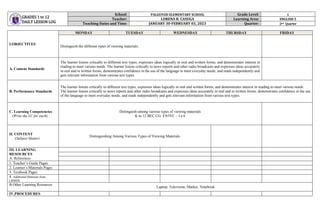
GRADES 1 to 12
DAILY LESSON LOG
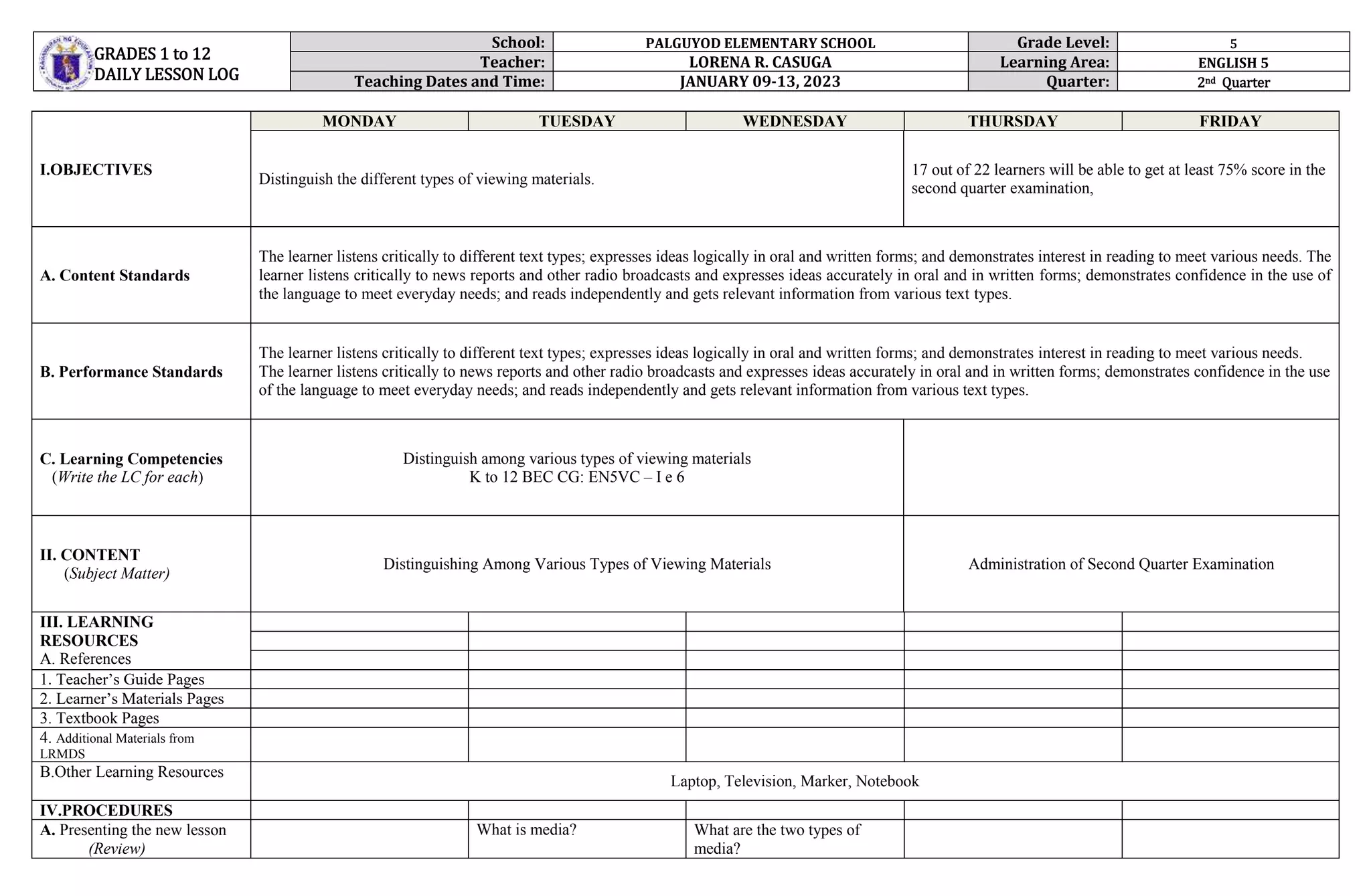
School: PALGUYOD ELEMENTARY SCHOOL Grade Level: 5
Teacher: LORENA R. CASUGA Learning Area: ENGLISH 5
Teaching Dates and Time: JANUARY 09-13, 2023 Quarter: 2nd Quarter
I.OBJECTIVES
MONDAY TUESDAY WEDNESDAY THURSDAY FRIDAY
Distinguish the different types of viewing materials.
17 out of 22 learners will be able to get at least 75% score in the
second quarter examination,
A. Content Standards
The learner listens critically to different text types; expresses ideas logically in oral and written forms; and demonstrates interest in reading to meet various needs. The
learner listens critically to news reports and other radio broadcasts and expresses ideas accurately in oral and in written forms; demonstrates confidence in the use of
the language to meet everyday needs; and reads independently and gets relevant information from various text types.
B. Performance Standards
The learner listens critically to different text types; expresses ideas logically in oral and written forms; and demonstrates interest in reading to meet various needs.
The learner listens critically to news reports and other radio broadcasts and expresses ideas accurately in oral and in written forms; demonstrates confidence in the use
of the language to meet everyday needs; and reads independently and gets relevant information from various text types.
C. Learning Competencies
(Write the LC for each)
Distinguish among various types of viewing materials
K to 12 BEC CG: EN5VC – I e 6
II. CONTENT
(Subject Matter)
Distinguishing Among Various Types of Viewing Materials Administration of Second Quarter Examination
III. LEARNING
RESOURCES
A. References
1. Teacher’s Guide Pages
2. Learner’s Materials Pages
3. Textbook Pages
4. Additional Materials from
LRMDS
B.Other Learning Resources
Laptop, Television, Marker, Notebook
IV.PROCEDURES
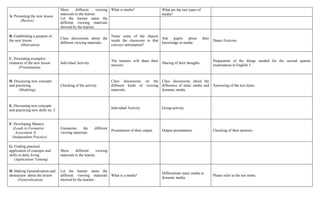
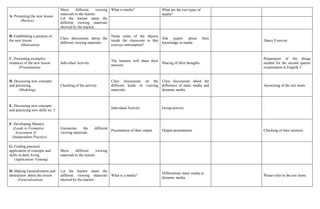
A. Presenting the new lesson
(Review)
What is media? What are the two types of
media?
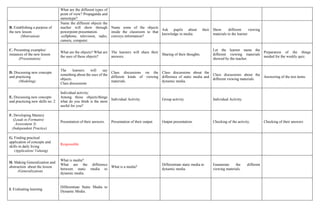
What are the different types of
point of view? Propaganda and
stereotype?
B. Establishing a purpose of
the new lesson
(Motivation)
Name the different objects the
teacher will show through
powerpoint presentation.
-cellphone, television, radio,
camera, computer.
Name some of the objects
inside the classroom to that
conveys information?
Ask pupils about their
knowledge in media.
Show different viewing
materials to the learner.
C. Presenting examples/
instances of the new lesson
(Presentation)
What are the objects? What are
the uses of these objects?
The learners will share their
answers.
Sharing of their thoughts.
Let the learner name the
different viewing materials
showed by the teacher.
Preparation of the things
needed for the weekly quiz.
D. Discussing new concepts
and practicing
(Modeling)
The learners will say
something about the uses of the
objects.
Class discussions
Class discussions on the
different kinds of viewing
materials.
Class discussions about the
difference of static media and
dynamic media.
Class discussions about the
different viewing materials.
Answering of the test items.
E. Discussing new concepts
and practicing new skills no. 2
Individual activity:
Among those objects/things
what do you think is the most
useful for you?
Individual Activity. Group activity. Individual Activity.
F. Developing Mastery
(Leads to Formative
Assessment 3)
(Independent Practice)
Presentation of their answers. Presentation of their output. Output presentation. Checking of the activity. Checking of their answers
G. Finding practical
application of concepts and
skills in daily living
(Application/ Valuing)
Responsible
H. Making Generalization and
abstraction about the lesson
(Generalization)
What is media?
What are the difference
between static media to
dynamic media.
What is a media?
Differentiate static media to
dynamic media.
Enumerate the different
viewing materials.
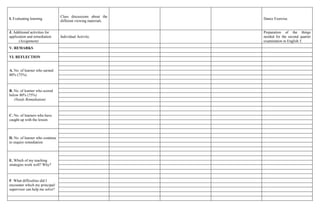
I. Evaluating learning
Differentiate Static Media to
Dynamic Media.
J. Additional activities for
application and remediation
(Assignment)
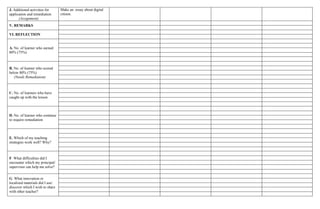
Make an essay about digital
citizen.
V. REMARKS
VI. REFLECTION
A. No. of learner who earned
80% (75%)
B. No. of learner who scored
below 80% (75%)
(Needs Remediation)
C. No. of learners who have
caught up with the lesson
D. No. of learner who continue
to require remediation
E. Which of my teaching
strategies work well? Why?
F. What difficulties did I
encounter which my principal/
supervisor can help me solve?
G. What innovation or
localized materials did I use/
discover which I wish to share
with other teacher?
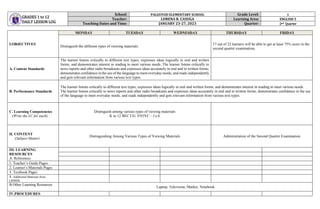
GRADES 1 to 12
DAILY LESSON LOG
School: PALGUYOD ELEMENTARY SCHOOL Grade Level: 5
Teacher: LORENA R. CASUGA Learning Area: ENGLISH 5
Teaching Dates and Time: JANUARY 23-27, 2023 Quarter: 2nd Quarter
I.OBJECTIVES
MONDAY TUESDAY WEDNESDAY THURSDAY FRIDAY
Distinguish the different types of viewing materials.
17 out of 22 learners will be able to get at least 75% score in the
second quarter examination,
A. Content Standards
The learner listens critically to different text types; expresses ideas logically in oral and written
forms; and demonstrates interest in reading to meet various needs. The learner listens critically to
news reports and other radio broadcasts and expresses ideas accurately in oral and in written forms;
demonstrates confidence in the use of the language to meet everyday needs; and reads independently
and gets relevant information from various text types.
B. Performance Standards
The learner listens critically to different text types; expresses ideas logically in oral and written forms; and demonstrates interest in reading to meet various needs.
The learner listens critically to news reports and other radio broadcasts and expresses ideas accurately in oral and in written forms; demonstrates confidence in the use
of the language to meet everyday needs; and reads independently and gets relevant information from various text types.
C. Learning Competencies
(Write the LC for each)
Distinguish among various types of viewing materials
K to 12 BEC CG: EN5VC – I e 6
II. CONTENT
(Subject Matter)
Distinguishing Among Various Types of Viewing Materials Administration of the Second Quarter Examination
III. LEARNING
RESOURCES
A. References
1. Teacher’s Guide Pages
2. Learner’s Materials Pages
3. Textbook Pages
4. Additional Materials from
LRMDS
B.Other Learning Resources
Laptop, Television, Marker, Notebook
IV.PROCEDURES
A. Presenting the new lesson
(Review)
Show different viewing
materials to the learner.
Let the learner name the
different viewing materials
showed by the teacher.
What is media? What are the two types of
media?
B. Establishing a purpose of
the new lesson
(Motivation)
Class discussions about the
different viewing materials.
Name some of the objects
inside the classroom to that
conveys information?
Ask pupils about their
knowledge in media.
Dance Exercise.
C. Presenting examples/
instances of the new lesson
(Presentation)
Individual Activity.
The learners will share their
answers.
Sharing of their thoughts.
Preparation of the things needed for the second quarter
examination in English 5.
D. Discussing new concepts
and practicing
(Modeling)
Checking of the activity.
Class discussions on the
different kinds of viewing
materials.
Class discussions about the
difference of static media and
dynamic media.
Answering of the test items.
E. Discussing new concepts
and practicing new skills no. 2
Individual Activity. Group activity. .
F. Developing Mastery
(Leads to Formative
Assessment 3)
(Independent Practice)
Enumerate the different
viewing materials.
Presentation of their output. Output presentation. Checking of their answers.
G. Finding practical
application of concepts and
skills in daily living
(Application/ Valuing)
Show different viewing
materials to the learner.
H. Making Generalization and
abstraction about the lesson
(Generalization)
Let the learner name the
different viewing materials
showed by the teacher.
What is a media?
Differentiate static media to
dynamic media.
Please refer to the test items.
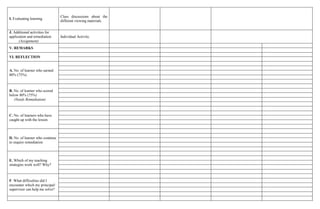
I. Evaluating learning
Class discussions about the
different viewing materials.
J. Additional activities for
application and remediation
(Assignment)
Individual Activity.
V. REMARKS
VI. REFLECTION
A. No. of learner who earned
80% (75%)
B. No. of learner who scored
below 80% (75%)
(Needs Remediation)
C. No. of learners who have
caught up with the lesson
D. No. of learner who continue
to require remediation
E. Which of my teaching
strategies work well? Why?
F. What difficulties did I
encounter which my principal/
supervisor can help me solve?
G. What innovation or
localized materials did I use/
discover which I wish to share
with other teacher?
GRADES 1 to 12
DAILY LESSON LOG
School: PALGUYOD ELEMENTARY SCHOOL Grade Level: 5
Teacher: LORENA R. CASUGA Learning Area: ENGLISH 5
Teaching Dates and Time: JANUARY 30-FEBRUARY 03, 2023 Quarter: 2nd Quarter
I.OBJECTIVES
MONDAY TUESDAY WEDNESDAY THURSDAY FRIDAY
Distinguish the different types of viewing materials.
A. Content Standards
The learner listens critically to different text types; expresses ideas logically in oral and written forms; and demonstrates interest in
reading to meet various needs. The learner listens critically to news reports and other radio broadcasts and expresses ideas accurately
in oral and in written forms; demonstrates confidence in the use of the language to meet everyday needs; and reads independently and
gets relevant information from various text types.
B. Performance Standards
The learner listens critically to different text types; expresses ideas logically in oral and written forms; and demonstrates interest in reading to meet various needs.
The learner listens critically to news reports and other radio broadcasts and expresses ideas accurately in oral and in written forms; demonstrates confidence in the use
of the language to meet everyday needs; and reads independently and gets relevant information from various text types.
C. Learning Competencies
(Write the LC for each)
Distinguish among various types of viewing materials
K to 12 BEC CG: EN5VC – I e 6
II. CONTENT
(Subject Matter)
Distinguishing Among Various Types of Viewing Materials
III. LEARNING
RESOURCES
A. References
1. Teacher’s Guide Pages
2. Learner’s Materials Pages
3. Textbook Pages
4. Additional Materials from
LRMDS
B.Other Learning Resources
Laptop, Television, Marker, Notebook
IV.PROCEDURES
A. Presenting the new lesson
(Review)
Show different viewing
materials to the learner.
Let the learner name the
different viewing materials
showed by the teacher.
What is media? What are the two types of
media?
B. Establishing a purpose of
the new lesson
(Motivation)
Class discussions about the
different viewing materials.
Name some of the objects
inside the classroom to that
conveys information?
Ask pupils about their
knowledge in media.
Dance Exercise.
C. Presenting examples/
instances of the new lesson
(Presentation)
Individual Activity.
The learners will share their
answers.
Sharing of their thoughts.
Preparation of the things
needed for the second quarter
examination in English 5.
D. Discussing new concepts
and practicing
(Modeling)
Checking of the activity.
Class discussions on the
different kinds of viewing
materials.
Class discussions about the
difference of static media and
dynamic media.
Answering of the test items.
E. Discussing new concepts
and practicing new skills no. 2
Individual Activity. Group activity. . .
F. Developing Mastery
(Leads to Formative
Assessment 3)
(Independent Practice)
Enumerate the different
viewing materials.
Presentation of their output. Output presentation. Checking of their answers.
G. Finding practical
application of concepts and
skills in daily living
(Application/ Valuing)
Show different viewing
materials to the learner.
H. Making Generalization and
abstraction about the lesson
(Generalization)
Let the learner name the
different viewing materials
showed by the teacher.
What is a media?
Differentiate static media to
dynamic media.
Please refer to the test items.
I. Evaluating learning
Class discussions about the
different viewing materials.
Dance Exercise.
J. Additional activities for
application and remediation
(Assignment)
Individual Activity.
Preparation of the things
needed for the second quarter
examination in English 5.
V. REMARKS
VI. REFLECTION
A. No. of learner who earned
80% (75%)
B. No. of learner who scored
below 80% (75%)
(Needs Remediation)
C. No. of learners who have
caught up with the lesson
D. No. of learner who continue
to require remediation
E. Which of my teaching
strategies work well? Why?
F. What difficulties did I
encounter which my principal/
supervisor can help me solve?
G. What innovation or
localized materials did I use/
discover which I wish to share
with other teacher?

ENGLISH 5 JAN 9-13, 2023.docx

  • 1.
    GRADES 1 to12 DAILY LESSON LOG School: PALGUYOD ELEMENTARY SCHOOL Grade Level: 5 Teacher: LORENA R. CASUGA Learning Area: ENGLISH 5 Teaching Dates and Time: JANUARY 09-13, 2023 Quarter: 2nd Quarter I.OBJECTIVES MONDAY TUESDAY WEDNESDAY THURSDAY FRIDAY Distinguish the different types of viewing materials. 17 out of 22 learners will be able to get at least 75% score in the second quarter examination, A. Content Standards The learner listens critically to different text types; expresses ideas logically in oral and written forms; and demonstrates interest in reading to meet various needs. The learner listens critically to news reports and other radio broadcasts and expresses ideas accurately in oral and in written forms; demonstrates confidence in the use of the language to meet everyday needs; and reads independently and gets relevant information from various text types. B. Performance Standards The learner listens critically to different text types; expresses ideas logically in oral and written forms; and demonstrates interest in reading to meet various needs. The learner listens critically to news reports and other radio broadcasts and expresses ideas accurately in oral and in written forms; demonstrates confidence in the use of the language to meet everyday needs; and reads independently and gets relevant information from various text types. C. Learning Competencies (Write the LC for each) Distinguish among various types of viewing materials K to 12 BEC CG: EN5VC – I e 6 II. CONTENT (Subject Matter) Distinguishing Among Various Types of Viewing Materials Administration of Second Quarter Examination III. LEARNING RESOURCES A. References 1. Teacher’s Guide Pages 2. Learner’s Materials Pages 3. Textbook Pages 4. Additional Materials from LRMDS B.Other Learning Resources Laptop, Television, Marker, Notebook IV.PROCEDURES A. Presenting the new lesson (Review) What is media? What are the two types of media?
  • 2.
    What are thedifferent types of point of view? Propaganda and stereotype? B. Establishing a purpose of the new lesson (Motivation) Name the different objects the teacher will show through powerpoint presentation. -cellphone, television, radio, camera, computer. Name some of the objects inside the classroom to that conveys information? Ask pupils about their knowledge in media. Show different viewing materials to the learner. C. Presenting examples/ instances of the new lesson (Presentation) What are the objects? What are the uses of these objects? The learners will share their answers. Sharing of their thoughts. Let the learner name the different viewing materials showed by the teacher. Preparation of the things needed for the weekly quiz. D. Discussing new concepts and practicing (Modeling) The learners will say something about the uses of the objects. Class discussions Class discussions on the different kinds of viewing materials. Class discussions about the difference of static media and dynamic media. Class discussions about the different viewing materials. Answering of the test items. E. Discussing new concepts and practicing new skills no. 2 Individual activity: Among those objects/things what do you think is the most useful for you? Individual Activity. Group activity. Individual Activity. F. Developing Mastery (Leads to Formative Assessment 3) (Independent Practice) Presentation of their answers. Presentation of their output. Output presentation. Checking of the activity. Checking of their answers G. Finding practical application of concepts and skills in daily living (Application/ Valuing) Responsible H. Making Generalization and abstraction about the lesson (Generalization) What is media? What are the difference between static media to dynamic media. What is a media? Differentiate static media to dynamic media. Enumerate the different viewing materials. I. Evaluating learning Differentiate Static Media to Dynamic Media.
  • 3.
    J. Additional activitiesfor application and remediation (Assignment) Make an essay about digital citizen. V. REMARKS VI. REFLECTION A. No. of learner who earned 80% (75%) B. No. of learner who scored below 80% (75%) (Needs Remediation) C. No. of learners who have caught up with the lesson D. No. of learner who continue to require remediation E. Which of my teaching strategies work well? Why? F. What difficulties did I encounter which my principal/ supervisor can help me solve? G. What innovation or localized materials did I use/ discover which I wish to share with other teacher?
  • 4.
    GRADES 1 to12 DAILY LESSON LOG School: PALGUYOD ELEMENTARY SCHOOL Grade Level: 5 Teacher: LORENA R. CASUGA Learning Area: ENGLISH 5 Teaching Dates and Time: JANUARY 23-27, 2023 Quarter: 2nd Quarter I.OBJECTIVES MONDAY TUESDAY WEDNESDAY THURSDAY FRIDAY Distinguish the different types of viewing materials. 17 out of 22 learners will be able to get at least 75% score in the second quarter examination, A. Content Standards The learner listens critically to different text types; expresses ideas logically in oral and written forms; and demonstrates interest in reading to meet various needs. The learner listens critically to news reports and other radio broadcasts and expresses ideas accurately in oral and in written forms; demonstrates confidence in the use of the language to meet everyday needs; and reads independently and gets relevant information from various text types. B. Performance Standards The learner listens critically to different text types; expresses ideas logically in oral and written forms; and demonstrates interest in reading to meet various needs. The learner listens critically to news reports and other radio broadcasts and expresses ideas accurately in oral and in written forms; demonstrates confidence in the use of the language to meet everyday needs; and reads independently and gets relevant information from various text types. C. Learning Competencies (Write the LC for each) Distinguish among various types of viewing materials K to 12 BEC CG: EN5VC – I e 6 II. CONTENT (Subject Matter) Distinguishing Among Various Types of Viewing Materials Administration of the Second Quarter Examination III. LEARNING RESOURCES A. References 1. Teacher’s Guide Pages 2. Learner’s Materials Pages 3. Textbook Pages 4. Additional Materials from LRMDS B.Other Learning Resources Laptop, Television, Marker, Notebook IV.PROCEDURES
  • 5.
    A. Presenting thenew lesson (Review) Show different viewing materials to the learner. Let the learner name the different viewing materials showed by the teacher. What is media? What are the two types of media? B. Establishing a purpose of the new lesson (Motivation) Class discussions about the different viewing materials. Name some of the objects inside the classroom to that conveys information? Ask pupils about their knowledge in media. Dance Exercise. C. Presenting examples/ instances of the new lesson (Presentation) Individual Activity. The learners will share their answers. Sharing of their thoughts. Preparation of the things needed for the second quarter examination in English 5. D. Discussing new concepts and practicing (Modeling) Checking of the activity. Class discussions on the different kinds of viewing materials. Class discussions about the difference of static media and dynamic media. Answering of the test items. E. Discussing new concepts and practicing new skills no. 2 Individual Activity. Group activity. . F. Developing Mastery (Leads to Formative Assessment 3) (Independent Practice) Enumerate the different viewing materials. Presentation of their output. Output presentation. Checking of their answers. G. Finding practical application of concepts and skills in daily living (Application/ Valuing) Show different viewing materials to the learner. H. Making Generalization and abstraction about the lesson (Generalization) Let the learner name the different viewing materials showed by the teacher. What is a media? Differentiate static media to dynamic media. Please refer to the test items.
  • 6.
    I. Evaluating learning Classdiscussions about the different viewing materials. J. Additional activities for application and remediation (Assignment) Individual Activity. V. REMARKS VI. REFLECTION A. No. of learner who earned 80% (75%) B. No. of learner who scored below 80% (75%) (Needs Remediation) C. No. of learners who have caught up with the lesson D. No. of learner who continue to require remediation E. Which of my teaching strategies work well? Why? F. What difficulties did I encounter which my principal/ supervisor can help me solve?
  • 7.
    G. What innovationor localized materials did I use/ discover which I wish to share with other teacher?
  • 8.
    GRADES 1 to12 DAILY LESSON LOG School: PALGUYOD ELEMENTARY SCHOOL Grade Level: 5 Teacher: LORENA R. CASUGA Learning Area: ENGLISH 5 Teaching Dates and Time: JANUARY 30-FEBRUARY 03, 2023 Quarter: 2nd Quarter I.OBJECTIVES MONDAY TUESDAY WEDNESDAY THURSDAY FRIDAY Distinguish the different types of viewing materials. A. Content Standards The learner listens critically to different text types; expresses ideas logically in oral and written forms; and demonstrates interest in reading to meet various needs. The learner listens critically to news reports and other radio broadcasts and expresses ideas accurately in oral and in written forms; demonstrates confidence in the use of the language to meet everyday needs; and reads independently and gets relevant information from various text types. B. Performance Standards The learner listens critically to different text types; expresses ideas logically in oral and written forms; and demonstrates interest in reading to meet various needs. The learner listens critically to news reports and other radio broadcasts and expresses ideas accurately in oral and in written forms; demonstrates confidence in the use of the language to meet everyday needs; and reads independently and gets relevant information from various text types. C. Learning Competencies (Write the LC for each) Distinguish among various types of viewing materials K to 12 BEC CG: EN5VC – I e 6 II. CONTENT (Subject Matter) Distinguishing Among Various Types of Viewing Materials III. LEARNING RESOURCES A. References 1. Teacher’s Guide Pages 2. Learner’s Materials Pages 3. Textbook Pages 4. Additional Materials from LRMDS B.Other Learning Resources Laptop, Television, Marker, Notebook IV.PROCEDURES
  • 9.
    A. Presenting thenew lesson (Review) Show different viewing materials to the learner. Let the learner name the different viewing materials showed by the teacher. What is media? What are the two types of media? B. Establishing a purpose of the new lesson (Motivation) Class discussions about the different viewing materials. Name some of the objects inside the classroom to that conveys information? Ask pupils about their knowledge in media. Dance Exercise. C. Presenting examples/ instances of the new lesson (Presentation) Individual Activity. The learners will share their answers. Sharing of their thoughts. Preparation of the things needed for the second quarter examination in English 5. D. Discussing new concepts and practicing (Modeling) Checking of the activity. Class discussions on the different kinds of viewing materials. Class discussions about the difference of static media and dynamic media. Answering of the test items. E. Discussing new concepts and practicing new skills no. 2 Individual Activity. Group activity. . . F. Developing Mastery (Leads to Formative Assessment 3) (Independent Practice) Enumerate the different viewing materials. Presentation of their output. Output presentation. Checking of their answers. G. Finding practical application of concepts and skills in daily living (Application/ Valuing) Show different viewing materials to the learner. H. Making Generalization and abstraction about the lesson (Generalization) Let the learner name the different viewing materials showed by the teacher. What is a media? Differentiate static media to dynamic media. Please refer to the test items.
  • 10.
    I. Evaluating learning Classdiscussions about the different viewing materials. Dance Exercise. J. Additional activities for application and remediation (Assignment) Individual Activity. Preparation of the things needed for the second quarter examination in English 5. V. REMARKS VI. REFLECTION A. No. of learner who earned 80% (75%) B. No. of learner who scored below 80% (75%) (Needs Remediation) C. No. of learners who have caught up with the lesson D. No. of learner who continue to require remediation E. Which of my teaching strategies work well? Why? F. What difficulties did I encounter which my principal/ supervisor can help me solve?
  • 11.
    G. What innovationor localized materials did I use/ discover which I wish to share with other teacher?