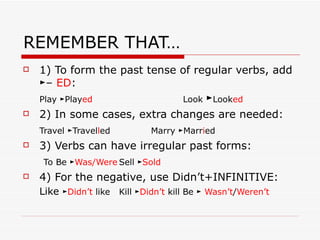
REMEMBER THAT… 1) To form the past tense of regular verbs, add ►–  ED : Play ►Play ed Look  ► Look ed 2) In some cases, extra changes are needed:  Travel ►Travel l ed  Marry ►Marr i ed 3) Verbs can have irregular past forms:   To Be ► Was/Were Sell ► Sold 4) For the negative, use Didn’t+INFINITIVE: Like  ► Didn’t  like  Kill ► Didn’t  kill Be ►  Wasn’t / Weren’t
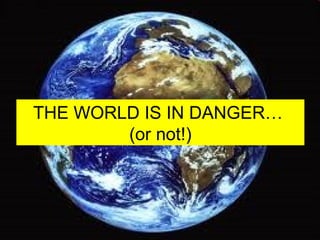
THE WORLD IS IN DANGER…  (or not!)
OBJECTIVES To become aware of the changes that our planet is undergoing To propose measures to stop climate change
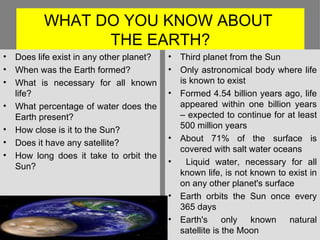
WHAT DO YOU KNOW ABOUT  THE EARTH? Third planet from the Sun Only astronomical body where life is known to exist Formed 4.54 billion years ago, life appeared within one billion years – expected to continue for at least 500 million years About 71% of the surface is covered with salt water oceans Liquid water, necessary for all known life, is not known to exist in on any other planet's surface Earth orbits the Sun once every 365 days  Earth's only known natural satellite is the Moon Does life exist in any other planet? When was the Earth formed? What is necessary for all known life? What percentage of water does the Earth present? How close is it to the Sun? Does it have any satellite? How long does it take to orbit the Sun?
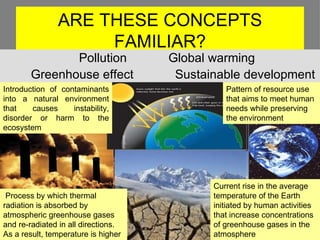
ARE THESE CONCEPTS FAMILIAR? Pollution  Global warming  Greenhouse effect  Sustainable development Introduction of contaminants into a natural environment that causes instability, disorder or harm to the ecosystem Process by which thermal radiation is absorbed by atmospheric greenhouse gases and re-radiated in all directions. As a result, temperature is higher Current rise in the average temperature of the Earth initiated by human activities that increase concentrations of greenhouse gases in the atmosphere Pattern of resource use that aims to meet human needs while preserving the environment
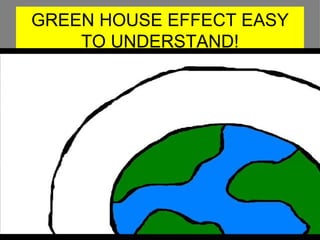
GREEN HOUSE EFFECT EASY TO UNDERSTAND!
CLIMATE CHANGE
TASK 1 Make a list of things that we are doing wrong. For example: We are using private cars too much.
TASK 2 Make a list of things that we will have to do to improve the situation. For example: We will have to use public transports.
ARE WE DOING ENOUGH TO SAVE OUR PLANET?
CONCLUSIONS ¡ ¡ ¡ ¡ ¡ ¡ ¡

English 4

  • 1.
    REMEMBER THAT… 1)To form the past tense of regular verbs, add ►– ED : Play ►Play ed Look ► Look ed 2) In some cases, extra changes are needed: Travel ►Travel l ed Marry ►Marr i ed 3) Verbs can have irregular past forms: To Be ► Was/Were Sell ► Sold 4) For the negative, use Didn’t+INFINITIVE: Like ► Didn’t like Kill ► Didn’t kill Be ► Wasn’t / Weren’t
  • 2.
    THE WORLD ISIN DANGER… (or not!)
  • 3.
    OBJECTIVES To becomeaware of the changes that our planet is undergoing To propose measures to stop climate change
  • 4.
    WHAT DO YOUKNOW ABOUT THE EARTH? Third planet from the Sun Only astronomical body where life is known to exist Formed 4.54 billion years ago, life appeared within one billion years – expected to continue for at least 500 million years About 71% of the surface is covered with salt water oceans Liquid water, necessary for all known life, is not known to exist in on any other planet's surface Earth orbits the Sun once every 365 days Earth's only known natural satellite is the Moon Does life exist in any other planet? When was the Earth formed? What is necessary for all known life? What percentage of water does the Earth present? How close is it to the Sun? Does it have any satellite? How long does it take to orbit the Sun?
  • 5.
    ARE THESE CONCEPTSFAMILIAR? Pollution Global warming Greenhouse effect Sustainable development Introduction of contaminants into a natural environment that causes instability, disorder or harm to the ecosystem Process by which thermal radiation is absorbed by atmospheric greenhouse gases and re-radiated in all directions. As a result, temperature is higher Current rise in the average temperature of the Earth initiated by human activities that increase concentrations of greenhouse gases in the atmosphere Pattern of resource use that aims to meet human needs while preserving the environment
  • 6.
    GREEN HOUSE EFFECTEASY TO UNDERSTAND!
  • 7.
  • 8.
    TASK 1 Makea list of things that we are doing wrong. For example: We are using private cars too much.
  • 9.
    TASK 2 Makea list of things that we will have to do to improve the situation. For example: We will have to use public transports.
  • 10.
    ARE WE DOINGENOUGH TO SAVE OUR PLANET?
  • 11.
    CONCLUSIONS ¡ ¡¡ ¡ ¡ ¡ ¡