Our Ho e: Eart , a U ique
Life Su tai i g Pla et
8th class science curiosity
By:K Sandeep Swamy(M.Sc,B.Ed)
For Online Classes (IITJEE & NEET foundation and academics)
contact : 9491878325
Subscribe Samyans Eduhub youtube channel
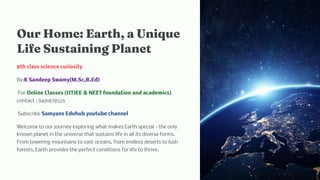
Welcome to our journey exploring what makes Earth special - the only
known planet in the universe that sustains life in all its diverse forms.
From towering mountains to vast oceans, from endless deserts to lush
forests, Earth provides the perfect conditions for life to thrive.
Eart : A Delicate Life Layer
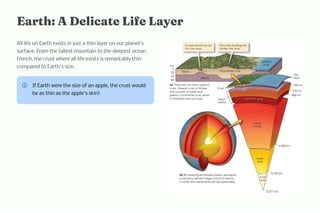
All life on Earth exists in just a thin layer on our planet's
surface. From the tallest mountain to the deepest ocean
trench, the crust where all life exists is remarkably thin
compared to Earth's size.
If Earth were the size of an apple, the crust would
be as thin as the apple's skin!
W at Make Eart U ique?
Perfect Di ta ce fro
Su
Earth orbits in the "Goldilocks
zone" - not too hot, not too
cold, allowing water to exist in
liquid form.
Circular Orbit
Earth's nearly circular orbit
keeps temperatures steady
throughout the year,
preventing extreme seasons.
Ju t t e Rig t Size
Earth's gravity is strong enough to hold an atmosphere but not so
strong that it would crush life forms.
Eart ' Protective S ield
T e At o p ere
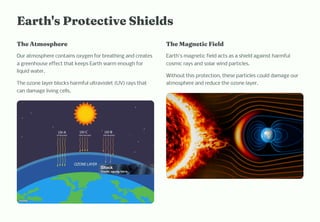
Our atmosphere contains oxygen for breathing and creates
a greenhouse effect that keeps Earth warm enough for
liquid water.
The ozone layer blocks harmful ultraviolet (UV) rays that
can damage living cells.
T e Mag etic Field
Earth's magnetic field acts as a shield against harmful
cosmic rays and solar wind particles.
Without this protection, these particles could damage our
atmosphere and reduce the ozone layer.
Co pari g Pla et i Our Solar Sy te
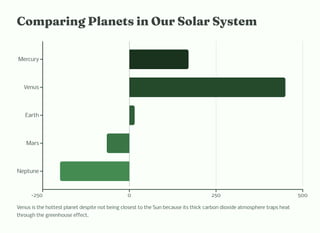
Mercury
Venus
Earth
Mars
Neptune
-250 0 250 500
Venus is the hottest planet despite not being closest to the Sun because its thick carbon dioxide atmosphere traps heat
through the greenhouse effect.
T e Blue Pla et
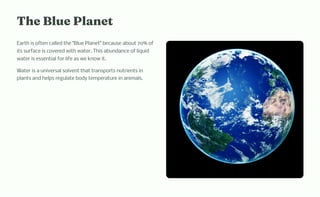
Earth is often called the "Blue Planet" because about 70% of
its surface is covered with water. This abundance of liquid
water is essential for life as we know it.
Water is a universal solvent that transports nutrients in
plants and helps regulate body temperature in animals.
Mar : Our Pla etary Neig bor
Could Mar Have Supported Life?
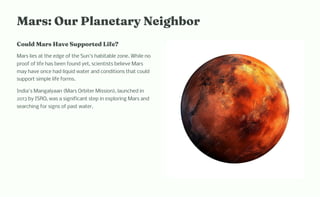
Mars lies at the edge of the Sun's habitable zone. While no
proof of life has been found yet, scientists believe Mars
may have once had liquid water and conditions that could
support simple life forms.
India's Mangalyaan (Mars Orbiter Mission), launched in
2013 by ISRO, was a significant step in exploring Mars and
searching for signs of past water.
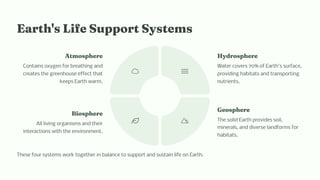
Eart ' Life Support Sy te
These four systems work together in balance to support and sustain life on Earth.
At o p ere
Contains oxygen for breathing and
creates the greenhouse effect that
keeps Earth warm.
Hydro p ere
Water covers 70% of Earth's surface,
providing habitats and transporting
nutrients.
Geo p ere
The solid Earth provides soil,
minerals, and diverse landforms for
habitats.
Bio p ere
All living organisms and their
interactions with the environment.
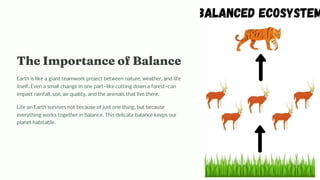
T e I porta ce of Bala ce
Earth is like a giant teamwork project between nature, weather, and life
itself. Even a small change in one part4like cutting down a forest4can
impact rainfall, soil, air quality, and the animals that live there.
Life on Earth survives not because of just one thing, but because
everything works together in balance. This delicate balance keeps our
planet habitable.
Reproductio : E uri g Life Co ti ue
W y Reproductio Matter
If plants and animals didn't reproduce, life would eventually
disappear from Earth. Reproduction ensures that each type
of organism continues to exist.
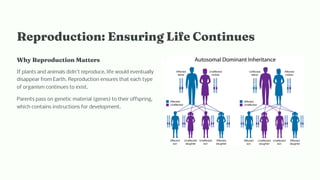
Parents pass on genetic material (genes) to their offspring,
which contains instructions for development.
Type of Reproductio
A exual Reproductio
A single parent produces offspring that are exact copies
of itself.
Examples: Vegetative propagation in plants, cell division
in bacteria and amoeba.
Sexual Reproductio
Two parents contribute genetic material, creating
offspring with a mix of traits.
This mixing helps maintain useful features while allowing
new ones to appear.
Vegetative Propagatio i Pla t
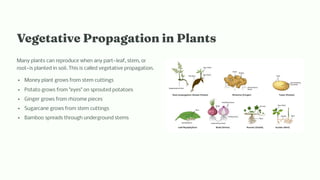
Many plants can reproduce when any part4leaf, stem, or
root4is planted in soil. This is called vegetative propagation.
Money plant grows from stem cuttings
Potato grows from "eyes" on sprouted potatoes
Ginger grows from rhizome pieces
Sugarcane grows from stem cuttings
Bamboo spreads through underground stems
Sexual Reproductio i
Pla t
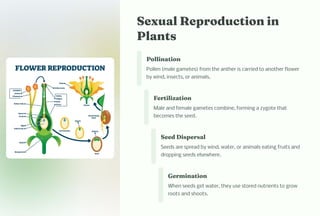
Polli atio
Pollen (male gametes) from the anther is carried to another flower
by wind, insects, or animals.
Fertilizatio
Male and female gametes combine, forming a zygote that
becomes the seed.
Seed Di per al
Seeds are spread by wind, water, or animals eating fruits and
dropping seeds elsewhere.
Ger i atio
When seeds get water, they use stored nutrients to grow
roots and shoots.
Sexual Reproductio i
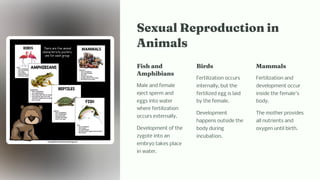
A i al
Fi a d
A p ibia
Male and female
eject sperm and
eggs into water
where fertilization
occurs externally.
Development of the
zygote into an
embryo takes place
in water.
Bird
Fertilization occurs
internally, but the
fertilized egg is laid
by the female.
Development
happens outside the
body during
incubation.
Ma al
Fertilization and
development occur
inside the female's
body.
The mother provides
all nutrients and
oxygen until birth.
Ge etic Variatio : T e Key to Adaptatio
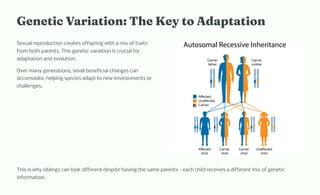
Sexual reproduction creates offspring with a mix of traits
from both parents. This genetic variation is crucial for
adaptation and evolution.
Over many generations, small beneficial changes can
accumulate, helping species adapt to new environments or
challenges.
This is why siblings can look different despite having the same parents - each child receives a different mix of genetic
information.
T e Triple Pla etary Cri i
Cli ate C a ge
Burning fossil fuels releases
greenhouse gases, trapping heat
and causing global warming.
Even small temperature increases
can melt ice caps, raise sea levels,
and cause extreme weather.
Biodiver ity Lo
Habitat destruction threatens
countless species and disrupts
ecosystems.
Every type of living thing has a role,
and losing even a few weakens
nature's ability to support life.
Pollutio
Air, water, and soil pollution harm
both people and nature.
Pollutants can cause health
problems, damage crops, and
spread through food chains.
E viro e tal T reat
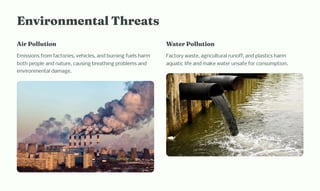
Air Pollutio
Emissions from factories, vehicles, and burning fuels harm
both people and nature, causing breathing problems and
environmental damage.
Water Pollutio
Factory waste, agricultural runoff, and plastics harm
aquatic life and make water unsafe for consumption.
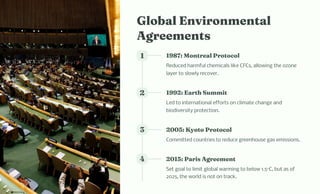
Global E viro e tal
Agree e t
1 1987: Mo treal Protocol
Reduced harmful chemicals like CFCs, allowing the ozone
layer to slowly recover.
2 1992: Eart Su it
Led to international efforts on climate change and
biodiversity protection.
3 2005: Kyoto Protocol
Committed countries to reduce greenhouse gas emissions.
4 2015: Pari Agree e t
Set goal to limit global warming to below 1.5°C, but as of
2025, the world is not on track.
Taki g Actio
Reduce, Reu e, Recycle
Reusing, repairing, and recycling items
like clothes and plastic reduce pollution
and waste.
E ergy Co ervatio
Using renewable energy like solar and
wind, and improving energy efficiency
in homes and transportation.
Protect Biodiver ity
Preserving diverse ecosystems creates
stronger, more balanced natural
systems that can better withstand
changes.
Small actions by individuals add up to make a significant difference when everyone participates.
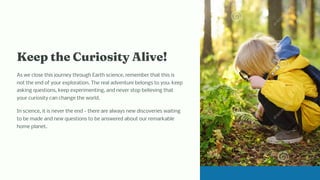
Keep t e Curio ity Alive!
As we close this journey through Earth science, remember that this is
not the end of your exploration. The real adventure belongs to you: keep
asking questions, keep experimenting, and never stop believing that
your curiosity can change the world.
In science, it is never the end - there are always new discoveries waiting
to be made and new questions to be answered about our remarkable
home planet.