Unit features
We created the Touchstone series with the help of the
Cambridge International Corpus of North American English.
The corpus is a large database of language from everyday
conversations, radio and television broadcasts, and
newspapers and books.
Using computer software, we analyze the corpus to find
out how people actually use English. We use the corpus as
a “touchstone” to make sure that each lesson teaches you
authentic and useful language. The corpus helps us choose
and explain the grammar, vocabulary, and conversation
strategies you need to communicate successfully in English.
Touchstone makes learning English fun. It gives you many
different opportunities to interact with your classmates.
You can exchange personal information, take class surveys,
role-play situations, play games, and discuss topics of
personal interest. Using Touchstone, you can develop
confidence in your ability to understand real-life English
and to express yourself clearly and effectively in everyday
situations.
We hope you enjoy using Touchstone and wish you every
success with your English classes.
Michael McCarthy
Jeanne McCarten
Helen Sandiford
The Workbook gives you
language practice and extra
reading and writing activities.
Progress checks help you
assess your progress.
A Touchstone checkpoint
after every three units
reviews grammar,
vocabulary, and conversation
strategies.
A Self-study Audio CD/
CD-ROM gives you more
practice with listening,
speaking, and vocabulary
building.
The Class Audio Program
presents the conversations
and listening activities in
natural, lively English.
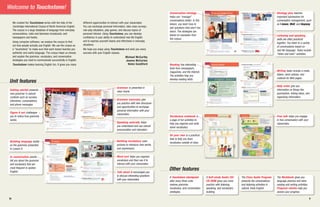
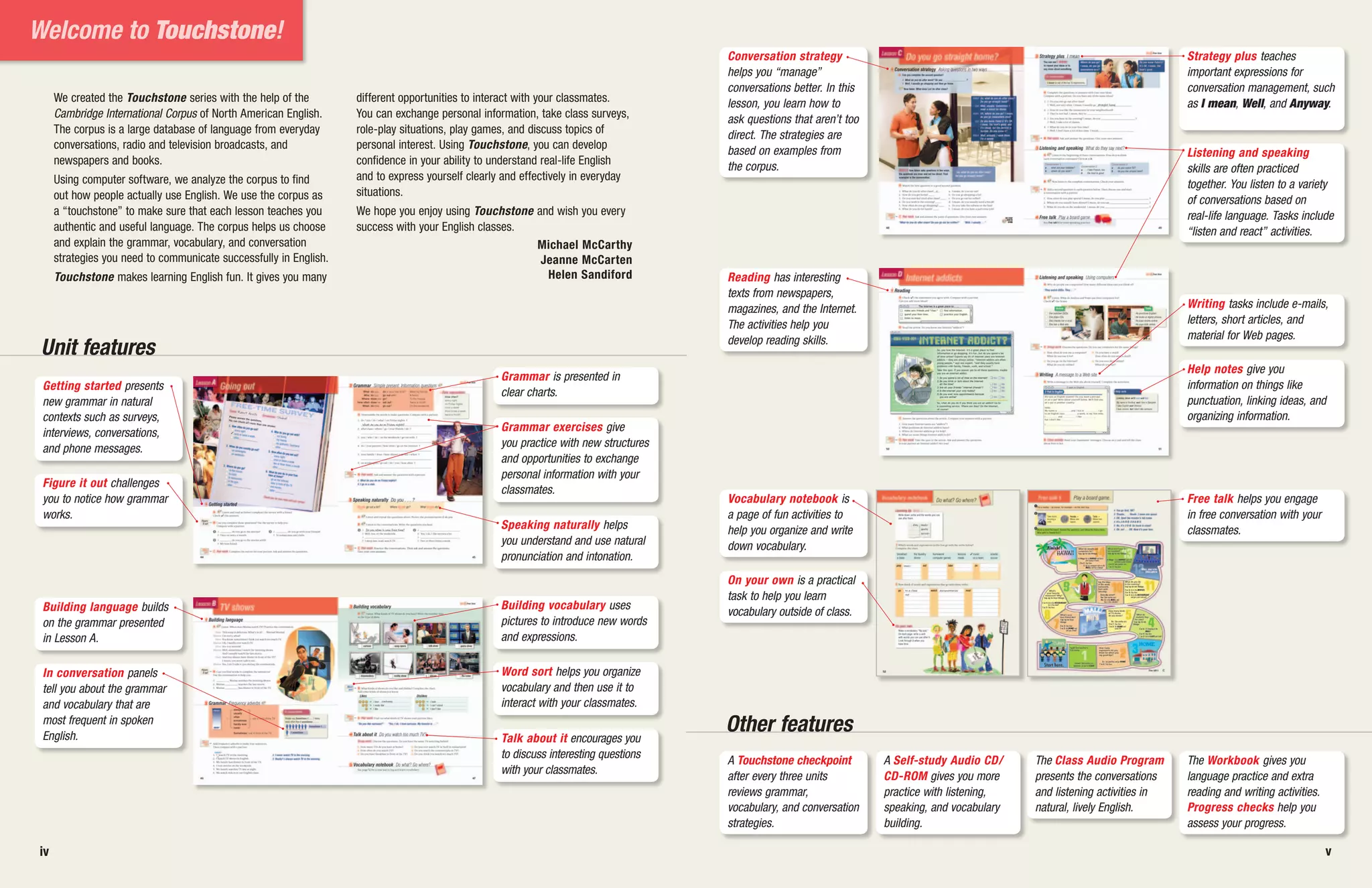
Getting started presents
new grammar in natural
contexts such as surveys,
interviews, conversations,
and phone messages.
Figure it out challenges
you to notice how grammar
works.
Grammar is presented in
clear charts.
Grammar exercises give
you practice with new structures
and opportunities to exchange
personal information with your
classmates.
Speaking naturally helps
you understand and use natural
pronunciation and intonation.
Building language builds
on the grammar presented
in Lesson A.
In conversation panels
tell you about the grammar
and vocabulary that are
most frequent in spoken
English.
Building vocabulary uses
pictures to introduce new words
and expressions.
Word sort helps you organize
vocabulary and then use it to
interact with your classmates.
Talk about it encourages you
to discuss interesting questions
with your classmates.
Conversation strategy
helps you “manage”
conversations better. In this
lesson, you learn how to
ask questions that aren’t too
direct. The strategies are
based on examples from
the corpus.
Strategy plus teaches
important expressions for
conversation management, such
as I mean, Well, and Anyway.
Listening and speaking 	
skills are often practiced
together. You listen to a variety
of conversations based on
real-life language. Tasks include
“listen and react” activities.
Reading has interesting
texts from newspapers,
magazines, and the Internet.
The activities help you
develop reading skills.
Writing tasks include e-mails,
letters, short articles, and
material for Web pages.
Help notes give you
information on things like
punctuation, linking ideas, and
organizing information.
Vocabulary notebook is
a page of fun activities to
help you organize and write
down vocabulary.
Free talk helps you engage
in free conversation with your
classmates.
On your own is a practical
task to help you learn
vocabulary outside of class.
Other features
Welcome to Touchstone!
iv v

Student Book Overview Touchstone

  • 1.
    Unit features We createdthe Touchstone series with the help of the Cambridge International Corpus of North American English. The corpus is a large database of language from everyday conversations, radio and television broadcasts, and newspapers and books. Using computer software, we analyze the corpus to find out how people actually use English. We use the corpus as a “touchstone” to make sure that each lesson teaches you authentic and useful language. The corpus helps us choose and explain the grammar, vocabulary, and conversation strategies you need to communicate successfully in English. Touchstone makes learning English fun. It gives you many different opportunities to interact with your classmates. You can exchange personal information, take class surveys, role-play situations, play games, and discuss topics of personal interest. Using Touchstone, you can develop confidence in your ability to understand real-life English and to express yourself clearly and effectively in everyday situations. We hope you enjoy using Touchstone and wish you every success with your English classes. Michael McCarthy Jeanne McCarten Helen Sandiford The Workbook gives you language practice and extra reading and writing activities. Progress checks help you assess your progress. A Touchstone checkpoint after every three units reviews grammar, vocabulary, and conversation strategies. A Self-study Audio CD/ CD-ROM gives you more practice with listening, speaking, and vocabulary building. The Class Audio Program presents the conversations and listening activities in natural, lively English. Getting started presents new grammar in natural contexts such as surveys, interviews, conversations, and phone messages. Figure it out challenges you to notice how grammar works. Grammar is presented in clear charts. Grammar exercises give you practice with new structures and opportunities to exchange personal information with your classmates. Speaking naturally helps you understand and use natural pronunciation and intonation. Building language builds on the grammar presented in Lesson A. In conversation panels tell you about the grammar and vocabulary that are most frequent in spoken English. Building vocabulary uses pictures to introduce new words and expressions. Word sort helps you organize vocabulary and then use it to interact with your classmates. Talk about it encourages you to discuss interesting questions with your classmates. Conversation strategy helps you “manage” conversations better. In this lesson, you learn how to ask questions that aren’t too direct. The strategies are based on examples from the corpus. Strategy plus teaches important expressions for conversation management, such as I mean, Well, and Anyway. Listening and speaking skills are often practiced together. You listen to a variety of conversations based on real-life language. Tasks include “listen and react” activities. Reading has interesting texts from newspapers, magazines, and the Internet. The activities help you develop reading skills. Writing tasks include e-mails, letters, short articles, and material for Web pages. Help notes give you information on things like punctuation, linking ideas, and organizing information. Vocabulary notebook is a page of fun activities to help you organize and write down vocabulary. Free talk helps you engage in free conversation with your classmates. On your own is a practical task to help you learn vocabulary outside of class. Other features Welcome to Touchstone! iv v