OBJECTIVES:
Explain and sharea critical insight on the feelings
evoked from a reading material.
Read and define words related to the text, and
deduce meaning of words
Determine and differentiate the structure and
elements of a poem.
At the end of the lesson, you are able to:
Identify and evaluate the structural, biographical,
historical, and sociocultural context of a poem.
4.
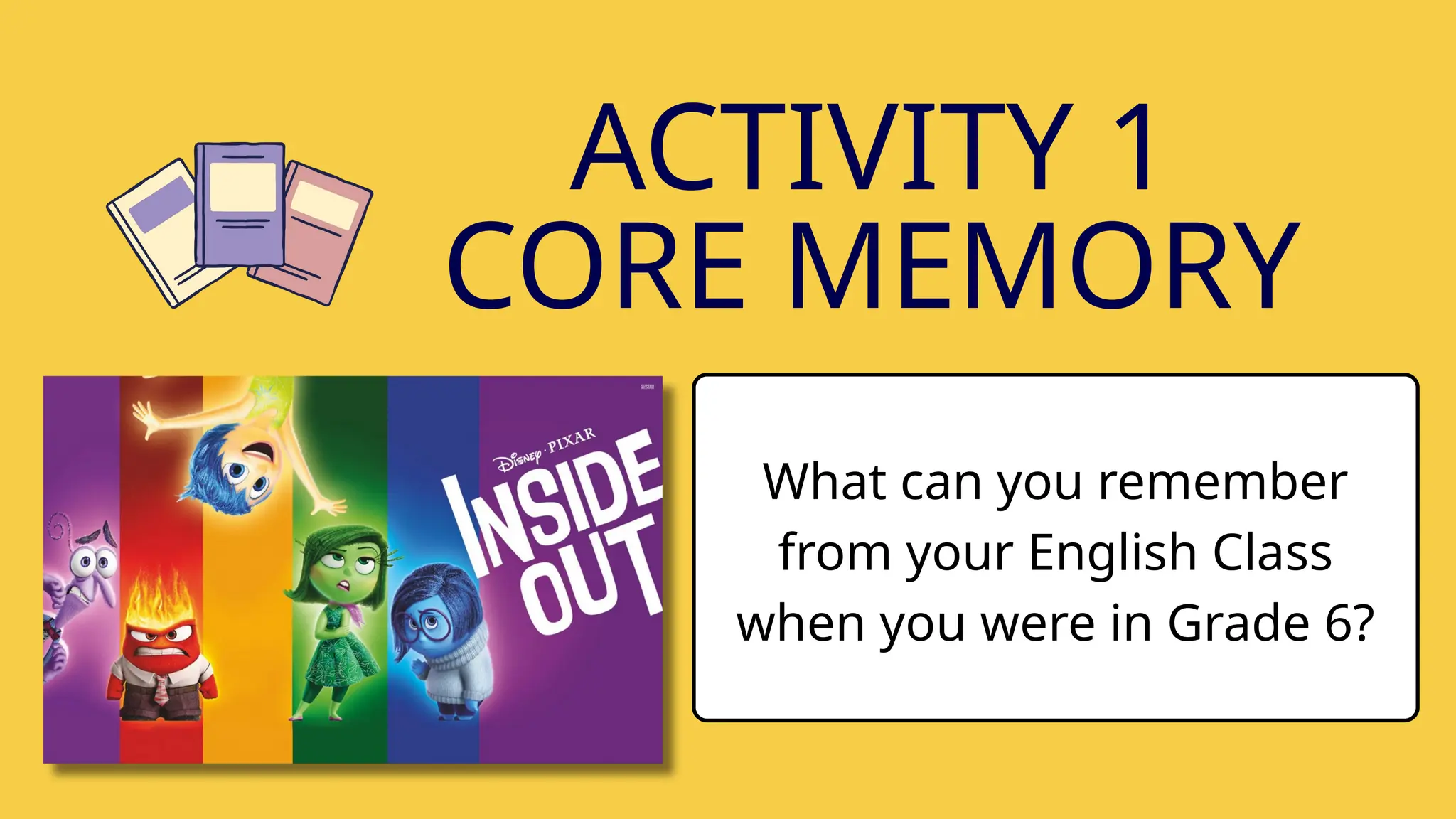
What can youremember
from your English Class
when you were in Grade 6?
ACTIVITY 1
CORE MEMORY
Literature is thewritten or spoken
expression of human experiences,
thoughts, and emotions. It reflects life,
culture, and imagination.
12.
• Prose –written in ordinary language;
follows natural flow of speech.
• Poetry – written in verse and uses
rhythm, imagery, and sometimes
rhyme.
2 TYPES OF LITERATURE
13.
Prose is themost common form of writing.
It includes:
• Fiction – made-up stories (e.g., short
stories, novels)
• Non-fiction – based on facts (e.g.,
essays, biographies, articles)
WHAT IS PROSE?
A POEM ISA PIECE OF WRITING,
USUALLY USING SOME KIND OF
rhyme scheme or metrical pattern,
that expresses a writer’s feelings (or
the feelings of a persona).
WHAT IS POEM?
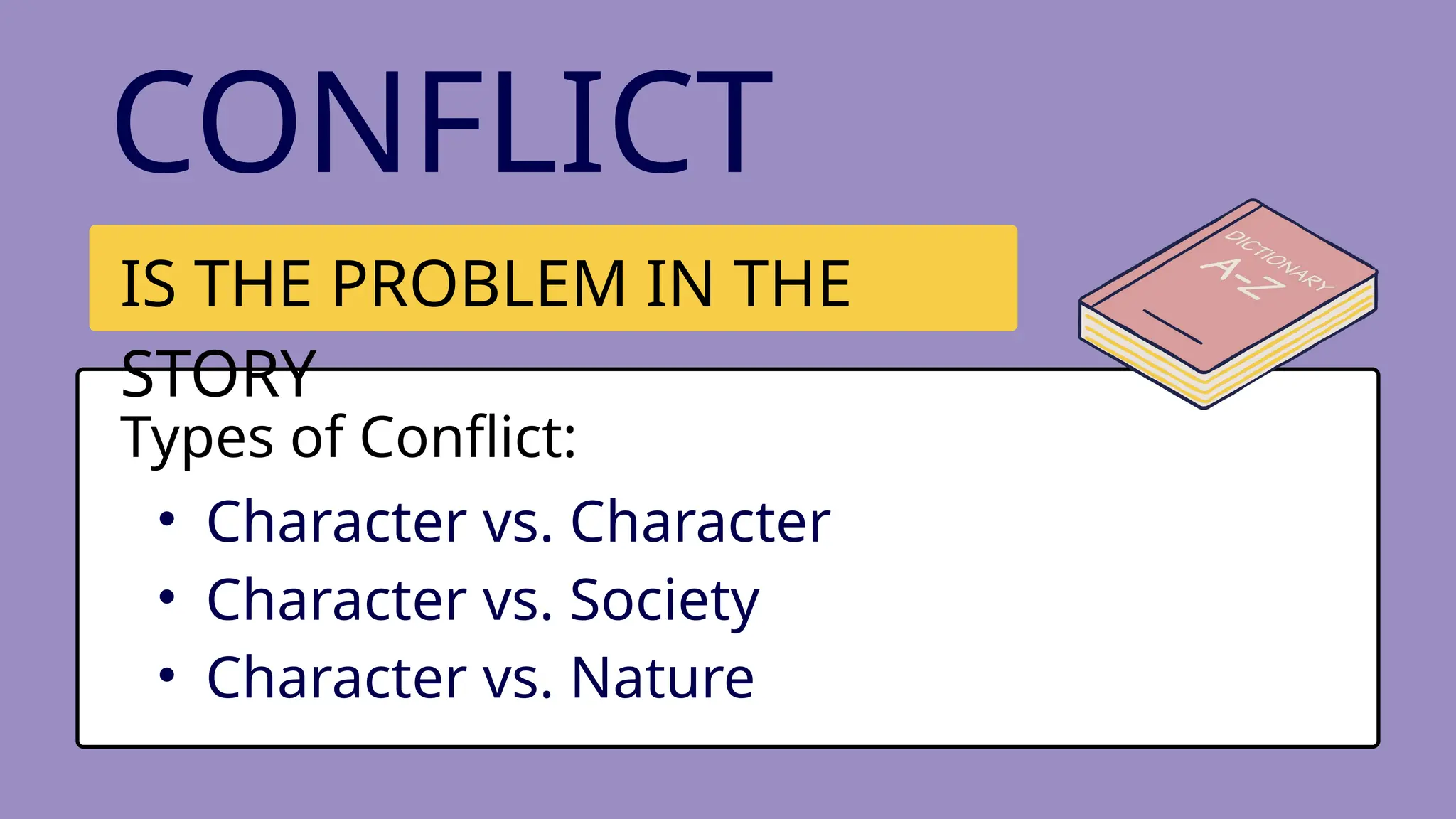
IS THE PROBLEMIN THE
STORY
CONFLICT
Types of Conflict:
• Character vs. Character
• Character vs. Society
• Character vs. Nature
18.
THIS IS ACOMMON TYPE
OF CONFLICT IN WHICH
ONE CHARACTER’S
(PROTAGONIST) NEEDS OR
WANTS ARE AT ODDS WITH
ANOTHER CHARACTER
(ANTAGONIST).
CHARACTER VS.
CHARACTER
PROTAGONIST - MAIN
CHARACTER OF THE
STORY.
ANTAGONIST -
OPPOSES THE MAIN
CHARACTER
19.
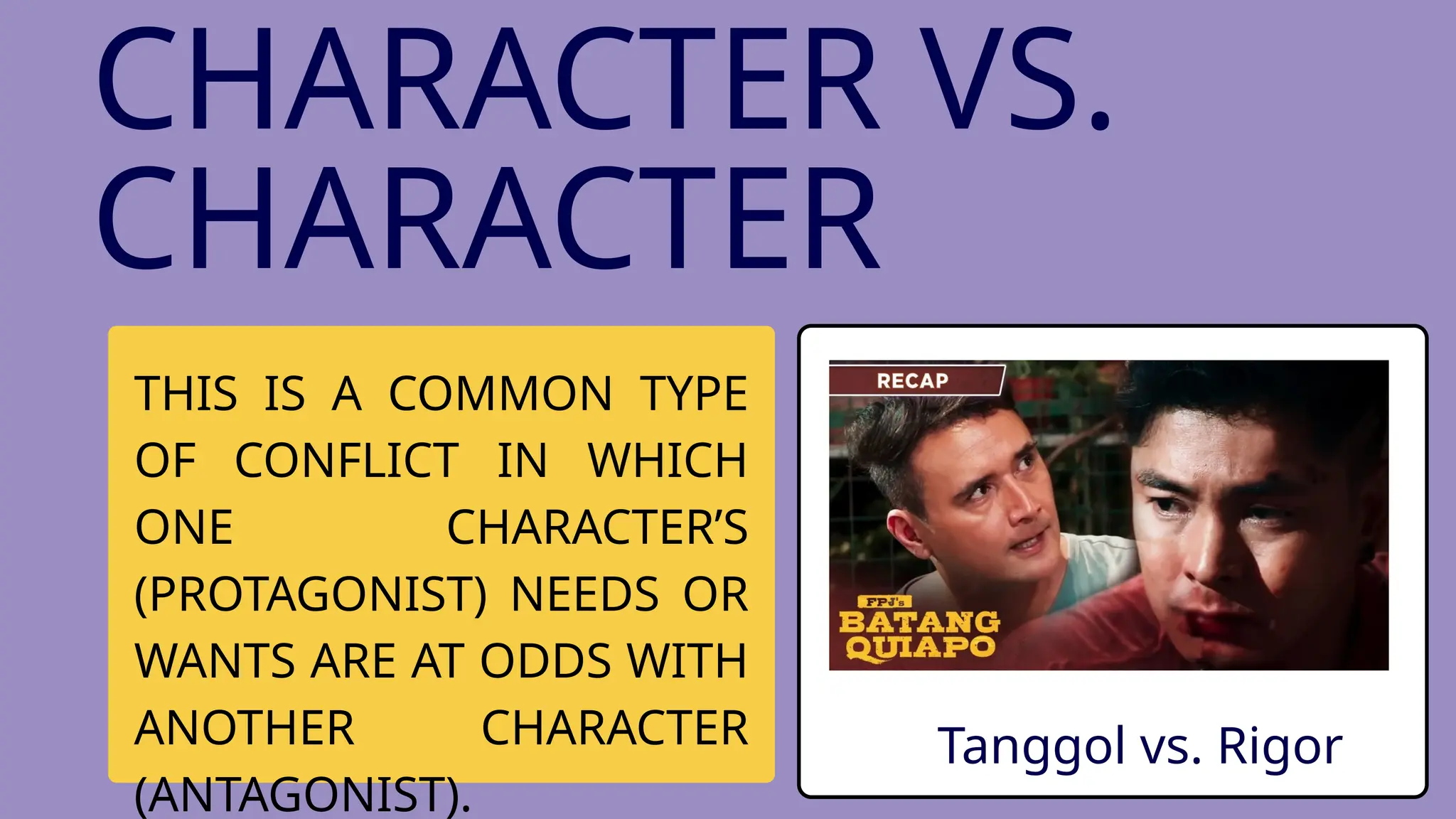
THIS IS ACOMMON TYPE
OF CONFLICT IN WHICH
ONE CHARACTER’S
(PROTAGONIST) NEEDS OR
WANTS ARE AT ODDS WITH
ANOTHER CHARACTER
(ANTAGONIST).
CHARACTER VS.
CHARACTER
Tanggol vs. Rigor
20.
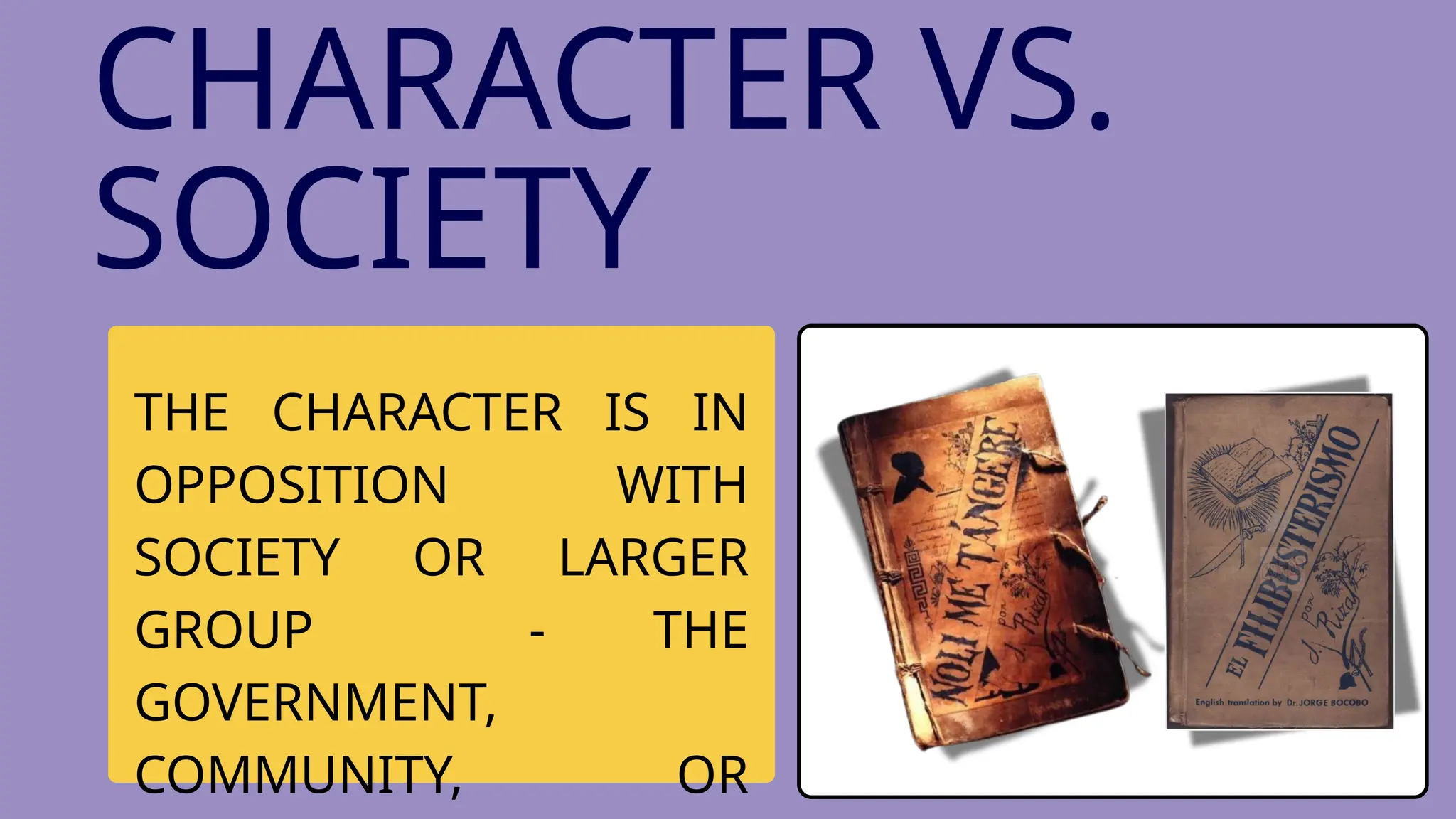
THE CHARACTER ISIN
OPPOSITION WITH
SOCIETY OR LARGER
GROUP - THE
GOVERNMENT,
COMMUNITY, OR
CHARACTER VS.
SOCIETY
21.
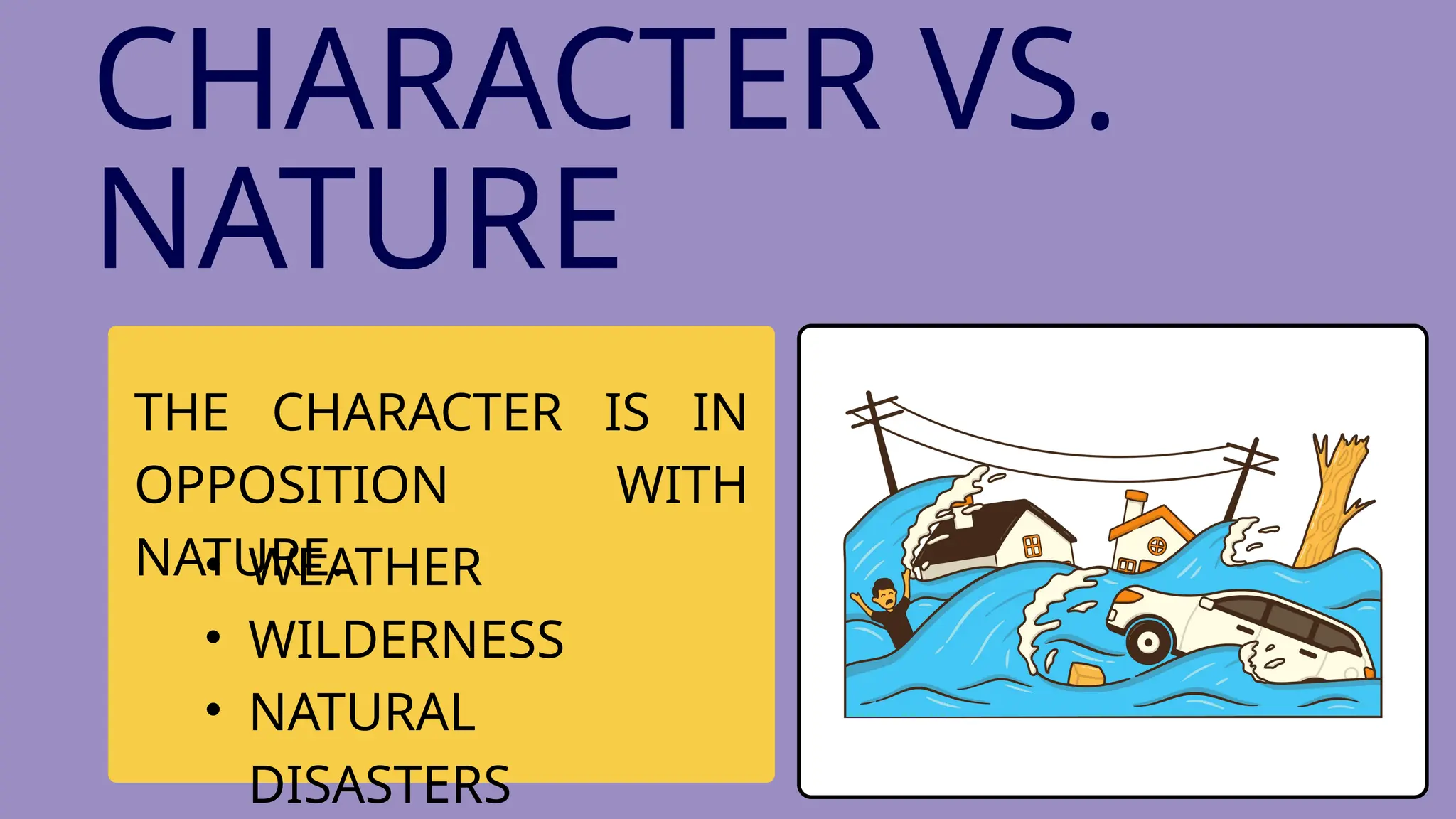
THE CHARACTER ISIN
OPPOSITION WITH
NATURE.
CHARACTER VS.
NATURE
• WEATHER
• WILDERNESS
• NATURAL
DISASTERS
22.
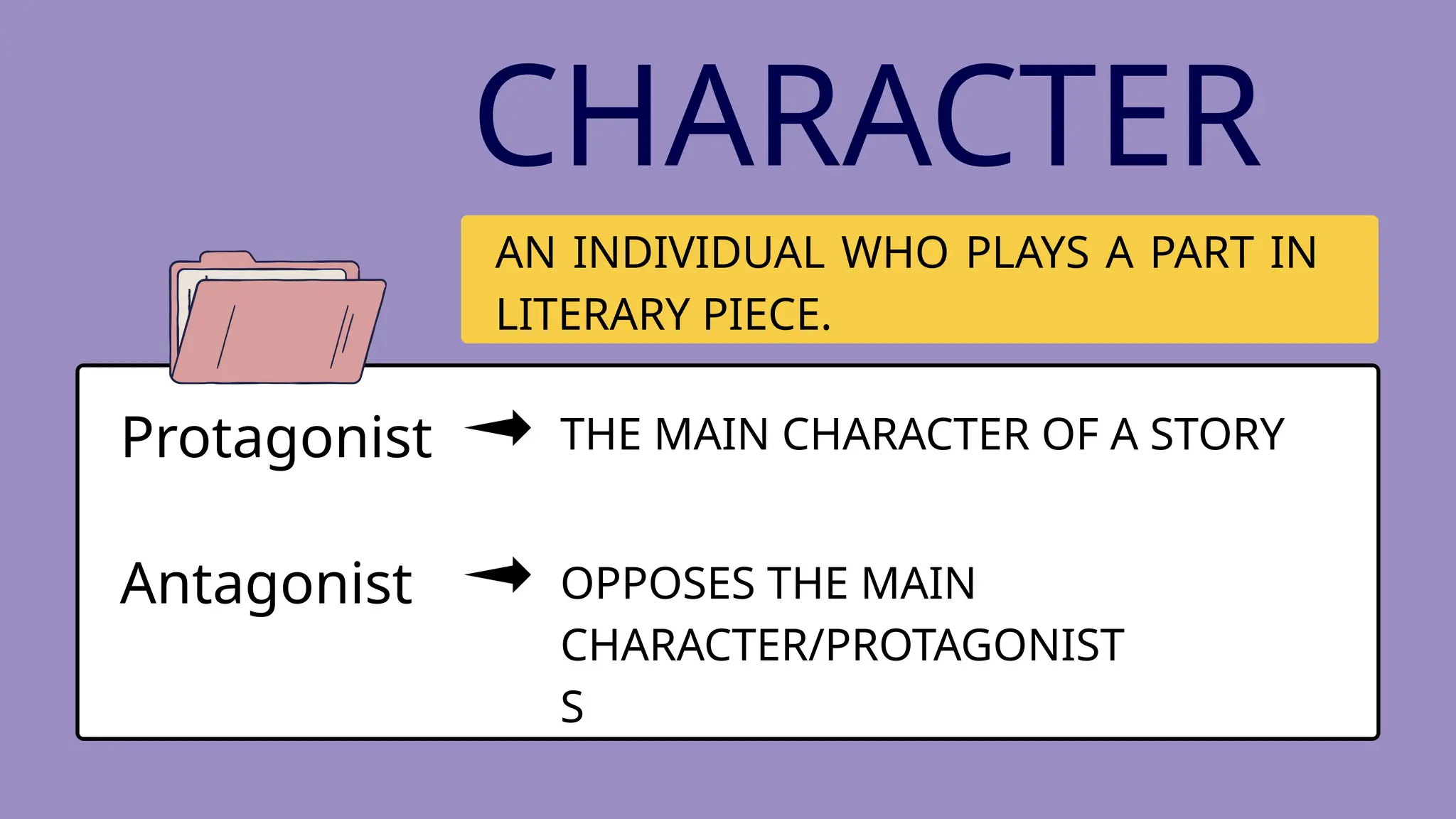
AN INDIVIDUAL WHOPLAYS A PART IN
LITERARY PIECE.
CHARACTER
Protagonist THE MAIN CHARACTER OF A STORY
Antagonist OPPOSES THE MAIN
CHARACTER/PROTAGONIST
S
23.
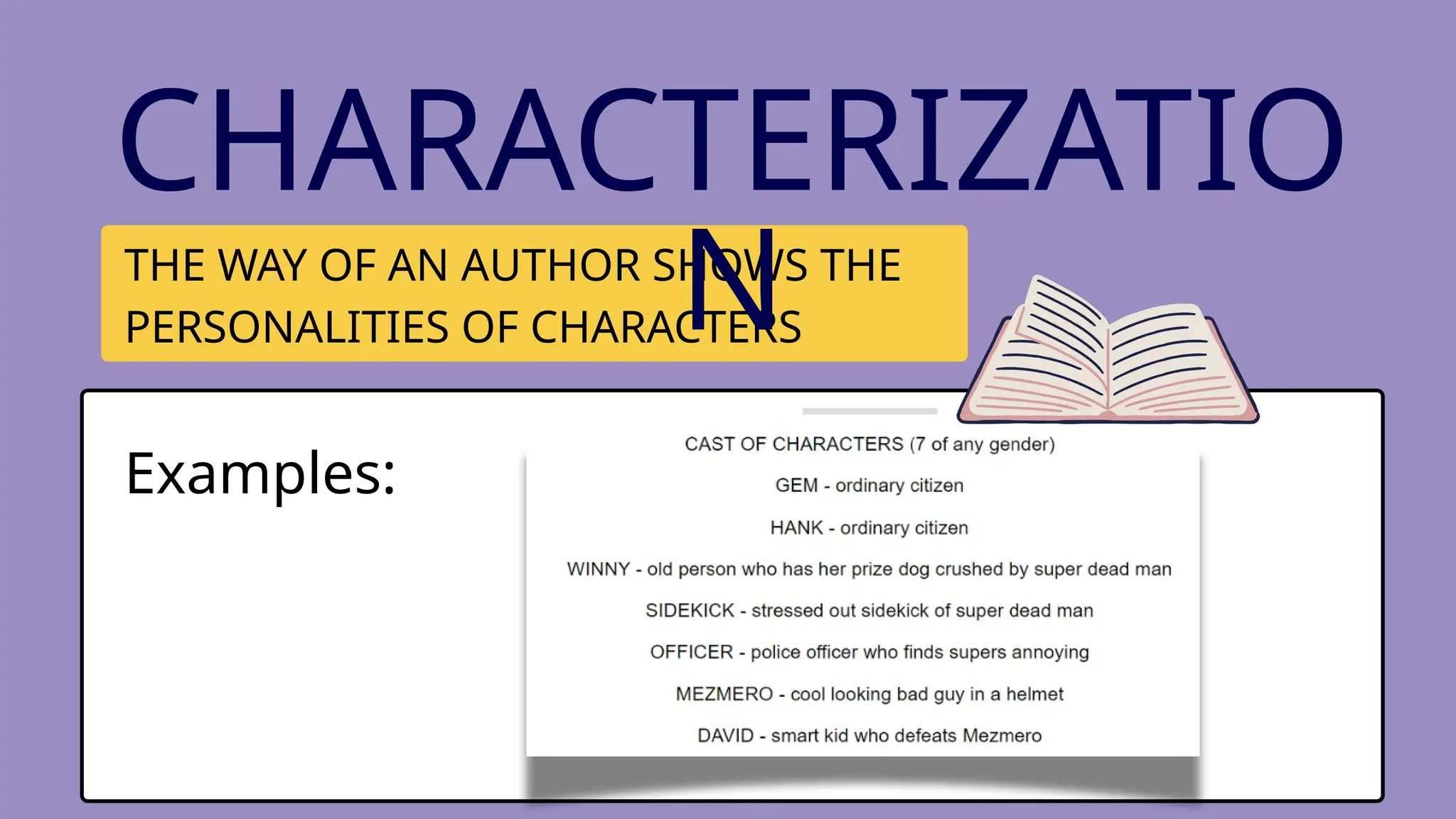
THE WAY OFAN AUTHOR SHOWS THE
PERSONALITIES OF CHARACTERS
CHARACTERIZATIO
N
Examples:
24.
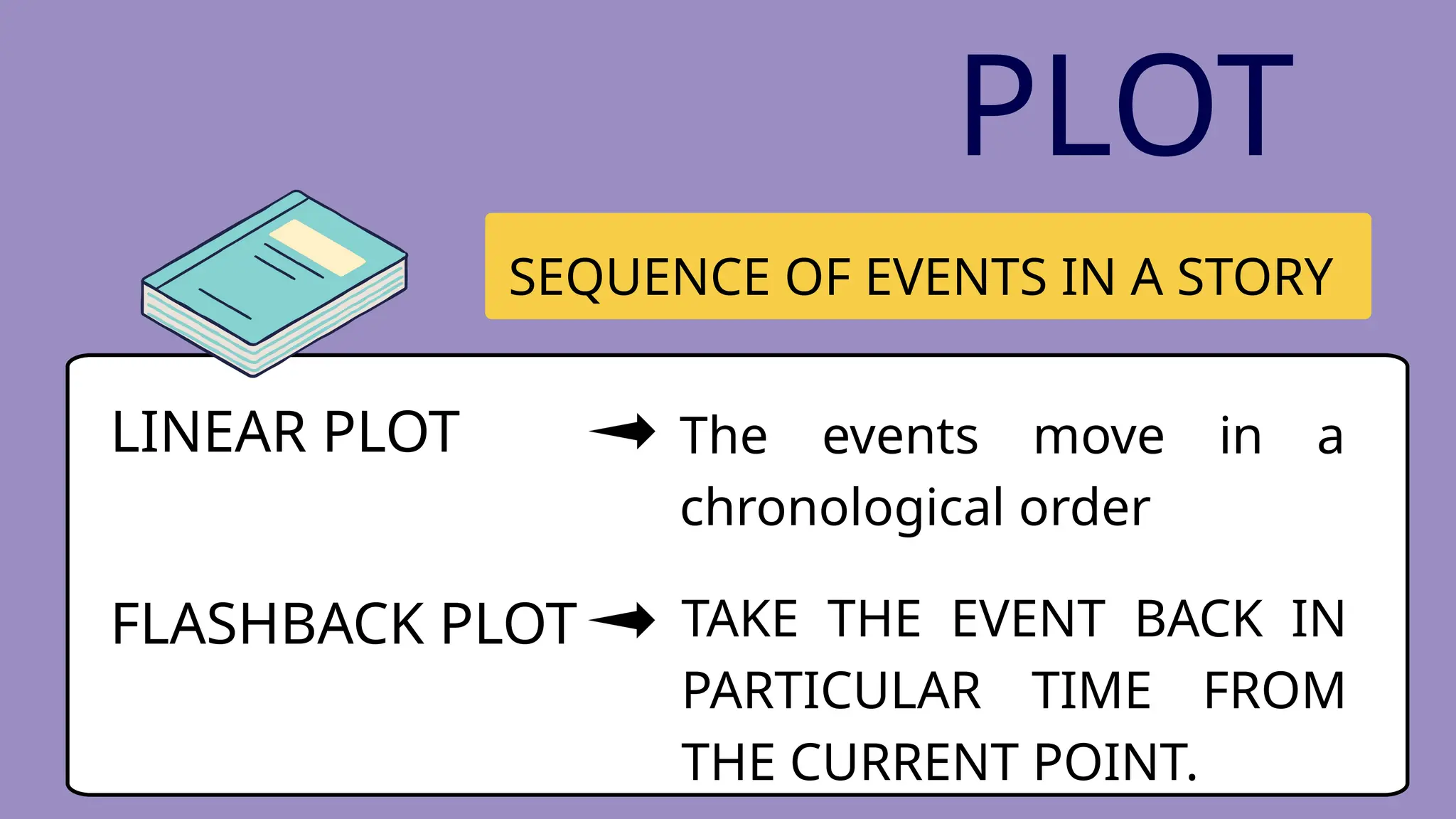
SEQUENCE OF EVENTSIN A STORY
PLOT
LINEAR PLOT The events move in a
chronological order
FLASHBACK PLOT TAKE THE EVENT BACK IN
PARTICULAR TIME FROM
THE CURRENT POINT.
25.
SEQUENCE OF EVENTSIN A STORY
PLOT
(Linear Plot)
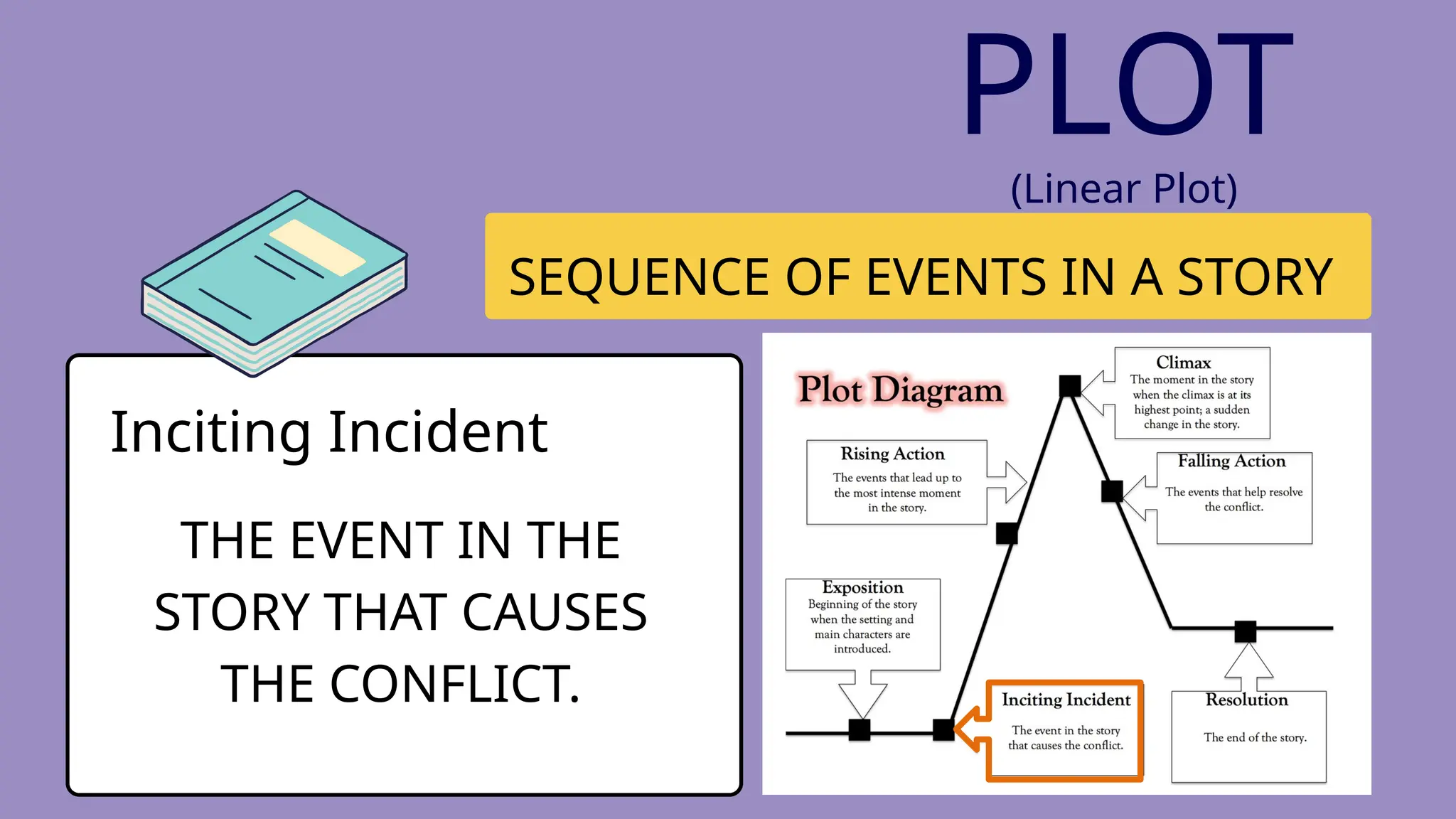
Exposition
BEGINNING OF THE
STORY WHERE
CHARACTERS AND
SETTING ARE
26.
SEQUENCE OF EVENTSIN A STORY
Inciting Incident
THE EVENT IN THE
STORY THAT CAUSES
THE CONFLICT.
PLOT
(Linear Plot)
27.
SEQUENCE OF EVENTSIN A STORY
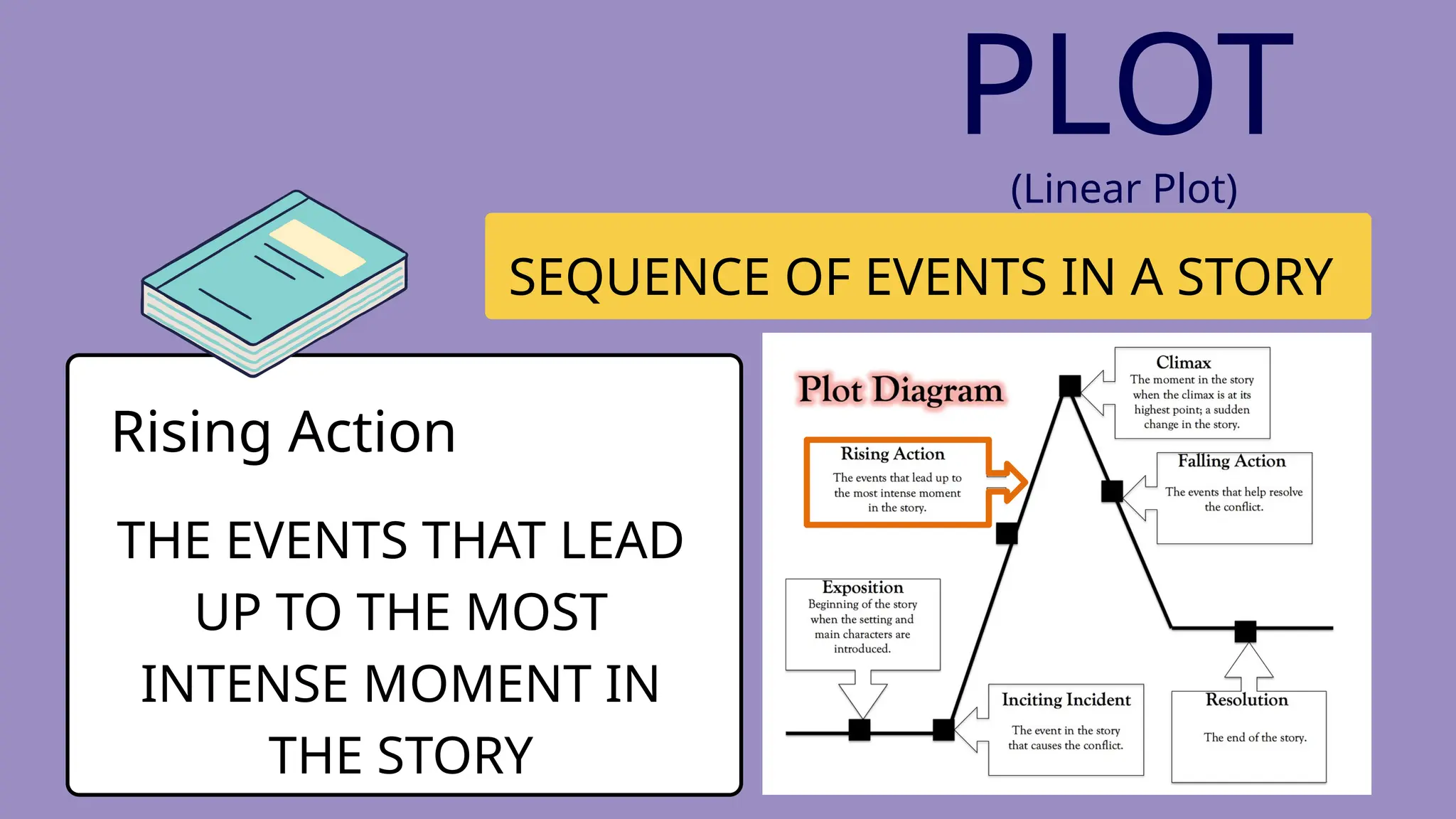
Rising Action
THE EVENTS THAT LEAD
UP TO THE MOST
INTENSE MOMENT IN
THE STORY
PLOT
(Linear Plot)
28.
SEQUENCE OF EVENTSIN A STORY
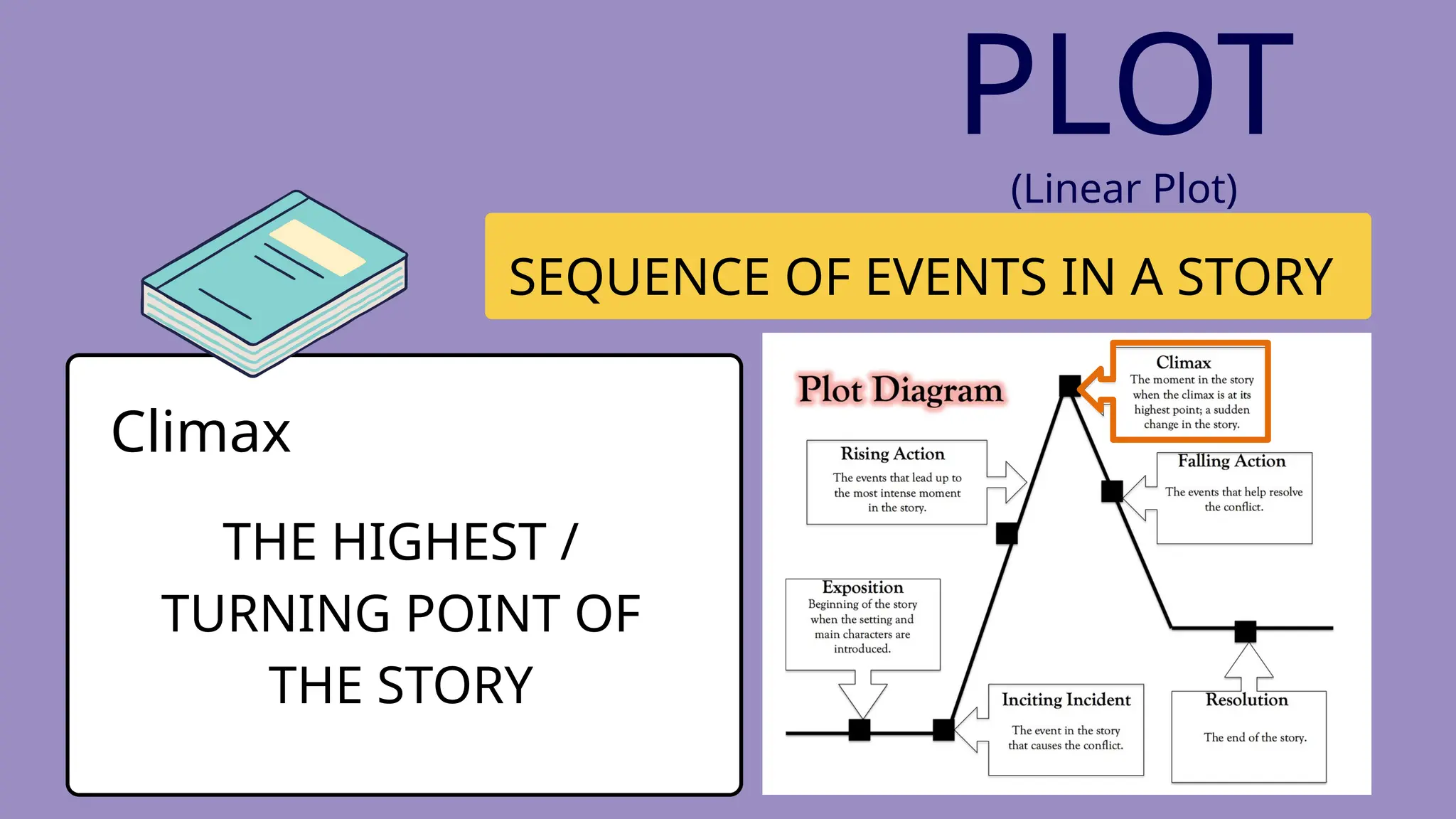
Climax
THE HIGHEST /
TURNING POINT OF
THE STORY
PLOT
(Linear Plot)
29.
SEQUENCE OF EVENTSIN A STORY
Falling Action
THE EVENT WHEN THE
CONFLICT IS RESOLVED
PLOT
(Linear Plot)
30.
SEQUENCE OF EVENTSIN A STORY
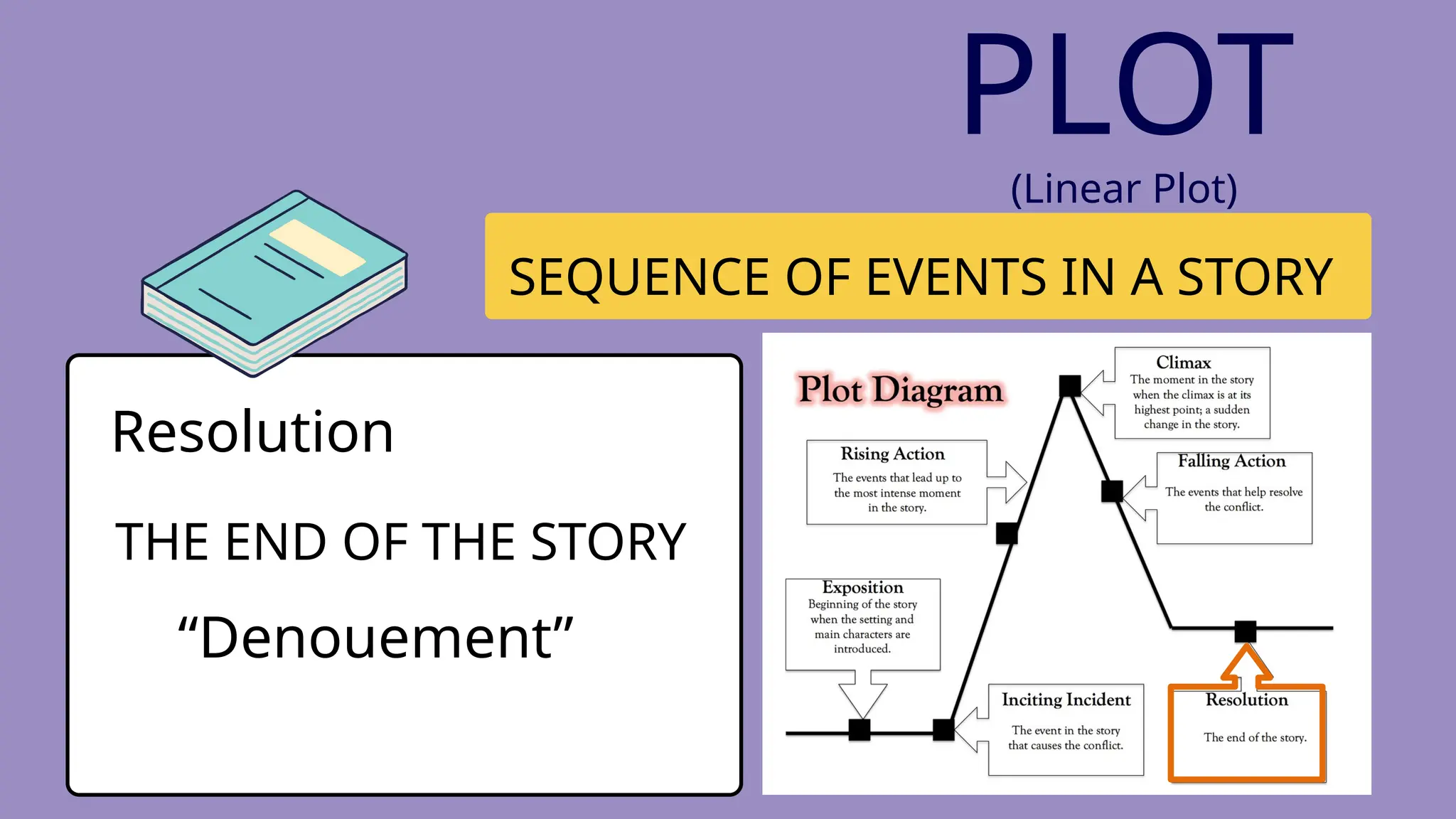
Resolution
THE END OF THE STORY
“Denouement”
PLOT
(Linear Plot)
31.
THE FEELING SETBY THE AUTHOR AND READER
IN THE POEM
TONE AND
MOOD
TONE THE FEELING / ATMOSPHERE THAT THE AUTHOR
HAS SET IN THE POEM
MOOD THE FEELING / ATMOSPHERE THAT THE READER
FELT AFTER READING THE POEM
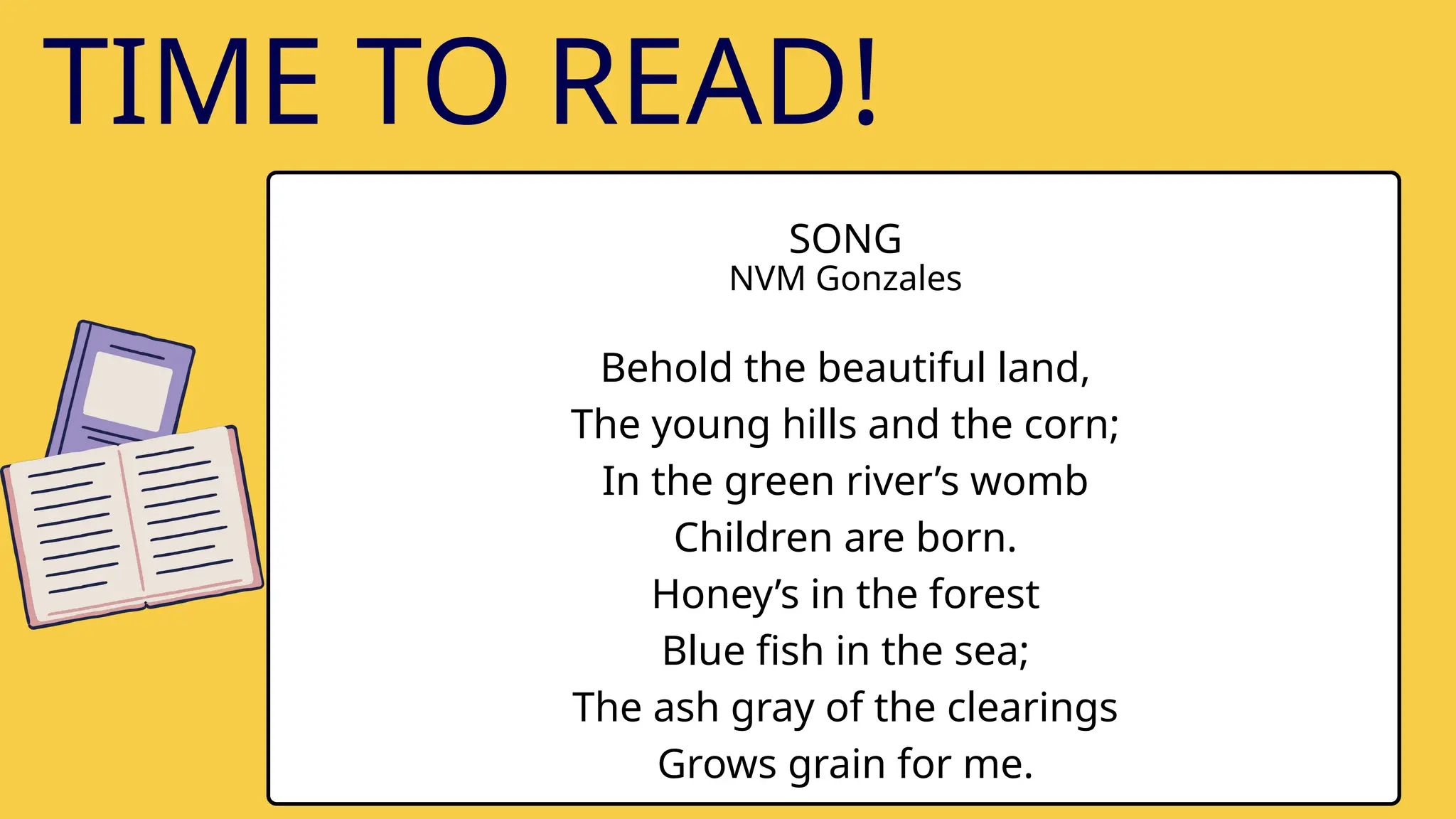
SONG
NVM Gonzales
Behold thebeautiful land,
The young hills and the corn;
In the green river’s womb
Children are born.
Honey’s in the forest
Blue fish in the sea;
The ash gray of the clearings
Grows grain for me.
TIME TO READ!
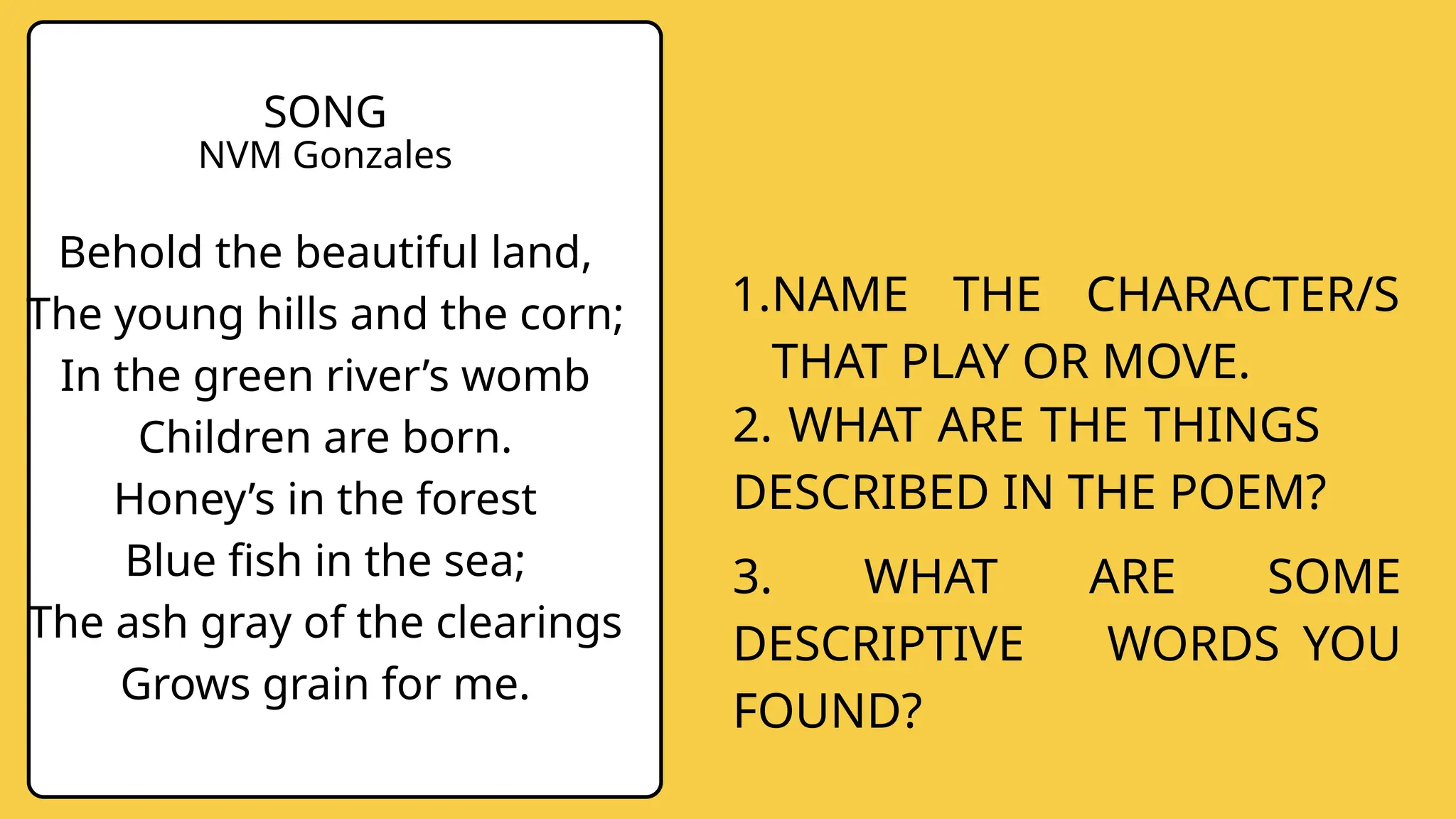
48.
SONG
NVM Gonzales
Behold thebeautiful land,
The young hills and the corn;
In the green river’s womb
Children are born.
Honey’s in the forest
Blue fish in the sea;
The ash gray of the clearings
Grows grain for me.
1.NAME THE CHARACTER/S
THAT PLAY OR MOVE.
3. WHAT ARE SOME
DESCRIPTIVE WORDS YOU
FOUND?
2. WHAT ARE THE THINGS
DESCRIBED IN THE POEM?
49.
Descriptive words helpa writer create vivid mental images
for readers, painting scenes, emotions, or sensory
experiences through language. They can evoke specific
emotions or moods, adding depth to the poem.
Descriptive words provide specific details that enhance the
reader's understanding and engagement with the poem.
They can describe physical characteristics, actions, or even
abstract concepts in a tangible way.
DESCRIPTIVE
WORDS
50.
ACTIVITY 7
POWER OFWORDS
FORM WORDS OUT OF THE
JUMBLED LETTERS AND USE
THE SENTENCE PROVIDED AS
CONTEXT CLUES.
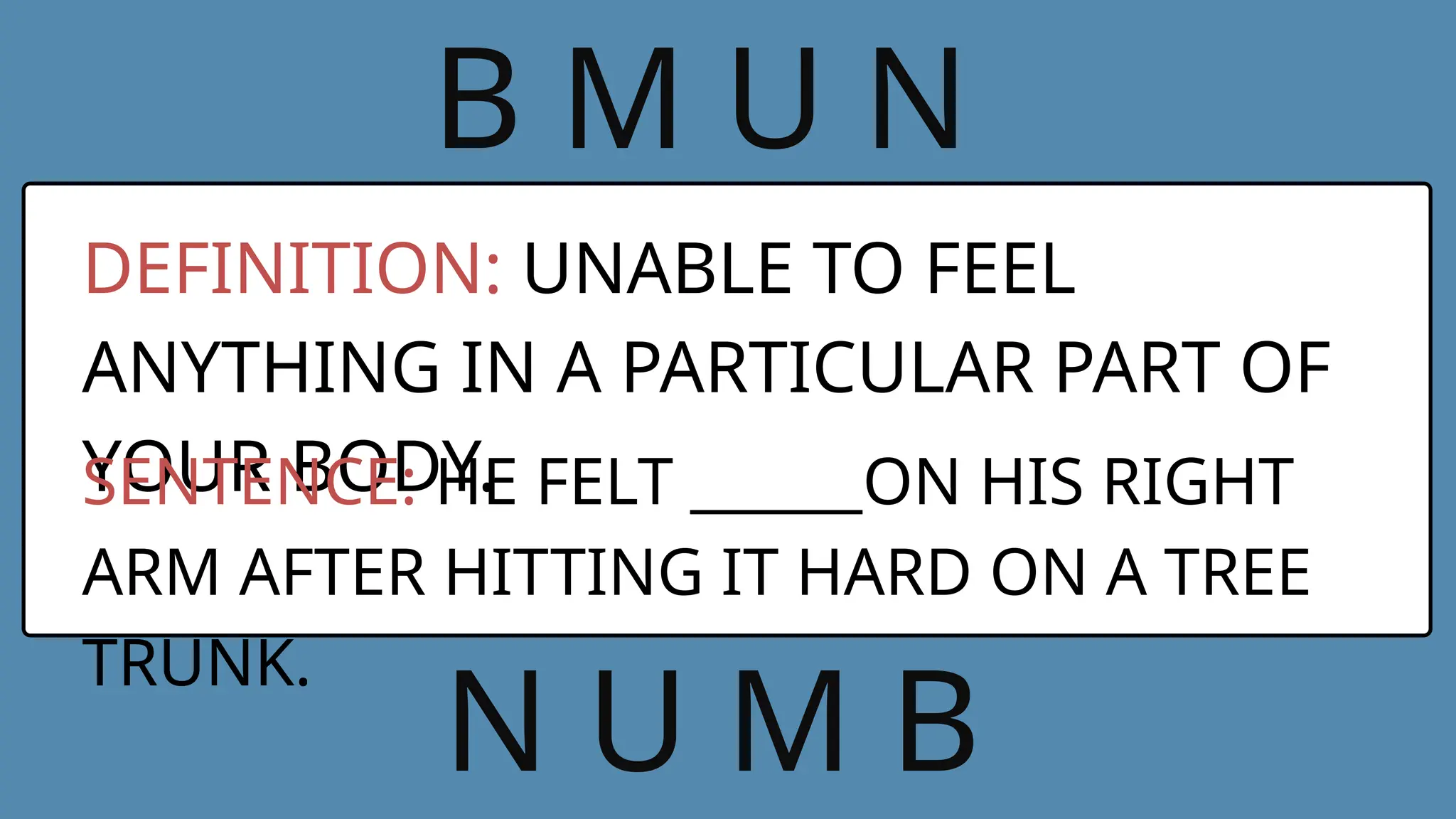
51.
B M UN
DEFINITION: UNABLE TO FEEL
ANYTHING IN A PARTICULAR PART OF
YOUR BODY.
SENTENCE: HE FELT ______ON HIS RIGHT
ARM AFTER HITTING IT HARD ON A TREE
TRUNK.
N U M B
52.
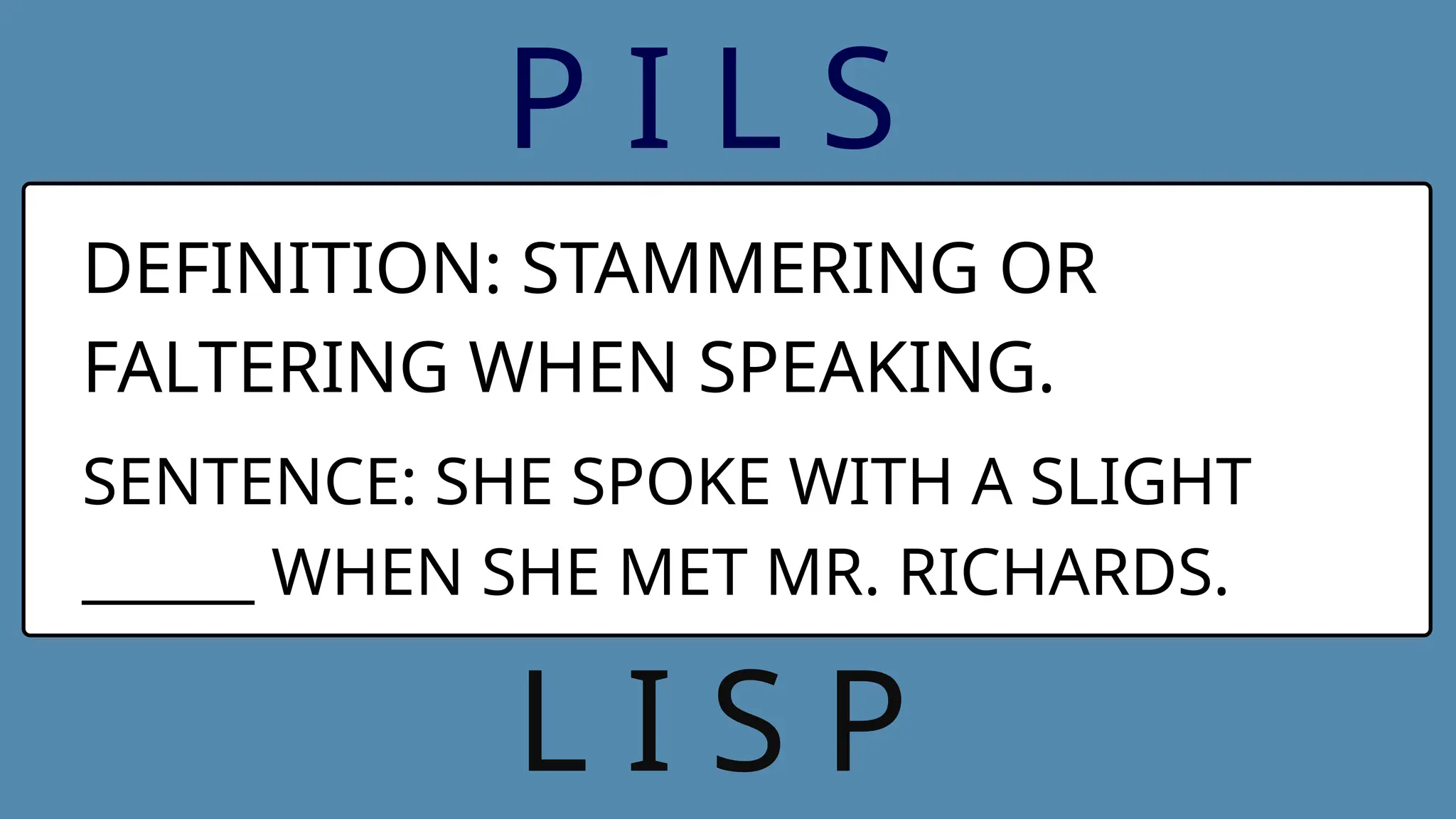
P I LS
DEFINITION: STAMMERING OR
FALTERING WHEN SPEAKING.
SENTENCE: SHE SPOKE WITH A SLIGHT
______ WHEN SHE MET MR. RICHARDS.
L I S P
53.
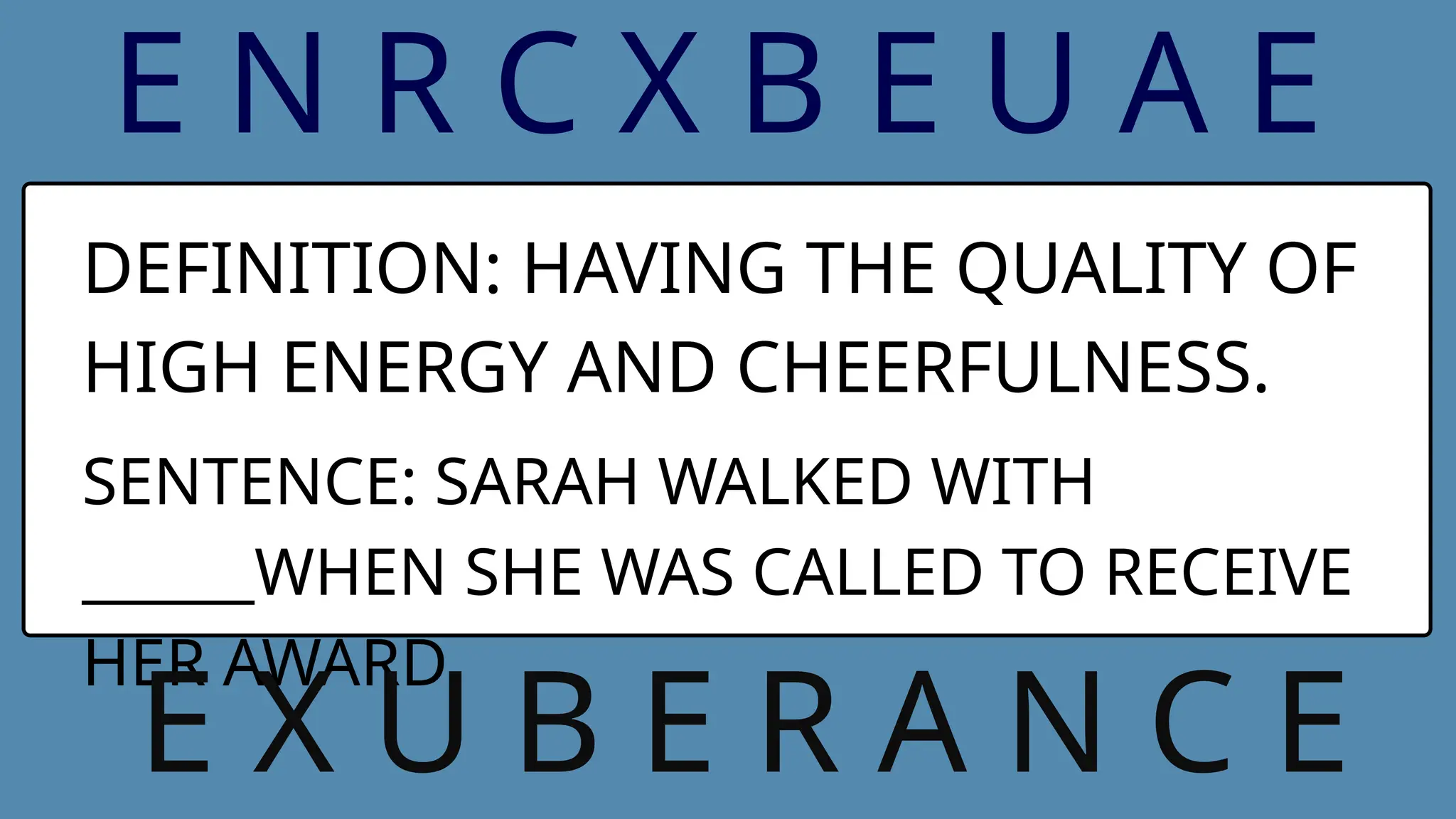
E N RC X B E U A E
DEFINITION: HAVING THE QUALITY OF
HIGH ENERGY AND CHEERFULNESS.
SENTENCE: SARAH WALKED WITH
______WHEN SHE WAS CALLED TO RECEIVE
HER AWARD.
E X U B E R A N C E
54.
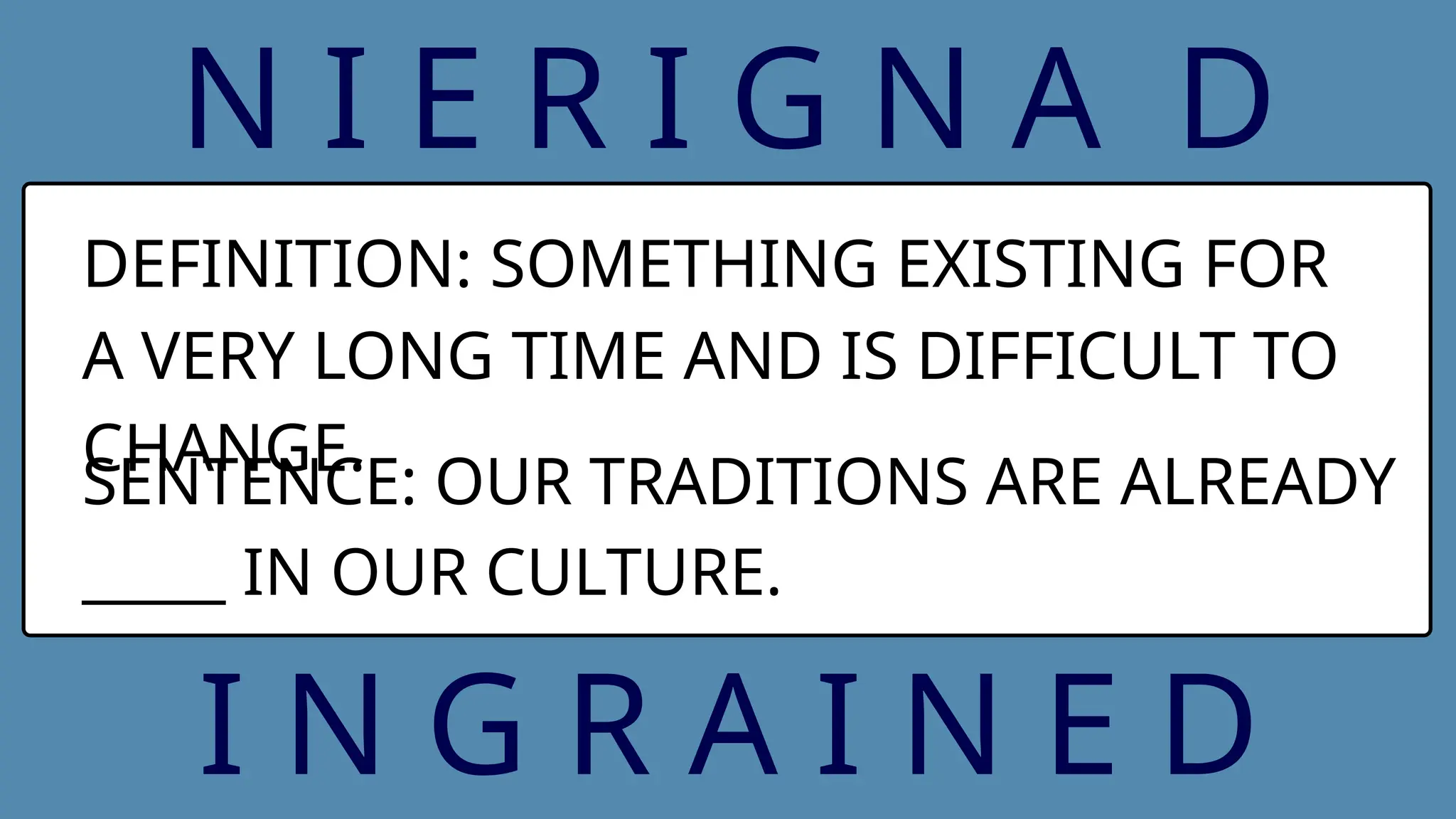
N I ER I G N A D
DEFINITION: SOMETHING EXISTING FOR
A VERY LONG TIME AND IS DIFFICULT TO
CHANGE.
SENTENCE: OUR TRADITIONS ARE ALREADY
_____ IN OUR CULTURE.
I N G R A I N E D
55.
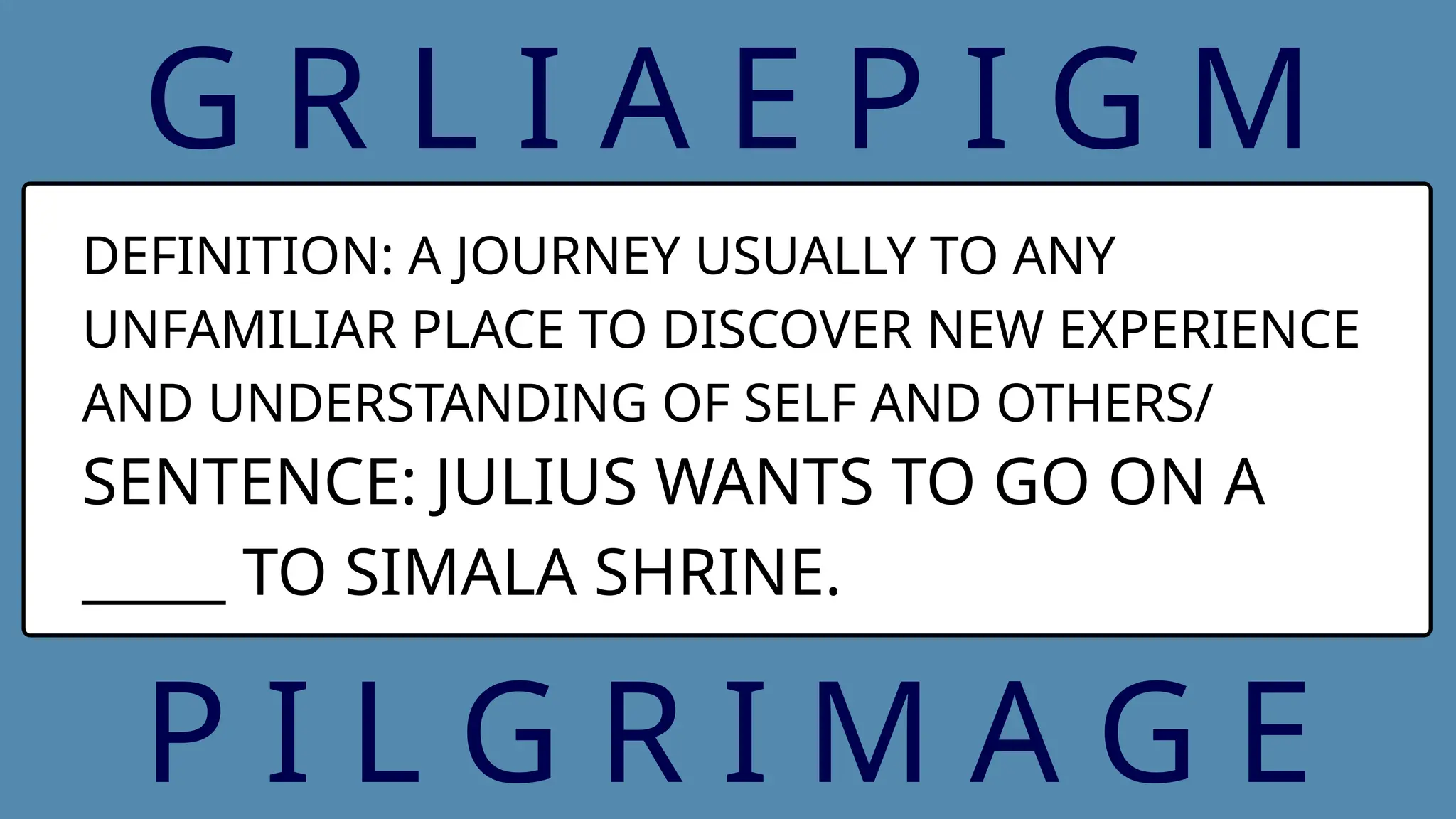
G R LI A E P I G M
DEFINITION: A JOURNEY USUALLY TO ANY
UNFAMILIAR PLACE TO DISCOVER NEW EXPERIENCE
AND UNDERSTANDING OF SELF AND OTHERS/
SENTENCE: JULIUS WANTS TO GO ON A
_____ TO SIMALA SHRINE.
P I L G R I M A G E
56.
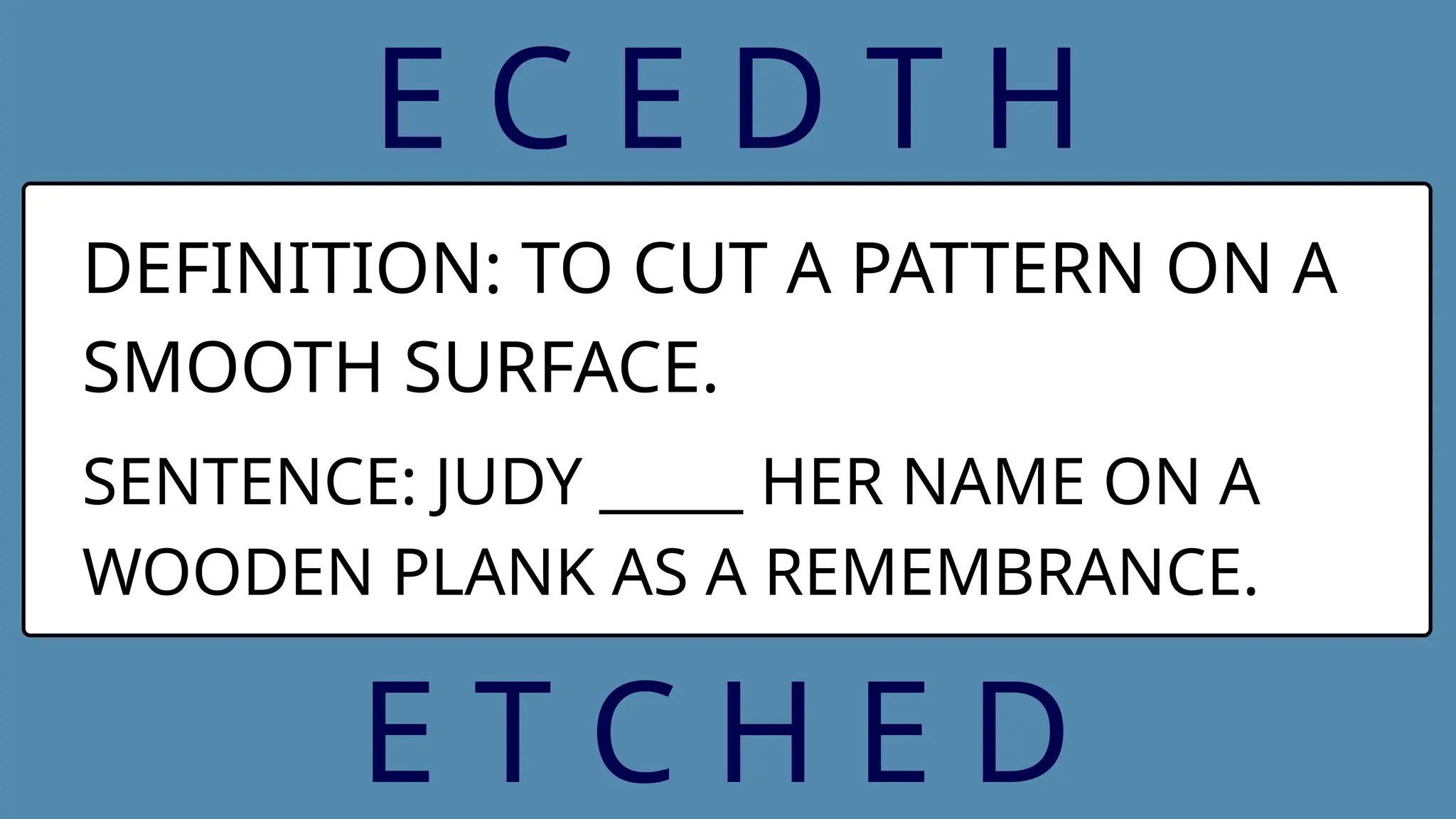
E C ED T H
DEFINITION: TO CUT A PATTERN ON A
SMOOTH SURFACE.
SENTENCE: JUDY _____ HER NAME ON A
WOODEN PLANK AS A REMEMBRANCE.
E T C H E D
57.
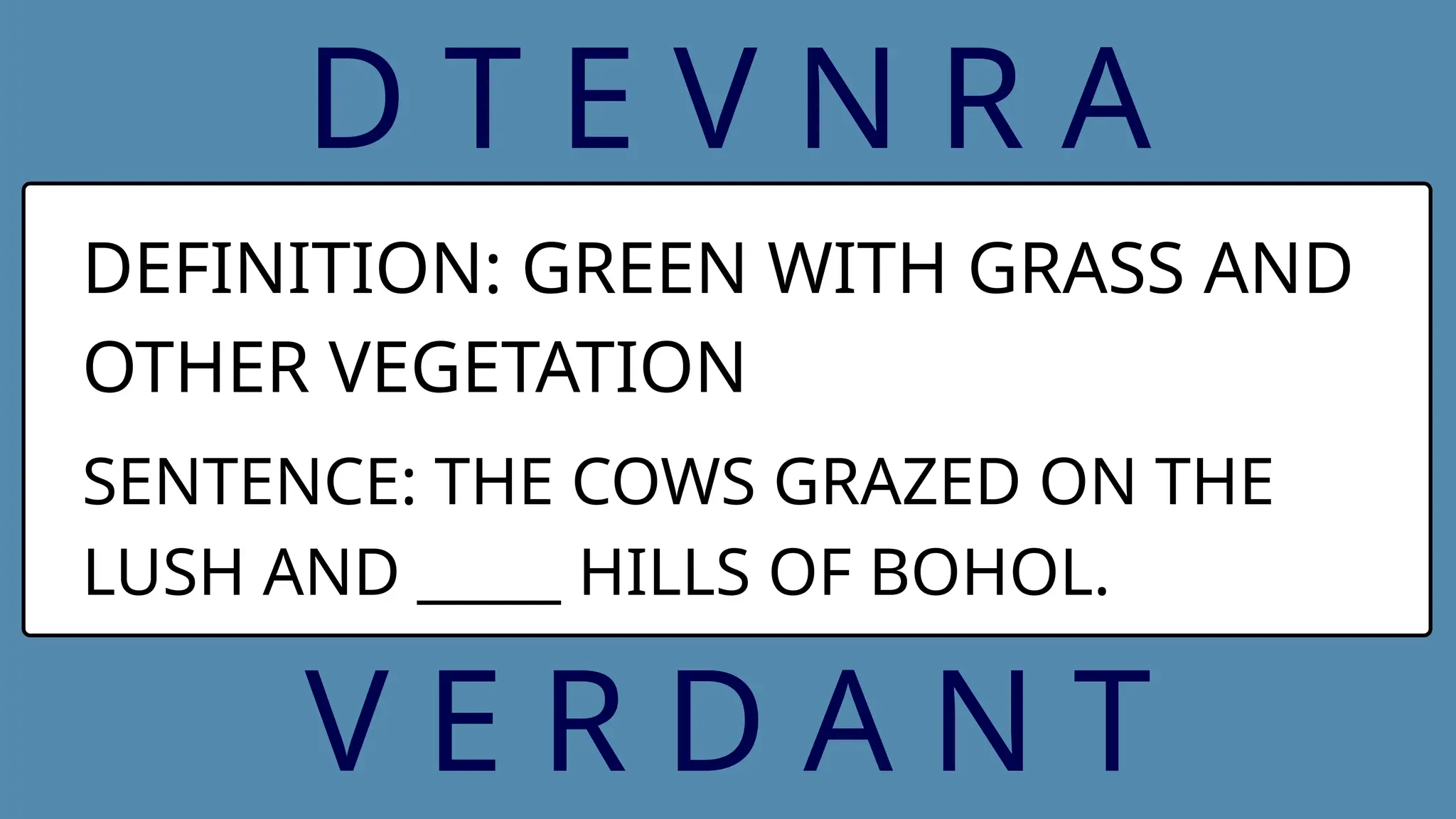
D T EV N R A
DEFINITION: GREEN WITH GRASS AND
OTHER VEGETATION
SENTENCE: THE COWS GRAZED ON THE
LUSH AND _____ HILLS OF BOHOL.
V E R D A N T
58.
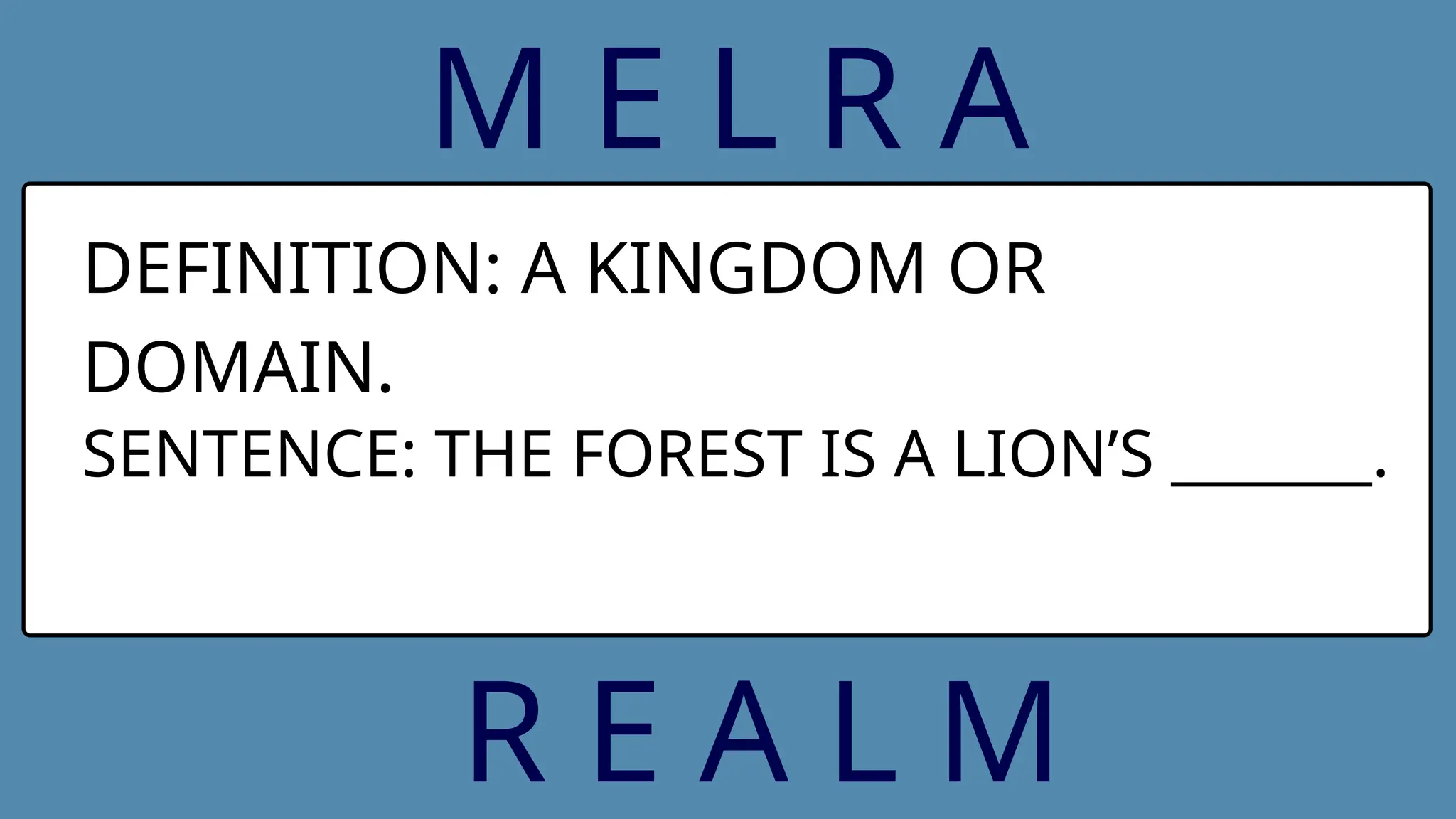
M E LR A
DEFINITION: A KINGDOM OR
DOMAIN.
SENTENCE: THE FOREST IS A LION’S _______.
R E A L M
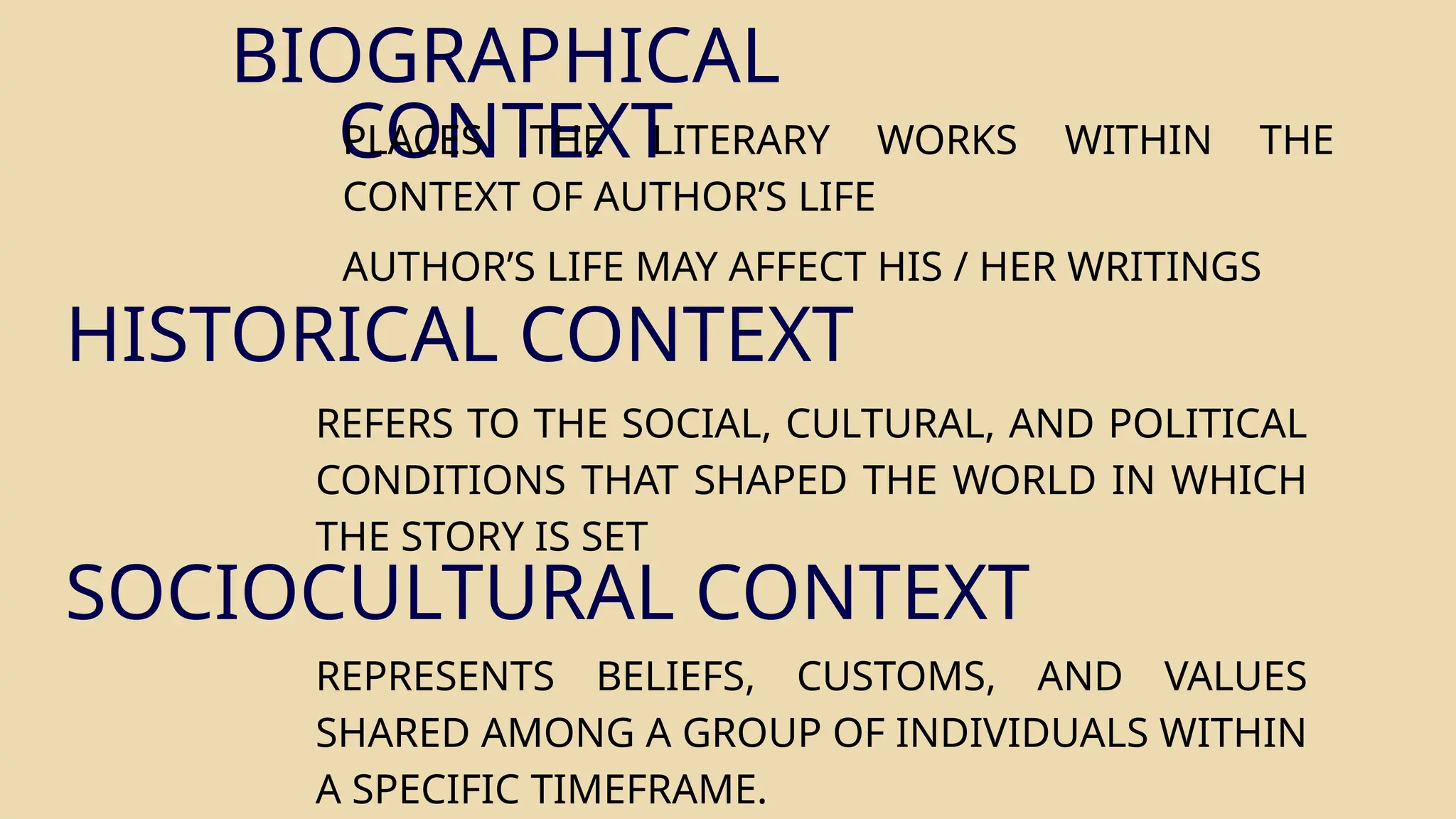
BIOGRAPHICAL
CONTEXT
PLACES THE LITERARYWORKS WITHIN THE
CONTEXT OF AUTHOR’S LIFE
AUTHOR’S LIFE MAY AFFECT HIS / HER WRITINGS
HISTORICAL CONTEXT
REFERS TO THE SOCIAL, CULTURAL, AND POLITICAL
CONDITIONS THAT SHAPED THE WORLD IN WHICH
THE STORY IS SET
REPRESENTS BELIEFS, CUSTOMS, AND VALUES
SHARED AMONG A GROUP OF INDIVIDUALS WITHIN
A SPECIFIC TIMEFRAME.
SOCIOCULTURAL CONTEXT












![M3-ELEMENTS OF PHILIPPINE LITERARY GENRES1 [Autosaved].pptx](https://cdn.slidesharecdn.com/ss_thumbnails/m3-elementsofphilippineliterarygenres1autosaved-240218134957-975a091b-thumbnail.jpg?width=640&height=640&fit=bounds)


