Engineering isEngineering is
EverywhereEverywhere
David T. BowkerDavid T. Bowker
Purdue College of EngineeringPurdue College of Engineering
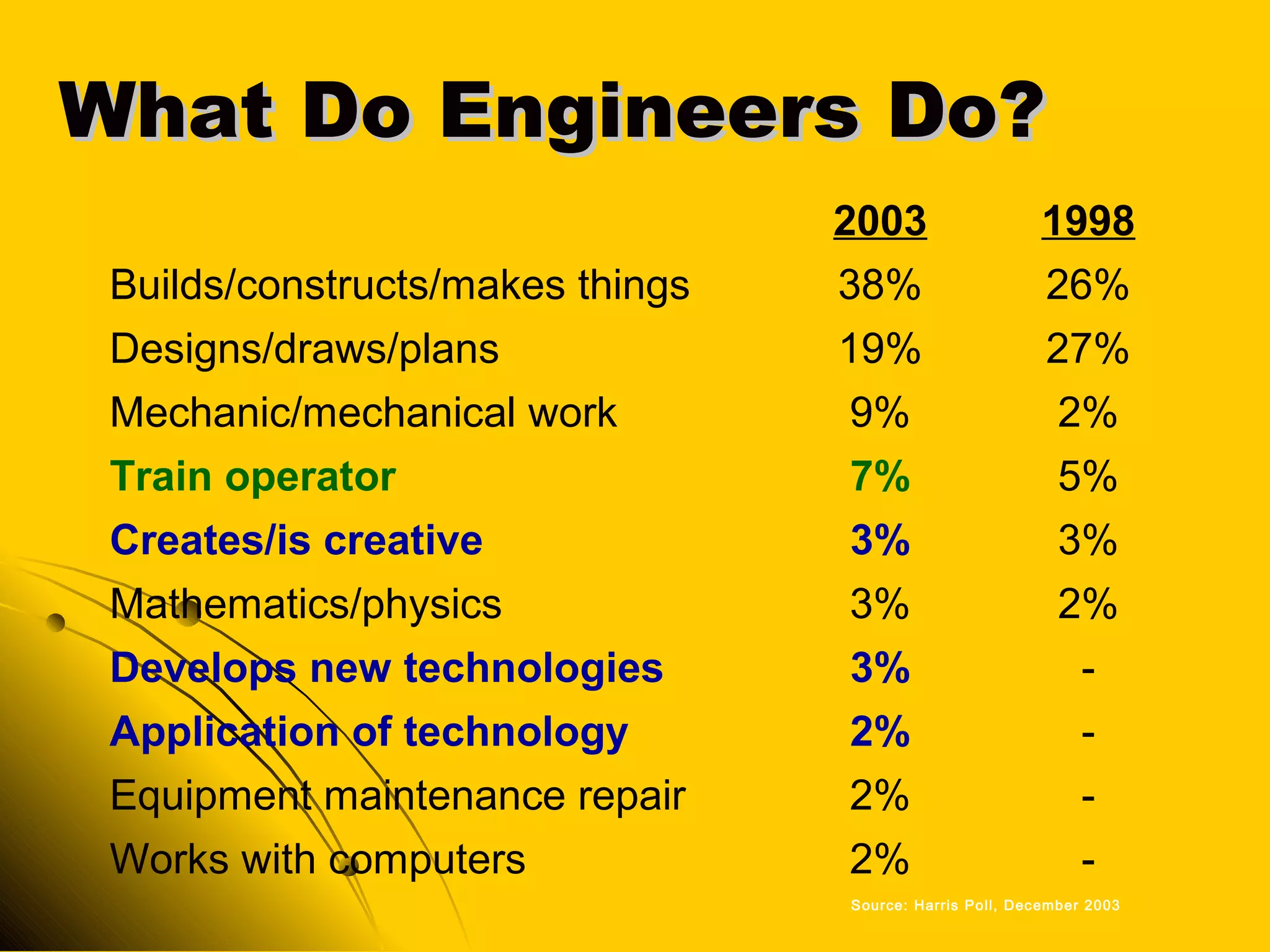
What Do Engineers Do?What Do Engineers Do?
2003 1998
Builds/constructs/makes things 38% 26%
Designs/draws/plans 19% 27%
Mechanic/mechanical work 9% 2%
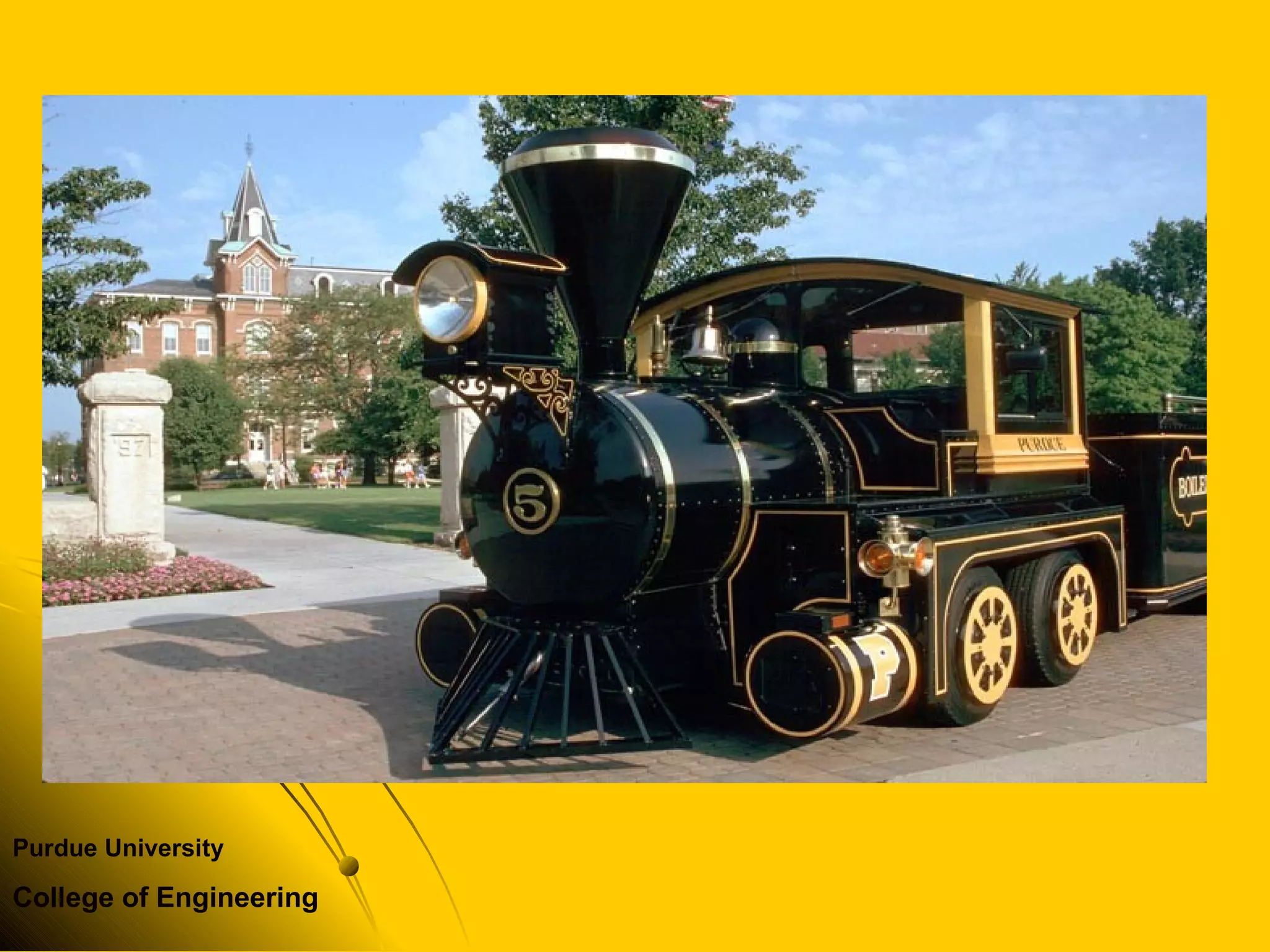
Train operator 7% 5%
Creates/is creative 3% 3%
Mathematics/physics 3% 2%
Develops new technologies 3% -
Application of technology 2% -
Equipment maintenance repair 2% -
Works with computers 2% -
Source: Harris Poll, December 2003
Purdue University
College of Engineering
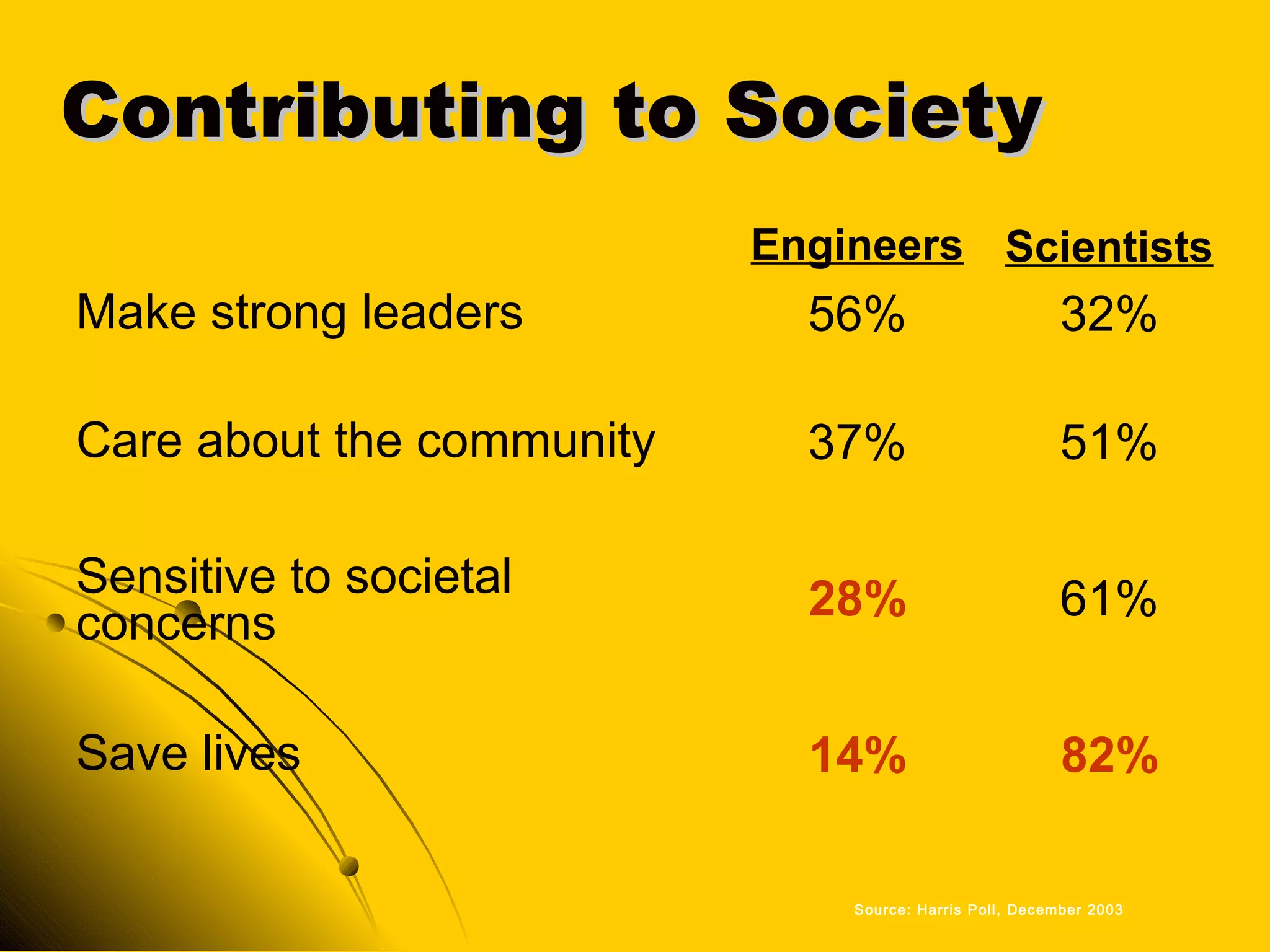
Contributing to SocietyContributing to Society
Engineers Scientists
Make strong leaders 56% 32%
Care about the community 37% 51%
Sensitive to societal
concerns 28% 61%
Save lives 14% 82%
Source: Harris Poll, December 2003
Purdue University
College of Engineering
•Feed the world •Live on Mars
•Provide affordable healthcare
•Protect the environment
•Design material devices that save lives
•Be challenged
•Be bold
•Never stop learning
•Be creative •Be a leader
•Provide a safe water supply
Purdue University
College of Engineering
EngineeringEngineering
is…is…
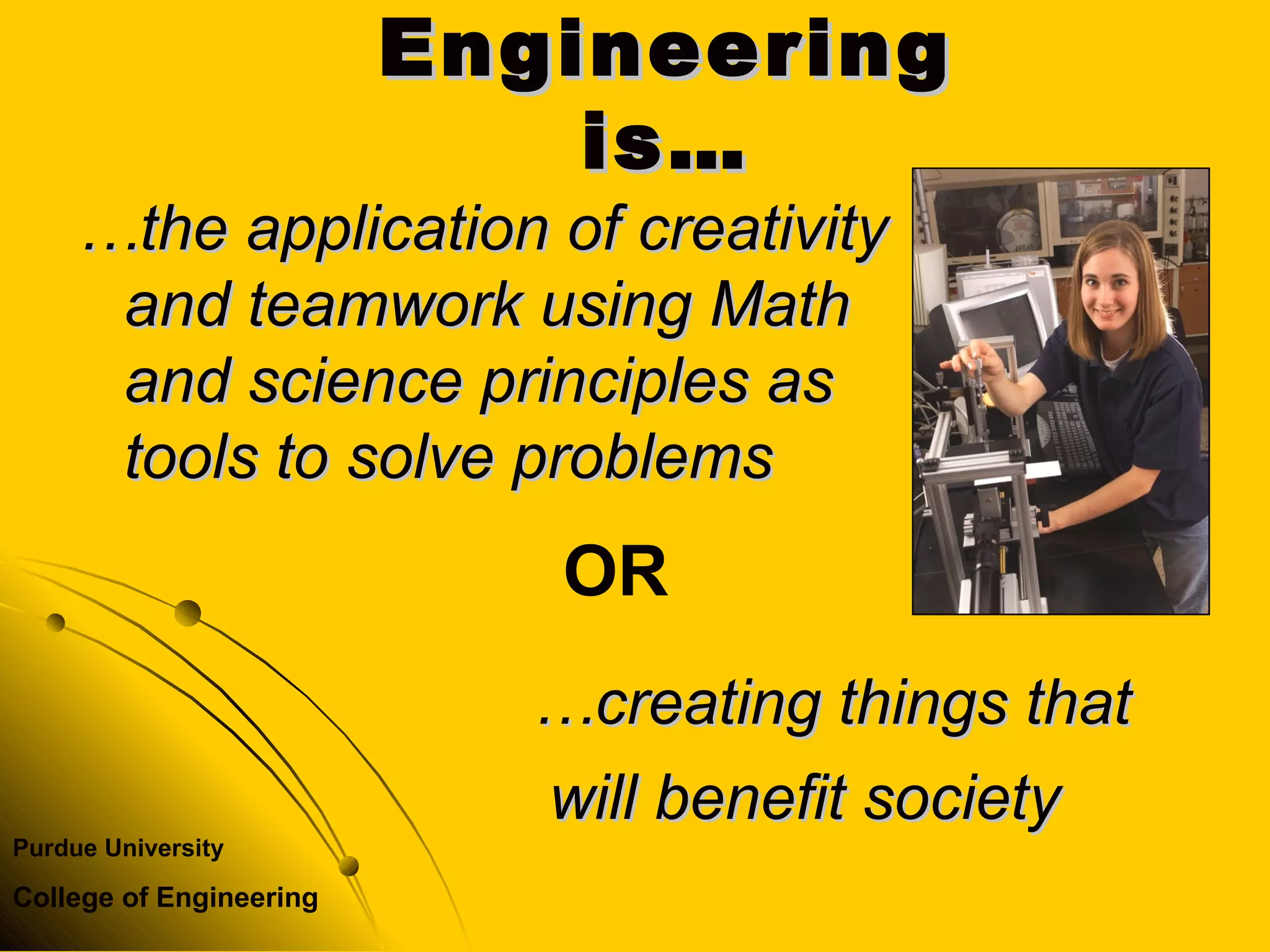
……the application of creativitythe application of creativity
and teamwork using Mathand teamwork using Math
and science principles asand science principles as
tools to solve problemstools to solve problems
……creating things thatcreating things that
will benefit societywill benefit society
OR
Purdue University
College of Engineering
““Engineers have a hand inEngineers have a hand in
designing, creating, ordesigning, creating, or
modifying nearly everythingmodifying nearly everything
we touch, wear, eat, see, andwe touch, wear, eat, see, and
hear in our daily lives.”hear in our daily lives.”
- American Society of Engineering Education- American Society of Engineering Education
Engineering isEngineering is
everywhereeverywhere
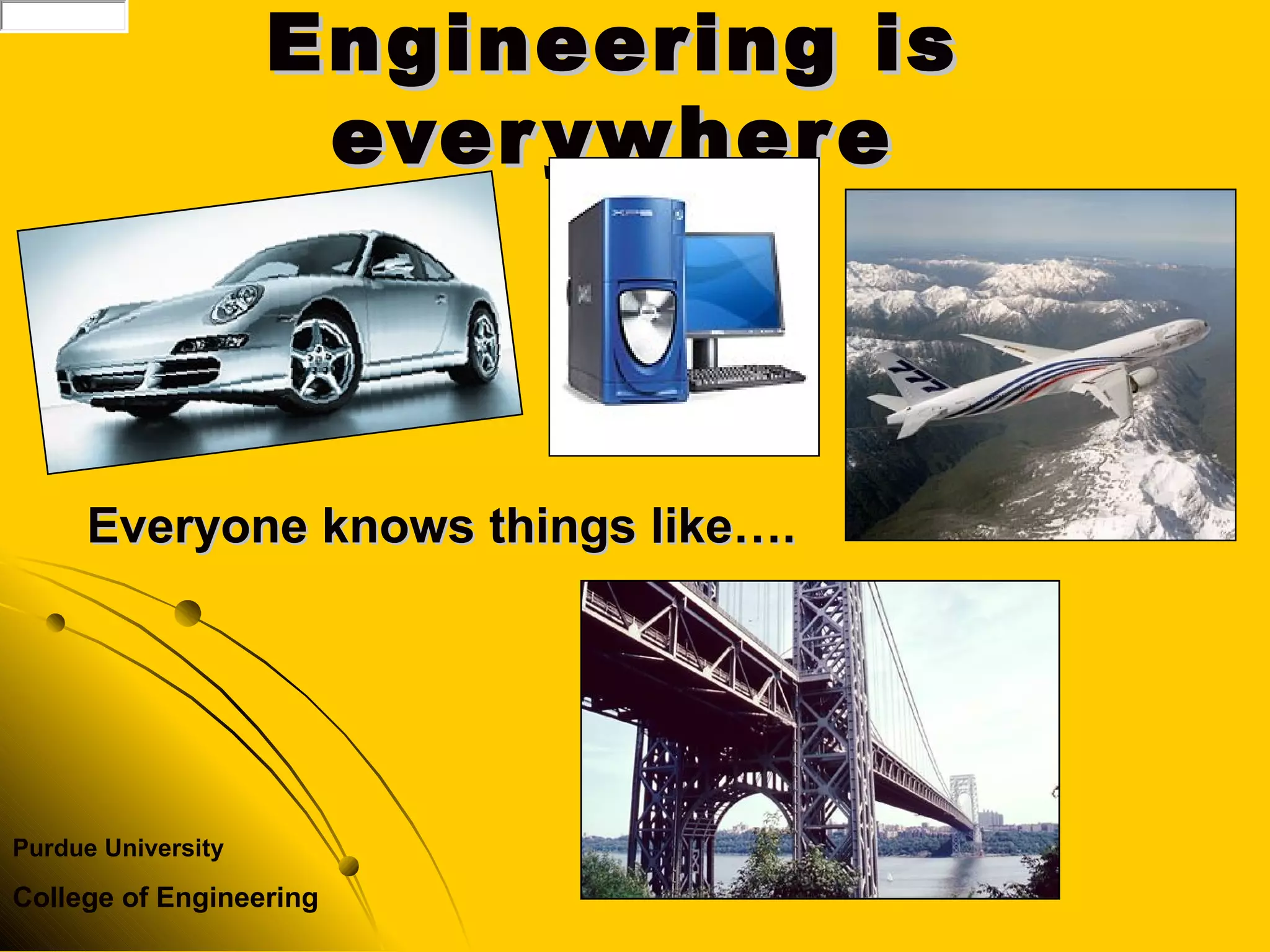
Everyone knows things like….Everyone knows things like….
Purdue University
College of Engineering
Purdue University
College of Engineering
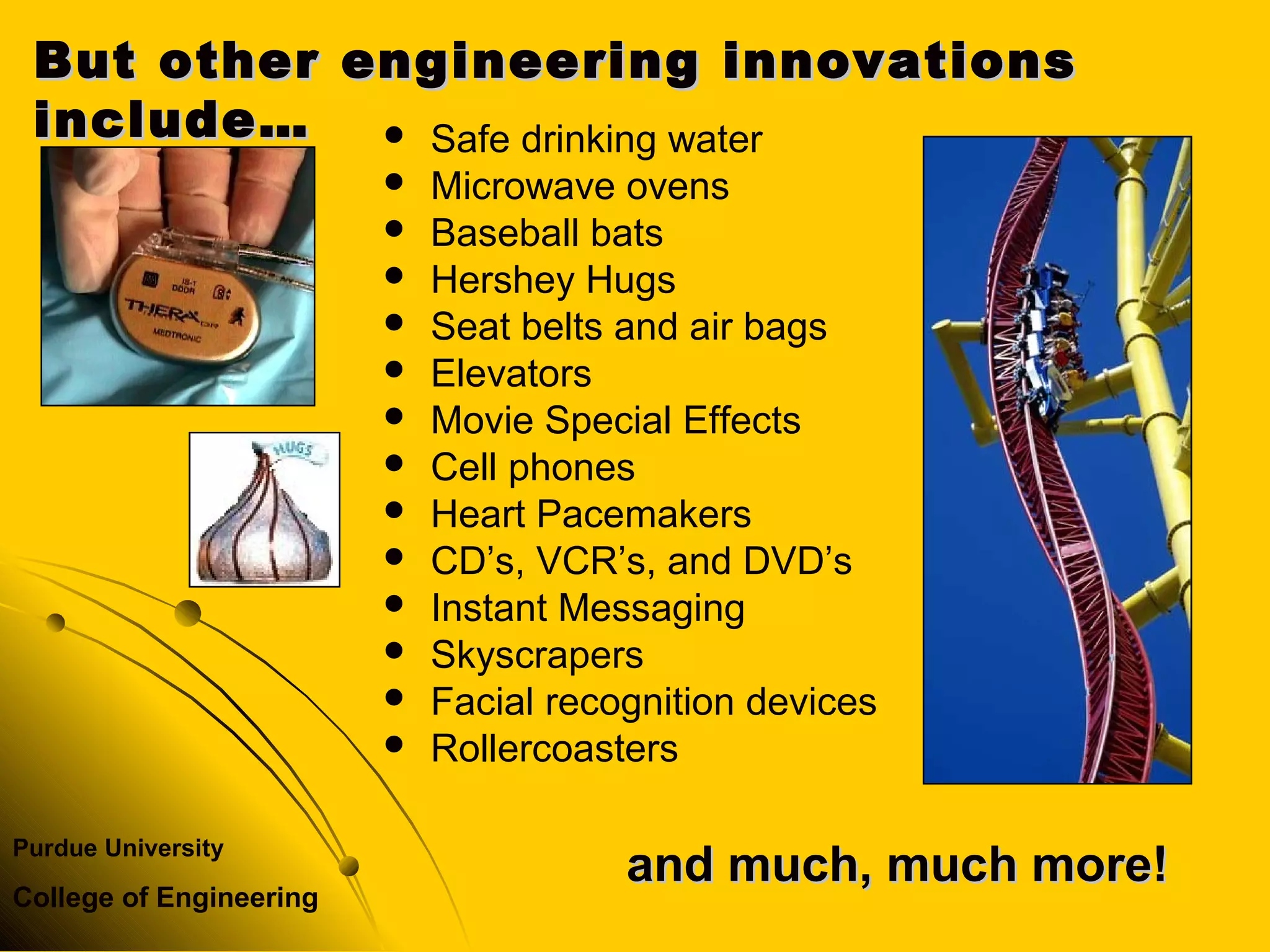
 Safe drinking water
 Microwave ovens
 Baseball bats
 Hershey Hugs
 Seat belts and air bags
 Elevators
 Movie Special Effects
 Cell phones
 Heart Pacemakers
 CD’s, VCR’s, and DVD’s
 Instant Messaging
 Skyscrapers
 Facial recognition devices
 Rollercoasters
But other engineering innovationsBut other engineering innovations
include…include…
and much, much more!and much, much more!
Biomedical
Biomedical
Environmental
Computer Multidisciplin
Multidisciplinaryary
Industrial
Industrial
Interdisciplinary
Aeronautical
&
Astronautical
Materials
MaterialsScience
Science
Engineering
Engineering
Nuclear
Agricultural
Agricultural
Mechanical
Biological
Chemical
CivilCivil
CConstruction
onstruction
EEngineering
ngineering
MManagement
anagement
Electrical
Electrical
Purdue University
College of Engineering
Engineers are…Engineers are…
N
IN
OVA
VE
TI
Purdue University
College of Engineering
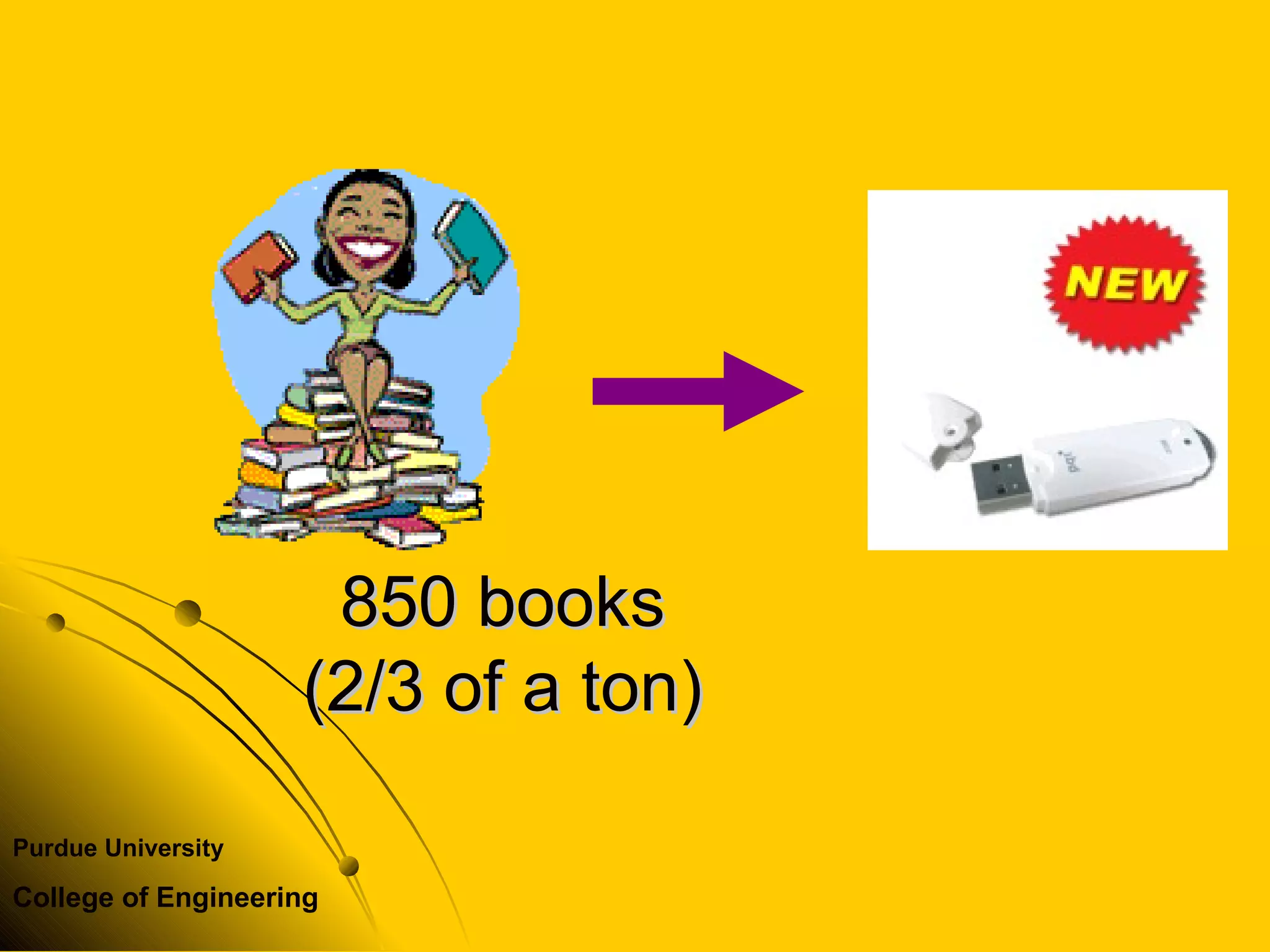
850 books850 books
(2/3 of a ton)(2/3 of a ton)
Purdue University
College of Engineering
Engineers are…Engineers are…
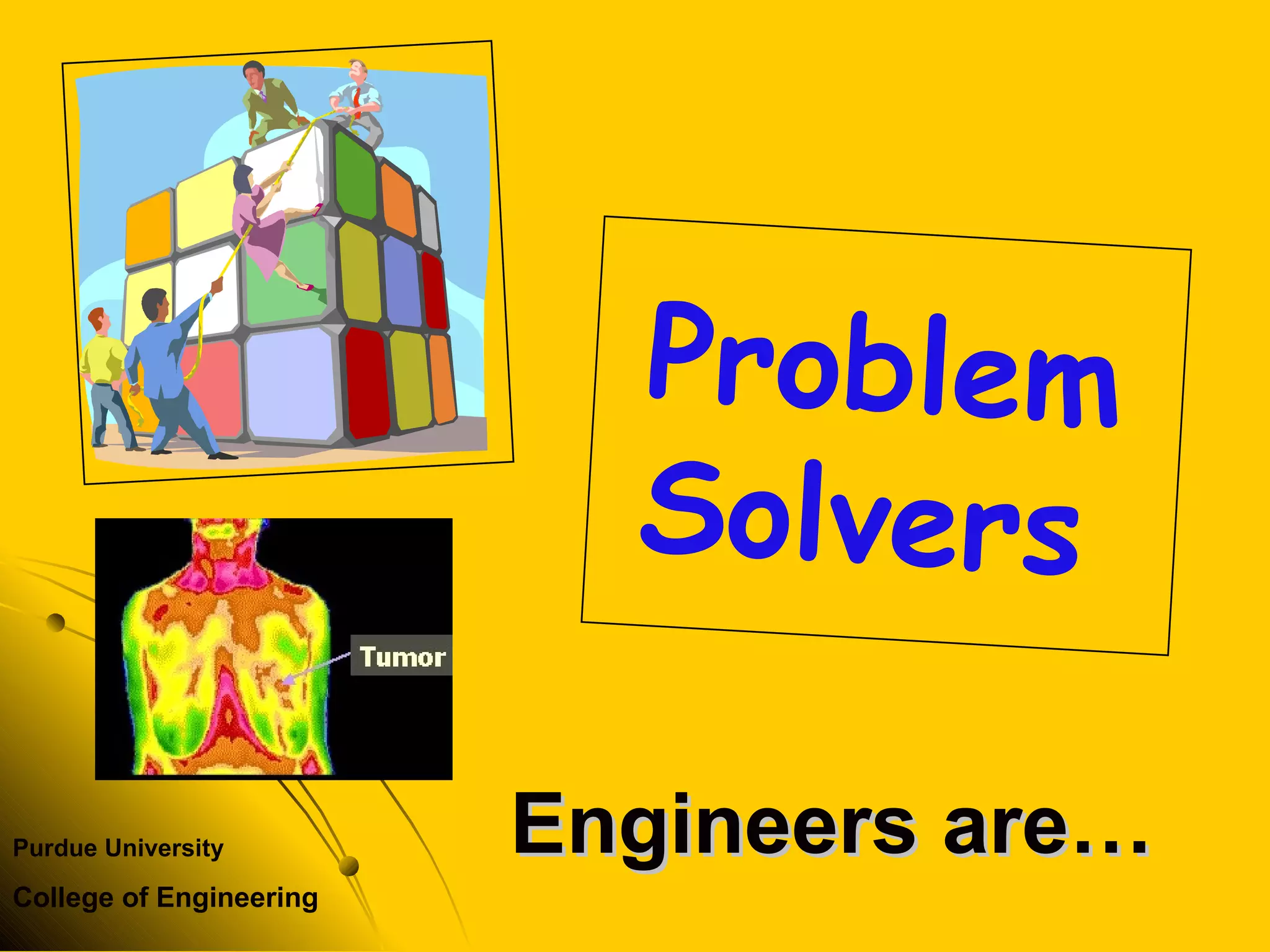
Problem
Solvers
Purdue University
College of Engineering
Engineers are…Engineers are…
RC e
aT i
V
e
Purdue University
College of Engineering
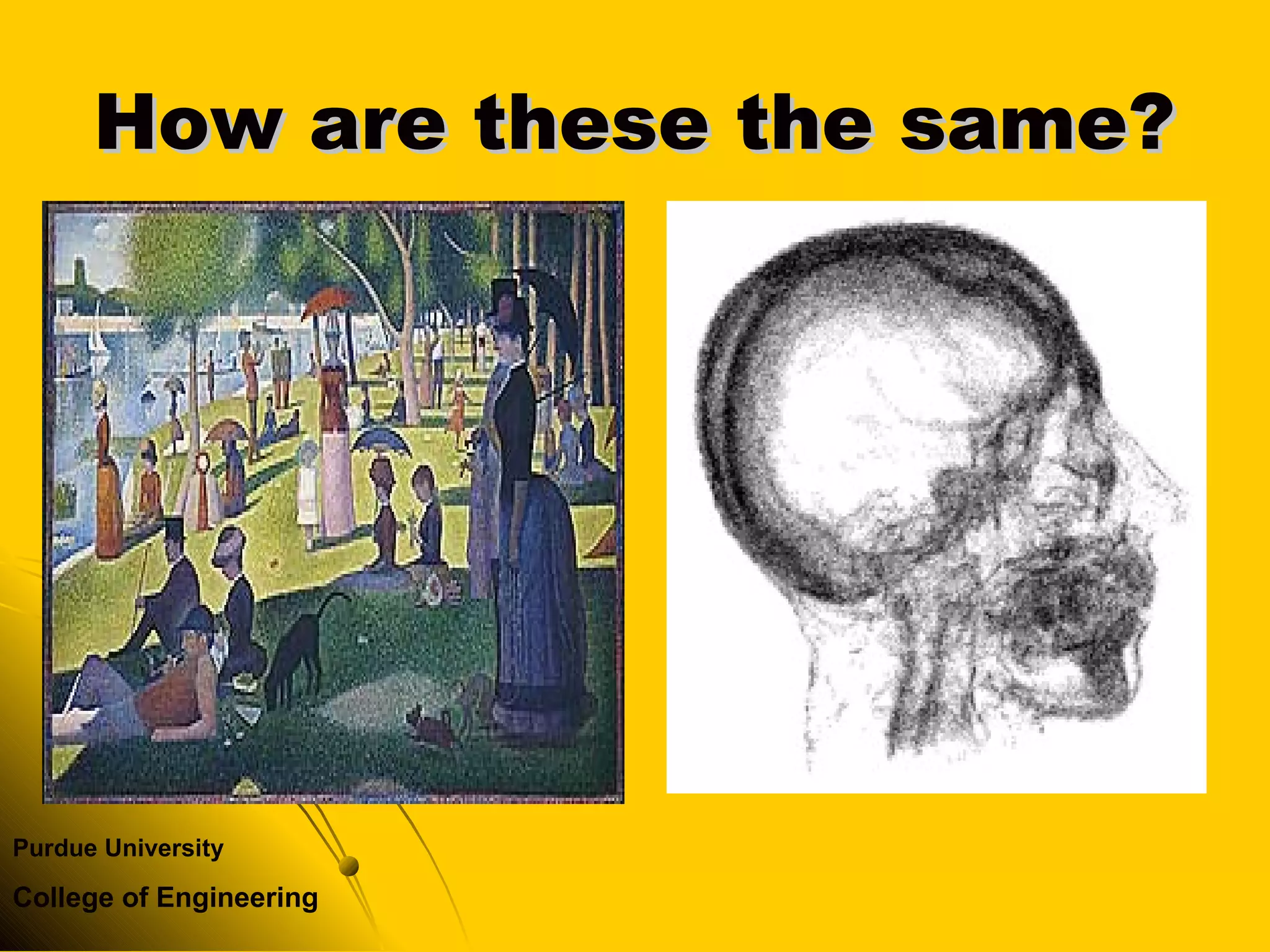
How are these the same?How are these the same?
Top 10 Engineering SkillsTop 10 Engineering Skills
 Problem-solvingProblem-solving
 Analytical/Creative ThinkingAnalytical/Creative Thinking
 Design-OrientedDesign-Oriented
 Communication-written & oralCommunication-written & oral
 Adapt to changeAdapt to change
Purdue University
College of Engineering
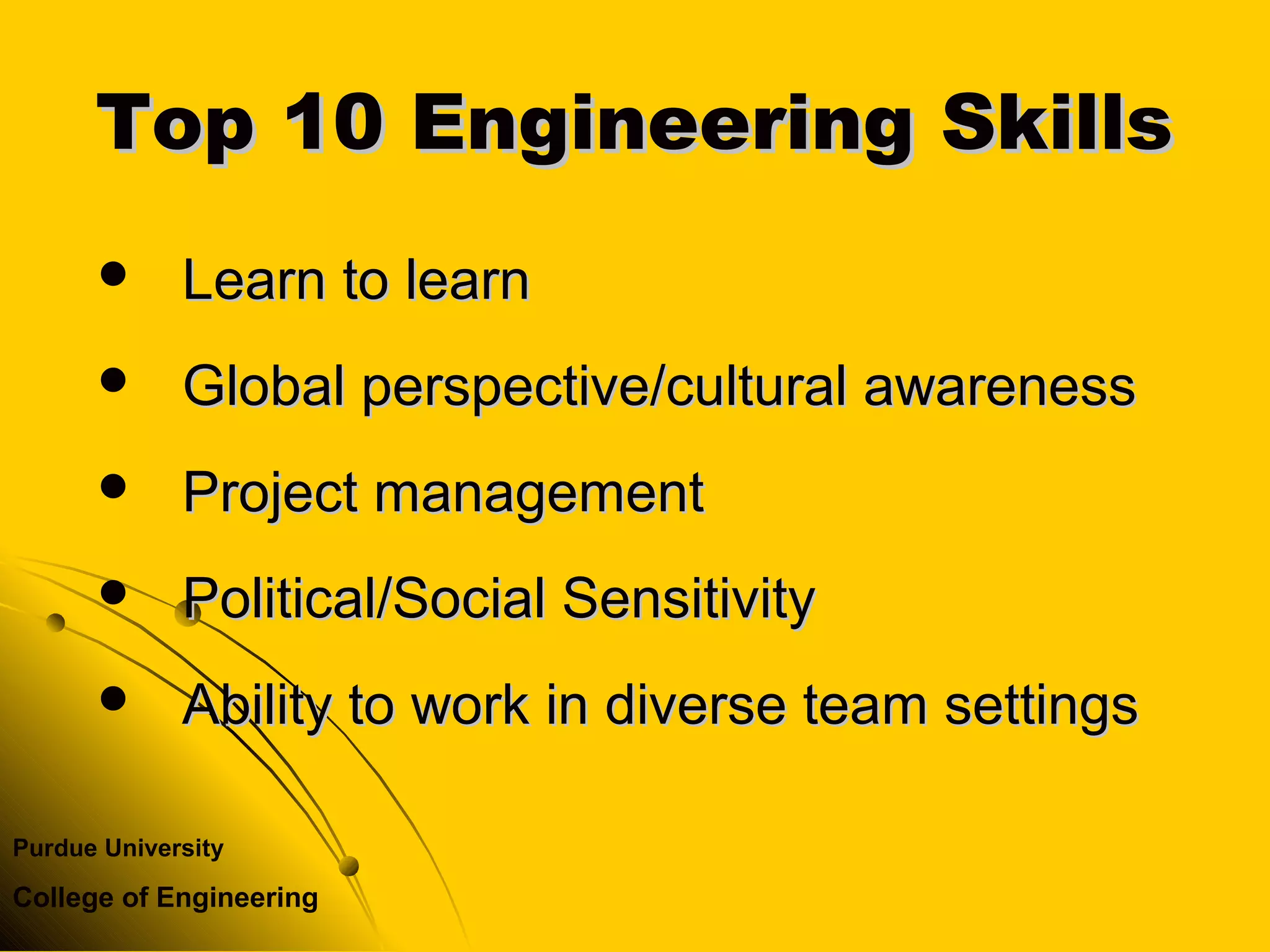
Top 10 Engineering SkillsTop 10 Engineering Skills
 Learn to learnLearn to learn
 Global perspective/cultural awarenessGlobal perspective/cultural awareness
 Project managementProject management
 Political/Social SensitivityPolitical/Social Sensitivity
 Ability to work in diverse team settingsAbility to work in diverse team settings
Purdue University
College of Engineering
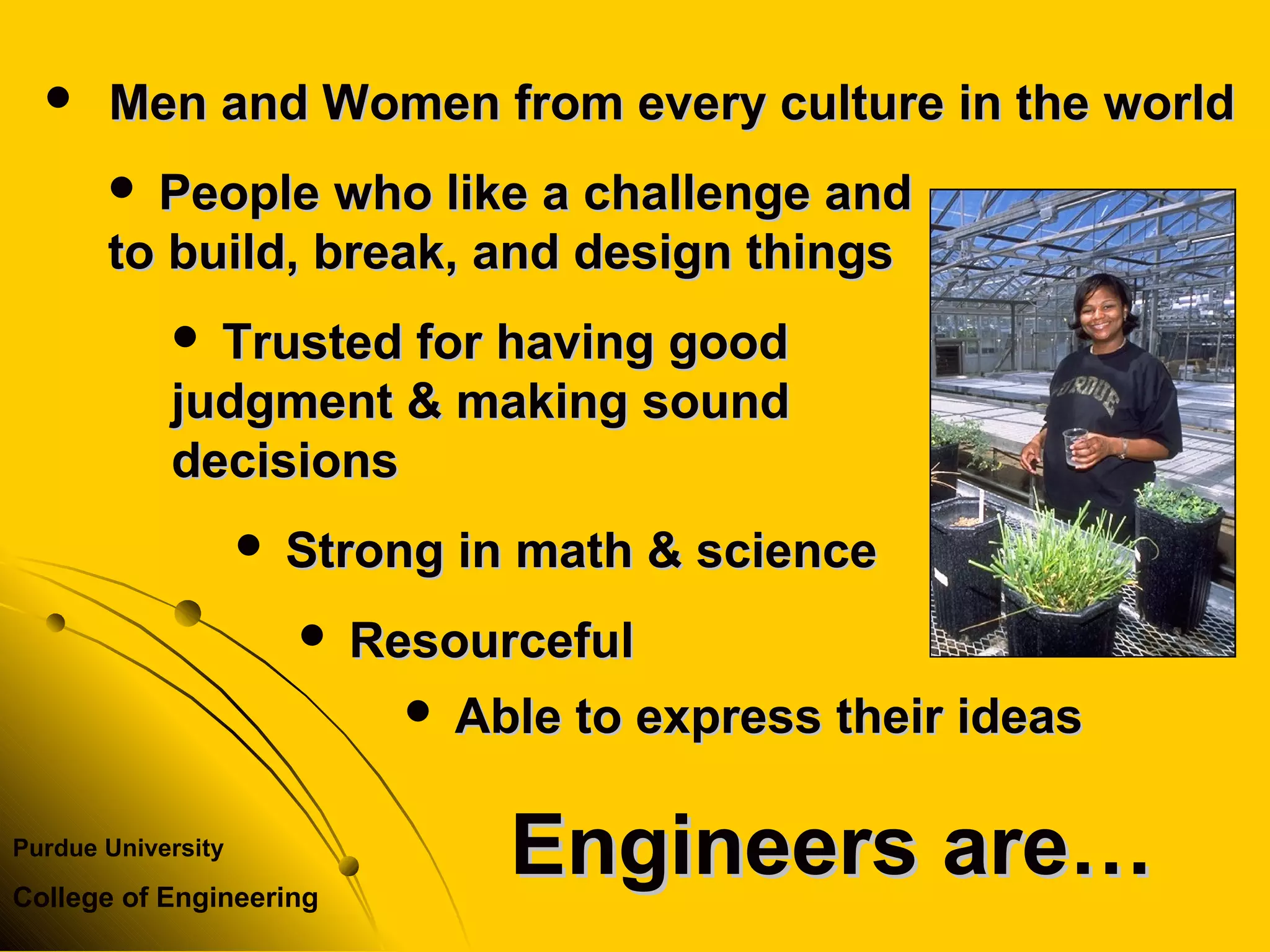
Engineers are…Engineers are…
 Men and Women from every culture in the worldMen and Women from every culture in the world
 People who like a challenge andPeople who like a challenge and
to build, break, and design thingsto build, break, and design things
 Trusted for having goodTrusted for having good
judgment & making soundjudgment & making sound
decisionsdecisions
 Strong in math & scienceStrong in math & science
 ResourcefulResourceful
 Able to express their ideasAble to express their ideas
Purdue University
College of Engineering
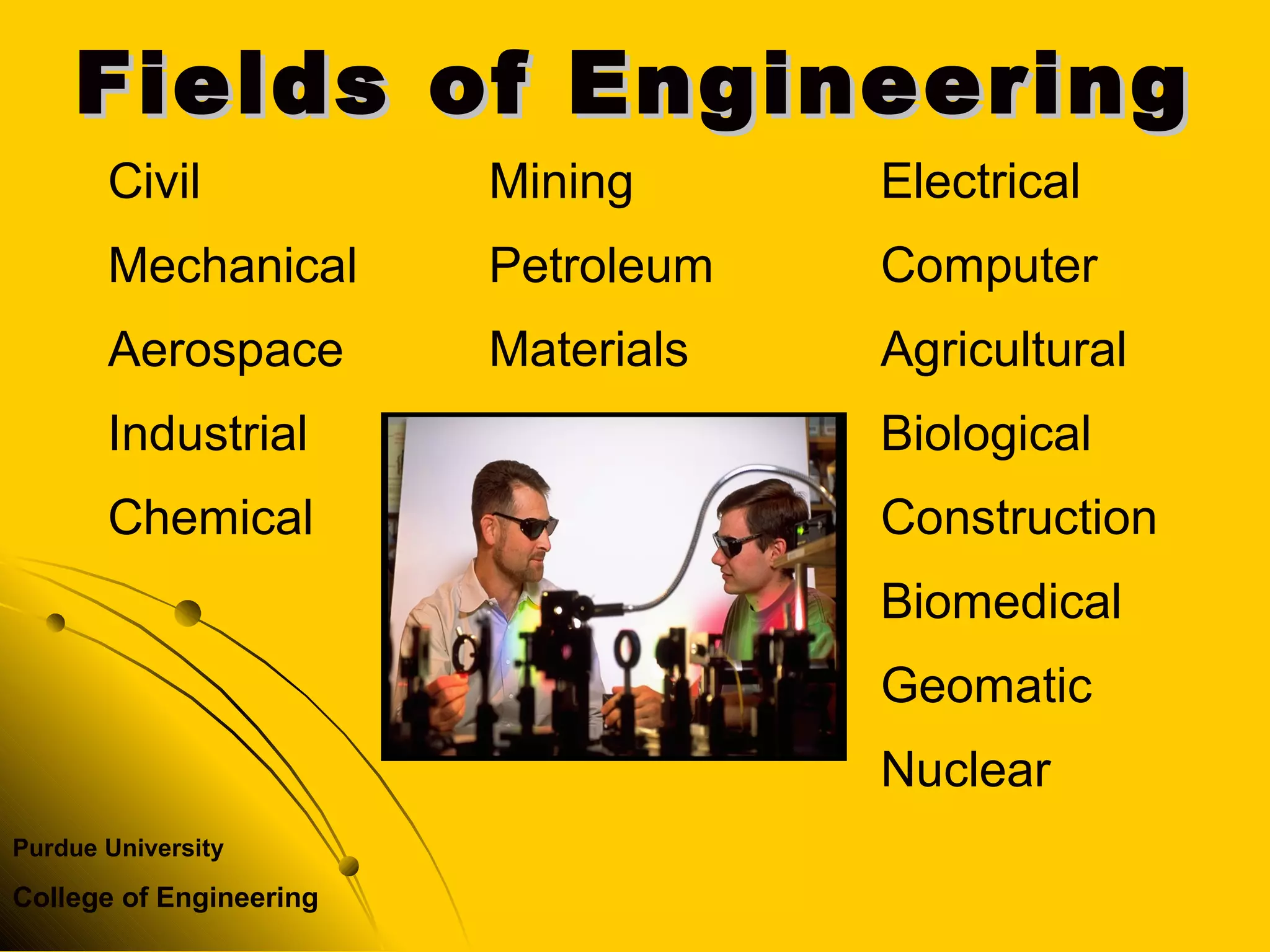
Fields of EngineeringFields of Engineering
Electrical
Computer
Agricultural
Biological
Construction
Biomedical
Geomatic
Nuclear
Civil
Mechanical
Aerospace
Industrial
Chemical
Mining
Petroleum
Materials
Purdue University
College of Engineering
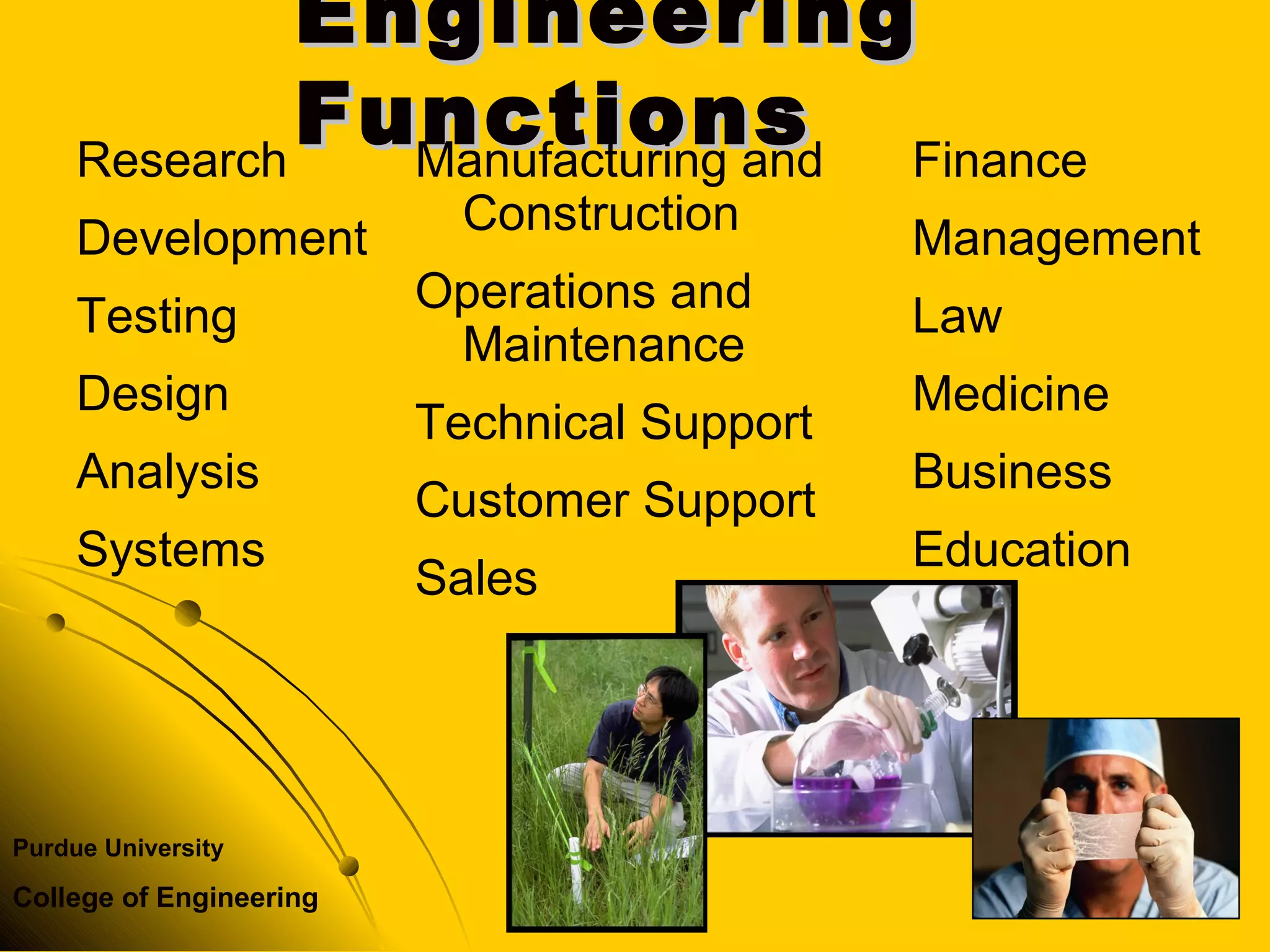
EngineeringEngineering
FunctionsFunctionsResearch
Development
Testing
Design
Analysis
Systems
Manufacturing and
Construction
Operations and
Maintenance
Technical Support
Customer Support
Sales
Finance
Management
Law
Medicine
Business
Education
Purdue University
College of Engineering
LeadershipLeadership
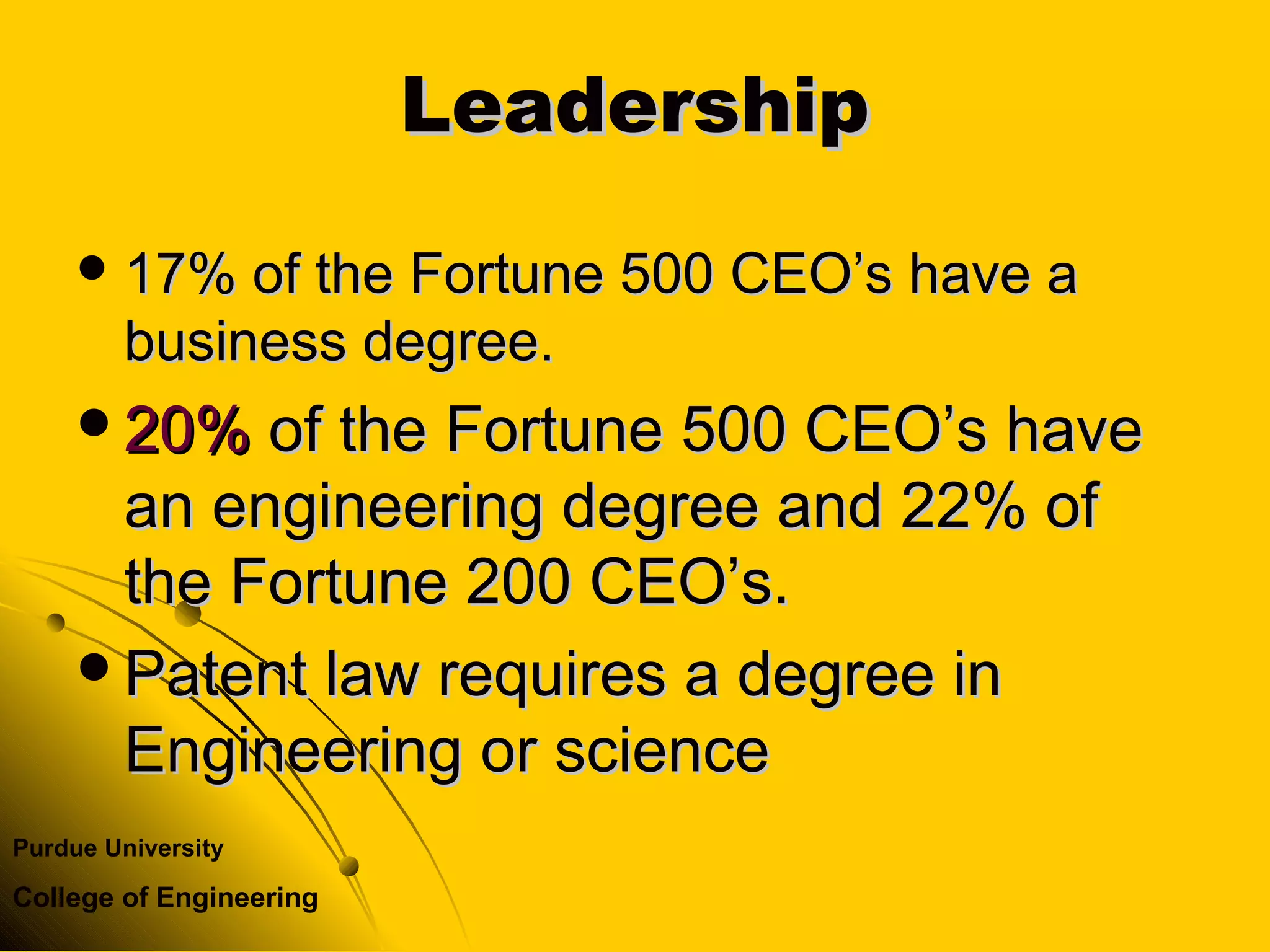
 17% of the Fortune 500 CEO’s have a17% of the Fortune 500 CEO’s have a
business degree.business degree.
20%20% of the Fortune 500 CEO’s haveof the Fortune 500 CEO’s have
an engineering degree and 22% ofan engineering degree and 22% of
the Fortune 200 CEO’s.the Fortune 200 CEO’s.
Patent law requires a degree inPatent law requires a degree in
Engineering or scienceEngineering or science
Why we NEED more EngineersWhy we NEED more Engineers
Aging engineering workforce
Fewer students choosing engineering
Global competition
Integration of technology into all of
society
Diversity = Innovation
-
Purdue University
College of Engineering
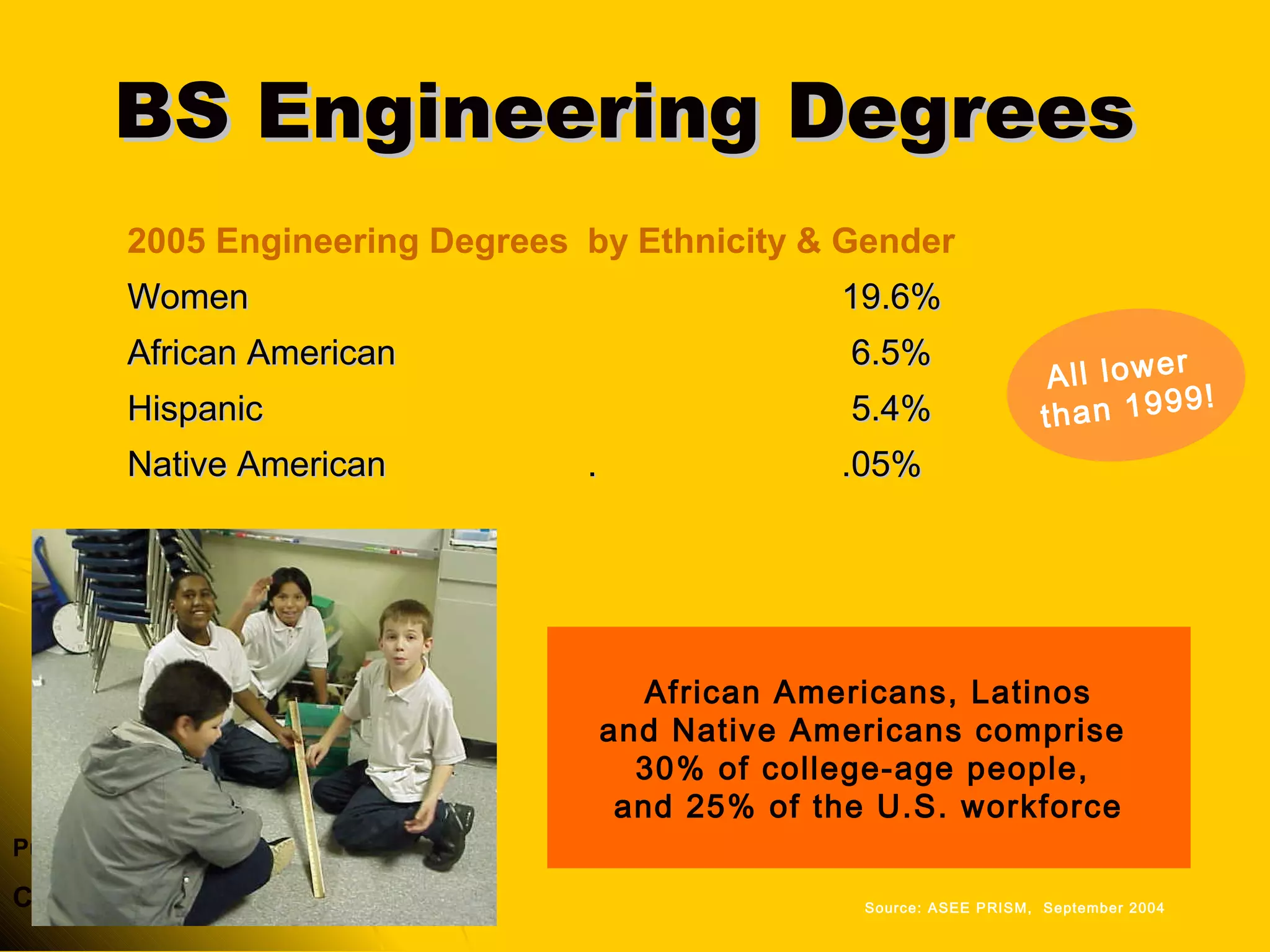
BS Engineering DegreesBS Engineering Degrees
2005 Engineering Degrees by Ethnicity & Gender
WomenWomen 19.6%19.6%
African AmericanAfrican American 6.5%6.5%
HispanicHispanic 5.4%5.4%
Native AmericanNative American .. .05%.05%
Source: ASEE PRISM, September 2004
All lower
than 1999!
African Americans, Latinos
and Native Americans comprise
30% of college-age people,
and 25% of the U.S. workforce
Purdue University
College of Engineering
Let’s talk about EngineeringLet’s talk about Engineering
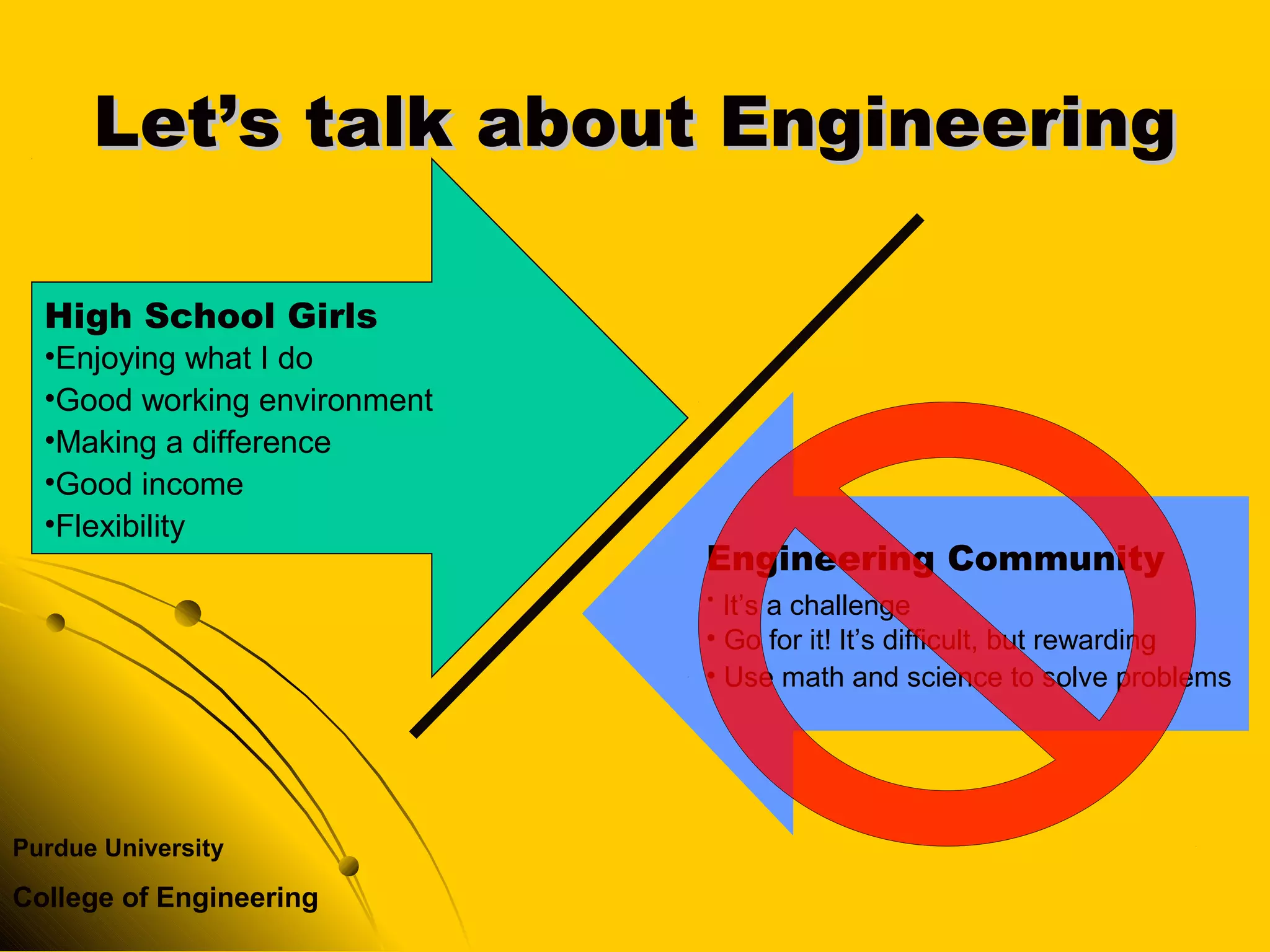
Engineering Community
• It’s a challenge
• Go for it! It’s difficult, but rewarding
• Use math and science to solve problems
High School Girls
•Enjoying what I do
•Good working environment
•Making a difference
•Good income
•Flexibility
Purdue University
College of Engineering
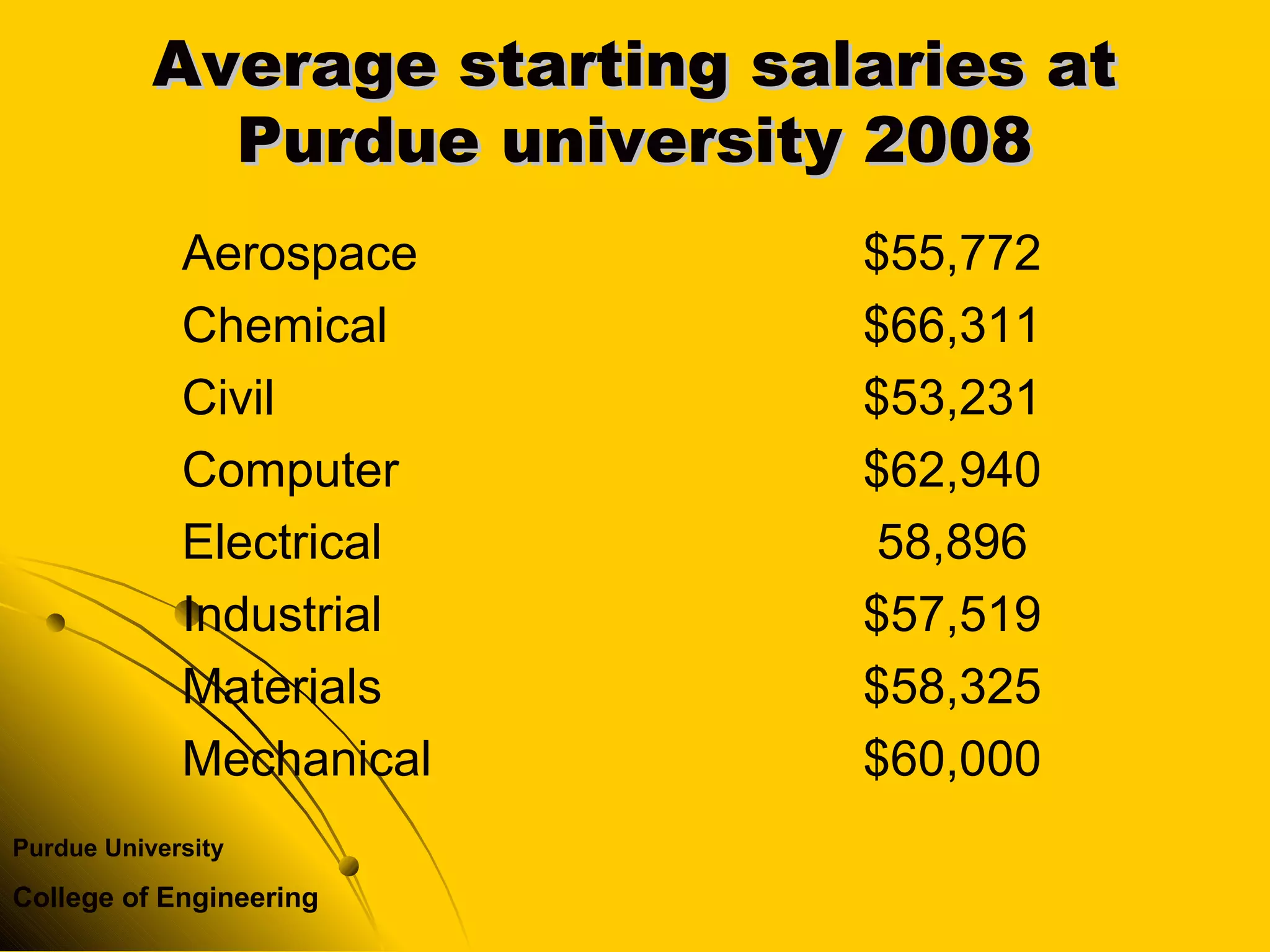
Average starting salaries atAverage starting salaries at
Purdue university 2008Purdue university 2008
Aerospace $55,772
Chemical $66,311
Civil $53,231
Computer $62,940
Electrical 58,896
Industrial $57,519
Materials $58,325
Mechanical $60,000
Purdue University
College of Engineering
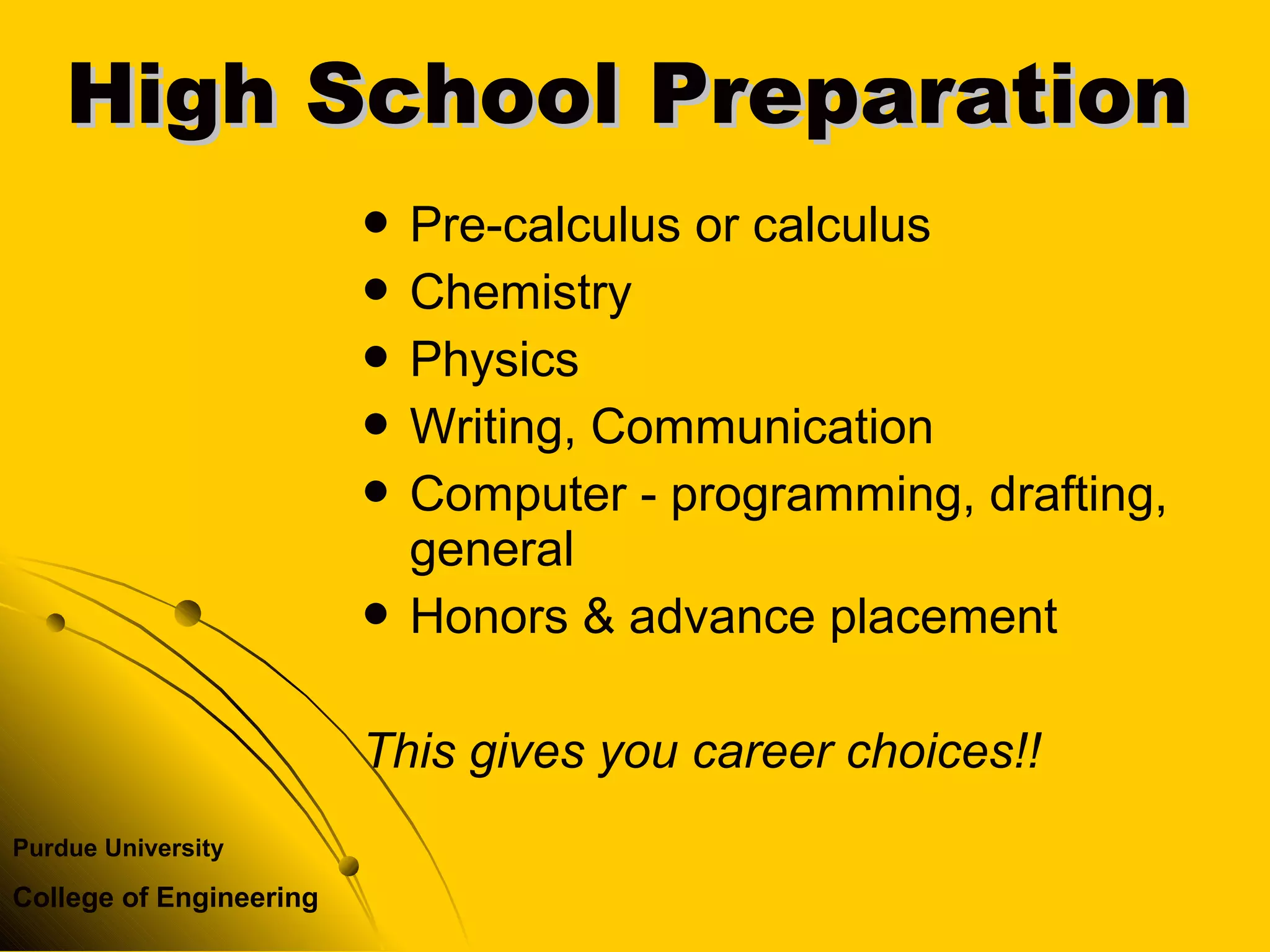
 Pre-calculus or calculus
 Chemistry
 Physics
 Writing, Communication
 Computer - programming, drafting,
general
 Honors & advance placement
This gives you career choices!!
High School PreparationHigh School Preparation
Purdue University
College of Engineering
Contact usContact us
atat
Office Phone: (765) 494-3975Office Phone: (765) 494-3975
Email:Email: dbowker@purdue.edudbowker@purdue.edu
Purdue University
College of Engineering
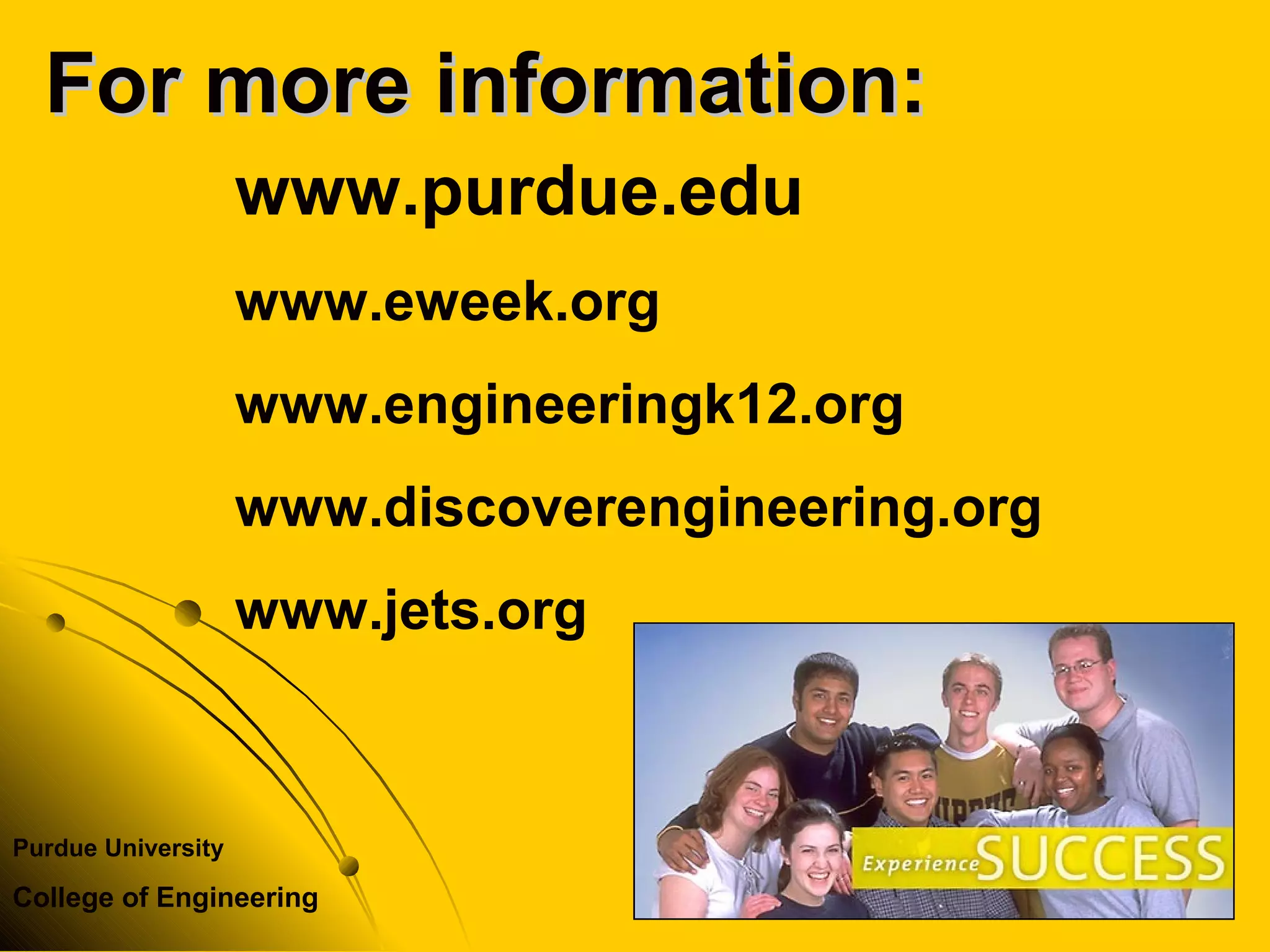
For more information:For more information:
www.purdue.edu
www.eweek.org
www.engineeringk12.org
www.discoverengineering.org
www.jets.org

Engineering is everywhere

  • 1.
    Engineering isEngineering is EverywhereEverywhere DavidT. BowkerDavid T. Bowker Purdue College of EngineeringPurdue College of Engineering
  • 2.
    What Do EngineersDo?What Do Engineers Do? 2003 1998 Builds/constructs/makes things 38% 26% Designs/draws/plans 19% 27% Mechanic/mechanical work 9% 2% Train operator 7% 5% Creates/is creative 3% 3% Mathematics/physics 3% 2% Develops new technologies 3% - Application of technology 2% - Equipment maintenance repair 2% - Works with computers 2% - Source: Harris Poll, December 2003
  • 3.
  • 4.
    Contributing to SocietyContributingto Society Engineers Scientists Make strong leaders 56% 32% Care about the community 37% 51% Sensitive to societal concerns 28% 61% Save lives 14% 82% Source: Harris Poll, December 2003
  • 5.
    Purdue University College ofEngineering •Feed the world •Live on Mars •Provide affordable healthcare •Protect the environment •Design material devices that save lives •Be challenged •Be bold •Never stop learning •Be creative •Be a leader •Provide a safe water supply
  • 6.
    Purdue University College ofEngineering EngineeringEngineering is…is… ……the application of creativitythe application of creativity and teamwork using Mathand teamwork using Math and science principles asand science principles as tools to solve problemstools to solve problems ……creating things thatcreating things that will benefit societywill benefit society OR
  • 7.
    Purdue University College ofEngineering ““Engineers have a hand inEngineers have a hand in designing, creating, ordesigning, creating, or modifying nearly everythingmodifying nearly everything we touch, wear, eat, see, andwe touch, wear, eat, see, and hear in our daily lives.”hear in our daily lives.” - American Society of Engineering Education- American Society of Engineering Education
  • 8.
    Engineering isEngineering is everywhereeverywhere Everyoneknows things like….Everyone knows things like…. Purdue University College of Engineering
  • 9.
    Purdue University College ofEngineering  Safe drinking water  Microwave ovens  Baseball bats  Hershey Hugs  Seat belts and air bags  Elevators  Movie Special Effects  Cell phones  Heart Pacemakers  CD’s, VCR’s, and DVD’s  Instant Messaging  Skyscrapers  Facial recognition devices  Rollercoasters But other engineering innovationsBut other engineering innovations include…include… and much, much more!and much, much more!
  • 10.
  • 11.
    Purdue University College ofEngineering Engineers are…Engineers are… N IN OVA VE TI
  • 12.
    Purdue University College ofEngineering 850 books850 books (2/3 of a ton)(2/3 of a ton)
  • 13.
    Purdue University College ofEngineering Engineers are…Engineers are… Problem Solvers
  • 14.
    Purdue University College ofEngineering Engineers are…Engineers are… RC e aT i V e
  • 15.
    Purdue University College ofEngineering How are these the same?How are these the same?
  • 16.
    Top 10 EngineeringSkillsTop 10 Engineering Skills  Problem-solvingProblem-solving  Analytical/Creative ThinkingAnalytical/Creative Thinking  Design-OrientedDesign-Oriented  Communication-written & oralCommunication-written & oral  Adapt to changeAdapt to change
  • 17.
    Purdue University College ofEngineering Top 10 Engineering SkillsTop 10 Engineering Skills  Learn to learnLearn to learn  Global perspective/cultural awarenessGlobal perspective/cultural awareness  Project managementProject management  Political/Social SensitivityPolitical/Social Sensitivity  Ability to work in diverse team settingsAbility to work in diverse team settings
  • 18.
    Purdue University College ofEngineering Engineers are…Engineers are…  Men and Women from every culture in the worldMen and Women from every culture in the world  People who like a challenge andPeople who like a challenge and to build, break, and design thingsto build, break, and design things  Trusted for having goodTrusted for having good judgment & making soundjudgment & making sound decisionsdecisions  Strong in math & scienceStrong in math & science  ResourcefulResourceful  Able to express their ideasAble to express their ideas
  • 19.
    Purdue University College ofEngineering Fields of EngineeringFields of Engineering Electrical Computer Agricultural Biological Construction Biomedical Geomatic Nuclear Civil Mechanical Aerospace Industrial Chemical Mining Petroleum Materials
  • 20.
    Purdue University College ofEngineering EngineeringEngineering FunctionsFunctionsResearch Development Testing Design Analysis Systems Manufacturing and Construction Operations and Maintenance Technical Support Customer Support Sales Finance Management Law Medicine Business Education
  • 21.
    Purdue University College ofEngineering LeadershipLeadership  17% of the Fortune 500 CEO’s have a17% of the Fortune 500 CEO’s have a business degree.business degree. 20%20% of the Fortune 500 CEO’s haveof the Fortune 500 CEO’s have an engineering degree and 22% ofan engineering degree and 22% of the Fortune 200 CEO’s.the Fortune 200 CEO’s. Patent law requires a degree inPatent law requires a degree in Engineering or scienceEngineering or science
  • 22.
    Why we NEEDmore EngineersWhy we NEED more Engineers Aging engineering workforce Fewer students choosing engineering Global competition Integration of technology into all of society Diversity = Innovation -
  • 23.
    Purdue University College ofEngineering BS Engineering DegreesBS Engineering Degrees 2005 Engineering Degrees by Ethnicity & Gender WomenWomen 19.6%19.6% African AmericanAfrican American 6.5%6.5% HispanicHispanic 5.4%5.4% Native AmericanNative American .. .05%.05% Source: ASEE PRISM, September 2004 All lower than 1999! African Americans, Latinos and Native Americans comprise 30% of college-age people, and 25% of the U.S. workforce
  • 24.
    Purdue University College ofEngineering Let’s talk about EngineeringLet’s talk about Engineering Engineering Community • It’s a challenge • Go for it! It’s difficult, but rewarding • Use math and science to solve problems High School Girls •Enjoying what I do •Good working environment •Making a difference •Good income •Flexibility
  • 25.
    Purdue University College ofEngineering Average starting salaries atAverage starting salaries at Purdue university 2008Purdue university 2008 Aerospace $55,772 Chemical $66,311 Civil $53,231 Computer $62,940 Electrical 58,896 Industrial $57,519 Materials $58,325 Mechanical $60,000
  • 26.
    Purdue University College ofEngineering  Pre-calculus or calculus  Chemistry  Physics  Writing, Communication  Computer - programming, drafting, general  Honors & advance placement This gives you career choices!! High School PreparationHigh School Preparation
  • 27.
    Purdue University College ofEngineering Contact usContact us atat Office Phone: (765) 494-3975Office Phone: (765) 494-3975 Email:Email: dbowker@purdue.edudbowker@purdue.edu
  • 28.
    Purdue University College ofEngineering For more information:For more information: www.purdue.edu www.eweek.org www.engineeringk12.org www.discoverengineering.org www.jets.org

Editor's Notes

  • #3 Is a growth since 1998 in the public’s perception that engineers create things. But there was also an increase in the number of people that think we drive trains…no kidding. That’s pathetic. Where are the positive image icons for our profession? What sitcom represents hip, creative, young professionals engaged in jointly addressing the challenges of our time? And enjoying career satisfaction and making a decent living while making a contribution to society? In essence, where are the connections for our youth? Engineering is an ultimately creative endeavor, but as you can see from these results, we keep that a secret, enjoyed by the anointed within our ranks. We need innovative thinkers; people with wild ideas to join our profession. Of note is that the general public doesn’t make the connection between the development of new technologies with the role engineers play in society. We build bridges and roads. Bridges and roads are a good things, but there is more to our profession… And early, relevant exposure of youth to the excitement of engineering to integrate the science, math and technology already in pre-college curricula is a means to broaden the public’s perception of the creativity and relevance of our profession.
  • #5 Encouraged that the public sees engineers as strong leaders, and that they see us as caring about the community more than they did in 1998. However, I am troubled that they see us as far less sensitive to societal concerns than they did in 1998. From a gender inclusion perspective, I would posit that it would serve our profession well to be viewed as sensitive to societal concerns. While adults are twice as likely to see us as saving lives now than they did in 1998, we do not enjoy the public appreciation for this that scientists do.
  • #7 You might be wondering what the difference is between science and engineering, well…
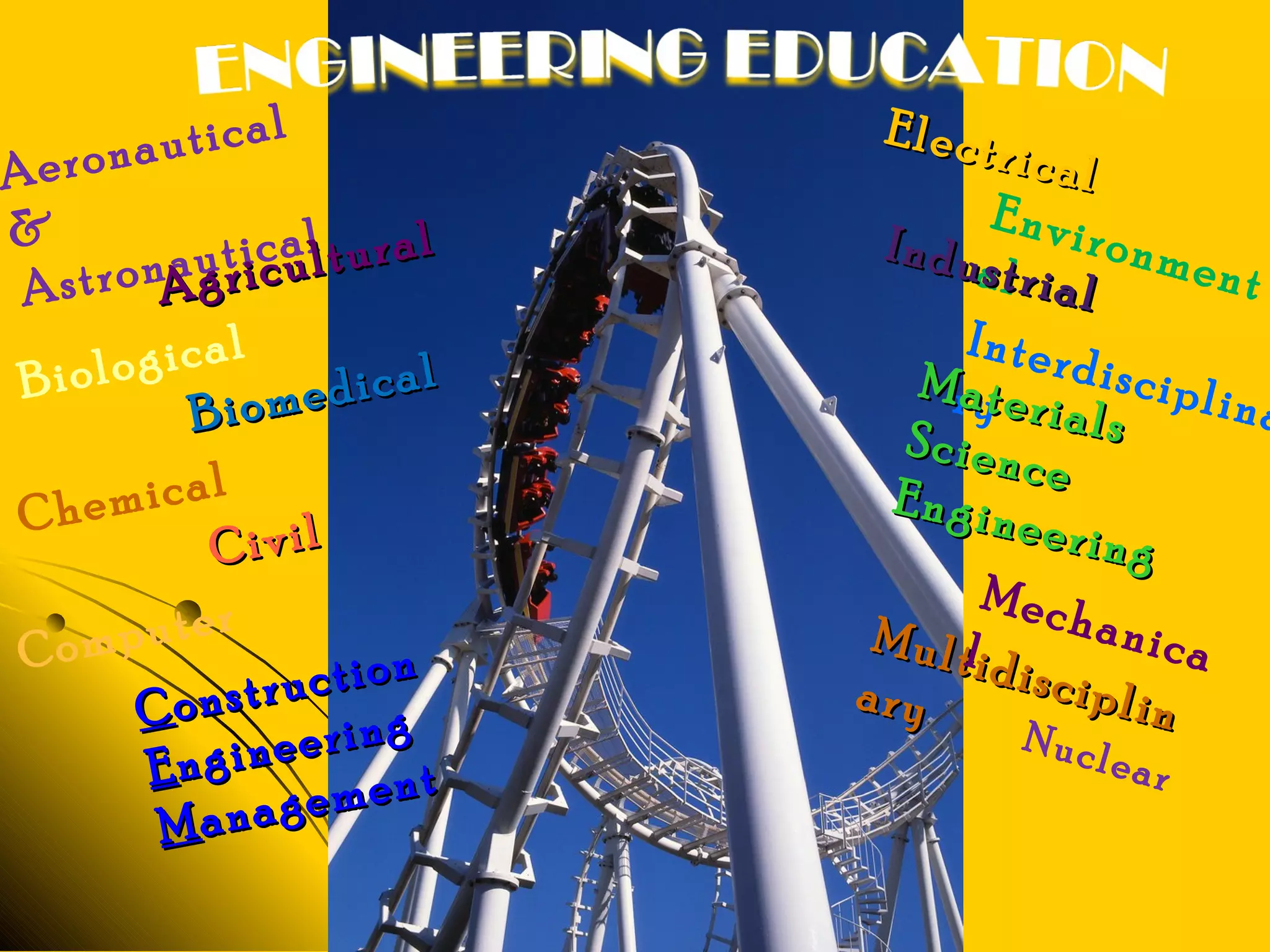
  • #11 Aeronautical Engineering – Physics and Aerodynamics Agriculture – Impact of the structure on the land and soil Biological – How will the g-forces impact the rider? Biomedical – Chemical – Hydraulics fluids, Paint Civil – Structure Computer – creating the design, running the coaster itself CEM – Overseeing the job site Electrical – Environmental – how the coaster will impact the environment, increased traffic = increased emissions, water usage, soil erosion Industrial – parts creation, operator interaction Interdisciplinary – Materials – What the structure, rider compartment, rider belts/harnesses/bars, etc. are made of Mechanical – Multidisciplinary – All of the above Nuclear – alternate energy sources for running it?