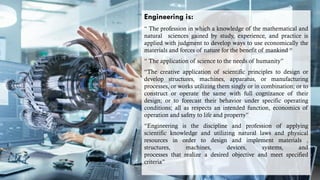
Engineering is:
“ The profession in which a knowledge of the mathematical and
natural sciences gained by study, experience, and practice is
applied with judgment to develop ways to use economically the
materials and forces of nature for the benefit of mankind “
“ The application of science to the needs of humanity”
“The creative application of scientific principles to design or
develop structures, machines, apparatus, or manufacturing
processes, or works utilizing them singly or in combination; or to
construct or operate the same with full cognizance of their
design; or to forecast their behavior under specific operating
conditions; all as respects an intended function, economics of
operation and safety to life and property”
“Engineering is the discipline and profession of applying
scientific knowledge and utilizing natural laws and physical
resources in order to design and implement materials ,
structures, machines, devices, systems, and
processes that realize a desired objective and meet specified
criteria”
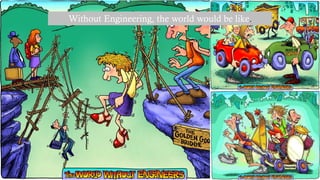
Without Engineering, the world would be like.
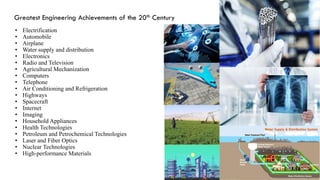
Greatest Engineering Achievements of the 20th Century
• Electrification
• Automobile
• Airplane
• Water supply and distribution
• Electronics
• Radio and Television
• Agricultural Mechanization
• Computers
• Telephone
• Air Conditioning and Refrigeration
• Highways
• Spacecraft
• Internet
• Imaging
• Household Appliances
• Health Technologies
• Petroleum and Petrochemical Technologies
• Laser and Fiber Optics
• Nuclear Technologies
• High-performance Materials
Engineering Disciplines
1. Aeronautics and astronautics
2. Agricultural engineering
3. Biological engineering
4. Chemical engineering
5. Civil engineering
6. Electrical engineering
7. Engineering science
8. Financial engineering
9. Fire protection engineering
10. Industrial engineering
1. Mechanical engineering
2. Materials engineering
3. Military engineer
4. Nuclear engineering
5. Ocean engineering
6. Optical engineering
7. Petroleum engineering
8. Planetary engineering
9. Software engineering
10. Social engineering
11. Stellar engineering
12. Textile engineering
What Is
Mechanical
Engineering?
Definition.
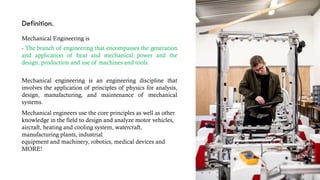
Mechanical Engineering is
- The branch of engineering that encompasses the generation
and application of heat and mechanical power and the
design, production and use of machines and tools.
Mechanical engineering is an engineering discipline that
involves the application of principles of physics for analysis,
design, manufacturing, and maintenance of mechanical
systems.
Mechanical engineers use the core principles as well as other
knowledge in the field to design and analyze motor vehicles,
aircraft, heating and cooling system, watercraft,
manufacturing plants, industrial
equipment and machinery, robotics, medical devices and
MORE!
Technically, mechanical engineering is the application of the principles and problem-solving techniques of
engineering from design to manufacturing to the marketplace for any object. Mechanical engineers analyze
their work using the principles of motion, energy, and force—ensuring that designs function safely, efficiently,
and reliably, all at a competitive cost.
Mechanical engineers make a difference. That's because mechanical engineering careers center on creating
technologies to meet human needs. Virtually every product or service in modern life has probably been
touched in some way by a mechanical engineer to help humankind.
This includes solving today's problems and creating future solutions in health care, energy, transportation,
world hunger, space exploration, climate change, and more.
Being ingrained in many challenges and innovations across many fields means a mechanical engineering
education is versatile. To meet this broad demand, mechanical engineers may design a component, a
machine, a system, or a process. This ranges from the macro to the micro, from the largest systems like cars
and satellites to the smallest components like sensors and switches. Anything that needs to be
manufactured—indeed, anything with moving parts—needs the expertise of a mechanical engineer.
What do mechanical engineers do?
Mechanical engineering combines creativity, knowledge and
analytical tools to complete the difficult task of shaping an idea
into reality.
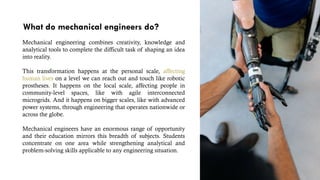
This transformation happens at the personal scale, affecting
human lives on a level we can reach out and touch like robotic
prostheses. It happens on the local scale, affecting people in
community-level spaces, like with agile interconnected
microgrids. And it happens on bigger scales, like with advanced
power systems, through engineering that operates nationwide or
across the globe.
Mechanical engineers have an enormous range of opportunity
and their education mirrors this breadth of subjects. Students
concentrate on one area while strengthening analytical and
problem-solving skills applicable to any engineering situation.
Disciplines within mechanical engineering include but are not limited to:
• Acoustics
• Aerospace
• Automation
• Automotive
• Autonomous Systems
• Biotechnology
• Composites
• Computer Aided Design (CAD)
• Control Systems
• Cyber security
• Design
• Energy
• Ergonomics
• Human health
• Manufacturing and additive manufacturing
• Mechanics
• Nanotechnology
• Production planning
• Robotics
• Structural analysis
What is Engineering?

What is Engineering?

  • 2.
    Engineering is: “ Theprofession in which a knowledge of the mathematical and natural sciences gained by study, experience, and practice is applied with judgment to develop ways to use economically the materials and forces of nature for the benefit of mankind “ “ The application of science to the needs of humanity” “The creative application of scientific principles to design or develop structures, machines, apparatus, or manufacturing processes, or works utilizing them singly or in combination; or to construct or operate the same with full cognizance of their design; or to forecast their behavior under specific operating conditions; all as respects an intended function, economics of operation and safety to life and property” “Engineering is the discipline and profession of applying scientific knowledge and utilizing natural laws and physical resources in order to design and implement materials , structures, machines, devices, systems, and processes that realize a desired objective and meet specified criteria”
  • 3.
    Without Engineering, theworld would be like.
  • 5.
    Greatest Engineering Achievementsof the 20th Century • Electrification • Automobile • Airplane • Water supply and distribution • Electronics • Radio and Television • Agricultural Mechanization • Computers • Telephone • Air Conditioning and Refrigeration • Highways • Spacecraft • Internet • Imaging • Household Appliances • Health Technologies • Petroleum and Petrochemical Technologies • Laser and Fiber Optics • Nuclear Technologies • High-performance Materials
  • 6.
    Engineering Disciplines 1. Aeronauticsand astronautics 2. Agricultural engineering 3. Biological engineering 4. Chemical engineering 5. Civil engineering 6. Electrical engineering 7. Engineering science 8. Financial engineering 9. Fire protection engineering 10. Industrial engineering 1. Mechanical engineering 2. Materials engineering 3. Military engineer 4. Nuclear engineering 5. Ocean engineering 6. Optical engineering 7. Petroleum engineering 8. Planetary engineering 9. Software engineering 10. Social engineering 11. Stellar engineering 12. Textile engineering
  • 7.
  • 8.
    Definition. Mechanical Engineering is -The branch of engineering that encompasses the generation and application of heat and mechanical power and the design, production and use of machines and tools. Mechanical engineering is an engineering discipline that involves the application of principles of physics for analysis, design, manufacturing, and maintenance of mechanical systems. Mechanical engineers use the core principles as well as other knowledge in the field to design and analyze motor vehicles, aircraft, heating and cooling system, watercraft, manufacturing plants, industrial equipment and machinery, robotics, medical devices and MORE!
  • 9.
    Technically, mechanical engineeringis the application of the principles and problem-solving techniques of engineering from design to manufacturing to the marketplace for any object. Mechanical engineers analyze their work using the principles of motion, energy, and force—ensuring that designs function safely, efficiently, and reliably, all at a competitive cost. Mechanical engineers make a difference. That's because mechanical engineering careers center on creating technologies to meet human needs. Virtually every product or service in modern life has probably been touched in some way by a mechanical engineer to help humankind. This includes solving today's problems and creating future solutions in health care, energy, transportation, world hunger, space exploration, climate change, and more. Being ingrained in many challenges and innovations across many fields means a mechanical engineering education is versatile. To meet this broad demand, mechanical engineers may design a component, a machine, a system, or a process. This ranges from the macro to the micro, from the largest systems like cars and satellites to the smallest components like sensors and switches. Anything that needs to be manufactured—indeed, anything with moving parts—needs the expertise of a mechanical engineer.
  • 10.
    What do mechanicalengineers do? Mechanical engineering combines creativity, knowledge and analytical tools to complete the difficult task of shaping an idea into reality. This transformation happens at the personal scale, affecting human lives on a level we can reach out and touch like robotic prostheses. It happens on the local scale, affecting people in community-level spaces, like with agile interconnected microgrids. And it happens on bigger scales, like with advanced power systems, through engineering that operates nationwide or across the globe. Mechanical engineers have an enormous range of opportunity and their education mirrors this breadth of subjects. Students concentrate on one area while strengthening analytical and problem-solving skills applicable to any engineering situation.
  • 11.
    Disciplines within mechanicalengineering include but are not limited to: • Acoustics • Aerospace • Automation • Automotive • Autonomous Systems • Biotechnology • Composites • Computer Aided Design (CAD) • Control Systems • Cyber security • Design • Energy • Ergonomics • Human health • Manufacturing and additive manufacturing • Mechanics • Nanotechnology • Production planning • Robotics • Structural analysis