Working with Sources:
Summarizing,
Paraphrasing, and
Quoting
© Hondros College
Summarizing, Paraphrasing,
and Quoting
Using sources within your essay is a deceptively difficult process, as there
are several steps to take to insure that you’re using sources in a way that
gets the information across effectively and does so in a stylistically elegant
way.
When you want to integrate sources into an essay, you have three tools at
your disposal: summary, paraphrase, and quotation. Each has its own
distinct purpose and form.
By the end of this lesson, you will be able to:
Use summary, paraphrase, and quotation in writing
Punctuate quotations properly
Working with Texts 2
Summary
You’re probably familiar with the concept of summary: restating
information in your own words, in a condensed form. If your
friend wanted to know what the movie Toy Story was about,
you might summarize it by saying, “Toy Story is about toys who
compete for the attention of their owner, Andy. Woody, the
cowboy, is Andy’s favorite, but Buzz Lightyear, the new
astronaut toy, wins Andy’s affection. However, they eventually
help each other and become friends.”
In an essay, a summary works the same way: it takes the
ideas of a source and puts it in your own words, usually
condensing it to one or two sentences.
Working with Texts 3
Summary
Summaries are useful for recording the gist of what a source is
trying to say, without getting caught up in the background
detail and non-essential supporting evidence. Maybe, in your
papers, you want to very briefly summarize the results of a
study on a new Alzheimer's treatment, but you don’t need to
present all of the details, because it isn’t exactly the focus of
your paper. This would be a great time to summarize.
As another example, take a look at the article “Obesity Surgery
May Become Option for Many More” available at
http://www.nytimes.com/2010/12/02/business/02obese.html?re
f=health, and then take a look at a summary of the article on
the next slide.
Working with Texts 4
Summary
In “Obesity Surgery May Become Option for Many More,” Andrew Pollack
writes that surgeries to insert Lap-Band devices in patients with weight
problems may soon become available to patients with a BMI of 35, or 30 if
the patient has one serious health problem. Currently, the surgery is only
available to patients with a BMI of 40, or 35 if the patient has one serious
health problem. The proposed change is being driven by Allergan, the
company who manufactures lap bands (Pollack, 2010).
Note how the title and author of the article is introduced in the opening line.
Also, notice that writing a summary means picking out the main ideas of the
piece, and also some select details. The details you select will vary based
on what the purpose of your essay is. Finally, make sure to include an in-
text citation at the end, in parentheses. The citation includes the author’s
last name and the year of publication.
Working with Texts 5
Paraphrase
Sometimes, as a writer, you need more detail than a summary
provides. In these situations, you may only be concerned with
one aspect of a writer’s piece. In this situation, you can
paraphrase a portion of the writer’s article. A paraphrase is
when you carefully describe a specific portion of the author’s
discussion, but you do so in your own words.
When you paraphrase, you generally shorten the author’s
discussion, omitting examples and other details. However,
while you are rewriting the author’s point in your own words,
you must be careful to not distort the original meaning of the
source.
Working with Texts 6
Paraphrase
Here’s an example, from the article we summarized earlier.
The following quote comes directly from the text of that article:
“If the agency approves the change, the number of Americans
eligible for the Lap-Band operation could easily double,
ensuring more sales for Allergan and probably more insurance
coverage for such operations. But the proposed change,
sought at a time when the obesity epidemic in the United
States seems intractable, still leaves some people uneasy, in
part because of side effects and failure rates. In addition, long-
term weight reduction is hard to maintain.”
Look at the next slide for a paraphrase of this quote.
Working with Texts 7
Paraphrase
Approving the change would result in more people becoming
eligible for a Lap-Band, more sales, and more insurance
coverage for Lap-Band surgeries. However, critics of the
change point to the Lap-Band’s problems: side effects, failure
rates, and issues with patients maintaining their weight loss
(Pollack, 2010).
In the above paraphrase, I shortened the quote, put it in my
own words, and expressed the same sentiment without
distorting the writer’s point. Note, as well, that I included an in-
text citation; you must always include an in-text citation to give
credit for the information found in your paraphrase.
Working with Texts 8
Quotation
When you’re integrating texts into your own writing, you should
use paraphrases frequently. Occasionally, though, the author
writes something so eloquently that you feel you would lose
some of his or her meaning if you paraphrased it into your own
words. In this situation, you can quote a portion of the author’s
writing.
You should only quote when a paraphrase would result in a
loss of meaning, when you’re picking apart the author’s words
themselves, when the author’s language is especially
profound, or when you’re utilizing an author’s words to
establish your own credibility.
Working with Texts 9
Quotation
Punctuation and accuracy are very important when it comes to
transcribing a quote. Make sure that:
You copy the source material extremely carefully, without altering
any spelling or punctuation
You put the the exact words being transcribed in quotation marks
You proofread the quotation with a close eye, to be certain that
there are no errors
You don’t just drop a quote into the middle of your writing, without
connecting it to your own language in some way. (Using signal
phrases, as illustrated on the next slide, can help you achieve this.)
Working with Texts 10
Quotation
The following example uses the same quote that we
paraphrased earlier; I’ll repeat it here, for convenience:
“If the agency approves the change, the number of Americans
eligible for the Lap-Band operation could easily double, ensuring
more sales for Allergan and probably more insurance coverage for
such operations. But the proposed change, sought at a time when
the obesity epidemic in the United States seems intractable, still
leaves some people uneasy, in part because of side effects and
failure rates. In addition, long-term weight reduction is hard to
maintain.”
The example on the next slide will integrate parts of this quote
into a new paragraph.
Working with Texts 11
Quotation
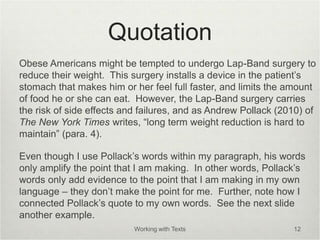
Obese Americans might be tempted to undergo Lap-Band surgery to
reduce their weight. This surgery installs a device in the patient’s
stomach that makes him or her feel full faster, and limits the amount
of food he or she can eat. However, the Lap-Band surgery carries
the risk of side effects and failures, and as Andrew Pollack (2010) of
The New York Times writes, “long term weight reduction is hard to
maintain” (para. 4).
Even though I use Pollack’s words within my paragraph, his words
only amplify the point that I am making. In other words, Pollack’s
words only add evidence to the point that I am making in my own
language – they don’t make the point for me. Further, note how I
connected Pollack’s quote to my own words. See the next slide
another example.
Working with Texts 12
Quotation
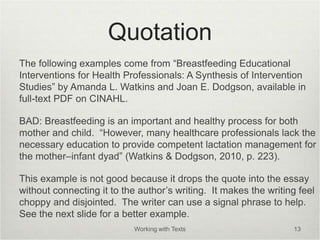
The following examples come from “Breastfeeding Educational
Interventions for Health Professionals: A Synthesis of Intervention
Studies” by Amanda L. Watkins and Joan E. Dodgson, available in
full-text PDF on CINAHL.
BAD: Breastfeeding is an important and healthy process for both
mother and child. “However, many healthcare professionals lack the
necessary education to provide competent lactation management for
the mother–infant dyad” (Watkins & Dodgson, 2010, p. 223).
This example is not good because it drops the quote into the essay
without connecting it to the author’s writing. It makes the writing feel
choppy and disjointed. The writer can use a signal phrase to help.
See the next slide for a better example.
Working with Texts 13
Quotation
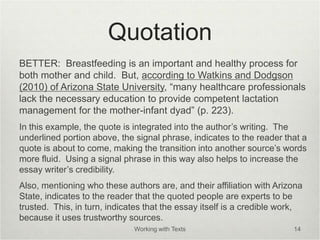
BETTER: Breastfeeding is an important and healthy process for
both mother and child. But, according to Watkins and Dodgson
(2010) of Arizona State University, “many healthcare professionals
lack the necessary education to provide competent lactation
management for the mother-infant dyad” (p. 223).
In this example, the quote is integrated into the author’s writing. The
underlined portion above, the signal phrase, indicates to the reader that a
quote is about to come, making the transition into another source’s words
more fluid. Using a signal phrase in this way also helps to increase the
essay writer’s credibility.
Also, mentioning who these authors are, and their affiliation with Arizona
State, indicates to the reader that the quoted people are experts to be
trusted. This, in turn, indicates that the essay itself is a credible work,
because it uses trustworthy sources.
Working with Texts 14
Punctuating Quotes
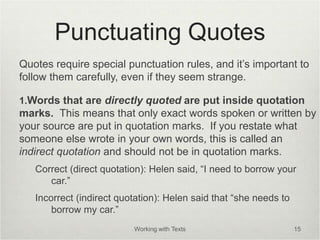
Quotes require special punctuation rules, and it’s important to
follow them carefully, even if they seem strange.
1.Words that are directly quoted are put inside quotation
marks. This means that only exact words spoken or written by
your source are put in quotation marks. If you restate what
someone else wrote in your own words, this is called an
indirect quotation and should not be in quotation marks.
Correct (direct quotation): Helen said, “I need to borrow your
car.”
Incorrect (indirect quotation): Helen said that “she needs to
borrow my car.”
Working with Texts 15
Punctuating Quotes
2. Periods and commas at the end of the quotation
should come inside the quotation marks. This one is
confusing, because it seems counter-intuitive. In fact, this
is a punctuation rule that’s different in other English-
speaking countries. But, here in America, we put the
periods and commas at the end of the quote inside the
quotation mark. I’ll illustrate this with examples:
Correct: The teacher said, “Mark, please turn in your exam.”
Incorrect: The teacher said, “Mark, please turn in your exam”.
Note that the period goes inside the quotation mark. This same
rule applies to commas, as well.
Working with Texts 16
Punctuating Quotes
Here’s another example:
Correct: According to Watkins and Dodgson (2010), “many
health professionals are left to seek out breastfeeding
information on their own,” which results in less new mothers
getting the education they need about breastfeeding.
Incorrect: According to Watkins and Dodgson (2010), “many
health professionals are left to seek out breastfeeding
information on their own”, which results in less new mothers
getting the education they need about breastfeeding.
(Note that I did not include a page number for this citation (and others in
this section), as I normally would, in order to illustrate the comma rule.
More on that later.)
Working with Texts 17
Punctuating Quotes
3. If you have a quote-within-a-quote, use single
quotation marks. In other words, if the person you’re
quoting is quoting someone else, the quote inside of the
larger quote gets single quotation marks, while the larger
quote gets double quotation marks. Also, commas and
periods go inside the single quotation marks, just as they
do with double quotation marks. That’s horribly confusing,
so let’s look at an example:
Correct: According to Dr. Smith (2009), “Mozart described the
piece as ‘one of his favorites.’”
Incorrect: According to Dr. Smith (2009), “Mozart described
the piece as “one of his favorites”.”
Working with Texts 18
Punctuating Quotes
4. Use commas after words like “said” and “replied” before
quotes. If a “she said” phrase comes after the quote, use a
comma before the phrase, inside the quote. This is another
confusing one to spell out specifically, so let’s look at a couple of
examples.
Correct: My mother shouted, “Clean your room!”
Notice, in this example, the comma comes after the word “shouted,”
which functions like “replied” or “said.”
Correct: “I just cleaned it,” I muttered.
In this example, the comma comes at the end of the quote, before
the phrase “I muttered” (which functions the same as “he said.”)
Working with Texts 19
Punctuating Quotes
As a corollary to the previous point, note that you don’t use
commas when quotes are streamlined into the sentence. For
example:
A. O. Scott (2010) described the movie Dear John as having a
“ripe, summery glow.”
5.If a quote is broken up by a “she said” phrase, punctuate
both before the phrase and after it. There are a couple of
different scenarios to consider here; see the next slide.
Working with Texts 20
Punctuating Quotes
a. If you’re breaking up a quote at the end of one of a sentence, put
a comma after the quote and a period after the “she said”
phrase. Start the next part of the quote with a capital letter.
Example: “I have to go to the store,” John said. “I need to pick up
hamburger.”
b. If the quote is broken up in the middle of a sentence, put a
comma after the quote, a comma after the “she said” phrase,
and don’t capitalize the first word of the second part of the quote.
Example: “I’m going to run to the store,” John said, “because I need
some milk.”
Working with Texts 21
Punctuating Quotes
6. To edit a quote, use brackets and ellipses. Believe it or not,
you can actually edit a quote – within reason. Sometimes, it’s
necessary to change a quote slightly so that it fits within the
grammatical structure of your sentence. Or, other times it’s
necessary to shorten a quote, to remove information that you
don’t need. Brackets (the [ and ] symbols) and ellipses (three
periods in a row, like this: …) must be used in these situations to
indicate where and how you edited the quote.
It’s also very important to note that editing quotes is an intricate
process. You must be very careful to avoid changing the
meaning of the quote in question. See the next slide for different
scenarios and examples (adapted and expanded from page 419
of The Little, Brown Compact Handbook,7th ed., by Jane E.
Aaron) Working with Texts 22
Punctuating Quotes
a. Use brackets to add clarifying information to the quotes. Sometimes,
some of the meaning of the quote gets lost when you pull it out of its
original context. One of the ways to correct this is to add in extra
information in brackets, as in the example below.
“The success of [the American version of] The Office has been a boon for
NBC,” writes an anonymous blogger.
b. Use brackets to change the form of a word to fit the grammatical
structure of the sentence.
The show “never fail[ed] to delight.” (In this case, I changed the verb from
the present tense “fails” to the past tense “failed”)
You can use the same technique to make a word in a quote plural:
character[s]
Working with Texts 23
Punctuating Quotes
c. Use brackets to change the capitalization of a letter. Sometimes this
comes in handy if you want to use a quote at the beginning of your
sentence, but the portion of the quote you want to use doesn’t start with
a capital letter.
“[T]o change course now would be a terrible idea,” he wrote.
d. Use brackets to replace a pronoun with the word or words to which the
pronoun refers. This can be helpful if the portion of the quote that you
want to use has pronouns in it, but it isn’t clear in your own writing what
that pronoun would be referring to.
As one reporter notes, “The police decided they needed to contain [the
protesters].” (In this situation, “the protesters” replaces the pronoun
“them”)
Working with Texts 24
Punctuating Quotes
e. Use ellipses to indicate where words are removed from a quote.
This can be useful when you want to quote an author’s words,
but you also want to cut out some unneeded information. Notice
how the second example here cuts out the unneeded information
(italicized) from the first example, and how the sentence is better
focused as a result.
According to a statement released by NASA, “The space program,
which still launches shuttles and satellites every year, needs
more funding if it its to continue pushing the boundaries of
technology.”
According to a statement released by NASA, “The space program…
needs more funding if it is to continue pushing the boundaries of
technology.” Working with Texts 25
Titles in Quotes
In some situations, quotation marks are used to indicate the title of a
work. Other times, italics are used. How do you know which one to
use?
As a rule of thumb, italics are used for larger works, and quotes are
used for shorter works, or parts of larger works.
Use quotes for: short stories, journal articles, chapter titles,
newspaper or magazine articles, song titles, episode of a TV show
title
Use italics for: the title of a book; a whole journal, newspaper, or
magazine; a music album; a TV show or movie title
(You should never, though, use both at the same time.)
Working with Texts 26
Block Quotes
APA style papers should very rarely include quotes longer than 40 words. If
you are tempted to use a long quotation, consider how you can summarize
that source, paraphrase it, or quote from it selectively. If you feel that it is
essential to your essay that you include a long quote, make sure to discuss
its importance thoroughly. In addition, APA dictates a specific format for
long quotations. These “block quotes” are
 Started on a new line
 Indented half an inch (if a block quote is multiple paragraphs long,
indent another half an inch for new paragraphs)
 Double spaced.
 Cited after the final punctuation mark (see the next section for
clarification)
See page 171 of the Publication Manual of the American Psychological
Association (6th ed.) for more information.
Working with Texts 27
Block Quotes
Here’s an example of what a block quote looks like:
Watkins and Dodgson (2010) describe the method of data analysis used in their study:
Each article was read and reread. A matrix was created with key research
components so that across-case comparisons could be made. These data were
used to create display tables.
Frequencies and summaries were carried out as appropriate. Synthesis of the study
findings using a content analysis process was used to answer the research aims.
(p. 225)
[Insert an analysis of this quote here. Explain why your block quote is important, and
relate it to your thesis.] Working with Texts 28
To Review
Summaries, paraphrases, and quotations are different tools
you can use to integrate sources into your own written works.
Remember:
•Summary is restating information from a source in your own
words, in a condensed form
•Paraphrase is carefully describing a section of a source in
your own words.
•Quotation is restating another source’s exact words in your
own writing; quotes must be carefully punctuated.
Working with Texts 29

ENG200 Lesson - Working with Sources - Summary, Paraphrase, Quotation.ppt

  • 1.
  • 2.
    Summarizing, Paraphrasing, and Quoting Usingsources within your essay is a deceptively difficult process, as there are several steps to take to insure that you’re using sources in a way that gets the information across effectively and does so in a stylistically elegant way. When you want to integrate sources into an essay, you have three tools at your disposal: summary, paraphrase, and quotation. Each has its own distinct purpose and form. By the end of this lesson, you will be able to: Use summary, paraphrase, and quotation in writing Punctuate quotations properly Working with Texts 2
  • 3.
    Summary You’re probably familiarwith the concept of summary: restating information in your own words, in a condensed form. If your friend wanted to know what the movie Toy Story was about, you might summarize it by saying, “Toy Story is about toys who compete for the attention of their owner, Andy. Woody, the cowboy, is Andy’s favorite, but Buzz Lightyear, the new astronaut toy, wins Andy’s affection. However, they eventually help each other and become friends.” In an essay, a summary works the same way: it takes the ideas of a source and puts it in your own words, usually condensing it to one or two sentences. Working with Texts 3
  • 4.
    Summary Summaries are usefulfor recording the gist of what a source is trying to say, without getting caught up in the background detail and non-essential supporting evidence. Maybe, in your papers, you want to very briefly summarize the results of a study on a new Alzheimer's treatment, but you don’t need to present all of the details, because it isn’t exactly the focus of your paper. This would be a great time to summarize. As another example, take a look at the article “Obesity Surgery May Become Option for Many More” available at http://www.nytimes.com/2010/12/02/business/02obese.html?re f=health, and then take a look at a summary of the article on the next slide. Working with Texts 4
  • 5.
    Summary In “Obesity SurgeryMay Become Option for Many More,” Andrew Pollack writes that surgeries to insert Lap-Band devices in patients with weight problems may soon become available to patients with a BMI of 35, or 30 if the patient has one serious health problem. Currently, the surgery is only available to patients with a BMI of 40, or 35 if the patient has one serious health problem. The proposed change is being driven by Allergan, the company who manufactures lap bands (Pollack, 2010). Note how the title and author of the article is introduced in the opening line. Also, notice that writing a summary means picking out the main ideas of the piece, and also some select details. The details you select will vary based on what the purpose of your essay is. Finally, make sure to include an in- text citation at the end, in parentheses. The citation includes the author’s last name and the year of publication. Working with Texts 5
  • 6.
    Paraphrase Sometimes, as awriter, you need more detail than a summary provides. In these situations, you may only be concerned with one aspect of a writer’s piece. In this situation, you can paraphrase a portion of the writer’s article. A paraphrase is when you carefully describe a specific portion of the author’s discussion, but you do so in your own words. When you paraphrase, you generally shorten the author’s discussion, omitting examples and other details. However, while you are rewriting the author’s point in your own words, you must be careful to not distort the original meaning of the source. Working with Texts 6
  • 7.
    Paraphrase Here’s an example,from the article we summarized earlier. The following quote comes directly from the text of that article: “If the agency approves the change, the number of Americans eligible for the Lap-Band operation could easily double, ensuring more sales for Allergan and probably more insurance coverage for such operations. But the proposed change, sought at a time when the obesity epidemic in the United States seems intractable, still leaves some people uneasy, in part because of side effects and failure rates. In addition, long- term weight reduction is hard to maintain.” Look at the next slide for a paraphrase of this quote. Working with Texts 7
  • 8.
    Paraphrase Approving the changewould result in more people becoming eligible for a Lap-Band, more sales, and more insurance coverage for Lap-Band surgeries. However, critics of the change point to the Lap-Band’s problems: side effects, failure rates, and issues with patients maintaining their weight loss (Pollack, 2010). In the above paraphrase, I shortened the quote, put it in my own words, and expressed the same sentiment without distorting the writer’s point. Note, as well, that I included an in- text citation; you must always include an in-text citation to give credit for the information found in your paraphrase. Working with Texts 8
  • 9.
    Quotation When you’re integratingtexts into your own writing, you should use paraphrases frequently. Occasionally, though, the author writes something so eloquently that you feel you would lose some of his or her meaning if you paraphrased it into your own words. In this situation, you can quote a portion of the author’s writing. You should only quote when a paraphrase would result in a loss of meaning, when you’re picking apart the author’s words themselves, when the author’s language is especially profound, or when you’re utilizing an author’s words to establish your own credibility. Working with Texts 9
  • 10.
    Quotation Punctuation and accuracyare very important when it comes to transcribing a quote. Make sure that: You copy the source material extremely carefully, without altering any spelling or punctuation You put the the exact words being transcribed in quotation marks You proofread the quotation with a close eye, to be certain that there are no errors You don’t just drop a quote into the middle of your writing, without connecting it to your own language in some way. (Using signal phrases, as illustrated on the next slide, can help you achieve this.) Working with Texts 10
  • 11.
    Quotation The following exampleuses the same quote that we paraphrased earlier; I’ll repeat it here, for convenience: “If the agency approves the change, the number of Americans eligible for the Lap-Band operation could easily double, ensuring more sales for Allergan and probably more insurance coverage for such operations. But the proposed change, sought at a time when the obesity epidemic in the United States seems intractable, still leaves some people uneasy, in part because of side effects and failure rates. In addition, long-term weight reduction is hard to maintain.” The example on the next slide will integrate parts of this quote into a new paragraph. Working with Texts 11
  • 12.
    Quotation Obese Americans mightbe tempted to undergo Lap-Band surgery to reduce their weight. This surgery installs a device in the patient’s stomach that makes him or her feel full faster, and limits the amount of food he or she can eat. However, the Lap-Band surgery carries the risk of side effects and failures, and as Andrew Pollack (2010) of The New York Times writes, “long term weight reduction is hard to maintain” (para. 4). Even though I use Pollack’s words within my paragraph, his words only amplify the point that I am making. In other words, Pollack’s words only add evidence to the point that I am making in my own language – they don’t make the point for me. Further, note how I connected Pollack’s quote to my own words. See the next slide another example. Working with Texts 12
  • 13.
    Quotation The following examplescome from “Breastfeeding Educational Interventions for Health Professionals: A Synthesis of Intervention Studies” by Amanda L. Watkins and Joan E. Dodgson, available in full-text PDF on CINAHL. BAD: Breastfeeding is an important and healthy process for both mother and child. “However, many healthcare professionals lack the necessary education to provide competent lactation management for the mother–infant dyad” (Watkins & Dodgson, 2010, p. 223). This example is not good because it drops the quote into the essay without connecting it to the author’s writing. It makes the writing feel choppy and disjointed. The writer can use a signal phrase to help. See the next slide for a better example. Working with Texts 13
  • 14.
    Quotation BETTER: Breastfeeding isan important and healthy process for both mother and child. But, according to Watkins and Dodgson (2010) of Arizona State University, “many healthcare professionals lack the necessary education to provide competent lactation management for the mother-infant dyad” (p. 223). In this example, the quote is integrated into the author’s writing. The underlined portion above, the signal phrase, indicates to the reader that a quote is about to come, making the transition into another source’s words more fluid. Using a signal phrase in this way also helps to increase the essay writer’s credibility. Also, mentioning who these authors are, and their affiliation with Arizona State, indicates to the reader that the quoted people are experts to be trusted. This, in turn, indicates that the essay itself is a credible work, because it uses trustworthy sources. Working with Texts 14
  • 15.
    Punctuating Quotes Quotes requirespecial punctuation rules, and it’s important to follow them carefully, even if they seem strange. 1.Words that are directly quoted are put inside quotation marks. This means that only exact words spoken or written by your source are put in quotation marks. If you restate what someone else wrote in your own words, this is called an indirect quotation and should not be in quotation marks. Correct (direct quotation): Helen said, “I need to borrow your car.” Incorrect (indirect quotation): Helen said that “she needs to borrow my car.” Working with Texts 15
  • 16.
    Punctuating Quotes 2. Periodsand commas at the end of the quotation should come inside the quotation marks. This one is confusing, because it seems counter-intuitive. In fact, this is a punctuation rule that’s different in other English- speaking countries. But, here in America, we put the periods and commas at the end of the quote inside the quotation mark. I’ll illustrate this with examples: Correct: The teacher said, “Mark, please turn in your exam.” Incorrect: The teacher said, “Mark, please turn in your exam”. Note that the period goes inside the quotation mark. This same rule applies to commas, as well. Working with Texts 16
  • 17.
    Punctuating Quotes Here’s anotherexample: Correct: According to Watkins and Dodgson (2010), “many health professionals are left to seek out breastfeeding information on their own,” which results in less new mothers getting the education they need about breastfeeding. Incorrect: According to Watkins and Dodgson (2010), “many health professionals are left to seek out breastfeeding information on their own”, which results in less new mothers getting the education they need about breastfeeding. (Note that I did not include a page number for this citation (and others in this section), as I normally would, in order to illustrate the comma rule. More on that later.) Working with Texts 17
  • 18.
    Punctuating Quotes 3. Ifyou have a quote-within-a-quote, use single quotation marks. In other words, if the person you’re quoting is quoting someone else, the quote inside of the larger quote gets single quotation marks, while the larger quote gets double quotation marks. Also, commas and periods go inside the single quotation marks, just as they do with double quotation marks. That’s horribly confusing, so let’s look at an example: Correct: According to Dr. Smith (2009), “Mozart described the piece as ‘one of his favorites.’” Incorrect: According to Dr. Smith (2009), “Mozart described the piece as “one of his favorites”.” Working with Texts 18
  • 19.
    Punctuating Quotes 4. Usecommas after words like “said” and “replied” before quotes. If a “she said” phrase comes after the quote, use a comma before the phrase, inside the quote. This is another confusing one to spell out specifically, so let’s look at a couple of examples. Correct: My mother shouted, “Clean your room!” Notice, in this example, the comma comes after the word “shouted,” which functions like “replied” or “said.” Correct: “I just cleaned it,” I muttered. In this example, the comma comes at the end of the quote, before the phrase “I muttered” (which functions the same as “he said.”) Working with Texts 19
  • 20.
    Punctuating Quotes As acorollary to the previous point, note that you don’t use commas when quotes are streamlined into the sentence. For example: A. O. Scott (2010) described the movie Dear John as having a “ripe, summery glow.” 5.If a quote is broken up by a “she said” phrase, punctuate both before the phrase and after it. There are a couple of different scenarios to consider here; see the next slide. Working with Texts 20
  • 21.
    Punctuating Quotes a. Ifyou’re breaking up a quote at the end of one of a sentence, put a comma after the quote and a period after the “she said” phrase. Start the next part of the quote with a capital letter. Example: “I have to go to the store,” John said. “I need to pick up hamburger.” b. If the quote is broken up in the middle of a sentence, put a comma after the quote, a comma after the “she said” phrase, and don’t capitalize the first word of the second part of the quote. Example: “I’m going to run to the store,” John said, “because I need some milk.” Working with Texts 21
  • 22.
    Punctuating Quotes 6. Toedit a quote, use brackets and ellipses. Believe it or not, you can actually edit a quote – within reason. Sometimes, it’s necessary to change a quote slightly so that it fits within the grammatical structure of your sentence. Or, other times it’s necessary to shorten a quote, to remove information that you don’t need. Brackets (the [ and ] symbols) and ellipses (three periods in a row, like this: …) must be used in these situations to indicate where and how you edited the quote. It’s also very important to note that editing quotes is an intricate process. You must be very careful to avoid changing the meaning of the quote in question. See the next slide for different scenarios and examples (adapted and expanded from page 419 of The Little, Brown Compact Handbook,7th ed., by Jane E. Aaron) Working with Texts 22
  • 23.
    Punctuating Quotes a. Usebrackets to add clarifying information to the quotes. Sometimes, some of the meaning of the quote gets lost when you pull it out of its original context. One of the ways to correct this is to add in extra information in brackets, as in the example below. “The success of [the American version of] The Office has been a boon for NBC,” writes an anonymous blogger. b. Use brackets to change the form of a word to fit the grammatical structure of the sentence. The show “never fail[ed] to delight.” (In this case, I changed the verb from the present tense “fails” to the past tense “failed”) You can use the same technique to make a word in a quote plural: character[s] Working with Texts 23
  • 24.
    Punctuating Quotes c. Usebrackets to change the capitalization of a letter. Sometimes this comes in handy if you want to use a quote at the beginning of your sentence, but the portion of the quote you want to use doesn’t start with a capital letter. “[T]o change course now would be a terrible idea,” he wrote. d. Use brackets to replace a pronoun with the word or words to which the pronoun refers. This can be helpful if the portion of the quote that you want to use has pronouns in it, but it isn’t clear in your own writing what that pronoun would be referring to. As one reporter notes, “The police decided they needed to contain [the protesters].” (In this situation, “the protesters” replaces the pronoun “them”) Working with Texts 24
  • 25.
    Punctuating Quotes e. Useellipses to indicate where words are removed from a quote. This can be useful when you want to quote an author’s words, but you also want to cut out some unneeded information. Notice how the second example here cuts out the unneeded information (italicized) from the first example, and how the sentence is better focused as a result. According to a statement released by NASA, “The space program, which still launches shuttles and satellites every year, needs more funding if it its to continue pushing the boundaries of technology.” According to a statement released by NASA, “The space program… needs more funding if it is to continue pushing the boundaries of technology.” Working with Texts 25
  • 26.
    Titles in Quotes Insome situations, quotation marks are used to indicate the title of a work. Other times, italics are used. How do you know which one to use? As a rule of thumb, italics are used for larger works, and quotes are used for shorter works, or parts of larger works. Use quotes for: short stories, journal articles, chapter titles, newspaper or magazine articles, song titles, episode of a TV show title Use italics for: the title of a book; a whole journal, newspaper, or magazine; a music album; a TV show or movie title (You should never, though, use both at the same time.) Working with Texts 26
  • 27.
    Block Quotes APA stylepapers should very rarely include quotes longer than 40 words. If you are tempted to use a long quotation, consider how you can summarize that source, paraphrase it, or quote from it selectively. If you feel that it is essential to your essay that you include a long quote, make sure to discuss its importance thoroughly. In addition, APA dictates a specific format for long quotations. These “block quotes” are  Started on a new line  Indented half an inch (if a block quote is multiple paragraphs long, indent another half an inch for new paragraphs)  Double spaced.  Cited after the final punctuation mark (see the next section for clarification) See page 171 of the Publication Manual of the American Psychological Association (6th ed.) for more information. Working with Texts 27
  • 28.
    Block Quotes Here’s anexample of what a block quote looks like: Watkins and Dodgson (2010) describe the method of data analysis used in their study: Each article was read and reread. A matrix was created with key research components so that across-case comparisons could be made. These data were used to create display tables. Frequencies and summaries were carried out as appropriate. Synthesis of the study findings using a content analysis process was used to answer the research aims. (p. 225) [Insert an analysis of this quote here. Explain why your block quote is important, and relate it to your thesis.] Working with Texts 28
  • 29.
    To Review Summaries, paraphrases,and quotations are different tools you can use to integrate sources into your own written works. Remember: •Summary is restating information from a source in your own words, in a condensed form •Paraphrase is carefully describing a section of a source in your own words. •Quotation is restating another source’s exact words in your own writing; quotes must be carefully punctuated. Working with Texts 29