Identifying
Propaganda
Techniques
At the end of this lesson, you should
be able to:
1. define propaganda and the different
propaganda techniques;
2. distinguish types of propaganda
techniques; and
3. develop tolerance or show respect
for others’ point of view.
Directions: Identify the kind of
stereotype in each number.
1. “Do not believe what our barangay
captain says. He is only a high school
graduate,” Maquie told her neighbors.
2. People who live in Pulang Bato Village,
a place where many crimes happen,
are bad and dangerous.
3. Senior citizens are not allowed to avail
of the cash for work program in the
barangay because the officials believe
that they can’t do the work anymore.
4. Filipinos are always late. That’s the
reason why we have “Filipino time.
5. Girls are emotional, so they cannot be
strong leaders.
Read the paragraph
carefully and answer the
questions that follow.
(1) Many residents from Brgy. Nagkakaisa
are falling in line at the barangay hall to
claim a free umbrella donated by YXY
Channel 27. (2) Alita gets a black umbrella
while her friend, Panyong, receives a pink
umbrella. (3) Panyong tells a crew member
of the TV station that he wants to get a
black umbrella because all the members of
their dance group are wearing black jeans,
black shirts, black shoes, and anything
black.
(4) He says that since his friends
already own a black umbrella, he needs
this one, too. (5) The crew member
then asks Alita to exchange an umbrella
with Panyong telling her that she should
take the pink umbrella because she is a
girl. (6) Alita, feeling so upset, refuses
to accept the pink umbrella and goes
home crying.
1. What object serves as the
source of the problem in the
story?
a. line b. umbrella
c. shoes d. shirts
2. Which of the following is the crew
member’s reason why he/she would like
to replace Alita’s black umbrella with a
pink umbrella?
a. donors have the right to take back
what they have given.
b. Panyong needs a black umbrella for
their dance shows.
c. a pink umbrella is a girl’s umbrella.
d. boys are superior to girls
3. Which sentences in Number
2 are examples of a
stereotype?
a. a & b
b. b. b &
c. c & d
d. a & d
4. Why does Panyong want a black
umbrella?
a. He believes that a black umbrella will
make him look handsome.
b. He wants to be like his friends who prefer
black as the color of the group.
c. He knows that a black umbrella absorbs
more UV rays from the sun.
d. He wants to give an umbrella to his
mother.
5. Which sentence in the paragraph shows
the “bandwagon” propaganda technique
that deals with the popularity of something
with regard to its specific quality,
characteristic, product, or fashion?
a. first
b. second
c. third
d. fifth
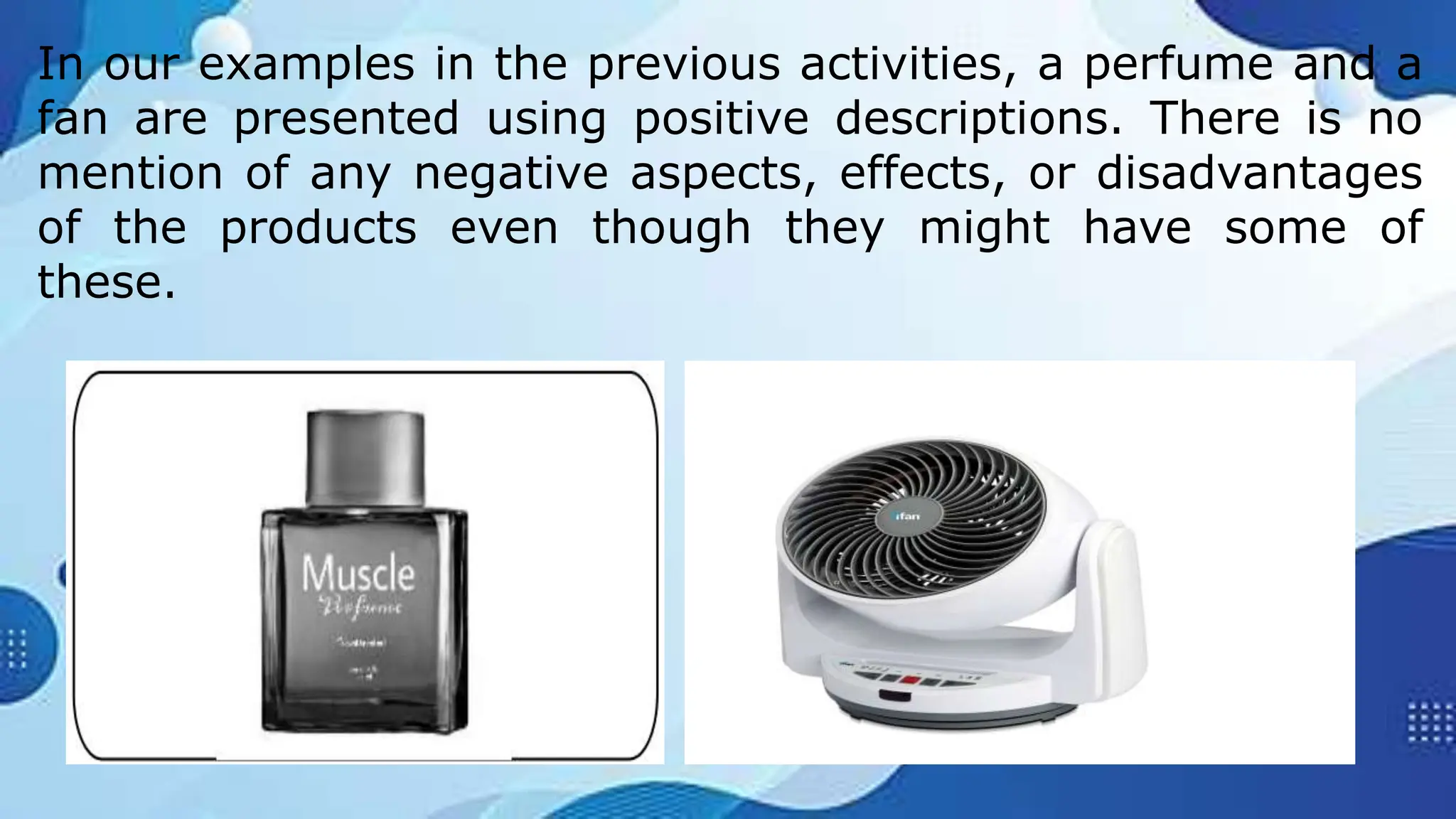
Analyze the advertisements below then answer
the questions that follow.
1. What product is being promoted or sold?
a. muscle b. perfume c. scent d. men
2. What does the advertisement want to say?
a. The perfume smells like the scent of a
woman.
b. Those who will use the perfume will get big
muscles.
c. Men who will use the perfume are considered
strong and real men.
d. Men must use perfume when working out at
the gym.
3. What specific stereotype is
used in this situation?
a. Gender
b. Group
c. Cultural
d. Age
4. Do you think that the smell or scent of
the perfume is something that ALL men will
like? Why?
a. Yes, because it is a man’s scent.
b. Yes, because of the word muscle.
c. No, because Blossoms Perfume has the
best scent.
d. No, because not all men will like
something that they have not tried yet.
5. What words in the advertisement
are used to attract male customers?
a. for real, real men
b. perfume, scent
c. muscle
d. none of the above
6. What type of propaganda
technique is associated with the term
“real men,” which tries to present a
very pleasant image?
a. bandwagon
b. testimonial
c. plain folks
d. glittering generalities
Sing the lines of this
advertisement to the tune
of “Silent Night” then
answer the
questions that follow.
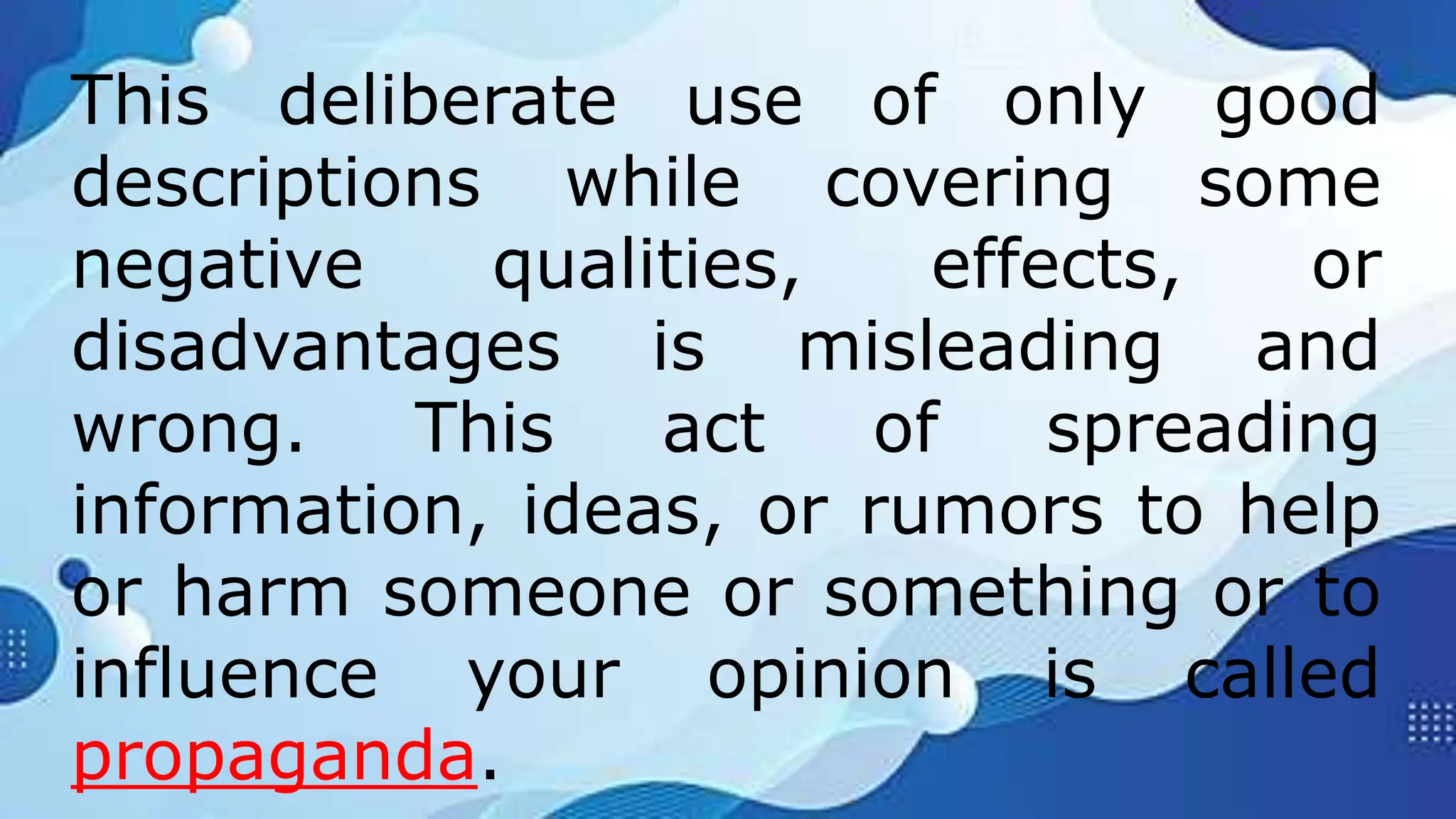
Silent night. Enjoyable night.
Air is cool. The room is nice.
The fan that keeps you happy at night.
The fan that helps you sleep at night.
Sleep with this turned on all night
Wake up with this feeling fresh.
iFAN
The super quite electric fan
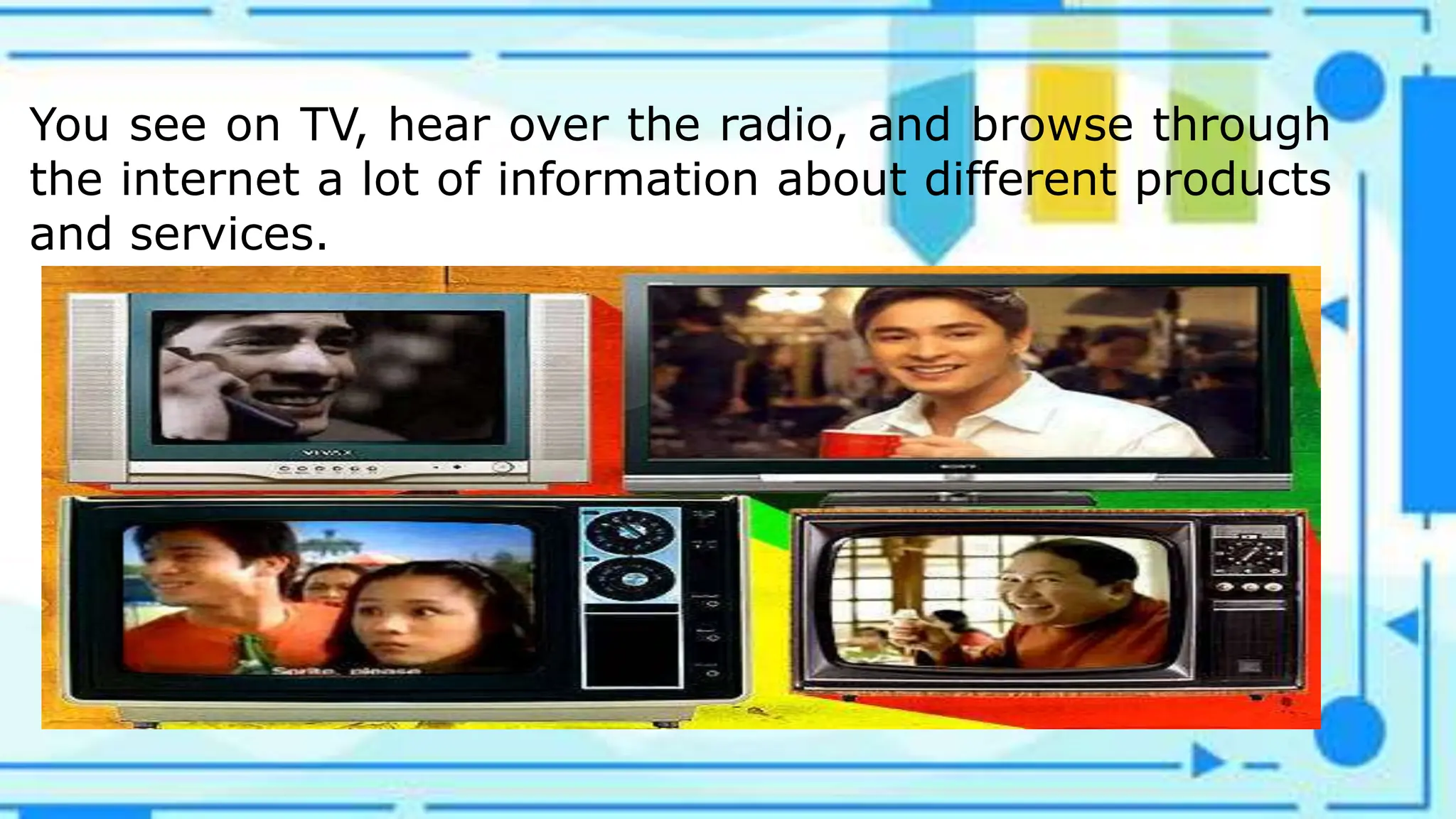
You see on TV, hear over the radio, and browse through
the internet a lot of information about different products
and services.
In our examples in the previous activities, a perfume and a
fan are presented using positive descriptions. There is no
mention of any negative aspects, effects, or disadvantages
of the products even though they might have some of
these.
This deliberate use of only good
descriptions while covering some
negative qualities, effects, or
disadvantages is misleading and
wrong. This act of spreading
information, ideas, or rumors to help
or harm someone or something or to
influence your opinion is called
propaganda.
PROPAGANDA TECHNIQUES
1. Bandwagon
A bandwagon is the use of a thing, idea, or
trend that attracts growing support from a
number of people.
Example: Juan wants to buy a new Sonic
cellphone because an advertisement shows
that nine out of ten Filipinos prefer to use it
over other phones.
2. Glittering Generalities
This is considered as the most basic type of
propaganda. It is defined as the use of
praises or pleasant-sounding words and
comments in favor of someone or
something. These words paint a positive
description of people and things much like
the glitter and sparkle that you see in a
diamond.
The advertisement about a men’s
perfume which uses attention-getting
words such as “real men” and another
about an electric fan which uses ideal
descriptions like “silent night, enjoyable
night, cool, nice, and fresh” all show an
example of glittering generalities..
3. Name-Calling
If glittering generalities are often filled with
praises in order to provide a positive meaning
to a certain advocacy or product, name-calling
is the opposite. It is often a destructive rather
than constructive propaganda. Name-calling is
a technique that uses negative descriptions,
comments, or ideas that are labeled or tagged
to someone or something.
For example, when a person says that
his/her rival is the “attack dog” of the
other team, the speaker is putting a
negative label on that person. Those
who hear might get suspicious and
uncomfortable with the said person
although what has been said may not
be true.
4. Plain Folks
Nothing can be more familiar and closer to our hearts
than the regular people and common life values such as
family, finance, and health. The “plain folks” propaganda
technique is simply defined as the use or portrayal of
ordinary people in real-life settings to promote an idea,
product, or service. Seeing an advertisement about a
mother doing some laundry beside a water pump while
using a particular product, say a particular detergent
soap, will also attract others to use the same soap since
it is used by a real person who is also like them.
5. Testimonial
One of the most popular propaganda
techniques is testimonial. It is a method of
using the words, impressions, and
recommendations of a famous person to
promote an idea, product, or service. This is
very common on TV and radio
advertisements where a showbiz celebrity, a
famous athlete, or a well-known TV host
endorses a product or campaign for an
advocacy or project.
Example: A famous singer is talking on TV
about a new cooking oil. She says that her
cooking has improved and the food she
cooks has become tastier because of this
cooking oil.
6. Transfer
This type of propaganda is defined as a
technique that projects or transfers
certain positive or negative qualities of
a person, ideology, or object to other
things and people that make them more
or less attractive. As stated, the
qualities that may be transferred could
be positive or negative.
Because you can relate to the Christmas song
and the famous mobile phone brand, their
qualities are somehow “transferred” to the
product which is the electric fan. If you were
about to buy a new fan, you may consider
buying this electric fan because you can
imagine that your nights will be quiet and
enjoyable like a typical Christmas night and
you can also feel that this is a reliable
product since it sounds like a popular mobile
phone brand.
7. Card Stacking
The basic definition for this propaganda
technique is that it refers to thestacking of
cards in favor of a person, product, action,
or idea being talked about. The “cards”
being stacked are the qualities and reasons
that are provided in support of the thing
being described. This technique also
involves the deliberate omission of certain
facts that may make the thing or person
look bad.
Propaganda techniques, just like
stereotypes, also influence your ideas
or opinions about people. Most of these
techniques may be used in favor or
against a person, a group, an
organization, or an institution.
Therefore, you should be able to
recognize them if they are used in
certain ways, so you can make better
and wise decisions or actions.

ENG 5 Q2 Identifying Propaganda Techniques.pptx

  • 1.
  • 2.
    At the endof this lesson, you should be able to: 1. define propaganda and the different propaganda techniques; 2. distinguish types of propaganda techniques; and 3. develop tolerance or show respect for others’ point of view.
  • 3.
    Directions: Identify thekind of stereotype in each number. 1. “Do not believe what our barangay captain says. He is only a high school graduate,” Maquie told her neighbors. 2. People who live in Pulang Bato Village, a place where many crimes happen, are bad and dangerous.
  • 4.
    3. Senior citizensare not allowed to avail of the cash for work program in the barangay because the officials believe that they can’t do the work anymore. 4. Filipinos are always late. That’s the reason why we have “Filipino time. 5. Girls are emotional, so they cannot be strong leaders.
  • 5.
    Read the paragraph carefullyand answer the questions that follow.
  • 6.
    (1) Many residentsfrom Brgy. Nagkakaisa are falling in line at the barangay hall to claim a free umbrella donated by YXY Channel 27. (2) Alita gets a black umbrella while her friend, Panyong, receives a pink umbrella. (3) Panyong tells a crew member of the TV station that he wants to get a black umbrella because all the members of their dance group are wearing black jeans, black shirts, black shoes, and anything black.
  • 7.
    (4) He saysthat since his friends already own a black umbrella, he needs this one, too. (5) The crew member then asks Alita to exchange an umbrella with Panyong telling her that she should take the pink umbrella because she is a girl. (6) Alita, feeling so upset, refuses to accept the pink umbrella and goes home crying.
  • 8.
    1. What objectserves as the source of the problem in the story? a. line b. umbrella c. shoes d. shirts
  • 9.
    2. Which ofthe following is the crew member’s reason why he/she would like to replace Alita’s black umbrella with a pink umbrella? a. donors have the right to take back what they have given. b. Panyong needs a black umbrella for their dance shows. c. a pink umbrella is a girl’s umbrella. d. boys are superior to girls
  • 10.
    3. Which sentencesin Number 2 are examples of a stereotype? a. a & b b. b. b & c. c & d d. a & d
  • 11.
    4. Why doesPanyong want a black umbrella? a. He believes that a black umbrella will make him look handsome. b. He wants to be like his friends who prefer black as the color of the group. c. He knows that a black umbrella absorbs more UV rays from the sun. d. He wants to give an umbrella to his mother.
  • 12.
    5. Which sentencein the paragraph shows the “bandwagon” propaganda technique that deals with the popularity of something with regard to its specific quality, characteristic, product, or fashion? a. first b. second c. third d. fifth
  • 13.
    Analyze the advertisementsbelow then answer the questions that follow. 1. What product is being promoted or sold? a. muscle b. perfume c. scent d. men
  • 14.
    2. What doesthe advertisement want to say? a. The perfume smells like the scent of a woman. b. Those who will use the perfume will get big muscles. c. Men who will use the perfume are considered strong and real men. d. Men must use perfume when working out at the gym.
  • 15.
    3. What specificstereotype is used in this situation? a. Gender b. Group c. Cultural d. Age
  • 16.
    4. Do youthink that the smell or scent of the perfume is something that ALL men will like? Why? a. Yes, because it is a man’s scent. b. Yes, because of the word muscle. c. No, because Blossoms Perfume has the best scent. d. No, because not all men will like something that they have not tried yet.
  • 17.
    5. What wordsin the advertisement are used to attract male customers? a. for real, real men b. perfume, scent c. muscle d. none of the above
  • 18.
    6. What typeof propaganda technique is associated with the term “real men,” which tries to present a very pleasant image? a. bandwagon b. testimonial c. plain folks d. glittering generalities
  • 19.
    Sing the linesof this advertisement to the tune of “Silent Night” then answer the questions that follow.
  • 20.
    Silent night. Enjoyablenight. Air is cool. The room is nice. The fan that keeps you happy at night. The fan that helps you sleep at night. Sleep with this turned on all night Wake up with this feeling fresh. iFAN The super quite electric fan
  • 25.
    You see onTV, hear over the radio, and browse through the internet a lot of information about different products and services.
  • 26.
    In our examplesin the previous activities, a perfume and a fan are presented using positive descriptions. There is no mention of any negative aspects, effects, or disadvantages of the products even though they might have some of these.
  • 27.
    This deliberate useof only good descriptions while covering some negative qualities, effects, or disadvantages is misleading and wrong. This act of spreading information, ideas, or rumors to help or harm someone or something or to influence your opinion is called propaganda.
  • 28.
    PROPAGANDA TECHNIQUES 1. Bandwagon Abandwagon is the use of a thing, idea, or trend that attracts growing support from a number of people. Example: Juan wants to buy a new Sonic cellphone because an advertisement shows that nine out of ten Filipinos prefer to use it over other phones.
  • 29.
    2. Glittering Generalities Thisis considered as the most basic type of propaganda. It is defined as the use of praises or pleasant-sounding words and comments in favor of someone or something. These words paint a positive description of people and things much like the glitter and sparkle that you see in a diamond.
  • 30.
    The advertisement abouta men’s perfume which uses attention-getting words such as “real men” and another about an electric fan which uses ideal descriptions like “silent night, enjoyable night, cool, nice, and fresh” all show an example of glittering generalities..
  • 32.
    3. Name-Calling If glitteringgeneralities are often filled with praises in order to provide a positive meaning to a certain advocacy or product, name-calling is the opposite. It is often a destructive rather than constructive propaganda. Name-calling is a technique that uses negative descriptions, comments, or ideas that are labeled or tagged to someone or something.
  • 33.
    For example, whena person says that his/her rival is the “attack dog” of the other team, the speaker is putting a negative label on that person. Those who hear might get suspicious and uncomfortable with the said person although what has been said may not be true.
  • 35.
    4. Plain Folks Nothingcan be more familiar and closer to our hearts than the regular people and common life values such as family, finance, and health. The “plain folks” propaganda technique is simply defined as the use or portrayal of ordinary people in real-life settings to promote an idea, product, or service. Seeing an advertisement about a mother doing some laundry beside a water pump while using a particular product, say a particular detergent soap, will also attract others to use the same soap since it is used by a real person who is also like them.
  • 37.
    5. Testimonial One ofthe most popular propaganda techniques is testimonial. It is a method of using the words, impressions, and recommendations of a famous person to promote an idea, product, or service. This is very common on TV and radio advertisements where a showbiz celebrity, a famous athlete, or a well-known TV host endorses a product or campaign for an advocacy or project.
  • 38.
    Example: A famoussinger is talking on TV about a new cooking oil. She says that her cooking has improved and the food she cooks has become tastier because of this cooking oil.
  • 39.
    6. Transfer This typeof propaganda is defined as a technique that projects or transfers certain positive or negative qualities of a person, ideology, or object to other things and people that make them more or less attractive. As stated, the qualities that may be transferred could be positive or negative.
  • 40.
    Because you canrelate to the Christmas song and the famous mobile phone brand, their qualities are somehow “transferred” to the product which is the electric fan. If you were about to buy a new fan, you may consider buying this electric fan because you can imagine that your nights will be quiet and enjoyable like a typical Christmas night and you can also feel that this is a reliable product since it sounds like a popular mobile phone brand.
  • 42.
    7. Card Stacking Thebasic definition for this propaganda technique is that it refers to thestacking of cards in favor of a person, product, action, or idea being talked about. The “cards” being stacked are the qualities and reasons that are provided in support of the thing being described. This technique also involves the deliberate omission of certain facts that may make the thing or person look bad.
  • 44.
    Propaganda techniques, justlike stereotypes, also influence your ideas or opinions about people. Most of these techniques may be used in favor or against a person, a group, an organization, or an institution. Therefore, you should be able to recognize them if they are used in certain ways, so you can make better and wise decisions or actions.

Editor's Notes

  • #4 In the previous lesson, you have learned about stereotypes which are fixed and overgeneralized beliefs about a class or group of people or things. Let us see how well you can remember your lesson on stereotypes by doing the activities that follow.
  • #26 You also notice that many pieces of information about these products and services are exaggerated to influence or convince you to buy them.
  • #28 There are many types of propaganda techniques that are used to influence your impression or opinion about people and things. To help you get a better understanding of this lesson, read the following definitions and examples of the common propaganda techniques:
  • #29 The scenario about the black umbrella becoming popular among members of a dance group in What’s In is an example of a bandwagon. There is no other reason why Panyong wanted to have the black umbrella except that he knows that everyone in his group likes to use anything that is black and that he, too, must use everything that is colored black. This practice is very common in marketing where a customer buys a product because everybody else is buying it.
  • #31 Because of its ability to take advantage of the power of words, this technique 8 CO_Q2_English5_Module3_Lesson2 is used to enhance the image of people, places, or things.
  • #36 Other advertisements may show a farmer drinking a particular coffee, an office worker eating at a certain restaurant, or even a student using a specific brand of shoes that allow the audience to see the usefulness or advantages of the products in real life
  • #38 Because the person is famous and well-liked, the product or campaign being endorsed may also become popular among his or her followers. These people may buy the product or follow what he or she says not because they need to buy a product or do the action but because they simply like the famous person.
  • #40 In the previous exercise about a quiet electric fan, a positive transfer took place. In that example, the melody of a familiar Christmas song “Silent Night” and the use of “iFan” as the brand name which rhymes with a popular brand of a mobile phone” were used in a positive way to make the product easy to recognize and remember.
  • #43 Card stacking is a common strategy used in advertisements and debates. In an advertisement, a product is being presented with only its advantages without mentioning its disadvantages. In a debate, only the reasons or arguments in favor of one side is given
  • #44 To give a concrete example, an expensive whiskey is portrayed on a poster as something very pleasant. People are smiling and enjoying the company of other good-looking people while drinking. The advertisement does not show what happens when these people drink it too much.
  • #45 If you think your friends have a fixed opinion about someone or something, you can only hope to explain to them politely what you want them to know, but you have to respect their point of view.