Syllabus										English	102H							Spring	2017	
College	Writing	and	Rhetoric		
	
Instructor:			Victoria	M.	Arthur,	PhD		
Email:											varthur@uidaho.edu	
	
	
Office:												Brink	229	
Office	Hrs:				MW	2:30	–	3:30	&	by	appt.	
								
COURSE DESCRIPTION
	
English 102 is an introductory composition course, designed to improve your skills in persuasive,
expository writing, the sort you will be doing in other courses in college and in many jobs. Sometimes
this kind of writing is called transactional writing; it is used to transact something—persuade and inform
a reasonably well-educated audience, conduct business, evaluate, review, or explain a complex process,
procedure, or event.
LEARNING OUTCOMES
By the end of the course, a successful student should be able to...
1. Accurately assess and effectively respond to a wide variety of audiences and rhetorical situations.
2. Comprehend college-level and professional prose and analyze how authors present their ideas in
view of their probable purposes, audiences, and occasions.
3. Present ideas as related to, but clearly distinguished from, the ideas of others (including the
ability to paraphrase, summarize, and correctly cite and document borrowed material).
4. Focus on, articulate, and sustain a purpose that meets the needs of specific writing situations.
5. Explicitly articulate why they are writing, who they are writing for, and what they are saying.
6. Write critical analyses and syntheses of college-level and professional prose.
7. Be able to make the connection between questions and problems in your life both within and
outside of college.
8. Gather and evaluate information and use it for a rhetorical purpose in writing a research paper.
9. Attend to and productively incorporate a variety of perspectives.
10. Develop flexible strategies for generating, revising, editing, and proofreading.
11. Understand writing as an open process that permits writers to use later invention and re-thinking
to revise their work.
12. Give and receive constructive feedback from peers.
13. Use conventions of format and structure appropriate to the rhetorical situation and practice
appropriate means of documenting their work.
14. Locate, evaluate, organize, and use research material collected from electronic sources, including
scholarly library databases; other official databases (e.g., federal government databases); and
informal electronic networks and internet sources.
Of course, we expect that you are able to carry out some of these tasks already.
English	102	Syllabus	2	
DEADLINES
Administrative Deadlines
The university has certain deadlines of which you need to be aware if you want to drop the
course at some point during the term.
Wednesday, January 25 – Last day to drop the course without a grade of W.
Friday, March 31 – Last day to drop the course with a grade of W.
Class Deadlines
As the term progresses, you will be given major writing assignments, along with your daily
writing and reading work. Each of these assignments has a firm deadline. All late assignments
will receive a point deduction.
TEXTBOOK (available at the UI Bookstore)
• John Ramage et al, The Allyn & Bacon Guide to Writing.
	
COURSE EXPECTATIONS
Class	Preparation	and	Active	Participation			
My	philosophy	of	teaching	is	that	students	are	active	agents	of	their	own	learning	rather	than	
passive	vessels	to	be	filled	by	listening	to	me	lecture.	You	cannot	learn	to	write	by	listening	to	
me	talk	about	writing;	you	must	hone	your	skills	through	practice.	Therefore	a	significant	
amount	of	class	time	will	be	spent	writing,	discussing	your	writing	efforts	and	experiences,	and	
responding	to	each	other’s	drafts.	You	are	expected	to	bring	your	textbook	and	a	laptop	(or	
whatever	way	you	prefer	to	write)	to	each	class	meeting.		
The	minimum	expectations	for	participation	are	that	you		
• complete	any	reading	and	writing	assigned	before	the	class,		
• arrive	on	time	with	your	book	and	laptop,	and		
• enthusiastically	engage	in	class	activities	and	discussions.	
I	don’t	grade	attendance.	The	mini-lectures,	discussions	and	activities	we	do	in	class	are	
designed	to	help	you	write	the	major	projects.	Therefore,	attendance	is	rewarded	by	improved	
performance.	And	you	can	only	earn	the	homework/process	points	from	in-class	work	by	
actually	being	in	the	class	(and	doing	the	activity),	so	attendance	is	also	rewarded	in	this	way.	
University	of	Idaho	Classroom	Learning	Civility	Clause
In	any	environment	in	which	people	gather	to	learn,	it	is	essential	that	all	members	feel	as	free	
and	safe	as	possible	in	their	participation,	especially	in	regards	to	one’s	writing.	To	this	end,	it	is	
expected	that	everyone	in	this	course	will	be	treated	with	mutual	respect	and	civility,	with	an
English	102	Syllabus	3	
understanding	that	all	of	us	(students,	instructors,	professors,	guests,	and	teaching	assistants)	
will	be	respectful	and	civil	to	one	another	in	discussion,	in	action,	in	teaching,	and	in	learning.		
Should	you	feel	our	classroom	interactions	do	not	reflect	an	environment	of	civility	and	respect,	
please	meet	with	me	during	office	hours	to	discuss	your	concern.		Additional	resources	for	
expression	of	concern	or	requesting	support	include	the	Dean	of	Students	office	and	staff	(5-
6757),	the	UI	Counseling	&	Testing	Center’s	confidential	services	(5-6716),	or	the	UI	Office	of	
Human	Rights,	Access,	&	Inclusion	(5-4285).				
Plagiarism	
It	is	academically	dishonest,	and	sometimes	illegal,	to	present	someone	else’s	ideas	or	writing	
as	your	own.		Ignorance	is	not	a	defense:	it	is	your	responsibility	to	make	sure	you	use	proper	
citation,	so	get	assistance	(from	me,	for	example)	if	you	are	unsure.			
Sometimes	students	plagiarize	because	they	do	not	feel	they	can	complete	the	assignment.		If	
you	have	concerns	about	the	quality	of	your	work	or	your	ability	to	meet	deadlines,	please	talk	
to	me	about	it.		There	is	always	a	better	alternative	than	plagiarism,	which	may	cause	you	to	fail	
the	assignment	or	the	course	and	will	be	reported	to	the	Dean	of	Students.		For	more	
information	see	the	Plagiarism	Policy	on	the	English	Department	website:	
http://www.class.uidaho.edu/english/comp/plagiarism.htm.	
Disability	Accommodation	
The	University	of	Idaho	is	committed	to	providing	equal	and	integrated	access	for	individuals	
with	disabilities.		This	commitment	is	consistent	with	legal	requirements,	including	Section	504	
of	the	Rehabilitation	Act	of	1973	and	the	Americans	with	Disabilities	Act	(ADA)	of	1990,	and	
embodies	the	university’s	historic	determination	to	ensure	the	inclusion	of	all	members	of	its	
communities.	
If	you	have	a	disability	that	you	feel	may	impair	your	ability	to	complete	the	work	in	this	course	
as	it	is	designed,	please	let	me	know	as	soon	as	possible.		All	accommodations	must	be	approved	
through	Disability	Support	Services	located	in	the	Idaho	Commons,	Room	333,	885-6307.		
COURSE REQUIREMENTS
	
Major Writing Assignments
	
• Research	Topic	Proposal:				50	points	
• Annotated	Bibliography:			100	points	
• Research	Paper:																		100	points	
• Public	Statement:		 						50	points
English	102	Syllabus	4	
Process Work
There	will	be	shorter	(“invention”	or	“prep	work”)	writing	assignments	due	regularly.		These	
assignments	are	specifically	designed	to	help	you	generate	material	to	write	the	major	
assignments.	Complete	drafts	are	also	included	in	this	category.	For	each	major	assignment,	
you	will	also	be	asked	to	read	and	comment	on	the	papers	of	other	students.	The	number	of	
points	available	from	process	work	is	roughly	equivalent	to	the	total	points	for	the	major	
assignments.	
	
	
GRADING
	
Grading	criteria	are	provided	for	each	major	assignment.		
	
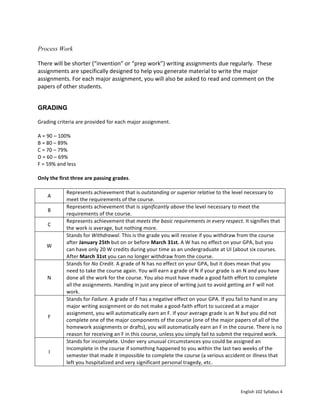
A	=	90	–	100%	
B	=	80	–	89%	
C	=	70	–	79%	
D	=	60	–	69%	
F	=	59%	and	less	
	
Only	the	first	three	are	passing	grades.		
	
A	
Represents	achievement	that	is	outstanding	or	superior	relative	to	the	level	necessary	to	
meet	the	requirements	of	the	course.	
B	
Represents	achievement	that	is	significantly	above	the	level	necessary	to	meet	the	
requirements	of	the	course.	
C	
Represents	achievement	that	meets	the	basic	requirements	in	every	respect.	It	signifies	that	
the	work	is	average,	but	nothing	more.	
W	
Stands	for	Withdrawal.	This	is	the	grade	you	will	receive	if	you	withdraw	from	the	course	
after	January	25th	but	on	or	before	March	31st.	A	W	has	no	effect	on	your	GPA,	but	you	
can	have	only	20	W	credits	during	your	time	as	an	undergraduate	at	UI	(about	six	courses.	
After	March	31st	you	can	no	longer	withdraw	from	the	course.	
N	
Stands	for	No	Credit.	A	grade	of	N	has	no	effect	on	your	GPA,	but	it	does	mean	that	you	
need	to	take	the	course	again.	You	will	earn	a	grade	of	N	if	your	grade	is	an	N	and	you	have	
done	all	the	work	for	the	course.	You	also	must	have	made	a	good	faith	effort	to	complete	
all	the	assignments.	Handing	in	just	any	piece	of	writing	just	to	avoid	getting	an	F	will	not	
work.	
F	
Stands	for	Failure.	A	grade	of	F	has	a	negative	effect	on	your	GPA.	If	you	fail	to	hand	in	any	
major	writing	assignment	or	do	not	make	a	good-faith	effort	to	succeed	at	a	major	
assignment,	you	will	automatically	earn	an	F.	If	your	average	grade	is	an	N	but	you	did	not	
complete	one	of	the	major	components	of	the	course	(one	of	the	major	papers	of	all	of	the	
homework	assignments	or	drafts),	you	will	automatically	earn	an	F	in	the	course.	There	is	no	
reason	for	receiving	an	F	in	this	course,	unless	you	simply	fail	to	submit	the	required	work.	
I	
Stands	for	incomplete.	Under	very	unusual	circumstances	you	could	be	assigned	an	
Incomplete	in	the	course	if	something	happened	to	you	within	the	last	two	weeks	of	the	
semester	that	made	it	impossible	to	complete	the	course	(a	serious	accident	or	illness	that	
left	you	hospitalized	and	very	significant	personal	tragedy,	etc.
English	102	Syllabus	5	
REPEATING THE COURSE
You	may	not	hand	in	the	same	papers	you	used	in	a	previous	semester.	If	you	are	repeating	the	course,	
you	need	to	write	new	versions	of	the	assignments.

Eng 102H Syllabus