Energy Efficiency and Sustainability
Enhancement at Hayat Diagnostic Center
Prepared by: Eng. Khadar A. Farah
Founder of S.A.V.E
ENERGY AUDITOR EXPLAINED
Introduction
• With the recent installation of a 70kW solar system
paired with battery storage, along with chillers for
the MRI, two split AC units, and motion sensor-
controlled lighting in toilets, the project will reduce
energy consumption, lower operational costs, and
contribute to environmental sustainability goals.
The focus will be on optimizing energy usage,
reducing dependency on grid electricity, and
automating key systems to work in harmony with
renewable energy sources.
Project Objectives
• Improve energy efficiency of MRI, CT, HVAC,
and lighting systems
• Optimize operational costs(Chillers)
• Integrate investments (solar, BMS, storage)
• Implement energy conservation measures
(ECMs)
• Establish a strong foundation for implementing
a Building Management System (BMS).
Energy Efficiency Improvements
• • 20% reduction in MRI energy consumption
during idle states
• • 15% reduction in CT energy consumption
during idle states
• • Optimized energy usage in HVAC, lighting, and
auxiliary systems
• Paves the way for BMS by modernizing
infrastructure, optimizing operations, and
creating a culture of data-driven efficiency.
Cost Optimization
• • 75% reduction in energy costs through solar
integration
• • ROI within 3 years by implementing further
operational optimizations
Integration of Investments
• • Solar system, BMS, and battery storage
working together
• • Optimizing energy flow for maximum
performance
Energy Conservation Measures (ECMs)
• • Identifying and prioritizing the most cost-
effective ECMs
• • Detailed technical and financial analysis to
determine savings
PAVES THE WAY FOR BMS
• • Efficient Baseline Systems:The project optimizes critical
systems such as HVAC, lighting, and medical equipment,
making them energy-efficient and ensuring compatibility
with advanced automation technologies.
• • Establishing Monitoring and Data Collection Via
Energy Audit:
– The project’s energy audits lay the groundwork for detailed
monitoring, providing insights into energy usage and
operational patterns.
– This data serves as a precursor to automating monitoring
through a BMS.
Secondary Goals
• • Enhance solar system performance
• • Staff training on energy-saving practices
• • Ensure sustainability alignment with service
quality
Expected Outcomes
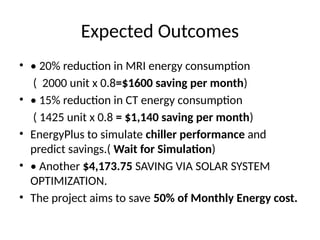
• • 20% reduction in MRI energy consumption
( 2000 unit x 0.8=$1600 saving per month)
• • 15% reduction in CT energy consumption
( 1425 unit x 0.8 = $1,140 saving per month)
• EnergyPlus to simulate chiller performance and
predict savings.( Wait for Simulation)
• • Another $4,173.75 SAVING VIA SOLAR SYSTEM
OPTIMIZATION.
• The project aims to save 50% of Monthly Energy cost.
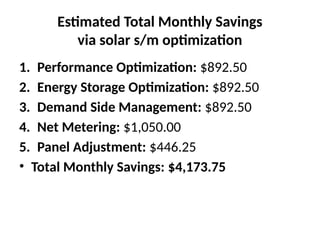
Estimated Total Monthly Savings
via solar s/m optimization
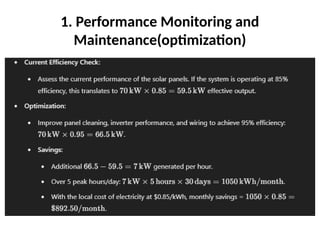
1. Performance Optimization: $892.50
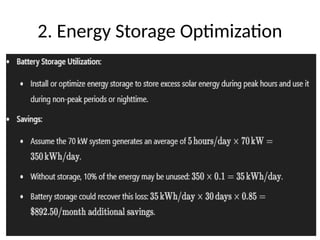
2. Energy Storage Optimization: $892.50
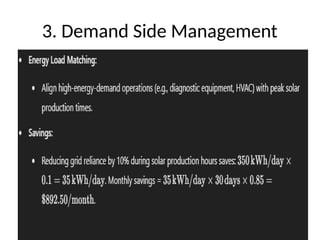
3. Demand Side Management: $892.50
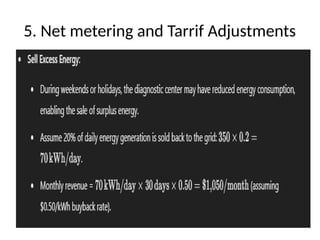
4. Net Metering: $1,050.00
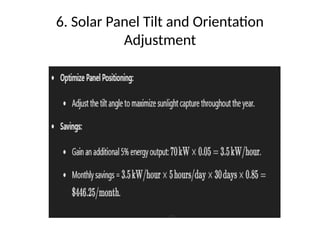
5. Panel Adjustment: $446.25
• Total Monthly Savings: $4,173.75
1. Performance Monitoring and
Maintenance(optimization)
2. Energy Storage Optimization
3. Demand Side Management
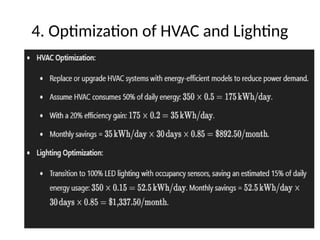
4. Optimization of HVAC and Lighting
5. Net metering and Tarrif Adjustments
6. Solar Panel Tilt and Orientation
Adjustment
Rationale for Energy Audit
• Necessary to optimize recent investments
• Level 2 and Level 3 audits will provide
comprehensive insights and ROI analysis
Energy Audit Scope
• Energy Usage Assessment
• Operational Optimization
• Technology Integration
• Staff Training and Awareness
Energy Usage Assessment
• Baseline energy consumption analysis
• Evaluate solar system contribution and battery
storage efficiency
• Study usage patterns of MRI, CT, HVAC, and
lighting
Operational Optimization
• Align solar generation with peak demand (MRI,
CT)
• Maximize energy storage during non-solar
hours
• System adjustments to improve energy savings
Technology Integration
• Integrate BMS for advanced load balancing
• Optimize HVAC, lighting, and solar system
interactions
• Evaluate system efficiency and identify
potential improvements
Training and Awareness
• Staff training on optimizing renewable energy
systems
• Develop energy-saving guidelines and best
practices
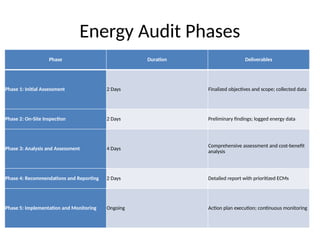
Energy Audit Phases
• Phase 4: Recommendations(2 DAYS)
• Phase 5: Implementation(ONGOING)
Phase Duration Deliverables
Phase 1: Initial Assessment 2 Days Finalized objectives and scope; collected data
Phase 2: On-Site Inspection 2 Days Preliminary findings; logged energy data
Phase 3: Analysis and Assessment 4 Days
Comprehensive assessment and cost-benefit
analysis
Phase 4: Recommendations and Reporting 2 Days Detailed report with prioritized ECMs
Phase 5: Implementation and Monitoring Ongoing Action plan execution; continuous monitoring
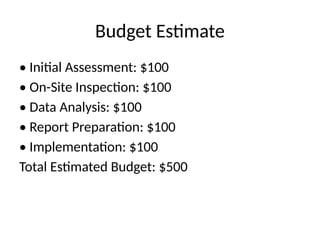
Budget Estimate
• Initial Assessment: $100
• On-Site Inspection: $100
• Data Analysis: $100
• Report Preparation: $100
• Implementation: $100
Total Estimated Budget: $500
Conclusion
• This project will optimize energy use, reduce
costs, and enhance sustainability at Hayat
Diagnostic Center. By integrating renewable
energy, energy-efficient systems, and
automation, we will achieve significant
environmental and financial benefits.
GO GREEN, SAVE ENERGY

Energy_Efficiency_and_Sustainability_Proposal.pptx

  • 1.
    Energy Efficiency andSustainability Enhancement at Hayat Diagnostic Center Prepared by: Eng. Khadar A. Farah Founder of S.A.V.E
  • 2.
  • 3.
    Introduction • With therecent installation of a 70kW solar system paired with battery storage, along with chillers for the MRI, two split AC units, and motion sensor- controlled lighting in toilets, the project will reduce energy consumption, lower operational costs, and contribute to environmental sustainability goals. The focus will be on optimizing energy usage, reducing dependency on grid electricity, and automating key systems to work in harmony with renewable energy sources.
  • 4.
    Project Objectives • Improveenergy efficiency of MRI, CT, HVAC, and lighting systems • Optimize operational costs(Chillers) • Integrate investments (solar, BMS, storage) • Implement energy conservation measures (ECMs) • Establish a strong foundation for implementing a Building Management System (BMS).
  • 5.
    Energy Efficiency Improvements •• 20% reduction in MRI energy consumption during idle states • • 15% reduction in CT energy consumption during idle states • • Optimized energy usage in HVAC, lighting, and auxiliary systems • Paves the way for BMS by modernizing infrastructure, optimizing operations, and creating a culture of data-driven efficiency.
  • 6.
    Cost Optimization • •75% reduction in energy costs through solar integration • • ROI within 3 years by implementing further operational optimizations
  • 7.
    Integration of Investments •• Solar system, BMS, and battery storage working together • • Optimizing energy flow for maximum performance
  • 8.
    Energy Conservation Measures(ECMs) • • Identifying and prioritizing the most cost- effective ECMs • • Detailed technical and financial analysis to determine savings
  • 9.
    PAVES THE WAYFOR BMS • • Efficient Baseline Systems:The project optimizes critical systems such as HVAC, lighting, and medical equipment, making them energy-efficient and ensuring compatibility with advanced automation technologies. • • Establishing Monitoring and Data Collection Via Energy Audit: – The project’s energy audits lay the groundwork for detailed monitoring, providing insights into energy usage and operational patterns. – This data serves as a precursor to automating monitoring through a BMS.
  • 10.
    Secondary Goals • •Enhance solar system performance • • Staff training on energy-saving practices • • Ensure sustainability alignment with service quality
  • 11.
    Expected Outcomes • •20% reduction in MRI energy consumption ( 2000 unit x 0.8=$1600 saving per month) • • 15% reduction in CT energy consumption ( 1425 unit x 0.8 = $1,140 saving per month) • EnergyPlus to simulate chiller performance and predict savings.( Wait for Simulation) • • Another $4,173.75 SAVING VIA SOLAR SYSTEM OPTIMIZATION. • The project aims to save 50% of Monthly Energy cost.
  • 12.
    Estimated Total MonthlySavings via solar s/m optimization 1. Performance Optimization: $892.50 2. Energy Storage Optimization: $892.50 3. Demand Side Management: $892.50 4. Net Metering: $1,050.00 5. Panel Adjustment: $446.25 • Total Monthly Savings: $4,173.75
  • 13.
    1. Performance Monitoringand Maintenance(optimization)
  • 14.
    2. Energy StorageOptimization
  • 15.
    3. Demand SideManagement
  • 16.
    4. Optimization ofHVAC and Lighting
  • 17.
    5. Net meteringand Tarrif Adjustments
  • 18.
    6. Solar PanelTilt and Orientation Adjustment
  • 19.
    Rationale for EnergyAudit • Necessary to optimize recent investments • Level 2 and Level 3 audits will provide comprehensive insights and ROI analysis
  • 20.
    Energy Audit Scope •Energy Usage Assessment • Operational Optimization • Technology Integration • Staff Training and Awareness
  • 21.
    Energy Usage Assessment •Baseline energy consumption analysis • Evaluate solar system contribution and battery storage efficiency • Study usage patterns of MRI, CT, HVAC, and lighting
  • 22.
    Operational Optimization • Alignsolar generation with peak demand (MRI, CT) • Maximize energy storage during non-solar hours • System adjustments to improve energy savings
  • 23.
    Technology Integration • IntegrateBMS for advanced load balancing • Optimize HVAC, lighting, and solar system interactions • Evaluate system efficiency and identify potential improvements
  • 24.
    Training and Awareness •Staff training on optimizing renewable energy systems • Develop energy-saving guidelines and best practices
  • 25.
    Energy Audit Phases •Phase 4: Recommendations(2 DAYS) • Phase 5: Implementation(ONGOING) Phase Duration Deliverables Phase 1: Initial Assessment 2 Days Finalized objectives and scope; collected data Phase 2: On-Site Inspection 2 Days Preliminary findings; logged energy data Phase 3: Analysis and Assessment 4 Days Comprehensive assessment and cost-benefit analysis Phase 4: Recommendations and Reporting 2 Days Detailed report with prioritized ECMs Phase 5: Implementation and Monitoring Ongoing Action plan execution; continuous monitoring
  • 26.
    Budget Estimate • InitialAssessment: $100 • On-Site Inspection: $100 • Data Analysis: $100 • Report Preparation: $100 • Implementation: $100 Total Estimated Budget: $500
  • 27.
    Conclusion • This projectwill optimize energy use, reduce costs, and enhance sustainability at Hayat Diagnostic Center. By integrating renewable energy, energy-efficient systems, and automation, we will achieve significant environmental and financial benefits.
  • 28.