By: Rebecca Stemkoski Energy & Work
What is Energy? Capacity for performing work.
What is Work? The transfer of energy from one physical system to another, especially the transfer of energy to a body by the application of a force that moves the body in the direction of the force.
There are Two Forms of Energy: Potential Kinetic
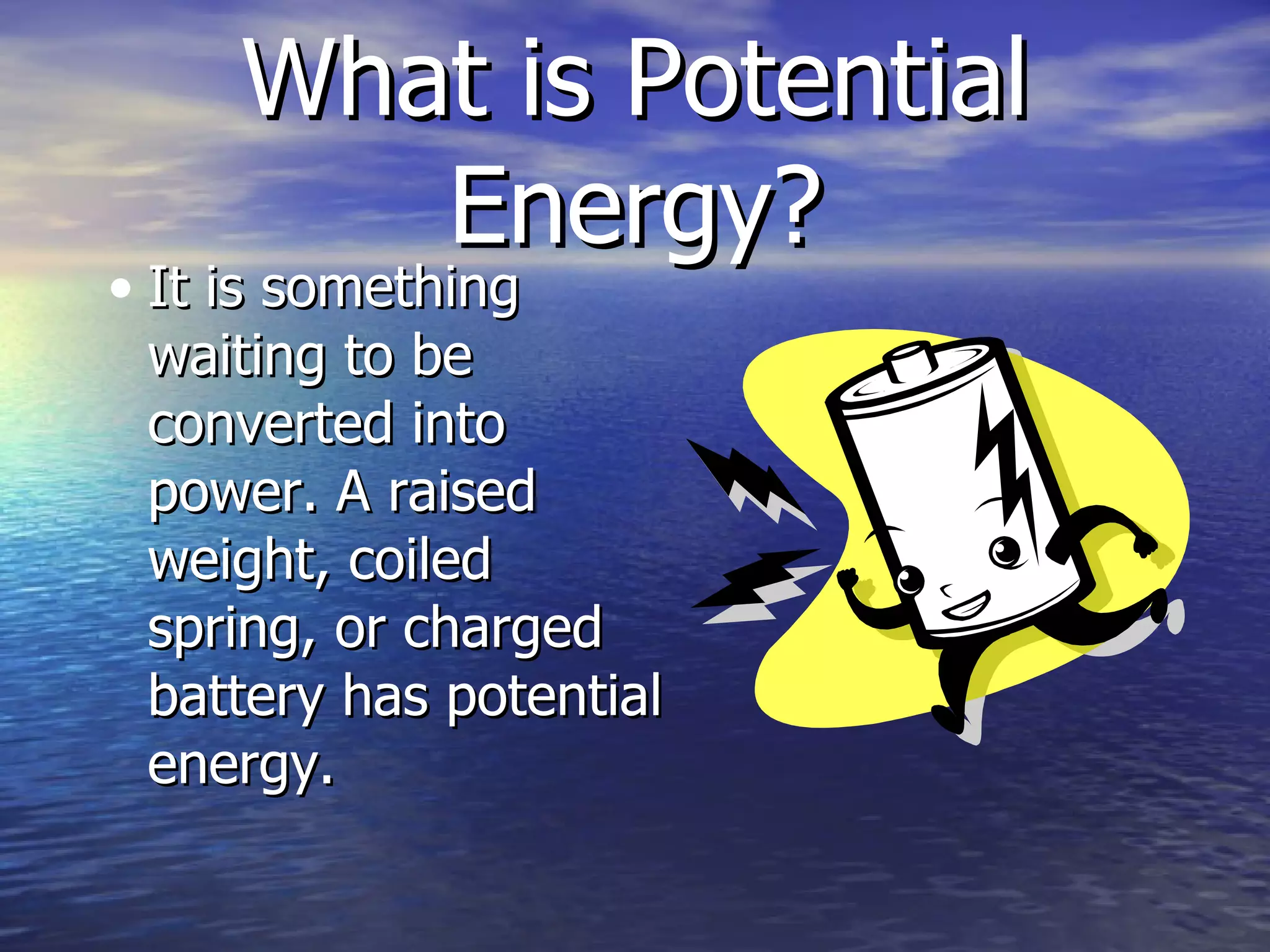
What is Potential Energy? It is something waiting to be converted into power. A raised weight, coiled spring, or charged battery has potential energy.
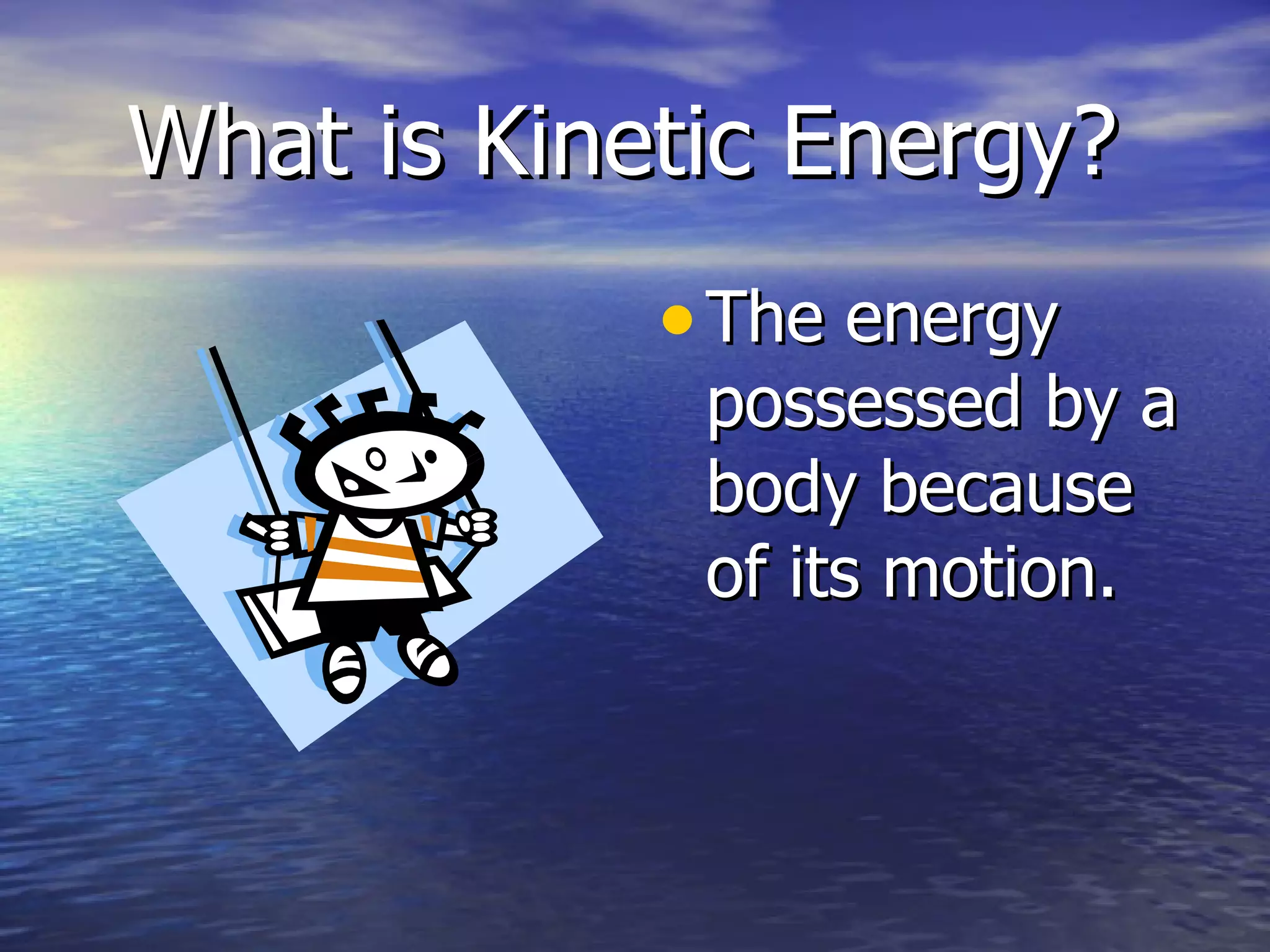
What is Kinetic Energy? The energy possessed by a body because of its motion.
Where can you find Energy?
Some places you can find energy: Any electronic device that contains a charged battery. Riding your bike down the road. Bottle Rockets. Driving a car. Eating and Digesting food.
What kinds of Energy did you use today?   -- Electricity,  if you used  electric lights , or a  radio , or  TV. -- Light --that was what the electricity in the  lightbulb  was converted to. -- Sound --that was what the electricity in the  radio  was converted to. -- Chemical energy- -when you ate  breakfast , it gave you strength. -- Heat --if you  cooked  your food, or  heated the house . -- Nuclear energy- -if you enjoyed  sunlight , because the Sun gets its energy by combining atomic nuclei of hydrogen to helium, deep inside it.
What kind of Energy is being transferred when using an electric fan?
Electric to Kinetic
In a car battery?
Chemical to Electric.
Can it be converted back to chemical energy?
Yes, when the battery is charged.
In a rocket nozzle?
Heat to Kinetic.
Are We Running out of Energy? Hydrogen fuel cells generate electricity   Advanced natural gas turbines   coal combustion   Wind power   Biomass energy   Alternative transportation fuels   Geothermal energy   Hot hydrothermal resources   NO.
Indiana Standards 5.1.1 Recognize and describe that results of similar scientific investigations may turn out differently because of inconsistencies in methods, materials, and observations*. 5.2.4 Keep a notebook to record observations and be able to distinguish inferences* from actual observations.  5.2.8 Recognize when and describe that comparisons might not be accurate because some of the conditions are not kept the same. 5.5.1 Make precise and varied measurements and specify the appropriate units.
References http://www-istp.gsfc.nasa.gov/stargaze/Lenergy.htm   www.howstuffworks.com http://science.howstuffworks.com/fpte10.htm   http://www.indianastandardsresources.org/standardSummary.asp?Subject=sci&Grade=5#

Energy Work

  • 1.
    By: Rebecca StemkoskiEnergy & Work
  • 2.
    What is Energy?Capacity for performing work.
  • 3.
    What is Work?The transfer of energy from one physical system to another, especially the transfer of energy to a body by the application of a force that moves the body in the direction of the force.
  • 4.
    There are TwoForms of Energy: Potential Kinetic
  • 5.
    What is PotentialEnergy? It is something waiting to be converted into power. A raised weight, coiled spring, or charged battery has potential energy.
  • 6.
    What is KineticEnergy? The energy possessed by a body because of its motion.
  • 7.
    Where can youfind Energy?
  • 8.
    Some places youcan find energy: Any electronic device that contains a charged battery. Riding your bike down the road. Bottle Rockets. Driving a car. Eating and Digesting food.
  • 9.
    What kinds ofEnergy did you use today? -- Electricity, if you used electric lights , or a radio , or TV. -- Light --that was what the electricity in the lightbulb was converted to. -- Sound --that was what the electricity in the radio was converted to. -- Chemical energy- -when you ate breakfast , it gave you strength. -- Heat --if you cooked your food, or heated the house . -- Nuclear energy- -if you enjoyed sunlight , because the Sun gets its energy by combining atomic nuclei of hydrogen to helium, deep inside it.
  • 10.
    What kind ofEnergy is being transferred when using an electric fan?
  • 11.
  • 12.
    In a carbattery?
  • 13.
  • 14.
    Can it beconverted back to chemical energy?
  • 15.
    Yes, when thebattery is charged.
  • 16.
    In a rocketnozzle?
  • 17.
  • 18.
    Are We Runningout of Energy? Hydrogen fuel cells generate electricity Advanced natural gas turbines coal combustion Wind power Biomass energy Alternative transportation fuels Geothermal energy Hot hydrothermal resources NO.
  • 19.
    Indiana Standards 5.1.1Recognize and describe that results of similar scientific investigations may turn out differently because of inconsistencies in methods, materials, and observations*. 5.2.4 Keep a notebook to record observations and be able to distinguish inferences* from actual observations. 5.2.8 Recognize when and describe that comparisons might not be accurate because some of the conditions are not kept the same. 5.5.1 Make precise and varied measurements and specify the appropriate units.
  • 20.
    References http://www-istp.gsfc.nasa.gov/stargaze/Lenergy.htm www.howstuffworks.com http://science.howstuffworks.com/fpte10.htm http://www.indianastandardsresources.org/standardSummary.asp?Subject=sci&Grade=5#