Accelerated Linux: Addressing Performance-Feature
Trade-offs on Multicore Devices
Linux is not suited for real-time applications. So when the ecosystem
and rich feature set of Linux is desired in combination with strict real-
time requirements, Enea’s Accelerated Linux provides a runtime
without trade-offs between features and performance.
Real-Time Accelerated Linux
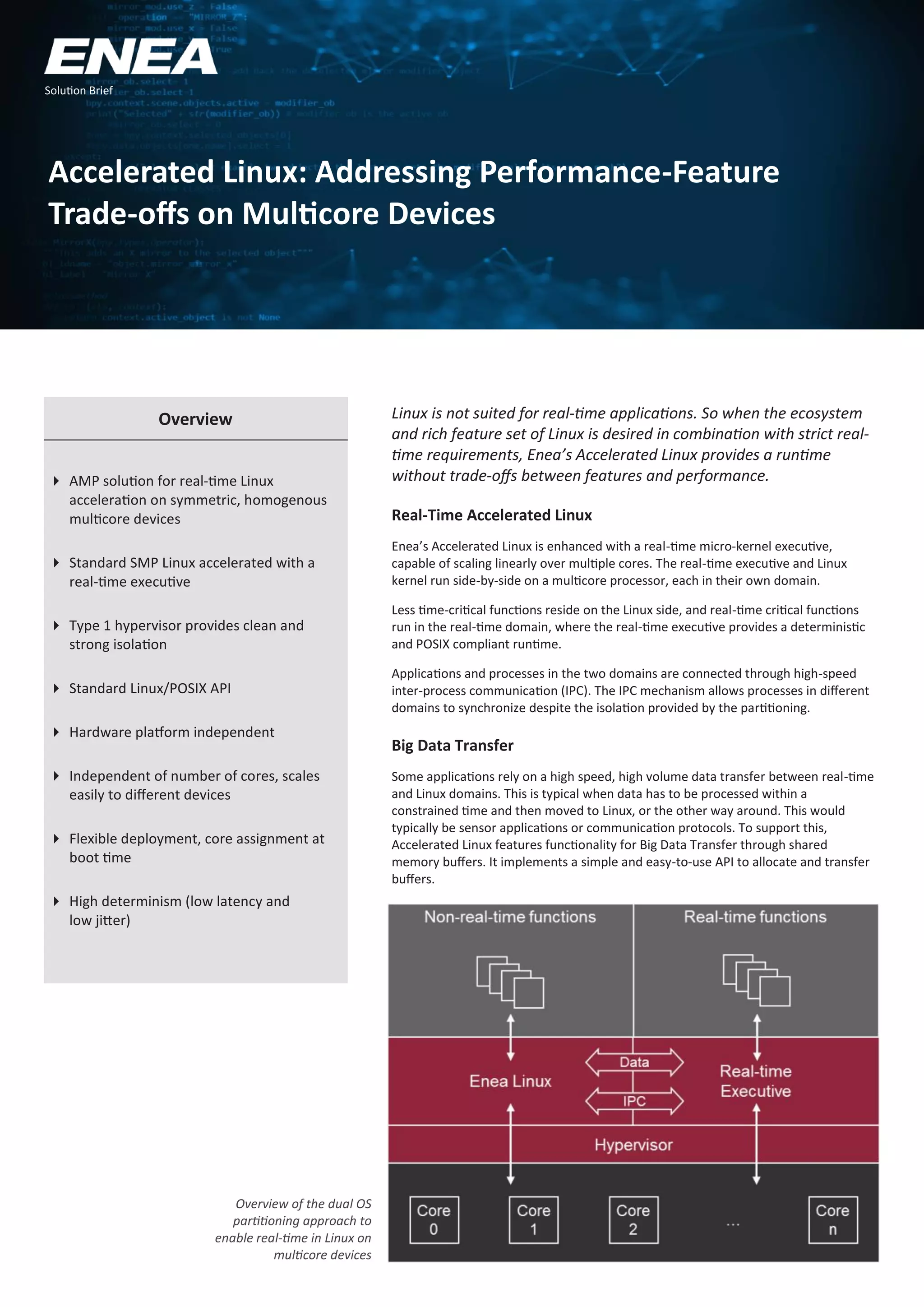
Enea’s Accelerated Linux is enhanced with a real-time micro-kernel executive,
capable of scaling linearly over multiple cores. The real-time executive and Linux
kernel run side-by-side on a multicore processor, each in their own domain.
Less time-critical functions reside on the Linux side, and real-time critical functions
run in the real-time domain, where the real-time executive provides a deterministic
and POSIX compliant runtime.
Applications and processes in the two domains are connected through high-speed
inter-process communication (IPC). The IPC mechanism allows processes in different
domains to synchronize despite the isolation provided by the partitioning.
Big Data Transfer
Some applications rely on a high speed, high volume data transfer between real-time
and Linux domains. This is typical when data has to be processed within a
constrained time and then moved to Linux, or the other way around. This would
typically be sensor applications or communication protocols. To support this,
Accelerated Linux features functionality for Big Data Transfer through shared
memory buffers. It implements a simple and easy-to-use API to allocate and transfer
buffers.
 AMP solution for real-time Linux
acceleration on symmetric, homogenous
multicore devices
 Standard SMP Linux accelerated with a
real-time executive
 Type 1 hypervisor provides clean and
strong isolation
 Standard Linux/POSIX API
 Hardware platform independent
 Independent of number of cores, scales
easily to different devices
 Flexible deployment, core assignment at
boot time
 High determinism (low latency and
low jitter)
Overview
Solution Brief
Overview of the dual OS
partitioning approach to
enable real-time in Linux on
multicore devices
Shared Resources
Enabled by fast zero-copy IPC between the Linux domain and the real
-time domain, both partitions can share a number of services such as
file system and debug channels as well as hardware resources. The
ability to share resources allows better resource utilization.
Deployment Flexibility
Accelerated Linux provides complete flexibility on how a multi-core
processor is partitioned between Linux and real-time domains. Cores
can be assigned to either domain (Linux or real-time executive) at
boot time, based on the needs for the application. This makes it
possible to easily change the configuration to match new
requirements or new hardware platforms.
No Black Boxes
Certain approaches to real-time in Linux create "black boxes" that
cannot be debugged in the runtime environment. Enea’s Accelerated
Linux supports full debug and profiling capabilities of the real-time
domain. This is enabled by a virtual point-to-point Ethernet
connection between the two domains.
Ultra-thin Hypervisor
Accelerated Linux uses the open source Jailhouse hypervisor to
partition the processor cores. It provides strong and clean isolation
between the Linux domain and the real-time domain. Being ultra-
thin, it enables direct hardware access to the real-time domain,
providing native performance to the real-time executive. As a result,
the hypervisor incurs almost no added latency.
Hardware Support
Accelerated Linux is adapted to ARMv8 and x86 homogenous
multicore processors, including:
 Xilinx Zynq Ultrascale+
 Xilinx Zynq 70xx
 STM32MP
 Altera Stratix 10
 Intel Denverton
 NXP i.MX
 NXP LayerScape LS20XX
 TI Sitara
 NXP B4860
 Nvidia Tegra
Typical Use Cases
Accelerated Linux is intended for systems that require both high
performance real-time as well as Linux.
Real-time + GUI
Many embedded devices are fitted with advanced graphics and Linux
provides an abundance of components for graphical user interfaces.
However, some require a true real-time environment. Typical
applications include medical devices, industrial automation, and
consumer electronics.
Sensors with High Data Volume
Advanced sensors often produce a continuous data stream that
needs real-time processing. Typical applications include radar and
lidar systems, vision control, and real-time image analysis.
Networking
Networking applications often require a Linux runtime for the higher
layers in the protocol stack, while the lower layers require a strict real
-time environment. A typical example is LTE/5G Radio Access
Networks.
Enea develops the software foundation for the connected society. We provide solutions for mobile traffic optimization, subscriber data management,
network virtualization, traffic classification, embedded operating systems, and professional services. Solution vendors, systems integrators, and service
providers use Enea to create new world-leading networking products and services. More than 3 billion people around the globe already rely on Enea
technologies in their daily lives. For more information: www.enea.com
Enea® is a registered trademark of Enea AB and its subsidiaries. Enea® OSE, Enea NFV Access, Enea NFV Core, Enea Accelerated Linux are registered or unregistered trademarks of Enea AB or its subsidiaries. Any other
company, product or service names mentioned above are the registered or unregistered trademarks of their respective owner. All rights reserved. © Enea AB 2019.
Evaluation
Contact Enea to request an evaluation or a demo of Accelerated Linux.
www.enea.com/accelerated-linux

Enea accelerated-linux-datasheet

  • 1.
    Accelerated Linux: AddressingPerformance-Feature Trade-offs on Multicore Devices Linux is not suited for real-time applications. So when the ecosystem and rich feature set of Linux is desired in combination with strict real- time requirements, Enea’s Accelerated Linux provides a runtime without trade-offs between features and performance. Real-Time Accelerated Linux Enea’s Accelerated Linux is enhanced with a real-time micro-kernel executive, capable of scaling linearly over multiple cores. The real-time executive and Linux kernel run side-by-side on a multicore processor, each in their own domain. Less time-critical functions reside on the Linux side, and real-time critical functions run in the real-time domain, where the real-time executive provides a deterministic and POSIX compliant runtime. Applications and processes in the two domains are connected through high-speed inter-process communication (IPC). The IPC mechanism allows processes in different domains to synchronize despite the isolation provided by the partitioning. Big Data Transfer Some applications rely on a high speed, high volume data transfer between real-time and Linux domains. This is typical when data has to be processed within a constrained time and then moved to Linux, or the other way around. This would typically be sensor applications or communication protocols. To support this, Accelerated Linux features functionality for Big Data Transfer through shared memory buffers. It implements a simple and easy-to-use API to allocate and transfer buffers.  AMP solution for real-time Linux acceleration on symmetric, homogenous multicore devices  Standard SMP Linux accelerated with a real-time executive  Type 1 hypervisor provides clean and strong isolation  Standard Linux/POSIX API  Hardware platform independent  Independent of number of cores, scales easily to different devices  Flexible deployment, core assignment at boot time  High determinism (low latency and low jitter) Overview Solution Brief Overview of the dual OS partitioning approach to enable real-time in Linux on multicore devices
  • 2.
    Shared Resources Enabled byfast zero-copy IPC between the Linux domain and the real -time domain, both partitions can share a number of services such as file system and debug channels as well as hardware resources. The ability to share resources allows better resource utilization. Deployment Flexibility Accelerated Linux provides complete flexibility on how a multi-core processor is partitioned between Linux and real-time domains. Cores can be assigned to either domain (Linux or real-time executive) at boot time, based on the needs for the application. This makes it possible to easily change the configuration to match new requirements or new hardware platforms. No Black Boxes Certain approaches to real-time in Linux create "black boxes" that cannot be debugged in the runtime environment. Enea’s Accelerated Linux supports full debug and profiling capabilities of the real-time domain. This is enabled by a virtual point-to-point Ethernet connection between the two domains. Ultra-thin Hypervisor Accelerated Linux uses the open source Jailhouse hypervisor to partition the processor cores. It provides strong and clean isolation between the Linux domain and the real-time domain. Being ultra- thin, it enables direct hardware access to the real-time domain, providing native performance to the real-time executive. As a result, the hypervisor incurs almost no added latency. Hardware Support Accelerated Linux is adapted to ARMv8 and x86 homogenous multicore processors, including:  Xilinx Zynq Ultrascale+  Xilinx Zynq 70xx  STM32MP  Altera Stratix 10  Intel Denverton  NXP i.MX  NXP LayerScape LS20XX  TI Sitara  NXP B4860  Nvidia Tegra Typical Use Cases Accelerated Linux is intended for systems that require both high performance real-time as well as Linux. Real-time + GUI Many embedded devices are fitted with advanced graphics and Linux provides an abundance of components for graphical user interfaces. However, some require a true real-time environment. Typical applications include medical devices, industrial automation, and consumer electronics. Sensors with High Data Volume Advanced sensors often produce a continuous data stream that needs real-time processing. Typical applications include radar and lidar systems, vision control, and real-time image analysis. Networking Networking applications often require a Linux runtime for the higher layers in the protocol stack, while the lower layers require a strict real -time environment. A typical example is LTE/5G Radio Access Networks. Enea develops the software foundation for the connected society. We provide solutions for mobile traffic optimization, subscriber data management, network virtualization, traffic classification, embedded operating systems, and professional services. Solution vendors, systems integrators, and service providers use Enea to create new world-leading networking products and services. More than 3 billion people around the globe already rely on Enea technologies in their daily lives. For more information: www.enea.com Enea® is a registered trademark of Enea AB and its subsidiaries. Enea® OSE, Enea NFV Access, Enea NFV Core, Enea Accelerated Linux are registered or unregistered trademarks of Enea AB or its subsidiaries. Any other company, product or service names mentioned above are the registered or unregistered trademarks of their respective owner. All rights reserved. © Enea AB 2019. Evaluation Contact Enea to request an evaluation or a demo of Accelerated Linux. www.enea.com/accelerated-linux