Module 6: Network
Security Infrastructure
Endpoint Security (ESec)
© 2020 Cisco and/or its affiliates. All rights reserved. Cisco Confidential
Module Objectives
Module Title: Network Security Infrastructure
Module Objective: Explain how devices and services are used to enhance network security.
Topic Title Topic Objective
Security Devices Explain how specialized devices are used to enhance network security.
Security Services Explain how network services enhance network security.
2
© 2020 Cisco and/or its affiliates. All rights reserved. Cisco Confidential
6.1 Security Devices
3
© 2020 Cisco and/or its affiliates. All rights reserved. Cisco Confidential 4
© 2020 Cisco and/or its affiliates. All rights reserved. Cisco Confidential
Security Devices
Firewalls
A firewall is a system, or group of systems, that enforces an access control policy between networks.
Common Firewall Properties:
• Firewalls are resistant to network attacks.
• Firewalls are the only transit point between internal corporate networks and external networks
because all traffic flows through the firewall.
• Firewalls enforce the access control policy.
Firewall Benefits:
• They prevent the exposure of sensitive hosts, resources, and applications to untrusted users.
• They sanitize protocol flow, which prevents the exploitation of protocol flaws.
• They block malicious data from servers and clients.
• They reduce security management complexity by off-loading most of the network access control
to a few firewalls in the network.
5
© 2020 Cisco and/or its affiliates. All rights reserved. Cisco Confidential
Security Devices
Firewalls (Cont.)
A firewall is a system, or group of systems, that enforces an access control policy between networks.
Firewall Limitations:
• A misconfigured firewall can have serious consequences for the network, such as becoming a
single point of failure.
• The data from many applications cannot be passed over firewalls securely.
• Users might proactively search for ways around the firewall to receive blocked material, which
exposes the network to potential attack.
• Network performance can slow down.
• Unauthorized traffic can be tunneled or hidden as legitimate traffic through the firewall.
6
© 2020 Cisco and/or its affiliates. All rights reserved. Cisco Confidential
Security Devices
Common Security Architectures
Firewall design is primarily about device interfaces permitting or denying traffic based on the source,
the destination, and the type of traffic. Three common firewall designs are:
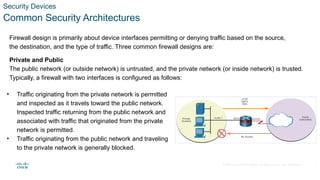
Private and Public
The public network (or outside network) is untrusted, and the private network (or inside network) is trusted.
Typically, a firewall with two interfaces is configured as follows:
• Traffic originating from the private network is permitted
and inspected as it travels toward the public network.
Inspected traffic returning from the public network and
associated with traffic that originated from the private
network is permitted.
• Traffic originating from the public network and traveling
to the private network is generally blocked.
7
© 2020 Cisco and/or its affiliates. All rights reserved. Cisco Confidential
Security Devices
Common Security Architectures (Cont.)
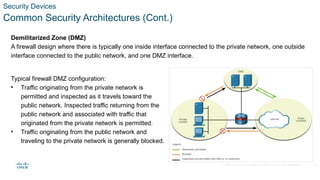
Demilitarized Zone (DMZ)
A firewall design where there is typically one inside interface connected to the private network, one outside
interface connected to the public network, and one DMZ interface.
Typical firewall DMZ configuration:
• Traffic originating from the private network is
permitted and inspected as it travels toward the
public network. Inspected traffic returning from the
public network and associated with traffic that
originated from the private network is permitted.
• Traffic originating from the public network and
traveling to the private network is generally blocked.
8
© 2020 Cisco and/or its affiliates. All rights reserved. Cisco Confidential
Security Devices
Common Security Architectures (Cont.)
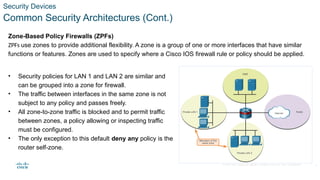
Zone-Based Policy Firewalls (ZPFs)
ZPFs use zones to provide additional flexibility. A zone is a group of one or more interfaces that have similar
functions or features. Zones are used to specify where a Cisco IOS firewall rule or policy should be applied.
• Security policies for LAN 1 and LAN 2 are similar and
can be grouped into a zone for firewall.
• The traffic between interfaces in the same zone is not
subject to any policy and passes freely.
• All zone-to-zone traffic is blocked and to permit traffic
between zones, a policy allowing or inspecting traffic
must be configured.
• The only exception to this default deny any policy is the
router self-zone.
9
© 2020 Cisco and/or its affiliates. All rights reserved. Cisco Confidential
Security Devices
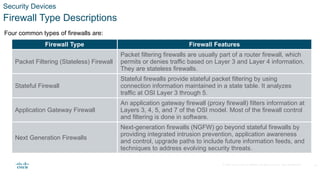
Firewall Type Descriptions
Four common types of firewalls are:
Firewall Type Firewall Features
Packet Filtering (Stateless) Firewall
Packet filtering firewalls are usually part of a router firewall, which
permits or denies traffic based on Layer 3 and Layer 4 information.
They are stateless firewalls.
Stateful Firewall
Stateful firewalls provide stateful packet filtering by using
connection information maintained in a state table. It analyzes
traffic at OSI Layer 3 through 5.
Application Gateway Firewall
An application gateway firewall (proxy firewall) filters information at
Layers 3, 4, 5, and 7 of the OSI model. Most of the firewall control
and filtering is done in software.
Next Generation Firewalls
Next-generation firewalls (NGFW) go beyond stateful firewalls by
providing integrated intrusion prevention, application awareness
and control, upgrade paths to include future information feeds, and
techniques to address evolving security threats.
10
© 2020 Cisco and/or its affiliates. All rights reserved. Cisco Confidential
Security Devices
Firewall Type Descriptions (Cont.)
Other methods of implementing firewalls include:
• Host-based (server and personal) firewall - A PC or server with firewall software running on it.
• Transparent firewall - Filters IP traffic between a pair of bridged interfaces.
• Hybrid firewall - A combination of the various firewall types.
11
© 2020 Cisco and/or its affiliates. All rights reserved. Cisco Confidential
Security Devices
Intrusion Prevention and Detection Devices
Common Characteristics of intrusion detection system (IDS) and intrusion prevention system (IPS):
• Both technologies are deployed as sensors in the form of several different devices:
• A router configured with Cisco IOS IPS software
• A device specifically designed to provide dedicated IDS or IPS services
• A network module installed in an adaptive security appliance (ASA), switch, or router
• Both technologies use signatures to detect patterns of misuse in network traffic. A signature is a set of
rules that an IDS or IPS uses to detect malicious activity.
• Both can detect atomic patterns (single-packet) or composite patterns (multi-packet).
12
© 2020 Cisco and/or its affiliates. All rights reserved. Cisco Confidential
Security Devices
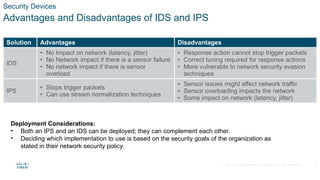
Advantages and Disadvantages of IDS and IPS
Solution Advantages Disadvantages
IDS
• No Impact on network (latency, jitter)
• No Network impact if there is a sensor failure
• No network impact if there is sensor
overload
• Response action cannot stop trigger packets
• Correct tuning required for response actions
• More vulnerable to network security evasion
techniques
IPS
• Stops trigger packets
• Can use stream normalization techniques
• Sensor issues might affect network traffic
• Sensor overloading impacts the network
• Some impact on network (latency, jitter)
Deployment Considerations:
• Both an IPS and an IDS can be deployed; they can complement each other.
• Deciding which implementation to use is based on the security goals of the organization as
stated in their network security policy.
13
© 2020 Cisco and/or its affiliates. All rights reserved. Cisco Confidential
Security Devices
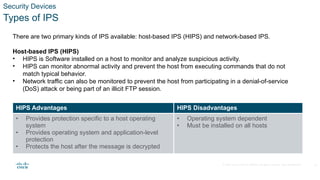
Types of IPS
There are two primary kinds of IPS available: host-based IPS (HIPS) and network-based IPS.
Host-based IPS (HIPS)
• HIPS is Software installed on a host to monitor and analyze suspicious activity.
• HIPS can monitor abnormal activity and prevent the host from executing commands that do not
match typical behavior.
• Network traffic can also be monitored to prevent the host from participating in a denial-of-service
(DoS) attack or being part of an illicit FTP session.
HIPS Advantages HIPS Disadvantages
• Provides protection specific to a host operating
system
• Provides operating system and application-level
protection
• Protects the host after the message is decrypted
• Operating system dependent
• Must be installed on all hosts
14
© 2020 Cisco and/or its affiliates. All rights reserved. Cisco Confidential
Security Devices
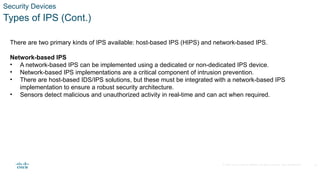
Types of IPS (Cont.)
There are two primary kinds of IPS available: host-based IPS (HIPS) and network-based IPS.
Network-based IPS
• A network-based IPS can be implemented using a dedicated or non-dedicated IPS device.
• Network-based IPS implementations are a critical component of intrusion prevention.
• There are host-based IDS/IPS solutions, but these must be integrated with a network-based IPS
implementation to ensure a robust security architecture.
• Sensors detect malicious and unauthorized activity in real-time and can act when required.
15
© 2020 Cisco and/or its affiliates. All rights reserved. Cisco Confidential
Security Devices
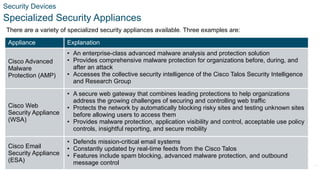
Specialized Security Appliances
There are a variety of specialized security appliances available. Three examples are:
Appliance Explanation
Cisco Advanced
Malware
Protection (AMP)
• An enterprise-class advanced malware analysis and protection solution
• Provides comprehensive malware protection for organizations before, during, and
after an attack
• Accesses the collective security intelligence of the Cisco Talos Security Intelligence
and Research Group
Cisco Web
Security Appliance
(WSA)
• A secure web gateway that combines leading protections to help organizations
address the growing challenges of securing and controlling web traffic
• Protects the network by automatically blocking risky sites and testing unknown sites
before allowing users to access them
• Provides malware protection, application visibility and control, acceptable use policy
controls, insightful reporting, and secure mobility
Cisco Email
Security Appliance
(ESA)
• Defends mission-critical email systems
• Constantly updated by real-time feeds from the Cisco Talos
• Features include spam blocking, advanced malware protection, and outbound
message control 16
© 2020 Cisco and/or its affiliates. All rights reserved. Cisco Confidential
6.2 Security Services
17
© 2020 Cisco and/or its affiliates. All rights reserved. Cisco Confidential
Security Services
Traffic Control with ACLs
An Access Control List (ACL) is a series of commands that control whether a device forwards or
drops packets based on information found in the packet header. ACLs perform the following tasks:
• They limit network traffic to increase network performance.
• They provide traffic flow control.
• They provide a basic level of security for network access.
• They filter traffic based on traffic type
• They screen hosts to permit or deny access to network services.
In addition to either permitting or denying traffic, ACLs can be used for selecting types of traffic to be
analyzed, forwarded, or processed in other ways.
18
© 2020 Cisco and/or its affiliates. All rights reserved. Cisco Confidential
Security Services
ACLs: Important Features
Two types of Cisco IPv4 ACLs are standard and extended.
Standard ACLs can be used to permit or deny traffic only from source IPv4 addresses. The
destination of the packet and the ports involved are not evaluated.
Extended ACLs filter IPv4 packets based on several attributes that include:
• Protocol type
• Source IPv4 address
• Destination IPv4 address
• Source TCP or UDP ports
• Destination TCP or UDP ports
• Optional protocol type information for finer control
19
© 2020 Cisco and/or its affiliates. All rights reserved. Cisco Confidential
Security Services
ACLs: Important Features (Cont.)
• Standard and extended ACLs can be created using either a number or a name to identify the ACL
and its list of statements.
• By configuring ACL logging, an ACL message can be generated and logged when traffic meets the
permit or deny criteria defined in the ACL.
• Cisco ACLs can also be configured to only allow TCP traffic that has an ACK or RST bit set, so
that only traffic from an established TCP session is permitted. This can be used to deny any TCP
traffic from outside the network that is trying to establish a new TCP session.
20
© 2020 Cisco and/or its affiliates. All rights reserved. Cisco Confidential
Security Services
Packet Tracer - ACL Demonstration
In this Packet Tracer activity, you will complete the following objectives:
• Part 1: Verify Local Connectivity and Test Access Control List
• Part 2: Remove Access Control List and Repeat Test
21
© 2020 Cisco and/or its affiliates. All rights reserved. Cisco Confidential
Security Services
SNMP
• Simple Network Management Protocol (SNMP) allows administrators to manage end devices
such as servers, workstations, routers, switches, and security appliances, on an IP network.
• It enables network administrators to monitor and manage network performance, find and solve
network problems, and plan for network growth.
• The SNMP system consists of two elements:
• SNMP manager that runs SNMP management software
• SNMP agents which are the nodes being monitored and managed
• The Management Information Base (MIB) is a database on the agents that stores data and
operational statistics about the device.
• The SNMP manager is part of a network management system (NMS).
• The SNMP manager can collect information from an SNMP agent by using the “get” action and
can change configurations on an agent by using the “set” action.
• In addition, SNMP agents can forward information directly to a network manager by using “traps”.
22
© 2020 Cisco and/or its affiliates. All rights reserved. Cisco Confidential
Security Services
NetFlow
• A Cisco IOS technology that provides statistics on packets flowing through a Cisco router or
multilayer switch.
• NetFlow provides data to enable network and security monitoring, network planning, traffic
analysis to include identification of network bottlenecks, and IP accounting for billing purposes.
• NetFlow technology distinguishes packet flows using a combination of seven fields:
• Source IP address
• Destination IP address
• Source port number
• Destination port number
• Layer 3 protocol type
• Type of Service (ToS) marking
• Input logical interface
23
© 2020 Cisco and/or its affiliates. All rights reserved. Cisco Confidential
Security Services
Port Mirroring
• Packet analyzer (packet sniffer or traffic sniffer) limitation - because network switches can
isolate traffic, traffic sniffers or other network monitors, such as IDS, cannot access all the traffic
on a network segment.
• Port mirroring is a feature that allows a switch to make duplicate copies of traffic passing through
a switch, and then send it out a port with a network monitor attached. The original traffic is
forwarded in the usual manner.
24
© 2020 Cisco and/or its affiliates. All rights reserved. Cisco Confidential
Security Services
Syslog Servers
• When certain events occur on a network, networking devices have trusted mechanisms to notify
the administrator with detailed system messages.
• Network administrators have a variety of options for storing, interpreting, and displaying these
messages, and for being alerted to those messages.
• Syslog protocol is the most common method of accessing system messages.
• The syslog logging service provides three primary functions:
• The ability to gather logging information for monitoring and troubleshooting
• The ability to select the type of logging information that is captured
• The ability to specify the destination of captured syslog messages
25
© 2020 Cisco and/or its affiliates. All rights reserved. Cisco Confidential
Security Services
NTP
• Network Time Protocol (NTP) is important to synchronize the time across all devices on the
network. When the time is not synchronized between devices, it will be impossible to determine
the order of the events that have occurred in different parts of the network.
• As a network grows, it becomes difficult to ensure that all infrastructure devices are operating with
synchronized time.
• A solution to keep time setting synchronized is configuring the Network Time Protocol (NTP).
• NTP protocol allows routers on the network to synchronize their time settings with an NTP server.
• A group of NTP clients that obtain time and date information from a single source have more
consistent time settings.
26
© 2020 Cisco and/or its affiliates. All rights reserved. Cisco Confidential
Security Services
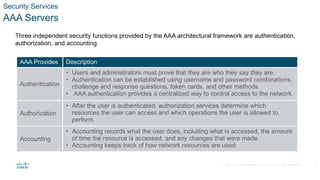
AAA Servers
Three independent security functions provided by the AAA architectural framework are authentication,
authorization, and accounting.
AAA Provides Description
Authentication
• Users and administrators must prove that they are who they say they are.
• Authentication can be established using username and password combinations,
challenge and response questions, token cards, and other methods.
• AAA authentication provides a centralized way to control access to the network.
Authorization
• After the user is authenticated, authorization services determine which
resources the user can access and which operations the user is allowed to
perform.
Accounting
• Accounting records what the user does, including what is accessed, the amount
of time the resource is accessed, and any changes that were made.
• Accounting keeps track of how network resources are used.
27
© 2020 Cisco and/or its affiliates. All rights reserved. Cisco Confidential
Security Services
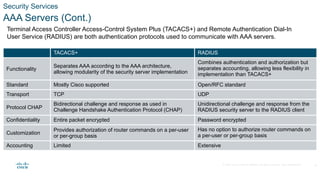
AAA Servers (Cont.)
Terminal Access Controller Access-Control System Plus (TACACS+) and Remote Authentication Dial-In
User Service (RADIUS) are both authentication protocols used to communicate with AAA servers.
TACACS+ RADIUS
Functionality
Separates AAA according to the AAA architecture,
allowing modularity of the security server implementation
Combines authentication and authorization but
separates accounting, allowing less flexibility in
implementation than TACACS+
Standard Mostly Cisco supported Open/RFC standard
Transport TCP UDP
Protocol CHAP
Bidirectional challenge and response as used in
Challenge Handshake Authentication Protocol (CHAP)
Unidirectional challenge and response from the
RADIUS security server to the RADIUS client
Confidentiality Entire packet encrypted Password encrypted
Customization
Provides authorization of router commands on a per-user
or per-group basis
Has no option to authorize router commands on
a per-user or per-group basis
Accounting Limited Extensive
28
© 2020 Cisco and/or its affiliates. All rights reserved. Cisco Confidential
Security Services
VPN
• A virtual private network (VPN) is a private network that is created over a public network, usually
the internet. VPN uses virtual connections that are routed through the internet from the
organization to the remote site.
• A VPN connects two endpoints, such as a remote office to a central office, over a public network,
to form a logical connection. The logical connections can be made at either Layer 2 or Layer 3.
• A VPN is private in that the traffic is encrypted to keep the data confidential while it is transported
across the public network.
• Common examples of Layer 3 VPNs are GRE, Multiprotocol Label Switching (MPLS), and IPsec.
• Layer 3 VPNs can be point-to-point site connections, such as GRE and IPsec, or they can
establish any-to-any connectivity to many sites using MPLS.
• VPNs are commonly deployed in a site-to-site topology to securely connect central sites with
remote locations. They are also deployed in a remote-access topology to provide secure remote
access to external users travelling or working from home.
29

Endpoint Security - Network Security Infrastructure

  • 1.
    Module 6: Network SecurityInfrastructure Endpoint Security (ESec)
  • 2.
    © 2020 Ciscoand/or its affiliates. All rights reserved. Cisco Confidential Module Objectives Module Title: Network Security Infrastructure Module Objective: Explain how devices and services are used to enhance network security. Topic Title Topic Objective Security Devices Explain how specialized devices are used to enhance network security. Security Services Explain how network services enhance network security. 2
  • 3.
    © 2020 Ciscoand/or its affiliates. All rights reserved. Cisco Confidential 6.1 Security Devices 3
  • 4.
    © 2020 Ciscoand/or its affiliates. All rights reserved. Cisco Confidential 4
  • 5.
    © 2020 Ciscoand/or its affiliates. All rights reserved. Cisco Confidential Security Devices Firewalls A firewall is a system, or group of systems, that enforces an access control policy between networks. Common Firewall Properties: • Firewalls are resistant to network attacks. • Firewalls are the only transit point between internal corporate networks and external networks because all traffic flows through the firewall. • Firewalls enforce the access control policy. Firewall Benefits: • They prevent the exposure of sensitive hosts, resources, and applications to untrusted users. • They sanitize protocol flow, which prevents the exploitation of protocol flaws. • They block malicious data from servers and clients. • They reduce security management complexity by off-loading most of the network access control to a few firewalls in the network. 5
  • 6.
    © 2020 Ciscoand/or its affiliates. All rights reserved. Cisco Confidential Security Devices Firewalls (Cont.) A firewall is a system, or group of systems, that enforces an access control policy between networks. Firewall Limitations: • A misconfigured firewall can have serious consequences for the network, such as becoming a single point of failure. • The data from many applications cannot be passed over firewalls securely. • Users might proactively search for ways around the firewall to receive blocked material, which exposes the network to potential attack. • Network performance can slow down. • Unauthorized traffic can be tunneled or hidden as legitimate traffic through the firewall. 6
  • 7.
    © 2020 Ciscoand/or its affiliates. All rights reserved. Cisco Confidential Security Devices Common Security Architectures Firewall design is primarily about device interfaces permitting or denying traffic based on the source, the destination, and the type of traffic. Three common firewall designs are: Private and Public The public network (or outside network) is untrusted, and the private network (or inside network) is trusted. Typically, a firewall with two interfaces is configured as follows: • Traffic originating from the private network is permitted and inspected as it travels toward the public network. Inspected traffic returning from the public network and associated with traffic that originated from the private network is permitted. • Traffic originating from the public network and traveling to the private network is generally blocked. 7
  • 8.
    © 2020 Ciscoand/or its affiliates. All rights reserved. Cisco Confidential Security Devices Common Security Architectures (Cont.) Demilitarized Zone (DMZ) A firewall design where there is typically one inside interface connected to the private network, one outside interface connected to the public network, and one DMZ interface. Typical firewall DMZ configuration: • Traffic originating from the private network is permitted and inspected as it travels toward the public network. Inspected traffic returning from the public network and associated with traffic that originated from the private network is permitted. • Traffic originating from the public network and traveling to the private network is generally blocked. 8
  • 9.
    © 2020 Ciscoand/or its affiliates. All rights reserved. Cisco Confidential Security Devices Common Security Architectures (Cont.) Zone-Based Policy Firewalls (ZPFs) ZPFs use zones to provide additional flexibility. A zone is a group of one or more interfaces that have similar functions or features. Zones are used to specify where a Cisco IOS firewall rule or policy should be applied. • Security policies for LAN 1 and LAN 2 are similar and can be grouped into a zone for firewall. • The traffic between interfaces in the same zone is not subject to any policy and passes freely. • All zone-to-zone traffic is blocked and to permit traffic between zones, a policy allowing or inspecting traffic must be configured. • The only exception to this default deny any policy is the router self-zone. 9
  • 10.
    © 2020 Ciscoand/or its affiliates. All rights reserved. Cisco Confidential Security Devices Firewall Type Descriptions Four common types of firewalls are: Firewall Type Firewall Features Packet Filtering (Stateless) Firewall Packet filtering firewalls are usually part of a router firewall, which permits or denies traffic based on Layer 3 and Layer 4 information. They are stateless firewalls. Stateful Firewall Stateful firewalls provide stateful packet filtering by using connection information maintained in a state table. It analyzes traffic at OSI Layer 3 through 5. Application Gateway Firewall An application gateway firewall (proxy firewall) filters information at Layers 3, 4, 5, and 7 of the OSI model. Most of the firewall control and filtering is done in software. Next Generation Firewalls Next-generation firewalls (NGFW) go beyond stateful firewalls by providing integrated intrusion prevention, application awareness and control, upgrade paths to include future information feeds, and techniques to address evolving security threats. 10
  • 11.
    © 2020 Ciscoand/or its affiliates. All rights reserved. Cisco Confidential Security Devices Firewall Type Descriptions (Cont.) Other methods of implementing firewalls include: • Host-based (server and personal) firewall - A PC or server with firewall software running on it. • Transparent firewall - Filters IP traffic between a pair of bridged interfaces. • Hybrid firewall - A combination of the various firewall types. 11
  • 12.
    © 2020 Ciscoand/or its affiliates. All rights reserved. Cisco Confidential Security Devices Intrusion Prevention and Detection Devices Common Characteristics of intrusion detection system (IDS) and intrusion prevention system (IPS): • Both technologies are deployed as sensors in the form of several different devices: • A router configured with Cisco IOS IPS software • A device specifically designed to provide dedicated IDS or IPS services • A network module installed in an adaptive security appliance (ASA), switch, or router • Both technologies use signatures to detect patterns of misuse in network traffic. A signature is a set of rules that an IDS or IPS uses to detect malicious activity. • Both can detect atomic patterns (single-packet) or composite patterns (multi-packet). 12
  • 13.
    © 2020 Ciscoand/or its affiliates. All rights reserved. Cisco Confidential Security Devices Advantages and Disadvantages of IDS and IPS Solution Advantages Disadvantages IDS • No Impact on network (latency, jitter) • No Network impact if there is a sensor failure • No network impact if there is sensor overload • Response action cannot stop trigger packets • Correct tuning required for response actions • More vulnerable to network security evasion techniques IPS • Stops trigger packets • Can use stream normalization techniques • Sensor issues might affect network traffic • Sensor overloading impacts the network • Some impact on network (latency, jitter) Deployment Considerations: • Both an IPS and an IDS can be deployed; they can complement each other. • Deciding which implementation to use is based on the security goals of the organization as stated in their network security policy. 13
  • 14.
    © 2020 Ciscoand/or its affiliates. All rights reserved. Cisco Confidential Security Devices Types of IPS There are two primary kinds of IPS available: host-based IPS (HIPS) and network-based IPS. Host-based IPS (HIPS) • HIPS is Software installed on a host to monitor and analyze suspicious activity. • HIPS can monitor abnormal activity and prevent the host from executing commands that do not match typical behavior. • Network traffic can also be monitored to prevent the host from participating in a denial-of-service (DoS) attack or being part of an illicit FTP session. HIPS Advantages HIPS Disadvantages • Provides protection specific to a host operating system • Provides operating system and application-level protection • Protects the host after the message is decrypted • Operating system dependent • Must be installed on all hosts 14
  • 15.
    © 2020 Ciscoand/or its affiliates. All rights reserved. Cisco Confidential Security Devices Types of IPS (Cont.) There are two primary kinds of IPS available: host-based IPS (HIPS) and network-based IPS. Network-based IPS • A network-based IPS can be implemented using a dedicated or non-dedicated IPS device. • Network-based IPS implementations are a critical component of intrusion prevention. • There are host-based IDS/IPS solutions, but these must be integrated with a network-based IPS implementation to ensure a robust security architecture. • Sensors detect malicious and unauthorized activity in real-time and can act when required. 15
  • 16.
    © 2020 Ciscoand/or its affiliates. All rights reserved. Cisco Confidential Security Devices Specialized Security Appliances There are a variety of specialized security appliances available. Three examples are: Appliance Explanation Cisco Advanced Malware Protection (AMP) • An enterprise-class advanced malware analysis and protection solution • Provides comprehensive malware protection for organizations before, during, and after an attack • Accesses the collective security intelligence of the Cisco Talos Security Intelligence and Research Group Cisco Web Security Appliance (WSA) • A secure web gateway that combines leading protections to help organizations address the growing challenges of securing and controlling web traffic • Protects the network by automatically blocking risky sites and testing unknown sites before allowing users to access them • Provides malware protection, application visibility and control, acceptable use policy controls, insightful reporting, and secure mobility Cisco Email Security Appliance (ESA) • Defends mission-critical email systems • Constantly updated by real-time feeds from the Cisco Talos • Features include spam blocking, advanced malware protection, and outbound message control 16
  • 17.
    © 2020 Ciscoand/or its affiliates. All rights reserved. Cisco Confidential 6.2 Security Services 17
  • 18.
    © 2020 Ciscoand/or its affiliates. All rights reserved. Cisco Confidential Security Services Traffic Control with ACLs An Access Control List (ACL) is a series of commands that control whether a device forwards or drops packets based on information found in the packet header. ACLs perform the following tasks: • They limit network traffic to increase network performance. • They provide traffic flow control. • They provide a basic level of security for network access. • They filter traffic based on traffic type • They screen hosts to permit or deny access to network services. In addition to either permitting or denying traffic, ACLs can be used for selecting types of traffic to be analyzed, forwarded, or processed in other ways. 18
  • 19.
    © 2020 Ciscoand/or its affiliates. All rights reserved. Cisco Confidential Security Services ACLs: Important Features Two types of Cisco IPv4 ACLs are standard and extended. Standard ACLs can be used to permit or deny traffic only from source IPv4 addresses. The destination of the packet and the ports involved are not evaluated. Extended ACLs filter IPv4 packets based on several attributes that include: • Protocol type • Source IPv4 address • Destination IPv4 address • Source TCP or UDP ports • Destination TCP or UDP ports • Optional protocol type information for finer control 19
  • 20.
    © 2020 Ciscoand/or its affiliates. All rights reserved. Cisco Confidential Security Services ACLs: Important Features (Cont.) • Standard and extended ACLs can be created using either a number or a name to identify the ACL and its list of statements. • By configuring ACL logging, an ACL message can be generated and logged when traffic meets the permit or deny criteria defined in the ACL. • Cisco ACLs can also be configured to only allow TCP traffic that has an ACK or RST bit set, so that only traffic from an established TCP session is permitted. This can be used to deny any TCP traffic from outside the network that is trying to establish a new TCP session. 20
  • 21.
    © 2020 Ciscoand/or its affiliates. All rights reserved. Cisco Confidential Security Services Packet Tracer - ACL Demonstration In this Packet Tracer activity, you will complete the following objectives: • Part 1: Verify Local Connectivity and Test Access Control List • Part 2: Remove Access Control List and Repeat Test 21
  • 22.
    © 2020 Ciscoand/or its affiliates. All rights reserved. Cisco Confidential Security Services SNMP • Simple Network Management Protocol (SNMP) allows administrators to manage end devices such as servers, workstations, routers, switches, and security appliances, on an IP network. • It enables network administrators to monitor and manage network performance, find and solve network problems, and plan for network growth. • The SNMP system consists of two elements: • SNMP manager that runs SNMP management software • SNMP agents which are the nodes being monitored and managed • The Management Information Base (MIB) is a database on the agents that stores data and operational statistics about the device. • The SNMP manager is part of a network management system (NMS). • The SNMP manager can collect information from an SNMP agent by using the “get” action and can change configurations on an agent by using the “set” action. • In addition, SNMP agents can forward information directly to a network manager by using “traps”. 22
  • 23.
    © 2020 Ciscoand/or its affiliates. All rights reserved. Cisco Confidential Security Services NetFlow • A Cisco IOS technology that provides statistics on packets flowing through a Cisco router or multilayer switch. • NetFlow provides data to enable network and security monitoring, network planning, traffic analysis to include identification of network bottlenecks, and IP accounting for billing purposes. • NetFlow technology distinguishes packet flows using a combination of seven fields: • Source IP address • Destination IP address • Source port number • Destination port number • Layer 3 protocol type • Type of Service (ToS) marking • Input logical interface 23
  • 24.
    © 2020 Ciscoand/or its affiliates. All rights reserved. Cisco Confidential Security Services Port Mirroring • Packet analyzer (packet sniffer or traffic sniffer) limitation - because network switches can isolate traffic, traffic sniffers or other network monitors, such as IDS, cannot access all the traffic on a network segment. • Port mirroring is a feature that allows a switch to make duplicate copies of traffic passing through a switch, and then send it out a port with a network monitor attached. The original traffic is forwarded in the usual manner. 24
  • 25.
    © 2020 Ciscoand/or its affiliates. All rights reserved. Cisco Confidential Security Services Syslog Servers • When certain events occur on a network, networking devices have trusted mechanisms to notify the administrator with detailed system messages. • Network administrators have a variety of options for storing, interpreting, and displaying these messages, and for being alerted to those messages. • Syslog protocol is the most common method of accessing system messages. • The syslog logging service provides three primary functions: • The ability to gather logging information for monitoring and troubleshooting • The ability to select the type of logging information that is captured • The ability to specify the destination of captured syslog messages 25
  • 26.
    © 2020 Ciscoand/or its affiliates. All rights reserved. Cisco Confidential Security Services NTP • Network Time Protocol (NTP) is important to synchronize the time across all devices on the network. When the time is not synchronized between devices, it will be impossible to determine the order of the events that have occurred in different parts of the network. • As a network grows, it becomes difficult to ensure that all infrastructure devices are operating with synchronized time. • A solution to keep time setting synchronized is configuring the Network Time Protocol (NTP). • NTP protocol allows routers on the network to synchronize their time settings with an NTP server. • A group of NTP clients that obtain time and date information from a single source have more consistent time settings. 26
  • 27.
    © 2020 Ciscoand/or its affiliates. All rights reserved. Cisco Confidential Security Services AAA Servers Three independent security functions provided by the AAA architectural framework are authentication, authorization, and accounting. AAA Provides Description Authentication • Users and administrators must prove that they are who they say they are. • Authentication can be established using username and password combinations, challenge and response questions, token cards, and other methods. • AAA authentication provides a centralized way to control access to the network. Authorization • After the user is authenticated, authorization services determine which resources the user can access and which operations the user is allowed to perform. Accounting • Accounting records what the user does, including what is accessed, the amount of time the resource is accessed, and any changes that were made. • Accounting keeps track of how network resources are used. 27
  • 28.
    © 2020 Ciscoand/or its affiliates. All rights reserved. Cisco Confidential Security Services AAA Servers (Cont.) Terminal Access Controller Access-Control System Plus (TACACS+) and Remote Authentication Dial-In User Service (RADIUS) are both authentication protocols used to communicate with AAA servers. TACACS+ RADIUS Functionality Separates AAA according to the AAA architecture, allowing modularity of the security server implementation Combines authentication and authorization but separates accounting, allowing less flexibility in implementation than TACACS+ Standard Mostly Cisco supported Open/RFC standard Transport TCP UDP Protocol CHAP Bidirectional challenge and response as used in Challenge Handshake Authentication Protocol (CHAP) Unidirectional challenge and response from the RADIUS security server to the RADIUS client Confidentiality Entire packet encrypted Password encrypted Customization Provides authorization of router commands on a per-user or per-group basis Has no option to authorize router commands on a per-user or per-group basis Accounting Limited Extensive 28
  • 29.
    © 2020 Ciscoand/or its affiliates. All rights reserved. Cisco Confidential Security Services VPN • A virtual private network (VPN) is a private network that is created over a public network, usually the internet. VPN uses virtual connections that are routed through the internet from the organization to the remote site. • A VPN connects two endpoints, such as a remote office to a central office, over a public network, to form a logical connection. The logical connections can be made at either Layer 2 or Layer 3. • A VPN is private in that the traffic is encrypted to keep the data confidential while it is transported across the public network. • Common examples of Layer 3 VPNs are GRE, Multiprotocol Label Switching (MPLS), and IPsec. • Layer 3 VPNs can be point-to-point site connections, such as GRE and IPsec, or they can establish any-to-any connectivity to many sites using MPLS. • VPNs are commonly deployed in a site-to-site topology to securely connect central sites with remote locations. They are also deployed in a remote-access topology to provide secure remote access to external users travelling or working from home. 29

Editor's Notes

  • #1 Endpoint Security (ESec) Module 6: Network Security Infrastructure
  • #3 6: Network Security Infrastructure 6.1: Security Devices
  • #4 6: Network Security Infrastructure 6.1: Security Devices
  • #5 6: Network Security Infrastructure 6.1: Security Devices 6.1.2: Firewalls
  • #6 6: Network Security Infrastructure 6.1: Security Devices 6.1.2: Firewalls 6.1.2: Firewalls (Cont.)
  • #7 6: Network Security Infrastructure 6.1: Security Devices 6.1.3: Common Security Architectures
  • #8 6: Network Security Infrastructure 6.1: Security Devices 6.1.3: Common Security Architectures 6.1.3: Common Security Architectures (Cont.)
  • #9 6: Network Security Infrastructure 6.1: Security Devices 6.1.3: Common Security Architectures 6.1.3: Common Security Architectures (Cont.)
  • #10 6: Network Security Infrastructure 6.1: Security Devices 6.1.4: Firewall Type Descriptions
  • #11 6: Network Security Infrastructure 6.1: Security Devices 6.1.4: Firewall Type Descriptions (Cont.) 6.1.5: Activity - Check Your Understanding - Identify the Type of Firewall
  • #12 6: Network Security Infrastructure 6.1: Security Devices 6.1.6: Intrusion Prevention and Detection Devices
  • #13 6: Network Security Infrastructure 6.1: Security Devices 6.1.7: Advantages and Disadvantages of IDS and IPS
  • #14 6: Network Security Infrastructure 6.1: Security Devices 6.1.8: Types of IPS
  • #15 6: Network Security Infrastructure 6.1: Security Devices 6.1.8: Types of IPS (Cont.)
  • #16 6: Network Security Infrastructure 6.1: Security Devices 6.1.9: Specialized Security Appliances 6.1.10: Check Your Understanding - Compare IDS and IPS Characteristics
  • #17 6: Network Security Infrastructure 6.2: Security Services
  • #18 6: Network Security Infrastructure 6.2: Security Services 6.2.2: Traffic Control with ACLs
  • #19 6: Network Security Infrastructure 6.2: Security Services 6.2.3: ACLs: Important Features
  • #20 6: Network Security Infrastructure 6.2: Security Services 6.2.3: ACLs: Important Features (Cont.)
  • #21 6: Network Security Infrastructure 6.2: Security Services 6.2.4: Packet Tracer - ACL Demonstration
  • #22 6: Network Security Infrastructure 6.2: Security Services 6.2.5: SNMP
  • #23 NetFlow is a network protocol developed by Cisco for collecting and monitoring network traffic data. It provides detailed information about network traffic, which can help in traffic analysis, performance monitoring, and security threat detection.
  • #24 6: Network Security Infrastructure 6.2: Security Services 6.2.7: Port Mirroring
  • #25 6: Network Security Infrastructure 6.2: Security Services 6.2.8: Syslog Servers
  • #26 6: Network Security Infrastructure 6.2: Security Services 6.2.9: NTP
  • #27 AAA (Authentication, Authorization, and Accounting) servers are a framework used to manage and control access to computer resources, enforce policies, and track usage in network environments. These servers provide a centralized way to authenticate users, determine what resources they can access, and log their activities for auditing and billing purposes.
  • #28 6: Network Security Infrastructure 6.2: Security Services 6.2.10: AAA Servers (Cont.)
  • #29 6: Network Security Infrastructure 6.2: Security Services 6.2.11: VPN 6.2.12: Check Your Understanding - Network Security Infrastructure