Text
Encryption and Decryption
Developed By:
Shashi Kr. Singh (1150986)
Sandeep Prasad (1150980)
Sumit Kumar (1150994)
Rishabh Anand (1150967)
Submitted To:
Rupinder Kaur Gurm
Department of Computer Science
RIMT-Institute of Engineering & Technology
Punjab ( India.)
Table of Content
1. Introduction
2. Text Encryption
3. Text Decryption
4. Feasibility-Study
5. Methodology
6. Purpose of Project
7. System Requirements
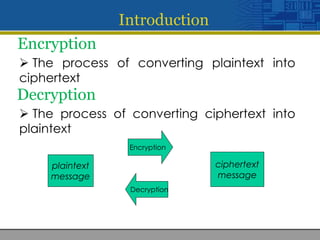
 The process of converting plaintext into
ciphertext
 The process of converting ciphertext into
plaintext
Introduction
Encryption
plaintext
message
ciphertext
message
Encryption
Decryption
Decryption
• Encryption is a process whereby
plaintext is converted into or ciphertext.
Encryption
Plaintext X Ciphertext Y
Key K
Text Encryption
 The original unaltered contents of the
message or text is called plaintext.
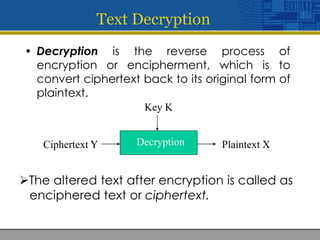
• Decryption is the reverse process of
encryption or encipherment, which is to
convert ciphertext back to its original form of
plaintext.
Decryption
Ciphertext Y Plaintext X
Key K
Text Decryption
The altered text after encryption is called as
enciphered text or ciphertext.
• Decryption process needs to use the same key
that is used in the encryption process to obtain
the original plaintext.
• Although one may obtain a copy of the
encrypted message, one must use the correct
key to successfully decrypt the message.
Text Decryption
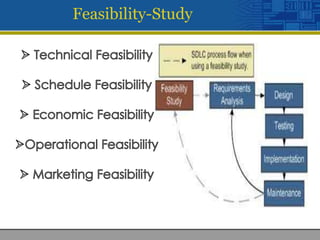
Feasibility-Study
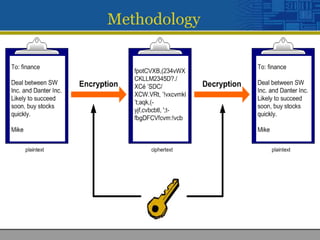
Methodology
Purpose of Project
• Provides security
• File encryption
• Communication encryption
• Network traffic encryption
• Password manager
• Single sign-on
System Requirements
• Turbo C & C++ and Dev-C
• Works on Windows 7, XP, Vista and 8
• Works on 64 bit Windows & 32 bit Windows
• Mac OS X 10.3 and above
Software Requirements
Hardware Requirements
• Intel Pentium 4 or above
• Floppy-Drive
• CD-ROM drive
• 10 GB of free hard-disk
• keyboard and mouse
• RAM(minimum 512 MB)
Friends….
Any Question ?
Encryption and decryption of data using cryptography

Encryption and decryption of data using cryptography

  • 1.
    Text Encryption and Decryption DevelopedBy: Shashi Kr. Singh (1150986) Sandeep Prasad (1150980) Sumit Kumar (1150994) Rishabh Anand (1150967) Submitted To: Rupinder Kaur Gurm Department of Computer Science RIMT-Institute of Engineering & Technology Punjab ( India.)
  • 2.
    Table of Content 1.Introduction 2. Text Encryption 3. Text Decryption 4. Feasibility-Study 5. Methodology 6. Purpose of Project 7. System Requirements
  • 3.
     The processof converting plaintext into ciphertext  The process of converting ciphertext into plaintext Introduction Encryption plaintext message ciphertext message Encryption Decryption Decryption
  • 4.
    • Encryption isa process whereby plaintext is converted into or ciphertext. Encryption Plaintext X Ciphertext Y Key K Text Encryption  The original unaltered contents of the message or text is called plaintext.
  • 5.
    • Decryption isthe reverse process of encryption or encipherment, which is to convert ciphertext back to its original form of plaintext. Decryption Ciphertext Y Plaintext X Key K Text Decryption The altered text after encryption is called as enciphered text or ciphertext.
  • 6.
    • Decryption processneeds to use the same key that is used in the encryption process to obtain the original plaintext. • Although one may obtain a copy of the encrypted message, one must use the correct key to successfully decrypt the message. Text Decryption
  • 7.
  • 8.
  • 9.
    Purpose of Project •Provides security • File encryption • Communication encryption • Network traffic encryption • Password manager • Single sign-on
  • 10.
    System Requirements • TurboC & C++ and Dev-C • Works on Windows 7, XP, Vista and 8 • Works on 64 bit Windows & 32 bit Windows • Mac OS X 10.3 and above Software Requirements Hardware Requirements • Intel Pentium 4 or above • Floppy-Drive • CD-ROM drive • 10 GB of free hard-disk • keyboard and mouse • RAM(minimum 512 MB)
  • 11.