

Understanding Encryption
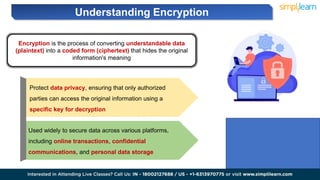
Encryption is the process of converting understandable data
(plaintext) into a coded form (ciphertext) that hides the original
information's meaning
Used widely to secure data across various platforms,
including online transactions, confidential
communications, and personal data storage
Protect data privacy, ensuring that only authorized
parties can access the original information using a
specific key for decryption
Role of Block Ciphers in Digital Security
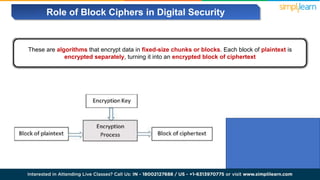
These are algorithms that encrypt data in fixed-size chunks or blocks. Each block of plaintext is
encrypted separately, turning it into an encrypted block of ciphertext
Role of Block Ciphers in Digital Security
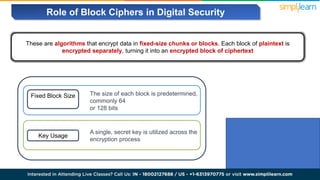
These are algorithms that encrypt data in fixed-size chunks or blocks. Each block of plaintext is
encrypted separately, turning it into an encrypted block of ciphertext
Fixed Block Size
Key Usage
The size of each block is predetermined,
commonly 64
or 128 bits
A single, secret key is utilized across the
encryption process
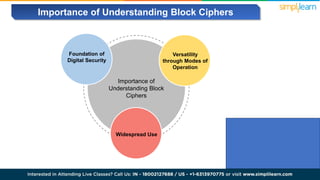
Importance of Understanding Block Ciphers
Importance of
Understanding Block
Ciphers
Widespread Use
Foundation of
Digital Security
Versatility
through Modes of
Operation
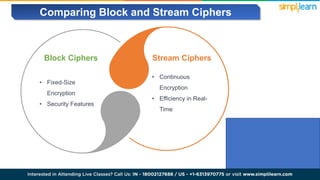
Comparing Block and Stream Ciphers
Block Ciphers
• Fixed-Size
Encryption
• Security Features
Stream Ciphers
• Continuous
Encryption
• Efficiency in Real-
Time
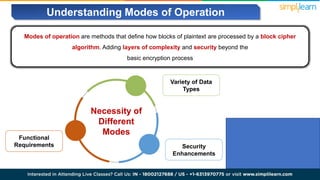
Understanding Modes of Operation
Modes of operation are methods that define how blocks of plaintext are processed by a block cipher
algorithm. Adding layers of complexity and security beyond the
basic encryption process
Security
Enhancements
Variety of Data
Types
Necessity of
Different
Modes
Functional
Requirements
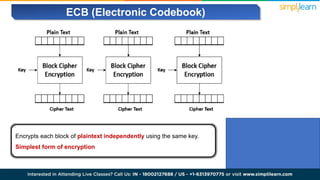
ECB (Electronic Codebook)
Encrypts each block of plaintext independently using the same key.
Simplest form of encryption
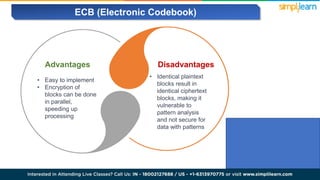
ECB (Electronic Codebook)
Advantages
• Easy to implement
• Encryption of
blocks can be done
in parallel,
speeding up
processing
Disadvantages
• Identical plaintext
blocks result in
identical ciphertext
blocks, making it
vulnerable to
pattern analysis
and not secure for
data with patterns
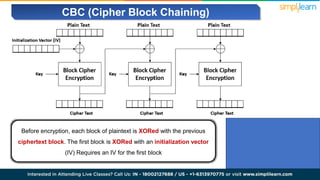
CBC (Cipher Block Chaining)
Before encryption, each block of plaintext is XORed with the previous
ciphertext block. The first block is XORed with an initialization vector
(IV) Requires an IV for the first block
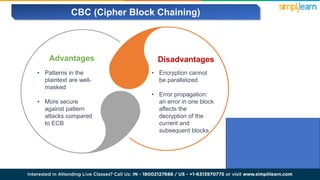
CBC (Cipher Block Chaining)
Advantages
• Patterns in the
plaintext are well-
masked
• More secure
against pattern
attacks compared
to ECB
Disadvantages
• Encryption cannot
be parallelized
• Error propagation:
an error in one block
affects the
decryption of the
current and
subsequent blocks
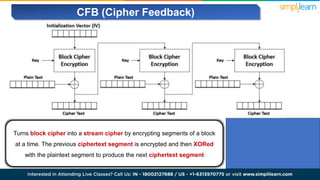
CFB (Cipher Feedback)
Turns block cipher into a stream cipher by encrypting segments of a block
at a time. The previous ciphertext segment is encrypted and then XORed
with the plaintext segment to produce the next ciphertext segment
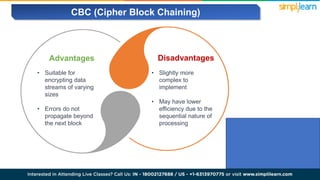
CBC (Cipher Block Chaining)
Advantages
• Suitable for
encrypting data
streams of varying
sizes
• Errors do not
propagate beyond
the next block
Disadvantages
• Slightly more
complex to
implement
• May have lower
efficiency due to the
sequential nature of
processing
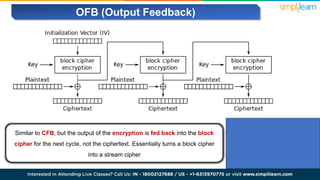
OFB (Output Feedback)
Similar to CFB, but the output of the encryption is fed back into the block
cipher for the next cycle, not the ciphertext. Essentially turns a block cipher
into a stream cipher
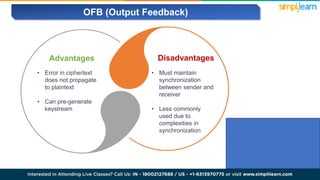
OFB (Output Feedback)
Advantages
• Error in ciphertext
does not propagate
to plaintext
• Can pre-generate
keystream
Disadvantages
• Must maintain
synchronization
between sender and
receiver
• Less commonly
used due to
complexities in
synchronization
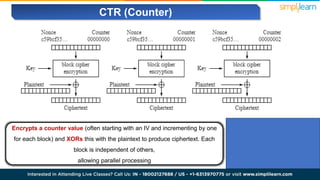
CTR (Counter)
Encrypts a counter value (often starting with an IV and incrementing by one
for each block) and XORs this with the plaintext to produce ciphertext. Each
block is independent of others,
allowing parallel processing
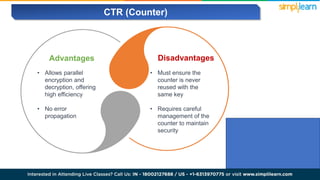
CTR (Counter)
Advantages
• Allows parallel
encryption and
decryption, offering
high efficiency
• No error
propagation
Disadvantages
• Must ensure the
counter is never
reused with the
same key
• Requires careful
management of the
counter to maintain
security
Block Cipher Modes Of Operation | Computer Networking and Security | Simplilearn

Block Cipher Modes Of Operation | Computer Networking and Security | Simplilearn

  • 2.
    Understanding Encryption Encryption isthe process of converting understandable data (plaintext) into a coded form (ciphertext) that hides the original information's meaning Used widely to secure data across various platforms, including online transactions, confidential communications, and personal data storage Protect data privacy, ensuring that only authorized parties can access the original information using a specific key for decryption
  • 3.
    Role of BlockCiphers in Digital Security These are algorithms that encrypt data in fixed-size chunks or blocks. Each block of plaintext is encrypted separately, turning it into an encrypted block of ciphertext
  • 4.
    Role of BlockCiphers in Digital Security These are algorithms that encrypt data in fixed-size chunks or blocks. Each block of plaintext is encrypted separately, turning it into an encrypted block of ciphertext Fixed Block Size Key Usage The size of each block is predetermined, commonly 64 or 128 bits A single, secret key is utilized across the encryption process
  • 5.
    Importance of UnderstandingBlock Ciphers Importance of Understanding Block Ciphers Widespread Use Foundation of Digital Security Versatility through Modes of Operation
  • 6.
    Comparing Block andStream Ciphers Block Ciphers • Fixed-Size Encryption • Security Features Stream Ciphers • Continuous Encryption • Efficiency in Real- Time
  • 7.
    Understanding Modes ofOperation Modes of operation are methods that define how blocks of plaintext are processed by a block cipher algorithm. Adding layers of complexity and security beyond the basic encryption process Security Enhancements Variety of Data Types Necessity of Different Modes Functional Requirements
  • 8.
    ECB (Electronic Codebook) Encryptseach block of plaintext independently using the same key. Simplest form of encryption
  • 9.
    ECB (Electronic Codebook) Advantages •Easy to implement • Encryption of blocks can be done in parallel, speeding up processing Disadvantages • Identical plaintext blocks result in identical ciphertext blocks, making it vulnerable to pattern analysis and not secure for data with patterns
  • 10.
    CBC (Cipher BlockChaining) Before encryption, each block of plaintext is XORed with the previous ciphertext block. The first block is XORed with an initialization vector (IV) Requires an IV for the first block
  • 11.
    CBC (Cipher BlockChaining) Advantages • Patterns in the plaintext are well- masked • More secure against pattern attacks compared to ECB Disadvantages • Encryption cannot be parallelized • Error propagation: an error in one block affects the decryption of the current and subsequent blocks
  • 12.
    CFB (Cipher Feedback) Turnsblock cipher into a stream cipher by encrypting segments of a block at a time. The previous ciphertext segment is encrypted and then XORed with the plaintext segment to produce the next ciphertext segment
  • 13.
    CBC (Cipher BlockChaining) Advantages • Suitable for encrypting data streams of varying sizes • Errors do not propagate beyond the next block Disadvantages • Slightly more complex to implement • May have lower efficiency due to the sequential nature of processing
  • 14.
    OFB (Output Feedback) Similarto CFB, but the output of the encryption is fed back into the block cipher for the next cycle, not the ciphertext. Essentially turns a block cipher into a stream cipher
  • 15.
    OFB (Output Feedback) Advantages •Error in ciphertext does not propagate to plaintext • Can pre-generate keystream Disadvantages • Must maintain synchronization between sender and receiver • Less commonly used due to complexities in synchronization
  • 16.
    CTR (Counter) Encrypts acounter value (often starting with an IV and incrementing by one for each block) and XORs this with the plaintext to produce ciphertext. Each block is independent of others, allowing parallel processing
  • 17.
    CTR (Counter) Advantages • Allowsparallel encryption and decryption, offering high efficiency • No error propagation Disadvantages • Must ensure the counter is never reused with the same key • Requires careful management of the counter to maintain security