ERASMUS-SOCRATES PROGRAM
UNIVERSITY OF PATRAS
Department of Physics
GENERAL INFORMATION AND STRUCTURE OF THE DEPARTMENT
Chairperson :
Professor Vassilios Anastassopoulos
Tel: +302610 996147
Fax: +302610 997456
Email: vassilis@physics.upatras.gr
http://ellab.physics.upatras.gr/Personnel/Faculty/Homepages/Anastasopoulos/vassilis.html
The Secretariat:
Mrs. Dimitra Giannakopoulou
Tel: +302610 996077
Fax: +302610 996089
Degrees Offered:
Undergraduate: 4 year degree (Ptychio)
Graduate : M.Sc., Ph.D.
Description of the Department
The Department of Physics is concerned with the teaching and study of the fundamental
laws and phenomena of nature, from the structure of elementary particles to the structure
of the Universe. In addition, great emphasis is given to the practical importance of
Physics as the foundation of modern technology.
The Department has one of the largest undergraduate student body in the University with
over 1200 undergraduates currently enrolled, as well as about 70 graduate students. There
are 50 faculty members who undertake teaching and research activities.
The Erasmus-Socrates Departmental Coordinator:
Associate Professor Evangelos Vitoratos
UNIVERSITY OF PATRAS
Department of Physics
26500 Patras, GREECE
Tel.: +302610 997 487 - 996065
Fax : +302610 997 487
Email: vitorato@pelops.physics.upatras.gr
The ECTS Departmental Coordinator:
Associate Professor Athanassios Vomvas
UNIVERSITY OF PATRAS
Department of Physics
26500 Patras, GREECE
Tel.: +302610 997 451 / 996 075
Fax : +302610 997 481 / 996089
Email: avomvas@physics.upatras.gr
Structure of the Department
Divisions:
There are four divisions in the Department:
The Applied Physics Division
The Condensed Matter Division
The Electronics and Computers Division
The Theoretical and Mathematical Physics and Philosophy of Science Division
Laboratories:
In the Department there are the following Laboratories:
The Electronics Laboratory, The Atmospheric Physics Laboratory, the Astronomy
Laboratory, the Solid State Physics Laboratory, the Laser Laboratory, the Renewable
Energy and Environment Laboratory, the Laboratory of the Physics of Liquids and
Mesophases, the Polymer and Composite Materials Laboratory and further six Laboratory
facilities for the general use of the Department.
List of faculty members of the Department (in parenthesis the University they
conducted their PhD thesis and the year they finished it)
Professors
Anastassopoulos Vassilios (Univ. of Patras, GR, 1986)
Bakas Ioannis ( Univ. of London, UK, 1985)
Efthimiopoulos Thomas (Mc Master Un., Canada, 1978)
Georgas Anastassios (Univ. of Southern California, USA, 1977)
Geroyannis Vassilios (Univ. of Patras, GR, 1978)
Yiannoulis Panayiotis (Ohio State University, USA, 1973)
Goudis Christos (Univ. of Manchester, UK, 1974)
Haritantis Ioannis (Univ. of Patras, GR, 1976)
Karahalios Georgios ( Univ. of Patras, GR, 1978)
Mytilineou Eugenia (Univ. of Cambridge, UK, 1978)
Pisanias Michail (Univ. of Tennessee, USA, 1972)
Toprakcioglu Christos (Univ. of Cambridge, UK, 1980)
Zdetsis Aristides ( Thomas Jepherson Univ.,USA, 1976)
Zioutas Konstantin (Univ. of Bonn, Germany, 1972)
Assosiate Professors
Athanassouli Georgia (Univ. of Patras, GR, 1984)
Couris Stylianos ( Univ. of Toulouse, France, 1983)
Georga Stavroula ( Univ. of Patras, GR, 1985)
Fotopoulos Spyridon (Univ. of Patras, GR, 1983)
Ghikas Dimitrios (Univ. of London, UK, 1978)
Kosmopoulos Ioannis (Univ. of Patras, GR, 1975)
Krontiras Christoforos ( Univ. of Patras, GR, 1989)
Lola Smaragda (Univ. of Oxford, UK,1993)
Persefonis Petros ( Univ. of Patras, GR, 1983)
Sakkopoulos Sotirios (Univ. of Patras, GR, 1974)
Sotiropoulos Ioannis ( Univ. of Patras, GR, 1980)
Thoma Kallirroe-Andriani ( Univ. of Kent, UK, 1980)
Vitoratos Evagelos (Univ. of Patras, GR, 1989)
Vomvas Athanassios (Univ. of Patras, GR, 1984)
Vradis Alexandros ( Univ. of Patras, GR, 1984)
Zenginoglou Haralambos (Univ. of Patras, GR, 1981)
Zigouris Evangelos ( Univ. of Patras, GR, 1986)
Assistant Professors
Argiriou Athanassios (Univ. of Provence, France, 1987)
Brodimas Georgios ( Univ. of Patras, GR, 1991)
Giannetas Vassilios ( Univ. of Patras, GR, 1986)
Economou Georgios (Univ. of Patras, GR, 1989)
Papatheou Vassilios ( Univ. of Patras, GR, 1985 )
Pomoni Ekaterini ( Univ. of Patras, GR, 1983)
Psillakis Zaharias ( Univ. of Patras, GR, 1985)
Psychalinos Costas (Univ. of Patras, 1991)
Sourlas Dimitrios (Univ. of Patras, GR, 1980)
Terzis Andreas ( Univ. of Patras, GR, 1991)
Tripanagnostopoulos Ioannis ( Univ. of Patras, GR, 1992)
Tsatis Dimitrios (Univ. of Patras, GR, 1979)
Vlachos Konstantinos ( Univ. of Patras, GR, 1983)
Zafiropoulos Vassilios ( Univ. of Manchester, UK, 1981)
Lecturers
Anastassopoulos Dimitrios ( Univ. of Patras, GR, 1991)
Bakalis Dimitrios (Univ. of Patras, 2001)
Christopoulou Panagiota-Eleftheria (Univ. of Patras, GR, 1993)
Flogaitis Ekaterini ( Univ. of Patras, GR, 1980)
Papadopoulos Panagiotis (Univ. of Patras, GR, 1998)
Rapti Anastasia ( Univ. of Patras, GR, 1998)
Research activities of the Department
The faculty of the Department are actively involved in the following topics:
Conventional energy sources; photoelectric and transport properties of crystals,
nanocrystalline and amorphous semiconductors; liquid crystals and their applications;
optical properties of liquid crystals; magnetic materials; microelectronic materials;
models of ionic devices; insulating materials and semiconductors; time resolved
femtosecond spectroscopy; multi- photon processes by femtosecond lasers; photonic
polymers; fiber optics sensors; theoretical physics of lasers; non-linear optics; X ray
diffractometry; high temperature superconductors; electrical properties and
photoconductivity of insulating materials and polymers; properties of conductive
polymers; materials, ionic mixing and embedding; lithography; design and
implementation of integrated circuits; signal processing and image; aids for handicapped
people; dynamic astronomy; mechanical and dynamic systems; atmospheric physics;
theoretical and applied astrophysics; fluid mechanics.
Instrumental Facilities of the Department
The research groups of the Department have developed the necessary facilities to carry on
their own research activities mentioned above. Moreover the Department has purchased
two FTIR Spectrophotometers for the needs of optical measurements.
The Computer Center of the Department is fully equipped with 20 work stations (Pentium
4) working in Windows XP (service pack 2) environment. The server is an IBM dual
Xeon, 2GHz, 1024 MB Ram running in Redhat Enterprise Linux.
The Department has at its disposal a small but fully equipped astronomical observatory.
Program of study
The courses offered by the Department are divided in two categories: the compulsory
courses, e.g. the courses containing the basic knowledge every Physicist should be
acquired with, and the elective ones. The elective courses can form groups, upon student‟s
choice, focusing on specific areas of Physics.
COURSE CATALOGUE OF THE DEPARTMENT OF PHYSICS
Regarding the course code numbers in this catalogue the following conventions apply: All
course code numbers are three digit integers preceded by one or two letters of the Latin
Alphabet. The first letter classifies the course in one of the following categories:
A: Astronomy, Astrophysics, Atmospheric Sciences
C: Computer science, Programming, Data processing, Numerical analysis
E: Electronics
G: General
M: Mathematics
P : Physics
Laboratory courses are designated by the additional letter L, following the course
classification letter. e.g., course code number ELxxx designates an electronics laboratory
course, while code number PLxxx designates a physics laboratory course.
The three digit integers in the course code numbers classify each course in one of four
levels of the content material:
101-199: Introductory, or elementary level courses (1st
-year)
201-299: Intermediate level courses (2nd
-year)
301-399: Intermediate-advanced level courses (3rd
-year)
401-499: Advanced level courses and/or specialized courses (4rth
-year)
The following conventions also apply: odd code numbers designate courses taught fall
semesters, while even code numbers designate courses taught spring semesters.
Code numbers in the ranges: 101-149, 201-249, 301-349, 401-499 designate required
courses, while course numbers in the ranges: 152-199, 252-299, 352-399, and 402-499
designate elective courses.
The letter designation of the category is not followed for the Dissertation, which can be
either experimental or theoretical from any of the above mentioned categories
In addition to the courses offered by the department of physics, students of physics are
required to take eight ECTS of introductory chemistry.
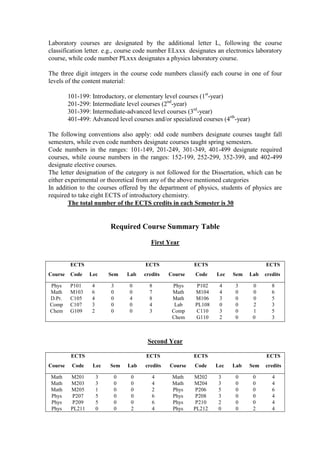
The total number of the ECTS credits in each Semester is 30
Required Course Summary Table
First Year
ECTS ECTS ECTS ECTS
Course Code Lec Sem Lab credits Course Code Lec Sem Lab credits
Phys P101 4 3 0 8 Phys P102 4 3 0 8
Math M103 6 0 0 7 Math M104 4 0 0 6
D.Pr. C105 4 0 4 8 Math M106 3 0 0 5
Comp C107 3 0 0 4 Lab PL108 0 0 2 3
Chem G109 2 0 0 3 Comp C110 3 0 1 5
Chem G110 2 0 0 3
Second Year
ECTS ECTS ECTS ECTS
Course Code Lec Sem Lab credits Course Code Lec Lab Sem credits
Math M201 3 0 0 4 Math M202 3 0 0 4
Math M203 3 0 0 4 Math M204 3 0 0 4
Math M205 1 0 0 2 Phys P206 5 0 0 6
Phys P207 5 0 0 6 Phys P208 3 0 0 4
Phys P209 5 0 0 6 Phys P210 2 0 0 4
Phys PL211 0 0 2 4 Phys PL212 0 0 2 4
Electiv. 4 Electiv. 4
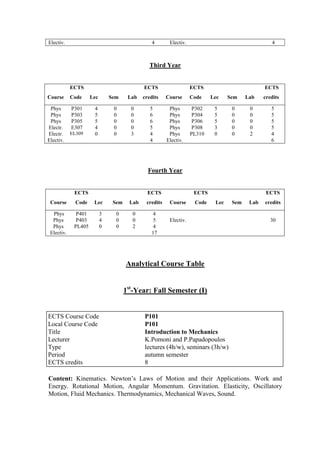
Third Year
ECTS ECTS ECTS ECTS
Course Code Lec Sem Lab credits Course Code Lec Sem Lab credits
Phys P301 4 0 0 5 Phys P302 5 0 0 5
Phys P303 5 0 0 6 Phys P304 5 0 0 5
Phys P305 5 0 0 6 Phys P306 5 0 0 5
Electr. E307 4 0 0 5 Phys P308 3 0 0 5
Electr. EL309 0 0 3 4 Phys PL310 0 0 2 4
Electiv. 4 Electiv. 6
Fourth Year
ECTS ECTS ECTS ECTS
Course Code Lec Sem Lab credits Course Code Lec Sem Lab credits
Phys P401 3 0 0 4
Phys Ρ403 4 0 0 5 Electiv. 30
Phys ΡL405 0 0 2 4
Electiv. 17
Analytical Course Table
1st
-Year: Fall Semester (I)
Content: Kinematics. Newton‟s Laws of Motion and their Applications. Work and
Energy. Rotational Motion, Angular Momentum. Gravitation. Elasticity, Oscillatory
Motion, Fluid Mechanics. Thermodynamics, Mechanical Waves, Sound.
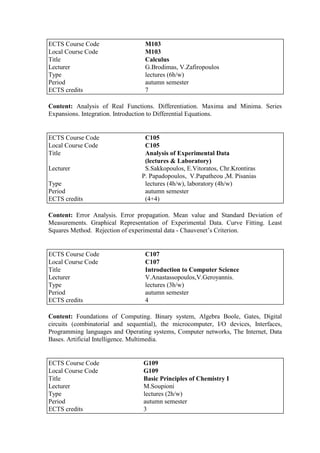
ECTS Course Code P101
Local Course Code P101
Title Introduction to Mechanics
Lecturer K.Pomoni and P.Papadopoulos
Type lectures (4h/w), seminars (3h/w)
Period autumn semester
ECTS credits 8
Content: Analysis of Real Functions. Differentiation. Maxima and Minima. Series
Expansions. Integration. Introduction to Differential Equations.
Content: Error Analysis. Error propagation. Mean value and Standard Deviation of
Measurements. Graphical Representation of Experimental Data. Curve Fitting. Least
Squares Method. Rejection of experimental data - Chauvenet‟s Criterion.
Content: Foundations of Computing. Binary system, Algebra Boole, Gates, Digital
circuits (combinatorial and sequential), the microcomputer, I/O devices, Interfaces,
Programming languages and Operating systems, Computer networks, The Internet, Data
Bases. Artificial Intelligence. Multimedia.
ECTS Course Code M103
Local Course Code M103
Title Calculus
Lecturer G.Brodimas, V.Zafiropoulos
Type lectures (6h/w)
Period autumn semester
ECTS credits 7
ECTS Course Code C105
Local Course Code C105
Title Analysis of Experimental Data
(lectures & Laboratory)
Lecturer S.Sakkopoulos, E.Vitoratos, Chr.Krontiras
P. Papadopoulos, V.Papatheou ,M. Pisanias
Type lectures (4h/w), laboratory (4h/w)
Period autumn semester
ECTS credits (4+4)
ECTS Course Code C107
Local Course Code C107
Title Introduction to Computer Science
Lecturer V.Anastassopoulos,V.Geroyannis.
Type lectures (3h/w)
Period autumn semester
ECTS credits 4
ECTS Course Code G109
Local Course Code G109
Title Basic Principles of Chemistry I
Lecturer M.Soupioni
Type lectures (2h/w)
Period autumn semester
ECTS credits 3
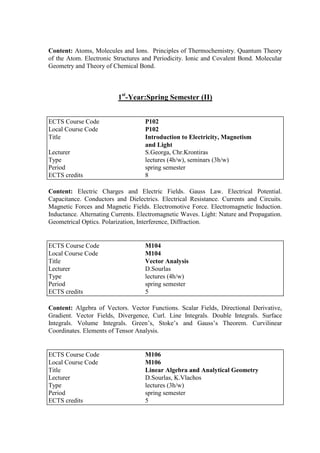
Content: Atoms, Molecules and Ions. Principles of Thermochemistry. Quantum Theory
of the Atom. Electronic Structures and Periodicity. Ionic and Covalent Bond. Molecular
Geometry and Theory of Chemical Bond.
1st
-Year:Spring Semester (II)
Content: Electric Charges and Electric Fields. Gauss Law. Electrical Potential.
Capacitance. Conductors and Dielectrics. Electrical Resistance. Currents and Circuits.
Magnetic Forces and Magnetic Fields. Electromotive Force. Electromagnetic Induction.
Inductance. Alternating Currents. Electromagnetic Waves. Light: Nature and Propagation.
Geometrical Optics. Polarization, Interference, Diffraction.
Content: Algebra of Vectors. Vector Functions. Scalar Fields, Directional Derivative,
Gradient. Vector Fields, Divergence, Curl. Line Integrals. Double Integrals. Surface
Integrals. Volume Integrals. Green‟s, Stoke‟s and Gauss‟s Theorem. Curvilinear
Coordinates. Elements of Tensor Analysis.
ECTS Course Code P102
Local Course Code P102
Title Introduction to Electricity, Magnetism
and Light
Lecturer S.Georga, Chr.Krontiras
Type lectures (4h/w), seminars (3h/w)
Period spring semester
ECTS credits 8
ECTS Course Code M104
Local Course Code M104
Title Vector Analysis
Lecturer D.Sourlas
Type lectures (4h/w)
Period spring semester
ECTS credits 5
ECTS Course Code M106
Local Course Code M106
Title Linear Algebra and Analytical Geometry
Lecturer D.Sourlas, K.Vlachos
Type lectures (3h/w)
Period spring semester
ECTS credits 5
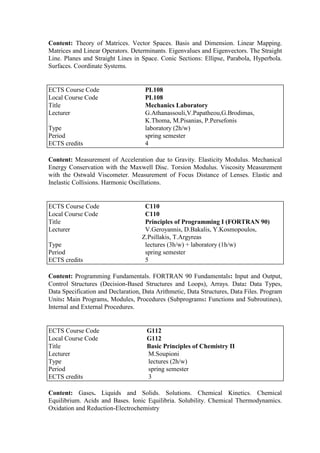
Content: Theory of Matrices. Vector Spaces. Basis and Dimension. Linear Mapping.
Matrices and Linear Operators. Determinants. Eigenvalues and Eigenvectors. The Straight
Line. Planes and Straight Lines in Space. Conic Sections: Ellipse, Parabola, Hyperbola.
Surfaces. Coordinate Systems.
Content: Measurement of Acceleration due to Gravity. Elasticity Modulus. Mechanical
Energy Conservation with the Maxwell Disc. Torsion Modulus. Viscosity Measurement
with the Ostwald Viscometer. Measurement of Focus Distance of Lenses. Elastic and
Inelastic Collisions. Harmonic Oscillations.
Content: Programming Fundamentals. FORTRAN 90 Fundamentals: Input and Output,
Control Structures (Decision-Based Structures and Loops), Arrays. Data: Data Types,
Data Specification and Declaration, Data Arithmetic, Data Structures, Data Files. Program
Units: Main Programs, Modules, Procedures (Subprograms: Functions and Subroutines),
Internal and External Procedures.
Content: Gases. Liquids and Solids. Solutions. Chemical Kinetics. Chemical
Equilibrium. Acids and Bases. Ionic Equilibria. Solubility. Chemical Thermodynamics.
Oxidation and Reduction-Electrochemistry
ECTS Course Code PL108
Local Course Code PL108
Title Mechanics Laboratory
Lecturer G.Athanassouli,V.Papatheou,G.Brodimas,
K.Thoma, M.Pisanias, P.Persefonis
Type laboratory (2h/w)
Period spring semester
ECTS credits 4
ECTS Course Code C110
Local Course Code C110
Title Principles of Programming I (FORTRAN 90)
Lecturer V.Geroyannis, D.Bakalis, Y.Kosmopoulos,
Z.Psillakis, T.Argyreas
Type lectures (3h/w) + laboratory (1h/w)
Period spring semester
ECTS credits 5
ECTS Course Code G112
Local Course Code G112
Title Basic Principles of Chemistry II
Lecturer M.Soupioni
Type lectures (2h/w)
Period spring semester
ECTS credits 3
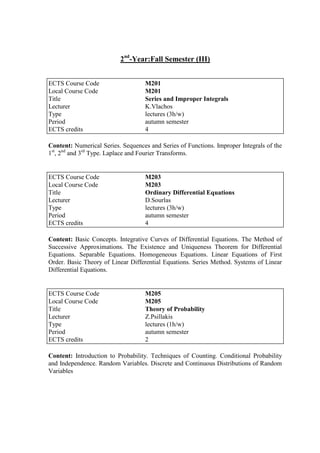
2nd
-Year:Fall Semester (III)
Content: Numerical Series. Sequences and Series of Functions. Improper Integrals of the
1st
, 2nd
and 3rd
Type. Laplace and Fourier Transforms.
Content: Basic Concepts. Integrative Curves of Differential Equations. The Method of
Successive Approximations. The Existence and Uniqueness Theorem for Differential
Equations. Separable Equations. Homogeneous Equations. Linear Equations of First
Order. Basic Theory of Linear Differential Equations. Series Method. Systems of Linear
Differential Equations.
Content: Introduction to Probability. Techniques of Counting. Conditional Probability
and Independence. Random Variables. Discrete and Continuous Distributions of Random
Variables
ECTS Course Code M201
Local Course Code M201
Title Series and Improper Integrals
Lecturer K.Vlachos
Type lectures (3h/w)
Period autumn semester
ECTS credits 4
ECTS Course Code M203
Local Course Code M203
Title Ordinary Differential Equations
Lecturer D.Sourlas
Type lectures (3h/w)
Period autumn semester
ECTS credits 4
ECTS Course Code M205
Local Course Code M205
Title Theory of Probability
Lecturer Z.Psillakis
Type lectures (1h/w)
Period autumn semester
ECTS credits 2
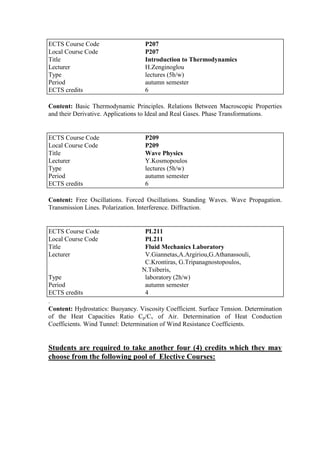
Content: Basic Thermodynamic Principles. Relations Between Macroscopic Properties
and their Derivative. Applications to Ideal and Real Gases. Phase Transformations.
Content: Free Oscillations. Forced Oscillations. Standing Waves. Wave Propagation.
Transmission Lines. Polarization. Interference. Diffraction.
.
Content: Hydrostatics: Buoyancy. Viscosity Coefficient. Surface Tension. Determination
of the Heat Capacities Ratio Cp/Cv of Air. Determination of Heat Conduction
Coefficients. Wind Tunnel: Determination of Wind Resistance Coefficients.
Students are required to take another four (4) credits which they may
choose from the following pool of Elective Courses:
ECTS Course Code P207
Local Course Code P207
Title Introduction to Thermodynamics
Lecturer H.Zenginoglou
Type lectures (5h/w)
Period autumn semester
ECTS credits 6
ECTS Course Code P209
Local Course Code P209
Title Wave Physics
Lecturer Y.Kosmopoulos
Type lectures (5h/w)
Period autumn semester
ECTS credits 6
ECTS Course Code PL211
Local Course Code PL211
Title Fluid Mechanics Laboratory
Lecturer V.Giannetas,A.Argiriou,G.Athanassouli,
C.Krontiras, G.Tripanagnostopoulos,
N.Tsiberis,
Type laboratory (2h/w)
Period autumn semester
ECTS credits 4
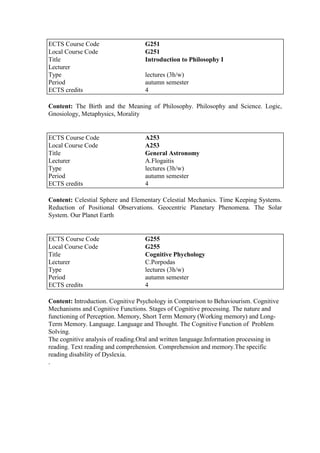
Content: The Birth and the Meaning of Philosophy. Philosophy and Science. Logic,
Gnosiology, Metaphysics, Morality
Content: Celestial Sphere and Elementary Celestial Mechanics. Time Keeping Systems.
Reduction of Positional Observations. Geocentric Planetary Phenomena. The Solar
System. Our Planet Earth
Content: Introduction. Cognitive Psychology in Comparison to Behaviourism. Cognitive
Mechanisms and Cognitive Functions. Stages of Cognitive processing. The nature and
functioning of Perception. Memory, Short Term Memory (Working memory) and Long-
Term Memory. Language. Language and Thought. The Cognitive Function of Problem
Solving.
The cognitive analysis of reading.Oral and written language.Information processing in
reading. Text reading and comprehension. Comprehension and memory.The specific
reading disability of Dyslexia.
.
ECTS Course Code G251
Local Course Code G251
Title Introduction to Philosophy I
Lecturer
Type lectures (3h/w)
Period autumn semester
ECTS credits 4
ECTS Course Code A253
Local Course Code A253
Title General Astronomy
Lecturer A.Flogaitis
Type lectures (3h/w)
Period autumn semester
ECTS credits 4
ECTS Course Code G255
Local Course Code G255
Title Cognitive Phychology
Lecturer C.Porpodas
Type lectures (3h/w)
Period autumn semester
ECTS credits 4
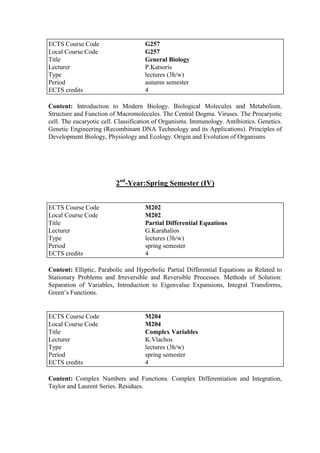
Content: Introduction to Modern Biology. Biological Molecules and Metabolism.
Structure and Function of Macromolecules. The Central Dogma. Viruses. The Procaryotic
cell. The eucaryotic cell. Classification of Organisms. Immunology. Antibiotics. Genetics.
Genetic Engineering (Recombinant DNA Technology and its Applications). Principles of
Development Biology, Physiology and Ecology. Origin and Evolution of Organisms
2nd
-Year:Spring Semester (IV)
Content: Elliptic, Parabolic and Hyperbolic Partial Differential Equations as Related to
Stationary Problems and Irreversible and Reversible Processes. Methods of Solution:
Separation of Variables, Introduction to Eigenvalue Expansions, Integral Transforms,
Green‟s Functions.
Content: Complex Numbers and Functions. Complex Differentiation and Integration,
Taylor and Laurent Series. Residues.
ECTS Course Code G257
Local Course Code G257
Title General Biology
Lecturer P.Katsoris
Type lectures (3h/w)
Period autumn semester
ECTS credits 4
ECTS Course Code M202
Local Course Code M202
Title Partial Differential Equations
Lecturer G.Karahalios
Type lectures (3h/w)
Period spring semester
ECTS credits 4
ECTS Course Code M204
Local Course Code M204
Title Complex Variables
Lecturer K.Vlachos
Type lectures (3h/w)
Period spring semester
ECTS credits 4
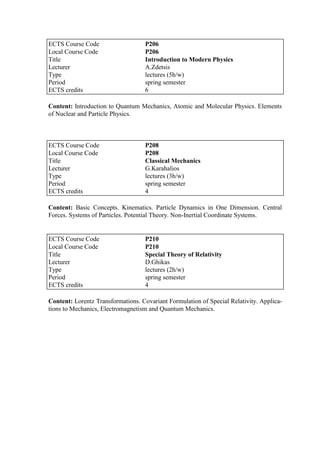
Content: Introduction to Quantum Mechanics, Atomic and Molecular Physics. Elements
of Nuclear and Particle Physics.
Content: Basic Concepts. Kinematics. Particle Dynamics in One Dimension. Central
Forces. Systems of Particles. Potential Theory. Non-Inertial Coordinate Systems.
Content: Lorentz Transformations. Covariant Formulation of Special Relativity. Applica-
tions to Mechanics, Electromagnetism and Quantum Mechanics.
ECTS Course Code P206
Local Course Code P206
Title Introduction to Modern Physics
Lecturer A.Zdetsis
Type lectures (5h/w)
Period spring semester
ECTS credits 6
ECTS Course Code P208
Local Course Code P208
Title Classical Mechanics
Lecturer G.Karahalios
Type lectures (3h/w)
Period spring semester
ECTS credits 4
ECTS Course Code P210
Local Course Code P210
Title Special Theory of Relativity
Lecturer D.Ghikas
Type lectures (2h/w)
Period spring semester
ECTS credits 4
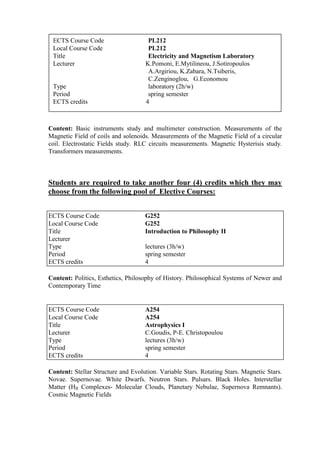
Content: Basic instruments study and multimeter construction. Measurements of the
Magnetic Field of coils and solenoids. Measurements of the Magnetic Field of a circular
coil. Electrostatic Fields study. RLC circuits measurements. Magnetic Hysterisis study.
Transformers measurements.
Students are required to take another four (4) credits which they may
choose from the following pool of Elective Courses:
Content: Politics, Esthetics, Philosophy of History. Philosophical Systems of Newer and
Contemporary Time
Content: Stellar Structure and Evolution. Variable Stars. Rotating Stars. Magnetic Stars.
Novae. Supernovae. White Dwarfs. Neutron Stars. Pulsars. Black Holes. Interstellar
Matter (HII Complexes- Molecular Clouds, Planetary Nebulae, Supernova Remnants).
Cosmic Magnetic Fields
ECTS Course Code G252
Local Course Code G252
Title Introduction to Philosophy II
Lecturer
Type lectures (3h/w)
Period spring semester
ECTS credits 4
ECTS Course Code A254
Local Course Code A254
Title Astrophysics I
Lecturer C.Goudis, P-E. Christopoulou
Type lectures (3h/w)
Period spring semester
ECTS credits 4
ECTS Course Code PL212
Local Course Code PL212
Title Electricity and Magnetism Laboratory
Lecturer K.Pomoni, E.Mytilineou, J.Sotiropoulos
A.Argiriou, K.Zabara, N.Tsiberis,
C.Zenginoglou, G.Economou
Type laboratory (2h/w)
Period spring semester
ECTS credits 4
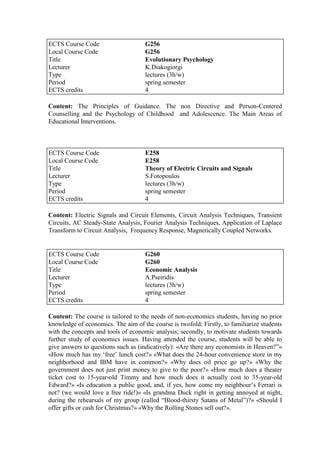
Content: The Principles of Guidance. The non Directive and Person-Centered
Counselling and the Psychology of Childhood and Adolescence. The Main Areas of
Educational Interventions.
Content: Electric Signals and Circuit Elements, Circuit Analysis Techniques, Transient
Circuits, AC Steady-State Analysis, Fourier Analysis Techniques, Application of Laplace
Transform to Circuit Analysis, Frequency Response, Magnetically Coupled Networks.
Content: The course is tailored to the needs of non-economics students, having no prior
knowledge of economics. The aim of the course is twofold: Firstly, to familiarize students
with the concepts and tools of economic analysis; secondly, to motivate students towards
further study of economics issues. Having attended the course, students will be able to
give answers to questions such as (indicatively): «Are there any economists in Heaven?”»
«How much has my „free‟ lunch cost?» «What does the 24-hour convenience store in my
neighborhood and IBM have in common?» «Why does oil price go up?» «Why the
government does not just print money to give to the poor?» «How much does a theater
ticket cost to 15-year-old Timmy and how much does it actually cost to 35-year-old
Edward?» «Is education a public good, and, if yes, how come my neighbour‟s Ferrari is
not? (we would love a free ride!)» «Is grandma Duck right in getting annoyed at night,
during the rehearsals of my group (called “Blood-thirsty Satans of Metal”)?» «Should I
offer gifts or cash for Christmas?» «Why the Rolling Stones sell out?».
ECTS Course Code G256
Local Course Code G256
Title Evolutionary Psychology
Lecturer K.Diakogiorgi
Type lectures (3h/w)
Period spring semester
ECTS credits 4
ECTS Course Code E258
Local Course Code E258
Title Theory of Electric Circuits and Signals
Lecturer S.Fotopoulos
Type lectures (3h/w)
Period spring semester
ECTS credits 4
ECTS Course Code G260
Local Course Code G260
Title Economic Analysis
Lecturer A.Pseiridis
Type lectures (3h/w)
Period spring semester
ECTS credits 4
3rd
-Year:Fall Semester (V)
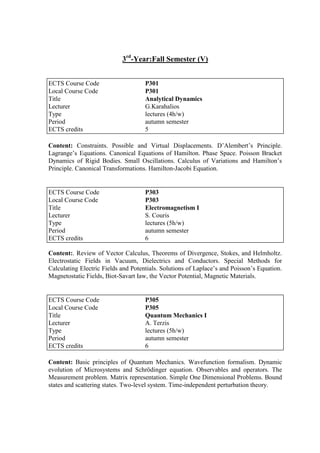
Content: Constraints. Possible and Virtual Displacements. D‟Alembert‟s Principle.
Lagrange‟s Equations. Canonical Equations of Hamilton. Phase Space. Poisson Bracket
Dynamics of Rigid Bodies. Small Oscillations. Calculus of Variations and Hamilton‟s
Principle. Canonical Transformations. Hamilton-Jacobi Equation.
Content:. Review of Vector Calculus, Theorems of Divergence, Stokes, and Helmholtz.
Electrostatic Fields in Vacuum, Dielectrics and Conductors. Special Methods for
Calculating Electric Fields and Potentials. Solutions of Laplace‟s and Poisson‟s Equation.
Magnetostatic Fields, Biot-Savart Iaw, the Vector Potential, Magnetic Materials.
Content: Basic principles of Quantum Mechanics. Wavefunction formalism. Dynamic
evolution of Microsystems and Schrödinger equation. Observables and operators. The
Measurement problem. Matrix representation. Simple One Dimensional Problems. Bound
states and scattering states. Two-level system. Time-independent perturbation theory.
ECTS Course Code P301
Local Course Code P301
Title Analytical Dynamics
Lecturer G.Karahalios
Type lectures (4h/w)
Period autumn semester
ECTS credits 5
ECTS Course Code P303
Local Course Code P303
Title Electromagnetism I
Lecturer S. Couris
Type lectures (5h/w)
Period autumn semester
ECTS credits 6
ECTS Course Code P305
Local Course Code P305
Title Quantum Mechanics I
Lecturer A. Terzis
Type lectures (5h/w)
Period autumn semester
ECTS credits 6
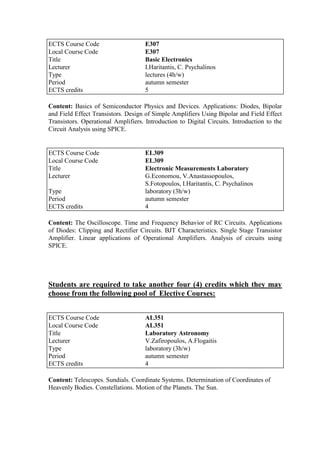
Content: Basics of Semiconductor Physics and Devices. Applications: Diodes, Bipolar
and Field Effect Transistors. Design of Simple Amplifiers Using Bipolar and Field Effect
Transistors. Operational Amplifiers. Introduction to Digital Circuits. Introduction to the
Circuit Analysis using SPICE.
Content: The Oscilloscope. Time and Frequency Behavior of RC Circuits. Applications
of Diodes: Clipping and Rectifier Circuits. BJT Characteristics. Single Stage Transistor
Amplifier. Linear applications of Operational Amplifiers. Analysis of circuits using
SPICE.
Students are required to take another four (4) credits which they may
choose from the following pool of Elective Courses:
Content: Telescopes. Sundials. Coordinate Systems. Determination of Coordinates of
Heavenly Bodies. Constellations. Motion of the Planets. The Sun.
ECTS Course Code E307
Local Course Code E307
Title Basic Electronics
Lecturer I.Haritantis, C. Psychalinos
Type lectures (4h/w)
Period autumn semester
ECTS credits 5
ECTS Course Code EL309
Local Course Code EL309
Title Electronic Measurements Laboratory
Lecturer G.Economou, V.Anastassopoulos,
S.Fotopoulos, I.Haritantis, C. Psychalinos
Type laboratory (3h/w)
Period autumn semester
ECTS credits 4
ECTS Course Code AL351
Local Course Code AL351
Title Laboratory Astronomy
Lecturer V.Zafiropoulos, A.Flogaitis
Type laboratory (3h/w)
Period autumn semester
ECTS credits 4
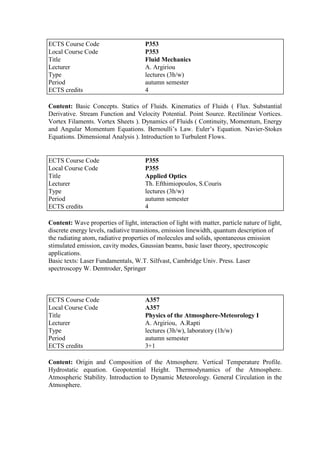
Content: Basic Concepts. Statics of Fluids. Kinematics of Fluids ( Flux. Substantial
Derivative. Stream Function and Velocity Potential. Point Source. Rectilinear Vortices.
Vortex Filaments. Vortex Sheets ). Dynamics of Fluids ( Continuity, Momentum, Energy
and Angular Momentum Equations. Bernoulli‟s Law. Euler‟s Equation. Navier-Stokes
Equations. Dimensional Analysis ). Introduction to Turbulent Flows.
Content: Wave properties of light, interaction of light with matter, particle nature of light,
discrete energy levels, radiative transitions, emission linewidth, quantum description of
the radiating atom, radiative properties of molecules and solids, spontaneous emission
stimulated emission, cavity modes, Gaussian beams, basic laser theory, spectroscopic
applications.
Basic texts: Laser Fundamentals, W.T. Silfvast, Cambridge Univ. Press. Laser
spectroscopy W. Demtroder, Springer
Content: Origin and Composition of the Atmosphere. Vertical Temperature Profile.
Hydrostatic equation. Geopotential Height. Thermodynamics of the Atmosphere.
Atmospheric Stability. Introduction to Dynamic Meteorology. General Circulation in the
Atmosphere.
ECTS Course Code P353
Local Course Code P353
Title Fluid Mechanics
Lecturer A. Argiriou
Type lectures (3h/w)
Period autumn semester
ECTS credits 4
ECTS Course Code P355
Local Course Code P355
Title Applied Optics
Lecturer Th. Efthimiopoulos, S.Couris
Type lectures (3h/w)
Period autumn semester
ECTS credits 4
ECTS Course Code A357
Local Course Code A357
Title Physics of the Atmosphere-Meteorology I
Lecturer A. Argiriou, A.Rapti
Type lectures (3h/w), laboratory (1h/w)
Period autumn semester
ECTS credits 3+1
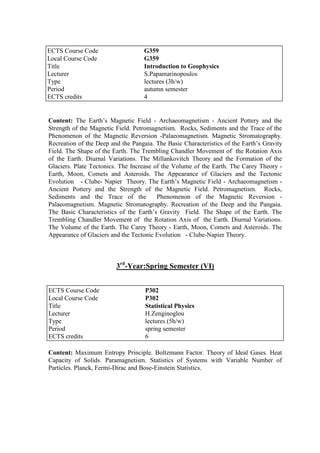
Content: The Earth‟s Magnetic Field - Archaeomagnetism - Ancient Pottery and the
Strength of the Magnetic Field. Petromagnetism. Rocks, Sediments and the Trace of the
Phenomenon of the Magnetic Reversion -Palaeomagnetism. Magnetic Stromatography.
Recreation of the Deep and the Pangaia. The Basic Characteristics of the Earth‟s Gravity
Field. The Shape of the Earth. The Trembling Chandler Movement of the Rotation Axis
of the Earth. Diurnal Variations. The Millankovitch Theory and the Formation of the
Glaciers. Plate Tectonics. The Increase of the Volume of the Earth. The Carey Theory -
Earth, Moon, Comets and Asteroids. The Appearance of Glaciers and the Tectonic
Evolution - Clube- Napier Theory. The Earth‟s Magnetic Field - Archaeomagnetism -
Ancient Pottery and the Strength of the Magnetic Field. Petromagnetism. Rocks,
Sediments and the Trace of the Phenomenon of the Magnetic Reversion -
Palaeomagnetism. Magnetic Stromatography. Recreation of the Deep and the Pangaia.
The Basic Characteristics of the Earth‟s Gravity Field. The Shape of the Earth. The
Trembling Chandler Movement of the Rotation Axis of the Earth. Diurnal Variations.
The Volume of the Earth. The Carey Theory - Earth, Moon, Comets and Asteroids. The
Appearance of Glaciers and the Tectonic Evolution - Clube-Napier Theory.
3rd
-Year:Spring Semester (VI)
Content: Maximum Entropy Principle. Boltzmann Factor. Theory of Ideal Gases. Heat
Capacity of Solids. Paramagnetism. Statistics of Systems with Variable Number of
Particles. Planck, Fermi-Dirac and Bose-Einstein Statistics.
ECTS Course Code G359
Local Course Code G359
Title Introduction to Geophysics
Lecturer S.Papamarinopoulos
Type lectures (3h/w)
Period autumn semester
ECTS credits 4
ECTS Course Code P302
Local Course Code P302
Title Statistical Physics
Lecturer H.Zenginoglou
Type lectures (5h/w)
Period spring semester
ECTS credits 6
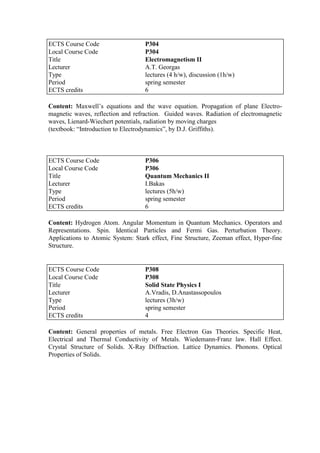
Content: Maxwell‟s equations and the wave equation. Propagation of plane Electro-
magnetic waves, reflection and refraction. Guided waves. Radiation of electromagnetic
waves, Lienard-Wiechert potentials, radiation by moving charges
(textbook: “Introduction to Electrodynamics”, by D.J. Griffiths).
Content: Hydrogen Atom. Angular Momentum in Quantum Mechanics. Operators and
Representations. Spin. Identical Particles and Fermi Gas. Perturbation Theory.
Applications to Atomic System: Stark effect, Fine Structure, Zeeman effect, Hyper-fine
Structure.
Content: General properties of metals. Free Electron Gas Theories. Specific Heat,
Electrical and Thermal Conductivity of Metals. Wiedemann-Franz law. Hall Effect.
Crystal Structure of Solids. X-Ray Diffraction. Lattice Dynamics. Phonons. Optical
Properties of Solids.
ECTS Course Code P304
Local Course Code P304
Title Electromagnetism II
Lecturer A.T. Georgas
Type lectures (4 h/w), discussion (1h/w)
Period spring semester
ECTS credits 6
ECTS Course Code P306
Local Course Code P306
Title Quantum Mechanics II
Lecturer I.Bakas
Type lectures (5h/w)
Period spring semester
ECTS credits 6
ECTS Course Code P308
Local Course Code P308
Title Solid State Physics I
Lecturer A.Vradis, D.Anastassopoulos
Type lectures (3h/w)
Period spring semester
ECTS credits 4
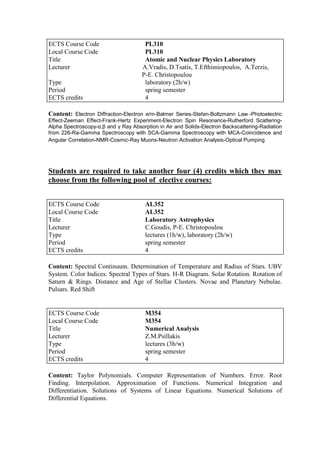
Content: Electron Diffraction-Electron e/m-Balmer Series-Stefan-Boltzmann Law -Photoelectric
Effect-Zeeman Effect-Frank-Hertz Experiment-Electron Spin Resonance-Rutherford Scattering-
Alpha Spectroscopy-α,β and γ Ray Absorption in Air and Solids-Electron Backscattering-Radiation
from 226-Ra-Gamma Spectroscopy with SCA-Gamma Spectroscopy with MCA-Coincidence and
Angular Correlation-NMR-Cosmic-Ray Muons-Neutron Activation Analysis-Optical Pumping
Students are required to take another four (4) credits which they may
choose from the following pool of elective courses:
Content: Spectral Continuum. Determination of Temperature and Radius of Stars. UBV
System. Color Indices. Spectral Types of Stars. H-R Diagram. Solar Rotation. Rotation of
Saturn & Rings. Distance and Age of Stellar Clusters. Novae and Planetary Nebulae.
Pulsars. Red Shift
Content: Taylor Polynomials. Computer Representation of Numbers. Error. Root
Finding. Interpolation. Approximation of Functions. Numerical Integration and
Differentiation. Solutions of Systems of Linear Equations. Numerical Solutions of
Differential Equations.
ECTS Course Code PL310
Local Course Code PL310
Title Atomic and Nuclear Physics Laboratory
Lecturer A.Vradis, D.Tsatis, T.Efthimiopoulos, A.Terzis,
P-E. Christopoulou
Type laboratory (2h/w)
Period spring semester
ECTS credits 4
ECTS Course Code AL352
Local Course Code AL352
Title Laboratory Astrophysics
Lecturer C.Goudis, P-E. Christopoulou
Type lectures (1h/w), laboratory (2h/w)
Period spring semester
ECTS credits 4
ECTS Course Code M354
Local Course Code M354
Title Numerical Analysis
Lecturer Z.M.Psillakis
Type lectures (3h/w)
Period spring semester
ECTS credits 4
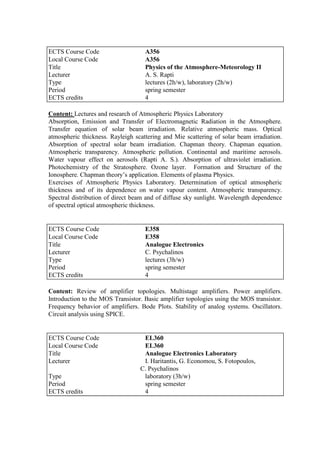
Content: Lectures and research of Atmospheric Physics Laboratory
Absorption, Emission and Transfer of Electromagnetic Radiation in the Atmosphere.
Transfer equation of solar beam irradiation. Relative atmospheric mass. Optical
atmospheric thickness. Rayleigh scattering and Mie scattering of solar beam irradiation.
Absorption of spectral solar beam irradiation. Chapman theory. Chapman equation.
Atmospheric transparency. Atmospheric pollution. Continental and maritime aerosols.
Water vapour effect on aerosols (Rapti A. S.). Absorption of ultraviolet irradiation.
Photochemistry of the Stratosphere. Ozone layer. Formation and Structure of the
Ionosphere. Chapman theory‟s application. Elements of plasma Physics.
Exercises of Atmospheric Physics Laboratory. Determination of optical atmospheric
thickness and of its dependence on water vapour content. Atmospheric transparency.
Spectral distribution of direct beam and of diffuse sky sunlight. Wavelength dependence
of spectral optical atmospheric thickness.
Content: Review of amplifier topologies. Multistage amplifiers. Power amplifiers.
Introduction to the MOS Transistor. Basic amplifier topologies using the MOS transistor.
Frequency behavior of amplifiers. Bode Plots. Stability of analog systems. Oscillators.
Circuit analysis using SPICE.
ECTS Course Code A356
Local Course Code A356
Title Physics of the Atmosphere-Meteorology II
Lecturer A. S. Rapti
Type lectures (2h/w), laboratory (2h/w)
Period spring semester
ECTS credits 4
ECTS Course Code E358
Local Course Code E358
Title Analogue Electronics
Lecturer C. Psychalinos
Type lectures (3h/w)
Period spring semester
ECTS credits 4
ECTS Course Code EL360
Local Course Code EL360
Title Analogue Electronics Laboratory
Lecturer I. Haritantis, G. Economou, S. Fotopoulos,
C. Psychalinos
Type laboratory (3h/w)
Period spring semester
ECTS credits 4
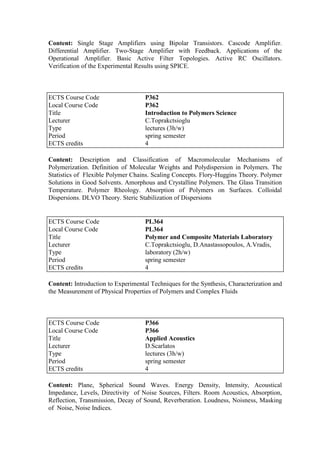
Content: Single Stage Amplifiers using Bipolar Transistors. Cascode Amplifier.
Differential Amplifier. Two-Stage Amplifier with Feedback. Applications of the
Operational Amplifier. Basic Active Filter Topologies. Active RC Oscillators.
Verification of the Experimental Results using SPICE.
Content: Description and Classification of Macromolecular Mechanisms of
Polymerization. Definition of Molecular Weights and Polydispersion in Polymers. The
Statistics of Flexible Polymer Chains. Scaling Concepts. Flory-Huggins Theory. Polymer
Solutions in Good Solvents. Amorphous and Crystalline Polymers. The Glass Transition
Temperature. Polymer Rheology. Absorption of Polymers on Surfaces. Colloidal
Dispersions. DLVO Theory. Steric Stabilization of Dispersions
Content: Introduction to Experimental Techniques for the Synthesis, Characterization and
the Measurement of Physical Properties of Polymers and Complex Fluids
Content: Plane, Spherical Sound Waves. Energy Density, Intensity, Acoustical
Impedance, Levels, Directivity of Noise Sources, Filters. Room Acoustics, Absorption,
Reflection, Transmission, Decay of Sound, Reverberation. Loudness, Noisness, Masking
of Noise, Noise Indices.
ECTS Course Code P362
Local Course Code P362
Title Introduction to Polymers Science
Lecturer C.Toprakctsioglu
Type lectures (3h/w)
Period spring semester
ECTS credits 4
ECTS Course Code PL364
Local Course Code PL364
Title Polymer and Composite Materials Laboratory
Lecturer C.Toprakctsioglu, D.Anastassopoulos, A.Vradis,
Type laboratory (2h/w)
Period spring semester
ECTS credits 4
ECTS Course Code P366
Local Course Code P366
Title Applied Acoustics
Lecturer D.Scarlatos
Type lectures (3h/w)
Period spring semester
ECTS credits 4
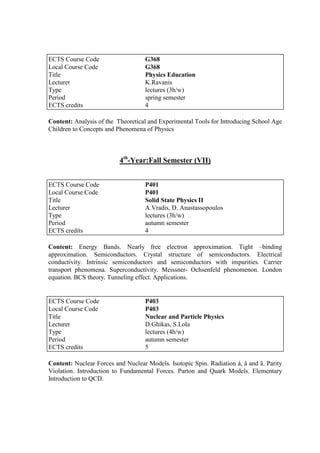
Content: Analysis of the Theoretical and Experimental Tools for Introducing School Age
Children to Concepts and Phenomena of Physics
4th
-Year:Fall Semester (VII)
Content: Energy Bands. Nearly free electron approximation. Tight –binding
approximation. Semiconductors. Crystal structure of semiconductors. Electrical
conductivity. Intrinsic semiconductors and semiconductors with impurities. Carrier
transport phenomena. Superconductivity. Meissner- Ochsenfeld phenomenon. London
equation. BCS theory. Tunneling effect. Applications.
Content: Nuclear Forces and Nuclear Models. Isotopic Spin. Radiation á, â and ã. Parity
Violation. Introduction to Fundamental Forces. Parton and Quark Models. Elementary
Introduction to QCD.
ECTS Course Code G368
Local Course Code G368
Title Physics Education
Lecturer K.Ravanis
Type lectures (3h/w)
Period spring semester
ECTS credits 4
ECTS Course Code P401
Local Course Code P401
Title Solid State Physics II
Lecturer A.Vradis, D. Anastassopoulos
Type lectures (3h/w)
Period autumn semester
ECTS credits 4
ECTS Course Code P403
Local Course Code P403
Title Nuclear and Particle Physics
Lecturer D.Ghikas, S.Lola
Type lectures (4h/w)
Period autumn semester
ECTS credits 5
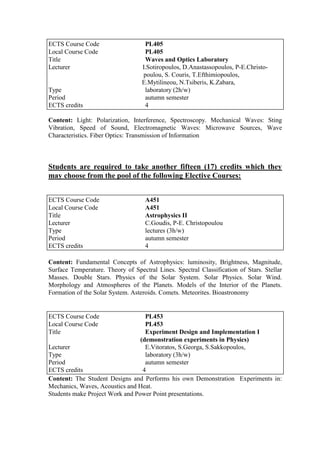
Content: Light: Polarization, Interference, Spectroscopy. Mechanical Waves: Sting
Vibration, Speed of Sound, Electromagnetic Waves: Microwave Sources, Wave
Characteristics. Fiber Optics: Transmission of Information
Students are required to take another fifteen (17) credits which they
may choose from the pool of the following Elective Courses:
Content: Fundamental Concepts of Astrophysics: luminosity, Brightness, Magnitude,
Surface Temperature. Theory of Spectral Lines. Spectral Classification of Stars. Stellar
Masses. Double Stars. Physics of the Solar System. Solar Physics. Solar Wind.
Morphology and Atmospheres of the Planets. Models of the Interior of the Planets.
Formation of the Solar System. Asteroids. Comets. Meteorites. Bioastronomy
Content: The Student Designs and Performs his own Demonstration Experiments in:
Mechanics, Waves, Acoustics and Heat.
Students make Project Work and Power Point presentations.
ECTS Course Code PL405
Local Course Code PL405
Title Waves and Optics Laboratory
Lecturer I.Sotiropoulos, D.Anastassopoulos, P-E.Christo-
poulou, S. Couris, Τ.Efthimiopoulos,
E.Mytilineou, N.Tsiberis, K.Zabara,
Type laboratory (2h/w)
Period autumn semester
ECTS credits 4
ECTS Course Code A451
Local Course Code A451
Title Astrophysics II
Lecturer C.Goudis, P-E. Christopoulou
Type lectures (3h/w)
Period autumn semester
ECTS credits 4
ECTS Course Code PL453
Local Course Code PL453
Title Experiment Design and Implementation I
(demonstration experiments in Physics)
Lecturer E.Vitoratos, S.Georga, S.Sakkopoulos,
Type laboratory (3h/w)
Period autumn semester
ECTS credits 4
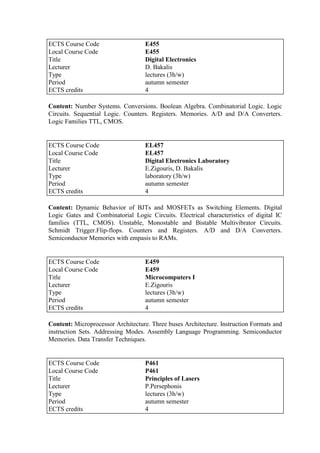
Content: Number Systems. Conversions. Boolean Algebra. Combinatorial Logic. Logic
Circuits. Sequential Logic. Counters. Registers. Memories. A/D and D/A Converters.
Logic Families TTL, CMOS.
Content: Dynamic Behavior of BJTs and MOSFETs as Switching Elements. Digital
Logic Gates and Combinatorial Logic Circuits. Electrical characteristics of digital IC
families (TTL, CMOS). Unstable, Monostable and Bistable Multivibrator Circuits.
Schmidt Trigger.Flip-flops. Counters and Registers. A/D and D/A Converters.
Semiconductor Memories with empasis to RAMs.
Content: Microprocessor Architecture. Three buses Architecture. Instruction Formats and
instruction Sets. Addressing Modes. Assembly Language Programming. Semiconductor
Memories. Data Transfer Techniques.
ECTS Course Code E455
Local Course Code E455
Title Digital Electronics
Lecturer D. Bakalis
Type lectures (3h/w)
Period autumn semester
ECTS credits 4
ECTS Course Code EL457
Local Course Code EL457
Title Digital Electronics Laboratory
Lecturer E.Zigouris, D. Bakalis
Type laboratory (3h/w)
Period autumn semester
ECTS credits 4
ECTS Course Code E459
Local Course Code E459
Title Microcomputers I
Lecturer E.Zigouris
Type lectures (3h/w)
Period autumn semester
ECTS credits 4
ECTS Course Code P461
Local Course Code P461
Title Principles of Lasers
Lecturer P.Persephonis
Type lectures (3h/w)
Period autumn semester
ECTS credits 4
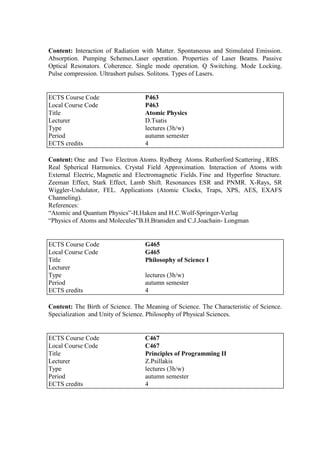
Content: Interaction of Radiation with Matter. Spontaneous and Stimulated Emission.
Absorption. Pumping Schemes.Laser operation. Properties of Laser Beams. Passive
Optical Resonators. Coherence. Single mode operation. Q Switching. Mode Locking.
Pulse compression. Ultrashort pulses. Solitons. Types of Lasers.
Content: One and Two Electron Atoms. Rydberg Atoms. Rutherford Scattering , RBS.
Real Spherical Harmonics. Crystal Field Approximation. Interaction of Atoms with
External Electric, Magnetic and Electromagnetic Fields. Fine and Hyperfine Structure.
Zeeman Effect, Stark Effect, Lamb Shift. Resonances ESR and PNMR. X-Rays, SR
Wiggler-Undulator, FEL. Applications (Atomic Clocks, Traps, XPS, AES, EXAFS
Channeling).
References:
“Atomic and Quantum Physics”-H.Haken and H.C.Wolf-Springer-Verlag
“Physics of Atoms and Molecules”B.H.Bransden and C.J.Joachain- Longman
Content: The Birth of Science. The Meaning of Science. The Characteristic of Science.
Specialization and Unity of Science. Philosophy of Physical Sciences.
ECTS Course Code P463
Local Course Code P463
Title Atomic Physics
Lecturer D.Tsatis
Type lectures (3h/w)
Period autumn semester
ECTS credits 4
ECTS Course Code G465
Local Course Code G465
Title Philosophy of Science I
Lecturer
Type lectures (3h/w)
Period autumn semester
ECTS credits 4
ECTS Course Code C467
Local Course Code C467
Title Principles of Programming II
Lecturer Z.Psillakis
Type lectures (3h/w)
Period autumn semester
ECTS credits 4
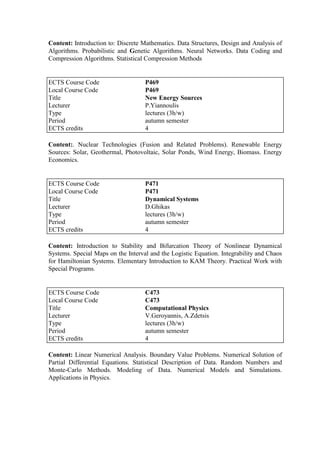
Content: Introduction to: Discrete Mathematics. Data Structures, Design and Analysis of
Algorithms. Probabilistic and Genetic Algorithms. Neural Networks. Data Coding and
Compression Algorithms. Statistical Compression Methods
Content:. Nuclear Technologies (Fusion and Related Problems). Renewable Energy
Sources: Solar, Geothermal, Photovoltaic, Solar Ponds, Wind Energy, Biomass. Energy
Economics.
Content: Introduction to Stability and Bifurcation Theory of Nonlinear Dynamical
Systems. Special Maps on the Interval and the Logistic Equation. Integrability and Chaos
for Hamiltonian Systems. Elementary Introduction to KAM Theory. Practical Work with
Special Programs.
Content: Linear Numerical Analysis. Boundary Value Problems. Numerical Solution of
Partial Differential Equations. Statistical Description of Data. Random Numbers and
Monte-Carlo Methods. Modeling of Data. Numerical Models and Simulations.
Applications in Physics.
ECTS Course Code P469
Local Course Code P469
Title New Energy Sources
Lecturer P.Yiannoulis
Type lectures (3h/w)
Period autumn semester
ECTS credits 4
ECTS Course Code P471
Local Course Code P471
Title Dynamical Systems
Lecturer D.Ghikas
Type lectures (3h/w)
Period autumn semester
ECTS credits 4
ECTS Course Code C473
Local Course Code C473
Title Computational Physics
Lecturer V.Geroyannis, A.Zdetsis
Type lectures (3h/w)
Period autumn semester
ECTS credits 4
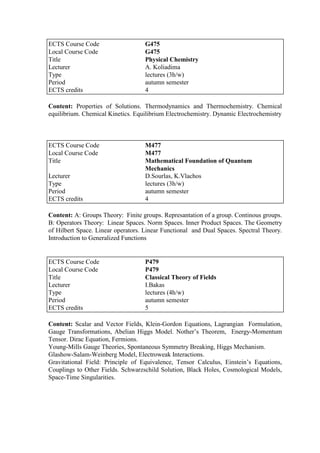
Content: Properties of Solutions. Thermodynamics and Thermochemistry. Chemical
equilibrium. Chemical Kinetics. Equilibrium Electrochemistry. Dynamic Electrochemistry
Content: A: Groups Theory: Finite groups. Represantation of a group. Continous groups.
B: Operators Theory: Linear Spaces. Norm Spaces. Inner Product Spaces. The Geometry
of Hilbert Space. Linear operators. Linear Functional and Dual Spaces. Spectral Theory.
Introduction to Generalized Functions
Content: Scalar and Vector Fields, Klein-Gordon Equations, Lagrangian Formulation,
Gauge Transformations, Abelian Higgs Model. Nother‟s Theorem, Energy-Momentum
Tensor. Dirac Equation, Fermions.
Young-Mills Gauge Theories, Spontaneous Symmetry Breaking, Higgs Mechanism.
Glashow-Salam-Weinberg Model, Electroweak Interactions.
Gravitational Field: Principle of Equivalence, Tensor Calculus, Einstein‟s Equations,
Couplings to Other Fields. Schwarzschild Solution, Black Holes, Cosmological Models,
Space-Time Singularities.
ECTS Course Code G475
Local Course Code G475
Title Physical Chemistry
Lecturer A. Koliadima
Type lectures (3h/w)
Period autumn semester
ECTS credits 4
ECTS Course Code M477
Local Course Code M477
Title Mathematical Foundation of Quantum
Mechanics
Lecturer D.Sourlas, K.Vlachos
Type lectures (3h/w)
Period autumn semester
ECTS credits 4
ECTS Course Code P479
Local Course Code P479
Title Classical Theory of Fields
Lecturer I.Bakas
Type lectures (4h/w)
Period autumn semester
ECTS credits 5
Content: Propagation of Light in Optical Fibers, Modes, Dispersion and Pulse
Broadening. Optical Dielectric Wave Guides, Couplers and Modulators. Distributed
Feedback Lasers and Laser Arrays. Semiconductor Lasers - quantum well and quantum
dot lasers. (reference: "Optical Electronics" by Amnon Yariv).
Content: Experiment 1: He-Ne Laser,Experiment 2: Coupling of an He-Ne laser beam to
an optical fiber, Experiment 3: Simulations of optical cavities, Experiment 4: Fourier
optics – spatial filtering
Content: The Topic of the Dissertation is Given by the Instructors
ECTS Course Code P481
Local Course Code P481
Title Optoelectronics
Lecturer A.Georgas
Type lectures (3h/w)
Period autumn semester
ECTS credits 4
ECTS Course Code PL483
Local Course Code PL483
Title Lab Courses in Lasers
Lecturer V.Giannetas, P.Persefonis
Type Laboratory (1h/w)
Period autumn semester
ECTS credits 2
ECTS Course Code 485
Local Course Code 485
Title Dissertation
Lecturer Anyone of the Members of the Staff
Type Theoretical or Experimental (5h/w)
Period autumn semester
ECTS credits 6
4rth
-Year:Spring Semester (VIII)
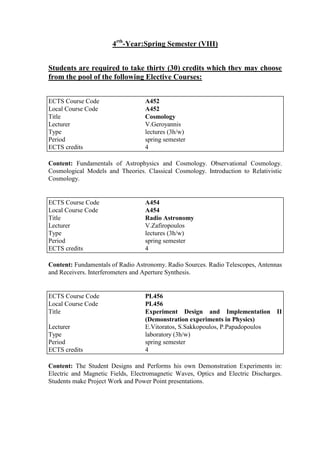
Students are required to take thirty (30) credits which they may choose
from the pool of the following Elective Courses:
Content: Fundamentals of Astrophysics and Cosmology. Observational Cosmology.
Cosmological Models and Theories. Classical Cosmology. Introduction to Relativistic
Cosmology.
Content: Fundamentals of Radio Astronomy. Radio Sources. Radio Telescopes, Antennas
and Receivers. Interferometers and Aperture Synthesis.
Content: The Student Designs and Performs his own Demonstration Experiments in:
Electric and Magnetic Fields, Electromagnetic Waves, Optics and Electric Discharges.
Students make Project Work and Power Point presentations.
ECTS Course Code A452
Local Course Code A452
Title Cosmology
Lecturer V.Geroyannis
Type lectures (3h/w)
Period spring semester
ECTS credits 4
ECTS Course Code A454
Local Course Code A454
Title Radio Astronomy
Lecturer V.Zafiropoulos
Type lectures (3h/w)
Period spring semester
ECTS credits 4
ECTS Course Code PL456
Local Course Code PL456
Title Experiment Design and Implementation II
(Demonstration experiments in Physics)
Lecturer E.Vitoratos, S.Sakkopoulos, P.Papadopoulos
Type laboratory (3h/w)
Period spring semester
ECTS credits 4
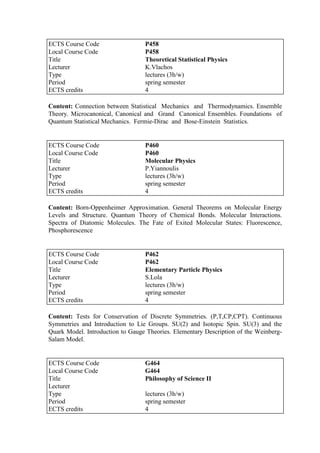
Content: Connection between Statistical Mechanics and Thermodynamics. Ensemble
Theory. Microcanonical, Canonical and Grand Canonical Ensembles. Foundations of
Quantum Statistical Mechanics. Fermie-Dirac and Bose-Einstein Statistics.
Content: Born-Oppenheimer Approximation. General Theorems on Molecular Energy
Levels and Structure. Quantum Theory of Chemical Bonds. Molecular Interactions.
Spectra of Diatomic Molecules. The Fate of Exited Molecular States: Fluorescence,
Phosphorescence
Content: Tests for Conservation of Discrete Symmetries. (P,T,CP,CPT). Continuous
Symmetries and Introduction to Lie Groups. SU(2) and Isotopic Spin. SU(3) and the
Quark Model. Introduction to Gauge Theories. Elementary Description of the Weinberg-
Salam Model.
ECTS Course Code P458
Local Course Code P458
Title Theoretical Statistical Physics
Lecturer K.Vlachos
Type lectures (3h/w)
Period spring semester
ECTS credits 4
ECTS Course Code P460
Local Course Code P460
Title Molecular Physics
Lecturer P.Yiannoulis
Type lectures (3h/w)
Period spring semester
ECTS credits 4
ECTS Course Code P462
Local Course Code P462
Title Elementary Particle Physics
Lecturer S.Lola
Type lectures (3h/w)
Period spring semester
ECTS credits 4
ECTS Course Code G464
Local Course Code G464
Title Philosophy of Science II
Lecturer
Type lectures (3h/w)
Period spring semester
ECTS credits 4
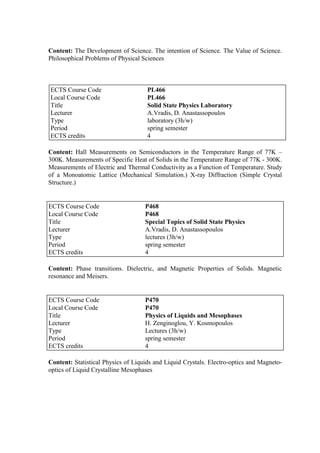
Content: The Development of Science. The intention of Science. The Value of Science.
Philosophical Problems of Physical Sciences
Content: Hall Measurements on Semiconductors in the Temperature Range of 77K –
300Κ. Measurements of Specific Heat of Solids in the Temperature Range of 77K - 300K.
Measurements of Electric and Thermal Conductivity as a Function of Temperature. Study
of a Monoatomic Lattice (Mechanical Simulation.) X-ray Diffraction (Simple Crystal
Structure.)
Content: Phase transitions. Dielectric, and Magnetic Properties of Solids. Magnetic
resonance and Meisers.
Content: Statistical Physics of Liquids and Liquid Crystals. Electro-optics and Magneto-
optics of Liquid Crystalline Mesophases
ECTS Course Code PL466
Local Course Code PL466
Title Solid State Physics Laboratory
Lecturer A.Vradis, D. Anastassopoulos
Type laboratory (3h/w)
Period spring semester
ECTS credits 4
ECTS Course Code P468
Local Course Code P468
Title Special Topics of Solid State Physics
Lecturer A.Vradis, D. Anastassopoulos
Type lectures (3h/w)
Period spring semester
ECTS credits 4
ECTS Course Code P470
Local Course Code P470
Title Physics of Liquids and Mesophases
Lecturer H. Zenginoglou, Y. Kosmopoulos
Type Lectures (3h/w)
Period spring semester
ECTS credits 4
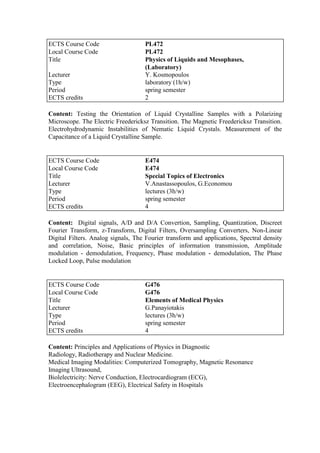
Content: Testing the Orientation of Liquid Crystalline Samples with a Polarizing
Microscope. The Electric Freedericksz Transition. The Magnetic Freedericksz Transition.
Electrohydrodynamic Instabilities of Nematic Liquid Crystals. Measurement of the
Capacitance of a Liquid Crystalline Sample.
Content: Digital signals, A/D and D/A Convertion, Sampling, Quantization, Discreet
Fourier Transform, z-Transform, Digital Filters, Oversampling Converters, Non-Linear
Digital Filters. Analog signals, The Fourier transform and applications, Spectral density
and correlation, Noise, Basic principles of information transmission, Amplitude
modulation - demodulation, Frequency, Phase modulation - demodulation, The Phase
Locked Loop, Pulse modulation
Content: Principles and Applications of Physics in Diagnostic
Radiology, Radiotherapy and Nuclear Medicine.
Medical Imaging Modalities: Computerized Tomography, Magnetic Resonance
Imaging Ultrasound,
Biolelectricity: Nerve Conduction, Electrocardiogram (ECG),
Electroencephalogram (EEG), Electrical Safety in Hospitals
ECTS Course Code PL472
Local Course Code PL472
Title Physics of Liquids and Mesophases,
(Laboratory)
Lecturer Y. Kosmopoulos
Type laboratory (1h/w)
Period spring semester
ECTS credits 2
ECTS Course Code E474
Local Course Code E474
Title Special Topics of Electronics
Lecturer V.Anastassopoulos, G.Economou
Type lectures (3h/w)
Period spring semester
ECTS credits 4
ECTS Course Code G476
Local Course Code G476
Title Elements of Medical Physics
Lecturer G.Panayiotakis
Type lectures (3h/w)
Period spring semester
ECTS credits 4
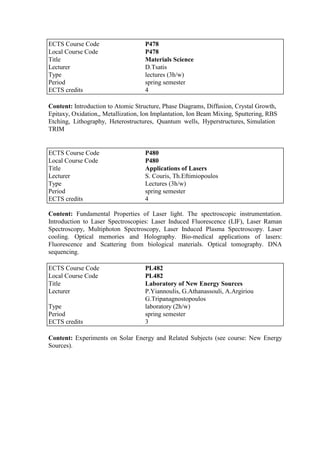
Content: Introduction to Atomic Structure, Phase Diagrams, Diffusion, Crystal Growth,
Epitaxy, Oxidation,, Metallization, Ion Implantation, Ion Beam Mixing, Sputtering, RBS
Etching, Lithography, Heterostructures, Quantum wells, Hyperstructures, Simulation
TRIM
Content: Fundamental Properties of Laser light. The spectroscopic instrumentation.
Introduction to Laser Spectroscopies: Laser Induced Fluorescence (LIF), Laser Raman
Spectroscopy, Multiphoton Spectroscopy, Laser Induced Plasma Spectroscopy. Laser
cooling. Optical memories and Holography. Bio-medical applications of lasers:
Fluorescence and Scattering from biological materials. Optical tomography. DNA
sequencing.
Content: Experiments on Solar Energy and Related Subjects (see course: New Energy
Sources).
ECTS Course Code P478
Local Course Code P478
Title Materials Science
Lecturer D.Tsatis
Type lectures (3h/w)
Period spring semester
ECTS credits 4
ECTS Course Code P480
Local Course Code P480
Title Applications of Lasers
Lecturer S. Couris, Th.Eftimiopoulos
Type Lectures (3h/w)
Period spring semester
ECTS credits 4
ECTS Course Code PL482
Local Course Code PL482
Title Laboratory of New Energy Sources
Lecturer P.Yiannoulis, G.Athanassouli, A.Argiriou
G.Tripanagnostopoulos
Type laboratory (2h/w)
Period spring semester
ECTS credits 3
Content: Gunn Diodes. p-n , p+
- n, n+
- p Junctions. Electrical Breakdown in p-n
Junctions. Schottky Diodes. Heterojunctions. Ionic Conductivity and Devices. Device
Modeling.
Content: Fundamentals of Tensor Analysis. Principles and Methods of Continuum
Mechanics. Langrangian and Eulerian Methods of Description. Deformation Tensors.
Deformation rate Tensor. Velocity Distribution. Continuum Equation. Stress Vector and
Tensor. Principles of Momentum and Angular Momentum. Equations of Motion of a
Continuum. Linear Elastic Systems. Ideal Fluid. Newtonean Fluid
Content: DMA and Interrupts. Peripheral Interfacing. I/O Devices for Process and
Instrumentation Control. Transducers, Sensors, Optocouplers, A/D and D/A Converters.
Data Acquisition Systems. Development Aids and Trouble Shooting Techniques.
Advanced Microprocessors and Microcontrollers.
ECTS Course Code P484
Local Course Code P484
Title Physics of Semiconductor Devices
Lecturer K.A.Thoma
Type lectures (3h/w)
Period spring semester
ECTS credits 4
ECTS Course Code P486
Local Course Code P486
Title Continuum Mechanics
Lecturer A.Terzis
Type lectures (3h/w)
Period spring semester
ECTS credits 4
ECTS Course Code E488
Local Course Code E488
Title Microcomputers II
Lecturer E.Zigouris
Type lectures (1h/w), laboratory (3h/w)
Period spring semester
ECTS credits 4
ECTS Course Code P490
Local Course Code P490
Title Introduction to quantum optics
Lecturer A.T. Georgas & D. Ghikas
Type lectures (3h/w)
Period spring semester
ECTS credits 4
Content: Review of quantum mechanics, time-dependent perturbation theory, interaction
of light with two-level atoms. Density matrix operator,damping, two-photon interaction.
Field quantization, spontaneous emission.Introduction to quantum information
technology, operation of a modelquantum computer, experiments demonstrating
nonlocality in quantum physics.
Content: The Topic of the Dissertation is given by the Instructors.
ECTS Course Code 492
Local Course Code 492
Title Dissertation
Lecturer Anyone of the Members of the Staff
Type Theoretical or Experimental (5h/w)
Period spring semester
ECTS credits 6
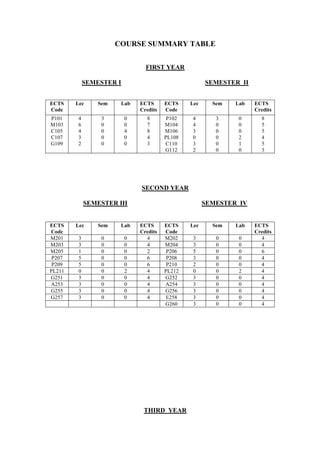
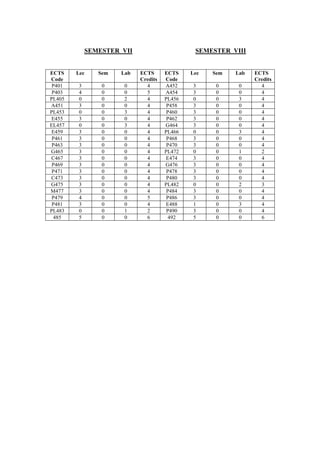
COURSE SUMMARY TABLE
FIRST YEAR
SEMESTER I SEMESTER II
ECTS
Code
Lec Sem Lab ECTS
Credits
ECTS
Code
Lec Sem Lab ECTS
Credits
P101
M103
C105
C107
G109
4
6
4
3
2
3
0
0
0
0
0
0
4
0
0
8
7
8
4
3
P102
M104
M106
PL108
C110
G112
4
4
3
0
3
2
3
0
0
0
0
0
0
0
0
2
1
0
8
5
5
4
5
3
SECOND YEAR
SEMESTER III SEMESTER IV
ECTS
Code
Lec Sem Lab ECTS
Credits
ECTS
Code
Lec Sem Lab ECTS
Credits
M201 3 0 0 4 M202 3 0 0 4
M203 3 0 0 4 M204 3 0 0 4
M205 1 0 0 2 P206 5 0 0 6
P207 5 0 0 6 P208 3 0 0 4
P209 5 0 0 6 P210 2 0 0 4
PL211 0 0 2 4 PL212 0 0 2 4
G251 3 0 0 4 G252 3 0 0 4
A253 3 0 0 4 A254 3 0 0 4
G255 3 0 0 4 G256 3 0 0 4
G257 3 0 0 4 E258 3 0 0 4
G260 3 0 0 4
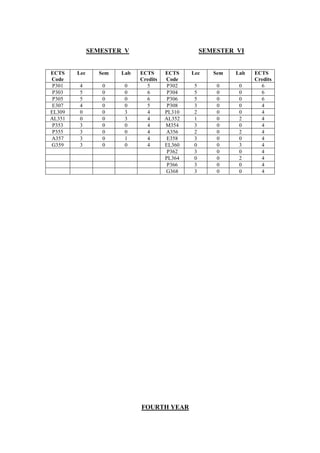
THIRD YEAR
SEMESTER V SEMESTER VI
ECTS
Code
Lec Sem Lab ECTS
Credits
ECTS
Code
Lec Sem Lab ECTS
Credits
P301 4 0 0 5 P302 5 0 0 6
Ρ303 5 0 0 6 Ρ304 5 0 0 6
Ρ305 5 0 0 6 P306 5 0 0 6
Ε307 4 0 0 5 P308 3 0 0 4
ΕL309 0 0 3 4 PL310 2 0 0 4
AL351 0 0 3 4 AL352 1 0 2 4
P353 3 0 0 4 M354 3 0 0 4
P355 3 0 0 4 A356 2 0 2 4
A357 3 0 1 4 E358 3 0 0 4
G359 3 0 0 4 EL360 0 0 3 4
P362 3 0 0 4
PL364 0 0 2 4
P366 3 0 0 4
G368 3 0 0 4
FOURTH YEAR
SEMESTER VII SEMESTER VIII
ECTS
Code
Lec Sem Lab ECTS
Credits
ECTS
Code
Lec Sem Lab ECTS
Credits
P401 3 0 0 4 A452 3 0 0 4
Ρ403 4 0 0 5 A454 3 0 0 4
ΡL405 0 0 2 4 PL456 0 0 3 4
A451 3 0 0 4 P458 3 0 0 4
PL453 0 0 3 4 P460 3 0 0 4
E455 3 0 0 4 P462 3 0 0 4
EL457 0 0 3 4 G464 3 0 0 4
E459 3 0 0 4 PL466 0 0 3 4
P461 3 0 0 4 P468 3 0 0 4
P463 3 0 0 4 P470 3 0 0 4
G465 3 0 0 4 PL472 0 0 1 2
C467 3 0 0 4 E474 3 0 0 4
P469 3 0 0 4 G476 3 0 0 4
P471 3 0 0 4 P478 3 0 0 4
C473 3 0 0 4 P480 3 0 0 4
G475 3 0 0 4 PL482 0 0 2 3
M477 3 0 0 4 P484 3 0 0 4
P479 4 0 0 5 P486 3 0 0 4
P481 3 0 0 4 E488 1 0 3 4
PL483 0 0 1 2 P490 3 0 0 4
485 5 0 0 6 492 5 0 0 6

En physics

  • 1.
    ERASMUS-SOCRATES PROGRAM UNIVERSITY OFPATRAS Department of Physics GENERAL INFORMATION AND STRUCTURE OF THE DEPARTMENT Chairperson : Professor Vassilios Anastassopoulos Tel: +302610 996147 Fax: +302610 997456 Email: vassilis@physics.upatras.gr http://ellab.physics.upatras.gr/Personnel/Faculty/Homepages/Anastasopoulos/vassilis.html The Secretariat: Mrs. Dimitra Giannakopoulou Tel: +302610 996077 Fax: +302610 996089 Degrees Offered: Undergraduate: 4 year degree (Ptychio) Graduate : M.Sc., Ph.D. Description of the Department The Department of Physics is concerned with the teaching and study of the fundamental laws and phenomena of nature, from the structure of elementary particles to the structure of the Universe. In addition, great emphasis is given to the practical importance of Physics as the foundation of modern technology. The Department has one of the largest undergraduate student body in the University with over 1200 undergraduates currently enrolled, as well as about 70 graduate students. There are 50 faculty members who undertake teaching and research activities. The Erasmus-Socrates Departmental Coordinator: Associate Professor Evangelos Vitoratos UNIVERSITY OF PATRAS Department of Physics 26500 Patras, GREECE Tel.: +302610 997 487 - 996065 Fax : +302610 997 487 Email: vitorato@pelops.physics.upatras.gr
  • 2.
    The ECTS DepartmentalCoordinator: Associate Professor Athanassios Vomvas UNIVERSITY OF PATRAS Department of Physics 26500 Patras, GREECE Tel.: +302610 997 451 / 996 075 Fax : +302610 997 481 / 996089 Email: avomvas@physics.upatras.gr Structure of the Department Divisions: There are four divisions in the Department: The Applied Physics Division The Condensed Matter Division The Electronics and Computers Division The Theoretical and Mathematical Physics and Philosophy of Science Division Laboratories: In the Department there are the following Laboratories: The Electronics Laboratory, The Atmospheric Physics Laboratory, the Astronomy Laboratory, the Solid State Physics Laboratory, the Laser Laboratory, the Renewable Energy and Environment Laboratory, the Laboratory of the Physics of Liquids and Mesophases, the Polymer and Composite Materials Laboratory and further six Laboratory facilities for the general use of the Department. List of faculty members of the Department (in parenthesis the University they conducted their PhD thesis and the year they finished it) Professors Anastassopoulos Vassilios (Univ. of Patras, GR, 1986) Bakas Ioannis ( Univ. of London, UK, 1985) Efthimiopoulos Thomas (Mc Master Un., Canada, 1978) Georgas Anastassios (Univ. of Southern California, USA, 1977) Geroyannis Vassilios (Univ. of Patras, GR, 1978) Yiannoulis Panayiotis (Ohio State University, USA, 1973) Goudis Christos (Univ. of Manchester, UK, 1974) Haritantis Ioannis (Univ. of Patras, GR, 1976) Karahalios Georgios ( Univ. of Patras, GR, 1978) Mytilineou Eugenia (Univ. of Cambridge, UK, 1978) Pisanias Michail (Univ. of Tennessee, USA, 1972) Toprakcioglu Christos (Univ. of Cambridge, UK, 1980) Zdetsis Aristides ( Thomas Jepherson Univ.,USA, 1976) Zioutas Konstantin (Univ. of Bonn, Germany, 1972)
  • 3.
    Assosiate Professors Athanassouli Georgia(Univ. of Patras, GR, 1984) Couris Stylianos ( Univ. of Toulouse, France, 1983) Georga Stavroula ( Univ. of Patras, GR, 1985) Fotopoulos Spyridon (Univ. of Patras, GR, 1983) Ghikas Dimitrios (Univ. of London, UK, 1978) Kosmopoulos Ioannis (Univ. of Patras, GR, 1975) Krontiras Christoforos ( Univ. of Patras, GR, 1989) Lola Smaragda (Univ. of Oxford, UK,1993) Persefonis Petros ( Univ. of Patras, GR, 1983) Sakkopoulos Sotirios (Univ. of Patras, GR, 1974) Sotiropoulos Ioannis ( Univ. of Patras, GR, 1980) Thoma Kallirroe-Andriani ( Univ. of Kent, UK, 1980) Vitoratos Evagelos (Univ. of Patras, GR, 1989) Vomvas Athanassios (Univ. of Patras, GR, 1984) Vradis Alexandros ( Univ. of Patras, GR, 1984) Zenginoglou Haralambos (Univ. of Patras, GR, 1981) Zigouris Evangelos ( Univ. of Patras, GR, 1986) Assistant Professors Argiriou Athanassios (Univ. of Provence, France, 1987) Brodimas Georgios ( Univ. of Patras, GR, 1991) Giannetas Vassilios ( Univ. of Patras, GR, 1986) Economou Georgios (Univ. of Patras, GR, 1989) Papatheou Vassilios ( Univ. of Patras, GR, 1985 ) Pomoni Ekaterini ( Univ. of Patras, GR, 1983) Psillakis Zaharias ( Univ. of Patras, GR, 1985) Psychalinos Costas (Univ. of Patras, 1991) Sourlas Dimitrios (Univ. of Patras, GR, 1980) Terzis Andreas ( Univ. of Patras, GR, 1991) Tripanagnostopoulos Ioannis ( Univ. of Patras, GR, 1992) Tsatis Dimitrios (Univ. of Patras, GR, 1979) Vlachos Konstantinos ( Univ. of Patras, GR, 1983) Zafiropoulos Vassilios ( Univ. of Manchester, UK, 1981) Lecturers Anastassopoulos Dimitrios ( Univ. of Patras, GR, 1991) Bakalis Dimitrios (Univ. of Patras, 2001) Christopoulou Panagiota-Eleftheria (Univ. of Patras, GR, 1993) Flogaitis Ekaterini ( Univ. of Patras, GR, 1980) Papadopoulos Panagiotis (Univ. of Patras, GR, 1998) Rapti Anastasia ( Univ. of Patras, GR, 1998)
  • 4.
    Research activities ofthe Department The faculty of the Department are actively involved in the following topics: Conventional energy sources; photoelectric and transport properties of crystals, nanocrystalline and amorphous semiconductors; liquid crystals and their applications; optical properties of liquid crystals; magnetic materials; microelectronic materials; models of ionic devices; insulating materials and semiconductors; time resolved femtosecond spectroscopy; multi- photon processes by femtosecond lasers; photonic polymers; fiber optics sensors; theoretical physics of lasers; non-linear optics; X ray diffractometry; high temperature superconductors; electrical properties and photoconductivity of insulating materials and polymers; properties of conductive polymers; materials, ionic mixing and embedding; lithography; design and implementation of integrated circuits; signal processing and image; aids for handicapped people; dynamic astronomy; mechanical and dynamic systems; atmospheric physics; theoretical and applied astrophysics; fluid mechanics. Instrumental Facilities of the Department The research groups of the Department have developed the necessary facilities to carry on their own research activities mentioned above. Moreover the Department has purchased two FTIR Spectrophotometers for the needs of optical measurements. The Computer Center of the Department is fully equipped with 20 work stations (Pentium 4) working in Windows XP (service pack 2) environment. The server is an IBM dual Xeon, 2GHz, 1024 MB Ram running in Redhat Enterprise Linux. The Department has at its disposal a small but fully equipped astronomical observatory. Program of study The courses offered by the Department are divided in two categories: the compulsory courses, e.g. the courses containing the basic knowledge every Physicist should be acquired with, and the elective ones. The elective courses can form groups, upon student‟s choice, focusing on specific areas of Physics. COURSE CATALOGUE OF THE DEPARTMENT OF PHYSICS Regarding the course code numbers in this catalogue the following conventions apply: All course code numbers are three digit integers preceded by one or two letters of the Latin Alphabet. The first letter classifies the course in one of the following categories: A: Astronomy, Astrophysics, Atmospheric Sciences C: Computer science, Programming, Data processing, Numerical analysis E: Electronics G: General M: Mathematics P : Physics
  • 5.
    Laboratory courses aredesignated by the additional letter L, following the course classification letter. e.g., course code number ELxxx designates an electronics laboratory course, while code number PLxxx designates a physics laboratory course. The three digit integers in the course code numbers classify each course in one of four levels of the content material: 101-199: Introductory, or elementary level courses (1st -year) 201-299: Intermediate level courses (2nd -year) 301-399: Intermediate-advanced level courses (3rd -year) 401-499: Advanced level courses and/or specialized courses (4rth -year) The following conventions also apply: odd code numbers designate courses taught fall semesters, while even code numbers designate courses taught spring semesters. Code numbers in the ranges: 101-149, 201-249, 301-349, 401-499 designate required courses, while course numbers in the ranges: 152-199, 252-299, 352-399, and 402-499 designate elective courses. The letter designation of the category is not followed for the Dissertation, which can be either experimental or theoretical from any of the above mentioned categories In addition to the courses offered by the department of physics, students of physics are required to take eight ECTS of introductory chemistry. The total number of the ECTS credits in each Semester is 30 Required Course Summary Table First Year ECTS ECTS ECTS ECTS Course Code Lec Sem Lab credits Course Code Lec Sem Lab credits Phys P101 4 3 0 8 Phys P102 4 3 0 8 Math M103 6 0 0 7 Math M104 4 0 0 6 D.Pr. C105 4 0 4 8 Math M106 3 0 0 5 Comp C107 3 0 0 4 Lab PL108 0 0 2 3 Chem G109 2 0 0 3 Comp C110 3 0 1 5 Chem G110 2 0 0 3 Second Year ECTS ECTS ECTS ECTS Course Code Lec Sem Lab credits Course Code Lec Lab Sem credits Math M201 3 0 0 4 Math M202 3 0 0 4 Math M203 3 0 0 4 Math M204 3 0 0 4 Math M205 1 0 0 2 Phys P206 5 0 0 6 Phys P207 5 0 0 6 Phys P208 3 0 0 4 Phys P209 5 0 0 6 Phys P210 2 0 0 4 Phys PL211 0 0 2 4 Phys PL212 0 0 2 4
  • 6.
    Electiv. 4 Electiv.4 Third Year ECTS ECTS ECTS ECTS Course Code Lec Sem Lab credits Course Code Lec Sem Lab credits Phys P301 4 0 0 5 Phys P302 5 0 0 5 Phys P303 5 0 0 6 Phys P304 5 0 0 5 Phys P305 5 0 0 6 Phys P306 5 0 0 5 Electr. E307 4 0 0 5 Phys P308 3 0 0 5 Electr. EL309 0 0 3 4 Phys PL310 0 0 2 4 Electiv. 4 Electiv. 6 Fourth Year ECTS ECTS ECTS ECTS Course Code Lec Sem Lab credits Course Code Lec Sem Lab credits Phys P401 3 0 0 4 Phys Ρ403 4 0 0 5 Electiv. 30 Phys ΡL405 0 0 2 4 Electiv. 17 Analytical Course Table 1st -Year: Fall Semester (I) Content: Kinematics. Newton‟s Laws of Motion and their Applications. Work and Energy. Rotational Motion, Angular Momentum. Gravitation. Elasticity, Oscillatory Motion, Fluid Mechanics. Thermodynamics, Mechanical Waves, Sound. ECTS Course Code P101 Local Course Code P101 Title Introduction to Mechanics Lecturer K.Pomoni and P.Papadopoulos Type lectures (4h/w), seminars (3h/w) Period autumn semester ECTS credits 8
  • 7.
    Content: Analysis ofReal Functions. Differentiation. Maxima and Minima. Series Expansions. Integration. Introduction to Differential Equations. Content: Error Analysis. Error propagation. Mean value and Standard Deviation of Measurements. Graphical Representation of Experimental Data. Curve Fitting. Least Squares Method. Rejection of experimental data - Chauvenet‟s Criterion. Content: Foundations of Computing. Binary system, Algebra Boole, Gates, Digital circuits (combinatorial and sequential), the microcomputer, I/O devices, Interfaces, Programming languages and Operating systems, Computer networks, The Internet, Data Bases. Artificial Intelligence. Multimedia. ECTS Course Code M103 Local Course Code M103 Title Calculus Lecturer G.Brodimas, V.Zafiropoulos Type lectures (6h/w) Period autumn semester ECTS credits 7 ECTS Course Code C105 Local Course Code C105 Title Analysis of Experimental Data (lectures & Laboratory) Lecturer S.Sakkopoulos, E.Vitoratos, Chr.Krontiras P. Papadopoulos, V.Papatheou ,M. Pisanias Type lectures (4h/w), laboratory (4h/w) Period autumn semester ECTS credits (4+4) ECTS Course Code C107 Local Course Code C107 Title Introduction to Computer Science Lecturer V.Anastassopoulos,V.Geroyannis. Type lectures (3h/w) Period autumn semester ECTS credits 4 ECTS Course Code G109 Local Course Code G109 Title Basic Principles of Chemistry I Lecturer M.Soupioni Type lectures (2h/w) Period autumn semester ECTS credits 3
  • 8.
    Content: Atoms, Moleculesand Ions. Principles of Thermochemistry. Quantum Theory of the Atom. Electronic Structures and Periodicity. Ionic and Covalent Bond. Molecular Geometry and Theory of Chemical Bond. 1st -Year:Spring Semester (II) Content: Electric Charges and Electric Fields. Gauss Law. Electrical Potential. Capacitance. Conductors and Dielectrics. Electrical Resistance. Currents and Circuits. Magnetic Forces and Magnetic Fields. Electromotive Force. Electromagnetic Induction. Inductance. Alternating Currents. Electromagnetic Waves. Light: Nature and Propagation. Geometrical Optics. Polarization, Interference, Diffraction. Content: Algebra of Vectors. Vector Functions. Scalar Fields, Directional Derivative, Gradient. Vector Fields, Divergence, Curl. Line Integrals. Double Integrals. Surface Integrals. Volume Integrals. Green‟s, Stoke‟s and Gauss‟s Theorem. Curvilinear Coordinates. Elements of Tensor Analysis. ECTS Course Code P102 Local Course Code P102 Title Introduction to Electricity, Magnetism and Light Lecturer S.Georga, Chr.Krontiras Type lectures (4h/w), seminars (3h/w) Period spring semester ECTS credits 8 ECTS Course Code M104 Local Course Code M104 Title Vector Analysis Lecturer D.Sourlas Type lectures (4h/w) Period spring semester ECTS credits 5 ECTS Course Code M106 Local Course Code M106 Title Linear Algebra and Analytical Geometry Lecturer D.Sourlas, K.Vlachos Type lectures (3h/w) Period spring semester ECTS credits 5
  • 9.
    Content: Theory ofMatrices. Vector Spaces. Basis and Dimension. Linear Mapping. Matrices and Linear Operators. Determinants. Eigenvalues and Eigenvectors. The Straight Line. Planes and Straight Lines in Space. Conic Sections: Ellipse, Parabola, Hyperbola. Surfaces. Coordinate Systems. Content: Measurement of Acceleration due to Gravity. Elasticity Modulus. Mechanical Energy Conservation with the Maxwell Disc. Torsion Modulus. Viscosity Measurement with the Ostwald Viscometer. Measurement of Focus Distance of Lenses. Elastic and Inelastic Collisions. Harmonic Oscillations. Content: Programming Fundamentals. FORTRAN 90 Fundamentals: Input and Output, Control Structures (Decision-Based Structures and Loops), Arrays. Data: Data Types, Data Specification and Declaration, Data Arithmetic, Data Structures, Data Files. Program Units: Main Programs, Modules, Procedures (Subprograms: Functions and Subroutines), Internal and External Procedures. Content: Gases. Liquids and Solids. Solutions. Chemical Kinetics. Chemical Equilibrium. Acids and Bases. Ionic Equilibria. Solubility. Chemical Thermodynamics. Oxidation and Reduction-Electrochemistry ECTS Course Code PL108 Local Course Code PL108 Title Mechanics Laboratory Lecturer G.Athanassouli,V.Papatheou,G.Brodimas, K.Thoma, M.Pisanias, P.Persefonis Type laboratory (2h/w) Period spring semester ECTS credits 4 ECTS Course Code C110 Local Course Code C110 Title Principles of Programming I (FORTRAN 90) Lecturer V.Geroyannis, D.Bakalis, Y.Kosmopoulos, Z.Psillakis, T.Argyreas Type lectures (3h/w) + laboratory (1h/w) Period spring semester ECTS credits 5 ECTS Course Code G112 Local Course Code G112 Title Basic Principles of Chemistry II Lecturer M.Soupioni Type lectures (2h/w) Period spring semester ECTS credits 3
  • 10.
    2nd -Year:Fall Semester (III) Content:Numerical Series. Sequences and Series of Functions. Improper Integrals of the 1st , 2nd and 3rd Type. Laplace and Fourier Transforms. Content: Basic Concepts. Integrative Curves of Differential Equations. The Method of Successive Approximations. The Existence and Uniqueness Theorem for Differential Equations. Separable Equations. Homogeneous Equations. Linear Equations of First Order. Basic Theory of Linear Differential Equations. Series Method. Systems of Linear Differential Equations. Content: Introduction to Probability. Techniques of Counting. Conditional Probability and Independence. Random Variables. Discrete and Continuous Distributions of Random Variables ECTS Course Code M201 Local Course Code M201 Title Series and Improper Integrals Lecturer K.Vlachos Type lectures (3h/w) Period autumn semester ECTS credits 4 ECTS Course Code M203 Local Course Code M203 Title Ordinary Differential Equations Lecturer D.Sourlas Type lectures (3h/w) Period autumn semester ECTS credits 4 ECTS Course Code M205 Local Course Code M205 Title Theory of Probability Lecturer Z.Psillakis Type lectures (1h/w) Period autumn semester ECTS credits 2
  • 11.
    Content: Basic ThermodynamicPrinciples. Relations Between Macroscopic Properties and their Derivative. Applications to Ideal and Real Gases. Phase Transformations. Content: Free Oscillations. Forced Oscillations. Standing Waves. Wave Propagation. Transmission Lines. Polarization. Interference. Diffraction. . Content: Hydrostatics: Buoyancy. Viscosity Coefficient. Surface Tension. Determination of the Heat Capacities Ratio Cp/Cv of Air. Determination of Heat Conduction Coefficients. Wind Tunnel: Determination of Wind Resistance Coefficients. Students are required to take another four (4) credits which they may choose from the following pool of Elective Courses: ECTS Course Code P207 Local Course Code P207 Title Introduction to Thermodynamics Lecturer H.Zenginoglou Type lectures (5h/w) Period autumn semester ECTS credits 6 ECTS Course Code P209 Local Course Code P209 Title Wave Physics Lecturer Y.Kosmopoulos Type lectures (5h/w) Period autumn semester ECTS credits 6 ECTS Course Code PL211 Local Course Code PL211 Title Fluid Mechanics Laboratory Lecturer V.Giannetas,A.Argiriou,G.Athanassouli, C.Krontiras, G.Tripanagnostopoulos, N.Tsiberis, Type laboratory (2h/w) Period autumn semester ECTS credits 4
  • 12.
    Content: The Birthand the Meaning of Philosophy. Philosophy and Science. Logic, Gnosiology, Metaphysics, Morality Content: Celestial Sphere and Elementary Celestial Mechanics. Time Keeping Systems. Reduction of Positional Observations. Geocentric Planetary Phenomena. The Solar System. Our Planet Earth Content: Introduction. Cognitive Psychology in Comparison to Behaviourism. Cognitive Mechanisms and Cognitive Functions. Stages of Cognitive processing. The nature and functioning of Perception. Memory, Short Term Memory (Working memory) and Long- Term Memory. Language. Language and Thought. The Cognitive Function of Problem Solving. The cognitive analysis of reading.Oral and written language.Information processing in reading. Text reading and comprehension. Comprehension and memory.The specific reading disability of Dyslexia. . ECTS Course Code G251 Local Course Code G251 Title Introduction to Philosophy I Lecturer Type lectures (3h/w) Period autumn semester ECTS credits 4 ECTS Course Code A253 Local Course Code A253 Title General Astronomy Lecturer A.Flogaitis Type lectures (3h/w) Period autumn semester ECTS credits 4 ECTS Course Code G255 Local Course Code G255 Title Cognitive Phychology Lecturer C.Porpodas Type lectures (3h/w) Period autumn semester ECTS credits 4
  • 13.
    Content: Introduction toModern Biology. Biological Molecules and Metabolism. Structure and Function of Macromolecules. The Central Dogma. Viruses. The Procaryotic cell. The eucaryotic cell. Classification of Organisms. Immunology. Antibiotics. Genetics. Genetic Engineering (Recombinant DNA Technology and its Applications). Principles of Development Biology, Physiology and Ecology. Origin and Evolution of Organisms 2nd -Year:Spring Semester (IV) Content: Elliptic, Parabolic and Hyperbolic Partial Differential Equations as Related to Stationary Problems and Irreversible and Reversible Processes. Methods of Solution: Separation of Variables, Introduction to Eigenvalue Expansions, Integral Transforms, Green‟s Functions. Content: Complex Numbers and Functions. Complex Differentiation and Integration, Taylor and Laurent Series. Residues. ECTS Course Code G257 Local Course Code G257 Title General Biology Lecturer P.Katsoris Type lectures (3h/w) Period autumn semester ECTS credits 4 ECTS Course Code M202 Local Course Code M202 Title Partial Differential Equations Lecturer G.Karahalios Type lectures (3h/w) Period spring semester ECTS credits 4 ECTS Course Code M204 Local Course Code M204 Title Complex Variables Lecturer K.Vlachos Type lectures (3h/w) Period spring semester ECTS credits 4
  • 14.
    Content: Introduction toQuantum Mechanics, Atomic and Molecular Physics. Elements of Nuclear and Particle Physics. Content: Basic Concepts. Kinematics. Particle Dynamics in One Dimension. Central Forces. Systems of Particles. Potential Theory. Non-Inertial Coordinate Systems. Content: Lorentz Transformations. Covariant Formulation of Special Relativity. Applica- tions to Mechanics, Electromagnetism and Quantum Mechanics. ECTS Course Code P206 Local Course Code P206 Title Introduction to Modern Physics Lecturer A.Zdetsis Type lectures (5h/w) Period spring semester ECTS credits 6 ECTS Course Code P208 Local Course Code P208 Title Classical Mechanics Lecturer G.Karahalios Type lectures (3h/w) Period spring semester ECTS credits 4 ECTS Course Code P210 Local Course Code P210 Title Special Theory of Relativity Lecturer D.Ghikas Type lectures (2h/w) Period spring semester ECTS credits 4
  • 15.
    Content: Basic instrumentsstudy and multimeter construction. Measurements of the Magnetic Field of coils and solenoids. Measurements of the Magnetic Field of a circular coil. Electrostatic Fields study. RLC circuits measurements. Magnetic Hysterisis study. Transformers measurements. Students are required to take another four (4) credits which they may choose from the following pool of Elective Courses: Content: Politics, Esthetics, Philosophy of History. Philosophical Systems of Newer and Contemporary Time Content: Stellar Structure and Evolution. Variable Stars. Rotating Stars. Magnetic Stars. Novae. Supernovae. White Dwarfs. Neutron Stars. Pulsars. Black Holes. Interstellar Matter (HII Complexes- Molecular Clouds, Planetary Nebulae, Supernova Remnants). Cosmic Magnetic Fields ECTS Course Code G252 Local Course Code G252 Title Introduction to Philosophy II Lecturer Type lectures (3h/w) Period spring semester ECTS credits 4 ECTS Course Code A254 Local Course Code A254 Title Astrophysics I Lecturer C.Goudis, P-E. Christopoulou Type lectures (3h/w) Period spring semester ECTS credits 4 ECTS Course Code PL212 Local Course Code PL212 Title Electricity and Magnetism Laboratory Lecturer K.Pomoni, E.Mytilineou, J.Sotiropoulos A.Argiriou, K.Zabara, N.Tsiberis, C.Zenginoglou, G.Economou Type laboratory (2h/w) Period spring semester ECTS credits 4
  • 16.
    Content: The Principlesof Guidance. The non Directive and Person-Centered Counselling and the Psychology of Childhood and Adolescence. The Main Areas of Educational Interventions. Content: Electric Signals and Circuit Elements, Circuit Analysis Techniques, Transient Circuits, AC Steady-State Analysis, Fourier Analysis Techniques, Application of Laplace Transform to Circuit Analysis, Frequency Response, Magnetically Coupled Networks. Content: The course is tailored to the needs of non-economics students, having no prior knowledge of economics. The aim of the course is twofold: Firstly, to familiarize students with the concepts and tools of economic analysis; secondly, to motivate students towards further study of economics issues. Having attended the course, students will be able to give answers to questions such as (indicatively): «Are there any economists in Heaven?”» «How much has my „free‟ lunch cost?» «What does the 24-hour convenience store in my neighborhood and IBM have in common?» «Why does oil price go up?» «Why the government does not just print money to give to the poor?» «How much does a theater ticket cost to 15-year-old Timmy and how much does it actually cost to 35-year-old Edward?» «Is education a public good, and, if yes, how come my neighbour‟s Ferrari is not? (we would love a free ride!)» «Is grandma Duck right in getting annoyed at night, during the rehearsals of my group (called “Blood-thirsty Satans of Metal”)?» «Should I offer gifts or cash for Christmas?» «Why the Rolling Stones sell out?». ECTS Course Code G256 Local Course Code G256 Title Evolutionary Psychology Lecturer K.Diakogiorgi Type lectures (3h/w) Period spring semester ECTS credits 4 ECTS Course Code E258 Local Course Code E258 Title Theory of Electric Circuits and Signals Lecturer S.Fotopoulos Type lectures (3h/w) Period spring semester ECTS credits 4 ECTS Course Code G260 Local Course Code G260 Title Economic Analysis Lecturer A.Pseiridis Type lectures (3h/w) Period spring semester ECTS credits 4
  • 17.
    3rd -Year:Fall Semester (V) Content:Constraints. Possible and Virtual Displacements. D‟Alembert‟s Principle. Lagrange‟s Equations. Canonical Equations of Hamilton. Phase Space. Poisson Bracket Dynamics of Rigid Bodies. Small Oscillations. Calculus of Variations and Hamilton‟s Principle. Canonical Transformations. Hamilton-Jacobi Equation. Content:. Review of Vector Calculus, Theorems of Divergence, Stokes, and Helmholtz. Electrostatic Fields in Vacuum, Dielectrics and Conductors. Special Methods for Calculating Electric Fields and Potentials. Solutions of Laplace‟s and Poisson‟s Equation. Magnetostatic Fields, Biot-Savart Iaw, the Vector Potential, Magnetic Materials. Content: Basic principles of Quantum Mechanics. Wavefunction formalism. Dynamic evolution of Microsystems and Schrödinger equation. Observables and operators. The Measurement problem. Matrix representation. Simple One Dimensional Problems. Bound states and scattering states. Two-level system. Time-independent perturbation theory. ECTS Course Code P301 Local Course Code P301 Title Analytical Dynamics Lecturer G.Karahalios Type lectures (4h/w) Period autumn semester ECTS credits 5 ECTS Course Code P303 Local Course Code P303 Title Electromagnetism I Lecturer S. Couris Type lectures (5h/w) Period autumn semester ECTS credits 6 ECTS Course Code P305 Local Course Code P305 Title Quantum Mechanics I Lecturer A. Terzis Type lectures (5h/w) Period autumn semester ECTS credits 6
  • 18.
    Content: Basics ofSemiconductor Physics and Devices. Applications: Diodes, Bipolar and Field Effect Transistors. Design of Simple Amplifiers Using Bipolar and Field Effect Transistors. Operational Amplifiers. Introduction to Digital Circuits. Introduction to the Circuit Analysis using SPICE. Content: The Oscilloscope. Time and Frequency Behavior of RC Circuits. Applications of Diodes: Clipping and Rectifier Circuits. BJT Characteristics. Single Stage Transistor Amplifier. Linear applications of Operational Amplifiers. Analysis of circuits using SPICE. Students are required to take another four (4) credits which they may choose from the following pool of Elective Courses: Content: Telescopes. Sundials. Coordinate Systems. Determination of Coordinates of Heavenly Bodies. Constellations. Motion of the Planets. The Sun. ECTS Course Code E307 Local Course Code E307 Title Basic Electronics Lecturer I.Haritantis, C. Psychalinos Type lectures (4h/w) Period autumn semester ECTS credits 5 ECTS Course Code EL309 Local Course Code EL309 Title Electronic Measurements Laboratory Lecturer G.Economou, V.Anastassopoulos, S.Fotopoulos, I.Haritantis, C. Psychalinos Type laboratory (3h/w) Period autumn semester ECTS credits 4 ECTS Course Code AL351 Local Course Code AL351 Title Laboratory Astronomy Lecturer V.Zafiropoulos, A.Flogaitis Type laboratory (3h/w) Period autumn semester ECTS credits 4
  • 19.
    Content: Basic Concepts.Statics of Fluids. Kinematics of Fluids ( Flux. Substantial Derivative. Stream Function and Velocity Potential. Point Source. Rectilinear Vortices. Vortex Filaments. Vortex Sheets ). Dynamics of Fluids ( Continuity, Momentum, Energy and Angular Momentum Equations. Bernoulli‟s Law. Euler‟s Equation. Navier-Stokes Equations. Dimensional Analysis ). Introduction to Turbulent Flows. Content: Wave properties of light, interaction of light with matter, particle nature of light, discrete energy levels, radiative transitions, emission linewidth, quantum description of the radiating atom, radiative properties of molecules and solids, spontaneous emission stimulated emission, cavity modes, Gaussian beams, basic laser theory, spectroscopic applications. Basic texts: Laser Fundamentals, W.T. Silfvast, Cambridge Univ. Press. Laser spectroscopy W. Demtroder, Springer Content: Origin and Composition of the Atmosphere. Vertical Temperature Profile. Hydrostatic equation. Geopotential Height. Thermodynamics of the Atmosphere. Atmospheric Stability. Introduction to Dynamic Meteorology. General Circulation in the Atmosphere. ECTS Course Code P353 Local Course Code P353 Title Fluid Mechanics Lecturer A. Argiriou Type lectures (3h/w) Period autumn semester ECTS credits 4 ECTS Course Code P355 Local Course Code P355 Title Applied Optics Lecturer Th. Efthimiopoulos, S.Couris Type lectures (3h/w) Period autumn semester ECTS credits 4 ECTS Course Code A357 Local Course Code A357 Title Physics of the Atmosphere-Meteorology I Lecturer A. Argiriou, A.Rapti Type lectures (3h/w), laboratory (1h/w) Period autumn semester ECTS credits 3+1
  • 20.
    Content: The Earth‟sMagnetic Field - Archaeomagnetism - Ancient Pottery and the Strength of the Magnetic Field. Petromagnetism. Rocks, Sediments and the Trace of the Phenomenon of the Magnetic Reversion -Palaeomagnetism. Magnetic Stromatography. Recreation of the Deep and the Pangaia. The Basic Characteristics of the Earth‟s Gravity Field. The Shape of the Earth. The Trembling Chandler Movement of the Rotation Axis of the Earth. Diurnal Variations. The Millankovitch Theory and the Formation of the Glaciers. Plate Tectonics. The Increase of the Volume of the Earth. The Carey Theory - Earth, Moon, Comets and Asteroids. The Appearance of Glaciers and the Tectonic Evolution - Clube- Napier Theory. The Earth‟s Magnetic Field - Archaeomagnetism - Ancient Pottery and the Strength of the Magnetic Field. Petromagnetism. Rocks, Sediments and the Trace of the Phenomenon of the Magnetic Reversion - Palaeomagnetism. Magnetic Stromatography. Recreation of the Deep and the Pangaia. The Basic Characteristics of the Earth‟s Gravity Field. The Shape of the Earth. The Trembling Chandler Movement of the Rotation Axis of the Earth. Diurnal Variations. The Volume of the Earth. The Carey Theory - Earth, Moon, Comets and Asteroids. The Appearance of Glaciers and the Tectonic Evolution - Clube-Napier Theory. 3rd -Year:Spring Semester (VI) Content: Maximum Entropy Principle. Boltzmann Factor. Theory of Ideal Gases. Heat Capacity of Solids. Paramagnetism. Statistics of Systems with Variable Number of Particles. Planck, Fermi-Dirac and Bose-Einstein Statistics. ECTS Course Code G359 Local Course Code G359 Title Introduction to Geophysics Lecturer S.Papamarinopoulos Type lectures (3h/w) Period autumn semester ECTS credits 4 ECTS Course Code P302 Local Course Code P302 Title Statistical Physics Lecturer H.Zenginoglou Type lectures (5h/w) Period spring semester ECTS credits 6
  • 21.
    Content: Maxwell‟s equationsand the wave equation. Propagation of plane Electro- magnetic waves, reflection and refraction. Guided waves. Radiation of electromagnetic waves, Lienard-Wiechert potentials, radiation by moving charges (textbook: “Introduction to Electrodynamics”, by D.J. Griffiths). Content: Hydrogen Atom. Angular Momentum in Quantum Mechanics. Operators and Representations. Spin. Identical Particles and Fermi Gas. Perturbation Theory. Applications to Atomic System: Stark effect, Fine Structure, Zeeman effect, Hyper-fine Structure. Content: General properties of metals. Free Electron Gas Theories. Specific Heat, Electrical and Thermal Conductivity of Metals. Wiedemann-Franz law. Hall Effect. Crystal Structure of Solids. X-Ray Diffraction. Lattice Dynamics. Phonons. Optical Properties of Solids. ECTS Course Code P304 Local Course Code P304 Title Electromagnetism II Lecturer A.T. Georgas Type lectures (4 h/w), discussion (1h/w) Period spring semester ECTS credits 6 ECTS Course Code P306 Local Course Code P306 Title Quantum Mechanics II Lecturer I.Bakas Type lectures (5h/w) Period spring semester ECTS credits 6 ECTS Course Code P308 Local Course Code P308 Title Solid State Physics I Lecturer A.Vradis, D.Anastassopoulos Type lectures (3h/w) Period spring semester ECTS credits 4
  • 22.
    Content: Electron Diffraction-Electrone/m-Balmer Series-Stefan-Boltzmann Law -Photoelectric Effect-Zeeman Effect-Frank-Hertz Experiment-Electron Spin Resonance-Rutherford Scattering- Alpha Spectroscopy-α,β and γ Ray Absorption in Air and Solids-Electron Backscattering-Radiation from 226-Ra-Gamma Spectroscopy with SCA-Gamma Spectroscopy with MCA-Coincidence and Angular Correlation-NMR-Cosmic-Ray Muons-Neutron Activation Analysis-Optical Pumping Students are required to take another four (4) credits which they may choose from the following pool of elective courses: Content: Spectral Continuum. Determination of Temperature and Radius of Stars. UBV System. Color Indices. Spectral Types of Stars. H-R Diagram. Solar Rotation. Rotation of Saturn & Rings. Distance and Age of Stellar Clusters. Novae and Planetary Nebulae. Pulsars. Red Shift Content: Taylor Polynomials. Computer Representation of Numbers. Error. Root Finding. Interpolation. Approximation of Functions. Numerical Integration and Differentiation. Solutions of Systems of Linear Equations. Numerical Solutions of Differential Equations. ECTS Course Code PL310 Local Course Code PL310 Title Atomic and Nuclear Physics Laboratory Lecturer A.Vradis, D.Tsatis, T.Efthimiopoulos, A.Terzis, P-E. Christopoulou Type laboratory (2h/w) Period spring semester ECTS credits 4 ECTS Course Code AL352 Local Course Code AL352 Title Laboratory Astrophysics Lecturer C.Goudis, P-E. Christopoulou Type lectures (1h/w), laboratory (2h/w) Period spring semester ECTS credits 4 ECTS Course Code M354 Local Course Code M354 Title Numerical Analysis Lecturer Z.M.Psillakis Type lectures (3h/w) Period spring semester ECTS credits 4
  • 23.
    Content: Lectures andresearch of Atmospheric Physics Laboratory Absorption, Emission and Transfer of Electromagnetic Radiation in the Atmosphere. Transfer equation of solar beam irradiation. Relative atmospheric mass. Optical atmospheric thickness. Rayleigh scattering and Mie scattering of solar beam irradiation. Absorption of spectral solar beam irradiation. Chapman theory. Chapman equation. Atmospheric transparency. Atmospheric pollution. Continental and maritime aerosols. Water vapour effect on aerosols (Rapti A. S.). Absorption of ultraviolet irradiation. Photochemistry of the Stratosphere. Ozone layer. Formation and Structure of the Ionosphere. Chapman theory‟s application. Elements of plasma Physics. Exercises of Atmospheric Physics Laboratory. Determination of optical atmospheric thickness and of its dependence on water vapour content. Atmospheric transparency. Spectral distribution of direct beam and of diffuse sky sunlight. Wavelength dependence of spectral optical atmospheric thickness. Content: Review of amplifier topologies. Multistage amplifiers. Power amplifiers. Introduction to the MOS Transistor. Basic amplifier topologies using the MOS transistor. Frequency behavior of amplifiers. Bode Plots. Stability of analog systems. Oscillators. Circuit analysis using SPICE. ECTS Course Code A356 Local Course Code A356 Title Physics of the Atmosphere-Meteorology II Lecturer A. S. Rapti Type lectures (2h/w), laboratory (2h/w) Period spring semester ECTS credits 4 ECTS Course Code E358 Local Course Code E358 Title Analogue Electronics Lecturer C. Psychalinos Type lectures (3h/w) Period spring semester ECTS credits 4 ECTS Course Code EL360 Local Course Code EL360 Title Analogue Electronics Laboratory Lecturer I. Haritantis, G. Economou, S. Fotopoulos, C. Psychalinos Type laboratory (3h/w) Period spring semester ECTS credits 4
  • 24.
    Content: Single StageAmplifiers using Bipolar Transistors. Cascode Amplifier. Differential Amplifier. Two-Stage Amplifier with Feedback. Applications of the Operational Amplifier. Basic Active Filter Topologies. Active RC Oscillators. Verification of the Experimental Results using SPICE. Content: Description and Classification of Macromolecular Mechanisms of Polymerization. Definition of Molecular Weights and Polydispersion in Polymers. The Statistics of Flexible Polymer Chains. Scaling Concepts. Flory-Huggins Theory. Polymer Solutions in Good Solvents. Amorphous and Crystalline Polymers. The Glass Transition Temperature. Polymer Rheology. Absorption of Polymers on Surfaces. Colloidal Dispersions. DLVO Theory. Steric Stabilization of Dispersions Content: Introduction to Experimental Techniques for the Synthesis, Characterization and the Measurement of Physical Properties of Polymers and Complex Fluids Content: Plane, Spherical Sound Waves. Energy Density, Intensity, Acoustical Impedance, Levels, Directivity of Noise Sources, Filters. Room Acoustics, Absorption, Reflection, Transmission, Decay of Sound, Reverberation. Loudness, Noisness, Masking of Noise, Noise Indices. ECTS Course Code P362 Local Course Code P362 Title Introduction to Polymers Science Lecturer C.Toprakctsioglu Type lectures (3h/w) Period spring semester ECTS credits 4 ECTS Course Code PL364 Local Course Code PL364 Title Polymer and Composite Materials Laboratory Lecturer C.Toprakctsioglu, D.Anastassopoulos, A.Vradis, Type laboratory (2h/w) Period spring semester ECTS credits 4 ECTS Course Code P366 Local Course Code P366 Title Applied Acoustics Lecturer D.Scarlatos Type lectures (3h/w) Period spring semester ECTS credits 4
  • 25.
    Content: Analysis ofthe Theoretical and Experimental Tools for Introducing School Age Children to Concepts and Phenomena of Physics 4th -Year:Fall Semester (VII) Content: Energy Bands. Nearly free electron approximation. Tight –binding approximation. Semiconductors. Crystal structure of semiconductors. Electrical conductivity. Intrinsic semiconductors and semiconductors with impurities. Carrier transport phenomena. Superconductivity. Meissner- Ochsenfeld phenomenon. London equation. BCS theory. Tunneling effect. Applications. Content: Nuclear Forces and Nuclear Models. Isotopic Spin. Radiation á, â and ã. Parity Violation. Introduction to Fundamental Forces. Parton and Quark Models. Elementary Introduction to QCD. ECTS Course Code G368 Local Course Code G368 Title Physics Education Lecturer K.Ravanis Type lectures (3h/w) Period spring semester ECTS credits 4 ECTS Course Code P401 Local Course Code P401 Title Solid State Physics II Lecturer A.Vradis, D. Anastassopoulos Type lectures (3h/w) Period autumn semester ECTS credits 4 ECTS Course Code P403 Local Course Code P403 Title Nuclear and Particle Physics Lecturer D.Ghikas, S.Lola Type lectures (4h/w) Period autumn semester ECTS credits 5
  • 26.
    Content: Light: Polarization,Interference, Spectroscopy. Mechanical Waves: Sting Vibration, Speed of Sound, Electromagnetic Waves: Microwave Sources, Wave Characteristics. Fiber Optics: Transmission of Information Students are required to take another fifteen (17) credits which they may choose from the pool of the following Elective Courses: Content: Fundamental Concepts of Astrophysics: luminosity, Brightness, Magnitude, Surface Temperature. Theory of Spectral Lines. Spectral Classification of Stars. Stellar Masses. Double Stars. Physics of the Solar System. Solar Physics. Solar Wind. Morphology and Atmospheres of the Planets. Models of the Interior of the Planets. Formation of the Solar System. Asteroids. Comets. Meteorites. Bioastronomy Content: The Student Designs and Performs his own Demonstration Experiments in: Mechanics, Waves, Acoustics and Heat. Students make Project Work and Power Point presentations. ECTS Course Code PL405 Local Course Code PL405 Title Waves and Optics Laboratory Lecturer I.Sotiropoulos, D.Anastassopoulos, P-E.Christo- poulou, S. Couris, Τ.Efthimiopoulos, E.Mytilineou, N.Tsiberis, K.Zabara, Type laboratory (2h/w) Period autumn semester ECTS credits 4 ECTS Course Code A451 Local Course Code A451 Title Astrophysics II Lecturer C.Goudis, P-E. Christopoulou Type lectures (3h/w) Period autumn semester ECTS credits 4 ECTS Course Code PL453 Local Course Code PL453 Title Experiment Design and Implementation I (demonstration experiments in Physics) Lecturer E.Vitoratos, S.Georga, S.Sakkopoulos, Type laboratory (3h/w) Period autumn semester ECTS credits 4
  • 27.
    Content: Number Systems.Conversions. Boolean Algebra. Combinatorial Logic. Logic Circuits. Sequential Logic. Counters. Registers. Memories. A/D and D/A Converters. Logic Families TTL, CMOS. Content: Dynamic Behavior of BJTs and MOSFETs as Switching Elements. Digital Logic Gates and Combinatorial Logic Circuits. Electrical characteristics of digital IC families (TTL, CMOS). Unstable, Monostable and Bistable Multivibrator Circuits. Schmidt Trigger.Flip-flops. Counters and Registers. A/D and D/A Converters. Semiconductor Memories with empasis to RAMs. Content: Microprocessor Architecture. Three buses Architecture. Instruction Formats and instruction Sets. Addressing Modes. Assembly Language Programming. Semiconductor Memories. Data Transfer Techniques. ECTS Course Code E455 Local Course Code E455 Title Digital Electronics Lecturer D. Bakalis Type lectures (3h/w) Period autumn semester ECTS credits 4 ECTS Course Code EL457 Local Course Code EL457 Title Digital Electronics Laboratory Lecturer E.Zigouris, D. Bakalis Type laboratory (3h/w) Period autumn semester ECTS credits 4 ECTS Course Code E459 Local Course Code E459 Title Microcomputers I Lecturer E.Zigouris Type lectures (3h/w) Period autumn semester ECTS credits 4 ECTS Course Code P461 Local Course Code P461 Title Principles of Lasers Lecturer P.Persephonis Type lectures (3h/w) Period autumn semester ECTS credits 4
  • 28.
    Content: Interaction ofRadiation with Matter. Spontaneous and Stimulated Emission. Absorption. Pumping Schemes.Laser operation. Properties of Laser Beams. Passive Optical Resonators. Coherence. Single mode operation. Q Switching. Mode Locking. Pulse compression. Ultrashort pulses. Solitons. Types of Lasers. Content: One and Two Electron Atoms. Rydberg Atoms. Rutherford Scattering , RBS. Real Spherical Harmonics. Crystal Field Approximation. Interaction of Atoms with External Electric, Magnetic and Electromagnetic Fields. Fine and Hyperfine Structure. Zeeman Effect, Stark Effect, Lamb Shift. Resonances ESR and PNMR. X-Rays, SR Wiggler-Undulator, FEL. Applications (Atomic Clocks, Traps, XPS, AES, EXAFS Channeling). References: “Atomic and Quantum Physics”-H.Haken and H.C.Wolf-Springer-Verlag “Physics of Atoms and Molecules”B.H.Bransden and C.J.Joachain- Longman Content: The Birth of Science. The Meaning of Science. The Characteristic of Science. Specialization and Unity of Science. Philosophy of Physical Sciences. ECTS Course Code P463 Local Course Code P463 Title Atomic Physics Lecturer D.Tsatis Type lectures (3h/w) Period autumn semester ECTS credits 4 ECTS Course Code G465 Local Course Code G465 Title Philosophy of Science I Lecturer Type lectures (3h/w) Period autumn semester ECTS credits 4 ECTS Course Code C467 Local Course Code C467 Title Principles of Programming II Lecturer Z.Psillakis Type lectures (3h/w) Period autumn semester ECTS credits 4
  • 29.
    Content: Introduction to:Discrete Mathematics. Data Structures, Design and Analysis of Algorithms. Probabilistic and Genetic Algorithms. Neural Networks. Data Coding and Compression Algorithms. Statistical Compression Methods Content:. Nuclear Technologies (Fusion and Related Problems). Renewable Energy Sources: Solar, Geothermal, Photovoltaic, Solar Ponds, Wind Energy, Biomass. Energy Economics. Content: Introduction to Stability and Bifurcation Theory of Nonlinear Dynamical Systems. Special Maps on the Interval and the Logistic Equation. Integrability and Chaos for Hamiltonian Systems. Elementary Introduction to KAM Theory. Practical Work with Special Programs. Content: Linear Numerical Analysis. Boundary Value Problems. Numerical Solution of Partial Differential Equations. Statistical Description of Data. Random Numbers and Monte-Carlo Methods. Modeling of Data. Numerical Models and Simulations. Applications in Physics. ECTS Course Code P469 Local Course Code P469 Title New Energy Sources Lecturer P.Yiannoulis Type lectures (3h/w) Period autumn semester ECTS credits 4 ECTS Course Code P471 Local Course Code P471 Title Dynamical Systems Lecturer D.Ghikas Type lectures (3h/w) Period autumn semester ECTS credits 4 ECTS Course Code C473 Local Course Code C473 Title Computational Physics Lecturer V.Geroyannis, A.Zdetsis Type lectures (3h/w) Period autumn semester ECTS credits 4
  • 30.
    Content: Properties ofSolutions. Thermodynamics and Thermochemistry. Chemical equilibrium. Chemical Kinetics. Equilibrium Electrochemistry. Dynamic Electrochemistry Content: A: Groups Theory: Finite groups. Represantation of a group. Continous groups. B: Operators Theory: Linear Spaces. Norm Spaces. Inner Product Spaces. The Geometry of Hilbert Space. Linear operators. Linear Functional and Dual Spaces. Spectral Theory. Introduction to Generalized Functions Content: Scalar and Vector Fields, Klein-Gordon Equations, Lagrangian Formulation, Gauge Transformations, Abelian Higgs Model. Nother‟s Theorem, Energy-Momentum Tensor. Dirac Equation, Fermions. Young-Mills Gauge Theories, Spontaneous Symmetry Breaking, Higgs Mechanism. Glashow-Salam-Weinberg Model, Electroweak Interactions. Gravitational Field: Principle of Equivalence, Tensor Calculus, Einstein‟s Equations, Couplings to Other Fields. Schwarzschild Solution, Black Holes, Cosmological Models, Space-Time Singularities. ECTS Course Code G475 Local Course Code G475 Title Physical Chemistry Lecturer A. Koliadima Type lectures (3h/w) Period autumn semester ECTS credits 4 ECTS Course Code M477 Local Course Code M477 Title Mathematical Foundation of Quantum Mechanics Lecturer D.Sourlas, K.Vlachos Type lectures (3h/w) Period autumn semester ECTS credits 4 ECTS Course Code P479 Local Course Code P479 Title Classical Theory of Fields Lecturer I.Bakas Type lectures (4h/w) Period autumn semester ECTS credits 5
  • 31.
    Content: Propagation ofLight in Optical Fibers, Modes, Dispersion and Pulse Broadening. Optical Dielectric Wave Guides, Couplers and Modulators. Distributed Feedback Lasers and Laser Arrays. Semiconductor Lasers - quantum well and quantum dot lasers. (reference: "Optical Electronics" by Amnon Yariv). Content: Experiment 1: He-Ne Laser,Experiment 2: Coupling of an He-Ne laser beam to an optical fiber, Experiment 3: Simulations of optical cavities, Experiment 4: Fourier optics – spatial filtering Content: The Topic of the Dissertation is Given by the Instructors ECTS Course Code P481 Local Course Code P481 Title Optoelectronics Lecturer A.Georgas Type lectures (3h/w) Period autumn semester ECTS credits 4 ECTS Course Code PL483 Local Course Code PL483 Title Lab Courses in Lasers Lecturer V.Giannetas, P.Persefonis Type Laboratory (1h/w) Period autumn semester ECTS credits 2 ECTS Course Code 485 Local Course Code 485 Title Dissertation Lecturer Anyone of the Members of the Staff Type Theoretical or Experimental (5h/w) Period autumn semester ECTS credits 6
  • 32.
    4rth -Year:Spring Semester (VIII) Studentsare required to take thirty (30) credits which they may choose from the pool of the following Elective Courses: Content: Fundamentals of Astrophysics and Cosmology. Observational Cosmology. Cosmological Models and Theories. Classical Cosmology. Introduction to Relativistic Cosmology. Content: Fundamentals of Radio Astronomy. Radio Sources. Radio Telescopes, Antennas and Receivers. Interferometers and Aperture Synthesis. Content: The Student Designs and Performs his own Demonstration Experiments in: Electric and Magnetic Fields, Electromagnetic Waves, Optics and Electric Discharges. Students make Project Work and Power Point presentations. ECTS Course Code A452 Local Course Code A452 Title Cosmology Lecturer V.Geroyannis Type lectures (3h/w) Period spring semester ECTS credits 4 ECTS Course Code A454 Local Course Code A454 Title Radio Astronomy Lecturer V.Zafiropoulos Type lectures (3h/w) Period spring semester ECTS credits 4 ECTS Course Code PL456 Local Course Code PL456 Title Experiment Design and Implementation II (Demonstration experiments in Physics) Lecturer E.Vitoratos, S.Sakkopoulos, P.Papadopoulos Type laboratory (3h/w) Period spring semester ECTS credits 4
  • 33.
    Content: Connection betweenStatistical Mechanics and Thermodynamics. Ensemble Theory. Microcanonical, Canonical and Grand Canonical Ensembles. Foundations of Quantum Statistical Mechanics. Fermie-Dirac and Bose-Einstein Statistics. Content: Born-Oppenheimer Approximation. General Theorems on Molecular Energy Levels and Structure. Quantum Theory of Chemical Bonds. Molecular Interactions. Spectra of Diatomic Molecules. The Fate of Exited Molecular States: Fluorescence, Phosphorescence Content: Tests for Conservation of Discrete Symmetries. (P,T,CP,CPT). Continuous Symmetries and Introduction to Lie Groups. SU(2) and Isotopic Spin. SU(3) and the Quark Model. Introduction to Gauge Theories. Elementary Description of the Weinberg- Salam Model. ECTS Course Code P458 Local Course Code P458 Title Theoretical Statistical Physics Lecturer K.Vlachos Type lectures (3h/w) Period spring semester ECTS credits 4 ECTS Course Code P460 Local Course Code P460 Title Molecular Physics Lecturer P.Yiannoulis Type lectures (3h/w) Period spring semester ECTS credits 4 ECTS Course Code P462 Local Course Code P462 Title Elementary Particle Physics Lecturer S.Lola Type lectures (3h/w) Period spring semester ECTS credits 4 ECTS Course Code G464 Local Course Code G464 Title Philosophy of Science II Lecturer Type lectures (3h/w) Period spring semester ECTS credits 4
  • 34.
    Content: The Developmentof Science. The intention of Science. The Value of Science. Philosophical Problems of Physical Sciences Content: Hall Measurements on Semiconductors in the Temperature Range of 77K – 300Κ. Measurements of Specific Heat of Solids in the Temperature Range of 77K - 300K. Measurements of Electric and Thermal Conductivity as a Function of Temperature. Study of a Monoatomic Lattice (Mechanical Simulation.) X-ray Diffraction (Simple Crystal Structure.) Content: Phase transitions. Dielectric, and Magnetic Properties of Solids. Magnetic resonance and Meisers. Content: Statistical Physics of Liquids and Liquid Crystals. Electro-optics and Magneto- optics of Liquid Crystalline Mesophases ECTS Course Code PL466 Local Course Code PL466 Title Solid State Physics Laboratory Lecturer A.Vradis, D. Anastassopoulos Type laboratory (3h/w) Period spring semester ECTS credits 4 ECTS Course Code P468 Local Course Code P468 Title Special Topics of Solid State Physics Lecturer A.Vradis, D. Anastassopoulos Type lectures (3h/w) Period spring semester ECTS credits 4 ECTS Course Code P470 Local Course Code P470 Title Physics of Liquids and Mesophases Lecturer H. Zenginoglou, Y. Kosmopoulos Type Lectures (3h/w) Period spring semester ECTS credits 4
  • 35.
    Content: Testing theOrientation of Liquid Crystalline Samples with a Polarizing Microscope. The Electric Freedericksz Transition. The Magnetic Freedericksz Transition. Electrohydrodynamic Instabilities of Nematic Liquid Crystals. Measurement of the Capacitance of a Liquid Crystalline Sample. Content: Digital signals, A/D and D/A Convertion, Sampling, Quantization, Discreet Fourier Transform, z-Transform, Digital Filters, Oversampling Converters, Non-Linear Digital Filters. Analog signals, The Fourier transform and applications, Spectral density and correlation, Noise, Basic principles of information transmission, Amplitude modulation - demodulation, Frequency, Phase modulation - demodulation, The Phase Locked Loop, Pulse modulation Content: Principles and Applications of Physics in Diagnostic Radiology, Radiotherapy and Nuclear Medicine. Medical Imaging Modalities: Computerized Tomography, Magnetic Resonance Imaging Ultrasound, Biolelectricity: Nerve Conduction, Electrocardiogram (ECG), Electroencephalogram (EEG), Electrical Safety in Hospitals ECTS Course Code PL472 Local Course Code PL472 Title Physics of Liquids and Mesophases, (Laboratory) Lecturer Y. Kosmopoulos Type laboratory (1h/w) Period spring semester ECTS credits 2 ECTS Course Code E474 Local Course Code E474 Title Special Topics of Electronics Lecturer V.Anastassopoulos, G.Economou Type lectures (3h/w) Period spring semester ECTS credits 4 ECTS Course Code G476 Local Course Code G476 Title Elements of Medical Physics Lecturer G.Panayiotakis Type lectures (3h/w) Period spring semester ECTS credits 4
  • 36.
    Content: Introduction toAtomic Structure, Phase Diagrams, Diffusion, Crystal Growth, Epitaxy, Oxidation,, Metallization, Ion Implantation, Ion Beam Mixing, Sputtering, RBS Etching, Lithography, Heterostructures, Quantum wells, Hyperstructures, Simulation TRIM Content: Fundamental Properties of Laser light. The spectroscopic instrumentation. Introduction to Laser Spectroscopies: Laser Induced Fluorescence (LIF), Laser Raman Spectroscopy, Multiphoton Spectroscopy, Laser Induced Plasma Spectroscopy. Laser cooling. Optical memories and Holography. Bio-medical applications of lasers: Fluorescence and Scattering from biological materials. Optical tomography. DNA sequencing. Content: Experiments on Solar Energy and Related Subjects (see course: New Energy Sources). ECTS Course Code P478 Local Course Code P478 Title Materials Science Lecturer D.Tsatis Type lectures (3h/w) Period spring semester ECTS credits 4 ECTS Course Code P480 Local Course Code P480 Title Applications of Lasers Lecturer S. Couris, Th.Eftimiopoulos Type Lectures (3h/w) Period spring semester ECTS credits 4 ECTS Course Code PL482 Local Course Code PL482 Title Laboratory of New Energy Sources Lecturer P.Yiannoulis, G.Athanassouli, A.Argiriou G.Tripanagnostopoulos Type laboratory (2h/w) Period spring semester ECTS credits 3
  • 37.
    Content: Gunn Diodes.p-n , p+ - n, n+ - p Junctions. Electrical Breakdown in p-n Junctions. Schottky Diodes. Heterojunctions. Ionic Conductivity and Devices. Device Modeling. Content: Fundamentals of Tensor Analysis. Principles and Methods of Continuum Mechanics. Langrangian and Eulerian Methods of Description. Deformation Tensors. Deformation rate Tensor. Velocity Distribution. Continuum Equation. Stress Vector and Tensor. Principles of Momentum and Angular Momentum. Equations of Motion of a Continuum. Linear Elastic Systems. Ideal Fluid. Newtonean Fluid Content: DMA and Interrupts. Peripheral Interfacing. I/O Devices for Process and Instrumentation Control. Transducers, Sensors, Optocouplers, A/D and D/A Converters. Data Acquisition Systems. Development Aids and Trouble Shooting Techniques. Advanced Microprocessors and Microcontrollers. ECTS Course Code P484 Local Course Code P484 Title Physics of Semiconductor Devices Lecturer K.A.Thoma Type lectures (3h/w) Period spring semester ECTS credits 4 ECTS Course Code P486 Local Course Code P486 Title Continuum Mechanics Lecturer A.Terzis Type lectures (3h/w) Period spring semester ECTS credits 4 ECTS Course Code E488 Local Course Code E488 Title Microcomputers II Lecturer E.Zigouris Type lectures (1h/w), laboratory (3h/w) Period spring semester ECTS credits 4
  • 38.
    ECTS Course CodeP490 Local Course Code P490 Title Introduction to quantum optics Lecturer A.T. Georgas & D. Ghikas Type lectures (3h/w) Period spring semester ECTS credits 4 Content: Review of quantum mechanics, time-dependent perturbation theory, interaction of light with two-level atoms. Density matrix operator,damping, two-photon interaction. Field quantization, spontaneous emission.Introduction to quantum information technology, operation of a modelquantum computer, experiments demonstrating nonlocality in quantum physics. Content: The Topic of the Dissertation is given by the Instructors. ECTS Course Code 492 Local Course Code 492 Title Dissertation Lecturer Anyone of the Members of the Staff Type Theoretical or Experimental (5h/w) Period spring semester ECTS credits 6
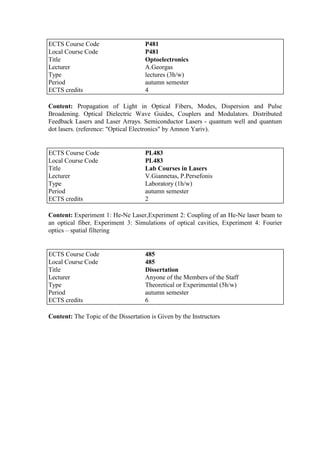
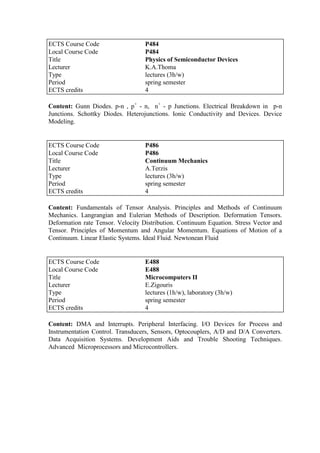
  • 39.
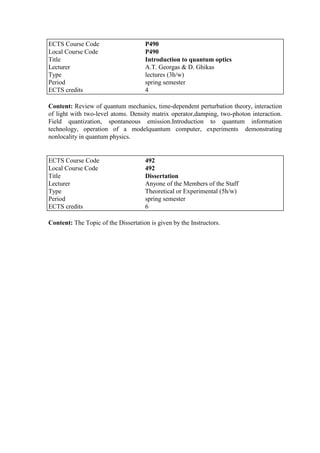
    COURSE SUMMARY TABLE FIRSTYEAR SEMESTER I SEMESTER II ECTS Code Lec Sem Lab ECTS Credits ECTS Code Lec Sem Lab ECTS Credits P101 M103 C105 C107 G109 4 6 4 3 2 3 0 0 0 0 0 0 4 0 0 8 7 8 4 3 P102 M104 M106 PL108 C110 G112 4 4 3 0 3 2 3 0 0 0 0 0 0 0 0 2 1 0 8 5 5 4 5 3 SECOND YEAR SEMESTER III SEMESTER IV ECTS Code Lec Sem Lab ECTS Credits ECTS Code Lec Sem Lab ECTS Credits M201 3 0 0 4 M202 3 0 0 4 M203 3 0 0 4 M204 3 0 0 4 M205 1 0 0 2 P206 5 0 0 6 P207 5 0 0 6 P208 3 0 0 4 P209 5 0 0 6 P210 2 0 0 4 PL211 0 0 2 4 PL212 0 0 2 4 G251 3 0 0 4 G252 3 0 0 4 A253 3 0 0 4 A254 3 0 0 4 G255 3 0 0 4 G256 3 0 0 4 G257 3 0 0 4 E258 3 0 0 4 G260 3 0 0 4 THIRD YEAR
  • 40.
    SEMESTER V SEMESTERVI ECTS Code Lec Sem Lab ECTS Credits ECTS Code Lec Sem Lab ECTS Credits P301 4 0 0 5 P302 5 0 0 6 Ρ303 5 0 0 6 Ρ304 5 0 0 6 Ρ305 5 0 0 6 P306 5 0 0 6 Ε307 4 0 0 5 P308 3 0 0 4 ΕL309 0 0 3 4 PL310 2 0 0 4 AL351 0 0 3 4 AL352 1 0 2 4 P353 3 0 0 4 M354 3 0 0 4 P355 3 0 0 4 A356 2 0 2 4 A357 3 0 1 4 E358 3 0 0 4 G359 3 0 0 4 EL360 0 0 3 4 P362 3 0 0 4 PL364 0 0 2 4 P366 3 0 0 4 G368 3 0 0 4 FOURTH YEAR
  • 41.
    SEMESTER VII SEMESTERVIII ECTS Code Lec Sem Lab ECTS Credits ECTS Code Lec Sem Lab ECTS Credits P401 3 0 0 4 A452 3 0 0 4 Ρ403 4 0 0 5 A454 3 0 0 4 ΡL405 0 0 2 4 PL456 0 0 3 4 A451 3 0 0 4 P458 3 0 0 4 PL453 0 0 3 4 P460 3 0 0 4 E455 3 0 0 4 P462 3 0 0 4 EL457 0 0 3 4 G464 3 0 0 4 E459 3 0 0 4 PL466 0 0 3 4 P461 3 0 0 4 P468 3 0 0 4 P463 3 0 0 4 P470 3 0 0 4 G465 3 0 0 4 PL472 0 0 1 2 C467 3 0 0 4 E474 3 0 0 4 P469 3 0 0 4 G476 3 0 0 4 P471 3 0 0 4 P478 3 0 0 4 C473 3 0 0 4 P480 3 0 0 4 G475 3 0 0 4 PL482 0 0 2 3 M477 3 0 0 4 P484 3 0 0 4 P479 4 0 0 5 P486 3 0 0 4 P481 3 0 0 4 E488 1 0 3 4 PL483 0 0 1 2 P490 3 0 0 4 485 5 0 0 6 492 5 0 0 6